As robots proliferate across food and beverage (F&B) services, from robotic servers and baristas to kitchen assistants and bartenders, understanding human–robot interaction in these contexts has become critical for both industry and academia. The purpose of this study is to synthesize existing literature on service robots within F&B contexts.
The review uses the Preferred Reporting Items for Systematic Reviews and Meta-Analyses guidelines and the Context–Intervention–Mechanisms–Outcomes (CIMO) framework to extract and synthesize findings from 180 peer-reviewed studies.
The synthesis identifies five key themes: robot attributes and design; value creation; service failure and recovery; consumer and service format contingencies; and barriers to adoption. Three critical gaps emerged: insufficient differentiation between restaurant types, lack of specification of robot service roles and limited integration of different value perspectives specific to the nature of F&B businesses.
This review advances human–robot interaction research by identifying four categories of robotic intervention cues (role, positioning, design and communication), which provide a theoretically grounded architecture for organizing future research in F&B contexts. Theoretical gaps and future research directions are also provided, especially with regard to beverage and culinary production, value for money, price fairness and robo-tipping.
This review establishes F&B robotics as a theoretically distinct stream within hospitality and tourism service robot research and offers a CIMO-based framework for explaining how robotized service encounters shape consumer responses in F&B contexts.
1. Introduction
Service robots, which can be defined as “information technology in a physical embodiment, providing customized services by performing physical as well as nonphysical tasks with a high degree of autonomy” (Jörling et al., 2019, p. 405), are reshaping hospitality service delivery, with particularly visible growth in food and beverage (F&B) settings such as restaurants, coffee shops and bars. Unlike stationary self-service technologies, service robots possess autonomous movement and interaction capabilities, which allow them to operate within service environments and participate in encounters that customers interpret as social, relational and experience-defining (Manthiou and Klaus, 2022). In F&B operations, robots have emerged in both front- and back-of-house roles, from mobile food runners and ordering interfaces to kitchen cobots and automated production lines. Their gradual implementation reflects pressures around labor availability, efficiency and consistency, and also the need for differentiation (Choi et al., 2023; Ivanov et al., 2019).
Recent industry developments illustrate why F&B services have become a primary testing ground for robotics. Major chains have invested in automation systems designed to streamline high-volume production and reduce repetitive workload. Chipotle, for example, has been testing automation prototypes such as the Autocado avocado-processing system and an augmented makeline for digital-order assembly (Chipotle, 2024), while Sweetgreen has been focusing on scaling its automated Infinite Kitchen concept as part of its automation growth strategy (Manning, 2024). Smaller operators are also experimenting with robotic bartenders, baristas and servers as branded attractions or experiential centerpieces (Spence, 2023). Robots such as Bellabot or Plato are used as restaurant servers, while systems such as Artly’s barista robot demonstrate that robots may be directly involved in beverage preparation and delivery. For instance, venues such as Tipsy Robot in Las Vegas frame the robotized bartending service explicitly as both a drink-delivery system and a spectacle. These examples show that adoption of robots within F&B businesses alters not only labor structures but also the nature of the service encounter itself, how it is performed and what customers value in the experience.
F&B settings differ in meaningful ways from other hospitality and service contexts where robots have been studied, such as hotels, airports and other structured service environments (Ye et al., 2022). As compared to service encounters in lodging accommodations, which can be extended and highly personalized (Wen et al., 2025), most interactions in F&B contexts tend to be shorter, high-frequency and more standardized. But despite the rapid growth of research on service robots in hospitality and tourism, the literature has developed in ways that limit its applicability to F&B contexts specifically. Existing reviews examined service robots broadly across hospitality and tourism settings (Ivanov et al., 2019; Ye et al., 2022) or focused on specific sectors such as hotels (Rana et al., 2025), without fully accounting for the distinctive service logics, consumer expectations and operational dynamics that define F&B encounters. In addition, F&B service is heterogeneous, made up of several commercially dynamic sectors with their own service formats and consumption cultures (Johns and Pine, 2002). As such, a mechanism that explains acceptance of a hotel front-desk robot would offer limited guidance for understanding a robot bartender or dining companion, whose role often involves entertainment value and social comfort. This concern is amplified by the rapid growth of robotics research itself, where studies vary widely in what robot-related cues they manipulate, the mechanisms they measure and which outcomes they prioritize. The result is a dynamic but fragmented body of evidence, which remains difficult to cumulate into a clear understanding of how, when and why service robots improve or undermine foodservice experiences.
Consequently, the purpose of this study is to systematically review and synthesize the empirical literature on service robots in F&B contexts. To achieve this, the review combines the Preferred Reporting Items for Systematic Reviews and Meta-Analyses (PRISMA) guidelines with the Context–Intervention–Mechanisms–Outcomes (CIMO) framework. PRISMA provides a transparent and replicable protocol for identifying, screening and selecting studies (Page et al., 2021). CIMO then provides the analytical logic for synthesizing findings by asking what works, in which contexts, through which mechanisms and with what consequences (Denyer et al., 2008). This review is guided by three research objectives:
map publication trends, contexts of inquiry and methodological approaches;
identify the main research streams in the literature; and
synthesize F&B robot-related interventions, mechanisms and outcomes into a CIMO-based framework of robotized F&B service encounters.
In addressing these goals, this research makes three central contributions to human–robot interaction research. First, F&B robotics is established as a theoretically distinct stream within hospitality and tourism service robot research. Second, the review identifies and synthesizes five research threads: robot attributes and design; value creation; service failure and recovery; consumer and service-format contingencies; and barriers to adoption. Third, a CIMO-based framework is developed, identifying cues related to role (e.g. bartender, chef) and positioning of the robots (social, entertainment) as largely overlooked in prior research. The review also identifies emerging questions around robotic beverage and culinary production, value for money, price fairness and robo-tipping.
2. Service robots in food and beverage
At its most basic level, F&B service is concerned with the provision of food, which may include a wide range of culinary styles and cuisine types, and beverages, both alcoholic and non-alcoholic. As such, F&B businesses span multiple commercial sectors, including independent and chain restaurants, fast-food and quick-service operations, coffee shops, wine bars and catering, but also any other settings where food or beverages are provided as part of a broader service system (Lillicrap and Cousins, 2010). In practice, F&B management is generally positioned within the broader umbrella of hospitality management (Riley, 2005). Accordingly, foodservice consumer research has long been subsumed under broader hospitality or tourism scholarship, despite substantial growth in restaurant, food and gastronomy-related research (Rodríguez-López et al., 2020). Yet, foodservice possesses distinctive characteristics and market dynamics that are often more volatile and changeable than hotels or tourist attractions, making foodservice a distinctive setting for studying consumer behavior (Johns and Pine, 2002).
Hospitality and tourism scholarship has examined service robots across multiple roles and sectors, including room service delivery robots, robot receptionists, concierge robots, cleaning robots, robot guides and baristas (Acar et al., 2024). Research in this literature also explored customer perceptions of robots, including the factors shaping evaluations, acceptance, satisfaction and behavioral intentions (Ivanov et al., 2019; Ma et al., 2024). A central insight from this research is that service robots are evaluated not only as functional devices but also through their appearance, communication style, perceived social presence and humanlike cues. With regard to F&B, service robots are commonly used in restaurants as food runners, servers or hosts (Moriuchi and Murdy, 2025). In beverage-related services, robots’ roles may extend beyond delivery to also include crafting the beverage itself. In back-of-house and open kitchen environments, robots may also operate as chefs, cooks or kitchen cobots.
3. Methods
3.1 Identification
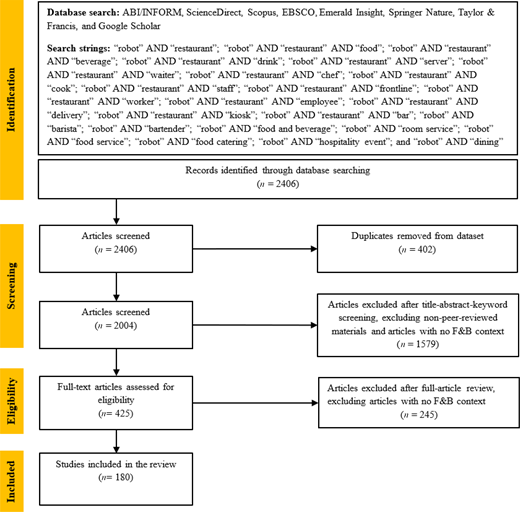
This systematic review followed the PRISMA guidelines to ensure transparency and replicability in identifying and screening research on service robots in F&B service contexts (Page et al., 2021). The multi-stage process of identification, screening, eligibility assessment and inclusion is summarized in a PRISMA flow diagram (see Figure 1). A comprehensive search was conducted across major academic databases with broad coverage of hospitality, tourism, management and technology scholarship, including ABI/INFORM, ScienceDirect, Scopus, EBSCO, Emerald Insight, Springer Nature, Taylor & Francis and Google Scholar. To capture the full range of available literature, no time restriction was applied to the search criteria. To maintain conceptual focus, the search strategy prioritized F&B-specific terminology and excluded broad hospitality or tourism terms unless they explicitly referred to F&B services. Thus, search strings paired “robot” with terms such as restaurant, server, waiter, chef, barista, bartender, food and beverage, catering or dining (see Figure 1). Only peer-reviewed articles published in the English language were considered. At the end of the search, a total of 2,406 articles were identified and imported into Zotero 7 for reference management and duplicate removal prior to title/abstract and full-text screening (Avci et al., 2025).
3.2 Screening, eligibility and inclusion
The screening stage proceeded in two steps:
removal of duplicates (402 entries);
assessment of title–abstract–keywords (Hollebeek et al., 2024).
Given the focus of this research, eligible studies needed to be conducted within at least one F&B context involving a service robot. As such, screening activities in the second step consisted of removing studies that did not satisfy these criteria (e.g. primarily technical studies such as engineering- or computer science-focused, without clear implications for service management or hospitality research). In addition, articles centered on adjacent digital technologies such as chatbots, mobile ordering systems, augmented reality and virtual reality were excluded, as were hotel or other hospitality-based studies that did not explicitly involve F&B services. Furthermore, although non-peer-reviewed papers (e.g. conference proceedings, editorials, book chapters, research notes and tutorials) were excluded from the search protocol, additional screening led to the removal of such materials that were inadvertently captured. At the end of the screening, a total of 425 papers remained for full eligibility assessment. After further removing papers that did not have at least an F&B component as context of inquiry, a total of 180 studies (see Appendix 1 in Supplementary File) were included for the synthesis.
3.3 Context–intervention–mechanisms–outcomes logic for synthesis
Following the PRISMA-guided identification and screening, the synthesis of studies was structured using CIMO logic, which is widely used in evidence-informed management research to integrate fragmented findings by specifying what works, through which mechanisms and under what contextual conditions (Denyer et al., 2008). As applied to this research, Context refers to the service setting and task structure. Intervention denotes robot-related features and implementation strategies (e.g. robot type, anthropomorphism, role assignment). Mechanism captures the psychological processes through which interventions produce effects (e.g. trust formation, social presence, perceived value). Outcome encompasses evaluative, behavioral and relational consequences (e.g. satisfaction, behavioral intentions, forgiveness). This CIMO-based logic provides the basis for the integrative framework developed in Section 4.4.
4. Results
4.1 Publication trends in food and beverage robotics research
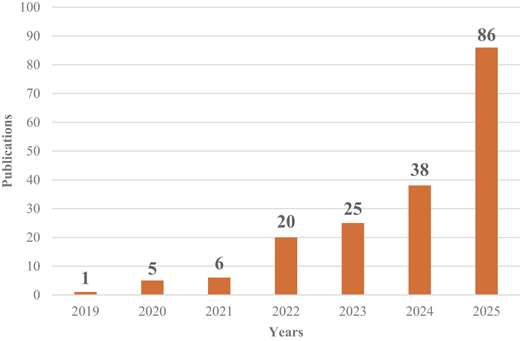
The research field of human–robot interaction within F&B contexts has grown steadily since the late 2010s. The first identified paper focusing specifically on robots in F&B appeared in 2019, marking the beginning of a trajectory that has expanded rapidly over the past six years. As illustrated in Figure 2, annual publications have been growing since, reaching 37 papers in 2024 and 86 in 2025. Those numbers signal a sharp intensification of scholarly attention to robotic service within F&B contexts. Most of the papers in this review (112 studies, 62.22%) were published in hospitality and tourism-related journals (see Appendix 2 in Supplementary File). In terms of outlets, the International Journal of Hospitality Management leads the field with 32 published papers, followed by the International Journal of Contemporary Hospitality Management (17 papers) and the Journal of Hospitality and Tourism Technology (17 papers). Other journals, such as the Journal of Business Research, the Journal of the Academy of Marketing Science, or Technological Forecasting and Social Change, have also contributed to this growing literature, indicating that investigations on robots in F&B gained visibility not only in hospitality and tourism-specific outlets but also in broader management, marketing and technology journals. The distribution of publications underscores the multidisciplinary appeal of the subject while also suggesting that hospitality and tourism journals remain the primary venue for advancing this stream of research.
4.2 Methods used
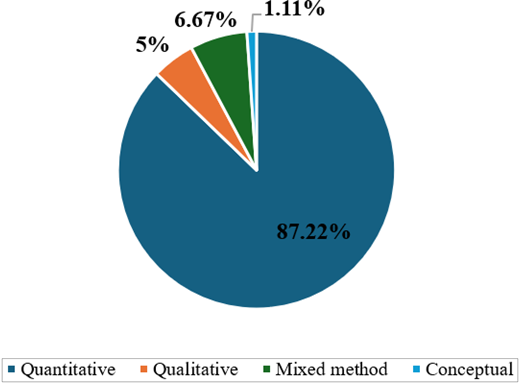
In terms of research designs, the reviewed data set reveals a strong predominance of quantitative methods (157 studies, 87.22%; see Figure 3). Among these quantitative studies, the majority used experimental designs (96 studies, 53.33%; see Table 1), reflecting the common use of controlled settings to test consumer perceptions, behaviors and interactions with service robots. Among the 96 quantitative studies that used experiments, the number of experiments in each study was different (see Appendix 3 in Supplementary File). Although most studies included multiple experiments, three-experiment studies (39 papers) and two-experiment studies (25 papers) were the most common. The remainder of quantitative studies primarily used surveys (60 studies, 33.33%), while one study (0.55%) relied on online review analysis, with quantitative techniques in the analysis.
Qualitative approaches were less common, accounting for only nine studies (5%). Of these, seven used interviews, one used a case study design and one adopted a qualitative survey (see Skubis, 2024). Mixed-methods research represented 6.67% of the data set (12 studies), with nine studies following an exploratory sequential design and three studies using an explanatory sequential design. Finally, the data set also included two conceptual studies, which contributed to theoretical insights without empirical testing.
4.3 Contexts of inquiry
Research focusing on service robots within F&B contexts was conducted within three main settings: restaurants, coffee shops and bars. In this picture, restaurants clearly dominate as the primary empirical setting, consistent with both their centrality in hospitality consumption and the visibility of robot deployment in restaurant operations. They were used as context of inquiry in a total of 161 studies (89.44%), and as shown in Table 2, a total of 95 studies used restaurants as the sole context of investigation. In 54 other studies, restaurants were used as contexts of inquiry along with non-F&B service contexts such as hotels, banking and insurance, health care and hospitals or museums. By contrast, coffee shops and bars appeared far less frequently, although they have begun to enter the literature more visibly in recent years. This distribution suggests that theory development and empirical evidence in the F&B robotics domain have been driven largely by restaurant-based studies, while other F&B formats remain comparatively underexamined.
4.4 Context–intervention–mechanisms–outcomes-based framework and integrative synthesis
4.4.1 Service contexts and robot-related interventions.
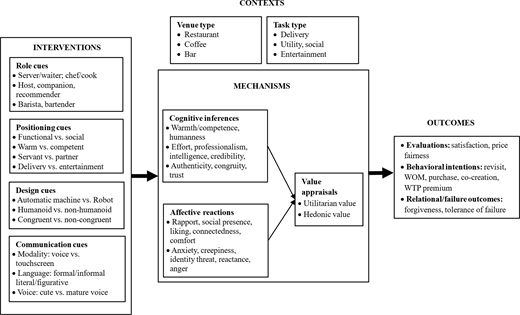
As shown in Table 2, robotized service encounters within F&B service contexts occur mostly in restaurants, coffee shops and bars. In CIMO terms, these constitute the Context, that is, the situated conditions that shape what interventions are possible, what customers expect and how robotic service is interpreted and evaluated. Within these contexts, service robots represent the core Intervention. They are introduced into the servicescape as a strategic means to enhance the experience, improve efficiency or create differentiation (Sharma et al., 2026; Wu et al., 2025). Regardless of implementation logic, service robots inevitably alter what customers encounter in the service system, thereby setting in motion a chain of psychological responses that ultimately manifest as service evaluations, behavioral intentions or relational and failure-related outcomes (see Figure 4).
In restaurants, service robots most commonly appear as servers or waiters that support front-of-house workflows. They transport F&B, help in clearing dishes, guide guests and in some cases facilitate ordering through touchscreens or voice interaction. Robotic applications for kitchens are also making their way in the literature, with robot chefs and cooks handling preparation and production tasks in back-of-house environments (Seyitoğlu et al., 2025; Wilson et al., 2025). Beyond these roles, robots are also positioned as hosts to greet and seat customers or as communication and service assistants supporting customer interaction and guidance (Skubis, 2024). In coffee-service contexts, barista robots focus on beverage preparation (Choi et al., 2023). Similarly, bartender robots are also designed to mix and dispense drinks and may even be framed as entertainers through automated flair or performance elements (Shan et al., 2024). As such, service robots are deployed within F&B services as role-specific systems that perform different tasks, occupy different levels of visibility and shape different forms of customer experience.
The synthesis of evidence gathered from the reviewed articles reveals that robot deployment in F&B services is an organization-induced intervention shaped by manipulable dimensions that determine how the robot is experienced by the customer. The synthesis presented in Figure 4 identifies four cue categories that define the robotized encounter as an intervention:
Role cues, which capture the functional identity of the robot in the service system (e.g. server, chef, host, barista, bartender) and signal which tasks it is expected to perform (see Kazakova et al., 2025; Wilson et al., 2025; Yıldız and Hökelekli, 2025).
Positioning cues, which reflect how the robot is framed relative to the customer and to the venue’s service logic. For example, functional vs social orientation (Chang and Kim, 2022; Huo et al., 2025); servant vs partner framing (Teng et al., 2024); delivery versus entertainment purpose (Huang et al., 2025); warm vs competent (Liu and Wang, 2025).
Physical design cues, which encompass the physical affordances and aesthetic features of the robot, such as humanoid versus non-humanoid embodiment (e.g. Arikan et al., 2023; Choi et al., 2024) and congruent versus incongruent design (Ma et al., 2024).
Communication cues, which refer to how the robot interacts with customers. For instance, voice versus touchscreen modality (Liu et al., 2025); language style (Shi et al., 2025); formality (Park et al., 2023); conversational style (Yan et al., 2025).
4.4.2 Mechanisms and outcomes.
Studies consistently explain the effects of robotic intervention cues within customers’ experiences in F&B settings through two broad classes of mechanisms: cognitive inferences and affective reactions. Cognitively, customers form inferences about warmth and competence (Chang and Kim, 2022), humanness, effort (Kim et al., 2024), professionalism (Kazakova et al., 2025), intelligence, congruence (Ma et al., 2024), credibility (Lu et al., 2021), authenticity (Huo et al., 2025) and trust (Zheng et al., 2023), which shape how the robot and the service experience are evaluated. Affectively, the same cues can generate rapport, social presence (Becker et al., 2023), liking (Kim et al., 2025a), connectedness (Wang et al., 2025) and comfort (Huang and Liu, 2022), but they can also produce anxiety (Guo et al., 2024), creepiness (Kang et al., 2023), identity threat, reactance (Kim et al., 2023) and anger (Park et al., 2023). Eventually, these cognitive and affective processes consolidate into broader value appraisals, mostly characterized as utilitarian (efficiency, convenience, functional performance) and hedonic (novelty, enjoyment, entertainment). Finally, as shown in Figure 4, outcomes in robotized F&B encounters are organized into three categories: service evaluations (e.g. satisfaction), behavioral intentions (e.g. revisit intention, word-of-mouth) and relational and failure-related outcomes (e.g. forgiveness).
5. Discussion
5.1 Key findings across thematic streams
5.1.1 Robot attributes and design.
One of the most consistent threads in the F&B robotics literature concerns the role of robot attributes and design in shaping customer outcomes. Studies repeatedly emphasized the importance of functional and physical features, particularly in restaurant contexts where robots are primarily expected to perform tasks such as serving, carrying or preparing food. For example, Acar et al. (2024) found that customers in restaurants prioritize robots’ physical attributes over relational ones, a finding that aligns with earlier observations that utilitarian efficiency dominates consumer expectations in general foodservice. Yet, other studies suggest that the alignment between robot capabilities and the service context is also critical. For instance, Balaji et al. (2024) argued that carefully calibrated designs integrating functional, cognitive and socio-emotional features can significantly enhance engagement and co-creation. This implies that while functional attributes are baseline expectations, the layering of social-emotional capabilities is also necessary for robots to be successful beyond mere novelty effects.
With regard to anthropomorphism, humanlike robots were shown to foster rapport and comfort (Becker et al., 2023). More broadly, the literature suggests that customers tend to respond favorably when robots display humanlike appearance cues. For instance, Kim et al. (2025b) indicated that patrons showed stronger preferences for bartender robots when they exhibited higher levels of physical anthropomorphism. Similarly, Zhu et al. (2025) demonstrated how artificial empathy can enhance social presence and continuous co-creation intentions. Yet, other researchers documented how anthropomorphism can backfire. For example, Kim et al. (2023) found that overly humanlike robots threaten human identity and diminish intention to use, particularly when high anthropomorphic cues are coupled with low autonomy. In the same vein, Kang et al. (2023) also argued that perceptions of creepiness coexist with perceptions of coolness to influence consumers’ value assessments. These results confirm the predictions from the uncanny valley theory, according to which robots that are too humanlike may unsettle customers. A middle ground here resides in zoomorphic (animal-like robots), which were found to evoke more positive emotions as compared to humanlike robots (Cheng and Hwang, 2025). Nevertheless, it remains unclear whether physical or behavioral anthropomorphism is more effective in shaping positive consumer responses, making this a critical avenue for future inquiry.
5.1.2 Value creation: hedonic, utilitarian.
Another large body of work centers on the value that robots deliver in dining contexts, often framed as hedonic versus utilitarian benefits. On the utilitarian side, robots contribute to efficiency and consistency, which are factors that enhance perceptions of service quality and functional value (Ma et al., 2024). On the hedonic side, robots often inject novelty and playfulness into service encounters, thereby enhancing the emotional value of the service (Kenebayeva et al., 2025). Yet this comes with trade-offs. Indeed, Alotaibi et al. (2024) note that perceived service newness may heighten hedonic benefits while undermining perceived value overall, pointing to a novelty penalty when consumers interpret robots as gimmicky rather than genuinely useful.
Furthermore, the balance between hedonic and utilitarian values is contingent on context. In fact, Kim and Cha (2024) found that the affective dimensions of robotic service depend heavily on hedonic value, while functional evaluations rely mostly on utilitarian value. However, their findings also indicate that the COVID-19 pandemic disrupted these relationships, which shows that shocks at the macro-level may shift consumption logics. Studies that focused on value creation indicate that robots in F&B are not inherently value-creating. Rather, they can enhance or diminish value depending on whether consumers interpret them as efficient tools or entertaining novelties (Yıldız and Hökelekli, 2025). This tension between robots as function enhancers and experience enhancers remains unresolved, and future work might explore how F&B businesses can strategically manage this duality.
5.1.3 Service failure, responsibility and recovery.
Service failure is inevitable in hospitality, and research highlights that robots reshape attribution and recovery dynamics in distinctive ways. Arikan et al. (2023) found that less humanlike agents often shift failure attribution toward the firm, whereas humanlike agents absorb more responsibility themselves. For instance, service robots capable of mimicking human empathy in their behaviors are held less accountable for service failures (Choi and Kim, 2025). Ryoo et al. (2024) also found that customers often blame firms rather than robots when failures occur, particularly when robots are seen as lacking controllability. This observed dynamic suggests that while robots may shield employees from blame, they may simultaneously expose firms to reputational risk. Indeed, Song et al. (2025) reported that customers expect greater compensation when robots fail, thereby raising the stakes for recovery efforts.
In terms of recovery strategies, Liu and Wang (2025) revealed that warm responses are more effective for process failures, whereas competent responses suit outcome failures. Park et al. (2023) demonstrated that communication style matters, with informal and intimacy-building responses helping to mitigate negative emotions and word-of-mouth. Interestingly, Zhao et al. (2025) found that anthropomorphism enhances forgiveness, though only under certain conditions (e.g. low cuteness, low power distance customers). Consequently, service recovery in robotic contexts cannot simply mimic human recovery strategies. Instead, firms must navigate a complex interplay of anthropomorphism, communication and responsibility attribution to protect satisfaction and loyalty.
5.1.4 Consumer and service format contingencies.
Consumer acceptance of robots in F&B services varies substantially depending on who the customer is and what kind of experience is being delivered. Robot encounters do not appear to generate uniform responses across situations, and receptivity to robot service turns accordingly with the social intensity of the interaction and the extent to which the service situation activates interpersonal concerns. For example, in socially sensitive or embarrassing contexts, customers often report feeling less judged and more comfortable interacting with robots as compared to humans (Guo et al., 2024). This line of work suggests that robotic service can become particularly appealing when social evaluation concerns are salient, and customers prefer a less socially demanding interaction.
Restaurant format also provides an additional boundary condition that helps reconcile why robots may succeed in some F&B settings but not others. For instance, human service consistently elevates satisfaction through hedonic value pathways in experiential formats such as fine dining. In contrast, casual or quick-service contexts prioritize utilitarian value, making consumers more likely to reward robotic service (Wang et al., 2025). Overall, these findings suggest that understanding robot acceptance in F&B requires attention to the alignment between customer traits (e.g. social needs and cultural beliefs) and the service logic of the venue (e.g. experiential versus efficiency-focused formats).
5.1.5 Barriers to adoption.
Despite enthusiasm for robotic innovation, barriers to acceptance remain salient. In fact, research indicates that concerns over privacy can diminish the intention to use robotic technologies, particularly in credence service sectors characterized by high data vulnerability (Yao et al., 2024). This aligns with hospitality research on privacy calculus, which suggested that perceived risks can outweigh benefits in sensitive service encounters. In the culinary domain, perceptions of authenticity and tastiness emerge as persistent barriers. Indeed, Huang et al. (2023) found that consumers resist robot chefs not primarily because of ethical concerns or fears of malfunction, but because they doubt the authenticity and taste of robot-prepared meals. In addition, Baek et al. (2025) indicate that even the representation of a robot chef in advertising content can depress purchase intentions, in part because consumers experience the concept as unexpected and incongruent with their expectations of dining. This challenges the industry narrative that safety and reliability are the main adoption hurdles and instead points to the symbolic dimension of food preparation.
5.2 Theoretical gaps and future research directions
Although F&B robotics research is maturing into an established field, several critical gaps limiting theoretical advancements remain. Addressing these gaps will be essential for conceptualizing the systemic impact of robotics on F&B operations in particular and hospitality systems in general.
5.2.1 Context-design alignment.
A recurring limitation observed in prior research on human–robot interaction in F&B service is the lack of context specificity, especially as related to the restaurant context. In fact, although quick service, casual dining and fine dining maintain different service requirements and expectations (e.g. warmth, efficiency, authenticity), current studies often generalize them under a single “restaurant” classification. Multiple studies admit that they did not control for restaurant type, ownership type, or cuisine, even though these contextual features likely shape evaluations. Nevertheless, these distinctions remain consequential, because acceptance is contingent on how well robot embodiment and service scripts align with the dominant service logic of the venue. For example, empirical evidence indicates that consumers show lower acceptance of AI robotic chefs in luxury environments compared to fast-food outlets, reinforcing the notion that authenticity and craftsmanship are paramount in fine dining (Baek et al., 2025).
In addition, recent research also indicates that the wrong robot form in a specific service format can depress value perceptions. For instance, Chuah and Soeiro (2025) noted that a drop in perceived food quality occurs when machine-like robots are deployed in full-service restaurants, thereby lowering willingness to pay. In contrast, highly humanlike robots in quick-service settings diminish perceived service quality, which similarly discourages spending. All in all, these patterns demonstrate that neither “more humanlike” nor “more machine-like” designs are universally superior. It is rather the context of operation that ultimately dictates the adopted design and what customers can reasonably expect of the robot. Furthermore, findings from the present review also suggest that restaurant type could shape when entertainment-oriented deployments help versus when they distract. In fact, in their study on robotic companionship for solo diners, Huang et al. (2025) showed that restaurant format interacts with robotic service type such that, in traditional restaurant settings, solo diners receiving entertainment-oriented (vs delivery-oriented) robotic service form a stronger rapport and report more favorable responses.
Consequently, future work should move beyond global claims of human likeness and instead theorize the fit between design choices and the service setting. Servicescape elements such as crowding and noise may further condition whether a robot’s appearance, gestures, or movement affordances enhance comfort or feel intrusive. Spatial layout should also be considered in future research, as most existing restaurants were not designed with robots in mind and may present limitations in terms of robot circulation. Moreover, careful distinction among robot roles (e.g. server, barista, bartender, chef) can prevent over-generalization and clarify boundary conditions for the effects of anthropomorphism. Future research should also treat restaurant type as a core design parameter rather than a background descriptor, systematically testing how service format (quick service, casual or fine dining), ownership and brand positioning and cuisine norms condition the impact of robot form and role. Such work would also sharpen design recommendations.
5.2.2 Robot role coverage.
Similar to the venue type, many studies do not clearly specify the robot’s role (e.g. server, barista, chef or bartender), which makes it difficult to determine where particular findings are most applicable. The empirical base on F&B robotics also remains skewed toward dining-room and coffee settings, leaving comparatively less insight into bar and kitchen roles. Two robotic roles within F&B services remain under-examined yet theoretically rich: bartender and chef. In practice, bartenders and chefs are evaluated against role-specific standards that sometimes differ from those applied to servers or runners. Those standards include, for example, entertainment and personalization value at the bar (Spence, 2023), as well as authenticity and craftsmanship in food preparation and presentation (Yıldız and Hökelekli, 2025). Related evidence from coffee-shop contexts further suggests that depending on the interaction logic and environment (i.e. whether robots are used for delivery-only or also involved in production) can meaningfully shape customer responses. Thus, differentiating factors in terms of various service formats may plausibly carry over to bar settings where experiential cues and interaction patterns may differ from other F&B settings.
In light of the gap in coverage for various robot roles, future research should examine how underexplored F&B roles differ in the expectations and evaluative criteria they activate. In bars, evaluation of service providers also hinges on micro-interactions occurring on the frontline. Therefore, future research may explore how robotic attributes such as precision and flair contribute to shaping perceived authenticity, social connection, or drink/food quality, thereby illuminating the mechanisms underlying consumer responses to robotic service in bars or open-kitchen restaurants. As for the latter, authenticity and craft come to the fore. Therefore, extending work on tastiness and authenticity (Huang et al., 2023) to include chef signature cues and visible chef–guest relationship building would help clarify when dishes prepared by robots feel acceptable or even appear distinctive. Reflecting this, Seyitoğlu et al. (2025) called for more research on guest perceptions of robot-prepared food, including how cultural/geographic factors and ethical concerns (e.g. heritage, job displacement) shape acceptance. Such an agenda would also benefit from a multi-stakeholder lens (owners, kitchen staff, guests) and should weigh ethical considerations as automation expands (Seyitoğlu et al., 2025).
5.2.3 Value creation.
The current state of F&B robotics literature examined customer value through separate utilitarian and hedonic dimensions (e.g. Kim and Cha, 2024). This distinction has been useful in showing that robots may create functional value through efficiency, consistency and convenience, while also creating hedonic value through novelty, enjoyment and coolness. However, dining out, visiting a coffee shop or going to a bar often involves a more integrated value experience in which functional, emotional, sensory, social and symbolic elements are evaluated together. This integrated value perspective is especially important in beverage and culinary production contexts, where robots may also be involved in crafting the core offering. In such cases, customers may make stronger monetary judgments because the robot also becomes associated with the product itself. Future research should therefore move beyond treating utilitarian and hedonic value as parallel outcomes and instead examine how different value dimensions interact over time. In addition, future research could also examine how robot involvement in production shapes perceived value for money, price fairness and willingness to pay, as well as perceptions of deservingness.
Finally, value judgments in F&B robotics are likely to be shaped by cultural norms around payment and tipping. The act of tipping a worker is a socio-cultural practice through which customers express gratitude, recognition of service effort or status. Robotized service complicates these meanings because customers may question who or what the tip is for. This issue becomes particularly salient when robots are involved in beverage or culinary production, where customers may attribute value to the visible act of crafting the drink or meal. In this vein, Moriuchi and Murdy (2025) showed that when tipping is perceived as fair, customers are more willing to tip. They explained this by fairness strengthening the spillover from perceived organizational motives of introducing robots (e.g. altruistic intent) to overall evaluations of the organization. Ultimately, this insight points to the need for more research that focuses on how the framing of tip purpose can shape tipping behavior for service provided by robots. Therefore, future research should also examine how robot roles and their degree of involvement in the crafting F&B products influence willingness to tip or pay more, as well as perceived value for money.
6. Conclusions
This review consolidated and critiqued the current state of knowledge on robots in F&B services, showing a fast-maturing yet uneven field. Empirically, research focused mostly on restaurants and relied heavily on experiments, whereas cafes, bars and kitchens remained comparatively underexplored. Methodologically, the dominance of vignette and cross-sectional designs limits ecological validity (Gonzalez-Jimenez and Costa Pinto, 2024), and measurement tools seem to lag behind the context-specific nature of F&B encounters. From a conceptual standpoint, the present review advances knowledge on the impact of robot attributes on consumers’ perceptions. Across the five thematic streams identified, customer responses to robots in F&B settings were found to depend not only on whether robots perform their assigned tasks effectively but also on how they enact their service roles through their positioning, design affordances and communication capabilities. This is all the more important because F&B robots are increasingly moving beyond delivery and support toward tasks that customers traditionally associate with human skill. Overall, the findings carry several theoretical and practical implications.
6.1 Theoretical implications
This systematic review contributes to the body of literature on human–robot interaction in hospitality and tourism services, which has expanded rapidly in response to the surging adoption of service robots across hotels, restaurants and travel contexts. Within this broader stream, F&B services occupy a distinctive position that has not always been treated as such. A food or beverage experience involves a set of expectations that primarily revolve around craft, sociability, authenticity, atmosphere and experiential value, which differ meaningfully from the transactional logic of check-in desks or concierge services. Focusing exclusively on F&B contexts and synthesizing 180 studies within this domain ultimately allows us to establish F&B robotics as a theoretically distinct subfield with its own dynamics, boundary conditions and open questions. A first theoretical contribution concerns the classification of robot-related cues into four categories: role, positioning, design and communication. Much of the prior literature concentrated primarily on design and communication cues as the principal levers through which robots shape customer responses. This review advances the field by identifying two additional and under-theorized cue categories (i.e. role and positioning).
Second, the findings of this review suggest a need to move beyond the utilitarian–hedonic dichotomy that structured much of the value literature in this domain. Findings from this review suggest that F&B encounters are better understood through an integrated and systemic conception of value, as judgments over aspects such as price fairness and authenticity become entangled. Extending this argument, the theatrical and entertainment dimensions of robotic service constitute an experiential value layer that existing utilitarian–hedonic models cannot capture. Ultimately, this review calls for the development of theoretical frameworks that treat experiential and symbolic value as core dimensions of the service encounter rather than secondary enrichments layered onto functional and hedonic assessments. Third, the theoretical implications extend beyond service management to the sociology and cultural study of human–robot interaction. In F&B contexts, frontline service robots become social actors that embody roles within spaces that convey cultural meaning and specific norms. As such, the introduction of service robots into these spaces carries significant implications for culturally embedded practices such as tipping.
6.2 Practical implications
The F&B industry is a heterogeneous and commercially volatile sector, spanning several types of businesses, including various types of restaurants, including hotel restaurants, coffee shops, pubs, wine bars, etc. A central message for the industry from this review is straightforward: robot deployment is not a one-size-fits-all decision. For quick-service and fast-food operators, efficiency-oriented robots with lower sociability are likely the strongest fit, as customers in these settings mostly prioritize speed, consistency and convenience. However, in casual and fine-dining restaurants, robot deployment should be piloted carefully and introduced in roles where automation adds visible value without displacing human interaction.
The more significant untapped opportunity for operators, however, lies not in efficiency but in experience design. Most F&B businesses that have adopted robots have done so primarily to cut labor costs or address staffing shortages, a strategy that leaves considerable value on the table. Robots are also capable of entertaining guests, creating spectacle and generating the kind of memorable, shareable moments that drive word-of-mouth and repeat visits. Real-world implementations have already demonstrated this. In Japan, Softbank’s Pepper Parlor Cafe deploys robots that not only take orders but can also play games and take photos with customers (Chuah and Soeiro, 2025). At the Hajime restaurant in Thailand, Samurai robot waiters deliver food and can also perform dance shows for guests (Chang and Kim, 2022). Being entertained by a robot significantly enhances its emotional appeal, capturing attention and creating enjoyment in ways that deepen engagement and generate pleasure.
6.3 Limitations and future research
Despite its contributions, this review is not exempt from limitations. First, although the CIMO framework enabled the organization of contexts, interventions, mechanisms and outcomes, it did not incorporate the moderating variables examined across the literature. However, those factors (e.g. power distance, consumer innovativeness, technology readiness, social needs, prior robot experience, dining configuration and service failure type) contribute significantly to shaping the conditions under which robotic interventions produce favorable or unfavorable outcomes. In addition, F&B robotics is developing quickly, and some technologies are still emerging, changing or not yet fully represented in academic research. As robot bartenders, baristas, chefs, delivery systems and AI-enabled service agents become more sophisticated, the categories and relationships identified in this review may need refinement. Future reviews should therefore periodically update the evidence base and examine whether new robot roles, interaction modalities and production-oriented applications require revised frameworks for understanding robotized F&B service encounters.
References
Supplementary material
The supplementary material for this article can be found online.