
Skip to article sections
Purpose

Teaching models in higher education entrepreneurship programs affect students’ entrepreneurial intentions. Yet evidence related to their effects on long-term venture creation remains limited. Past research on the effects of teaching models on entrepreneurship has focused narrowly on entrepreneurship education programs. The present study moves beyond this past narrow focus to study teaching model effects on new venture creation across a broad array of higher education programs.

Design/methodology/approach

We assess the effects of teaching models on new venture creation across 35 educational programs (entrepreneurship and other business programs) at a large Danish business school, tracing venture creation data for 5 years after graduation (N = 4,717).

Findings

Competence-based teaching models positively impact graduates’ long-term new venture creation across all programs, with no differences between entrepreneurship vs other types of programs.

Research limitations/implications

These findings carry implications for both education and entrepreneurship research, as well as policymakers and educators, by pointing toward ways of impacting postgraduate business venturing through teaching model reforms extending beyond entrepreneurship education.

Originality/value

For the first time, we find effects of competence teaching models on postgraduation new venture creation across a broad array of business administration programs. The results are novel in documenting that teaching models generally impact venture creation in the long term, and that this occurs regardless of whether the program content centers on entrepreneurship or on other business administration content.

Reflecting demands of political agendas that seek economic growth, societal development (Bosma, 2013) and higher education institutions (HEIs) increasingly offer educational programs to help students create new ventures (Liñan, 2004; Nabi and Liñán, 2011; Rideout and Gray, 2013) and pursue entrepreneurial careers (Wilson et al., 2007). Whereas higher levels of formal education do not directly impact the choice of entrepreneurship as a career pathway (Van der Sluis et al., 2008). Entrepreneurship education programs (EEPs) aim to enhance students’ entrepreneurial skills and competence (e.g. Cui et al., 2021; Eesley et al., 2016; European Commission, 2012; Fayolle, 2013; Katz, 2008; Neck and Greene, 2011). A growing body of evidence indicates that entrepreneurial skills can be taught through relevant courses and programs (Hahn et al., 2017; Karlsson and Moberg, 2013; Mandel and Noyes, 2016) affecting the short-term propensity of graduates to engage in business venturing (e.g. Ripollés and Blesa, 2024; Lackéus, 2013; Pittaway and Cope, 2007), as well as their employability (Rogers-Draycott et al., 2024; Decker-Lange et al., 2024). Although the skills taught in entrepreneurship programs are argued to be applicable in the subsequent career choices of graduates (Di Gregorio and Shane, 2003; Leitch et al., 2012), a significant research gap remains regarding the long-term entrepreneurial effects of these programs (Cho and Lee, 2018; Pittaway and Cope, 2007), which is critical as policymakers and HEIs are keen to promote start-up behavior and performance. This gap also highlights the need for longitudinal studies tracking the impact of EEPs.

In exploring factors influencing EEPs success or failure, teaching emerges as a crucial element in directing graduates toward new venture creation (NVC) (Béchard and Gregoire, 2005). Teaching models are forms of organization that address specific pedagogical goals, shape learning styles, learning approaches and outcomes (Béchard and Grégoire, 2005, 2007). Nabi et al. (2017) find positive impacts of all teaching models on subjective and short-term indicators (e.g. entrepreneurial intention), and highlight potential for positive impact of competence and demand-competence teaching models, emphasizing experiential learning and real-life problem-solving, on long-term behavioral indicators. In competence teaching models, “teaching is conceived as a strategic intervention to allow for—and influence— how students organize the resources at their disposal (e.g. knowledge, abilities) into competences that can be mobilized for action” (Béchard and Grégoire, 2005, pp. 115–116). Student competences develop through constructive learning objectives, collaborative pedagogies, contextualized knowledge and self-directed exams (Béchard and Grégoire, 2005).

While conventional teaching strategies sometimes fail despite their entrepreneurial objectives (Padilla-Angulo et al. (2023), competence and demand-competence teaching models have been found to positively impact entrepreneurial learning outcomes (Cascavilla et al., 2022; Ripollés and Blesa, 2024). Limited research tentatively indicates some positive long-term entrepreneurship outcomes such as start-ups (Vincett and Farlow, 2008), performance (Gilbert, 2012) and career choice (Lyons and Zhang, 2018).

Nabi et al. (2017) highlight a research gap, calling for direct comparisons of teaching models’ impacts on long-term entrepreneurship indicators. Another research gap is the specific focus on EEPs and courses in previous studies, which overlooks the potential impact of competence teaching models on NVC across all higher education (HE) programs. Despite HE programs’ diversity in teaching models, research exploring competence teaching models’ impact beyond EEPs is lacking. Building on existing theory (Béchard and Grégoire, 2005), we propose a link between teaching models and entrepreneurial skill development across all HE programs.

The ways HE programs are taught may thus have implications for the entrepreneurial careers of their graduates, regardless of whether the program content relates to entrepreneurship or other business administration fields. Rather than solely comparing teaching models across different EEPs or courses, we consider teaching models involved across all types of HE programs adding to our understanding of how teaching models impact entrepreneurial behavior.

These two distinct yet related research gaps form the rationale for this study. To address them, our study contrasts the teaching models adopted by a broad range of business school two-year master’s programs to investigate their impacts on long-term NVC within the five-year period following students’ graduation.

Applying an operational classification of teaching models (Béchard and Grégoire, 2005), we distinguish teaching models in mandatory master’s-level courses offered at a Danish business school. We link course codes to program-specific teaching model scores (TMS), and to individual-level, institutional registers on student performance and NVC.

This study makes two key contributions. Firstly, it addresses Nabi et al.’s (2017) call for rigorous research on program-level teaching models, providing evidence for their long-term effects on NVC. Secondly, it extends prior literature by broadening the theoretical perspective on how program pedagogies and teaching models are relevant for facilitating NVC, in and beyond the context of entrepreneurship education (EE), suggesting students can develop entrepreneurial skills without enrolling in EEPs, with significant implications for educators and practitioners. This informs educational policy by suggesting avenues for promoting graduate entrepreneurship through university-wide pedagogical reforms emphasizing competence teaching models.

In examining teaching model effects on NVC, we recognize the evolution of EE through at least three pedagogical paradigms; teaching about (e.g. lecture-based teaching), for (e.g. action-oriented and case-based teaching) and through (e.g. experiential teaching) entrepreneurship (Hägg and Gabrielsson, 2020). This progression signifies a historical shift toward active learner-centric (Bean and Melzer, 2021), situated, project-based (Guo et al., 2020) and experiential entrepreneurship learning. At the more extreme end of this shift, we find Venture Creation Programs (VCPs) in HE, where experiential learning is applied in the creation of new ventures as a central part of the program (Smith et al., 2022; Lackéus and Williams Middleton, 2015). However, contemporary EEPs exhibit diverse pedagogical approaches, from traditional didactics to case-based and experiential learning (Sansone et al., 2021; Tiberius et al., 2023). This heterogeneity is captured by the concept of teaching models.

Béchard and Grégoire (2005, 2007) developed a framework of five EE teaching models, rooted in prior educational literature. Teaching models organize specific goals and objectives in pedagogical situations, influencing learning outcomes, skills and careers (Lackéus, 2020). The framework includes: The supply model (S) emphasizing traditional didactics; the demand model (D) focusing on case-oriented work; the competence model (C) featuring real-world and experiential learning situations; the supply-demand (SD) hybrid model blending lectures with cases and applications; and the demand-competence (DC) hybrid model combining cases and applications with real-life experiences. These models align with the shift from transmission-based to constructivist EE approaches, as well as the evolution from models that focus on teaching about entrepreneurship, to later models that teach for, and through, entrepreneurship (Hägg and Gabrielsson, 2020; Schultz, 2022)

Given entrepreneurial skills’ multidimensional nature – encompassing knowledge, attitudes, motivation and practical capacities (Hahn et al., 2017), all five teaching models may contribute to shape students into potential entrepreneurs. Béchard and Grégoire (2005) caution that no model is inherently superior, though Nabi et al. (2017) suggest that competence and demand-competence models show promise for long-term effects.

At the operational level, Béchard and Grégoire (2005) argued that teaching models are based on four dimensions: teaching goals, knowledge emphasized, pedagogical methods and means and forms of evaluation. We briefly review the operationalization of competence teaching models, highlighting mechanisms and reference their deployment in EEPs:

  1. Creative and generative learning objectives build competence for developing, designing and creatively constructing new knowledge (Béchard and Grégoire, 2005). These objectives foster competencies in creativity, problem solving and navigating uncertainty (Mandel and Noyes, 2016; Motta and Galina, 2023; Bacigalupo et al., 2016; Morland et al., 2021) and often serve as part of the objectives in EEPs (Alabduljader et al., 2018; Wong and Chans, 2021; Hytti and O’Gorman, 2004).

  2. Contextualizing knowledge to the situation and the actions to be performed, such as knowing how to solve complex problems and mobilize resources, builds competence in addressing contingencies and situational factors, preparing for action (Béchard and Grégoire, 2005). This dimension enhances competencies in valuing ideas and learning through experience (Bacigalupo et al., 2016). EEPs typically recognize the need to move beyond generalist approaches in the teaching of content (Alabduljader et al., 2018) in order to generate competencies in dealing with dynamic and situational stakeholder interaction (Mandel and Noyes, 2016) or evolving business plans (Sirelkhatim and Gangi, 2015).

  3. Collaborative and interactive pedagogical methods and means centered on interactions between context, student, teacher and social learning resources encourages social competencies (Béchard and Grégoire, 2005). These methods train for networking and mobilizing of others and for working in a team (Pache and Chowdhury, 2012; Bacigalupo et al., 2016). These pedagogical formats are central to most experiential EEPs (Mandel and Noyes, 2016; Motta and Galina, 2023; Morland et al., 2021), and serve important functions (intermixed with other teaching formats) in other kinds of EEPs (Alabduljader et al., 2018; Sirelkhatim and Gangi, 2015).

  4. Authentic performance evaluation forms develop students’ self-directed and action-oriented competencies in complex, student-managed projects (Béchard and Grégoire, 2005). Research into such assessment forms is limited (Smith et al., 2022), but they may foster proactiveness in opportunity evaluation (Mandel and Noyes, 2016), perseverance, planning and project management (Bacigalupo et al., 2016). Entrepreneurship educators emphasize the importance of formative and learner-centered assessment forms (Rasmussen, 2016). Nevertheless, assessment formats in international EEPs often remain relatively conventional (van Ewijk et al., 2020). Top-rated EEPs frequently utilize group-based assessment with project reports, alongside student presentation (Tiberius et al., 2023).

While these dimensions were introduced in an EE context, competence teaching models may also train entrepreneurship competences beyond EEPs (Stenholm et al., 2021). This includes enhancing learning outcomes and entrepreneurial competencies in any program.

Research on long-term effects of HE pedagogy shows that pedagogical interventions and teaching models like project and problem-based learning influence graduates’ careers. Problem-based learning typically applies competence teaching models, impacting careers in STEM (Beier et al., 2019; LaForce et al., 2017) and medicine (Tsigarides et al., 2017). These models focus on using knowledge in practical contexts, developing reasoning strategies and enhancing motivation for learning (e.g. Biggs et al., 2022).

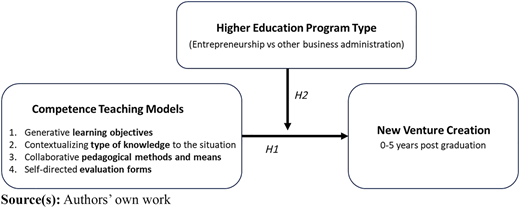
Despite the progressiveness of EEPs, significant advances in teaching models have been observed across HE. Past research often overlooks how these models might influence career choices across program types (Crișan et al., 2024). This study tests the relationship between competence teaching models and graduate NVC extending past theory to examine if these models in any HE program can influence long-term business venturing (see Figure 1).

H1.

Competence teaching models in any HE business administration program have positive impacts on long-term NVC.

We anticipate that the interaction between program content (entrepreneurship vs other programs) and teaching models will affect NVC positively (H1). Competence teaching models are likely to have a stronger impact in EEPs due to targeted training where the content and teaching model are closely aligned (Hägg and Gabrielsson, 2020; Schultz, 2022; Béchard and Grégoire, 2005). Research suggests that the effectiveness of EEPs depends on the alignment of educational objectives, methods and assessment with program content (Fayolle and Gailly, 2008; Maritz and Brown, 2013; van Ewijk et al., 2020). Misalignments often result in inconsistent outcomes (Crișan et al., 2024; Ilonen, 2021). Thus, literature supports the notion that synergistic effects from well-aligned teaching content and pedagogy enhances learning outcomes. Accordingly, the impact of teaching models on NVC is expected to vary depending on program type and focus.

H2.

The effect of competence teaching models on long-term NVC is greater in entrepreneurship programs compared with other types of business administration programs.

To test these hypotheses, we employ a detailed coding scheme to categorize 35 master programs in a Danish business school, in terms of their teaching models. We track graduates of these programs for 5 years, combining university administrative registers with employment and business registers. With this study, we give unique primacy to teaching models over program content and investigate whether HE programs must offer entrepreneurial content if the teaching models are to exert an impact on long-term NVC among graduates.

The study drew data from multiple sources, uniquely combining records from all two-year master’s programs at a large Danish business school with high-quality administrative data from the firm registration database, the entrepreneurship database, and relevant labor market and sociodemographic databases with Statistics Denmark. The business school studied comprises over 20,000 students, has 15 departments and 35 master’s programs divided into seven program clusters spanning a wide range of fields: general management; finance and economics; innovation and entrepreneurship; marketing; digitalization and operations; leadership and organization; and linguistics. We linked program and course-specific information from all graduates from 2013 to 2015, tracking their progress during their master’s programs following them into the labor market 5 years postgraduation. Approximately 6,500 students graduated during this period with enrolment in 800+ different courses. Our analyses focus on a refined sample to mitigate noise arising from student heterogeneity, especially stemming from graduates without a prior association with a Danish educational institution (primary school through bachelor’s program). These students were excluded to ensure familiarity with the national educational system and labor market. Graduates spending 5+ years on their two-years master’s (<2%) and those over 35 years at graduation (<1%) were also excluded. Analysis is run on a sample of 4,717 students.

We collected course descriptions for courses taken by students in the sample, categorizing them according to the teaching model applied (885 unique courses coded). Master’s programs at this university consist of 120 ECTS, typically distributed as 7.5 ECTS per course, with about 30–60 ECTS mandatory courses, a 30 ECTS thesis and 30–60 ECTS in electives, including internships. Online course descriptions, updated each semester, serve as the legal framework for teaching and are crucial for university administration to plan teaching and exams. They accurately reflect (changes in) course content, learning objectives, pedagogy, exam formats, etc. Coding was based on semester-specific course descriptions to reflect changes over time.

NVC is measured using the business registration database, covering all new businesses and their founders/owners. In Denmark, firms must register with the Danish Business Authorities, providing a unique ID (CVR). Founders use their social security number when applying for a CVR, enabling linking to other databases.

This dataset is suitable for investigating the impact of teaching models on NVC addressing methodological challenges. It enables capturing teaching models for EEP and non-EEPs, thus disentangling effects of entrepreneurship course content and pedagogy. By merging administrative registers, we track students as they enter the labor market, mitigating attrition unless a student emigrates. Using administrative registers also enables controlling for factors like parental experiences with NVC.

We define NVC as registering a business with a new CVR number within 5 years of graduation, including the graduation year. This timeframe aligns with research indicating short durations to start and register (e.g. Shim and Davidsson, 2018) a venture. The 5-year window is suitable as long-term effects of EEPs on business venturing are expected to remain stable for about 5 years after graduation (Fayolle et al., 2016). We consider only founders and CEOs at registration and active firms (i.e. reporting revenue within the first 5 years), excluding any ventures created before or during the master’s program to simplify interpretation of educational effects. While some graduates may have participated in start-up, nascent entrepreneurial or extracurricular activities, our focus is on ventures initiated postgraduation. Our final sample includes 366 graduates with at least one registered venture.

Béchard and Grégoire (2005) derive their teaching model framework from HE literature, so any program or course can be classified according to it, by coding the operational dimensions and using information typically found in formal program regulations or course descriptions. But few studies of the impacts of EE apply the teaching model framework to the course or program level (e.g. Sansone et al., 2021). Generally, EE studies underreport the details of pedagogical interventions (Martin et al., 2013; Pittaway and Cope, 2007), which hinders efforts to classify these interventions according to their applied teaching models. In the review by Nabi et al. (2017), fewer than half of all EE impact studies could be classified. To address methodological underreporting concerns, we adapt Béchard and Grégoire’s classification of teaching models by specifying a coding scheme for application on course descriptions in HE programs that considers the four operational levels of the original framework: learning objectives, knowledge emphasized, pedagogical methods and means, and forms of evaluation (see Table 1).

First, regarding learning objectives, a keyword search of the course description was conducted, applying Bloom’s taxonomy of educational objectives (Anderson and Krathwohl, 2001). Educators are required to adopt this typology when formulating learning objectives. “Evaluate” and “create” related keywords were coded C; “apply” and “analyze” were coded D; and “knowledge” and “understand” as S. For classifying forms of evaluation, we consulted the business school’s own typology of exam formats, indicating C for formats like academic papers and large projects, D for case-based exams and oral exams based on written material and S for written or oral exams without preparation. We classified knowledge emphasized as S if emphasis was put on abstract theory (e.g. introductory law, auditing); D if courses provided applied knowledge (e.g. methods, courses on regional politics); and situated, contextualized knowledge and resource mobilization as C (e.g. project-based learning or problem-based learning, internships). Pedagogical methods and means classification averaged three subdimensions: activities, teacher role and student role. Activities like lectures and readings were coded S; exercises and group work as D; and workshops, field trips and venture creation activities as C. Teacher roles were classified as S for one-way format knowledge dissemination, D for facilitating learning processes or involving industry guest lecturers (D) and C for acting as coaches engaged in knowledge co-creation. Student roles were classified as S for primarily individual work, D for assignments of self-chosen topics, and C for interactive, intensive project work.

To calculate the numerical TMS for each course, we averaged the four subdimensions, assigning scores as follows: S = −1, D = 0 and C = 1. Then we aggregated TMS to the program level. On average, each program consists of 7 mandatory courses, with a minimum of 3 and a maximum of 13 courses. We exclude two programs with very large proportions (two-thirds or more) of semester credits assigned to a single mandatory course; these large courses would unduly skew the TMS at the program level. In calculating the program-level TMS, we only included mandatory courses and assigned weights on the basis of the course credits. In total, graduates in the sample attended 885 different courses. After coding these courses, we examined the internal consistency to determine Cronbach’s α = 0.66. An additional confirmatory factor analysis with oblique rotation confirmed that the four dimensions should be collated into one scale (one factor with an eigenvalue >1).

We tested the reliability of the TMS in two ways. First, an independent evaluator coded 20 randomly selected course descriptions in terms of learning objectives and formats of evaluation. The intraclass correlation between the two sets of codes is very high, at 0.91 (Koo and Li, 2016). Second, another rater scored 51 randomly selected courses in terms of knowledge emphasized and pedagogical methods. The interrater reliability score (Cohen’s kappa) was 0.66 overall, and similarly high for all four subdimensions: knowledge emphasized (0.64), activities (0.72), teacher role (0.71) and student role (0.71). Kappa values above 0.60 indicate substantial to nearly perfect agreement (Blackman and Koval, 2000). Together, these interrater reliability checks indicate good consistency of our classification of teaching models.

We include two controls for entrepreneurship electives. Using a 7.5-credit cut-off, the elective standard, we indicate enrollment in one entrepreneurship elective (20.6%) and two or more electives (9.5%). These indicators address biases, identifying students with particular entrepreneurship interests. Accounting for voluntary participation is crucial in assessing effects of teaching models and minimizing self-selection biases.

We include controls for a range of sociodemographic characteristics that appear in previous entrepreneurship research: gender, ethnicity (e.g. Johansen, 2014), marital status, age, income (e.g. Rauch and Hulsink, 2015) and parents’ experiences with entrepreneurship (e.g. Oosterbeek et al., 2010; Aadland et al., 2023). For the majority of students, we obtained measures of these covariates upon their entry to the program, while we measure marital status and income one to two years into the program for 6% of students. Finally, we include dummies to control for missing data.

We specify our model by using a linear probability model with fixed effects to estimate the average effects of (competence) teaching models on long-term NVC.

To address potential self-selection problems, we augmented the linear probability model by introducing fixed effects at the program cluster level, encompassing seven clusters according to the main topics of the 35 programs. Fixed effects regression mitigates unobserved factors by holding them constant, effectively controlling for average differences between program clusters. In the analysis, we effectively account for unobserved shared characteristics among students enrolled in the same program cluster that may influence their propensity for starting a firm. By mitigating concerns related to self-selection into programs with similar teaching models and content, we can assess the impacts of teaching models more accurately. This approach also helps address the influence of unobserved factors that may confound the relationship between teaching models and entrepreneurial outcomes. Notably, fixed effects are widely employed in research examining the effects of EE (e.g. Eesley and Lee, 2021; Hockerts, 2018).

We assume that students choose their master’s programs based on relevant factors, such as whether it was a direct continuation of their completed bachelor’s program, interest in the subject matter and career prospects, or legal claims to admittance, rather than the specific teaching models applied in mandatory courses. Thus, we used the following specification:

where FC denotes of the probability of NVC by student i in program j, and TMS denotes TMS within the range [−1 to 1]. The coefficient β1 signifies the average treatment effect of increasing TMS one unit (i.e. from “demand” to “competence” teaching models) on the likelihood of creating a firm. Furthermore, EEL includes two indicators for the number of entrepreneurship electives taken by the student i. Controls describe the combined set of control variables used, including gender, ethnicity, marital status, age, disposable income deciles, graduation year, parent’s experiences with NVC and an indicator of whether parents’ firms are 5 years or older. Finally, θ represents program cluster fixed effects, capturing unobserved heterogeneity at this level and e captures residual variation.

Table 2 displays descriptive statistics for primary study variables. The first column shows averages across program clusters, subsequent columns detail statistics by program cluster. Notably, EEP graduates exhibit the highest entrepreneurial activity at 13.4%, compared to the overall average of 7.8%. Organization graduates experience the most exposure to competence teaching models at 12.2%. Additionally, 77.2% of EEP graduates enrolled in at least one entrepreneurship elective, and 22.5% in two or more. Digitalization and operations graduates also enroll in multiple entrepreneurship electives more frequently than their counterparts (37.5%).

Table 3 provides correlations for the primary study variables, indicating no significant relationship between NVC and TMS. However, enrollment in two or more entrepreneurship electives correlates positively with both TMS and NVC. Furthermore, the four teaching model subdimensions correlate positively with the full TMS. The highest correlation concerns pedagogical methods and means (90.7%), and knowledge emphasized also seems particularly important (i.e. providing students with applied knowledge and know-how), in that it is the only subdimension correlating positively and significantly with NVC.

In this section, we explore the relationship between competence teaching models and NVC for both entrepreneurship and nonentrepreneurship graduates (see Table 4). Model M1 shows no significant relationship between, teaching models and NVC. Model M2 incorporates indicators for entrepreneurship electives and reveals a positive relationship with two or more electives, but no relationship with teaching models. In Model M3, after adjusting for sociodemographic factors, applying a competence teaching model, as opposed to a demand teaching model, increases the likelihood of NVC by 3.7% points (β = 0.037, p < 0.05, Cohen’s d = 0.074). Given that the baseline NVC rate in this study is 7.8%, this increase translates to a relative 47% increase in the likelihood of engaging in NVC. Model M3 thus highlights the importance of considering individual characteristics when attempting to understand the impacts of teaching models (education) on entrepreneurial outcomes (self-selection).

Model M4 features program cluster fixed effects. Here, we find a significant relationship between TMS and NVC. After controlling for the influence of enrollment into specific program clusters, the estimated effect of changing teaching models from demand to competence on NVC is significant (β = 0.049, p < 0.01, Cohen’s d = 0.098). This change corresponds to an average increase of 4.9% points in the likelihood of graduates starting new ventures, which represents a 62.8% increase relative to the baseline NVC rate of 7.8%. These results remain virtually unchanged (0.045, p < 0.01; Cohen’s d = 0.09); not shown in table) even when excluding entrepreneurship graduates from the analysis.

A key sociodemographic influence appears to be gender, as it correlates positively with TMS, but negatively with NVC. On average, female students more often enroll in courses with a higher degree of competence teaching but are less likely to start their own firms; failing to control for gender therefore introduces a downward bias in estimates of the effect of competence teaching on NVC. Having a father with entrepreneurial experience also enhances the likelihood of engaging in NVC. The indicator variable for missing information about the mother implies a negative relationship with NVC, perhaps due to the high correlation with nationality; we lack information about non-Danish parents. Together, these results support H1: Competence teaching models positively impact long-term NVC, when controlling for program cluster fixed effects and entrepreneurship electives.

To test H2, we introduce an interaction term between enrollment in entrepreneurship program clusters and TMS to determine the relative effect of competence teaching models on NVC, within and outside of entrepreneurship programs. Model M5 indicates that graduates of EEPs benefit from competence teaching models to an extent similar to that of graduates from other fields. The significant main effects indicate substantial effects of teaching models both within and outside EEPs, highlighting the importance of competence teaching models in fostering NVC.

Additionally, we explore the impact of the four subdimension of the TMS (see Table 5). Three dimensions (forms of evaluation, knowledge emphasized and pedagogical methods and means) affect NVC positively, but only knowledge emphasized is statistically significant (0.046, p < 0.001, Cohen’s d = 0.092). The estimate for learning objectives is close to zero and not statistically significant. This highlights the importance of emphasizing contextualized and situated knowledge in teaching—including know-how for solving complex problems and preparing for action (cf. formalized or abstract knowledge)—as this seem particularly important for cultivating NVC.

This study tested the impact of teaching models on NVC both within and outside of EEPs, examining the suggestion by Nabi et al. (2017), that competence teaching models have higher long-term impacts due to real-life learning applications. Inspired by comparative studies (Wegner et al., 2020; Crișan et al., 2024), we contrasted EEPs with traditional business administrations programs.

Our findings support the main hypothesis (H1) that competence teaching models encourage NVC across various business administration programs, corroborating previous research linking competence-type teaching to entrepreneurial outcomes (e.g. Lackéus, 2020; Nabi et al., 2017; Cascavilla et al., 2022). This suggest that teaching for long-term entrepreneurship outcomes is feasible in non-EEPs without adding new mandatory entrepreneurship courses (Crișan et al., 2024). Our study affirms the broader applicability of the Béchard and Grégoire framework across academic disciplines. However, examining the relative effects within and outside EEP contexts (H2), revealed no significant differences in long-term NVC impacts between EEP graduates and others, challenging the specialized role of EEPs in HE.

One possible reason for the rejection of H2 is the nature of the EEPs in the present sample. The EEPs in the present sample teach for and through entrepreneurship in ways that are within the pedagogical range of what business schools traditionally offer, while bending toward experiential formats, as illustrated by their TMS. They are thus not akin to dedicated VCP where experiential pedagogies are perhaps more extreme, and directed to starting up ventures as the core of the program (Smith et al., 2022).

While recognizing the importance of specialized EEPs, our findings indicate that competence teaching models can equip all business school graduates with entrepreneurial skills. Specialized EEPs remain vital for developing entrepreneurial skills and competencies and facilitating university-industry knowledge transfer (e.g. Piperopoulos and Dimov, 2015; Sansone et al., 2021).

Our findings confirm the positive impact of competence teaching models on entrepreneurial outcomes, suggesting further research in effects pedagogical advancements. The study reveals that competence teaching models’ effects extend to various business programs, opening new avenues for EE research. Programs that emphasize situated and contextualized knowledge strongly correlates with NVC, while generative learning objectives seem less important.

This study did not find that the interaction between teaching models and course content significantly affected entrepreneurial outcomes, questioning prevalent assumptions in the entrepreneurship literature (e.g. Fayolle and Gailly, 2008; Crișan et al., 2024; Ilonen, 2021). Our findings indicate that changes in teaching models likely yield similar NVC impacts in and outside EEPs. However, it remains a possibility that a purposeful design of a program with a more extreme variant of competence teaching models than found in our sample (e.g. VCPs) could potentially affect NVC more in EEPs than in non-EEPs, and we need more research to asses effects at the very high end of the teaching model spectrum.

As such, the implications extend beyond EEPs, illuminating how teaching models can affect long-term graduate career paths across domains. While our findings suggest that competence teaching models may support or encourage students in their entrepreneurial endeavor, it is important to approach these findings with some caution. Simply changing teaching models might not yield the desired results, as pedagogy, learning objectives, subject matter, assessment formats, etc. should align to produce the desired outcomes (e.g. van Ewijk et al., 2020). Further, adjusting teaching models across an entire university would prove a significant investment for a potentially modest increase in the number of entrepreneurs. We also lack insights into teaching models’ impact on other entrepreneurial outcomes such as enterprising behavior, or career choices, also relevant to entrepreneurship, such as engagement in creative industries, management or undertaking intrapreneurship roles.

An additional consideration for future research is investigating how the individual student’s course portfolio (i.e. composition) influences entrepreneurial outcomes. Although, in this study, the fixed effects accounts for the mix of mandatory courses and electives, future research could follow the avenue set by van Ewijk et al. (2020) to examine how courses, pedagogies and teaching models complement each other. Such studies could further help develop the framework of Béchard and Gregoire (2005).

This research offers implications for educational practitioners and policymakers. While our findings emphasize the efficacy of competence teaching models in enhancing entrepreneurial skills, insights from previous research (e.g. Padilla-Angulo et al., 2023; van Ewijk et al., 2020), indicate a need for educators to adopt hands-on, experiential approaches to foster entrepreneurial behavior. Such approaches not only prepare students for venture creation but also equip them with versatile skills for roles in, e.g. management or intrapreneurship.

Our findings provide guidance for HEIs on diversifying entrepreneurial engagement pathways. Considering the perceived barrier to entrepreneurship among students (Tomy and Pardede, 2020), embedding entrepreneurial principles from competence teaching models into existing courses could widen access to entrepreneurial skills (Crișan et al., 2024), potentially increasing the accessibility of entrepreneurship as a career option.

Policymakers might use these insights to promote educational policies that enhance practical entrepreneurial skills. Embedding entrepreneurial competencies and fostering enterprising behavior across the curriculum may help prepare more students for entrepreneurial thinking and action, enhancing the overall educational impact (e.g. van Ewijk et al., 2020; Padilla-Angulo et al., 2023). Revising teaching models in HE programs likely affect learning outcomes, and any revision should balance the need for entrepreneurial benefits against other concerns.

Future research should assess long-term societal impacts of integrating competence-based teaching models across educational systems, focusing on optimizing these models not only for venture creation but also for addressing global challenges.

Our study, focused on business school graduates from a single institution, may have limits to generalizability due to contextual influences on EE (Thomassen et al., 2020). The findings arise from real-life tracking of actual pedagogies experienced by students, with venture creations measured 5 years postgraduation, offering high ecological validity, although some factors remain uncontrolled.

A key limitation could be course or program selection biases, where students choose courses based on teaching styles or assessment methods, as enterprising students may prefer programs with fewer exams or competence-based teaching models, potentially skewing results toward those predisposed to entrepreneurship. To reduce this risk of bias, we calculated the TMS using only mandatory courses, as all students within a program is subjected to the same teaching models. Although we sought to mitigate self-selection effects and found our results robust across various models, inherent limitations persist.

Continued research might gain more control over the treatment variable by employing randomized controlled experiments to establish cause–effect relations. Such experimental designs could manipulate teaching models at the course level, while quasi-experimental designs could compare teaching model effects of redesigned programs. Our current design does not allow us to specify how pedagogy translates into graduates’ decisions to form new ventures. We call for studies that trace how the operational dimensions of teaching models influence the formation of entrepreneurial mindsets, self-efficacy, intentions and eventually the decision to engage in entrepreneurship.

Responding to political agendas for economic growth and development, HEIs have made significant investments in establishing EEPs in recent decades, seeking to encourage graduates to pursue entrepreneurial careers. The teaching models employed in such programs help determine the success of entrepreneurial outcomes; accordingly, we test the long-term impacts of teaching models within and outside of an EE context. Specifically, we show that competence teaching models (emphasizing learner-centric, situated, authentic and experiential approaches to learning) positively increase chances of NVC 0–5 years postgraduation. Importantly, competence-based teaching models impact graduates’ long-term NVC across all programs, with no differences between entrepreneurship versus other types of programs. Until now, there has been a lack of studies testing the impact of teaching models on entrepreneurial outcomes by contrasting entrepreneurship and nonentrepreneurship programs. The findings of this study have implications for research by showing that entrepreneurship competences are not confined to dedicated entrepreneurship programs. Our research offers a novel perspective on how teaching models might be tailored to various HE disciplines aiming to promote entrepreneurship. By documenting the impact of teaching models on graduate career outcomes in terms of venture creation beyond EE, our study also contributes to the field of educational sciences.

Funding: The work was supported by the Danish Council for Independent Research [8108-00031B].
Aadland
,
T.
,
Hägg
,
G.
,
Lundqvist
,
M.A.
,
Stockhaus
,
M.
and
Middleton
,
K.W.
(
2023
), “
Mitigating the lack of prior entrepreneurial experience and exposure through entrepreneurship education programs
”,
International Journal of Entrepreneurial Behavior and Research
, Vol. 
30
No. 
11
, pp. 
19
-
44
, doi: .
Alabduljader
,
N.
,
Ramani
,
R.
and
Solomon
,
G.
(
2018
), “
Entrepreneurship education: a qualitative review of US curricula for steady and high growth potential ventures
”,
Annals of Entrepreneurship Education and Pedagogy
, pp.
37
-
57
, doi: .
Anderson
,
L.
and
Krathwohl
,
D.
(
2001
),
A Taxonomy for Learning, Teaching, and Assessing: A Revision of Bloom’s Taxonomy of Educational Objectives: Complete Edition
,
Addison Wesley Longman
,
New York
.
Bacigalupo
,
M.
,
Kampylis
,
P.
,
Punie
,
Y.
and
Van den Brande
,
G.
(
2016
),
EntreComp: The Entrepreneurship Competence Framework
,
Publication Office of the European Union
,
Luxembourg
, doi: .
Bean
,
J.
and
Melzer
,
D.
(
2021
),
Engaging Ideas: The Professor’s Guide to Integrating Writing, Critical Thinking, and Active Learning in the Classroom
,
John Wiley & Sons
,
NJ
.
Béchard
,
J.
and
Gregoire
,
D.A.
(
2005
), “Understanding teaching models in entrepreneurship for higher education”, in
Kyrö
,
P.
and
Carrier
,
C.
(Eds),
The Dynamics of Learning Entrepreneurship in a Cross-Cultural University Context
,
Reserach Centre for Vocational and Professional Education
,
Tampere
, pp. 
104
-
134
.
Béchard
,
J.
and
Grégoire
,
D.
(
2007
), “Archetypes of pedagogical innovation for entrepreneurship in higher education: model and illustrations”, in
Fayolle
,
A.
(Ed.),
Handbook of Research in Entrepreneurship Education: A General Perspective
,
Edward Elgar Publishing
,
MA
, Vol. 
1
, pp. 
261
-
284
, doi: .
Beier
,
M.
,
Kim
,
M.
,
Saterbak
,
A.
,
Leautaud
,
V.
,
Bishnoi
,
S.
and
Gilberto
,
J.
(
2019
), “
The effect of authentic project-based learning on attitudes and career aspirations in STEM
”,
Journal of Research in Science Teaching
, Vol. 
56
No. 
1
, pp. 
3
-
23
, doi: .
Biggs
,
J.
,
Tang
,
C.
and
Kennedy
,
G.
(
2022
),
Teaching for Quality Learning at University
,
McGraw-hill education
,
UK
.
Blackman
,
N.
and
Koval
,
J.
(
2000
), “
Interval estimation for Cohen's kappa as a measure of agreement
”,
Statistics in Medicine
, Vol. 
19
No. 
5
, pp. 
723
-
741
, doi: .
Bosma
,
N.
(
2013
), “
The global entrepreneurship Monitor (GEM) and its impact on entrepreneurship research
”,
Foundations and Trends in Entrepreneurship
, Vol. 
9
No. 
2
, pp. 
143
-
248
, doi: .
Cascavilla
,
I.
,
Hahn
,
D.
and
Minola
,
T.
(
2022
), “
How you teach matters! An exploratory study on the relationship between teaching models and learning outcomes in entrepreneurship education
”,
Administrative Sciences
, Vol. 
12
No. 
1
, p.
12
, doi: .
Cho
,
Y.
and
Lee
,
J.
(
2018
), “
Entrepreneurial orientation, entrepreneurial education and performance
”,
Asia Pacific Journal of Innovation and Entrepreneurship
, Vol. 
12
No. 
2
, pp. 
124
-
134
, doi: .
Crișan
,
E.
,
Beleiu
,
I.
,
Salanță
,
I.
,
Bordean
,
O.
and
Bunduchi
,
R.
(
2024
), “
Embedding entrepreneurship education in non-business courses: a systematic review and guidelines for practice
”,
Management Learning
, Vol. 
55
No. 
4
.
Cui
,
J.
,
Sun
,
J.
and
Bell
,
R.
(
2021
), “
The impact of entrepreneurship education on the entrepreneurial mindset of college students in China: the mediating role of inspiration and the role of educational attributes
”,
International Journal of Management in Education
, Vol. 
19
No. 
1
, 100296, doi: .
Decker-Lange
,
C.
,
Lange
,
K.
and
Walmsley
,
A.
(
2024
), “
How does entrepreneurship education affect employability? Insights from UK higher education
”,
International Journal of Entrepreneurial Behavior and Research
, Vol. 
30
No. 
5
, pp. 
1249
-
1269
, doi: .
Di Gregorio
,
D.
and
Shane
,
S.
(
2003
), “
Why do some universities generate more start-ups than others?
”,
Research Policy
, Vol. 
32
No. 
2
, pp. 
209
-
227
, doi: .
Eesley
,
C.
and
Lee
,
Y.
(
2021
), “
Do university entrepreneurship programs promote entrepreneurship?
”,
Strategic Management Journal
, Vol. 
42
No. 
4
, pp. 
833
-
861
, doi: .
Eesley
,
C.
,
Li
,
J.
and
Yang
,
D.
(
2016
), “
Does institutional change in universities influence high-tech entrepreneurship? Evidence from China's Project 985
”,
Organization Science
, Vol. 
27
No. 
2
, pp. 
446
-
461
, doi: .
European Commission
(
2012
), “
Effects and impact of entrepreneurship programmes in higher education
”,
Brussels
.
Fayolle
,
A.
(
2013
), “
Personal views on the future of entrepreneurship education
”,
Entrepreneurship and Regional Development
, Vol. 
25
Nos
7-8
, pp. 
692
-
701
, doi: .
Fayolle
,
A.
and
Gailly
,
B.
(
2008
), “
From craft to science: teaching models and learning processes in entrepreneurship education
”,
Journal of European Industrial Training
, Vol. 
32
No. 
7
, pp. 
569
-
593
, doi: .
Fayolle
,
A.
,
Verzat
,
C.
and
Wapshott
,
R.
(
2016
), “
In quest of legitimacy: the theoretical and methodological foundations of entrepreneurship education research
”,
International Small Business Journal
, Vol. 
34
No. 
7
, pp. 
895
-
904
, doi: .
Gilbert
,
D.
(
2012
), “
From chalk and talk to walking the walk: facilitating dynamic learning contexts for entrepreneurship students in fast-tracking innovations
”,
Education and Training
, Vol. 
54
Nos
2-3
, pp. 
152
-
166
, doi: .
Guo
,
P.
,
Saab
,
N.
,
Post
,
L.S.
and
Admiraal
,
W.
(
2020
), “
A review of project-based learning in higher education: student outcomes and measures
”,
International Journal of Educational Research
, Vol. 
102
, 101586, doi: .
Hägg
,
G.
and
Gabrielsson
,
J.
(
2020
), “
A systematic literature review of the evolution of pedagogy in entrepreneurial education research
”,
International Journal of Entrepreneurial Behaviour and Research
, Vol. 
26
No. 
5
, pp. 
829
-
861
, doi: .
Hahn
,
D.
,
Minola
,
T.
,
Van Gils
,
A.
and
Huybrechts
,
J.
(
2017
), “
Entrepreneurial education and learning at universities: exploring multilevel contingencies
”,
Entrepreneurship and Regional Development
, Vol. 
29
Nos
9-10
, pp. 
945
-
974
, doi: .
Hockerts
,
K.
(
2018
), “
The effect of experiential social entrepreneurship education on intention formation in students
”,
Journal of Social Entrepreneurship
, Vol. 
9
No. 
3
, pp. 
234
-
256
, doi: .
Hytti
,
U.
and
O'Gorman
,
C.
(
2004
), “
What is ‘enterprise education’? An analysis of the objectives and methods of enterprise education programmes in four European countries
”,
Education + Training
, Vol. 
46
No. 
1
, pp. 
11
-
23
, doi: .
Ilonen
,
S.
(
2021
), “
Creating an entrepreneurial learning environment for entrepreneurship education in HE: the educator's perspective
”,
Industry and Higher Education
, Vol. 
35
No. 
4
, pp. 
518
-
530
, doi: .
Johansen
,
V.
(
2014
), “
Entrepreneurship education and academic performance
”,
Scandinavian Journal of Educational Research
, Vol. 
58
No. 
3
, pp. 
300
-
314
, doi: .
Karlsson
,
T.
and
Moberg
,
K.
(
2013
), “
Improving perceived entrepreneurial abilities through education: exploratory testing of an entrepreneurial self efficacy scale in a pre-post setting
”,
International Journal of Management in Education
, Vol. 
11
No. 
1
, pp. 
1
-
11
, doi: .
Katz
,
J.
(
2008
), “
Fully mature but not fully legitimate: a different perspective on the state of entrepreneurship education
”,
Journal of Small Business Management
, Vol. 
46
No. 
4
, pp. 
550
-
566
, doi: .
Koo
,
T.
and
Li
,
M.
(
2016
), “
A guideline of selecting and reporting intraclass correlation coefficients for reliability research
”,
Journal of Chiropractic Medicine
, Vol. 
15
No. 
2
, pp. 
155
-
163
, doi: .
Lackéus
,
M.
(
2013
), “Developing entrepreneurial competencies”,
Licentate Thesis, Chalmers University of Technology
.
Lackéus
,
M.
(
2020
), “
Comparing the impact of three different experiential approaches to entrepreneurship in education
”,
International Journal of Entrepreneurial Behaviour and Research
, Vol. 
26
No. 
5
, pp. 
937
-
971
, doi: .
Lackéus
,
M.
and
Williams Middleton
,
K.
(
2015
), “
Venture creation programs: bridging entrepreneurship education and technology transfer
”,
Education + Training
, Vol. 
57
No. 
1
, pp. 
48
-
73
, doi: .
LaForce
,
M.
,
Noble
,
E.
and
Blackwell
,
C.
(
2017
), “
Problem-based learning (PBL) and student interest in STEM careers: the roles of motivation and ability beliefs
”,
Education Sciences
, Vol. 
7
No. 
4
, p.
92
, doi: .
Leitch
,
C.
,
Hazlett
,
S.
and
Pittaway
,
L.
(
2012
), “
Entrepreneurship education and context
”,
Entrepreneurship and Regional Development
, Vol. 
24
Nos
9-10
, pp. 
733
-
740
, doi: .
Liñan
,
F.
(
2004
), “
Intention-based models of entrepreneurship education
”,
Piccola Impresa/Small Business
, Vol. 
3
No. 
1
, pp. 
11
-
35
.
Lyons
,
E.
and
Zhang
,
L.
(
2018
), “
Who does (not) benefit from entrepreneurship programs?
”,
Strategic Management Journal
, Vol. 
39
No. 
1
, pp. 
85
-
112
, doi: .
Mandel
,
R.
and
Noyes
,
E.
(
2016
), “
Survey of experiential entrepreneurship education offerings among top undergraduate entrepreneurship programs
”,
Education and Training
, Vol. 
58
No. 
2
, pp. 
164
-
178
, doi: .
Maritz
,
A.
and
Brown
,
C.
(
2013
), “
Illuminating the black box of entrepreneurship education programs
”,
Education + Training
, Vol. 
55
No. 
3
, pp. 
234
-
252
, doi: .
Martin
,
B.
,
McNally
,
J.
and
Kay
,
M.
(
2013
), “
Examining the formation of human capital in entrepreneurship: a meta-analysis of entrepreneurship education outcomes
”,
Journal of Business Venturing
, Vol. 
28
No. 
2
, pp. 
211
-
224
, doi: .
Morland
,
L.
,
Scott
,
J.
and
Thompson
,
J.
(
2021
), “
Experiential entrepreneurship education and the student-focused entrepreneurial university
”,
Education + Training
, Vol. 
63
No. 
9
, pp. 
1258
-
1275
, doi: .
Motta
,
V.
and
Galina
,
S.
(
2023
), “
Experiential learning in entrepreneurship education: a systematic literature review
”,
Teaching and Teacher Education
, Vol. 
121
, 103919, doi: .
Nabi
,
G.
and
Liñán
,
F.
(
2011
), “
Graduate entrepreneurship in the developing world: intentions , education and development
”,
Education + Training
, Vol. 
53
No. 
5
, pp. 
325
-
334
,
No. July 2015
, doi: .
Nabi
,
G.
,
Fayolle
,
A.
,
Lyon
,
E.
,
Krueger
,
N.
and
Walmsley
,
A.
(
2017
), “
The impact of entrepreneurship education in higher education: a systematic review and research agenda
”,
Academy of Management Learning and Education
, Vol. 
16
No. 
2
, pp. 
277
-
299
, doi: .
Neck
,
H.
and
Greene
,
P.
(
2011
), “
Entrepreneurship education: known worlds and new frontiers
”,
Journal of Small Business Management
, Vol. 
49
No. 
1
, pp. 
55
-
70
, doi: .
Oosterbeek
,
H.
,
van Praag
,
M.
and
Ijsselstein
,
A.
(
2010
), “
The impact of entrepreneurship education on entrepreneurship skills and motivation
”,
European Economic Review
, Vol. 
54
No. 
3
, pp. 
442
-
454
, doi: .
Pache
,
A.
and
Chowdhury
,
I.
(
2012
), “
Social entrepreneurs as institutionally embedded entrepreneurs: toward a new model of social entrepreneurship education
”,
The Academy of Management Learning and Education
, Vol. 
11
No. 
3
, pp. 
494
-
510
, doi: .
Padilla-Angulo
,
L.
,
Díaz-Pichardo
,
R.
and
Leal-Rodríguez
,
A.L.
(
2023
), “
Are different entrepreneurship-promotion activities equally effective? An analysis by academic year and gender
”,
International Entrepreneurship and Management Journal
, Vol. 
19
No. 
1
, pp.
1
-
25
, doi: .
Piperopoulos
,
P.
and
Dimov
,
D.
(
2015
), “
Burst bubbles or build steam? Entrepreneurship education, entrepreneurial self-efficacy, and entrepreneurial intentions
”,
Journal of Small Business Management
, Vol. 
53
No. 
4
, pp. 
970
-
985
, doi: .
Pittaway
,
L.
and
Cope
,
J.
(
2007
), “
Entrepreneurship education: a systematic review of the evidence
”,
International Small Business Journal
, Vol. 
25
No. 
5
, pp. 
479
-
510
, doi: .
Rasmussen
,
R.
(
2016
), “
Assessment for learning in innovation and entrepreneurship education
”,
Advances in Digital Education and Lifelong Learning
, Vol. 
2
, pp. 
3
-
29
, doi: .
Rauch
,
A.
and
Hulsink
,
W.
(
2015
), “
Putting entrepreneurship education where the intention to act lies: an investigation into the impact of entrepreneurship education on entrepreneurial behavior
”,
The Academy of Management Learning and Education
, Vol. 
14
No. 
2
, pp. 
187
-
204
, doi: .
Rideout
,
E.
and
Gray
,
D.
(
2013
), “
Does entrepreneurship education really work? A review and methodological critique of the entrepreneurship education
”, Vol. 
51
No. 
3
, pp. 
329
-
351
, doi: .
Ripollés
,
M.
and
Blesa
,
A.
(
2024
), “
The role of teaching methods and students' learning motivation in turning an environmental mindset into entrepreneurial actions
”,
International Journal of Management in Education
, Vol. 
22
No. 
2
, 100961, doi: .
Rogers-Draycott
,
M.
,
Bozward
,
D.
,
Smith
,
K.
,
Mave
,
M.
,
Curtis
,
V.
and
Maragh
,
D.
(
2024
), “
Does entrepreneurship education deliver? A review of entrepreneurship education university programmes in the UK
”,
Education Sciences
, Vol. 
14
No. 
4
, p.
361
, doi: .
Sansone
,
G.
,
Battaglia
,
D.
,
Landoni
,
P.
and
Paolucci
,
E.
(
2021
), “
Academic spinoffs: the role of entrepreneurship education
”,
The International Entrepreneurship and Management Journal
, Vol. 
17
No. 
1
, pp. 
369
-
399
, doi: .
Schultz
,
C.
(
2022
), “
A balanced strategy for entrepreneurship education: engaging students by using multiple course modes in a business curriculum
”,
Journal of Management Education
, Vol. 
46
No. 
2
, pp. 
313
-
344
, doi: .
Shim
,
J.
and
Davidsson
,
P.
(
2018
), “
Shorter than we thought: the duration of venture creation processes
”,
Journal of Business Venturing Insights
, Vol. 
9
, pp. 
10
-
16
, doi: .
Sirelkhatim
,
F.
and
Gangi
,
Y.
(
2015
), “
Entrepreneurship education: a systematic literature review of curricula contents and teaching methods
”,
Cogent Business and Management
, Vol. 
2
No. 
1
, pp. 
1
-
11
, doi: .
Smith
,
K.
,
Rogers-Draycott
,
M.C.
and
Bozward
,
D.
(
2022
), “
Full curriculum-based venture creation programmes: current knowledge and research challenges
”,
International Journal of Entrepreneurial Behavior and Research
, Vol. 
28
No. 
4
, pp. 
1106
-
1127
, doi: .
Stenholm
,
P.
,
Ramström
,
J.
,
Franzén
,
R.
and
Nieminen
,
L.
(
2021
), “
Unintentional teaching of entrepreneurial competences
”,
Industry and Higher Education
, Vol. 
35
No. 
4
, pp. 
505
-
517
, doi: .
Thomassen
,
M.
,
Williams Middleton
,
K.
,
Ramsgaard
,
M.
,
Neergaard
,
H.
and
Warren
,
L.
(
2020
), “
Conceptualizing context in entrepreneurship education: a literature review
”,
International Journal of Entrepreneurial Behavior and Research
, Vol. 
26
No. 
5
, pp. 
863
-
886
, doi: .
Tiberius
,
V.
,
Weyland
,
M.
and
Mahto
,
R.
(
2023
), “
Best of entrepreneurship education? A curriculum analysis of the highest-ranking entrepreneurship MBA programs
”,
International Journal of Management in Education
, Vol. 
21
No. 
1
, 100753, doi: .
Tomy
,
S.
and
Pardede
,
E.
(
2020
), “
An entrepreneurial intention model focussing on higher education
”,
International Journal of Entrepreneurial Behaviour and Research
, Vol. 
26
No. 
7
, pp. 
1423
-
1447
, doi: .
Tsigarides
,
J.
,
Wingfield
,
L.
and
Kulendran
,
M.
(
2017
), “
Does a PBL-based medical curriculum predispose training in specific career paths? A systematic review of the literature
”,
BMC Research Notes
, Vol. 
10
, pp. 
1
-
9
, doi: .
Van der Sluis
,
J.
,
Van Praag
,
M.
and
Vijverberg
,
W.
(
2008
), “
Education and entrepreneurship selection and performance: a review of the empirical literature
”,
Journal of Economic Surveys
, Vol. 
22
No. 
5
, pp. 
795
-
841
, doi: .
van Ewijk
,
A.
,
Oikkonen
,
E.
and
Belghiti-Mahut
,
S.
(
2020
), “
Linking methods to outcomes: a multi-course mixed-method study of the effects of active and passive pedagogy on entrepreneurial intentions
”,
International Journal of Management in Education
, Vol. 
18
No. 
3
, 100420, doi: .
Vincett
,
P.
and
Farlow
,
S.
(
2008
), “
‘Start-a-Business’: an experiment in education through entrepreneurship
”,
Journal of Small Business and Enterprise Development
, Vol. 
15
No. 
2
, pp. 
274
-
288
, doi: .
Wegner
,
D.
,
Thomas
,
E.
,
Teixeira
,
E.
and
Maehler
,
A.
(
2020
), “
University entrepreneurial push strategy and students' entrepreneurial intention
”,
International Journal of Entrepreneurial Behavior and Research
, Vol. 
26
No. 
2
, pp. 
307
-
325
, doi: .
Wilson
,
F.
,
Kickul
,
J.
and
Marlino
,
D.
(
2007
), “
Gender, entrepreneurial self–efficacy, and entrepreneurial career intentions: implications for entrepreneurship education
”,
Entrepreneurship Theory and Practice
, Vol. 
31
No. 
3
, pp. 
387
-
406
, doi: .
Wong
,
H.Y.
and
Chans
,
C.K.
(
2021
), “
A systematic review on the learning outcomes in entrepreneurship education within higher education settings
”,
Assessment and Evaluation in Higher Education
, Vol. 
47
No. 
8
, pp. 
1213
-
1230
, doi: .
Published by Emerald Publishing Limited. This article is published under the Creative Commons Attribution (CC BY 4.0) licence. Anyone may reproduce, distribute, translate and create derivative works of this article (for both commercial and non-commercial purposes), subject to full attribution to the original publication and authors. The full terms of this licence may be seen at http://creativecommons.org/licences/by/4.0/legalcode

Data & Figures

Figure 1
A model diagram shows competence teaching models and higher education program type influencing new venture creation.The diagram shows a text box on the bottom left labeled “Competence Teaching Models” containing four numbered items: “1. Generative learning objectives,” “2. Contextualizing type of knowledge to the situation,” “3. Collaborative pedagogical methods and means,” and “4. Self-directed evaluation forms.” A right-pointing arrow labeled “H 1” connects this box to a text box on the bottom right labeled “New Venture Creation - 0 to 5 years post graduation.” Above the arrow “H 1,” there is another text box labeled “Higher Education Program Type (Entrepreneurship versus other business administration)” with a downward arrow labeled “H 2” pointing toward the arrow “H 1” connecting the two lower text boxes.

Conceptual model of competence teaching model impact on new venture creation in higher education

Figure 1
A model diagram shows competence teaching models and higher education program type influencing new venture creation.The diagram shows a text box on the bottom left labeled “Competence Teaching Models” containing four numbered items: “1. Generative learning objectives,” “2. Contextualizing type of knowledge to the situation,” “3. Collaborative pedagogical methods and means,” and “4. Self-directed evaluation forms.” A right-pointing arrow labeled “H 1” connects this box to a text box on the bottom right labeled “New Venture Creation - 0 to 5 years post graduation.” Above the arrow “H 1,” there is another text box labeled “Higher Education Program Type (Entrepreneurship versus other business administration)” with a downward arrow labeled “H 2” pointing toward the arrow “H 1” connecting the two lower text boxes.

Conceptual model of competence teaching model impact on new venture creation in higher education

Close modal
Table 1

Classification of teaching models

Supply modelDemand modelCompetence model
Ontological levelParadigmObjectivistSubjectivistInteractionist
Conceptions of teachingTo teach is to impart information and tell a storyTo teach is to ensure the appropriation of knowledge and organize students' activitiesTo teach is to converse with the students about the knowledge and make learning possible
RolesA teacher is a presenter. Students are passive recipientsA teacher is a facilitator and tutor. Students are participantsA teacher is a coach/developer. Students are active participants in the co-construction of knowledge
ContentDefined by scholarly research in the relevant discipline(s)Defined by students' needs with respect to a given domainDefined by the problems to be solved by competent actors in real-life situations
Operational levelDimensionsSupply (-1)Demand (0)Competence (+1)Coding
Learning objectivesLowest levels of Bloom’s taxonomy (e.g. remember, understand)Middle levels of Bloom’s taxonomy (e.g. apply, analyze, evaluate)Highest levels of Bloom’s taxonomy (e.g. create, design, formulate)Automated keyword search
Forms of evaluationSummative (e.g. written sit-in exam)Formative and summative (e.g. case assignment)Performance in authentic situations (e.g. project work)
Knowledge emphasizedFormal (abstract) theory (de-contextualized)Applied theory, contextualized knowledgeSituated and contextualized, prepared for action, making, solving and doingManual coding
Pedagogical methods and meansEmphasizing transmissionEmphasizing discussionEmphasizing interaction and production
-ActivityLectures/readings (watching, listening)Exercises, group work, case discussionsActive problem-solving, workshops, company visits and venture creation
-Teacher roleOne-way disseminationTeacher as a facilitator, guest lecturesTeacher as a coach, knowledge co-created with students
-Student rolePassive (solo work)Assignments, student presentationsInteractive, intensive group work, creative project work

Source(s): Adapted from Béchard and Grégoire (2005) 

Table 2

Descriptive statistics for included study variables

AllOpeFinGenManEEOrganLingMarket
New venture creation0.0780.0840.0730.0850.1340.0700.0410.072
(0.268)(0.278)(0.260)(0.279)(0.341)(0.255)(0.199)(0.259)
Teaching model (Competence = 1)−0.168−0.024−0.439−0.274−0.0620.122−0.077−0.022
(0.254)(0.157)(0.182)(0.233)(0.138)(0.073)(0.029)(0.129)
Learning objectives0.1970.194−0.0120.1420.1250.4540.2370.367
(0.374)(0.385)(0.222)(0.247)(0.450)(0.271)(0.172)(0.510)
Forms of evaluation−0.260−0.077−0.522−0.356−0.3320.019−0.014−0.143
(0.280)(0.435)(0.056)(0.117)(0.094)(0.244)(0.043)(0.260)
Knowledge emphasized−0.323−0.194−0.559−0.4270.004−0.023−0.218−0.297
(0.327)(0.140)(0.348)(0.382)(0.229)(0.058)(0.049)(0.156)
Pedagogical methods and means−0.311−0.136−0.650−0.456−0.0270.020−0.314−0.107
(0.357)(0.156)(0.320)(0.375)(0.237)(0.041)(0.120)(0.138)
1 EE elective0.2040.1940.0970.2270.7720.2120.1180.152
(0.403)(0.396)(0.295)(0.419)(0.420)(0.409)(0.323)(0.359)
2+ EE elective0.0970.3750.0140.0830.2250.1530.0240.049
(0.296)(0.485)(0.118)(0.276)(0.418)(0.360)(0.152)(0.215)
Gender (female = 1)0.4990.4460.3100.4480.5080.6410.7550.622
(0.500)(0.498)(0.463)(0.497)(0.501)(0.480)(0.431)(0.485)
Danish nationality0.8370.7650.8280.8000.7820.8910.9120.875
(0.370)(0.424)(0.377)(0.400)(0.414)(0.311)(0.284)(0.331)
Cohabiting0.6510.6530.6260.6770.6970.6690.6400.631
(0.477)(0.477)(0.484)(0.468)(0.460)(0.471)(0.481)(0.483)
Age24.52924.67324.24324.32924.85324.69124.95324.679
(2.082)(2.168)(2.039)(2.088)(2.186)(1.906)(2.066)(2.095)
Disposable income5.9475.5236.4846.1525.3095.6895.4935.779
(deciles)(2.567)(2.320)(2.672)(2.780)(2.489)(2.310)(2.344)(2.396)
Grad. Year 20130.3300.3190.2800.3890.3130.2780.4340.327
(0.470)(0.467)(0.449)(0.488)(0.464)(0.448)(0.496)(0.470)
Grad. Year 20140.3290.3880.3140.3380.3550.2690.3300.337
(0.470)(0.488)(0.464)(0.473)(0.479)(0.444)(0.471)(0.473)
Grad. Year 20150.3410.2930.4060.2730.3320.4530.2360.336
(0.474)(0.456)(0.491)(0.446)(0.472)(0.498)(0.425)(0.472)
Mother new venture creation0.0630.0590.0620.0800.0390.0870.0270.053
(0.242)(0.235)(0.241)(0.271)(0.194)(0.281)(0.161)(0.224)
Mother firm age 5+ years0.0460.0460.0440.0560.0360.0640.0180.042
(0.210)(0.210)(0.206)(0.230)(0.186)(0.246)(0.132)(0.202)
Father new venture creation0.1910.1680.2050.2270.1660.1860.1330.177
(0.393)(0.375)(0.404)(0.419)(0.373)(0.389)(0.340)(0.382)
Father firm age 5+ years0.1600.1510.1660.1960.1530.1510.1060.146
(0.367)(0.358)(0.372)(0.397)(0.361)(0.358)(0.309)(0.353)
No info on mother0.0920.1400.1140.1070.1340.0700.0180.058
(0.290)(0.348)(0.318)(0.309)(0.341)(0.255)(0.132)(0.234)
N4,7173921,1291,039307543339968

Note(s): Summary statistics on student sample. Standard deviations are in parentheses. Program cluster abbreviations: Ope. = digitalization and operations, Fin = finance and economics, GenMan = general management, EE = innovation and entrepreneurship, Organ. = leadership and organization, Ling. = linguistics, Market. = marketing

Average, SD, N for all program clusters, and for each program cluster separately

Source(s): Authors’ own work

Table 3

Correlations for primary study variables, all graduates

New venture creationTeaching model score (competence = 1)Learning objectivesForms of evaluationKnowledge emphasizedPedagogical methods means1 EE elective2+ EE electives
New venture creation1.000       
Teaching model Score (competence = 1)0.0241.000      
Learning objectives−0.0060.561***1.000     
Forms of evaluation0.0160.661***0.0111.000    
Knowledge emphasized0.046**0.819***0.234***0.456***1.000   
Pedagogical Methods means0.0220.907***0.294***0.569***0.834***1.000  
1 EE elective0.0210.095***−0.033*0.0220.167***0.146***1.000 
2+ EE electives0.045**0.161***−0.086***0.236***0.145***0.179***−0.165***1.000

Note(s): *p < 0.05, **p < 0.01, ***p < 0.001

Source(s): Authors’ own work

Table 4

Hierarchical regression results: effects of teaching models on new venture creation 0–5 years after graduation (entrepreneurship and nonentrepreneurship graduates)

ModelM1M2M3M4M5
Gender (female = 1)  −0.065***−0.063***−0.064***
  (0.007)(0.007)(0.007)
Danish nationality  −0.010−0.009−0.009
  (0.014)(0.014)(0.014)
Cohabiting  0.0060.0050.005
  (0.008)(0.008)(0.008)
Age  0.0020.0020.002
  (0.002)(0.002)(0.002)
Disposable income (deciles)  0.0030.0030.003
  (0.002)(0.002)(0.002)
Grad. year 2014  0.0010.0010.001
  (0.009)(0.009)(0.009)
Grad. year 2015  −0.003−0.001−0.002
  (0.008)(0.008)(0.008)
Mother new venture creation  0.0860.0870.087
  (0.048)(0.049)(0.049)
Mother firm age 5+ years  −0.032−0.032−0.033
  (0.057)(0.057)(0.057)
Father new venture creation  0.0250.0250.025
  (0.025)(0.025)(0.025)
Father firm age 5+ years  −0.005−0.007−0.007
  (0.025)(0.026)(0.026)
No info on mother  −0.036*−0.039**−0.039**
  (0.014)(0.013)(0.013)
1 EE elective 0.0180.0190.0050.005
 (0.012)(0.012)(0.011)(0.011)
2+ EE electives 0.042*0.034*0.0260.026
 (0.016)(0.016)(0.017)(0.017)
Teaching model0.0250.0150.037*0.049**0.046**
(competence = 1)(0.019)(0.019)(0.015)(0.016)(0.016)
Teaching model × entrepreneurship program cluster    0.058
    (0.078)
Constant  0.0020.0020.002
  (0.002)(0.002)(0.002)
Fixed effectsNoNoNoYesYes
N4,7174,7174,7174,7174,717

Note(s): Standard errors in parentheses, *p < 0.05, **p < 0.01, ***p < 0.001

Source(s): Authors’ own work

Table 5

Hierarchical regression results: effects of teaching model subdimensions on new venture creation, 0–5 years after graduation (entrepreneurship and nonentrepreneurship graduates)

Learning objectivesForms of evaluationKnowledge emphasizedPedagogical methods and means
Gender (female = 1)−0.065***−0.064***−0.063***−0.065***
(0.007)(0.007)(0.007)(0.007)
Danish nationality−0.008−0.007−0.010−0.009
(0.014)(0.014)(0.014)(0.014)
Cohabiting0.0060.0060.0040.006
(0.008)(0.008)(0.008)(0.008)
Age0.0020.0020.0020.002
(0.002)(0.002)(0.002)(0.002)
Disposable income (deciles)0.0030.0030.004*0.003
(0.002)(0.002)(0.002)(0.002)
Grad. year 20140.0010.0010.0010.001
(0.009)(0.009)(0.009)(0.009)
Grad. year 2015−0.002−0.001−0.000−0.001
(0.008)(0.008)(0.008)(0.008)
Mother new venture creation0.0880.0870.0860.087
(0.049)(0.049)(0.049)(0.049)
Mother firm age 5+ years−0.033−0.032−0.034−0.033
(0.057)(0.057)(0.057)(0.057)
Father new venture creation0.0260.0260.0250.025
(0.025)(0.025)(0.025)(0.025)
Father firm age 5+ years−0.007−0.007−0.007−0.007
(0.026)(0.026)(0.026)(0.026)
No info on mother−0.035*−0.037*−0.042**−0.038**
(0.013)(0.014)(0.013)(0.013)
1 EE elective0.0050.0040.0040.005
(0.011)(0.011)(0.010)(0.011)
2+ EE electives0.0270.0210.0260.026
(0.017)(0.017)(0.016)(0.017)
TMS sub-dimension−0.0020.0390.046***0.021
(0.014)(0.023)(0.012)(0.013)
Constant0.0460.0520.0480.048
(0.057)(0.056)(0.057)(0.057)
Fixed effectsYesYesYesYes
N4,7174,7174,7174,717

Note(s): Standard errors in parentheses, *p < 0.05, **p < 0.01, ***p < 0.001

Source(s): Authors’ own work

Supplements

References

Aadland
,
T.
,
Hägg
,
G.
,
Lundqvist
,
M.A.
,
Stockhaus
,
M.
and
Middleton
,
K.W.
(
2023
), “
Mitigating the lack of prior entrepreneurial experience and exposure through entrepreneurship education programs
”,
International Journal of Entrepreneurial Behavior and Research
, Vol. 
30
No. 
11
, pp. 
19
-
44
, doi: .
Alabduljader
,
N.
,
Ramani
,
R.
and
Solomon
,
G.
(
2018
), “
Entrepreneurship education: a qualitative review of US curricula for steady and high growth potential ventures
”,
Annals of Entrepreneurship Education and Pedagogy
, pp.
37
-
57
, doi: .
Anderson
,
L.
and
Krathwohl
,
D.
(
2001
),
A Taxonomy for Learning, Teaching, and Assessing: A Revision of Bloom’s Taxonomy of Educational Objectives: Complete Edition
,
Addison Wesley Longman
,
New York
.
Bacigalupo
,
M.
,
Kampylis
,
P.
,
Punie
,
Y.
and
Van den Brande
,
G.
(
2016
),
EntreComp: The Entrepreneurship Competence Framework
,
Publication Office of the European Union
,
Luxembourg
, doi: .
Bean
,
J.
and
Melzer
,
D.
(
2021
),
Engaging Ideas: The Professor’s Guide to Integrating Writing, Critical Thinking, and Active Learning in the Classroom
,
John Wiley & Sons
,
NJ
.
Béchard
,
J.
and
Gregoire
,
D.A.
(
2005
), “Understanding teaching models in entrepreneurship for higher education”, in
Kyrö
,
P.
and
Carrier
,
C.
(Eds),
The Dynamics of Learning Entrepreneurship in a Cross-Cultural University Context
,
Reserach Centre for Vocational and Professional Education
,
Tampere
, pp. 
104
-
134
.
Béchard
,
J.
and
Grégoire
,
D.
(
2007
), “Archetypes of pedagogical innovation for entrepreneurship in higher education: model and illustrations”, in
Fayolle
,
A.
(Ed.),
Handbook of Research in Entrepreneurship Education: A General Perspective
,
Edward Elgar Publishing
,
MA
, Vol. 
1
, pp. 
261
-
284
, doi: .
Beier
,
M.
,
Kim
,
M.
,
Saterbak
,
A.
,
Leautaud
,
V.
,
Bishnoi
,
S.
and
Gilberto
,
J.
(
2019
), “
The effect of authentic project-based learning on attitudes and career aspirations in STEM
”,
Journal of Research in Science Teaching
, Vol. 
56
No. 
1
, pp. 
3
-
23
, doi: .
Biggs
,
J.
,
Tang
,
C.
and
Kennedy
,
G.
(
2022
),
Teaching for Quality Learning at University
,
McGraw-hill education
,
UK
.
Blackman
,
N.
and
Koval
,
J.
(
2000
), “
Interval estimation for Cohen's kappa as a measure of agreement
”,
Statistics in Medicine
, Vol. 
19
No. 
5
, pp. 
723
-
741
, doi: .
Bosma
,
N.
(
2013
), “
The global entrepreneurship Monitor (GEM) and its impact on entrepreneurship research
”,
Foundations and Trends in Entrepreneurship
, Vol. 
9
No. 
2
, pp. 
143
-
248
, doi: .
Cascavilla
,
I.
,
Hahn
,
D.
and
Minola
,
T.
(
2022
), “
How you teach matters! An exploratory study on the relationship between teaching models and learning outcomes in entrepreneurship education
”,
Administrative Sciences
, Vol. 
12
No. 
1
, p.
12
, doi: .
Cho
,
Y.
and
Lee
,
J.
(
2018
), “
Entrepreneurial orientation, entrepreneurial education and performance
”,
Asia Pacific Journal of Innovation and Entrepreneurship
, Vol. 
12
No. 
2
, pp. 
124
-
134
, doi: .
Crișan
,
E.
,
Beleiu
,
I.
,
Salanță
,
I.
,
Bordean
,
O.
and
Bunduchi
,
R.
(
2024
), “
Embedding entrepreneurship education in non-business courses: a systematic review and guidelines for practice
”,
Management Learning
, Vol. 
55
No. 
4
.
Cui
,
J.
,
Sun
,
J.
and
Bell
,
R.
(
2021
), “
The impact of entrepreneurship education on the entrepreneurial mindset of college students in China: the mediating role of inspiration and the role of educational attributes
”,
International Journal of Management in Education
, Vol. 
19
No. 
1
, 100296, doi: .
Decker-Lange
,
C.
,
Lange
,
K.
and
Walmsley
,
A.
(
2024
), “
How does entrepreneurship education affect employability? Insights from UK higher education
”,
International Journal of Entrepreneurial Behavior and Research
, Vol. 
30
No. 
5
, pp. 
1249
-
1269
, doi: .
Di Gregorio
,
D.
and
Shane
,
S.
(
2003
), “
Why do some universities generate more start-ups than others?
”,
Research Policy
, Vol. 
32
No. 
2
, pp. 
209
-
227
, doi: .
Eesley
,
C.
and
Lee
,
Y.
(
2021
), “
Do university entrepreneurship programs promote entrepreneurship?
”,
Strategic Management Journal
, Vol. 
42
No. 
4
, pp. 
833
-
861
, doi: .
Eesley
,
C.
,
Li
,
J.
and
Yang
,
D.
(
2016
), “
Does institutional change in universities influence high-tech entrepreneurship? Evidence from China's Project 985
”,
Organization Science
, Vol. 
27
No. 
2
, pp. 
446
-
461
, doi: .
European Commission
(
2012
), “
Effects and impact of entrepreneurship programmes in higher education
”,
Brussels
.
Fayolle
,
A.
(
2013
), “
Personal views on the future of entrepreneurship education
”,
Entrepreneurship and Regional Development
, Vol. 
25
Nos
7-8
, pp. 
692
-
701
, doi: .
Fayolle
,
A.
and
Gailly
,
B.
(
2008
), “
From craft to science: teaching models and learning processes in entrepreneurship education
”,
Journal of European Industrial Training
, Vol. 
32
No. 
7
, pp. 
569
-
593
, doi: .
Fayolle
,
A.
,
Verzat
,
C.
and
Wapshott
,
R.
(
2016
), “
In quest of legitimacy: the theoretical and methodological foundations of entrepreneurship education research
”,
International Small Business Journal
, Vol. 
34
No. 
7
, pp. 
895
-
904
, doi: .
Gilbert
,
D.
(
2012
), “
From chalk and talk to walking the walk: facilitating dynamic learning contexts for entrepreneurship students in fast-tracking innovations
”,
Education and Training
, Vol. 
54
Nos
2-3
, pp. 
152
-
166
, doi: .
Guo
,
P.
,
Saab
,
N.
,
Post
,
L.S.
and
Admiraal
,
W.
(
2020
), “
A review of project-based learning in higher education: student outcomes and measures
”,
International Journal of Educational Research
, Vol. 
102
, 101586, doi: .
Hägg
,
G.
and
Gabrielsson
,
J.
(
2020
), “
A systematic literature review of the evolution of pedagogy in entrepreneurial education research
”,
International Journal of Entrepreneurial Behaviour and Research
, Vol. 
26
No. 
5
, pp. 
829
-
861
, doi: .
Hahn
,
D.
,
Minola
,
T.
,
Van Gils
,
A.
and
Huybrechts
,
J.
(
2017
), “
Entrepreneurial education and learning at universities: exploring multilevel contingencies
”,
Entrepreneurship and Regional Development
, Vol. 
29
Nos
9-10
, pp. 
945
-
974
, doi: .
Hockerts
,
K.
(
2018
), “
The effect of experiential social entrepreneurship education on intention formation in students
”,
Journal of Social Entrepreneurship
, Vol. 
9
No. 
3
, pp. 
234
-
256
, doi: .
Hytti
,
U.
and
O'Gorman
,
C.
(
2004
), “
What is ‘enterprise education’? An analysis of the objectives and methods of enterprise education programmes in four European countries
”,
Education + Training
, Vol. 
46
No. 
1
, pp. 
11
-
23
, doi: .
Ilonen
,
S.
(
2021
), “
Creating an entrepreneurial learning environment for entrepreneurship education in HE: the educator's perspective
”,
Industry and Higher Education
, Vol. 
35
No. 
4
, pp. 
518
-
530
, doi: .
Johansen
,
V.
(
2014
), “
Entrepreneurship education and academic performance
”,
Scandinavian Journal of Educational Research
, Vol. 
58
No. 
3
, pp. 
300
-
314
, doi: .
Karlsson
,
T.
and
Moberg
,
K.
(
2013
), “
Improving perceived entrepreneurial abilities through education: exploratory testing of an entrepreneurial self efficacy scale in a pre-post setting
”,
International Journal of Management in Education
, Vol. 
11
No. 
1
, pp. 
1
-
11
, doi: .
Katz
,
J.
(
2008
), “
Fully mature but not fully legitimate: a different perspective on the state of entrepreneurship education
”,
Journal of Small Business Management
, Vol. 
46
No. 
4
, pp. 
550
-
566
, doi: .
Koo
,
T.
and
Li
,
M.
(
2016
), “
A guideline of selecting and reporting intraclass correlation coefficients for reliability research
”,
Journal of Chiropractic Medicine
, Vol. 
15
No. 
2
, pp. 
155
-
163
, doi: .
Lackéus
,
M.
(
2013
), “Developing entrepreneurial competencies”,
Licentate Thesis, Chalmers University of Technology
.
Lackéus
,
M.
(
2020
), “
Comparing the impact of three different experiential approaches to entrepreneurship in education
”,
International Journal of Entrepreneurial Behaviour and Research
, Vol. 
26
No. 
5
, pp. 
937
-
971
, doi: .
Lackéus
,
M.
and
Williams Middleton
,
K.
(
2015
), “
Venture creation programs: bridging entrepreneurship education and technology transfer
”,
Education + Training
, Vol. 
57
No. 
1
, pp. 
48
-
73
, doi: .
LaForce
,
M.
,
Noble
,
E.
and
Blackwell
,
C.
(
2017
), “
Problem-based learning (PBL) and student interest in STEM careers: the roles of motivation and ability beliefs
”,
Education Sciences
, Vol. 
7
No. 
4
, p.
92
, doi: .
Leitch
,
C.
,
Hazlett
,
S.
and
Pittaway
,
L.
(
2012
), “
Entrepreneurship education and context
”,
Entrepreneurship and Regional Development
, Vol. 
24
Nos
9-10
, pp. 
733
-
740
, doi: .
Liñan
,
F.
(
2004
), “
Intention-based models of entrepreneurship education
”,
Piccola Impresa/Small Business
, Vol. 
3
No. 
1
, pp. 
11
-
35
.
Lyons
,
E.
and
Zhang
,
L.
(
2018
), “
Who does (not) benefit from entrepreneurship programs?
”,
Strategic Management Journal
, Vol. 
39
No. 
1
, pp. 
85
-
112
, doi: .
Mandel
,
R.
and
Noyes
,
E.
(
2016
), “
Survey of experiential entrepreneurship education offerings among top undergraduate entrepreneurship programs
”,
Education and Training
, Vol. 
58
No. 
2
, pp. 
164
-
178
, doi: .
Maritz
,
A.
and
Brown
,
C.
(
2013
), “
Illuminating the black box of entrepreneurship education programs
”,
Education + Training
, Vol. 
55
No. 
3
, pp. 
234
-
252
, doi: .
Martin
,
B.
,
McNally
,
J.
and
Kay
,
M.
(
2013
), “
Examining the formation of human capital in entrepreneurship: a meta-analysis of entrepreneurship education outcomes
”,
Journal of Business Venturing
, Vol. 
28
No. 
2
, pp. 
211
-
224
, doi: .
Morland
,
L.
,
Scott
,
J.
and
Thompson
,
J.
(
2021
), “
Experiential entrepreneurship education and the student-focused entrepreneurial university
”,
Education + Training
, Vol. 
63
No. 
9
, pp. 
1258
-
1275
, doi: .
Motta
,
V.
and
Galina
,
S.
(
2023
), “
Experiential learning in entrepreneurship education: a systematic literature review
”,
Teaching and Teacher Education
, Vol. 
121
, 103919, doi: .
Nabi
,
G.
and
Liñán
,
F.
(
2011
), “
Graduate entrepreneurship in the developing world: intentions , education and development
”,
Education + Training
, Vol. 
53
No. 
5
, pp. 
325
-
334
,
No. July 2015
, doi: .
Nabi
,
G.
,
Fayolle
,
A.
,
Lyon
,
E.
,
Krueger
,
N.
and
Walmsley
,
A.
(
2017
), “
The impact of entrepreneurship education in higher education: a systematic review and research agenda
”,
Academy of Management Learning and Education
, Vol. 
16
No. 
2
, pp. 
277
-
299
, doi: .
Neck
,
H.
and
Greene
,
P.
(
2011
), “
Entrepreneurship education: known worlds and new frontiers
”,
Journal of Small Business Management
, Vol. 
49
No. 
1
, pp. 
55
-
70
, doi: .
Oosterbeek
,
H.
,
van Praag
,
M.
and
Ijsselstein
,
A.
(
2010
), “
The impact of entrepreneurship education on entrepreneurship skills and motivation
”,
European Economic Review
, Vol. 
54
No. 
3
, pp. 
442
-
454
, doi: .
Pache
,
A.
and
Chowdhury
,
I.
(
2012
), “
Social entrepreneurs as institutionally embedded entrepreneurs: toward a new model of social entrepreneurship education
”,
The Academy of Management Learning and Education
, Vol. 
11
No. 
3
, pp. 
494
-
510
, doi: .
Padilla-Angulo
,
L.
,
Díaz-Pichardo
,
R.
and
Leal-Rodríguez
,
A.L.
(
2023
), “
Are different entrepreneurship-promotion activities equally effective? An analysis by academic year and gender
”,
International Entrepreneurship and Management Journal
, Vol. 
19
No. 
1
, pp.
1
-
25
, doi: .
Piperopoulos
,
P.
and
Dimov
,
D.
(
2015
), “
Burst bubbles or build steam? Entrepreneurship education, entrepreneurial self-efficacy, and entrepreneurial intentions
”,
Journal of Small Business Management
, Vol. 
53
No. 
4
, pp. 
970
-
985
, doi: .
Pittaway
,
L.
and
Cope
,
J.
(
2007
), “
Entrepreneurship education: a systematic review of the evidence
”,
International Small Business Journal
, Vol. 
25
No. 
5
, pp. 
479
-
510
, doi: .
Rasmussen
,
R.
(
2016
), “
Assessment for learning in innovation and entrepreneurship education
”,
Advances in Digital Education and Lifelong Learning
, Vol. 
2
, pp. 
3
-
29
, doi: .
Rauch
,
A.
and
Hulsink
,
W.
(
2015
), “
Putting entrepreneurship education where the intention to act lies: an investigation into the impact of entrepreneurship education on entrepreneurial behavior
”,
The Academy of Management Learning and Education
, Vol. 
14
No. 
2
, pp. 
187
-
204
, doi: .
Rideout
,
E.
and
Gray
,
D.
(
2013
), “
Does entrepreneurship education really work? A review and methodological critique of the entrepreneurship education
”, Vol. 
51
No. 
3
, pp. 
329
-
351
, doi: .
Ripollés
,
M.
and
Blesa
,
A.
(
2024
), “
The role of teaching methods and students' learning motivation in turning an environmental mindset into entrepreneurial actions
”,
International Journal of Management in Education
, Vol. 
22
No. 
2
, 100961, doi: .
Rogers-Draycott
,
M.
,
Bozward
,
D.
,
Smith
,
K.
,
Mave
,
M.
,
Curtis
,
V.
and
Maragh
,
D.
(
2024
), “
Does entrepreneurship education deliver? A review of entrepreneurship education university programmes in the UK
”,
Education Sciences
, Vol. 
14
No. 
4
, p.
361
, doi: .
Sansone
,
G.
,
Battaglia
,
D.
,
Landoni
,
P.
and
Paolucci
,
E.
(
2021
), “
Academic spinoffs: the role of entrepreneurship education
”,
The International Entrepreneurship and Management Journal
, Vol. 
17
No. 
1
, pp. 
369
-
399
, doi: .
Schultz
,
C.
(
2022
), “
A balanced strategy for entrepreneurship education: engaging students by using multiple course modes in a business curriculum
”,
Journal of Management Education
, Vol. 
46
No. 
2
, pp. 
313
-
344
, doi: .
Shim
,
J.
and
Davidsson
,
P.
(
2018
), “
Shorter than we thought: the duration of venture creation processes
”,
Journal of Business Venturing Insights
, Vol. 
9
, pp. 
10
-
16
, doi: .
Sirelkhatim
,
F.
and
Gangi
,
Y.
(
2015
), “
Entrepreneurship education: a systematic literature review of curricula contents and teaching methods
”,
Cogent Business and Management
, Vol. 
2
No. 
1
, pp. 
1
-
11
, doi: .
Smith
,
K.
,
Rogers-Draycott
,
M.C.
and
Bozward
,
D.
(
2022
), “
Full curriculum-based venture creation programmes: current knowledge and research challenges
”,
International Journal of Entrepreneurial Behavior and Research
, Vol. 
28
No. 
4
, pp. 
1106
-
1127
, doi: .
Stenholm
,
P.
,
Ramström
,
J.
,
Franzén
,
R.
and
Nieminen
,
L.
(
2021
), “
Unintentional teaching of entrepreneurial competences
”,
Industry and Higher Education
, Vol. 
35
No. 
4
, pp. 
505
-
517
, doi: .
Thomassen
,
M.
,
Williams Middleton
,
K.
,
Ramsgaard
,
M.
,
Neergaard
,
H.
and
Warren
,
L.
(
2020
), “
Conceptualizing context in entrepreneurship education: a literature review
”,
International Journal of Entrepreneurial Behavior and Research
, Vol. 
26
No. 
5
, pp. 
863
-
886
, doi: .
Tiberius
,
V.
,
Weyland
,
M.
and
Mahto
,
R.
(
2023
), “
Best of entrepreneurship education? A curriculum analysis of the highest-ranking entrepreneurship MBA programs
”,
International Journal of Management in Education
, Vol. 
21
No. 
1
, 100753, doi: .
Tomy
,
S.
and
Pardede
,
E.
(
2020
), “
An entrepreneurial intention model focussing on higher education
”,
International Journal of Entrepreneurial Behaviour and Research
, Vol. 
26
No. 
7
, pp. 
1423
-
1447
, doi: .
Tsigarides
,
J.
,
Wingfield
,
L.
and
Kulendran
,
M.
(
2017
), “
Does a PBL-based medical curriculum predispose training in specific career paths? A systematic review of the literature
”,
BMC Research Notes
, Vol. 
10
, pp. 
1
-
9
, doi: .
Van der Sluis
,
J.
,
Van Praag
,
M.
and
Vijverberg
,
W.
(
2008
), “
Education and entrepreneurship selection and performance: a review of the empirical literature
”,
Journal of Economic Surveys
, Vol. 
22
No. 
5
, pp. 
795
-
841
, doi: .
van Ewijk
,
A.
,
Oikkonen
,
E.
and
Belghiti-Mahut
,
S.
(
2020
), “
Linking methods to outcomes: a multi-course mixed-method study of the effects of active and passive pedagogy on entrepreneurial intentions
”,
International Journal of Management in Education
, Vol. 
18
No. 
3
, 100420, doi: .
Vincett
,
P.
and
Farlow
,
S.
(
2008
), “
‘Start-a-Business’: an experiment in education through entrepreneurship
”,
Journal of Small Business and Enterprise Development
, Vol. 
15
No. 
2
, pp. 
274
-
288
, doi: .
Wegner
,
D.
,
Thomas
,
E.
,
Teixeira
,
E.
and
Maehler
,
A.
(
2020
), “
University entrepreneurial push strategy and students' entrepreneurial intention
”,
International Journal of Entrepreneurial Behavior and Research
, Vol. 
26
No. 
2
, pp. 
307
-
325
, doi: .
Wilson
,
F.
,
Kickul
,
J.
and
Marlino
,
D.
(
2007
), “
Gender, entrepreneurial self–efficacy, and entrepreneurial career intentions: implications for entrepreneurship education
”,
Entrepreneurship Theory and Practice
, Vol. 
31
No. 
3
, pp. 
387
-
406
, doi: .
Wong
,
H.Y.
and
Chans
,
C.K.
(
2021
), “
A systematic review on the learning outcomes in entrepreneurship education within higher education settings
”,
Assessment and Evaluation in Higher Education
, Vol. 
47
No. 
8
, pp. 
1213
-
1230
, doi: .

Languages

or Create an Account

Close Modal
Close Modal
