This paper investigates how business partners shape university behaviour within funded multistakeholder project consortia, addressing a gap in Academic Engagement and Entrepreneurial University literature on relational and systemic dimensions of partner influence.
The study adopts an abductive longitudinal case study of a project consortium (13 partners) within a European funding programme, over 30 months. It applies a systems thinking framework using causal loop diagrams to trace nonlinear feedback processes influencing university behaviour.
Influence operates through indirect, implicit mechanisms rather than formal authority. Symbolic and relational resources such as legitimacy, credibility and coalition alignment, emerge as the primary sources of power. Three sequential balancing feedback loops progressively marginalise the university, shifting its role from proactive innovation to defencive survival.
The single-case design limits generalisability but enables in-depth theorisation of relational power and feedback dynamics in multistakeholder settings.
Universities should invest in coalition-building capabilities and institutional support structures to prevent marginalisation and mission drift.
The paper reconceptualises academic engagement as an emergent system property and extends stakeholder theory by incorporating informal, relational power dynamics.
1. Introduction
Participation in funded projects is a strategic activity for entrepreneurial universities, as it enables knowledge exchange with industry partners and access to external funding sources, in line with the university's third mission (Perkmann et al., 2013; Etzkowitz, 2003b).
To this end, universities participate in multi-stakeholder partnerships and inter-organisational project consortia with Non-Governmental Organisations (NGOs) and private firms. Such heterogeneous collaborations secure complementarity of knowledge and expertise to attain the project goals, but simultaneously, the interaction of university and business actors in a dynamic and constrained environment gives rise to tensions and mutual influences (Hasche and Linton, 2021).
Tensions and influences stem from different institutional logics and power asymmetries that characterise university-industry partnerships (Öberg, 2025; Decker-Lange et al., 2024). Industry partners, driven by commercial or performance-oriented incentives, may impose project priorities, needs, and goals, thereby shaping universities' behaviour beyond formal governance mechanisms (Benneworth and Jongbloed, 2010; Perkmann et al., 2013).
Hence, universities' participation in funded project partnerships and consortia poses crucial challenges for their entrepreneurial behaviour (Clark, 1998; Rothaermel et al., 2007). Literature highlights several drivers of business partners' influence over universities, including the prevalence of business over university policy (Pacheco et al., 2024) industry/business expectations over university capability (Öberg, 2025), and the shaping role of third-party digital infrastructures supporting universities-enterprises interactions (Linzalone et al., 2020; Rippa and Secundo, 2019).
However, the way it occurs is only weakly addressed, despite scholars calling for greater attention to the micro-level processes and behavioural patterns through which project partners' influence is internalised by university actors (Jones and Coates, 2020).
Furthermore, previous research has primarily examined university-business relations from a collaborative perspective (Hasche and Linton, 2021; Perkman et al., 2013), with limited attention to the mechanisms underlying tensions between universities and businesses. Among these mechanisms, influence plays a central yet underexplored role. The influence of partners changes universities' behaviour, affecting performance and organisational autonomy, and ultimately causing a “mission drift” (Benneworth and Jongbloed, 2010).
This paper addresses this gap by focussing explicitly on the mechanisms through which business partners shape university behaviour in funded project partnerships. The investigated research question is: How is university behaviour shaped by business partners in funded project partnerships?
To address this question, the paper builds on a single case study to explore the behaviour of a public university under the influence of a business partner. Namely, the paper examines the case of a public university that participated in a European funding program within a project consortium involving 13 partners, including NGOs and a private business firm. Over a 30-month period, the business partner, through direct and indirect influence, marginalised and isolated the university, which faced budget and role downsizing. The behaviour of the university partner in such business partner influence activities represents a polar case study (Pettigrew, 1990; Yin, 2018).
Our research uses an abductive, qualitative case study approach (Dubois and Gadde, 2002), combining participant observations (Czarniawska, 2012), project archives (Eisenhardt, 2002; Yin, 2018), and literature anchors (Dubois and Gadde, 2002). We adopt a Systems Thinking lens to analyse partner interactions and university behaviour as dynamic, multi-level conditioning processes (Hasche and Linton, 2021).
The contribution of this paper is twofold: first, it theorises how influence operates as a behavioural conditioning mechanism within funded project consortia; second, it offers propositions for the strategic management of university behaviour under asymmetric stakeholder influence.
The remainder of the paper is structured as follows. Section 2 reviews the literature on academic engagement, project partnerships, and stakeholder influence. Section 3 outlines the abductive case study design and analytical approach. Section 4 presents the case findings through a Systems Thinking lens. Section 5 discusses theoretical implications for entrepreneurial universities, and Section 6 concludes with contributions, limitations, and future research directions.
2. Theoretical background
2.1 Entrepreneurial university and academic engagement behaviour
The concept of “Entrepreneurial University” emerged in the 2000s to describe universities that began to exhibit entrepreneurial behaviour (Etzkowitz, 2004). This means pursuing strategically two main activities: Academic Entrepreneurship (Etzkowitz, 2004; Siegel and Wright, 2015) and Academic Engagement (Fuller and Pickernell, 2018; de Wit-de Vries et al., 2019). Academic Entrepreneurship is “the process by which individuals affiliated with a university engage in innovative activities that lead to the commercialisation of knowledge, typically through licencing, patenting, or the creation of university spin-offs” (Shane, 2004) (p. 3). Academic Engagement (AE), instead, is a wide set of knowledge-related collaboration activities between academics and external organisations, ranging from firms to start-ups and spin-offs, up to public agencies and EU funding bodies, that involve direct interaction, without necessarily leading to formal commercialisation outcomes such as patents or spin-offs (Perkman et al., 2013).
In practice, AE frequently unfolds within formally constituted project consortia, defined as temporary, goal-oriented inter-organisational arrangements in which autonomous actors of different institutional types collaborate under shared governance while retaining distinct identities (Ring and Van de Ven, 1994).
AE is strategic for universities to diversify funding sources, enhance research relevance, strengthen legitimacy and reputation, and impact on business and economic wealth (Etzkowitz, 2003b; Perkmann et al., 2013). Nonetheless, it is not without criticism. Academic entrepreneurial behaviour in project partnerships requires a critical interplay between entrepreneurial traits (e.g. opportunity-seeking, proactivity, and innovation) and public institutional logics (e.g. mission, bureaucracy, credibility, and university constraints). The behaviour of the university within AE projects, while underpinning the entrepreneurial university model (Clark, 1998), simultaneously faces key theoretical challenges related to goal hybridity, power asymmetries, partnering organisations, and stakeholder influence (Etzkowitz, 2003b; Perkmann et al., 2013; Sydow et al., 2004).
Within funded project partnerships, university behaviour plays a pivotal role in mediating between academic logics (e.g. public mission, non-profit orientation) and business logics (e.g. market orientation, performance-driven objectives).
This tension is amplified by the dynamic and intangible nature of inter-organisational interactions, characterised by power asymmetries, shifting interests, and evolving relational patterns that continually reshape partner behaviour (Aaltonen et al., 2024; Fortes et al., 2023). Understanding these dynamics is crucial for managing university behaviour across project lifecycles and for preventing marginalisation or resource erosion within consortia. Indeed, recent literature has emphasised the need to understand academic entrepreneurial behaviour as a set of adaptive responses to external influences and systemic conditions (Hasche and Linton, 2021; Pacheco et al., 2024; Öberg, 2025). Accordingly, universities are increasingly viewed as behavioural systems in which entrepreneurial actions are co-shaped by internal capabilities and external expectations (Decker-Lange et al., 2024).
2.2 Multistakeholder projects and academic entrepreneurial behaviour
Within project-based consortia, autonomous organisations with heterogeneous and often conflicting interests interact under conditions of limited hierarchy. In such settings, power asymmetries enable powerful partners to influence others' behaviour, steering project trajectories toward their own interests and expectations (Lundin and Söderholm, 1995; van Marrewijk and van den Ende, 2022). Business partners typically exercise resource and market power, enabling agenda-setting and strategic influence, while universities rely mainly on knowledge-based and legitimacy power, with weaker bargaining leverage (Radko et al., 2023; Perkmann et al., 2013). NGOs, on their own, primarily exert normative and moral power, influencing problem framing rather than formal governance (Mitchell et al., 1997; Etzkowitz, 2003b).
Powerful business partners can pressure universities with explicit demands or requirements, such as contractual performance levels, compliance rules, or budget constraints, or through (more subtle) influence that compels universities to adapt their behaviour (Morrison et al., 2020; Radko et al., 2023).
Influence is the relational process of shaping the behaviours of other partners through persuasion, negotiation, and other psychosocial processes, while leveraging resources such as expertise, legitimacy, networks, credibility, and reputation (Yukl, 2013). Influence processes can be targeted either directly at a Partner or at an intermediary partner capable of influencing the target.
Pressure, by contrast, denotes coercive or constraining actions that limit another partner's choice set, such as explicit threats, conditional resource allocation, deadline manipulation, or escalation to the project authority, and is often imposed rather than relational (Mintzberg, 1983). So, pressure exploits formal power asymmetries while influence leverages “soft”, relational ability asymmetries (strategic power asymmetries). Even where partners are formally equal, asymmetries in relational power, such as network centrality, brokerage positions, leadership authority, legitimacy, and reputational capital, enable some actors to disproportionately shape others' behaviour (Emerson, 1962; Mintzberg, 1983). University behaviour is the set of organisational actions universities enact through governance structures, as represented by their representatives, in projects (Etzkowitz, 2003a). In project consortia, university behaviour manifests as patterned organisational actions and strategic responses enacted through representatives interacting with other partners under external influence (Perkmann et al., 2013). The behaviour of a university within project consortia is a strategic, adaptable engagement process in which the university aligns its academic, financial, and reputational interests with those of multiple stakeholders. Literature highlights four fundamental behaviours: resource-seeking, legitimacy-seeking, adaptive, and brokerage. Resource-seeking behaviour is characterised by actions aimed at accessing funding, infrastructure, and networks (Clark, 1998; Perkmann et al., 2013). Legitimacy-seeking behaviour tends to align with external partners' expectations and policy agendas to enhance credibility (Compagnucci and Spigarelli, 2020). Adaptive behaviour tends to reshape internal governance, incentives, and roles to fit the dynamics of heterogeneous consortia (Radko, 2023). Finally, the brokerage behaviour views the university as an intermediary among knowledge domains, disciplines, and stakeholder groups (Etzkowitz, 2013).
Influence from powerful partners is therefore a key determinant of university behaviour in academic engagement projects. Empirical research in the stream of university-industry collaboration shows that differences in partner goals and power contribute to conflict and affect collaboration success, indicating that dominant industry partners exert directional influence on universities' behaviour in funded projects (asymmetry studies on public-private collaboration).
Literature actually highlights that within consortia, the interaction with business partners acts as a double-edged dynamic: when aligned through constructive engagement, they enhance universities' entrepreneurial behaviour, fostering innovation and collaboration; when conflicts or power asymmetries dominate, they undermine autonomy, reducing entrepreneurial capacity and constraining adaptive behaviours (Pfeffer and Salancik, 1978; Radko et al., 2023).
Influence dynamics and behavioural processes are tightly linked, as behaviours are shaped by individual and collective sensemaking within inter-organisational contexts (Gabay-Mariani et al., 2024). Universities' responses to partner influence reflect strategic adaptation and cognitive reframing, depending on internal belief systems, perceived legitimacy, and institutional constraints (Pacheco et al., 2024). However, existing studies remain largely silent on the micro-level mechanisms through which such influence is enacted within project partnerships.
2.3 How partners influence university behaviour in multistakeholder project consortia
While entrepreneurial behaviour has been extensively examined at individual (Fayolle and Liñán, 2014; Nabi et al., 2017) and organisational (Guerrero et al., 2016) levels, project-based contexts introduce a distinct behavioural pattern.
In the project, university behaviour is enacted through project teams led by academic coordinators. The university coordinator represents a critical junction between business partners' influence and organisational behaviour. According to this last view, the academic staff person who initiates and leads externally funded project participation (i.e. the academic entrepreneur) (Etzkowitz, 2003a) shapes the university's interaction with partners through individual perceptions, interpretations, and discretionary decisions. The university's coordinator acts as a bridge between micro-level influence (individual actions) and macro-level influence (organisational outcomes). By aggregating, translating, and selectively channelling influence pressures, coordinators transform individual interactions into collective organisational responses affecting governance, legitimacy, and resource allocation (Huxham and Vangen, 2005).
A critical review of the project coordinator's position in university-led consortia highlights a structural tension that is widely noted, though often under-theorised, in the project and university–industry collaboration literature. Project coordinators are individual academics or managers, yet they simultaneously embody the university as an organisational actor within the consortium. As individuals, they exercise discretion, interpret project rules, negotiate informally, and engage in micro-political behaviour (Mintzberg, 1983). As organisational representatives, they are expected to protect institutional interests, comply with formal governance, and maintain legitimacy vis-à-vis funders and partners (Pfeffer and Salancik, 1978; Perkmann et al., 2013).
Despite this centrality, the mechanisms by which partner influence is transmitted through coordinators to shape university behaviour remain poorly theorised. Recent research conceptualises universities' behavioural responses to partner influence as emergent outcomes of complex social systems (Correia et al., 2024; French et al., 2022; Lichtenstein, 2016; Guerrero and Urbano, 2017). Furthermore, Correia et al. (2024) argue that the complex social systems in which universities operate are predominantly conflictual. Competition and institutional differences among partners generate power asymmetries that, in particular, hinder the participation of universities, often marginalising them within collaborative arrangements. The extant literature supports the project system's tendency to shape University partner behaviour (Tucker et al., 2025). Indeed, it highlights that university-business collaborations are often hindered by discrepancies in resource allocation (such as funding delays, complexities in distributing funds, and conflicts in managing shared resources). These issues create tensions that impair academic actors' ability to operate entrepreneurially. Such processes are nonlinear and iterative, evolving through feedback loops that gradually reconfigure roles, priorities, and resources within consortia (Decker-Lange et al., 2024).
In EU-funded projects, universities often have diminished agency when consultancies dominate coordination and budget distribution, while non-profits are pushed to peripheral roles (Vigoroso et al., 2023). From an academic entrepreneurial perspective, this limits knowledge exploitation, hampers strategic learning, and undermines the entrepreneurial development of universities (Guerrero and Urbano, 2012). All in all, partner influence in multi-stakeholder projects should be seen as a systemic and behavioural phenomenon that operates through feedback loops, affecting universities' adaptive behaviour (Öberg, 2025). This view extends beyond structural power analysis and aligns with universities' capacity to navigate influences to preserve their entrepreneurial identity within complex collaborative systems.
This duality places coordinators in a boundary-spanning and brokerage role (Tushman and Scanlan, 1981), making them key mediators and moderators of partner influence. However, their personal incentives (career, reputation, workload reduction) may diverge from institutional priorities, creating risks of agency drift, informal capture by powerful partners, or selective translation of pressures into organisational behaviour. Despite their centrality, literature largely treats coordinators as neutral governance mechanisms, neglecting their behavioural agency, conditioning effects, and political vulnerability. This represents a significant theoretical gap, particularly in funded, multi-stakeholder project consortia.
3. Material and methods
3.1 Research methodology. Abductive, qualitative case study
To shed light on the RQ “How do business partners influence university behaviour in funded project partnership consortia?”, we focus on a longitudinal single-case study examining the participation of a public university in a project partnership consortium within a European funding programme.
This kind of study involves an “in-depth examination of a phenomenon over an extended period of time, allowing the researcher to capture changes, developments, and processes as they unfold in their real-life context” (Yin, 2018) (p. 44). Although case study findings are not statistically generalisable, they are well-suited for theory development and proposition building in underexplored research domains (Yin, 2018).
Across the various typologies of case study, we adopt an abductive, qualitative case study research design (George and Bennett, 2005; Dubois and Gadde, 2002). This approach iteratively combines empirical observations (e.g. participant observation and project documentation) with theoretical insights, allowing empirical evidence and theory to mutually inform each other.
Abductive case studies are particularly appropriate for investigating complex and poorly understood phenomena, such as multi-stakeholder project settings, where causal mechanisms and interaction dynamics are not fully theorised. By iteratively moving between induction and deduction, abductive reasoning enables the interpretation of surprising evidence, the refinement of constructs, and the development of plausible causal explanations (Dubois and Gadde, 2002). Pure deductive and inductive approaches are, in this case, not appropriate, since the phenomenon is weakly theorised and dynamically unfolding. Deduction would impose predefined constructs, risking theoretical forcing, while induction alone would limit explanatory power and abstraction. Abductive logic, by contrast, better accommodates surprises, enabling iterative refinement between data and theory and uncovering causal mechanisms in complex settings (Eisenhardt, 2002; Yin, 2018).
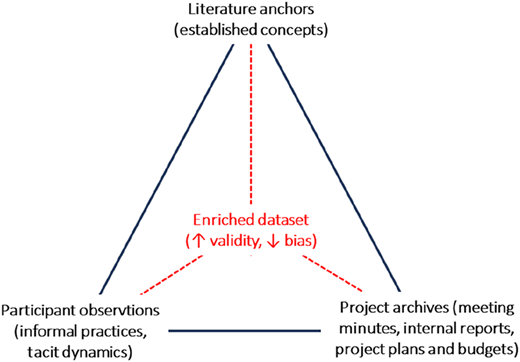
Participant observation captured informal interactions and implicit power dynamics, while project archives offered formal accounts of decisions and procedures. This dual source approach ensures that interpretations are not based on a single perspective but are cross-checked across data types (Miles et al., 2014) and triangulation (Yin, 2018).
To limit researcher bias and enhance analytical rigour, empirical observations were systematically anchored to established theoretical constructs (Miles et al., 2014) (Figure 1). This systematic integration of empirical and theoretical approaches involves iteratively moving between data and constructs, refining both as the process unfolds (Dubois and Gadde, 2002). In practice, project events and partner interactions were coded using a combination of inductive (emerging from the data) and deductive (informed by stakeholder theory, systems thinking, and governance literature) coding.
Furthermore, we employed pattern matching (Yin, 2018), a systematic comparison of empirical observations with theoretically predicted dynamics, based on Systems Thinking archetypes (Senge, 1990; Sterman, 2000). This methodological combination strengthens internal validity by linking observed empirical patterns to established theoretical structures.
3.2 Case selection. Motivations and theoretical significance
The case study concerns a consortium of 13 partners involved in an international cooperation project called Creativo [1], funded by a European agency within a funding programme during the period 2014–2021. The project was selected as a polar case (Pettigrew, 1990) for the following theoretical and methodological reasons:
The project is a rare case of a university partner downsizing in a European-funded project consortium; the role and budget reallocation resulted from an economic dispute initiated by a business partner.
The university partner, despite public, due to the small size, lacked a dedicated office for European funded projects, allowing for direct observation of partner influence on academic behaviour without institutional mediation mechanisms.
The European funding programme requires multistakeholder project consortia as a form of project governance. It “promotes transnational collaboration among diverse organisations, such as cultural institutions, creative enterprises, and broadcasters across EU member and associated countries by funding international cooperation projects” (European Commission, 2023), offering a fertile ground for exploring stakeholder dynamics.
The business partner's influence and the university's behavioural unfolding occurred over a 30-month period, a fundamental methodological requirement for a comprehensive longitudinal observation. Stability and the lack of adaptation by the focal subject (i.e. the university) to the stresses of the partnership are essential conditions for observing unfolding causal mechanisms (Van de Ven and Huber, 1990; Pettigrew, 1990). In this case, stability consisted of maintaining the original role and budget allocation until a formal change was imposed by the funding authority.
As an international cooperation project, Creativo involved a heterogeneous set of actors, including government bodies, NGOs, private business firms, entities, and local communities, each with their own interests, objectives, and cultural backgrounds (Khan et al., 2022).
Although the analytical focus is on the university partner, the study considers the entire project partnership as an interdependent system, as isolating single-partner behaviour would overlook systemic influence dynamics. Accordingly, university behaviour within the consortium is conceptualised as an emergent system outcome shaped by feedback loops, interdependencies, institutional constraints, stakeholder interactions, delays, and unintended consequences (Meadows and Wright, 2008; Sterman, 2000). Systems Thinking, therefore, represents a suitable analytical lens for investigating multi-stakeholder project endeavours (Linzalone et al., 2023), such as academic engagement initiatives.
3.3 Case study. An outline of the project creativo
Creativo's objective is to develop an innovative Business Model prototype, along with associated implementation and management tools, to ensure the financial sustainability of European cultural and arts organisations. Indeed, its goal is to enhance the resilience and sustainability of culture and arts organisations within the global Market of Culture and Creativity. Its duration is 48 months and involves 13 Partner organisations that have formally joined a Consortium. The project budget is €4 million, of which €2 million is funded by the European programme.
In line with the funder's requirements, the country, the statutory nature, and the specialisation of the Project Partners were diversified and complementary: universities, private business firms, and NGOs (i.e. Culture and Arts organisations) from eight countries of the European Union (Table 1).
These requirements, on the one hand, encourage cross-country and cross-sector knowledge exchange, cooperation, and work specialisation within the project environment; however, such a consortium structure results in limited proximity among partners. In fact, several elements of heterogeneity characterise the stakeholders: cultural diversity, geographical relocation, the political-economic frameworks of the home countries, the statutory nature, the interests in the project, and the Partners' missions, all of which influence their level of engagement.
Divergent interests among the Partners create tensions that often trigger influence activities from high-interest and high-power partners (Donaldson and Preston, 1995; Huxham and Vangen, 2005; Aaltonen and Kujala, 2010).
Creativo encounters very different levels and types of “interest” and budgets: some partners, like businesses and universities, had very consistent budget shares; others (i.e. cultural organisations) had limited budgets.
3.3.1 Empirical setting and consortium composition
This section provides a detailed description of the empirical setting and the composition of the project consortium. In line with qualitative case study standards and systems-thinking approaches, specifying system components and initial conditions is essential for interpreting interaction dynamics and feedback mechanisms (Sterman, 2000; Yin, 2018). Therefore, we explicitly characterise the actors involved in the project, their attributes, and their initial configuration within the consortium.
The empirical setting is represented by the Creativo project, funded under a European flagship funding programme. It supports the cultural, creative, and audiovisual sectors, financing transnational projects that promote cooperation, innovation, artistic mobility, competitiveness, and cultural diversity across Europe. As is typical of funded collaborative projects, the initiative required the formation of a transnational consortium composed of heterogeneous partners with complementary competencies.
The consortium involved organisations from eight European countries: Finland, Sweden, Greece, Italy, Slovakia, the United Kingdom, the Netherlands, and Belgium. This composition combines diverse institutional, cultural, legal and economic systems, potentially capable of coordinating frictions and trust gaps among partners (Hofstede, 2001). Further, project partners differ in type (i.e. nature, mission, operational field). Multi-actor partnerships often generate coalitions, informal blocs, and political bargaining as actors pursue divergent interests and resources, producing tensions over influence, priorities, and control (Das and Teng, 2000). The consortium, in fact, comprises: 2 international networks, 6 cultural centres, 2 public universities, 2 cultural agencies, 1 municipality, and 3 theatre companies. Partners differ significantly in organisational size, role in the project, resource endowments, and prior experience with EU-funded collaborations.
A specific analysis is ultimately required to determine the relational position of each partner at the project start. Relational position is a construct that reflects an actor's ability to shape coordination, information flows, agenda-setting, and coalition formation. Relevant foundations include network centrality (Freeman, 1979), structural holes and brokerage (Burt, 1992), resource dependence and power (Pfeffer and Salancik, 1978), and alliance governance (Provan et al., 2007). Since it is a multidimensional concept, we assume 6 elements forming the relational position:
Frequency of interaction with others;
Formal governance role (coordinator/WP leader);
Brokerage between subgroups;
Resource/control contribution;
Reputation/expertise dependence of others;
Participation in informal coalitions.
The intensity of an actor in each of the six elements gives rise to 6 “relational positions” we identify in: core-central actor, broker-boundary-spanner, semi-central operational actor, semi-peripheral actor, peripheral actor, isolated/symbolic partner (Table 2), that capture relational positions of a project partner, with respect to the other partners in the consortium.
Assessing each partner to the scale, we coded and classified partners' position in Creativo project (Table 3). Their relational scores are interpretive (e.g. High/Medium/Low) and triangulate formal role, network embeddedness, brokerage potential, expertise dependence, and participation visibility. Final labels synthesise overall relational influence.
We finally frame the system conditions that characterise the empirical context of the consortium (Table 4) [2].
Several asymmetries characterise collaboration among project partners. First, the consortium exhibited significant resource asymmetries, particularly in terms of budget allocation and financial dependence on the project. Partners P10 and P11 held substantial budget shares, while others had limited or no direct financial allocation. Moreover, certain actors (e.g. P10) are small in size, with large budget/large grant shares, and are highly dependent on the project for their organisational sustainability, whereas others (e.g. universities) were not financially dependent.
Second, partners differed in their prior experience with EU-funded projects.
Some organisations had extensive experience in managing or participating in international consortia, while others had limited exposure. This asymmetry influenced their ability to navigate formal procedures, governance mechanisms, and informal coordination processes.
Third, the consortium was characterised by relational asymmetries, including differences in network centrality, proximity, and prior collaboration ties. Some partners occupied more central or brokerage positions, while others were relatively peripheral, with limited relational embeddedness within the consortium.
These structural asymmetries define the system's initial conditions, which are critical for interpreting the evolution of interaction dynamics and feedback loops within the consortium.
From a systems thinking perspective, such initial configurations influence how tensions emerge, how influence processes unfold, and how behavioural patterns evolve over time.
Within this configuration, particular emphasis is placed on the interaction between P10 and P11, which constitute a critical dyad for understanding the influence dynamics analysed in this study. Their positioning in terms of resource control, relational proximity, and strategic interests played a key role in shaping the observed behavioural patterns.
3.4 Data collection and analysis
Data were gathered through participant observation (Czarniawska, 2012) and archival sources, including formal meeting minutes, emails, postal correspondence, and project deliverables. Following an abductive approach, conceptual anchors were repeatedly developed from the literature to guide the interpretation of empirical data. To reduce researcher bias, only factual, verifiable data were collected and systematically stored (e.g. project repositories, mailboxes, consortium reports, and internal and external project deliverables) (Eisenhardt, 2002).
Empirical data were consolidated into a single, chronological narrative, tracing partners' actions and their linked effects. Chronological organisation of data supported longitudinal analysis and facilitated identification of causal links, including those mediated by temporal delays (Senge, 1990; Sterman, 2000).
This approach further facilitated the identification of dynamic interactions and the extraction of tacit knowledge, consistent with recommendations for abductive inquiry in complex, multi-actor social contexts spanning diverse organisational and institutional settings (Dawson and Hjorth, 2011). As a result, we systematically reconstructed the evolving trajectory of partners' actions and their impacts (Table 5). It is assumed, according to the project archival codes, that the code P10 for the business partner and P11 for the university partner.
The (Table 5) was operationalised into a Model boundary diagram (Sterman, 2000; Meadows and Wright, 2008) (Table 6) by systematically mapping empirical observations onto a network of causal relationships, where each partner action and reaction is represented as a cause-and-effect link with polarity (Sterman, 2000; Eden and Ackermann, 2001). The link polarity is the directional nature of the relationship between two variables in a causal model, indicating whether a change in the cause reinforces or counteracts a change in the effect (Sterman, 2000). Positive (+) and negative (−) link polarities characterise the effect in the first and second cases.
The theoretical anchors guide variable and construct selection (Sterman, 2000; Bryson, 2004; Miles et al., 2014; Checkland, 1981). Further, methodological rigour of the data elaboration is supported by traceable and transparent coding of observations-to-constructs, consistent with qualitative system modelling and Causal Loop Diagram practices (Sterman, 2000; Eden and Ackermann, 2001). The Model Boundary Diagram serves as the input dataset for the System Thinking mapping and analysis.
We analyse the data through a theoretical lens and the tools of System Thinking, an approach that guides theory selection and methodological choices, particularly well-suited to complex, multi-actor, dynamic contexts (Checkland, 1981; Sterman, 2000). In our case, it is suitable for modelling the complex interactions between actors in the project context, and for identifying the “system structures”. A key tool of System Thinking is the Causal Loop Diagram (Forrester, 1961; Sterman, 2000; Meadows and Wright, 2008). Then, feedback loops and system archetypes are detected and analysed; finally, time-series graphs are employed to study university behaviour. They are particularly useful for investigation, as they capture and visualise the dynamic patterns of a system, stimulate discussion about the underlying feedback loops driving behaviours (Senge, 1990), and compare expected versus actual or alternative scenarios of system evolution.
3.5 Validity
The research process was carefully scrutinised for validity (Yin, 2018). Assuming validity as credibility, accuracy, and trustworthiness of the link between empirical evidence and the theoretical claims derived from it, validity has been established by using literature (i.e. theoretical anchors) to connect empirical evidence and create reliable chains of evidence. The differentiated data sources further enabled cross-checking between qualitative and quantitative data, thereby enhancing trustworthiness. Internal validity was supported by identifying causal relationships in the empirical data and by cross-checking the authors' reasoning and explanations.
4. Findings
4.1 Feedback loops
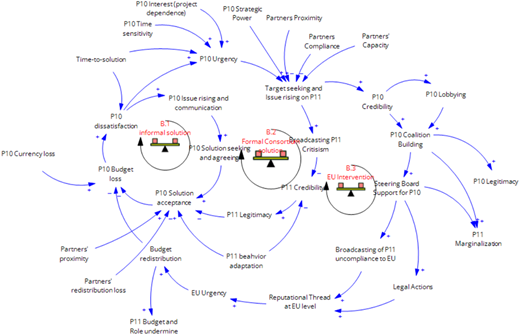
By entering the data (Table 6) into System Dynamics software, we obtain the Causal Loop Diagram (CLD) of Creativo's partners' interactions that culminated in a university undermining (Figure 2).
The CLD reveals six feedback loops ( Appendix), three of which are dominant and three are latent (Sterman, 2000). A dominant feedback loop is the feedback structure that currently exerts the greatest influence on the system's observed behaviour, shaping trends and patterns at a given time horizon. Dominance may shift over time as conditions change (Forrester, 1961; Sterman, 2000).
Our analysis focuses on the dominants, since they outweigh the others and shape the system's behaviour at any given moment. The three dominant feedback loops are the balancing loops: B.1, B.2, B.3. Dominant loops frequently change across project or system phases, a phenomenon known as shifting loop dominance (Forrester, 1961).
4.1.1 Balancing feedback loop B.1 – informal collective problem solving and proximity-based self-adaptation
In the first stage, the partnership interactions are regulated by the feedback loop B.1. This loop shows the system's tendency to zero out dissatisfaction within the partnership, despite partner P10's dissatisfaction due to the budget loss. The system aims to preserve collaboration among partners, adjusting interactions to balance actors' needs and maintain collective satisfaction and system stability (Checkland, 1981). From a systems-thinking perspective, a project partnership behaves as an adaptive relational system: actors' dissatisfactions are absorbed through balancing feedback loops involving negotiation, task redistribution, and emergent coordination, allowing the partnership to maintain stability despite inevitable tensions.
Based on partners' proximity and collaboration to restore satisfaction within the partnership through feedback loops and adaptive negotiation to balance actors' satisfaction (Checkland, 1981; Senge, 1990). However, the lack of proximity among some partners and the threat of redistributing P10's economic loss among all partners hampered the system's goal-seeking. Proximity is both a resource and an outcome. This collective problem-solving effort is coordinated by interactions among partners to resolve shared or focal actors' problems through information exchange and mutual adjustment (Provan and Kenis, 2008; Gray, 1989). As proximity decreases, relational distance increases; this, in turn, amplifies tensions and hinders further collaboration (Boschma, 2005; Granovetter, 1985). Additionally, the delay in solving the business partner's problem increases the time-to-solution and, in turn, the urgency of P10. The sudden increase triggers the dominance of the loop B.2, while the feedback loop B.1 extinguishes in magnitude. A shift in dominance then occurs.
4.1.2 Loop B.2 – strategic reframe of the issue
Once the feedback loop B.1 saturates, for proximity lack and solution inefficacy, the urgency of P10, that is time-sensitive (i.e. as time passes the urgency of the partner increases) (Boschma, 2005; Mitchell et al., 1997), rises to shift the dominance on the feedback loop B.2. This makes B.2 dominating the system, thereby governing the behaviour in the next stage. This loop lays the foundation and prepares for the following reframe of the problem, as a necessary process to save the consortium's existence and stability.
When an individual actor's concern (problem, dissatisfaction, or claim) is redefined as a system-level issue, it represents a shift in framing from local rationality to collective rationality (Weick, 1995). This occurs when an actor strategically or cognitively translates private needs into shared system concerns, thereby mobilising attention and resources at the consortium or organisational level. In System Thinking, this is linked to feedback amplification and goal redefinition: the system absorbs the local tension by adapting its structures or norms to reduce systemic disequilibrium (Senge, 1990; Sterman, 2000).
The Business partner P10 erodes University (P11) credibility by detecting and broadcasting a technical incompliance in the internal deliverable. University, however, outweighs rigidity and regulatory compliance to protect its reputation in the eyes of the Partners. Adaptation and negotiation with the partners are discarded. While the university loses credibility, the business partner P10 gains legitimacy.
4.1.3 Loop B.3 – formal self-regulation
Dominance shifts from B.2 to B.3. This sequential shift in loop dominance creates staged regulation, in which each loop sets the conditions for the next to activate. This structure highlights layered stabilisation in complex systems: the system keeps finding new balancing paths as earlier loops lose effectiveness, seeking long-term stability (Sterman, 2000).
The business partner P10 has reframed its request for budget recovery at the partnership system level. Lobbying with the Project Coordinator and the Steering Board is enabled. Here, balancing arises from collective partner dynamics: dissatisfaction spreads within the consortium, prompting governance mechanisms to respond more decisively. The balancing loop faces pressure: the collective voice hastens balancing attempts but also heightens the risk of escalation if the balancing action is weak. The loop B.3 seeks equilibrium by involving a higher authority (i.e. the funding agency) to enforce a solution. This represents a governance escalation loop in which balancing is delegated to a superior institutional body. B.3 shifts the issue to the broader system, affecting the reputation of the Agency programmes at risk, with legal and reputational threats extending to participating institutions.
In inter-organisational governance, balancing loops often depends on network coordinators, but their effectiveness relies on trust, legitimacy, and authority (Provan and Kenis, 2008).
All three loops (B.1, B.2, B.3) emerge to stabilise dissatisfaction in the partnership through governance responses (coordination, mediation, reputation management). B.1 and B.3 are directed towards solution, while B.2 mainly involves resource reallocation, as a means to reframe the issue at the system level. Balancing loops act as goal-seeking processes, pulling variables back towards a reference level (Sterman, 2000).
4.2 System's structure
The number, the type (balancing or reinforcing), and the interconnections between feedback loops as they emerge from the CLD determine the system structure responsible for the system's behaviour over time. System structure can be traced back to system archetypes, recurring patterns of structure and behaviour in complex systems that explain why certain problems or outcomes repeatedly emerge across different contexts, regardless of the specific actors or settings involved (Kim, 1992; Senge, 1990).
Creativo's structure has three balancing loops that operate across three temporal stages. They dominate each stage, thus primarily governing the system's behaviour over time, while the other three loops remain latent (Sterman, 2000).
4.3 Behaviour over time graph
The Behaviour Over Time (BOT) graph is a graphical representation of how one or more variables change over time, used to visualise trends, patterns, and dynamics in a system. BOT graphs help identify underlying feedback structures, delays, and causal relationships that generate observed behaviours (Meadows and Wright, 2008; Sterman, 2000). They are powerful diagrams representing normalised trends of the system's variables, like growth, decline, oscillation, or stabilisation, which emerge from causal loop diagrams. They illustrate how feedback structures shape system trajectories over time (Morecroft, 2015; Sterman, 2000). These graphs enable long-term analysis of system variables, offering insights into underlying feedback loops, delays, and nonlinearities. They support knowledge development by linking causal loop diagrams with observed or simulated trajectories, thus enhancing understanding of system behaviour and policy effects (Sterman, 2000; Morecroft, 2015).
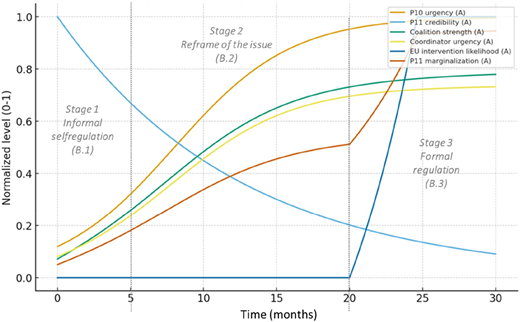
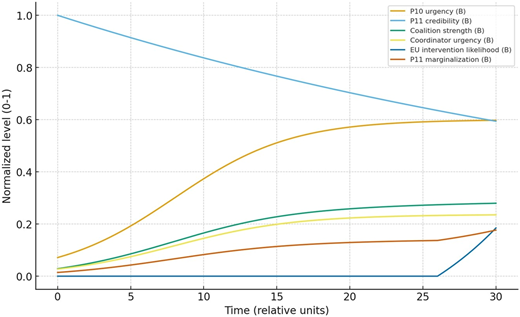
We select and report six key system functions over time (Figure 3) because they are crucial to the analysis, both individually and collectively. They are specifically: business partner urgency, university credibility, coalition strength, coordinator urgency, sponsor intervention likelihood, and university marginalisation.
P10 Urgency captures the driving dissatisfaction of the orchestrating partner. Urgency acts as the motor for influence actions (broadcasting and coalition building). Without it, the process wouldn't activate. P11 Credibility, the target variable, is under attack. As criticism rises, credibility diminishes, weakening P11's role. It is key because credibility is the “currency” of academic partners in consortia. Coalition Strength indicates whether other partners align with P10 or P11. It amplifies reputational pressure. It is important to observe how the erosion of credibility leads to collective responses. Coordinator Urgency reflects pressures within the consortium, as the coordinator serves as the mediator among partners. In the feedback loops, it serves as the balancing counterforce: when the coalition grows, the coordinator is compelled to act. Sponsor EU Intervention Likelihood indicates the escalation layer (B.3 loop). If coalition and reputational issues persist, the conflict escalates beyond the consortium, risking the European program's reputation. University marginalisation is the outcome: the academic partner's role and budget diminish. It measures the success or failure of P10's influence.
Together, they map the core dynamics of resources and outcomes, showing how initial dissatisfaction (P10 urgency) leads to reputational attacks (P11 credibility), which in turn trigger alliance building (coalition strength), provoke balancing attempts (coordinator urgency), escalate the situation (EU likelihood), and ultimately result in marginalisation of the university (P11).
Under the pressures of the consortium system, the university P11 exhibits legitimacy-seeking behaviour by adhering to the formal arrangements agreed upon to enhance credibility within the partnership. The strategic construction of a role or identity in the dispute arena, intended to influence perceptions of legitimacy and power dynamics (Hardy and Phillips, 1998; Mitchell et al., 1997), becomes problematic here.
P11 credibility decreases over time due to criticism, lobbying, and coalition attacks. P11 credibility diminishes exponentially as the consortium perceives a drop in reliability. P11 resources (Budget, Role) decrease linearly, following the influence of the Steering board and EU-level intervention, leading to a redistribution loop.
P10 Legitimacy/Influence increases as dissatisfaction translates into coalition-building and budget gains. It rises in a mirror-like fashion, gaining authority as P11 weakens. Consortium cohesion falls due to escalating disputes, reputational threats, and legal action. In essence, tensions in governance and budget allocations slowly erode cohesion and engagement.
5. Discussion
The study demonstrates how high-interest, high-strategic-power partners orchestrate influence actions aligned with the system's strategies, often to the detriment of universities within funded project consortia. Influence involves multiple, iterative, and concurrent pathways of action, each operating at a specific level of authority (e.g. partners, consortium, steering board, European programme management director). Escalation from one level to another is supported by a sense of urgency. The core weakening of P11's role is achieved through influence actions (e.g. detecting and attributing criticism, lobbying, coalition building, steering board exclusion), which erode signalling resources such as legitimacy, credibility, and relational assets. These are key resources to control rather than financial ones (Clark, 1998; Etzkowitz, 2004). A fundamental managerial awareness for universities stems from identifying these core resources.
In multistakeholder-funded projects, universities' behaviour is mainly influenced by partners' strategic and relational power, as influence efforts focus on symbolic resources such as legitimacy and credibility rather than financial control.
In response to the system's adaptive, emergent behaviour, the university adopted a behavioural mix of defencive entrepreneurship, reduced opportunity-seeking, a reactive posture, and path dependency. In fact, P11 exhibits defencive entrepreneurship, investing effort to protect its role (from legal disputes and partners' lobbying towards European Agency legitimacy). At the same time, opportunity-seeking declines, as entrepreneurial initiatives such as innovation, dissemination, and engagement suffer under resource cuts and reputational threats. This leads to a reactive posture, with P11 shifting from proactive engagement in knowledge valorisation and partnerships to survival-oriented strategies. Over time, path dependency emerges, as repeated coalition targeting creates a self-reinforcing cycle in which P11 is progressively sidelined in future projects.
Under coalition pressures and escalating influence, universities exhibit adaptive and defencive entrepreneurial behaviours, progressively shifting from proactive innovation to reactive survival and path-dependent marginalisation.
Positioning in a dispute refers to the stance an actor adopts in framing the conflict. Positioning is then the strategic act of defining and communicating one's stance, role, and legitimacy in the conflict through explicit demands, narratives, or identity claims to influence how the dispute is understood and resolved (Hardy and Phillips, 1998; Davies and Harré, 1990). The university has taken an early position, thus remaining closed in this reputational cage.
University partner P11 demonstrates strictly formal, compliant behaviour, adopting a highly rule-bound stance to strategically enhance credibility and role (Hardy and Phillips, 1998). The behaviour of an academic partner who maintains a very rigid or adaptable stance in consortia can be described as a compliance-based credibility strategy: a conscious alignment with formal rules, contracts, and funding requirements, used to strengthen legitimacy and institutional role, even if it reduces partners' flexibility. This behaviour is characterised by procedural rigidity, marked by strict adherence to funding rules, deliverable formats, and reporting deadlines; non-flexibility, reflected in a reluctance to adjust tasks or concede to informal partner requests; legitimacy seeking, aimed at being recognised by funders and coordinators as credible and indispensable; and defencive positioning, often deployed in response to perceived threats of marginalisation or reputational attacks.
It is a positional strategy of credibility reinforcement through non-concession.
Results allow us to contrast with Hendry's pattern of solution seeking in project consortia: the mechanism pattern comprises problem-raising, positioning, and solution-seeking (Hendry, 2005). A stakeholder articulates a claim, concern, or dissatisfaction that challenges the system. It serves to frame an issue so that it becomes salient and difficult to ignore. After raising the issue, the subject engages in discursive positioning: aligning with allies, framing the issue in moral, technical, or institutional terms, and assigning responsibility or blame. This step concerns credibility and legitimacy: the issue is narrated in a way that resonates with broader audiences, shaping perceptions of who appears “right” or “reasonable”. Once the issue is established and positions are clarified, stakeholders push for practical or negotiated solutions. The process often involves compromise, but the party with greater legitimacy and coalition support ultimately shapes the outcome.
In power-influenced consortia, universities often adopt a compliance-based credibility strategy, rigid adherence to formal rules and procedures, to preserve legitimacy, though at the cost of adaptability and collaboration.
P11's behaviour demonstrates a static legitimacy-seeking orientation, suitable for public universities but inadequate in dynamic, power-driven consortia. An entrepreneurial approach would necessitate boundary-spanning, discursive reframing, adaptive compromise, resilience, and repositioning. To effectively counteract partners' influence and protect both the role and the budget, universities involved in collaborative project courses must implement staged behavioural strategies. Boundary-spanning in the initial phases facilitates access to diverse knowledge flows and the legitimisation of alliances, reducing exposure to dominant partners (Tushman and Scanlan, 1981). Progressing to discursive reframing, universities can strategically craft narratives and problem framings that highlight their unique academic contributions, thereby shaping perceptions of value and aligning project aims with institutional interests (Hardy and Phillips, 1998). In subsequent stages, adaptive compromise becomes essential: by selectively conceding on secondary issues, universities maintain trust and collaboration whilst safeguarding core mandates and resource allocations (Oliver, 1991). Finally, resilience and repositioning enable universities to transform setbacks into learning opportunities, bolstering adaptive capacity and securing a more prominent role in future project dynamics (Lengnick-Hall and Beck, 2025). Together, these stages form a dynamic behavioural repertoire that ensures universities can both withstand and strategically respond to shifting inter-partner power relations.
To effectively counter partner influence, universities should adopt staged behavioural strategies, boundary spanning, discursive reframing, adaptive compromise, and resilience that enable dynamic adaptation and long-term legitimacy within multistakeholder projects (Figure 4).
In funded project consortia, the entrepreneurial behaviour of a university partner (P11) is influenced not only by its knowledge contributions but also by stakeholder power dynamics and coalition pressures. When targeted, the university's entrepreneurial role shifts from proactive innovation to defencive survival, constrained by typical system traps (e.g. escalation, success to the successful) (Sterman, 2000; Senge, 1990). Over time, this results in either the erosion of entrepreneurial identity or a redefinition of entrepreneurship as resilience and coalition-building rather than just innovation.
It is important to analyse the partner with strategic power who orchestrates influence actions in a consortium, known as the “orchestrator”. This actor coordinates, aligns, and mobilises resources and influence among diverse partners (Dhanaraj and Parkhe, 2006; Hurmelinna-Laukkanen et al., 2012). Resources managed by orchestrators are primarily symbolic and relational rather than financial. From a network theory perspective, it mediates flows of information, influence, and legitimacy between others (Burt, 2004; Levina and Vaast, 2005), and is thus regarded as a broker or boundary spanner. The orchestrator differs from the lead partner within a consortium. The lead partner is formally recognised and directs the overall strategy (Provan and Kenis, 2008; Sydow et al., 2016); meanwhile, the orchestrator lacks formal authority but oversees symbolic resources. Universities could enhance their ability to recognise and manage symbolic resources, as well as to act as an institutional entrepreneur (Battilana et al., 2009).
Recent literature emphasises dynamic capabilities, network brokerage, and institutional entrepreneurship in university AE (Battilana et al., 2009; Dhanaraj and Parkhe, 2006; Levina and Vaast, 2005), highlighting adaptive boundary-spanning and coalition management. This study is in line with these insights on the one hand, but contrasts with empirical work tracing how high-power partners orchestrate influence to erode universities' legitimacy and credibility. Namely, the findings show the sequential escalation and defencive responses. Further, it extends literature by detailing a causal mechanism linking partner influence, symbolic resource erosion, and staged adaptive university behaviours, providing a fine-grained, longitudinal view of how multistakeholder power dynamics shape university entrepreneurial behaviour (Sydow et al., 2016; Provan and Kenis, 2008).
6. Conclusions
This paper examined how a university's academic entrepreneurial behaviour is undermined in multi-stakeholder project consortia. Using a longitudinal case study analysed with a Systems Thinking approach, we found that a university's role is not fixed but dynamically shaped by intra-consortium power struggles and coalition pressures. These factors can force a university to shift from proactive innovation to defencive survival, a response constrained by typical system traps.
Our findings offer a new understanding of academic engagement as an emergent property within a complex social system, presenting a relational-systemic perspective that contrasts with earlier static and linear analyses. The study identifies four interconnected mechanisms, presented as propositions, that collectively enhance theory: (1) universities' behaviour is influenced more by partners' relational and symbolic power than by formal authority; (2) adaptive and defencive behaviours develop under coalition pressures; (3) credibility strategies based on compliance help maintain legitimacy but reduce flexibility; and (4) staged and resilient strategies support long-term adaptation and legitimacy. Overall, this research provides empirically grounded insights into a relatively under-explored area, emphasising the vital need for universities to foster resilience and strategic awareness when engaging in collaborative research projects.
Considering the limitations of a single case study, our findings are not broadly generalisable but provide a basis for future research. Further studies could use this systems-based framework to examine different consortia structures, project types, or institutional contexts to test the hypotheses presented here. This would enhance our understanding of the complex interaction between stakeholder influence and the changing nature of the entrepreneurial university.
Contributing to both theory and practice, this paper redefines academic entrepreneurial behaviour as an emergent, adaptive, and relational process rather than a deliberate managerial plan, offering a dynamic perspective on how universities operate within power-influenced systems. The methodology (i.e. longitudinal case analysis combined with CLD-based system thinking) allows for detailed temporal reconstruction and theoretical generalisation. Future research should test these propositions across diverse institutional contexts to evaluate their transferability and boundary conditions.
6.1 Implications
This study offers several key theoretical contributions by shifting from a static view of academic entrepreneurship to a more dynamic and systemic perspective.
First, it bridges a theoretical gap. The research fills a gap in the literature by illuminating the mechanisms and dynamics through which partners shape universities' roles in funded, multistakeholder project consortia. While previous work has identified external pressures as a factor, this study uses a systems-thinking framework and Causal Loop Diagrams (CLDs) to reveal the nonlinear, recursive processes and feedback loops that govern these interactions. This way, the study supports the idea that universities' behaviour in multistakeholder projects, such as many academic engagement projects, is an emergent property of a complex social system rather than a deliberate, linear managerial plan.
Secondly, it redefines power and behaviour. The paper differentiates between explicit pressures and more subtle, relational influences that develop dynamically during project implementation. It proposes that strategic power asymmetries, those related to differences in lobbying, networking, and framing capacities, can be more significant than formal or structural power in shaping a university's role and budget. This shift from emphasising proactive behaviour to a defencive, survival-driven entrepreneurial identity offers a new perspective for understanding universities' responses to conflictual, multi-stakeholder environments.
Third, it enhances Stakeholder Theory by incorporating an empirical study within the Academic Engagement domain. The findings advance Stakeholder Theory by illustrating how power dynamics and coalition-building among partners of equal standing can marginalise an academic actor in a collaborative setting. It shows that a partner's legitimacy can be diminished not only by its own actions but also by the collective efforts of a powerful coalition.
These three contributions directly reflect the four propositions advanced in the Discussion:
Propositions 1 and 2 extend Stakeholder Theory by explaining how relational power and coalition dynamics drive adaptive and defencive behaviours in academic settings.
Proposition 3 bridges institutional and entrepreneurial theories, showing that compliance-based credibility strategies protect legitimacy but constrain innovation and collaboration.
Proposition 4 integrates resilience and dynamic capabilities perspectives, identifying adaptive and staged responses as key to maintaining long-term institutional legitimacy.
Some important implications for managerial practice can also be drawn. The findings of this paper provide practical insights for university administrators, project managers, and policymakers involved in EU-funded projects.
For universities, this research acts as a warning, urging institutions to adopt a more adaptable and resilient entrepreneurial approach. University administrators and project teams should not presume a balanced or cooperative environment solely because partners hold equal formal power. Instead, they must remain vigilant in recognising and addressing strategic power imbalances and be ready to build coalitions to safeguard their role and mission. The study underscores the importance of universities investing in internal support systems, such as a dedicated offices to European funded projects, to prevent the loss of autonomy and mission drift.
For project managers and consortia leaders, the study highlights the vital importance of effective governance and conflict resolution from the start of the project. Consortia leaders should proactively monitor and tackle power imbalances and conflicting interests to ensure genuine co-creation rather than shifting towards a contractor-client relationship. Encouraging transparency, trust, and open communication can help prevent the “stress, tensions, and experiments” that result in negative emergent reconfigurations.
Policymakers, such as those in the European Union, should recognise that the intended benefits of transnational, cross-sectoral collaboration can be undermined by informal power dynamics. Mechanisms to protect the roles and contributions of academic partners, beyond formal contractual obligations, may be necessary to ensure that European funding effectively promotes academic entrepreneurship and innovation.
The propositions presented in this paper offer a unified theoretical and practical framework. Specifically, they demonstrate how universities' entrepreneurial behaviour arises through recursive power–legitimacy feedback loops, illustrating that compliance and resilience together shape institutional adaptation, and providing practical guidance for developing governance structures and internal capabilities that strengthen strategic resilience in multi-stakeholder environments. The following table (Table 7) summarises these propositions and their corresponding implications.
Appendix
Loop Number 1 of length 4
P10 dissatisfaction
P10 Issue rising and communication
P10 Solution seeking and agreeing
P10 Solution acceptance
P10 Budget loss
Loop Number 2 of length 7
P10 dissatisfaction
P10 Urgency
Target seeking and Issue rising on P11
Broadcasting P11 Criticisms
P11 Credibility
P11 Legitimacy
P10 Solution acceptance
P10 Budget loss
Loop Number 3 of length 10
P10 dissatisfaction
P10 Urgency
Target seeking and Issue rising on P11
P10 Credibility
P10 Coalition Building
Steering Board Support for P10
Broadcasting of P11 incompliance to EU
Reputational Thread at EU level
EU Urgency
Budget redistribution
P10 Budget loss
Loop Number 4 of length 10
P10 dissatisfaction
P10 Urgency
Target seeking and Issue rising on P11
P10 Credibility
P10 Coalition Building
Steering Board Support for P10
Legal Actions
Reputational Thread at EU level
EU Urgency
Budget redistribution
P10 Budget loss
Loop Number 5 of length 11
P10 dissatisfaction
P10 Urgency
Target seeking and Issue rising on P11
P10 Credibility
P10 Lobbying
P10 Coalition Building
Steering Board Support for P10
Legal Actions
Reputational Thread at EU level
EU Urgency
Budget redistribution
P10 Budget loss
Loop Number 6 of length 11
P10 dissatisfaction
P10 Urgency
Target seeking and Issue rising on P11
P10 Credibility
P10 Lobbying
P10 Coalition Building
Steering Board Support for P10
Broadcasting of P11 incompliance to EU
Reputational Thread at EU level
EU Urgency
Budget redistribution
Notes
Confidential name.
Given the high heterogeneity of the partners', that radically differ in structure and outputs, we treat ‘Size’ as a multidimensional qualitative construct (Kimberly, 1976) combining four indicators: (1) staff and managerial capacity, (2) annual budget/resource base, (3) physical infrastructure or assets (venues, buildings, sqm, seats), and (4) geographic/network reach and stakeholder centrality. Categories were interpreted as follows: Small = niche/local actors with limited staff/resources; Medium = stable professional organisations with regional/national operations; Large = major public institutions or nationally relevant actors; Very large = transnational networks, universities, or flagship multi-site infrastructures with substantial resources and broad influence (Kimberly, 1976).