Drawing on a mapping of the existing literature, this study aims to develop a multi-level framework for school leadership capacity building in the era of AI, providing a foundation for professional development.
The study adopts a systematic mapping approach to review empirical and conceptual literature on AI in school leadership. The review process was informed by PRISMA-ScR guidelines to ensure transparency and rigor.
The analysis identifies seven interrelated dimensions of AI-enabled school leadership organized into a multi-level framework across three levels: individual, organizational and systemic.
This study moves beyond the fragmentation of the existing literature and offers a synthetic and theoretically integrated understanding of school leadership in AI-driven environments. It conceptualizes AI-driven leadership as a multi-level and dynamic capacity-building process shaped by interactions across individual, organizational and systemic levels.
Introduction
The rapid advancement of Artificial Intelligence (AI) is transforming decision-making, data management, and administrative systems in modern organizations. In education, the integration of AI creates possibilities for teaching, learning, and school administration, while supporting automation and organizational effectiveness (Adams and Thompson, 2025; Arar et al., 2025; Assayed and Assayed, 2026; DeMatthews et al., 2026; Kafa, 2025a,b,c). At the same time, ΑΙ is reshaping the role of school leadership, as leaders are called to manage complex technological, pedagogical, and ethical issues in an environment of uncertainty (Fullan et al., 2024; Karakose and Tulubas, 2025).
However, despite the opportunities offered by ΑΙ, school leaders are not sufficiently prepared to take advantage of them. Research indicates that many school leaders have limited knowledge and skills, as well as low readiness regarding the pedagogical use of ΑΙ (Alkan et al., 2025; Anysiadou and Gkliati, 2025; Kafa, 2025b). Τhere is a growing need to develop new professional skills, such as digital literacy, data analysis, and evidence-based decision-making (Awodiji and Naicker, 2024; Bellibaş et al., 2025). This transition concerns not only technological proficiency but also adaptability, strategic thinking, and change management (Milton and Al-Busaidi, 2023; Richardson et al., 2025).
Some studies focus on specific aspects, such as leaders' technological skills, ΑΙ adoption, or ethical issues, whereas others explore its challenges and implications for school leadership (Adams and Thompson, 2025; Kafa, 2025b; Kafa and Eteokleous, 2024). Α limited number of studies have proposed frameworks to guide the use of AI in school leadership. For example, DeMatthews et al. (2026) introduced a six-domain framework emphasizing ethical AI use, strategic planning, instructional innovation, professional development, data-informed decision-making, and operational efficiency. Similarly, Lipsou et al. (2026) examined AI integration through a governance-oriented perspective, focusing on organizational benefits, ethical challenges, and accountability. Both approaches tend to focus on specific leadership functions or governance processes, resulting in perspectives with limited integration across individual, organizational, and systemic levels.
Despite growing research on AI and school leadership, the literature remains fragmented and has not been systematically synthesized (Adams and Thompson, 2025; DeMatthews et al., 2026; Göçen and Döğer, 2025; Kafa, 2025a, b; Lipsou et al., 2026; Wollscheid et al., 2024) to provide insights into how leadership capacity develops across different levels of the educational system. Furthermore, synthesis and bibliometric studies confirm that the field remains divided and lacks theoretical integration, highlighting the need for holistic approaches (Adewale and Ndwandwe, 2025; Wollscheid et al., 2024) that explain how individual skills, organizational conditions, and systemic factors shape leadership practice in AI-driven environments.
This study moves beyond the fragmentation of the existing literature and offers a synthetic and theoretically integrated understanding of school leadership in AI-driven environments. In particular, it conceptualizes AI-driven leadership as a multi-level and dynamic capacity-building process shaped by interactions across individual, organizational, and systemic levels. The main objective of this study is to develop a multi-level framework for leadership capacity building in the era of artificial intelligence. Drawing on a systematic mapping of the existing literature, the study seeks to synthesize fragmented evidence and identify the key dimensions that shape leadership practice in AI-driven educational contexts, providing a foundation for professional development. To address this objective, the study is guided by the following two research questions:
What are the key dimensions of AI-driven school leadership identified in the literature?
How can these dimensions be organized into a multi-level framework for leadership capacity building across individual, organizational, and systemic levels?
Methodology
This study adopts a systematic mapping approach in the form of a scoping review to synthesize the fragmented literature on AI in school leadership. Following the two research questions, this scoping review assisted in the development of a multi-level framework for leadership capacity building. The review process was informed by the PRISMA-ScR guidelines, ensuring transparency in the overall selection of studies. Particularly, a systematic search was conducted across the following academic databases: Scopus, ERIC, Google Scholar and Web of Science. This systematic search focused on studies published between 2020 and 2026 and included the following combinations of keywords: “artificial intelligence”, “AI”, “school leadership”, “educational leadership”, “principals”, and “administration”. Additionally, the inclusion criteria comprised empirical and conceptual studies, published in peer-reviewed journals, focused on AI and school leadership, and the exclusion criteria were studies that addressed higher education or other educational sectors and studies focused on teachers without any leadership relevance.
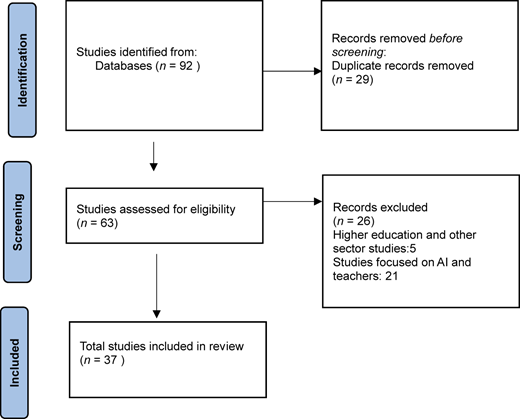
The study selection process is presented in the following Figure 1, PRISMA flow diagram. Particularly, the initial search identified 93 studies, and after assessing them for eligibility, 63 studies were screened. Following the exclusion process, 37 studies were included in the final sample of this review. The 37 studies are presented in Appendix A.
Analytical synthesis and dimension development
Following data extraction, the included studies were examined comparatively to identify recurring patterns related to AI and school leadership. Particular attention was given to leadership competencies, organizational conditions, and system-level factors that appeared consistently across the literature. Studies addressing similar issues were grouped together and organized into broader thematic categories.
This process led to the identification of seven dimensions that captured the main ways in which AI is shaping leadership practice in educational settings. In a subsequent step, the dimensions were organized into three interconnected levels (individual, organizational, and systemic) according to the primary level at which they operate. Although each dimension was assigned to a specific level, the analysis indicated that several dimensions extend across levels and influence one another. This provided the basis for the development of the proposed multi-level framework.
Findings
Overview of identified literature
Based on the following Table 1, the review found that the methodology of the included studies was diverse, with conceptual studies forming the largest proportion, followed by literature reviews and empirical research. Among empirical studies, quantitative approaches were more prevalent than qualitative and mixed-method designs. The geographical distribution of the literature indicates growing global interest in AI and school leadership. A significant number of studies adopted an international perspective, while empirical research was conducted across regions including the United States, Europe, Asia, and Africa.
Emerging dimensions
The thematic analysis, as shown in Table 2, identified seven key thematic dimensions that capture the complex nature of AI in school leadership. These dimensions reflect the dynamic interplay between technological capabilities, human judgment, and organizational conditions, shaping how leadership is enacted in AI-driven educational environments. Each dimension is presented below.
AI literacy and digital leadership competencies
Firstly, the results highlight AI literacy and digital competence as foundational dimensions of school leadership in the AI era. School leaders are expected to develop the capacity to interpret, and critically engage with AI systems and data-driven processes (Alkan et al., 2025; Ayasrah and Almulla, 2026; Bellibaş et al., 2025; Chen, 2025). It goes beyond technical knowledge to include data-literacy, evidence-based decision-making, and the ability to navigate complex digital environments (Karakose and Tulubas, 2024; Milton and Al-Busaidi, 2023). The results indicate that many school leaders show limited knowledge of AI and insufficient readiness to integrate it effectively into leadership practice (Alkan et al., 2025; Awodiji and Naicker, 2024; Khasawneh et al., 2025). The lack of preparedness is identified as a basic barrier to the effective use of AI in educational context, particularly in relation to pedagogical applications and decision-making.
Furthermore, AI literacy is associated with self-efficacy, adaptability, and the ability to lead innovation and change. Studies suggest that school leaders with higher levels of AI competence are more likely to engage with emerging technologies in a confident way (Assayed and Assayed, 2026; Bellibaş et al., 2025; Chen, 2025). AI literacy functions not only as a technical skill but also as a key driver of leadership transformation in digital environments. Overall, AI literacy represents a main leadership competency that enables critical engagement with AI and supports data-driven leadership.
AI in decision-making and administration
The use of AI for decision-making and administrative effectiveness emerged as a central theme. The literature suggests that school leaders are integrating AI into their practices to support managerial tasks and improve organizational efficiency (Adams and Thompson, 2025; Anysiadou and Gkliati, 2025; Göçen and Döğer, 2025; Kafa, 2025b). Many studies described how AI is mainly used in administrative rather than pedagogical functions. School leaders tend to adopt AI for tasks such as scheduling, resource allocation, data processing, and communication (Adams and Thompson, 2025; Kafa, 2025b; Tyson and Sauers, 2021). It appears that AI is perceived as a tool that simplifies routine work and reduces administrative workload. Several studies highlighted the role of AI in supporting data-informed decision-making. Leaders use AI systems to analyze large volumes of data, identify patterns and generate insights that would be difficult to obtain through traditional methods (Arar et al., 2025; Bixler and Ceballos, 2025; Göçen and Döğer, 2025). This supports evidence-based decisions in planning and performance tracking.
However, the literature indicates that the use of AI in decision-making is not without challenges. Some evidence pointed to limited trust in AI systems and concerns about over-reliance on automated processes (Adewale and Ndwandwe, 2025; Arar et al., 2025). Others showed that leaders often lack the necessary expertise to interpret AI-generated data (Anysiadou and Gkliati, 2025; Hejres, 2022). These findings suggest that AI is positioned as a decision-support tool rather than a decision-maker. Therefore, the significance is in enhancing leadership capacity, improving efficiency, and enabling more informed actions (Göçen and Döğer, 2025), rather than replacing leadership judgment.
Ethical, transparent, and responsible use of AI
Ethics, transparency, and the ethical use of artificial intelligence were identified as a key dimension in the literature. The integration of AI in school leadership is not neutral. It raises concerns, related to fairness, accountability, and data protection (DeMatthews et al., 2026; Ho, 2025; Polat et al., 2025; Renta-Davids et al., 2025). The analysis emphasized that AI systems can reproduce or amplify existing biases. This creates risks for decision-making processes, particularly when automated systems are used to analyze student data or support administrative decisions (Aldighrir, 2024; Polat et al., 2025). As a result, school leaders are expected to develop critical awareness of how AI systems operate and how they generate results. Data privacy also emerged as a major concern. The use of AI often involves the collection and processing of sensitive student and staff data. Some studies highlighted the need for clear policies and safeguards to ensure data protection and compliance with ethical standards (Ho, 2025; Renta-Davids et al., 2025).
Transparency was another key issue identified in the literature. AI-driven decisions are frequently viewed as lacking transparency and difficult to explain. This lack of transparency can undermine trust among teachers, students and parents (DeMatthews et al., 2026; Fullan et al., 2024). Therefore, school leaders are essential in ensuring that AI use is understandable and in line with organizational values. Additionally, the importance of ethical leadership in guiding AI integration is evident. Leaders are not only users of technology but also responsible for ensuring fairness and equity in their schools (Fullan et al., 2024; Ho, 2025), including issues of access and avoiding the reinforcement of inequalities. AI should not only be functional but also in accordance with educational values. These findings, highlight that school leaders play a critical role in bridging the gap between technology and ethics, so that AI is used in ways that promote equity and transparency in education.
Continuous professional development
A key condition for the effective integration of AI in school leadership is continuous professional development, as emphasized in the literature. Furthermore, school leaders are not adequately prepared to respond to the demands of an AI-driven environment (Awodiji and Naicker, 2024; Chen, 2025; Fusarelli and Fusarelli, 2024; Kafa, 2025a; Richardson et al., 2025). There are studies that point to a clear gap between the skills required and the competencies of school leaders. This gap is evident in both empirical and conceptual research. Professional development is not optional but essential, as school leaders lack the necessary knowledge to use AI tools effectively and to integrate them into leadership practice (Assayed and Assayed, 2026; Awodiji and Naicker, 2024; Κim and Wargo, 2025). The literature indicates that traditional forms of training are insufficient. Short-term or fragmented professional development initiatives do not support effective engagement with AI. Instead, studies emphasize the need for continuous, flexible and adaptive learning opportunities (Sposato, 2024; Sposato and Dittmar, 2025). AI-driven systems can enable personalized training, adaptive learning pathways and targeted skill development (Chen, 2025; Sposato and Dittmar, 2025), creating unique opportunities for individualized and effective leadership development.
At the same time, professional development is closely linked to collaboration and collective learning, as school leaders benefit from participating in professional networks and learning communities (Fusarelli and Fusarelli, 2024; Richardson et al., 2025). As a result, these structures enhance knowledge sharing and reflective practice. Another important finding is that professional development should take place across different phases of AI adoption. Leaders need support before, during and after the implementation of AI initiatives (Kafa, 2025a; Richardson et al., 2025; Sposato, 2024). This highlights the importance of building sustainable learning ecosystems rather than isolated training efforts (Fusarelli and Fusarelli, 2024; Sposato and Dittmar, 2025). Without, ongoing learning and support, school leaders are unlikely to integrate AI into their leadership practice. Therefore, the findings indicate that continuous professional development is a foundation of effective leadership in AI integration.
Organizational readiness and culture
The analysis revealed that organizational readiness and school culture significantly influence the integration of AI in educational contexts. The literature shows that the use of AI is not only dependent on individual competencies but is also strongly influenced by organizational conditions within schools (Dogan and Arslan, 2025; Holmström, 2022; Kafa, 2025a; Wollscheid et al., 2024). It appears that schools need to be adequately prepared at multiple levels to support AI adoption, including technological infrastructure, digital tools, and clear strategic direction for AI use (Holmström, 2022; Kim and Wargo, 2025; Tyson and Sauers, 2021). Without these conditions, even competent school leaders may face barriers in implementing AI effectively. Several studies emphasized that organizational readiness involves cultural dimensions. Schools that promote innovation, collaboration, and openness to change are more likely to successfully integrate AI into leadership practices (Dogan and Arslan, 2025; Kafa, 2025a; Wollscheid et al., 2024).
In contrast, rigid organizational structures and resistance to change can limit the potential of AI adoption. The role of school leaders is crucial in shaping this culture. In fact, leaders act as drivers of change who influence attitudes toward technology and guide the adoption process within their organizations (Kim and Wargo, 2025; Tyson and Sauers, 2021). Through communication and support, they contribute to the development of a shared understanding of AI use. The literature highlights that organizational readiness is closely related to continuous professional development. Training initiatives are more effective when they are part of a supportive organizational environment that encourages learning and experimentation (Fusarelli and Fusarelli, 2024; Kafa, 2025a). The above findings underline that AI integration emerges not only from individual competencies and effort but also from an organizational and systemic process, rather than an individual effort, that support innovation and change.
Human-AI leadership symbiosis
The review identified the relationship between human leadership and AI as a central theme. The evidence shows that AI does not replace school leaders but rather complements and enhances their role within educational organizations (Adams and Thompson, 2025; Arar et al., 2025; Fullan et al., 2024; Göçen and Döğer, 2025). Most studies agree with the idea that leadership remains a fundamentally human-centered process. Key dimensions of leadership, such as ethical judgment, empathy, relational understanding, and contextual awareness, cannot be replicated by AI systems (Fullan et al., 2024; Karakose, 2024). As a result, AI is primarily positioned as a supportive tool, not a substitute for human decision-making and leadership practice.
Unlike the ethical and responsible leadership dimension, which focuses on issues of fairness, transparency, accountability, and data governance, human-AI leadership symbiosis centers on the complementary relationship between human leaders and AI systems. The emphasis is not on whether AI is used responsibly, but on how leadership is reconfigured through the interaction between human judgment and technological capabilities.
The integration of AI is transforming the nature of leadership itself. Specifically, AI contributes analytical capacity and speed, while human leaders provide ethical reasoning and contextual decision-making (Assayed and Assayed, 2026; Osegbue et al., 2025). Therefore, the effectiveness of leadership depends on the balance between both roles. Τhe literature also highlights concerns about over-reliance on AI, loss of professional autonomy, and the growing influence of AI on leadership functions (Adewale and Ndwandwe, 2025; Arar et al., 2025; Assayed and Assayed, 2026; Quaquebeke and Gerpott, 2023). Despite these concerns, the prevailing perspective does not support a replacement scenario. Instead, it points toward a redefinition of leadership roles in AI-environments. School leaders must critically engage with AI systems while retaining responsibility for final decisions (Fullan et al., 2024; Karakose, 2024). The findings of our review suggest that school leadership is reconfigured as a hybrid process and is evolving into a socio-technical model that combines technological assistance with human judgment.
Policy and governance in AI-driven educational ecosystems
The final theme highlights the critical role of policy, governance, and the broader AI ecosystem in shaping the integration of artificial intelligence in school leadership. The analysis shows that effective AI adoption extends beyond individual competencies and organizational readiness, requiring coherence with system-level structures and conditions (Ho, 2025; Kim and Wargo, 2025; Polat et al., 2025). The literature emphasizes that clear policy frameworks are essential for guiding the responsible use of AI in education. These frameworks provide direction regarding data governance, ethical standards, and acceptable uses of AI technologies (Ho, 2025; Polat et al., 2025). In the absence of such policies, school leaders operate in uncertain environments, which may hinder integration or lead to varied practices.
Governance mechanisms play a key role in ensuring accountability and transparency. The availability of digital platforms and tools, AI systems, and technical support is a necessary condition for implementation (Holmström, 2022; Kim and Wargo, 2025). Another main aspect concerns the role of partnerships and networks. Collaboration among schools, universities, research institutions, and technology providers is identified as a significant factor of AI integration (Fusarelli and Fusarelli, 2024; Wollscheid et al., 2024). Furthermore, external support systems, such as national training programs and mentoring structures, are highlighted as important components of the AI ecosystem (Kafa, 2025a; Tyson and Sauers, 2021).
AI integration in school leadership unfolds as a systemic and policy-driven process. Leadership practice is a part of a broader socio-technical ecosystem, where governance, infrastructure, and collaboration shape the conditions for effective implementation. These findings suggest that leadership capacity cannot be sustained through individual effort alone. AI integration requires a multi-level framework that connects individual, organizational, and systemic dimensions of leadership.
A multi-level framework for leadership capacity building
Building on the findings, a multi-level framework for leadership capacity building on AI is introduced. The framework aims to provide a structured and integrative representation of school leadership in the context of AI.
Framework overview
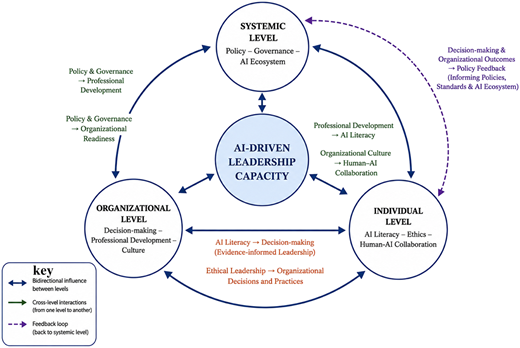
This framework offers a structured way to conceptualize school leadership in AI-driven school contexts. It integrates the seven dimensions identified in our review and organizes them into a coherent structure. Rather than presenting leadership as a set of isolated skills, the framework positions it as a dynamic and multi-level process. Three interconnected levels are identified: the individual level, concerning the leader; the organizational level, relating to the school; and the systemic level, referring to the broader policy environment. These levels are closely linked and continuously shape and influence one another.
Leadership capacity develops through interactions across three levels. Systemic policies and governance arrangements shape organizational conditions, while organizational structures and professional development opportunities influence individual leadership capacities. In turn, leadership practices enacted at the individual and organizational levels may inform future organizational strategies and policy development.
Framework structure and dimensions
The proposed framework consists of seven dimensions across three levels.
At the individual level, leadership capacity is shaped by:
AI literacy and data competence, which refers to the ability to comprehend and critically engage with AI systems and data.
Ethical and responsible leadership, focusing on bias awareness, transparency, and data privacy in AI use.
Human-AI leadership symbiosis, which reflects the leader's ability to work effectively with AI while maintaining human judgment.
At the organizational level, leadership is enacted through:
Decision-making and administration, where AI functions as a decision-support tool to enhance administrative efficiency and support data-informed decisions.
Continuous professional development, enabling ongoing learning and adaptation.
Organizational readiness and culture, including infrastructure, collaboration, and openness to innovation.
At the systemic level, leadership is guided by:
Policy and governance for AI leadership, including regulations, support systems, and strategic direction.
These dimensions are interconnected and function as part of a comprehensive leadership system rather than as independent elements. Although each dimension is primarily located within a specific level of the framework, several dimensions operate across levels and influence one another. For instance, AI literacy is situated at the individual level but is strongly influenced by organizational professional development opportunities and broader policy priorities. Likewise, ethical and responsible leadership extends beyond individual leadership practices, shaping organizational decision-making and responses to systemic governance requirements. Therefore, the framework should be understood as a level-based analytical structure that acknowledges the dynamic interactions and cross-level influence of the identified dimensions.
Dynamic interactions across levels
A defining feature of the proposed framework is its dynamic nature. Leadership capacity is not static, but develops over time through continuous interaction between levels. Individual competencies are shaped by organizational environments and broader systemic structures, including policies, governance, and resources. These relationships operate as feedback loops, with changes at one level influencing others. For instance, new policy directions may require new leadership skills, while emerging practices at the school level may inform policy development and improvement. This dynamic perspective emphasizes the need for consistency across levels. Without consistency, leadership efforts risk remaining fragmented or limited in impact.
The multi-level structure and the dynamic interactions between levels are shown in Figure 2. In addition to illustrating the three levels of the framework, the figure highlights key cross-level relationships identified in the review. For example, policy and governance influence organizational readiness and professional development, which in turn shape individual capacities such as AI literacy and human-AI collaboration. Similarly, leadership practices and organizational outcomes may generate feedback that informs future policy development and governance decisions. The framework conceptualizes school leadership as an evolving and context-dependent process. It captures the complexity of AI-driven environments and offers a structured framework for explaining how leadership capacity can be developed in a coherent and sustainable way.
Discussion
Our scoping review highlights how the integration of AI is reshaping school leadership as an evolving process. The findings suggest that AI does not simply introduce new tools into educational settings but requires a rethinking of leadership roles and practices. Leadership moves beyond traditional administrative functions toward data-informed and ethically guided processes.
The study expands on prior research that has examined isolated aspects of AI in education, such as technological skills or ethical concerns (Aldighrir, 2024; Polat et al.., 2025; Wollscheid et al., 2024), by offering a more integrated perspective. The results show that leadership in AI-driven environments is shaped by multiple interacting dimensions, such as AI literacy, decision-making, ethics, and organizational factors. This outlines the need for holistic approaches to examining leadership in digitally complex environments (Adewale and Ndwandwe, 2025 Wollscheid et al., 2024).
A key finding concerns the importance of AI literacy as a foundational leadership competency. School leaders are expected to critically engage with AI systems and data, yet the literature reveals a gap between expectations and actual preparedness (Alkan et al., 2025; Anysiadou and Gkliati, 2025). Extending the existing literature, οur study presents AI literacy not only as a technical requirement but also as a central component of leadership capacity in AI-driven contexts. It is confirmed that AI is used as a decision-support tool that enhances administrative efficiency and decision-making (Adams and Thompson, 2025; Arar et al., 2025). However, leadership remains human-centered, as decisions involving ethics and contextual judgment continue to rely on human judgment (Fullan et al., 2024; Karakose, 2024; Raptis and Psyrras, 2026). Evidence shows that leadership in AI contexts is best viewed as a hybrid process where human judgment and technological capabilities complement each other (Davenport and Miller, 2022).
The ethical dimension also emerges as central concern. AI integration raises issues of fairness, transparency, and data privacy, positioning school leaders as drivers in ensuring value-driven use of technology (DeMatthews et al., 2026; Ho, 2025; Polat et al., 2025). Continuous professional development is essential for effective AI integration, emphasizing ongoing learning over fragmented training (Fusarelli and Fusarelli, 2024; Richardson et al., 2025). Furthermore, the analysis indicates that AI integration is shaped by not only individual competencies but by organizational and systemic conditions as well. Organizational readiness, culture, and infrastructure influence how AI is adopted and used (Holmström, 2022; Wollscheid et al., 2024). In turn, policy frameworks and governance structures define the broader environment in which leadership is enacted (Ho, 2025; Kim and Wargo, 2025). Therefore, leadership can be seen as a multi-level phenomenon operating within complex systems.
Our review contributes to the literature by advancing a social-technical and multi-level perspective on school leadership in the era of AI. It moves beyond fragmented approaches by integrating individual, organizational, and systemic dimensions into a coherent framework. Therefore, leadership can be seen as a multi-level phenomenon rather than a collection of individual competencies. The proposed “Multi-Level Framework for Leadership Capacity Building” conceptualizes leadership as a dynamic process driven by interactions between humans and technological systems, in line with socio-technical perspectives (Orlikowski, 2007).
Lastly, the study addresses a critical gap in the literature by offering an integrative framework that captures the main dimensions of AI-driven school leadership and their interactions across levels. It moves the field away from descriptive approaches toward a more coherent and theoretically informed perspective on leadership in AI-driven educational environments.
Implications
The results have important implications for research, practice, and policy in the field of school leadership in the AI era. By highlighting the multi-level and socio-technical nature of leadership, our study suggests that effective AI integration requires coherence across individual competencies, organizational conditions, and systemic support.
For research
Our review calls for a shift from fragmented approaches toward multi-level analyses of AI in school leadership. Future research should prioritize examining the interactions between leadership practices, organizational conditions, and policy environments rather than exploring these dimensions in isolation. There is a clear need for strong empirical designs that are not limited to studies based on perceptions. Longitudinal, experimental, and mixed-method approaches could provide deeper insights into how leadership evolves in AI-driven contexts and what conditions enable sustainable integration. Moreover, additional work should develop clearly defined indicators for the proposed framework and empirically test it. This includes developing measurement tools, validating constructs, and examining its applicability across diverse educational systems.
These implications extend previous calls for more integrated approaches to AI and educational leadership (Adewale and Ndwandwe, 2025; Wollscheid et al., 2024). Existing studies have primarily examined specific dimensions of AI-driven leadership, including technological competence (Alkan et al., 2025; Bellibaş et al., 2025), ethical considerations (Ho, 2025; Polat et al., 2025), and organizational readiness (Holmström, 2022; Wollscheid et al., 2024), rather than examining them through an integrated and multi-level perspective. Our findings suggest that future research should explore how these dimensions interact across individual, organizational, and systemic levels. Such an approach could contribute to a more comprehensive understanding of how leadership capacity develops in AI-driven educational environments.
For practice
The analysis shows that AI integration requires a redefinition of leadership practice instead of the addition of new technical tasks. School leaders should be supported in developing critical capacities, to interpret and use AI, rather than focusing solely on tool adoption. Professional development should move from isolated training to practice-based learning. Such approaches include coaching, peer learning, and real-time applications within schools. Emphasis should be placed on decision-making, ethical judgment, and the ability to work effectively with AI systems. Leadership needs to focus on creating conditions that support the effective use of AI. This requires the integration of practices and structures, while ensuring that technology supports and does not replace human-centered leadership processes.
For policy
Evidence from our study underlines the need for coherent and actionable policy frameworks that extend general guidelines. Policies should clearly define roles, responsibilities, and standards for AI use in school leadership, particularly in relation to accountability and ethical governance. In addition, policy efforts should focus on building capacity at scale. Such efforts include designing national or regional systems for leadership development without relying on stand-alone initiatives. Sustained investment in infrastructure must be in line with human capacity development to ensure effective implementation. Finally, policy should facilitate coordinated ecosystems that connect several sectors such as education, research, and technology. In this way, coherence becomes essential for translating innovation into practice and preventing inequitable AI adoption across schools.
Limitations and future scope of research
Τhe study has some limitations that should be acknowledged. First, the scoping review approach was adopted to map an emerging and fragmented field. However, it does not involve formal quality appraisal of included studies. As such, the findings provide a conceptual synthesis rather than an evaluation of the strength of evidence. At the same time, the empirical evidence in this area remains limited. A considerable proportion of the studies included are conceptual or review-based. Consequently, it is difficult to reach firm conclusions about how AI is implemented and experienced in everyday school leadership practice. In addition, the geographical distribution of the studies is concentrated in a limited number of regions. Although the literature reflects growing international interest, certain regions remain under-represented. This may affect the transferability of the findings across different educational systems and contexts. Also, the rapidly evolving nature of AI constitutes a limitation. The evidence captured reflects a specific point in time, while ongoing technological developments may reshape leadership practices in ways not yet documented in the literature. Lastly, the proposed framework is conceptual and has not yet been empirically validated. Although it is grounded in a systematic synthesis of the literature, future research is needed to test, refine, and apply the framework in diverse contexts.
The supplementary material for this article can be found online.