This study examines how using music-based mood regulation is associated with school principals’ work demands and stress. Although music has been identified as a resource for mood regulation, its use among educational leaders remains unexplored.
Using cross-sectional survey data from the Finnish Principal Barometer (N = 323), the study assessed work demands, stress, and burnout with selected scales from the Copenhagen Psychosocial Questionnaire. Music-based mood regulation was assessed with the Brief Music in Mood Regulation scale, both as a composite score and as separate strategies. Associations were examined using stepwise regression analyses, and hierarchical cluster analysis was applied to identify distinct music use profiles.
Higher emotional demands at work and greater somatic stress were associated with more frequent use of music for mood regulation. Principals’ music use was more strongly aligned with constructive mood regulation than with emotional venting or distraction. Notably, this pattern was also common among principals reporting higher stress.
The findings suggest that music may represent an accessible, low-threshold coping resource for educational leadership professionals.
This study contributes to the literature in two ways. First, it examines music-based mood regulation among educational leaders, a professional group not previously studied in this context. Second, it complements previous work by analysing seven distinct mood-regulation strategies in relation to work demands and stress, providing a differentiated picture of how music use is embedded in demanding professional roles.
1. Introduction
Research consistently shows that school leaders face intense work demands and elevated levels of stress and burnout globally (Marsh et al., 2023; Tamadoni et al., 2024). The Principal Health and Wellbeing surveys (Riley et al., 2021) as well as the Finnish principal barometer reports (Ferber et al., 2026) have demonstrated that school leaders in many Western countries experience substantially higher levels of stress compared to the general population, which highlights the need to identify accessible ways to support school principals’ well-being. Thus, the purpose of this study is to examine the use of music as a potential mood-regulation tool for stress management, and how it is associated with work demands and stress among Finnish school principals.
School principals provide a particularly relevant context for examining stress management, as their work combines educational leadership, administrative responsibility, and intensive interpersonal engagement. Principals are required to respond to policy changes, heavy workloads, tight deadlines, and frequent interruptions. In parallel, they navigate complex social and emotional situations involving staff, students, parents, and wider school communities, often mediating sensitive relationships and conflicts (Marsh et al., 2023; Maxwell and Riley, 2017). In Finland, these responsibilities are shaped by a decentralized education system in which schools enjoy considerable autonomy. Finnish principals are therefore responsible also for overseeing curriculum implementation, managing school resources, and ensuring alignment with national educational goals (Elomaa et al., 2023; Upadyaya et al., 2020). Recent research on Finnish principals has linked their work demands to occupational outcomes such as workplace commitment (Mäkinen et al., 2026). The COVID-19 pandemic further intensified principals’ work demands, forcing them to manage unprecedented disruptions while upholding academic and operational standards, both in Finland and globally (Chatzipanagiotou and Katsarou, 2023; Nissinen et al., 2024; Reid, 2022; Toyama et al., 2024). Upadyaya et al. (2021) showed that, during the COVID-19 pandemic, most Finnish school principals experienced high or altered levels of stress related to their work.
Such sustained demands carry risks beyond immediate strain. These dynamics can be understood through the Job Demands-Resources (JD-R) theory, which proposes that job demands tend to increase strain, whereas resources buffer against these effects and support well-being (Bakker and Demerouti, 2007; Bakker et al., 2023). Prolonged stress is associated with anxiety, depression, and burnout (Lazarus and Folkman, 1984). Moreover, high work demands such as time pressure can hinder psychological detachment and recovery from work (Bakker and Demerouti, 2007, 2017). Sonnentag (2018) describes this as the “recovery paradox”: when job stressors are highest and recovery is most needed, employees' ability to recover tends to deteriorate, which in turn undermines their well-being.
This makes readily available forms of relief particularly valuable. The recreational value of music is widely recognized, and its role in mood regulation has also received increasing attention in research (Baltazar and Saarikallio, 2016; Peters et al., 2024). Studies suggest that effective emotion regulation reduces physiological stress (Thayer et al., 2012) and listening to music has been linked to similar effects, including stress reduction and enhanced emotional well-being (Mojtabavi et al., 2020). In a 2020 meta-analysis of 9,617 participants, de Witte and colleagues found that music interventions diminished stress, with both physiological and psychological outcomes measured (de Witte et al., 2020). These findings shed light on the intriguing possibilities for leveraging music as an effective stress-management tool.
The value of music in helping people cope with workplace demands is supported by evidence showing its frequent use under conditions of high stress and emotional demands. Research indicates that music is particularly utilized for regulating negative mood (Koehler et al., 2023), and that such engagement leads to improved emotional states afterwards (Hennessy et al., 2021). The utilization of music has also been linked to longer-term well-being outcomes. For example, a study by Groarke and Hogan (2018) found that regulating negative emotions through music correlates with both psychological resilience and life satisfaction. Park and Suh (2023) similarly found positive associations between hardiness, life satisfaction, and listening to music to regulate emotions. Gender may also shape these processes, as women and men tend to differ in how they use music to regulate their emotions (Carlson et al., 2015).
Research has increasingly framed music-based mood regulation not as a single behaviour but as a set of distinct strategies. The Music in Mood Regulation framework (Saarikallio, 2011, 2012) distinguishes several such strategies, ranging from seeking renewed energy or comfort to processing difficult emotions or venting them. A key premise of this approach is that these strategies are not interchangeable and may relate to stress and well-being in different, sometimes opposite, ways. Thomson et al. (2014) explored the role of music in mood regulation among young people and its links to stress, depression, and anxiety. Their findings revealed contrasting effects depending on the type of regulation strategy employed. For instance, the strategy of using music to provoke strong sensations was negatively associated with stress, depression, and anxiety, while using music as entertainment was negatively associated with depression. Conversely, the strategy of using music to discharge negative emotions was positively correlated with stress, depression, and anxiety, and using music as a diversion from worries was positively linked to anxiety and stress. These findings underline the complexity of the role of music in emotion regulation, emphasizing the importance of understanding individual strategies and contexts.
In occupational contexts, a 2025 scoping review of 30 workplace studies found music-based interventions promising for reducing work-related stress and supporting well-being, with psychological benefits, such as improved mood and reduced anxiety, alongside physiological ones (Nyarubeli et al., 2025). A systematic review focussing on health workers similarly reported reduced stress and anxiety (Colin et al., 2023). However, both reviews emphasized that the evidence base remains limited, and that long-term or sustained interventions, and their effects over time, remain largely unexamined.
Despite this growing body of research, studies have centred largely on structured interventions, leaving employees' self-initiated use of music far less examined. This study bridges musical mood regulation research with occupational health context by examining the use of music in mood regulation among school principals, a group of leadership professionals dealing with high work demands. By exploring how principals incorporate music into their daily lives to manage stress and work demands, this research provides valuable insights into the broader applicability of music as a tool for enhancing emotional well-being in challenging professional environments. The present study aimed to investigate (1) how self-reported stress and work demands are associated with the use of music in mood regulation among school principals, and (2) how different music-based mood regulation strategies are utilized among school principals.
2. Materials and methods
2.1 Study design
This study is part of the longitudinal Finnish Principal Barometer, which collects a wide range of survey data on school principals’ occupational well-being. The project partially aligns with the international study of educators’ health and well-being (Link to the website). Data collection for this study was conducted in collaboration with the Finnish School Principals’ Association.
The cross-sectional dataset used in this study was collected during April and May 2023 through the m-Path online survey platform. The research project was approved by the Research Ethics Committee in the Humanities and Social and Behavioural Sciences of University of Helsinki.
2.2 Sample
The survey was sent to approximately 1,200 school principals from basic and secondary education, of which 493 (41%) responded to the survey, resulting in a total of 323 completed responses of the sub-questionnaires included in this study. From these 323 participants, out of those who reported their education level, eight had a doctoral degree, 308 had a master’s degree, two had a bachelor’s degree, and two reported other forms of education. In the sample, 215 reported their gender as female (66.6%) and 104 as male (32.2%). The age of the participants ranged from 30 to 67, with a mean of 52.2 years (SD = 7.2).
Participants were invited to the study via email, which included information explaining the study’s purpose, its voluntary nature and its adherence to the guidelines of the Finnish Advisory Board on Research Integrity.
2.3 Data collection
The stress, somatic stress, work demands and burnout levels of the participants were measured by using the Copenhagen Psychosocial Questionnaire-II (COPSOQ II). The questionnaire incorporates several theoretical frameworks and is a widely used questionnaire on measuring work-related stress and psychosocial well-being, and has been validated in multiple languages (Dicke et al., 2018; Pejtersen et al., 2010; Berthelsen et al., 2018). The questionnaire has been translated to Finnish, and it is utilized by the Finnish Institute of Occupational Health (2022). Items within the COPSOQ II subscales of work demands, stress, somatic stress, and burnout were combined to construct the corresponding summary variables (see Supplementary Tables (ST) I and II).
The use of music was measured by the Finnish Brief Music in Mood Regulation Scale, which has been validated in Finnish (B-MMR, Saarikallio, 2012). It assesses seven music-based strategies for mood regulation: Entertainment, Revival, Strong Sensation, Diversion, Discharge, Mental Work, and Solace (see Table 1 and ST III). Each strategy includes three questions, and they are answered on a five-point Likert scale ranging from “Strongly Disagree” to “Strongly Agree”.
2.4 Statistical analysis
Statistical analyses were conducted using SPSS version 28 (IBM Corp, 2021). The data was analyzed using a combination of statistical methods to explore the relationships between work demands, stress, and music use strategies among school principals.
We examined connections between work demands, perceived and somatic stress, and the composite score of all strategies for use of music in mood regulation. We also examined separate music use strategies using Pearson correlation. The use of a composite score is justified as the B-MMR scale has consistently shown a robust second-order factor structure (Ansani et al., 2025; Saarikallio, 2012). Due to the visually inspected non-normality of the variables, Spearman’s correlations were also examined to ensure there were no major differences between the two correlation coefficients that would result in a need for further examination.
To further study the associations between music use strategies, demands at work, and experienced stress, linear regression analyses were conducted. Separate stepwise regression models were run for each B-MMR mood regulation strategy as well as for the composite score as the dependent variable, with demands at work, stress, somatic stress, burnout, age, and gender as predictors. Stepwise regression is an automated statistical procedure that is especially suitable in exploratory contexts to select a subset of predictor variables by iteratively adding (i.e. forward method) or removing (i.e. backward method) them based on certain statistical criteria (Hair et al., 2019, p. 264). In our case, SPSS follows this procedure: at each step, the independent variable not in the equation that has the smallest probability of F is entered if that probability is sufficiently small (p < 0.05). Variables in the regression equation are removed if their probability of F becomes sufficiently large (p > 0.10). The method terminates this process when no more variables are eligible for inclusion or removal (IBM Corp, 2021, p. 137). The interaction between demands for hiding emotions and gender was added as a predictor after we obtained contradictory correlation coefficients for males and females. The model fit was assessed using R2 and adjusted R2 values, and the significance of each predictor was evaluated with p-values (<0.05 was considered significant). Standardized beta coefficients (β) were reported. Then, further analyses with variables included in the last step of the stepwise models were conducted to obtain partial eta squared values (η2) to estimate and compare effect-size estimates of individual predictors.
The assumptions for linear regression were met for each model. Homoscedasticity was examined visually, based on scatterplots of standardized predicted values and standardized residuals: the accuracy of the models did not change based on the magnitude of the predicted values. The Pearson correlation coefficients between the predictors were smaller than 0.8, and variance inflation factors (VIF) for the models remained below 5, thus signalling no collinearity issues. Assumption of linearity of residuals for the models was examined visually from the P-P plots of standardized residuals, which indicated no substantial deviations from normality (see Supplementary Figures (SF) I-VIII). In the inspection of skewness and kurtosis, the absolute values remained below 2 and 7, respectively, for all variables included in the analyses, a limit proposed by West et al. (1995).
To examine whether combinations of music use strategies previously linked with better or worse well-being would emerge from the data, we performed a cluster analysis to categorize the sample into profiles. We ran a hierarchical cluster analysis with an agglomerative approach, in which each participant starts in their own cluster. We used squared Euclidean distance for distance measure and Ward’s method for cluster linkage (Ward, 1963). Compared to k-means clustering, another frequently used method, hierarchical clustering was better suited for our exploratory analysis as we had no prior theoretical assumptions on the number of clusters/profiles. Compared to latent profile analysis, clustering methods such as hierarchical clustering are better suited for data with variables that are not normally distributed (Oberski, 2016), such as those in our dataset.
3. Results
3.1 Descriptive statistics
The mean, minimum and maximum values as well as standard deviation of each variable included in the models are presented in Table 2. The internal consistencies of the subscales (Cronbach’s alpha coefficients) were found to be acceptable, ranging from 0.74 to 0.88.
3.2 Correlations
Correlations between the composite score of regulating mood with music, work demands and stress are reported in Table 3.
We also examined the correlations between individual music strategies, work demands, stress, and burnout. Emotional demands correlated positively with all music in mood regulation strategies (Strong Sensation: r(321) = 0.24, p < 0.001, Entertainment: r(321) = 0.13, p = 0.02, Solace: r(321) = 0.22, p < 0.001, Revival: r(321) = 0.17, p = 0.002, Mental Work: r(321) = 0.26, p < 0.001, Diversion: r(321) = 0.17, p = 0.002, and Discharge: r(321) = 0.12, p = 0.03).
Somatic stress correlated positively with all other strategies, but not with Entertainment or Revival (Strong Sensation: r(318) = 0.22, p < 0.001, Solace: r(318) = 0.21, p < 0.001, Mental Work: r(318) = 0.22, p < 0.001, Diversion: r(318) = 0.11, p = 0.04, and Discharge: r(318) = 0.20, p < 0.001). Perceived stress correlated positively with Solace (r(318) = 0.13, p = 0.02) as well as Discharge (r(318) = 0.12, p = 0.04), and so did burnout (r(319) = 0.18, p < 0.001 for Solace and r(319) = 0.11, p = 0.04 for Discharge).
Demands for hiding emotions had a reverse pattern of correlations in male compared to female participants: males had negative correlations between demands for hiding emotions and music use variables. Gender-specific correlations between demands for hiding emotions and music in mood regulation variables are reported in the Supplementary Material (ST IV), as well as the non-significant correlations between music use strategies and work pace (ST V), quantitative demands (ST VI), cognitive demands (ST VII) and demands for hiding emotions (ST VIII).
There were no major differences between Spearman’s correlation coefficients (see ST IX) and the Pearson correlation coefficients reported here.
3.3 Stepwise regression analyses: predicting music use in mood regulation with work demands, stress, and burnout
In our exploratory stepwise models, we included work demands, stress, and burnout as independent variables. Work demands included experienced emotional, quantitative, and cognitive demands, as well as demands for hiding emotions and work pace. Stress and burnout variables included experience of stress, somatic stress, and burnout. Eight separate models were constructed: one for each music use strategy, and one for the composite score.
Age and gender were included in all models as independent variables in a covariate perspective. As correlations between music use strategies and demands for hiding emotions were reversed in male compared to female participants, we included interaction between gender and hiding emotions as an additional independent variable in all models.
In the model for the composite score of music use, the emotional demands variable was selected in step 1. In step 2, adding the interaction of demands for hiding emotions and gender significantly improved the model (ΔR2 = 0.03, ΔF(1, 304) = 8.88, p = 0.003). The final model accounted for 8% of the variance in music use in mood regulation (Adjusted R2 = 0.08, F(2, 304) = 13.4, p < 0.001). Standardized regression coefficients are reported in Table 4.
Below, we report the results of the last steps of the regression models for all music use strategies in descending order based on effect size.
The Mental Work model included emotional demands (β = 0.21, t = 3.6, p < 0.001), hiding emotions x gender (β = 0.14, t = 2.4, p = 0.02), and somatic stress (β = 0.13, t = 2.2, p = 0.03) in the last step. The model accounted for 11% of the variance in the utilization of the Mental Work music use strategy (Adjusted R2 = 0.11, F(3, 303) = 11.9, p < 0.001).
Strong Sensation was predicted by emotional demands (β = 0.20, t = 3.5, p < 0.001), somatic stress (β = 0.24, t = 3.5, p < 0.001), and stress (β = −0.16, t = −2.4, p = 0.02) in the last step. Note the inverse relationship between experienced stress and Strong Sensation in this model. The model accounted for 9% of the variance in the Strong Sensation music use strategy (Adjusted R2 = 0.09, F(3, 303) = 10.9, p < 0.001).
The Solace model included emotional demands (β = 0.19, t = 3.3, p < 0.001), hiding emotions x gender (β = 0.16, t = 3.0, p = 0.003), and gender (β = 0.15, t = 2.6, p = 0.009) in the last step. The model accounted for 8% of the variance in the Solace music use strategy (Adjusted R2 = 0.08, F(3, 303) = 10.4, p < 0.001).
The Discharge model included somatic stress (β = 0.18, t = 3.2, p < 0.001) and hiding emotions x gender (β = 0.13, t = 2.3, p = 0.02) in the last step. The model accounted for 5% of the variance in the Discharge music use strategy (Adjusted R2 = 0.05, F(2, 304) = 9.3, p < 0.001).
The Revival model included emotional demands (β = 0.16, t = 2.8, p = 0.005) and hiding emotions x gender (β = 0.13, t = 2.3, p = 0.02) in the last step. The model accounted for 4% of the variance in the Revival music use strategy (Adjusted R2 = 0.04, F(2, 304) = 7.3, p < 0.001).
The Diversion model included emotional demands (β = 0.16, t = 2.9, p = 0.004) and hiding emotions x gender (β = 0.12, t = 2.1, p = 0.04) in the last step. The model accounted for 4% of the variance in the Diversion music use strategy (Adjusted R2 = 0.04, F(2, 304) = 7.0, p < 0.001).
Entertainment was predicted by emotional demands (β = 0.12, t = 2.1, p = 0.04) and hiding emotions x gender (β = 0.12, t = 2.0, p = 0.04) in the last step. The model accounted for 2% of the variance in the Entertainment music use strategy (Adjusted R2 = 0.02, F(2, 304) = 4.6, p < 0.01).
Burnout, age, quantitative and cognitive work demands, and work pace were not statistically significant predictors of using music in mood regulation in the stepwise regression, and therefore not selected in the models.
3.4 Contribution of predictors: effect size estimates
The inclusion of partial eta squared values (η2) provides an estimation of the unique contribution of the work demand and stress variables to various music-based mood regulation strategies, including the B-MMR sum variable. The analyses were conducted in a single model for each music use strategy, enabling direct comparison of the unique explanatory power of each predictor previously included in the stepwise regression model while accounting for the influence of the others.
The difference between the predictors was not large. The η2 values are reported in Table 5. For example, emotional demands explained 5% of the variance of the B-MMR composite score, whereas interaction between demands for hiding emotions and gender accounted for 3.0%. When examining individual strategies, in four of the seven models, emotional demands explained a greater proportion of variance compared to the other variables. These models were Mental Work, Solace, Revival, and Diversion. In the model for Entertainment, emotional demands explained an equal, small proportion as hiding emotions x gender. Emotional demands were not included as a significant predictor in the model for Discharge.
Somatic stress explained the greatest proportion of variance in the model predicting Strong Sensation and Discharge. Table 5 provides a more detailed view of the contribution of individual predictors. Note that the differences in effect size estimates are small, and therefore definitive interpretations based on the order of explained variance should be avoided.
3.5 Music use profiles
To investigate the emergence of different music use strategies, we performed a hierarchical cluster analysis. Based on visual inspection of the dendrogram of the model, the optimal number of clusters was determined to be two. The silhouette values computed with Euclidean distance indicating how well data points fit into their cluster compared to the neighbouring one are shown in Table 6. The values decreased with increasing cluster number, indicating the best fit for the two-cluster solution.
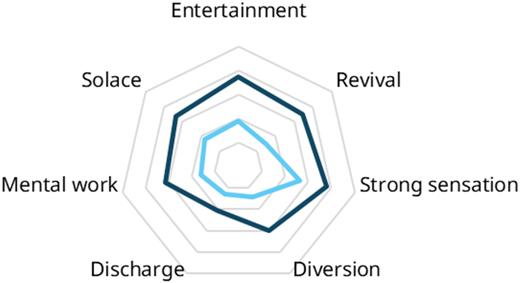
In the two-cluster solution, the profiles differ in mean values, but both include relatively high Strong Sensation strategy mean values. The first profile was characterized by relatively high mean values in all strategies except Discharge. The second profile had low mean values in all categories excluding Strong Sensation, which had a relatively high mean value compared to the other strategies. The first profile included 219 participants, and 104 participants were characterized by the second profile. The profiles are visualized in Figure 1.
The mean for Entertainment on a scale of 1–5 was 3.7 (SD = 0.85) for the first profile and 1.9 (SD = 0.91) for the second profile. For Revival, the mean values were 3.5 (SD = 0.9) and 1.5 (SD = 0.57). As mentioned above, the mean values for Strong Sensation were relatively high for the first (M = 3.8, SD = 0.75) as well as the second profile (M = 2.6, SD = 1.14). For Diversion, 3.0 (SD = 0.89) was the mean for the first profile, and 1.4 (SD = 0.60) was the mean for the second profile. The mean values for Discharge were 2.1 (SD = 0.89) and 1.3 (SD = 0.53). Mental Work mean values were 3.2 (SD = 0.87) and 1.6 (SD = 0.71). For Solace, the mean values were 3.3 (SD = 0.88) for the first profile and 1.8 (SD = 0.77) for the second profile.
4. Discussion
This study contributes to a better understanding of the associations between music use, stress, and work demands, offering a novel perspective on how music relates to occupational well-being and may inform approaches to supporting school principals’ well-being. The results showed that utilization of music-based mood regulation was significantly associated with increased emotional demands at work and somatic stress.
4.1 Stress and work demands among school principals
The school principals in this study reported high work demands but relatively low levels of stress. This finding is somewhat unexpected, as previous research has generally shown that school principals in Finland experienced high or relatively high levels of stress and burnout during and following the COVID-19 pandemic (Salmela-Aro et al., 2020, 2025; Upadyaya et al., 2021). In contrast, the reported high or relatively high levels of work demands were in line with expectations for the profession (Chatzipanagiotou and Katsarou, 2023; Upadyaya et al., 2020). According to the Job Demands-Resources theory, job demands tend to increase stress, whereas resources buffer against it and promote well-being (Bakker et al., 2023; Bakker and Demerouti, 2007). Among school principals, this pattern is evident as well: greater resources are associated with reduced stress and burnout (e.g. Dicke et al., 2018; Federici and Skaalvik, 2012; Toyama et al., 2022; Toyama et al., 2024). Thus, the relatively low stress levels of the principals in our sample may suggest that they had sufficient resources and were possibly able to perceive high demands as challenges rather than hindrances. Similarly, Kubicek et al. (2023) found that while increases in workload add to strain and reduce motivation, cognitive demands may enhance motivation and learning while reducing strain. In this way, high work demands may, to some extent, strengthen motivation among school principals. However, in our study, these resources did not eliminate the effects of job demands on well-being entirely: both perceived stress and somatic stress were positively associated with all categories of work demands in our sample.
4.2 Stress, work demands, and music use
Music use for mood regulation appeared to be associated with the emotionally demanding aspects of principals’ work. Those who reported more use of music also tended to report higher emotional demands, greater somatic stress, and more burnout symptoms, while women reported higher music use than men. In contrast, music use was not similarly associated with work pace, quantitative demands, or cognitive demands at work. Together, these patterns indicate that music use might be more closely linked to emotional strain than to workload intensity or cognitive effort. Prior research suggests that music can be an effective tool for managing emotional strain (Baltazar and Saarikallio, 2016; Peters et al., 2024).
The association between music use and somatic stress, but not perceived stress more broadly, suggests that the relationship between music use and stress may be particularly embodied. Somatic stress reflects the physical manifestations of emotional strain, such as tension, fatigue, or sleep difficulties, which may be intertwined with how individuals engage with music at a bodily and sensory level, for example through physiological relaxation, rhythmic entrainment, or emotional absorption. This interpretation is consistent with previous research highlighting close links between listening to music and bodily aspects of stress and well-being (e.g. Feneberg et al., 2021), although the present findings do not allow us to draw conclusions about directionality.
4.3 Music in mood-regulation strategies
Examining the results at the level of music in mood-regulation strategies provides a more nuanced picture of how music use is intertwined with school principals’ work-related experiences. Overall, the findings suggest that music use among school principals is more closely associated with the emotionally demanding aspects of work than with task-related demands.
When interpreted through the B-MMR framework, the strength of associations explained by individual predictor variables suggests that different work-related experiences may be linked to distinct forms of musical mood regulation. Emotional demands emerged as the predictor accounting for the largest share of variance in four of the seven strategy-specific models: Mental Work, Solace, Revival, and Diversion. These strategies share a common feature in that they operate in relation to a current affective state, whether through cognitive processing, comfort, renewal, or the redirection of attention. That such strategies were more commonly used by principals reporting high emotional demands is consistent with the idea that emotional strain draws people toward music as a means of managing existing affective states.
Somatic stress, which reflects the physical manifestations of strain, was most strongly associated with Strong Sensation and Discharge, a pattern not observed for other stress measures. These strategies differ in their aim: Strong Sensation is oriented toward inducing intense emotional experiences, whereas Discharge involves the expression of an already activated emotional state through music that mirrors it (Saarikallio, 2012). What they share is a particularly intense form of engagement with music. We tentatively suggest that such intense engagement may also carry a bodily dimension, which could help explain the association with physiological strain. This interpretation aligns with research linking music listening to embodied aspects of stress and affect regulation (Feneberg et al., 2021), although the B-MMR itself does not explicitly specify a bodily component for these strategies.
The small negative association between perceived stress and use of the Strong Sensation strategy further suggests that those experiencing higher stress tended to report less frequent engagement with highly activating or intense musical experiences. This aligns with the B-MMR framework in that Strong Sensation involves seeking particularly intense emotional experiences through music, which may be less frequently used when individuals experience increased mental strain.
The burnout levels of school principals were positively correlated with Solace (seeking comfort) and Discharge (venting negative emotions). This pattern shows that higher levels of exhaustion co-occurred with greater use of music for both emotional comfort and emotional release, suggesting that music use may be closely intertwined with how principals experience and regulate prolonged strain. These patterns align with the Job Demands-Resources framework, which suggests that when resources are limited, people are limited in their capacity to regulate their emotions effectively (Bakker and Demerouti, 2007). In demanding professional contexts, where rapid, problem-focused coping is often required, music may instead provide a means to manage affective overload rather than workload intensity itself (Baltazar and Saarikallio, 2016; Peters et al., 2024).
The effect-size estimates indicate that associations between work-related strain and music-based mood regulation are strategy-specific rather than uniform. Emotional demands were associated with most B-MMR strategies but were notably absent from Discharge. In contrast, somatic stress showed the strongest links with Strong Sensation and Discharge. At the same time, the generally small-to-medium effect sizes underscore that no single factor dominates music use, supporting the view that music-based mood regulation in demanding work contexts reflects a multifaceted process rather than a single regulatory pathway.
4.4 Gender-specific patterns
The relationship between demands of hiding emotions at work and regulating mood with music was moderated by gender in several models. Women tended to use music for mood regulation more when demands of hiding emotions were high, whereas men showed the opposite pattern. This pattern suggests that music use may hold different relevance for women and men in emotionally demanding work contexts, although the underlying mechanisms remain unclear. Gendered work roles, differences in emotional labour, or broader social expectations may influence both the experience of emotional demands and the use of affective coping strategies such as music.
Recent meta-analysis by Zhao et al. (2025) found that the association between emotional labour and poorer mental health was stronger among women. In the context of school leadership, Ispa-Landa and Thomas (2019) argue that gendered expectations may intensify these demands: women principals may be expected to combine warmth with authority and can be judged negatively if they are seen as insufficiently caring. The present findings are consistent with research showing that gender shapes the use of music for mood regulation, with women's music use associated with more adaptive regulatory patterns than men's (Carlson et al., 2015). However, the present results do not allow conclusions about why these differences occur. The associations likely reflect a complex interplay of occupational context, gendered expectations, and individual preferences in emotion regulation.
4.5 Profiles
In line with our other findings, the cluster analysis suggests that school principals tend to use music in ways that support their well-being. The results did not reveal any profiles in which Discharge or Diversion were popular. The best-fitting two-cluster solution mainly differed in the overall level of music use: active users showed relatively high scores across all strategies except Discharge, while less active users also favoured the Strong Sensation strategy. Across all tested cluster solutions, Discharge consistently emerged as the least preferred strategy.
4.6 The role of music use in mood regulation in well-being
Although principals in our sample appear capable of managing stress despite high work demands, it is important to acknowledge the detrimental effects of excessive workload on motivation, learning, and stress (Kubicek et al., 2023). The responsibility for managing stress cannot rest solely on the individual, as personal emotion regulation strategies cannot counteract the effects of an unsustainable workload. Nevertheless, in our sample, music was something principals reached out to even if they were facing burnout. This suggests that principals may turn to music as an accessible and familiar coping strategy when experiencing intense emotional or physiological stress. Similar findings have been reported by Hennessy et al. (2021), who observed that individuals most affected by the COVID-19 pandemic were also most likely to use music for emotional relief. However, rather than indicating that use of music directly reduces stress, these associations may reflect an adaptive behavioural pattern in which individuals under high demands seek comfort and regulation through music (Koehler et al., 2023; Peters et al., 2024). This interpretation aligns with that of Miranda and Claes (2009), who conclude that music utilization under stress represents active coping rather than a state of well-being. In other words, principals may turn to music not because they are well, but because they are striving to stay well.
Importantly, this pattern also extends the Job Demands-Resources framework beyond a simple buffering view of resources: music was not uniformly related to demands overall, but showed strategy-specific links that varied by the type of emotional demand (emotional demands vs demands of hiding emotions) and by the form of strain (somatic vs perceived stress). In other words, music appears as a context-sensitive personal resource whose role depends on the quality of demands rather than being a one-size-fits-all buffer. It should be noted that, unlike trait-like personal resources such as self-efficacy or optimism (Xanthopoulou et al., 2007), the use of music is a behavioural self-regulatory strategy rather than a stable disposition, yet it may function in a resource-like manner when individuals draw on it to manage the affective demands of their work.
At the same time, several alternative interpretations of the observed associations between music use and emotional or physiological strain should be considered. One possibility is that engaging with music reflects a response to emotionally demanding work and heightened stress. Another is that habitual mood regulation with music may increase individuals’ awareness of their emotional and bodily states, making strain more salient for them. It is also possible that a third factor, such as personality traits or temperament, contributes both to a greater tendency to use music for mood regulation and to a heightened sensitivity to emotional demands and stress. Taken together, these interpretations underline that music use in demanding work contexts is likely embedded in a complex, reciprocal process rather than reflecting a simple cause–effect relationship.
Substantial body of research has demonstrated the value of music for well-being, but different strategies of music utilization have not, to our knowledge, been studied before in the context of occupational well-being. Our sample of school principals consisted of people coping with stress effectively, despite experiencing high work demands. By bridging music in mood regulation research with the occupational health context, this study offers a novel perspective on how professionals in demanding occupational contexts utilize different regulatory methods.
5. Limitations and future implications
There were some limitations in this study. As the data was part of the large-scale Principal Barometer longitudinal study, the selection of questionnaires was necessarily limited to manage participant burden. More specifically, the number of music-related questions was reduced; no data regarding the number of hours spent with music, the music genre listened to, or musical hobbies (e.g. learning to play a musical instrument or sing in a choir) was collected. This limitation is not suspected to affect the results, as previous studies have found that musical training does not moderate the effect between music use in mood regulation and psychopathology (Thomson et al., 2014).
Our sample places some limitations on the interpretation of the results. School principals can be considered a homogenous group since they experience similar sources of work stress and face similar demands. This could have been reflected in their use of music in mood regulation: our cluster analysis implied that there was no group with high scores in the Discharge strategy. It should, however, be noted that the silhouette value indicating data fit in the cluster analysis was quite low. Future studies could benefit from examining profiles in a more heterogeneous sample. In addition, our survey may be subject to selection bias: principals experiencing the highest workload or burnout may have been less likely to participate due to time constraints, potentially leading to an underestimation of overall stress and burnout levels.
We used stepwise regression to explore which stress and work demand variables were the best predictors of using music to regulate mood. This was done as there is a lack of previous research on the relationship between specific work demands and music utilization, which prevented us from making theoretical assumptions. The stepwise method is suitable for explorative investigation but can be affected by problems with overfitting to specific data. Therefore, it would be valuable to repeat these analyses with different samples to further evaluate and compare the findings.
As our study is cross-sectional, it does not allow for inferences about the causal effects of the different musical mood regulation strategies. It would be useful to study further whether guiding participants to use music in constructive ways affects their well-being. Future longitudinal studies might further explore how different music strategies specifically contribute to mood regulation and stress resilience in leadership contexts. If proven useful, future studies should examine how to implement music education on the topic of mood regulation. In the context of educational professionals and leaders, it would be beneficial to test practical implementations integrated in teacher education or in well-being interventions.
6. Conclusions
This study contributes to a more nuanced understanding of how music use in mood regulation is associated with emotionally demanding work contexts among school principals. The findings suggest that principals’ music use is primarily aligned with strategies oriented toward affective regulation and reflection, instead of emotional venting or distraction. Rather than demonstrating that music use reduces stress, the results highlight how music is embedded in principals’ everyday attempts to engage with emotional and physiological strain. Notably, music use was most consistently associated with higher emotional demands at work and somatic stress, but not to quantitative or cognitive demands. By focussing on strategy-specific patterns of music use, this study adds to existing research on stress and self-regulation and offers a basis for future research on the potential role of music in supporting well-being in educational leadership and other high-demand occupations.
Author contributions
E.M. and I.V. made methodological choices, performed the statistical analysis and were responsible for writing the manuscript. M.H. and S.S. conceptualized the study, acquired funding and provided resources. F.K., A.A., M.H., K.K. and S.S. supervised the statistical analysis, methodological choices and writing. All authors contributed to and accepted the final version of this article.
We wish to thank the late Professor Katariina Salmela-Aro for the opportunity to work with her on the Principal Barometer project. We also want to thank Research Director Mari Tervaniemi, Postdoctoral Researcher Hiroyuki Toyama and University Lecturer Lauri Hietajärvi for their valuable comments on the article, and Ms. Satu Havakka for her kind help with editing the text.
The supplementary material for this article can be found online.