Skip to article sections
Purpose

The aim of this systematic review was to identify key factors that contribute to organizational and individual resilience for healthcare workers and informal caregivers in elderly care and further, to examine how leaders can support these factors.

Design/methodology/approach

This study was conducted as a systematic integrative review with narrative synthesis. Searches were conducted in the following electronic databases: CINAHL via EBSCOhost Medline via EBSCOhost, Scopus and the British nurse index June, 2024, with updated searches in September 2025. Eligible studies were original, peer-reviewed empirical journal articles, published in English between 2014 and 2025.

Findings

A total of hundred and thirty-four studies were included in the review. The synthesis resulted in four themes (three deductive themes and one inductive theme) describing key factors supporting organizational and individual resilience for healthcare workers and informal caregivers, and how leaders support these factors: key factors for individual resilience in healthcare workers; key factors for individual resilience in informal caregivers; key factors for organizational resilience; and leaders as intermediaries for organizational and individual resilience.

Originality/value

The review findings underscore the interdependent relationship between individual and organizational resilience and highlight the importance of reconciling both aspects to create resilient elderly healthcare systems. Moreover, the review emphasizes the leader's role as a mediator between individual and organizational resilience and reinforces the leader's role in building resilient care systems, including supporting informal caregivers’ resilience. The findings also identify organizational factors that can enhance individual resilience and be translated into concrete measures for supporting individual resilience.

The world's population of elderly is growing, while healthcare services worldwide face massive human resource challenges (World Health Organization and the United Nations Children's Fund (UNICEF), 2018; World Health Organization, 2015). This is marked by a shortage of qualified personnel and a mismatch between capacity and demand due to workload imbalances, limited resources, role ambiguity and the emotional toll of patient care (Anesi and Kerlin, 2021; Søvold et al., 2021; Yuan et al., 2021). These discrepancies result in stress, burnout, uncertainty and diminished mental health and well-being among healthcare professionals and leaders, as well as informal caregivers (Raso et al., 2021; Glette et al., 2018). Evidence points to the fact that an increasing share of European healthcare services for the elderly will be provided in community settings such as patients’ homes. Yet workforce capacity, professional competence and trained leadership remain inadequate to manage this transition and the evolving working conditions (Bing-Jonsson et al., 2016; Johannessen et al., 2021). Under these circumstances, it is crucial to assess and alleviate the burdens faced by providers of elderly care and support them with tailored, integrated healthcare interventions that emphasize resilience as a protective factor (Vázquez et al., 2024). Such support is closely connected to improved mental well-being – defined as a state in which individuals are on a pathway to realizing their potential, coping with normal stresses, working productively and contributing to their community (Søvold et al., 2021). Understanding how individual resilient capacity fluctuates or can be enhanced through available assets and resources is essential for providing genuine support to both healthcare professionals and informal caregivers (Herz et al., 2024; Teahan et al., 2018). It is also fundamental to understand how organizational and individual resilience factors intersect and how leadership contributes to this intersection (Coles et al., 2017; Ree et al., 2021).

Resilience in healthcare is defined as “the capacity to adapt to challenges and changes at different system levels to maintain high quality care” (Wiig et al., 2020b. p. 6). Resilience is a theoretical approach concerned with understanding how healthcare organizations and systems manage performance variability and the need to balance flexibility with stability in healthcare organizations (Grote, 2019; Wiig et al., 2020b). Furthermore, resilience in healthcare emphasizes the need to understand why systems succeed in improving patient care rather than solely focusing on system failures (Hollnagel et al., 2013). While resilience in healthcare has garnered increased research interest over the past decade (Ellis et al., 2019), the demand for knowledge on how to enable resilient healthcare services surged during and after the COVID-19 pandemic (Ellis et al., 2019; OECD, 2023; World Health Organization, 2021). In addition to this interest in organizational resilience, there has been an increased acknowledgement of the importance of supporting individual resilience, including the promotion of mental well-being, as a crucial component of organizational resilience in healthcare settings. Individual resilience is defined in this review as “the personal qualities that enable one to thrive in the face of adversity” (Connor and Davidson, 2003. p.76).

Research on resilience in healthcare has predominantly treated individual and organizational resilience as separate constructs (Wiig et al., 2023). While each has been studied independently (Huey and Palaganas, 2020; Robertson et al., 2016; McKinley et al., 2019), there remains a lack of research integrating these two dimensions of resilience (Guise et al., 2024). According to Wiig et al. (2023), gaining more knowledge of the link between individual and organizational resilience, and how to integrate this understanding into resilience thinking, is crucial to facilitate and advance resilient healthcare services. More research is needed to understand the key influence of informal caregivers on resilience in healthcare (Guise et al., 2024). Moreover, the emerging recognition of the pivotal role of healthcare leaders in fostering resilience in healthcare (Bowman, 2022; Glette et al., 2024) has prompted calls for further investigation into how leadership supports both individual and organizational resilience in healthcare workers and informal caregivers (Agostini et al., 2023; Akerjordet et al., 2018; Ree et al., 2023), as this is currently lacking in the literature.

The aim of this review was to identify key factors that contribute to organizational and individual resilience for healthcare workers and informal caregivers in elderly care and further, to examine how leaders can support these factors.

The research question was.

  • What factors can support organizational resilience and individual resilience for healthcare workers and informal caregivers in elderly care, and how can leaders support these factors?

This study employed a systematic integrative review with narrative synthesis to investigate resilience factors and leader support, incorporating research from diverse methodologies (Popay et al., 2006; Whittemore and Knafl, 2005). The review was registered with the International prospective register of systematic reviews (PROSPERO) [CRD42024553240], and applied the Preferred Reporting Items for Systematic Reviews and Meta-analyses (PRISMA) guidelines for reporting systematic reviews (Appendix 1) (Moher et al., 2015).

Utilizing the expertise of a specialist librarian, we developed a search strategy. Search words eligible for our research question were selected based on resilience literature and research and organized in the PICO framework (Appendix 2). Databases were selected for their coverage of the subject areas and validated through test searches. Comprehensive searches were conducted across the following electronic databases: CINAHL via EBSCOhost, Medline via EBSCOhost, Scopus and the British nurse index. Initial searches were performed in all the included databases, followed by discussions within the core review group and with the librarian to refine the search strategy (Appendix 2). The main searches were conducted during June 2024. Updated searches were conducted in September 2025.

This systematic review included peer-reviewed qualitative, quantitative and mixed-method studies in English language, investigating individual and/or organizational resilience in elderly care. English is currently the predominant language for scientific publications suggesting that including only English-language study captured the most relevant available data on factors contributing to organizational and individual resilience (Ridsdale, 2024). Eligible studies were to be published between January 2014 and June 2024 as the research interest in resilience in healthcare was limited before this time (Hollnagel et al., 2015; Braithwaite et al., 2015). The review did not include grey literature or doctoral theses. Studies focusing on health personnel, specialists or leaders working in hospitals, specialist healthcare services, psychiatric healthcare institutions or other healthcare services unrelated to elderly care, as well as informal caregivers connected to such services were also excluded (see Table 1).

Following the main search, all references were downloaded into a reference management software (EndNote version 21), where duplicates were removed. The remaining records were then exported to Rayyan Professional, a web and mobile app for systematic reviews (Ouzzani et al., 2016), for title and abstract screening. Screening was conducted individually and blinded by two independent reviewers (review teams: MKRS & KRO, IJB & VG, ML & SS, FT & CDH, MF & MKG, PC & LP, SN & AKV). Initially, the review teams reviewed a 5% excerpt of the data material to calibrate inclusion and exclusion criteria. An 82% agreement was achieved, and a second 5% review was therefore not necessary (Belur et al., 2021). However, discussions for clarification of the criteria were held within the core review team and resulted in a “review support sheet” (Appendix 3). Thereafter, the title and abstract review was conducted (review teams: RB & SN, PC & LP, MF & MKG, FT & CHD, ML & SS, IJB & VG, MKRS & KRO). Updated searches were reviewed by MKG, KA and AH. Any disagreements on article inclusion or exclusion were resolved within the designated review team. After title and abstract screening, included articles were downloaded back into EndNote for full-text retrieval. Full-text documents were randomly distributed among the review teams and reviewed in pairs, blindly, against inclusion and exclusion criteria. Disagreement on full-text inclusion or exclusion was discussed within the designated review team. If unresolved, another review team conducted a second review to make the final decision. Reasons for inclusion or exclusion of articles were continuously recorded in a predesigned Excel form. The study selection process was fully documented using PRISMA (Moher et al., 2015).

All included studies underwent a quality assessment using the Joanna Briggs Institute (JBI) assessment tools (Moola et al., 2017). Assessments were conducted blinded in pairs, by designated review teams. Disagreements on quality rating were discussed within the review team and re-distributed to another team for resolution if agreement could not be met. JBI does not entail a scoring system, and therefore, no cut-of score was applied (Moola et al., 2017). Records rated low quality was therefore not excluded but given less weight in the write-up of the results (Munn et al., 2020). Eighty-two studies were assessed to have high quality, forty-four studies were assessed to have medium quality and eight studies were assessed to have low quality (Appendix 4).

A pre-designed Microsoft Excel data extraction form was distributed among reviewers. This form included elements such as technical data of the articles and data pertinent to the review questions (see Table 2). To ensure comprehensive data collection, the extraction process was conducted individually by pairs of reviewers within designated data extraction teams (CDH&HBL, LE&TS, AH&KA, MKG&FT, MF&RB, AC&IJB). To support the data extraction process, the RiH Quality and Resilience Trigger Tool (Aase et al., 2020) was used to help identify any aspect of organizational resilience which was unclear, implied or obscured in the data material. Similar tools were not available for individual resilience; however, reviewers were provided with a thorough description and definition of individual resilience to assist in data extraction (Appendix 5).

A framework analysis (Dixon-Woods, 2011) was employed to analyze the included studies. This method uses matrices to organize thematic categories for coding of the data. A key feature of framework analysis is its ability to incorporate predefined themes or concepts from the outset (a priori), while also allowing for the inclusion of newly emerged themes or concepts through inductive analysis of the data (de novo) (Dixon-Woods, 2011). Inspired by Akerjordet et al.’s (2018) approach to framework analysis, the analysis consisted of three steps: (1) Summarize data using the coding categories (collect extracted data across studies, report eventual quantitative outcomes on a study-by-study basis) (deductive); (2) Synthesis of qualitative studies/descriptive summary of quantitative results (inductive); (3) Describe patterns, relationships, similarities, differences, etc. related to the research question.

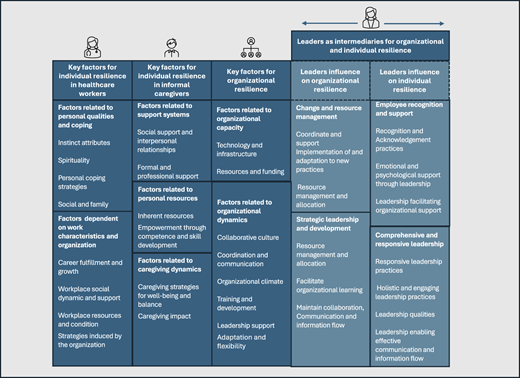
The deductive analysis systematically considered the areas: key factors for individual resilience in healthcare workers, key factors for individual resilience in informal caregivers, key factors for organizational resilience as well as leaders influence on organizational and individual resilience (coding categories framework). Qualitative and quantitative data were initially coded and organized into separate Word tables. These codes were then compiled, and categorized into a third Word table. Finally, the categories were grouped under overarching themes (see Figure 2). Additionally, the analysis aimed to identify other attributes that emerged inductively from the data (Dixon-Woods, 2011). Data that did not fit into any of the predefined coding areas were coded into a separate Word table. Alongside data on leaders influence on individual and organizational resilience, this led to the emergence of the deductive theme: “leaders as intermediaries for organizational resilience”. Throughout the analysis process, the authors engaged in several discussions to refine and validate the findings.

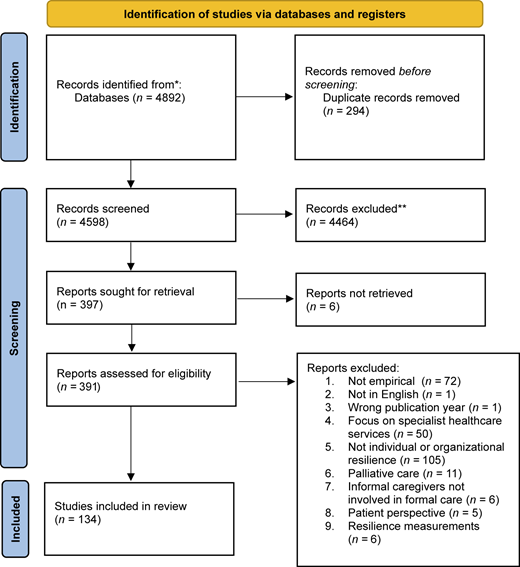
Hundred and thirty-four studies met inclusion criteria (see Figure 1 and appendix 4). Of these, 90 were qualitative studies Hung et al. (2022), Franzosa et al. (2021), Jones et al. (2024), Mehta et al. (2017), Naweed et al. (2022), Browne et al. (2014), Krane et al. (2023), Søvde et al. (2024), Ree et al. (2023), de la Cuesta-Benjumea et al. (2019), Tretteteig et al. (2017), Foley et al. (2021), Lyng et al. (2023), Glette et al. (2024), Donnellan et al. (2017), Hainstock et al. (2017), McGuinness et al. (2024), Boettcher et al. (2023), Birt et al. (2023), Connelly et al. (2022), Hughes et al. (2024), Wilkinson et al. (2023), Butler (2018), Hoeks et al. (2023), Donnellan et al. (2019), Klockner et al. (2023), Caspar et al. (2020), Alcañiz-Garrán et al. (2021), Kabasinguzi et al. (2023), Amateau et al. (2023), Chang and Kim (2022), Chang and Eun Young (2023), Cottrell et al. (2020), Donnellan et al. (2015), Donnellan et al. (2024), Dorell et al. (2016), Førsund and Schumacher (2024), Grigorovich et al. (2024), Hunt et al. (2018), Hvalvik and Reierson (2015), Lai et al. (2022), Lauritzen et al. (2019), Lee et al. (2016), Lyng et al. (2024), Midje et al. (2024b), Orhierhor et al. (2023), Rasoal et al. (2018), Roberts and Struckmeyer (2018), Rogers et al. (2024), Schilgen et al. (2019), Scrymgeour et al. (2020), Tingvold and Munkejord (2023), Titley et al. (2023), Uekusa (2019), Yan et al. (2023), Cope et al. (2016), Scerri et al. (2022), Lyng et al. (2021), Dickey et al. (2023), Arbel et al. (2025), Bergqvist et al. (2023), Boamah et al. (2025), Paun et al. (2025), Casey et al. (2024), Conway et al. (2020), Silva et al. (2018), Dellafiore et al. (2025), Fisher et al. (2020), Hazzan et al. (2022), Hung et al. (2025), Howe et al. (2024), Idsøe-Jakobsen et al. (2025), Jacklin et al. (2015), Knight et al. (2024), Leocadie et al. (2020), Lev and Dolberg (2024), Lyng et al. (2025), Mahomed and Pretorius (2022), Nachtergaele et al. (2024), Park and Lee (2024), Ploeg et al. (2020), Sánchez-Izquierdo et al. (2025), Stubbs et al. (2025), Suleiman et al. (2024), Tulloch et al. (2022), Tunsi et al. (2025), Wang et al. (2024a), Wennerberg et al. (2016), Wohlgemuth et al. (2015), 35 were quantitative (DeGraves et al., 2024; Ayalon and Green, 2015; Blanco-Donoso et al., 2022; Chen et al., 2021; Yu, 2016; Elliott et al., 2016; Gao et al., 2014; Hong et al., 2022; Joling et al., 2017; Kennedy, 2023; Kim et al., 2022; Korbus et al., 2023; Lin et al., 2021; Liu and Bern-Klug, 2016; Low et al., 2023; Mallon et al., 2023; Mangialavori et al., 2022; Maxwell et al., 2023; McKay et al., 2021; Pariona-Cabrera et al., 2023; Rom et al., 2024; Scheuermann et al., 2023; Sun et al., 2023; Vanderepitte et al., 2019; Wollesen et al., 2019; Bamonti et al., 2019; Boyacıoğlu and Kutlu, 2017; Lathren et al., 2024; Lun, 2024; Pandya, 2020; Parkinson et al., 2022; Potier et al., 2018; Séoud and Ducharme, 2015; Sloane et al., 2024; Yari and Samouei, 2024) and 9 employed a mixed-method design (Dreher et al., 2019; Beattie et al., 2023; Gebhard et al., 2022; McGuinness et al., 2022; Jamieson et al., 2024; Baik et al., 2022; Dorell et al., 2017; Leslie et al., 2020; Utz et al., 2025). The studies were conducted in a range of different countries and healthcare settings and involved informal care givers, healthcare professionals and healthcare leaders (see Table 3 for overview demographics in included studies).

The data analysis revealed four primary themes (with related sub-themes). Three themes were based on pre-identified concepts (a priori) (Dixon-Woods, 2011): (1) key factors for individual resilience in healthcare workers, (2) Key factors for individual resilience in informal caregivers and (3) Key factors for organizational resilience. The fourth theme emerged inductively from the data (de novo) (Dixon-Woods, 2011) (4) Leaders as intermediate for organizational and individual resilience. An illustration of the analysis process and overview of themes and subthemes is shown in Figure 2. In the following, the results are presented according to the identified themes and sub-themes.

Of the hundred and thirty-four included studies, fifty-four featured descriptions of factors supporting individual resilience in healthcare workers in elderly care (Sun et al., 2023; Kabasinguzi et al., 2023; Lyng et al., 2023; Mallon et al., 2023; Lee et al., 2016; Jamieson et al., 2024; Lai et al., 2022; Wilkinson et al., 2023; Klockner et al., 2023; Scrymgeour et al., 2020; Wollesen et al., 2019; Low et al., 2023; Uekusa, 2019; Titley et al., 2023; McGuinness et al., 2022, 2024; Orhierhor et al., 2023; Foley et al., 2021; McKay et al., 2021; Naweed et al., 2022; Rogers et al., 2024; Boettcher et al., 2023; Beattie et al., 2023; Birt et al., 2023; Scerri et al., 2022; Lin et al., 2021; Blanco-Donoso et al., 2022; Amateau et al., 2023; Schilgen et al., 2019; Butler, 2018; Cope et al., 2016; Connelly et al., 2022; Chang and Kim, 2022; DeGraves et al., 2024; Franzosa et al., 2021; Midje et al., 2024b; Dreher et al., 2019; Hong et al., 2022; Hung et al., 2022, 2025; Hughes et al., 2024; Gebhard et al., 2022; Elliott et al., 2016; Korbus et al., 2023; Gao et al., 2014; Howe et al., 2024; Bergqvist et al., 2023; Stubbs et al., 2025; Sloane et al., 2024; Bamonti et al., 2019; Lathren et al., 2024; Pandya, 2020; Boamah et al., 2025; Sánchez-Izquierdo et al., 2025).

Factors related to personal qualities and coping

Several of the identified factors for healthcare workers were related to personal qualities and coping. These included healthcare workers' intrinsic attributes such as religion and spirituality (Kabasinguzi et al., 2023; Titley et al., 2023; Rogers et al., 2024; Scerri et al., 2022; Howe et al., 2024; Stubbs et al., 2025; Sloane et al., 2024), self-efficacy (Kim et al., 2022; Hong et al., 2022; Elliott et al., 2016), positive attitude and optimism (Titley et al., 2023; Beattie et al., 2023; Cope et al., 2016; Hong et al., 2022; Howe et al., 2024; Sánchez-Izquierdo et al., 2025; Bamonti et al., 2019), age (Mallon et al., 2023), self-compassion (Hughes et al., 2024; Sloane et al., 2024; Lathren et al., 2024) and humor (Cope et al., 2016; Gebhard et al., 2022). There was also data on individual coping strategies such as compartmentalization techniques, self-reflection, reframing, mindfulness, perseverance, problem-focused coping and emotional coping (Naweed et al., 2022; Connelly et al., 2022; Franzosa et al., 2021; Gebhard et al., 2022; Beattie et al., 2023; Stubbs et al., 2025; Howe et al., 2024; Pandya, 2020), which were applied by healthcare professionals to enhance individual resilience. External factors that contributed to individual resilience were support from family and friends (Kim et al., 2022; Klockner et al., 2021; Beattie et al., 2023; Scerri et al., 2022; Amateau et al., 2023; Hong et al., 2022; Hughes et al., 2023; Titley et al., 2023; Howe et al., 2024; Bergqvist et al., 2023; Sánchez-Izquierdo et al., 2025), leisure activities and as self-care (Kabasinguzi et al., 2023; Jamieson et al., 2024; Scerri et al., 2022; Amateau et al., 2023; Cope et al., 2016; Franzosa et al., 2021; Gebhard et al., 2022; Gao et al., 2014; McGuinness et al., 2024; Boamah et al., 2025). According to one study, self-caring behaviors provided healthcare workers with an arsenal of control strategies to manage workplace stress (Cope et al., 2016). Another study found that initiatives that enable healthcare professionals to get out of their clinical space were positive (McGuinness et al., 2024). Two studies discussed the introduction of organizational measures to increase resilience in healthcare professionals and included mindfulness, meditation and breathing exercises (Klockner et al., 2023; DeGraves et al., 2024; Pandya, 2020).

Factors dependent on work characteristics and organization

Effective support systems in the workplace were seen as an influencing factor for individual resilience in healthcare workers (Blanco-Donoso et al., 2022; Cope, 2016; Connelly et al., 2022; Chang and Eun Young, 2022; Hong et al., 2022; Hughes et al., 2024; Korbus et al., 2023; Franzosa et al., 2021; Gebhard et al., 2022; Dreher et al., 2019; Howe et al., 2024; Bergqvist et al., 2023; Sánchez-Izquierdo et al., 2025; Stubbs et al., 2025; Boamah et al., 2025; Hung et al., 2025). This included the ability to share concerns (psychological safety) and emotions (Lyng et al., 2024; Schilgen et al., 2019;Chang and Eun Young, 2022; Lee et al., 2016; Naweed et al., 2022; Rasoal et al., 2018; Stubbs et al., 2025; Boamah et al., 2025), experience peer support (Mallon et al., 2023; Cope et al., 2016; Howe et al., 2024; Bergqvist et al., 2023; Sánchez-Izquierdo et al., 2025), be included in well-organized team-work (Wilkinson et al., 2023; Midje et al., 2024a; McGuinness et al., 2024; Boamah et al., 2025), as well as having the ability to share responsibilities and having good relationships with colleagues (Wilkinson et al., 2023; Titley et al., 2023; Connelly et al., 2022; Hung et al., 20252022). Healthcare workers in Connelly et al. (2022) study stated that “teamwork is how you get to be resilient in this job”, and that “not having a team to rely on caused stress”. Rasoal et al. (2018) found that well-working teams helped workers to ventilate their emotions and to more easily clarify aspects that they were struggling with. Having management support was also found to influence individual resilience (Low et al., 2023; Cope, 2016; Connelly et al., 2022). In Cope et al. (2016) study it was, for example, stated by healthcare professionals that “components for a good nursing work setting were a strong, reliable and motivating leadership”. Similarly, Low et al. (2023) found that healthcare professionals with supportive management experienced lower levels of emotional exhaustion and depersonalization.

Opportunities for professional growth, carer fulfillment, learning and training also emerged as factors supporting individual resilience in healthcare workers (Mallon et al., 2023; Jamieson et al., 2024; Lyng et al., 2024; Orhierhor et al., 2023; McKay et al., 2021; Elliott et al., 2016; Sun et al., 2023; Foley et al., 2021; Lin et al., 2021; Boamah et al., 2025). Access to learning and training opportunities contributed to increased confidence and subsequent individual resilience (Lyng et al., 2023, 2024; Orhierhor et al., 2023) and, moreover, made it easier for healthcare professionals to adjust to, and thrive in new roles (Jamieson et al., 2024; Foley et al., 2021) or overcome challenges (Chang and Eun Young, 2022). In continuation of this, professional identity, doing rewarding and meaningful work and having work-related expectations met were found to be important (Foley et al., 2021; Gebhard et al., 2022; Lee et al., 2016; Lai et al., 2022; Beattie et al., 2023; Blanco-Donoso et al., 2022; Amateau et al., 2023; Midje et al., 2024b; Hung et al., 2025; Sánchez-Izquierdo et al., 2025). For example, one study found that professional commitment created a sense of responsibility, motivating individuals to remain in their roles despite being near burnout (Uekusa, 2019). A sense of pride and purpose in their work (McGuinness et al., 2022; Beattie et al., 2023; Blanco-Donoso et al., 2022; Cope et al., 2016; Hong et al., 2022; Hung et al., 2025) was also mentioned as a key factor in several studies, along with the ability to provide good care and achieve positive patient outcomes. Meeting their own professional standards cultivated a sense of meaningfulness and joy at work (Lai et al., 2022; Foley et al., 2021; Cope et al., 2016; Midje et al., 2024b; Dreher et al., 2019; Hung et al., 2025), including compassion satisfaction (Gao et al., 2014). Health professionals' autonomy (Hughes et al., 2024) and the ability maintain control (Cope et al., 2016) were also mentioned as factors contributing to individual resilience.

In terms of workplace resources and conditions, a safe work environment (Butler, 2018; Boettcher et al., 2023), having access to equipment (Uekusa, 2019) and imbalance in job demands (Korbus et al., 2023; Gao et al., 2014; Elliott et al., 2016; Boamah et al., 2025) were discussed. For example, Elliott et al. (2016)’ study found that healthcare professionals with lower job demands experienced better physical and mental health. Moreover, several studies showed that reduction of staff retention (Franzosa et al., 2021; Dreher et al., 2019; Gao et al., 2014; Boamah et al., 2025), alongside absenteeism and turnover (Dreher et al., 2019) had implications for individual resilience.

Lastly, the importance of a sound work–life balance was emphasized in several studies (Wollesen et al., 2019; McGuinness et al., 2022; Cope et al., 2016; Connelly et al., 2022; Dreher et al., 2019; Howe et al., 2024). In one such study, healthcare professionals expressed that the experience of the COVID-19 pandemic had increased their awareness of the need for an adequate work–life balance (McGuinness et al., 2022). Another study showed that a sound work–life balance assisted participants with their ability to self-control and self-manage (Cope et al., 2016). Two studies also discussed programs aimed at improving resilience at the organizational level (the occupational adaptation program and an online meditation program) which demonstrated promising results (McKay et al., 2021; Pandya, 2020).

Of the hundred and thirty-four included studies, fifty-four featured descriptions of factors contributing to individual resilience in informal caregivers in elderly care (Yan et al., 2023; Lauritzen et al., 2019; Tretteteig et al., 2017; Scheuermann et al., 2023; Yu, 2016; Jones et al., 2024; Donnellan et al., 2015, 2017, 2019, 2024; Maxwell et al., 2023; Mehta et al., 2017; Grigorovich et al., 2024; Roberts and Struckmeyer, 2018; Hainstock et al., 2017; Browne et al., 2014; Ayalon and Green, 2015; Chen et al., 2021; Alcañiz-Garrán et al., 2021; Hunt et al., 2018; Vanderepitte et al., 2019; Dorell et al., 2016, 2017; Hvalvik and Reierson, 2015; Cottrell et al., 2020; Søvde et al., 2024; Liu and Bern-Klug, 2016; Lee et al., 2016; Joling et al., 2017; Mahomed and Pretorius, 2022; Ploeg et al., 2020; Casey et al., 2024; Jacklin et al., 2015; Leocadie et al., 2020; Knight et al., 2024; Conway et al., 2020; Wohlgemuth et al., 2015; Hazzan et al., 2022; Parkinson et al., 2022; Dellafiore et al., 2025; Paun et al., 2025; Wennerberg et al., 2016; Silva et al., 2018; Suleiman et al., 2024; Tulloch et al., 2022; Tunsi et al., 2025; Boyacıoğlu and Kutlu, 2017; Potier et al., 2018; Séoud and Ducharme, 2015; Yari and Samouei, 2024; Baik et al., 2022; Utz et al., 2025; Leslie et al., 2020; Arbel et al., 2025).

Factors related to support systems

Several studies found that having support, either from family or friends, and/or having a good relationship with the person they were caring for influenced informal caregivers' individual resilience (Yan et al., 2023; Donnellan et al., 2015, 2017, 2019, 2024; Hainstock et al., 2017; Browne et al., 2014; Alcañiz-Garrán et al., 2021; Liu and Bern-Klug, 2016; Joling et al., 2017; Ploeg et al., 2020; Conway et al., 2020; Hazzan et al., 2022; Paun et al., 2025; Suleiman et al., 2024; Tunsi et al., 2025; Yari and Samouei, 2024; Baik et al., 2022; Dorell et al., 2017; Utz et al., 2025; Leslie et al., 2020). However, this support was not always sufficient to support individual resilience (Donnellan et al., 2017). Some form of professional support and/or access to support groups was still found to be important (Lauritzen et al., 2019; Tretteteig et al., 2017; Yu, 2016; Scheuermann et al., 2023; Grigorovich et al., 2024; Roberts and Struckmeyer, 2018; Hainstock et al., 2017; Alcañiz-Garrán et al., 2021; Donnellan et al., 2019; Søvde et al., 2024; Ploeg et al., 2020; Conway et al., 2020; Hazzan et al., 2022; Dellafiore et al., 2025; Paun et al., 2025; Leslie et al., 2020; Arbel et al., 2025). One study found that support groups reduced perceived burdens and increased general well-being (Yu, 2016). Another study showed that informal caregivers perceived support groups as a source of growth and positive influence (Lauritzen et al., 2019), while a third found that such groups helped caregivers feel less isolated (Grigorovich et al., 2024). That said, one study found that the support group needed to be a good individual fit, and that not everyone was comfortable with group sessions (Roberts and Struckmeyer, 2018).

Access to respite care and counseling were additional aspects of professional support that were reported to influence individual resilience (Scheuermann et al., 2023; Tretteteig et al., 2017; Maxwell et al., 2023; Grigorovich et al., 2024; Roberts and Struckmeyer, 2018; Paun et al., 2025; Utz et al., 2025; Conway et al., 2020). Respite care provided families with a sense of shared responsibility and relief, while still being active in their caregiver role (Tretteteig et al., 2017). Having a good relationship with formal caregivers (e.g. primary care team, nurses) (Alcañiz-Garrán et al., 2021), appropriate coordination and continuity between care providers (Hvalvik and Reierson, 2015; Søvde et al., 2024) and getting help (from professionals) to assess and accept their situations (Roberts and Struckmeyer, 2018) were also found to influence individual resilience. Furthermore, three studies identified economic factors as influential, noting that receiving financial support such as vouchers (Roberts and Struckmeyer, 2018) or having the means to hire additional help (Alcañiz-Garrán et al., 2021; Conway et al., 2020) appeared to enhance informal caregivers' individual resilience. There were also reports of informal caregivers participating in formal programs, which were found to be efficient in enhancing individual resilience (Casey et al., 2024; Dorell et al., 2017; Boyacıoğlu and Kutlu, 2017).

Factors related to personal resources

Personal resources such as feelings of control (Jones et al., 2024), feeling competent in the caregiving role (Donnellan et al., 2015; Mehta et al., 2017; Joling et al., 2017; Casey et al., 2024; Leocadie et al., 2020; Wohlgemuth et al., 2015), increasing skills (Mehta et al., 2017; Leocadie et al., 2020; Leslie et al., 2020) and learning to assume multiple roles (Cottrell et al., 2020) were all found to be influencing factors for individual resilience in informal caregivers. However, one study addressed the increasing complexity of caregiving tasks, and how age might impact their ability to keep up with these demands (Alcañiz-Garrán et al., 2021). If informal caregivers were satisfied with the healthcare system (Ayalon and Green, 2015) and could navigate it effectively (Alcañiz-Garrán et al., 2021; Hainstock et al., 2017; Wohlgemuth et al., 2015), it positively impacted their resilience in most cases (Alcañiz-Garrán et al., 2021). Having a sense of humor (Mehta et al., 2017; Alcañiz-Garrán et al., 2021; Wennerberg et al., 2016), a high sense of coherence (Potier et al., 2018), a high sense of self-efficacy (Séoud and Ducharme, 2015; Boyacıoğlu and Kutlu, 2017) or support in religion and/or spirituality (Mehta et al., 2017; Browne et al., 2014; Alcañiz-Garrán et al., 2021; Mahomed and Pretorius, 2022; Jacklin et al., 2015; Knight et al., 2024; Paun et al., 2025; Silva et al., 2018; Tunsi et al., 2025; Baik et al., 2022) were also identified as contributing factors for individual resilience in this group.

Factors related to caregiving dynamics

A diverse range of strategies applied by informal caregivers to maintain individual resilience were identified. For example, several studies discussed the use of technology, where informal caregivers applied technological aids to ease their caregiving tasks or to gather necessary information (Grigorovich et al., 2024; Leslie et al., 2020; Utz et al., 2025; Arbel et al., 2025). Two studies highlighted the importance of caregivers setting boundaries for themselves, such as not living with the person they cared for (Grigorovich et al., 2024; Chen et al., 2021). A series of studies found that practicing self-care (leisure activities, doing “normal” tasks, caring for own needs) (Grigorovich et al., 2024; Hainstock et al., 2017; Alcañiz-Garrán et al., 2021; Hunt et al., 2018; Donnellan et al., 2019, 2024; Dorell et al., 2016; Søvde et al., 2024; Arbel et al., 2025; Ploeg et al., 2020; Casey et al., 2024; Leocadie et al., 2020; Wennerberg et al., 2016; Tulloch et al., 2022; Baik et al., 2022; Utz et al., 2025; Leslie et al., 2020) supported informal caregivers' resilience. Other strategies included reframing (Chen et al., 2021), positive thinking (Chen et al., 2021; Donnellan et al., 2015, 2019; Leslie et al., 2020; Wennerberg et al., 2016; Ploeg et al., 2020; Arbel et al., 2025), proactive problem solving (Hvalvik and Reierson, 2015; Chen et al., 2021; Séoud and Ducharme, 2015; Tulloch et al., 2022) and actively seeking help (Cottrell et al., 2020; Utz et al., 2025; Dorell et al., 2017; Paun et al., 2025; Hazzan et al., 2022; Arbel et al., 2025).

Of the hundred and thirty-four included studies, thirty-seven featured descriptions of key factors for organizational resilience in elderly care (Yan et al., 2023; Uekusa, 2019; Tingvold and Munkejord, 2023; Rom et al., 2024; Wilkinson et al., 2023; Naweed et al., 2022; Boettcher et al., 2023; Scerri et al., 2022; Amateau et al., 2023; Chang and Eun Young, 2023; Hunt et al., 2018; Glette et al., 2024; Førsund and Schumacher, 2024; Hoeks et al., 2023; Hong et al., 2022; Hung et al., 2022; Lyng et al., 2021, 2024, 2025; Lai et al., 2022; Jamieson et al., 2024; Krane et al., 2023; Lee et al., 2016; Ree et al., 2023; Kennedy, 2023; McGuinness et al., 2022, 2024; Dickey et al., 2023; Howe et al., 2024; Idsøe-Jakobsen et al., 2025; Park and Lee, 2024; Sánchez-Izquierdo et al., 2025; Stubbs et al., 2025; Wang et al., 2024a; Lev and Dolberg, 2024; Bergqvist et al., 2023). Several of the studies explored the impact of the COVID-19 pandemic (Boettcher et al., 2023; Yan et al., 2023; Wilkinson et al., 2023; Baughman et al., 2021; Scerri et al., 2022; Glette et al., 2024; Førsund and Schumacher, 2024; Hoeks et al., 2023; Hung et al., 2022; Lai et al., 2022; Krane et al., 2023; Lyng et al., 2021; McGuinness et al., 2024; Ree et al., 2023; Bergqvist et al., 2023; Lev and Dolberg, 2024; Sánchez-Izquierdo et al., 2025; Park and Lee, 2024; Howe et al., 2024) or other crises (Uekusa, 2019; Dickey et al., 2023) on organizational resilience.

Factors related to organizational capacity

Innovations, new technologies and tools to streamline and enhance work processes in elderly care (Yan et al., 2023; Scerri et al., 2022; Lyng et al., 2021, 2024; McGuinness et al., 2024; Bergqvist et al., 2023) were stated as factors affecting organizational resilience. In several studies, new technology or tools had been developed because of challenges derived from the COVID-19 pandemic (Yan et al., 2023; Scerri et al., 2022; Lyng et al., 2021; McGuinness et al., 2024). In one study, it was even stated that new technology was the “silver lining” of the pandemic, facilitating remote working, service accessibility and efficiency (McGuinness et al., 2024). Having access to adequate funding and resources were other influencing aspects identified in the data (Uekusa, 2019; Wilkinson et al., 2023; Hunt et al., 2018; Hong et al., 2022; Hung et al., 2022). When considering resources, adequate staffing (Boettcher et al., 2023; Hunt et al., 2018; Hung et al., 2022; Krane et al., 2023; Kennedy, 2023) including having back-up plans for staffing (Boettcher et al., 2023) were often mentioned as being influential for organizational resilience. One study found that consistent staffing levels and high retention rates contributed to organizational resilience (Kennedy, 2023), and another stated the importance of being able to keep healthcare personnel in the workplace, especially during a crisis (Uekusa, 2019).

Physical infrastructure, for example having common meeting points for staff (Tingvold and Munkejord, 2023) and having the manager's office placed nearby to staff, was also mentioned as an influencing factor for organizational resilience (Tingvold and Munkejord, 2023).

Factors related to organizational dynamics

The studies reviewed frequently highlighted adaptive capacity as a key factor for supporting organizational resilience, primarily defined by healthcare professionals' ability to adapt to changes within the organization or their work situation (Naweed et al., 2022; Scerri et al., 2022; Dickey et al., 2023; Glette et al., 2024; Førsund and Schumacher, 2024; Hoeks et al., 2023; Hong et al., 2022; Jamieson et al., 2024; Krane et al., 2023; Lyng et al., 2021, 2023; McGuinness et al., 2024; Howe et al., 2024; Idsøe-Jakobsen et al., 2025; Park and Lee, 2024; Wang et al., 2024a; Bergqvist et al., 2023). This included transgressing professional boundaries (Naweed et al., 2022), stretching the scope of their roles (Naweed et al., 2022; Boettcher et al., 2023; Dickey et al., 2023; Hoeks et al., 2023; Lai et al., 2022; Jamieson et al., 2024; Krane et al., 2023; McGuinness et al., 2024), bending the rules (Naweed et al., 2022), embracing new ways of working (Førsund and Schumacher, 2024; Hoeks et al., 2023), changing routines and procedures (Lai et al., 2022; Lyng et al., 2021), improvisation (Hoeks et al., 2023), innovation (Lyng et al., 2021), reorganizing (Krane et al., 2023) adjusting (Førsund and Schumacher, 2024; McGuinness et al., 2024), restructuring (Krane et al., 2023), aligning (Lyng et al., 2023) being creative (Krane et al., 2023; Ree et al., 2023; Wang et al., 2024a; Bergqvist et al., 2023) and flexible (Krane et al., 2023; Boettcher et al., 2023; Bergqvist et al., 2023; Idsøe-Jakobsen et al., 2025) and being able to maintain healthcare delivery despite hardship (Scerri et al., 2022; Lai et al., 2022). Leaders' ability to adapt was also noted as influential (Glette et al., 2024; Ree et al., 2023), for example, coming up with new ways of working, managing staff shortages and prioritizing tasks and resources (Ree et al., 2023). The leadership role was also described in other terms, such as the importance of effective and/or strong leadership (Scerri et al., 2022; Hung et al., 2022) and the meaning of leadership involvement (Lyng et al., 2024). Low leadership turnover was also found to be an influencing factor for organizational resilience (Kennedy, 2023).

Coordination and cooperation within and across different healthcare services were stated as key factors related to organizational resilience in elderly care. Clear lines of information, communication and information sharing (Boettcher et al., 2023; Amateau et al., 2023; Hoeks et al., 2023; Hung et al., 2022) was one such aspect. Another was cooperation among co-workers and leaders (Tingvold and Munkejord, 2023), between healthcare professions (interdisciplinary cooperation) (Lee et al., 2016; Lyng et al., 2023) and with external healthcare providers (Wilkinson et al., 2023). Overall, effective teamwork and team cohesion (Scerri et al., 2022; Hung et al., 2022; Lee et al., 2016; Sánchez-Izquierdo et al., 2025; Wang et al., 2024a), a shared focus (Lyng et al., 2023) and an open organizational culture (Scerri et al., 2022) were all found to influence organizational resilience. Lastly, several included studies highlighted that giving healthcare professionals opportunity to learn and receive training or education (Baughman et al., 2021; Amateau et al., 2023; Hung et al., 2022; Lyng et al., 2024; Jamieson et al., 2024; Wang et al., 2024a; Park and Lee, 2024; Sánchez-Izquierdo et al., 2025) was important to organizational resilience, as well as having a peer-to-peer learning community (Lai et al., 2022; Wang et al., 2024a) and collaborative learning possibilities (Lyng et al., 2023, 2025).

The inductive analysis of the data demonstrated that leaders in elderly care often function as mediators between individual and organizational resilience through their influence on both aspects.

Leaders who provide emotional support, show compassion, offer guidance, prioritize workers' well-being, remain accessible, create spaces for reflection and discussion demonstrate trust and respect toward their employees, and ensure that employees feel acknowledged can contribute to enhancing the individual resilience of healthcare workers. This, in turn, can positively influence organizational resilience (Yeh et al., 2019; Klockner et al., 2023; Krane et al., 2023; McGuinness et al., 2024; Ree et al., 2023; Foley et al., 2021; Boettcher et al., 2023; Beattie et al., 2023; Caspar et al., 2020; Connelly et al., 2022; Midje et al., 2024b; Hughes et al., 2024; Jamieson et al., 2024; Tingvold and Munkejord, 2023; Nachtergaele et al., 2024; Lyng et al., 2025; Lev and Dolberg, 2024). For example, leaders in Caspar et al. (2020) study stated that when leaders trust and respect their employees, they assume a greater level of autonomy. Connelly et al. (2022) found that being valued at work by the leadership allowed healthcare workers to continue to work and maintain their capacity to adapt as challenges arose. A study by Beattie et al. (2023) found that when leaders were compassionate and led by example, strong connections were formed between staff and leaders, leading to mutual trust and providing much-needed certainty in times of rapid and constant change.

The analysis also indicated that the introduction of organizational measures by leaders (measures that enhanced organizational resilience) could influence individual resilience positively. For example, several COVID-19-related studies showed that managers alleviated stress and fears and supported individual resilience among healthcare professionals through several organizational measures. This could involve ensuring timely distribution of information (Krane et al., 2023; McGuinness et al., 2024; Ree et al., 2023; Jamieson et al., 2024; Wilkinson et al., 2023; Lyng et al., 2021; Glette et al., 2024), providing support and/or direct supervision (Lev and Dolberg, 2024), facilitating teamwork (Ree et al., 2023; Beattie et al., 2023; Caspar et al., 2020), including staff in decision-making or creating spaces for staff to be heard (Hughes et al., 2024; McGuinness et al., 2024; Boettcher et al., 2023; Glette et al., 2024), securing adequate staffing and resources (Ree et al., 2023; Hughes et al., 2024; Uekusa, 2019; Lyng et al., 2021; Glette et al., 2024), and providing or facilitating training in infection prevention routines and guidelines, either though courses or peer-to-peer training (Ree et al., 2023; Glette et al., 2024). One study found that healthcare professionals gained a sense of control when they were included in decisions on changes to workplace strategies. Furthermore, when their psychological needs were met through workplace support structures, including support from leaders, they experienced a positive impact on their personal and professional identity, as well as a greater sense of adaptability and skillfulness (Hughes et al., 2024). Another study (Ree et al., 2023), demonstrated how leaders emphasized teamwork and working toward common goals during the pandemic. This led to increased collaboration across departments and units, among professional groups, and between leaders and staff. As a result, they developed stronger relationships, which fostered a sense of team cohesion, greater flexibility and an enhanced understanding of the necessity of everyone's role. A study with a non-pandemic focus showed similar results, demonstrating different leadership characteristics which could influence individual and further, organizational resilience: Clinical leaders are adaptable, proactive and collaborative professionals who inspire and support their teams through strong communication, problem-solving and informal leadership (Nachtergaele et al., 2024).

Organizational aspects, which leaders often regulated, such as resource allocation and task allocation, were found to have possible influence on individual resilience, also outside of pandemic periods, for example, job demand (Korbus et al., 2023; Chang and Eun Young, 2023; Idsøe-Jakobsen et al., 2025) and working climate (Korbus et al., 2023).

Informal caregivers' resilience – leaders influence

There were limited data discussing leaders' influence on informal caregivers' resilience. However, aspects which influence informal caregiver resilience that are managed and can be improved by leaders were mentioned. For example, Hvalvik and Reiersen (2015) found that an important aspect of safeguarding informal care givers' resilience was to ensure that they felt valued and included, as well as creating an environment that supports effective communication and cooperation, ensuring proper allocation of resources and facilitating coordination among the various care providers. Søvde et al. (2024) demonstrated similar findings, underlining the importance of continuity in care and care coordination for resilience. Other aspects essential for informal care givers' resilience that may be influenced by healthcare leaders were having a professional support system in place (Donnellan et al., 2024), this could include creating resilience hubs and introducing coaching roles (Fisher et al., 2020), and lastly, providing access to caregiver education and knowledge building opportunities (Browne et al., 2014; Joling et al., 2017).

This pioneering systematic review identified key factors that contribute to both organizational and individual resilience among healthcare workers and informal caregivers in elderly care, underscoring the pivotal role of leadership in mediating these factors. For healthcare workers, key mechanisms of individual resilience encompassed intrinsic attributes, effective personal coping strategies, social and familial support, career fulfillment and growth, as well as workplace support and resources. In the case of informal caregivers, resilience was fostered by social support, interpersonal relationships, professional support, inherent resources, competence and skills, and the overall impact of caregiving. Organizational resilience was associated with factors related to technology, resources, funding, organizational climate, collaborative culture and leadership support. Leaders enhanced both individual resilience and organizational resilience through their leadership.

The role of leaders in fostering resilient healthcare systems has garnered increased attention in recent years and is now well recognized in the resilience literature (Agostini et al., 2023; Bowman, 2022; Akerjordet et al., 2018; de Zulueta, 2015; Förster et al., 2023; Eliot, 2020; Arnold, 2017). Nevertheless, limited research has examined the interface between individual and organizational resilience and the impact of leadership on both dimensions (Wiig et al., 2023). Individual resilience among healthcare personnel has been shown to reduce nurse turnover, enhance work engagement and performance (Poku et al., 2025), serve as a protective factor against burnout (Moon and Shin, 2018; Cooper et al., 2021) and ultimately, influence the overall quality and safety of care (Williams et al., 2016; Garcia et al., 2019; Van Bogaert et al., 2014). According to our review results, healthcare professionals' individual resilience encompasses both personal and organizational dimensions. While the impact of organizational factors – such as job demands, poor work relationships, work–life balance and staff shortages – on individual resilience is well documented (Cooper et al., 2021; Yu et al., 2019), there has been limited focus on organizational measures to support it. Previous interventions have predominantly targeted the individual (e.g. mindfulness, self-care skills, interactive reflexive writing, cognitive behavioral therapy and stress management), and the documented effects of these measures have been variable (McKinley et al., 2019; Cleary et al., 2018; Huey and Palaganas, 2020; Joyce et al., 2018; Pollock et al., 2020).

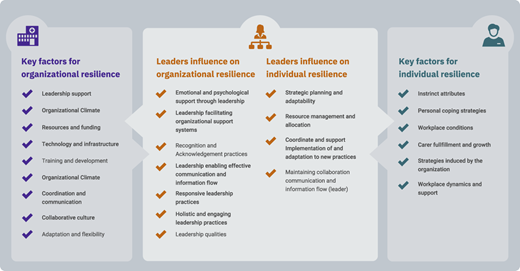
In this review, however, we identified several organizational factors that can contribute to individual resilience and further, be translated into concrete organizational measures for supporting individual resilience in elderly care. Examples were career fulfillment and professional growth, comprehensive workplace support (including leadership support) and enhanced workplace resources (Connelly et al., 2022; Cope et al., 2016; Foley et al., 2021; Lai et al., 2022; Mallon et al., 2023; Midje et al., 2024b; Low et al., 2023; Boamah et al., 2025). Nevertheless, fostering individual resilience requires measures that target both the individual and the organization (Wiig et al., 2023), and fostering organizational resilience requires organizations that facilitate resilience in workers (World Health Organization, 2021). The interplay between individual and organizational resilience found in this review can be summarized thus: resilient organizations enhance individual resilience and resilient individuals, in turn, bolster overall organizational resilience. The precise nature and extent of this interplay remains unclear and warrants further investigation. However, the current review suggests that leaders occupy a central position in these complex dynamics, positioning them to influence and mediate between both dimensions (Figure 3).

Several examples in the reviewed literature illuminate the interplay between individual and organizational resilience, as well as the leaders' mediating role. When leaders establish trust and respect among employees, they can thereby foster greater autonomy and enhanced healthcare personnel's ability to adapt (adaptive capacity) (Caspar et al., 2020; Connelly et al., 2022) – a key driver of organizational resilience (Wiig et al., 2020b). However, a significant aspect to consider in this context, is that while fostering adaptive capacity is key for enhancing organizational resilience (Fagerdal et al., 2022), it is equally imperative for the organization, including its leaders, to establish robust and stable frameworks within which healthcare workers can operate (Grote, 2019; Macrae, 2013). Leaders must also recognize that adaptations can be both beneficial and detrimental, whereas negative or low value adaptations often signal poor organizational structure and can compromise the safety of both healthcare personnel and patients (Glette et al., 2023; Wears and Hettinger, 2014). The significance of leaders establishing robust and stable frameworks to support individual and organizational resilience were particularly highlighted in the included studies on the pandemic. By and large, these studies found that the provision of timely and adequate information by leaders during the COVID-19 pandemic reduced stress and increased security among healthcare personnel (Glette et al., 2024; Krane et al., 2023; Lyng et al., 2021), thereby addressing emerging issues of tension, anxiety and potential turnover during that period (Falatah, 2021). Moreover, the literature provided examples of improved individual resilience when leaders facilitated dedicated time and space for healthcare personnel to reflect, vent and be heard (Boettcher et al., 2023; Nachtergaele et al., 2024). Creating and supporting reflexive spaces – defined as physical or virtual platforms for dialogue and reflection – has been identified as crucial for developing resilient healthcare services (Wiig et al., 2020a). Such spaces enable workers to collectively reflect on current challenges, necessary adaptations and daily work needs. In addition to serving as outlets for venting and reflection, these spaces can offer valuable insights into measures that reinforce healthcare professionals' resilience at both organizational and individual levels. They also promote effective and collaborative decision-making, as well as increased professional autonomy – further linking organizational and individual resilience, as indicated by the results (Hughes et al., 2024).

Building on the preceding review, a deeper understanding of the interplay between organizational and individual resilience – and the central role of leaders as mediators – is essential for promoting resilience in healthcare. An increased understanding of these dynamics can enhance leaders' awareness of their capacity as resilience drivers. This awareness can enable leaders to recognize and effectively leverage their positions to foster both individual and organizational resilience. These insights can inform the development of specific, targeted organizational measures that leaders can implement in clinical practice to support resilience across all levels.

Leadership is shaped by multiple factors, including individual resilience, personality traits, leadership style and the governance structures within which they operate. Nevertheless, which leadership style is most effective in promoting resilience in healthcare has previously been discussed in the literature (Eliot, 2020; Tvedt et al., 2023; Barasa et al., 2018). The current notion is that leaders who foster resilience in healthcare, adapt their leadership styles based on the situation (e.g. crisis vs. normal operation) and their individual workers (e.g. novices vs experienced workers) (Glette et al., 2024; Grote, 2019).

The results of this review do not lead us to be able to discuss specific leadership styles. They do, however, underscore the importance of the relational dimension of leadership in enhancing resilience in healthcare. Leaders who provided emotional support, demonstrated compassion, offered guidance, prioritized well-being, remained accessible, and fostered trust and respect, effectively bolstered healthcare workers' resilience, which in turn reinforced organizational resilience (Yeh et al., 2019; Klockner et al., 2023; Krane et al., 2023; McGuinness et al., 2024; Ree et al., 2023; Foley et al., 2021; Boettcher et al., 2023; Beattie et al., 2023; Caspar et al., 2020; Connelly et al., 2022; Midje et al., 2024b; Hughes et al., 2024; Jamieson et al., 2024; Tingvold and Munkejord, 2023; Lev and Dolberg, 20242022). This is supported by Fagerdal et al. (2022) who found that leaders' engagement with staff increased organizational resilience. They achieved this by fostering a culture of support, flexibility and mutual assistance, which in turn improved the healthcare team's capacity during peak situations.

Considering that healthcare services inherently involve uncertainty and interactions with individuals in challenging life circumstances, coupled with the demands of working within high-tempo, high-reliability organizations that increasingly emphasize effectiveness (Sutcliffe, 2011; Glette and Wiig, 2021), healthcare personnel often face additional strain. This highlights the need for compassionate leadership to support individual resilience (de Zulueta, 2015), in addition to facilitating organizational resilience (e.g. manage resource, funding and staffing, technology and infrastructure, facilitate training and reflexive spaces) (Boettcher et al., 2023; Lyng et al., 2021; Tingvold and Munkejord, 2023; Wilkinson et al., 2023; Idsøe-Jakobsen et al., 2025).

Informal caregivers are the backbone of long-term care and serve as a crucial complement to formal healthcare services in elderly care (Organization, 2024; Coon, 2012). Moreover, they are increasingly recognized as key contributors to resilient healthcare systems, including their role in supporting performance variability and adaptations (Guise et al., 2024). This is exemplified through their work in supporting and advocating for patients, filling in information gaps within and across healthcare providers, settings and system levels, filling gaps in the system by directly covering up for healthcare tasks when needed, or support healthcare personnels' work by monitoring and observing the patients' condition (Guise et al., 2024). The need for informal caregivers to be able to maintain future healthcare delivery will continue to increase in line with the expected rising healthcare demands and subsequent healthcare workers crisis. Consequently, the caregiver burden will increase (Lindt et al., 2020), necessitating further attention for informal caregivers' resilience.

The findings of this review indicate that informal caregivers share similar needs with healthcare professionals in maintaining individual resilience throughout their caregiving responsibilities. Key factors include a sense of control (Jones et al., 2024), feelings of competence (Donnellan et al., 2015; Mehta et al., 2017; Joling et al., 2017; Casey et al., 2024) and opportunities for skill development (Mehta et al., 2017; Leocadie et al., 2020; Leslie et al., 2020). Additionally, the review highlights that informal caregivers' resilience is influenced by their access to both relational and professional support – areas in which healthcare leaders have the capacity to intervene and provide assistance in a holistic approach. For example, a study by Bosveld et al. (2024) found that providing patients and informal caregivers with structured, professional support through organized training, via the “Academy for patients and informal caregivers” – a comprehensive, centralized infrastructure within the organization – enhanced informal caregivers’ self-reliance. This, in turn, led to improved mental well-being and self-efficacy.

The literature underscores significant challenges faced by informal caregivers in elderly care, including inadequate information flow, difficulties in navigating the healthcare system and a lack of consistency in available support (Kim et al., 2023). Many caregivers report a lack of awareness and confusion regarding the formal support services available to them (Wiles, 2003). While healthcare professionals generally hold positive attitudes toward informal caregivers, there remains a gap in their knowledge of how to effectively support them, compounded by systemic barriers that hinder meaningful integration into care processes. As a result, caregiver identification, assessment and support mechanisms are often inconsistent (Sabo et al., 2022). One identified study in the current review suggests that healthcare professionals should be mandated and trained to connect with and support informal caregivers (Fisher et al., 2020).

To enable informal caregivers to contribute to healthcare system resilience, the system around them needs to support their individual resilience. While the role of healthcare professionals in supporting informal caregivers is well established in the literature, the role of healthcare leaders – both how they can influence informal caregivers directly and through organization of healthcare work – remains underexplored (Kim et al., 2023; Wiles, 2003; Sabo et al., 2022). Leaders have a unique opportunity to influence the organization and execution of support for informal caregivers in healthcare services. This includes fostering environments that promote effective communication and collaboration between formal and informal caregivers, develop or integrate routines, frameworks and toolkits specifically designed to enable healthcare professionals to more effectively engage and support informal caregivers, ensure allocation of resources to sustain caregiver support – such as support groups, informational resources and training – and facilitate coordination between care providers (Hvalvik and Reierson, 2015; Søvde et al., 2024; Donnellan et al., 2024; Browne et al., 2014; Joling et al., 2017; Westerling et al., 2024). Moreover, leaders can actively and formally integrate informal caregivers into the care process. Programs like Hospital-at-Home have, for example, demonstrated significant benefits, including reduced stress, increased involvement in care decisions and improved health outcomes for both care receiver and the caregiver (Wang et al., 2024b; Snyder, 2025),

The limited data on leaders' possible influence on informal caregivers’ resilience in this review may be attributed to the fact that informal caregivers often have minimal contact with healthcare leaders in many countries. This may, however, increase in line with the emerging mismatch between capacity and demand in healthcare services, and the increased need to include informal caregivers in patient care. This demonstrates a need for further research to address this gap in the literature and to develop and explore interventions to support this. Moreover, the results indicate a need to inform leaders of the importance of supporting resilience in informal caregivers, and the implication well-supported informal caregivers may have on organizational resilience.

This systematic review is the first in its kind to adopt a holistic approach on resilience, encompassing individual and organizational resilience as well as the perspectives and experiences of professionals, leaders and informal caregivers. While we restricted our review to provision of elderly care, our findings are broadly applicable to care delivered by healthcare professionals and informal caregivers.

Although the review aimed to examine how leaders support factors for individual and organizational resilience, the term “leaders” and its variants were not included in the search strategy. This omission could potentially have resulted in missing out on eligible studies. However, during the development of the search strategy, it was found that including the term “leader” significantly narrowed the search. Consequently, a decision was made to exclude it, and instead identify data on leaders through study selection and analysis, ensuring that as many eligible studies as possible were reviewed. Additionally, the search strategy excluded studies published before 2014, non-English language studies, and non-empirical studies. A broader search strategy incorporating these aspects, as well as inclusion of additional search words and databases, could have influenced the study's results.

Further research is needed to gain a more comprehensive understanding of the relationship between individual and organizational resilience as well as the leaders' role.

This review is the first to explore the intersection of individual resilience in healthcare workers and informal caregivers, organizational resilience in elderly care and the role of leadership in shaping these dynamics. The findings highlight the reciprocal relationship between individual and organizational resilience, emphasizing the need to strengthen both to build a resilient healthcare system that ensures adaptive capacity and care quality. The review reinforces leadership as a key driver of resilience in elderly care, emphasizing not only structural and strategic measures but also the enhancement of the relational dimension of leadership. Additionally, it identifies concrete organizational measures that support individual and organizational resilience. Lastly, the review reveals the often-overlooked role of leaders in supporting informal caregivers in elderly care and the lack of research on this critical aspect. Addressing these gaps is essential for fostering an adaptive and sustainable healthcare system.

JBI

Johanna Briggs Institute

PROSPERO

International Prospective Register of Systematic Reviews

PRISMA

Preferred Reporting Items for Systematic Reviews and Meta-Analyses

MKG was in charge of the project administration, took part in the conceptualization process, as well as the search and screening process and had the main responsibility for the formal analysis and the original draft preparation. KA and AH contributed to the formal analysis, the original draft preparation as well as to the quality assessment and screening process. SW, HBL and CHD had the main responsibility for the conceptualization of the project idea and contributed to the project development, screening, reviewing and editing the manuscript. VG, IJB, RB, MF, AC, FT, MKRS, KRO, ML, SS, SN, LE, TS, SK, EK, ER, AKV, PC and LP contributed to the screening process, data extraction, quality assessment, project discussions and reviewing and editing the manuscript. JB and RCW contributed to project discussions and quality assurance of the manuscript, including reviewing and editing the manuscript.

The authors extend their gratitude to University Librarian Katharina Töpfer for developing the search strategy and assisting with the data base search process. Additionally they thank Jørn Ole Borum for his graphical design of Figure 3 and Daniel Adrian Lungu for designing the Excel data extraction sheet.

The supplementary material for this article can be found online.
Aase
,
K.
,
Guise
,
V.
,
Billett
,
S.
,
Sollid
,
S.J.M.
,
Njå
,
O.
,
Røise
,
O.
,
Manser
,
T.
,
Anderson
,
J.E.
and
Wiig
,
S.
(
2020
), “
Resilience in Healthcare (RiH): a longitudinal research programme protocol
”,
BMJ Open
, Vol. 
10
No. 
10
, e038779, doi: .
Agostini
,
L.
,
Onofrio
,
R.
,
Piccolo
,
C.
and
Stefanini
,
A.
(
2023
), “
A management perspective on resilience in healthcare: a framework and avenues for future research
”,
BMC Health Services Research
, Vol. 
23
No. 
1
, p.
774
, doi: .
Akerjordet
,
K.
,
Furunes
,
T.
and
Haver
,
A.
(
2018
), “
Health-promoting leadership: an integrative review and future research agenda
”,
Journal of Advanced Nursing
, Vol. 
74
No. 
7
, pp. 
1505
-
1516
, doi: .
Alcañiz-Garrán
,
M.
,
García-Sanjuán
,
S.
,
Ramos-Pichardo
,
J.D.
,
Sanjuán-Quiles
,
A.
and
Montejano-Lozoya
,
R.
(
2021
), “
The experiences of older individuals providing care to older dependents: a phenomenological study in Spain
”,
PLoS One
, Vol. 
16
No. 
8
, e0255600, doi: .
Amateau
,
G.
,
Gendron
,
T.L.
and
Rhodes
,
A.
(
2023
), “
Stress, strength, and respect: viewing direct care staff experiences through a trauma-informed lens
”,
Gerontology and Geriatrics Education
, Vol. 
44
No. 
3
, pp. 
380
-
395
, doi: .
Anesi
,
G.L.
and
Kerlin
,
M.P.
(
2021
), “
The impact of resource limitations on care delivery and outcomes: routine variation, the coronavirus disease 2019 pandemic, and persistent shortage
”,
Current Opinion in Critical Care
, Vol. 
27
No. 
5
, pp. 
513
-
519
, doi: .
Arbel
,
I.
,
Cameron
,
J.I.
,
Trentham
,
B.
and
Dawson
,
D.R.
(
2025
), “
A narrative inquiry into how oldest-old care-givers of people with dementia manage age-related care-giving challenges
”,
Ageing and Society
, Vol. 
45
No. 
4
, pp. 
656
-
685
, doi: .
Arnold
,
K.A.
(
2017
), “
Transformational leadership and employee psychological well-being: a review and directions for future research
”,
Journal of Occupational Health Psychology
, Vol. 
22
No. 
3
, pp. 
381
-
393
, doi: .
Ayalon
,
L.
and
Green
,
O.
(
2015
), “
Live-in versus live-out home care in Israel: satisfaction with services and caregivers’ outcomes
”,
The Gerontologist
, Vol. 
55
No. 
4
, pp. 
628
-
642
, doi: .
Baik
,
D.
,
McIlvennan
,
C.K.
,
Baker
,
C.
and
Coats
,
H.
(
2022
), “
Caregiving experiences of older family caregivers of persons with heart failure: a mixed methods study
”,
Geriatric Nursing
, Vol. 
48
, pp. 
51
-
57
, doi: .
Bamonti
,
P.
,
Conti
,
E.
,
Cavanagh
,
C.
,
Gerolimatos
,
L.
,
Gregg
,
J.
,
Goulet
,
C.
,
Pifer
,
M.
and
Edelstein
,
B.
(
2019
), “
Coping, cognitive emotion regulation, and burnout in long-term care nursing staff: a preliminary study
”,
Journal of Applied Gerontology: The Official Journal of the Southern Gerontological Society
, Vol. 
38
No. 
1
, pp. 
92
-
111
, doi: .
Barasa
,
E.
,
Mbau
,
R.
and
Gilson
,
L.
(
2018
), “
What is resilience and how can it Be nurtured? A systematic review of empirical literature on organizational resilience
”,
International Journal of Health Policy and Management
, Vol. 
7
No. 
6
, pp. 
491
-
503
, doi: .
Baughman
,
A.W.
,
Renton
,
M.
,
Wehbi
,
N.K.
,
Sheehan
,
E.J.
,
Gregorio
,
T.M.
,
Yurkofsky
,
M.
,
Levine
,
S.
,
Jackson
,
V.
,
Pu
,
C.T.
and
Lipsitz
,
L.A.
(
2021
), “
Building community and resilience in Massachusetts nursing homes during the COVID‐19 pandemic
”,
Journal of the American Geriatrics Society
, Vol. 
69
No. 
10
, pp. 
2716
-
2721
, doi: .
Beattie
,
M.
,
Carolan
,
C.
,
Macaden
,
L.
,
Maciver
,
A.
,
Dingwall
,
L.
,
Macgilleeathain
,
R.
and
Schoultz
,
M.
(
2023
), “
Care home workers experiences of stress and coping during COVID-19 pandemic: a mixed methods study
”,
Nursing Open
, Vol. 
10
No. 
2
, pp. 
687
-
703
, doi: .
Belur
,
J.
,
Tompson
,
L.
,
Thornton
,
A.
and
Simon
,
M.
(
2021
), “
Interrater reliability in systematic review methodology: exploring variation in coder decision-making
”,
Sociological Methods and Research
, Vol. 
50
No. 
2
, pp. 
837
-
865
, doi: .
Bergqvist
,
M.
,
Bastholm‐Rahmner
,
P.
,
Gustafsson
,
L.L.
,
Holmgren
,
K.
,
Veg
,
A.
,
Wachtler
,
C.
and
Schmidt‐Mende
,
K.
(
2023
), “
How much are we worth? Experiences of nursing assistants in Swedish nursing homes during the first wave of COVID‐19
”,
International Journal of Older People Nursing
, Vol. 
18
No. 
1
, pp. 
1
-
11
, doi: .
Bing-Jonsson
,
P.C.
,
Hofoss
,
D.
,
Kirkevold
,
M.
,
Bjørk
,
I.T.
and
Foss
,
C.
(
2016
), “
Sufficient competence in community elderly care? Results from a competence measurement of nursing staff
”,
BMC Nursing
, Vol. 
15
No. 
1
, p.
5
, doi: .
Birt
,
L.
,
Lane
,
K.
,
Corner
,
J.
,
erson
,
K.
and
Bunn
,
D.
(
2023
), “
Care-home nurses’ responses to the COVID-19 pandemic: managing ethical conundrums at personal cost: a qualitative study
”,
Journal of Nursing Scholarship: An Official Publication of Sigma Theta Tau International Honor Society of Nursing
, Vol. 
55
No. 
1
, pp. 
226
-
238
, doi: .
Blanco-Donoso
,
L.M.
,
Moreno-Jiménez
,
J.
,
Gallego-Alberto
,
L.
,
Amutio
,
A.
,
Moreno-Jiménez
,
B.
and
Garrosa
,
E.
(
2022
), “
Satisfied as professionals, but also exhausted and worried!!: the role of job demands, resources and emotional experiences of Spanish nursing home workers during the COVID-19 pandemic
”,
Health and Social Care in the Community
, Vol. 
30
No. 
1
, pp. 
e148
-
e160
, doi: .
Boamah
,
S.A.
,
Akter
,
F.
,
Karimi
,
B.
and
Havaei
,
F.
(
2025
), “
Navigating workforce challenges in long-term care: a Co-design approach to solutions
”,
International Journal of Environmental Research and Public Health
, Vol. 
22
No. 
4
, p.
520
, doi: .
Boettcher
,
N.
,
Celis
,
S.
and
Lashewicz
,
B.
(
2023
), “
Canadian long-term residential care staff recommendations for pandemic preparedness and workforce mental health
”,
Journal of Long-Term Care
, pp. 
178
-
194
, doi: .
Bosveld
,
M.H.
,
Smits
,
A.G.M.
,
Mertens
,
H.J.M.M.
,
Zandvoort
,
M.J.J.M.v.
,
Mook
,
W.N.K.A.v.
and
Bokhoven
,
M.A.v.
(
2024
), “
Patients and informal caregivers in the lead: a qualitative study on the experiences of patients, informal caregivers, and healthcare professionals with involvement in treatment, e-health and self-management programs
”,
BMC Health Services Research
, Vol. 
24
No. 
1
, p.
713
, doi: .
Bowman
,
A.
(
2022
), “
Leadership and resilience: where the literature stands
”,
Journal of Leadership Studies
, Vol. 
16
No. 
2
, pp. 
33
-
41
, doi: .
Boyacıoğlu
,
N.E.
and
Kutlu
,
Y.
(
2017
), “
The effectiveness of psychoeducational interventions in reducing the care burden of family members caring for the elderly in Turkey: a randomized controlled study
”,
Archives of Psychiatric Nursing
, Vol. 
31
No. 
2
, pp. 
183
-
189
, doi: .
Braithwaite
,
J.
,
Wears
,
R.L.
and
Hollnagel
,
E.
(
2015
), “
Resilient health care: turning patient safety on its head
”,
International Journal for Quality in Health Care
, Vol. 
27
No. 
5
, pp. 
418
-
420
, doi: .
Browne
,
C.V.
,
Mokuau
,
N.
,
Ka'opua
,
L.S.
,
Kim
,
B.J.
,
Higuchi
,
P.
and
Braun
,
K.L.
(
2014
), “
Listening to the voices of native Hawaiian elders and ‘ohana caregivers’: discussions on aging, health, and care preferences
”,
Journal of Cross-Cultural Gerontology
, Vol. 
29
No. 
2
, pp. 
131
-
151
.
Butler
,
S.
(
2018
), “
Exploring relationships among occupational safety, job turnover, and age among home care aides in Maine
”,
New Solutions: A Journal of Environmental and Occupational Health Policy
, Vol. 
27
No. 
4
, pp. 
501
-
523
, doi: .
Casey
,
D.
,
Smyth
,
S.
,
Doyle
,
P.
,
Gallagher
,
N.
,
O'Sullivan
,
G.
,
Murphy
,
K.
,
Dröes
,
R.-M.
and
Whelan
,
B.
(
2024
), “
An embedded qualitative study of the experiences of people with dementia, their caregivers and volunteer older adults who participated in the CREST resilience-building psychosocial intervention
”,
BMC Geriatrics
, Vol. 
24
No. 
1
, p.
780
, doi: .
Caspar
,
S.
,
Phinney
,
A.
,
Spenceley
,
S.
and
Ratner
,
P.
(
2020
), “
Creating cultures of care: exploring the social organization of care delivery in long-term care homes
”,
Journal of Long-Term Care
, Vol. 
2020
, pp. 
13
-
29
, doi: .
Chang
,
S.O.
and
Eun Young
,
K.
(
2022
), “
The resilience of nursing staffs in nursing homes: concept development applying a hybrid model
”,
BMC Nursing
, Vol. 
21
, pp. 
1
-
12
.
Chang
,
S.O.
and
Eun Young
,
K.
(
2023
), “
The resilience of nursing staffs in nursing homes: concept development applying a hybrid model
”,
BMC Nursing
, Vol. 
21
, pp. 
1
-
12
.
Chang
,
S.O.
and
Kim
,
E.Y.
(
2022
), “
Ways that nursing home nursing staff build resilience: a phenomenographic approach
”,
BMC Geriatrics
, Vol. 
22
No. 
1
, pp. 
1
-
10
, doi: .
Chen
,
M.-C.
,
Palmer
,
M.H.
and
Lin
,
S.-Y.
(
2021
), “
Pilot test of a learned resourcefulness program for older family caregivers in Taiwan
”,
Geriatric Nursing
, Vol. 
42
No. 
5
, pp. 
1129
-
1134
, doi: .
Cleary
,
M.
,
Kornhaber
,
R.
,
Thapa
,
D.K.
,
West
,
S.
and
Visentin
,
D.
(
2018
), “
The effectiveness of interventions to improve resilience among health professionals: a systematic review
”,
Nurse Education Today
, Vol. 
71
, pp. 
247
-
263
, doi: .
Coles
,
E.
,
Wells
,
M.
,
Maxwell
,
M.
,
Harris
,
F.M.
,
Anderson
,
J.
,
Gray
,
N.M.
,
Milner
,
G.
and
MacGillivray
,
S.
(
2017
), “
The influence of contextual factors on healthcare quality improvement initiatives: what works, for whom and in what setting? Protocol for a realist review
”,
Systematic Reviews
, Vol. 
6
No. 
1
, p.
168
, doi: .
Connelly
,
D.M.
,
Garnett
,
A.
,
Snobelen
,
N.
,
Guitar
,
N.
,
Flores-S
,
oval
,
C.
,
Sinha
,
S.
,
Calver
,
J.
,
Pearson
,
D.
and
Smith-Carrier
,
T.
(
2022
), “
Resilience amongst Ontario registered practical nurses in long-term care homes during COVID-19: a grounded theory study
”,
Journal of Advanced Nursing
, Vol. 
78
No. 
12
, pp. 
4221
-
4235
, doi: .
Connor
,
K.M.
and
Davidson
,
J.R.T.
(
2003
), “
Development of a new resilience scale: the Connor-Davidson resilience scale (CD-RISC)
”,
Depression and Anxiety
, Vol. 
18
No. 
2
, pp. 
76
-
82
, doi: .
Conway
,
L.
,
Wolverson
,
E.
and
Clarke
,
C.
(
2020
), “
Shared experiences of resilience amongst couples where one partner is living with dementia-A grounded theory study
”,
Frontiers of Medicine
, Vol. 
7
, p.
219
, doi: .
Coon
,
D.W.
(
2012
), “
Resilience and family caregiving
”,
Annual Review of Gerontology and Geriatrics
, Vol. 
32
No. 
1
, pp. 
231
-
249
, doi: .
Cooper
,
A.L.
,
Brown
,
J.A.
and
Leslie
,
G.D.
(
2021
), “
Nurse resilience for clinical practice: an integrative review
”,
Journal of Advanced Nursing
, Vol. 
77
No. 
6
, pp. 
2623
-
2640
, doi: .
Cope
,
V.
(
2016
), “
The resilience of aged care nurses
”,
Australian Nursing and Midwifery Journal
, Vol. 
23
No. 
7
, p.
39
.
Cope
,
V.C.
,
Jones
,
B.
and
Hendricks
,
J.
(
2016
), “
Residential aged care nurses: portraits of resilience
”,
Contemporary Nurse
, Vol. 
52
No. 
6
, pp. 
736
-
752
, doi: .
Cottrell
,
L.
,
Duggleby
,
W.
,
Ploeg
,
J.
,
McAiney
,
C.
,
Peacock
,
S.
,
Ghosh
,
S.
,
Holroyd-Leduc
,
J.M.
,
Nekolaichuk
,
C.
,
Forbes
,
D.
,
Paragg
,
J.
and
Swindle
,
J.
(
2020
), “
Using focus groups to explore caregiver transitions and needs after placement of family members living with dementia in 24-hour care homes
”,
Aging and Mental Health
, Vol. 
24
No. 
2
, pp. 
227
-
232
, doi: .
de la Cuesta-Benjumea
,
C.
,
Ramis-Ortega
,
E.
and
Arredondo Gonzalez
,
C.P.
(
2019
), “
To manage a complex dependency: the experience of caregiving after a fall
”,
J Adv Nurs
, Vol. 
75
No. 
1
, pp.
138
-
149
, doi: .
de Zulueta
,
P.C.
(
2015
), “
Developing compassionate leadership in health care: an integrative review
”,
Journal of Healthcare Leadership
, Vol. 
8
, pp. 
1
-
10
, doi: .
DeGraves
,
B.S.
,
Titley
,
H.
,
Duan
,
Y.
,
Thorne
,
T.E.
,
Banerjee
,
S.
,
Ginsburg
,
L.
,
Salma
,
J.
,
Hegadoren
,
K.
,
Angel
,
C.
,
Keefe
,
J.
,
Lanius
,
R.
and
Estabrooks
,
C.A.
(
2024
), “
Workforce resilience supporting staff in managing stress: a coherent breathing intervention for the long‐term care workforce
”,
Journal of American Geriatrics Society
, Vol. 
72
No. 
3
, pp. 
753
-
766
, doi: .
Dellafiore
,
F.
,
Diamanti
,
O.
,
Guardamagna
,
L.
,
Modena
,
G.
,
Servi
,
P.
,
Rotondo
,
D.A.
,
Nania
,
T.
,
Saba
,
A.
and
Artioli
,
G.
(
2025
), “
The transition to caregiver in advanced Alzheimer’s disease: from emotional connection to care responsibility—a grounded theory approach
”,
Nursing Reports
, Vol. 
15
No. 
8
, p.
284
, doi: .
Dickey
,
S.
,
Krienke
,
L.
,
Rosemberg
,
M.A.
and
Bell
,
S.A.
(
2023
), “
Home-based care and mental health during a disaster: a qualitative analysis
”,
Journal of Applied Gerontology
, Vol. 
42
No. 
2
, pp. 
213
-
220
, doi: .
Dixon-Woods
,
M.
(
2011
), “
Using framework-based synthesis for conducting reviews of qualitative studies
”,
BMC Medicine
, Vol. 
9
No. 
1
, p.
39
, doi: .
Donnellan
,
W.J.
,
Bennett
,
K.M.
and
Soulsby
,
L.K.
(
2015
), “
What are the factors that facilitate or hinder resilience in older spousal dementia carers? A qualitative study
”,
Aging and Mental Health
, Vol. 
19
No. 
10
, pp. 
932
-
939
, doi: .
Donnellan
,
W.J.
,
Bennett
,
K.M.
and
Soulsby
,
L.K.
(
2017
), “
Family close but friends closer: exploring social support and resilience in older spousal dementia carers
”,
Aging and Mental Health
, Vol. 
21
No. 
11
, pp. 
1222
-
1228
, doi: .
Donnellan
,
W.J.
,
Bennett
,
K.M.
and
Soulsby
,
L.K.
(
2019
), “
How does carer resilience change over time and care status? A qualitative longitudinal study
”,
Aging and Mental Health
, Vol. 
23
No. 
11
, pp. 
1510
-
1516
, doi: .
Donnellan
,
W.J.
,
Bennett
,
K.M.
and
Watson
,
N.
(
2024
), “
Exploring resilience in adult daughter and spousal carers of people living with dementia in North West England: an ecological approach
”,
Quality in Ageing and Older Adults
, Vol. 
22
No. 
1
, pp. 
40
-
55
, doi: .
Dorell
,
Å.
,
Bäckström
,
B.
,
Ericsson
,
M.
,
Johansson
,
M.
,
Östlund
,
U.
and
Sundin
,
K.
(
2016
), “
Experiences with family health conversations at residential homes for older people
”,
Clinical Nursing Research
, Vol. 
25
No. 
5
, pp. 
560
-
582
, doi: .
Dorell
,
Å.
,
Isaksson
,
U.
,
Östlund
,
U.
and
Sundin
,
K.
(
2017
), “
Family health conversations have positive outcomes on families - a mixed method research study
”,
The Open Nursing Journal
, Vol. 
11
No. 
1
, pp. 
14
-
25
, doi: .
Dreher
,
M.M.
,
Hughes
,
R.G.
,
ley
,
P.A.
and
Tavakoli
,
A.S.
(
2019
), “
Improving retention among certified nursing assistants through compassion fatigue awareness and self-care skills education
”,
Journal of Holistic Nursing
, Vol. 
37
No. 
3
, pp. 
296
-
308
.
Eliot
,
J.L.
(
2020
), “
Resilient leadership: the impact of a servant leader on the resilience of their followers
”,
Advances in Developing Human Resources
, Vol. 
22
No. 
4
, pp. 
404
-
418
, doi: .
Elliott
,
K.-E.J.
,
Stirling
,
C.M.
,
Martin
,
A.J.
,
Robinson
,
A.L.
and
Scott
,
J.L.
(
2016
), “
We are not all coping: a cross-sectional investigation of resilience in the dementia care workforce
”,
Health Expectations
, Vol. 
19
No. 
6
, pp. 
1251
-
1264
, doi: .
Ellis
,
L.A.
,
Churruca
,
K.
,
Clay-Williams
,
R.
,
Pomare
,
C.
,
Austin
,
E.E.
,
Long
,
J.C.
,
Grødahl
,
A.
and
Braithwaite
,
J.
(
2019
), “
Patterns of resilience: a scoping review and bibliometric analysis of resilient health care
”,
Safety Science
, Vol. 
118
, pp. 
241
-
257
, doi: .
Fagerdal
,
B.
,
Lyng
,
H.B.
,
Guise
,
V.
,
Anderson
,
J.E.
,
Thornam
,
P.L.
and
Wiig
,
S.
(
2022
), “
Exploring the role of leaders in enabling adaptive capacity in hospital teams - a multiple case study
”,
BMC Health Services Research
, Vol. 
22
No. 
1
, p.
908
, doi: .
Falatah
,
R.
(
2021
), “
The impact of the coronavirus disease (COVID-19) pandemic on nurses' turnover intention: an integrative review
”,
Nursing Reports
, Vol. 
11
No. 
4
, pp. 
787
-
810
, doi: .
Fisher
,
R.
,
Parmar
,
J.
,
Duggleby
,
W.
,
Tian
,
P.G.J.
,
Janzen
,
W.
,
Anderson
,
S.
and
Brémault-Phillips
,
S.
(
2020
), “
Health-care workforce training to effectively support family caregivers of seniors in care
”,
Canadian Geriatrics Journal
, Vol. 
23
No. 
2
, pp. 
160
-
171
, doi: .
Foley
,
L.
,
Avramidis
,
P.
and
all
,
S.
(
2021
), “
New to the community setting: nurses’ experiences and the importance of orientation
”,
Australian Journal of Primary Health
, Vol. 
27
No. 
1
, pp. 
50
-
56
, doi: .
Förster
,
C.
,
Duchek
,
S.
,
Geithner
,
S.
and
Krägler
,
M.
(
2023
), “
Developing an integrated framework of healthcare leaders’ resilience
”,
Review of Managerial Science
, Vol. 
17
No. 
5
, pp. 
1765
-
1788
, doi: .
Førsund
,
L.H.
and
Schumacher
,
E.
(
2024
), “
Alone yet accountable, the unseen buffers: a qualitative study of nurses' experiences working in home care during the COVID-19 pandemic
”,
Scandinavian Journal of Caring Sciences
, Vol. 
38
No. 
2
, pp. 
321
-
333
, doi: .
Franzosa
,
E.
,
Gorbenko
,
K.
,
Brody
,
A.A.
,
Leff
,
B.
,
Ritchie
,
C.S.
,
Kinosian
,
B.
,
Ornstein
,
K.A.
and
Federman
,
A.D.
(
2021
), “
At home, with care: lessons from New York city home‐based primary care practices managing COVID‐19
”,
Journal of the American Geriatrics Society
, Vol. 
69
No. 
2
, pp. 
300
-
306
, doi: .
Gao
,
F.
,
Newcombe
,
P.
,
Tilse
,
C.
,
Wilson
,
J.
and
Tuckett
,
A.
(
2014
), “
Models for predicting turnover of residential aged care nurses: a structural equation modelling analysis of secondary data
”,
International Journal of Nursing Studies
, Vol. 
51
No. 
9
, pp. 
1258
-
1270
, doi: .
Garcia
,
C.d.L.
,
Abreu
,
L.C.d.
,
Ramos
,
J.L.S.
,
Castro
,
C.F.D.d.
,
Smiderle
,
F.R.N.
,
Santos
,
J.A.d.
and
Bezerra
,
I.M.P.
(
2019
), “
Influence of burnout on patient safety: systematic review and meta-analysis
”,
Medicina
, Vol. 
55
No. 
9
, p.
553
, doi: .
Gebhard
,
D.
,
Neumann
,
J.
,
Wimmer
,
M.
and
Mess
,
F.
(
2022
), “
The second side of the coin—resilience, meaningfulness and joyful moments in home health care workers during the COVID-19 pandemic
”,
International Journal of Environmental Research and Public Health
, Vol. 
19
No. 
7
,
3836
, doi: .
Glette
,
M.K.
and
Wiig
,
S.
(
2021
), “
The role of organizational factors in how efficiency-thoroughness trade-offs potentially affect clinical quality dimensions – a review of the literature
”,
International Journal of Health Governance
, Vol. 
26
No. 
3
, pp. 
250
-
265
, doi: .
Glette
,
M.K.
,
Røise
,
O.
,
Kringeland
,
T.
,
Churruca
,
K.
,
Braithwaite
,
J.
and
Wiig
,
S.
(
2018
), “
Nursing home leaders' and nurses' experiences of resources, staffing and competence levels and the relation to hospital readmissions - a case study
”,
BMC Health Services Research
, Vol. 
18
No. 
1
, p.
955
, doi: .
Glette
,
M.K.
,
Ludlow
,
K.
,
Wiig
,
S.
,
Bates
,
D.W.
and
Austin
,
E.E.
(
2023
), “
Resilience perspective on healthcare professionals' adaptations to changes and challenges resulting from the COVID-19 pandemic: a meta-synthesis
”,
BMJ Open
, Vol. 
13
No. 
9
, e071828, doi: .
Glette
,
M.K.
,
Kringeland
,
T.
,
Samal
,
L.
,
Bates
,
D.W.
and
Wiig
,
S.
(
2024
), “
A qualitative study of leaders' experiences of handling challenges and changes induced by the COVID-19 pandemic in rural nursing homes and homecare services
”,
BMC Health Services Research
, Vol. 
24
No. 
1
, p.
442
, doi: .
Grigorovich
,
A.
,
Rittenberg
,
N.
,
Dick
,
T.
,
McCann
,
A.
,
Abbott
,
A.
,
Kmielauskas
,
A.
,
Estioko
,
V.
,
Kulasingham
,
S.
and
Cameron
,
J.I.
(
2024
), “
Roles and coping strategies of sons caring for a parent with dementia
”,
American Journal of Occupational Therapy
, Vol. 
70
No. 
1
, pp. 
1
-
9
, doi: .
Grote
,
G.
(
2019
), “Leadership in resilient organizations”, in
Wiig
,
S.
and
Fahlbruch
,
B.
(Eds),
Exploring Resilience : A Scientific Journey from Practice to Theory
,
Springer Open
,
Cham
, pp. 
59
-
67
.
Guise
,
V.
,
Chambers
,
M.
,
Lyng
,
H.B.
,
Haraldseid-Driftland
,
C.
,
Schibevaag
,
L.
,
Fagerdal
,
B.
,
Dombestein
,
H.
,
Ree
,
E.
and
Wiig
,
S.
(
2024
), “
Identifying, categorising, and mapping actors involved in resilience in healthcare: a qualitative stakeholder analysis
”,
BMC Health Services Research
, Vol. 
24
No. 
1
, p.
230
, doi: .
Hainstock
,
T.
,
Cloutier
,
D.
and
Penning
,
M.
(
2017
), “
From home to 'home': mapping the caregiver journey in the transition from home care into residential care
”,
Journal of Aging Studies
, Vol. 
43
, pp. 
32
-
39
, doi: .
Hazzan
,
A.A.
,
Dauenhauer
,
J.
,
Follansbee
,
P.
,
Hazzan
,
J.O.
,
Allen
,
K.
and
Omobepade
,
I.
(
2022
), “
Family caregiver quality of life and the care provided to older people living with dementia: qualitative analyses of caregiver interviews
”,
BMC Geriatrics
, Vol. 
22
No. 
1
, pp. 
1
-
11
, doi: .
Herz
,
M.
,
Bösl
,
S.
and
Gebhard
,
D.
(
2024
), “
Individual and organizational interventions to promote staff health and well-being in residential long-term care: a systematic review of randomized controlled trials over the past 20 years
”,
BMC Nursing
, Vol. 
23
No. 
1
, p.
195
, doi: .
Hoeks
,
R.A.
,
Deml
,
M.J.
,
Dubois
,
J.
,
Senn
,
O.
,
Streit
,
S.
,
Rachamin
,
Y.
and
Jungo
,
K.T.
(
2023
), “
Broken bones and apple brandy: resilience and sensemaking of general practitioners and their at-risk patients during the COVID-19 pandemic in Switzerland
”,
Anthropology and Medicine
, Vol. 
30
No. 
4
, pp. 
346
-
361
, doi: .
Hollnagel
,
E.
,
Braithwaite
,
J.
and
Wears
,
R.L.
(
2013
),
Resilient Health Care
,
Ashgate
,
Farnham, Surrey
.
Hollnagel
,
E.
,
Robert
,
L.W.
and
Braithwaite
,
J.
(
2015
), “
From Safety-I to Safety -II: a white paper
”,
The Resilient Health care Net, University of Southern Denmark, University of Florida, USA, and Macquarie University, Australia
.
Hong
,
Z.
,
Zhou
,
W.
,
Song
,
M.
,
Wang
,
Y.
,
Liu
,
S.
and
Zhang
,
L.
(
2022
), “
Social support and mental health of caregivers in pension institutions: a mediated moderation model
”,
Current Psychology
, Vol. 
41
No. 
3
, pp. 
1395
-
1403
, doi: .
Howe
,
A.S.
,
Jules
,
K.
,
Tan
,
J.K.C.D.
,
Khan
,
R.
,
Li
,
A.K.C.
,
Edwards
,
B.
,
King
,
E.C.
,
Nizzer
,
S.
,
Gohar
,
B.
,
Yazdani
,
A.
,
Bani-Fatemi
,
A.
,
Chattu
,
V.K.
,
Sinclair
,
L.
,
Kay
,
M.
and
Nowrouzi-Kia
,
B.
(
2024
), “
The effects of occupational and mental stress among home care rehabilitation professionals working during the COVID-19 pandemic: an exploratory qualitative study
”,
Home Health Care Management and Practice
, Vol. 
36
No. 
3
, pp. 
230
-
242
, doi: .
Huey
,
C.W.T.
and
Palaganas
,
J.C.
(
2020
), “
What are the factors affecting resilience in health professionals? A synthesis of systematic reviews
”,
Medical Teacher
, Vol. 
42
No. 
5
, pp. 
550
-
560
, doi: .
Hughes
,
M.
,
Butchard
,
S.
and
Giebel
,
C.
(
2023
), “
The role of identity in the experiences of dementia care workers from a minority ethnic background during the COVID-19 pandemic: a qualitative study
”,
Health Expectations
, Vol. 
26
No. 
4
, pp. 
1668
-
1678
, doi: .
Hughes
,
M.
,
Butchard
,
S.
and
Giebel
,
C.
(
2024
), “
The role of identity in the experiences of dementia care workers from a minority ethnic background during the COVID-19 pandemic: a qualitative study
”,
Health Expectations
, Vol. 
26
No. 
4
, pp. 
1668
-
1678
, doi: .
Hung
,
L.
,
Yang
,
S.C.
,
Guo
,
E.
,
Sakamoto
,
M.
,
Mann
,
J.
,
Dunn
,
S.
and
Horne
,
N.
(
2022
), “
Staff experience of a Canadian long-term care home during a COVID-19 outbreak: a qualitative study
”,
BMC Nursing
, Vol. 
21
No. 
1
, p.
45
, doi: .
Hung
,
L.
,
Boucher
,
N.A.
,
Ren
,
L.H.
,
Wong
,
K.L.Y.
,
Wong
,
J.O.Y.
,
Zhao
,
Y.
and
Wu
,
T.
(
2025
), “
Exploring the sources and experiences of joy in caregiving: insights from formal caregivers in long-term care
”,
Journal of the American Medical Directors Association
, Vol. 
26
No. 
3
, doi: .
Hunt
,
B.
,
Truran
,
L.
and
Reynolds
,
F.
(
2018
), “
‘Like a drawing of breath’: leisure-based art-making as a source of respite and identity among older women caring for loved ones with dementia
”,
International Journal of Research in Pharmacology and Pharmacotherapeutics
, Vol. 
10
No. 
1
, pp. 
29
-
44
, doi: .
Hvalvik
,
S.
and
Reierson
,
I.Å.
(
2015
), “
Striving to maintain a dignified life for the patient in transition: next of kin's experiences during the transition process of an older person in transition from hospital to home
”,
International Journal of Qualitative Studies on Health and Well-Being
, Vol. 
10
No. 
1
,
26554
, doi: .
Idsøe-Jakobsen
,
I.
,
Dombestein
,
H.
,
Lawton
,
R.
and
Wiig
,
S.
(
2025
), “
Adaptive capacity within the homecare setting: the importance and value of a shared perception of risk
”,
Journal of Patient Safety
, Vol. 
21
No. 
4
, pp. 
246
-
255
, doi: .
Jacklin
,
K.
,
Pace
,
J.E.
and
Warry
,
W.
(
2015
), “
Informal dementia caregiving among indigenous communities in Ontario, Canada
”,
Care Management Journals: Journal of Case Management; The Journal of Long Term Home Health Care
, Vol. 
16
No. 
2
, pp. 
106
-
120
, doi: .
Jamieson
,
J.A.
,
enboer
,
E.
,
Anderson
,
B.
,
Lordly
,
D.
,
Macdonald
,
B.
and
Fox
,
A.N.N.
(
2024
), “
Changing roles and responsibilities of dietitians from diverse settings during the first three waves of the COVID-19 pandemic in Nova Scotia
”,
Canadian Journal of Dietetic Practice and Research
, Vol. 
85
No. 
1
, pp. 
12
-
19
.
Johannessen
,
T.
,
Ree
,
E.
,
Aase
,
I.
,
Bal
,
R.
and
Wiig
,
S.
(
2021
), “
Exploring managers’ response to a quality and safety leadership intervention: findings from a multiple case study in Norwegian nursing homes and homecare services
”,
BMJ Open Quality
, Vol. 
10
No. 
3
, e001494, doi: .
Joling
,
K.J.
,
Windle
,
G.
,
Dröes
,
R.-M.
,
Huisman
,
M.
,
Hertogh
,
C.M.P.M.
and
Woods
,
R.T.
(
2017
), “
What are the essential features of resilience for informal caregivers of people living with dementia? A Delphi consensus examination
”,
Aging and Mental Health
, Vol. 
21
No. 
5
, pp. 
509
-
517
, doi: .
Jones
,
S.M.
,
Mioshi
,
E.
and
Killett
,
A.
(
2024
), “
Coping but not allowing the coping to be everything: resilience in informal dementia care
”,
Health and Social Care in the Community
, Vol. 
27
No. 
4
, pp. 
e289
-
e297
, doi: .
Joyce
,
S.
,
Shand
,
F.
,
Tighe
,
J.
,
Laurent
,
S.J.
,
Bryant
,
R.A.
and
Harvey
,
S.B.
(
2018
), “
Road to resilience: a systematic review and meta-analysis of resilience training programmes and interventions
”,
BMJ Open
, Vol. 
8
No. 
6
, e017858, doi: .
Kabasinguzi
,
I.
,
Ali
,
N.
and
Ochepo
,
P.
(
2023
), “
Mental health experiences and coping strategies of BAME care workers who worked in nursing and residential care homes during the COVID-19 pandemic in Luton, England
”,
BMC Public Health
, Vol. 
23
No. 
1
, p.
592
, doi: .
Kennedy
,
K.A.
(
2023
), “
The effect of nurse aide retention on Ohio's nursing home resident care experience scores: a facility-level analysis
”,
Journal of Applied Gerontology
, Vol. 
42
No. 
1
, pp. 
37
-
48
, doi: .
Kim
,
H.K.
,
Seo
,
J.H.
and
Park
,
C.H.
(
2022
), “
The mediating effect of self-efficacy and coping strategy in relation to job stress and psychological well-being of home-visiting care workers for elderly during the COVID-19 pandemic
”,
International Journal of Environmental Research and Public Health
, Vol. 
19
No. 
19
,
12164
, doi: .
Kim
,
B.
,
Wister
,
A.
,
O’dea
,
E.
,
Mitchell
,
B.A.
,
Li
,
L.
and
Kadowaki
,
L.
(
2023
), “
Roles and experiences of informal caregivers of older adults in community and healthcare system navigation: a scoping review
”,
BMJ Open
, Vol. 
13
No. 
12
, e077641, doi: .
Klockner
,
K.
,
Crawford
,
C.
,
Craigie
,
M.
,
Tsai
,
L.
and
Hegney
,
D.
(
2021
), “
A qualitative exploration of a mindful resiliency program for community healthcare providers
”,
Nursing and Health Sciences
, Vol. 
23
No. 
3
, pp. 
620
-
627
, doi: .
Klockner
,
K.
,
Crawford
,
C.
,
Craigie
,
M.
,
Tsai
,
L.
and
Hegney
,
D.
(
2023
), “
A qualitative exploration of a mindful resiliency program for community healthcare providers
”,
Nursing and Health Sciences
, Vol. 
23
No. 
3
, pp. 
620
-
627
, doi: .
Knight
,
B.
,
Keane
,
N.
,
Benea
,
D.
and
Stone
,
R.
(
2024
), “
Values and the experience of family care-giving: cultural values or shared family values?
”,
Ageing and Society
, Vol. 
44
No. 
1
, pp. 
61
-
78
, doi: .
Korbus
,
H.
,
Hildebr
,
C.
,
Schott
,
N.
,
Bischoff
,
L.
,
Otto
,
A.-K.
,
Jöllenbeck
,
T.
,
Schoene
,
D.
,
Voelcker-Rehage
,
C.
,
Vogt
,
L.
,
Weigelt
,
M.
and
Wollesen
,
B.
(
2023
), “
Health status, resources, and job demands in geriatric nursing staff: a cross-sectional study on determinants and relationships
”,
International Journal of Nursing Studies
, Vol. 
145
.
Krane
,
M.S.
,
Arntzen
,
C.
,
Tingvold
,
L.
and
Moholt
,
J.-M.
(
2023
), “
Crisis management in Norwegian nursing homes during the covid-19 pandemic: pragmatism and performativity
”,
Journal of Care Research/Tidsskrift for Omsorgsforskning
, Vol. 
9
No. 
2
, pp. 
21
-
36
, doi: .
Lai
,
V.S.-K.
,
Yau
,
S.-Y.
,
Lee
,
L.Y.-K.
,
Li
,
B.S.-Y.
,
Law
,
S.S.-P.
and
Huang
,
S.
(
2022
), “
Caring for older people during and beyond the COVID-19 pandemic: experiences of residential health care workers
”,
International Journal of Environmental Research and Public Health
, Vol. 
19
No. 
22
, 15287, doi: .
Lathren
,
C.R.
,
Efird-Green
,
L.
,
Reed
,
D.
,
Zimmerman
,
S.
,
Perreira
,
K.M.
,
Bluth
,
K.
and
Sloane
,
P.D.
(
2024
), “
The prevalence and benefits of self-compassion among professional caregivers
”,
Journal of the American Medical Directors Association
, Vol. 
25
No. 
8
, 105099, doi: .
Lauritzen
,
J.
,
Bjerrum
,
M.B.
,
Pedersen
,
P.U.
and
Sørensen
,
E.E.
(
2019
), “
Support groups for carers of a person with dementia who lives at home: a focused ethnographic study
”,
Journal of Advanced Nursing
, Vol. 
75
No. 
11
, pp. 
2934
-
2942
, doi: .
Lee
,
A.A.
,
Lee
,
S.N.
and
Armour
,
M.
(
2016
), “
Drivers of change: learning from the lived experiences of nursing home social workers
”,
Social Work in Health Care
, Vol. 
55
No. 
3
, pp. 
247
-
264
, doi: .
Leocadie
,
M.-C.
,
Morvillers
,
J.-M.
,
Pautex
,
S.
and
Rothan-Tondeur
,
M.
(
2020
), “
Characteristics of the skills of caregivers of people with dementia: observational study
”,
BMC Family Practice
, Vol. 
21
No. 
1
, pp. 
1
-
13
, doi: .
Leslie
,
M.
,
Gray
,
R.P.
,
Eales
,
J.
,
Fast
,
J.
,
Magnaye
,
A.
and
Khayatzadeh-Mahani
,
A.
(
2020
), “
The care capacity goals of family carers and the role of technology in achieving them
”,
BMC Geriatrics
, Vol. 
20
No. 
1
, p.
52
, doi: .
Lev
,
S.
and
Dolberg
,
P.
(
2024
), “
You killed the hospital, they have ‘No place left’: the experience of nursing home multidisciplinary staff in Israel during the COVID-19 pandemic
”,
Journal of Aging and Social Policy
, Vol. 
36
No. 
6
, pp. 
1472
-
1492
, doi: .
Lin
,
L.-C.
,
Huang
,
Y.-C.
,
Carter
,
P.
and
Zuniga
,
J.
(
2021
), “
Resilience among nurses in long term care and rehabilitation settings
”,
Applied Nursing Research
, Vol. 
62
, 151518, doi: .
Lindt
,
N.
,
van Berkel
,
J.
and
Mulder
,
B.C.
(
2020
), “
Determinants of overburdening among informal carers: a systematic review
”,
BMC Geriatrics
, Vol. 
20
No. 
1
, p.
304
, doi: .
Liu
,
J.
and
Bern-Klug
,
M.
(
2016
), “
I should be doing more for my parent: Chinese adult children's worry about performance in providing care for their oldest-old parents
”,
International Psychogeriatrics
, Vol. 
28
No. 
2
, pp. 
303
-
315
, doi: .
Low
,
Y.S.
,
Bhar
,
S.
and
Chen
,
W.S.
(
2023
), “
Exploring the relationship between co-worker and supervisor support, self- confidence, coping skills and burnout in residential aged care staff
”,
BMC Nursing
, Vol. 
21
, pp.
1
-
10
.
Lun
,
M.W.A.
(
2024
), “
Caregiver resilience factors among young adult family caregivers of frail elders
”,
Journal of Human Behavior in the Social Environment
, Vol. 
34
No. 
8
, pp. 
1326
-
1339
, doi: .
Lyng
,
H.B.
,
Ree
,
E.
,
Wibe
,
T.
and
Wiig
,
S.
(
2021
), “
Healthcare leaders' use of innovative solutions to ensure resilience in healthcare during the Covid-19 pandemic: a qualitative study in Norwegian nursing homes and home care services
”,
BMC Health Services Research
, Vol. 
21
No. 
1
, p.
878
, doi: .
Lyng
,
H.B.
,
Haraldseid-Driftl
,
C.
,
Guise
,
V.
,
Ree
,
E.
,
Dombestein
,
H.
,
Fagerdal
,
B.
,
Wæhle
,
H.V.
and
Wiig
,
S.
(
2023
), “
Making tacit knowledge explicit through objects: a qualitative study of the translation of resilience into practice
”,
Frontiers in Public Health
, Vol. 
11
, 1173483, doi: .
Lyng
,
H.B.
,
Ree
,
E.
,
Strømme
,
T.
,
Johannessen
,
T.
,
Aase
,
I.
,
Ullebust
,
B.
,
Thomsen
,
L.H.
,
Holen-Rabbersvik
,
E.
,
Schibevaag
,
L.
,
Bates
,
D.W.
and
Wiig
,
S.
(
2024
), “
Barriers and enablers for externally and internally driven implementation processes in healthcare: a qualitative cross-case study
”,
BMC Health Research Services
, Vol. 
24
No. 
1
, p.
528
, doi: .
Lyng
,
H.B.
,
Cheek
,
C.
and
Haraldseid-Driftland
,
C.
(
2025
), “
Two sides of the story: bridging organizational and individual resilience - a qualitative study
”,
BMC Health Services Research
, Vol. 
25
No. 
1
,
1050
, doi: .
Macrae
,
C.
(
2013
), “Reconciling regulation and resilience in health care”, in
Hollnagel
,
E.
,
Braithwaite
,
J.
and
Wears
,
R.L.
(Eds),
Resilient Health Care
,
Ashgate
,
Farnham, Surrey, England
, pp. 
111
-
121
.
Mahomed
,
A.
and
Pretorius
,
C.
(
2022
), “
Understanding the lived experiences of family caregivers of individuals with dementia in Soweto, a South African Township
”,
Dementia
, Vol. 
21
No. 
7
, pp. 
2264
-
2287
,
(14713012)
, doi: .
Mallon
,
A.
,
Mitchell
,
G.
,
Carter
,
G.
,
Francis McLaughlin
,
D.
,
Linden
,
M.
and
Brown Wilson
,
C.
(
2023
), “
Exploring resilience in care home nurses: an online survey
”,
Healthcare
, Vol. 
11
No. 
24
,
3120
,
[PubMed]
, doi: .
Mangialavori
,
S.
,
Riva
,
F.
,
Froldi
,
M.
,
Carabelli
,
S.
,
Caimi
,
B.
,
Rossi
,
P.
,
Delle Fave
,
A.
and
Calicchio
,
G.
(
2022
), “
Psychological distress and resilience among Italian healthcare workers of geriatric services during the COVID-19 pandemic
”,
Geriatric Nursing
, Vol. 
46
, pp. 
132
-
136
, doi: .
Maxwell
,
C.J.
,
Dayes
,
L.
,
Amuah
,
J.E.
,
Hogan
,
D.B.
,
Lane
,
N.E.
,
McGrail
,
K.M.
,
Gruneir
,
A.
,
Griffith
,
L.E.
,
Chamberlain
,
S.A.
,
Rutter
,
E.C.
,
Corbett
,
K.
and
Hoben
,
M.
(
2023
), “
Coping behaviors and health status during the COVID-19 pandemic among caregivers of assisted living residents in Western Canada
”,
Journal of the American Medical Directors Association
, Vol. 
24
No. 
4
, pp. 
410
-
419
, doi: .
McGuinness
,
S.L.
,
Johnson
,
J.
,
Eades
,
O.
,
Cameron
,
P.A.
,
Forbes
,
A.
,
Fisher
,
J.
,
Grantham
,
K.
,
Hodgson
,
C.
,
Hunter
,
P.
,
Kasza
,
J.
,
Kelsall
,
H.L.
,
Kirkman
,
M.
,
Russell
,
G.
,
Russo
,
P.L.
,
Sim
,
M.R.
,
Singh
,
K.P.
,
Skouteris
,
H.
,
Smith
,
K.L.
,
Stuart
,
R.L.
,
Teede
,
H.J.
,
Trauer
,
J.M.
,
Udy
,
A.
,
Zoungas
,
S.
and
Leder
,
K.
(
2022
), “
Mental health outcomes in Australian healthcare and aged-care workers during the second year of the COVID-19 pandemic
”,
International Journal of Environmental Research and Public Health
, Vol. 
19
No. 
9
,
4951
, doi: .
McGuinness
,
S.L.
,
Eades
,
O.
,
Zhong
,
S.
,
Clifford
,
S.
,
Fisher
,
J.
,
Kelsall
,
H.L.
,
Kirkman
,
M.
,
Russell
,
G.
,
Skouteris
,
H.
,
Leder
,
K.
,
Cameron
,
P.A.
,
Forbes
,
A.
,
Grantham
,
K.
,
Hodgson
,
C.L.
,
Hunter
,
P.
,
Kasza
,
J.
,
Russo
,
P.L.
,
Sim
,
M.
,
Singh
,
K.
,
Smith
,
K.L.
,
Stuart
,
R.L.
,
Teede
,
H.J.
,
Trauer
,
J.M.
,
Udy
,
A.
and
Zoungas
,
S.
(
2024
), “
A longitudinal qualitative exploration of Victorian healthcare workers’ and organisations’ evolving views and experiences during COVID-19
”,
BMC Health Services Research
, Vol. 
24
No. 
1
, p.
596
, doi: .
McKay
,
M.H.
,
Pickens
,
N.D.
,
Medley
,
A.
and
Evetts
,
C.L.
(
2021
), “
Outcomes of team-centered, occupational adaptation-based versus traditional dementia workforce training
”,
Canadian Journal of Occupational Therapy
, Vol. 
88
No. 
4
, pp. 
384
-
394
, doi: .
McKinley
,
N.
,
Karayiannis
,
P.N.
,
Convie
,
L.
,
Clarke
,
M.
,
Kirk
,
S.J.
and
Campbell
,
W.J.
(
2019
), “
Resilience in medical doctors: a systematic review
”,
Postgraduate Medical Journal
, Vol. 
95
No. 
1121
, pp. 
140
-
147
, doi: .
Mehta
,
K.
,
Leng
,
T.
,
Mehta
,
K.K.
and
Leng
,
T.L.
(
2017
), “
Experiences of formal and informal caregivers of older persons in Singapore
”,
Journal of Cross-Cultural Gerontology
, Vol. 
32
No. 
3
, pp. 
373
-
385
.
Midje
,
H.H.
,
Nyborg
,
V.N.
,
Nordsteien
,
A.
,
Øvergård
,
K.I.
,
Brembo
,
E.A.
and
Torp
,
S.
(
2024a
), “
Antecedents and outcomes of work engagement among nursing staff in long‐term care facilities—a systematic review
”,
Journal of Advanced Nursing
, Vol. 
80
No. 
1
, pp. 
42
-
59
, doi: .
Midje
,
H.H.
,
Øvergård
,
K.I.
and
Torp
,
S.
(
2024b
), “
Exploring work engagement in the context of person-centred practices: a qualitative study in municipal long-term care facilities for older people
”,
International Practice Development Journal
, Vol. 
11
No. 
2
, pp. 
1
-
17
, doi: .
Moher
,
D.
,
Shamseer
,
L.
,
Clarke
,
M.
,
Ghersi
,
D.
,
Liberati
,
A.
,
Petticrew
,
M.
,
Shekelle
,
P.
,
Stewart
,
L.A.
and
Group
,
P.-P.
(
2015
), “
Preferred reporting items for systematic review and meta-analysis protocols (PRISMA-P) 2015 statement
”,
Systematic Reviews
, Vol. 
4
No. 
1
, p.
1
, doi: .
Moola
,
S.
,
Munn
,
Z.
,
Tufanaru
,
C.
,
Aromataris
,
E.
,
Sears
,
K.
,
Sfetcu
,
R.
,
Currie
,
M.
,
Qureshi
,
R.
,
Mattis
,
P.
,
Lisy
,
K.
and
P
,
F.M.
(
2017
), “Systematic reviews of etiology and risk”, in
Aromataris
,
E.M.Z.
(Ed.),
Joanna Briggs Institute Reviewer's Manual
,
The Joanna Briggs Institute
.
Moon
,
Y.
and
Shin
,
S.Y.
(
2018
), “
Moderating effects of resilience on the relationship between emotional labor and burnout in care workers
”,
Journal of Gerontological Nursing
, Vol. 
44
No. 
10
, pp. 
30
-
39
, doi: .
Munn
,
Z.
,
Barker
,
T.H.
,
Moola
,
S.
,
Tufanaru
,
C.
,
Stern
,
C.
,
McArthur
,
A.
,
Stephenson
,
M.
and
Aromataris
,
E.
(
2020
), “
Methodological quality of case series studies: an introduction to the JBI critical appraisal tool
”,
JBI Evidence Synthesis
, Vol. 
18
No. 
10
, pp. 
2127
-
2133
, doi: .
Nachtergaele
,
S.
,
De Roo
,
N.
,
Allart
,
J.
,
De Vriendt
,
P.
,
Embo
,
M.
and
Cornelis
,
E.
(
2024
), “
Clinical leadership in nursing homes: a qualitative study of healthcare professionals' perspectives on concept and characteristics
”,
Nursing Open
, Vol. 
11
No. 
6
, pp. 
1
-
13
, doi: .
Naweed
,
A.
,
Stahlut
,
J.
and
O'Keeffe
,
V.
(
2022
), “
The essence of care: versatility as an adaptive response to challenges in the delivery of quality aged care by personal care attendants
”,
Human Factors
, Vol. 
64
No. 
1
, pp. 
109
-
125
, doi: .
OECD
(
2023
), “
Ready for the next crisis? Investing in health system resilience
”.
Organization TWH
(
2024
), “
Long-term care financing: lessons for low- and middle-income settings
”,
The World Health Organization (Ed.) Supporting informal long-term caregivers, Geneva, The World Health Organization
.
Orhierhor
,
M.
,
Pringle
,
W.
,
Halperin
,
D.
,
Parsons
,
J.
,
Halperin
,
S.A.
and
Bettinger
,
J.A.
(
2023
), “
Lessons learned from the experiences and perspectives of frontline healthcare workers on the COVID-19 response: a qualitative descriptive study
”,
BMC Health Research Services
, Vol. 
23
No. 
1
,
1074
, doi: .
Ouzzani
,
M.
,
Hammady
,
H.
,
Fedorowicz
,
Z.
and
Elmagarmid
,
A.
(
2016
), “
Rayyan – a web and mobile app for systematic reviews
”,
Systematic Reviews
, Vol. 
5
No. 
210
, 210, doi: .
Page
,
M.J.
,
Bossuyt
,
P.M.
,
Butron
,
I.
,
Hoffmann
,
T.C.
,
Mulrow
,
C.D.
,
Shamseer
,
L.
,
Chou
,
R.
,
Glanville
,
J.
,
Grimshaw
,
J.M.
,
Hróbjartsson
,
A.
,
Lalu
,
M.M.
,
Li
,
T.
,
Loder
,
E.W.
,
Mayo-Wilson
,
E.
,
McDonald
,
S.
,
McGuinness
,
L.A.
,
Stewart
,
L.A.
,
Thomas
,
J.
,
Tricco
,
A.C.
,
Welch
,
V.A.
,
Whiting
,
P.
and
Moher
,
D.
(
2021
), “
The PRISMA 2020 statement: an updated guideline for reporting systematic reviews
”,
BMJ
, Vol. 
29
No. 
327
, p.
n71
, doi: .
Pandya
,
S.P.
(
2020
), “
Geriatric social workers in adult day care facilities: meditation, worker resilience, and job satisfaction
”,
Health and Social Work
, Vol. 
45
No. 
4
, pp. 
259
-
267
, doi: .
Pariona-Cabrera
,
P.
,
Meacham
,
H.
,
Tham
,
T.L.
,
Cavanagh
,
J.
,
Halvorsen
,
B.
,
Holl
,
P.
and
Bartram
,
T.
(
2023
), “
The buffering effects of psychological capital on the relationship between physical violence and mental health issues of nurses and personal care assistants working in aged care facilities
”,
Health Care Management Review
, Vol. 
48
No. 
1
, pp. 
42
-
51
, doi: .
Park
,
J.Y.
and
Lee
,
I.
(
2024
), “
Healthcare workers' experiences in long-term care facilities during cohort quarantine for the COVID-19 pandemic in South Korea: a qualitative study
”,
BMJ Open
, Vol. 
14
No. 
12
, e089309, doi: .
Parkinson
,
M.
,
Carr
,
S.M.
and
Abley
,
C.
(
2022
), “
Facilitating social coping-‘seeking emotional and practical support from others’-as a critical strategy in maintaining the family care of people with dementia
”,
Health and Social Care in the Community
, Vol. 
30
No. 
2
, pp. 
558
-
569
, doi: .
Paun
,
O.
,
Ruppar
,
T.
,
Mohr
,
L.
,
Emezue
,
C.N.
and
Szanton
,
S.L.
(
2025
), “
Resilience in black/African American partner caregivers of persons with Alzheimer's disease and related Dementias
”,
Research in Gerontological Nursing
, Vol. 
18
No. 
1
, pp. 
21
-
28
.
Ploeg
,
J.
,
Northwood
,
M.
,
Duggleby
,
W.
,
McAiney
,
C.A.
,
Chambers
,
T.
,
Peacock
,
S.
,
Fisher
,
K.
,
Ghosh
,
S.
,
Markle-Reid
,
M.
,
Swindle
,
J.
,
Williams
,
A.
and
Triscott
,
J.A.
(
2020
), “
Caregivers of older adults with dementia and multiple chronic conditions: exploring their experiences with significant changes
”,
Dementia
, Vol. 
19
No. 
8
, pp. 
2601
-
2620
, doi: .
Poku
,
C.A.
,
Bayuo
,
J.
,
Agyare
,
V.A.
,
Sarkodie
,
N.K.
and
Bam
,
V.
(
2025
), “
Work engagement, resilience and turnover intentions among nurses: a mediation analysis
”,
BMC Health Services Research
, Vol. 
25
No. 
1
, p.
71
, doi: .
Pollock
,
A.
,
Campbell
,
P.
,
Cheyne
,
J.
,
Cowie
,
J.
,
Davis
,
B.
,
McCallum
,
J.
,
McGill
,
K.
,
Elders
,
A.
,
Hagen
,
S.
,
McClurg
,
D.
,
Torrens
,
C.
and
Maxwell
,
M.
(
2020
), “
Interventions to support the resilience and mental health of frontline health and social care professionals during and after a disease outbreak, epidemic or pandemic: a mixed methods systematic review
”,
Cochrane Database of Systematic Reviews
, Vol. 
2020
No. 
11
, doi: .
Popay
,
J.
,
Roberts
,
H.
,
Sowden
,
A.
,
Petticrew
,
M.
,
Arai
,
L.
,
Rodgers
,
M.
,
Britten
,
N.
,
Roen
,
K.
and
Duffy
,
S.
(
2006
), “
Guidance on the conduct of narrative synthesis in systematic reviews
”,
A Product from the ESRC Methods Programme Version
, Vol. 
1
No. 
1
, p.
b92
.
Potier
,
F.
,
Degryse
,
J.-M.
,
Henrard
,
S.
,
Aubouy
,
G.
and
de Saint-Hubert
,
M.
(
2018
), “
A high sense of coherence protects from the burden of caregiving in older spousal caregivers
”,
Archives of Gerontology and Geriatrics
, Vol. 
75
, pp. 
76
-
82
, doi: .
Raso
,
R.
,
Fitzpatrick
,
J.J.
and
Masick
,
K.
(
2021
), “
Nurses’ intent to leave their position and the profession during the COVID-19 pandemic
”,
The Journal of Nursing Administration
, Vol. 
51
No. 
10
, pp. 
488
-
494
, doi: .
Rasoal
,
D.
,
Kihlgren
,
A.
and
Skovdahl
,
K.
(
2018
), “
Balancing different expectations in ethically difficult situations while providing community home health care services: a focused ethnographic approach
”,
BMC Geriatrics
, Vol. 
18
No. 
1
, p.
312
, doi: .
Ree
,
E.
,
Ellis
,
L.A.
and
Wiig
,
S.
(
2021
), “
Managers' role in supporting resilience in healthcare: a proposed model of how managers contribute to a healthcare system's overall resilience
”,
International Journal of Health Governance
, Vol. 
26
No. 
3
, pp. 
266
-
280
, doi: .
Ree
,
E.
,
Wiig
,
S.
,
Seljemo
,
C.
,
Wibe
,
T.
and
Lyng
,
H.B.
(
2023
), “
Managers’ strategies in handling the COVID-19 pandemic in Norwegian nursing homes and homecare services
”,
Leadership in Health Services
, Vol. 
36
No. 
2
, pp.
200
-
218
, doi: .
Ridsdale
,
A.
(
2024
), “
Language restrictions in systematic literature reviews: a reflection on the current tone
”,
Source Health Economics
, available at: https://source-he.com/language-restrictions-in-slr/ 
(accessed 26 September 2024)
.
Roberts
,
E.
and
Struckmeyer
,
K.M.
(
2018
), “
The impact of respite programming on caregiver resilience in dementia care: a qualitative examination of family caregiver perspectives
”,
Inquiry
, Vol. 
55
, pp. 
1
-
11
, doi: .
Robertson
,
H.D.
,
Elliott
,
A.M.
,
Burton
,
C.
,
Iversen
,
L.
,
Murchie
,
P.
,
Porteous
,
T.
and
Matheson
,
C.
(
2016
), “
Resilience of primary healthcare professionals: a systematic review
”,
British Journal of General Practice
, Vol. 
66
No. 
647
, pp. 
e423
-
e433
, doi: .
Rogers
,
R.K.
,
Myers
,
D.R.
,
Garrison
,
B.V.
,
Singletary
,
J.E.
and
McClellan
,
A.
(
2024
), “
The influence of spirituality on professional identity, role performance, and career resilience among nursing home social workers
”,
Journal of Gerontological Social Work
, Vol. 
67
No. 
3
, pp. 
306
-
321
, doi: .
Rom
,
Y.
,
Morag
,
I.
,
Palgi
,
Y.
and
Isaacson
,
M.
(
2024
), “
The architectural layout of long-term care units: relationships between support for residents’ well-being and for caregivers’ burnout and resilience
”,
International Journal of Environmental Research and Public Health
, Vol. 
21
No. 
5
, p.
575
, doi: .
Sabo
,
K.K.
,
Chin
,
E.D.
,
Sethares
,
K.A.
,
Hunter Revell
,
S.M.
and
Nicholas
,
P.K.
(
2022
), “
Knowledge, attitudes, and practices of primary healthcare providers with assessing and supporting older informal caregivers
”,
Geriatric Nursing
, Vol. 
44
, pp. 
159
-
166
, doi: .
Sánchez-Izquierdo
,
M.
,
García-Sánchez
,
R.
,
Prieto-Ursúa
,
M.
,
Mateos-Nozal
,
J.
and
Ordóñez
,
Á.
(
2025
), “
Positive outcomes among nursing home caregivers in Spain during the COVID-19 pandemic: a qualitative interview study
”,
PLoS One
, Vol. 
20
No. 
4 April
, e0320663, doi: .
Scerri
,
A.
,
Borg Xuereb
,
C.
and
Scerri
,
C.
(
2022
), “
Nurses’ experiences of caring for long-term care residents with dementia during the COVID-19 pandemic
”,
Gerontology and Geriatric Medicine
, Vol. 
8
, doi: .
Scheuermann
,
J.S.
,
Gräßel
,
E.
and
Pendergrass
,
A.
(
2023
), “
Predictors of expressed, felt, and normative needs for informal caregiver counseling: domestic care for people aged 65+ years
”,
Zeitschrift fur Gerontologie und Geriatrie
, Vol. 
56
No. 
5
, pp. 
395
-
401
, doi: .
Schilgen
,
B.
,
Handtke
,
O.
,
Nienhaus
,
A.
and
Mösko
,
M.
(
2019
), “
Work-related barriers and resources of migrant and autochthonous homecare nurses in Germany: a qualitative comparative study
”,
Applied Nursing Research
, Vol. 
46
, pp. 
57
-
66
, doi: .
Scrymgeour
,
G.C.
,
Smith
,
L.
,
Maxwell
,
H.
and
Paton
,
D.
(
2020
), “
Nurses working in healthcare facilities during natural disasters: a qualitative enquiry
”,
International Nursing Review
, Vol. 
67
No. 
3
, pp. 
427
-
435
, doi: .
Séoud
,
J.N.
and
Ducharme
,
F.
(
2015
), “
Factors associated with resilience among female family caregivers of a functionally or cognitively impaired aging relative in Lebanon: a correlational study
”,
Journal of Research in Nursing
, Vol. 
20
No. 
7
, pp. 
567
-
579
, doi: .
Silva
,
M.C.M.d.
,
Moreira-Almeida
,
A.
and
Castro
,
E.A.B.d.
(
2018
), “
Elderly caring for the elderly: spirituality as tensions relief
”,
Revista Brasileira de Enfermagem
, Vol. 
71
No. 
5
, pp. 
2461
-
2468
, doi: .
Sloane
,
P.D.
,
Efird-Green
,
L.
,
Reed
,
D.
,
Travers
,
J.L.
,
Perreira
,
K.M.
,
Lathren
,
C.
,
Bluth
,
K.
and
Zimmerman
,
S.
(
2024
), “
Stress-related coping and its relationship to well-being in nursing assistants and personal care aides in nursing homes and assisted living
”,
Alzheimer's and Dementia
, Vol. 
10
No. 
4
, e70011, doi: .
Snyder
,
R.E.
(
2025
), “
Supporting family caregivers in hospital at home
”,
Health Affairs Forefront
,
Health Affairs
.
Søvde
,
B.E.
,
voll
,
A.M.
,
Natvik
,
E.
and
Drageset
,
J.
(
2024
), “
Caregiving for frail home‐dwelling older people: a qualitative study of family caregivers’ experiences
”,
International Journal of Older People Nursing
, Vol. 
19
No. 
1
, pp. 
1
-
10
.
Søvold
,
L.E.
,
Naslund
,
J.A.
,
Kousoulis
,
A.A.
,
Saxena
,
S.
,
Qoronfleh
,
M.W.
,
Grobler
,
C.
and
Münter
,
L.
(
2021
), “
Prioritizing the mental health and well-being of healthcare workers: an urgent global public health priority
”,
Frontiers in Public Health
, Vol. 
9
, 679397, doi: .
Stubbs
,
M.
,
Sunner
,
C.
,
Gaviola
,
M.
,
Popoola
,
T.
and
Reis
,
J.
(
2025
), “
Experiences of grief and loss among registered nurses in residential aged care facilities: a qualitative descriptive study
”,
Death Studies
, pp. 
1
-
15
, doi: .
Suleiman
,
K.
,
Lightfoot
,
E.
and
Moone
,
R.
(
2024
), “
Strategies and sacrifices of family caregiving in the Somali-American community: a qualitative study
”,
BMC Health Services Research
, Vol. 
24
No. 
1
,
1186
, doi: .
Sun
,
C.
,
Xing
,
Y.
,
Wen
,
Y.
,
Wan
,
X.
,
Ding
,
Y.
,
Cui
,
Y.
,
Xu
,
W.
,
Wang
,
X.
,
Xia
,
H.
,
Zhang
,
Q.
and
Yuan
,
M.
(
2023
), “
Association between career adaptability and turnover intention among nursing assistants: the mediating role of psychological capital
”,
BMC Nursing
, Vol. 
22
No. 
1
, pp. 
1
-
12
, doi: .
Sutcliffe
,
K.M.
(
2011
), “
High reliability organizations (HROs)
”,
Best Practice and Research Clinical Anaesthesiology
, Vol. 
25
No. 
2
, pp. 
133
-
144
, doi: .
Teahan
,
Á.
,
Lafferty
,
A.
,
McAuliffe
,
E.
,
Phelan
,
A.
,
O'Sullivan
,
L.
,
O'Shea
,
D.
and
Fealy
,
G.
(
2018
), “
Resilience in family caregiving for people with dementia: a systematic review
”,
International Journal of Geriatric Psychiatry
, Vol. 
33
No. 
12
, pp. 
1582
-
1595
, doi: .
Tingvold
,
L.
and
Munkejord
,
M.C.
(
2023
), “
Shared goals, communication and mutual respect in multicultural staff teams: a relational coordination perspective
”,
Nursing Open
, Vol. 
8
No. 
2
, pp. 
957
-
965
, doi: .
Titley
,
H.K.
,
Young
,
S.ra
,
Savage
,
A.
,
Thorne
,
T.
,
Spiers
,
J.
and
Estabrooks
,
C.A.
(
2023
), “
Cracks in the foundation: the experience of care aides in long-term care homes during the COVID-19 pandemic
”,
Journal of the American Geriatrics Society
, Vol. 
71
No. 
1
, pp. 
198
-
205
, doi: .
Tretteteig
,
S.
,
Vatne
,
S.
,
Mork Rokstad
,
A.M.
and
Rokstad
,
A.M.M.
(
2017
), “
The influence of day care centres designed for people with dementia on family caregivers - a qualitative study
”,
BMC Geriatrics
, Vol. 
17
, pp. 
1
-
11
, doi: .
Tulloch
,
K.
,
McCaul
,
T.
and
Scott
,
T.L.
(
2022
), “
Positive aspects of dementia caregiving during the COVID-19 pandemic
”,
Clinical Gerontologist
, Vol. 
45
No. 
1
, pp. 
86
-
96
, doi: .
Tunsi
,
A.Y.
,
Tammar
,
A.
,
Wahbah
,
J.
,
Al-Marhoon
,
F.
,
Al-Mashjary
,
J.
,
Alaamri
,
M.
,
Alhofaian
,
A.
and
Alharazi
,
R.
(
2025
), “
An exploration of the experiences of informal caregivers of stroke patients in Saudi Arabia; A qualitative study
”,
SAGE Open Nursing
, Vol. 
11
, doi: .
Tvedt
,
I.M.
,
Tommelein
,
I.D.
,
Klakegg
,
O.J.
and
Wong
,
J.-M.
(
2023
), “
Organizational values in support of leadership styles fostering organizational resilience: a process perspective
”,
International Journal of Managing Projects in Business
, Vol. 
16
No. 
2
, pp. 
258
-
278
, doi: .
Uekusa
,
S.
(
2019
), “
Exploring disasters through the eyes of residential nursing home caregivers
”,
Social Work Public Health
, Vol. 
34
No. 
6
, pp. 
529
-
541
, doi: .
World Health Organization and the United Nations Children’s Fund (UNICEF)
(
2018
), “
A vision for primary healthcare in 21st century towards universal health coverage and the sustainable development goals
”.
Utz
,
R.L.
,
Mundinger
,
H.L.
,
Thompson
,
A.
,
Towsley
,
G.L.
,
Dassel
,
K.B.
,
Terrill
,
A.
and
Bristol
,
A.A.
(
2025
), “
Redefining respite for family caregivers: lessons learned from the COVID-19 pandemic
”,
Frontiers in Health Services
, Vol. 
5
, pp. 
1
-
11
, doi: .
Van Bogaert
,
P.
,
Timmermans
,
O.
,
Weeks
,
S.M.
,
van Heusden
,
D.
,
Wouters
,
K.
and
Franck
,
E.
(
2014
), “
Nursing unit teams matter: impact of unit-level nurse practice environment, nurse work characteristics, and burnout on nurse reported job outcomes, and quality of care, and patient adverse events—a cross-sectional survey
”,
International Journal of Nursing Studies
, Vol. 
51
No. 
8
, pp. 
1123
-
1134
, doi: .
Vanderepitte
,
S.
,
Putman
,
K.
,
Van Den Noortgate
,
N.
,
Verhaeghe
,
S.
and
Annemans
,
L.
(
2019
), “
Effectiveness of an in-home respite care program to support informal dementia caregivers: a comparative study
”,
International Journal of Geriatric Psychiatry
, Vol. 
34
No. 
10
, pp. 
1534
-
1544
.
Vázquez
,
F.L.
,
Blanco
,
V.
,
Andrade
,
E.
,
Otero
,
P.
,
Bueno
,
A.M.
,
Simón
,
M.A.
and
Torres Á
,
J.
(
2024
), “
Resilience as a protective factor against depression in informal caregivers
”,
Frontiers in Psychology
, Vol. 
15
, 1370863, doi: .
Wang
,
J.
,
Anderson
,
R.
,
Perez
,
J.S.
,
Estabrooks
,
C.A.
,
Berta
,
W.
,
Lanham
,
H.J.
,
Duan
,
Y.
,
Iaconi
,
A.
and
Beeber
,
A.
(
2024a
), “
Understanding adaptive leadership in the context of nursing homes
”,
Journal of Applied Gerontology
, Vol. 
43
No. 
10
, pp. 
1524
-
1535
, doi: .
Wang
,
X.
,
Stewart
,
C.
and
Lee
,
G.
(
2024b
), “
Patients’ and caregivers’ perceptions of the quality of hospital-at-home service: a scoping review
”,
Journal of Clinical Nursing
, Vol. 
33
No. 
3
, pp. 
817
-
838
, doi: .
Wears
,
R.L.
and
Hettinger
,
A.Z.
(
2014
), “
The tragedy of adaptability
”,
Annals of Emergency Medicine
, Vol. 
63
No. 
3
, pp. 
338
-
339
, doi: .
Wennerberg
,
M.M.T.
,
Eriksson
,
M.
,
Danielson
,
E.
and
Lundgren
,
S.M.
(
2016
), “
Unravelling Swedish informal caregivers' generalised resistance resources
”,
Scandinavian Journal of Caring Sciences
, Vol. 
30
No. 
3
, pp. 
602
-
613
, doi: .
Westerling
,
U.
,
Hellgren
,
M.
,
Hermansson
,
L.
and
Strid
,
E.N.
(
2024
), “
Informal caregivers' experiences of support from a tailored primary healthcare unit for older adults – a focus group study
”,
Scandinavian Journal of Caring Sciences
, Vol. 
38
No. 
3
, pp. 
730
-
744
, doi: .
Whittemore
,
R.
and
Knafl
,
K.
(
2005
), “
The integrative review: updated methodology
”,
Journal of Advanced Nursing
, Vol. 
52
No. 
5
, pp. 
546
-
553
, doi: .
Wiig
,
S.
,
Aase
,
K.
and
Bal
,
R.
(
2020a
), “
Reflexive spaces: leveraging resilience into healthcare regulation and management
”,
Journal of Patient Safety
, Vol.
17
No.
8
, pp.
e1681
e1684
, doi: .
Wiig
,
S.
,
Aase
,
K.
,
Billett
,
S.
,
Canfield
,
C.
,
Roise
,
O.
,
Nja
,
O.
,
Guise
,
V.
,
Haraldseid-Driftland
,
C.
,
Ree
,
E.
,
Anderson
,
J.E.
and
Macrae
,
C.
(
2020b
), “
Defining the boundaries and operational concepts of resilience in the resilience in healthcare research program
”,
BMC Health Research Services
, Vol. 
20
No. 
1
, p.
330
, doi: .
Wiig
,
S.
,
Lyng
,
H.B.
,
Greenfield
,
D.
and
Braithwaite
,
J.
(
2023
), “
Care in the future—reconciling health system and individual resilience
”,
International Journal for Quality in Health Care
, Vol. 
35
No. 
4
, mzad082, doi: .
Wiles
,
J.
(
2003
), “
Informal caregivers' experiences of formal support in a changing context
”,
HSCC
, Vol. 
11
No. 
3
, pp. 
189
-
207
, doi: .
Wilkinson
,
K.
,
Lang
,
I.
,
Thompson-Coon
,
J.O.
,
Liabo
,
K.
,
Goodwin
,
V.A.
,
Coxon
,
G.
,
Cox
,
G.
,
Marriott
,
C.
,
Abel
,
C.
and
Day
,
J.O.
(
2023
), “
The impact of a public health crisis on the well-being of UK senior care home staff: a qualitative interview study
”,
Journal of Long-Term Care
, pp. 
338
-
349
, doi: .
Williams
,
J.
,
Hadjistavropoulos
,
T.Gh
,
ehari
,
O.O.
,
Malloy
,
D.C.
,
Hunter
,
P.V.
and
Martin
,
R.R.
(
2016
), “
Resilience and organisational empowerment among long-term care nurses: effects on patient care and absenteeism
”,
Journal of Nursing
, Vol. 
24
No. 
3
, pp. 
300
-
308
.
Wohlgemuth
,
C.M.
,
Auerbach
,
H.P.
and
Parker
,
V.A.
(
2015
), “
Advantages and challenges: the experience of geriatrics health care providers as family caregivers
”,
The Gerontologist
, Vol. 
55
No. 
4
, pp. 
595
-
604
, doi: .
Wollesen
,
B.
,
Hagemann
,
D.
,
Pabst
,
K.
,
Schlüter
,
R.
,
Bischoff
,
L.L.
,
Otto
,
A.-K.
,
Hold
,
C.
and
Fenger
,
A.
(
2019
), “
Identifying individual stressors in geriatric nursing staff-A cross-sectional study
”,
International Journal of Environmental Research and Public Health
, Vol. 
16
No. 
19
,
3587
, doi: .
World Health Organization
(
2015
), “
World report on ageing and health
”,
World Health Organization
.
World Health Organization
(
2021
), “
Building health systems resilience for universal health coverage and health security during the COVID-19 pandemic and beyond: a brief on the WHO position
”,
Geneva, World Health Organization, p. 52
.
Yan
,
K.
,
Sadler
,
T.
,
Brauner
,
D.
,
Pollack
,
H.A.
and
Konetzka
,
R.T.
(
2023
), “
Caregiving for older adults with dementia during the time of COVID-19: a multi-state exploratory qualitative study
”,
Journal of Applied Gerontology
, Vol. 
42
No. 
10
, pp. 
2078
-
2088
, doi: .
Yari
,
Z.
and
Samouei
,
R.
(
2024
), “
Predicting the level of resilience of adults aged 25-65 relation to the elderly according to their interpersonal problem-solving methods
”,
Journal of Education and Health Promotion
, Vol. 
13
No. 
1
, p.
179
, doi: .
Yeh
,
I.L.
,
Samsi
,
K.
,
revala
,
T.
,
Manthorpe
,
J.
and
Yeh
,
I.L.
(
2019
), “
Constituents of effective support for homecare workers providing care to people with dementia at end of life
”,
International Journal of Geriatric Psychiatry
, Vol. 
34
No. 
2
, pp. 
352
-
359
, doi: .
Yu
,
D.S.F.
(
2016
), “
Effects of a health and social collaborative case management model on health outcomes of family caregivers of frail older adults: preliminary data from a pilot randomized controlled trial
”,
Journal of the American Geriatrics Society
, Vol. 
64
No. 
10
, pp. 
2144
-
2148
, doi: .
Yu
,
F.
,
Raphael
,
D.
,
Mackay
,
L.
,
Smith
,
M.
and
King
,
A.
(
2019
), “
Personal and work-related factors associated with nurse resilience: a systematic review
”,
International Journal of Nursing Studies
, Vol. 
93
, pp. 
129
-
140
, doi: .
Yuan
,
Z.
,
Yu
,
D.
,
Zhao
,
H.
,
Wang
,
Y.
,
Jiang
,
W.
,
Chen
,
D.
,
Liu
,
X.
and
Li
,
X.
(
2021
), “
Burnout of healthcare workers based on the effort-reward imbalance model: a cross-sectional study in China
”,
International Journal of Public Health
, Vol. 
66
, 599831, doi: .
Published by Emerald Publishing Limited. This article is published under the Creative Commons Attribution (CC BY 4.0) licence. Anyone may reproduce, distribute, translate and create derivative works of this article (for both commercial and non-commercial purposes), subject to full attribution to the original publication and authors. The full terms of this licence may be seen at Link to the terms of the CC BY 4.0 licence.

Supplementary data

Data & Figures

Figure 1
A P R I S M A flowchart titled “Identification of studies via databases and registers” outlines three stages.The flowchart is organized vertically into three stages labeled in vertical boxes on the left side: “Identification”, “Screening”, and “Included”. At the top, a horizontal box is titled “Identification of studies via databases and registers”. Below, in the “Identification” stage, a rectangle is labeled “Records identified from asterisk: Databases ( n equals 4892 )”. A horizontal arrow points right to a rectangle labeled “Records removed before screening: Duplicate records removed ( n equals 294 )”. A downward arrow from the first box leads to the “Screening” stage. This stage contains three main steps. First, a rectangle labeled “Records screened ( n equals 4598 )” with a horizontal arrow pointing right to “Records excluded double asterisk ( n equals 4464 )”. A downward arrow leads to “Reports sought for retrieval ( n equals 397 )” with a horizontal arrow pointing right to “Reports not retrieved ( n equals 6 )”. A downward arrow leads to “Reports assessed for eligibility ( n equals 391 )”. A horizontal arrow points right to a large rectangle spanning the “Included” stage is labeled “Reports excluded: 1. Not empirical ( n equals 72 ) 2. Not in English ( n equals 1 ) 3. Wrong publication year ( n equals 1 ) 4. Focus on specialist healthcare services ( n equals 50 ) 5. Not individual or organizational resilience ( n equals 105 ) 6. Palliative care ( n equals 11 ) 7. Informal caregivers not involved in formal care ( n equals 6 ) 8. Patient perspective ( n equals 5 ) 9. Resilience measurements ( n equals 6 )”. A final downward arrow leads to the “Included” stage at the bottom, which contains a rectangle labeled “Studies included in review ( n equals 134 )”.

PRISMA 2020 flow diagram for systematic reviews. Source: Page et al. (2021) 

Figure 1
A P R I S M A flowchart titled “Identification of studies via databases and registers” outlines three stages.The flowchart is organized vertically into three stages labeled in vertical boxes on the left side: “Identification”, “Screening”, and “Included”. At the top, a horizontal box is titled “Identification of studies via databases and registers”. Below, in the “Identification” stage, a rectangle is labeled “Records identified from asterisk: Databases ( n equals 4892 )”. A horizontal arrow points right to a rectangle labeled “Records removed before screening: Duplicate records removed ( n equals 294 )”. A downward arrow from the first box leads to the “Screening” stage. This stage contains three main steps. First, a rectangle labeled “Records screened ( n equals 4598 )” with a horizontal arrow pointing right to “Records excluded double asterisk ( n equals 4464 )”. A downward arrow leads to “Reports sought for retrieval ( n equals 397 )” with a horizontal arrow pointing right to “Reports not retrieved ( n equals 6 )”. A downward arrow leads to “Reports assessed for eligibility ( n equals 391 )”. A horizontal arrow points right to a large rectangle spanning the “Included” stage is labeled “Reports excluded: 1. Not empirical ( n equals 72 ) 2. Not in English ( n equals 1 ) 3. Wrong publication year ( n equals 1 ) 4. Focus on specialist healthcare services ( n equals 50 ) 5. Not individual or organizational resilience ( n equals 105 ) 6. Palliative care ( n equals 11 ) 7. Informal caregivers not involved in formal care ( n equals 6 ) 8. Patient perspective ( n equals 5 ) 9. Resilience measurements ( n equals 6 )”. A final downward arrow leads to the “Included” stage at the bottom, which contains a rectangle labeled “Studies included in review ( n equals 134 )”.

PRISMA 2020 flow diagram for systematic reviews. Source: Page et al. (2021) 

Close modal
Figure 2
A tabular presentation shows resilience factors categorized by icons and text boxes across five vertical columns.The tabular presentation is organized into five vertical columns. The first three columns feature icons at the top, and the fourth and fifth columns are grouped under a shared header with an icon above them. The first column is labeled “Key factors for individual resilience in healthcare workers” and displays an icon of a healthcare worker at the top. The column includes two sections. The top section is labeled “Factors related to personal qualities and coping” and lists “Instinct attributes”, “Spirituality”, “Personal coping strategies”, and “Social and family”. The bottom section is labeled “Factors dependent on work characteristics and organization” and lists “Career fulfillment and growth”, “Workplace social dynamics and support”, “Workplace resources and conditions”, and “Strategies induced by the organization”. The second column is labeled “Key factors for individual resilience in informal caregivers” and shows an icon of a caregiver at the top. The column includes three sections. The first section is labeled “Factors related to support systems” and lists “Social support and interpersonal relationships” and “Formal and professional support”. The second section is labeled “Factors related to personal resources” and lists “Inherent resources” and “Empowerment through competence and skill development”. The third section is labeled “Factors related to caregiving dynamics” and lists “Caregiving strategies for well-being and balance” and “Caregiving impact”. The third column is labeled “Key factors for organizational resilience” and shows an icon representing an organization at the top. The column includes two sections. The first section is labeled “Factors related to organizational capacity” and lists “Technology and infrastructure” and “Resources and funding”. The second section is labeled “Factors related to organizational dynamics” and lists “Collaborative culture”, “Coordination and communication”, “Organizational climate”, “Training and development”, “Leadership support”, and “Adaptation and flexibility”. The fourth and fifth columns are grouped under the shared header “Leaders as intermediaries for organizational and individual resilience”, with an icon of a person displayed above. The fourth column is labeled “Leaders influence on organizational resilience” and includes two sections. The first section is labeled “Change and resource management” and lists “Coordinate and support”, “Implementation of and adaptation to new practices”, and “Resource management and allocation”. The second section is labeled “Strategic leadership and development” and lists “Resource management and allocation”, “Facilitate organizational learning”, and “Maintain collaboration, communication, and information flow”. The fifth column is labeled “Leaders influence on individual resilience” and includes two sections. The first section is labeled “Employee recognition and support” and lists “Recognition and acknowledgment practices”, “Emotional and psychological support through leadership”, and “Leadership facilitating organizational support”. The second section is labeled “Comprehensive and responsive leadership” and lists “Responsive leadership practices”, “Holistic and engaging leadership practices”, “Leadership qualities”, and “Leadership enabling effective communication and information flow”.

Overview analysis process, themes and sub-themes

Figure 2
A tabular presentation shows resilience factors categorized by icons and text boxes across five vertical columns.The tabular presentation is organized into five vertical columns. The first three columns feature icons at the top, and the fourth and fifth columns are grouped under a shared header with an icon above them. The first column is labeled “Key factors for individual resilience in healthcare workers” and displays an icon of a healthcare worker at the top. The column includes two sections. The top section is labeled “Factors related to personal qualities and coping” and lists “Instinct attributes”, “Spirituality”, “Personal coping strategies”, and “Social and family”. The bottom section is labeled “Factors dependent on work characteristics and organization” and lists “Career fulfillment and growth”, “Workplace social dynamics and support”, “Workplace resources and conditions”, and “Strategies induced by the organization”. The second column is labeled “Key factors for individual resilience in informal caregivers” and shows an icon of a caregiver at the top. The column includes three sections. The first section is labeled “Factors related to support systems” and lists “Social support and interpersonal relationships” and “Formal and professional support”. The second section is labeled “Factors related to personal resources” and lists “Inherent resources” and “Empowerment through competence and skill development”. The third section is labeled “Factors related to caregiving dynamics” and lists “Caregiving strategies for well-being and balance” and “Caregiving impact”. The third column is labeled “Key factors for organizational resilience” and shows an icon representing an organization at the top. The column includes two sections. The first section is labeled “Factors related to organizational capacity” and lists “Technology and infrastructure” and “Resources and funding”. The second section is labeled “Factors related to organizational dynamics” and lists “Collaborative culture”, “Coordination and communication”, “Organizational climate”, “Training and development”, “Leadership support”, and “Adaptation and flexibility”. The fourth and fifth columns are grouped under the shared header “Leaders as intermediaries for organizational and individual resilience”, with an icon of a person displayed above. The fourth column is labeled “Leaders influence on organizational resilience” and includes two sections. The first section is labeled “Change and resource management” and lists “Coordinate and support”, “Implementation of and adaptation to new practices”, and “Resource management and allocation”. The second section is labeled “Strategic leadership and development” and lists “Resource management and allocation”, “Facilitate organizational learning”, and “Maintain collaboration, communication, and information flow”. The fifth column is labeled “Leaders influence on individual resilience” and includes two sections. The first section is labeled “Employee recognition and support” and lists “Recognition and acknowledgment practices”, “Emotional and psychological support through leadership”, and “Leadership facilitating organizational support”. The second section is labeled “Comprehensive and responsive leadership” and lists “Responsive leadership practices”, “Holistic and engaging leadership practices”, “Leadership qualities”, and “Leadership enabling effective communication and information flow”.

Overview analysis process, themes and sub-themes

Close modal
Figure 3
A diagram shows key factors and leader influences on organizational and individual resilience using checkmark lists.The diagram is organized into three main vertical panels. The left panel features a hospital icon and the heading “Key factors for organizational resilience”. Below it is a list with checkmarks: “Leadership support”, “Organizational climate”, “Resources and funding”, “Technology and infrastructure”, “Training and development”, “Organizational climate”, “Coordination and communication”, “Collaborative culture”, and “Adaptation and flexibility”. The center panel features an icon of a leader within a hierarchy and includes two headings. Under “Leaders influence on organizational resilience”, a list with checkmarks includes: “Emotional and psychological support through leadership”, “Leadership facilitating organizational support systems”, “Recognition and acknowledgment practices”, “Leadership enabling effective communication and information flow”, “Responsive leadership practices”, “Holistic and engaging leadership practices”, and “Leadership qualities”. Under “Leaders influence on individual resilience”, a list with checkmarks includes: “Strategic planning and adaptability”, “Resource management and allocation”, “Coordination and support for the implementation of and adaptation to new practices”, and “Maintaining collaboration, communication, and information flow (leader)”. The right panel features an icon of a person and the heading “Key factors for individual resilience”. Below it is a list with checkmarks: “Instinct attributes”, “Personal coping strategies”, “Workplace conditions”, “Career fulfillment and growth”, “Strategies induced by the organization”, and “Workplace dynamics and support”.

Leaders’ position in the complex dynamics of individual and organizational resilience

Figure 3
A diagram shows key factors and leader influences on organizational and individual resilience using checkmark lists.The diagram is organized into three main vertical panels. The left panel features a hospital icon and the heading “Key factors for organizational resilience”. Below it is a list with checkmarks: “Leadership support”, “Organizational climate”, “Resources and funding”, “Technology and infrastructure”, “Training and development”, “Organizational climate”, “Coordination and communication”, “Collaborative culture”, and “Adaptation and flexibility”. The center panel features an icon of a leader within a hierarchy and includes two headings. Under “Leaders influence on organizational resilience”, a list with checkmarks includes: “Emotional and psychological support through leadership”, “Leadership facilitating organizational support systems”, “Recognition and acknowledgment practices”, “Leadership enabling effective communication and information flow”, “Responsive leadership practices”, “Holistic and engaging leadership practices”, and “Leadership qualities”. Under “Leaders influence on individual resilience”, a list with checkmarks includes: “Strategic planning and adaptability”, “Resource management and allocation”, “Coordination and support for the implementation of and adaptation to new practices”, and “Maintaining collaboration, communication, and information flow (leader)”. The right panel features an icon of a person and the heading “Key factors for individual resilience”. Below it is a list with checkmarks: “Instinct attributes”, “Personal coping strategies”, “Workplace conditions”, “Career fulfillment and growth”, “Strategies induced by the organization”, and “Workplace dynamics and support”.

Leaders’ position in the complex dynamics of individual and organizational resilience

Close modal
Table 1

Inclusion and exclusion criteria

Inclusion criteriaExclusion criteria
Study designOriginal peer-reviewed empirical journal articles (qualitative, quantitative, mixed method)Study protocols, conference papers, systematic/scoping/narrative review papers, journal commentaries, doctoral dissertations, book chapters and editorials
LanguageStudies in EnglishStudies in languages other than English
Publication dateStudies published between 2014 and 2024Studies published before 2014
Population and contextStudies concerning all types of healthcare workers (nurses, physicians, assistants, licensed practical nurses, allied healthcare personnel, nurse consultants); leaders (e.g. head of section, ward leader, unit leader, head of district etc.) informal caregivers (next of kin, relatives, nuclear family, extended family or kins); within elderly care (home healthcare, nursing homes, residential care facilities, assisted living facilities, old age homes)Studies focusing on health personnel, specialists or leaders working in hospitals, or other specialist healthcare services, psychiatric healthcare services/institutions (not elderly care) or other healthcare services which are not targeted at elderly care, and informal caregivers connected to such healthcare services
Studies focusing on the patient perspective (e.g. patients' experiences, patients' resilience)
OutcomeStudies investigating individual resilience in healthcare workers and informal care givers in elderly care
Studies investigating organizational resilience in relation to healthcare workers and informal caregivers in elderly care
Studies investigating organizational/individual resilience in long-term care
Studies not investigating individual resilience for healthcare workers and informal caregivers in elderly care
Studies not investigating organizational resilience in elderly care (in primary healthcare services)
Studies concerning persons with mild cognitive impairment (which are not elderly)
Studies involving informal caregivers, where the care receiver is not involved in any formal care (e.g. home care services, nursing home, etc.)
Studies measuring resilience in healthcare services, healthcare professionals or informal caregivers (e.g. how resilient healthcare professionals are)
Table 2

Elements for data extraction

Technical dataData related to the review questions
TitleDescription of, and/or descriptions of key factors for individual resilience according to definition
AuthorData on leaders influence on/connection to individual resilience
MethodDescription of, and/or descriptions of key factors for organizational resilience according to definition
SettingData on leaders influence on/connection to organizational resilience
CountryIf described, data on the relationship between individual and organizational resilience
Study populationIf described, data on leaders influence on/connection to the relationship of individual resilience and organizational resilience
Table 3

Overview of study demographics

ClassificationsNumber of included studies
Country
UK13
USA23
Spain4
Italy1
Malta1
Canada20
Norway15
Sweden4
Denmark1
Australia16
New Zealand2
China4
Singapore2
Taiwan1
South Korea3
Switzerland6
Netherlands2
Belgium3
Germany5
Turkey1
South Africa1
Brazil1
Israel3
Iran1
Saudi Arabia1
Study methods
Qualitative90
Quantitative35
Mixed method9
Participants
Informal caregivers54
Healthcare personnel76
Leaders7
Setting
Home care47
Care facilities68
Other22

Supplements

Supplementary data

References

Aase
,
K.
,
Guise
,
V.
,
Billett
,
S.
,
Sollid
,
S.J.M.
,
Njå
,
O.
,
Røise
,
O.
,
Manser
,
T.
,
Anderson
,
J.E.
and
Wiig
,
S.
(
2020
), “
Resilience in Healthcare (RiH): a longitudinal research programme protocol
”,
BMJ Open
, Vol. 
10
No. 
10
, e038779, doi: .
Agostini
,
L.
,
Onofrio
,
R.
,
Piccolo
,
C.
and
Stefanini
,
A.
(
2023
), “
A management perspective on resilience in healthcare: a framework and avenues for future research
”,
BMC Health Services Research
, Vol. 
23
No. 
1
, p.
774
, doi: .
Akerjordet
,
K.
,
Furunes
,
T.
and
Haver
,
A.
(
2018
), “
Health-promoting leadership: an integrative review and future research agenda
”,
Journal of Advanced Nursing
, Vol. 
74
No. 
7
, pp. 
1505
-
1516
, doi: .
Alcañiz-Garrán
,
M.
,
García-Sanjuán
,
S.
,
Ramos-Pichardo
,
J.D.
,
Sanjuán-Quiles
,
A.
and
Montejano-Lozoya
,
R.
(
2021
), “
The experiences of older individuals providing care to older dependents: a phenomenological study in Spain
”,
PLoS One
, Vol. 
16
No. 
8
, e0255600, doi: .
Amateau
,
G.
,
Gendron
,
T.L.
and
Rhodes
,
A.
(
2023
), “
Stress, strength, and respect: viewing direct care staff experiences through a trauma-informed lens
”,
Gerontology and Geriatrics Education
, Vol. 
44
No. 
3
, pp. 
380
-
395
, doi: .
Anesi
,
G.L.
and
Kerlin
,
M.P.
(
2021
), “
The impact of resource limitations on care delivery and outcomes: routine variation, the coronavirus disease 2019 pandemic, and persistent shortage
”,
Current Opinion in Critical Care
, Vol. 
27
No. 
5
, pp. 
513
-
519
, doi: .
Arbel
,
I.
,
Cameron
,
J.I.
,
Trentham
,
B.
and
Dawson
,
D.R.
(
2025
), “
A narrative inquiry into how oldest-old care-givers of people with dementia manage age-related care-giving challenges
”,
Ageing and Society
, Vol. 
45
No. 
4
, pp. 
656
-
685
, doi: .
Arnold
,
K.A.
(
2017
), “
Transformational leadership and employee psychological well-being: a review and directions for future research
”,
Journal of Occupational Health Psychology
, Vol. 
22
No. 
3
, pp. 
381
-
393
, doi: .
Ayalon
,
L.
and
Green
,
O.
(
2015
), “
Live-in versus live-out home care in Israel: satisfaction with services and caregivers’ outcomes
”,
The Gerontologist
, Vol. 
55
No. 
4
, pp. 
628
-
642
, doi: .
Baik
,
D.
,
McIlvennan
,
C.K.
,
Baker
,
C.
and
Coats
,
H.
(
2022
), “
Caregiving experiences of older family caregivers of persons with heart failure: a mixed methods study
”,
Geriatric Nursing
, Vol. 
48
, pp. 
51
-
57
, doi: .
Bamonti
,
P.
,
Conti
,
E.
,
Cavanagh
,
C.
,
Gerolimatos
,
L.
,
Gregg
,
J.
,
Goulet
,
C.
,
Pifer
,
M.
and
Edelstein
,
B.
(
2019
), “
Coping, cognitive emotion regulation, and burnout in long-term care nursing staff: a preliminary study
”,
Journal of Applied Gerontology: The Official Journal of the Southern Gerontological Society
, Vol. 
38
No. 
1
, pp. 
92
-
111
, doi: .
Barasa
,
E.
,
Mbau
,
R.
and
Gilson
,
L.
(
2018
), “
What is resilience and how can it Be nurtured? A systematic review of empirical literature on organizational resilience
”,
International Journal of Health Policy and Management
, Vol. 
7
No. 
6
, pp. 
491
-
503
, doi: .
Baughman
,
A.W.
,
Renton
,
M.
,
Wehbi
,
N.K.
,
Sheehan
,
E.J.
,
Gregorio
,
T.M.
,
Yurkofsky
,
M.
,
Levine
,
S.
,
Jackson
,
V.
,
Pu
,
C.T.
and
Lipsitz
,
L.A.
(
2021
), “
Building community and resilience in Massachusetts nursing homes during the COVID‐19 pandemic
”,
Journal of the American Geriatrics Society
, Vol. 
69
No. 
10
, pp. 
2716
-
2721
, doi: .
Beattie
,
M.
,
Carolan
,
C.
,
Macaden
,
L.
,
Maciver
,
A.
,
Dingwall
,
L.
,
Macgilleeathain
,
R.
and
Schoultz
,
M.
(
2023
), “
Care home workers experiences of stress and coping during COVID-19 pandemic: a mixed methods study
”,
Nursing Open
, Vol. 
10
No. 
2
, pp. 
687
-
703
, doi: .
Belur
,
J.
,
Tompson
,
L.
,
Thornton
,
A.
and
Simon
,
M.
(
2021
), “
Interrater reliability in systematic review methodology: exploring variation in coder decision-making
”,
Sociological Methods and Research
, Vol. 
50
No. 
2
, pp. 
837
-
865
, doi: .
Bergqvist
,
M.
,
Bastholm‐Rahmner
,
P.
,
Gustafsson
,
L.L.
,
Holmgren
,
K.
,
Veg
,
A.
,
Wachtler
,
C.
and
Schmidt‐Mende
,
K.
(
2023
), “
How much are we worth? Experiences of nursing assistants in Swedish nursing homes during the first wave of COVID‐19
”,
International Journal of Older People Nursing
, Vol. 
18
No. 
1
, pp. 
1
-
11
, doi: .
Bing-Jonsson
,
P.C.
,
Hofoss
,
D.
,
Kirkevold
,
M.
,
Bjørk
,
I.T.
and
Foss
,
C.
(
2016
), “
Sufficient competence in community elderly care? Results from a competence measurement of nursing staff
”,
BMC Nursing
, Vol. 
15
No. 
1
, p.
5
, doi: .
Birt
,
L.
,
Lane
,
K.
,
Corner
,
J.
,
erson
,
K.
and
Bunn
,
D.
(
2023
), “
Care-home nurses’ responses to the COVID-19 pandemic: managing ethical conundrums at personal cost: a qualitative study
”,
Journal of Nursing Scholarship: An Official Publication of Sigma Theta Tau International Honor Society of Nursing
, Vol. 
55
No. 
1
, pp. 
226
-
238
, doi: .
Blanco-Donoso
,
L.M.
,
Moreno-Jiménez
,
J.
,
Gallego-Alberto
,
L.
,
Amutio
,
A.
,
Moreno-Jiménez
,
B.
and
Garrosa
,
E.
(
2022
), “
Satisfied as professionals, but also exhausted and worried!!: the role of job demands, resources and emotional experiences of Spanish nursing home workers during the COVID-19 pandemic
”,
Health and Social Care in the Community
, Vol. 
30
No. 
1
, pp. 
e148
-
e160
, doi: .
Boamah
,
S.A.
,
Akter
,
F.
,
Karimi
,
B.
and
Havaei
,
F.
(
2025
), “
Navigating workforce challenges in long-term care: a Co-design approach to solutions
”,
International Journal of Environmental Research and Public Health
, Vol. 
22
No. 
4
, p.
520
, doi: .
Boettcher
,
N.
,
Celis
,
S.
and
Lashewicz
,
B.
(
2023
), “
Canadian long-term residential care staff recommendations for pandemic preparedness and workforce mental health
”,
Journal of Long-Term Care
, pp. 
178
-
194
, doi: .
Bosveld
,
M.H.
,
Smits
,
A.G.M.
,
Mertens
,
H.J.M.M.
,
Zandvoort
,
M.J.J.M.v.
,
Mook
,
W.N.K.A.v.
and
Bokhoven
,
M.A.v.
(
2024
), “
Patients and informal caregivers in the lead: a qualitative study on the experiences of patients, informal caregivers, and healthcare professionals with involvement in treatment, e-health and self-management programs
”,
BMC Health Services Research
, Vol. 
24
No. 
1
, p.
713
, doi: .
Bowman
,
A.
(
2022
), “
Leadership and resilience: where the literature stands
”,
Journal of Leadership Studies
, Vol. 
16
No. 
2
, pp. 
33
-
41
, doi: .
Boyacıoğlu
,
N.E.
and
Kutlu
,
Y.
(
2017
), “
The effectiveness of psychoeducational interventions in reducing the care burden of family members caring for the elderly in Turkey: a randomized controlled study
”,
Archives of Psychiatric Nursing
, Vol. 
31
No. 
2
, pp. 
183
-
189
, doi: .
Braithwaite
,
J.
,
Wears
,
R.L.
and
Hollnagel
,
E.
(
2015
), “
Resilient health care: turning patient safety on its head
”,
International Journal for Quality in Health Care
, Vol. 
27
No. 
5
, pp. 
418
-
420
, doi: .
Browne
,
C.V.
,
Mokuau
,
N.
,
Ka'opua
,
L.S.
,
Kim
,
B.J.
,
Higuchi
,
P.
and
Braun
,
K.L.
(
2014
), “
Listening to the voices of native Hawaiian elders and ‘ohana caregivers’: discussions on aging, health, and care preferences
”,
Journal of Cross-Cultural Gerontology
, Vol. 
29
No. 
2
, pp. 
131
-
151
.
Butler
,
S.
(
2018
), “
Exploring relationships among occupational safety, job turnover, and age among home care aides in Maine
”,
New Solutions: A Journal of Environmental and Occupational Health Policy
, Vol. 
27
No. 
4
, pp. 
501
-
523
, doi: .
Casey
,
D.
,
Smyth
,
S.
,
Doyle
,
P.
,
Gallagher
,
N.
,
O'Sullivan
,
G.
,
Murphy
,
K.
,
Dröes
,
R.-M.
and
Whelan
,
B.
(
2024
), “
An embedded qualitative study of the experiences of people with dementia, their caregivers and volunteer older adults who participated in the CREST resilience-building psychosocial intervention
”,
BMC Geriatrics
, Vol. 
24
No. 
1
, p.
780
, doi: .
Caspar
,
S.
,
Phinney
,
A.
,
Spenceley
,
S.
and
Ratner
,
P.
(
2020
), “
Creating cultures of care: exploring the social organization of care delivery in long-term care homes
”,
Journal of Long-Term Care
, Vol. 
2020
, pp. 
13
-
29
, doi: .
Chang
,
S.O.
and
Eun Young
,
K.
(
2022
), “
The resilience of nursing staffs in nursing homes: concept development applying a hybrid model
”,
BMC Nursing
, Vol. 
21
, pp. 
1
-
12
.
Chang
,
S.O.
and
Eun Young
,
K.
(
2023
), “
The resilience of nursing staffs in nursing homes: concept development applying a hybrid model
”,
BMC Nursing
, Vol. 
21
, pp. 
1
-
12
.
Chang
,
S.O.
and
Kim
,
E.Y.
(
2022
), “
Ways that nursing home nursing staff build resilience: a phenomenographic approach
”,
BMC Geriatrics
, Vol. 
22
No. 
1
, pp. 
1
-
10
, doi: .
Chen
,
M.-C.
,
Palmer
,
M.H.
and
Lin
,
S.-Y.
(
2021
), “
Pilot test of a learned resourcefulness program for older family caregivers in Taiwan
”,
Geriatric Nursing
, Vol. 
42
No. 
5
, pp. 
1129
-
1134
, doi: .
Cleary
,
M.
,
Kornhaber
,
R.
,
Thapa
,
D.K.
,
West
,
S.
and
Visentin
,
D.
(
2018
), “
The effectiveness of interventions to improve resilience among health professionals: a systematic review
”,
Nurse Education Today
, Vol. 
71
, pp. 
247
-
263
, doi: .
Coles
,
E.
,
Wells
,
M.
,
Maxwell
,
M.
,
Harris
,
F.M.
,
Anderson
,
J.
,
Gray
,
N.M.
,
Milner
,
G.
and
MacGillivray
,
S.
(
2017
), “
The influence of contextual factors on healthcare quality improvement initiatives: what works, for whom and in what setting? Protocol for a realist review
”,
Systematic Reviews
, Vol. 
6
No. 
1
, p.
168
, doi: .
Connelly
,
D.M.
,
Garnett
,
A.
,
Snobelen
,
N.
,
Guitar
,
N.
,
Flores-S
,
oval
,
C.
,
Sinha
,
S.
,
Calver
,
J.
,
Pearson
,
D.
and
Smith-Carrier
,
T.
(
2022
), “
Resilience amongst Ontario registered practical nurses in long-term care homes during COVID-19: a grounded theory study
”,
Journal of Advanced Nursing
, Vol. 
78
No. 
12
, pp. 
4221
-
4235
, doi: .
Connor
,
K.M.
and
Davidson
,
J.R.T.
(
2003
), “
Development of a new resilience scale: the Connor-Davidson resilience scale (CD-RISC)
”,
Depression and Anxiety
, Vol. 
18
No. 
2
, pp. 
76
-
82
, doi: .
Conway
,
L.
,
Wolverson
,
E.
and
Clarke
,
C.
(
2020
), “
Shared experiences of resilience amongst couples where one partner is living with dementia-A grounded theory study
”,
Frontiers of Medicine
, Vol. 
7
, p.
219
, doi: .
Coon
,
D.W.
(
2012
), “
Resilience and family caregiving
”,
Annual Review of Gerontology and Geriatrics
, Vol. 
32
No. 
1
, pp. 
231
-
249
, doi: .
Cooper
,
A.L.
,
Brown
,
J.A.
and
Leslie
,
G.D.
(
2021
), “
Nurse resilience for clinical practice: an integrative review
”,
Journal of Advanced Nursing
, Vol. 
77
No. 
6
, pp. 
2623
-
2640
, doi: .
Cope
,
V.
(
2016
), “
The resilience of aged care nurses
”,
Australian Nursing and Midwifery Journal
, Vol. 
23
No. 
7
, p.
39
.
Cope
,
V.C.
,
Jones
,
B.
and
Hendricks
,
J.
(
2016
), “
Residential aged care nurses: portraits of resilience
”,
Contemporary Nurse
, Vol. 
52
No. 
6
, pp. 
736
-
752
, doi: .
Cottrell
,
L.
,
Duggleby
,
W.
,
Ploeg
,
J.
,
McAiney
,
C.
,
Peacock
,
S.
,
Ghosh
,
S.
,
Holroyd-Leduc
,
J.M.
,
Nekolaichuk
,
C.
,
Forbes
,
D.
,
Paragg
,
J.
and
Swindle
,
J.
(
2020
), “
Using focus groups to explore caregiver transitions and needs after placement of family members living with dementia in 24-hour care homes
”,
Aging and Mental Health
, Vol. 
24
No. 
2
, pp. 
227
-
232
, doi: .
de la Cuesta-Benjumea
,
C.
,
Ramis-Ortega
,
E.
and
Arredondo Gonzalez
,
C.P.
(
2019
), “
To manage a complex dependency: the experience of caregiving after a fall
”,
J Adv Nurs
, Vol. 
75
No. 
1
, pp.
138
-
149
, doi: .
de Zulueta
,
P.C.
(
2015
), “
Developing compassionate leadership in health care: an integrative review
”,
Journal of Healthcare Leadership
, Vol. 
8
, pp. 
1
-
10
, doi: .
DeGraves
,
B.S.
,
Titley
,
H.
,
Duan
,
Y.
,
Thorne
,
T.E.
,
Banerjee
,
S.
,
Ginsburg
,
L.
,
Salma
,
J.
,
Hegadoren
,
K.
,
Angel
,
C.
,
Keefe
,
J.
,
Lanius
,
R.
and
Estabrooks
,
C.A.
(
2024
), “
Workforce resilience supporting staff in managing stress: a coherent breathing intervention for the long‐term care workforce
”,
Journal of American Geriatrics Society
, Vol. 
72
No. 
3
, pp. 
753
-
766
, doi: .
Dellafiore
,
F.
,
Diamanti
,
O.
,
Guardamagna
,
L.
,
Modena
,
G.
,
Servi
,
P.
,
Rotondo
,
D.A.
,
Nania
,
T.
,
Saba
,
A.
and
Artioli
,
G.
(
2025
), “
The transition to caregiver in advanced Alzheimer’s disease: from emotional connection to care responsibility—a grounded theory approach
”,
Nursing Reports
, Vol. 
15
No. 
8
, p.
284
, doi: .
Dickey
,
S.
,
Krienke
,
L.
,
Rosemberg
,
M.A.
and
Bell
,
S.A.
(
2023
), “
Home-based care and mental health during a disaster: a qualitative analysis
”,
Journal of Applied Gerontology
, Vol. 
42
No. 
2
, pp. 
213
-
220
, doi: .
Dixon-Woods
,
M.
(
2011
), “
Using framework-based synthesis for conducting reviews of qualitative studies
”,
BMC Medicine
, Vol. 
9
No. 
1
, p.
39
, doi: .
Donnellan
,
W.J.
,
Bennett
,
K.M.
and
Soulsby
,
L.K.
(
2015
), “
What are the factors that facilitate or hinder resilience in older spousal dementia carers? A qualitative study
”,
Aging and Mental Health
, Vol. 
19
No. 
10
, pp. 
932
-
939
, doi: .
Donnellan
,
W.J.
,
Bennett
,
K.M.
and
Soulsby
,
L.K.
(
2017
), “
Family close but friends closer: exploring social support and resilience in older spousal dementia carers
”,
Aging and Mental Health
, Vol. 
21
No. 
11
, pp. 
1222
-
1228
, doi: .
Donnellan
,
W.J.
,
Bennett
,
K.M.
and
Soulsby
,
L.K.
(
2019
), “
How does carer resilience change over time and care status? A qualitative longitudinal study
”,
Aging and Mental Health
, Vol. 
23
No. 
11
, pp. 
1510
-
1516
, doi: .
Donnellan
,
W.J.
,
Bennett
,
K.M.
and
Watson
,
N.
(
2024
), “
Exploring resilience in adult daughter and spousal carers of people living with dementia in North West England: an ecological approach
”,
Quality in Ageing and Older Adults
, Vol. 
22
No. 
1
, pp. 
40
-
55
, doi: .
Dorell
,
Å.
,
Bäckström
,
B.
,
Ericsson
,
M.
,
Johansson
,
M.
,
Östlund
,
U.
and
Sundin
,
K.
(
2016
), “
Experiences with family health conversations at residential homes for older people
”,
Clinical Nursing Research
, Vol. 
25
No. 
5
, pp. 
560
-
582
, doi: .
Dorell
,
Å.
,
Isaksson
,
U.
,
Östlund
,
U.
and
Sundin
,
K.
(
2017
), “
Family health conversations have positive outcomes on families - a mixed method research study
”,
The Open Nursing Journal
, Vol. 
11
No. 
1
, pp. 
14
-
25
, doi: .
Dreher
,
M.M.
,
Hughes
,
R.G.
,
ley
,
P.A.
and
Tavakoli
,
A.S.
(
2019
), “
Improving retention among certified nursing assistants through compassion fatigue awareness and self-care skills education
”,
Journal of Holistic Nursing
, Vol. 
37
No. 
3
, pp. 
296
-
308
.
Eliot
,
J.L.
(
2020
), “
Resilient leadership: the impact of a servant leader on the resilience of their followers
”,
Advances in Developing Human Resources
, Vol. 
22
No. 
4
, pp. 
404
-
418
, doi: .
Elliott
,
K.-E.J.
,
Stirling
,
C.M.
,
Martin
,
A.J.
,
Robinson
,
A.L.
and
Scott
,
J.L.
(
2016
), “
We are not all coping: a cross-sectional investigation of resilience in the dementia care workforce
”,
Health Expectations
, Vol. 
19
No. 
6
, pp. 
1251
-
1264
, doi: .
Ellis
,
L.A.
,
Churruca
,
K.
,
Clay-Williams
,
R.
,
Pomare
,
C.
,
Austin
,
E.E.
,
Long
,
J.C.
,
Grødahl
,
A.
and
Braithwaite
,
J.
(
2019
), “
Patterns of resilience: a scoping review and bibliometric analysis of resilient health care
”,
Safety Science
, Vol. 
118
, pp. 
241
-
257
, doi: .
Fagerdal
,
B.
,
Lyng
,
H.B.
,
Guise
,
V.
,
Anderson
,
J.E.
,
Thornam
,
P.L.
and
Wiig
,
S.
(
2022
), “
Exploring the role of leaders in enabling adaptive capacity in hospital teams - a multiple case study
”,
BMC Health Services Research
, Vol. 
22
No. 
1
, p.
908
, doi: .
Falatah
,
R.
(
2021
), “
The impact of the coronavirus disease (COVID-19) pandemic on nurses' turnover intention: an integrative review
”,
Nursing Reports
, Vol. 
11
No. 
4
, pp. 
787
-
810
, doi: .
Fisher
,
R.
,
Parmar
,
J.
,
Duggleby
,
W.
,
Tian
,
P.G.J.
,
Janzen
,
W.
,
Anderson
,
S.
and
Brémault-Phillips
,
S.
(
2020
), “
Health-care workforce training to effectively support family caregivers of seniors in care
”,
Canadian Geriatrics Journal
, Vol. 
23
No. 
2
, pp. 
160
-
171
, doi: .
Foley
,
L.
,
Avramidis
,
P.
and
all
,
S.
(
2021
), “
New to the community setting: nurses’ experiences and the importance of orientation
”,
Australian Journal of Primary Health
, Vol. 
27
No. 
1
, pp. 
50
-
56
, doi: .
Förster
,
C.
,
Duchek
,
S.
,
Geithner
,
S.
and
Krägler
,
M.
(
2023
), “
Developing an integrated framework of healthcare leaders’ resilience
”,
Review of Managerial Science
, Vol. 
17
No. 
5
, pp. 
1765
-
1788
, doi: .
Førsund
,
L.H.
and
Schumacher
,
E.
(
2024
), “
Alone yet accountable, the unseen buffers: a qualitative study of nurses' experiences working in home care during the COVID-19 pandemic
”,
Scandinavian Journal of Caring Sciences
, Vol. 
38
No. 
2
, pp. 
321
-
333
, doi: .
Franzosa
,
E.
,
Gorbenko
,
K.
,
Brody
,
A.A.
,
Leff
,
B.
,
Ritchie
,
C.S.
,
Kinosian
,
B.
,
Ornstein
,
K.A.
and
Federman
,
A.D.
(
2021
), “
At home, with care: lessons from New York city home‐based primary care practices managing COVID‐19
”,
Journal of the American Geriatrics Society
, Vol. 
69
No. 
2
, pp. 
300
-
306
, doi: .
Gao
,
F.
,
Newcombe
,
P.
,
Tilse
,
C.
,
Wilson
,
J.
and
Tuckett
,
A.
(
2014
), “
Models for predicting turnover of residential aged care nurses: a structural equation modelling analysis of secondary data
”,
International Journal of Nursing Studies
, Vol. 
51
No. 
9
, pp. 
1258
-
1270
, doi: .
Garcia
,
C.d.L.
,
Abreu
,
L.C.d.
,
Ramos
,
J.L.S.
,
Castro
,
C.F.D.d.
,
Smiderle
,
F.R.N.
,
Santos
,
J.A.d.
and
Bezerra
,
I.M.P.
(
2019
), “
Influence of burnout on patient safety: systematic review and meta-analysis
”,
Medicina
, Vol. 
55
No. 
9
, p.
553
, doi: .
Gebhard
,
D.
,
Neumann
,
J.
,
Wimmer
,
M.
and
Mess
,
F.
(
2022
), “
The second side of the coin—resilience, meaningfulness and joyful moments in home health care workers during the COVID-19 pandemic
”,
International Journal of Environmental Research and Public Health
, Vol. 
19
No. 
7
,
3836
, doi: .
Glette
,
M.K.
and
Wiig
,
S.
(
2021
), “
The role of organizational factors in how efficiency-thoroughness trade-offs potentially affect clinical quality dimensions – a review of the literature
”,
International Journal of Health Governance
, Vol. 
26
No. 
3
, pp. 
250
-
265
, doi: .
Glette
,
M.K.
,
Røise
,
O.
,
Kringeland
,
T.
,
Churruca
,
K.
,
Braithwaite
,
J.
and
Wiig
,
S.
(
2018
), “
Nursing home leaders' and nurses' experiences of resources, staffing and competence levels and the relation to hospital readmissions - a case study
”,
BMC Health Services Research
, Vol. 
18
No. 
1
, p.
955
, doi: .
Glette
,
M.K.
,
Ludlow
,
K.
,
Wiig
,
S.
,
Bates
,
D.W.
and
Austin
,
E.E.
(
2023
), “
Resilience perspective on healthcare professionals' adaptations to changes and challenges resulting from the COVID-19 pandemic: a meta-synthesis
”,
BMJ Open
, Vol. 
13
No. 
9
, e071828, doi: .
Glette
,
M.K.
,
Kringeland
,
T.
,
Samal
,
L.
,
Bates
,
D.W.
and
Wiig
,
S.
(
2024
), “
A qualitative study of leaders' experiences of handling challenges and changes induced by the COVID-19 pandemic in rural nursing homes and homecare services
”,
BMC Health Services Research
, Vol. 
24
No. 
1
, p.
442
, doi: .
Grigorovich
,
A.
,
Rittenberg
,
N.
,
Dick
,
T.
,
McCann
,
A.
,
Abbott
,
A.
,
Kmielauskas
,
A.
,
Estioko
,
V.
,
Kulasingham
,
S.
and
Cameron
,
J.I.
(
2024
), “
Roles and coping strategies of sons caring for a parent with dementia
”,
American Journal of Occupational Therapy
, Vol. 
70
No. 
1
, pp. 
1
-
9
, doi: .
Grote
,
G.
(
2019
), “Leadership in resilient organizations”, in
Wiig
,
S.
and
Fahlbruch
,
B.
(Eds),
Exploring Resilience : A Scientific Journey from Practice to Theory
,
Springer Open
,
Cham
, pp. 
59
-
67
.
Guise
,
V.
,
Chambers
,
M.
,
Lyng
,
H.B.
,
Haraldseid-Driftland
,
C.
,
Schibevaag
,
L.
,
Fagerdal
,
B.
,
Dombestein
,
H.
,
Ree
,
E.
and
Wiig
,
S.
(
2024
), “
Identifying, categorising, and mapping actors involved in resilience in healthcare: a qualitative stakeholder analysis
”,
BMC Health Services Research
, Vol. 
24
No. 
1
, p.
230
, doi: .
Hainstock
,
T.
,
Cloutier
,
D.
and
Penning
,
M.
(
2017
), “
From home to 'home': mapping the caregiver journey in the transition from home care into residential care
”,
Journal of Aging Studies
, Vol. 
43
, pp. 
32
-
39
, doi: .
Hazzan
,
A.A.
,
Dauenhauer
,
J.
,
Follansbee
,
P.
,
Hazzan
,
J.O.
,
Allen
,
K.
and
Omobepade
,
I.
(
2022
), “
Family caregiver quality of life and the care provided to older people living with dementia: qualitative analyses of caregiver interviews
”,
BMC Geriatrics
, Vol. 
22
No. 
1
, pp. 
1
-
11
, doi: .
Herz
,
M.
,
Bösl
,
S.
and
Gebhard
,
D.
(
2024
), “
Individual and organizational interventions to promote staff health and well-being in residential long-term care: a systematic review of randomized controlled trials over the past 20 years
”,
BMC Nursing
, Vol. 
23
No. 
1
, p.
195
, doi: .
Hoeks
,
R.A.
,
Deml
,
M.J.
,
Dubois
,
J.
,
Senn
,
O.
,
Streit
,
S.
,
Rachamin
,
Y.
and
Jungo
,
K.T.
(
2023
), “
Broken bones and apple brandy: resilience and sensemaking of general practitioners and their at-risk patients during the COVID-19 pandemic in Switzerland
”,
Anthropology and Medicine
, Vol. 
30
No. 
4
, pp. 
346
-
361
, doi: .
Hollnagel
,
E.
,
Braithwaite
,
J.
and
Wears
,
R.L.
(
2013
),
Resilient Health Care
,
Ashgate
,
Farnham, Surrey
.
Hollnagel
,
E.
,
Robert
,
L.W.
and
Braithwaite
,
J.
(
2015
), “
From Safety-I to Safety -II: a white paper
”,
The Resilient Health care Net, University of Southern Denmark, University of Florida, USA, and Macquarie University, Australia
.
Hong
,
Z.
,
Zhou
,
W.
,
Song
,
M.
,
Wang
,
Y.
,
Liu
,
S.
and
Zhang
,
L.
(
2022
), “
Social support and mental health of caregivers in pension institutions: a mediated moderation model
”,
Current Psychology
, Vol. 
41
No. 
3
, pp. 
1395
-
1403
, doi: .
Howe
,
A.S.
,
Jules
,
K.
,
Tan
,
J.K.C.D.
,
Khan
,
R.
,
Li
,
A.K.C.
,
Edwards
,
B.
,
King
,
E.C.
,
Nizzer
,
S.
,
Gohar
,
B.
,
Yazdani
,
A.
,
Bani-Fatemi
,
A.
,
Chattu
,
V.K.
,
Sinclair
,
L.
,
Kay
,
M.
and
Nowrouzi-Kia
,
B.
(
2024
), “
The effects of occupational and mental stress among home care rehabilitation professionals working during the COVID-19 pandemic: an exploratory qualitative study
”,
Home Health Care Management and Practice
, Vol. 
36
No. 
3
, pp. 
230
-
242
, doi: .
Huey
,
C.W.T.
and
Palaganas
,
J.C.
(
2020
), “
What are the factors affecting resilience in health professionals? A synthesis of systematic reviews
”,
Medical Teacher
, Vol. 
42
No. 
5
, pp. 
550
-
560
, doi: .
Hughes
,
M.
,
Butchard
,
S.
and
Giebel
,
C.
(
2023
), “
The role of identity in the experiences of dementia care workers from a minority ethnic background during the COVID-19 pandemic: a qualitative study
”,
Health Expectations
, Vol. 
26
No. 
4
, pp. 
1668
-
1678
, doi: .
Hughes
,
M.
,
Butchard
,
S.
and
Giebel
,
C.
(
2024
), “
The role of identity in the experiences of dementia care workers from a minority ethnic background during the COVID-19 pandemic: a qualitative study
”,
Health Expectations
, Vol. 
26
No. 
4
, pp. 
1668
-
1678
, doi: .
Hung
,
L.
,
Yang
,
S.C.
,
Guo
,
E.
,
Sakamoto
,
M.
,
Mann
,
J.
,
Dunn
,
S.
and
Horne
,
N.
(
2022
), “
Staff experience of a Canadian long-term care home during a COVID-19 outbreak: a qualitative study
”,
BMC Nursing
, Vol. 
21
No. 
1
, p.
45
, doi: .
Hung
,
L.
,
Boucher
,
N.A.
,
Ren
,
L.H.
,
Wong
,
K.L.Y.
,
Wong
,
J.O.Y.
,
Zhao
,
Y.
and
Wu
,
T.
(
2025
), “
Exploring the sources and experiences of joy in caregiving: insights from formal caregivers in long-term care
”,
Journal of the American Medical Directors Association
, Vol. 
26
No. 
3
, doi: .
Hunt
,
B.
,
Truran
,
L.
and
Reynolds
,
F.
(
2018
), “
‘Like a drawing of breath’: leisure-based art-making as a source of respite and identity among older women caring for loved ones with dementia
”,
International Journal of Research in Pharmacology and Pharmacotherapeutics
, Vol. 
10
No. 
1
, pp. 
29
-
44
, doi: .
Hvalvik
,
S.
and
Reierson
,
I.Å.
(
2015
), “
Striving to maintain a dignified life for the patient in transition: next of kin's experiences during the transition process of an older person in transition from hospital to home
”,
International Journal of Qualitative Studies on Health and Well-Being
, Vol. 
10
No. 
1
,
26554
, doi: .
Idsøe-Jakobsen
,
I.
,
Dombestein
,
H.
,
Lawton
,
R.
and
Wiig
,
S.
(
2025
), “
Adaptive capacity within the homecare setting: the importance and value of a shared perception of risk
”,
Journal of Patient Safety
, Vol. 
21
No. 
4
, pp. 
246
-
255
, doi: .
Jacklin
,
K.
,
Pace
,
J.E.
and
Warry
,
W.
(
2015
), “
Informal dementia caregiving among indigenous communities in Ontario, Canada
”,
Care Management Journals: Journal of Case Management; The Journal of Long Term Home Health Care
, Vol. 
16
No. 
2
, pp. 
106
-
120
, doi: .
Jamieson
,
J.A.
,
enboer
,
E.
,
Anderson
,
B.
,
Lordly
,
D.
,
Macdonald
,
B.
and
Fox
,
A.N.N.
(
2024
), “
Changing roles and responsibilities of dietitians from diverse settings during the first three waves of the COVID-19 pandemic in Nova Scotia
”,
Canadian Journal of Dietetic Practice and Research
, Vol. 
85
No. 
1
, pp. 
12
-
19
.
Johannessen
,
T.
,
Ree
,
E.
,
Aase
,
I.
,
Bal
,
R.
and
Wiig
,
S.
(
2021
), “
Exploring managers’ response to a quality and safety leadership intervention: findings from a multiple case study in Norwegian nursing homes and homecare services
”,
BMJ Open Quality
, Vol. 
10
No. 
3
, e001494, doi: .
Joling
,
K.J.
,
Windle
,
G.
,
Dröes
,
R.-M.
,
Huisman
,
M.
,
Hertogh
,
C.M.P.M.
and
Woods
,
R.T.
(
2017
), “
What are the essential features of resilience for informal caregivers of people living with dementia? A Delphi consensus examination
”,
Aging and Mental Health
, Vol. 
21
No. 
5
, pp. 
509
-
517
, doi: .
Jones
,
S.M.
,
Mioshi
,
E.
and
Killett
,
A.
(
2024
), “
Coping but not allowing the coping to be everything: resilience in informal dementia care
”,
Health and Social Care in the Community
, Vol. 
27
No. 
4
, pp. 
e289
-
e297
, doi: .
Joyce
,
S.
,
Shand
,
F.
,
Tighe
,
J.
,
Laurent
,
S.J.
,
Bryant
,
R.A.
and
Harvey
,
S.B.
(
2018
), “
Road to resilience: a systematic review and meta-analysis of resilience training programmes and interventions
”,
BMJ Open
, Vol. 
8
No. 
6
, e017858, doi: .
Kabasinguzi
,
I.
,
Ali
,
N.
and
Ochepo
,
P.
(
2023
), “
Mental health experiences and coping strategies of BAME care workers who worked in nursing and residential care homes during the COVID-19 pandemic in Luton, England
”,
BMC Public Health
, Vol. 
23
No. 
1
, p.
592
, doi: .
Kennedy
,
K.A.
(
2023
), “
The effect of nurse aide retention on Ohio's nursing home resident care experience scores: a facility-level analysis
”,
Journal of Applied Gerontology
, Vol. 
42
No. 
1
, pp. 
37
-
48
, doi: .
Kim
,
H.K.
,
Seo
,
J.H.
and
Park
,
C.H.
(
2022
), “
The mediating effect of self-efficacy and coping strategy in relation to job stress and psychological well-being of home-visiting care workers for elderly during the COVID-19 pandemic
”,
International Journal of Environmental Research and Public Health
, Vol. 
19
No. 
19
,
12164
, doi: .
Kim
,
B.
,
Wister
,
A.
,
O’dea
,
E.
,
Mitchell
,
B.A.
,
Li
,
L.
and
Kadowaki
,
L.
(
2023
), “
Roles and experiences of informal caregivers of older adults in community and healthcare system navigation: a scoping review
”,
BMJ Open
, Vol. 
13
No. 
12
, e077641, doi: .
Klockner
,
K.
,
Crawford
,
C.
,
Craigie
,
M.
,
Tsai
,
L.
and
Hegney
,
D.
(
2021
), “
A qualitative exploration of a mindful resiliency program for community healthcare providers
”,
Nursing and Health Sciences
, Vol. 
23
No. 
3
, pp. 
620
-
627
, doi: .
Klockner
,
K.
,
Crawford
,
C.
,
Craigie
,
M.
,
Tsai
,
L.
and
Hegney
,
D.
(
2023
), “
A qualitative exploration of a mindful resiliency program for community healthcare providers
”,
Nursing and Health Sciences
, Vol. 
23
No. 
3
, pp. 
620
-
627
, doi: .
Knight
,
B.
,
Keane
,
N.
,
Benea
,
D.
and
Stone
,
R.
(
2024
), “
Values and the experience of family care-giving: cultural values or shared family values?
”,
Ageing and Society
, Vol. 
44
No. 
1
, pp. 
61
-
78
, doi: .
Korbus
,
H.
,
Hildebr
,
C.
,
Schott
,
N.
,
Bischoff
,
L.
,
Otto
,
A.-K.
,
Jöllenbeck
,
T.
,
Schoene
,
D.
,
Voelcker-Rehage
,
C.
,
Vogt
,
L.
,
Weigelt
,
M.
and
Wollesen
,
B.
(
2023
), “
Health status, resources, and job demands in geriatric nursing staff: a cross-sectional study on determinants and relationships
”,
International Journal of Nursing Studies
, Vol. 
145
.
Krane
,
M.S.
,
Arntzen
,
C.
,
Tingvold
,
L.
and
Moholt
,
J.-M.
(
2023
), “
Crisis management in Norwegian nursing homes during the covid-19 pandemic: pragmatism and performativity
”,
Journal of Care Research/Tidsskrift for Omsorgsforskning
, Vol. 
9
No. 
2
, pp. 
21
-
36
, doi: .
Lai
,
V.S.-K.
,
Yau
,
S.-Y.
,
Lee
,
L.Y.-K.
,
Li
,
B.S.-Y.
,
Law
,
S.S.-P.
and
Huang
,
S.
(
2022
), “
Caring for older people during and beyond the COVID-19 pandemic: experiences of residential health care workers
”,
International Journal of Environmental Research and Public Health
, Vol. 
19
No. 
22
, 15287, doi: .
Lathren
,
C.R.
,
Efird-Green
,
L.
,
Reed
,
D.
,
Zimmerman
,
S.
,
Perreira
,
K.M.
,
Bluth
,
K.
and
Sloane
,
P.D.
(
2024
), “
The prevalence and benefits of self-compassion among professional caregivers
”,
Journal of the American Medical Directors Association
, Vol. 
25
No. 
8
, 105099, doi: .
Lauritzen
,
J.
,
Bjerrum
,
M.B.
,
Pedersen
,
P.U.
and
Sørensen
,
E.E.
(
2019
), “
Support groups for carers of a person with dementia who lives at home: a focused ethnographic study
”,
Journal of Advanced Nursing
, Vol. 
75
No. 
11
, pp. 
2934
-
2942
, doi: .
Lee
,
A.A.
,
Lee
,
S.N.
and
Armour
,
M.
(
2016
), “
Drivers of change: learning from the lived experiences of nursing home social workers
”,
Social Work in Health Care
, Vol. 
55
No. 
3
, pp. 
247
-
264
, doi: .
Leocadie
,
M.-C.
,
Morvillers
,
J.-M.
,
Pautex
,
S.
and
Rothan-Tondeur
,
M.
(
2020
), “
Characteristics of the skills of caregivers of people with dementia: observational study
”,
BMC Family Practice
, Vol. 
21
No. 
1
, pp. 
1
-
13
, doi: .
Leslie
,
M.
,
Gray
,
R.P.
,
Eales
,
J.
,
Fast
,
J.
,
Magnaye
,
A.
and
Khayatzadeh-Mahani
,
A.
(
2020
), “
The care capacity goals of family carers and the role of technology in achieving them
”,
BMC Geriatrics
, Vol. 
20
No. 
1
, p.
52
, doi: .
Lev
,
S.
and
Dolberg
,
P.
(
2024
), “
You killed the hospital, they have ‘No place left’: the experience of nursing home multidisciplinary staff in Israel during the COVID-19 pandemic
”,
Journal of Aging and Social Policy
, Vol. 
36
No. 
6
, pp. 
1472
-
1492
, doi: .
Lin
,
L.-C.
,
Huang
,
Y.-C.
,
Carter
,
P.
and
Zuniga
,
J.
(
2021
), “
Resilience among nurses in long term care and rehabilitation settings
”,
Applied Nursing Research
, Vol. 
62
, 151518, doi: .
Lindt
,
N.
,
van Berkel
,
J.
and
Mulder
,
B.C.
(
2020
), “
Determinants of overburdening among informal carers: a systematic review
”,
BMC Geriatrics
, Vol. 
20
No. 
1
, p.
304
, doi: .
Liu
,
J.
and
Bern-Klug
,
M.
(
2016
), “
I should be doing more for my parent: Chinese adult children's worry about performance in providing care for their oldest-old parents
”,
International Psychogeriatrics
, Vol. 
28
No. 
2
, pp. 
303
-
315
, doi: .
Low
,
Y.S.
,
Bhar
,
S.
and
Chen
,
W.S.
(
2023
), “
Exploring the relationship between co-worker and supervisor support, self- confidence, coping skills and burnout in residential aged care staff
”,
BMC Nursing
, Vol. 
21
, pp.
1
-
10
.
Lun
,
M.W.A.
(
2024
), “
Caregiver resilience factors among young adult family caregivers of frail elders
”,
Journal of Human Behavior in the Social Environment
, Vol. 
34
No. 
8
, pp. 
1326
-
1339
, doi: .
Lyng
,
H.B.
,
Ree
,
E.
,
Wibe
,
T.
and
Wiig
,
S.
(
2021
), “
Healthcare leaders' use of innovative solutions to ensure resilience in healthcare during the Covid-19 pandemic: a qualitative study in Norwegian nursing homes and home care services
”,
BMC Health Services Research
, Vol. 
21
No. 
1
, p.
878
, doi: .
Lyng
,
H.B.
,
Haraldseid-Driftl
,
C.
,
Guise
,
V.
,
Ree
,
E.
,
Dombestein
,
H.
,
Fagerdal
,
B.
,
Wæhle
,
H.V.
and
Wiig
,
S.
(
2023
), “
Making tacit knowledge explicit through objects: a qualitative study of the translation of resilience into practice
”,
Frontiers in Public Health
, Vol. 
11
, 1173483, doi: .
Lyng
,
H.B.
,
Ree
,
E.
,
Strømme
,
T.
,
Johannessen
,
T.
,
Aase
,
I.
,
Ullebust
,
B.
,
Thomsen
,
L.H.
,
Holen-Rabbersvik
,
E.
,
Schibevaag
,
L.
,
Bates
,
D.W.
and
Wiig
,
S.
(
2024
), “
Barriers and enablers for externally and internally driven implementation processes in healthcare: a qualitative cross-case study
”,
BMC Health Research Services
, Vol. 
24
No. 
1
, p.
528
, doi: .
Lyng
,
H.B.
,
Cheek
,
C.
and
Haraldseid-Driftland
,
C.
(
2025
), “
Two sides of the story: bridging organizational and individual resilience - a qualitative study
”,
BMC Health Services Research
, Vol. 
25
No. 
1
,
1050
, doi: .
Macrae
,
C.
(
2013
), “Reconciling regulation and resilience in health care”, in
Hollnagel
,
E.
,
Braithwaite
,
J.
and
Wears
,
R.L.
(Eds),
Resilient Health Care
,
Ashgate
,
Farnham, Surrey, England
, pp. 
111
-
121
.
Mahomed
,
A.
and
Pretorius
,
C.
(
2022
), “
Understanding the lived experiences of family caregivers of individuals with dementia in Soweto, a South African Township
”,
Dementia
, Vol. 
21
No. 
7
, pp. 
2264
-
2287
,
(14713012)
, doi: .
Mallon
,
A.
,
Mitchell
,
G.
,
Carter
,
G.
,
Francis McLaughlin
,
D.
,
Linden
,
M.
and
Brown Wilson
,
C.
(
2023
), “
Exploring resilience in care home nurses: an online survey
”,
Healthcare
, Vol. 
11
No. 
24
,
3120
,
[PubMed]
, doi: .
Mangialavori
,
S.
,
Riva
,
F.
,
Froldi
,
M.
,
Carabelli
,
S.
,
Caimi
,
B.
,
Rossi
,
P.
,
Delle Fave
,
A.
and
Calicchio
,
G.
(
2022
), “
Psychological distress and resilience among Italian healthcare workers of geriatric services during the COVID-19 pandemic
”,
Geriatric Nursing
, Vol. 
46
, pp. 
132
-
136
, doi: .
Maxwell
,
C.J.
,
Dayes
,
L.
,
Amuah
,
J.E.
,
Hogan
,
D.B.
,
Lane
,
N.E.
,
McGrail
,
K.M.
,
Gruneir
,
A.
,
Griffith
,
L.E.
,
Chamberlain
,
S.A.
,
Rutter
,
E.C.
,
Corbett
,
K.
and
Hoben
,
M.
(
2023
), “
Coping behaviors and health status during the COVID-19 pandemic among caregivers of assisted living residents in Western Canada
”,
Journal of the American Medical Directors Association
, Vol. 
24
No. 
4
, pp. 
410
-
419
, doi: .
McGuinness
,
S.L.
,
Johnson
,
J.
,
Eades
,
O.
,
Cameron
,
P.A.
,
Forbes
,
A.
,
Fisher
,
J.
,
Grantham
,
K.
,
Hodgson
,
C.
,
Hunter
,
P.
,
Kasza
,
J.
,
Kelsall
,
H.L.
,
Kirkman
,
M.
,
Russell
,
G.
,
Russo
,
P.L.
,
Sim
,
M.R.
,
Singh
,
K.P.
,
Skouteris
,
H.
,
Smith
,
K.L.
,
Stuart
,
R.L.
,
Teede
,
H.J.
,
Trauer
,
J.M.
,
Udy
,
A.
,
Zoungas
,
S.
and
Leder
,
K.
(
2022
), “
Mental health outcomes in Australian healthcare and aged-care workers during the second year of the COVID-19 pandemic
”,
International Journal of Environmental Research and Public Health
, Vol. 
19
No. 
9
,
4951
, doi: .
McGuinness
,
S.L.
,
Eades
,
O.
,
Zhong
,
S.
,
Clifford
,
S.
,
Fisher
,
J.
,
Kelsall
,
H.L.
,
Kirkman
,
M.
,
Russell
,
G.
,
Skouteris
,
H.
,
Leder
,
K.
,
Cameron
,
P.A.
,
Forbes
,
A.
,
Grantham
,
K.
,
Hodgson
,
C.L.
,
Hunter
,
P.
,
Kasza
,
J.
,
Russo
,
P.L.
,
Sim
,
M.
,
Singh
,
K.
,
Smith
,
K.L.
,
Stuart
,
R.L.
,
Teede
,
H.J.
,
Trauer
,
J.M.
,
Udy
,
A.
and
Zoungas
,
S.
(
2024
), “
A longitudinal qualitative exploration of Victorian healthcare workers’ and organisations’ evolving views and experiences during COVID-19
”,
BMC Health Services Research
, Vol. 
24
No. 
1
, p.
596
, doi: .
McKay
,
M.H.
,
Pickens
,
N.D.
,
Medley
,
A.
and
Evetts
,
C.L.
(
2021
), “
Outcomes of team-centered, occupational adaptation-based versus traditional dementia workforce training
”,
Canadian Journal of Occupational Therapy
, Vol. 
88
No. 
4
, pp. 
384
-
394
, doi: .
McKinley
,
N.
,
Karayiannis
,
P.N.
,
Convie
,
L.
,
Clarke
,
M.
,
Kirk
,
S.J.
and
Campbell
,
W.J.
(
2019
), “
Resilience in medical doctors: a systematic review
”,
Postgraduate Medical Journal
, Vol. 
95
No. 
1121
, pp. 
140
-
147
, doi: .
Mehta
,
K.
,
Leng
,
T.
,
Mehta
,
K.K.
and
Leng
,
T.L.
(
2017
), “
Experiences of formal and informal caregivers of older persons in Singapore
”,
Journal of Cross-Cultural Gerontology
, Vol. 
32
No. 
3
, pp. 
373
-
385
.
Midje
,
H.H.
,
Nyborg
,
V.N.
,
Nordsteien
,
A.
,
Øvergård
,
K.I.
,
Brembo
,
E.A.
and
Torp
,
S.
(
2024a
), “
Antecedents and outcomes of work engagement among nursing staff in long‐term care facilities—a systematic review
”,
Journal of Advanced Nursing
, Vol. 
80
No. 
1
, pp. 
42
-
59
, doi: .
Midje
,
H.H.
,
Øvergård
,
K.I.
and
Torp
,
S.
(
2024b
), “
Exploring work engagement in the context of person-centred practices: a qualitative study in municipal long-term care facilities for older people
”,
International Practice Development Journal
, Vol. 
11
No. 
2
, pp. 
1
-
17
, doi: .
Moher
,
D.
,
Shamseer
,
L.
,
Clarke
,
M.
,
Ghersi
,
D.
,
Liberati
,
A.
,
Petticrew
,
M.
,
Shekelle
,
P.
,
Stewart
,
L.A.
and
Group
,
P.-P.
(
2015
), “
Preferred reporting items for systematic review and meta-analysis protocols (PRISMA-P) 2015 statement
”,
Systematic Reviews
, Vol. 
4
No. 
1
, p.
1
, doi: .
Moola
,
S.
,
Munn
,
Z.
,
Tufanaru
,
C.
,
Aromataris
,
E.
,
Sears
,
K.
,
Sfetcu
,
R.
,
Currie
,
M.
,
Qureshi
,
R.
,
Mattis
,
P.
,
Lisy
,
K.
and
P
,
F.M.
(
2017
), “Systematic reviews of etiology and risk”, in
Aromataris
,
E.M.Z.
(Ed.),
Joanna Briggs Institute Reviewer's Manual
,
The Joanna Briggs Institute
.
Moon
,
Y.
and
Shin
,
S.Y.
(
2018
), “
Moderating effects of resilience on the relationship between emotional labor and burnout in care workers
”,
Journal of Gerontological Nursing
, Vol. 
44
No. 
10
, pp. 
30
-
39
, doi: .
Munn
,
Z.
,
Barker
,
T.H.
,
Moola
,
S.
,
Tufanaru
,
C.
,
Stern
,
C.
,
McArthur
,
A.
,
Stephenson
,
M.
and
Aromataris
,
E.
(
2020
), “
Methodological quality of case series studies: an introduction to the JBI critical appraisal tool
”,
JBI Evidence Synthesis
, Vol. 
18
No. 
10
, pp. 
2127
-
2133
, doi: .
Nachtergaele
,
S.
,
De Roo
,
N.
,
Allart
,
J.
,
De Vriendt
,
P.
,
Embo
,
M.
and
Cornelis
,
E.
(
2024
), “
Clinical leadership in nursing homes: a qualitative study of healthcare professionals' perspectives on concept and characteristics
”,
Nursing Open
, Vol. 
11
No. 
6
, pp. 
1
-
13
, doi: .
Naweed
,
A.
,
Stahlut
,
J.
and
O'Keeffe
,
V.
(
2022
), “
The essence of care: versatility as an adaptive response to challenges in the delivery of quality aged care by personal care attendants
”,
Human Factors
, Vol. 
64
No. 
1
, pp. 
109
-
125
, doi: .
OECD
(
2023
), “
Ready for the next crisis? Investing in health system resilience
”.
Organization TWH
(
2024
), “
Long-term care financing: lessons for low- and middle-income settings
”,
The World Health Organization (Ed.) Supporting informal long-term caregivers, Geneva, The World Health Organization
.
Orhierhor
,
M.
,
Pringle
,
W.
,
Halperin
,
D.
,
Parsons
,
J.
,
Halperin
,
S.A.
and
Bettinger
,
J.A.
(
2023
), “
Lessons learned from the experiences and perspectives of frontline healthcare workers on the COVID-19 response: a qualitative descriptive study
”,
BMC Health Research Services
, Vol. 
23
No. 
1
,
1074
, doi: .
Ouzzani
,
M.
,
Hammady
,
H.
,
Fedorowicz
,
Z.
and
Elmagarmid
,
A.
(
2016
), “
Rayyan – a web and mobile app for systematic reviews
”,
Systematic Reviews
, Vol. 
5
No. 
210
, 210, doi: .
Page
,
M.J.
,
Bossuyt
,
P.M.
,
Butron
,
I.
,
Hoffmann
,
T.C.
,
Mulrow
,
C.D.
,
Shamseer
,
L.
,
Chou
,
R.
,
Glanville
,
J.
,
Grimshaw
,
J.M.
,
Hróbjartsson
,
A.
,
Lalu
,
M.M.
,
Li
,
T.
,
Loder
,
E.W.
,
Mayo-Wilson
,
E.
,
McDonald
,
S.
,
McGuinness
,
L.A.
,
Stewart
,
L.A.
,
Thomas
,
J.
,
Tricco
,
A.C.
,
Welch
,
V.A.
,
Whiting
,
P.
and
Moher
,
D.
(
2021
), “
The PRISMA 2020 statement: an updated guideline for reporting systematic reviews
”,
BMJ
, Vol. 
29
No. 
327
, p.
n71
, doi: .
Pandya
,
S.P.
(
2020
), “
Geriatric social workers in adult day care facilities: meditation, worker resilience, and job satisfaction
”,
Health and Social Work
, Vol. 
45
No. 
4
, pp. 
259
-
267
, doi: .
Pariona-Cabrera
,
P.
,
Meacham
,
H.
,
Tham
,
T.L.
,
Cavanagh
,
J.
,
Halvorsen
,
B.
,
Holl
,
P.
and
Bartram
,
T.
(
2023
), “
The buffering effects of psychological capital on the relationship between physical violence and mental health issues of nurses and personal care assistants working in aged care facilities
”,
Health Care Management Review
, Vol. 
48
No. 
1
, pp. 
42
-
51
, doi: .
Park
,
J.Y.
and
Lee
,
I.
(
2024
), “
Healthcare workers' experiences in long-term care facilities during cohort quarantine for the COVID-19 pandemic in South Korea: a qualitative study
”,
BMJ Open
, Vol. 
14
No. 
12
, e089309, doi: .
Parkinson
,
M.
,
Carr
,
S.M.
and
Abley
,
C.
(
2022
), “
Facilitating social coping-‘seeking emotional and practical support from others’-as a critical strategy in maintaining the family care of people with dementia
”,
Health and Social Care in the Community
, Vol. 
30
No. 
2
, pp. 
558
-
569
, doi: .
Paun
,
O.
,
Ruppar
,
T.
,
Mohr
,
L.
,
Emezue
,
C.N.
and
Szanton
,
S.L.
(
2025
), “
Resilience in black/African American partner caregivers of persons with Alzheimer's disease and related Dementias
”,
Research in Gerontological Nursing
, Vol. 
18
No. 
1
, pp. 
21
-
28
.
Ploeg
,
J.
,
Northwood
,
M.
,
Duggleby
,
W.
,
McAiney
,
C.A.
,
Chambers
,
T.
,
Peacock
,
S.
,
Fisher
,
K.
,
Ghosh
,
S.
,
Markle-Reid
,
M.
,
Swindle
,
J.
,
Williams
,
A.
and
Triscott
,
J.A.
(
2020
), “
Caregivers of older adults with dementia and multiple chronic conditions: exploring their experiences with significant changes
”,
Dementia
, Vol. 
19
No. 
8
, pp. 
2601
-
2620
, doi: .
Poku
,
C.A.
,
Bayuo
,
J.
,
Agyare
,
V.A.
,
Sarkodie
,
N.K.
and
Bam
,
V.
(
2025
), “
Work engagement, resilience and turnover intentions among nurses: a mediation analysis
”,
BMC Health Services Research
, Vol. 
25
No. 
1
, p.
71
, doi: .
Pollock
,
A.
,
Campbell
,
P.
,
Cheyne
,
J.
,
Cowie
,
J.
,
Davis
,
B.
,
McCallum
,
J.
,
McGill
,
K.
,
Elders
,
A.
,
Hagen
,
S.
,
McClurg
,
D.
,
Torrens
,
C.
and
Maxwell
,
M.
(
2020
), “
Interventions to support the resilience and mental health of frontline health and social care professionals during and after a disease outbreak, epidemic or pandemic: a mixed methods systematic review
”,
Cochrane Database of Systematic Reviews
, Vol. 
2020
No. 
11
, doi: .
Popay
,
J.
,
Roberts
,
H.
,
Sowden
,
A.
,
Petticrew
,
M.
,
Arai
,
L.
,
Rodgers
,
M.
,
Britten
,
N.
,
Roen
,
K.
and
Duffy
,
S.
(
2006
), “
Guidance on the conduct of narrative synthesis in systematic reviews
”,
A Product from the ESRC Methods Programme Version
, Vol. 
1
No. 
1
, p.
b92
.
Potier
,
F.
,
Degryse
,
J.-M.
,
Henrard
,
S.
,
Aubouy
,
G.
and
de Saint-Hubert
,
M.
(
2018
), “
A high sense of coherence protects from the burden of caregiving in older spousal caregivers
”,
Archives of Gerontology and Geriatrics
, Vol. 
75
, pp. 
76
-
82
, doi: .
Raso
,
R.
,
Fitzpatrick
,
J.J.
and
Masick
,
K.
(
2021
), “
Nurses’ intent to leave their position and the profession during the COVID-19 pandemic
”,
The Journal of Nursing Administration
, Vol. 
51
No. 
10
, pp. 
488
-
494
, doi: .
Rasoal
,
D.
,
Kihlgren
,
A.
and
Skovdahl
,
K.
(
2018
), “
Balancing different expectations in ethically difficult situations while providing community home health care services: a focused ethnographic approach
”,
BMC Geriatrics
, Vol. 
18
No. 
1
, p.
312
, doi: .
Ree
,
E.
,
Ellis
,
L.A.
and
Wiig
,
S.
(
2021
), “
Managers' role in supporting resilience in healthcare: a proposed model of how managers contribute to a healthcare system's overall resilience
”,
International Journal of Health Governance
, Vol. 
26
No. 
3
, pp. 
266
-
280
, doi: .
Ree
,
E.
,
Wiig
,
S.
,
Seljemo
,
C.
,
Wibe
,
T.
and
Lyng
,
H.B.
(
2023
), “
Managers’ strategies in handling the COVID-19 pandemic in Norwegian nursing homes and homecare services
”,
Leadership in Health Services
, Vol. 
36
No. 
2
, pp.
200
-
218
, doi: .
Ridsdale
,
A.
(
2024
), “
Language restrictions in systematic literature reviews: a reflection on the current tone
”,
Source Health Economics
, available at: https://source-he.com/language-restrictions-in-slr/ 
(accessed 26 September 2024)
.
Roberts
,
E.
and
Struckmeyer
,
K.M.
(
2018
), “
The impact of respite programming on caregiver resilience in dementia care: a qualitative examination of family caregiver perspectives
”,
Inquiry
, Vol. 
55
, pp. 
1
-
11
, doi: .
Robertson
,
H.D.
,
Elliott
,
A.M.
,
Burton
,
C.
,
Iversen
,
L.
,
Murchie
,
P.
,
Porteous
,
T.
and
Matheson
,
C.
(
2016
), “
Resilience of primary healthcare professionals: a systematic review
”,
British Journal of General Practice
, Vol. 
66
No. 
647
, pp. 
e423
-
e433
, doi: .
Rogers
,
R.K.
,
Myers
,
D.R.
,
Garrison
,
B.V.
,
Singletary
,
J.E.
and
McClellan
,
A.
(
2024
), “
The influence of spirituality on professional identity, role performance, and career resilience among nursing home social workers
”,
Journal of Gerontological Social Work
, Vol. 
67
No. 
3
, pp. 
306
-
321
, doi: .
Rom
,
Y.
,
Morag
,
I.
,
Palgi
,
Y.
and
Isaacson
,
M.
(
2024
), “
The architectural layout of long-term care units: relationships between support for residents’ well-being and for caregivers’ burnout and resilience
”,
International Journal of Environmental Research and Public Health
, Vol. 
21
No. 
5
, p.
575
, doi: .
Sabo
,
K.K.
,
Chin
,
E.D.
,
Sethares
,
K.A.
,
Hunter Revell
,
S.M.
and
Nicholas
,
P.K.
(
2022
), “
Knowledge, attitudes, and practices of primary healthcare providers with assessing and supporting older informal caregivers
”,
Geriatric Nursing
, Vol. 
44
, pp. 
159
-
166
, doi: .
Sánchez-Izquierdo
,
M.
,
García-Sánchez
,
R.
,
Prieto-Ursúa
,
M.
,
Mateos-Nozal
,
J.
and
Ordóñez
,
Á.
(
2025
), “
Positive outcomes among nursing home caregivers in Spain during the COVID-19 pandemic: a qualitative interview study
”,
PLoS One
, Vol. 
20
No. 
4 April
, e0320663, doi: .
Scerri
,
A.
,
Borg Xuereb
,
C.
and
Scerri
,
C.
(
2022
), “
Nurses’ experiences of caring for long-term care residents with dementia during the COVID-19 pandemic
”,
Gerontology and Geriatric Medicine
, Vol. 
8
, doi: .
Scheuermann
,
J.S.
,
Gräßel
,
E.
and
Pendergrass
,
A.
(
2023
), “
Predictors of expressed, felt, and normative needs for informal caregiver counseling: domestic care for people aged 65+ years
”,
Zeitschrift fur Gerontologie und Geriatrie
, Vol. 
56
No. 
5
, pp. 
395
-
401
, doi: .
Schilgen
,
B.
,
Handtke
,
O.
,
Nienhaus
,
A.
and
Mösko
,
M.
(
2019
), “
Work-related barriers and resources of migrant and autochthonous homecare nurses in Germany: a qualitative comparative study
”,
Applied Nursing Research
, Vol. 
46
, pp. 
57
-
66
, doi: .
Scrymgeour
,
G.C.
,
Smith
,
L.
,
Maxwell
,
H.
and
Paton
,
D.
(
2020
), “
Nurses working in healthcare facilities during natural disasters: a qualitative enquiry
”,
International Nursing Review
, Vol. 
67
No. 
3
, pp. 
427
-
435
, doi: .
Séoud
,
J.N.
and
Ducharme
,
F.
(
2015
), “
Factors associated with resilience among female family caregivers of a functionally or cognitively impaired aging relative in Lebanon: a correlational study
”,
Journal of Research in Nursing
, Vol. 
20
No. 
7
, pp. 
567
-
579
, doi: .
Silva
,
M.C.M.d.
,
Moreira-Almeida
,
A.
and
Castro
,
E.A.B.d.
(
2018
), “
Elderly caring for the elderly: spirituality as tensions relief
”,
Revista Brasileira de Enfermagem
, Vol. 
71
No. 
5
, pp. 
2461
-
2468
, doi: .
Sloane
,
P.D.
,
Efird-Green
,
L.
,
Reed
,
D.
,
Travers
,
J.L.
,
Perreira
,
K.M.
,
Lathren
,
C.
,
Bluth
,
K.
and
Zimmerman
,
S.
(
2024
), “
Stress-related coping and its relationship to well-being in nursing assistants and personal care aides in nursing homes and assisted living
”,
Alzheimer's and Dementia
, Vol. 
10
No. 
4
, e70011, doi: .
Snyder
,
R.E.
(
2025
), “
Supporting family caregivers in hospital at home
”,
Health Affairs Forefront
,
Health Affairs
.
Søvde
,
B.E.
,
voll
,
A.M.
,
Natvik
,
E.
and
Drageset
,
J.
(
2024
), “
Caregiving for frail home‐dwelling older people: a qualitative study of family caregivers’ experiences
”,
International Journal of Older People Nursing
, Vol. 
19
No. 
1
, pp. 
1
-
10
.
Søvold
,
L.E.
,
Naslund
,
J.A.
,
Kousoulis
,
A.A.
,
Saxena
,
S.
,
Qoronfleh
,
M.W.
,
Grobler
,
C.
and
Münter
,
L.
(
2021
), “
Prioritizing the mental health and well-being of healthcare workers: an urgent global public health priority
”,
Frontiers in Public Health
, Vol. 
9
, 679397, doi: .
Stubbs
,
M.
,
Sunner
,
C.
,
Gaviola
,
M.
,
Popoola
,
T.
and
Reis
,
J.
(
2025
), “
Experiences of grief and loss among registered nurses in residential aged care facilities: a qualitative descriptive study
”,
Death Studies
, pp. 
1
-
15
, doi: .
Suleiman
,
K.
,
Lightfoot
,
E.
and
Moone
,
R.
(
2024
), “
Strategies and sacrifices of family caregiving in the Somali-American community: a qualitative study
”,
BMC Health Services Research
, Vol. 
24
No. 
1
,
1186
, doi: .
Sun
,
C.
,
Xing
,
Y.
,
Wen
,
Y.
,
Wan
,
X.
,
Ding
,
Y.
,
Cui
,
Y.
,
Xu
,
W.
,
Wang
,
X.
,
Xia
,
H.
,
Zhang
,
Q.
and
Yuan
,
M.
(
2023
), “
Association between career adaptability and turnover intention among nursing assistants: the mediating role of psychological capital
”,
BMC Nursing
, Vol. 
22
No. 
1
, pp. 
1
-
12
, doi: .
Sutcliffe
,
K.M.
(
2011
), “
High reliability organizations (HROs)
”,
Best Practice and Research Clinical Anaesthesiology
, Vol. 
25
No. 
2
, pp. 
133
-
144
, doi: .
Teahan
,
Á.
,
Lafferty
,
A.
,
McAuliffe
,
E.
,
Phelan
,
A.
,
O'Sullivan
,
L.
,
O'Shea
,
D.
and
Fealy
,
G.
(
2018
), “
Resilience in family caregiving for people with dementia: a systematic review
”,
International Journal of Geriatric Psychiatry
, Vol. 
33
No. 
12
, pp. 
1582
-
1595
, doi: .
Tingvold
,
L.
and
Munkejord
,
M.C.
(
2023
), “
Shared goals, communication and mutual respect in multicultural staff teams: a relational coordination perspective
”,
Nursing Open
, Vol. 
8
No. 
2
, pp. 
957
-
965
, doi: .
Titley
,
H.K.
,
Young
,
S.ra
,
Savage
,
A.
,
Thorne
,
T.
,
Spiers
,
J.
and
Estabrooks
,
C.A.
(
2023
), “
Cracks in the foundation: the experience of care aides in long-term care homes during the COVID-19 pandemic
”,
Journal of the American Geriatrics Society
, Vol. 
71
No. 
1
, pp. 
198
-
205
, doi: .
Tretteteig
,
S.
,
Vatne
,
S.
,
Mork Rokstad
,
A.M.
and
Rokstad
,
A.M.M.
(
2017
), “
The influence of day care centres designed for people with dementia on family caregivers - a qualitative study
”,
BMC Geriatrics
, Vol. 
17
, pp. 
1
-
11
, doi: .
Tulloch
,
K.
,
McCaul
,
T.
and
Scott
,
T.L.
(
2022
), “
Positive aspects of dementia caregiving during the COVID-19 pandemic
”,
Clinical Gerontologist
, Vol. 
45
No. 
1
, pp. 
86
-
96
, doi: .
Tunsi
,
A.Y.
,
Tammar
,
A.
,
Wahbah
,
J.
,
Al-Marhoon
,
F.
,
Al-Mashjary
,
J.
,
Alaamri
,
M.
,
Alhofaian
,
A.
and
Alharazi
,
R.
(
2025
), “
An exploration of the experiences of informal caregivers of stroke patients in Saudi Arabia; A qualitative study
”,
SAGE Open Nursing
, Vol. 
11
, doi: .
Tvedt
,
I.M.
,
Tommelein
,
I.D.
,
Klakegg
,
O.J.
and
Wong
,
J.-M.
(
2023
), “
Organizational values in support of leadership styles fostering organizational resilience: a process perspective
”,
International Journal of Managing Projects in Business
, Vol. 
16
No. 
2
, pp. 
258
-
278
, doi: .
Uekusa
,
S.
(
2019
), “
Exploring disasters through the eyes of residential nursing home caregivers
”,
Social Work Public Health
, Vol. 
34
No. 
6
, pp. 
529
-
541
, doi: .
World Health Organization and the United Nations Children’s Fund (UNICEF)
(
2018
), “
A vision for primary healthcare in 21st century towards universal health coverage and the sustainable development goals
”.
Utz
,
R.L.
,
Mundinger
,
H.L.
,
Thompson
,
A.
,
Towsley
,
G.L.
,
Dassel
,
K.B.
,
Terrill
,
A.
and
Bristol
,
A.A.
(
2025
), “
Redefining respite for family caregivers: lessons learned from the COVID-19 pandemic
”,
Frontiers in Health Services
, Vol. 
5
, pp. 
1
-
11
, doi: .
Van Bogaert
,
P.
,
Timmermans
,
O.
,
Weeks
,
S.M.
,
van Heusden
,
D.
,
Wouters
,
K.
and
Franck
,
E.
(
2014
), “
Nursing unit teams matter: impact of unit-level nurse practice environment, nurse work characteristics, and burnout on nurse reported job outcomes, and quality of care, and patient adverse events—a cross-sectional survey
”,
International Journal of Nursing Studies
, Vol. 
51
No. 
8
, pp. 
1123
-
1134
, doi: .
Vanderepitte
,
S.
,
Putman
,
K.
,
Van Den Noortgate
,
N.
,
Verhaeghe
,
S.
and
Annemans
,
L.
(
2019
), “
Effectiveness of an in-home respite care program to support informal dementia caregivers: a comparative study
”,
International Journal of Geriatric Psychiatry
, Vol. 
34
No. 
10
, pp. 
1534
-
1544
.
Vázquez
,
F.L.
,
Blanco
,
V.
,
Andrade
,
E.
,
Otero
,
P.
,
Bueno
,
A.M.
,
Simón
,
M.A.
and
Torres Á
,
J.
(
2024
), “
Resilience as a protective factor against depression in informal caregivers
”,
Frontiers in Psychology
, Vol. 
15
, 1370863, doi: .
Wang
,
J.
,
Anderson
,
R.
,
Perez
,
J.S.
,
Estabrooks
,
C.A.
,
Berta
,
W.
,
Lanham
,
H.J.
,
Duan
,
Y.
,
Iaconi
,
A.
and
Beeber
,
A.
(
2024a
), “
Understanding adaptive leadership in the context of nursing homes
”,
Journal of Applied Gerontology
, Vol. 
43
No. 
10
, pp. 
1524
-
1535
, doi: .
Wang
,
X.
,
Stewart
,
C.
and
Lee
,
G.
(
2024b
), “
Patients’ and caregivers’ perceptions of the quality of hospital-at-home service: a scoping review
”,
Journal of Clinical Nursing
, Vol. 
33
No. 
3
, pp. 
817
-
838
, doi: .
Wears
,
R.L.
and
Hettinger
,
A.Z.
(
2014
), “
The tragedy of adaptability
”,
Annals of Emergency Medicine
, Vol. 
63
No. 
3
, pp. 
338
-
339
, doi: .
Wennerberg
,
M.M.T.
,
Eriksson
,
M.
,
Danielson
,
E.
and
Lundgren
,
S.M.
(
2016
), “
Unravelling Swedish informal caregivers' generalised resistance resources
”,
Scandinavian Journal of Caring Sciences
, Vol. 
30
No. 
3
, pp. 
602
-
613
, doi: .
Westerling
,
U.
,
Hellgren
,
M.
,
Hermansson
,
L.
and
Strid
,
E.N.
(
2024
), “
Informal caregivers' experiences of support from a tailored primary healthcare unit for older adults – a focus group study
”,
Scandinavian Journal of Caring Sciences
, Vol. 
38
No. 
3
, pp. 
730
-
744
, doi: .
Whittemore
,
R.
and
Knafl
,
K.
(
2005
), “
The integrative review: updated methodology
”,
Journal of Advanced Nursing
, Vol. 
52
No. 
5
, pp. 
546
-
553
, doi: .
Wiig
,
S.
,
Aase
,
K.
and
Bal
,
R.
(
2020a
), “
Reflexive spaces: leveraging resilience into healthcare regulation and management
”,
Journal of Patient Safety
, Vol.
17
No.
8
, pp.
e1681
e1684
, doi: .
Wiig
,
S.
,
Aase
,
K.
,
Billett
,
S.
,
Canfield
,
C.
,
Roise
,
O.
,
Nja
,
O.
,
Guise
,
V.
,
Haraldseid-Driftland
,
C.
,
Ree
,
E.
,
Anderson
,
J.E.
and
Macrae
,
C.
(
2020b
), “
Defining the boundaries and operational concepts of resilience in the resilience in healthcare research program
”,
BMC Health Research Services
, Vol. 
20
No. 
1
, p.
330
, doi: .
Wiig
,
S.
,
Lyng
,
H.B.
,
Greenfield
,
D.
and
Braithwaite
,
J.
(
2023
), “
Care in the future—reconciling health system and individual resilience
”,
International Journal for Quality in Health Care
, Vol. 
35
No. 
4
, mzad082, doi: .
Wiles
,
J.
(
2003
), “
Informal caregivers' experiences of formal support in a changing context
”,
HSCC
, Vol. 
11
No. 
3
, pp. 
189
-
207
, doi: .
Wilkinson
,
K.
,
Lang
,
I.
,
Thompson-Coon
,
J.O.
,
Liabo
,
K.
,
Goodwin
,
V.A.
,
Coxon
,
G.
,
Cox
,
G.
,
Marriott
,
C.
,
Abel
,
C.
and
Day
,
J.O.
(
2023
), “
The impact of a public health crisis on the well-being of UK senior care home staff: a qualitative interview study
”,
Journal of Long-Term Care
, pp. 
338
-
349
, doi: .
Williams
,
J.
,
Hadjistavropoulos
,
T.Gh
,
ehari
,
O.O.
,
Malloy
,
D.C.
,
Hunter
,
P.V.
and
Martin
,
R.R.
(
2016
), “
Resilience and organisational empowerment among long-term care nurses: effects on patient care and absenteeism
”,
Journal of Nursing
, Vol. 
24
No. 
3
, pp. 
300
-
308
.
Wohlgemuth
,
C.M.
,
Auerbach
,
H.P.
and
Parker
,
V.A.
(
2015
), “
Advantages and challenges: the experience of geriatrics health care providers as family caregivers
”,
The Gerontologist
, Vol. 
55
No. 
4
, pp. 
595
-
604
, doi: .
Wollesen
,
B.
,
Hagemann
,
D.
,
Pabst
,
K.
,
Schlüter
,
R.
,
Bischoff
,
L.L.
,
Otto
,
A.-K.
,
Hold
,
C.
and
Fenger
,
A.
(
2019
), “
Identifying individual stressors in geriatric nursing staff-A cross-sectional study
”,
International Journal of Environmental Research and Public Health
, Vol. 
16
No. 
19
,
3587
, doi: .
World Health Organization
(
2015
), “
World report on ageing and health
”,
World Health Organization
.
World Health Organization
(
2021
), “
Building health systems resilience for universal health coverage and health security during the COVID-19 pandemic and beyond: a brief on the WHO position
”,
Geneva, World Health Organization, p. 52
.
Yan
,
K.
,
Sadler
,
T.
,
Brauner
,
D.
,
Pollack
,
H.A.
and
Konetzka
,
R.T.
(
2023
), “
Caregiving for older adults with dementia during the time of COVID-19: a multi-state exploratory qualitative study
”,
Journal of Applied Gerontology
, Vol. 
42
No. 
10
, pp. 
2078
-
2088
, doi: .
Yari
,
Z.
and
Samouei
,
R.
(
2024
), “
Predicting the level of resilience of adults aged 25-65 relation to the elderly according to their interpersonal problem-solving methods
”,
Journal of Education and Health Promotion
, Vol. 
13
No. 
1
, p.
179
, doi: .
Yeh
,
I.L.
,
Samsi
,
K.
,
revala
,
T.
,
Manthorpe
,
J.
and
Yeh
,
I.L.
(
2019
), “
Constituents of effective support for homecare workers providing care to people with dementia at end of life
”,
International Journal of Geriatric Psychiatry
, Vol. 
34
No. 
2
, pp. 
352
-
359
, doi: .
Yu
,
D.S.F.
(
2016
), “
Effects of a health and social collaborative case management model on health outcomes of family caregivers of frail older adults: preliminary data from a pilot randomized controlled trial
”,
Journal of the American Geriatrics Society
, Vol. 
64
No. 
10
, pp. 
2144
-
2148
, doi: .
Yu
,
F.
,
Raphael
,
D.
,
Mackay
,
L.
,
Smith
,
M.
and
King
,
A.
(
2019
), “
Personal and work-related factors associated with nurse resilience: a systematic review
”,
International Journal of Nursing Studies
, Vol. 
93
, pp. 
129
-
140
, doi: .
Yuan
,
Z.
,
Yu
,
D.
,
Zhao
,
H.
,
Wang
,
Y.
,
Jiang
,
W.
,
Chen
,
D.
,
Liu
,
X.
and
Li
,
X.
(
2021
), “
Burnout of healthcare workers based on the effort-reward imbalance model: a cross-sectional study in China
”,
International Journal of Public Health
, Vol. 
66
, 599831, doi: .

Languages

or Create an Account

Close Modal
Close Modal