The present work investigates Critical Success Factors (CSFs) for the successful execution of Green Lean Six Sigma (GLSS) in the Indian manufacturing sector in alignment with Industry 4.0 (I4.0).
A systematic literature review (SLR) was conducted to ensure a comprehensive and structured examination of existing studies. Relevant articles were sourced from well-established electronic databases, including Science Direct, Taylor & Francis, Elsevier, Emerald, Google Scholar and Scopus, to identify the CSFs for the integration of GLSS with I4.0 technologies. Grey relational analysis was subsequently applied to prioritize the identified CSFs. Additionally, the findings of the study were validated using the best-worst method.
This study aims to identify and model the CSFs of GLSS-I4.0 initiatives that are crucial for the successful implementation of GLSS in manufacturing environments aligned with I4.0 technologies. A comprehensive review of the existing literature was carried out to identify 27 relevant CSFs within the GLSS-I4.0 framework that effectively address the specific needs of the manufacturing sector. The study reveals that CSFs 21 (Focused on leveraging technological innovation and industry best practices), CSFs 13 (Managing organizational change within GLSSI4.0 initiatives), CSFs 18 (Built-in flexibility and responsiveness within the GLSSI4.0 model), CSFs 10 (An organized approach to embedding I4.0 within GLSS), CSFs 1 (Robust project management and supervision), CSFs 19 (A culture of adaptability and continuous improvement aligned with GLSSI4.0 implementation), CSFs 20 (Institutional readiness for GLSS implementation supported by I4.0 technologies) and CSFs 12 (Availability of standard operating procedures for GLSS-I4.0 integration) were recognized as highly significant CSFs in enabling the successful integration of GLSS with I4.0 technologies and were considered as most significant CSFs for integrating GLSS approach with I4.0 technologies.
The study provides a strategic roadmap for the practitioners to facilitate the effective execution of GLSS practices within the I4.0 context. The integration of GLSS with I4.0 technologies offers a significant competitive advantage in the contemporary industrial landscape by enhancing an organization’s ability to deliver customized products that meet dynamically evolving customer requirements.
This study represents the first comprehensive investigation of CSFs for integrating GLSS with I4.0 technologies in the context of the Indian manufacturing sector Keywords: Manufacturing sectors; Green Lean Six Sigma; Industry 4.0; Critical Success Factors; Gray Relational Analysis; Best Worst Method.
1. Introduction
Industrial sectors play a crucial role in contributing to India's Gross Domestic Product (GDP) (Jain and Ajmera, 2020). The Indian government has launched key schemes like “Make in India” and “Digital India” to boost the development of manufacturing organizations. To strengthen the manufacturing ecosystems, the Indian government has introduced major initiatives such as Make in India and Digital India, aimed at accelerating industrial growth and technological advancement. Consequently, manufacturing organizations are increasingly exploring effective quality improvement strategies to respond to the evolving and dynamic demands of consumers. In the contemporary economic landscape, there is heightened awareness of the environmental and social challenges faced by businesses (Yacob et al., 2019). Issues such as climate change and environmental pollution have prompted stakeholders to place greater emphasis on environmentally sustainable products and services (Kwon, 2020). Organizational sustainability is characterized by the use of clean, energy-efficient processes to produce goods and services, while also improving operational performance, ensuring the health and safety of employees, communities and consumers and offering fair compensation to all workers (Thakur and Mangla, 2019; Kaswan et al., 2021). As a result, manufacturing industries are being driven to implement sustainable practices aimed at lowering emissions and fulfilling their environmental responsibilities (Parmar and Desai, 2020). Therefore, sustainable manufacturing is becoming the strategy of choice for modern industries, offering an economically practical approach to reducing pollution and conserving resources across the entire product life cycle (Ibrahim and Kumar, 2025). The GLSS is distinct as a green concept that aims at the enhancement of the ecological performance of an organization, Lean targets the elimination of wastes and non-value-added activities and Six Sigma is employed for the minimization of product defects (Yadav et al., 2023a, b). However, if executed together, these approaches can better address the ecological anxieties of industrial sectors by reducing waste, value addition, emissions and resource preservation (Huo et al., 2019).
Industry 4.0 is a novel pattern encouraging substantial enhancement by automation and digital transformation (Khanzode et al., 2021). Chiarini and Kumar (2022) employed Structural Equation Modelling (SEM) in Indian steel manufacturing organizations to establish the relationship between inventory mechanization practices and productivity. Skalli et al. (2023) utilized TISM and their interrelations by MICMAC analysis to expose the barriers to initiative suppleness in an insurance firm. Singh and Rathi (2024) stated that I4.0 technologies and LSS are now accessible to all companies in almost all nations, though their approval and execution will distinguish their concert and a major concern factor for enhancing competitiveness. A study examining the pathway toward the adoption of GLSS concept and I4.0 in a developing economy is necessary to tackle sustainability challenges, develop context-appropriate adoption frameworks, address execution constraints and strengthen industrial competitiveness (Ibrahim and Kumar, 2025). Such research offers empirical insights to support firms and policymakers in achieving environmentally sustainable, digitally driven and operationally efficient industrial development (Yadav et al., 2023a, b). Although GLSS and I4.0 are increasingly acknowledged as important drivers of sustainability and operational excellence, organizations especially in developing economies have limited understanding of CSFs necessary for their effective integration (Khanzode et al., 2021). Most existing research considers GLSS and I4.0 independently, providing insufficient empirical insights into the organizational, technological and environmental conditions that support their combined implementations (Samanta et al., 2024). As a result, organizations often experience disjointed adoption efforts, limited use of digital technologies for sustainability purposes and inconsistent performance outcomes.
However, several authors have identified barriers and critical success factors (CSFs) for the execution of the GLSS approach (Yadav et al., 2023a, b) and Industry 4.0 (Samanta et al., 2024) independently/distinctly for several kinds of firms, but less research has been carried out on the CSFs of GLSS with Industry 4.0 technologies.
The purpose of the current work is to identify the CSFs that contribute to the execution of the GLSS approach incorporation with I4.0 skills in the setting of manufacturing industries and rank these barriers by using the Gray relational analysis (GRA). GRA is an effective indicator for exploring the correlation between series with less data and could overcome the limitations of the arithmetic technique. GRA has been successfully applied to solve a variety of MCDM problems.
Furthermore, the outcomes of the current study have been authenticated by the best worst method (BWM). BWM is a multi-criteria decision-making technique that employs two vectors of pairwise comparison to obtain the criteria weights. Firstly, the best (most attractive, most important) and the worst (least attractive, least critical) criteria are recognized by the decision-maker, after which the best criterion and worst criterion are compared to the other criteria by using a number on a (1–9) scale (Rezaei, 2014). The present study offers significant theoretical implications for researchers and newcomers in the field of integrated GLSS with I4.0 technologies, particularly in the context of improving the productivity of manufacturing sectors. The findings of this study offer valuable practical insights for the Indian manufacturing sectors. The techniques employed in this study serve as a strategic roadmap for practitioners, guiding the execution of more effective GLSS practices within the context of I4.0.
The present study has been conducted to address the subsequent research questions:
To what extent do industrial experts agree on the relative importance of each CSFs for the successful implementation of GLSS approach integrated with I4.0 technologies?
To evaluate and rank the validated CSFs for successful integration of these approaches by applying GRA technique
To evaluate and assign relative importance weights to the CSFs for effective GLSS-I4.0 execution through BWM
The current work is organized into eight sections. Section 1 provides an introduction to the research. Section 2 outlines the literature search methodology by the PRISMA approach, background on Green Lean Six Sigma (GLSS) Approach, Industry 4:0, Integration of GLSS with Industry 4.0, research gaps and identification of CSFs for Green Lean Six Sigma Integrated Industry 4.0 (GLSSI). Consequently, the next section presents the research method adopted to carry out the present work. Section 4 depicts discussions on findings. Section 5 describes the theoretical and practical implications of the present work. Section 6 presents conclusions, and the last section provides limitations and a future research agenda of the current work.
2. Literature review
This part of the present work comprises a systematic literature review through the PRISMA approach, background on the GLSS Approach and Industry 4:0, and Integration of GLSS and Industry 4.0. This section also contains recognized research gaps suitable for the current work.
2.1 Systematic literature review through the PRISMA approach
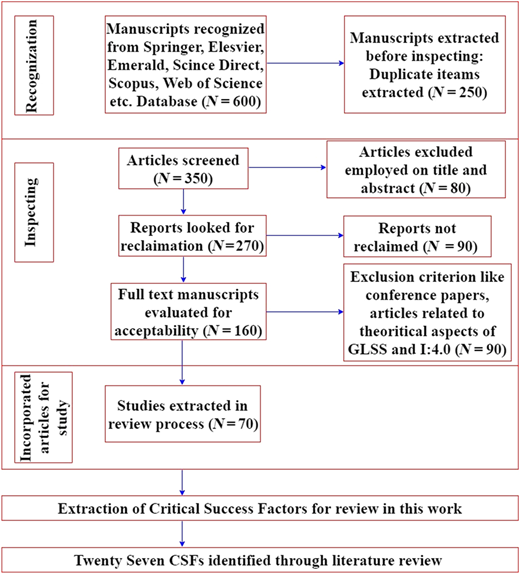
The articles have been taken from well-recognized journals and tagged with keywords like GLSS, Industry 4:0, CSFs, sustainability, integration of GLSS and I:4.0 for execution in manufacturing sectors. The Prisma Approach (as shown in Figure 1) has been adopted to carry out the systematic literature review in this research work. Firstly, the authors searched articles from Springer, Elsevier, Emerald, Science Direct, Scopus, Web of Science, etc. databases. Only English-language, peer-reviewed international journal articles published from 2000 to 2024 were considered. Initially, a total of papers (N = 600) were recognized. However, after the preliminary review, manuscripts (N = 250) were excluded as they did not contain pertinent information related to the designated focus on CSFs.
In the inspection phase, some articles (N = 350) have been screened. Out of these articles, some articles (N = 80) were excluded based on the title and abstract. After that, reports of the articles (N = 270) were looked up for reclamation, and papers (N = 90) reports were not reclaimed. Then, later, full-text manuscripts (N = 160) were evaluated for acceptability. Papers (N = 90) came under the exclusion criterion employed on conference papers, and articles related to theoretical aspects of GLSS and Industry 4.0. At last, articles (N = 70) were extracted for the review process in the present work (Referring Appendix: A). Finally, the screened research papers identified 27 CSFs and consulted with the industrial personnel.
2.2 Background on the green Lean Six Sigma approach and industry 4:0
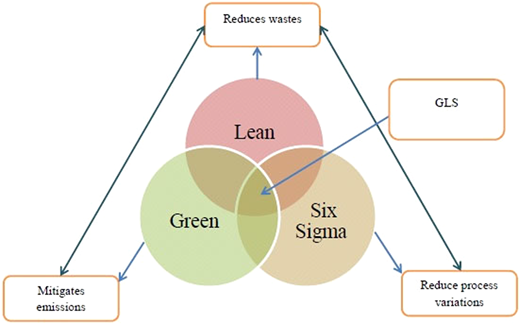
The origins of GLSS can be linked to the Toyota Production System (TPS), widely recognized as Lean in Western nations (Gholami et al., 2021). Green technology, Lean and Six Sigma are complementary approaches, each capable of offsetting the limitations of the others (Cherrafi et al., 2017). While Lean is appreciated for its effectiveness in quantifying waste, it falls short in measuring environmental impacts and identifying potential environmental hotspots (Vinodh et al., 2016). Six Sigma emphasizes minimizing variation and defects, offering a reliable approach to achieving high-quality products at reasonable costs (Gaikwad et al., 2020). However, this concept does not specifically report on the challenges associated with eco-friendly and societal sustainability aspects (Gahlot and Yadav, 2022). Thus, there is a requirement to integrate the green concept with equally Lean and SS to attain an all-inclusive enhancement tactic, known as GLSS, to get eco-friendly products in an organization (Kaswan et al., 2023; Singh et al., 2023). Figure 2 illustrates a combined model of GLSS.
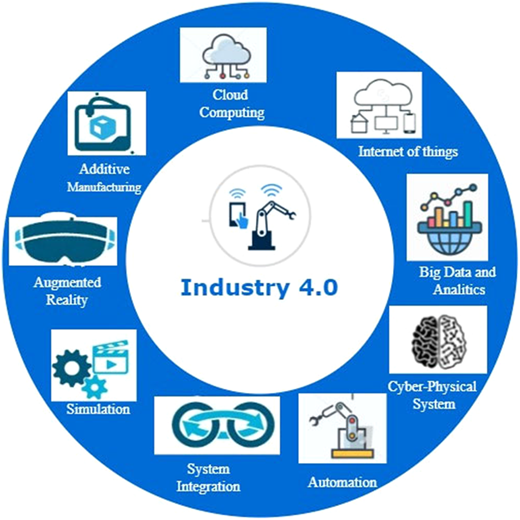
Pongboonchai-Empl et al. (2024) stated that the Fourth Industrial Revolution represents the most recent stage in the evolution of industry since its inception in the 18th century, which began with the first manufacturing revolution, marked by the introduction of steam engines as a pivotal innovation. Through the application of cyber-physical systems (CPS), the Internet and intelligent systems with improved human–machine communication, I:4.0 facilitates the whole communication across the value chain (Chiarini and Kumar, 2022) and enables real-time monitoring of production systems (Tortorella et al., 2019; Fatorachian and Kazemi, 2021). Industry 4.0 constitutes distinct technologies as shown in Figure 3.
2.3 Integration of GLSS with industry 4.0
Limited prior studies have been conducted on integrating I4.0 with functional superiority approaches like GLSS, which is relatively scarce. Siegel et al. (2019) investigated the impact of I4.0 and lean manufacturing on achieving functional excellence by surveying 108 European industries. Shahin et al. (2020) invested in the use of Lean tools alongside I4.0 technologies to enhance the functional performance of the firms. Singh et al. (2021a, b) suggested that a combined Lean Six Sigma (LSS) and I4.0 strategy enhances metrics such as cycle time, waste reduction and quality but does not significantly affect the environmental metrics. Kaswan et al. (2023) presented a theoretical framework for integrating GLSS and I4.0 by the application of distinct tools and methods of these approaches at the distinct phases of the understanding of the project.
2.4 Research gaps
The existing literature contains limited research on the integration of Lean and LSS with I4.0, and studies exploring the synergy between I4.0 and sustainability are similarly scarce. To the best of the author's knowledge, less work has been carried out for integrating GLSS and I4.0 technologies. Kaswan et al. (2023) presented a theoretical framework for integrating GLSS and I4.0 by the application of distinct tools and methods of these approaches at the distinct phases of the understanding of the project. Furthermore, there is no evidence to prioritize and rank CSFs for integrating GLSS and I4.0 technologies through the GRA technique and further authenticated by the BWM method in the context of manufacturing industries. Therefore, to fill this gap, the present study dispenses factual evidence to improve the understanding of CSFs for integrating these concepts. Therefore, the noted literature gaps have provided a way for the current study.
2.5 Identification of critical success factors for integrated GLSS industry 4.0
CSFs are considered key enablers for achieving organizational goals and ensuring effective quality management and performance. In response to this challenge, we have identified 27 CSFs (see Table 1) that may enable the incorporation of GLSS with I4.0 technologies.
3. Research methodology
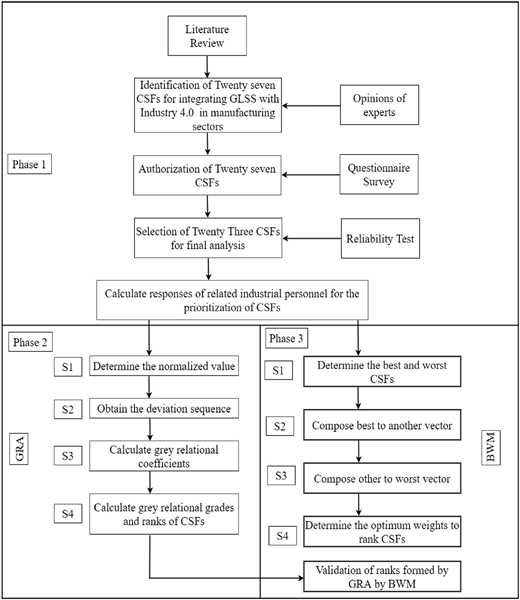
This research adopted a three-phase methodological approach. In the first phase, the study focused on the identifying CSFs that enable the integration of GLSS with I4.0 technologies within the industrial organizations. For this purpose, a structured questionnaire was designed and administered to industrial practitioners and academic experts to obtain their perspectives. The second phase involved prioritizing the identified CSFs using the GRA technique. Figure 4 illustrates the overall research methodology employed in this study.
3.1 Phase 1: formation of the questionnaire for the survey, collection of data and evaluation of the reliability of data
In the initial phase of the study, an extensive review of the existing literature was conducted to identify the CSFs relevant to manufacturing industries in the Indian context. Based on this analysis, 27 CSFs were identified. Subsequently, a structured questionnaire was developed and distributed to industry experts, researchers, academicians and mid-to-senior level professionals from the various manufacturing sectors across India. The survey employed a five-point Likert scale, where a rating of 5 represented the most critical CSF to be prioritized, and a rating of 1 represented the least CSF. Initially, approximately 240 manufacturing professionals from Indian industries were contacted through email, telephone and personal visits to explain the concept of GLSS and I4.0 integration within organizations. Referring Appendix B, the questionnaire has been circulated approximately to the 240 manufacturing professionals (including: industry personals, concerned researchers, academicians) via email, telephonically and in-person visits to get their insights on subject matter. Out of 240 professionals only 130 filled the questionnaire, and 115 of them were found valid and chosen for further analysis. The professionals selected all had over 18 years of experience in their field. The details and profiles of the experts are depicted in Table 2.
Before employing techniques like GRA and BWM, a reliability test was carried out with SPSS version 25.0. After inputting the response into SPSS version 25.0, Cronbach's alpha (α) and item-total correlations (CITC) were calculated. The values of Cronbach's alpha (α) and CITC were evaluated against the threshold levels to assess the consistency and reliability of the survey responses (as presented in Table 2). As per Porter et al. (2008), items with an α value greater than 0.7 are considered consistent and reliable. Additionally, a CITC value exceeding 0.3 indicates that an item is associated with a composite score of all items within the same set. In this reliability test, 4 CSFs (as presented in Table 3) had CITC values below 0.3 (Indicated in bold), meaning these items like CSFs11 (Eco-management system), CSFs 16 (Engaged and proficient workforce), CSFs18 (Process oversight and governance for GLSSI) and CSFs21 (Embracing a philosophy of continuous improvement) did not exhibit a similar construct with the other 23 items. As a result, four CSFs were excluded from the previously identified CSFs listed in Table 1. Ultimately, a total of 23 CSFs (with revised codes CSFs 1 to CSFs 23) were selected for further study and analysis, as shown in Table 4.
3.2 Phase 2: prioritization of CSFs for integrating GLSS with industry 4.0 in the context of the manufacturing sector by the GRA technique
The GRA technique was also introduced after examining the issue and consulting with the decision-maker team. After identifying CSFs and developing the questionnaire, the next step is prioritizing these CSFs using GRA analysis. The steps involved in GRA are as follows:
Step 1: Determine the normalized value
The initial step consists of standardizing the data gathered with the assistance of experts within the organization. The responses provided by experts o’ on CSFs ‘i’ are aggregated and represented as ‘Cio’.
We have collected opinions based on the feedback from industry personnel, including the plant and production manager (P&PM), research and development head (R&DH), consultant master belt (CMB) and academicians (A), including professors, associate professors and assistant professors. Table 5 depicts responses from industrial and academician employees.
Step 2: Obtain the deviation sequence
In this stage of GRA, the deviation sequence () is derived using equation (2), Table 6 represents the calculated deviation sequence.
Step 3: Compute Gray relational coefficients
In the next step, Equation (3) is used in the third stage to get the Gray relational coefficients (Kio). In this case, max (Δ) signifies the largest value of the deviation sequence while min(Δ) indicates its minimum value. K value is assumed to be 0.5. The Gray relationship coefficients are shown in Table 7.
Step 4: Determine the Gray relational grades and rank the CSFs
In the fourth step of the GRA process, the grey relational grade (Yio) is computed using equation (4):
Here, “n” represents the number of respondent groups within the industry under study. In this case, n = 8. The grey relational grade is established, and based on this data, CSFs are ranked. Table 8 depicts the grey relational grades and the corresponding ranks of CSFs for integrating GLSS with I4.0.
3.3 Phase 3: prioritization of CSFs for integrating GLSS with industry 4.0 in the context of the manufacturing sector by the BWM method
BWM is a multi-criteria decision-making method that uses two vectors of pairwise comparisons to determine the criteria weights. Initially, the decision-maker identifies the best (most significant or most desirable) and worst (least important or least desirable) criteria.
Step 1: Identification of CSFs for integrating GLSS with Industry 4.0 within a manufacturing environment
In this step, CSFs were recognized by a literature review and by consulting with industrial personnel. Table 9 depicts the characteristics and demographic background of respondents.
Step 2: Determine the best and worst barrier
From the finalized LSS barriers identified the best (most attractive, most important) and the worst (least attractive, least critical) barriers or decision criteria dependent on the expert's opinions.
Step 3: Industrial personnel are detecting predilection of the best decision criterion (C) over another decision criterion, with the help of 9 point measure (statistics among 1 and 9; in which for number 1: C is likewise significant to k, and for number 9: C is enormously more significant than k). The outcome is the best-to-others (CO) vector as follows:
However, Ck designates the preference of best criterion (C) over any criterion k, and it is clear that aCC = 1.
Step 4: Industrial personnel are also detecting predilection of all the decision criteria over worst criterion (Z), with the help of a 9 point measure (statistics between 1 and 9; in which for number 1: k is likewise significant to Z and for number 9: k is enormously more significant than z), that outcomes in others to worst (OZ) vector as follows.
Where akz designates the preference of any criterion k over the worst criterion Z, and it is clear that azz = 1. Table 10 depicts the best to others and others to the worst preference.
Step 5: Determine the optimum weights (z1*, z2*, z3*,……… …. zn*) for all CSFs for integrating GLSS with Industry 4.0 within the manufacturing environment
To attain weights of CSFs, we take into consideration the Linear Programming (LPP) Model of BWM.
The optimum weights ought to be obtained such that the maximum absolute differences for all k could be minimized for
Problem (8) is a linear optimization problem with an exclusive solution, values for optimum weights (z1*, z2*, z3*,… zn*), and the optimum objective function value ξL are determined by solving it. Table 11 depicts the ranks of LSS barriers by using the BWM technique.
4. Discussion of findings
The analysis and prioritization of CSFs for the effective execution of quality enhancement methods, from the perspective of the current shifts in manufacturing, are the key concerns for establishing a firm's competitive position in the market (Ershadi et al., 2021). Previous studies have independently explored the CSFs of GLSS and I4.0 (Samanta et al., 2024). Researchers have recognized CSFs based on literature reviews and expert opinions, but have not addressed the reliability testing necessary to finalize these factors before employing decision-making techniques (Yadav et al., 2023a, b). In this study, 27 CSFs were recognized from the prevailing literature and finalized for the Indian manufacturing context through expert consultations, followed by a reliability test to ensure consistency. These test results demonstrated strong consistency, with a Cronbach's alpha (α) value above 0.8. Then, the GRA technique is employed to rank and understand the emphasized interrelationship between these CSFs. The results of the present work have been validated through the BWM technique.
Therefore, the study reveals CSFs 21 (Emphasis on technological innovation and practices), CSFs 13 (Change management for GLSSI), CSFs 18 (Flexibility and responsiveness for the GLSSI approach), CSFs 10 (A structured approach to integrating GLSS with I4.0), CSFs 1 (Efficient project coordination and oversight), CSFs 19 (Organizational culture supportive of change during GLSSI adoption), CSFs 20 (Organizational preparedness for adopting GLSS with I4.0 technologies) and CSFs 12 (Access to standard operating procedures (SOPs) for integrating GLSS with Industry 4.0) were considered as most significant CSFs for integrating GLSS approach with I4.0 technologies. CSFs 3 (Effective communication at all organizational levels), CSFs 4 (Adoption of sustainable packaging solutions), CSFs 14 (Access to precise and up-to-date information), CSFs 7 (Tracking performance following the integration of I4.0 and GLSS), CSFs 9 (Educational initiatives for advanced technologies and GLSS), CSFs 8 (Improve the supply chain integration for adopting the GLSSI approach), CSFs 15 (Access to funding for investing in new technologies and GLSS) and CSFs 17 (Strategic alignment of business and information systems for merging GLSS with I4.0) were considered as least significant CSFs for integrating GLSS with I4.0 technologies. Therefore, there is a significant need to integrate the existing GLSS system with a modern smart manufacturing system to effectively capitalize on the competitive and rapidly changing market driven by dynamic demands.
5. Implications
5.1 Theoretical implications
The current work offers valuable theoretical insights for prospective researchers and beginners in the field of GLSS and I4.0, focusing on enhancing the productivity of Indian manufacturing sectors. The present study provides important theoretical contributions for the researchers and emerging scholars in the domain of GLSS integrated with I4.0 technologies, particularly with respect to enhancing productivity in manufacturing sectors. By applying GRA technique, the study prioritizes the identified CSFs, thereby encouraging future researchers to investigate alternative analytical approaches, implementation barriers and associated variables related to the integration. Additionally, BWM technique is employed to evaluate and rank the key CSFs within the manufacturing context. Moreover, this study enriches the existing body of knowledge by highlighting relatively underexplored dimensions of GLSS-I4.0 integration and offers a theoretical foundation for the systematic development of integrated frameworks in future research.
5.2 Practical implications
The findings of this study offer meaningful practical implications for the Indian manufacturing sector. The methodologies applied serve as a strategic roadmap for practitioners, supporting the effective implementation of GLSS practices within the I4.0 environment. Such integration can enhance competitive advantage in the contemporary industrial landscape by strengthening organization's ability to deliver customized products that address evolving customer requirements. Furthermore, this study provides a structured basis for the strategic selection of GLSS practices in conjunction with I4.0 capabilities, thereby maximizing the benefits of their integration. By offering a comprehensive evaluation of CSFs and their interrelationships through GRA and the BWM, the study establishes a robust foundation for practitioners to more effectively integrate emerging I4.0 technologies into GLSS implementation.
6. Conclusions
The present research work explores CSFs for the integration of the GLSS approach with Industry 4.0 technologies in the context of Indian manufacturing organizations. A total of 27 CSF barriers are recognized through the literature review and further authenticated by experts in the industry. Furthermore, a reliability test was conducted, and after inputting the response into SPSS version 25.0, α and CITC values were calculated. In this reliability test, 4 CSFs had CITC values below 0.3, meaning these items, like CSFs11 (Eco-management system), CSFs 16 (Engaged and proficient workforce), CSFs18 (Process oversight and governance for GLSSI) and CSFs21 (Embracing a philosophy of continuous improvement) did not exhibit a similar construct with the other 23 items. As a result, four CSFs were excluded from the previously identified CSFs listed. Ultimately, a total of 23 CSFs were selected for further study and analysis in the present work. Furthermore, the GRA technique has been deployed to prioritize these CSFs for the integration of the GLSS approach with Industry 4.0 technologies. The results have been validated through the BWM technique. The study reveals that CSFs 21 (Focused on leveraging technological innovation and industry best practices) with GRG value of 0.735529, CSFs 13 (Managing organizational change within GLSSI4.0 initiatives) with GRG value of 0.71649, CSFs 18 (Built-in flexibility and responsiveness within the GLSSI4.0 model) with GRG value of 0.647534, CSFs 10 (An organized approach to embedding I4.0 within GLSS) with GRG value of 0.633117, CSFs 1 (Robust project management and supervision) with GRG value of 0.585966, CSFs 19 (A culture of adaptability and continuous improvement aligned with GLSSI4.0 implementation) with GRG value of 0.581959, CSFs 20 (Institutional readiness for GLSS implementation supported by I4.0 technologies) with GRG value of 0.530952 and CSFs 12 (Availability of standard operating procedures for GLSS-I4.0 integration) with GRG value of 0.511197 were considered as most significant CSFs for integrating GLSS approach with I4.0 technologies.
7. Limitations and future research agenda
Despite key contributions, the study is not deprived of limitations. Firstly, this study is entirely restricted to Indian manufacturing organizations. While exploring the CSFs, the interrelationships among them were not taken into consideration. Another drawback of this work is that data were only gathered from fewer respondents. Considering the small sample size, it is not probable to simplify the outcomes for all industrial sectors of other economies. These limitations provide the direction for future research.
Future research should involve large-scale surveys to compare the results obtained through different MCDM techniques, to establish the generalizability of the findings.
CSFs can be applied to other industry sectors such as healthcare, project management, electronics, services and engineering.
For assessing CSFs, graph theory could be applied in future studies.
The researchers can also develop integral measures and a systematic integrated GLSS Industry 4.0 framework.
The supplementary material for this article can be found online.