The research, carried out with three lesson study teams in two primary schools in Malta, focuses on teachers’ changing perceptions of using Generative Artificial Intelligence (GenAI) in teaching using lesson study. The study seeks to discern how teachers’ interpretation and judgement towards the use of AI may lead them to its future integration in teaching.
This paper presents a multiple-case case study for an in-depth analysis of teachers’ perceptions towards the employment of AI in formal educational settings. Data, from email interviews with the three teachers teaching the lessons and detailed reports of each lesson study group, are analysed using the Technology Acceptance Model (TAM) as a theoretical lens.
Teachers’ use of GenAI in teaching using lesson study positively enhanced their perceptions and attitudes towards AI. It boosted their agency instigating them to intentionally see how to learn more about its employment to improve students’ learning experiences.
Using the TAM to examine teachers’ perceptions of using GenAI in teaching using lesson study, this research offers insights into teachers’ attitudes towards emerging technologies. It also provides implications for the design of professional development programmes through the integration of GenAI for teacher support.
Introduction
Industrial revolutions, which carved the trajectory of human progress, portray unprecedented advancements in technology. In the unfolding 4th Industrial Revolution, the rise of autonomous and AI powered intelligent machines are reshaping the way we live and transforming the world of work (Camilleri, 2023).
The free availability of ChatGPT in 2022 was instrumental in bringing AI within reach of many. AI continues to rapidly permeate within peoples’ life and across various domains also making it a promising technology that can be employed in education (Alwaqdani, 2024). Nonetheless, as AI in Education (AIED) is progressively being acquired and used within various educational aspects including administration, assessment, learning and teaching, one cannot neglect how teachers are perceiving its employment within formal educational contexts (Tahiru, 2021).
The COVID-19 pandemic in 2020 forced educators to shift towards online teaching. Consequently, ready or not, educators had to quickly adopt digital technologies to ensure the continuity of learning (Calleja and Camilleri, 2021). Similarly, the advent and popularisation of GenAI near the end of 2022, such as with ChatGPT, marks a new era in educational technology for teachers (Chiu, 2023). GenAI tools, capable of producing text, images and other outputs based on prompts, offer teachers novel ways to enhance lesson planning, resource creation and classroom engagement. The user-friendly interfaces of these tools instigate teachers to reconsider how AI can support and sustain new approaches to teaching and learning within formal education settings.
Lesson study, a collaborative professional development (PD) model, widely recognized for its effectiveness in improving teaching and learning (Huang et al., 2019), was influenced by the advent of emerging educational AI tools. It had to be adapted to more hybrid and virtual environments. Through adaptation, we witnessed the integration of emerging educational AI tools into the research, planning and teaching phases of the lesson study cycle (Calleja and Camilleri, 2021). This mandatory shift, on the part of teachers doing lesson study, was not only a temporary adaptation but also instigated them to potentially and intentionally harness and enact the employment of AI. As a result, the research reported in this paper seeks to gain a better understanding of how teachers doing lesson study explore emerging digital applications, develop new competencies and, along the process, consider how AI tools can transform their teaching and learning practices.
While a growing body of research explores the role of emerging educational AI tools in lesson study (Huang et al., 2021), the potential of GenAI in this context remains underexplored. As AI tools become increasingly integrated into education, it is crucial to understand how teachers perceive themselves and the use of AI tools in reshaping their teaching practices and PD. This “multiple-case” case study (Yin, 2009), therefore, seeks to explore how three groups of primary school teachers in Malta perceive the use of GenAI in lesson study.
Following teachers’ adoption of GenAI in lesson study and, more specifically in their lesson planning as a means of engaging students more deeply in learning Maltese, this research examines teachers’ perceptions of AI instigated change. More specifically, this qualitative study, which draws on interview data and lesson study reports, investigates and elucidates participants’ nascent experiential views regarding AIED through three research questions, namely.
What are the perceptions of a small group of primary school teachers in Malta towards the use of GenAI in teaching?
How do these teachers’ perceptions towards integrating GenAI tools in teaching change because of their lesson study experience?
What learning opportunities and challenges do teachers perceive to/and encounter as they use GenAI tools in lesson study and what future possibilities do they foresee in their teaching and in improving teaching through lesson study?
By merging the inherent qualities of lesson study and teachers’ developing inclinations towards the employment of AI, this paper explores teachers’ contextualized perceptions of GenAI by combining the principles of lesson study with teachers’ gained experiences and growing interest in AI-assisted teaching and learning. Hence, drawing on the Technology Acceptance Model (TAM) (Davis et al., 1989) as a theoretical lens, the research presented in this paper examines teachers’ experiences of integrating GenAI in lesson study and offers insights into how emerging educational AI tools can support PD experiences, change practices and improve teaching. It also contributes to the broader understanding of how AI tools are transforming teacher PD, with implications for the design and implementation of future PD activities.
Literature review
While the primary goal underlying AI is to procure intelligent systems capable of reasoning, learning, problem solving and creativity, such systems should inherently merge with educational activities. Rainer et al. (2016) state how, as a subfield in computer science, AI is directed towards the provision of smart systems. These include machines that utilise AI to perform tasks autonomously or with minimal human intervention. These systems can therefore learn, adapt and make decisions based on data and information, often surpassing human capabilities in specific areas. Like humans, AI is inherently capable of exhibiting intelligent qualities that include learning, logical thinking, solving complex problems, perceiving their environment and generating novel ideas (Xia et al., 2022; Chiu et al., 2023). AI technologies can complement the education sector because education, and therefore learning, fundamentally involve the use of cognitive processes centred on knowledge acquisition and transmission. AI systems, designed to emulate cognitive functions and tackle complex problems using algorithms and structured information, can significantly enhance both the teaching capabilities of teachers and the learning experiences of students. Hence, humans can take this transformation as an opportunity to enhance their use of AI and, in the process, learn how to integrate it within their work (Camilleri, 2023).
Wang et al. (2024) state how the emergence of numerous AI tools are revolutionising learning management and training systems. Personalised learning assistants can provide students with tailored support and guidance in their work. Similarly, by analysing students’ data, adaptive learning platforms (ALP), can provide personalised and adjustable lesson content according to students’ strengths, needs and weaknesses. Combining AI algorithms with virtual reality (VR) and augmented reality (AR) and other ALP can provide teachers with “just-in-time” (Calleja et al., 2021) and “just-for-you” opportunities that instigate more personalised and immersive learning experiences. Ultimately, through these experiences, teachers can make learning more adaptive to students’ needs (Pham, 2024). Additionally, teachers may avail themselves of other supportive platforms such as Khanmigo, a ChatGPT-4 AI tutor, which is employed across various subjects such as language learning and, Duolingo a sophisticated language learning platform (Wang et al., 2024). Nonetheless, we note that, while the employment of AIED has surged, literature on how teachers perceive it is still scattered (Chiu et al., 2023).
Chiu et al. (2023) and Wang et al. (2024) argue that a thorough analysis of recent AIED literature is needed and is essential to fully comprehend the field’s conceptual landscape. Despite previous review efforts, most of the current literature have narrowly focused on AIED applications and their features. Besides failing to provide a comprehensive overview of research themes and approaches, there also seems to be a notable absence of investigations into the core theories underpinning AIED research and adoption (Wang et al., 2024). These theories are consequently vital for interpreting current studies, providing a framework that guides future research endeavours. Like Alwaqdani (2024) and Yang and Appleget (2024), we argue that the way AI traits are channelled within formal educational settings will depend on how these are perceived, discerned, contextualised and, therefore, used by teachers within their classrooms for improving students’ learning outcomes.
Teachers have a central role in the ways AI can be meaningfully integrated within formal educational settings. Hence, understanding how AIED can be integrated into collaborative teacher professional development such as, lesson study, is crucial. Indeed, we see great potential in GenAI for teacher development initiatives like lesson study. The collaborative, reflective and research-oriented nature of lesson study (Huang et al., 2019) can enhance teachers to become curators of content and learning experiences, elucidating and selecting tailormade AI-generated materials to suit individual students’ needs. Through GenAI, teachers can also facilitate deep learning encouraging students to become critical thinkers and learn to develop individual learning skills (AI for Education, 2023).
Theoretical framework
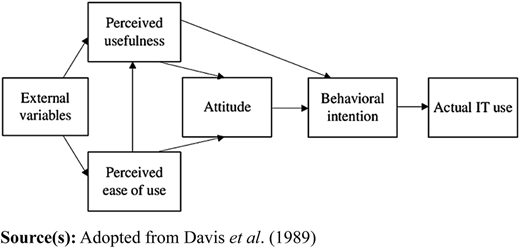
The Technology Acceptance Model (TAM) is a widely used theoretical framework that explains and predicts an individual’s acceptance and use of technology (Sánchez-Prieto et al., 2020). The TAM framework posits that an individual’s behavioural intention to use a technology is primarily determined by two key factors: the Perceived Ease of Use (PEoU) and the Perceived Usefulness (PU) (Davis et al., 1989). As shown in Figure 1, these two factors influence users’ attitudes through portrayed beliefs and use, that is the behavioural intention and actual use of the technology in question.
The model has four core variables:
Perceived ease of use (PEoU): assesses the subjective ease with which users understand and operate a particular technology. This also includes the degree of confidence that users convey within their ability to do so without difficulty.
Perceived usefulness (PU): quantifies the degree to which users believe a technology will effectively enhance what they do. It therefore serves as a predictor of their inclination and intention to adopt and, adapt to, the technology.
Behavioural intention (BI): establishes the outcomes of the combined influence of the PEoU and PU. The PEoU and PU collectively induce users’ behavioural intentions towards the technology. Therefore, the BI inherently shapes users’ intents to interact with the technology in question, (de)motivating its adoption and use.
Observable Outcomes and Actual Use: BI are finally manifested in observable attitudes towards use and actual technology utilisation. These observable outcomes reflect the users’ developed attitudes towards the practical implementation of technology.
The extensive use of the TAM in research supports its effectiveness to identify user motivations and overall attitudes towards technology (Granić and Marangunić, 2019; Scherer and Teo, 2019), making it a robust primary analytical framework for understanding teachers’ attitudes towards AI. For example, Scherer and Teo (2019) suggest that the TAM helps us understand better how technology acceptance or rejection is based on perceptions of use that individuals foster towards technology. In our study, the TAM is used to help us understand teachers’ embraced perceptions and intended future use of GenAI in lesson study.
Yang and Appleget (2024) portray how numerous studies have explored various cohorts of teachers’ perceptions towards technology using TAM. Then again, while the employment of the TAM within GenAI is still limited and emerging, research conducted by Behizadeh et al. (2023) and Chiu (2023) point towards a strong demand for GenAI integration in teacher PD – mainly due to its perceived benefits and the need for guidance. Kaplan-Rakowski et al. (2023) further showed a positive correlation between GenAI usage and teacher attitudes. Studies by Karahan (2023) and Park (2023) have begun to explore this area, highlighting varied perspectives and the potential for growth through AI literacy programmes. Given the novelty of GenAI within teaching, our study is therefore directed towards investigating teachers’ acceptance, perceptions of use and concerns regarding the employment of emerging educational AI tools in lesson studies conducted within schools in Malta.
Methodology
Case study research
Using a “multiple-case”, case study approach (Yin, 2009), we carried out an in-depth analysis to investigate teachers’ changing perceptions of using GenAI in lesson study. Our analysis is, therefore, defined by the purposeful selection of three teams involving primary school teachers, working in two different schools, who chose to integrate GenAI tools in their lesson studies. Subsequently, the purposeful selection of multiple cases catered for comparing the different cases in our attempt to enhance theory.
The schools, lesson study teams and research participants
For school A (see Table 1), lesson study was a new PD initiative that Helen, who taught Year 5 students (10-year-olds), embarked on. Helen was, at the time, doing a lesson study course as part of her postgraduate studies at the University of Malta. This course, taught by the first author, engaged participants in learning about and implementing a lesson study.
In school B (see Table 1), lesson study was a long-term initiative taken up by the school leadership in 2022 (nearly two years prior to this study). Hence, at this school, teachers were familiar with lesson study – they had either heard of it during PD sessions or had previously engaged in the process. At school B, deputy heads facilitated the lesson study process of the two teams.
Team A involved six participants: two teachers, a deputy head and a head of school, a mentor and a teacher educator from the University of Malta acting as a knowledgeable other (KO). Besides the KO, one of the two Year 5 teachers (Helen) who facilitated the meetings, was the only knowledgeable person about AI and had previously used it in planning her lessons. For the rest of the team, AI was a new tool.
Team B1 involved four participants: a Year 4 teacher, the digital literacy teacher (Martha) and a deputy head of school who facilitated the lesson study. The KO, a Maltese specialist teacher educator, provided feedback on the lesson plan. She attended the lesson and shared her insights in the post-lesson discussion.
At school B, the digital literacy teacher was also invited by the Year 5 teacher (Jade) to participate in a second lesson study on a Maltese writing lesson. Besides the digital literacy teacher, Team B2 involved a Year 5 teacher, a learning support educator and a deputy head of school. As in the case of team B1, the deputy head acted as the facilitator of this lesson study.
For each lesson study team, we interviewed the teacher who taught the lesson. Table 2 provides details about the research participants.
The three lesson studies
The three lesson studies focused on improving the teaching of Maltese – currently a topical issue in local primary school settings. In their lesson study, each team discussed, incorporated and implemented AI tools in teaching with the aim of improving students’ learning experiences. Table 3 outlines the four lesson study phases that the three teams went through and how AI tools were incorporated within the research lesson.
Lesson study by team A
This lesson study involving one cycle, carried out over a period of five weeks (March to April 2024), focused on sentence structure of Year 5 students in Maltese language writing. The team addressed this issue by planning a sequence of three lessons that led to the writing research lesson reported in this paper. They used GenAI to generate photos based on given information and eventually create two characters who could communicate with students using the Maltese language through AI generated text. The lesson engaged students in peer review as an assessment strategy, a process whereby they could think critically on the feedback received on their work, hence, improving on their use of verbs and adjectives to describe the two characters.
Lesson study by team B1
Carried out over a nine-week period (January to March 2024), the aim underlying the research lesson, done over one cycle, was to support Year 4 students (9-year-olds) in developing their Maltese language vocabulary during a pre-writing lesson so that they could gain confidence in their writing. In the process, the team incorporated AI tools in their lesson plan so that students could engage in more active, collaborative and independent learning. Aspects related to inquiry, critical thinking, collaborative work in small groups and discussion were embedded in the lesson.
Lesson study by team B2
This lesson study, done over one cycle and carried out over a period of eight weeks (March to May 2024), focused on enhancing Year 5 students’ digital literacy skills by employing AI tools to help them develop the use of tenses and adjectives as they produced an advert in Maltese. The team’s objective was to engage students in a small collaborative project so that they could demonstrate proficiency in Maltese creative writing and digital skills by creating a video advertisement of a school activity using “CapCut” or a similar video editing app on their tablets. During the research lesson, which involved small group presentations of the adverts, each group of students were asked to provide constructive feedback to their peers.
Data collection
Qualitative data, directed to capture teachers’ perceptions and attitudes towards AI use in lesson study, was collected during the scholastic year 2023–2024 and consisted of: (1) a detailed lesson study report and lesson plan, and (2) an email interview, held at the end of the scholastic year, with the teacher of each lesson study team who taught the research lesson. The qualitative data was then thematically analysed.
Aspers and Corte (2019) describe qualitative research as an iterative journey intended to deepen our understanding. Hence, it provides a comprehensive understanding of a topic by revealing intricacies that might escape more quantitative methods. This strength is demonstrated in the present study, where the employed qualitative methods uncovered rich details about participants’ experiences, viewpoints and attitudinal shifts from perceiving how, to the actual use of AI enabled platforms chosen.
Lesson study report and lesson plan
During their lesson study, each team documented the stages and devised a detailed lesson plan. The plan included information about the school and the students, the lesson objectives, lesson phases, assigned tasks and resources and a list of observers and KOs. To enhance collaboration, accessibility and teamwork, the three teams produced their lesson study reports using Google docs. On average, the lesson report consisted of a 30-page report.
The email interview
The post-lesson study interview (see Appendix), with the teacher who had taught the lesson, sought to capture teachers’ experiences in using AI tools both in terms of expectations prior to and contextualised perceptions during their lesson study. The questions focused on dimensions, as defined and delineated in the terminology of the TAM namely:
Embraced perceptions, held by the participating teachers, were discerned through their PU and PEoU.
Arising attitudes towards use were discerned through their BI underlying the use or intended use of the technology in question as delineated through the employed terminology in the TAM.
Focus, therefore, was directed towards the type and nature of AI tools used, the support required or sought, the specific related tasks that incorporated AI tools and perceived and acknowledged challenges and benefits of using AI in lesson study.
Initially, our intention was to carry out the in-person interviews in June 2024. However, at the time, teachers had limited “free” time during school hours. This made in-person data collection difficult, making us look for an alternative. Our reading of literature suggested that we could propose email interviewing to teachers as this still could provide us with an in-depth interviewing process that could generate rich and informative accounts (Dahlin, 2021). Email interviewing, as suggested by Dahlin (2021), involved the participants responding asynchronously to our set of closed and open-ended questions. The eight-week timeline (June to July 2024) for our asynchronous interviews provided participants with ample time to reflect on our questions and to make the lesson study accounts that they communicated more personal (Pell et al., 2020). While this process proved to be more time consuming than in-person interviewing, as most of the participants initially provided short and, at times, superficial responses, we benefitted from interview responses that were already transcribed.
In putting email interviewing into practice, we sought that the three teachers could “tell their story as they see it, feel it, experience it” (Corbin and Morse, 2003, p. 339). Hence, we focused on understanding how they interpreted AI and understood their practice of integrating it in their lesson study. To do this, the first author explained the intentions of the study and then discussed how the email communication could take place. The interview questions were sent to each participant who then got back to us with their answers. Following our analysis, which included a thorough reading and discussion of the content, we got back to the participants asking follow-up questions that either sought clarifications or more details. This kind of member check (Koelsch, 2013) was also a useful tool for triangulating the data.
Data analysis
Data from teachers’ lesson study reports and lesson plans and their interviews were read thoroughly, and aspects related to teachers’ use of AI tools were highlighted. Guided by the TAM framework, we analysed data using a deductive coding process so that we could ensure a thorough and nuanced understanding of teachers’ use, perspectives and perceptions.
The coding for the qualitative data involved labelling and organizing the dataset to identify different themes and the relationships that characterized them (Rogers, 2018). This process allowed for examination and interpretation of the data to understand what it represented. Subsequently, codes that characterised the same meaning were merged to form broader themes. These themes were discerned using a thematic analysis technique, which allowed the researchers to identify, analyse and interpret patterns of meanings.
This process consisted of five main steps:
Data preparation – we transcribed the data in Microsoft Word and then transferred it into a Microsoft Excel spreadsheet to facilitate note taking and coding
)Data familiarization – we thoroughly reviewed the responses multiple times, making initial notes and observations on emerging ideas
Coding – we coded the data through close reading, assigning labels and codes to key phrases and words (e.g. AI tools, students, dilemmas and benefits)
Theme identification – using Excel’s “filter” and “sort” tools, we grouped related codes to identify overarching themes, for example, “perceived usefulness of AI”, “perceived ease of use” and “behavioural intentions in using AI”
To ensure trustworthiness and reliability, we independently conducted the data analysis, triangulated the results from the different sources and then met to discuss and finalise the themes.
Findings
Teachers’ perceived usefulness and benefits of AI in lesson study
Notwithstanding perceived shortcomings, related mostly to the need to create an account for each student (Martha), limited access to image generation without a paid subscription (Jade) and a time-consuming log-in process (Helen), the teachers in each of the three lesson study teams reported on the usefulness of AI tools in their lessons. Predominantly, they reported on the PU and benefits of AI to motivate and engage students in learning the subject concerned. Unequivocally, this also made learning more personalised when the applications and platforms employed conveyed and facilitated the qualities in the students to choose what and how to learn.
AI tools are highly motivating for students to engage actively in learning. (Jade, Interview)
AI image generators inspire students’ creativity in writing tasks and presentations. (Martha, LS report)
Moreover, Helen and Martha expressed how the intentional use of AI applications (e.g. AI image and talking photo generators, Canva and ChatGPT) offered opportunities for students to develop transversal skills where:
Students think more critically as they choose what works best for them. Also, when working on a task, they collaborate and put more effort to use AI tools effectively. (Helen, Interview)
ChatGPT is a useful tool which inspires students’ creativity for other skill-based tasks. Story starters, image, video and voice generators are highly beneficial tools to engage students in learning language and STEM subjects. (Martha, Interview)
Besides benefits for students, these teachers also perceived AI as useful and beneficial for teachers and student-centred teaching.
It made lesson planning much more exciting. When students saw that I was excited to introduce this new tool [the AI talking photo generator] they replicated such excitement. They asked me how I prepared such resources and wanted to learn more to try them out themselves. (Helen, Interview)
Using AI, teachers can provoke students’ enthusiasm and participation. We saw this when we included AI in our language lessons. (Martha, Interview)
With ChatGPT teachers can motivate students and involve them in the lesson by allowing them to generate their own images and create templates for their posters, making learning more personalised. (Jade, Interview)
In her interview, Helen mentioned that whenever teachers can use AI to make their lessons more student-centred, this needs to be taken as a positive initiative. Such initiatives need to be supported and prompted and, as Martha argues, there is a need for more teacher autonomy.
Teachers should be given the autonomy to choose their preferred apps for their lessons and should be trusted that they will be using them for educational purposes.
Teachers’ perceived ease of use of AI in teaching using lesson study
Teachers reported on their students’ experiences but also on their own learning. They used terms like “feeling comfortable” (Helen) on using AI for teaching but also as “a modality for self-learning” (Martha). In this case, AI was perceived as enabling and provocative to motivate students to become actively engaged not only in learning but also in accepting challenges mainly related to subjectively choosing what and how to employ AI tools in their research lesson design.
In her interview Martha mentioned how, due to her previous experiences on using AI tools in other lessons, she felt comfortable deciding on how best to avail herself of them. She further commented on how she used ChatGPT:
We used ChatGPT for lesson planning and to create resources. Through ChatGPT we created a list of suggestions for students to help them when speaking in public.
As Martha mentioned this also evoked an enhanced sense of personalisation in the students, allowing them to decide what and how to learn.
The fact that students were able to create a tangible image ‘themselves’ from their ideas and prompts and then use the image to develop their thoughts, write or speak about it motivated them to be on task and to reach the intended outcome. It also gave them more autonomy and ownership of their final language task creation. (Martha, Interview)
Although these teachers spoke positively about AI tools in teaching and learning, the experiences learned from hands-on integration of these tools in lesson study made them aware of some issues of use.
We found technical problems. Some students were unable to access their account while for others, the apps were not responding. A couple of students also ended up losing their work. (Jade, Interview)
I was aware of specific licence limitations. It made me a bit anxious that certain websites might not work during the lesson. (Martha, Interview)
For Helen, while she was aware of the challenges and issues of integrating AI, she still saw this lesson study as an opportunity to gain feedback and improve implementation:
We [the lesson study team] were all initially quite nervous to use AI because it was our first time, and we did not know how the students would react. So, it was like a test for us. We decided to use it so that we could get feedback from observers. (LS report)
Similarly, in her end of report reflection, Jade remarked that the use of AI in teaching using lesson study was a stepping stone for possible future practices.
After working on a detailed lesson plan, I feel quite confident to research and implement appropriate AI tools for my classroom. (LS report)
Teachers’ attitudes and behavioural intentions of using AI in teaching beyond lesson study and perceived prospects for professional development
Engaging in the lesson study process seemed critical for teachers. More than anything, the process instigated a dialogue where, through choosing what and in what context to employ various AI tools, the teachers themselves also learned about the efficacy and quality of the applications in questions through the insightful feedback gained when employed for teaching. Martha and Helen, for example, described how lesson study helped them embrace the potential of AI tools and seek further insights.
I kept researching for other AI websites to generate images. During my research I also found a webinar and discovered the website ‘Adobe Firefly’. If it was not for this lesson study, I would not have felt motivated to research for alternative websites and would not have attended the webinar. (Martha, Interview)
After this lesson study I am even more intrigued to use this tool [the AI talking photo generator] and attend courses to expand my knowledge to better use AI tools in my teaching. (Helen, Interview)
From her side, Jade mentioned that she intended to enhance her abilities in using AI by following on the work done in lesson study.
I want to use AI tools more often. So, I seek to learn how to use AI for editing videos.
For Helen, PD appeared critical and communicated her wish as follows:
To learn how different AI tools can be used in different lessons and what tools are most useful particularly for content which I usually find challenging to teach. (Interview)
Like Helen, Martha was also intrigued to use AI tools and know more.
Following this lesson study, I continued using AI in language and STEM lessons. For instance, I co-designed AI activities to create poems, songs, animations and videos about the solar system with 15 schools participating in an eTwinning project called ‘STEM explorers’. (Martha, Interview)
These findings suggest that GenAI provided both the teachers and their students with a practical and authentic learning experience. For the teachers the use of GenAI enhanced their pedagogical knowledge while it enabled personalised learning in the students. The teachers, participating in the two lesson studies, acknowledged GenAI technologies as beneficial tools for teaching and learning. They also recognised the significance of teacher agency and innovation, demonstrating a comprehension of the generative and social dimensions of GenAI technologies.
Discussion
We now discuss the reported findings within our three research questions.
What are the perceptions of a small group of primary school teachers in Malta towards the use of GenAI in teaching?
Lesson study teams used AI tools to enhance students’ modality of communication and self-expression. Data from teachers converged on the usefulness of GenAI in their lessons. Teachers described the perceived usefulness and benefits that GenAI had to help them motivate their students to engage better in learning Maltese. This experience highlights that experiencing benefits of using GenAI is critical. In fact, in their international study with 508 teachers in six different countries, Viberg et al. (2023) found that when teachers experience the benefits of AI, they tend to trust it more.
Besides serving as a motivating factor for students, the PU of AI platforms was further consolidated by the promotion and the development of transversal skills. Similarly to what was reported in AI for Education (2023) Website, this PU included critical thinking and creativity across both parties, that is the teachers and the students. Subsequently, for the teachers in this study, GenAI tools assisted them in promoting student-centred teaching. On the other hand, it also became clear that through lessons that employed AI within the teaching and learning process, students took more ownership of their learning making it more personalised.
How do these teachers’ perceptions of and dispositions for integrating GenAI tools in teaching change because of their lesson study experience?
In the context of positive teacher feelings towards the use of GenAI, the interviewed teachers appeared confident in the ways lesson study supported their AI use in teaching. This finding is highlighted by Kaplan-Rakowski et al. (2023) and Viberg et al. (2023) who portray how professional development experiences can lead to more trust in GenAI and teacher self-efficacy. In our study, this aspect inherently portrays how teachers were not only instigated to experiment and work with AI but also how, through actual hands-on experiences, they strengthened their positive attitude towards the technology in question. Admittedly, feedback given shows how lesson study was instrumental for the teachers concerned to discern the usefulness of AIED and enhance their perceptions towards its ease of use. Subsequently, we discern how lesson study has helped teachers to move out of their comfort zones, embrace and integrate GenAI to address issues and fill in the needs they subsequently discerned when comparing to teaching Maltese language without AI.
A key aspect within lesson study process for these teachers were the ongoing opportunities to engage in discussions about teaching. Such dialogue, which is usually missing for teachers in Malta, supported teachers’ learning about the efficacy and quality of the AI applications that they intended to use. As suggested by Rainer et al. (2016), the teachers in our study perceived AI as a “smart system” capable of supporting student learning. Moreover, discussions in lesson study offered teachers the space needed to gain feedback about the GenAI tools intended for use that was purposeful and targeted to address the issues that they identified with teaching.
One aspect that emerged from their engagement with lesson study was that the process helped them to embrace the potential of AI tools and to seek further learning about their use beyond their lesson studies experience. As a matter of fact, nascent data suggests how the growing PU through PEoU was instrumental for these teachers to develop (for Helen and Jade) or develop further (for Martha) their disposition to continue building on the work done during their lesson study and explore the potential of using GenAI in other lessons – for example, teaching content that teachers usually find challenging to communicate in the absence of AI. Subsequently, beyond their employed lesson study, the teachers in our study continued to sustain AI use in language and STEM subjects. Hence, as suggested by Alwaqdani (2024) and Yang and Appleget (2024), teachers’ PU and PEoU in using GenAI leads to possible future use.
What learning opportunities and challenges do teachers perceive to/and encounter as they use GenAI tools in lesson study and what future possibilities do they foresee in their teaching and in improving teaching through lesson study?
For these teachers, AI provoked an enhanced sense of personalisation and growth towards learning and education in general. Adding to the study findings by Pham (2024), the observable traits that emerged within our study were:
Firstly, portrayed through an enhanced positive motivation towards the usefulness of AI in formal educational contexts.
Secondly, the actual use itself, inherently facilitated the process through which the involved teachers perceived an easier ease towards the employment of AI.
Thirdly, this lesson study experience enabled their migration from teacher-centred to a more student-centred teaching and learning approach.
Our findings suggests that the positive experiences gained through the teachers’ employment of AI in lesson study outweighed any arising difficulties. While students may have encountered some technical problems related to account access, unresponsive apps and licence limitations, teachers believed that the benefits outweighed the challenges. The employment of GenAI offered opportunities through which teachers could explore first-hand the possibilities of students gaining ownership of their learning and, therefore, making it more personalised. For example, there were instances where students used image generation to express their thoughts and enhance how they write and publicly speak about their deliberations. Towards this end, and again as expressed by Yang and Appleget (2024), we observed a positive association between the employment of GenAI tools and the teachers’ intentions to learn more about GenAI in the future. In fact, the teachers involved requested more PD opportunities and support to help them learn better on how to avail themselves of the potential that such AI tools offer to teaching and learning.
Conclusion
We agree with Kizilcec (2024) that a better understanding of teachers’ perceptions on incorporating AI is essential to unlocking the full potential benefits of these innovations. As the present research suggests teachers integrated GenAI into their lessons based on their perceptions of its potential benefits. Subsequently, insights gained through experiential use allowed these teachers to develop foresight directed towards possible future use. The PEoU and PU as defined in the TAM served to discern and explain how teachers’ assessment of AI’s utility and accessibility shaped their instructional decisions. Ultimately, this motivated their BI on how they incorporated AI tools into their lessons for improving the learning experiences for their students, also serving as a stimulus towards future use. Hence, as suggested by Viberg et al. (2023), teachers perceive benefits when they use AI within a robust reflective and collaborative model of PD.
Through the TAM, we systematically examined how within the three cases of teachers involved in lesson studies at their school, their perceptions towards AIED translated into concrete pedagogical approaches for improving student learning of Maltese with potential for possible forthcoming opportunities. This suggests that the collaborative, research-based and reflective PD through lesson study positively influenced teachers’ PEoU and PU. Hence, when teachers’ PEoU and PU induces positive BI towards GenAI, then it is likely that this will motivate them to continue learning about it while using it to improve their teaching practices for a more personalised learning experience for students.
While AI can be transformative, we have seen in this research that teaching is still a human quality (Camilleri, 2023). AI can effectively imitate and perform tasks that usually require human intelligence and pertain to learning and thinking, involve problem-solving and decision-making (Xia et al., 2022; Chiu et al., 2023). However, elements that are also evident within lesson study and that make teachers human, inherent qualities like collaboration, negotiation and conflict resolution, emotional intelligence, adaptability and discussion, are still fundamental in teaching and learning (Mitchell, 2019). This, therefore, entails understanding how, through lesson study, teachers may collaboratively look, interpret and relate with GenAI to address their contextualised realities. This finding leads us to a second implication related to the role of GenAI in teacher and student learning. The integration of GenAI in collaborative PD activities offers authentic opportunities where both teachers and their students may utilise this technological tool as means to negotiate and offer more targeted and constructive feedback.
We hence argue that emerging educational AI tools can support PD experiences, change practices and improve teaching when integrated within robust PD models like lesson study. For example, we concur with Calleja et al. (2021) that, in the design of lessons, integrating GenAI would not only offer “just-in-case” or “just-in-time” learning opportunities but that, the flexibility that AI offers would instigate personalised “just-for-you” learning experiences for teachers. Also, teachers may use GenAI as a mediating tool to better understand and provide more meaningful learning experiences for students. Our study suggests that the outcomes of the combined qualities of the PU and PEoU induced teachers’ BI towards GenAI, with the perceived benefits pointing to a stronger need to integrate GenAI in future teacher PD initiatives (Behizadeh et al., 2023; Chiu, 2023).
Limitations and further research
This study has its limitations that derive from its qualitative case study nature and its potential generalisability to a wider population of teachers. Still, these study limitations provide the reader with highly contextualised findings (Yin, 2009). Indeed, while this research has limited its focus on three qualitative cases of AI integration in teaching using lesson study, the findings may well speak of the perceptions that primary school teachers have towards the use of GenAI in teaching using lesson study. Additionally, we think that the findings direct us to reflect on how teachers’ PU and PEoU can shape their attitude and lead them to adopt GenAI in their everyday work.
The use of email interviews provided the three teachers in our study with time to reflect on our set of questions and follow-up prompts. However, we feel that this method limited the kind of open conversation and spontaneity that we intended to have with these teachers. As a result, we are mindful that the use of email interviews may have restricted our search to delve deeper into the thoughts, emotions and meanings of teachers related to, for example, the ways they intended to use AI tools, how they eventually enacted them in class and their reasons for developing positive BI in integrating AI tools in their future lessons and teaching.
As we have argued, our findings, on teachers’ positive BI and attitudes towards GenAI, position GenAI as a potentially transformative tool and call for additional research on how the study reported in this paper could be transferred and repeated to other contexts for comparability of results. Literature about international adaptations of lesson study (Seleznyov, 2018) and teachers’ practices and perceived use of GenAI (Alwaqdani, 2024; Chiu et al., 2023) lead us to predict that results could differ across international educational contexts. Data, from a larger sample size of teachers on their use of GenAI in lesson study, even including teachers from different disciplines, can provide more robust findings and conclusions about GenAI’s transformative nature and potential. This can also help us understand if GenAI use through the employment of lesson study can be influenced by different subject areas that invariably employ different teaching methodologies. Additionally, while teachers’ positive BI and attitudes towards the use GenAI augur well for further integration, we also think that the teachers in our study could sustain their work better with support from their school leaders. School leaders, who may perceive GenAI as a transformative teaching and learning tool, need to embrace new technologies and to work alongside teachers as they integrate GenAI in their teaching. School leaders can do this, for example, by providing teachers with access to GenAI and with PD opportunities like lesson study to collaboratively learn about the potential of GenAI as a transformative technology in education (Yang and Appleget, 2024). We, hence, also promote transformative learning and conclude by suggesting research initiatives directed towards school leaders’ perspectives and perceptions of GenAI in teacher education and in student learning.
References
Appendix –Interview Questions
To what extent were you aware of AI tools prior to your lesson study?
How comfortable did you feel with the idea of using AI in your lesson study?
What AI tool/s did you use for your lesson study and how did this/these benefit the learning for the lesson study participants and the students?
What kind of support did you require for integrating AI in lesson study and where did you get this from?
What specific tasks did AI support you with or help you do better in your lesson study?
What potential challenges did AI offer in your lesson study?
Following this lesson study experience, what is one takeaway vis-à-vis the use of AI in teaching?
Following this experience, how do you think that AI may benefit students without them losing their identity and cognitive abilities to think and decide for themselves?
Based on your lesson study experience, do you think that AI can be useful for primary school teachers?
How likely are you to choose and use AI tools in your teaching after this lesson study?
Think about your current understanding of AI and the resources available at your school, how confident are you in your ability to find and implement appropriate AI tools for your classroom?
If you were offered further professional development on using AI tools in the classroom, what specific things would you hope to learn?