In digital education curricular initiatives, some teachers are taking on key roles when appointed as instructional coaches (ICs) and become crucial in the sustainability of the initiative by coaching teachers. This study aimed to find out the difficulties ICs are facing when mentoring teachers in the development of the digital skills and to identify the coaching activities the coaches offer.
Employing a mixed-methods research design focusing on a qualitative approach, the research team conducted 6 focus groups with 38 ICs from 12 primary schools in Switzerland. Quantitative descriptive data were collected through a survey submitted before and after the focus group.
The results indicate that (1) the professional development (PD) activities offered to teachers vary greatly depending on the instructional coach characteristics and the school to which the teachers belong, (2) the in-service training of ICs should include coaching and leadership skills and (3) distributed leadership to ICs could facilitate the adoption of technologies by teachers and support change in the school.
Some ICs offer activities with a low involvement of the teacher. ICs' training programs should provide strategies to better take advantage of PD activities. The authors suggest training ICs in PD activities, aligned with Gibbons and Cobb's (2017) such as analyzing classroom video or lesson study involving a group of teachers working together with an expert to improve a lesson. District and school leaders should provide ICs with explicit guidance and more resources to achieve systemic change. ICs should also be empowered by being involved in the development of the school's continuing education training plans.
This study presents a new perspective about understanding and applying in-service teacher PD in the context of a digital education curricular initiative.
Introduction
In recent years, many countries have encouraged the use of digital technologies in schools for educational purposes through large-scale initiatives at the level of a country or administrative region [Organisation for Economic Co-operation and Development (OECD), 2015]. However, these initiatives have difficulty gaining sustainability (Hauge, 2014). Two aspects are crucial for the success of digital education reform – teachers' initial training and continuous education (Gudmundsdottir and Hatlevik, 2018) – which have a positive impact on teachers' technology-integration practices (Ottenbreit-Leftwich et al., 2020). Professional development (PD) for teachers is effective with forms of mentoring support (Castanheira, 2016) and more likely to achieve sustained changes in practice than more traditional workshops and lectures (Connor, 2017). PD should be ongoing and job-embedded, based on a nonevaluative partnership (Bakhshaei et al., 2018) between the teacher and coach. Instructional coaches (ICs) provide PD sessions, support teacher growth (Kraft et al., 2018) and help teachers in learning how to implement the best research-based instructional practices (Desimone and Pak, 2017).
Teachers working with an IC tend to use technology more frequently and in more powerful ways than teachers working without an IC (Bakhshaei et al., 2018) as they increase their self-efficacy (Heineman, 2016).
Therefore, ICs are critical levers for the improvement of teacher practices (Walsh et al., 2020), acting as bridges between a district's vision and application of the reform in the classroom (Christie, 2016), and are increasingly considered essential to achieving its scaling up (Coburn, 2003). However, the IC role is difficult to implement as ICs focus on various instructional issues (Fullan and Knight, 2011). Because the IC role is frequently poorly defined, school leaders are unsure about how best to utilize instructional coaching (Johnson, 2016).
As research associated with PD activities that aim to encourage teachers' technology-integration practices is limited (Ehsanipour and Gomez Zaccarelli, 2017), the conditions required for effective instructional coaching need to be examined to better inform stakeholders and training institutions.
Our study focuses on ICs participating in an ongoing large-scale digital education curricular initiative in Switzerland, examining the challenges ICs face and the coaching PD activities they offer to teachers. We considered the following research questions:
What are the difficulties experienced by the ICs involved in the digital education curricular initiative when supporting teachers?
Which PD activities do ICs provide to teachers? Why do they provide these specific activities?
Background
In this section, we first provide a brief synthesis of three models of instructional coaching that could apply to the context of the research questions. Then we present the conceptual framework we used in our study, focusing on technology integration. We then review the literature for each component of our framework. This review provides an update on what the field currently knows, and does not know, about ICs' difficulties in supporting teachers in a digital education curricular initiative and informs the design of this study and our interpretation of the data.
Instructional coaching is a form of PD seeking to facilitate change in teacher practice through a partnership (Mangin and Dunsmore, 2015) understood as a collaboration with teachers and based on a relationship of trust (Knight, 2009). Several instructional coaching models exist, although few are specific to the integration of digital technologies.
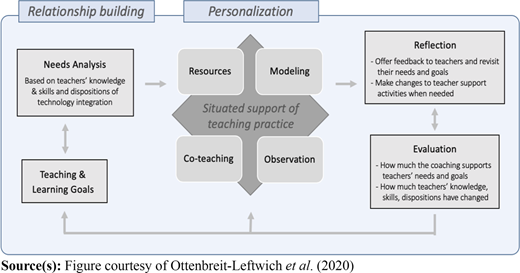
Ottenbreit-Leftwich et al.’s (2020) model (Figure 1) portrays changes in teachers' technology-integration practices. The model incorporates the characteristics of effective PD as (modeling, co-teaching, etc.) and centers on the importance of relationship building and personalization to best address teachers' needs and goals within their contexts.
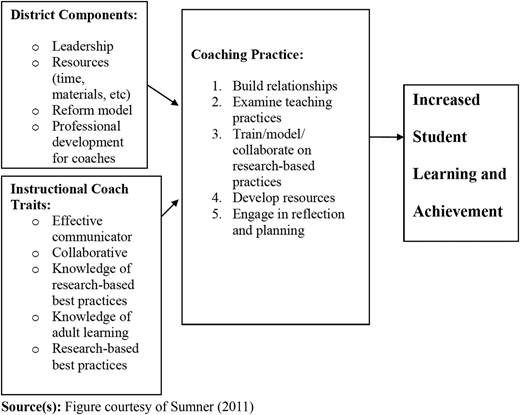
Sumner's (2011) model (Figure 2) is not specific for digital technologies integration, but compared to Ottenbreit-Leftwich et al.’s (2020) model, it considers the school context, the district components and the coach's characteristics and coaching practices, which are important, especially in a wide-scale digital education curricular initiative involving a large number schools with different cultures and contexts. However, in this model, coaching practices are not clearly defined in terms of effectiveness and are not related specifically to the integration of digital technologies.
Despite their value, both models have limitations as they ignore either the school context or the effectiveness of coaching PD activities. These elements are essential, as schools in our sample have different policies concerning ICs' coaching practices and digital education implementation is related to the school context (e.g. infrastructure and equipment).
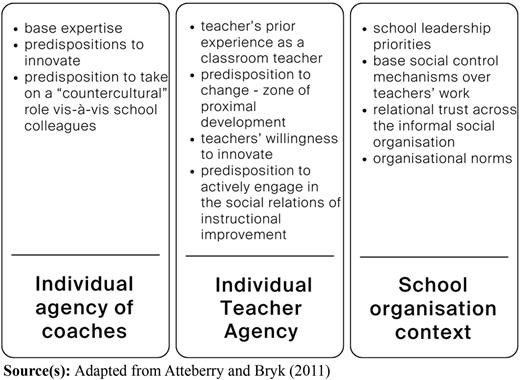
A third model, by Atteberry and Bryk (2011; Figure 3), includes determinants related to (1) agency of coaches, (2) agencies of teachers and (3) school organization context. These elements explain the variability of teachers' participation in PD activities, which is an indicator of ICs' success. The fact that teachers participate in PD activities, especially when they are not compulsory, leads us to believe that what the IC proposes is useful to them. However, the model ignores coaching PD activities.
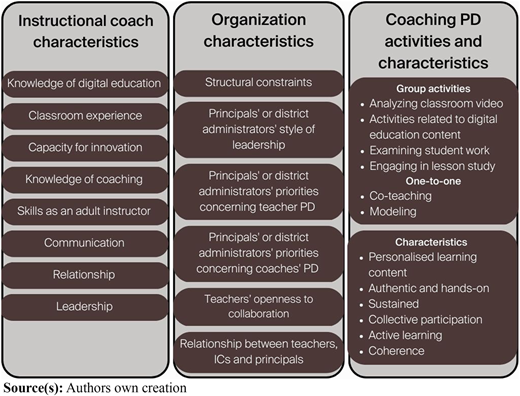
Considering the limitations of each model, we developed our conceptual framework (Figure 4) by selecting three main concepts common to the models to guide our analysis and answer our research questions: (1) IC characteristics, (2) organization characteristics and (3) coaching PD activities.
The first two components of the model (IC and organization characteristics) allow us to understand more about the implications of RQ1: What are the difficulties experienced by the ICs involved in the digital education curricular initiative when supporting teachers?
The third component (coaching PD activities) and related literature provide provisional hypothetical answers to RQ2: Which PD activities do ICs provide to teachers? Why do they provide these specific activities?
Each part of the model is explained in the next sections.
IC characteristics
IC characteristics define the conditions necessary for a successful instructional technology coaching intervention (Bakhshaei et al., 2018). Therefore, ICs must have certain professional qualities and characteristics (Johnson, 2016), and according to Bakhshaei et al. (2018), they should be convinced of the potential benefits of technology for education.
The proficiency of the ICs depends on their experience or training in a specific disciplinary field. Some ICs are granted such functions precisely because of their mastery of that field (Draelants, 2007). One key quality is their teaching experience (Bakhshaei et al., 2018) as it is crucial to hire professionals credible in the eyes of both the teachers and school leaders (Johnson, 2016). Their capacity for innovation (Dugal, 2009) is essential, especially when it comes to digital technologies and their use in an educational context.
To be proficient, they need to improve these skills. Therefore, ICs need ongoing PD (Wilson, 2021). First, they should receive training in their fields of expertise (Duchesne, 2016). They should also develop skills as an adult instructor as many coaches are coming out of the classroom with little to no experience coaching or working with adult learners (Johnson, 2016). They should train to become strong communicators (Bakhshaei et al., 2018), relationship builders and leaders (Wise, 2021). They should develop coaching skills (Chval et al., 2010) and their ability to develop a nonthreatening partnership, free of judgment and focused on student learning (Johnson, 2016).
Organization characteristics
Organization characteristics define the conditions necessary for a successful instructional technology coaching intervention because of their impact on the agency of ICs and teachers. These characteristics relate to structural constraints (e.g. the number of teachers to supervise vs. time; Atteberry and Bryk, 2011), district or school administrators' style of leadership and their priorities concerning teacher PD and PD for coaches (Heineke, 2013).
According to Aguilar (2019), many school district leaders are committed to implementing coaching, but they are frustrated by the lack of systematic management and planning of the instructional coaching program. Trotty-Aubrey's (2019) research shows that a lack of district protocols concerning ICs' roles and tasks leads to differing implementations in district schools. The misalignment of the district, school administration and specialist skills lead to the underutilization of IC by 40%.
At the school level, Johnson (2016) observes that many leaders lack background on how to use instructional coaching PD models meaningfully. According to Matsumura et al. (2010), the principal's leadership attitude favorably predicts teachers' participation in coaching activities. Their research shows that school leaders who described coaching as valuable positively affected the time that coaches spent observing and providing feedback to teachers. Without strong leaders, clear expectations and sufficient time, coaches may exert little influence (Wise, 2021).
Therefore, district-level administrators should consider the priorities they want ICs to address (Kane and Rosenquist, 2019) and they should collaborate with school leaders to hire effective ICs (Wilson, 2021).
Other factors related to organization characteristics are teachers' openness to collaboration (Atteberry and Bryk, 2011, p. 360), the relationship (Ottenbreit-Leftwich et al., 2020) and partnership between teachers, ICs and school leaders (Bakhshaei et al., 2018).
Coaching PD activities
Although the current research on effective coaching activities is sparse (Gibbons and Cobb, 2017), we identified through a literature review six activities and six characteristics that are likely to have a positive impact on teachers' practices (see Table 1). We considered as well studies on coaching PD not implying technology integration (e.g. Gibbons and Cobb, 2017) to have a larger basis.
First, we note that PD can be grouped into coaching activities offered to (1) teachers individually (e.g. modeling and co-teaching) and (2) groups of teachers. Mangin and Dunsmore (2015) suggest that individual coaching alone may not build collective capacity, an important aspect of school improvement. Additionally, according to Gibbons and Cobb (2017), state and district policies increasingly encourage ICs to work with groups of teachers. Thus, both approaches should be considered complementary.
Literature reviews suggest that PD activities should be characterized by personalized learning content (Ottenbreit-Leftwich et al., 2020) and they should be authentic and hands-on (Liao et al., 2021) and sustained (Bakhshaei et al., 2018). PD coaching activities should include collective participation (Ottenbreit-Leftwich et al., 2020), active learning and coherence (Desimone and Pak, 2017).
Methodology
Research context
This research considered ICs participating in an ongoing large-scale digital education curricular initiative in Switzerland. Mandated by the Department of Education and the result of a collaboration between three universities, the initiative looks to integrate digital education (intended as computer science, information and communication technologies and digital citizenship) at all levels of compulsory education (K–12). Within this framework, all in-service teachers from 93 public schools (approximately 6,500 teachers and 100,000 students) are progressively trained to use digital technologies in order to teach computer science and digital citizenship by attending continuing education training. The initiative began in 2018 with 12 K–12 schools (“Cycle 1”: students' approximate ages 4–5 years to 7–8 years; “Cycle 2”: approximate ages 8–9 years to 11–12 years; “Cycle 3”: approximate ages 12–13 years to 14–15 years) taking part in a 4-year pilot phase. The aim of the pilot phase was to draw lessons to be applied to the deployment period (starting in 2022) and involving the remaining 81 schools.
Sixty-four ICs, 43 women (67%) and 21 men (33%), were appointed among teachers within the 12 pilot schools to provide onsite PD. They were selected at the beginning of the initiative's implementation, in 2018, based on their motivation to fill the role as the Department of Education needed to quickly recruit ICs to support several hundred teachers involved in the initiative. ICs work part-time as coaches. Teaching remains their primary occupation. The proportion of ICs per school and the number of coaching hours they are allocated are defined by the district. As part of the initiative, and starting in September 2018, the ICs attended between three and five training sessions per year, over 4 years, in person and during the contractual day. The focus of the training has been on digital education, as intended by the initiative.
Participants
The participants were recruited according to a pre-established criterion: the inclusion of their school in the pilot phase, which means they have been involved in the initiative since its beginnings and therefore have a deep understanding of its goals and challenges. Analyzing data in this phase of an extensive initiative provides useful information to policymakers, universities and IC trainers for scaling up and durability.
Procedure and instruments
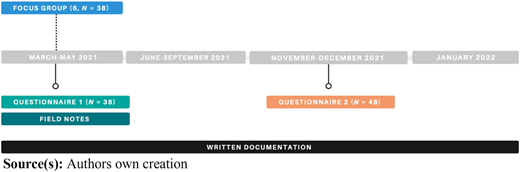
The data collection was carried out in 2021 (Figure 5).
Focus group
We invited the ICs to voluntarily join a focus group. Thirty-eight ICs (of 64, i.e. 59% of the total IC population), 26 women (68%) and 12 men (32%) participated ( Appendix 1). We did not collect more information regarding demographics beyond gender due to ensuring confidentiality.
To have a maximum of six to eight participants, five focus groups were organized with ICs in primary schools (Cycles 1 and 2). An additional focus group was organized with 10 ICs working in middle school (Cycle 3).
Three researchers led the focus groups, which lasted from 45 min to 60 min. The protocol ( Appendix 1) included 12 questions.
Questionnaire 1
A short survey ( Appendix 2) was submitted to the ICs taking part in the focus group (n = 38). The survey consisted of five items about experience as a teacher and as an IC, motivation to become an IC and previous training in digital education.
Questionnaire 2
All the ICs involved in the initiative responded to a second questionnaire. Forty-eight ICs (of 64, i.e. 73% of the total IC population) responded. The survey consisted of 22 items: demographics, perception of the training's utility, PD activities offered, perception of activities' utility, working conditions, motivation and needs.
Written documentation and field notes
Written documentation (ICs' job specifications and work conditions) and field notes collected during and after the focus groups were used to triangulate the data. The instruments used for each stage are synthesized in Table 2.
Data analysis
We applied a convergent mixed-methods design (Ivankova and Plano Clark, 2018) to combine the results of the quantitative and qualitative analyses.
Given the exploratory nature of the study, descriptive statistics were applied to analyze data collected through the questionnaires.
The data collected through the focus groups provided access to participants' own language and concerns, offering an opportunity to observe the process of collective sense making (Wilkinson, 1998).
To analyze the qualitative data, and to reduce and identify patterns, we conducted a thematic analysis (Braun and Clarke, 2006) following a five-step model (Castleberry and Nolen, 2018). First, the focus groups were audio recorded and transcribed. Second, we coded the data to convert raw data into useable data through the identification of themes. To facilitate the organization process of this substantial amount of textual data, we used NVivo (Version 12) software. To code the focus group transcripts, we utilized the constant comparative method (Miles and Huberman, 2003). An initial open and emergent coding phase tested the codebook based on our conceptual framework. Each researcher used it to code two transcripts individually. The researchers then met to compare, delete and add new emerging codes until 100% agreement was achieved through consensus (Syed and Nelson, 2015). Third, we interpreted the data by developing a thematic map, which is a visual representation of themes, codes and their relationships, to be able to see relationships among constructs. Finally, we drew conclusions to answer the research questions. As we chose a mixed-methods approach, we linked qualitative and quantitative data sets during the interpretation phase of the results.
Finally, we proceeded to a document analysis of written documentation provided by trainers and field notes collected by the main researcher.
Results
The findings are organized and presented to answer the research questions.
What are the difficulties experienced by the ICs involved in the digital education curricular initiative when supporting teachers?
A heterogeneous level of expertise
ICs should provide expertise in digital education. Yet, when ICs enter this position, they do not always have in-depth knowledge or experience in the domain.
The result of Survey 1 shows the heterogeneity of antecedent training in digital education and experience as ICs. Over 50% (20 of 38) of ICs had not attended any digital education training before taking on the role. The remaining 47% had diversified experience ranging from a first-year bachelor in computer science to a few days training in robotics.
During the focus groups, the participants without any prior training indicated that it was a major difficulty for them: “I feel a lot of pressure about everything technical … there are often questions for which I don't necessarily have answers. It's not always very pleasant to say, ‘I can't answer you, I don't know’” (Gr. 2, Ref. 3) [1].
Nonetheless, the results from Survey 2 showed that ICs in Cycle 1, who started to take part in the digital education curricular initiative at its beginning in 2018, felt well prepared (M = 5.5, standard deviation (SD) = 1.40) and even more so compared to ICs in Cycle 2 (M = 4.72, SD = 1.53), whose training started in 2019 (and had to stop during the coronavirus disease 2019 (COVID-19) pandemic in 2020) and to ICs in Cycle 3 (M = 4.87, SD = 0.99), who started the training in 2021.
Motivation
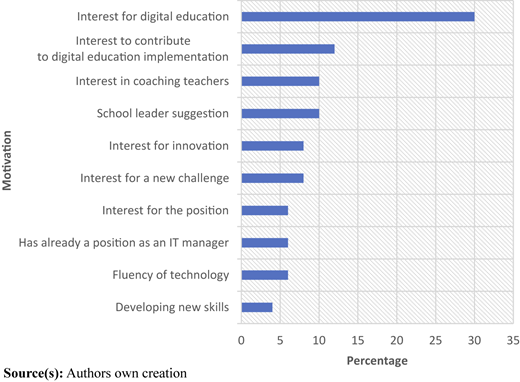
In Survey 1, the participants were asked in an open question why they decided to become ICs. The main motivation (Figure 6) was their interest in digital education (30%). Coaching teachers, which was their primary role, represented just 13% of the ICs taking part in the study [2].
This result showed that the IC position and its mission were not well understood, even for ICs themselves in the context of our study.
Little experience and support in transitioning from working with children to supporting adults
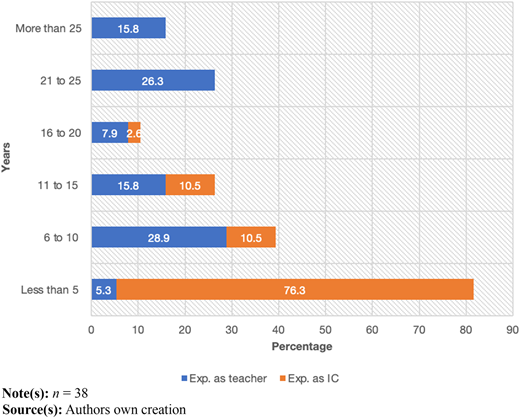
Figure 7 shows the participants' experiences as teachers and ICs according to the results of Survey 1. Most participants had little experience as ICs, with 76.3% of them having less than 5 years of experience (M = 4 years, SD = 5,06). However, most were experienced teachers: 50% had more than 16 years of teaching experience (M = 17 years, SD = 9,39).
While the participants noted their interest in helping their colleagues in the focus groups, some mentioned their difficulty in positioning themselves as coaches: “It's delicate. How do you coach peers when you're used to teaching children?” (Gr. 5, Ref. 1).
In short, most of the ICs are experienced teachers with little experience in adult education or coaching.
Teachers' openness to innovation
Teachers' reactions toward digital technologies were heterogeneous. Some were enthusiastic about using technologies and experimenting: “When we brought the iPads into the classes, we made people happy!” (Gr. 4, Ref. 1). Others were less open to innovation. ICs noted the fear of technology failure that sometimes triggered aggression: “If the app crashes, they're furious. … So, we're the one who collects this stuff. Sometimes it's an email, and I'm like ‘but you're angry with your computer, not with me, I haven't done anything to you!’ It's frustrating” (Gr. 2, Ref. 2). These reactions impacted ICs' attitudes and the PD activities they provided, their motivation and explained their difficulties in building a cooperative partnership.
Leadership
We identified three subcategories of factors affecting ICs relating to school leadership.
Organizing the work of IC and specifying their role
The focus groups showed that school leaders' involvement in the initiative was crucial, and without a clear organization of ICs' and information technology (IT) managers' tasks, it was difficult to work effectively:
The problem in our school is that it’s fragmented. Who does what, exactly? The IT manager? The instructional coach? The school leaders? It goes in all directions. (Gr. 2, Ref. 3)
When we accepted the job, it was not very clear regarding our tasks. (Gr. 4. Ref. 1)
It is important to note that the district defines ICs' job specifications, which includes seven roles and 31 tasks. Nevertheless, their role is not clear, both for the ICs and for the teachers. ICs' and IT managers' tasks frequently overlap in their day-to-day practices, partly because IT managers' job specifications do not yet exist. This confusion hinders ICs to understand their mission fully. The district provides the general working conditions for ICs' work, but school leaders have a room to maneuver to recruit ICs, distribute coaching hours, ask them to offer certain PD activities and organize PD in schools.
Providing effective infrastructure, equipment and supporting ICs
The allocation of resources (number of ICs per school and total of coaching hours) [3] varies depending on the school, as can be seen in the written documents. The district finances a minimal number of hours per school to provide equal treatment, but certain school leaders decide to allocate extra hours.
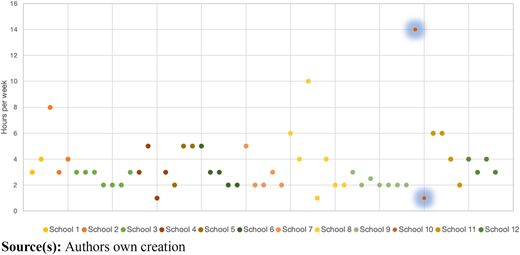
There are five ICs on average (SD = 2.4) per school. They provide on average 3.5 coaching hours (SD = 2.3) per week. Figure 8 illustrates the different patterns of coaching within the sample and school leaders' different strategies in organizing instructional coaching. School 9 has seven ICs with a few hours each, uniformly distributed between two and three periods per week (i.e. the equivalent of 7–11% of a full-time job). School 10 concentrates the coaching tasks across two ICs, but one of them, working 50% (14 h) as an IC appears as the reference for digital education in the school.
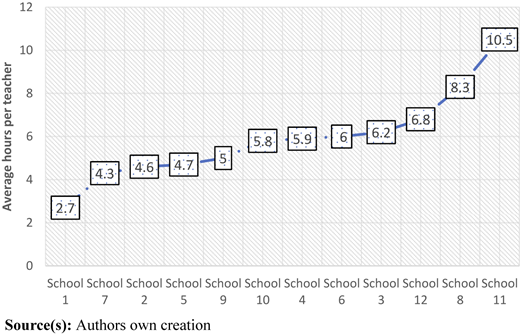
Figure 9 shows teachers' theoretical exposure to coaching during a school year [4] (the number of hours dedicated to coaching divided by the number of teachers in the school). This comparison underscores the great variation within schools in how much coaching “time” teachers receive. In Schools 11 and 8, the average is the highest (respectively, 10.5 h and 8.3 h).
If theoretical exposure is an indicator of what is possible and what is not, it does not explain entirely teachers' participation in PD activities. Taking part in PD activities depends not only on time allocated but also on ICs' strategies, teachers' attitudes toward digital education, school culture and openness to collaboration and innovation. The consequence is that some teachers receive much help and time and others none: “There will always be teachers who will do nothing, because they are not interested, and those who will do everything. So, finally ICs will only work with 6–8 teachers motivated” (Gr. 1, Ref. 1).
The variability in allocated IC hours can be traced to the variability of the attitudes of the schools' leaders. Some school leaders supported ICs because they had a deep understanding of the issues ICs had to face: “We're pretty well off. Our director was an IT manager elsewhere before, so all that interests him deeply” (Gr. 1, Ref. 3).
Some school leaders were enthusiastic but were not digitally literate and did not know how to support ICs: “We have a school leader who is lost. It's not his fault, but … we have to think about everything. How to do it? What should we do? We have to manage all the administration” (Gr. 2, Ref. 1).
In short, according to ICs, school leaders should be more involved in the implementation of an instructional coaching program and provide satisfactory hourly staffing, define ICs' and IT managers' tasks and communicate it explicitly to teachers.
Relationship of trust between the partners
For the ICs, it was “capital” (Gr. 5, Ref. 1) that they build a relationship of trust with teachers and with school leaders, but it was difficult when teachers did not fully understand the IC's mission: “Sometimes I feel they must be thinking, ‘What the hell is she doing?’” (Gr. 1, Ref. 3).
During the in-class modeling interventions, the ICs could tell whether teachers were confident, or not, depending on how they welcomed them: “I went into classes in each degree. I felt that some teachers were comfortable with another person coming into their classroom and others were not” (Gr. 2, Ref. 3). Sometimes teachers perceived the ICs as threatening and they were afraid of their judgment. Some ICs thus testified to difficult experiences: “We realize that some teachers don't venture to ask elementary things about their iPad. They put themselves in a position where they no longer dare to ask” (Gr. 2, Ref. 1).
The relationship of trust with school leaders varied from one school to another. In some schools, the ICs “listened” (Gr. 4, Ref. 1). In others, where the school leader strictly controlled the activities carried out, ICs felt oppressed: “Can we talk about the school leader's trust? Our school leader wants us to do lots of things, but at the same time, we must be accountable for everything. And by the minute, roughly” (Gr. 3, Ref. 1).
Which PD activities do ICs provide to teachers? Why do they provide these specific activities?
During the focus groups, the participants mentioned eight activities they conducted with teachers: (1) teacher workshop, (2) informal training, which offered the possibility for teachers to “engage with the discipline,” (3) modeling, (4) co-teaching, (5) replacing the teachers (the IC taught the class of students while the regular teacher left the classroom) and teaching a digitally related lesson, (6) preparing ready-to-use activities for the teachers, (7) offering technical support and (8) collaborating with teachers to build a project to carry out in the classroom, leading potentially to co-teaching. We note that the first three activities imply a low level of involvement from the teacher to acquire new skills.
Some ICs replaced the teachers in their classrooms and worked directly with their students because the teachers had no digital skills or because this was a common practice before the initiative started:
The teacher doesn’t attend. We’re just exchanging our classes, because she has no digital skills at all. So, she takes my students and I take hers. (Gr. 2, Ref. 1)
This is how we did for years. (Gr. 1, Ref. 5)
In-class modeling was also offered to teachers. Although some ICs considered in-class modeling useless to change teacher practices, they offered it for seven reasons (see Appendix 3).
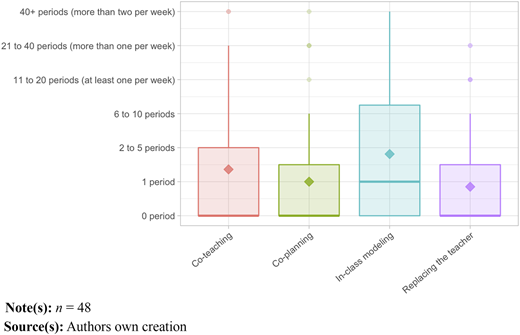
In Survey 2, we asked the ICs to report the weekly amount of time spent in the PD activities indicated in their job descriptions. We added the activity “replacing the teacher” as participants mentioned it in the focus groups.
Figure 10 shows that the results align with what had emerged from the focus groups, as in-class modeling was the activity most frequently offered.
Discussion
Much time devoted to technical troubleshooting; little time for pedagogy
Both teachers and ICs seemed to know little about ICs' roles and tasks. Only 11% of ICs mentioned “coaching” as a motivation to take on the position. This aligns with research illustrating that many ICs enter into appointments without a thorough understanding of their role (Gallucci et al., 2010).
Also, participants mentioned teachers' ignorance of the IC role, a result in line with Wise's (2021) study showing that ICs are a minority group among their peers, which creates a negative perception around what coaches do and how they spend their time. The lack of clarity in their job specification could explain these attitudes (Von Frank, 2010).
We observed that many ICs spent time on in-class modeling (without fully using its potential) and resolving technical problems. This aligns with Deussen et al.’s study (2007) that found coaches were expected to spend 60%–80% of their time working directly with teachers on pedagogical issues, but they actually spent only 28% of their time on these tasks.
Therefore, defining a clear role for both ICs and IT managers, having a clear organizational structure for PD and communicating it to all stakeholders is a priority to benefit fully from ICs' skills and to improve their impact on teachers' use of digital tools. The district should set the scope for who coaches are, what they do and how they should grow professionally (Stoetzel and Shedrow, 2020) for successful system change.
Selection criteria are unclear and ICs are a very heterogeneous group
ICs' perceptions regarding their role as experts and agents of change in the durability of digital education reform varied greatly. Some had attended training sessions on digital education before getting involved in the initiative. Others were new to the role; they were not yet trained and did not feel competent to support their colleagues.
The reason for these difficulties could be that many school leaders asked teachers to take on the role and one criterion was their experience as a teacher and not necessarily their knowledge in digital education or experience in a similar position. This aligns with Duchesne's (2016) results. However, hiring effective ICs is crucial (Johnson, 2016) and clear criteria should be defined by school leaders.
The initiative is growing fast as the objective is to train all teachers of the administrative region between 2018 and 2028 and the need for ICs with expertise in digital education is high. Therefore, school leaders do not have many choices when it comes to recruiting as the demand is higher than the supply.
However, the district should define a standardized set of selection criteria. In cases where it is impossible to recruit ICs with sufficient experience in digital education, coaching and adult education, it is essential that adequate training in these domains be provided (Aguilar, 2019).
How to train ICs to offer effective coaching PD activities to teachers.
Some ICs offered activities with low involvement from the teachers, who assumed a passive attitude. We observed that ICs did not mention the three activities suggested by Gibbons and Cobb (2017) – analyzing classroom video, examining students' work and lesson study – that require a high level of involvement from the teacher and an active attitude. This result aligns with Orianne and Draelants (2010) who noted that teachers wish to have ready-made educational tools and resources. On the other hand, ICs sought to help them to become autonomous. In our study, offering in-class modeling appeared to be an avoidance strategy, for both the ICs (to avoid conflict) and the teachers (to escape ICs' judgment). Most of the ICs used in-class modeling as a consequence of their unclear role and objectives.
Some activities like in-class modeling were offered with the aim of building trust with teachers. Teachers “crave explicit demonstrations” (Casey, 2011, p. 24); they need to see teaching strategies in action before they make them their own. In-class modeling can be a valuable learning opportunity, if teachers are actively involved, because they can observe what an expected teaching practice looks like. ICs should therefore continue to provide in-class modeling as a component of the instructional coaching process and take full advantage (e.g. by organizing debriefing sessions).
As the objectives of PD activities should be ambitious and achievable (Atteberry and Bryk, 2011), it would be a question of moving gradually from active in-class modeling to co-teaching, to put the teachers in action and thus help them gain confidence and autonomy.
ICs' training programs should progressively address these difficulties and provide strategies to take better advantage of PD activities. We suggest training ICs in PD activities, aligned with Gibbons and Cobb (2017), such as analyzing classroom video (e.g. observation of teachers' practices with digital technology). We also suggest offering lesson study to teachers working together with an expert to improve a lesson (Morris and Hiebert, 2011), offering modeling and ongoing feedback (Connor, 2017) and designing personalized learning content (Burggraaf, 2020).
Empowering ICs
Some school leaders encouraged the ICs by allocating additional coaching hours. Other school leaders had little interest in the PD program and underestimated the IC role by providing scarce means to succeed.
District and school leaders should provide ICs with explicit guidance and resources to achieve systemic change. Besides having adequate support from school leaders (Wise, 2021), ICs should be empowered by being involved in the development of the school's continuing education training plans (Beaulne et al., 2013). Von Frank (2010) found that when ICs and school leaders met regularly to establish the PD program's structure, better results were likely to be obtained. As underlined by Matsumura et al. (2009), when school leaders display an “egalitarian style of leadership,” ICs work more frequently with teachers on educational issues. Although instructional coaching is a combination of leadership and partnership (Knight, 2009), ICs' leadership should be developed and distributed leadership considered in schools. For school leaders to effectively implement and hire ICs, they should have a deep understanding of instructional coaching (Johnson, 2016). ICs should work as part of the school leadership team (Fullan and Knight, 2011) and the school community should identify ICs as leaders of PD and change.
This research presents limitations as it focuses on the ICs' perspectives and does not consider teachers' or leaders' points of view. Future research should include other stakeholder perspectives (e.g. teachers, school leaders and IC trainers).
Conclusion
This article answers RQ1 by highlighting the challenges ICs face during their day-to-day work. First, we note that some challenges are not entirely technology focused per se; they relate mainly to the IC role. However, technology integration is an issue because the technical complexity of some activities requires ICs and teachers to train. Second, ICs in the context of this study are an eclectic group with all the consequences this has for their formation. This could also be the case in other contexts of large-scale digital education curricular reforms, where large numbers of ICs need to be hired quickly.
While these different characteristics play a role in the quality of support they offer, the organization characteristics of the schools are also important. The school leadership's knowledge in digital education and the guidance it offers to ICs are vital to overcome the difficulties ICs encounter. Therefore, we recommend tutoring school leaders to recognize ICs as partners (Johnson, 2016) and change agents and to design with them a digital strategy to promote a digital culture for their school.
The results answering RQ2 show a variety of PD activities available to teachers. Not all of them are effective in addressing teachers' needs. Therefore, IC should be trained on how to conduct a teacher training needs analysis and on the criteria for selecting the most appropriate activity to meet teachers' needs.
This work was supported by the Ministry of Education (DFJC) of Canton de Vaud, Switzerland.
Notes
Verbatim quotes are cited as follows: Gr. = group, Ref. = IC reference.
The study was conducted in a French-speaking area where ICs are called “resource persons”. The role of IC appeared with the initiative in 2018. A similar role had existed in the past but with a different name (“anonymization”).
A full-time primary school teacher teaches 28 periods per week (each period is equivalent to 45 min).
A school year includes, in Anonymous, a total of 38 weeks.
Declaration of interests: The authors declare that they have no known competing financial interests or personal relationships that influence the work reported in this paper.
Ethics approval: The study received ethics approval Human Research Ethics Committee (HREC) No: 033–2019. Written informed consent was obtained from the participants.