


The purpose of this study is to describe and explore how leading in complexity is experienced by project managers in the Swedish public transport infrastructure sector and what strategies project managers use to manage the challenges it presents.
To explore the lived experiences of project managers who had led complex projects, a descriptive phenomenological methodology was conducted. Data were collected through semi-structured interviews. The data were analyzed using phenomenological procedures, including horizontalization, theme clustering and textural–structural description.
The findings show that project managers experience complexity not as discrete categories, but as intertwined conditions shaped by interdependencies, stakeholder dynamics and uncertainty. The study also reveals that the distinction between complicated and complex contexts becomes blurred in practice, as situations that are analytically distinguishable are experienced as inseparable. In response, leadership emerges as an ongoing process of sensemaking, coordination and adaptation. The complexity-informed leading (CIL) conceptual model summarizes how leadership is enacted in complex project environments.
This study contributes a phenomenological perspective by highlighting a gap between theoretical categorizations of complexity and project managers' lived experience. It shows how complexity is experienced as relational and emergent, rather than structurally defined, and how leadership practices arise in response to this ambiguity. The study reframes leadership in complex projects as a situated and interpretive practice and presents CIL conceptual model as an empirically grounded way of understanding how leadership is enacted in such conditions.
1. Introduction
The challenge of how to successfully navigate complexity has become a central concern both among scholars and practitioners. Complexity is defined here as the dynamic and unpredictable challenges faced by project managers and leaders, where multiple factors interact and decision outcomes are difficult to predict (Baccarini, 1996; Remington and Pollack, 2007; Uhl-Bien and Arena, 2018). Such interactions result in structural ambiguity and ever-changing problems that are usually caused by quick technological changes, changing regulatory frameworks and the rising demands of stakeholders (Rana and Shuja, 2022). It also relates to the rising challenge of enabling “stability in change” where organizations need to balance structured processes with increased flexibility and innovation in complex contexts, as highlighted by Fundin et al. (2025) in the future research agenda of quality management.
The level of such complexity is currently high for project managers in the public Swedish transport sector. For example, as requirements from the European Green Deal and Agenda 2030 currently necessitate huge public investments in long-term, transformation-driven projects (Alvehus and Loodin, 2023). These initiatives do also typically involve multiple internal and external stakeholders with different, and often competing, demands and expectations (Zanfelicce et al., 2025). Project managers must then consequently lead transformative efforts that change both processes and digital infrastructures, which in turn affect the interactions between all stakeholders (Rataj et al., 2025). This requires an ability to drive organizational change and ensure successful adaptation to new ways of working (Ingvarsson et al., 2023; Pahlén, 2024). Princes and Said (2022) emphasize that in such complex projects, leaders are burdened with the problem of managing not only the complexity of the project, which has a direct impact on the performance of team members, but they also have to demonstrate the trust-building qualities of leadership to get high quality results from the team.
Ameer et al. (2025) further state that complexity has two sides – it influences the internal dynamics of a project and causes external uncertainty. Therefore, they point out that companies should raise the horizon of their capabilities and skills to be able to deal with such complexities. In doing so, Soares et al. (2022) claim that agile project management does help manage internal complexity, but its short-term focus implies that a complementing strategic leadership is needed to support organizational learning and meet external complexity (Carvalho and Choo, 2025; Patton, 2015). The notion that leadership is the key factor to help companies overcome challenges and raise the quality standard to be able to handle the complexity and uncertainty is also recently stated by Bojesson (2024).
Nevertheless, it is still a mystery what exact methods and procedures leaders use to navigate through the unpredictable complexity in project environments (San Cristóbal et al., 2019). In their daily work, project managers who are dealing with complexity hardly get any support from conventional leadership theories (Heifetz, 1994; Uhl-Bien et al., 2007). This is especially true for situations where quality improvement is considered a main factor of organizational effectiveness (Tengblad, 2012; Uhl-Bien and Arena, 2018). Research has traditionally focused on what contributes to project success (Rehan et al., 2024), whereas the process by which leaders develop capabilities to manage complexity in practice has been largely neglected (Potter, 2020; Tengblad, 2012). Deep insight into the practical, human-centered processes through which leaders themselves experience, interpret and manage complexity in their daily work is hence lacking (Wallo et al., 2024). This lack of knowledge calls for more inductive studies that are based on the project managers' own lived experiences.
More specifically, there is a lack of in-depth, empirical research that captures how project managers' attribute meaning (meaning-making) to complexity and what strategies they use to practically navigate it (Vaagaasar et al., 2019). Thus, there is a human-centered research gap between theoretical models and the lived, practical experience of project managers in complex project environments (Mikkelsen, 2025). Several contemporary studies have highlighted the need for research in this direction, to better understand leadership as a practice-based process with an emphasis on meaningful and adaptive actions to manage complexities specifically in transport and infrastructure projects (Cellerino et al., 2025; Martinsuo et al., 2019). This study aims to address that gap by exploring project managers' lived experiences in large-scale and sustainability-oriented transport infrastructure projects in Sweden. Thereby, it responds to current calls in the fields of project management and quality management to better understand leadership as a practice-based process, emphasizing sensemaking action in navigating and managing the complexities in projects associated with achieving sustainable transport development.
Prior research has successfully advanced the understanding of project complexity, leadership, stakeholder dynamics and organizational learning in project settings (Ahern et al., 2014; Di Maddaloni and Derakhshan, 2024; Princes and Said, 2022). However, less attention has been given to how project managers themselves experience, interpret and make sense of complexity in daily practice. By adopting a phenomenological perspective, the authors’ ambition is to extend and add to the research stream by exploring complexity as a lived and meaning-making experience.
The purpose of this study is to describe and explore how project managers within public transport infrastructure in Sweden experience complexity and what leadership strategies they use to manage the challenges it presents. To achieve this purpose, the study is guided by the following two research questions:
What is experienced as constituting and contributing to complexity, and what meaning do project managers ascribe to it?
What leadership strategies are experienced to enable project managers to navigate in complexity?
2. Theoretical background
This section provides background on project management and leadership, learning-oriented culture and collaboration and stakeholder roles in complexity. This literature review focuses on the areas that are most relevant to interpreting the study’s findings. To clarify the study's theoretical positioning, this review draws on three complementary perspectives. First, complexity is understood as an emergent and relational condition shaped by interdependencies and uncertainty (Ahren et al., 2014; Snowden and Boone, 2007). Second, leadership is viewed as an adaptive relational practice enabling interaction, learning and responsiveness in uncertain contexts (Uhl-Bien and Arena, 2018; Uhl-Bien et al., 2007). Third, phenomenology provides an interpretive lens for understanding project managers' lived experiences of complexity (Giorgi, 2009; van Manen, 2016).
2.1 Project management and leadership in complex projects
Project managers at the public transport infrastructure sector like those of the Swedish transport sector carry out their duties in situations marked by changing regulations, uncertain technology and varied stakeholder expectations (Rana and Shuja, 2022). In these complex surroundings, the leaders' roles extend beyond the mere coordination of technical and organizational interdependencies to also include frequent interpretation and adjustment to newly arising conditions.
Theories lifting project complexity in project management literature is often defined by the structurally observable elements of the project such as the interdependence, uncertainty and stakeholder diversity of the system (Baccarini, 1996; Geraldi and Adlbrecht, 2007; Williams, 2002). Nevertheless, follow-up work in system-oriented research has pointed out that complexity is not only a structural condition but also a somewhat dynamic and emergent property resulting from the continuous interactions of many actors and organizational layers (Ahern et al., 2014). This idea changes the understanding of complexity from a mere static account of the project's features to a system of interrelations and adaptation processes that is alive.
Drawing on the Cynefin framework developed by Snowden and Boone (2007), it is important to distinguish between complicated and complex contexts, as these terms are often used interchangeably in project management literature. Complicated contexts may involve many interconnected elements, but causal relationships remain ultimately knowable through analysis and expertise. In contrast, complex contexts are characterized by nonlinear, evolving interactions where cause–effect relationships can only be understood retrospectively. Large infrastructure projects often contain both. While technical systems and planning structures may be complicated, the interaction between stakeholders, organizational dynamics and changing conditions gives rise to complexity in the sense of emergent and relational processes. In this study, complexity is therefore understood primarily as an emergent phenomenon, experienced through ongoing interpretation, ambiguity and adaptation in practice.
These perspectives provide insight for understanding the environment in which projects operate, but they do not reveal the complexity which project managers encounter in their daily work. Complexity is not only an attribute of a project, but it also comes from the lived experience of dealing with ambiguity, conflicting expectations and continuous interpretation (Mikkelsen, 2025; Snowden and Boone, 2007; Wallo et al., 2024). As Cicmil et al. (2006) note, project management research has long been dominated by instrumental rationality, whereas in reality, projects unfold as arenas of ambiguity, negotiation and lived sensemaking. Previous phenomenological studies have also explored project managers' lived experiences in complex and changing environments. For instance, Hopkins (2023) shows how project managers navigate change, learning and leadership transitions in complex adaptive systems.
Complexity, from a phenomenological perspective, is the subjective and relational tensions that arise when project managers must make decisions without having full knowledge, coordinate different viewpoints and accept the presence of the unclear situations (Uhl-Bien and Arena, 2018; Weick, 1995). This shifts the emphasis from what complexity is to how it is experienced, and how project managers encounter responsibility, pressure and uncertainty (Mikkelsen, 2025).
According to the complexity leadership theory (CLT), leadership under such circumstances requires the enabling of adaptation, interaction and learning, rather than the direct execution of predetermined solutions (Uhl-Bien et al., 2007). However, CLT primarily focuses on the description of the processes and, therefore, does not adequately address the issue of how leaders themselves recognize these processes. Hence, this creates a theoretical gap between the acknowledgment of complexity as a structural phenomenon and the recognition of it as a lived experience.
Traditional project management systems rely heavily on the idea of control, predictability and the achievement of success criteria which have been defined in advance such as cost, time and quality (Feger and Thomas, 2012). Nevertheless, these logical models frequently fail when projects go deep into turbulent environments which have changing goals, political uncertainty and dynamic stakeholder networks (Sydow et al., 2004). According to Snowden and Boone (2007), in complex settings, the causal relationships can be understood only after the fact; therefore, leaders are required to make decisions based on emergent sensemaking, understood as an action-based and iterative process through which individuals and groups make sense of complex and ambiguous situations, rather than sequential planning. This is in line with what Bhatti et al. (2021) call ethical and sustainable leadership, a synthesis between technological and human management.
Therefore leadership of a project changes from being a controller to an enabler of learning and meaning-making (Bushe and Marshak, 2016; Uhl-Bien et al., 2007) – the project manager becomes the leader. Leadership is seen as a form of local practice – a deeply interpretive and emotional response to the unknown – rather than the simple following of the predefined instructions. Reflective, sensemaking-oriented leadership, as Rana and Shuja (2022) indicate, gives the team the power to be more agile and at the same time keep their focus in situations of uncertainty.
The research presents the concept of leadership in complex projects as an intentional, experiential and sensemaking activity where project managers achieve temporary stability, encourage collective learning and facilitate adaptive responses. Such a perspective is consistent with the interpretivist and phenomenological tradition (Saunders et al., 2019), thus viewing project management as a human practice influenced by subjective interpretation and lived experience, instead of being a strictly technical discipline.
2.2 Learning-oriented culture
Several studies in complex transport and infrastructure projects suggest that a learning-oriented culture helps the project team to systematically learn from failures, which in turn improves resilience, adaptability and long-term performance (Brosa and Schieg, 2022; Wilson, 2019). From a phenomenological point of view, learning is not simply a formal practice but a lived relational process which is significantly impacted by the way leaders support reflection, dialogue and shared meaning-making. Leaders who are supportive of open communication and view difficulties as learning opportunities, therefore, through the kind of leadership they offer, empower employees to create a reality where complexity can be dealt with in practice (Wallo et al., 2024).
Learning-oriented leadership is a major factor in how project managers and teams perceive uncertainty. Through conversation facilitation, coaching and sensemaking, leaders empower the team to be in a better position to deal with unexpected situations (Pasamar et al., 2019; Wallo et al., 2021). Transformative leadership is associated with organizational learning due to its focus on innovation and problem solving (Lundqvist et al., 2022). This also applies to leadership in quality management that also addresses continuous learning culture as important to meet the needs of adaptability (Fundin and Eriksson, 2026). These indicate that learning is not only a capability of the organization but also a subjective experience that has a great impact on how individuals understand and take action in complex projects.
2.3 Collaboration and stakeholder roles in complex projects
Dealing with collaboration and stakeholders is basically one of the major things that make large transport projects complex in its nature. These engagements reflect various interests, expectations and interpretations, which project managers must manage through and understand almost instantly (Di Maddaloni and Derakhshan, 2024; Nguyen et al., 2021). Phenomenologically speaking, the complexity of stakeholders is felt in the experience of relational tensions, emotional labor and the necessity of constantly decoding the signals, priorities and concerns. Realizing the real aspect of stakeholder work is a huge move toward getting the point why project managers often depict collaboration as a double trouble and a way of learning. Cameron and Green (2015) support the statement and add that openness in communication and stakeholders' inclusion result in the creation of trust and the development of good collaboration relationships. Project managers, in order to cut inefficiencies, are taking on the role of intermediaries who encourage dialogue and problem-solving, as well as keeping the communication channels open (Ang'ana and Kilika, 2022).
2.4 A phenomenological perspective on project complexity
Existing theories have, for example, categorized complexity in terms of structure, uncertainty and interdependence (Baccarini, 1996; Geraldi and Adlbrecht, 2007; Williams, 2002). However, Cicmil et al. (2006), in their “Rethinking Project Management” agenda, argued that these models overlook the actual projects – the emotional, lived and interpretive dimensions through which the managers experience and understand their work. From a phenomenological point of view, complexity is the condition of being in the project world – an existential experience that surfaces when project managers deal with ambiguity, intersubjective relations and moral responsibility (Giorgi, 2009; van Manen, 2016).
The literature review in this paper conceptualizes complexity as a process of generating meaning that is dependent on the perceptions and the embodied understanding of those involved in project work, which is also framed by Sauer and Reich (2009) and Snowden and Boone (2007). It opens the door for the inquiry into such questions as: How do project managers interpret ambiguity? What meanings do they construct in moments of uncertainty? and How do these meanings shape action?
Using a phenomenological method, this study attempts to bridge the gap that exists between structural theories of complexity and everyday project management practice. The study recognizes that what is usually referred to as “complex” is, in fact, an experience that is felt through emotions, reflection and relational interaction. Phenomenology thus offers a way to get to the core of complexity – the issues, the paradoxes and the newly developed strategies which are overlooked by the structural or system models only (Cicmil et al., 2006; van Manen, 2016).
3. Research methods
In this study, a qualitative research design with descriptive-phenomenological methodology was chosen to capture the context and rich meaning of leadership and complexity. The study focused on project managers' lived experiences of leading large-scale, sustainable transport infrastructure projects within a Swedish public administration to identify the structural essence of the phenomena being studied: navigating complexity and emerging leadership strategies. This orientation understands sensemaking (Weick, 1995) as a process of simplifying complex situations to be understood and serve as a basis for action and facilitate organizational adaptation. The focus of this study was on describing project managers' lived experiences of this sensemaking and not the organizational outcome of the subsequent action.
3.1 Research design: a phenomenological approach
For this qualitative study, we used a descriptive phenomenological method and firmly anchored the study in the Husserl's tradition (Giorgi, 2009). Phenomenology is a qualitative method that is about gaining knowledge about how individuals experience and engage with phenomena in their daily lives (Dowling, 2007). Furthermore, the starting point of this research is primarily eidetic (Husserl, 1983). Consequently, we used a transcendental method where categories are derived directly from the data (Moustakas, 1994). The intention was to discover the meaning in the situation of the project managers' experience of leadership in an increasing complexity. Therefore, our obligation becomes a composite description of the phenomenon, which in turn requires the explicit use of certain phases in, for example, parentheses to reduce the effect of research bias in the analysis.
The chosen methodological approach was a cornerstone to achieve consistency and to illuminate the study's purpose of describing and exploring the phenomenon. Our aim was to uncover the meaning of how project managers talk about and experience the complexity of the phenomenon – specifically to map the lifeworld, practice-related strategies used in the context of working with complexity that arises in the management and leadership of large-scale and sustainability-oriented transport infrastructure projects in a Swedish public administration. We chose phenomenology because its ontological alignment serves the research question of seeking the essence of experience. In this respect, phenomenology differs from grounded theory (GT), which primarily aims to generate a theory grounded in participants' views (Creswell, 2013). The study also searches for the shared structural meaning within the group, which distinguishes it from narrative inquiry where the focus is on sequencing and structure in the individual interviewees' stories (Nasheeda et al., 2019).
We have carefully followed Creswell's (2013) design in this paper, a framework for data reduction and analysis from a descriptive perspective. The first steps of the study were to identify the phenomenon, understand the project managers' experiences of dealing with complexity and conduct the interviews. The composite essence emerged after following some of the most important procedures, such as Epoké (bracketing) (further explained in 3.4) and continuing the steps of the actual analysis where the identification of the most important statements in both the textural and structural description is finally made (Moustakas, 1994).
3.2 Research context and sampling
The research was carried out within a large public administration in Sweden. This organizational setting was a strategic choice as project managers in this context constantly have to navigate both the complexity of projects that stem from their own internal challenges such as planning, budgets and stakeholder collaboration and complex environments characterized by external uncertainty such as technological innovation, political changes and evolving regulations. Projects included in the study were formally classified as complex within the organization based on internal assessment criteria, including high levels of stakeholder interdependence, regulatory uncertainty and technological and organizational complexity. While these projects also contain complicated elements related to technical systems and planning structures, this study focused on the complex aspects characterized by emergent interactions, uncertainty and ongoing interpretation in practice.
Phenomenological research is not aimed at generalizing across a range of contexts but to acquire a deep understanding of a phenomenon as it is experienced in a meaningful context (Creswell and Poth, 2018). The chosen organization thus provided a targeted and rich information context in which they could observe the lived experiences of complexity in depth (Patton, 2015). As a project-based organization using the XLPM method (Lindahl and Ryd, 2020), each project is required to conduct a formal complexity assessment in which leadership capacity is an important factor. This made the organization particularly interesting for studies of how project managers process and respond to complexity in practice.
The study then used purposive, homogeneous sampling to identify participants with a shared and in-depth experience of complexity in their work, which is important for understanding their lived experience (Creswell and Poth, 2018). The criteria were as such: Participants had to have experience leading projects that were formally classified as complex within the organization. To further ensure homogeneity among participants for the study, all members were required to have at least five years' experience of leading complex projects and be capable of managing projects with interdependencies and uncertainty. Within this remit, 10 senior project managers were identified, of which some had former experience in line management or/had significant business development and organizational change experience. We initially approached 15 project managers by contacting their respective line managers, who facilitated contact and communicated the inclusion criteria. Finally, 10 project managers agreed to participate in the interviews.
Open-ended and semi-structured interviews were conducted digitally via Skype between January and March 2025. Digital interviews allowed for a flexible data gathering approach, and the open-ended questions allowed us to immerse ourselves in the complexities, difficulties and reflections that the informants provided (Kvale and Brinkmann, 2009). The questions put forth to the informant's concerned leadership and complexity which are focus points on the phenomenological method (Husserl, 1983; Sokolowski, 2000). Interviews ranged from 60 min to 120 min depending on the particulars of the respondents and the content of the interviews. The interview guide consisted of open-ended questions and space for follow-up questions (van Manen, 2016), and a pilot interview was conducted with a manager outside of the final sample to test the flow of the guide and ensure that the questions did lead to the answers (Yin, 2018).
The transcription was done verbatim using Microsoft Word. An accurate transcription was ensured through a process in which the first author listened to the entire audio recording while reviewing the transcribed text to verify that each word was reproduced correctly (Kvale and Brinkmann, 2009). The authors were writing reflective notes during data collection (see 3.4) as proposed by Finlay (2014) to record their first understanding and background.
Potential respondents were given written information in advance about the phenomena and purpose of the study. Informed consent was obtained from all 10 participants, who confirmed in writing that the interview data could be used for the research (Berg and Lune, 2017). All established ethical principles governing qualitative research were strictly followed, with a priority on confidentiality (Bryman, 2018) and participant integrity. Confidentiality was protected by immediate anonymization of all audio recordings and transcriptions. Crucially, the organization in the final report is generally referred to as “a large Swedish public administration” to protect the identity of the participants and minimize the risk of attribution.
3.3 The researcher's own experience with the phenomenon being studied
This study is a descriptive phenomenological study (Moustakas, 1994) where the researcher works with Epoké (bracketing experiences) to ensure that the interpretation of the data reflects the non-subjective experiences of the participants. Making the researcher aware of the experiences of the phenomenon is a first step in phenomenological analysis and representation. Creswell (2013) and Creswell and Poth (2018) emphasize that it is very important to identify these experiences to avoid bias when interpreting the perspectives of the participants. In the study, we consciously took into account our different backgrounds. One of us had extensive experience in project management in complexity and the others had a background in education and quality management. These insights have enriched our study and ensured that it follows Creswell and Poth's (2018) call. In following the principles of Epoké and Bracketing, we were consciously reflexive throughout. We were sometimes forced to reconsider what we thought we knew and believed about the matter, in this case our more or less conscious preconceived assumptions, something that is absolutely crucial for a researcher in a qualitative study (Finlay, 2014). Furthermore, the Horizontalization step (section 3.3) became in practice an application of Epoké because all the participants' statements were treated with the same starting value. By putting our experiences aside, we were able to better analyze and reflect on the participant's lived experiences of leading complex projects.
3.4 Data analysis method: a phenomenological analysis
Our analysis was based on a phenomenological approach and was aligned with Husserlian phenomenology, as operationalized in Giorgi's (2009) descriptive phenomenology, but with a more inductive design as guided by Creswell (2013). We followed Creswell (2013) steps, and the data analysis included textural–structural description, theme clustering and horizontalization. The authors read all interview transcripts several times to not forget about the people behind the quotations (Creswell, 2013) to get the wink of the lived experience prior to developing themes. In addition, the analysis was informed by principles of thematic analysis as outlined by Braun and Clarke (2006), particularly in the systematic identification, coding and clustering of themes. This approach complemented the phenomenological analysis by providing a structured process for organizing and interpreting patterns across the dataset.
Key statements were identified and grouped into themes that captured the essence of the experiences of the participants. The aim of this method was to identify the basic structure of a phenomenon through the analysis of the text in the data. This method aimed at finding the core of a phenomenon by looking at the similarities and differences between project managers (Creswell and Poth, 2018).
During horizontalization the data were comprehensively examined to find the most prominent statements that were equally acknowledged without making any assumptions (Creswell, 2013). To support the coding and clustering process, Mural was used as a visualization tool to map relationships between codes and support the systematic development of themes. Statements were grouped by asking, “What is this an example of?” This resulted in both textural descriptions (the “what” of experiences) and structural descriptions (the “how” of underlying patterns) and ultimately developed synthesized themes that were a composite description of the shared experiences (Creswell and Poth, 2018; Neubauer et al., 2019). The analysis provided a structured and rigorous approach to capturing the essence of the participants' experiences.
To ensure the credibility of the findings, we obtained external stakeholder validation (Lincoln and Guba, 1985) of the results and thematic structure. We presented our results and thematic structure to a few knowledgeable insiders: people well versed in both the phenomenon and the project methodology. These verifications strengthened the validity of the essence by confirming that the meaning structure generated was representative of the lived reality in the context.
The verbatim transcriptions of the interviews were examined for both divergent viewpoints and recurring themes. We also took notes on our own reactions during the interviews to remind the reader that we actively sought to bracket our preconceptions and allow the phenomenon to emerge as much as possible from the data itself (Finlay, 2014).
4. Findings
This study explores the phenomenon of understanding project managers' experiences of leadership in complex projects in the public transport sector through the lived experiences of the participants. During the phenomenological analysis, a list of significant statements was identified from the interviews about how the participants experienced the topics described in the research questions.
4.1 Experiences of complexity
Four themes were identified in relation to the first research question. Rather than representing discrete components or types of complexity, these themes reflect recurring ways in which complexity is experienced and made meaningful by project managers in practice. In line with a phenomenological perspective, the themes capture how complexity becomes visible through lived experience, rather than decomposing it into separate elements.
RQ1- What is experienced as constituting and contributing to complexity, and what meaning do project managers ascribe to it?
These experiential patterns are expressed through: (1) interdependent systems and processes, (2) many and diverse stakeholders, (3) cross-cultural and cross-professional factors and (4) dynamic change and uncertainty. These four themes are summarized in Table 1.
Summarized themes, textural and structural descriptions and significant statements related to research question 1
| Identified themes | Textural and structural description | Examples of significant statements |
|---|---|---|
| Interdependent systems and processes |
|
|
| Many and diverse stakeholders |
|
|
| Cross-cultural and cross-professional factors |
|
|
| Dynamic change and uncertainty |
|
|
These patterns are closely intertwined in practice and often co-occur, shaping how project managers interpret and respond to complex situations. Taken together, these findings suggest that complexity is not experienced as a set of isolated challenges, but as an ongoing process of navigating interdependent and evolving conditions. The themes thus represent different entry points into understanding how complexity is experienced, interpreted and navigated in practice. Summarizing the essence of the experience of the event, a composite description of “what” and “how” the participants experienced the phenomenon, highlighted as follows:
Project managers view complexity as a significant challenge that has various organizational, technical, social and contextual aspects. It is the outcome of the continual interactions of different stakeholders, interconnected systems and changing circumstances. The diversity of actors – internal teams, external partners, customers and regulators – each with their own agendas – makes a landscape that needs continuous navigation and while maintaining coordination and alignment.
The participants indicated that complexity significantly escalates when no single entity takes entire management of the value chain, thus resulting in vague accountability and the uncertainty of the project's outcome. They are in situations where objectives are ambiguous, interests are conflicting, needs are continually changing and interactions are unstable. The management issues that arise from interdependent systems and processes are very significant to the point that even one decision and/or change might affect multiple systems, processes or organizations, and most of the time, the results are unexpected and therefore, people find it difficult to anticipate and control them.
Complexity is also deeply experienced in collaborative processes. Managing projects across cultures and professions, working with people from different cultures on a project, and managing different professional disciplines, especially if the team is global, increases complexity. This creates additional challenges for project managers who already have communication, knowledge sharing and understanding challenges in their projects. The participants emphasize the importance of addressing the social and learning aspects of a project in addition to the technical aspects. They believe that through co-creation and iterative engagement, shared understanding can be created, competing interests balanced and dialogue constantly facilitated.
It was common for participants to describe that the complexity arises from there being many and diverse stakeholders who usually have competing priorities. Leaders constantly try to balance the conflicting interests of different stakeholders. They try to understand what is happening in formal hierarchical structure and what is happening in informal relationships and communication networks. Based on this, decisions need to be made that are strong and sustainable enough to meet the demands of regulators, the needs of users and the expectations of delivery partners.
The participants underscore that dynamic change and uncertainty are part of everyday life. They describe complexity as something that requires being adaptable, flexible and aware of how expectations, demands and contexts change. They emphasize that being able to manage complexity requires being an adaptable leader, having systems thinking approach, emotional intelligence, political savvy and perseverance. Leaders highlight that managing complexity is not about solving problems in a traditional way. Instead, it is more about drawing your own interpretations, understanding and getting through it as a natural part of leading modern, interconnected projects.
4.2 Strategies to leading in complexity
These findings should be understood in relation to the experiential dimensions of complexity presented above, as leadership practices emerge in response to how complexity is encountered in practice. Four interrelated themes were then identified in relation to the second research question. Rather than representing prescriptive leadership strategies, these themes reflect recurring ways in which leadership is enacted and emerges in practice as project managers engage with complexity. From a phenomenological perspective, they capture how leadership is experienced as an ongoing, situated process shaped through interaction, interpretation and adaptation.
RQ2: What leadership strategies are experienced to enable project managers to navigate in complexity?
These patterns of leadership practice are expressed through: (1) developing a holistic perspective on interdependencies, (2) fostering ongoing dialog and collaboration, (3) cultivating a learning and adaptive culture and (4) establishing structured follow-up and feedback mechanisms. These four themes are summarized in Table 2.
Summarized themes, textural and structural descriptions and significant statements in relation to research question 2
| Identified themes | Textual and structural descriptions | Examples of significant statements |
|---|---|---|
| Developing a holistic perspective on interdependencies |
|
|
| Fostering ongoing dialog and collaboration |
|
|
| Cultivating a learning and adaptive culture |
|
|
| Establishing a structured follow-up and feedback mechanism |
|
|
These practices are not applied in isolation but evolve in relation to each other and to the specific situations faced by project managers. Leadership in complexity thus appears as a continuous process of adjusting, coordinating and making sense of unfolding conditions, rather than implementing predefined solutions.
Essentially, the core of the essence is the composite description of the “what” and “how” the participants experienced the phenomenon, briefly outlined below:
Project managers repeat the necessity of having a holistic perspective while dealing with a series of interconnected dependencies that go across the organization. They point out the significance of understanding and mapping interconnected activities, processes and actors as a starting point of understanding how entities within the organization interact. Managing complexity successfully means, among other things, to be able to see the bigger system, recognize patterns, anticipate ripple effects and get people to work together across the boundaries, instead of merely local problem solving.
Project managers consider ongoing dialog and collaboration as the best way of dealing with complexity. The significance of collaborating innovatively and having a continuous dialogue with all involved or affected people, e.g. end users, customers and society, as well as sharing information constantly between departments, is experienced as the main factor of success. This outward-looking approach enables project managers to gather variety, facilitate mutual understanding through shared learning, tackle and define issues, especially when cooperating with external stakeholders, customers or partners in large-scale projects.
According to project managers, leaders should be able to cultivate a learning and an adaptive culture as one of the features of leading in complexity. They emphasize that the leaders should always be open-minded, view failures as opportunities to learn and enhance their skills as they get more information. It takes courage to change a fixed project plan to a flexible one and to be able to manage uncertainty in a good way, they say. By this they mean, creating a climate that allows co-interpretation, co-learning and co-development over time, which are co-essential for leadership effectiveness in complexity.
Project managers stress the importance of having properly coordinated follow-up and feedback mechanisms to facilitate cross-functional collaboration. It is predicted that project managers will have to take the role of facilitators when dealing with diverse teams trying to close the gap on their varied perspectives and build on respect for each other. Leaders set up routines for feedback, follow up and reflection to handle the complexity of the situation while still being able to adapt a situation of continuous follow-up coordination and adaptive learning is created. Through these methods all development does not stop along the way and at the same time there is room for adjustments if necessary.
In summary, leadership in complex project environments is experienced less as the application of predefined strategies and more as an ongoing process of relational coordination, reflection and sensemaking. The findings suggest that project managers do not “manage” complexity in a traditional sense, but continuously engage with it by fostering shared understanding, enabling learning and adapting their actions to evolving conditions.
4.3 Synthesis of findings: introducing complexity-informed leading (CIL) conceptual model
To illustrate and relate the empirical findings, Figure 1 presents a synthesized model of how project managers experience and engage with complexity in practice.
Figure 1 integrates the key sources of complexity identified in this study and the leadership practices into the CIL, an empirically grounded conceptual model, developed through synthesis of the empirical findings. Based on the four themes that contribute to complexity, i.e. interdependent systems and processes, across cultures and professions, many diverse stakeholders, dynamic change and uncertainty, four leadership practices have been identified through which project managers interpret, engage with and navigate complexity in practice. This conceptual model illustrates how project managers make sense of different sources of complexity and respond through relational, reflective and adaptive leadership practices.
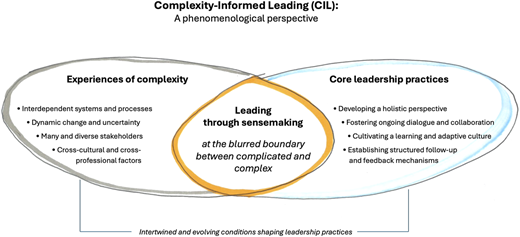
Complexity-informed leading (CIL): an empirically grounded conceptual model of how complexity is experienced and how leadership is enacted in practice. The figure illustrates the dynamic and intertwined relationship between experiential dimensions of complexity and leadership practices, emphasizing ongoing sensemaking rather than linear or prescriptive relationships
Complexity-informed leading (CIL): an empirically grounded conceptual model of how complexity is experienced and how leadership is enacted in practice. The figure illustrates the dynamic and intertwined relationship between experiential dimensions of complexity and leadership practices, emphasizing ongoing sensemaking rather than linear or prescriptive relationships
The CIL model shows that a holistic perspective, ongoing dialog and collaboration, structured follow-up and feedback mechanisms, and a learning and adaptive culture are central in how project managers navigate complexity in practice. These practices are experienced as supporting coordination, learning and adaptation in complex project environments.
5. Discussion, implications and limitations
This study contributes to the literature by bridging the gap between theoretical conceptualizations of complexity and the lived experience of project managers. While frameworks such as Cynefin (Snowden and Boone, 2007) distinguish analytically between complicated and complex contexts, our findings show that this distinction becomes blurred in practice.
By adopting a phenomenological perspective, the study demonstrates how complexity is experienced as a relational and emergent condition, where different types of challenges are intertwined rather than separable. This shifts the understanding of leadership from applying context-specific models to engaging in continuous sensemaking and adaptive coordination.
Unlike previous studies that present theories that describe project managers' work, what they are challenged by and need to relate to (Müller and Jugdev, 2012), the focus of this study is further on increasing understanding by exploring the sensemaking mechanisms in project managers' practical work (Weick, 1995).
As reflected in CIL conceptual model (Figure 1), a clear understanding of what contributes to complexity needs to be clarified before project managers can practice leadership to navigate complexity. Like other studies of project managers leading their projects, a common clear understanding of involving customers and stakeholders is a critical starting point for creating value (Di Maddaloni and Derakhshan, 2024). This becomes for coordination, quality and learning. The CIL model contributes by providing an empirical understanding of how leadership is experienced and enacted in complex project environments. Rather than introducing new leadership practices, CIL model shows how familiar practices take on new meaning in complex and uncertain contexts. The findings can be understood as bridging traditional process-oriented approaches to project management practices with a more holistic and practice-based understanding of how complexity is experienced and navigated in practice.
The CIL model is highly relevant in project management, where it offers a complementary perspective to traditional and agile methods. The CIL model addresses precisely this “how” and meets Mikkelsen's (2025) challenges, who argues that structural models describe what project managers should deliver but not how they should lead in emergent and ambiguous situations.
By fostering systems thinking, reflection and co-creation, CIL model contributes to learning and adaptation during the project. According to Hudnurkar et al. (2023), this allows for complexity, uncertainty and change to be managed in a more resilient and sustainable way, thereby enhancing the sustainable impact of the projects and the development capacity of the organization. The relationships found between the sources of complexity and the tasks of the leadership role suggest a possible relationship between the practices. Some practices could, for example, be more closely associated with specific sources of complexity. Therefore, CIL model can be understood as a conceptual representation of the empirical findings, highlighting how project managers work to understand and respond to context in complex situations, rather than a detailed or prescriptive model. Our findings suggest that project managers face challenges arising from the need to balance stakeholders' interests, cultural and organizational differences in complex environments, and the ways these interact with broader systems. To illustrate practical experiences, we will first discuss project managers' perceptions of complexity (5.1), then move on to their approaches in complex contexts, focusing on activities used to bridge the gap between thinking and doing (5.2).
The present findings deepen the study of leadership complexity and have theoretical implications for debates in the academic world, while at the same time, they provide practical guidance for leaders facing complex issues of quality management and project implementation in a rapidly changing environment.
5.1 Complexity as experienced and understood by project managers
Regarding the first research question, the findings broadly confirm and extend theoretical premises that public infrastructure projects in Swedish public transport constitute complex adaptive systems characterized by overdependence on systems and processes, a diversity of stakeholders and continuous change and uncertainty (Groβe, 2022; Nguyen et al., 2021). Here, the study adds a phenomenological depth that brings the concepts to life through the lived experiences of the project managers. Thus, a phenomenological perspective aids in clarifying the intricateness of the project and provides a deeper understanding of the same as the project leaders encounter it firsthand. This angle enhances the theory of project management by inviting the consideration of phenomenological concepts' involvement in the field of leadership and complexity, which, in turn, leads to the deeper insight of leadership as the practice that is experienced lived. Instead, the project managers understand complexity as a relational and emergent condition, shaped by professional diversity, conflicting interests, interdependent systems and processes, dynamic change and uncertainty. It is this shift in perspective that is our main contribution to the theory.
The study's findings confirm the work of Kallinikos (1998) and Williams (2002). These articles point to specific aspects that increase the complexity of systems. Just considering the argumentation of CIL model makes it quite obvious why it is important to understand these complexity-enabling problems. As stated by Snowden and Boone (2007), one cannot find the right answer in advance in complex contexts, and that the system itself is always changing, where the whole is more than the sum of the parts. The results are also consistent with Kumar's (2020) argument that managing complex change requires a high level of flexibility, a good flow of communication and integrative skills. However, our research shows that in addition to mental and leadership skills, emotional and relational work – negotiating differences, maintaining trust and facilitating sensemaking – is crucial to managing complexity in practice.
A further theoretical insight emerging from the findings concerns the distinction between complicated and complex contexts. While the Cynefin framework (Snowden and Boone, 2007) provides a valuable analytical distinction between these domains, our findings suggest that this distinction becomes less clear in project managers' everyday practice.
Project managers do not experience their work as divided into analytically distinct categories. Instead, situations involving technical interdependencies, stakeholder dynamics and evolving conditions are experienced as intertwined and shifting. Elements that could theoretically be understood as complicated – such as system dependencies or large-scale coordination – are often experienced as complex due to uncertainty, relational tensions and the need for ongoing interpretation.
This indicates a gap between the theoretical categorization of complexity and its lived experience. Rather than operating within clearly bounded domains, project managers appear to navigate hybrid situations where complicated and complex aspects coexist and are difficult to disentangle in practice.
From a leadership perspective, this means that managers cannot rely on predefined categorizations of situations. Instead, project managers engage in continuous sensemaking to interpret the nature of the challenges they face. Misinterpreting complex situations as merely complicated may lead to overreliance on planning and control, while treating complicated problems as complex may result in unnecessary experimentation. This further reinforces the need to understand leadership in complex projects as a situated and interpretive practice rather than a context-dependent application of predefined approaches.
5.2 Strategies to leading in complexity
Building on section 5.1, the results show how project managers enact leadership in situations where the nature of complexity is not clearly defined. Rather than operating within distinct categories of complicated or complex contexts, they navigate intertwined and evolving conditions. Leadership thus emerges as an ongoing process of interpretation, coordination and adaptation, rather than the application of predefined approaches. The practices – such as developing a holistic perspective on interdependencies, fostering ongoing dialog and collaboration, cultivating a learning and adaptive culture and establishing structured follow-up and feedback mechanisms signal a shift in leadership practice from command advice to facilitating value creation. In this area, our study brings specific everyday practices for leaders to be adaptive (Uhl-Bien et al., 2007) and develops the theory of complex adaptive systems by showing the micro-interactions – dialogue, iteration and stakeholder guidance – that create project resilience. This is similar to Conti's (2010) and Fundin and Eriksson (2026) argument for systems thinking in quality management, where insight into complex interactions is a prerequisite for quality management. Project managers are more like transferors than top-down planners in this context, which is a visualization of the project version of what Bhatti et al. (2021) calls ethical leadership, trust and knowledge sharing lead to project success. More precisely, the CIL model is an enabler of human-centered, learning-oriented methods that give the project manager tools to survive complexity.
The learning perspective as a daily leadership activity and not an investigation is an important conclusion for us. It is a result that is at least as logical as Wallo et al. (2024) who writes about learning-oriented leadership that, as a consequence of everyday activities in a construction, receives activities of conversation, experimentation, reflection and feedback. Lundqvist et al. (2022) argue that transformative leadership, as well as quality management (Fundin et al., 2025), improves organizational adaptability in turbulent environments and we support this claim.
5.3 Practical contributions to project management
One concrete action is to truly support the development of a type of leadership suited to managing projects in complexity. We really need to broaden the project manager's skill set to include facilitation skills, conflict resolution, reflective practice and adaptive systems thinking approach, rather than the traditional focus on the technicalities of project control. Ultimately, success in project management and quality management in complex environments must go beyond achieving time and cost goals to include adaptability, earning the trust of stakeholders and deep learning (Ang'ana and Kilika, 2022; Uhl-Bien, 2021). Traditionally, performance measures are the only indicator relied upon in empirical performance studies (Feger and Thomas, 2012), but this study adds new leadership aspects that matter for attaining long-term quality and learning results and that widen the range of what a project contributes. On a related note, some project managers in the organization in which the study was carried out have also started to apply the CIL model.
5.4 Discussion of methods and limitations
We chose a phenomenological method in the study to shed light on project managers' experiences of managing complexity. The aim was to create an understanding of a life in focus with a small, targeted sample, without drawing any general conclusions, and thus be able to answer the questions (Creswell, 2013; Neubauer et al., 2019). All interviewees have extensive experience of leadership assignments in addition to their work as project managers, and this enriched and deepened the stories in more contexts.
Transparent reporting of the participant selection, research context and analytical process contributed to the credibility of the study. The robustness of the main findings was strengthened through external stakeholder validation (Lincoln and Guba, 1985). In this way, the appropriateness of some of the premises that were put forward in the final interpretation stage was determined.
In phenomenology, it is essential that the participants themselves are allowed to explain and describe their experiences. For this reason, to also ensure that the analysis was based on actual data and not on preconceived notions about the theory, we maintained consistent and conscious reflexivity in all stages. In practice, this meant that we as researchers consciously reflected over time on how our prior knowledge and experiences in the subject affected the starting point, which is a requirement for consciously fulfilling our roles as researchers in qualitative research (Finlay, 2014).
Furthermore, while the study is based on a large public administrative authority in Sweden, the findings are relevant beyond this specific context. Project managers across sectors, including public and private organizations, face similar challenges related to complexity, stakeholder dynamics and uncertainty. At the same time, the in-depth study of the authority context creates high contextual relevance and transferability to other complex, tightly regulated projects (e.g. in infrastructure, defense, healthcare), as they often share characteristics regarding the degree of institutionalization, stakeholder dynamics and regulatory complexity.
5.5 Implications for future research
Our phenomenological study of meaning-making and complexity opens a number of new avenues for future research. The study would have contributed more variation in the sample to gain a better picture of how leaders and project managers work in different business environments. We suggest that future studies should work on refining and validating the CIL model to see how different ways of understanding complexity can affect how well projects adapt when dealing with larger groups. This could help to further operationalize and broaden the findings from this study.
Furthermore, cross-sectoral comparisons are needed to shed light on how the CIL model principles and meaning-making strategies differ between regulated public administration (our context) and complex and dynamic projects in the private sector. Future studies could also examine the connections between the different sources of complexity and the four identified strategies, for example whether there is an interdependence between them, and how important leadership practices relate to these sources.
Longitudinal studies tracking the application of learning-oriented leadership practices (emphasized by CIL model) and their impact on long-term organizational resilience and knowledge retention are also recommended. Future studies could explore how leadership can enable and facilitate learning in complex environments, which, according to the study's findings, contributes to project success and a learning organization in the long term.
6. Conclusion
The purpose of this study was to describe and explore how project managers of transport infrastructure in Sweden experience complexity and how they experience complexity and make sense of the challenges they face in their daily work. The findings show that complexity emerges from a variety of sources, and that project managers need to understand the dimensions that contribute to complexity in order to navigate different types of projects efficiently. This may require a holistic approach; ongoing communication and teamwork; structured follow-up and feedback systems; and a culture of learning and adaptability to create sustainability, long-term organizational value creation and resilience in complex project environments.

