


This paper aims to provide and empirically test a conceptual model in which artificial intelligence (AI), knowledge management processes (KMPs) and supply chain resilience (SCR) are simultaneously considered in terms of their reciprocal relationships and impact on manufacturing firm performance (MFP).
In the study, six hypotheses have been developed and tested through an empirical survey administered to 120 senior executives of Italian manufacturing firms. The data analysis has been carried out via the partial least squares structural equation modelling approach, using the Advanced Analysis for Composites 2.0 variance-based software program.
Using a conceptual model validated using an empirical survey, the study sheds light on the relationships between AI, KMPs and SCR, as well as their impacts on MFP. In particular, the authors show the positive effects of the adoption of AI on KMPs, as well as the influence of KMPs on SCR and MFP. Finally, the authors demonstrate that KMPs act as a mediator through which AI affects SCR and MFP.
This study highlights the critical role of KMPs for manufacturing firms that can deploy AI to stimulate KMPs and through attaining a high level of the latter might succeed in enhancing both their SCR and MFP.
This study demonstrates that manufacturing firms interested in properly applying AI to ameliorate their performance and resilience must carefully consider KMPs as a mediator mechanism.
1. Introduction
Increasing uncertainty and turbulent contexts might have significant repercussions on the manufacturing industry in terms of mandatory closures, logistics bottlenecks, supply difficulties and volatility in consumption trends (Ardolino et al., 2022). Indeed, in recent times, numerous research studies have demonstrated how the success and survival of manufacturing firms are closely linked to their ability to 1) embrace advanced digital technologies, such as artificial intelligence (AI) (Eloranta et al., 2021; Mohapatra et al., 2021; van Oorschot et al., 2022); 2) implement knowledge management processes (KMPs) capable of identifying the necessary knowledge and disseminating it within the organisation (Leoni, 2015; Sutopoh et al., 2021); and 3) put in place supply chain resilience (SCR) strategies to maintain satisfactory levels of performance in the short, medium and long terms (Belhadi et al., 2021a). In fact, these three elements (AI, KMPs and SCR) – individually considered – positively affect firm performance (Jallow et al., 2020; Li et al., 2017; Tan and Wong, 2015). However, it is worth noting that this effect becomes even more evident if these elements are considered in pairs. In this vein, for example, Modgil et al. (2021) and Yu et al. (2019) have demonstrated how the adoption of AI for SCR ensured business continuity and improved firm performance before and during COVID-19, while Ciampi and Rialti (2019) observed that AI adoption in knowledge-intensive manufacturing firms may increase firms’ performance.
However, to the best of the authors’ knowledge, despite the impact that these elements (i.e. AI, KMPs and SCR) can have on manufacturing firms, there are no studies that investigate these same elements in a holistic and integrated way, providing evidence on their reciprocal influences and related impacts on manufacturing firm performance (MFP). Indeed, previous research offers only a partial view of the AI, KMPs and SCR effects on performance by exclusively focussing, for example, on financial aspects (e.g. Li et al., 2017; Yu et al., 2019).
Thus, as emphasised by Al Mansoori et al. (2021) and Umar et al. (2021), these subjects require further investigation. Moreover, as recently recommended by practitioners (e.g. Capgemini, 2020; World Manufacturing Foundations, 2020, 2021), AI, KMPs and SCR should be considered jointly so as to be able to determine – with greater accuracy – the (positive) effects that they can have in terms of MFP.
Therefore, we aim to answer these calls by proposing a conceptual model in which AI, KMPs and SCR are simultaneously considered in terms of their reciprocal relationships, as well as their impacts on MFP. Moreover, the paper will practically test the proposed model to verify its empirical validity. Accordingly, we developed and tested six hypotheses through a survey administered to 120 senior executives of Italian manufacturing firms. For data analysis, we adopt the partial least squares structural equation modelling approach.
The results show the positive effects of the adoption of AI on KMPs, as well as the influence of KMPs on SCR and MFP. Finally, results demonstrate that KMPs acts as a mediator through which AI affects SCR and MFP.
This research contributes to theory and practice in several ways. In fact, our findings provide a model that can explain the relationships between AI, KMPs and SCR, as well as their impacts on MFP. Moreover, by demonstrating that KMPs act as a mediating mechanism through which AI benefits SCR and MFP, we provide manufacturing firms’ managers with indications of the importance that KMPs – supported by AI – have in terms of performance and resilience of the firm and its supply chain (SC).
After this introduction, section 2 presents the proposed research model and hypotheses. Section 3 reports the research method. Section 4 depicts the results, while section 5 is devoted to the discussion, in which both the theoretical and practical implications of the study are highlighted. Finally, section 6 presents the conclusions, limitations and future research avenues.
2. Conceptual model and hypothesis development
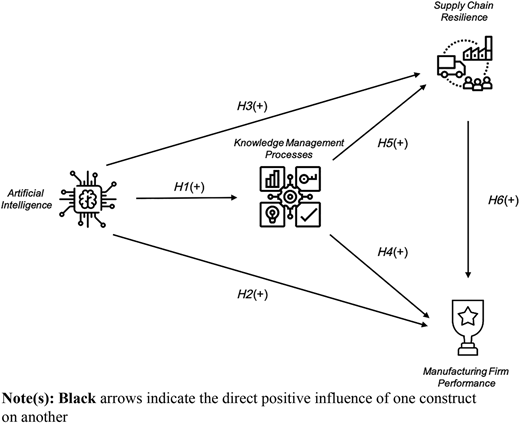
The following sub-sections are devoted to developing specific hypotheses at the basis of the proposed investigation. The assumed relationships among the studied constructs are graphically shown in Figure 1, representing the conceptual model we will test through our investigation.
2.1 Artificial intelligence impacts on knowledge management processes, manufacturing firm performance and supply chain resilience
Due to the ever-increasing amount of data and information collected by firms and fed into their processes, AI has attracted increased interest over the last decade by scholars and practitioners (Gao et al., 2021). AI can be briefly described as computers’ ability to perform cognitive functions, such as perceiving, reasoning, learning and problem-solving, that are usually associated with human minds (Bawack et al., 2021). Practically speaking, AI refers to using computers to imitate the human brain’s reasoning, learning, planning and other thinking activities, thus solving complex problems that only human experts could previously tackle (Lei and Wang, 2020). In particular, AI enables machines to learn, acquire, process and use knowledge to perform tasks, revealing or unlocking knowledge that can be delivered to humans to improve decision-making processes within organisations (Camarillo et al., 2018; Grzonka et al., 2018; Vajpayee and Ramachandran, 2019). In other words, AI can extract new knowledge from vast quantities of data, portraying complex mappings as a basis for human decision-making (Paschen et al., 2020). Hence, according to Bencsik (2021), there is a close mutual interaction between KM and AI: the former makes the understanding of knowledge possible, while the latter provides the tools to expand and use knowledge, as well as to create new knowledge in a way that was unimaginable before (Haenlein and Kaplan, 2019; Lu et al., 2018). In this vein, as emphasised by Al Mansoori et al. (2021) in their systematic literature review, modern organisations increasingly rely on AI mechanisms to enhance KMPs and performance thanks to their ability to 1) inductively determine relationships and trends in firms’ knowledge repositories (i.e. combining existing knowledge) to create new knowledge; 2) help in the search for knowledge; and 3) disseminate knowledge to those who need it. Thus, AI “can help push […] knowledge management” (Liebowitz, 2001, p. 4), making KMPs more effective (Mittal and Kumar, 2019). From this, we derive
AI has a positive effect on KMPs.
Furthermore, as noted by Butler et al. (2021) in their systematic literature review, AI can improve firms’ productivity by automating data management processes and eliminating the need for intermediaries. Hence, AI can ameliorate network communication, and in turn, this will help foster innovation within an organisation. Accordingly, Jallow et al. (2020) point out that AI adoption allows firms to gain a competitive edge and enhance their performance by allowing better productivity, profitability and efficiency. Explicitly referring to manufacturing firms, AI application allows for real-time decision-making and performance improvement by enabling predictive maintenance (Chen et al., 2021), enhanced quality control (Chiarini and Kumar, 2021) and improved safety (Pillai et al., 2020). Based on the above, we derive the following hypothesis:
AI has a positive effect on MFP.
Lastly, according to McKinsey [1], more and more companies have adopted digitalisation in general and AI in particular to mitigate the effects of disruptive events. For example, during the pandemic, numerous companies had to deploy digital technologies to enhance their SCR and maintain satisfactory levels of operational performance (Belhadi et al., 2021a; Mohapatra et al., 2021). In this vein, AI can provide the critical capability to devise better control mechanisms and identify areas of disruption because it can help firms in gathering data and processing information more efficiently and thus facilitating firms’ resource orchestration and information processing, ameliorating the real-time coordination and collaboration processes within their SC (Gupta et al., 2020; Modgil et al., 2021; Wamba et al., 2020a). This represents the base on which firms can build and promote SCR (Belhadi et al., 2021b; Ruel and El Baz, 2021; Yao and Fabbe-Costes, 2018; Wamba et al., 2020b), understood as the capability to anticipate and overcome SC disruptions (Pettit et al., 2013; Rice and Caniato, 2003; Sheffi, 2005). In this respect, AI can be considered a crucial enabler for strengthening SCR by improving the collaboration between contractors and suppliers, simplifying operations through higher levels of problem-solving speed and accuracy (Ivanov and Dolgui, 2020; Modgil et al., 2021; Schniederjans et al., 2020; Wamba et al., 2021). Based on the above, we derive the following:
AI has a positive effect on SCR.
2.2 Knowledge management processes and manufacturing firm performance
According to the knowledge-based view (KBV) of the firm (Grant, 1996), knowledge can be considered the most valuable resource of a firm, the only enduring source of competitive advantage that can improve a firm’s decision-making capacity and, consequently, its effective action (Alavi and Leidner, 2001; Davenport and Klahr, 1998; Knight and Howes, 2012; Nonaka and Takeuchi, 1995; Paniccia, 2018). Therefore, KM is seen by academics, practitioners and policymakers as one of the most essential strategic processes of any firm (Grant, 1996; OECD, 2004). Specifically, KM “is the process of creating value from an organisation’s intangible assets” (Liebowitz, 2004, p. 1). Consequently, increased attention has been paid to identifying KMPs critical to the development and exploitation of the knowledge needed to create competitive advantage (Anand et al., 2010; Linderman et al., 2010). In this vein – despite the small differences that still characterise the KM literature in terms of the number and labelling of KMPs – it is possible to state that KM encompasses five main distinct but interdependent processes – (1) acquiring, (2) creating, (3) using/applying, (4) archiving/storing and updating and (5) sharing/transferring (Alavi and Leidner, 2001; Heisig, 2009). These KMPs – as demonstrated by both qualitative and quantitative KM studies – have to be properly adopted by firms in order to improve their organisational (e.g. Choi and Lee, 2003; Khalifa et al., 2008; Zack et al., 2009), financial (e.g. Darroch and McNaughton, 2003) and market (e.g. Hussinki et al., 2017) performances. In the current manufacturing context, which is characterised by a paradigm shift, manufacturing firms are increasingly focusing on managing knowledge assets instead of managing physical assets to improve their performance (Gunasekaran and Ngai, 2007). Consequently, as demonstrated by Tan and Wong (2015), manufacturing firms are realising the importance of KM and adopting KMPs because they are able to positively impact their performance, bringing “a lot of benefits such as getting updated information for production, solving production problems in a shorter time, and improving product and process quality” (p. 825) and allowing managers “to come out with a more effective strategy to acquire the utmost benefits for their companies.” (p. 820). Based on this, we derive the following hypothesis:
KMPs has a positive effect on MFP.
2.3 Knowledge management processes and supply chain resilience
As stated before, for firms, managing the knowledge they possess, acquire, or create is crucial to being competitive and surviving in their environment (Grant, 1996). This is particularly true in the SC context because SCs can be viewed as cradles of knowledge, involving multiple autonomous actors with varying backgrounds (Samuel et al., 2011). Thus, according to Desouza et al. (2003), the effective use of KMPs allows all the SC actors to better align their objectives and interests (Li et al., 2012) and devise corrective actions before a risk event occurs (Ellegaard, 2008; Jüttner and Maklan, 2011), which can ultimately affect SC performance (Sangari et al., 2015). In particular, as demonstrated by Umar et al. (2021), the SC’s ability to properly acquire, share and use knowledge is crucial to guaranteeing that the SC can prepare and respond to disasters, minimising its vulnerability (Ellegaard, 2008; Kovács and Spens, 2007; Jüttner and Maklan, 2011), reducing the time required to deliver products from one actor to another (Dove, 1999) and enhancing the visibility and alignment among SC actors (Barratt and Oke, 2007). By doing so, KMPs work to achieve and enhance SCR (Ali et al., 2021; Blackhurst et al., 2011; Kumar and Anbanandam, 2019). Hence, we derive the following hypothesis:
KMPs has a positive effect on SCR.
2.4 Supply chain resilience and manufacturing firm performance
SCR is an indispensable capability in times of crisis, as already demonstrated by numerous studies (e.g. El Baz and Ruel, 2021; Nikookar and Yanadori, 2021; Ozdemir et al., 2022; Shen and Sun, 2021). Indeed, SCR concerns the ability to recover performance after having absorbed disruption effects (Hosseini et al., 2019; Spiegler et al., 2012). In particular, SCR enables firms to minimise the negative effects of disruptions, maintain business continuity by optimising resources (Roehrich et al., 2014) and maintain the supply to customers (Ambulkar et al., 2016). In this vein, Li et al., 2017 have emphasised the positive financial outcomes derived from the implementation of SCR because it allows a firm to respond more quickly and effectively to disruptions concerning competitors, increasing the firm’s market share, goodwill and profitability. Consequently, SCR can have a direct impact on firms’ performance by ensuring consistent service and stock availability and improving the ability to face various disruption threats (Altay et al., 2018; Ambulkar et al., 2016; Azevedo et al., 2013; Hohenstein et al., 2015; Liu and Lee, 2018; Liu et al., 2018). Drawing on the above, we proposed the following hypothesis:
SCR has a positive effect on MFP.
3. Methodology
3.1 Empirical context and data collection
We collected data through a questionnaire survey to test our hypotheses. In particular, we carried out our analysis according to a web survey, which is much more cost-effective and takes less time as compared to a paper-based survey (Couper, 2000). Moreover, web surveys do not allow for responses to be manually transferred into a database, avoiding interviewer bias (Dillman et al., 2014). We randomly selected 1,096 Italian manufacturing firms. A pilot study undertaken by the authors with some firms has revealed that their senior executives can influence initiatives related to AI adoption, are well-informed regarding the KMPs and also have a good understanding of their firms’ performance and SCR. Therefore, we considered the senior executives of each firm to be the primary data source for the empirical survey, along the lines of prior studies in operations and SC management (e.g. Flynn et al., 2010).
We first sent an invitation to the identified respondents, together with a cover letter explaining the motivations and objectives of our research. Then, we sent the questionnaire to the respondents who accepted the invitation. Finally, after discarding incomplete questionnaires, we obtained 120 useful questionnaires, which yielded a response rate of 11% that, according to Dillman et al. (2014), can be deemed acceptable. Next, we conducted a series of tests to verify the validity of the sample for data analysis purposes. First, we conducted a statistical power analysis pre-test (Cohen, 1988; Faul et al., 2009) using G*power software with a medium effect size (f2 = 0.150), a statistical power level of 0.95, three predictors (i.e. AI adoption, KMPs and SCR) and a confidence level of 0.01. The power analysis has revealed that the minimum size for our proposed model is a sample of 89 firms. Because our sample size is 120 firms, it has sufficient validity and statistical power to detect significant effects (Cohen, 1988). Furthermore, we had less than 5% missing values per item in the data collected, which is sufficient for partial least squares (PLS) data analysis (Hair et al., 2017). In addition, we have checked the squared Mahalanobis distances (Byrne, 2016) for multivariate outlier issues, which revealed no peculiarity or unusual cases in the dataset.
Finally, we conducted non-response bias tests using a t-test comparing the differences in firm characteristics between responding and non-responding firms (Flynn et al., 2010). The findings show no substantial statistical differences between the groups in terms of the age (t = 0.862, p = 0.139) or the size of the company (t = 0.671, p = 0.924). Moreover, a t-test to compare the characteristics of respondent firms with those of non-respondents was conducted. The results indicate that non-respondents and respondents have no significant statistical differences in terms of size (p > 0.05) or age (p > 0.05). Table 1 display the characteristics of the sample.
Characteristics of respondent firms
| Count | % | ||
|---|---|---|---|
| Sector | Machinery and equipment | 49 | 40.83% |
| Metal products and metallurgy | 26 | 21.67% | |
| Vehicles and Transport | 9 | 7.50% | |
| Textiles, Clothing and Leather | 6 | 5.00% | |
| Paper, paper products and printing | 6 | 5.00% | |
| Food, beverages and tobacco | 5 | 4.17% | |
| Petroleum, chemicals and pharmaceuticals | 5 | 4.17% | |
| Electronics and optical equipment | 9 | 7.50% | |
| Rubber and Plastics | 3 | 2.50% | |
| Other | 2 | 1.67% | |
| Turnover (M€) | 0–10 | 21 | 16.54% |
| 11–50 | 34 | 26.77% | |
| 51–100 | 17 | 13.39% | |
| 101–250 | 21 | 16.54% | |
| 251–500 | 14 | 11.02% | |
| 500+ | 13 | 10.24% | |
| Number of employees | 0–50 | 22 | 17.32% |
| 51–100 | 15 | 11.81% | |
| 101–250 | 22 | 17.32% | |
| 251–500 | 19 | 14.96% | |
| 501–1,000 | 16 | 12.60% | |
| +1,000 | 33 | 25.98% |
3.2 Measures
In research models, the measurement constructs are conceptualised as reflective or composite constructs (Benitez et al., 2018). In reflective constructs, the existence of one unobserved variable and individual random error is assumed to fully explain the variance of a set of indicators (Dijkstra and Henseler, 2015; Henseler et al., 2014). Hence, reflective constructs are often employed in research models to measure behavioural concepts such as attitudes, behaviours and traits (Henseler et al., 2016). On the other hand, composite constructs consist of more elementary components, and there are no restrictive relationships between items of the same construct, i.e. no co-variation among a block of indicators is assumed to be explained by a common factor (Benitez et al., 2017).
In several studies, KMP are considered reflective (e.g. Tan and Wong, 2015). However, modelling theoretical concepts as composites or emergent variables is an evolutionary phenomenon that has been acknowledged and employed in various disciplines in management research (Schuberth, 2021; Yu et al., 2021). In this respect, KMPs are viewed as a designed or a “forged” concept, i.e. as a human construct rather than a naturally occurring phenomenon (Henseler and Schuberth, 2020). Based on such premises and after consulting experts (i.e. knowledge managers) and previous research in the KM field (i.e. Ha et al., 2021; Reich et al., 2014), we conceptualised KMPs as a composite construct. Our conceptualisation is in line with the definition of composites which are viewed as a mixture of ingredients (several processes in our case) that generate a recipe (composite) (Henseler and Schuberth, 2020; Schuberth, 2021). Moreover, we are in line with the recommendations of Cepeda-Carrion et al. (2019) who offer tips on the use of PLS-SEM in KM. Indeed, the authors call for “KM academics […] to be aware that many of the measures they are using are more composites than factors” (p. 79). Regarding the other constructs (AI, SCR and MFP), they were considered reflective in the research model. For each item, we have used a 5-point Likert scale.
Moreover, all measures in the study were evaluated at the firm level and scales were developed in three phases similar to Ruel et al. (2021). Phase 1 operationalizes constructs using previous conceptualisation and cited literature. Phase 2 systematises the different sub-constructs and items presented in previous studies, in order to identify similarities and differences among all of them. Phase 3 evaluated the reliability and construct validity of all multi-item scales by pre-testing the survey (O’Leary-Kelly and Vokurka, 1998). Hence, five experts belonging to five different Italian manufacturing firms were consulted. They reviewed the initial measurement scales, also ensuring that the questions were clear, meaningful, relevant and easy to interpret. Their feedback was used to revise the questionnaire accordingly. Thus, some items were reformulated to be more straightforward, some others were removed to better adapt the survey to the specificities of the Italian manufacturing sector, and some wording was changed to reduce misinterpretations. Appendix reports the final items used for each construct, together with the original sources.
Specifically referring to the measurement of the AI adoption construct, participants were asked to choose the level of adoption from a list of specific AI tools derived from a review of previous literature on AI tools already used in KM, SC and manufacturing performance domains. In particular, the specific implementation and use of specific AI tools are used as a proxy to survey the level of AI adoption in manufacturing firms surveyed. Investigating the contribution made by one specific AI tool rather than another is not the objective of this study.
3.3 Control variables
We controlled for the effects of a firm’s size and age on AI. These covariates were often mobilised in studies on technology and digital initiatives (e.g. Syed et al., 2020; Wei et al., 2020). Firm size is a covariate that may reveal how the availability of resources can influence a firm’s adoption of digitalisation and AI initiatives (Khin and Ho, 2019). We derived a firm’s size by computing the natural logarithm of its full-time employees. Firm age is an indicator of the influence of a firm’s experience and knowledge on launching digitalisation and AI projects (Zhou and Wu, 2010). In this study, we measure a firm’s age using the natural logarithm of the total number of years the firm has been in business.
3.4 Common method bias
In survey-based studies, collecting perceptual data from a single source at a point in time generates common method bias (CMB) issues (MacKenzie and Podsakoff, 2012). To minimise CMB effects during data collection, we have followed MacKenzie and Podsakoff (2012) and Podsakoff et al. (2003). Thus, we gathered data from qualified respondents, used measures from several studies, ensured the anonymity of participants, counterbalanced questions order for predictor constructs to avoid a priming effect and item-context-induced mood state and employed clear and simple scales for the items.
Additionally, we have undertaken statistical tests to address CMB issues. We employed the marker variable (MV) technique based on the guidelines of Rönkkö and Ylitalo (2011). Consequently, we used the respondents’ experience as MV, and we conducted a regression analysis of the research model with and without MV. The analysis reveals similar results in terms of β value and significance, which implies that CMB issues can be deemed minimal for this study.
Moreover, the full collinearity test was also undertaken to minimise the CMB effects, following the procedure of Kock (2017) which consists of calculating the variance inflation factor (VIF) value of the model’s constructs. The PLS fit analysis results indicate that all the VIF values are below the cut-off value of 3.3 (Kock, 2017), thus confirming that CMB was not a major issue for this study.
3.5 Data analysis procedure
In this study, we adopt the PLS-SEM approach which constitutes an appropriate multivariate path modelling approach used to test predictive and causal research models (Hair et al., 2019). In addition, PLS is an adequate method to use in dealing with complex models that have composite constructs (Benitez et al., 2017, 2018, 2020; Henseler, 2021). Due to its flexibility, PLS has been deemed appropriate for this study.
In fact, PLS-SEM analysis is based on two main stages: (1) measurement model assessment and (2) structural model evaluation (Hair et al., 2019). Both steps were implemented using Advanced Analysis for Composites (ADANCO) 2.0 professional software, created by Henseler and Dijkstra (2015). This variance-based (SEM) software program can be used to assess causal and predictive research models (Benitez et al., 2018; Henseler, 2021).
4. Results
4.1 Measurement model assessment
In the first step of the analysis, we assess the measurement model to investigate each construct’s properties. Since we have a composite construct (KMPs), we adopted the approach recommended by several scholars (Henseler, 2021; Henseler and Schuberth, 2020; Benitez et al., 2018, 2020) which consists of undertaking a confirmatory composite analysis (CCA) before assessing the emergent variables of the KMPs construct, i.e. the sub-constructs. For the reflective constructs (AI, SCR and MFP), we evaluate their validity and reliability through their items’ loadings, reliabilities and average variance extracted (AVE).
4.2 Assessment of the composite construct
We assessed the composite construct’s psychometric properties using the CCA through the assessment of the overall fit of the model and the assessment of each emergent variable separately (Henseler and Schuberth, 2020; Benitez et al., 2018). We employed the bootstrap-based test for the exact overall model fit. We relied on values of the discrepancy measures, i.e. geodesic discrepancy (dG), standardised root mean squared residual (SRMR) and unweighted least squares (dULS). The results obtained are adequate (SRMR score should be less than 0.08) and below the 95% quantile of the corresponding reference distribution (Table 2). Accordingly, the specified model which considers KMPs as composite adequately fits the gathered data.
The confirmatory composite analysis of model fit
| Model fit (saturated model) | ||
|---|---|---|
| Discrepancy | Value | HI95 |
| SRMR | 0.0547 | 0.0571 |
| dULS | 3.8126 | 4.1542 |
| dG | 1.6118 | 2.5636 |
As a second step of the assessment, each emergent variable or sub-construct of KMPs is considered separately. First, all the sub-constructs of KMPs were freely correlated to obtain the latent variable scores. In the second step, the latent variable scores of the KMPs dimensions were used as the measures of the KMPs construct. We report the results of the analysis including the loadings, the weight estimates, the VIF scores and descriptive results in Table 3. We tested for multicollinearity and significance level of the five KMPs sub-construct (not reported due to space limitation) using 95% percentile confidence intervals based on 4,999 bootstrap runs. All the correlations among the emergent variables are adequate and none of their 95% percentile confidence intervals covered the 0 (Henseler and Schuberth, 2020). Regarding multicollinearity, all the VIF scores are lower than 5 (Benitez et al., 2020). Concerning the loadings and the weights of emergent indicators, we followed the guidelines of Benitez et al. (2018) who recommend retaining indicators regardless of the significance of their weight provided that their loading is significant. The findings show only one indicator having a weight that was not significant (KA4) but all the loadings of the emergent variables (KMPs sub-constructs) were significant at the 0.001 level. Combined together, the results of the assessment reveal no empirical evidence against the specified model and suggest adequate properties for KMPs as a composite construct (Benitez et al., 2018; Henseler and Schuberth, 2020; Henseler, 2021).
Measurement model evaluation of the composite construct
| Construct | Sub construct | Mean | SD | VIF | Weight | Loading |
|---|---|---|---|---|---|---|
| KMPs (composite, Mode B) | Knowledge acquisition (emergent) | |||||
| KA1 | 3.3417 | 1.1412 | 2.5087 | 0.219*** | 0.591*** | |
| KA2 | 2.9000 | 1.1030 | 1.9162 | 0.120*** | 0.497*** | |
| KA3 | 3.6333 | 1.1147 | 2.8316 | 0.288*** | 0.791*** | |
| KA4 | 4.0250 | 0.8347 | 1.4462 | 0.074 | 0.248*** | |
| KA5 | 3.1417 | 1.2588 | 2.2374 | 0.187*** | 0.644*** | |
| KA6 | 2.9250 | 1.2513 | 3.0452 | 0.208*** | 0.716*** | |
| KA7 | 2.7500 | 1.3917 | 2.2762 | 0.216*** | 0.716*** | |
| KA8 | 3.4667 | 1.0446 | 2.0576 | 0.225*** | 0.625*** | |
| Knowledge creation and generation (emergent) | ||||||
| KCG1 | 3.8500 | 1.0179 | 3.1556 | 0.230*** | 0.815*** | |
| KCG2 | 3.5500 | 1.1215 | 3.7605 | 0.207*** | 0.765*** | |
| KCG3 | 3.7000 | 0.9839 | 4.4088 | 0.252*** | 0.853*** | |
| KCG4 | 3.5667 | 1.0349 | 3.2007 | 0.217*** | 0.804*** | |
| KCG5 | 3.4000 | 1.0721 | 2.5374 | 0.163*** | 0.676*** | |
| KCG6 | 3.3083 | 1.1580 | 2.8333 | 0.230*** | 0.677*** | |
| Knowledge use and application (emergent) | ||||||
| KUA1 | 3.3667 | 0.9252 | 2.5569 | 0.312*** | 0.830*** | |
| KUA2 | 3.9917 | 0.8934 | 2.4571 | 0.227*** | 0.713*** | |
| KUA3 | 3.9500 | 0.8386 | 2.8991 | 0.282*** | 0.801*** | |
| KUA4 | 3.5167 | 1.1300 | 3.6782 | 0.426*** | 0.829*** | |
| Knowledge archiving and updating (emergent) | ||||||
| KAU1 | 3.2333 | 1.0349 | 4.6908 | 0.180*** | 0.860*** | |
| KAU2 | 3.2417 | 1.1000 | 4.7234 | 0.163*** | 0.822*** | |
| KAU3 | 3.2917 | 1.0322 | 3.4558 | 0.155*** | 0.759*** | |
| KAU4 | 3.4250 | 1.1050 | 3.1487 | 0.162*** | 0.750*** | |
| KAU5 | 3.4000 | 1.2394 | 3.0106 | 0.149*** | 0.751*** | |
| KAU6 | 2.9500 | 1.2424 | 3.3338 | 0.160*** | 0.778*** | |
| KAU7 | 3.3500 | 1.2745 | 3.2915 | 0.164*** | 0.801*** | |
| KAU8 | 3.1083 | 1.3271 | 2.9946 | 0.145*** | 0.724*** | |
| Knowledge sharing and transfer (emergent) | ||||||
| KST1 | 3.5083 | 0.9701 | 2.2074 | 0.138*** | 0.683*** | |
| KST2 | 3.6250 | 0.9878 | 4.3863 | 0.116*** | 0.657*** | |
| KST3 | 3.6750 | 1.1313 | 3.9693 | 0.166*** | 0.776*** | |
| KST4 | 3.7750 | 0.9117 | 2.7645 | 0.158*** | 0.807*** | |
| KST5 | 3.3500 | 1.2067 | 2.6291 | 0.150*** | 0.678*** | |
| KST6 | 2.2583 | 1.0807 | 1.5614 | 0.147*** | 0.706*** | |
| KST7 | 2.9333 | 1.1356 | 3.1634 | 0.080*** | 0.473*** | |
| KST8 | 3.3917 | 1.2387 | 2.9949 | 0.158*** | 0.738*** | |
| KST9 | 3.1500 | 1.1049 | 4.1526 | 0.118*** | 0.744*** | |
| KST10 | 2.5833 | 0.9701 | 2.6009 | 0.156*** | 0.813*** |
Note(s): *p < 0.1 **p < 0.01 ***p < 0.001
Based on n = 4.999 bootstrapping
4.3 Reliability and validity of reflective constructs
For the reflective constructs, we assessed the reliability of their items using factor loadings, which must be above 0.71 (Hair et al., 2017). The items with low factor loadings were dropped, and the remainder of the indicators displayed adequate and significant loadings (Table 4).
Indicators’ reliability of the reflective constructs
| Construct | Items | Mean | SD | Loading |
|---|---|---|---|---|
| Artificial intelligence (AI) adoption | AI1 | 0.8750 | 1.4234 | 0.7734*** |
| AI2 | 0.3000 | 0.9402 | 0.6805 Ψ | |
| AI3 | 0.9750 | 1.6975 | 0.7500*** | |
| AI4 | 0.7000 | 1.3385 | 0.7494*** | |
| AI5 | 0.9000 | 1.5792 | 0.6635 Ψ | |
| AI6 | 0.3110 | 1.5792 | 0.6807 Ψ | |
| AI7 | 0.2200 | 1.7561 | 0.8085*** | |
| AI8 | 0.3481 | 0.8990 | 0.5640 Ψ | |
| AI9 | 0.4222 | 1.3720 | 0.6120 Ψ | |
| Supply chain resilience (SCR) | SCR1 | 3.2667 | 1.0430 | 0.7279*** |
| SCR2 | 3.3667 | 0.9520 | 0.7800*** | |
| SCR3 | 3.5917 | 0.9915 | 0.7841*** | |
| SCR4 | 3.8000 | 0.9666 | 0.8372*** | |
| SCR5 | 3.4167 | 0.9751 | 0.7639*** | |
| Manufacturing firm performance (MFP) | MFP1 | 3.5750 | 0.1185 | 0.5321 Ψ |
| MFP2 | 3.4750 | 0.2074 | 0.7055*** | |
| MFP3 | 3.5000 | 0.1831 | 0.5413 Ψ | |
| MFP4 | 3.9916 | 0.3055 | 0.6856Ψ | |
| MFP5 | 3.5750 | 0.3139 | 0.8536*** | |
| MFP6 | 3.9166 | 0.3256 | 0.7884*** |
Note(s): **p < 0.01 ***p < 0.001
ΨItems deleted due to insufficient loading < 0.7
Based on n = 4.999 bootstrapping
Next, we assess the reliability of the reflective constructs through Dijkstra-Henseler’s reliability, Jöreskog’s composite reliability and Cronbach’s alpha, which measure the internal consistency of constructs (Hair et al., 2019). With all the reliability scores exceeding 0.7, the reliability of the constructs is corroborated (Table 5). In addition, we use the AVE values to evaluate the convergent validity of the constructs. Because all AVE scores are above 0.5, the convergent validity of all the constructs is confirmed (Ghasemy et al., 2021).
Reliability and convergent validity assessment of reflective constructs
| Constructs | rho (ρA) | rho (ρc) | Alpha(α) | AVE |
|---|---|---|---|---|
| Artificial intelligence (AI) | 0.7767 | 0.8539 | 0.7732 | 0.5940 |
| Supply chain resilience (SCR) | 0.8432 | 0.8854 | 0.8384 | 0.6075 |
| Manufacturing firm performance (MFP) | 0.7139 | 0.8271 | 0.7100 | 0.6160 |
Note(s): Rho (ρA): Dijkstra-Henseler’s reliability; rho (ρc): Jöreskog’s composite reliability; Alpha: Cronbach’s reliability, AVE = average variance extracted
Finally, we evaluated the discriminant validity of the constructs using the criterion approach of Fornell and Larcker (1981). Accordingly, we compared the square roots of the AVE of each construct with the correlations between other constructs. As displayed in Table 6, the square roots of the AVEs for all constructs were greater than the correlations between constructs. Furthermore, the heterotrait-monotrait ratio (HTMT) criterion was also employed to assess discriminant validity. With all the HTMT scores below the limit (<0.9), the findings show adequate discriminant validity (Henseler et al., 2016).
4.4 Structural model assessment
The next step in the PLS analysis involves evaluating the quality of the structural model. Several indicators are employed to assess the model’s fit based on the coefficient of determination, effect size and the SRMR value (Benitez et al., 2018, 2020; Henseler, 2021). The score of SRMR has been previously deemed adequate (Table 2). Concerning the coefficient of determination (R2 or adjusted R2), several scholars consider a value above 0.20 sufficient to explain the relationships between predictor and predicted variables (Wooldridge, 2020). In Table 7, the R2 and adjusted R2 coefficients are above 0.2 and suggest a sufficient explanatory power for research models assessed in PLS (Ghasemy et al., 2021; Hair et al., 2019).
Structural model evaluation
| Constructs | R2 | Adj. R2 | f2 |
|---|---|---|---|
| AI | - | - | - |
| KMPs | 0.2315 | 0.2250 | 0.3013 |
| SCR | 0.4080 | 0.3979 | 0.0006–0.5116 |
| MFP | 0.3822 | 0.3662 | 0.0208–0.2144 |
Next, the effect size f2 is often used as a substantial measure of predictor variables’ ability to explain the endogenous variables (Hair et al., 2019). According to Cohen (1988), there are three levels of effect sizes: small effects (f2 = 0.02), medium effects (f2 = 0.15) and large effects (f2 = 0.35). The results in Table 7 display large effect sizes, thus indicating a sufficient explanatory power on the part of the structural model.
4.5 Hypothesis testing
We used bootstrap resampling to test the hypotheses. The bootstrapping procedure is performed by having a large number of subsamples taken from the original sample and replacing it to produce a standard bootstrap error and to generate the β coefficient estimates (Wong, 2013). This standard error would produce a significance test for both the inner and outer model (T-values) by approximating the data normality (Kock, 2018). Bootstrapping method has been criticised for inherent instability; therefore, we followed the recommendations of Sarstedt et al. (2022) to perform a high number of bootstrapping iterations to obtain better approximation of the standard error and increase the significance of the t statistics. Consequently, we performed 10,000 resampling to enhance the results of hypotheses testing’s stability. Following Aguierre-Urreta and Rönkkö’s (2018) recommendations, we relied on percentile confidence intervals provided by ADANCO software in order to test the hypotheses of our model. The results are displayed in Table 8.
Hypothesis test
| Hypothesis test | Coeff (β) | Std. Deviation | T Statistics | 95% percentile CI | Conclusion |
|---|---|---|---|---|---|
| AI→KMPs (H1) | 0.4812 | 0.0736 | 6.0618*** | [0.300; 0.683] | H1 Supported |
| AI→MF (H2) | 0.0063 | 0.0792 | 0.0787 n.s | [−0.2509; 0.061] | H2 Rejected |
| AI→SCR (H3) | 0.0222 | 0.0798 | 0.2912 n.s | [−0.243; 0.053] | H3 Rejected |
| KMPs→MFP (H4) | 0.5105 | 0.1217 | 3.6411*** | [0.461; 0.930] | H4 Supported |
| KMPs→SCR (H5) | 0.6278 | 0.0817 | 8.1041*** | [0.598; 0.9016] | H5 Supported |
| SCR→MFP (H6) | 0.1343 | 0.1271 | 1.0566 n.s | [−0.268; 0.238] | H6 Rejected |
| Size→AI | 0.2625 | 0.0987 | 2.6334** | [0.058; 0.455] | Significant effect |
| Age→AI | −0.0404 | 0.0460 | −0.8857 n.s | [−0.147; 0.029] | Non-significant effect |
Note(s): ***p < 0.01 **p < 0.05* p < 0.1 n.s: not significant
Based on n = 9.999 bootstrapping
The results reveal positive and significant relationships between AI and KMPs, thus supporting H1. However, there was no significant impact on the part of AI on SCR and MFP; therefore, H2 and H3 were rejected.
The influence of KMPs on MFP and SCR was found to be significant and positive; thus, H4 and H5 were supported. Conversely, there was no significant impact on the part of SCR on MFP. Therefore, H6 was rejected.
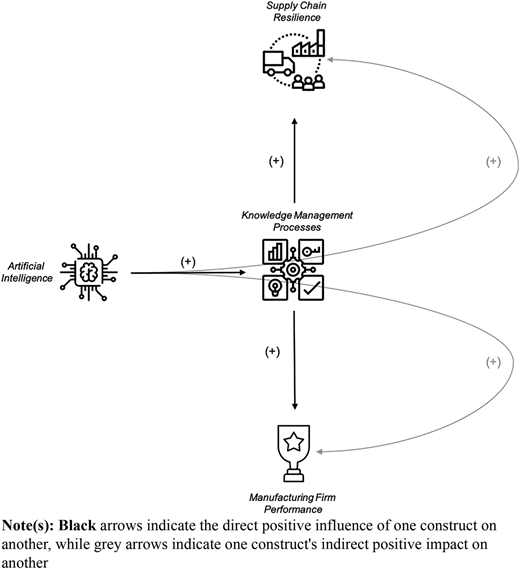
In addition, the results indicate a difference regarding the maturity of AI adoption based on firm size (β = 0.26, p < 0.01), implying that, the larger a firm is, the more advanced its AI adoption becomes. In contrast, firm age does not influence the maturity of AI initiatives. We also tested whether the indirect effects of the hypothesised relationships are significant and we obtained a beta coefficient equal to 0.29 (p < 0.01) for the relationship AI- KMPs-MFP and a beta coefficient equal to 0.30 (p < 0.01) for the relationship AI- KMPs-SCR. Thus, although the impact of AI on MFP and SCR is not significant, the results show a significant effect stemming from the mediation of KMPs. Therefore, with the mobilisation of KMPs, AI adoption can have a positive and significant impact on both MFP and SCR.
4.6 Robustness check
To assess the analysis’s robustness, we have adopted the approach of several scholars (Ghasemy et al., 2021; Hair et al., 2019; Sarstedt et al., 2020) to PLS robustness check. Consequently, we have undertaken the non-linear effects test to determine whether the relationships between the constructs are linear. Such a test examines the quadratic effects between the variables of the hypothesised model using a two-stage approach based on a bootstrapping analysis with 9,999 subsamples at a 5% significance level (Ghasemy et al., 2021). The results reveal that all the quadratic effects were not significant, thus ensuring the linearity of the relationships between the model’s constructs. Therefore, the robustness of the hypothesised model is deemed adequate.
5. Discussion
This paper aims to provide and test a conceptual model in which AI, KMPs and SCR are simultaneously considered in terms of their reciprocal relationships and impact on MFP. The results of the investigation support three out of six hypotheses of the initially proposed conceptual model and reveal a mediating effect on the part of KMPs in the relationship between AI and MFP and the relationship between AI and SCR. Figure 2 shows the emergent model.
5.1 Theoretical implications
The insights of this study are partially aligned with previous findings proving that AI adoption positively affects KMPs within firms (e.g. Al Mansoori et al., 2021; Liebowitz, 2001; Mittal and Kumar, 2019) and KMPs have a positive impact on both SCR (e.g. Kumar and Anbanandam, 2019; Umar et al., 2021) and MFP (e.g. Knight and Howes, 2012; Paniccia, 2018).
At the same time, the obtained results stand partially in contrast with the previous findings. In fact, even though the adoption of AI may enable real-time information sharing in the SC, fostering its resilience, the decision-making process should also be supported by structured KMPs (Buyukozkan and Gocer, 2018). In other words, the mere adoption of AI tools without appropriate KMPs is not effective (Zheng et al., 2021). The use of IoT sensors, for example, enables the collection of data from the external context in a raw mode, without providing any specific interpretation. Big data analytics are able to highlight particular patterns and trends within this raw data. In this way, it is possible to transform the data into useful information. Accordingly, using AI, which is intended to simulate the behaviour of human reasoning, allows for transforming data and information into useful knowledge (Ardolino et al., 2018). However, only effective KMPs can turn knowledge into appropriate decisions (Palaniswami and Jenicke, 1992; Sardar, 2020), with positive effects in terms of both SCR and MFP. Therefore, KMPs amplify the potential of AI, providing firms with the opportunity to have a competitive advantage that translates into both better performances as compared to competitors and greater resilience in dealing with turbulent situations. In fact, one of the hypotheses of the article aims to test whether the adoption of AI in manufacturing companies contributes positively to improving the effectiveness of KMPs. This hypothesis is accepted. Further originality of our study concerns the fact that the adoption of KMPs acts as a mediator through which AI affects SCR and MFP. To the best of our knowledge, this topic has not been sufficiently investigated in the previous literature.
5.2 Practical implications
From a practical point of view, the existence of a mediator reveals something about the process through which one construct (AI in our case) influences another (MFP and SCR in this case) (Renard, 2019), resulting in important practical implications for manufacturing firms. In fact, the emergent model (Figure 2) indicates that AI promotes KMPs (i.e. knowledge acquisition, creation and generation, use and application, archiving and updating, and sharing and transfer) but does not pave the way for MFP enhancement or SCR development. AI has positive effects on MFP and SCR only when KMPs intervene in these relationships. These findings highlight the critical role of KMPs in the manufacturing industry. This means that, to enhance the AI-MFP and AI-SCR links, managers must devote appropriate measures to develop effective KMPs within the firm, encouraging employees to commit to acquiring, sharing, applying and using knowledge. In other words, manufacturing firms can use AI tools to cultivate their level of capacity in KMPs (knowledge acquisition, sharing and application), which will, in turn, lead to better MFP and SCR enhancement.
Practically speaking, a manufacturing firm that has AI tools at its disposal will be able to manage and transform the various and numerous data that it acquires from the inside and also – and above all – from the outside into useful knowledge for the firm itself. This improved knowledge that will circulate within the firm will allow it, on the one hand, to improve its performance and, on the other hand, to increase the resilience of its SC.
6. Conclusions
The findings of this study contribute to the theoretical development of a conceptual model explaining the relationships between AI, KMPs and SCR, as well as their impact on MFP. Moreover, this study contributes to the literature by empirically examining the relationships between AI, KMPs and SCR in terms of their impacts on MFP. By doing so, we answer the call of practitioners (e.g. World Manufacturing Foundations, 2021) to jointly consider AI, KMPs and SCR in terms of their reciprocal effects on MFP. In particular, we demonstrate that KMPs act as a mediator through which AI benefits SCR and MFP; thus, they play a crucial role in manufacturing firms interested in properly applying AI tools to ameliorate their performance and resilience.
However, the findings of this study should be interpreted with caution in light of several limitations, which also represent interesting future research avenues. First of all, this paper investigates manufacturing firms located exclusively in Italy. Thus, even though it may be reasonable to believe that these firms can be considered a representative sample of – at least – European manufacturing firms, the enrichment of the starting sample could provide useful further insights. Moreover, the response rate could be increased, for example, through an extension of the time period devoted to the data collection. Moreover, although the Italian manufacturing context is characterised by a high proportion of SMEs (OECD, 2021), our investigation has not been conducted on this specific group. In fact, the average size of companies in our sample of respondents is larger than the national average; therefore, the results reported in this paper potentially tend to be more positive than the actual situation and further research may apply the same investigation exclusively to SMEs to specifically understand their reality. Furthermore, although questionnaires may be used as the only data collection method, future research may link this method with other methods (i.e. a mixed- or multiple-method research design), such as ad hoc interviews, in order to collect more detailed data. Lastly, we proposed a linear model; however, future studies could explore the existence of a circular relationship between the investigated constructs. For example, we stipulate that AI positively affects KMPs, but it would be interesting to consider the possibility that KMPs may also have a positive effect on AI.
To conclude, our study highlights the crucial importance of the mediating role of KMPs when examining the relationships between AI and MFP and between AI and SCR. The viewpoints proposed in this study have important implications for future research and manufacturers.
Notes
References
Appendix
Constructs and related items
| Construct | Sub-construct | Original sub-constructs and sources | Items |
|---|---|---|---|
| Knowledge management processes (KMPs) | Knowledge acquisition (KA) | Knowledge acquisition (Lee and Wong, 2015) Knowledge management capability (Lei et al., 2021) Knowledge acquisition (Mageswari et al., 2017) Knowledge acquisition (Tan and Wong, 2015) | In our firm, employees acquire knowledge from corporate repositories and databases In our firm, employees acquire knowledge from Internet In our firm, employees acquire knowledge from training courses, workshops or seminars In our firm, employees acquire knowledge from learning by doing and learning by observing In our firm, employees acquire knowledge from external sources and actors (others facilities, providers, clients, partners or competitors) In our firm external mentor organisations have been identified in order to learn from their experience (networks of professionals, consultants and experts) In our firm interviews are regularly carried out with employees who leave the organisation in order to improve knowledge and evaluate any critical experiences In our firm, employees are also hired based on the alignment of their knowledge with the corporate strategy |
| Knowledge creation and generation (KCG) | Knowledge generation (Ağ;an et al., 2018) Knowledge creation (Ernawati and Hamid, 2020) Knowledge creation and generation (Lee and Wong, 2015) Knowledge management capability (Lei et al., 2021) Knowledge creation (Mageswari et al., 2017) Knowledge creation and generation (Tan and Wong, 2015) | In our firm, employees are encouraged to create knowledge and put innovative ideas into practice in their daily tasks In our firm, employees participate in brainstorming sessions to discuss problems and identify potential solutions In our firm, employees work in team to create new knowledge In our firm new knowledge is generated by using new technologies In our firm, knowledge is generated by participating in new business opportunities In our firm, the main experiences of success and failure are traced in order to generate new knowledge | |
| Knowledge use and application (KUA) | Knowledge usage (Ağ;an et al., 2018) Knowledge application and utilisation (Lee and Wong, 2015) Knowledge management capability (Lei et al., 2021) Knowledge utilisation and application (Tan and Wong, 2015) | In our firm, employees apply best practice in their daily tasks In our firm, employees apply knowledge generated from similar situations in the past to solve new problems In our firm, employees apply existing knowledge assets to generate value | |
| Knowledge archiving and updating (KAU) | Knowledge storage (Ernawati and Hamid, 2020) Knowledge codification and storing (Lee and Wong, 2015) Knowledge storage (Mageswari et al., 2017) Knowledge storing and updating (Tan and Wong, 2015) | In our firm, employees organise knowledge in order to have quick access in case they’ll need it In our firm, employees update the archived knowledge In our firm, employees are willing to enrich the repositories where knowledge is stored In our firm, knowledge is accessible to anyone who needs it In our firm, every work procedure and the necessary skills for the various tasks are formalised and mapped In our firm, it is mandatory to document the experiences and learning during a new project/assignment (de-briefing after every project) In our firm, we have a centralised and updated archive (directory e-mail, note Lotus, Intranet) to organise acquired and generated knowledge In our firm, there is a database with the structured lists of employee skills | |
| Knowledge sharing and transfer (KST) | Knowledge sharing (Ağ;an et al., 2018) Knowledge dissemination (Ernawati and Hamid, 2020) Knowledge transferring and sharing (Lee and Wong, 2015) Knowledge management capability (Lei et al., 2021) Knowledge sharing (Mageswari et al., 2017) Knowledge sharing and transferring (Tan and Wong, 2015) | In our firm, employees share willingly and voluntarily share their thoughts, information, experiences and knowledge with the rest of the employees In our firm, employees participate in meetings, discussions or other knowledge sharing activities In our firm, employees use technological tools (groupware, e-mail, network tools, ecc) to share knowledge In our firm, employees share knowledge throw cooperation, collaboration and mutual interaction In our firm, employees have free access to documents, information and knowledge held by other divisions within firm In our firm, employee rotation between areas and tasks is adopted In our firm, there are specific processes for sharing knowledge and best practices between the organisation In our firm, periodic meetings are held to inform employees about main news that characterise the firm In our firm, there is a common language to sustain knowledge exchange and sharing between employees and departments In our firm, communities have been developed to allow people with common interests to share knowledge | |
| Supply chain resilience (SCR) | Risk mitigation competency (Ambulkar et al., 2016) SC performance (Barber et al., 2017) Supply chain resilience (Chunsheng et al., 2020) Supply chain robustness (Wieland and Wallenburg, 2012) | In our firm, we are able to cope with the changes arising from the interruption of the supply chain In our firm, we are able to provide a quick answer to the interruption of the supply chain In our firm, we are able to maintain high awareness of the situation in every moment In our firm, we are able to survive and take the opportunities In our firm, we are able to re-engineer collaboration and reduce uncertainty | |
| Manufacturing firm performance (MFP) | Manufacturing firm performances (Barber et al., 2017) Market performance outcome, Financial performance outcome, Qualitative performance outcome (Cristofaro et al., 2021) Organisational performance; operational performance (Mageswari et al., 2017) Manufacturing performance (Tan and Wong, 2015) Business performance (Wieland and Wallenburg, 2012) | Sales Operating margin Return on investments Customer satisfaction Productivity and efficiency Reactivity and flexibility |
| Construct | Sources | Items |
|---|---|---|
| Artificial intelligence (AI) adoption | Arnarsson et al. (2021) Belhadi et al. (2021b) Latête et al. (2021) Modgil et al. (2021) Pramod (2022) Rhem (2021) | In our firm we adopt AI tools based on “machine learning” technology |
| In our firm we adopt AI tools based on “neural network” technology | ||
| In our firm we adopt AI tools based on “deep learning” technology | ||
| In our firm we adopt AI tools based on “computer vision” technology | ||
| In our firm we adopt AI tools based on “natural language processing” technology | ||
| In our firm we adopt AI tools based on “cognitive computing” technology | ||
| In our firm we adopt AI tools based on “predictive analytics” technology | ||
| In our firm we adopt AI tools based on “robotic process automation” technology | ||
| In our firm we adopt AI tools based on “semantic search” technology |

