As the warehouse is increasingly viewed as a strategic component, retailers’ willingness to invest in automated warehouse systems (AWS) has increased. These investment decisions are influenced by well-known operational factors, but strategic factors, which have received limited attention in warehousing literature, also play a pivotal role. Addressing this gap, this study investigates how strategic factors influence AWS investment decisions in retail.
Based on a theoretical foundation of technology adoption, strategic intent, and automation strategy, an abductive multiple case study is conducted with eight purposefully selected retailers that had implemented or were in the process of implementing a large AWS.
The study ranks 10 competitive priorities and 21 AWS evaluation aspects and shows how the firm’s strategic intent and the AWS investment decisions can be connected via the formulation of a warehouse automation strategy. The findings reveal the content for such a strategy – including 7 categories and 17 considerations – related to, for example, technology innovativeness, efficiency versus adaptiveness, technology-supplier relationships, control and ownership, and risk exposure. The study empirically shows how manager characteristics and owner strategies influence retailers’ AWS investment decisions. Four strategic intent profiles are abductively developed: reliability and delivery service; profitable deliveries; scalable logistics for volume growth; and platform building for logistics services. The study also provides evidence of a reciprocal relationship between strategic intent and AWS investment decisions.
The study is conducted with a limited number of Swedish retailers, indicating a need for additional studies to test the findings across different contexts.
The study offers a framework for formulating a warehouse automation strategy. As a foundation for developing the framework, the study shares empirical insights from retailers in the forefront of AWS implementation.
The study contributes as a conversation changer by showing the importance of shifting from a tactical-operational focus to a strategic perspective on warehouse configuration in general and on AWS investment decisions in retail in particular.
1. Introduction
The warehouse is increasingly viewed as a strategic component, particularly in retailing. This is driven by the evolving retail context, including e-commerce and omnichannel, whereby customers expect larger product assortments, faster and more flexible deliveries, and a variation of order characteristics (Galipoglu et al., 2018; Risberg et al., 2023). Boysen and De Koster (2024) added: “Warehouses have always been an essential part of supply chains, but despite their fundamental role they were not seen as especially mission critical … however, this assessment has changed, and today’s warehouses have evolved to technology-enriched fulfillment factories with strategic relevance” (p. 1).
The strategic perspective on warehouses is not new. Already in the 1980s, McGinnis and Khon (1988) stated that “warehousing is an active participant in developing competitive strategies and competitive advantage” (p. 50). Primarily, this literature stream has considered warehouses as a component of the overall logistics network (Guthrie et al., 2017) including (1) the optimal number, size, and location of warehouses in the network (Korpela and Tuominen, 1996; De Marco et al., 2010; Emeç and Akkaya, 2018; Zhang and Swaminathan, 2020), (2) the outsourcing decision (Maltz, 1994; Akbari, 2018; Akhtar, 2023), (3) the total inventory of each warehouse (Accorsi et al., 2014), and (4) inventory management aspects (Min, 2009).
However, when it comes to warehouse configuration (or design), most publications analyze isolated optimization problems and focus on the tactical and operational level (Kembro et al., 2022), including classic books on warehousing (e.g. Tompkins and Smith, 1988; Frazelle, 2016; Bartholdi and Hackman, 2016). Frazelle, for example, commented: “It’s my personal favorite, but I have to admit that it’s the last logistics activity that should be considered when developing a supply-chain strategy … the warehouse is like a goalie in a soccer game. Like it or not, it’s the last line of defense and needs to be designed accordingly” (p. 12). The tactical and operational focus also concerns journal papers. Multiple reviews have been published in recent years (e.g. Custodio and Machado, 2020; Fottner et al., 2021; Fragapane et al., 2021; Kumar et al., 2021; Płaczek and Osieczko-Potoczna, 2024; Grover and Ashraf, 2024; Boysen and De Koster, 2024), and they all emphasize the tactical-operational focus. The same applies for reviews on automated warehouse systems (AWS) (e.g. Azadeh et al., 2019; Jaghbeer et al., 2020). Rouwenhorst et al. (2000) concluded that “the number of publications concerning design problems on a strategic level appears to be limited, despite the fact that at this level the most far-reaching decisions are made” (p. 524), adding that “more research on strategic issues is badly needed” (p. 527). Twenty years later, Kumar et al. (2021) reached a similar conclusion. Fragapane et al. (2021) added: “Few articles focus on decision-making at the strategic level … Instead, most of the reviewed articles focus on decision-making at the tactical-operational level” (p. 422).
There is therefore a knowledge gap in extant literature that lies between the strategic role of warehouses in logistics networks (e.g. where to locate the warehouse) and the tactical-operational focus for warehouse configuration (e.g. selecting the appropriate storage, routing, and picking method); that is, how strategic factors influence warehouse decision-making and configuration. This gap is increasingly important to address, as companies, and particularly retailers, make large investments in AWS (Azadeh et al., 2019; Kembro and Norrman, 2022). Such investments emphasize the notion that the structural configuration of a warehouse is of a strategic nature with long-term impact, with a possible – but previously not researched – reciprocal interdependence between the overall retail company strategy and the AWS investment. Yildirim et al. (2023) added: “According to Llopis-Albert et al. (2019), managers pay more attention to management and financial issues (which are mainly strategic and tactical focus areas in our framework) … In contrast, academic papers in our review mainly focus on operational decisions rather than strategic and tactical decisions. There should be cooperation between the practice and the theory, and a balanced approach among strategic, tactical, and operational focus areas” (p. 127).
Our study addresses this critical gap. Focusing on the retail sector, we investigate large AWS (i.e. automated systems that handle a majority of the material flows in the warehouse) from a strategic perspective. We formulate the following research question: How do strategic factors influence AWS investment decisions in retail? and tackle it through a multiple case study with eight retailers that recently made significant AWS investments. We abductively move between empirical insights and theory. The study is based on extant warehousing literature and technology adoption theory (e.g. Maghazei et al., 2022). As patterns emerged in the empirical data, we looked deeper into the literature on strategic intent (e.g. Patrucco et al., 2023) and automation strategy in the manufacturing literature (e.g. Winroth et al., 2007) to further frame and explain our findings.
Our study contributes to theory and practice in multiple ways. First, we show the importance of shifting from a tactical-operational focus to a strategic perspective on warehouse configuration in general and on AWS investments in retail in particular. Second, we formulate what can be referred to as a warehouse strategy for AWS investments. Third, we propose a conceptual framework that extends the previously proposed content of AWS decision frameworks and automation strategy, especially by incorporating strategic intent. Fourth, our study contributes as a conversation changer, by comparing warehouses to manufacturing facilities and bringing in new theory to explain and advance our understanding of highly automated warehouses in retail. Fifth, we unravel and explain the strategic complexity of AWS investment decisions in retail by ranking competitive priorities of the firm and evaluation aspects for AWS. Sixth, we empirically show how manager characteristics and owner strategies influence retailers’ AWS investment decisions, and then abductively develop four strategic intent profiles. Seventh, we provide empirical evidence of the reciprocal relationship between strategic intent and AWS investments, where much of the extant literature has suggested a one-directional relationship.
The remainder of the paper is organized as follows. As a basis for our abductive study, we first discuss our methodological approach before summarizing related academic literature. We then describe and abductively discuss the study’s findings. Finally, we summarize implications and the contribution to knowledge, managerial practice, and future research.
2. Methodology
2.1 Research design
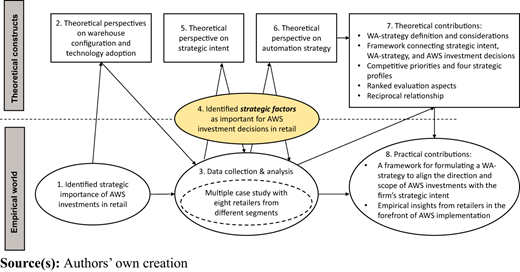
We conducted a phenomenon-driven study focusing on “identifying, capturing, documenting and conceptualizing a phenomenon of interest in order to facilitate knowledge creation and advancement” (Schwarz and Stensaker, 2016, p. 486). To seek new insights and assess how strategic factors influence AWS investment decisions in retail in a new light, we followed an abductive reasoning approach with iterations between empirical data and theory (Ketokivi and Choi, 2014). During the study, we were “moving back and forth between the empirical world and the theoretical constructs” (Dubois and Gadde, 2014, p. 1280). These steps are visualized in Figure 1 (numbers link the figure to the corresponding text) and described below.
The starting point for this research was (1) the observation that retailers increasingly view the warehouse as a strategic component and are more willing to make large AWS investments (Kembro et al., 2022). In previous studies, we observed that retailers chose different types and degrees of technology. To understand more about these investment decisions, we (2) reviewed literature on warehouse configuration and technology adoption. We used this as a basis to develop a data collection protocol and (3) conducted a multiple case study with eight purposefully selected retailers that had recently made significant AWS investments. Early in the data collection process, the empirical data and theoretical foundation directed us to (4) the importance of strategic factors. This is logical, as making a large structural investment and adopting new technologies suggests that strategic factors play a pivotal role (Maghazei et al., 2022). However, while this approach gave us a unique opportunity to empirically understand how strategy and warehousing interact in retail, we lacked a theoretical lens to provide additional explanation of the emerging patterns. Following an abductive approach, we therefore (5) turned to different literature streams on strategic factors, which led us to identify strategic intent (Hamel and Pralahad, 1989; Patrucco et al., 2023) as a key perspective for our studied phenomenon. This gave us a toolbox to frame the strategic perspective on AWS and to explain some of our findings (see, e.g. section 4.2 on strategic intent profiles).
As our abductive study progressed, both empirical data and literature suggested that strategic intent and AWS investment decisions are linked through the formulation of a warehouse automation (WA) strategy. The next logical step was to (6) dive deeper into literature on automation strategy. We concluded two important insights. First, there is a knowledge gap in extant warehousing literature that lies between the strategic role of warehouses in logistics networks (e.g. where to locate the warehouse) and the tactical-operational focus for warehouse configuration (e.g. selecting the appropriate storage, routing, and picking method). Consequently, as pointed out by multiple researchers, the strategic perspective on warehouse configuration is missing in warehousing literature. More specifically, we could not find any substantial literature on warehouse strategy or automation strategy. Second, our search on automation strategy led us (again) to the manufacturing literature (e.g. Säfsten et al., 2007; Lindström and Winroth, 2010). This literature helped us to (7) clarify and discuss our contributions to the automation strategy literature and to the warehousing literature in general, and (8) further frame our proposed WA-strategy framework. All actions taken to improve the validity and reliability (Yin, 2014) of the study are listed in Appendix 1.
2.2 Data collection and analysis
We conducted a multiple case study (Eisenhardt, 2021) with eight retailers that had recently made significant AWS investments (see Table 1). Due to anonymity, we cannot provide detailed information about each company. All retailers are based in/operate from Sweden but have and continue to increase their international presence. The retailers were purposefully selected (from an original sample of 300 invited companies, of which 50 responded to an initial survey and 31 to a second) based on the following criteria: (1) completed or in the process of implementing a large AWS; (2) different degree and type of automation technology (e.g. shuttle system, compact storage and order picking system, A-frame, and autonomous forklifts), (3) different sales channels (omnichannel vs pure e-tailers), and (4) a mix of segments/products (fashion, grocery, pharmaceutical, sports and leisure, DIY, department store, and automotive). The purpose of this approach was to obtain in-depth knowledge and enable both within-case and cross-case analysis of how retailers take strategic factors into consideration for their AWS investment decisions. To further motivate our case selection, we asked the companies to rate themselves how early they perceived that their company and warehouse management adopt technology (theory on diffusion of innovations; Rogers et al., 2014). All eight case retailers perceived themselves to be early compared to competitors (two innovators, three early adopters, and three early majority).
As a first step, we collected data through exploratory surveys (Malhotra and Grover, 1998). The survey questions captured (1) general information about the case retailers (e.g. size, turnover, type of channel, assortment range, and lead time offerings); (2) strategic logistics challenges (competitive priorities) for their warehouses; (3) the degree to which the companies invest in AWS; (4) evaluation factors for AWS investment decisions; and (5) the extent to which strategy and AWS influence each other. The respondents responded using a perceptual Likert scale ranging from 1 (“agree to a very low degree”) to 7 (“agree to a very high degree”).
Between August and October 2022, we visited and participated in guided tours in the eight retailers’ automated warehouses. The visits also included interviews with one or more key personnel such as supply chain (SC) director, logistics manager, warehouse manager, production manager, and sustainability manager. We recorded and transcribed all interviews, and coded all data using the NVivo tool. The coding was based on themes according to the interview guide (e.g. influence of ROI on investment decision), but new areas and interesting themes were also identified (e.g. influence of management background). The coded data were then analyzed based on a structured iteration between the theoretical perspective and empirical data (Ketokivi and Choi, 2014; Eisenhardt, 2021) with data reduction, data display, conclusion drawing, and verification (Miles and Huberman, 1994). By studying similarities and differences between cases (Eisenhardt, 2021), our aim was to elaborate theory, defining and grounding constructs through conceptualization and abstraction. Two researchers conducted the joint analysis and interpretation of the findings.
3. A strategic perspective on automated warehouse systems: establishing a theoretical foundation
The literature review section reflects our abductive approach, as we grounded our study in extant warehousing configuration literature and technology adoption, and then looked deeper into strategic intent and automation strategy in the manufacturing literature.
3.1 Automated warehouse systems in retail
The most obvious evidence of the warehouse’s increased strategic role is the retailers’ willingness to make large AWS investments with long-term impact (Kembro and Norrman, 2022). External key investment drivers include: (1) Industry 4.0 and the rapid development of material-handling technology (Azadeh et al., 2019), including mature, varied, and flexible technologies (McCrea, 2019, 2020), (2) proven business cases with global online giants leading the way and making large investments in automated material-handling technology (Alibaba Cloud, 2019; Fulfilment in our buildings, 2020), and (3) increased competition and plummeting profit margins, resulting in retailers increasingly focusing on cutting operational costs (Larke et al., 2018).
Kembro and Norrman (2022) concluded that retailers’ early investments primarily focused on AWS in outbound operations (i.e. order picking, packing, sorting, and shipping), and gradually increasing the focus on automating receiving and put-away. Their study points out that the most popular technologies among Swedish retailers include compact storage systems (e.g. Autostore), shuttle systems, location-bound sorting, packaging, weighing, sizing, and palletizing. Another common AWS (particularly in pharma) is the A-frame, which is suitable for large flows of small stock-keeping units (SKUs) (Azadeh et al., 2019). In recent years, technology has become more mature, varied, and flexible, and so the range of AWS has increased. This includes, for example, autonomous forklifts and vehicle-based storage and retrieval (Azadeh et al., 2019), robotic piece-picking (Kembro and Norrman, 2022), autonomous mobile robots (AMR) for picking and sorting, and pocket sorting (Boysen and De Koster, 2024). Examples of AWS and applications are listed in Table 2.
AWS investment decisions are guided by several evaluation aspects (e.g. McCrea, 2019, 2020; Yildirim et al., 2023), such as AWS cost and ROI, implementation time, throughput, and speed, picking efficiency, and flexibility, reliability, and scalability. Each AWS investment decision involves a trade-off analysis between different strategic configuration goals (Kembro and Norrman, 2020). In other words, different systems can be more or less suitable for achieving economy of scale, handling task complexity, market dynamics, and speed, and increased utilization of warehouse space. Boysen and De Koster (2024) discussed the challenge for any AWS to handle the range of varying demand, varying order structure, and varying lead times. They conclude that a systematic cross-comparison of how well different AWS achieve different goals is lacking. However, for the purpose of this paper it is valuable to make a simple comparison between two of the most common AWS in Swedish retail (Kembro and Norrman, 2022): the compact storage system Autostore and the shuttle systems. Both these technologies have well-known pros and cons.
First, Autostore is faster to implement (time from investment decision to full operation) than a large shuttle system. It is less capital intensive; the retailer can start with a small “cube” and expand gradually. The main challenge for Autostore is the limitation of SKU characteristics and size of volume/flows. The SKUs cannot be too big to fit in the totes (nor should they be too small). Furthermore, Autostore does not perform too well for high throughput or high quantities per SKU (e.g. store replenishment). In comparison, a shuttle system performs better for higher throughput and varied SKU characteristics. It is also relevant to consider the “ABC frequency curve”; the Autostore is not optimal for a flat curve, meaning that many SKUs are equally frequently picked (then, the robots must often dig up totes from deep down in the cube). Finally, it is relevant to consider that there is a limit to how big an Autostore can be. Beyond a certain size, it may be necessary to build a second cube (and a third, and so on), which leads to an expanded sorting issue for the warehouse operation (Kembro et al., 2022).
3.2 Technology adoption and strategic intent
To understand strategic factors that influence AWS investment decisions, we initiated our abductive study by drawing on technology adoption literature. Specifically, we considered the adoption of advanced manufacturing technology (AMT) literature (Maghazei et al., 2022), as highly automated warehouses increasingly resemble dedicated production lines.
Maghazei et al. (2022) argued that a business case is central, and this includes an assessment of economic potential and strategic relevance (Small and Yasin, 1997). Common economic indicators include cost of the technology, return on investment (ROI), payback period, and cost of capital (Burcher et al., 1999; Maghazei et al., 2022). This approach may create a bias against innovative technologies, as managers overlook strategic fit and less quantifiable and longer-term benefits (Small and Yasin, 1997). Managers are also concerned with costly training and short-term productivity dips (Maghazei et al., 2022). Sternberg and Norrman (2017) added: “history is full of technologies never adopted in favor of less optimal designs … [and] the previous adoption of technology is one of the strongest inhibitors of novel technology adoption” (p. 746). There is an inherent risk and uncertainty of being the first to invest in a new technology (cf. diffusion of innovation theory; Rogers et al., 2014). Maghazei et al. (2022) argued that financial assessment of technology adoption has limitations, and that the remedy is to ensure “an appropriate fit between firm strategies and technology adoption” (p. 563). It is therefore relevant to consider a firm’s strategic intent for AWS investment decisions.
Strategic intent (Hamel and Pralahad, 1989) has been used in the SC and operations strategy literature (e.g. Fawcett et al., 1997; Krause et al., 2001), and recently by Patrucco et al. (2023) in their study on purchasing strategy. Strategic intent can be conceptualized (or operationalized) as competitive priorities of the firm, i.e. the strategic goals and objectives that should be achieved (Patrucco et al., 2023). Patrucco et al. (2023) found that competitive priorities and purchasing practices are interdependent, calling for an integration of the two to develop effective purchasing strategies. For manufacturing, Hayes and Wheelwright (1984) emphasized that firms differ in the emphasis they give to each competitive priority, which creates unique strategic profiles (Flynn et al., 1999), and they describe competitive priorities as cost; product reliability (quality-performance); unique product features (quality-features); dependability (accuracy) of specifications, on-time delivery and service; plants’ product flexibility; and plants’ volume flexibility. For AMT, Burcher et al. (1999) listed a range of such competitive priorities, including cost, delivery lead time, delivery reliability, flexibility, and volume variability. In warehousing, strategic intent or strategic priorities have not been explicitly used. However, Kembro and Norrman (2020) discussed different strategic challenges (e.g. economy of scale, task complexity, market dynamics, speed, tied-up capital, and warehouse space), linked to different contextual profiles that retailers must prioritize between when making larger investments in warehouse configurations. They concluded that: “Large omnichannel retailers typically have … several contextual factors pointing in different directions. This implies the need to invest in more complex and costly configurations or to make trade-off analyses to determine the most important factors and goals. Such a trade-off analysis is probably guided by overall corporate strategies” (pp. 70–71).
Considering that highly automated warehouses increasingly resemble dedicated production lines, it is also reasonable to hypothesize that AWS investments may have implications for future strategic maneuvering. This notion originates from Parthasarthy and Sethi (1992), who investigated manufacturing technology and placed technology and strategy in a reciprocal relationship. This relationship has not been studied before in warehousing literature but suggests that there could be a reciprocal interdependence between competitive priorities and AWS; that is, the strategic intent influences the type/degree of AWS to invest in, while the chosen/implemented AWS will influence the possibilities to change future strategic direction for the company.
3.3 Automation strategy
Next, our abductive approach led us to a closer review of the literature on automation strategy (as a link between strategic intent and AWS investment decisions). This literature stream grew in the 1980s and 1990s as part of the manufacturing literature (e.g. Hayes and Wheelwright, 1984; Boyer et al., 1996). It was then further developed during the 2000s, linking manufacturing strategy with automation strategy (e.g. Säfsten et al., 2007; Winroth et al., 2007; Lindström and Winroth, 2010; Granlund, 2014).
For the purpose of our paper, here it is relevant to briefly define what is meant by “strategy”. Strategy can be defined in many ways, for example as something that can be planned or as something that emerges. It can be a “tool chosen to accomplish the fundamental objectives of the firm” (La Londe and Masters, 1994, p. 35) or emerging more as “a pattern in a stream of decisions” (Mintzberg, 1978, p. 934). Johnson et al. (2005) described it in more detail as “the direction and scope of an organisation over the long term, which achieves advantage in a changing environment through its configuration of resources and competences with the aim of fulfilling stakeholder expectations” (p. 9). From a business perspective, strategy concerns a long-term perspective on firm direction, objectives, and configuration decisions.
In manufacturing, research on automation strategy acknowledges (1) the need for companies to develop an automation strategy and (2) the need for more research on automation strategy (Säfsten et al., 2007; Winroth et al., 2007; Lindström and Winroth, 2010; Granlund, 2014). Granlund (2014) added, “while the importance and need of strategy connected with automation development and decisions and some support for the formulation of an automation strategy can be found, there is less support and descriptions of the actual content of the automation strategy” (p. 29). One focus in literature is on whether the automation strategy is the manufacturing strategy or if the automation strategy is one of many areas within the manufacturing strategy (Winroth et al., 2007). Warehousing is treated rather peripherally; instead, the term used is “internal logistics”. The general perception is that automation strategy is part of the internal logistics strategy, which is part of the manufacturing strategy (Granlund, 2014). Apart from Parthasarthy and Sethi (1992), most research suggests a one-directional relationship; that is, the company strategy influences the manufacturing strategy, which in turn influences the internal logistics and automation strategy (e.g. Granlund, 2014, Figures 19 and 21).
It is important to note that automation strategy in manufacturing focuses on process technology; that is, automation of material-handling processes (e.g. an automated guided vehicle) to move goods from station A to station B. This is significantly different compared to the retail context (the focus of our paper), where AWS comes in many different types, and for many different purposes (see Section 3.1). The research also circles around what is the right level of automation. Säfsten et al. (2007), for example, discussed under-automation, over-automation, and “rightomation”. Granlund (2014) discusses two more important decisions: (1) the choice of what to automate; and (2) the choice of technology. Referring to Hax and Majluf (1991) and Baines et al. (2005), Granlund (2014) also commented that some literature has brought up the issue of involving and relying on external partners, arguing for a rigorous supplier selection to ensure a successful automation project. Hofmann and Orr (2005) added, “This is a difficulty associated with multi-functional projects that is rarely considered in the literature” (p. 715).
In the past ten years, a review of the manufacturing literature (both keyword search and snowballing based on, e.g. Granlund, 2014) indicates a shift of focus from automation strategy to, for example, “digital transformation” and “digitalization strategy”. In parallel, during the same period (2015–2024) retailers have increased their focus on AWS, so the need for developing knowledge of automation strategy has gradually shifted from manufacturing to warehousing literature. It is important to stress that there is a knowledge gap in extant scientific warehousing literature that lies between the strategic role of warehouses in logistics networks (e.g. where to locate the warehouse) and the tactical-operational focus for warehouse configuration (e.g. selecting the appropriate storage, routing, and picking method). Multiple reviews have documented this gap (e.g. Fragapane et al., 2021; Kumar et al., 2021; Yildirim et al., 2023), and attention for a strategic perspective on AWS in retail is slowly picking up in scientific literature. Yildirim et al. (2023) recently investigated mobile robot automation and suggested a managerial decision framework where the strategic level included: (1) evaluation criteria and selection of the type of mobile robot system; (2) identification of key performance indicators; (3) facility layout; and (4) human-robot interaction management.
3.4 Toward a framework for understanding strategic factors that influence AWS investment decisions
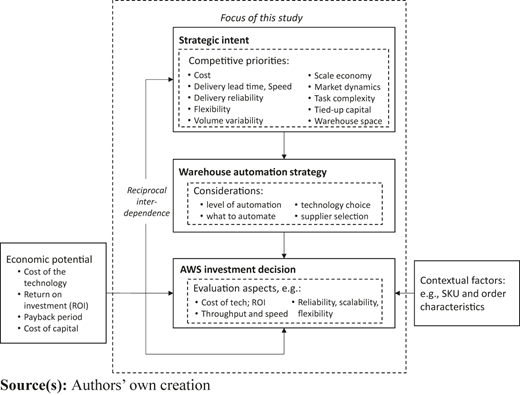
We use our literature review to create an initial framework for understanding the strategic perspective of AWS investment decisions (Figure 2). The literature, which is largely founded in manufacturing, suggests that economic potential and strategic intent (competitive priorities) are key for AWS investment decisions. It also highlights the importance of developing an automation strategy. The content of such an automation strategy mainly concerns the level of automation, what to automate, and the choice of technology. As we suggest in Figure 1, the automation strategy together with economic potential and well-known contextual factors (e.g. SKU and order characteristics) is the foundation for AWS investment decisions. The investment decisions are guided by several evaluation aspects. Finally, we hypothesize – with some support in manufacturing literature – that there is a reciprocal relationship between strategic intent and AWS investment decisions.
4. Insights from the empirical findings and analysis
In this section, we present insights from the empirical findings and analysis, to (1) develop the framework presented in Figure 2, and (2) answer the research question: How do strategic factors influence AWS investments decisions in retail? The structure follows the order of Figure 2; we start with strategic intent in terms of competitive priorities (section 4.1) and then add the observed influence of owner and management characteristics (4.2). We continue with WA strategy (4.3), followed by AWS evaluation aspects (4.4) and the reciprocal interdependence between strategic intent and AWS investment decisions (4.5). Finally, we summarize section 4 by connecting the dots between strategic intent, WA strategy, and AWS evaluation aspects in an updated conceptual framework (4.6).
4.1 Competitive priorities
First, we surveyed the case companies’ current and future competitive priorities (referred to as strategic logistics challenges in the survey; Table 3). The competitive priorities were identified from literature (e.g. Hayes and Wheelwright, 1984; Flynn et al., 1999; Burcher et al., 1999; Kembro and Norrman, 2020) and summarized them for warehousing as cost, delivery lead time, delivery reliability, flexibility, volume variability, scale economy, market dynamics, task complexity, tied-up capital, and warehouse space, with environmental aspects added.
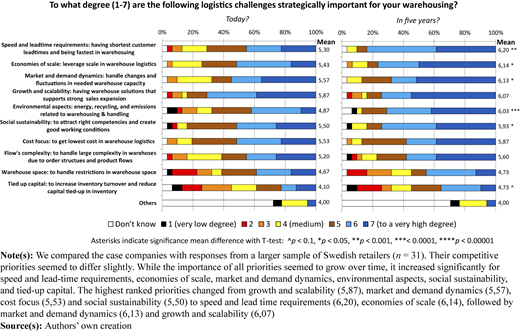
Our findings show that retailers balance multiple competitive priorities, and that the importance of each priority (except from space) increases over time. The case companies reported environmental aspects as the strategically most important priority in the future (6,6). While speed and lead time (6,5) as well as economies of scale (6,5) were also highly rated, the case companies ranked market and demand dynamics (5,9), and growth and scalability (5,9) highly but relatively less important. Social sustainability (6,4), cost focus (6,4), and flow complexity (6,4) were also ranked highly. Among the case companies, it is interesting to note that case B (and to some degree case F) perceived growth and scalability and warehouse space as less of a challenge. One possible explanation is that these companies had recently invested in excess capacity. Meanwhile, case E ranked social sustainability and cost slightly lower. Tied-up capital divided the case companies, where C, D, and E ranked it higher while the others ranked it lower. A comparison with a larger sample of Swedish retailers (n = 31) is available in Appendix 2, showing that the larger sample differed by ranking environmental aspects less important in the future while market and demand dynamics, as well as growth and scalability were ranked as more important.
4.2 The influence of owner and management characteristics
During the analysis process, we observed that the case companies (as forefront runners of AWS) often reasoned similarly around competitive priorities and AWS investment decisions. However, we noted some fundamental differences in perspectives of and justifications for their AWS investment decisions. We could not explain those differences with classic contingency factors such as retail segment (type of product), goods size, size of company, market dynamics, demand pattern (e.g. Faber et al., 2018; Kembro and Norrman, 2020). Nor could we explain the differences with isolated factors from the AMT literature (Maghazei et al., 2022).
Instead, our abductive analysis suggested that a combination of different inherent company characteristics – we refer to it as different “DNAs” – seemed to have a considerable influence. Based on our literature review, we could frame this as a combination of the owners’ perspective on economic value creation and the managers’ perspective (due to their professional origin and interest) on strategic relevance (Burcher et al., 1999), which seem to create a preference for or bias against certain technologies (Small and Yasin, 1997) and investment decisions. We observed differences in channel background, ownership form and value focus, management background and focus, as well as general innovativeness climate (Table 4) that during interviews either explicitly or implicitly seemed to motivate certain investment decisions. Specifically, they influenced decisions such as: (1) the size of the investment and requirements for payback period, (2) the importance of different financing solutions, and (3) the actual business purpose of the automation (e.g. increasing profitability and/or supporting rapid growth), as well as the decision-making process, and its pace.
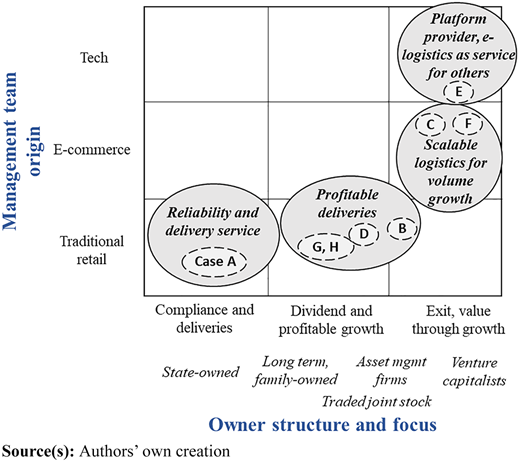
Our abductive analysis suggested four retail clusters with different “DNAs” – different combinations of management team origin ownership structure and focus on economic value creation. We refer to these as strategic intent profiles (Figure 3), which help to explain why the case companies invested in a certain degree and type of AWS. Strategic intent profiles (or categories) are not new in the strategic intent literature. However, for retail and AWS investment decisions, this is an original and important finding extending previous research on contextual profiles (Kembro and Norrman, 2020). As support for Figure 3, we draw on strategy literature and specifically insights on manager characteristics and owner strategies (e.g. Katz and Niehoff, 1998; Blackburn et al., 2013; Baron and Barbieri, 2019). The strategy literature generally agrees that manager characteristics and owner strategies influence the long-term direction of the company. Baron and Barbieri (2019) discussed two basic questions for an owner strategy: what are the goals (growth, liquidity, or control), and what are the guardrails, i.e. the financial and non-financial boundary conditions for the company based on the defined goals. As a concrete example – connecting back to Frazelle’s (2016) comparison of a warehouse and a goalkeeper – Lassas (2021) studied owner strategies in football and identified three profiles: win-maximizers, profit-maximizers, and political owners. In Figure 3, we use our empirical data to make a corresponding classification for retail. Later (end of section 4.3), we also connect each of the four strategic intent profiles with formulated WA strategies.
The first profile, exemplified by case A, focuses on Reliability and delivery service. The retailer with long-term owners such as the government emphasizes regulatory compliance, safety of products and employees, with delivery service to customers as the highest priority. The AWS should improve these aspects, leaning toward proven technology, low risk of downtime, and avoiding complex integrations between multiple suppliers. Financing arrangements and capital availability appeared to be a minor issue.
The second profile revolves around Profitable deliveries. These retailers (e.g. D, G, H) have a clear “retail-DNA” with a long trading tradition and ownership concentrated in one or a few families (with family members active in the operational management). The focus is on ROI and growth-with-profitability. The implemented AWS should therefore increase the retailers' competitiveness and support new, profitable customer value offerings. A similar aim was found in listed companies (case B), where investors (e.g. asset management firms) had long-term intentions of synergies between firms in different countries or segments.
The third profile focuses on Scalable logistics for volume growth. These retailers’ ownership structures are more short-term compared to the family-owned, regardless of whether it is a broad shareholding or more concentrated in one or more venture capital companies. Shareholder value can even be generated from an exit, meaning that the owners – when investing in AWS – focus more on selling the retail company than getting shareholder value from profitable retail operations. Sometimes, especially for young e-commerce retailers (C and F), the owners' business models promote a higher priority for growth than profitability; the company valuation is based more on sales growth and growth potential than on profit and profitability. Consequently, both the horizon length and size of investment in AWS often decrease. The financing models become more important if the owners are approaching an “exit”, that is, they will soon try to sell the company.
The fourth profile has many similarities with Scalable logistics for volume growth. However, our analysis indicated that the retail activity itself is perhaps more a means to the goal of delivering a platform for e-commerce and logistics services to other retailers. We refer to this profile as Platform building for logistics services. The ownership structure has a focus on increasing shareholder value through growth, but the growth is not generated solely through the company’s (case E) own retail operation; instead, the future profit is generated from other retail firms’ transactions. We perceive a difference in the management teams’ interest and competencies, where a “tech-DNA”, i.e. a background in and interest in IT and high-tech, is more important than the retail and logistics focus and experience that were distinctive for the other retailers’ management teams. This implied a greater focus on innovation (based on the retailer’s own technological know-how) and creating their own, customized systems based on simple and scalable technology.
4.3 An approach for formulating a warehouse automation strategy
Investing in AWS is an expensive and complex decision that affects the retailer for many years or even decades. Despite this, none of the case companies had formulated a clear automation strategy at the time of the study. Several claimed to be on their way: “We are currently formulating an automation plan”; “It is part of the overall supply chain strategy”; “We have formulated a vision”; or “We have no formal strategy but guiding principles.” Others claimed to have it available in a less tangible format: “It is part of the organizational culture” or “It exists in our minds, and semi-officially on paper.” Interestingly, in some sense, this reflects the gap we observed in warehousing literature concerning the strategic perspective on AWS investment decisions in retail.
To address this gap, we noted that many strategic decisions were discussed during our interviews with the case companies; sometimes the case representatives had similar reasoning around AWS investment decisions, but occasionally they differed greatly, indicating varying directions where strategic decisions must be taken. Our analysis of these (similar and differing) decisions revealed seven categories that together constitute what could be considered for formulating a WA strategy: (1) role in logistics network; (2) technology innovativeness; (3) efficiency versus adaptiveness; (4) relationship with technology supplier; (5) control and ownership; (6) risk exposure and robustness; and (7) sustainability. In Table 5, we use empirical case data to elaborate and motivate each of these WA-strategy categories and to submit a list of WA-strategy considerations. We also provide concrete examples of how the WA-strategy considerations can be used by linking the four strategic intent profiles (section 4.1) with formulated WA strategies (see Table 6). Some differences between the WA strategies become clear. The strategic intent profile “Profitable deliverables” is expanding brownfield sites, using long-term partners to fine-tune their AWS with robust operations, while the others are less capital-restricted or more growth-focused. The profile “Reliability and delivery service” mostly considers how to reduce different types of risks. Meanwhile, the profile “Scalable logistics” considers how to get the most growth potential from more limited investments with a shorter horizon and by leveraging partnership with tech-providers. The “Platform providers” profile focuses on independence and creating a unique AWS that can enable new business offerings.
These original insights address the gap concluded by Granlund (2014): “there is less support and descriptions of the actual content of the automation strategy” (p. 29). Our seven suggested categories also extend the previously proposed content of an automation strategy, namely level of automation, what to automate, and choice of technology (Säfsten et al., 2007; Winroth et al., 2007; Lindström and Winroth, 2010; Granlund, 2014). It should also be reiterated that developing an approach for formulating a WA strategy is new for the warehousing literature in general and retail context in particular. Therefore, inspired by previous strategy definitions (e.g. La Londe and Masters, 1994; Johnson et al., 2005) we propose a definition of planned-oriented WA strategy as:
a tool that helps decision makers align the direction and scope of AWS investments and configurations with the firm’s strategic intent to ensure that the firm meets its fundamental objectives and achieves advantages in a changing environment in the long term, with the aim of fulfilling stakeholder expectations.
4.4 Evaluation aspects for the automated warehouse systems decision
To increase our understanding of the complexity involved with AWS investment decisions, we surveyed the case companies’ perceptions of 21 AWS evaluation aspects (identified from scientific and popular science literature such as McCrea, 2019, 2020; see Table 7). This is an extension of previous scientific literature. For example, Yildirim et al. (2023) only listed (without ranking) six criteria to evaluate mobile robot systems.
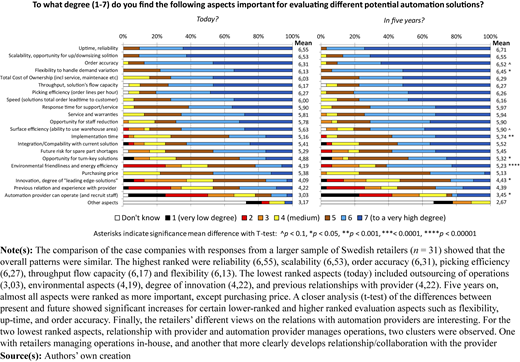
The highest ranked evaluation aspects included AWS reliability (6,9), order accuracy (6,9), speed (6,9), throughput (6,8), picking efficiency (6,8) and scalability (6,6). The results showed that the importance of almost all 21 evaluation aspects increased over time, and in five years, 12 of the aspects were ranked above 6,0. This suggests that the AWS decisions become increasingly complex over time, but also indicates that the capability to assess and compare evaluation aspects must increase. One case respondent (B) commented: “It is more complex in many ways today to make the decision than it was when our decision was made like 7–8 years ago, in the sense that so much has happened in the world.” Another respondent (C) added: “I would say, yes, it is a complex decision. Because there are many ways to do something … you have to really clarify, you have to understand what the process is that you need in general and at what speed do you want to perform this.” Another relevant observation is that all evaluation aspects related to performance are ranked high, yet the case companies choose different AWS. One explanation is that different AWS are a better match for different strategies and contexts. In other words, the AWS assessment and decision-making must be founded in the companies’ (including owners and management) priorities and needs.
The comparison with a larger sample of Swedish retailers (n = 31), available in Appendix 3, showed an overall similar pattern in terms of ranking and development. It is interesting to note the retailers’ different views on the relations with automation providers. For the two lowest ranked aspects, relationship with provider and automation provider manages operations, two clusters were observed in the general data – one with retailers managing operations in-house, and another that more clearly develops relationship/collaboration with the provider.
4.5 Interdependence between strategy and automated warehouse systems
Finally, we empirically investigated the hypothesis of a reciprocal relationship between strategic intent and AWS investment decisions. All case respondents confirmed that a decision in the warehouse influences the logistics network, and vice versa (Kembro et al., 2022), they also confirmed that a WA strategy should be part of the overall logistics and SC strategy. What may not be obvious at the time of investing in a new AWS is how that decision will affect the company for many years, or even decades, to come. One respondent (B) reflected: “… are we sure that this is the right way to go now then, because we are locking ourselves into an investment that will shape our next 10–20 years” For this long-term perspective, the connection between strategic issues and AWS is important.
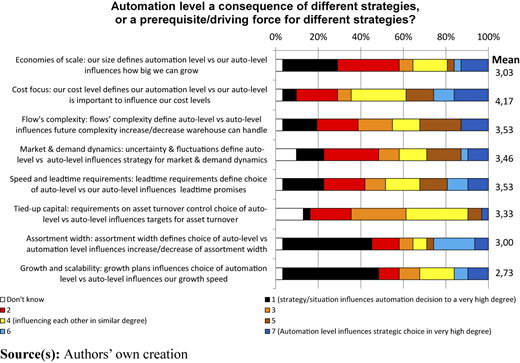
We surveyed the connection between the retailers’ strategy and AWS. Among the case companies, we observed several dipolar patterns where many answered either 1, 2 or 6, 7 (Table 8), i.e. several respondents believed that the firm strategy completely influences the implemented AWS, while others think the opposite. In particular, case companies C and H, but also cases A, B, and G, generally perceived that their strategy influenced AWS investment decisions. Meanwhile, cases F and D argued that the AWS influences future strategic maneuvering. We also noted that case companies A, B, D, and G indicated answers 3–5 for many aspects, suggesting a reciprocal interdependence. Our findings thereby support Parthasarthy and Sethi (1992) who placed manufacturing technology and strategy in a reciprocal relationship. This is an important contribution both to warehousing literature and to extant research on automation strategy (e.g. Granlund, 2014), which has mainly suggested a one-directional relationship.
We compared the case companies with responses from a larger sample of Swedish retailers ( Appendix 4). Analysis of averages suggests a reciprocal interdependence, but strategy had a slightly stronger influence on the AWS than vice versa. In conclusion, warehouses are expensive, time consuming, and difficult to redesign. As one respondent (C) put it: “You do have a huge investment that you need to take. Once you got it in, you can’t easily take it out. It's not so easy always to adjust it to different needs. And it also has a certain capacity that you cannot expand easily, but you also cannot just take it down when you don't need it, right?” Although automation technology has itself recently increased in flexibility, previous and current decisions for warehouses and automation will have a major impact on companies' future strategy discussions and decisions.
4.6 Elaboration of the warehouse automation strategy framework
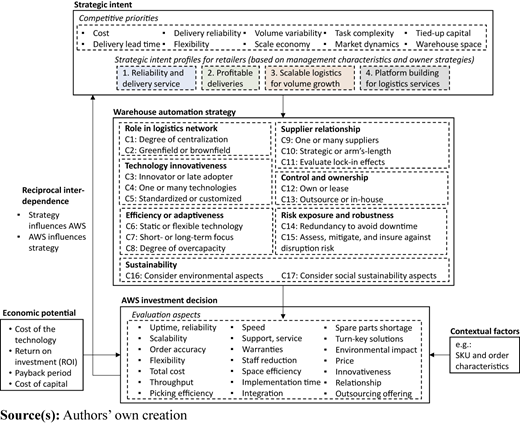
We summarize the above insights and theorize the reciprocal nature of AWS investments by connecting the dots between strategic intent, WA strategy, and evaluation aspects for AWS investment decisions in a conceptual framework (Figure 4). This is an elaboration of the framework presented in Figure 2.
As illustrated in Figure 4, strategic intent is driven by competitive priorities (which for warehousing revolve around cost, delivery lead time and reliability, flexibility, volume variability, scale economy, market dynamics, task complexity, tied-up capital, and warehouse space). The strategic intent is also influenced by the management team’s origin and the owners’ focus on economic value creation, as examples of antecedents of stakeholder expectations. Combinations of these, which we refer to as strategic intent profiles, help to explain how the case companies reasoned around level of automation, what to automate, technology choice, supplier selection, and a range of other AWS evaluation criteria. In other words, whether the strategic intent is focused on compliance and secure deliverables, profitability, scalability and growth, or changing business model from retailer to platform provider.
Strategic intent and AWS investment decisions are connected through the formulation of a WA strategy. We define WA strategy as “a tool that helps decision makers align the direction and scope of AWS investments and configurations with the firm’s strategic intent to ensure that the firm meets its fundamental objectives and achieves advantages in a changing environment in the long term, with the aim of fulfilling stakeholder expectations”. Although an explicit WA strategy is missing in both extant literature and the cases, we suggest that its formulation is vital for connecting strategic intent with AWS investment decisions. Our analysis revealed 7 categories and 17 considerations that constitute what should be addressed in a formulated WA strategy. The categories include owners’ and management’s perception on role in logistics network, technology innovativeness, efficiency versus adaptiveness, technology-supplier relationships, control and ownership, risk exposure, and sustainability. Our WA-strategy framework addresses the content gap of an automation strategy concluded by Granlund (2014) and extends the previously proposed content of strategic decision framework (Yildirim et al., 2023) and automation strategy (e.g. Granlund, 2014).
The formulated WA strategy, representing a combination of strategic considerations, will guide the retailer towards different investment evaluation aspects. Depending on whether the company’s “DNA” drives a more offensive or defensive perspective on the role of warehousing and AWS, it will influence which of the considerations and evaluation aspects are ranked most important. The investment evaluation aspects, and their prioritization, are instrumental in selecting what to automate, the technology choice, and supplier selection, which corresponds to extant automation strategy discussion. The implemented AWS will then lock the retailer’s performance on its competitive priorities for the foreseeable future and may influence the future strategic choices of the firm. The relationship between firm strategy and AWS must be understood as reciprocal; in other words, it is not only strategy that influences AWS investment decisions, but also the implemented AWS influences strategy.
5. Concluding discussion, implications, and future research
This study investigated how strategic factors influence AWS investment decisions in retail. We conducted a multiple case study with eight retailers that recently made significant AWS investments, and abductively moved between empirical insights and theory. Next, we discuss our findings and the implications for theory and practice. Finally, we elaborate on avenues for future research.
5.1 Theoretical implications
First, the gap between the strategic role of warehouses in logistics networks and the tactical-operational focus for warehouse configuration is well-documented (e.g. Fragapane et al., 2021; Kumar et al., 2021; Yildirim et al., 2023). As warehouses have more strategic relevance (Kembro et al., 2022; Boysen and De Koster, 2024), our study contributes as a conversation changer, by showing the importance of shifting focus from tactical-operational focus to a strategic perspective on warehouse configuration in general and on AWS investment decisions in retail in particular. We propose a conceptual framework focusing on the strategic perspective on AWS, including how different important constructs are related in a reciprocal way. This perspective shift, from operations to strategy, was done in the manufacturing literature decades ago, and it is high time for the warehousing community to follow suit. This applies at least for AWS in retail, which faces large costs, significant lock-in effects, fast technological development, and an increasingly uncertain environment, so researchers and practitioners need to talk more about strategic issues.
Second, our study elaborates on the notion that warehouses have evolved to fulfillment factories (Boysen and De Koster, 2024), by comparing warehouses to manufacturing facilities and bringing in new theory to explain and advance our understanding of highly automated warehouses in retail. Our abductive study has shown that manufacturing literature (e.g. AMT, automation strategy) as well as business strategy literature (strategic intent, owner strategies) are useful to fully grasp the rich and complex nuances of AWS investment decisions. Considering that production operations (e.g. in automotive industries) went through an automation journey long ago, it is likely that many of the issues faced in increasingly automated retail warehouses have been investigated in different ways in the manufacturing literature (e.g. the issue of psychosocial work environment for humans). This provides an interesting opportunity for researchers to expand the portfolio of theories in future studies on retail warehousing.
Third, we unravel and explain the strategic complexity of AWS investments decisions in retail by ranking 10 competitive priorities of the firm and 21 AWS evaluation aspects. This is an extension of previous scientific literature. For example, Yildirim et al. (2023) only listed (without ranking) six criteria to evaluate mobile robot systems. Our findings showed that the AWS decision becomes increasingly complex, as the importance of all competitive priorities and evaluation aspects increases over time. We also draw on strategy literature (e.g. Katz and Niehoff, 1998; Blackburn et al., 2013; Baron and Barbieri, 2019) and empirically show how manager characteristics (e.g. retailer or tech background) and owner strategies (view on growth, liquidity, and control) influence retailers’ AWS investment decisions. We then abductively develop four strategic intent profiles, namely reliability and delivery service; profitable deliveries; scalable logistics for volume growth; and platform building for logistics services. Altogether, the mix of competitive priorities, evaluation aspects, management characteristics, and owner strategies make AWS investment decisions a highly strategic and complex endeavor. In particular, the business purpose of the AWS and the role of owners should not be underplayed, and deserve attention in future research. In Nordic retail, several recent ownership changes have shown how differing owner strategies can impact the (re)direction of AWS investments.
Fourth, our study explains how a WA strategy connects strategic intent with AWS investment decisions. This is new territory for warehousing literature, which is why we turned to the manufacturing literature on automation strategy (e.g. Säfsten et al., 2007; Lindström and Winroth, 2010). Our analysis revealed 7 categories and 17 considerations that together constitute a foundation for formulating a WA strategy. These original insights are new for the warehousing literature in general and retail context in particular. They also address the content gap of an automation strategy concluded by Granlund (2014). Our framework extends the previously proposed content of strategic decision framework (Yildirim et al., 2023) and automation strategy (e.g. Granlund, 2014), which primarily emphasizes the level of automation, what to automate, and choice of technology. We bring in strategic intent alignment, arguing that the WA strategy must address, for example, technology innovativeness, efficiency versus adaptiveness, technology-supplier relationships, control and ownership, and risk exposure.
Fifth, we provide empirical evidence of the hypothesized reciprocal relationship (Parthasarthy and Sethi (1992)) between strategic intent and AWS investment decisions. This is an important contribution both to warehousing literature and to extant research on automation strategy (e.g. Granlund, 2014), which has mainly suggested a one-directional relationship. The reciprocal relationship relates to the many technology and technology-supplier lock-in effects, and our observation that highly automated warehouses in retail resemble dedicated production facilities. In brief, it means that the firm strategy influences AWS investment decisions, while the implemented AWS may influence the firm strategy, i.e. previous and current AWS investment decisions may have a major impact on companies' future strategy discussions and decisions.
5.2 Implication for managers
Somewhat surprisingly, our study revealed that retailers had not yet formally framed (or conceptualized) the range of critical long-term, automation-related decisions as a WA strategy. However, all interviewees agreed there is a need for it.
We contribute to practice in several ways. First, we offer a framework for formulating a WA strategy (see section 4.6). As a foundation for developing the framework, we share empirical insights from retailers in the forefront of AWS implementation, as well as from observations from a broader sample of retailers. Managers can use the framework, for example to: (1) discuss the firm’s important competitive priorities and how these could be balanced over time; (2) use the WA-strategy categories and considerations to go through important decisions step by step when planning their automation projects; and (3) set up criteria for their AWS in line with the ranked evaluation aspects. Second, the four strategic intent profiles and the discussion regarding owners’ and management teams’ characteristics (DNA) will help warehouse managers to better understand and prepare relevant business cases that align with stakeholders’ value creation priorities. Third, by understanding the reciprocal interdependence between strategic maneuvering and AWS, the study can also help warehouse managers to avoid being locked-in with the wrong technology and/or technology supplier and leverage the implemented technology for retail strategy development.
Interestingly, Frazelle (2016) compared the warehouse with a soccer goalkeeper. He argued that they both represent the last line of defense and should be the last to consider for strategy and design. We find the warehousing-goalkeeper comparison useful, but we disagree that they should be the last to consider for strategy and design. In modern soccer in general, and for progressive teams in particular, the goalkeeper’s role – and their needed capabilities – have changed dramatically (Shahine, 2022). Many coaches today view the goalkeeper as the base of the team’s build-up play and starting point of the attack. A “keeper-back” is introduced, playing between center-backs to help play around opposing forwards (Muller, 2024). The modern ball-playing “sweeper keepers” play accurate short passes and provide purposeful crosses further up the field; they therefore have capabilities to be good in passing with the feet, dribbling past an opponent forward, defending far away from the goal, and finding the offensive teammates with long passes. Although we see the leading soccer clubs playing in a more modern style, the “DNA”, the new owners, or the new coach of the club will influence the type of soccer played (modern or not) and thereby the required capabilities of the goalkeeper.
A similar transformation has taken place for warehouses. Previously considered as a “necessary evil” (Kembro and Norrman, 2022), they are now regarded as “technology-enriched fulfillment factories with strategic relevance” (Boysen and De Koster, 2024, p. 1). In our study, we emphasize the importance of aligning strategic intent with the invested AWS. We show how the AWS plays a strategic role for fulfilling the retailers’ objectives, meeting both competitive priorities and the owners’ preference on value creation. For modern retail, we still find the comparison between the soccer goalkeeper and the warehouse fruitful, but for other reasons than Frazelle (2016). If the modern retail warehouse is becoming a more offensive piece of the strategic puzzle, this must influence the WA strategy and the choice, design, and implementation of upgraded capabilities. The implemented AWS must also be aligned with the strategic intent of the firm.
5.3 Future research opportunities
Like any other study, this research has limitations. These should be accounted for, while they can also guide future research. The evolution of warehousing and SCM practices, in this article exemplified by the increasingly automated retail warehouses, could be further studied using different theoretical lenses and embracing new methodologies (Russo et al., 2023).
First, to increase the external validity of our findings, WA strategies should be investigated in various contexts (e.g. various countries, retail segments, and AWS technologies). Contingency theory could help to contextualize observations and explain reasons for strategic alignment between the strategic role of warehousing and different retail strategies across SCs. It is also worthwhile further investigating our abductive insights into the interrelations between strategic intent, WA strategy, evaluation aspects, and implemented practice. For this purpose, it is relevant to consider innovative warehouse technologies and practices that could be developed and analyzed through an intervention-based approach, action research, and design science projects. Specifically, it is relevant to investigate how the reciprocal interdependence between strategy and AWS differs between more static (e.g. shuttle and compact storage systems) and newer, more flexible AWS technologies. It could also be relevant to consider theories such as dynamic capabilities to understand differences in implementation success, especially for transformative AWS investments.
Other research avenues include the development of sharper operationalization of the four strategic intent profiles to prepare for empirical testing in survey-based research with larger samples. Future studies may also uncover additional strategic intent profiles. From a theoretical perspective, future research could benefit from upper echelons theory and ownership structure theory to further explain the relationships between top-managers’ origin and interests, owner structure, strategic intent, and WA investments. Another interesting avenue is to look deeper into the various categories and considerations of a WA strategy formulated in this study. The WA-strategy considerations could also be further integrated with overall SC strategies, comparing cost-efficient versus responsive/agile retail SCs. On the more detailed investment level, it could be investigated how technological advancements and integration of specific AWS technologies (1) should be considered as part of the strategic perspective, and (2) how they align with the competitive priorities of firms and the AWS evaluation aspects identified in this study. It would also be relevant to investigate the adaptiveness and robustness of highly automated warehouses related to new risks and potential disruptions such as cyber-attacks.
Finally, it is interesting to understand environmental and social sustainability aspects, for example, how human factors will be influenced by different disruptive digital and automation technologies related to Smart Warehousing and Industry 5.0 (Kembro and Norrman, 2022; Panagou et al., 2024). Returning to the analogy with the modern goalkeeper, future research could further investigate what competencies and capabilities are required for future warehouse workers (see, e.g. Kembro et al., 2024) and what kind of training (and trainers/managers) is necessary to support the progression towards strategic management of new, emerging AWS technologies. A limitation of the investigated cases is their traditional linear business models. Further research should study strategic intent, warehouse strategies, evaluation aspects, and practice for firms transitioning to circular SCs.
This research study was funded by The Swedish Retail and Wholesale Council.