This study aims to investigate the integration of Education for Sustainable Development (ESD) into Russian language courses at a Chinese university using a cross-cultural language-teaching framework. It aims to develop strategies to enhance students’ linguistic competencies while addressing sustainability challenges.
A mixed-methods approach was used, combining qualitative and quantitative data collection and analysis (classroom observations, teacher interviews, surveys and pre- and post-tests) regarding 36 final-year students and 3 teachers.
Embedding ESD into Russian language curricula significantly improved students’ language proficiency and sustainability awareness. Project-based learning, discussions and debates on the Sustainable Development Goals deepened students’ intercultural understanding and critical thinking skills. Teachers found the changes effective, although challenges included students’ limited prior knowledge and linguistic difficulties with sustainability-related terminology.
The study provides a replicable 12-week implementation roadmap for B2-level university Russian courses, including sequenced cross-cultural tasks, sample Russian input types and competency-aligned assessment checkpoints to support ESD integration and language development.
The research offers actionable curriculum design recommendations, including project-based learning and cross-cultural tasks, and underscores the need for teacher training in sustainability-oriented pedagogy.
This study addresses a theoretical gap in ESD-focused research in relation to Russian language education; current studies predominantly relate to English language contexts.
Introduction
Foreign language education has transcended the transmission of linguistic forms to embrace wider educational purposes, including global citizenship, intercultural communication and the cultivation of ethical and social responsibility (Byram, 2018; Ge et al., 2023; Porto et al., 2018; Ruiz et al., 2024). Situated within this shift, Education for Sustainable Development (ESD) provides a coherent policy and pedagogical framework linking language learning to the Sustainable Development Goals (SDGs) by prioritizing critical and systems thinking, intercultural awareness and action-oriented learning central to educating future global citizens (UNESCO, 2017, pp. 8, 10, 2020, pp. 8, 14). In international policy terms, SDG Target 4.7 (United Nations, 2015) mandates that all learners acquire the knowledge, skills, values and attitudes needed to promote sustainable development (including through ESD, global citizenship and cultural diversity appreciation), thus positioning higher education, including language programs, as a lever for societal transformation. Building on this mandate, ESD is articulated as holistic and transformational education addressing learning content (e.g. sustainability topics), pedagogy (e.g. participatory, learner-centered, project-based) and learning environments (e.g. whole-institution approaches) to enable informed decision-making and responsible action for environmental integrity, economic viability and social justice.
Within this landscape, foreign language courses are uniquely positioned as intercultural spaces where learners encounter diverse narratives, values and problem framings. As ESD emphasizes cross-cutting “key competencies” (e.g. systems, anticipatory, normative, strategic, collaboration and critical thinking), it aligns naturally with language education’s communicative, intercultural and problem-solving aims and can be systematically embedded through content and tasks foregrounding sustainability discourses in multiple cultural contexts (UNESCO, 2017). Practically, this requires activities prompting learners to analyze issues, including climate action, social equity and responsible production from multilingual and multicultural perspectives, while engaging in dialogic, collaborative work fostering agency and civic participation. ESD for 2030 further operationalizes this integration through priority action areas – advancing policy, transforming learning environments, building educator capacity, empowering and mobilizing youth and accelerating local-level action – providing a structure within which language curricula can align with institutional strategies and community partnerships.
Thus, foreign language education is not confined to linguistic competence; it enables the development of dispositions and competencies associated with sustainability and global citizenship. By integrating ESD principles, language courses can surpass vocabulary and grammar to cultivate learners’ capacity to understand complex global challenges, negotiate cross-cultural perspectives and translate understanding into action – directly contributing to SDG 4.7 and the broader SDG agenda.
Research objectives
This study primarily aims to explore effective strategies for integrating ESD into Russian language courses within the cross-cultural language teaching framework. This research hypothesizes that incorporating sustainability themes into Russian language instruction enhances students’ linguistic proficiency while increasing their awareness of global issues, proposing a theoretical framework for integrating cross-cultural teaching with ESD in Russian language instruction. It also seeks to provide Russian language educators with practical course design recommendations, enabling them to integrate global challenges such as climate change, social equity and economic sustainability into their practices.
This study endeavors to fill the theoretical research gap by examining the integration of ESD and Russian language education. While substantial research exists on incorporating SDGs into English language education, studies focusing on Russian language teaching are scarce. This study offers actionable teaching strategies for Russian language educators, enabling them to incorporate sustainability-integrated curricula that enhance students’ intercultural communication skills and global outlook while fostering a sense of responsibility for sustainable development during the language-learning process.
Research questions
The study addresses the following core research questions:
Which sustainability topics are suitable for integration into Russian language courses?
How can effective ESD curricula be designed for cross-cultural language teaching?
What impact do these courses have on Chinese students’ Russian language proficiency and sustainability awareness?
To answer these questions, the study analyzes existing Russian language resources to identify appropriate sustainability themes; develops curriculum models aligning intercultural education with ESD objectives and tasks suited to students’ language proficiency and cultural backgrounds; and empirically evaluates changes in students’ linguistic competencies and global citizenship awareness after participating in ESD-integrated courses.
Expected contributions
This study contributes to the integration of ESD in foreign language instruction, specifically focusing on Russian-language education in Chinese universities. Theoretically, it addresses a significant research gap by extending ESD-related pedagogical frameworks beyond English-language teaching, illuminating how sustainability themes can be incorporated into Russian-language curricula. Practically, it offers evidence-based curriculum design strategies for implementing cross-cultural, sustainability-focused language instruction, equipping students with linguistic and critical thinking skills for engaging with global issues. Furthermore, the study provides empirical data on the effectiveness of project-based learning and intercultural tasks in enhancing language proficiency and sustainability awareness. These findings have implications for curriculum development, teacher training and broader educational policy aimed at fostering global citizenship through foreign language education.
This paper makes a primarily contextual contribution by providing one of the first empirical accounts of systematically integrating ESD into university-level Russian language teaching in China, a language-education context that remains underrepresented in the ESD-in-language-teaching literature. Methodologically, we do not claim methodological novelty, and instead adopt a mixed-methods, single-group pre–post design that is common in classroom-based pedagogical research. Our additional contribution is theoretical and design-oriented: We specify a cross-cultural, task-based ESD integration model and explicitly map the course tasks and outcome indicators to widely recognized ESD competency frameworks (e.g. systems thinking, anticipatory, normative, strategic and interpersonal competencies), thereby clarifying how juxtaposing Russian and Chinese sustainability discourses can support both language development and ESD competency growth (Rieckmann, 2012; UNESCO, 2017; Wiek et al., 2011).
Literature review
Education for Sustainable Development’s definition and theoretical foundations
The contemporary ESD concept emerged from international milestones that progressively reframed education’s purpose regarding sustainability. Early impulses are found in the 1972/1973 Stockholm Conference (United Nations, 1973), which foregrounded education’s role in addressing environmental challenges, and in the Brundtland Report (United Nations, 1987), which provided the widely cited definition of sustainable development and called for supportive educational reform. Momentum intensified at the 1992 UN Conference on Environment and Development in Rio de Janeiro, where Agenda 21 urged countries to embed sustainability education in national curricula. UNESCO subsequently led the UN Decade of ESD (2005–2014), consolidating a holistic, transformative understanding of ESD spanning disciplines, learning settings and education levels (UNESCO, 2014). The follow-up global framework, ESD for 2030, reinforces this stance and accelerates implementation through advancing policy, transforming learning environments, building educators’ capacities, empowering and mobilizing youth and catalyzing local-level action (UNESCO, 2020, p. 8). For language education, these priorities translate into curriculum and assessment designs integrating sustainability content and competencies; institutional strategies creating coherence between course objectives and campus practices; and professional learning equipping teachers to facilitate intercultural dialogue and action-oriented learning.
UNESCO specifies teaching cross-cutting key competencies – including systems thinking, anticipatory, normative, strategic, collaboration and critical thinking competencies – that underpin ESD across subjects and align naturally with communicative, intercultural and problem-solving goals in foreign language curricula (UNESCO, 2017, p. 14). The roadmap further emphasizes that achieving these competencies at scale requires policy alignment and sustained capacity-building, highlighting education’s catalytic role for societal transformation toward the SDGs (UNESCO, 2020). ESD extends beyond environmental protection, encompassing social equity and economic development themes; it closely aligns with the United Nations’ SDGs. According to Cardiff et al. (2024), ESD’s essence lies in using curriculum design to steer education toward sustainability by fostering problem-solving skills, critical thinking and a sense of global responsibility.
International institutions have played a decisive role in directing national language-education agendas through funding mechanisms, benchmarking and normative discourse; this top-down policy diffusion has created institutional pathways for cross-curricular agendas – such as ESD – to enter and gain legitimacy within language curricula (Borjian, 2014). Furthermore, recent research highlights ESD’s socio-cultural dimensions. Zygmunt (2016) argues that foreign language education, as part of sustainability’s socio-cultural pillar, is crucial for enabling international dialogues that address global challenges. Meanwhile, Albareda-Tiana et al. (2018) advocate a holistic approach to pre-service teacher training that develops sustainability competencies, underscoring the importance of equipping educators to integrate ESD principles across curricula.
In the language-learning context, ESD integration aims to enhance intercultural communication by enabling students to understand and discuss sustainability issues within a global context. Ge et al. (2023) argued that language courses are ideal for ESD, allowing students to explore sustainability challenges across cultures.
Furthermore, ESD follows a competencies-based approach encompassing knowledge, skills and values as core learning outcomes. In other words, ESD aims to equip learners not only with factual knowledge about sustainability but also with practical skills for problem-solving and critical thinking and with attitudes supporting sustainable and ethical action. According to UNESCO (2020, p. 8), ESD “empowers learners with the knowledge, skills, values and attitudes to take informed decisions and make responsible actions for environmental integrity, economic viability and a just society…while respecting cultural diversity” (Therese et al., 2022). This view is echoed in UNESCO’s (2015, p. 15) framework for global citizenship education, which “aims to be transformative, building the knowledge, skills, values and attitudes […] [to foster] a more inclusive, just and peaceful world” (Carroll, 2021). In cross-cultural language learning, these dimensions translate into acquiring new content knowledge (e.g. sustainability concepts in Russian and Chinese contexts), developing communicative and collaborative skills through intercultural tasks and internalizing shared values of cultural respect and global responsibility. This approach aligns with research on sustainability competencies; for example, Wiek et al. (2011), de Haan (2010) and Rieckmann (2012) identified key sustainability competencies –including systems thinking, anticipatory, normative, strategic and interpersonal competencies – that elaborate the specific skills and knowledge needed for effective sustainability education. By framing our pedagogy around knowledge, skills and values, we integrate these competency ideals into the language classroom, preparing students to discuss global issues in Russian and to act as informed, skillful and empathetic global citizens.
Education for Sustainable Development integration in foreign language teaching
Foreign language teaching cultivates intercultural competence, and embedding ESD content into language courses provides value beyond language acquisition. Interest has grown in how the SDGs can be effectively integrated into foreign language education to promote ESD. Ge et al. (2023) found that incorporating SDGs into language courses enhanced students’ values, beliefs and behavioral norms, deepening their understanding of global sustainability. This trend spans languages; for instance, Ruyffelaert (2022) demonstrated that integrating environmental sustainability topics into a French language course significantly heightened students’ awareness of environmental issues.
Research demonstrates the potential of innovative methods to raise students’ sustainable development awareness. For example, Drogaris et al. (2024) reported that combining virtual learning platforms with real-world social projects improved students’ language skills while providing them with sustainability-related competencies. Similarly, Carciu and Villares (2022) highlighted citizen science projects’ role in developing students’ sustainability capabilities through active participation and interaction, facilitating a deeper understanding and SDG-based practices. Embedding sustainability in other disciplines has shown comparable benefits. Gamage et al. (2022) introduced sustainability themes into STEM higher education programs, enhancing student engagement and fostering sustainable competencies; such interdisciplinary pedagogical innovations can likewise enrich foreign language teaching.
Despite these successes, challenges remain in systematically integrating ESD into foreign language education. Ruiz et al. (2024) found teachers’ limited understanding and knowledge to be a major barrier to embedding SDGs in education. Canaran and Bayram (2024) emphasized that training programs and professional support are required for effectively incorporating SDGs into curricula.
Intercultural and global citizenship education
Intercultural and global citizenship education are foreign language teaching’s core objectives. Byram (2018) emphasized that foreign language learning should transcend linguistic skill acquisition to include an understanding of the target language’s culture. Amid accelerating globalization, foreign language education must go beyond language learning to encourage students to understand and address global issues while developing problem-solving skills. Similarly, Aljuaid (2021) argues that incorporating global citizenship and intercultural learning is essential in modern foreign language curricula, and Sakallı and Kunt (2021) highlight the importance of fostering pluralistic dispositions in multilingual classrooms, demonstrating that foreign language education can shape students’ international outlooks in migration and cultural diversity contexts.
Global citizenship education expands intercultural education by emphasizing students’ responsibility to engage in global affairs. UNESCO (2014) defined global citizenship education as fostering students’ global perspectives and empowering them to contribute to sustainable global societies. This aligns with scholarly concepts of global competence: Hunter et al. (2006) describe globally competent individuals as open-minded and able to understand different cultures and perspectives, traits that parallel language learning’s aims of global citizenship education. Integrating SDGs into foreign language curricula helps link language learning with these global citizenship responsibilities.
Kwee (2021) investigated the integration of SDGs into English language teaching by exploring challenges faced by educators and students’ reactions to global citizenship education. Exposure to global issues through language courses improved students’ linguistic competence while heightening their sense of global responsibility.
Cultural education in Russian language courses
As in other foreign language courses, cultural education is a key component of Russian language instruction. Cultural elements are often conveyed through literature, history and media, providing a foundation for integrating SDG-related content. Topics, such as the relationship between humans and nature or social equity, frequently found in Russian literary works align closely with SDG themes. Savchenko and Barseghyan (2021) highlighted intercultural exchange’s growing importance in Russian language education, demonstrating that studying Russian culture enables students to comprehend sustainability challenges in different social contexts.
However, despite Russian language courses’ rich cultural content, SDGs are not systematically integrated into curricula. Current course designs often prioritize traditional linguistic skills over global citizenship and sustainability awareness. This shortcoming persists even as Chinese universities have expanded foreign language programs to meet national development needs; Tongxi and Yi (2019) note that while new language programs proliferate, their curricula do not systematically incorporate sustainability content. Moreover, Huang (2019) observes that under the Belt and Road Initiative, improving students’ intercultural competence is a major educational priority, suggesting that Russian-language courses could leverage cultural components to introduce sustainability topics and prepare students for global engagement (Huang (2019)). This underscores the need for further research to explore effective ways of embedding ESD into Russian language instruction.
Curriculum design and evaluation challenges and opportunities
Integrating ESD into foreign language teaching depends on curriculum design and effective evaluation. Mikhailova et al. (2024) suggested that designing appropriate assessment tools is essential for measuring changes in students’ knowledge, attitudes and behaviors related to sustainability topics. Ge et al. (2023) emphasized that the evaluation’s core lies in assessing students’ awareness of sustainability issues and their real-life application. Extending this, researchers are exploring innovative evaluation approaches. For example, Ghazali et al. (2024) employed concept mapping to assess preservice teachers’ understanding of SDGs in a mathematics course. Likewise, Guo and Zeng (2023) developed a model for evaluating online foreign language teaching under green and sustainable criteria, reflecting a growing trend to incorporate sustainability indicators into assessment.
Challenges remain in curriculum design, particularly in ensuring students’ deep understanding of SDGs and promoting cultural diversity and global citizenship. Sonetti et al. (2020) noted that, while current foreign language curricula provide some opportunities, more interdisciplinary collaboration is needed. Embracing new pedagogical formats offers further opportunities; Peng and Bian (2024) found that students accepted Small Private Online Course models in college language classes, suggesting that technology-enhanced approaches could facilitate sustainability incorporation into language curricula. Future research should continue exploring innovative teaching methods and assessment tools to advance ESD implementation in foreign language education.
Whole institution Education for Sustainable Development trajectories and curriculum change in higher education
While course-level innovations provide an actionable entry point for ESD implementation, higher education scholarship cautions that isolated modules often remain fragile unless supported by institutional structures and coherent curriculum pathways (Lozano et al., 2015; Sterling and Thomas, 2006). Whole-institution perspectives emphasize that ESD becomes sustainable when it is embedded across governance, quality assurance, program learning outcomes and campus practices rather than being confined to individual instructors’ initiatives (Lozano et al., 2015). From this perspective, curriculum redesign is not merely additive (i.e. “inserting sustainability topics”) but transformational, requiring systemic learning and institutional capabilities that enable sustained pedagogical change (Sterling and Thomas, 2006).
Empirical and conceptual work further shows that competence development for sustainability depends on learning opportunities distributed across formal and informal settings and aligned with program-level expectations (Barth et al., 2007; Lozano et al., 2017). Competence-oriented curriculum analyses indicate that sustainability competences may appear implicitly and fragmentarily in higher education programs, with key dimensions such as systems orientation and future orientation often underrepresented unless explicitly designed for (Lambrechts et al., 2013; Lozano et al., 2017). These findings support the argument that course-level pilots – such as the present ESD-integrated Russian course – should be interpreted as one component in a broader institutional pathway toward curriculum greening and competence-based ESD integration (Lozano et al., 2015; Sterling and Thomas, 2006).
Assessing Education for Sustainable Development learning outcomes in higher education
A persistent challenge in ESD research is the measurement of learning outcomes that span cognitive, socio-emotional and behavioral dimensions (Shephard, 2008; UNESCO, 2017). Beyond knowledge tests, ESD expects shifts in values, attitudes and dispositions, which are often harder to capture but central to sustainability-oriented education in higher education (Shephard, 2008). Assessment scholarship, therefore, recommends combining performance evidence (e.g. authentic tasks, analytic rubrics) with validated self-report instruments while being explicit about what construct is being measured (e.g. sustainability consciousness, sustainability literacy, global citizenship) (Décamps et al., 2017; Gericke et al., 2019).
Several established instruments provide useful benchmarks for evaluating sustainability-related learning outcomes in higher education. The Sustainability Consciousness Questionnaire (SCQ) operationalizes sustainability consciousness through knowingness, attitudes and behaviors across environmental, social and economic dimensions and has demonstrated empirical validation (Gericke et al., 2019). At a broader literacy level, the Sustainability Literacy Test (Sulitest) has been implemented internationally to assess sustainability literacy aligned with SDG-related knowledge and understanding in higher education settings (Décamps et al., 2017). For global citizenship outcomes, the Global Citizenship Scale offers a validated structure encompassing social responsibility, global competence and global civic engagement, which conceptually aligns with SDG 4.7 and ESD’s emphasis on civic participation (Morais and Ogden, 2011; UNESCO, 2015).
In the present study, our pre–post awareness survey was designed as a course-embedded measure emphasizing students’ baseline familiarity with SDG-related concepts and their perceived capacity to discuss sustainability issues in Russian, primarily reflecting the “cognitive/knowingness” dimension emphasized in ESD frameworks (UNESCO, 2017). Our global citizenship items targeted perceived global responsibility and willingness to participate in sustainability-related action, which is conceptually adjacent to established global citizenship measures (Morais and Ogden, 2011). To enhance transparency, the revised manuscript reports sample items, scoring procedures and reliability evidence for our measures, and we clarify that our course-embedded survey complements – rather than replaces – standardized instruments such as the SCQ and Sulitest (Décamps et al., 2017; Gericke et al., 2019).
Teacher professional learning and educator competencies for Education for Sustainable Development
Teacher capacity is repeatedly identified as a decisive condition for ESD implementation, particularly when instructors must facilitate value-laden discussions, interdisciplinary content and action-oriented learning (Lozano et al., 2017; UNESCO, 2020). Research on educator competencies for ESD emphasizes that teachers require not only sustainability-related content knowledge but also pedagogical competences to support critical reflection, ethical reasoning and socio-emotional learning outcomes (Cebrián and Junyent, 2015; Shephard, 2008). This is especially relevant for language teachers, whose work centers on discourse, perspective-taking and intercultural mediation – capacities that can strongly support ESD but also demand purposeful professional learning to manage contested narratives and culturally diverse interpretations (Cebrián and Junyent, 2015).
In teacher education research, studies of ESD competencies suggest potential imbalances in how educators prioritize sustainability learning (e.g. privileging factual knowledge over values, emotions and action) (Cebrián and Junyent, 2015). Complementing this, higher education scholarship argues that sustainability education should deliberately address affective outcomes (attitudes, values and behavioral intentions) rather than assuming that such outcomes will follow from knowledge gains alone (Shephard, 2008). Taken together, these strands imply that effective ESD integration in Russian language teaching requires structured support for teachers in selecting and scaffolding sustainability discourse appropriate to students’ linguistic level, facilitating intercultural dialogue around contested sustainability narratives and assessing both language performance and sustainability-oriented learning outcomes with transparent criteria (Lozano et al., 2017; UNESCO, 2020).
In summary, the extant literature reveals the practical significance and future potential of integrating ESD into foreign language teaching. Research demonstrates the success of incorporating SDGs into language courses to enhance students’ global citizenship awareness. However, research focusing on Russian language education remains limited. Further exploration is needed to facilitate systematically integrating SDGs into Russian language curricula through innovative teaching methods and course design while assessing their impact on students’ language proficiency and global responsibility.
Materials and methods
Research design
This study was conducted in accordance with the Declaration of Helsinki and approved by the Institutional Review Board of our university [details blinded for peer review]. All study participants provided informed consent.
This study used a mixed-methods approach, integrating qualitative and quantitative data collection and analysis to comprehensively explore the feasibility of incorporating ESD into Russian language courses and its impact on students. Qualitatively, classroom observations and teacher interviews were conducted to analyze how Russian language teachers integrate SDG-related content and how students engage with sustainability topics. A structured observation framework ensured systematic data collection. Researchers conducted eight classroom observation sessions, each lasting 90 min; instructional activities included lectures, group discussions, debates and project-based learning tasks.
Regarding study design and internal validity, this research adopted a single-group pre–post design to evaluate the feasibility of an ESD-infused Russian-language course and to document short-term learning outcomes. Because no concurrent comparison group was included, observed gains cannot be interpreted as causal effects of the intervention; maturation, history and test familiarization may also contribute to change. We therefore use cautious language (e.g. “was associated with”) and treat quantitative results as preliminary evidence intended to inform future quasi-experimental or cluster-randomized evaluations.
Classroom observations followed a predefined rubric focusing on student engagement (e.g. frequency and depth of participation, responsiveness to teacher prompts); language use (e.g. fluency, accuracy and complexity of Russian language expressions related to sustainability topics); critical thinking and intercultural communication skills (e.g. ability to compare sustainability practices in Russia and China, articulate well-reasoned arguments); and collaboration and problem-solving (e.g. group work dynamics, contributions to project-based activities).
Classroom observations data were collected through field notes, checklists and recordings. The field notes documented student interactions, emergent themes and teaching strategies, while the checklists assessed predefined engagement and learning criteria. Thus, qualitative analysis provided an in-depth understanding of subjective experiences in teaching and learning processes.
The quantitative component comprised student surveys and pre- and post-tests that quantitatively assessed changes in students’ cognition and attitudes, particularly their language proficiency and awareness of sustainability issues and global citizenship pre- and post-intervention.
The pre- and post-tests measured students’ language proficiency and their understanding of SDG-related sustainability topics. The tests included multiple-choice questions, short-answer questions and writing tasks aimed at capturing changes in students’ linguistic competencies (vocabulary, grammar, speaking fluency) and their knowledge of key sustainability concepts.
Twenty multiple-choice and fill-in-the-blank questions focused on sustainability-related terminology (e.g. “climate change,” “social equity,” and “green economy”), aiming to assess students’ understanding and recall of specific sustainability terms. Additionally, 15 multiple-choice and sentence completion questions evaluated students’ grammatical accuracy and comprehension of sustainability-related texts, targeting grammatical structures used in academic discussions (e.g. relative clauses, conditionals).
Individual oral exams (5–7 min per student) assessed fluency, coherence and use of sustainability-related vocabulary during spontaneous discussions on global sustainability issues (e.g. climate change, global inequality). Finally, a short essay (200–250 words) was requested discussing a specific SDG topic (e.g. “Russia’s role in global climate change” or “The importance of cultural diversity in sustainable development”). The essay was evaluated based on language use, argumentation and relevance to sustainability.
Oral performance and writing were scored using analytic rubrics ( Appendix 1). Two trained raters independently scored all recordings and essays after a calibration session using anchor samples; discrepancies larger than a predefined margin were discussed to consensus for archival scoring, while reliability was computed on the independent ratings. Inter-rater reliability was estimated with ICC (2,1; two-way random, absolute agreement).
A pre-test was given at the start of the course to establish students’ baseline language skills and sustainability awareness, and an identical post-test was administered at the end of the course to measure changes in these areas. The tests were scored from 0 to 100, with separate scores for vocabulary, grammar, oral expression and writing. This multi-method design allowed for a comprehensive evaluation of curriculum design effectiveness and ensured the research outcomes’ scientific rigor and breadth.
Research participants
Participants were divided into two groups: students and teachers. The students comprised 36 senior-year students from the Russian language program at Huzhou University in China. All students had successfully passed the National Russian Proficiency Test, Level 4, equivalent to the Common European Framework of Reference for Languages B2, indicating competence in listening, speaking, reading and writing. They were capable of conversing about familiar topics and participating in academic discussions within certain contextual constraints. Additionally, they had completed foundational grammar and vocabulary courses and received instruction in Russian history, literature and sociocultural studies.
Students demonstrated the listening ability to comprehend standard-paced Russian news reports, academic lectures and audiovisual materials; however, they might face difficulties when engaging with complex academic discussions or specialized texts. They could engage in coherent speaking conversations on every day and social issues and express personal opinions, although their vocabulary and linguistic range might be limited when discussing complex global topics such as sustainable development. They could read and understand Russian newspapers, online news articles, literary excerpts and academic texts, but they required additional guidance for sustainability-related materials containing specialized terminology. Students were capable of writing argumentative essays, explanatory texts and research reports; however, their ability to produce critically analytical content on academic topics required further development. For this study, students’ language proficiency needed to be sufficient to support participation in cross-cultural comparisons, text analysis, debates and project presentations. The selection of this participant group ensured a relatively balanced level of linguistic skills and cognitive abilities, allowing for a systematic assessment of the effectiveness of incorporating sustainability topics into Russian language courses.
Three Russian language teachers from Huzhou University, who possessed extensive experience in Russian language teaching but had varying levels of understanding of ESD, participated in the research. Their feedback helped identify practical course design and implementation challenges.
Instructional design
The course design focused on integrating the SDGs in the Russian language courses’ content (for a sample course design, see Appendix 2). The curriculum addressed diverse sustainability topics, including climate change, social equity and cultural diversity, through the following methods.
Text analysis: Selected Russian literature, news reports and films helped students analyze and discuss sustainability issues within the Russian language’s cultural context.
Discussions and debates: Activities were designed to engage students in expressing opinions on global issues in Russian. For example, students might be asked to debate Russia’s role in global climate change and explore how language communication fosters global collaboration.
Project-based learning: Students worked in groups on sustainability-related projects, such as researching how Russian Governmental and Non-governmental organizations address social inequality or environmental protection. This process aimed to enhance students’ language skills and critical thinking through research and collaboration.
Cross-cultural tasks: Tasks addressing cultural differences between Russia and China stimulated exploration of how both countries approach global sustainability challenges. These tasks aimed to promote intercultural understanding through language learning.
To make the cross-cultural mechanisms and learning aims explicit, the instructional design was guided by established ESD competency frameworks. We drew on competency categories commonly discussed in higher-education ESD research, including systems thinking and anticipatory, normative, strategic and interpersonal/collaboration competencies (Rieckmann, 2012; Wiek et al., 2011), as well as on UNESCO’s learning domains (cognitive, socio-emotional and behavioral/action) for ESD implementation (UNESCO, 2017).
In this course, “cross-cultural” was operationalized as a structured juxtaposition of sustainability discourses and practices in Russia and China. Students engaged with Russian-language texts and media on sustainability (e.g. climate policy narratives, social equity debates and cultural diversity representations) and compared them with Chinese contexts through guided prompts and collaborative tasks. Table 1 summarizes how each major task targeted specific ESD competencies and how those competencies were observed and assessed through language performances (e.g. debate turns, project outputs and written/oral assessments).
Data collection methods
To ensure comprehensive and accurate data, the study used the following data collection methods:
Surveys: Pre- and post-course surveys assessed students’ awareness of sustainability topics, interest in SDGs and perceptions of global citizenship (see Appendix 3 for an example survey). The surveys are based on established intercultural communication competence scales and ESD measurement indicators (Fantini, 2000; UNESCO, 2017). Items were rated on a five-point Likert scale (1 = strongly disagree, 5 = strongly agree).
Awareness measure (SAGC-R: Sustainability Awareness and Global Citizenship scale for Russian-language course contexts): To assess sustainability awareness in a foreign-language learning context, we used a 12-item instrument (SAGC-R) organized into four 3-item subscales aligned with course themes: Climate Change, Social Equity, Cultural Diversity and Russia–China Comparative Sustainability Discourses. Items were designed to capture understanding of sustainability issues, perceived ability to discuss them in Russian and willingness to engage with related perspectives. Example items include: “I can explain how climate change affects communities in Russian,” and “I can compare Chinese and Russian perspectives on sustainable development in a respectful way.”
Scoring: Each subscale score was computed as the mean of its three items; an overall awareness score was the mean of the four subscale scores.
Adaptation process: Items were adapted and contextualized with reference to established sustainability-awareness and global-citizenship measurement traditions (e.g. SCQ-related work and global citizenship scaling), then reviewed by two bilingual experts for content validity and clarity, followed by back-translation checks for the English reporting of sample items.
Classroom observations: During course implementation, researchers systematically observed students’ participation in discussions and debates, focusing on their ability to express themselves and interact with other students regarding sustainability topics in Russian (see Appendix 4).
Teacher interviews: After the course, semi-structured interviews were conducted with the teachers involved in course design and implementation. These interviews provided insights into their experiences, feedback on student performance and perspectives on incorporating ESD into language teaching (see Appendix 5 for the interview framework).
Pre- and post-tests: Language proficiency tests measured changes in students’ vocabulary, grammar and communicative skills related to sustainability topics. The tests included vocabulary assessments, grammar comprehension tests and oral expression evaluations; scores ranged from 0 to 100 (see Appendix 1).
Data analysis methods
Qualitative data analysis: Classroom observation records and teacher interview data were analyzed thematically. Through iterative reading of the records and interview content, themes related to teachers’ and students’ attitudes toward SDG-related topics, teaching challenges and successes were identified. Qualitative data analysis revealed how students understood the ESD content and how teachers adjusted their curriculum to meet student needs.
Qualitative analysis and integration: Observation notes and teacher interviews were analyzed using thematic analysis. Coding proceeded in three steps: open coding to generate candidate codes; iterative codebook refinement with definitions and inclusion/exclusion rules; and theme development through constant comparison across data sources. To enhance trustworthiness, two researchers independently coded a subset of the materials and resolved disagreements through discussion; triangulation was conducted across interviews, observations and student artifacts to corroborate mechanisms behind quantitative gains. Mixed-methods integration was operationalized through a joint display linking targeted competencies/tasks to quantitative outcomes and illustrative qualitative excerpts.
Quantitative analysis: Pre–post changes were tested using paired-samples t-tests (two-tailed) for each outcome. For transparency, we report n, df, exact p-values (or p < 0.001 where appropriate) and effect sizes for paired designs (Cohen’s dz) with 95% confidence intervals (CIs), alongside 95% CIs for mean change. Effect-size reporting follows current recommendations for cumulative and interpretable quantitative reporting.
Assumption checks and sensitivity analysis: We inspected the distribution of change scores using Q–Q plots and Shapiro–Wilk tests; to assess robustness, we also ran Wilcoxon signed-rank tests as a non-parametric sensitivity check.
Multiplicity: Because multiple outcomes were evaluated, we report results as exploratory but additionally provide Holm-adjusted p-values; conclusions remained unchanged after adjustment.
Inter-rater reliability: Inter-rater reliability was high for oral performance (ICC(2,1) = 0.88, bootstrap 95% CI [0.84, 0.92]) and acceptable-to-high for writing (ICC(2,1) = 0.83, bootstrap 95% CI [0.78, 0.87]).
Reliability and dimensionality: Internal consistency was examined for each three-item subscale using Cronbach’s alpha and McDonald’s omega. Given the small sample, we prioritized subscale-level reliability and item-total checks rather than fitting a full confirmatory factor model. In this study, internal consistency was acceptable to strong across subscales (α ≈ 0.76–0.88; ω ≈ 0.76–0.88), supporting the use of mean subscale scores in pre–post analyses.
No custom code or scripts were used in this analysis. All data cleaning and statistical analysis were conducted using built-in SPSS functions that are widely available and reproducible.
Results
For each pre–post outcome, we report descriptive statistics (M, SD), paired-samples t-tests with degrees of freedom, two-tailed p-values and effect sizes for within-subject change (Cohen’s dz) with 95% CIs. In addition, we examined the distribution of change scores to assess the plausibility of the paired t-test assumptions and conducted Wilcoxon signed-rank tests as robustness checks; these non-parametric results converged with the t-test conclusions (see Supplementary Table S1).
Changes in awareness of sustainability topics
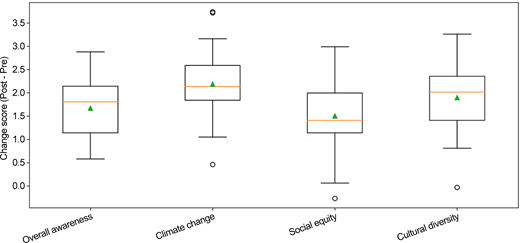
The pre–post survey results indicated substantial increases in students’ sustainability awareness. Overall awareness increased from M = 2.1 (SD = 0.8) at pre-test to M = 3.8 (SD = 0.7) at post-test, ΔM = 1.71, t(35) = 15.54, p < 0.001, Cohen’s dz = 2.59, 95% CI [1.90, 3.27]. The 95% CI for the mean change was [1.48, 1.93] (Table 2). Topic-level analyses showed similarly large gains for climate change (ΔM = 2.18, t(35) = 18.93, p < 0.001, dz = 3.16), social equity (ΔM = 1.51, t(35) = 12.76, p < 0.001, dz = 2.13) and cultural diversity (ΔM = 1.89, t(35) = 16.84, p < 0.001, dz = 2.81).
In competency terms, these awareness gains are most directly aligned with systems thinking (recognizing interconnections among environmental, social and economic dimensions), normative competency (articulating value-laden sustainability judgments) and critical thinking as described in sustainability competency frameworks (Table 1).
The distributions of individual change scores (post−pre) for awareness outcomes are shown in Figure 1.
Improvements in language proficiency
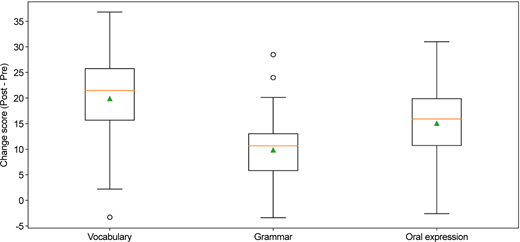
Pre–post language assessments showed significant gains in sustainability-related Russian language proficiency. Vocabulary scores increased from M = 65 (SD = 10) to M = 85 (SD = 7), ΔM = 19.91, t(35) = 13.27, p < 0.001, Cohen’s dz = 2.21, 95% CI [1.60, 2.82]. Grammar improved from M = 70 (SD = 8) to M = 80 (SD = 6), ΔM = 10.09, t(35) = 10.14, p < 0.001, dz = 1.69, 95% CI [1.17, 2.20]. Oral expression increased from M = 68 (SD = 9) to M = 83 (SD = 7), ΔM = 14.98, t(35) = 14.82, p < 0.001, dz = 2.47, 95% CI [1.80, 3.13] (Table 3).
These language gains are consistent with competency-oriented mechanisms targeted by the instructional design: Vocabulary and oral argumentation in debates map to strategic competency (formulating action-oriented proposals) and interpersonal competency (collaboration and dialogic negotiation), while grammar and discourse organization support critical thinking and the coherent articulation of cross-cultural comparisons (Table 1).
The distributions of individual change scores (post−pre) for language outcomes are shown in Figure 2.
Robustness checks and alternative interpretations
To evaluate whether the conclusions depended on parametric assumptions, we inspected change-score distributions (histograms and Q–Q plots) and conducted Wilcoxon signed-rank tests for each outcome. The non-parametric results were consistent with the paired t-tests (all outcomes remained statistically significant; Supplementary Table SI). Nevertheless, because the study uses a one-group pre–post design, part of the observed improvement could reflect alternative explanations such as increased familiarity with assessment formats, topic familiarity gained through repeated exposure or general maturation over the semester. Accordingly, we interpret the results as evidence of strong within-cohort improvement associated with the intervention while avoiding clear causal attribution.
Teacher feedback and implementation challenges
The three participating teachers consistently observed that cross-cultural tasks and project-based learning enhanced students’ language proficiency. Students displayed higher engagement and initiative, particularly during group projects, wherein they demonstrated strong critical thinking and language application abilities. Teachers also noted that incorporating SDG content into Russian language courses effectively enhanced students’ global citizenship awareness.
However, teachers identified two main challenges. The first was students’ limited background knowledge: Many students lacked sufficient foundational knowledge of sustainability topics, particularly of complex global issues such as climate change’s international impacts. This necessitated additional background and supplementary materials at the course start. The second major issue was the language difficulty. The complexity of technical terms related to sustainability challenged students, requiring more language support such as targeted vocabulary and expression practice.
Teacher feedback suggests that while integrating sustainability content into language courses is highly beneficial, modifications could optimize effectiveness. Specifically, teachers recommended incorporating more localized content relevant to students’ lives and studies. For instance, comparative studies on how China and Russia address sustainability challenges could enhance students’ understanding of both nations’ strategies and foster more meaningful discussions.
Classroom observations
At the course beginning, student participation in discussions on sustainability topics was relatively low, with many relying heavily on teacher-provided materials. Discussions were mostly passive, with limited voluntary contributions. By the course end, students demonstrated considerably higher engagement. During group debates, students actively posed questions and engaged in dynamic discussions with peers. Cross-cultural tasks, such as comparing how China and Russia address climate change, were particularly effective in sparking students’ interest. Students raised insightful questions while effectively expressing their ideas in Russian, showcasing improved critical thinking and communicative skills.
Field-note excerpts illustrate how cross-cultural tasks supported competency development. For example, during a China–Russia climate-policy comparison task, several groups progressed from listing facts to justifying trade-offs and proposing feasible actions, indicating growth in strategic and systems-oriented reasoning (Observation 6). Teachers also noted that students increasingly “asked each other for clarification and reformulated claims to be more precise in Russian,” suggesting interpersonal competency gains through collaborative discourse (Interview T2). Finally, in late-semester debates, students more frequently used modal and conditional constructions to express uncertainty and future-oriented scenarios (e.g. “If emission targets are not met, then […]”), aligning with anticipatory thinking expressed through language use (Observation 8).
Discussion
This study demonstrated that incorporating ESD into Russian language courses at a Chinese university significantly enhanced students’ linguistic skills and sense of global responsibility. Through cross-cultural tasks and discussions on SDG-related topics, students expanded their vocabulary, improved their communication skills and exhibited substantial progress in global citizenship awareness, supporting our hypothesis that embedding sustainability content into language education could enhance language proficiency and students’ awareness of global issues. While student knowledge can progress in any course, the significantly greater gains in sustainability awareness observed here underscore the added value of integrating ESD content beyond a standard language curriculum.
Our findings can be further understood through the lens of ESD competencies – knowledge, skills and values – offering a deeper cross-cultural analysis of the outcomes. The ESD-integrated Russian course exposed students to sustainability topics in both Russian and Chinese contexts, broadening their understanding of global issues. It simultaneously honed skills: students practiced linguistic and critical-thinking skills via project-based learning and intercultural dialogue, reflecting the actionable competencies that ESD strives to develop. Perhaps most importantly, the course nurtured values and attitudes aligned with sustainability and global citizenship, such as openness to cultural diversity and responsibility for shared global challenges. This competency-based interpretation is consistent with UNESCO’s guidance that ESD should enhance cognitive, social-emotional and behavioral learning dimensions – in other words, cultivating understanding, inculcating values and motivating action. Indeed, our cross-cultural approach mirrors UNESCO’s emphasis on respecting cultural diversity while empowering all learners to contribute to sustainable development (Therese et al., 2022). By engaging with Russian language and culture through sustainability themes, students improved their foreign language proficiency while developing a holistic competency profile as future global citizens, incorporating the knowledge to comprehend sustainability issues, cross-cultural communication and collaboration skills and sustainable practice values. Our discussion demonstrates how integrating ESD in language education fulfills broader educational goals identified by UNESCO and others for fostering higher education sustainability competences.
Importantly, the cross-cultural contribution of the intervention lies not simply in “adding sustainability topics” but in requiring students to juxtapose how sustainability is narrated, legitimized and debated in Russian-language contexts versus Chinese contexts. This comparative work created repeated opportunities for students to practice systems thinking (linking multi-level causes and consequences), normative reasoning (evaluating trade-offs and responsibilities) and strategic communication (proposing and defending actions) while using Russian as the medium of inquiry. In this sense, the cross-cultural design functioned as a pedagogical bridge between language development and ESD competency growth (Table 1).
Supporting findings by Ge et al. (2023), this study confirms that foreign language courses effectively foster students’ sense of global responsibility. By participating in sustainability projects and debates within Russian language classes, students deepened their understanding of global issues. This aligns with Byram’s (2018) intercultural communication theory, which posits that language learning should transcend vocabulary and grammar mastery to cultivate global responsibility and social engagement through intercultural interactions. However, while previous studies have largely focused on English-language instruction, our study extends these insights to Russian, broadening the applicability of ESD in foreign language education.
Moreover, teacher feedback highlighted the efficacy of the intervention in enhancing students’ language skills, aligning with results from prior research. For example, Drogaris et al. (2024) emphasized the success of innovative teaching methods, such as citizen science projects and online platforms, in boosting student engagement and language proficiency. This study’s classroom observations similarly revealed that project-based learning increased student participation and initiative. However, unlike prior studies that predominantly examined online learning tools, our research highlights the unique advantages of in-person, discussion-based approaches in fostering deeper engagement with sustainability topics.
These outcomes resonate strongly with UNESCO’s international benchmarks. For instance, UNESCO’s ESD Goals: Learning Objectives report (2017) calls for pedagogies that develop learners’ cognitive understanding, socio-emotional engagement and action-oriented skills for sustainability. Our approach integrates content knowledge on sustainability (cognitive domain), fosters intercultural empathy and ethical values (socio-emotional domain) and engages students in collaborative projects and debates (behavioral/action domain). This comprehensive strategy supports Target 4.7 of the SDGs, which UNESCO (2020) identifies as crucial for reorienting education toward sustainability across subjects. Moreover, our incorporation of cross-cultural dialogue reflects UNESCO’s emphasis on global citizenship education as an EST component, wherein learners build the “knowledge, skills, values and attitudes” to create a more just and inclusive world (UNESCO, 2015, p. 15). By drawing on these UNESCO frameworks, we deepen our analysis of the findings: The marked improvement in students’ sustainability awareness and language proficiency advances UNESCO’s ESD goals. Specifically, students’ increased global citizenship consciousness (noted in their reflections and post-course surveys) illustrates the transformative potential of ESD-infused language education, echoing UNESCO’s view of ESD as “holistic and transformational…an integral part of quality education” empowering learners as change agents (UNESCO, 2020, p. 8). In summary, this study’s micro-level outcomes connect with UNESCO’s ESD macro-level vision, enriching the interpretation of results with a robust international perspective.
Although our intervention is intentionally situated at the course level, whole-institution scholarship suggests that such pilots are most impactful when linked to program-level outcomes and institutional ESD strategies (Lozano et al., 2015; Sterling and Thomas, 2006). In this sense, the ESD-integrated Russian course can be interpreted as a “micro-curriculum” unit that operationalizes SDG 4.7 within a language program and provides assessable evidence that can inform broader curriculum redesign, staff development and institutional quality assurance for sustainability (Lozano et al., 2017; UNESCO, 2020). We therefore frame the present results as early-stage evidence supporting a scalable pathway – from course design to program alignment and, ultimately, whole-institution ESD implementation in higher education (Lozano et al., 2015; Sterling and Thomas, 2006).
Implications for practice, institutions and research
To make the intervention replicable within a typical 12–14-week semester, Table 4 provides a time-boxed implementation plan assuming two contact hours per week (adjustable to local timetables). The sequence progresses from foundational sustainability discourse and vocabulary scaffolding to cross-cultural comparison, debate and project-based production. Each week specifies task formats, sample Russian-language input types, targeted ESD competencies and concrete assessment checkpoints.
Institutional and policy implications (linking a course pilot to whole-institution ESD). Although the present intervention is course-based, whole-institution ESD scholarship suggests that scalability depends on alignment with program learning outcomes, staff development and institutional governance. A practical pathway is to formalize sustainability-and-intercultural-communication outcomes at the program level (e.g. “students can compare sustainability discourses across cultures in Russian and propose feasible actions using evidence”), then map multiple courses (language skills, translation, culture and project modules) to progressive competency development across years of study.
At the institutional level, capacity building can be supported through short professional-learning cycles for language instructors (ESD discourse selection, facilitation of value-laden dialogue and competency-aligned assessment), a shared repository of Russian-language sustainability materials curated with the library and sustainability office and community or campus partnerships that provide authentic tasks (e.g. bilingual communication for campus sustainability initiatives, local environmental education events, or intercultural dialogue forums). Embedding these elements into quality assurance (e.g. learning-outcome review, assessment moderation and reflective teaching portfolios) can help move from an “innovative module” to a durable institutional trajectory.
These outcomes have implications for future research. To strengthen causal inference and generalizability, future studies could adopt a multisite quasi-experimental design (or class-level cluster randomization where feasible) comparing ESD-integrated Russian classes with traditional Russian instruction across multiple universities. A recommended structure is pre-test, post-test and follow-up measurement (e.g. 8–12 weeks after course completion) to examine persistence of language and ESD-related gains. Quantitative outcomes should include language performance tasks scored with transparent rubrics and rater reliability reporting and validated sustainability/global citizenship measures (e.g. SCQ- or Sulitest-aligned approaches and global citizenship scales), supplemented by qualitative process data (classroom observations, teacher logs and student artifacts) to identify mechanisms and boundary conditions. This design would allow testing whether cross-cultural juxtaposition specifically contributes to competency development beyond general language learning progression.
Research contributions
This study provides insights into integrating ESD into foreign language education, demonstrating the success of incorporating sustainability topics into Russian language courses in a Chinese university. While most prior research has focused on ESD in more widely taught languages, this study is among the first to explore its application in Russian language instruction. Through cross-cultural tasks and project-based learning, students enhanced their language skills while developing critical thinking and a global perspective by engaging with real-world issues.
Additionally, the advantages of practical activities such as project-based learning and debates in language education were highlighted. Teachers reported that students were most engaged during these activities, effectively using Russian to articulate their understanding of global issues. This underscores the potential of combining intercultural education and ESD to increase student interest and improve language instruction.
This study offers valuable practical insights for Russian language educators seeking to incorporate ESD into their courses. First, teachers should introduce foundational knowledge about sustainability at the course beginning to ensure that students can engage deeply with key issues. Second, teaching activities that strengthen students’ language skills while enhancing their critical thinking and sensitivity to global issues including project-based learning, debates and cross-cultural tasks should be promoted. Third, schools should provide training programs to improve teachers’ understanding of sustainability topics and their ability to incorporate SDG content into language instruction. This would better equip teachers to guide students in meaningful discussions.
Research limitations and future directions
This study has certain limitations. First, students’ lack of foundational knowledge on sustainability topics was particularly evident at the course start. Many students struggled to engage deeply with complex global issues because of insufficient background understanding. Although supplementary materials and teacher explanations eventually mitigated this issue, future course designs should include comprehensive background preparation in the early phases.
Second, the study involved a single class of students, limiting the findings’ generalizability. Additionally, potential selection bias may have influenced the results, as the participants were from a particular cohort at a single university, which may not represent the broader population of language learners in different academic settings. Future research should involve larger and more diverse samples, encompassing students of varying proficiency levels and other language courses to assess the broader applicability of ESD integration in language education.
Based on our findings and given the study’s limitations, future research could explore the following areas:
First, future research should investigate how SDG content can be integrated into different language courses and compare the responses and performances of students from various linguistic and cultural backgrounds, particularly in complex cross-cultural tasks. Comparative studies will be useful in identifying best practices for incorporating ESD into foreign language education.
Second, regarding teacher training and development, researchers should focus on the role of teachers in integrating ESD content into language education, examining how teacher training can enhance their instructional capabilities and the practical implementation of SDG-related curricula.
Third, while this study provides evidence of short-term improvements in students’ understanding of SDGs and language skills, future longitudinal research should evaluate the long-term impact of these teaching methods. This includes assessing whether students continue to practice sustainability principles in their professional and personal lives.
By addressing these areas, future studies can further advance the integration of ESD into foreign language education, providing a more comprehensive understanding of its benefits and challenges across diverse educational contexts.
Conclusions
This study explored the effective integration of ESD into Russian language courses and assessed its impact on students’ linguistic proficiency and global responsibility. Using a mixed-methods approach, the study collected quantitative and qualitative data to validate the feasibility and effectiveness of this integration. The key findings are given in the following paragraphs.
First, students demonstrated significant improvements in their ability to express themselves in Russian, particularly in their use of vocabulary and complex grammatical structures related to sustainability topics. Cross-cultural tasks and project-based learning were pivotal in helping students master the language skills necessary for discussing complex issues, especially during debates and discussions. The improvement in vocabulary usage was substantial, with students’ scores increasing by 30% on average, reflecting their enhanced ability to use sustainability-related terms accurately and appropriately. Similarly, improvements in grammatical accuracy were notable, with students’ grammatical scores related to sustainability discussions rising by 15% on average.
Second, students exhibited a notable increase in their awareness of sustainability issues. Integrating SDG content significantly enhanced students’ global responsibility and awareness of sustainability issues. By the end of the course, students could discuss Russia’s role in global sustainability and articulate insights into sustainable development challenges faced both by China and globally.
Third, the teachers were crucial in facilitating this learning process. They were instrumental in course design and implementation, providing both language support and background knowledge on SDG topics. Their efforts were measured through direct feedback and classroom observations, which highlighted their importance in guiding students through the complexities of sustainability issues. Positive teacher feedback emphasized that SDG content enriched classroom discussions and increased student engagement.
In summary, this study offers a novel perspective on integrating ESD into foreign language education by focusing on Russian language courses. By adopting innovative teaching designs and diverse practical activities, students not only improved their language skills but also made significant progress in developing global citizenship awareness and responsibility. As a key tool for cultivating intercultural communication skills, foreign language education plays a vital role in modern educational systems. By embedding sustainability topics into language learning, educators can not only foster a deeper understanding of complex global issues but also help students connect their personal growth with the global community, preparing them to be responsible global citizens.
Supplementary material
The supplementary material for this article can be found online.
Ethics statement
The study was conducted in accordance with the Declaration of Helsinki and approved by the Institutional Review Board of Huzhou University (Approval No. 202403–01).
References
Further reading
Appendix 1. Analytic rubrics for oral and writing assessments
E1. Oral task rubric (0–5 each; total 25; converted to 0–100)
Task fulfillment and SDG content accuracy (0–5)
Sustainability-related lexical range and appropriacy (0–5)
Grammatical control (0–5)
Fluency and coherence (0–5)
Interactional competence (turn-taking, responsiveness) (0–5)
E2. Writing (short essay) rubric (0–5 each; total 30; converted to 0–100)
Content relevance and factuality (0–5)
Argumentation and critical stance (0–5)
Sustainability-related lexical use (0–5)
Grammar and accuracy (0–5)
Organization and coherence (0–5)
Mechanics (spelling/punctuation) (0–5)
Appendix 2. Sample course design
Course Theme: Dialogue on Climate Change: Russia and the World
Objectives
Enable students to master vocabulary and expressions related to climate change and environmental protection in Russian.
Foster students’ critical thinking and cross-cultural comparison skills on global climate change issues.
Teaching Content
Text Analysis: Analyze Russian news reports and government documents on climate policies and actions.
Group Discussion: Students discuss the differing impacts of climate change on Russia and China and compare them in Russian.
Debate: Students form pro and con teams to debate the topic “Should Russia take greater global responsibility for climate change?”
Project Assignment: Students draft a report on Russia’s role in addressing climate change and present it in Russian.
Assessment
Participation in class activities, language proficiency (particularly SDG-related vocabulary and expressions) and critical thinking.
Fluency and depth of content in project presentations.
Appendix 3. SAGC-R sustainability awareness in Russian-Language learning (12 items)
Instruction: Please indicate your agreement with each statement. (1 = strongly disagree; 2 = disagree; 3 = neutral; 4 = agree; 5 = strongly agree)
Climate Change (CC)
CC1. I understand the major causes and impacts of climate change.
CC2. I can explain (in Russian) how climate change affects communities.
CC3. I am willing to learn about and discuss climate-related solutions from different countries.
Social Equity (SE)
SE1. I understand how sustainability relates to fairness and social justice.
SE2. I can discuss (in Russian) how development policies may affect different social groups.
SE3. I am willing to consider multiple viewpoints when discussing equity-related SDG topics.
Cultural Diversity (CD)
CD1. I understand why cultural diversity matters for sustainable development.
CD2. I can discuss (in Russian) how cultural values shape sustainability choices.
CD3. I respect cultural differences when debating sustainability issues.
Russia–China Comparative Sustainability Discourses (RC)
RC1. I can identify similarities and differences between Chinese and Russian sustainability discourses.
RC2. I can compare Russian and Chinese sustainability-related examples in a balanced way.
RC3. I can communicate across cultures (in Russian) without stereotyping when discussing sustainability topics.
(Optional open-ended prompts used in this study)
OE1. Give one example of a sustainability topic you can now discuss more confidently in Russian.
OE2. What was the most challenging sustainability-related vocabulary or concept for you?
OE3. Describe one moment when comparing Chinese and Russian perspectives changed your thinking.
OE4. What additional support would help you learn sustainability topics through Russian?
Appendix 4. Classroom observation framework
Framework for observing students’ participation in discussions and project-based learning activities.
Classroom Interaction
Number of student contributions during discussions:
Did students proactively ask questions or share ideas? (Frequently/Sometimes/Rarely)
Assessment of students’ fluency and accuracy in language use during discussions:
Task Completion
Collaboration within groups during tasks:
Language proficiency and depth of content in project presentations:
Attitude and Interest
Level of interest in sustainability topics (High/Moderate/Low):
Participation in cross-cultural tasks:
Appendix 5. Teacher interview framework
Objective: These interviews aim to understand teachers’ experiences, challenges and feedback regarding the integration of ESD into Russian language courses.
Teaching Background
Please introduce your teaching experience, particularly your years of teaching Russian language courses.
Have you previously integrated sustainability topics into language courses? If yes, please provide a brief overview.
Course Design and Implementation
What were the main challenges you encountered while designing courses that incorporate SDGs? How did you address these challenges?
Which teaching methods (e.g. project-based learning, debates, cross-cultural tasks) were most effective in enhancing students’ language skills and sustainability awareness?
How did students respond to sustainability topics in the course? What positive changes did you observe?
Suggestions for Future Courses
How do you think sustainability content can be better integrated into future language teaching?
What support or training do you think teachers need for designing and implementing ESD-focused courses?