

Backpackers can be found all over the world, especially in urban areas where the main enclaves are established. The purpose of this paper is to discuss the operationalisation of the term “backpacker” and present a proposal to conceptualise backpackers and backpackers’ segments based on the operational criteria available in literature to avoid incongruities among researchers.
Based on a literature review, this study provides a critical review of the backpacker conceptualisation and operationalisation using a methodology divided into three phases, a quantitative analysis based on the Scopus database and a bibliometric analysis coupled with a manual analysis of documents (content analysis).
Substantial heterogeneity and complexity regarding the conceptualisation of backpacker tourism and its diversified subsegments were evident. For this reason, this paper argues that backpacker tourism can and should continue to be analysed from different perspectives, suitably framed in the theoretical instrument constructed to identify and distinguish the different subsegments through its operationalisation features.
This study provides a practical contribution to all researchers interested in the topic of backpackers proposing the operationalisation of the term backpacker and it subsegments to avoid disparate results and deviations. This contribution will enable the correct and objective assessment of the operationalisation of this concept for researchers, managers and destination management organisations, identifying exactly what phenomenon is to be studied.
Introduction
The economic and social relevance of backpacker tourism is highly recognised (Hampton & Routledge Taylor & Francis Group, 2013; Martins & Costa, 2017), especially in urban areas where the establishment of a network of hostels and other support services gave rise to the emergence of enclaves at the intersections of the main backpacker routes. Urban areas are effective gateways, providing transport, accommodation, food, among others, and as multi-attraction destinations, they offer a diverse set of attractions playing a crucial role for backpackers.
Often framed within the scope of youth tourism, it has been analysed from different perspectives. Paris and Teye (2010) emphasise the market perspective, based on quantitative methodologies, and the anthropological perspective, based on qualitative methodologies of an ethnographic nature. Chen and Huang (2019) refer that the focus of research has been on the development of backpacker tourism and its impacts and on topics inherent to backpacker tourists. The growing body of research also reflects the increasing diversity of geographical and cultural areas in which it has been conducted, contributing to the emergence of a variety of terms that have been in use since Cohen's (1972) “drifters” and Vogt's (1976) “wanderers” phenomena.
Backpackers can give significant contributions to tourism destinations (Martins & Costa, 2017), namely, urban destinations. They do not buy luxury products, spend more on local goods and services (e.g. catering, transport and accommodation) (Iaquinto, 2015; Ooi & Laing, 2010) foster the emergence of local and small firms (Hampton, 1998; Scheyvens, 2002) because business investments and the workers’ qualifications are not very high (Hamzah & Hampton & Routledge Taylor & Francis Group, 2013; Ooi & Laing, 2010; Rogerson, 2011). As their owners are locals, backpacker tourism also contributes to capital leakage reduction, to the mitigation of poverty and for the increase of induced effects (Dayour et al. 2016; Hampton, 1998), particularly in cities of developing countries. Destination management organisations (DMOs) should have a focus on backpacker tourism because it can also give a relevant contribution to a more sustainable tourism destination (Agyeiwaah et al.2020; Iaquinto, 2015) promoting, among others, the tourist loyalty due to the greater probability of backpackers to repeat the visit (Rogerson, 2011).
The increased interest in this market segment has led to an increase in scientific production, and consequently, some subsegments have been identified reflecting the diversity and heterogeneity of backpackers. This situation seems to have made the operationalisation of the term backpacker even more difficult; the construction of a definition whose operational criteria have made it unfeasible to include all the subsegments. As Scherer (2005, p. 696) highlight, “one of the major drawbacks of social science research is the need to resort to everyday language concepts in both theory and empirical investigation that led to the difficulty of obtaining widespread consensus in the scientific community”. The weak conceptualisation of the term backpacker leads to inconsistencies among researchers, an idea already advocated by Sørensen (2003, p. 852) when he mentioned that “Backpackers cannot be defined by means of unambiguous criteria”. In line with the works of Dayour et al. (2017) and O’ Regan (2018), the need to find a definition of the term backpacker whose distinctive criteria are accepted by most of the scientific community has become evident. It is intended with this work to fill a gap in the literature, suggesting an operationalisation process of the term backpacker and its subsegments. This procedure should be understood as a process that allows the identification of how a term can be measured and clearly distinguishable, ensuring consistency in the interpretation and collection of information.
The main objective is to discuss and present a theoretical instrument for operationalising the concept of backpacker and its subsegments based on operational criteria that exist in the literature.
Suggesting concrete criteria for its applicability, this proposal will ensure the:
replication of procedures in future scientific studies;
simplifying the collaborative research in the field and between different disciplines;
a more precise and standardised collection of statistical information on backpacker tourism, making it possible to correctly count tourists from this market segment; and
a correct and objective assessment of its impact on destinations, particularly urban destinations, where this type of tourism has the most significant impact.
Backpackers: origin and evolution to diverse subsegments
The historical evolution of backpacker tourism originates in the Grand Tour of the 17th and 18th centuries (Adler, 1985) and in the drifter phenomenon described by Cohen (1972) when he referred to the existence of institutionalised and non-institutionalised tourists (Ateljevic & Doorne, 2004; Reichel et al. Reichel et al., 2007). Since Cohen’s (1972) “drifter” and Vogt’s (1976) “wanderers” phenomena, the concept of backpacker has distanced itself from the notion of “hippy” and has become redundant to classify younger travellers (O’ Regan, 2018). The concept “long-term budget travellers” proposed by Riley (1988) classifies this type of tourist as single, educated, belonging to the European middle class and travelling alone on a low budget. However, the term most commonly used to describe this segment of tourist is now “backpackers” (Loker-Murphy & Pearce, 1995; Pearce, 1990; Richards & Wilson, 2004), often defined as tourists travelling with backpacks on their backs, on a small daily budget (Hampton & Hamzah, 2010) and for extended periods of time, predominantly young, with a preference for budget accommodation and informal, flexible itineraries (Pearce, 1990).
A large part of the literature on backpacker tourism uses the definition proposed by Pearce (1990) to describe tourists belonging to this market segment. Pearce (1990) describes them as:
predominantly young travellers;
more likely to stay in budget accommodation;
with an emphasis on meeting other travellers;
with independent and flexible travel arrangements;
with a preference for longer holidays; and
participation in informal activities.
However, despite its conceptualization being broadly consensual, this definition does not present unambiguous and strict criteria that can be generalised and operationalised at an international level. For example, what age range should be considered to frame the backpacker market? What is the meaning of longer holidays? And it is also relevant to note that several subsegments have been identified (Martins and Costa (2017). “Operational definitions allow for generalized replication of procedures and data to the extent that they specify the operations used in the production and measurement of phenomena” (Ribes-Iñesta, 2003, p. 124).
Lack of consensus and inconsistencies between different researchers due to the lack of a uniform criterion for operationalising the definition of backpacker was emphasised by Dayour et al. (2017). While some authors use, for example age or motivations for travelling as a distinguishing criterion (Pearce, 1990; Pearce & Foster, 2007; Sørensen, 2003), others select the characteristics of the trip, such as the type of accommodation or the duration of the trip (Adam, 2015; Pearce, 1990), belonging to a virtual community (O’Reilly, 2006; Paris, 2012), enclaves (Sørensen, 2003), self-recognition as backpackers (Reichel et al., 2007) or the economic criterion (O’Reilly, 2006). Each of these criteria has been used individually, such as the option for hostels or low-cost accommodation (Larsen et al., Larsen et al., 2011; Martins et al., Martins et al., 2018), belonging to a virtual community (Chen et al., 2014) or combined with others to include a greater diversity of backpackers in the studies. Several authors, however, still do not objectively identify the selection methodology of their object of study and that “may imply that some studies do not actually study backpackers” (Dayour et al., 2017, p. 2).
Literature reveal that it is not easy to objectively define a complex phenomenon that has evolved over decades, and that has changed from being a marginal phenomenon to an attractive mode of travel for millions of young people around the world and is not limited to a group of travellers with only a small budget to travel on.
Methodology
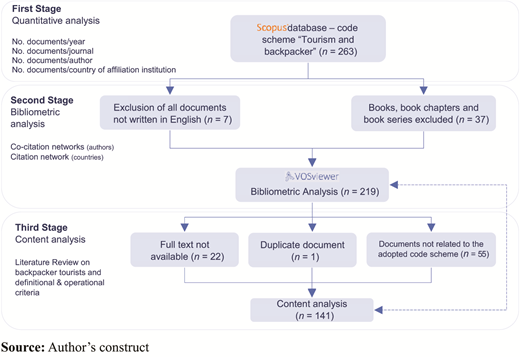
The literature review (Figure 1) was based on a search of scientific documents available on the Scopus platform concerning backpacker tourism (First stage). A meta-analysis was conducted and bibliometric methods were used (Second stage) of citation and co-citation analysis allowing a systematic, transparent and reproducible review process (Zupic & Čater, 2015). Bibliometric networks were also combined with manual analysis of documents (Third stage) (Agapito, 2020).
First stage of analysis
The research was carried out using the Scopus database because apart from being recognised as the largest abstract and citation database of peer-reviewed literature, “[offering] a more comprehensive view of scientific production worldwide in the areas of science, technology, medicine, social sciences, Arts and Humanities” (Elsevier, 2014, p. 1), it has greater coverage of tourism journals. The search and code scheme used was “tourism” and “backpacker” in the title, abstract and keywords (Figure 1). Data collection was carried out on 16 February 2022 and considered all articles published until the end of 2021. During the first phase, all indexed documents were taken into consideration (n = 263), a quantitative and descriptive analysis was carried out regarding the number of documents published per year, the identification of the most representative journals and authors and the respective countries of institution affiliation. All documents that were not written in English (n = 7), and all books and book chapters (n = 37) were subsequently excluded, as it was considered that the articles that have been published are representative of the knowledge produced on backpacker tourism. This selection resulted in 219 articles.
Second stage of analysis
In the next phase, the database of selected articles was downloaded (exported) from the Scopus platform in comma separated values format (Excel), and all information that could be exported was selected. This database was subsequently analysed using the VOSViewer software, a program developed by van Eck and Waltman (2010) used for constructing and viewing bibliometric maps that has been used by several disciplinary areas, including for some tourism research (Agapito, 2020; Serrano et al., Serrano et al., 2019; Veríssimo et al., Veríssimo et al., 2020). Figure 2 summarises the maps created using this software.
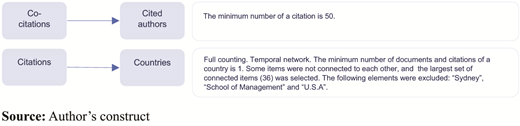
The creation of co-citation maps allows the existing relationship between pairs of units that appear together in reference lists (co-cited) to be analysed, and according to Benckendorff and Zehrer (2013, p. 127), there is a likelihood that they have something in common. A Temporal Citation network was produced to identify and explore the dynamics of the field and the diversification of operationalisation criteria used around the globe.
Third stage of analysis
In a third phase, the titles, abstracts and keywords of the 219 articles were analysed by the authors. All documents that were not available as a full-text document in Scopus (n = 23) were searched for in the Google search engine, and all those that were not available for download (n = 22) were excluded. The same process was carried out in relation to any documents that were duplicated (n = 1) and articles that were not related to the adopted code scheme (n = 55). Finally, the selected articles (n = 141) were examined by the two authors and interpreted manually through a content analysis. To improve the interrater reliability, the analysis took into consideration the fact that the articles analysed focussed on backpacker tourists and the description of the method of operationalisation of the backpacker concept adopted by the researchers.
Results
First stage – quantitative analysis
A search in the Scopus database returned 263 documents, of which 77.2% (n = 203) correspond to scientific articles, concentrated in two major areas of knowledge: Social Sciences (168 documents) and Business, Management and Accounting (168 documents). An increase in the number of publications on backpacker tourism over the years is thus verified.
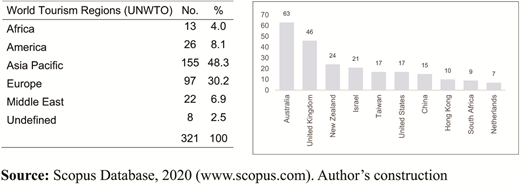
The analysis of Figure 3 allows us to verify the weight of the Asia Pacific region in the production of research on backpacker tourism, largely due to the growing number of Chinese researchers who have focussed on this topic.
Second stage – bibliometric analysis
In Figure 4, corresponding to the temporal network of nationalities of the researchers’ affiliation institution, the relation of items is determined based on the number of times they are mutually cited. The temporal network was generated to explore the dynamics of the field based on the average number of publications per year.
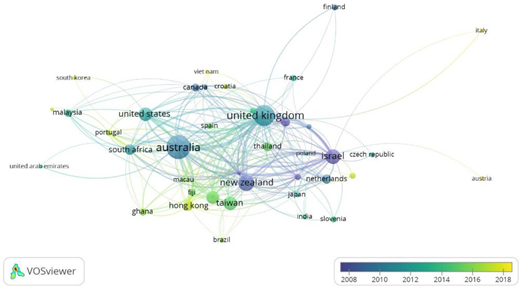
The largest cluster is dominated by Israel and New Zealand and according to the number of documents, Australia, the UK, New Zealand and Israel are the world leaders on backpacker tourism in line with the national affiliation of seminal authors. It is also evident here that in the past 10 years, researchers from several other countries have shown an interest in backpacker tourism, diversifying the research conducted in different regions of the world. The focus is no longer centred only on European and North American backpackers but also on Asian backpackers. The emergence of researchers’ interest from other European countries, such as Portugal, Spain, Hungary, Italy, Austria and Croatia, so far, on the fringes of the backpacker tourism topic, is relevant. However, the fact that Pearce’s (1990) definition remains an international reference, this spatial diffusion seems to have contributed to the increase and dispersion of new socio-cultural contexts that may have led to a certain unrooting of the backpacker label, as defended by O’Regan (2021) and to the diversification of criteria used in the operationalisation of the term backpacker.
In co-citation network map (Figure 5), the relation of items (cited authors) considers the number of times authors are cited together. The strength of the co-citation links by authors is evidenced by the size of the circles. The 19 authors who provided more knowledgeable to the scientific documents on backpacker tourism and respective connections, constitute two distinct clusters (green and red). In the centre of the map, in the red cluster, is Erik Cohen due to his important contribution with “Toward a Sociology of International Tourism” published in 1972 where a typology of tourism (institutionalised and non-institutionalised) is presented and discussed. This is followed by the article “Nomads from Affluence: Notes on the Phenomenon of Drifter Tourism” published in 1973 where drifters are analysed, described as more adventurous travellers who distance themselves not only from the usual tourist flows but also from the way of life in their home country.
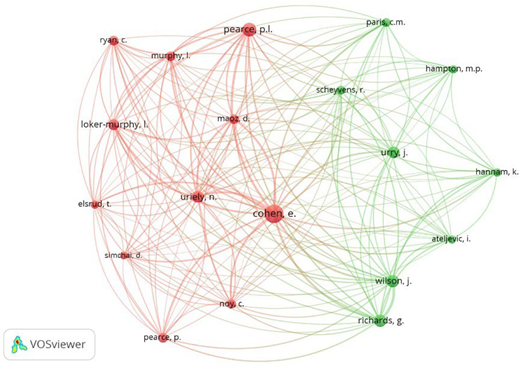
The red cluster is still dominated by a number of authors whose seminal research offers, not only, a market perspective about backpacker tourism in Australia (Loker-Murphy, 1997; Loker-Murphy & Pearce, 1995; Murphy, 2001; Pearce, 1990) with the backpacker definition presented by Pearce (1990) informing the major part of this co-citation network but also by a group of authors with a focus on qualitative studies with an ethnographic perspective (Elsrud, 1998, 2001; Maoz, 2006, 2007; Uriely et al., 2002).
John Urry (1992) is a key reference in the green cluster with his work related to the tourist gaze and with mobility, both important issues discussed in some books on backpackers (Hannam & Ateljevic, 2007; Hannam & Diekmann, 2010; Richards & Wilson, 2004). The economic relevance of backpacker tourism is also an eminent topic dominated by Hampton’s contribution (1998, 2013) and Scheyvens (2002). Together with Hannam and Diekmann (2010), Code Paris (2012) also examine the emergence of a flashpacker’s sub-culture as a subsegment of backpackers – one of the main deviations from the traditional concept of backpackers presented in scientific literature.
Third stage – content analysis
The diversity of characteristics associated with backpackers also results in a wide variety of criteria for the operationalisation of the backpacker concept, reflecting in part, the progressive diversity and heterogeneity of this market segment associated with younger tourists. Dayour et al. (2017, p. 2) summarise the criteria used by several researchers in the operationalisation of the term, highlighting the age, the motivations, the characteristics of the trip, among others. Based on the literature and content review, some of the main characteristics of backpackers identified and used by several researchers are briefly presented below.
It is important to note that many authors responsible for publishing articles on backpackers do not mention in their work how the term backpacker was operationalised (Table 1). Next, we will investigate more detail at each of these criteria.
Backpacker operational criteria
The sociodemographic characteristics are mainly related to age, which has been used by several researchers with different weights and measures (Table 2). The increase in average life expectancy and consequent ageing of the population, especially in more developed countries, call into question the establishment of an age limit up to which a traveller can be classified as a backpacker, so excluding all travellers aged over 40 may contribute to a partial and incomplete analysis of backpacker tourism. Although useful in distinguishing some sub-segments, age, as an isolated criterion, does not seem to be the most appropriate in operationalising the backpacker segment, as although the majority is predominantly young, there is no defined age range for travelling backpacker style.
Age as criterion
| Age | Authors |
|---|---|
| Predominantly young | Pearce (1990) |
| Between 15 and 29 years | Loker-Murphy and Pearce (1995) |
| Between 15 and 31 years | Adam (2015) |
| Between 18 and 33 years | Sørensen (2003) |
| Between 18 and 35 years | Pearce and Foster (2007) |
| Between 15 and 24 years | Hunter-Jones et al. (2008) |
| <40 years | Pearce et al. (2009) |
| >65 years | Chen et al. (2020) |
Travel characteristics.
The duration of the stay or the trip – does not seem to be a criterion that facilitates the operationalisation of the term backpacker (Table 3). Sørensen (2003) had already mentioned that the duration of the trip contributes to disqualifying most current backpackers by calling into question the ability to represent all backpackers according to Riley’s (1998) proposal that frames “budget travellers” among those who extend their trip beyond that of a cyclical holiday. On the other hand, the expression “extended holiday” presented in Pearce (1990) definition of a backpacker also does not specify its duration.
Travel characteristics as criterion
| Travel characteristics | Authors |
|---|---|
| Independent tourists who organise their own multi-destination travel with flexible itinerary | Loker-Murphy and Pearce (1995), Ooi and Laing (2010); Paris (2010), Riley (1988); Uriely et al. (2002) |
| With a low degree of planning and no fixed schedules | Nash et al. (2006), Pearce (1990), cited by Pearce and Foster (2007), Riley (1988) |
| Travel alone or in small groups | Hampton (1998), Hannam and Diekmann (2010); Riley (1988); Sørensen (2003) |
| With a preference for longer trips, traveling as long as possible | Nash et al. (2006), Paris (2010); Pearce (1990), cited by Richards and Wilson (2004), Pearce et al. (2009) |
| Travel with a backpack | Chen et al. (2014), Zhang et al. (2018) |
| Travel for leisure | Adam (2015) |
However, as the majority of the backpackers (long-term) usually travel for periods of more than one week, one can consider trips shorter than one week as specific to the sub-segments, namely, short-term backpackers, flashpackers, party backpackers and study backpackers.
Hostels are inexpensive types of accommodation that offer guests the possibility of reserving a bed in rooms of various types (shared dorms, private rooms…) and are sought by travellers with smaller travel budgets. As they are more informal and adventurous, and take into account the common areas (living rooms, kitchen, bar, etc.), they offer better opportunities for guests to socialise (Oliveira-Brochado & Gameiro, 2013), thus constituting the most visible, material and symbolic part of the backpacker culture (O’Regan, 2010). Therefore, several researchers have used the hostels as the main criterion for identifying backpackers, however, their option is also not without criticism. As they are more economical types of accommodation, as with the recent capsule hotels (Chiang, 2018), they attract various types of customers, so not all guests are effectively backpackers. In Australia, where the backpacker market is more mature, official authorities such as Tourism Research Australia (2009) and Tourism Victoria (2009) have adopted hostel or other low-cost accommodation to distinguish backpackers from other tourists. However, the choice of hostel may lead to other budget travellers not being identified in the research and some of those included in the study group not considering themselves as belonging to that group.
As meeting places, hostels also tend to be concentrated in some neighbourhoods that lie at the intersections of the main backpacker routes giving rise to the emergence of enclaves, territories distinct from the local environment with well-defined limits, where accommodation and other support services are concentrated, serve for backpackers to experience the comfort of home and the company of tourists with similar interests. Like in hostels, enclaves, frequented predominantly by backpackers, facilitate interaction with other travellers from different backgrounds contributing to the creation of a sense of togetherness or group. However, they are not very effective in terms of operationalising the backpacker concept, as their use would lead to the exclusion of all backpackers staying in hostels located outside the enclaves. While most enclaves are frequented by backpackers, it is also true that many backpackers do not exclusively frequent enclaves.
Some researchers use virtual communities associated with backpacker tourists to conduct their studies, identifying and surveying their members on several websites. Consisting mostly of younger travellers, the backpacker segment uses the internet intensively, both to plan their trips, consulting blogs and online sites to book flights or accommodation, and to keep in touch with friends and family. Some virtual communities include a diverse set of texts that describe in detail the journeys and adventures experienced by numerous travellers. Yet, despite being a simpler, cheaper and faster method of information collection, the appropriate identification of the target audience raises some doubts based on the membership of virtual communities (blogs, social networks and websites).
Self-recognition or self-identification as a backpacker is another criterion used to identify and operationalise the backpacker concept. The proportion of travellers who recognise themselves as backpackers’ changes with the country of origin and those who have more experience travelling are more likely to consider themselves as backpackers or travellers. There is a set of values and meanings attributed to backpackers that gives it a social identity, therefore, there needs to be a sense of belonging to the backpacker community for a traveller to recognise themselves as such. Although their motivations and risk perception are not very different from conventional tourists, it is common for backpackers not to recognise themselves as tourists to which they attribute negative connotations. The term backpacker is much more than a category of tourists, but also a social identity with its unique culture and values.
Although the use of the backpack as a distinctive criterion in identifying backpackers raises many doubts, the choice of luggage has been used in some studies (Chen et al., Chen et al., 2014; Zhang et al., Zhang et al., 2018). While most travellers travelling with a backpack on their back can be considered backpackers, many travellers opt for a smaller, stiffer suitcase to carry their belongings on shorter trips, as is the case for short-term backpackers. Increasing limitations on luggage weights imposed by low-cost airlines have led to significant changes in the types of luggage used. Although the concept backpacker is etymologically linked to the use of a backpack, nowadays backpacking can include travellers without a backpack.
Another central aspect of backpacker tourism that has been identified as an important distinguishing feature is the economic criterion. Besides being a motivation to backpacking, the existence of a reduced daily budget allows people to travel for longer periods of time leading to the choice of a cheaper means of transport and accommodation and more competitively priced tourist destinations. However, the criterion linked to the daily budget is also not very objective, as it is very dependent on the cost of living of the cities and countries visited. Additionally, there are sub-segments with greater purchasing power, such as Flashpackers and Holiday Backpackers, usually aged over 35, who seek more comfort and privacy, preferring hostels with single, double or other more expensive types of accommodation. A higher budget also leads to the choice of a private means of transport, such as rented cars and participation in more exclusive activities. However, the main difficulty of operationalisation lies in the fact that there is no criterion of a universal quantitative nature that can be used to distinguish the different sub-segments.
The motivation to travel can be described as a broad concept, which encompasses biological, psychological and social factors that activate, guide and maintain behaviour in different degrees of intensity. The literature review focussing on backpackers’ motivations to travel has revealed the existence of a large and diverse set of motivations (Table 4) that reflect the complexity and heterogeneity of this market segment in line with the work of Hsu et al. (2017) and Oliveira-Brochado and Gameiro (2013) who state that there is an emerging diversity and growing heterogeneity in the preferences of backpackers. As Loker-Murphy (1997) emphasises, backpackers do not travel only to meet other people and to have a good time.
Backpackers’ main motivations to travel
| Main motivations | |
|---|---|
| Maslow's classification hierarchy | Sources |
| Psychological needs | |
| Improving personal skills | Chen et al. (2014), Larsen et al. (2011); Mohsin & Ryan (2003) |
| Developing and updating personal skills | Chen et al. (2014); Hsu, Wang, & Huang (2014); Larsen et al. (2011); Mohsin & Ryan (2003); Pearce et al. (2009) |
| Social interaction with an emphasis on meeting new people | Chen et al. (2014); Hecht & Martin (2006); Larsen et al. (2011), Loker-Murphy (1997); Loker-Murphy and Pearce (1995), Maoz (2007); Mohsin & Ryan (2003); Murphy (2001), Oliveira-Brochado and Gameiro (2013); Paris and Teye (2010), Riley (1988) |
| Interacting with locals | Hsu et al. (2014); Loker-Murphy (1997), Paris and Teye (2010); Riley (1988) |
| The need to relax psychologically and mentally | Brzózka (2012); Chen et al. (2014), Larsen et al. (2011); Maoz (2007); Mohsin & Ryan (2003); Paris and Teye (2010), Richards and Wilson (2004); Uriely et al. (2002) |
| Developing and strengthening relationships | Paris and Teye (2010), Pearce et al. (2009) |
| Associating with other travellers | Mohsin & Ryan (2003); Loker-Murphy (1997), Oliveira-Brochado and Gameiro (2013); Paris and Teye (2010) |
| Self-fulfilment needs | |
| The pursuit of freedom, independence and open-mindedness | Brzózka (2012); Nok et al. (2017); Paris and Teye (2010), Pearce et al. (2009) |
| Realisation of the dream of a lifetime | Loker-Murphy (1997) |
| Looking to become different from others | Chen et al. (2014), Larsen et al. (2011); Maoz (2007); Mohsin & Ryan (2003) |
| Emphasis on the need to experience the local/foreign way of life | Chen et al. (2014); Hsu et al. (2014); Larsen et al. (2011); Mohsin & Ryan (2003) |
| Experiences that are only experienced once in a lifetime | Murphy (2001), Paris and Teye (2010) |
| Satisfying curiosity about new things | Hsu et al. (2014); Nok et al. (2017); Pearce et al. (2009) |
| Looking for nightlife fun and entertainment | Mikulic et al. (2016) |
| Escape and relaxation | Brzózka (2012); Chen et al. (2014), Larsen et al. (2011); Loker-Murphy (1997); Mohsin & Ryan (2003); Pearce et al. (2009) |
| Contact and knowledge of other cultures | Brzózka (2012); Chen et al. (2014); Hsu et al. (2014); Larsen et al. (2011), Loker-Murphy (1997); Loker-Murphy and Pearce (1995); Mohsin & Ryan (2003); O’Reilly (2006) |
| Search for authenticity | Gibson & Connell (2003) |
Nonetheless as observed before, in terms of risk perception and motivations, there are not many differences between backpackers and mainstream tourists, so the use of motivations as a distinguishing criterion does not seem to be the most appropriate, making its operationalisation almost impossible. However, if we consider the existence of several sub-segments of backpackers, some motivations could be used facilitating tourism marketing as well as the operationalisation of the several sub-segments, as can be seen in Table 5.
Backpackers’ sub-segments and their operationalisation features
| Backpackers’ subsegments | Distinctive features | |||||||||||||||||||
|---|---|---|---|---|---|---|---|---|---|---|---|---|---|---|---|---|---|---|---|---|
| Accommodation | Sociodemographic characteristics | Economic criterion | Trip characteristics | Identity | Others | |||||||||||||||
| Age | Duration | Means of transport | ||||||||||||||||||
| Hostel (dormitories) | Hostel (single/ double rooms) | 18–19 years | 20–24 years | 18–35 years | Age> 35 years | Low daily travel budget | Higher daily travel budget | They are taking a long trip (a) | They are taking a short trip (<1 week) | Made 7 or more long-term international trips in the last 5 years | Use public transport/ walking | Rent a car | Use backpack | Travel with new technologies (PC, Smartphone…) | Gap year at the end of secondary school | Pause or end of higher education/ military service | Students traveling on school breaks | Participation in volunteer activities | Preference for fun activities (parties) | |
| Backpackers (long-term) | ● | ● | ○ | ● | ○ | ○ | ||||||||||||||
| Backpackers (short-term) | ● | ○ | ● | ○ | ○ | ● | ○ | ○ | ||||||||||||
| Flashpackers | ● | ○ | ○ | ● | ○ | ● | ● | ○ | ● | ○ | ||||||||||
| Holiday Backpacker | ○ | ○ | ● | ● | ○ | ○ | ○ | |||||||||||||
| Gap Year Backpacker | ○ | ○ | ○ | ○ | ○ | ○ | ○ | ● | ||||||||||||
| Party Backpackers | ○ | ○ | ○ | ○ | ○ | ○ | ○ | ○ | ○ | ● | ||||||||||
| Voluntourism | ○ | ○ | ○ | ○ | ○ | ○ | ○ | ○ | ○ | ● | ||||||||||
| University Gap Traveller | ○ | ● | ○ | ○ | ○ | ○ | ○ | ● | ||||||||||||
| Study Backpacker | ○ | ● | ○ | ○ | ○ | ○ | ○ | ○ | ● | |||||||||||
| Global Nomads | ○ | ○ | ○ | ○ | ● | ● | ○ | ○ | ||||||||||||
Notes:
Main distinctive features (black circles) are highlighted in grey; (a) A long-term trip is one that is longer than 7 days (Richards, 2015)
Many authors combined several criteria introducing greater complexity to the conceptualization of the term backpacker. As backpacker tourism has been recognised as an important segment on the rise, it was considered relevant to identify and distinguish several sub-segments through the summary table (Table 5) where the main criteria used to distinguish the different subsegments and/or typologies of backpackers identified in the literature was compiled. The main distinctive features of the different subsegments or typologies of backpackers are listed (with black circles). This is a theoretical–practical instrument, based on the available scientific and technical literature, which contributes to addressing the current need to reconceptualise the backpacker concept, its sub-segments and its operationalisation throughout the world.
As several sub-segments share several characteristics, marked with a white circle, it is the presence of the distinctive characteristics (black circles) that enables the identification of each sub-segment. The proposed sub-segmentation of backpackers through more objective operational criteria contributes to a better distinction between backpackers and other travellers who also frequent hostels and other low-cost accommodation.
Definitional criteria proposal
The conceptual tool (Table 5) presented in this work allows us to objectively distinguish all sub-segments and/or typologies of backpackers. Furthermore, if the aim of a study focussed on the topic of backpackers is not related to the need to distinguish sub-segments, the criterion of accommodation (hostel) seems to be the most suitable.
Hostel as an operational criterion
The adoption of the hostel as an operational criterion is considered the most adequate as it meets a greater variety of criteria usually associated with backpacker tourists (Figure 6).
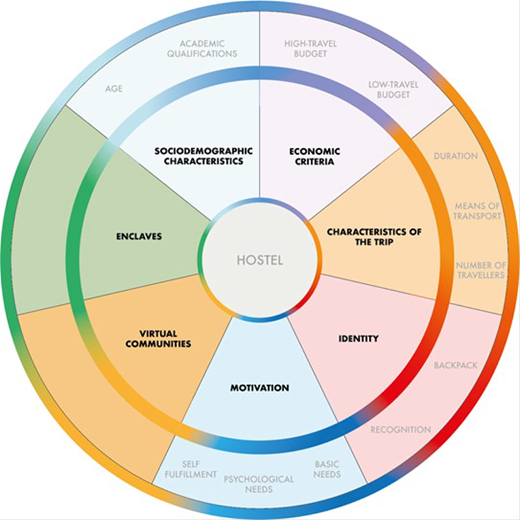
As backpackers usually try to travel for as long as possible, it is essential to travel on a low daily budget. As hostels are types of accommodation with a reduced cost per bed/night, they contribute to the existence of a lower daily travel budget (economic criterion). Assuming the existence of sub-segments of backpackers who have more generous travel budgets at their disposal, and in the absence of limits which facilitate their operationalisation, it is suggested that in studies which collect primary data, the backpackers with a “higher daily budget” correspond to those who indicate spending an amount equal or higher than the 3rd quartile of the surveyed sample per day. In the accommodation selection, the criterion “superior room, single or double”, as it is more expensive, also meets the flashpackers’ characteristics and can be used as a distinctive criterion.
The sociodemographic criterion is related to age and academic qualifications. However, few studies identify academic qualifications as an operational criterion. Age is used by several researchers with different weights and measures. Although backpackers are described as predominantly young and there is no evidence that supports an age limit, age criterion can be used to distinguish sub-segments.
The characteristics of the trip criterion should be related to the duration of the trip, means of transport and number of travellers. Depending on the subsegment analysed these characteristics vary accordingly.
As observed in this research, some of the main motivations for backpackers to travel is the search for greater social interaction with emphasis on meeting new people, developing and strengthening relationships and associating with other travellers. Hostels facilitate and promote contact and conviviality among their guests, either in the shared common spaces, such as the lounge, bar or kitchen, or in the shared rooms (dormitories).
Enclaves are associated with a higher concentration of hostels and support services to their clients (affordable bars and restaurants, transport and entertainment companies, among others) in certain areas of the destinations, so the choice of hostel as operational criterion, is in line with several characteristics associated with backpackers and the enclaves frequented.
Practically all hostels provide free internet access and sometimes computers and/or other internet access devices. Internet access is essential for backpackers to keep in touch with friends, family and online communities/backpacker groups. By providing these services, hostels facilitate more active virtual communities and help to promote word-of-mouth and the transmission of other electronic information.
Self-identification is commonly used by several researchers in backpackers’ conceptualisation. There is a set of values and meanings attributed to backpackers that provide them with a social identity and hostels provide an important contribution to the sense of belonging to the backpacker community. The use of a backpack is also a distinctive criterion used to identify backpackers.
Conclusion and future research agenda
Backpackers’ motivations to travel are not homogeneous, ranging from to explore other cultures, to increase their knowledge or to relax mentally (Table 4). Literature on backpacker tourism highlight the search for remote places (urban and rural) by travelling off the beaten track. However, urban enclaves are more likely to be service centres or transit points where backpackers can organise their travels and make purchases (Cohen, 2004).
Today, many backpackers travel for reasons that are different to those of their predecessors of the well-known “hippie trail”. The conceptual framework presented was fundamental to support later research and theoretical trajectories concerning backpacker tourism. However, the diversity and heterogeneity of the term backpacker and the lack of consensus and inconsistencies between researchers shows the importance of creating a uniform criterion for the operationalisation of the backpacker term. Our study tracks how backpacker tourism and mainly backpackers have been studied in scientific publications by using evaluative techniques of bibliometric data which allowed to know the evolution of citations and co-citations networks publications across different authors, countries and time. However, its operationalisation is not totally clear.
The theoretical instrument proposed in this research facilitate the identification of backpacker subsegments. But, if the research aim is not related to the need to distinguish sub-segments, the criterion of accommodation (hostel), supported by seven other criteria that are related and interconnected, seems to be the most suitable.
Theoretical and practical implication
Backpackers give significant contributions to tourism and particularly urban destinations, promoting the tourist loyalty. DMOs should have a focus on backpacker tourism because it can give a relevant contribution to a more sustainable tourism destination with backpackers spending more on local goods and services and fostering the emergence of local and small firms. This research contributes to the operationalisation of the backpacker concept for future scientific studies through the theoretical instrument constructed to identify and distinguish the different subsegments. It allows the standardisation in the collection of statistical information on backpacker tourism and promote a clarification in the collaborative research between different disciplines. The DMOs and other stakeholders can also target their marketing and advertising campaigns by providing a set of specific and appropriate services for each backpacker sub-segment and assess its impact on destinations, namely in urban areas.
Future research agenda
Focusing on the future main trends, economic growth will lead to an expansion of the middle class and consequently the number of people travelling will increase. This question is inseparable and inevitable for urban tourism research.
The expansion of the middle class will thus provide continued growth of youth tourism. These tourists have a higher probability to visit the same destination again (loyalty), stay for longer periods of time and consequently spend more money and urban destinations with more youth tourists are more resilient, recovering more quickly from potential crises.
The current demographic dynamic is another factor to take into account when reflecting on the future of urban tourism. The decrease in birth rates and the growing increase in average life expectancy has led the most developed countries to a progressive ageing of the population contributing to the changing profile of the urban tourist.
The authors would like to acknowledge the financial support of the research unit on Governance, Competitiveness and Public Policy (UIDB/04058/2020) + (UIDP/04058/2020), funded by national funds through FCT – Fundação para a Ciência e a Tecnologia, Portugal.

