Building upon the insights of the resource-based view and internationalization theories, the purpose of this paper is to examine the role networks play in SMEs' readiness for internationalization. By investigating three different types of knowledge sharing, namely economic-setting, market-specific and customer-specific, the study analyzes their effect on SMEs' readiness for internationalization.
The four research hypotheses derived by from the analysis of the literature have been investigated by applying the multiple regression technique. By means of an online survey, 300 valid questionnaires were collected and information from a sample of Italian SMEs belonging to 11 agro-food consortia have been analyzed.
The results suggest that SMEs' readiness for internationalization could be supported by sharing customer-specific, market-specific and economic-setting knowledge with other firms operating within the same agro-food consortium. Additionally, data analysis highlights a negative relation between the risk perception in the process and readiness for internationalization, suggesting the importance of knowledge sharing in reducing the criticality issues of being a newcomer entering international markets.
From a theoretical perspective, this study aims to fill the gap in knowledge management and international relationship marketing literature. Since proposes a combination of different kinds of knowledge that contribute to reducing the criticalities SMEs must face by identifying useful information to be conveyed within the network. From a managerial perspective, the study provides useful insights for the agro-food sector, highlighting how experiential and network knowledge constitutes a pre-condition for managing internationalization complexity and discovering opportunities on foreign markets.
1. Introduction
Economic globalization, the advent of digital technologies and the spread of social media have become important strategies for firms that seek opportunities to develop their business in international markets. The Internet and other new digital tools have drastically changed the business environment since they allow instant communication, the reduction of costs associated with physical distance and the acquisition of a huge amount of information about international customers (Ekeledo and Sivakumar, 2004; Berthon et al., 2012). This allows managers to better understand foreign consumers and markets as well as allowing firms to generate transactions and communications operational efficiencies (Mathews and Healy, 2007).
Extant literature has also remarked the key role knowledge plays in supporting firms' internationalization process (Del Giudice and Della Peruta, 2016). Knowledge has been proposed as an asset to enhance firms' capacities to operate in international markets (Johanson and Vahlne, 2006, 2009; Fletcher and Harris, 2012), and it is assumed to play a pivotal role in today globalized world because it significantly contributes to create and maintain competitive advantages in international markets (Santoro et al., 2018).
Starting to operate in foreign markets requires firms to face uncertainty and risks. To overcome these criticalities, firms have to generate and control different resources and capabilities (Knight and Cavusgil, 2004; Haapanen et al., 2016). In fact, firms develop competences and routines to successfully manage operations in their home market, but these are often not fully appropriate when operating in foreign markets (Kumar, 2009). Previous literature about the internationalization process (Johanson and Vahlne, 1977; Welch and Luostarinen, 1988) suggests that knowledge is one of the most important elements of internationalization and advises that firms have to acquire specific knowledge about foreign markets to be successful abroad. The lack of knowledge about foreign markets turned out to be “an important obstacle to the development of international operations” (Johanson and Vahlne, 1977, p. 23). Knowledge has been also identified as a critical element for the internationalization of small and medium enterprises (SMEs) so much so that the internationalization process theory posits knowledge generation and acquisition as crucial for influence on small firms' internationalization (Del Giudice and Della Peruta, 2016).
At the same time, current research stresses the role of network relationships in the international development of SMEs. Being part of a network allows firms to continuously interact with partners, understand what the best markets to serve are (Dimitratos et al., 2003), and discover the most effective and innovative ways to enter foreign markets. Yet, entering new markets generates uncertainty and exposes firms to several risks and, consequently, firms have to establish a set of resources and capabilities to address these criticalities (Haapanen et al., 2016). Frequently, SMEs have scarce resources and capabilities (Kahiya and Dean, 2016), and networks provide the opportunity to establish relationships and access complementary knowledge that are relevant for SMEs to get into new markets and sustain global competition (Bullinger et al., 2004).
From a marketing perspective, marketing knowledge represents a means to learn about foreign markets and interact with foreign customers (Knight et al., 2004) and could significantly contribute to solve problems. Scholars in international business adopt and extend the resource-based view (RBV) domain (Wernerfelt, 1984) to explain how marketing knowledge contributes in fostering the firm's market success (Del Giudice and Maggioni, 2014). However, marketing knowledge about the domestic market is not always suitable in foreign markets (Kumar, 2009), and this aspect is particularly challenging, especially for SMEs that must often deal with a scarcity of resources and capability. To develop strategically valuable resources and capabilities and obtain the marketing knowledge, firms need to identify solutions, such as collaboration and networks (Hutchinson et al., 2007), to acquire knowledge about foreign customers, overcome criticalities related to being a newcomer entering international markets, and succeed in international markets.
Several studies have analyzed the determinants of internationalization of SMEs (Gabrielsson and Manek Kirpalani, 2004; Knight and Cavusgil, 2004), but there are few attempts to evaluate their readiness for internationalization. Starting to operate in a different market is an extremely challenging task that requires competencies for identifying the best internationalization strategy, selecting the most suitable country and solving several criticalities that could occur in international scenarios. Hence, investigating the factors that could affect SMEs readiness to operate onto the international scene represents a first contribution of this study and could support firms in developing their internationalization process.
Extant literature has also highlighted that internationalization knowledge is critical for a sustainable process of SMEs internationalization (Fletcher and Harris, 2012). However, little is known about which kinds of knowledge better contribute to develop the competencies required to overcome the traditional lack of knowledge that firms have to face when they are planning to enter a foreign market. Because readiness to operate abroad could be derived from the combination of different kinds of knowledge, the study investigates three different “knowledge,” namely customer-specific, market-specific and economic-setting knowledge sharing, and evaluates their effect on SMEs readiness for internationalization. Since extant literature emphasizes that research on internationalization is mainly based on evidence from large firms (Dimitratos et al., 2016), this study tries to answer calls to an augmented attention towards SMEs internationalization processes and supports a better understanding of the antecedents of SMEs readiness for internationalization. Since traditionally SMEs widely rely on their network to offset their weakness, reduce transaction costs, and create and share knowledge and capability, this study assumes that local networks could support SMEs in exchanging knowledge about foreign markets and developing strategic marketing capabilities to successfully operate abroad. In this perspective, networks could represent that ideal environment where informal relationships take place and collaborations let knowledge flow from one firm to another (Nonaka, 1994).
Based on the above premises, the aim of the study is to investigate the role networks play in developing and sharing knowledge that could support SMEs that are beginning to operate in international markets. Recent evidence suggests that network relationships could support SMEs in identifying opportunities abroad (Coviello, 2006; Ellis, 2000). However, previous studies suggest that more efforts are needed to better understand whether and how networks affect SMEs' capabilities to identify business opportunities on foreign markets (Dimitratos et al., 2014). In this perspective, this study examines a sample of 300 SMEs operating in 11 Italian agro-food “protection consortia” and tries to investigate whether and how members of these networks obtain access to knowledge useful to grasp opportunities abroad and, hence, enhance their readiness for internationalization. We investigate more in detail the contribution that networks could provide to share knowledge about foreign customers, foreign market peculiarities and macro-environmental institutions of the hosting country.
Additionally, due to the complexity that firms, especially SMEs, must face when they decide to cross their national borders (Knight and Kim, 2009; Haapanen et al., 2016), we have also investigated the role that SMEs' risk management perception plays in hindering their readiness for internationalization. Even if the internationalization process of the firm has been widely researched, the behavior of firms, especially SMEs, prior to internationalization still requires some effort to better understand their internationalization process (Tan et al., 2007). Thus, the study aims to contribute to a better understanding of the role that the perception of being able to manage the risk related to operating abroad plays in SMEs' readiness for internationalization.
The remainder of the paper is structured as follows. First, a brief theoretical background and literature review of the role of different kinds of knowledge play in supporting the internationalization process of SMEs. Next, hypotheses development is described, followed by the adopted research methods and the main empirical results emerging from the quantitative analysis are given. Finally, the manuscript illustrates the main results considering the suggested hypotheses and then considers theoretical and practical implications, and limitations.
2. Theoretical background
Theoretical support for understanding the SMEs internationalization readiness could be derived by adopting two approaches, namely the knowledge-based perspective and international relationship marketing (IRM) perspective.
SMEs tend to lack substantial financial and human resources, and face difficulties to develop new knowledge quickly, missing those primary resources that bigger firms typically use to succeed in foreign markets. Internationalization has been described as a process that relies on learning and knowledge accumulation (Eriksson et al., 2000). In turn, the knowledge generation and acquisition processes are necessary drivers in the successful internationalization, particularly in resource-constrained SMEs that traditionally need to cope with scarce knowledge to enter foreign markets (Johanson and Vahlne, 1977, 2009; Autio et al., 2000). Internationalization has been described also as a knowledge-based process, since starting to operate in foreign markets represents a form of innovation (Bilkey and Tesar, 1977). Knowledge is essential for SMEs that face environmental uncertainties and also need to make decisions on how to enter foreign markets (Liesch and Knight, 1999). In this perspective, knowledge appears as a means to reduce uncertainty (Uit Beijerse, 1999) and knowledge accumulation has been identified as a fundamental element of SMEs' internationalization (Forsgren, 2002). The knowledge-based approach (Grant, 1996) suggests that the accumulation and renewal of knowledge within the firm determines how the firm evolves and affirms that competitive advantages derived from the knowledge possessed or accessed by a firm and its ability to develop it. Since SMEs willing to operate abroad often need to retrieve knowledge on how to conduct a business in a foreign market, knowledge-based theory offers a useful lens through which they can investigate the contribution networks offer to their members. This is because they provide access to knowledge, which in turn may influence the firm's performance (Hughes et al., 2019).
Several traditional internationalization theories describe internationalization as an incremental process (Bilkey and Tesar, 1977; Johanson and Vahlne, 1977). One of the most famous theories in the literature of firms' internationalization is the Uppsala model (Johanson and Vahlne, 1977), which states that starting to operate abroad is an incremental process. Being incremental means not only that internationalization is “the process of adapting firms' operations to international environments” (Calof and Beamish, 1995, p. 116) but also that, since international opportunities are complex to tackle, firms need to progressively acquire knowledge and information to become ready to fully exploit opportunities in foreign markets. In this perspective, the more a firm knows about the foreign environment, the more it is ready to operate in that market and, consequently, experiential knowledge assumes a pivotal role (Johanson and Vahlne, 1977). To develop a readiness for operating abroad, firms have to leverage different sources of knowledge, such as market information, customer information, and business intelligence. However, in few cases could firms access all this information directly, and especially SMEs tend to rely on external sources such as partners, suppliers, consumers and competitors for overcoming the criticalities of their limited resources and acquire information useful to access foreign markets successfully (Mohannak, 2007). To timely identify foreign market opportunities firms, in particular SMEs, have to develop strong marketing resources such as customer and distributional relationships (Davcik and Sharma, 2016) that contribute to obtaining a sustainable competitive advantage. In this vein, it appears particularly interesting to investigate the role networks play in supporting localized knowledge clusters where this information and knowledge traditionally acquired by accessing and operating on international markets could be obtained by establishing relationships with peers. By collaborating with other members of a network, firms could benefit from other SMEs even without establishing direct linkages with foreign stakeholders. In a network, SMEs collaborate in order to solve issues, share knowledge to learn, adapt and operate to reduce the level of uncertainty associated with the internationalization process (Cohen and Prusak, 2002; Davcik et al., 2020) and, consequently, get ready to operate abroad. Hence, it appears interesting to adopt this perspective to investigate more deeply the role networks operate in supporting firms to enhance their readiness for internationalization.
3. Literature review and hypotheses development
3.1 Specific knowledge sharing and network model for internationalization
Internationalization processes are related to the international development of the network in which the firm belongs (Ruigrok and Wagner, 2003; Kontinen and Ojala, 2011). Internationalization is now a consolidated phenomenon for firms, which increasingly seek to develop abroad to acquire competitiveness and survive in a market that has become global (Bullinger et al., 2004; Child and Hsieh, 2014; Paul et al., 2017). Today, the reduction of market barriers, the convergence of demand, and the development of technologies and communications, have led to profound transformations in the business, observing more dynamism throughout the environment (Dimitratos et al., 2003; Berthon et al., 2012; Boso et al., 2013; Vrontis et al., 2017). The first step consists in recognizing that international markets are a source of opportunity for growth or improved profitability. Furthermore, marketing strategies are strictly linked to consumer behavior and marketing targets. Hence, in different contexts there may be consumers with the same characteristics who require similar marketing strategies, and vice versa (Dimitratos et al., 2014). Where needs are differentiated, marketing strategies must be adapted regardless of geographical boundaries, customers' preferences, and specific values and cultures (Ibeh and Kasem, 2011; Child and Hsieh, 2014). By following this approach, IRM and networking spur knowledge on general internationalization issues and market-specific knowledge (Chetty and Eriksson, 2002; Johanson and Vahlne, 1990, 2006). This is also valid for customer-specific knowledge, which is gained through? Social capital, i.e. the resources stocked within the organizations network (Chetty and Agndal, 2007). By applying the lens of IRM, there are several consumer-specific characteristics that need to be investigated in depth to plan effective internationalization processes (Knight and Calantone, 2000; Garcia-Murillo and Annabi, 2002). Hånell et al. (2020) have noted that an individual's prior experiential knowledge of customer features and characteristics influence SMEs' commitments and internationalization behavior. The consumer-specific knowledge is therefore a fundamental element for setting up internationalization strategy (Del Giudice and Della Peruta, 2016; Leonidou et al., 2018). However, several previous authors have underlined the difficulty in finding consumers' baseline information (Knight and Calantone, 2000; Malhotra and Kubowicz Malhotra, 2011; Hollebeek, 2018). For this reason, Chandra and Wilkinson (2017) have highlighted the importance of the network for sharing the consumer-specific knowledge. In fact, especially for the SMEs, the network allows leveraging on shared knowledge with other firms belonging to the network, thus exploiting indeed the knowledge economies to activate the internationalization processes (Zain and Ng, 2006; Leonidou et al., 2018). Moreover, the SMEs' levels of readiness for internationalization are strongly linked to knowledge, especially experiential knowledge, which is seen as the main trigger for firm's internationalization (Sandberg, 2014). Following this perspective, experiential knowledge is an essential element in the development of consumer-specific knowledge: general and customer-specific knowledge are shared with the whole network to increase the levels of readiness for internationalization and thus facilitate the internationalization process for SMEs belonging to the network (Gebert et al., 2003; Zain and Ng, 2006; Chandra and Wilkinson, 2017).
Following this prospective, we assume that:
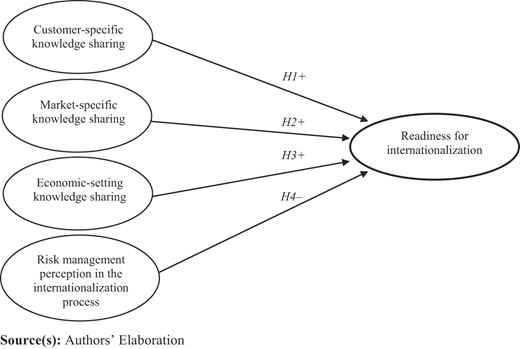
Customer-specific knowledge sharing is positively related to the readiness for internationalization.
In line with several previous authors, cases of resilience and adaptation have always been analyzed related to firms' internationalization processes (Malhotra et al., 2003; Vrontis and Thrassou, 2007; Davcik and Sharma, 2016; Lindstrand and Hånell, 2017; Johanson et al., 2020). As a matter of fact, to develop the level of readiness for internationalization, firms must also consider the efforts to adapt the demand to the new market offer, and vice versa. Therefore, Calantone et al. (2004) highlighted that internationalization is a process of adapting a firm, a product or a brand to a new international market, to new countries, and therefore to new cultures. Moreover, by applying the lens of the adapting process, Vrontis and Thrassou (2007) have assumed that even the new foreign markets must adapt by far to the offer of the internationalized firm. The issue of adaptation can be considered as a very long and difficult process to achieve and, for this reason, it can discourage firms from planning internationalization strategies, even more so if the adaptation concerns SMEs (Kuivalainen et al., 2012). The level of readiness for internationalization must include the assessment of a new market, environment, and the market-specific scenario.
Institutional knowledge and knowledge of the business network are the two elements that make up market-specific knowledge sharing (Eriksson et al., 1997). On one hand, the first concerns the institutional macro-environment of the host country, such as local governments, culture and norms (Eriksson et al., 1997, 2000; Jansson, 2007). Network knowledge, on the other hand, focuses on the dynamic aspects of international processes, in which the concept of international network itself is based (Del Giudice and Maggioni, 2014). In fact, network knowledge properly concerns the knowledge of the organization network of a specific target country, including suppliers, dynamics related to the consumer, the attractiveness of specific sector, and the competitiveness within the market (Vrontis and Thrassou, 2007). Nevertheless, the network model for internationalization shares the dynamics of adaptation in international markets with all the firms within the network (Del Giudice and Maggioni, 2014; Sui et al., 2019). Firms, above all SMEs, having few financial and internal resources for the timely and preventive assessment of the new outlet market, leverage the experiential knowledge sharing of the other firms belonging to the network (Zakery and Saremi, 2020). This allows the understanding and evaluation of the best adaptation solution to start operating abroad. Therefore, following Amdam et al. (2020), the focus on adapting the firm's products and services to the foreign market allows the development of a conscious readiness for internationalization through shared knowledge in the network.
Following this perspective, the entry mode into foreign markets highlights the central role of knowledge and the experiential knowledge of the network in choosing an appropriate entry strategy for the SMEs to start operating abroad (Malhotra, 2003; Sandberg, 2014).
Therefore, we argue that:
Market-specific knowledge sharing is positively related to the readiness for internationalization.
Managerial studies have approached on socio-economic settings in terms of organizations' external environment, that firms can affect by triggering long-term decisions (Del Giudice et al., 2016). Economic-setting knowledge is influenced by firms' structure and management decisions to enhance knowledge value within the whole business environment (Del Giudice and Maggioni, 2014). Moreover, Caputo et al. (2021) have noticed that knowledge hiding in socio-economic settings can be stimulated by employees' perception of internal and external environment competitiveness. This change in perspective has completely redesigned the management point of view of economic-setting knowledge sharing in order to examine the consequences of knowledge hiding in the business environment (Arain et al., 2019). Economic setting is considered by the managerial and marketing literature as a relational space in which the actors share knowledge and resources with each other (Christofi et al., 2013; Del Giudice et al., 2017). The economic setting can be defined as the set of culture and social value of which a market is embedded (Shneor, 2012).
The knowledge of a country's economic setting allows firms to develop the level of readiness for internationalization (Steenkamp, 2001; Kuivalainen et al., 2004; Goswami and Agrawal, 2019). For SMEs, it is not easy acquiring a proper enough level of knowledge on the foreign country's economic setting (Malhotra and Kubowicz Malhotra, 2011; Fletcher and Harris, 2012). Once again, by applying the lens of network perspective, several previous authors have identified membership in a network as an effective solution for sharing this kind of knowledge (Scuotto et al., 2017a, b; Del Giudice et al., 2017).
Networks allow the sharing of experiential knowledge on the economic system and legal environment of a potential target country for internationalization processes. Just a few authors investigated the role of networks and collaboration for SMEs' entry mode in foreign countries. Del Giudice et al. (2017) have highlighted how the knowledge-sharing of the economic setting of foreign markets affects by far the level of readiness for internationalization of SMEs. Hilmersson and Jansson (2012) noted that network's support allows SMEs to reduce common risks of internationalization by improving economic-setting knowledge specific, thus developing higher levels of readiness for internationalization.
Accordingly, we assume that:
Economic-setting knowledge sharing is positively related to the readiness for internationalization.
3.2 SMEs and risk management perception of internationalization processes
The internationalization process requires outstanding business decision-making skills. The most critical areas of international decision-making are basically three: in which market to enter, the marketing mix, and how to enter in the market (Del Giudice and Maggioni, 2014). In academic literature, it is sometimes pointed out that these three decision-making processes are interrelated (Malhotra and Majchrzak, 2019). However, the interrelated approach leads to very complex decision-making models, which are useful in the academic literature, but less useful for practical business purposes (Alam et al., 2020). Indeed, the international management and business literature evaluates internationalization processes as relevant strategies to increase financial performance, diversify products and services, and reduce business risk (Zahra et al., 2000; Bobillo et al., 2010; Haapanen et al., 2016; Leonidou et al., 2018). Therefore, through the internationalization process firms can leverage strategic factors in order to achieve benefits and create value (Ruigrok and Wagner, 2003). However, several authors identify the processes of internationalization as very risky due to the prior huge amount of knowledge required of foreign countries (Tallman and Li, 1996; Marin et al., 2017; Alam et al., 2020). Thus, internationalization provides several risky events for the business (Figueira-de-Lemos et al., 2011; Kiss et al., 2013). Moreover, the more SMEs have few internal resources, the more the internationalization processes are risky and unattractive (Alam et al., 2020). Handrito et al. (2020) have assumed that the amount of knowledge of the foreign country is a relevant factor for starting effective internationalization processes and for managing the internationalization's risks. In addition, the level of readiness for internationalization for SMEs is assessed based on the knowledge acquired of the foreign market, thus evaluating the risks associated with the internationalization process (Acedo and Florin, 2006; Boso et al., 2013).
Although the main research streams are addressed following the negative relation between risk management perception and internalization process, there are other authors who have suggested that by undertaking the internationalization process, firms are being more capable and aware of risk management (Festa et al., 2020). Indeed, territory-based knowledge management in international marketing processes highlights risk perception by playing an essential role in SME internationalization. In this vein, Festa et al. (2020) have noticed that international expansion is increasingly complex and, for that, “glocalism” could represent a real challenge for international strategies. SMEs, having limited availability of resources, can accumulate the missing knowledge of foreign countries through the network model (Acedo and Florin, 2006; Handrito et al., 2020). Sharing knowledge through the network model allows SMEs to manage the risks of internationalization processes (Pezderka and Sinkovics, 2011). A lack of knowledge about the foreign market increases the risk of perception in the internationalization process, thus limiting the development of the level of readiness for internationalization (Ruigrok and Wagner, 2003; Handrito et al., 2020).
Thus, we assume that:
Risk management perception in the internationalization process is negatively related to the readiness for internationalization.
4. Research method and data collection
4.1 Research scenario
By applying the lens of IRM, this study explores the different “knowledge” that improve the level of SME's readiness for internationalization. In particular, the paper follows the network perspective which examined the relevance of networks for internationalization processes (Ahuja, 2000; Fuller-Love and Thomas, 2004; Lee et al., 2012) and the impact of various forms of networks on cooperative internationalization strategies (Baird et al., 1993; Holm et al., 1996; Vaillant and Lafuente, 2019; Crupi et al., 2020; Seo, 2020).
The managerial literature has long observed how in the agro-food sector firms can benefit from network relationships for the purpose of internationalization (Maurel, 2009; Carneiro Zen et al., 2011), since the network allows them to share information, create useful contacts, access the necessary resources, promote their activities abroad and improve the image (Dalmoro, 2013).
A specific type of network is the “protection consortium,” in which, similar to the regional cluster proposed by Enright (1998), many resources and capabilities are the result of shared activities among the members (O'Reilly et al., 2003), such as sharing market knowledge, adapting technology and improving product quality (O'Reilly and Haines, 2004; Giacomini et al., 2010). Agro-food “protection consortium” is a clear example of long-term organizational network capable of pursuing the goal of growth and survival through the dissemination and sharing of vision, mission, and values among entrepreneurs (Fait et al., 2019). They are virtuous examples of the creation and dissemination of value inside and outside a network on the international scene. The network of formal and informal, personal and value sharing social relationships that characterizes them thus fully responds to the prospect of an internationalization process based on the sharing and use of resources from partners (Håkansson and Snehota, 1989; Chetty and Wilson, 2003; Johanson and Vahlne, 2009; Del Giudice et al., 2017), on acquiring experiential knowledge without having to go through the same experiences (Sharma and Blomstermo, 2003; Zhou et al., 2007), on the creation of an information flow of the business conditions of its partners (Johanson and Vahlne, 2009), on the possibility of identifying new business opportunities (Ellis, 2000; Harris and Wheeler, 2005). For this reason, the choice of considering the protection consortium as the setting through which to identify the SMEs under investigation, is consistent with the aim of the study that is to investigate the different “knowledge” shared that improve the level of SMEs' readiness for internationalization. The sample of companies subject to the empirical analysis comes from 11 agro-food “protection consortia.” These were identified using the intentional sample method (Yin, 1984), which considers the nature of the population and the objective of the study, which in our case concerns the behavior of members regardless of size, geographic location, and product portfolio (Eisenhardt, 1989). The selection, therefore, took place considering the following criteria (see Table 1): (1) of the most relevant agro-food areas in the Italian economic context: wine, ham, dairy, olive oil, and fruit farming (ISMEA, Fondazione Qualivita, 2019); (2) the date of foundation – all are among the oldest groups of producers formally created in Europe – the oldest firms were founded in 1924 and the newest one in 1990 - to regulate and protect the product of their own territory of origin (Crowne-Mohammed, 2005) therefore, represent a model for those associations created after the legislation on designations of origin (before 1992); (3) have in their statute the wording “Promotion and enhancement activities on foreign markets”.
Through the websites of the consortia, we performed a first screening of the member companies by selecting them following previous research (Freeman et al., 2012; Kuivalainen et al., 2012; Scuotto et al., 2017a, b; Del Giudice et al., 2017, 2019). In fact, despite the purely structural dimensions of SMEs, in this study we evaluate the specific knowledge on which SMEs leverage the readiness for internationalization level, when we have considered only members of consortium that sell final products (i.e. we have excluded breeders, growers, agricultural producers).
Then, preliminarily we have tested the questionnaire through a pilot survey on 20 firms. Subsequently, from September to November 2019, 1,320 questionnaires were sent along with a brief introduction of the research purpose. 380 questionnaires were collected, of which 300 were properly completed and valid and so analyzed. Table 2 shows the main characteristics of the SMEs respondents.
4.2 Measurement development
This study adopts a quantitative approach based on the collection of SMEs data using a structured survey (using a seven-point Likert scale ranging from “strongly disagree” to “totally agree”) to support the specific identification elements of knowledge to evaluate their impact of SMEs readiness for internationalization levels.
Based on previous research, the measures were used to highlight the three different “knowledge”: customer-specific, market-specific and economic-setting knowledge sharing. Moreover, we include the measure of perceived international risks to evaluate the effect of potential obstacles facing the internationalization process. Each investigated variable is shown in the following Table 3.
Several scholars have analyzed customer-specific knowledge sharing intra and inter-firms (Gebert et al., 2003; Garcia-Murillo and Annabi, 2002; Hånell et al., 2020). Largely, the variable of customer-specific knowledge sharing refers to a combination of customers' experiences, values, information and culture that provide a comprehensive framework to firms regarding the customers' behaviors (Gebert et al., 2003). In this vein, the variable is measured as a synthetic indicator explaining the main elements within international strategy to leverage the differentiation advantage internationally through customer-specific knowledge sharing. Moreover, customer-specific knowledge sharing is identified as social capital, which can be seen as relationship-based norms within the social resources of relationships and social skills (Jansson, 2007), thus improving the firms' readiness for internationalization.
Market-specific knowledge sharing is the experiential knowledge of the firms regarding the institutional macro-environment, specific country cultures and values, legal environment, and political system of the host country (Sandberg, 2014). Largely, this variable measures the stock of firms' information in term of market-knowledge needed to start the internationalization process. All this knowledge supports the firm in collecting other interesting market-specific knowledge and to achieve a good level of the readiness for internationalization (Blomstermo et al., 2004).
Economic-setting knowledge sharing is related to the social value and market environment in which the organizations are embedded (Goswami and Agrawal, 2019). In this vein, economic-setting knowledge sharing allows firms to understand the market design of a foreign country in order to develop an international strategy.
Finally, risk management perception refers to the ability of firms to manage increasing complex international strategies (Handrito et al., 2020). Hence, expanding the business globally could be a very risky challenge for SMEs, and for that risk's awareness can reduce the firms' readiness for internationalization.
4.3 Conceptual model
To the best of our knowledge, this study seems to provide a useful theoretical contribution that combines three different “knowledge” and the perceived risk on the SMEs' readiness internationalization level in order to support firms in developing their internationalization process. Figure 1 represents the conceptual model and the hypothesized relationships in the study. All the hypotheses considered are evaluated through regression analysis using the statistical packages IBM SPSS 25.0. The multiple regression analysis approach seems to be the most suitable based on the variables (Denicolai et al., 2021).
4.4 Regression analysis
We used the following regression models to evaluate the impact of the three different “knowledge” and the risk perception on the SMEs' readiness internationalization level.
Readiness for Internationalization = β0 + β1 customer-specific knowledge sharing + ε.
Readiness for Internationalization = β0 + β1 market-specific knowledge sharing + ε.
Readiness for Internationalization = β0 + β1 economic-setting knowledge sharing + ε.
Readiness for Internationalization = β0 − β1 risk perception in internationalization process + ε.
5. Findings
We launched an OLS multiple regression analysis to evaluate the relationship between the different kinds of “knowledge” and the SMEs internationalization readiness level.
Table 4 summarizes the results of the correlation analysis between the measures.
The fitness of the model has been tested by calculating several indexes as reported in the following Table 5.
The results showed no multicollinearity in the model, having variance inflation factors (VIF) < 4 (Hair et al., 2010), neither autocorrelation since the value calculated by the Durbin–Watson test is 1.951.
The relation between Customer-specific knowledge sharing and Readiness for internationalization is significantly positive, (B = 0.182, t-value = 2.451, p = 0.015), supporting the hypothesis H1. Moreover, a significantly positive relationship is noticed between Market-specific knowledge sharing and Readiness for internationalization (B = 0.129, t-value = 1.950, p = 0.052), supporting the H2. We support the hypothesis H3 pointing out the relation between Economic-setting knowledge sharing and Readiness for internationalization (B = 0.088, t-value = 1.968, p = 0.050), thus highlighting the positive and significant relation. Finally, the H4 hypothesis is supported because we observed a negative and significant relation between Risk perception in the internationalization process and Readiness for internationalization (B = −0.162, t-value = −2.566, p = 0.011).
6. Discussions
The process of internalization as a driver of competitive advantage for SMEs requires them to make an ever-increasing effort in its management (Schweizer, 2012; Dutot et al., 2014). The key factors are represented by information management (Knight and Liesch, 2002; Child and Hsieh, 2014), by the creation of networks (Spence et al., 2008; Musteen et al., 2010; Ciravegna et al., 2014; Thrassou et al., 2020), and by the ability to identify and use the knowledge helpful to the internationalization process (Basly, 2007; Rodriguez et al., 2010; Fletcher and Harris, 2012). Dissemination of knowledge is recognized as crucial to manage the complexity of the process (Brennan and Garvey, 2009; Fletcher and Prashantham, 2011; Hsu et al., 2013), to reduce risks and uncertainty (Nguyen et al., 2006), and to stimulate awareness of the opportunities of the foreign markets (Zhou et al., 2007). For most agro-food firms the internationalization process is becoming a relevant condition not only for survival but also for the success (Serrano et al., 2018).
Management literature has long observed how firms in the agro-food sector can benefit from network relationships for the purpose of internationalization (Maurel, 2009; Carneiro Zen et al., 2011), since the network allows them to share information, create useful contacts, access the necessary resources, promote their activities abroad and also improve their image (Dalmoro, 2013). In general, collaboration within networks facilitates the internationalization of SMEs (Hutchinson et al., 2007), as it becomes a channel of information and knowledge (Musteen et al., 2010), acts on the entry and selection methods of foreign markets (Ibeh and Kasem, 2011; Child and Hsieh, 2014), and allows them to overcome determining resource barriers (Ciravegna et al., 2014). However, many SMEs encounter difficulties in identifying useful information to convey within the different types of formal or informal networks (Casillas et al., 2009). For this reason, in this study we evaluate the specific knowledge sharing on which SMEs leverage the readiness for internationalization level i.e. customer-specific, market-specific and economic-setting knowledge sharing, related to the perceived risks of internationalization processes.
In the agro-food sector, indeed, the internationalization process passes through challenges posed by the sector's economic and non-economic environments, changes in lifestyles and food consumption and global growth (Serrano et al., 2018). Reducing the risks of entering a foreign market is therefore linked, as our findings show, to the ability to acquire knowledge in three specific areas: the customer (Garcia-Murillo and Annabi, 2002), macro-environmental institutions of the host country (Eriksson et al., 1997, 2000), market network (Ellis, 2000; Blomstermo et al., 2004; Chetty and Agndal, 2007).
In fact, the findings suggest that there is a positive relationship between customer-specific knowledge sharing and readiness for internationalization (H1). The customer-specific knowledge therefore responds to the need to have a customer profile available that does not simply arise from a series of data and information accumulated, collected, and recorded but from the personal knowledge of foreign customers acquired in the context of direct or indirect relations between the companies and customers or through the company's sales representatives, aimed at creating stable and solid relationships (Garcia-Murillo and Annabi, 2002). The exchange of tacit knowledge (Nonaka and Takeuchi, 1995), in this case that which arises from direct experience with the customer, is therefore perceived by the network participants as a precious resource for entering international markets. This confirms that experiential knowledge is a fundamental operational requirement (Fletcher and Harris, 2012; Johanson and Vahlne, 1990) as it allows SMEs' agro-food to face process and product innovations in a more conscious and not only incremental way (Hervas-Oliver et al., 2014). Similarly, market-specific knowledge sharing, and economic-setting knowledge sharing are also positively linked to readiness for internationalization (H2; H3). Market knowledge is specific as it concerns the knowledge of the firm's network in the specific market of the country, including suppliers, customers, and competitors, as well as certain market conditions (Blomstermo et al., 2004; Camuffo et al., 2007; Mejri and Umemoto, 2010). Institutional knowledge concerns macro-environmental institutions in the host country in terms of local government, laws, culture, and norms (Eriksson et al., 1997, 2000; Jansson, 2007). Both respond to the need to reduce the risks related to the management of relations with foreign counterparties. This confirms the relevance assigned by literature to understanding learning relationships in new international territories as well as business management (Eriksson et al., 1997; Fletcher et al., 2013; Johanson and Vahlne, 2009). To share this knowledge can be assimilated to cognitive learning (Basly, 2007) that enhances the opportunity to internationalize due to prior market knowledge (Cannone and Ughetto, 2014).
The sharing of knowledge in these areas allows the assessment of the risks associated with the internationalization process (Acedo and Florin, 2006; Boso et al., 2013). This is why the readiness for internationalization for SMEs is associated negatively and significantly with risk perception (H4). This confirms that the effective internationalization processes and related internationalization risks depend on the amount of knowledge of the foreign country (Handrito et al., 2020).
7. Conclusions
Several studies have shown that building relationships with customers (Del Giudice and Della Peruta, 2016; Leonidou et al., 2018) to obtain consumer-specific knowledge (Kim et al., 2003) and to efficiently predict market demand has a significant role to leverage the competitive advantage more effectively (Khosravi, 2014; Mitussis et al., 2006). Frequently, firms still lack systematic processes for managing and applying customer knowledge (Wu et al., 2013; Salomann et al., 2005), and this knowledge tends to be fragmented across multiple systems and locations (Davenport et al., 2001). Therefore, the network is very important for sharing the consumer-specific knowledge (Chandra and Wilkinson, 2017) because the network, exploiting the knowledge economies, allows leveraging on shared knowledge (Zain and Ng, 2006; Leonidou et al., 2018). Our study suggests that within business networks, which share common values and strategic paths, SMEs perceive the importance of sharing experiential knowledge to improve readiness for internationalization and therefore risk management perception. The experiential and networked nature of knowledge sharing for the purposes of internationalization is linked to pre-conditions necessary to create a suitable relational environment to ensure that knowledge sharing strategies can be effective for creating value for the network in the agro-food sector. The experiential and networked nature of knowledge sharing for the purposes of internationalization is linked to necessary pre-conditions which create a suitable relational environment to ensure that knowledge sharing strategies can be effective for adding value to the network in the agro-food sector.
Sharing knowledge derived from personal experiences (Hadley and Wilson, 2003; Mejri and Umemoto, 2010), from direct involvement in internationalization processes (Fletcher and Harris, 2012), or from direct relationships with network partners in specific situations of an international context (Knight and Liesch, 2002), answer the recognition of the benefit that can be drawn in terms of improving the firm's internal skills, enhancing the value of its product (Fait et al., 2019), and comparing previous international experiences with new knowledge (Child and Hsieh, 2014).
The network knowledge, i.e. the knowledge derived from social and business networks (Mejri and Umemoto, 2010), is the one with stronger influence on the intention of SMEs to export (Casillas et al., 2009), as it allows the network to log into new resources and to learn new skills that facilitate market entry (Loane and Bell, 2006; Peng et al., 2011; Kaur and Sandhu, 2013). An essential feature in order to strengthen the level of intensity and bonds strength within a network and to build the sense of belonging to a community, is the propensity to adopt behaviors consistent with the objectives shared, determining factors for generating an epistemic community that shares specific fields of knowledge (Fait et al., 2019).
8. Managerial and theoretical implications
The awareness expressed by companies about the experiential importance and networked nature of knowledge sharing for the purposes of internationalization, leads to some interesting managerial reflections.
The first contribution is of a specific nature for the agro-food sector. Food industries face major obstacles in entering international markets. Information asymmetries (Benito et al., 1993; Knight and Liesch, 2002; Child and Hsieh, 2014) such as differences in lifestyles and food consumption (Serrano et al., 2018), food safety or customs barriers (De Frahan and Vancauteren, 2006), institutional and economic factors all help penalize readiness for internationalization. Therefore, it becomes essential to learn and use knowledge related to internationalization (Basly, 2007; Rodriguez et al., 2010; Fletcher and Harris, 2012). This is possible with network agreements between SMEs within which trust, sharing of values and strategies are generated, fueled by a sharing of knowledge that can reduce complexity and ambiguity (Hsu et al., 2013), risks and uncertainty (Nguyen et al., 2006) and stimulate awareness of the opportunities of overseas markets (Zhou et al., 2007). In other words, cooperating for competing becomes a fundamental strategy for the internationalization of agro-food SMEs (Festa et al., 2020) and this requires awareness of the relevance of network knowledge (Del Giudice and Maggioni, 2014).
The second contribution is related to the specific nature of the network to which the companies in the sample belong. The protection consortiums are born, at the origin, around a shared value which is the protection and enhancement of the typical products of a territory both in Italy and abroad. The selected consortia support companies so that they can adopt and develop a wider international orientation, favoring the attitudes, behaviors and values that can make entry into international markets effective. The study, in fact, shows that within this typology there is a correct perception by the members of three areas of knowledge considered relevant for internalization – the customer, macro-environmental institutions of the host country, and the market network. The experiential and networked nature of knowledge sharing for the purposes of internationalization is the necessary pre-condition to create a suitable relational environment to implement an integrated marketing approach (Gilmore, 2020). The integrated marketing approach, in fact, presupposes brand communications where the different modes work together to create a seamless experience for the customer helping them to move through the various stages of the buying process. The organization, also, simultaneously consolidates its image, develops a dialogue and nurtures its relationship with customers and members (Kliatchko, 2005; Batra and Keller, 2016). In detail, customer-specific knowledge sharing is the precondition for a horizontal and vertical marketing integration. It is also indicative of the awareness of network members that their decisions and actions send messages to customers and that marketing and communications objectives must support higher-level corporate objectives and corporate missions. Furthermore, the networked knowledge represented by the perceived relevance for market-specific knowledge sharing and Economic-setting knowledge sharing are the preconditions for implementing a data integration system, i.e. marketing information system which collects and shares relevant data across different departments.
These considerations may be of interest to all young consortia who have recently started their path towards the international enhancement of a typical product and who need to create an environmental substrate in which it is adequately perceived, this being that it is important to cooperate to compete (Festa et al., 2020) and integrate the actions of marketing in order to have recognition on foreign markets (Polonsky and Jevons, 2009).
From a theoretical point of view, the main results contribute to expanding KS studies as it proposes a combination of different kinds of knowledge sharing – namely economic-setting, market-specific, and customer-specific knowledge sharing – which can help reduce difficulties encountered by SMEs in identifying useful information to be conveyed within the network (Casillas et al., 2009). At the same time, the understanding of the antecedents of SMEs' readiness for internationalization improves by providing greater attention to this area that has mainly involved in large firms up to now (Dimitratos et al., 2016; Deng and Zhang, 2018).
9. Research limits and future research perspectives
The informative value of the model is attested by the empirical results obtained by providing interesting reflections. Nevertheless, the study has some limitations. First, the observations cannot be generalized as they have derived from the analysis of a specific network that of the protection consortium of agro-food products. Due to their nature and operational characteristics, they represent a very particular network model in which trust, social relations, the bond with the territory play an important role in the importance assigned to knowledge and its sharing. Therefore, the previous reflections add value for managers and professionals who want to activate integrated marketing strategies within younger protection consortiums aimed at creating an environmental sub-layer suitable to stimulate readiness for internationalization and reduce risk perception. A second limit, however, is represented by the fact that, having used perception as an analysis perspective, vision is limited. By implementing other variables (i.e. level/percentage of sales abroad, level/percentage of investments in internationalization projects, creation of a virtual community, the adoption of ad hoc technologies), the reflections could also be different for this specific category of consortia. Future research is to observe the propensity considering strategic organizational or technological variables. The third limit is represented by the impossibility of generalizing these reflections as they could be different when the settings is are represented by other types of cooperation and different sectors. Future research on in other networks would therefore be necessary to verify the validity of experiential and networked nature of knowledge sharing as a pre-condition for internationalization. This would allow us to overcome the limit of the work represented by the cross-sectional nature of the data.
Finally, the research was conducted in a period shortly before the one in which the COVID-19 pandemic began, which generated an unprecedented global crisis. This has been a period that has generated uncertainty for SMEs but also rediscovered or lost opportunities. When at some point a crisis hits the flow of value, the effect is produced on all members of a network (Etemad, 2020). Therefore, a future line of research is to observe whether knowledge areas can represent an adequate collaborative plan to address uncertainties or to identify new opportunities or to see if alternatives exist.