The rise of virtual influencers (VIs) has reshaped influencer culture, yet existing literature lacks a cross-cultural examination of how VIs foster engagement from media communication and fan perspectives. Notably, factors influencing VI-fan engagement remain underexamined, leading to inconsistent findings and a critical knowledge gap. This study aims to address this gap by identifying overlooked determinants of VI-fan interactions, thereby enhancing such engagement both in China and globally.
A mixed-method approach, integrating content analysis and statistical analysis, was employed to compare fan engagement among top Chinese and global VIs, with theoretical grounding in the information adoption model and the eWOM narrative model.
The study identified the specific effects of platform differences and content types on VI-fan engagement. Additionally, it developed a content typology tailored to enhance such engagement, offering actionable insights for optimizing VI-fan engagement.
It provides detailed guidance on brand management for VIs, aiding in strategic decisions such as VI design, platform selection and content curation to strengthen fan engagement, whether for Chinese or global VI campaigns.
It fills a key literature gap by providing cross-cultural evidence on VI-fan engagement – an area previously marked by insufficient and inconsistent findings. Its focus on comparative analysis between China and the global context adds unique value, addressing the lack of cross-cultural analysis in existing studies.
Introduction
Over the past few years, influencer culture has garnered increasing attention, which describes how individuals with large followings on social media exert significant influence over their fans and other audiences (Luo and Kim, 2024). Recently, the rise of virtual characters has driven the reconstruction of influencer culture, with virtual influencers (VIs) emerging as a new area of exploration for current researchers (de Cicco et al., 2024). Scholars tend to understand VI-fan interactions in terms of the similarities and differences between VIs and human influencers (HIs) (Byun and Ahn, 2023), while primarily focusing on customer relations in business economics (Zhou et al., 2024) and human-computer interactions in computer science (Mirowska and Arsenyan, 2023). Existing literature suggests that there is limited research on how VIs promote the generation and development of fan attitudes and behavioral responses from the perspectives of media communication and fan culture (Akhtar et al., 2024), particularly neglecting the exploration of factors influencing VI-fan engagement (Shen, 2024). This has led to inconsistent results regarding the influence of VIs on fans (Lim and Lee, 2023), indicating a significant knowledge gap in this area.
Specifically, regarding VIs and their impact on fans, previous studies comparing VIs and HIs have shown that VIs have weaker attributes such as credibility, trustworthiness, and fan relationships. This is attributed to the uncanny valley effect (UVE), which causes people to tend to have negative emotional reactions toward humanoid robots (Mirowska and Arsenyan, 2023). However, other studies suggest that VIs outperform HIs in triggering fans’ perceptions of brand attitudes, engagement, and purchase intentions (Allal-Chérif et al., 2024). Although these studies yield inconsistent results, they all agree that VIs and HIs have different effects on fans. These studies were conducted in the same cultural context without exploring factors influencing cross-cultural fan engagement, which may explain the inconsistent findings.
Further exploring other determinants influencing the enhancement of VI-fan engagement across different cultural contexts is crucial for clarifying inconsistencies between VI and fan engagement, as well as for comprehensively understanding the impact of VI culture on media communication. The worship of VIs can be seen as a youth subculture that significantly influences young people’s values and social dynamics, potentially affecting self-presentation, impression formation, and trust perception (Xu et al., 2023). Further investigation into how VIs interact with their fans and the unique factors across different cultures is warranted, as existing literature highlights the uniqueness and significance of such interactions (Byun and Ahn, 2023). Hence, this study compares fan interactions with top VIs in China and globally, drawing on the Information Adoption Model (IAM) theory and the eWOM narrative model. It employs a mixed method that combines content analysis and statistical analysis to integrate multiple engagement factors such as credibility and argument quality.
This study has both theoretical and practical contributions to the existing knowledge. Theoretically, it responds to the current academic call for exploring additional factors affecting fan interactions in VI research (Wang et al., 2023) by examining multiple decisive factors—anthropomorphic appearance, cultural congruence, platform differences, and content types. Unlike previous studies (de Cicco et al., 2024), which merely compared the attributes of VIs and HIs, this study contributes to the existing literature by comprehensively understanding the interaction between VIs and fans from both perspectives in different cultural contexts. Furthermore, it extends the existing literature by developing a content typology for VI-fan engagement based on the eWOM narrative model, enriching the current insufficient findings on VI culture and communication and their impact on fans from different cultures (Akhtar et al., 2024). Moreover, it expands the IAM theory and UVE by clarifying inconsistent evidence related to VI credibility and argument quality. Practically, it provides more detailed management insights for companies when selecting Chinese VIs and global VIs.
Theoretical background
Recently, VIs have emerged as a new type of influencers interacting with fans. They are defined as computer-generated characters that engage with users on social media platforms, with their fan bases continuing to grow (Miyake, 2023). Existing literature highlights that the worship of VIs can influence fans’ thoughts, feelings, and behaviors through their words and actions (Xu et al., 2023). Given the significant influence of VIs on fans, scholars currently focus on comparing the different effects of VIs and HIs on fans (Stein et al., 2024), finding that VIs offer distinct fan interactions compared to HIs. This is because VIs can simultaneously engage with fans across multiple social media platforms and produce large amounts of consistent social media content that HIs struggle to match (Byun and Ahn, 2023). However, these studies primarily discuss the outcomes of VI interactions. For example, Lee and Yuan (2023) found that female VIs received more negative comments, while de Cicco et al. (2024) indicated that human-like VIs did not trigger negative reactions from fans. These studies have not focused on increasing fan engagement with VIs and exploring its determinants (Luo and Kim, 2024). Recent research suggests that fan engagement is a key indicator of the effectiveness of VI interactions on social media (Yu et al., 2024). Specifically, this is because VIs affect fans and non-fans differently. Due to fans’ identity alignment and emotional investment, they may ignore the artificiality of VIs and blindly adopt VIs’ recommendations (Li and Pang, 2024). However, non-fans may engage superficially (e.g. curiosity-driven clicks) or critically (e.g. skepticism about VI authenticity). Their engagement requires more rational appeals (e.g. data-driven endorsements) than emotional ones (Wang et al., 2025). Hence, scholars believe that fan engagement is the most important feature and advantage of VIs, contributing to enhancing fan stickiness (Shen, 2024).
Furthermore, current research findings on the interactions between VIs and fans are inconsistent. Some scholars argue that interactions with VIs fulfill personal identity and social relationship needs, especially as the incredible human qualities of VIs trigger active participation among post-millennials (de Brito Silva et al., 2022). Other scholars contend that VIs may reduce fan engagement due to their lack of authenticity and weak parasocial relationships (PSRs) with fans (Lou et al., 2022). Prior research indicated that when fans repeatedly interacted with the same media persona, they formed PSRs, which were regarded as a core element of media experiences (Tukachinsky and Stever, 2019). Faced with their strong influence on the media reception process, scholars have attempted to identify factors associated with stronger parasocial reactions among fans. By reviewing recent studies (see Table 1), most studies suggest that VIs have stronger parasocial interactions (PSIs) with fans compared to HIs, but Stein et al. (2024) pointed out that fans perceived VIs as psychologically distinct from humans and themselves despite VIs having stronger PSRs. It can be observed that these studies focus on analyzing the role of human-likeness and emotional expression in VIs’ interactions with fans, which explains why parasocial responses are influenced by factors related to human characteristics. These factors have been revealed as important antecedents of parasocial intensity and emotion (Lou, 2022).
The above analysis indicates that current research on VI-fan engagement is insufficient and inconsistent, indicating a need to reassess VI-fan engagement and explore more determinants beyond merely focusing on human-likeness and emotions. This will help further expand the primary theories, frameworks, and research results of VIs and fan interactions (Ahn et al., 2022). Additionally, previous research has shown that the disclosure of the VIs’ origin is significantly associated with fan interactions in PSIs (Lim and Lee, 2023). However, recent studies have not further analyzed it but have instead focused on a specific national case study of VIs (see Table 1), which fails to address VI-fan engagement in different cultural contexts (Liu et al., 2023). As such, unlike previous studies using PSRs, this study employs IAM to comprehensively understand VI-fan engagement. IAM was proposed by Sussman and Siegal (2003) to explain how individuals adopt information in computer-mediated communication to alter their intentions and behaviors from the perspectives of source credibility and argument quality. Previous studies have extensively used IAM to explore factors influencing fans’ adoption of HIs’ online messages (Verma et al., 2023). As these studies suggest, future media-focused work will increasingly adopt IAM (Pushparaj and Kushwaha, 2023). Applying IAM to this study provides a theoretical basis for understanding the factors influencing how fans engage with source credibility and argument quality in VI-fan interactions. Hence, this study poses the following research questions.
What factors determine VI-fan engagement in terms of source credibility and argument quality?
Do these determinants of VI-fan engagement vary across cultural contexts?
Research propositions
Source credibility propositions for VIs
Existing literature has sparked significant debate about the source credibility of VIs. Source credibility refers to the audience’s perception of the credibility of an information source, thereby gaining more specialized knowledge about a specific service or product (Teng et al., 2014). The importance of source credibility in fan responses has been discussed in the context of influencers. Prior studies support that source credibility has significant influence on interactions between HIs and fans (Ashraf et al., 2023). For HIs, the initial framework of credibility includes two dimensions—expertise and trustworthiness (Muda and Hamzah, 2021). Expertise is related to the information source’s level of knowledge in a particular field (Ismagilova et al., 2020), and trustworthiness is related to the source’s honesty and truthfulness when conveying information (Jin et al., 2019). Subsequently, many researchers proposed attractiveness as a third dimension, referring to the source’s appearance and physical beauty (Dhun and Dangi, 2023). Yuan and Lou (2020) proposed similarity as a fourth dimension, defined as the shared attributes between the source and the audience, which can increase the source’s credibility among the audience. In the case of VIs, as shown in Table 1, current studies have investigated VIs’ anthropomorphic appearance, origin disclosure, and communication channels when comparing the source credibility of VIs and HIs (Lim and Lee, 2023; Stein et al., 2024). These studies suggest that the credibility characteristics of VIs are significant for connecting with fans through parasocial interactions. Accordingly, this study combines the HI credibility framework and current VI credibility research to establish a credibility model encompassing VI anthropomorphic appearance, VI-fan cultural congruence, and different platforms. The differences between this study and the aforementioned studies are as follows.
Anthropomorphic appearance
Regarding source credibility, researchers have noted that anthropomorphism is a critical factor in the credibility of VIs (Byun and Ahn, 2023). Anthropomorphism is the tendency to infuse human-like characteristics, intentions, and emotions into the real or imagined behavior of non-human subjects (Epley et al., 2007). Related literature shows that fans respond differently to VIs’ anthropomorphic appearance. Specifically, prior studies have criticized VIs for possessing human characteristics, whose perfect images and lives prevent fans from identifying them as real influencers and lack persuasive power over fans due to UVE (Mrad et al., 2022). Recent research suggests that not all types of humanoid anthropomorphic appearances trigger UVE. For instance, other scholars found that computer-generated imagery influencers are highly attractive on physical and social levels, thus stimulating fan engagement (Lou et al., 2022). Considering the mixed findings, prior studies indicated that UVE appeared to lag behind the latest developments in computer graphics (Zhang et al., 2022). Furthermore, existing literature highlights a research gap regarding the source credibility of VIs, especially the non-human aspect and how perceived anthropomorphism affects VI-fan interactions (Melnychuk et al., 2024). Therefore, to further elucidate the role of anthropomorphic appearance in VI-fan interactions, this study proposes the following propositions.
Non-human VIs positively affect VIs’ credibility with higher fan engagement in VI-fan interactions.
Humanoid VIs positively affect VIs’ credibility with higher fan engagement in VI-fan interactions.
VI-fan cultural congruence
Prior research has shown that cultural attributes are an indispensable prerequisite for HIs’ perceived credibility (Gadekar et al., 2025). That is, influencers’ cultural attributes are intrinsic to their social media presence and are embedded in the posts they share with their fans (Abidin, 2016). Although VIs are fictional characters that do not exist, they still possess cultural attributes (Zhao, 2017). Their cultural attributes are constructed on two dimensions, one is given by developers who use different strategies to reveal VIs’ cultural attributes or make them opaque, and the other is VIs’ cultural attributes as perceived by fans (Lim and Lee, 2023). Extant literature suggests that fans’ perceptions of whether VIs are human or artificial may vary depending on the degree to which VIs’ cultural attributes are disclosed, which further affects fans’ responses to VIs (Miyake, 2023). High consistency between HIs and brands has been proven to increase the credibility of influencers and their posts (Martínez-López et al., 2020). The understanding of congruence has been further expanded by stating that congruence between HIs’ and fans’ cultural attributes enhances fans’ willingness to follow influencers’ recommendations (Casaló et al., 2018). Thus, an influencer’s culture should be considered an important criterion for selecting credible influencers, which guide digital content strategies targeting specific fans (Vrontis et al., 2021). Additionally, recent research indicates that cultural differences in social media behavior can be addressed by comparing fan responses to influencers in Western and non-Western contexts (Gadekar et al., 2025). Since current research has not yet addressed the role of cultural congruence between VIs and fans in interactions across Western and non-Western contexts, the following proposition is formulated.
Cultural congruence between VIs and fans positively affects VIs’ credibility with higher fan engagement in Chinese (3a) and global (3b) VI-fan interactions.
Different platforms and communication channels
In previous studies, platforms have been seen as another important factor influencing the credibility of the eWOM of HIs (Verma et al., 2023). Specifically, fans tend to find HIs on trusted platforms (Verma et al., 2023), but they perceive each platform differently, and influencers use different eWOM strategies for different platforms (Shen, 2023). As such, as the medium through which influencers interact with fans, platforms influence fans’ perceptions of influencer credibility (Yan et al., 2018). Existing literature proves that selecting different platforms varies fan engagement (Unnava and Aravindakshan, 2021). However, in previous studies, most scholars have focused on enhancing fan engagement through content strategies, while related literature has provided limited analysis of platforms as determinants of fan engagement (Theocharis et al., 2022). Given the current diversity of platforms, our understanding of VI-fan interactions remains limited to single social media platforms such as Instagram (Rutter et al., 2021) or TikTok (Kang and Lou, 2022). Current research on multiple social media platforms is underinvestigated, and it is necessary to compare the credibility of different communication channels in VI-fan interactions (Wang, 2024). Therefore, this study proposes the following propositions.
Platform differences positively affect VIs’ credibility with different fan engagement in Chinese (4a) and global (4b) VI-fan interactions.
Argument quality propositions for VIs
Finally, argument quality refers to the ability of an argument to convince recipients to accept the information (Cheung et al., 2009). Previous studies found that argument quality is an important factor in developing close relationships with fans (Peltier et al., 2024). In this study, argument quality refers to the level of fan engagement with VI post content. Previous research noted that different types of HI content elicited varying levels of fan engagement (Pelletier et al., 2020). For instance, texts related to pricing have a positive impact on fans’ likes, shares, and comments, while social media content related to brands and products has a smaller impact on fan behaviors (Shen, 2023). This indicates that not all content types have the same level of fan engagement, meaning that certain types inherently boost fan engagement while others do not. This aligns with recent findings that VI post content moderates the relationship between PSIs and fan engagement (Melnychuk et al., 2024). However, current research has not further investigated the role of different content types in the VI-fan engagement relationship.
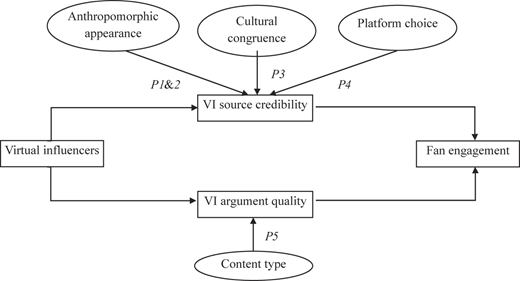
Regarding content types and engagement, scholars classify data into different categories based on primary content and research objectives. For example, De Vries et al. (2012) distinguished between informational and entertaining content, and Shahbaznezhad et al. (2021) proposed a classification of rational, emotional, and transactional content. This study adopts Kozinets et al.’s (2010) eWOM narrative model based on primary content and research objectives. According to this model, post content and its acceptance by target fans can be categorized by character narratives, communal norms, communication forums, and marketing promotion elements. Character narratives describe the communicator's personal stories or narratives, and communal norms are recognized as guidelines for expressing and receiving information in eWOM. In this study, character narratives and communal norms refer to VIs' anthropomorphism and cultural congruence in narrating and engaging different types of stories with their fans, which also corresponds to P1 through P3. Communication forums refer to communication venues, such as specific platforms, which relate to P4. Finally, we classify VIs’ post content using fan engagement rather than marketing promotion elements to fit the study’s objectives and propositions. Hence, this study further explores VIs’ argument quality in terms of content types, and proposes the following proposition and conceptual framework (see Figure 1).
Content types positively affect VIs’ argument quality, resulting in different levels of fan engagement in Chinese (5a) and global (5b) VI-fan interactions.
Data and method
Data sampling and collection
To create sample data, we examined 10 VIs based on the research questions and propositions, namely the Top 5 Chinese VIs and another Top 5 global VIs. A recent report by Statista (2024) suggests that China, with its large consumer base, is a global leader in the AI market after the U.S. Therefore, Chinese VIs are suitable for inclusion in global comparisons. The selected VIs were drawn from the lists in China's Top Virtual Influencers on Social Media (Lorenzana, 2022) and The Most-followed Virtual Influencers of 2022 (Hiort, 2022) verified by VirtualHumans.org, which provides the most reliable source of information about VIs and has proven its credibility and reliability in previous studies when investigating VIs (Conti et al., 2022; Melnychuk et al., 2024). These VIs were ranked based on the number of fans on social media, ensuring consistent and comparable selection criteria for Chinese and global VIs. Top VIs were chosen as the data sample because they interact with their fans more than the average VIs. Their rankings may be adjusted based on annual fan numbers, but this will not affect our findings, as our research questions and propositions do not directly involve VI fan numbers. Instead, this study focuses on analyzing VI-fan engagement in terms of credibility and argument quality.
Accordingly, the selected Chinese VIs are Angie, Ayayi, Honor of Kings Virtual Idol Group (HKVIG), Ling, and Luo Tianyi, and the global VIs are Barbie, CB of Casas Bahia, K/DA, Lu of Magalu, and Nobody Sausage (see Table 2). To collect data, we manually collected posts and corresponding fan engagement data from January to December 2023 for each VI, totaling 12,157 posts. Due to platform differences (P4), data for Chinese VIs were collected from their official accounts on Douyin (DY), Weibo (WB), and Xiaohongshu (XHS). Except for Ayayi, who has an Instagram account, these social media are the only three platforms where they post content. Similarly, our initial study of global VI platforms, including Facebook, Instagram (IG), TikTok (TT), Twitter, and YouTube (YT), found that Instagram, YouTube, and TikTok were the three platforms where they all post content. Therefore, data for global VIs were collected from their official Instagram, YouTube, and TikTok accounts for comparison with Chinese VIs.
Data analysis and coding variables
After data collection, this study employed content analysis and statistical analysis, which have been applied in previous studies (Creswell, 2014; de Brito Silva et al., 2022). Specifically, regarding anthropomorphic appearance (P1 and P2), Chinese and global VIs were first classified into non-human and humanoid groups based on their authenticity (see Table 3), referencing previous studies (Arsenyan and Mirowska, 2021; Allal-Chérif et al., 20242020). Subsequently, following Boerman’s research (2020), fan engagement for each type was calculated by dividing the average number of likes, shares, and comments by fan number. Prior studies support using likes, shares, and comments as coding variables for fan engagement (Unnava and Aravindakshan, 2021). Likes are viewed as fans' acceptance of the post and their positive attitudes toward the sender (Antonopoulos et al., 2016). Shares require higher fan engagement than simply clicking the “like” button, as they trigger more fan feedback through further sharing within the fan network (Unnava and Aravindakshan, 2021). Additionally, comments have the highest fan engagement, as fans need more effort to express their thoughts, attitudes, and feelings (Shen, 2021). Finally, t-tests were conducted in SPSS to assess statistical significance between groups.
Similarly, regarding cultural congruence (P3), Chinese and global VIs were first categorized into culturally congruent and non-culturally congruent groups based on previous studies (de Brito Silva et al., 2022; Kim and Park, 2023). Fan engagement was calculated for each group, and a t-test was conducted to assess statistical significance. For platform differences (P4), the fan engagement of Chinese VIs was analyzed based on variables from Weibo, Douyin, and Xiaohongshu. Likewise, fan engagement of global VIs was examined based on variables from Instagram, YouTube, and TikTok. Subsequently, an ANOVA test was performed to assess statistical significance since the number of variables exceeded two. Considering content types (P5), based on the aforementioned eWOM narrative model, the content of VIs' posts was encoded by three variables: character narratives, communal norms, and community reactions. Accordingly, the content types of VIs were categorized into four groups—Narration, Socialization, Advocacy, and Evaluation. Fan engagement with each category was tested through ANOVA to assess the statistical significance.
Results
Anthropomorphic appearance (P1 and P2)
From an anthropomorphic perspective, the non-human group in Chinese VIs includes the animated figure Luo Tianyi, and the five animated and animal figures that make up the Honor of Kings Virtual Idol Group, namely Yun, Liang, Bai, Xin, and Shouyue. The humanoid group in Chinese VIs includes Ayayi, Ling, and Angie. The t-test results for different Chinese samples indicate no significant difference (t = 1.579, p > 0.05) for fan engagement (see Table 4). Similarly, the non-human group in global VIs includes Nobody Sausage (object figure), Barbie (animated figure), and K/DA (four animated and animal figures, namely Ahri, Akali, Evelynn, and Kai’Sa), while the humanoid group consists of Lu of Magalu and Casas Bahia. The t-test results for different global samples show that fan engagement also indicate no significant difference (t = −0.929, p > 0.05). Besides, further t-tests were performed on the non-human group and the humanoid group including mixed Chinese and global samples, and the results show no significant difference (t = −1.084, p = 0.339). The above results indicate that anthropomorphism does not show a significant difference in VI-fan engagement. Therefore, P1 and P2 are not supported.
Cultural congruence (P3)
Regarding cultural congruence, non-cultural Chinese VIs consist of Ayayi and HKVIG, while the cultural group includes Luo Tianyi, Ling, and Angie. Specifically, Luo Tianyi was designed after the Chinese mythological character Luo Shen, known as The Goddess of the Luo River, who symbolizes beauty and unattainable love in Chinese culture. Similarly, Ling is named after Hua Ling in Peking Opera, referring to an important headdress worn by Qing Dynasty officials and nobles. She typically appears with black hair in a bun and single eyelids, and wears traditional Chinese clothes. In contrast, non-cultural VIs like Ayayi, whose short blonde hair is styled in each image with an expressionless face, show a style that is more Japanese. This stems from her creators, Ranmai Technology (China) and Aww Inc. (Japan). Therefore, the cultural group shows a stronger Chinese cultural identity, which aligns with the preferences of their Chinese fans. The t-test results for different Chinese samples do not indicate a significant difference (t = 1.202, p > 0.05). Similarly, non-cultural global VIs include Nobody Sausage and K/DA, while the cultural group includes Barbie (blonde hair, thick black eyeliner, pursed red lips, aligning with American appealing look), Magalu, and Casas Bahia (dark hair, bronze skin, with distinct Brazilian features). The t-test results for different global samples indicate no significant difference (t = −1.211, p > 0.05) for fan engagement (see Table 5). Additionally, further t-tests were conducted for the non-cultural group and the cultural group (including mixed Chinese and global samples). The results for different types show that fan engagement does not indicate a significant difference (t = −1.081, p = 0.359). It suggests that cultural congruence does not make a significant difference in VI-fan engagement. Consequently, P3 is not supported.
Platform differences (P4)
For platform differences, Chinese VI-fan engagement on Weibo, Douyin, and Xiaohongshu was analyzed, and the ANOVA results show that the effect of platform differences on Chinese VI-fan engagement is statistically significant (F = 4.375, p < 0.05, see Table 6). Among the three platforms, further analysis indicates that Douyin has higher fan engagement (Mean = 8.09) with Chinese VIs than Weibo (Mean = 1.35) and Xiaohongshu (Mean = 2.25). Similarly, Instagram, YouTube, and TikTok were studied for global VI-fan engagement. The result indicates that the effect of different global samples on VI-fan engagement is statistically significant (F = 5.381, p < 0.05). The results also show that TikTok has the highest VI-fan engagement (Mean = 5.02) compared to Instagram (Mean = 1.64) and YouTube (Mean = 3.64). These results indicate that platform differences positively affect fan engagement in Chinese and global VI-fan interactions, thus supporting P4.
Content types (P5)
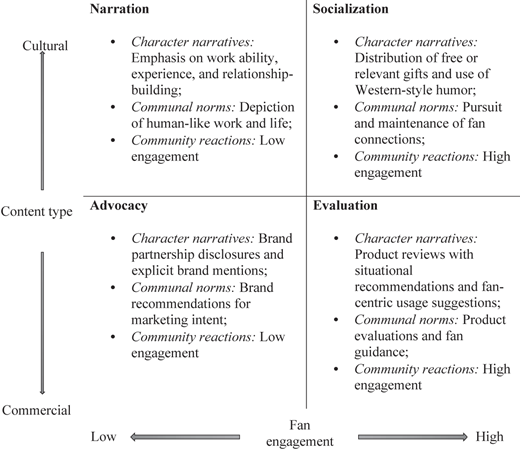
Considering content types, this study ultimately categorized VI-fan engagement into four types: Narration, Socialization, Advocacy, and Evaluation, based on their character narratives, communal norms, and community reactions as described in Table 3. ANOVA for VI-fan engagement was conducted for Chinese and global samples separately based on content types. The results for the Chinese samples show that the effect of content types on Chinese VI-fan engagement is statistically significant (F = 58.020, p < 0.01, see Table 7). Among the four types, the results further show that Evaluation (Mean = 6.61) and Socialization (Mean = 3.26) have higher engagement than Advocacy (Mean = 0.54) and Narration (Mean = 0.09). Meanwhile, the results of global samples show that the effect of content types on global VI-fan engagement is also statistically significant (F = 19.655, p < 0.01). Furthermore, Socialization has the highest level of fan engagement (Mean = 12.22) in global VI-fan interactions, while Advocacy has the lowest level of fan engagement (Mean = 3.10). Accordingly, the results support P5, and suggest that content types positively affect VIs’ argument quality, resulting in different levels of fan engagement in Chinese and global VI-fan interactions. In summary, the analysis above addresses RQ1. That is, VI-fan engagement is determined by platform differences and content types.
Discussion: content typology and VI-fan engagement
Based on the eWOM narrative model and the above results, this study developed a content typology for VI-fan engagement (see Figure 2). Specifically, Narration views VIs as real people and presents their human-like work and life experiences. Socialization attempts to help VIs seek and maintain social connections with fans. Advocacy shows VIs’ public support for recommending brands to achieve marketing objectives, and finally Evaluation reviews products and provides relevant advice to fans. As such, Narration and Socialization are more culturally relevant, while Advocacy and Evaluation are more commercially relevant. The above results further suggest that in Chinese and global samples, VI-fan engagement is higher in Socialization and Evaluation, while lower in Narration and Advocacy. Namely, Chinese samples have the highest VI-fan engagement in Evaluation while global samples have the highest in Socialization, but the overall VI-fan engagement of Chinese samples is lower than that in global samples. The following analysis addresses RQ2, clarifying how content types vary in VI-fan engagement across cultural contexts, and platform differences are described in the preceding section—Platform Differences (P4).
Narration: presenting human-like work and life
Regarding Narration, this content type tries to humanize VIs, but Chinese samples emphasize VIs’ professional workability and experience while global samples concentrate on presenting VIs’ interpersonal relationships, such as family, friendship, and love. For instance, many of Luo Tianyi’s posts are about her new songs, virtual concerts, or collaborations with other real-life celebrities to showcase her angelic voice. However, global VIs like Barbie have created a new storyline about her romance with another VI named Ken, uniting their respective fan bases and thus increasing fan engagement (see https://www.instagram.com/p/C0zSoGqRt4T/). Fans tend to perceive VIs as fictional and therefore have difficulty accepting the general anthropomorphization of VIs, as observed in previous studies on UVE (Mrad et al., 2022; Mirowska and Arsenyan, 2023). For example, they lack actual work capabilities, which are manipulated by their creators. This incredible anthropomorphization may account for the lower fan engagement in both Chinese and global samples.
Socialization: seeking and maintaining fan connections
Considering Socialization, Chinese samples mainly attract new fans and maintain loyal fans through gift-giving. Typically, fans must follow VIs’ official accounts and share social posts to draw lucky fans to receive gifts (see https://lottery.media.weibo.com/lottery/h5/history/list?mid=4908156352200891). The act of following and sharing posts increases the exposure of VIs in the fan community and helps attract new fans. After receiving gifts, fans share the post again on social media, further increasing the re-exposure of VIs among new and existing fans. By comparison, global samples tend to seek and maintain social connections through emotional empathy in posts, which may explain their highest VI-fan engagement in the results. As confirmed by previous research (Yu et al., 2024), VIs gain and keep fans through emotional sharing, and highly empathic fans prefer VIs. Nobody Sausage illustrates a typical case through four scenes in a video (see https://www.instagram.com/p/CnZrOD1DT8_/). Fans’ empathy can be seen in the comments, with active responses such as: “NYC too”, “Accurate lol”, and “Winter in Canada be like”. In other words, while VIs’ narration about work and life may lack credibility, fans' similar experiences and associated emotions with VIs are easily accepted and resonate, ultimately driving fan engagement.
Advocacy: recommending brands to meet marketing intent
This content type provides public support for achieving brand marketing intent by explicitly mentioning partnerships with specific brands and tagging brand names. For example, Angie announced that she was delighted to become Kao’s brand ambassador, recommending Kao’s new “Attack” series products and tagging Kao’s flagship store (see https://weibo.com/5788981598/MmgBmhq8T ? refer_flag = 1,001,030,103_). Similarly, Magalu holds a thermal bottle with the Stanley brand logo prominently displayed in the center, making it easy for fans to spot the brand. She clearly mentions how to directly obtain the thermal bottle by searching for a code in the online store, and tags the brand names “#copostanley” and “#stanley”. The core of such content lies in promoting the brand and impressing their fans through sponsoring VIs that highlight the brand name through uppercase letters, mentions, and hashtags. As indicated by previous studies (Verma et al., 2023; Shen, 2024), fans tend to resist obvious marketing intent in sponsored posts. That is, fans prefer to freely choose their favorite content, and when they detect strong marketing intent, they resist being manipulated. They may perceive their freedom of choice as threatened, leading them to resist such posts. Therefore, this content type presents a relatively low level of VI-fan engagement in both Chinese and global samples.
Evaluation: reviewing products and advising fans
While this content type appears commercially oriented, in China and globally, VIs assist brands in showcasing products without displaying brand logos or names, and advising fans to make appropriate choices through product reviews. In the global sample, VIs tend to review products in everyday life and travel scenarios, and provide practical advice to fans. A representative example from CB is, “My hair and body care start first thing in the morning. Do you have a ritual to start the day?” In contrast, Chinese VIs review products and offer occasion-specific advice to fans, such as Outfit of the Day and important festivals. For instance, Ayayi curated a shopping list for Double 11, China’s largest annual shopping event (see https://weibo.com/6336997013/NqPwD6qi5?refer_flag = 1,001,030,103_). Unlike Advocacy, the brand names are not directly highlighted in either example. Consistent with previous research (Shu and Sharif, 2018), understanding consumer behavior must consider product usage and usage contexts, as occasion matching determines the timing of consumption. As such, the VI-fan engagement of Evaluation is highest in the Chinese sample.
Conclusion
This study investigated VI-fan engagement in China and globally, and identified the determinants affecting VI-fan interactions that have been overlooked in previous studies. The findings suggest that platform differences and content types positively affect Chinese and global VI-fan engagement more than anthropomorphism and cultural congruence. Furthermore, this study developed a content typology for VI-fan engagement addressing gaps in existing literature regarding insufficient and inconsistent evidence across different cultures, thereby providing more nuanced managerial insights for companies managing Chinese and global VIs.
Theoretical implications
This study makes a three-fold contribution. First, it fills a gap in existing literature exploring the determinants of VI-fan engagement in Western and non-Western contexts. Researchers agree that research on VI-fan interactions is limited, especially neglecting factors influencing VI-fan engagement in different cultures (Gadekar et al., 2025). Unlike current studies focusing on comparing the effects of HIs and VIs on fans in parasocial relationships (Stein et al., 2024), this study responds to academic calls by comparing top Chinese and global VIs based on the IAM theory and the eWOM narrative model. It identified platform differences and content types as determinants of VIs’ credibility and argument quality in VI-fan engagement. It complements previous studies (Melnychuk et al., 2024) by examining multiple platforms and different content types, providing a comprehensive understanding of VI-fan engagement in Western and non-Western contexts from the perspectives of both VIs and fans.
Second, this study developed a content typology for VI-fan engagement based on character narratives, communal norms, and community reactions, which helps extend current studies related to AI-mediated communication. While recent research has shown that VI post content moderates the relationship between parasocial interactions and fan stickiness, current research has not further investigated the role of different content types in VI-fan engagement (Melnychuk et al., 2024). Accordingly, this study categorizes VI post content into Narration, Socialization, Advocacy, and Evaluation. The results indicate that different VI content types vary in fan engagement, and not all commercial content has lower fan engagement. It shows that VI-fan engagement is higher in Socialization and Evaluation, while lower in Narration and Advocacy. According to Figure 2, Advocacy and Evaluation are more commercialized, but Evaluation has higher fan engagement. This inconsistent finding can be explained by the aforementioned VI character narratives and communal norms.
Third, this study expands the IAM theory and UVE by clarifying inconsistent evidence in VI-fan engagement related to VIs’ credibility and argument quality. As mentioned earlier, there are inconsistent effects of VIs’ anthropomorphism on fan interactions due to UVE (Lim and Lee, 2023). This study further finds that anthropomorphic appearance and cultural congruence do not affect VI-fan engagement, supporting previous studies that not all types of humanoid VIs trigger UVE (Lou et al., 2022). Meanwhile, the findings of cultural congruence on VI-fan engagement are not consistent with previous research on influencer-fan interactions (Vrontis et al., 2021). This may be related to VIs’ nature, as the cultural attributes assigned to them by creators may not be significant to fans, which is a noteworthy issue. Moreover, this study not only expands the application of IAM theory to AI-mediated communication but also adds platform differences and content types to understand the source credibility and argument quality of VIs, as previous research concentrated on human-likeness and emotion in VI credibility (Yu et al., 2024).
Practical implications
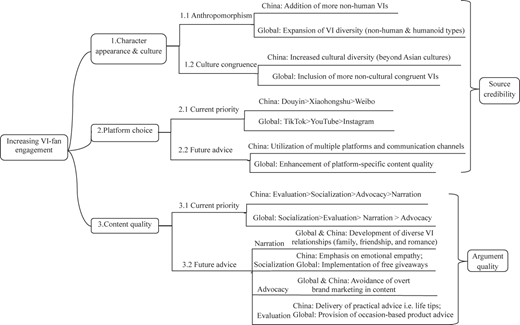
From a practical perspective, the findings help increase VIs’ credibility and argument quality, providing strategies to promote fans’ information adoption and engagement. Regarding anthropomorphic appearance and cultural congruence, it is recommended to increase the diversity of VIs, such as non-human Chinese VIs and non-culturally congruent global VIs, as there are no significant differences in VI-fan engagement between different types of samples. For platforms, it is recommended to prioritize using TikTok and Douyin for interacting with fans, as they exhibit the highest VI-fan engagement. Particularly, Chinese VIs could consider using communication channels across more than three platforms to further increase engagement with international fans, as global VIs (e.g. Barbie) interact with their fans via Instagram, YouTube, Facebook, Twitter, Twitch, TikTok, Merch Store, Spotify, e-mail, and official website. In terms of content types, it is advised that Socialization and Evaluation posts be added to evoke emotional empathy and provide occasion-matching suggestions, thereby further increasing VI-fan engagement. For Narration and Advocacy with lower engagement, consider developing diverse relationships—family, friendship, and romance—through VI partnerships, and avoid explicitly showcasing brand marketing intentions (see Figure 3).
Limitations for future research
This study has several limitations, which shed light on future research. Specifically, the current analysis is limited to 10 top Chinese and global VIs, and the findings regarding the anthropomorphic and cultural effects of VIs on fan engagement differ from those of previous studies. Therefore, future research can include more VIs from different regions and other variables to validate the findings of this study. Additionally, the focus of this study is on VI-fan engagement rather than examining the cultural effects of VIs. Hofstede’s cultural dimensions theory suggests that the analysis of cultural factors includes six dimensions. Therefore, further investigation into which cultural dimensions may affect VI-fan engagement would provide valuable insights for future research.