


Universities are increasingly encouraging students to join LinkedIn, a professional networking site (PNS), to enhance their employability prospects. Our study explores the double-edged sword of LinkedIn use among university students with a focus on its contrasting psychological impacts of stress and well-being.
Drawing on self-determination theory (SDT), conservation of resources theory (CORT), and recent social media research, this study proposes a theoretical model to explain users’ motivations for LinkedIn use, their experiences of LinkedIn-induced stress and well-being and how users deal with these experiences. Our model was tested via a survey of 221 undergraduate students and the use of structural equation modeling.
Results indicate that LinkedIn-induced well-being, stemming from the digital support of students’ basic psychological needs for autonomy, belongingness and competence, enhances their intrinsic motivation to engage with the platform. However, LinkedIn is also found to generate stress – driven by excessive demand and privacy threats – which undermines intrinsic motivation. Furthermore, LinkedIn well-being is found to be a personal resource that students leverage to manage this stress.
This study examines students’ experiences on LinkedIn, a PNS that has received less scholarly attention than hedonic social networking sites. Using SDT and CORT, we highlight the coexistence of stress and well-being on non-compulsory, utilitarian PNSs like LinkedIn. We further demonstrate how LinkedIn-derived well-being helps students manage LinkedIn technostress, addressing a key research gap, as few studies explore how social media users mitigate stress through positive mechanisms.
1. Introduction
According to a recent study by the U.S. Department of Labor, the average American will have held 10 jobs by the age of 40 (2023). Amid rising job transitions, professional networking has become paramount for success in the Future of Work (Cho and Lam, 2021). In fact, many experts suggest that at least four in five jobs are secured through professional network connections (Fisher, 2019). Naturally, in today’s digital age, networking increasingly takes place online, with professionals voluntarily leveraging professional networking sites (PNSs) to build and engage with their networks. Among the most popular sites for professionals is LinkedIn, a platform allowing users to create profiles, establish connections, join industry-specific communities, share their expertise and knowledge, as well as seek job opportunities (Cho and Lam, 2021). With millions of active job listings and an impressive six hires per minute (LinkedIn, n.d.), LinkedIn has emerged as an indispensable tool for continuous professional engagement and career development, essential in an era characterized by frequent job transitions.
Amid LinkedIn’s rising popularity, universities—often ranked by graduate employment rates—are increasingly encouraging students to create LinkedIn profiles to enhance their employability prospects (Mogaji, 2019). While LinkedIn’s career benefits are evident, promoting further social media use among young adults raises concerns, particularly with reports of their potential negative impacts on the rise (Cheng et al., 2021). This presents a dilemma for universities and researchers. On the one hand, recent studies suggest that LinkedIn participation not only offers employment advantages but also provides psychological benefits by enhancing users’ sense of connectedness and self-efficacy (Cho and Lam, 2021). On the other hand, numerous studies link higher social media use among adolescents and university students to negative outcomes such as poor academic performance and heightened mental health risks (Riehm et al., 2019). Given such findings, the decision to promote LinkedIn among students is not clear-cut. Despite LinkedIn’s unique properties, a review of the literature reveals that LinkedIn remains underexplored, particularly with respect to studies investigating the platform’s positive and negative impacts as coexisting phenomena. Furthermore, scholars such as Healy et al. (2023) have emphasized the need for deeper inquiry into LinkedIn to ensure that educators promoting it and leveraging it as a pedagogical tool “provide effective, empowering, and safe learning experiences for students” (p. 122).
Against this backdrop, our study aims to explore the double-edged sword of LinkedIn use by university students, with a focus on its psychological impacts, a sparsely researched area. To date, social media research has largely centered on hedonic social network sites (SNSs) like Facebook and Instagram. However, SNSs and PNSs differ fundamentally, with platforms like LinkedIn attracting distinct user groups with unique motivations, purposes, engagement patterns, and perceptions (Chang et al., 2017). These differences underscore the need for dedicated investigation (Davis et al., 2020). Importantly, PNSs also differ from enterprise social media (ESM), which primarily facilitate knowledge sharing within organizational boundaries (Boukef et al., 2024) and thus have distinct psychological implications. To address this gap, we draw on self-determination theory (SDT) and conservation of resources theory (CORT), along with recent social media and LinkedIn-specific research, to examine LinkedIn’s dual psychological effects.
Through a survey of 221 undergraduate students and the use of structural equation modeling (SEM), we found that LinkedIn use can simultaneously enhance students’ well-being and intrinsic motivation to use the platform, while also engendering stress due to both the excessive demand stemming from social interactions and the perceived privacy threats associated with maintaining their profile and presence on LinkedIn. Furthermore, our findings indicate that students’ well-being, stemming from the digital satisfaction of their basic psychological needs of autonomy, belongingness, and competence, constitutes an important personal resource that helps users to reduce their experience of LinkedIn-induced stress.
Our study makes several contributions. Firstly, it highlights the psychological mechanisms underlying users’ experiences of well-being, motivation, and technostress in the PNS context. Secondly, by distinguishing PNS from hedonic SNS and utilitarian ESM, it emphasizes the unique psychological dynamics of these platforms, particularly in relation to professional identity management and career-related pressures. In doing so, the study advances the broader understanding of IT duality, demonstrating that stress and well-being can coexist on voluntarily adopted PNS like LinkedIn. Finally, leveraging SDT and CORT, it shows that LinkedIn-derived well-being serves as a critical personal resource that helps users mitigate LinkedIn-induced technostress. This addresses a research gap, as few studies explore how social media users manage stress through positive mechanisms (Zhang et al., 2019). Our findings suggest that users are likely to continue using LinkedIn if the well-being derived is sufficient to offset resource losses (Hobfoll et al., 2018). From our findings, we offer practical recommendations to LinkedIn developers and universities to help students and other users navigate the platform’s psychological demand while maximizing its benefits.
The remainder of this paper is structured as follows. First, we review the existing LinkedIn literature. We then introduce the foundational theories of SDT and CORT, discussing their relevance within social media contexts; this discussion is followed by our theoretical development. Next, we outline our research methodology and present our analyses and results. We conclude with a discussion of the study’s limitations, contributions, and directions for future research.
2. Literature review
A wide range of social media platforms exists today, including SNSs like Facebook and Instagram, media-sharing platforms such as YouTube, and microblogging platforms like X (formerly Twitter), among others. Unlike other popular social media, which are primarily designed for hedonic use, LinkedIn is specifically intended for professional networking, job seeking, and recruitment (van Dijck, 2013). While hedonic SNSs dominate existing research, there is a notable paucity of studies examining social media use for professional reasons, with even fewer focusing specifically on LinkedIn and other PNSs (Davis, 2020). Addressing this gap is crucial, as PNSs—like LinkedIn, ResearchGate, and Xing [1]—differ fundamentally from their SNS counterparts and warrant dedicated investigation (Chang et al., 2017). Although research on LinkedIn has grown in recent years, researchers argue that significant gaps remain (Tifferet and Vilnai-Yavetz, 2018).
Our review of the LinkedIn literature identifies three overarching themes of inquiry. To provide a structured understanding of this body of work, we briefly outline each theme and clarify our study’s positioning within this research landscape. As a note, the themes identified are not mutually exclusive, as some studies address multiple aspects of LinkedIn use. Our full literature review and summary table are available in online Appendix A.
The first theme we identified examines the facilitators of and barriers to LinkedIn usage. Research in this area highlights how expected rewards drive LinkedIn adoption (e.g. Cho and Lam, 2021; Smith and Watkins, 2023), as well as the ways in which individual differences, such as demographics, personality traits, and cultural backgrounds, influence usage patterns. The second theme explores LinkedIn use by candidates, employees, and recruiters. This theme is particularly well-developed. Studies in this area examine how recruiters and HR professionals leverage the platform to shape, support, and enhance recruitment and selection processes, as well as how jobseekers manage their self-presentation strategies. Additionally, research in this area explores LinkedIn’s role as a pedagogical tool, particularly in relation to professional networking, career development, and industry insights (e.g. Healy et al., 2023).
The third theme examines the outcomes of LinkedIn use, with research largely focusing on its career-related impacts on individuals, organizations, and key sectors like higher education. While some studies have also explored LinkedIn’s psychological effects, both positive and negative, this area remains comparatively underexplored. Notably, most prior research has concentrated on LinkedIn’s negative psychological impacts, particularly the factors that deplete users’ resources (Choi and Lim, 2016), while relatively few studies have examined LinkedIn’s positive effects. More importantly, only a handful of studies (e.g. Chang et al., 2017; Oliver et al., 2024) have investigated the coexistence of both positive and negative psychological experiences.
Our study contributes to the literature by bridging Themes 1 and 3. While much of the existing research focuses on the professional motivations behind LinkedIn use, our study extends this perspective by examining how these motivations relate to the satisfaction of users’ psychological needs. By integrating research on LinkedIn’s facilitators and benefits (Theme 1) with studies on its psychological outcomes (Theme 3), we offer a more nuanced theoretical understanding of LinkedIn use. Additionally, building on emerging work within Theme 3, our study explores LinkedIn’s dual psychological effects, specifically, the interplay between LinkedIn-induced well-being and stress and their influence on users’ intrinsic motivation. Through this approach, we aim to provide a more comprehensive understanding of LinkedIn’s psychological impacts, grounded in the foundational frameworks of SDT and CORT, which we discuss next.
3. Theoretical background
3.1 Self-determination theory and the fulfillment of psychological needs
SDT is a broad framework for studying human motivation and personality. According to SDT, motivation can take two forms: intrinsic motivation, where individuals engage in an activity for its own sake; and extrinsic motivation, where individuals engage in an activity for external reasons, such as tangible rewards and recognition (Gagné and Deci, 2005). Formally, SDT is a macro-theory that delineates intrinsic and extrinsic sources of motivation and explains their roles in cognitive and social development, as well as in individual differences (Deci and Ryan, 2000).
SDT includes six micro-theories, each explaining specific dimensions of motivation and personality functioning. Among these micro-theories, the Basic Psychological Needs Theory (BPNT) emphasizes the foundational role of autonomy, belongingness, and competence in fostering psychological well-being and optimal functioning. The need for autonomy refers to an individual’s desire to experience a sense of choice, volition, and psychological freedom when engaging in an activity. The need for belongingness refers to the desire to be meaningfully connected to, feel cared for, and understood by others. Lastly, the need for competence refers to an individual’s desire to feel skilled and efficacious with respect to a goal, function, or task. At the core of BPNT is the notion that when these three needs are fulfilled, individuals experience greater psychological health and intrinsic motivation. Conversely, the frustration of any of these needs leads to specific declines in well-being, which, in turn, undermine motivation (Ryan and Deci, 2022).
Notably, SDT and BPNT have been validated in various contexts, including education, organizations, healthcare, and sports. Irrespective of the setting, a central tenet of SDT is that social and environmental characteristics are key determinants of an individual’s motivation. Thus, SDT scholars often examine how socio-environmental factors, such as leadership styles and peer support, affect the satisfaction of a person’s basic psychological needs (BPNs). Consequently, SDT research generally describes and assesses an individual’s environment in terms of whether its “supports” or “thwarts” basic needs (Jabagi et al., 2019). Recently, researchers have increasingly explored how technology affects human motivation and well-being. Within this research, SDT and BPNT have been particularly valuable in explaining the dynamics of SNS use. For instance, Karahanna et al. (2018) proposed that SNS use depends on users’ expectations of fulfilling psychological needs. This idea is central to Positive Technologies, Design, and Computing, which emphasize well-being-driven design (Peters et al., 2018). Following this tradition, we adopt SDT to explain PNS motivation.
3.2 Conservation of resources theory and stress
CORT is a “motivational theory that explains much of human behavior based on the evolutionary need to acquire and conserve resources for survival” (Hobfoll et al., 2018, p. 104). The theory broadly defines resources as objects, conditions, personal characteristics, and energies that individuals value or use to obtain additional resources. According to CORT, individuals experience stress when they perceive their resources as insufficient to meet environmental demands. This can occur when resources are genuinely depleted or perceived as at risk of depletion. CORT’s resource-oriented perspective of stress is grounded in the idea that people are inherently driven to acquire, retain, protect, and nurture resources they consider essential to their well-being (Hobfoll, 2001).
The theory is anchored in two foundational principles that emphasize the central role of resource dynamics in shaping human behavior and stress responses. The first, the resource investment principle, posits that people invest resources to gain additional resources, as well as to offset any actualized or potential stress (Hobfoll et al., 2018). For instance, a person might invest resources to recover from actual resource loss (e.g. hiring a tutor after performing poorly on an exam to regain confidence and improve future performance), to protect against potential resource loss (e.g. investing in a home security system), and/or to gain new resources (e.g. enrolling in a certification course to enhance career prospects and job opportunities).
The second principle, the primacy of loss principle, asserts that resource loss has a greater psychological impact than an equivalent resource gain. Simply put, while acquiring resources can help alleviate stress, the effects of resource loss are typically more intense and enduring. This asymmetry highlights that resource losses weigh more heavily on individuals’ well-being than the relief provided by comparable gain (Hobfoll, 2001).
In recent years, CORT has been used to explore the contradictory dark and bright sides of SNS use (e.g. Cheikh-Ammar, 2020), and to unpack paradoxical SNS behaviors among users, such as increased self-disclosure on SNS in response to social media overload (e.g. Zhang et al., 2019). We draw on these studies, and on CORT’s resource investment principle, to explain LinkedIn-induced technostress and the mechanisms through which users manage these stressors.
4. Research model and theoretical development
Our research model depicted in Figure 1 integrates SDT and CORT to explain two contrasting outcomes of LinkedIn use, well-being and stress, and to explain their opposing effects on a person’s intrinsic motivation to use LinkedIn. By synthesizing these theories, our model offers a robust lens for examining the duality of LinkedIn use by showcasing how LinkedIn well-being and stress coexist and shape users’ intrinsic motivation.
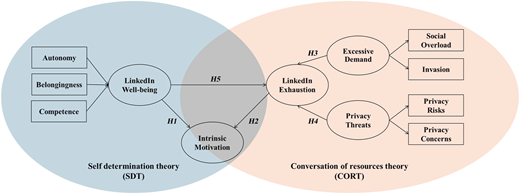
SDT and CORT have important theoretical overlaps, which ensure their compatibility and integration. First, both are theories of motivation grounded in the premise that individuals seek pleasure and avoid pain. Specifically, SDT suggests that individuals seek out contexts that satisfy their BPNs, thereby fostering their growth and fulfillment (Greguras et al., 2014). Similarly, CORT suggests that people engage with their environment to acquire and safeguard their resources to ensure their survival and success (Hobfoll et al., 2018).
Second, both theories share similar views on the types of personal characteristics or attributes considered as inner resources. Specifically, CORT recognizes companionship, intimacy with others, and social support (paralleling SDT’s belongingness concept) as well as self-efficacy (akin to SDT’s competence concept) as valued resources. CORT also identifies autonomy, or the sense of control, as a personal resource, mirroring SDT’s autonomy concept (Hobfoll, 2001; Hobfoll et al., 2018). Finally, both theories consider personal resources as key assets for dealing with undesirable events or situations. For instance, SDT suggests that environments that satisfy a person’s BPNs also strengthen their inner resources, thereby enhancing their resilience to adverse events and situations (Vansteenkiste and Ryan, 2013). This SDT perspective aligns with CORT’s principle of resource investment, which holds that individuals strategically allocate their resources to protect against resource loss, recover from loss, and gain new resources to better manage present and future challenges.
4.1 LinkedIn well-being and intrinsic motivation
People innately enjoy activities associated with the satisfaction of their needs and the positive experiences connected to such fulfillment (Cheikh-Ammar, 2020). In fact, SDT and BPNT propose that individuals actively seek out environments that support their BPNs and avoid those that thwart them (Ryan and Deci, 2000). The role of digital environments in fulfilling individuals’ BPNs is well-documented in the extant literature. For instance, Peters et al. (2018) found that digital interfaces that support users’ BPNs increase user engagement and motivation. Similarly, Jabagi et al. (2019) proposed that digital labor platform architectures can support gig workers’ intrinsic motivation for gig work by satisfying workers’ BPNs, while Chiu (2021) found that the digital support of students’ needs increased motivation in blended-learning environments.
In this paper, LinkedIn well-being is understood as the fulfillment of a user’s BPNs, and it is conceptualized as a second-order formative construct comprising autonomy, belongingness, and competence. Based on prior research, LinkedIn appears well-suited to support all three BPNs and to drive intrinsic motivation for its use. For instance, LinkedIn has been shown to support autonomy by providing professionals with control over their career planning and development (Smith and Watkins, 2023). It can foster autonomy by enabling users to engage in self-expression and impression management (Paliszkiewicz and Mądra-Sawicka, 2016). LinkedIn has also been shown to fulfill users’ needs for belongingness by facilitating interpersonal communication and relationship development (Cho and Lam, 2021), by providing social support (Davis et al., 2020), and by enabling users to experience positive feedback and a sense of community (Cho and Lam, 2021). Finally, LinkedIn has been shown to fulfill users’ needs for competence by offering work assistance and career guidance (Davis, 2020), as well as opportunities to share, acquire, and develop skills and expertise (Cho and Lam, 2021).
In summary, to the extent that LinkedIn supports users' BPNs, it will energize individuals to initiate action in the form of platform use (Cho and Lam, 2021; Karahanna et al., 2018). Consequently, users will be more likely to engage with the platform voluntarily and to experience it as intrinsically motivating (Ryan and Deci, 2022). Therefore, we propose that:
LinkedIn well-being is positively related to intrinsic motivation.
4.2 LinkedIn exhaustion and intrinsic motivation
Similar to other social media platforms, PNSs can be sources of technostress (Tarafdar et al., 2020) which manifest as exhaustion (Maier et al., 2015). PNS exhaustion “refers to the feeling of being tired and mentally drained as a result of engaging in [PNS] activities” (Cheikh-Ammar, 2020, p. 8), and it is typically caused by various stressors related to the platform and its use (Maier et al., 2015).
According to CORT, when individual resources are depleted, individuals experience stress (Hobfoll, 2001). The resource-depleting effects of LinkedIn use have been documented in prior research. For example, Johnson and Leo (2020) found that prolonged LinkedIn engagement, particularly for job-search activities, can result in ego depletion— “a state of having diminished resources following the exertion of self-regulation” (p. 1265). Additionally, other studies have highlighted the resource demands associated with LinkedIn. Factors such as system complexity and the time required to learn and effectively use the platform have been shown to reduce users’ motivation to adopt or continue using LinkedIn.
We stipulate that when users feel fatigued and exhausted from using a PNS, they are less likely to find the PNS enjoyable (Cheikh-Ammar, 2020; Cho and Lam, 2021). Consequently, they are likely to reduce or stop using the PNS as a defensive strategy to protect their resources (Ali et al., 2024; Maier et al., 2015). Regardless of whether they reduce or discontinue their use, individuals experiencing PNS exhaustion are less likely to engage in PNS activities due to the stressful, or resource-demanding, nature of their PNS usage. Importantly, fatigue has been linked to negative emotional outcomes, including anxiety, depression, and burnout (Bright et al., 2015). These outcomes are inversely related to intrinsic motivation, which thrives on positive affective states and well-being (Choi and Lim, 2016; Ryan and Deci, 2022). Therefore, we propose that:
LinkedIn exhaustion is negatively related to intrinsic motivation.
With LinkedIn exhaustion defined, we now build on CORT and prior work (e.g. Cheikh-Ammar, 2020) to theorize two types of stressors that contribute to PNS exhaustion, namely, stressors arising from actual resource depletion and stressors stemming from perceived threat of resource loss. More specifically, we theorize that Excessive Demand constitutes a form of actual resource depletion, as it requires users to continuously invest time and effort in the PNS. Conversely, we theorize that Privacy threats constitute a perceived threat of resource loss, as concerns over unauthorized access to one’s personal information and its potential exploitation create anticipatory stress.
4.2.1 Excessive demand and exhaustion
Central features of social media—including SNS, PNS, and ESM—comprise the ability to form relationships, engage in conversations, share personal information, and join communities (Karahanna et al., 2018; Kietzmann et al., 2011). In leveraging these features, users invest considerable resources in engaging with and reacting to other users’ content. Such behavior is frequently driven by subjective social support norms within a user’s community and expectations of reciprocation. Regardless of the underlying motivation, constantly providing social support—like feedback or validation—demands considerable time and effort, which can become overwhelming over time. We refer to this situation of actual resource depletion as excessive demand. More concretely, excessive demand in a PNS context refers to situations where users believe they are receiving and responding to too many social support requests, consuming an excessive amount of their time (e.g. Maier et al., 2015). We conceptualize excessive demand as comprising Maier et al.’s (2015) two stressors, namely, social overload and invasion.
Social overload occurs when users feel burdened by the need to acknowledge, support, and entertain their online connections (Choi and Lim, 2016). Following Maier et al. (2015), we define social overload in the context of a PNS as a user’s perception of giving “too much social support to their virtual friends”, colleagues, and/or PNS connections (p. 281). To our knowledge, no studies have specifically examined social overload on LinkedIn. However, research highlights LinkedIn’s central role in personal branding and professional identity management (e.g. Endacott et al., 2024; Tifferet and Vilnai-Yavetz, 2018). Given LinkedIn’s emphasis on professional visibility, we postulate that users may feel pressured to invest considerable time not only curating their profiles but also engaging with others’ content to enhance their professional image. This includes adhering to subjective social support norms, such as congratulating connections on job changes or achievements. Such commitments can lead to social overload, depleting users' resources. Moreover, akin to other social networking contexts, as one’s LinkedIn network grows, so does the potential burden and risk of exhaustion (Choi and Lim, 2016; Maier et al., 2015). Notably, this phenomenon extends beyond social media. For example, Hobfoll (2001) noted that women with larger networks experienced greater psychological distress during periods of widespread community stress, as the increasing demands of supporting others depleted their resources.
Importantly, the stress associated with the excessive demand of a PNS is not limited to a user’s online experience. Rather, this demand can spill over into a user’s personal life offline. Due to their ubiquity and the constant connection they afford, social media can entrap users in environments where they feel perpetually expected to be available, leading to increased stress and a sense of continuous surveillance (Maier et al., 2015). In such situations, users may feel their personal time has been invaded by the PNS as they are forced to “borrow” from their personal time to manage continuous PNS communications (Hobfoll et al., 2018).
In summary, excessive demand stemming from both the provision of social support and the intrusions into a user’s personal life depletes a user’s resources, leading to significant stress and exhaustion. This relationship is aligned with previous research. For instance, Choi and Lim (2016) found that both SNS and PNS were associated with overload that interferes in users’ offline lives (e.g. work, sleep, and social activities), resulting in anxiety and compulsive social media use. Therefore, we propose that:
Excessive demand is positively related to LinkedIn exhaustion.
4.2.2 Privacy threats and exhaustion
As a reminder, CORT suggests that, in addition to stress caused by the actual depletion of one’s resources, an individual may experience stress if the depletion of their resources is perceived as possible (Hobfoll, 2001). The expectation of resource loss can lead to anticipatory stress—stress that is independent of actual resource depletion. In this study, we focus on privacy threats as a key source of anticipatory stress and exhaustion for LinkedIn users. Privacy threats are broadly defined as users’ perceptions of the potential loss of their personal information—a key resource—due to intentional or unintentional dangers associated with social media use (Cheikh-Ammar, 2020).
Privacy threats are an inherent drawback of social media, and the information-sharing practices they entail (Cheung et al., 2015; Krasnova et al., 2010). Social media users reveal their identities by disclosing information such as their age, gender, location, and profession; they also shape their online identities through the self-disclosure of subjective information, such as thoughts, feelings, likes and dislikes (Kietzmann et al., 2011). Following established theories of social network embeddedness, high-density environments such as PNSs give rise to tensions between structural factors (e.g. the number of participants, the nature of interactions, and their structural arrangements) and the pursuit of personal goals (e.g. privacy, behavioral freedom, and control over social interactions) (Maier et al., 2015).
Due to privacy concerns relating to the unlawful access to their personal information and due to privacy risks relating to the danger of exposing personal information to unauthorized exploitation, we propose that LinkedIn users may perceive threats to their privacy. According to Claybaugh and Haseman (2013), privacy concerns are of particular importance to LinkedIn, since a user’s profile makes it very easy for the user to be identified. Moreover, privacy concerns on LinkedIn have been found to positively influence perceived privacy risks, which, in turn, are negatively associated with users’ continuance intentions (Chang et al., 2017). Drawing on prior research, we propose that privacy threats can lead to resource depletion as users experience anxiety about the unauthorized access to their personal information and the potential harm associated with its release (Cheikh-Ammar, 2020). This depletion of resources may account for the negative impacts, both direct and indirect, of privacy concerns and privacy risks on users’ continuance intentions observed by Chang et al. (2017).
It is important to recognize that LinkedIn users generally expect to be able to leverage PNS features and functionalities to control what information they share and with whom it is shared (e.g. Kietzmann et al., 2011). Prior research suggests that when consumers control their information, their perceived privacy risks are reduced (Cheung et al., 2015). This implies that perceived privacy threats stem from users’ fears that their expectations are unmet or compromised (Bélanger and Crossler, 2011). If users believe their privacy expectations are not satisfied, leaving their personal information susceptible to unauthorized access, theft, or use, they may experience significant stress even if these threats never occur. Similarly, persistent doubts about their protection from such threats can emotionally drain LinkedIn users, leading to exhaustion. For instance, concerns surrounding privacy on LinkedIn have been shown to cause stress among academic users and to deter their use (LaPoe et al., 2017).
In short, privacy threats lead users to anticipate experiences of resource depletion in the form of negative energies like stress and anxiety. Therefore, we propose that:
Privacy threats are positively related to LinkedIn exhaustion.
4.3 The relationship between LinkedIn well-being and stress
People experiencing stress generally seek adjustments to alter this unpleasant reality, a mechanism recognized by both SDT and CORT. Within SDT, people are considered proactive organisms who strive to optimize their life conditions and who tend to avoid environments that thwart their BPNs. Moreover, when they perceive their BPNs as chronically thwarted by an environment, they engage in need substituting and compensatory behaviors (Vansteenkiste and Ryan, 2013). Within CORT, people are also viewed as proactively engaging with their environment, but with the goal of minimizing the net loss of resources. CORT stipulates that when facing actual or potential resource loss, people engage in behavioral changes such as seeking resource replacements, resource re-evaluation, and/or shifting their perspective to reinterpret a resource threat as a challenge (Hobfoll, 2001).
Both SDT and CORT recognize well-being as an inner resource that fosters resilience in the face of difficult situations by promoting emotional stability, a positive outlook, and better health (Hobfoll, 2001; Hobfoll et al., 2018; Vansteenkiste and Ryan, 2013). Drawing on both theories, we argue that individuals experiencing LinkedIn exhaustion will leverage their resources to deal with the stress endured. Specifically, we propose that users’ well-being, derived from LinkedIn’s digital support of their BPNs, serves as a key personal resource that people mobilize to compensate for the exhaustion caused by resource loss (Excessive Demand) and the threat of resource loss (LinkedIn Privacy Threats).
Building on this, we propose that LinkedIn well-being, rooted in the fulfillment of users’ BPNs (Cho and Lam, 2021), enables users to engage in resource re-appraisal and/or resource replacement strategies (Hobfoll, 2001) by broadening their thought-action repertoires through positive mental affect—a crucial component of well-being. For instance, users with greater well-being are more likely to interpret LinkedIn exhaustion as a signal to prioritize offline activities and personal interactions, thereby conserving mental energy. By substituting time spent on LinkedIn with offline activities, like exercise, in-person socializing, or professional connections (resource replacement), these users replenish their psychological resources and reduce fatigue. Similarly, individuals with higher well-being may be more likely to view exhaustion caused by privacy threats as manageable risks (resource re-appraisal), prompting them to adopt better privacy practices without undue stress (Krasnova et al., 2010). In sum, by fostering emotional stability, a positive outlook, and a proactive mindset, well-being enhances users’ ability to identify and implement mitigation strategies more effectively to address the impacts of LinkedIn stress and exhaustion. Therefore, we propose that:
LinkedIn well-being is negatively related to LinkedIn exhaustion.
5. Research methodology
To test our research model, a cross-sectional survey was disseminated to undergraduate students at a large North American business school. Students were offered course credit in exchange for participating. A total of 365 students responded. Through data cleansing, we removed responses with incomplete answers, failed attention checks, or outlier response times. Our final sample size (n = 221) exceeded the minimum threshold for sufficient statistical power. Specifically, assuming an estimated effect size of 0.3 and a statistical power of 0.8, with a probability level of 0.01, a minimum sample of 161 respondents was required (Benitez et al., 2020).
5.1 Measurement instrument
5.1.1 Items
Pre-existing measurement instruments were adapted to measure our constructs in the LinkedIn context. LinkedIn well-being was specified as a second-order formative construct with three dimensions—autonomy, belongingness, and competence—each measured with reflective indicators. Conversely, Excessive demand and privacy threats were specified as second-order reflective constructs, each comprising two dimensions measured with reflective indicators. More specifically, excessive demand included the dimensions of social overload and invasion, while privacy threats included privacy risks and privacy concerns.
Control variables included extent of use (a self-assessment of use ranging from no use to very heavy use), gender, history (users’ experience with LinkedIn as measured in years), minutes per day spent on LinkedIn, perceived ease of use, and perceived usefulness. All constructs were measured using a 7-point Likert scale (1 = totally disagree; 7 = totally agree). See online Appendix B for the measurement instrument. Table 1 displays the distribution of the control variables.
Control variables
| Frequency | Percent | |
|---|---|---|
| Gender | ||
| Female | 86 | 38.9 |
| Male | 135 | 61.1 |
| History | ||
| Less than 6 months | 96 | 43.4 |
| At least 6 months, yet less than 2 years | 61 | 27.6 |
| 2–3 years | 42 | 19.0 |
| 3–4 years | 11 | 5.0 |
| More than 4 years | 11 | 5.0 |
| Minutes per day spent on LinkedIn | ||
| 10 min or less | 133 | 60.2 |
| 11–30 min | 47 | 21.3 |
| 31–60 min | 28 | 12.7 |
| 1–2 h | 10 | 4.5 |
| 2–3 h | 1 | 0.4 |
| 3–6 h | 2 | 0.9 |
| Extent of use | ||
| No use | 27 | 12.2 |
| Minimal use | 77 | 34.8 |
| Occasional use | 50 | 22.6 |
| Moderate use | 29 | 13.1 |
| Frequent use | 20 | 9.0 |
| Heavy use | 10 | 4.5 |
| Very heavy use | 8 | 3.8 |
Note(s): (n = 221)
Source(s): Authors’ own work
5.1.2 Survey design considerations
We implemented various ex ante procedural controls to mitigate common method bias (CMB). Firstly, participants received clear instructions and anonymity assurances to enhance response accuracy. Secondly, neutral wording was used to avoid guiding respondents toward specific answers (Kock et al., 2021; Podsakoff et al., 2003). Thirdly, independent and dependent variables were presented in different parts of the survey to “erase measurement-related clues” (Kock et al., 2021, p. 4), and the ordering of items within constructs was also randomized. Finally, to ensure clarity and simplicity, we avoided using reverse-coded items. We also pretested the survey with the target population (Kock et al., 2021; Podsakoff et al., 2003).
6. Data analysis
6.1 Approach
We tested our path model using partial least squares structural equation modeling (PLS-SEM), a widely preferred method for analyzing path diagrams with latent variables and multiple indicators. We employed PLS-SEM using SmartPLS 3.2.3 for three reasons. Firstly, PLS-SEM should be given preference when the primary research objective is the prediction and explanation of focal constructs. Secondly, PLS-SEM accommodates complex research models with many constructs, indicators, and/or relationships. Finally, PLS-SEM effectively evaluates hierarchical component models with one or more formatively measured constructs, which cannot be assessed using covariance-based SEM (CB-SEM) without construct specification modifications (Hair et al., 2022; Petter, 2018). Our study meets these criteria by examining LinkedIn Well-being and LinkedIn Exhaustion—along with their antecedents—and their impact on Intrinsic Motivation within a complex model comprising nine first-order constructs, three second-order constructs (one formative), and six control variables. Thus, PLS-SEM is the optimal choice (Hair et al., 2022; Sarstedt et al., 2023). Following Hair et al. (2022), we applied a two-stage approach, first validating the measurement model followed by the structural model.
6.2 Measurement model
To start, we examined our measurement model and confirmed the psychometric properties of our instruments (see Table 2) using Cronbach’s alpha (α), composite reliability (CR), and average variance extracted (AVE) indices. Cronbach’s alpha and CR values exceeded the threshold of 0.7 and were below 0.95. Additionally, AVE values for all constructs exceeded the minimum threshold of 0.50. Thus, reliability and convergent validity were confirmed (Ringle et al., 2020).
Construct reliability and convergent validity
| Constructs | Items | Loadings | CA | CR | AVE |
|---|---|---|---|---|---|
| Autonomy | AUTO_1 | 0.816 | 0.816 | 0.821 | 0.646 |
| AUTO_2 | 0.773 | ||||
| AUTO_3 | 0.857 | ||||
| AUTO_4 | 0.765 | ||||
| Belongingness | BLNG_1 | 0.890 | 0.885 | 0.887 | 0.744 |
| BLNG_2 | 0.858 | ||||
| BLNG_3 | 0.822 | ||||
| BLNG_4 | 0.879 | ||||
| Competence | COMP_1 | 0.873 | 0.818 | 0.842 | 0.651 |
| COMP_2 | 0.893 | ||||
| COMP_3 | 0.736 | ||||
| COMP_4 | 0.736 | ||||
| Intrinsic Motivation | IM_1 | 0.914 | 0.913 | 0.918 | 0.851 |
| IM_2 | 0.918 | ||||
| IM_3 | 0.935 | ||||
| Invasion | INV_1 | 0.857 | 0.843 | 0.854 | 0.683 |
| INV_2 | 0.716 | ||||
| INV_3 | 0.858 | ||||
| INV_4 | 0.864 | ||||
| LinkedIn Exhaustion | LEX_1 | 0.935 | 0.915 | 0.917 | 0.854 |
| LEX_2 | 0.927 | ||||
| LEX_3 | 0.911 | ||||
| Perceived Ease of Use | PEOU_1 | 0.816 | 0.901 | 0.921 | 0.772 |
| PEOU_2 | 0.897 | ||||
| PEOU_3 | 0.922 | ||||
| PEOU_4 | 0.875 | ||||
| Perceived Usefulness | PU_1 | 0.733 | 0.874 | 0.883 | 0.614 |
| PU_2 | 0.792 | ||||
| PU_3 | 0.832 | ||||
| PU_4 | 0.765 | ||||
| PU_5 | 0.785 | ||||
| PU_6 | 0.789 | ||||
| Privacy Concerns | PCON_1 | 0.927 | 0.945 | 0.945 | 0.859 |
| PCON_2 | 0.912 | ||||
| PCON_3 | 0.932 | ||||
| PCON_4 | 0.936 | ||||
| Privacy Risks | RISK_1 | 0.911 | 0.900 | 0.907 | 0.771 |
| RISK_2 | 0.915 | ||||
| RISK_3 | 0.789 | ||||
| RISK_4 | 0.893 | ||||
| Social Overload | SOL_1 | 0.916 | 0.910 | 0.915 | 0.737 |
| SOL_2 | 0.886 | ||||
| SOL_3 | 0.819 | ||||
| SOL_4 | 0.883 | ||||
| SOL_5 | 0.781 |
Note(s): N = 221; CA=Cronbach alpha; CR = composite reliability; AVE = average variance extractedSource(s): Authors’ own work
Next, discriminant validity was assessed. Using the Fornell and Larcker criterion, we confirmed that the square-root of the AVE of each construct was higher than its highest correlation with any other construct, ensuring satisfactory discriminant validity (Hair et al., 2017) (see Table 3). Additionally, we assessed discriminant validity using the Heterotrait-Monotrait ratio (HTMT). All values fell below the recommended threshold of 0.85, thereby confirming discriminant validity among the reflective constructs (Henseler et al., 2015). HTMT results are presented in online Appendix C.
Correlations between constructs and the square root of AVE
| 1 | 2 | 3 | 4 | 5 | 6 | 7 | 8 | 9 | 10 | 11 | |
|---|---|---|---|---|---|---|---|---|---|---|---|
| 1. Autonomy | 0.804 | ||||||||||
| 2. Belongingness | 0.501 | 0.863 | |||||||||
| 3. Competence | 0.406 | 0.499 | 0.807 | ||||||||
| 4. Intrinsic Motivation | 0.433 | 0.452 | 0.501 | 0.922 | |||||||
| 5. Invasion | 0.031 | 0.299 | 0.203 | 0.177 | 0.826 | ||||||
| 6. LinkedIn Exhaustion | −0.200 | 0.071 | −0.095 | −0.239 | 0.303 | 0.924 | |||||
| 7. Perceived Ease of Use | 0.275 | 0.183 | 0.451 | 0.370 | 0.001 | −0.199 | 0.878 | ||||
| 8. Perceived Usefulness | 0.321 | 0.344 | 0.505 | 0.527 | 0.215 | −0.121 | 0.461 | 0.783 | |||
| 9. Privacy Concerns | −0.151 | 0.064 | −0.050 | −0.053 | 0.261 | 0.324 | −0.168 | −0.067 | 0.927 | ||
| 10. Privacy Risks | −0.079 | 0.047 | 0.060 | 0.018 | 0.279 | 0.218 | −0.091 | −0.015 | 0.603a | 0.878 | |
| 11. Social Overload | 0.178 | 0.459 | 0.209 | 0.293 | 0.574 | 0.329 | 0.019 | 0.221 | 0.239 | 0.222 | 0.858 |
Note(s): The square root of average variance extracted (AVE) is shown in the main diagonal
We acknowledge that the correlation between privacy concerns and privacy risks (0.603) may appear high. However, it remains below the square root of the average variance extracted (AVE) for each construct, indicating acceptable discriminant validity. As a reminder, these two constructs belong to the second-order reflective-reflective construct of privacy threats. As emphasized by methodological experts (e.g. Hair et al., 2024), in reflective-reflective higher-order constructs, the lower-order constructs (in this case, privacy concerns and privacy risks) are expected to be highly correlated, as the higher-order construct accounts for and explains these correlations. Consequently, this level of correlation is not problematic but rather necessary to support the validity of the measurement modelSource(s): Authors’ own work
To evaluate the LinkedIn well-being construct, we assessed multicollinearity among its three sub-dimensions and their respective significance levels (Kock et al., 2021). All VIF scores for the inner model were below the recommended threshold of 3.3 (see Table 4). Importantly, whereas the weights for the sub-dimensions of autonomy and competence were significant—thereby suggesting that they contribute significantly to the formation of the Well-being construct—the weight for the belongingness sub-dimension was not significant. Given the formative nature of the construct and its theoretical underpinnings, the belongingness sub-dimension was retained (Petter et al., 2007).
Second-order construct assessments
| Description | Dimensions | Weights/Loadings | VIF/CR | p-value/AVE | |
|---|---|---|---|---|---|
| LinkedIn Well-being | Formative | Autonomy | 0.46 | 1.52 | <0.001 |
| Belongingness | 0.20 | 1.60 | ns | ||
| Competence | 0.55 | 2.03 | <0.001 | ||
| Excessive Demand | Reflective Cronbach’s Alpha (0.90) | Social Overload Invasion | 0.92 | 0.91 | 0.57 |
| 0.85 | |||||
| Privacy Threats | Reflective Cronbach’s Alpha (0.92) | Privacy Risks | 0.88 | 0.93 | 0.65 |
| Privacy Concerns | 0.91 |
Note(s): VIF = variance inflation factor; CR = composite reliability; AVE = average variance extractedSource(s): Authors’ own work
6.3 Structural model
Various empirical thresholds for statistical significance and explained variances (R2) were examined (see Table 5). All paths were found to be statistically significant, thereby confirming our hypotheses (Hair et al., 2017). More specifically, consistent with SDT, we confirmed that LinkedIn well-being positively influences intrinsic motivation for LinkedIn (H1: 0.366, p < 0.001). In line with SDT and CORT, we found that LinkedIn exhaustion negatively influences intrinsic motivation for LinkedIn (H2: −0.162, p < 0.01). Moreover, in accordance with CORT, we found that actual stress, stemming from excessive demand (H3: 0.386; p < 0.001), and anticipatory stress, stemming from privacy threats (H4: 0.145; p < 0.05), positively influence LinkedIn exhaustion. Finally, consistent with SDT and CORT, we found that LinkedIn well-being negatively influences LinkedIn exhaustion (H5: −0.202, p < 0.05).
Structural model results
| Paths | Hypotheses | Coefficient |
|---|---|---|
| LinkedIn Well-Being → Intrinsic Motivation | H1 | 0.366*** |
| LinkedIn Exhaustion → Intrinsic Motivation | H2 | −0.162** |
| Excessive Demand → LinkedIn Exhaustion | H3 | 0.386*** |
| Privacy Threats → LinkedIn Exhaustion | H4 | 0.145* |
| LinkedIn Well-Being → LinkedIn Exhaustion | H5 | −0.202* |
| Control variables | ||
| Extent of Use → Intrinsic Motivation | 0.128 ns | |
| Extent of Use → LinkedIn Exhaustion | 0.135 ns | |
| Extent of Use → LinkedIn Well-Being | 0.006 ns | |
| Gender → Intrinsic Motivation | 0.068 ns | |
| Gender → LinkedIn Exhaustion | 0.051 ns | |
| Gender → LinkedIn Well-Being | −0.027 ns | |
| History → Intrinsic Motivation | 0.044 ns | |
| History → LinkedIn Exhaustion | −0.007 ns | |
| History → LinkedIn Well-Being | 0.021 ns | |
| Minutes per Day → Intrinsic Motivation | 0.084 ns | |
| Minutes per Day → LinkedIn Exhaustion | −0.004 ns | |
| Minutes per Day → LinkedIn Well-Being | −0.009 ns | |
| Perceived Ease of Use → Intrinsic Motivation | 0.008 ns | |
| Perceived Ease of Use → LinkedIn Exhaustion | −0.073 ns | |
| Perceived Ease of Use → Well-Being | 0.025 ns | |
| Perceived Usefulness → Intrinsic Motivation | 0.252*** | |
| Perceived Usefulness → LinkedIn Exhaustion | −0.112 ns | |
| Perceived Usefulness → LinkedIn Well-Being | 0.004 ns | |
| Variance explained | R2 | R2 adjusted |
|---|---|---|
| Intrinsic motivation | 0.477 | 0.457 |
| LinkedIn Exhaustion | 0.250 | 0.218 |
Note(s): ***p < 0.001 **p < 0.01 *p < 0.05
Source(s): Authors' own work
6.4 Post-hoc test
Lastly, we conducted statistical tests to examine the differential effects of two relationship sets in our model. Guided by the Primacy of Resource Loss principle, we tested how LinkedIn well-being (resource gain) and excessive demand (resource loss) affect LinkedIn exhaustion. Following Rodríguez-Entrena et al. (2018), we analyzed parameter estimates and bootstrap distributions. Our findings confirm that resource loss (H3: |0.386|) is more salient to stress than resource gain (H2: |0.202|), and that actual resource loss (H3: 0.386) has a greater impact on stress than anticipated loss (H4: 0.145). See online Appendix D for our detailed post-hoc tests.
7. Discussion
In this study, we explored the psychological impacts of LinkedIn on university students. In confirming our hypotheses, our study offers various scholarly and practical contributions.
7.1 Scholarly implications and contributions
Firstly, we contribute to the social media literature through our investigation of LinkedIn—a platform that is understudied compared to hedonic SNS platforms like Facebook. Given that SNSs and PNSs attract distinct user groups characterized by different motivations, purposes, engagement patterns, and perceptions (Chang et al., 2017), explorations into the psychological impacts of LinkedIn are necessary, as they are likely to yield unique insights.
Our study also contributes to the PNS literature in various ways. Specifically, we contribute to the LinkedIn literature exploring the expected uses and benefits of LinkedIn as motivations for its adoption (Theme 1). While most LinkedIn studies examine professional or informational motivations for platform use, our study applies SDT to link these motivations to the satisfaction of users' psychological needs, providing deeper insight into how LinkedIn well-being influences motivation to use the platform. In doing so, we also demonstrate that users can experience intrinsic motivation even when using a predominantly utilitarian PNS like LinkedIn with its strong externalized incentives and rewards (Cho and Lam, 2021).
We also contribute to the literature exploring the psychological impacts of LinkedIn use (Theme 3) by investigating the interplay between LinkedIn’s positive and negative psychological impacts. Specifically, our study adopts an IT duality perspective to explore how LinkedIn use simultaneously fosters well-being and induces exhaustion, shaping users’ overall motivation to engage with the platform. As demonstrated in our literature review, research on LinkedIn’s psychological impacts remains limited compared to studies exploring its utilitarian and career-related outcomes. Moreover, few studies investigate the concurrent experience of positive and negative psychological responses.
Secondly, by employing an integrated theoretical model, leveraging both SDT and CORT, our study offers a more nuanced analysis of user motivation and resource management in the context of PNSs. In combining these theories, our research reveals how LinkedIn can simultaneously act as a resource that fulfills psychological needs and as a source of resource depletion due to excessive demand and privacy threats. Furthermore, our integrated model demonstrates how LinkedIn-induced well-being can mitigate the stress caused by excessive platform demand and privacy threats. Exploring this duality can support researchers aiming to develop interventions and platform designs that maximize benefits while minimizing adverse effects on users. It can inform efforts to teach users healthier ways of engaging with the platform, addressing calls from scholars to prioritize such approaches (e.g. Chang et al., 2017; Healy et al., 2023; Oliver et al., 2024).
Thirdly, we contribute to CORT and its application in information systems (IS) research on technostress. Specifically, our study highlights the distinct roles that actual resource loss—stemming from excessive demand (H3)—and anticipated resource loss—stemming from privacy threats (H4)—play in depleting users’ resources. To further explore these findings, we conducted post-hoc analyses comparing the relative strengths of these relationships. The results confirmed that actual resource loss from excessive demand (H3: 0.386) had a greater impact on stress than anticipated resource loss from privacy threats (H4: 0.145). This finding advances the CORT literature where the relative impact of resource threats versus actual losses remains debated, with evidence supporting both perspectives (Halbesleben et al., 2014).
Additionally, our post-hoc analyses provide further confirmation of the primacy of loss principle, which holds that resource loss (H3: |0.386|) is more salient to stress than resource gain (H2: |0.202|). Given that LinkedIn can simultaneously increase and deplete users’ resources, validating this principle in an online context is particularly significant. It underscores the need for scholars to explore this duality and to identify the mechanisms that mitigate the platform’s dark sides—such as excessive demand and privacy threats—which may be difficult to offset by its positive aspects, including LinkedIn-derived well-being and career-related benefits (Hobfoll, 2001).
Finally, we advance our understanding of IT duality by demonstrating that stress and well-being can be experienced concurrently in PNSs, despite being non-compulsory and utilitarian in nature. In doing so, we provide support for CORT’s resource investment principle, showing that well-being is a personal resource that helps users to manage LinkedIn stress. This contributes to addressing a research gap, as relatively few studies explore how users manage stress through positive mechanisms (Zhang et al., 2019). It also highlights the potential role that Positive Computing can play in mitigating the dark sides of IS. Where enjoyment and intrinsic motivation have been found to be positively related to IS use (Cheung et al., 2015), our findings suggest that users are likely to continue using LinkedIn if the well-being and digital needs support it provides to users are sufficient to mitigate LinkedIn-induced resource losses (Hobfoll et al., 2018).
7.2 Practical implications
Although LinkedIn offers numerous career-related benefits, it is not without criticism. Concerns have been raised regarding its business model, design, structure, and culture. For instance, while users control their profile content, LinkedIn’s normative pressures can hinder authentic self-expression, making it difficult or even risky. More critically, participation on LinkedIn may expose users to privacy and safety risks. Despite these concerns, LinkedIn’s use as a pedagogical tool for career and employability learning remains relatively underexplored. Consequently, there is insufficient evidence to inform effective learning programs or to guide best practices for LinkedIn’s educational use. Scholars have thus called for further research to help educators design safe, empowering, and effective LinkedIn-based learning experiences (Healy et al., 2023).
Our study helps to close this gap by offering practical recommendations for educators, universities, and LinkedIn developers. Within the context of our study, we identified excessive demand as having the most substantial impact on university students’ LinkedIn exhaustion. This finding is significant, as overload and invasion are well-documented negative predictors of social media satisfaction (Maier et al., 2015). Moreover, SNS overload has been found to be a strong predictor of SNS addiction, particularly among undergraduates (Choi and Lim, 2016). For universities promoting LinkedIn, this underscores the need to educate students about information privacy and PNS overload. Universities could implement programs like those at Stanford University, which offer courses on creating effective online presences, managing privacy, networking, and balancing professional and personal engagement. Additionally, encouraging students to use free apps like ScreenZen, which track and limit online activity, offers a cost-effective way to mitigate overload. These interventions foster healthier PNS engagement and help students navigate professional networking more effectively.
For PNS developers the challenge lies in balancing user engagement with mechanisms that prevent overload, which could lead to withdrawal or platform abandonment. Enhancing user autonomy through status options such as “available,” “idle,” or “hidden” (Kietzmann et al., 2011) could reduce overload while supporting autonomy and belongingness needs (Karahanna et al., 2018). Filtering mechanisms to limit incoming messages (Maier et al., 2015) could further enhance user experience. Additionally, developers could incorporate Positive Computing principles, which promote well-being and help users manage PNS-induced stress. As well-being enhances intrinsic motivation and resilience, such features could attract and retain users while fostering healthier engagement.
By tackling excessive demand and privacy threats, our recommendations aim to sustain LinkedIn as a valuable tool for professional networking and employability learning while safeguarding users’ well-being. Through targeted efforts by educators, universities, and developers, LinkedIn can provide effective and empowering experiences for students and professionals alike.
7.3 Research limitations and future research avenues
This study has certain limitations—some of which present future research opportunities. The first limitation concerns our sample selection. Specifically, while we focused on young adults due to their increased susceptibility to internet-induced technostress (Lozano-Blasco et al., 2022), this decision may limit the generalizability of our findings. Additionally, all our participants were current LinkedIn users.
Considering these limitations, future research should study individuals across different age groups, as well as non-users and ex-users, to confirm the generalizability of our findings. Future research could also explore the role that personality traits and skills play in our research model. According to CORT, individuals’ traits and skills impact how they appraise, acquire, and protect their resources, as well as how they cope with stress (Hobfoll, 2001). SDT research has also found that individuals’ autonomy- and control-orientations play a role in managing stress (Vansteenkiste and Ryan, 2013). Thus, integrating concepts like resilience or self-efficacy within our model could provide deeper insights into the mechanisms of stress and resource management.
8. Conclusion
The increase in the number of jobs held per person over their career is a hallmark of the Future of Work. With some experts predicting that today’s youngest cohort of workers, Gen Z, will experience more job transitions and hold many careers over their lifetime (Broom, 2023), it is likely that students and young professionals will increasingly leverage LinkedIn to drive career success. Given young adults’ susceptibility to PNS stress, we hope that scholars will continue to explore LinkedIn to help users better balance its possibilities and pitfalls.
Ethical declarations
Formal approval from an independent ethics committee was sought prior to any data collection involving human subjects. The research was confirmed to meet all ethical guidelines and to adhere to the legal requirements of the country where the study was conducted. This study was approved by the Western University Non-Medical Research Ethics Board (NMREB). File Number: 107,531.
Note
ResearchGate is a European PNS for researchers and scientists to share research, discuss, and collaborate. XING is a Hamburg-based career-oriented networking site.
The supplementary material for this article can be found online.

