Even though previous studies have investigated the usage of generative artificial intelligence (AI) tools such as chat generative pre-trained transformer (ChatGPT) in developed countries, only a few studies have tried to explore the continued usage of these tools in the context of accounting education sustainability in developing countries like Jordan. Therefore, the primary purpose of this study is to examine the factors that influence the usage and continuance of ChatGPT among accounting students for educational purposes, based on an integrated unified theory of acceptance and use of technology model with protection motivation theory.
Based on data collected from accounting students in Jordanian higher education institutions, the proposed research model is verified using a partial least squares structural equation modelling approach.
The study results found that performance expectancy, effort expectancy, social influence and protection motivation significantly influence ChatGPT usage. Moreover, ChatGPT usage was found to significantly affect continuance usage of ChatGPT.
The results of the current study offered crucial implications for accounting students, instructors and policymakers at universities eager to integrate generative AI tools such as ChatGPT in educational settings.
1. Introduction
One of the generative artificial intelligence (AI) tools is chat generative pre-trained transformer (ChatGPT), which was officially launched in November 2022 and within the first five days of its launch, it earned more than one million users, surpassing the prior records set by well-known social media platforms such as Facebook, Twitter and Instagram, among others (Al-Okaily et al., 2025a). Since its launch, users have been using ChatGPT for different purposes in an educational context. ChatGPT can be defined as an AI chatbot that can generate human-like text and interact with the user with great affectation and understanding (Al-Okaily et al., 2025b). According to Adiguzel et al. (2023), ChatGPT is a qualified model that answers inquiries, questions and follow-up questions in a human-like and conversational way. In this regard, several previous studies focused on the usability of ChatGPT for educational purposes (Tiwari et al., 2024; Iranmanesh et al., 2024).
The investigation of critical factors that may affect the usage of ChatGPT is not a novel research topic in developed countries (Wu et al., 2025; Sergeeva et al., 2025). Yet, understanding the antecedent factors that affect the continuance usage of ChatGPT in the context of accounting education sustainability in developing countries like Jordan is somewhat unique. Consequently, the purpose of this study is to investigate the antecedent factors that directly influence continuance usage of ChatGPT in the context of accounting education sustainability by integrating the unified theory of acceptance and use of technology (UTAUT) and the protection motivation theory (PMT). Therefore, the current study contributed to the existing body of knowledge on how changing ChatGPT services affects student behaviour in higher education institutions in the Jordanian context, concentrating more on long-term continuance usage rather than initial usage.
The current research is important since the results aim to provide recommendations and valuable guidelines in the context of the continuance usage of ChatGPT in developing countries like Jordan. Therefore, the problems which were explained earlier highlight the main research question, which is:
What factors influence the intention to continue using ChatGPT for educational purposes among Jordanian accounting students?
To answer this research question, the current study used well-established arguments from UTAUT and PMT and data collected from participants who have used ChatGPT in the context of accounting education. Regarding the research objective, the research intends to examine factors that may influence the intention to continue using ChatGPT in the context of accounting education in Jordan. Consequently, the main research objective is formulated as follows: to find out the factors that can lead to continuance usage of ChatGPT among Jordanian accounting students by integrating the UTAUT model with PMT.
The remainder of this article is organised as follows. Section 2 offers a literature review and hypothesis development. The research methodology is then conceptualised in Section 3. Data analysis and results are presented in Section 4. Section 5 presents a discussion of the implications of the research results. Limitations and directions for future work are presented in Section 6. The last section is dedicated to the research conclusion.
2. Literature review and hypotheses development
The existing literature reveals that numerous studies have been conducted worldwide, shedding light on various aspects of generative AI (GenAI) in education. For example, Sun and Hoelscher (2023) highlight a crucial consideration to keep in mind regarding GenAI in education, which is the potential risk of students becoming overly reliant on it. This could impede their critical thinking, problem-solving and independent learning skills (Alazmi and Alemtairy, 2024; Parker et al., 2024). As an AI-powered tool, GenAI also raises broader ethical concerns, such as plagiarism and privacy, as well as the potential for biases and the production of inaccurate information (Samara et al., 2024). On the flip side, numerous studies highlight the potential of GenAI as an innovative educational tool in various fields, including higher academic education (Ilieva et al., 2023), statistics and data science (Ellis and Slade, 2023), testing and evaluation in school education (Jauhiainen and Guerra, 2023), medical education (Wong et al., 2023), as well as learning analytics (Chang et al., 2023).
In this regard, numerous studies tried to integrate the UTAUT proposed by Venkatesh et al. (2003) and the theory of planned behaviour (TPB) proposed by Ajzen and Fishbein (1975) and the technology acceptance model (TAM) proposed by Davis et al., (1989) with the PMT in an information technology usage and continuance context. According to recent studies, Al-Okaily et al. (2025c) integrated PMT with TAM to explore the antecedent factors that directly influence FinTech usage, which in turn affects continuance intention to use FinTech products in the post-COVID-19 era and the results revealed that most of the proposed hypotheses were accepted. Furthermore, Al-Ghazo et al. (2024) demonstrated the role of AI-enabled health systems in the Jordanian context by integrating the PMT and TAM. Notably, the results reveal that perceived severity and perceived vulnerability have a significant positive impact on the perceived need for digital contact tracing apps (CTAs), which, in turn, affects the individuals’ intention to use CTAs. It also reveals that perceived trust in government, perceived privacy and perceived usefulness have a significant positive impact on individuals’ intention to use CTAs, which, in turn, affects the usage of CTAs.
The current research adopted the UTAUT model proposed by Venkatesh et al. (2003) as the primary theoretical foundation for the current study model and extended it with the PMT developed by Rogers et al. (1975) to get a better understanding of the antecedents that affect the continuance usage of ChatGPT in the educational setting in developing countries like Jordan. The PMT is one of the most well-established theories which attempt to illustrate how people initiate and implement protective behaviours. Although ChatGPT has been widely used in the cross-world, studies have been conducted on the continuance usage of ChatGPT in the educational setting, which is sparse, especially in developing countries like Jordan.
To adapt UTAUT and PMT in the ChatGPT context, the current study proposed several relationships as illustrated in Table 1. In this regard, the key constructs of UTAUT [i.e. performance expectancy, effort expectancy and social influence (SI)] were integrated with the construct of PMT [i.e. protection motivation (PM)] to have a strong model providing an accurate picture of the major aspects that shape ChatGPT usage in the Jordanian context. However, the proposed model excludes the intention to use, as this factor is considered unsuitable to the context of continuance usage, where the current study focused on ChatGPT continuance usage rather than the initial intention. To avoid the research model complexity, the relationship between the facilitating condition and intention was also excluded.
2.1 Performance expectancy (PE)
Venkatesh et al. (2003, p. 447) defined performance expectancy as “refers to the degree to which an individual believes that using the system will help him or her to attain gains in job performance.” Venkatesh et al. (2003) derived performance expectancy from five constructs from prior information TAMs, namely, (1) perceived usefulness in TAM and C-TAM-TPB, (2) relative advantage in innovation diffusion theory (IDT), (3) extrinsic motivation in motivational model, (4) job fit in model of pc utilization (MPCU) and (5) outcomes expectations in social cognitive theory. In the context of ChatGPT, previous studies have found a positive relationship between performance expectancy and the intention to use ChatGPT for educational purposes (Iranmanesh et al., 2024; Tiwari et al., 2024; Strzelecki et al., 2024; Budhathoki et al., 2024). Theoretically, it is claimed that the higher the performance expectancy of ChatGPT, the higher the Jordanian student’s behavioural intention to use ChatGPT will be when they believe that usage of ChatGPT will improve their academic achievement and productivity. Accordingly, this study proposes the following hypothesis:
There is a positive association between the performance expectancy and actual usage of ChatGPT.
2.2 Effort expectancy (EE)
According to Venkatesh et al. (2003), effort expectancy is defined as “refers to the degree of ease associated with the use of the system” (Venkatesh et al., 2003, p. 450). Venkatesh et al. (2003) derived effort expectancy from three constructs from prior information TAMs: (1) perceived ease of use in TAM, (2) complexity in MPCU and (3) complexity in IDT. Reviewing the previous studies, effort expectancy was found to be a significant factor in predicting behavioural intention in several contexts (e.g. Al-Qaysi et al., 2024; Strzelecki et al., 2024; Iranmanesh et al., 2024; Alazmi et al., 2023; Al-Okaily et al., 2024). In addition, Foroughi et al. (2024) and Budhathoki et al. (2024) found that effort expectancy has influenced significantly the intention to use ChatGPT. In a related context, it is expected that if the Jordanian student’s perceptions about ChatGPT usage are free of effort and answers student questions easily, then they will play a vital role in the usage of ChatGPT. Therefore, this leads to the following hypothesis:
There is a positive association between the effort expectancy and actual usage of ChatGPT.
2.3 Social influence (SI)
SI is defined as “the degree to which an individual perceives the importance of others to believe that he or she should use the new system” (Venkatesh et al., 2003, p. 450). SI is similar to subjective norms in TRA, TPB and C-TAM–TPB (Venkatesh et al., 2003). According to Venkatesh et al. (2003), individuals generally behave in a certain way to live up to the expectations of their peers, relatives and colleagues. In addition, previous studies have demonstrated that positive opinions from peers, friends, relatives and family members serve as a motivating factor for individuals to adopt new technology (Al-Okaily and Al-Okaily, 2025a). According to the above studies, technology users who are encouraged by positive social network signals are more likely to have a strong behavioural drive to use new technology. In the context of ChatGPT, various previous studies showed that SI has a significant and positive relationship with student intentions, which, in turn, contributes to the usage of ChatGPT (Strzelecki et al., 2024; Al-Qaysi et al., 2024; Tiwari et al., 2024). In the context of current research, SI can have an important effect on the student intentions towards compliance with the usage of ChatGPT because they can be influenced by the recommendations of colleagues around them in the university. Therefore, this study assumes the following hypothesis:
There is a positive association between the social influence and actual usage of ChatGPT.
2.4 Protection motivation (PM)
Another direct construct of the actual usage (AU) of ChatGPT in the proposed research model is PM. In fact, PM did not come from constructs of the UTAUT model, but PMT suggests PM as a success factor might directly influence the decision to use new technology while taking security precautions (Al-Ghazo et al., 2024). PM is defined as “an intervening factor connecting risk and fear perceptions to behavioral intentions” (Rogers et al., 1975). Rogers et al.(1975) stated in the PMT that severity and expectancy of exposure influence the adoption of a recommended response. In this study, PMT was assumed to focus primarily on measuring the perception of people’s safety/protection. For this reason, constructs directly related to infection prevention and deemed as motivations to use ChatGPT. On the other hand, due to the study being conducted during the period of the coronavirus pandemic, the desire to avoid the expected danger of coronavirus and the expectation as to how this can be achieved through using ChatGPT and thus, will greater behavioural intentions which, in turn, directly influence the decision to continue using ChatGPT while taking security precautions. Consequentially, this study proposes the following hypothesis:
There is a positive association between the PM and actual usage of ChatGPT.
2.5 Actual usage (AU)
AU refers to the extent to which end users have used information technology usage for decision-making purposes in their respective fields (Choudhury and Shamszare, 2023). Notably, the existing literature attests to a positive correlation between the AU of technology and their inclination to continuously use it, as evidenced by numerous studies (Strzelecki et al., 2024; Jeyaraj et al., 2023). According to Bhattacherjee et al.(2001), continuance usage intention is the willingness to continue using a currently used IS and the current study considers it as a proxy for actual continued use behaviour (Jeyaraj et al., 2023). Given these established relationships in educational technology, it is expected that similar dynamics apply to ChatGPT, a widely used AI in student learning contexts (Strzelecki et al., 2024). Thus, this study believes that more users interacting with ChatGPT will give them more chances to evaluate how well it meets their needs, which will raise their satisfaction and strengthen their willingness to keep using it. Consequently, the current hypothesis implies that as users’ actual system usage strengthens, their intentions to continue using ChatGPT will similarly increase. Hence, this study proposes the following hypothesis:
There is a positive association between actual usage and continuance usage of ChatGPT.
3. Methodology
To achieve the main purpose of the current research, a quantitative research method with a purposive sampling technique was used to collect data from 582 actual users of ChatGPT. The purposive sampling technique is helpful when the process of recruiting participants in the study is established by choosing individuals with matching characteristics (Al-Okaily and Al-Okaily, 2025b). However, one of the limitations of using a non-probability sampling with the purposive sampling technique is that it negatively affects the generalisability of findings. Therefore, potential studies can be conducted by using a probability sampling to avoid potential biases and, hence, the generalisability of results.
The survey was divided into two parts: demographic characteristics and an ethical approval statement to participate in the current study, as well as measurement items, which were graded on a five-point Likert scale ranging from “1, strongly disagree” to “5, strongly agree”. The survey was created in English and then translated into Arabic by an expert translator, due to Arabic is the native language in Jordan. A second translator then reverse-translated the Arabic version into English to ensure the accuracy of the Arabic items. Cronbach’s alpha value was investigated for survey measurement items and the yielded values were found to be higher than the threshold of 0.70 as suggested by Hair et al. (2014).
Finally, a preliminary set of measurement items that were previously operationalised and validated in empirical studies and demonstrated good reliability. The measurement items were adapted from related past research and modified to suit the current research context (as can be seen in Table 1). The main constructs of UTAUT, performance expectancy, effort expectancy, SI and AU were measured by items used by Venkatesh et al. (2012) and Venkatesh et al. (2003). Meanwhile, PM was measured by three items adapted from Boss et al. (2015). Finally, continuance usage was measured using two items adapted from Bhattacherjee et al. (2001) and Mathieson et al. (1991). Table 1 below shows the measurement items and sources.
4. Data analysis and results
4.1 Evaluation of the measurement model
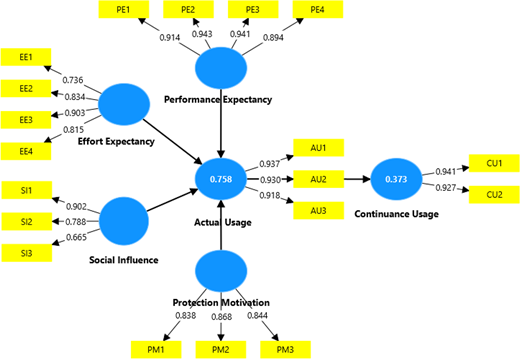
Evaluation of the measurement model is the first step to analysing the model of structural equation modeling by internal consistency reliability, convergent validity and discriminant validity. As shown in Table 2 and Figure 1, the factor loadings, Cronbach’s alpha and composite reliability for all items and factors surpass the cut-off point. With respect to average variance extracted (AVE), the AVE measures the variance encapsulated by the indicators relative to measurement error and this should be higher than 0.50 to justify the use of the construct (Hair et al., 2014).
Concerning discriminant validity, discriminant validity is defined as “the extent to which a construct is truly distinct from other factors by empirical standards” (Hair et al., 2014, p. 104). In the current study, there is a method to assess the discriminant validity, namely, the Heterotrait-Monotrait (HTMT) correlation matrix, which should be below 0.90 (Henseler et al., 2015). The HTMT criterion has high sensitivity and specificity in detecting discriminant validity problems and more empirical evidence is needed to use this approach (Henseler et al., 2015). In addition, the Fornell and Lacker criterion exists if the diagonal values are greater than other off-diagonal values in the rows and columns (Fornell and Larcker, 1981). The results also show that all indicators load is higher on their respective constructs than on any other constructs in the path model. Accordingly, as shown in Table 3, the results of the HTMT and Fornell–Larcker methods meet the recommended value range.
4.2 Evaluation of the structural model
Evaluation of the structural model is the second step of the partial least squares structural equation modelling analysis. According to Valerie et al. (2012), Stone-Geisser’s test is calculated by the following formula: Q2 = I−SSE/SSO. Based on the recommendation of Hair et al. (2014), the model of the current study has predictive relevance considering that the values of the cross-redundancy are greater than zero. The results show that the obtained cross-validated redundancy values for AU and continuance usage were found to be 0.810 and 0.689, respectively, which shows large predictive relevance. Thus, it is suggested by these results that the current research model has adequate prediction relevance.
To establish the significance of the association, the current study has used the statistics of the 0.95 confidence intervals. An association is significant if the lower and upper limits of the 0.95 confidence interval do not include zero. Consequently, from the bootstrapping of the structural (inner) model, the path analysis output confirmed that the AU of ChatGPT is significantly and positively influenced by performance expectancy, effort expectancy, SI and PM. Furthermore, the results indicated that the continuance usage of ChatGPT is significantly and positively influenced by AU, as can be shown in Table 4 below.
5. Discussion and implications
This study investigated antecedent factors that impact the continuance usage of ChatGPT in the context of accounting education in developing countries like Jordan. Based on data collected from participants who have used ChatGPT in the context of accounting education. The study found that performance expectancy, effort expectancy, SI and PM significantly influence ChatGPT usage. Moreover, ChatGPT usage was found to significantly affect continuance usage of ChatGPT.
As expected, performance expectancy and effort expectancy were found to have a significant impact on ChatGPT usage, which agrees with the UTAUT model introduced by Venkatesh et al. (2003, 2012). In the context of ChatGPT, performance expectancy and effort expectancy have been identified as significant predictors of ChatGPT usage in previous research (e.g. Al-Qaysi et al., 2024; Iranmanesh et al., 2024; Alazemi et al., 2025). This implies that students are more likely to use functional technologies like ChatGPT when they have high levels of performance expectancy and effort expectancy. In the context of the current research study, the findings suggest that students in Jordanian higher education institutions believe ChatGPT is useful and it is easy to use ChatGPT, as well as does not require much effort; they are more likely to use it and thus the related hypotheses (H1 and H2) were accepted.
The empirical results also confirmed the hypothesis (H3), which assumes a positive association between SI and AU of ChatGPT and hence the related hypothesis was accepted. This implies that other people’s opinions, such as friends and peers, have a significant role in the usage of ChatGPT. Accordingly, students’ willingness to use ChatGPT is highly influenced by the opinions of influential colleagues in their universities. In this regard, various previous studies confirmed that SI has a significant and positive relationship with student intentions, which, in turn, contributes to the usage of ChatGPT (Al-Qaysi et al., 2024; Tiwari et al., 2024).
Likewise, H4 suggests a positive association between PM and AU of ChatGPT. The study outcome found that PM is the second strongest predictor of usage. These results are consistent with previous research that has demonstrated a positive correlation between PM and AU in various contexts, such as AI-enabled health systems (Al-Ghazo et al., 2024). In this regard, due to the study being conducted during the period of the coronavirus pandemic, the desire to avoid the expected danger of coronavirus and the expectation as to how this can be achieved through using ChatGPT. This indicates that students are more likely to have stronger intentions to use ChatGPT when they experience a stimulus to protect themselves from the severity and danger of coronavirus.
Unsurprisingly, the results show that AU has a significant impact on the continuance usage of ChatGPT and hence H5 was accepted. These results are consistent with previous research that has demonstrated a positive correlation between AU and continuance usage in several contexts, such as ChatGPT software (Strzelecki et al., 2024; Jeyaraj et al., 2023) and e-learning systems (Alazmi et al., 2024). This indicates that students interact more with ChatGPT when it gives them more chances to evaluate how well it meets their needs, which will raise their satisfaction and strengthen their willingness to continue using it.
Practically, the interdisciplinary implications of this study offer crucial insights for educators, policymakers and researchers eager to incorporate GenAI into educational frameworks. For educators, the identified themes – including academic integrity, medical education and game-based learning – showcase GenAI’s extensive applications across diverse teaching environments. By focusing on pivotal issues such as research methodology and academic integrity, educators can strategically select GenAI tools that enhance curriculum goals and address ethical concerns. For example, examining GenAI’s influence on academic integrity can empower educators to develop guidelines for responsible AI use in assignments, effectively mitigating fears around academic dishonesty. In addition, game-based learning and medical education findings highlight GenAI’s capacity to foster engaging and specialised learning experiences, enabling educators to connect meaningfully with students and achieve targeted learning objectives.
6. Limitations and future studies
Although the results of the current study offer several implications that have been mentioned earlier, a few limitations should be considered in future research. One of the research limitations is that the current study was validated by applying quantitative data collected from students in Jordanian higher education institutions by a purposive sampling technique, which could negatively affect the generalisability of findings. Subsequently, future studies can be conducted by reapplying qualitative data with cross-sectional data to obtain a deeper understanding of circumstances of ChatGPT usage over time to ensure the validity of findings and, therefore, the generalisability of results. In conclusion, the current study investigated the direct effect of PM on the usage of ChatGPT. However, future work could focus on considering PM as an indirect effect variable (mediating or moderating effects) with contextual or confounding variables, such as the role of social media or cultural contexts, which could refine the understanding of these influences in educational settings.
7. Conclusion
The current study contributed to the existing body of knowledge in both theoretical and practical contributions. In this regard, the study attempts to fill the gap in the existing continuance usage research literature by integrating two most well-known theories, namely, UTAUT and PMT, to gain a better understanding of the critical determinants for the continuance usage of ChatGPT. In addition, the current study contributed to the existing body of knowledge on how changing ChatGPT services affects student behaviour in higher education institutions, concentrating more on long-term continuance usage rather than initial usage, especially in specific contexts like Jordan, which is extremely different from any time addressed previously. Consequently, this research can be considered among the first studies in the Jordanian context to integrate the UTAUT and PMT, aiming to gain a better understanding of the critical motivational factors influencing ChatGPT continuance usage.