Purpose
This study aims to investigate the contribution of knowledge-intensive business services firms to small- and medium-sized manufacturers’ digital servitization journeys, addressing the standardization versus customization dichotomy of services and solutions provision.
Design/methodology/approach
To identify the challenges that small- and medium-sized firms must face in the digital servitization journey and the role that knowledge-intensive business services firms may play in the innovation processes, the authors conduct a review on two still unrelated literature streams and develop a longitudinal single-case study, with a particular focus on knowledge generation mechanisms.
Findings
Digital servitization is a particularly challenging transformational journey for minor firms. Knowledge-intensive business services firms can act as sources, facilitators, and carriers of knowledge, and they can orchestrate further contributions of other external partners and firms.
Research limitations/implications
The paper contributes to theory describing the roadmap and the role of external service providers in digital servitization journeys of smaller firms’, that are frequently excluded from mainstream research although being the backbone of European economies.
Practical implications
Digital servitization in minor manufacturing firms requires a long-term orientation and a multi-stage roadmap. Mixing standardized technology-based solutions and complementary professional services, knowledge-intensive business services firms can significantly contribute to lowering the journey’s uncertainties, operational complexity, and costs.
Originality/value
The paper sheds lights on how the collaboration between knowledge-intensive business services firms and small manufacturers generates novel knowledge and capabilities that contribute to takle the challenges of the different stages of the digital servitization roadmap.
Highlights:
Digital servitization is a transformational journey particularly challenging for minor size manufacturers that are the backbone of European economy.
Digital servitization in SMEs requires a long-term orientation and a multi-stage roadmap.
The contribution of KIBS firms in customers’ digital servitization is twofold: they act as sources, facilitators and carriers of knowledge; and they orchestrate further contributions of external firms.
Partnering with KIBS can greatly favour the digital servitization journey in SMEs; mixing standardized solutions and complementary services, KIBS firms can significantly help in reducing costs and operational complexity.
1. Introduction
Servitization is “the transformational process whereby a company shifts from a product-centric to a service-centric business model and logic” (Kowalkowski et al., 2017a, 2017b, p. 8). In this move, digital technologies play a crucial role (Momeni and Martinsuo, 2018; Paiola and Gebauer, 2020). Previous research claims that digital servitization (DS) can bring remarkable benefits (Baines et al., 2009; Paschou et al., 2020). However, this transformation is risky (Gebauer, 2005), as it impacts radically the business model (BM) configuration of product-centric firms (Kohtamäki et al., 2019; Visnjic et al., 2017). In addition, the necessity of introducing digital technologies to support the move to digital services may require qualified contributions from external partners (Hasselblatt et al., 2018; Andersson and Mattsson, 2016). This is particularly true in the case of small- and medium-sized enterprises (SMEs) that frequently need partners to integrate their capabilities and tackle with such complex innovations (Rajala et al., 2008; Franco and Haase, 2015; Saccani et al., 2014). In this scenario, companies that provide knowledge-intensive business services (KIBS) are recognized as important carriers of innovation for SMEs (Muller and Doloreux, 2009; Zhou et al., 2017). For this reason, some studies address the contribution of KIBS firms to servitization of large and small manufacturers (Kohtamäki and Partanen, 2016; Ayala et al., 2017). However, many aspects of this interplay remain largely underexplored (Rapaccini et al., 2020a, 2020b; Grandinetti et al., 2020). This is particularly the case of minor businesses that are frequently excluded from mainstream research (Luoto et al., 2017). With a particular focus on servitization enabled by digital technologies, i.e. the so-called “digital servitization” (Ayala et al., 2019; Bustinza et al., 2021), this paper aims at filling this gap. More specifically, this study answers the following questions:
What are the problems that SMEs face in their DS journey?
What are the contributions made by KIBS firms to address the mentioned problems?
The remainder of the paper is organized as follows: Section 2 presents the theoretical background of this study. Firstly, this section shows the problems that SMEs face in their DS journey and responds to RQ1. Then, it summarizes the review of a second stream of literature, which as said regards the mechanisms through which KIBS firms play their roles as agent of innovation in the context of SMEs. Section 3 illustrates the research methodology use to collect empirical material, while Sections 4 and 5, respectively, present and generalize the paper findings. This section also connects the contributions made by KIBS firms to the DS roadmap that has been identified. Section 6 concludes this study, highlights its implications and limitations and suggests avenues of future research.
2. Theoretical background
2.1 Digital servitization in small- and medium-sized enterprises
DS is the enablement of servitization through digital technologies (Ardolino et al., 2017; Paschou et al., 2020; Gebauer et al., 2021). The rationales that drive manufacturers to infuse services into their businesses include the erosion of margins from product sales, the intensification of rivalry and the search for new business opportunities (Michalik et al., 2019). Like larger firms, SMEs can be forced into servitization by competitive pressures and product commoditization (Confente et al., 2015). When servitization is successfully implemented, manufacturers can differentiate their offerings (Man et al., 2002), increase revenues and profits (Kowalkowski et al., 2017a, 2017b), stabilize their cash flows (Kowalkowski et al., 2013) and mitigate the impact of global crises (Rapaccini et al., 2020a, 2020b). The shift of manufacturers to digital services has been observed in numerous industries and involves firms of different sizes (Paschou et al., 2020; Ambroise et al., 2018), but it does not always represent a panacea (Baines et al., 2009). Servitization is seen as a risky move that forces to tackle with extremely ill-structured problems (Struyf et al., 2021). When dealing with DS, firms also need to take into account the effect of digitalization (Confente et al., 2015). For instance, these originate as cost savings in service delivery (Kanovska and Tomaskova, 2018), insights from data collected from connected equipment (Basirati et al., 2019) or higher differentiation from rivalry (Peillon and Dubruc, 2019; Coreynen et al., 2017). There is, however, no free meal, as digitalization brings more complexity and changes to the organization and practices (Kanovska and Tomaskova, 2018; Kohtamäki et al., 2020).
The extant literature acknowledges that even smaller firms can profit from the infusion of digital services in their product-centric businesses (Grandinetti et al., 2020). However, this move requires tackling with various problems (Chalal et al., 2015; Teso and Walters, 2016; Tauqeer and Bang, 2018). These are summarized in Table 1.
The relevance of external contributions in the move towards digitally based forms of servitization highlights how inter-organizational relations are crucial in such transformations, especially in the context of minor manufacturers. Industrial marketing scholars have used the network approach to conceptually and empirically investigate buyer–supplier relationships (Håkansson and Snehota, 1995). Using a dyadic or a multi-actor interface perspective (Anderson et al., 1994; Araujo et al., 2016), adopting the firm’s strategy and the institutional points of view (Waluszewski, 2011), this literature maintains that some of the elements that explain why some BM innovations are more successful than others could be embedded in buyer–supplier relationships. Partnering with technology-based service providers and KIBS may contribute to value creation (Aarikka-Stenroos and Jaakkola, 2012).
Recently, the relational perspective has extended its focus on the effects of digitalization on product and service innovation, investigating subjects that are particularly significant for this study, such as the interdependencies implied by BtoB solutions among suppliers and end-user firms in capital goods industries (Windahl, 2015); the role of platforms in digital transformation (Andersson and Mattsson, 2016); the impact of co-creation with customers in the provision of BtoB advanced services (Ruiz-Alba et al., 2019); the evolution of small-sized KIBS firms from consultants to Industry 4.0 solutions providers (Mersico et al., 2022); and the relevance of interfaces between manufacturing firms and Internet of Things (IoT)-related suppliers within DS initiatives (Ferreira and Lind, 2022).
The mentioned literature contributed to the shaping of this paper. In fact, we assume that DS is a complex innovation that challenges the business architecture of product-centric firms (Visnjic et al., 2017). We also assume that KIBS partners can help manufacturers – especially minor firms – to address this transformation. The next sub-section reviews the literature on this topic.
2.2 Contributions of knowledge-intensive business services firms to small- and medium-sized enterprise innovation
Any firm providing knowledge-intensive services to business customers can be defined as a KIBS firm (Miles et al., 1995). This broad definition includes not only consultancy firms and providers of professional service but also technology vendors and system integrators (Zhou et al., 2017). The literature discriminates between two major categories, namely, professional (P-KIBS) and technological KIBS (T-KIBS) (Miles et al., 1995). The first group includes those firms that provide professional services such as tax and accounting, law and engineering. T-KIBS instead provide technology-based solutions through goal-oriented projects and services. By mixing different mechanisms for crafting novel knowledge, both T-KIBS and P-KIBS firms can contribute to SMEs innovation (Strambach, 2001; Das and Teng, 2002; Shearmur and Doloreux, 2013). They in fact induce changes to the practices and routines of their clients (Muller and Zenker, 2001). In particular, it is agreed that T-KIBS create opportunities for innovation, while P-KIBS support their implementation (Miles et al., 1995; D’Antone and Santos, 2016).
In this interplay with their customers, KIBS enable the generation of new knowledge (Wagner et al., 2014) or the codification of the existing one (Drejer and Vinding, 2005). In this sense, KIBS act as knowledge source, facilitator or carrier (Muller and Zenker, 2001; He and Wong, 2009; Miles, 2012). The novel knowledge originates by moulding the stocks possessed by the KIBS with those of its customer. Otherwise, they can be carried by the KIBS across the industries to contaminate new domains. This virtuous cycle has been observed in numerous studies, which confirm that KIBS first absorb, then carry and finally release the absorbed knowledge to the new context (Bettencourt et al., 2002, Paiola, 2012).
In their role of knowledge source, facilitator and carrier, the KIBS implements different forms of interactions with its customers (Muller and Zenker, 2001; Gadrey and Gallouj, 1998; Sundbo and Gallouj, 2000). Zhou et al. (2017) discriminate complementary from supplementary interactions. The first occurs when the knowledge mastered by the KIBS is combined with that of the customer to create some new stocks via in-depth relationships. The second is the case of pre-existing knowledge that is crafted into a solution that the KIBS then gives to its customer. In this latter case, of course, the customers play a less active role, and the corresponding interactions with the KIBS are more easier and focused. The complexity of the interactions between the KIBS and the customer firm also depends on the extent of customization of the services provided (Miles et al., 1995; den Hertog, 2000). The KIBS firms usually tailor their services to meet their customer needs (Muller and Doloreux, 2009; den Hertog, 2000). However, in certain cases, the customer prefers more standardized solutions, which are usually more convenient and faster to adopt (Töllner et al., 2011). Extant literature agrees on the advantages of standardization in the context of smaller business (Tether et al., 2001) and pinpoints that customization–standardization trade-off is an important driver of innovation (Bettiol et al., 2012; Landry et al., 2012). Table 2 summarizes the potential contributions made by KIBS firms to SMEs innovation.
Integrating the considerations of Tables 1 and 2, we can develop the research framework of this study. As mentioned, this paper aims at investigating the contributions made by KIBS firms to address the problems of SMEs undergoing DS. We assume that these contributions may have the form of novel knowledge stocks that are generated in the interplay between the KIBS and their customers. In other cases, these stocks may pre-exist and are just carried across domains by the KIBS. In addition, the novel knowledge could be created through the provision of custom services in goal-oriented projects or through pre-arranged solutions. On the base of this considerations, Table 3 shows the questions on which this study speculates. These questions inform the collection of the empirical material, whose method is explained in the next section.
3. Research methodology
3.1 Case selection
This paper uses an in-depth, longitudinal single-case study (Crotty, 1998; Voss et al., 2002) to advance the current knowledge about the role of KIBS firms in supporting the DS of SMEs, as case-based inductive research is appropriate when dealing with a new topic (Welch et al., 2011). In line with the principles of theory-building empirical research (Meredith, 1993; Meredith, 1998; Melnyk and Handfield, 1998), we used a case study to collect empirical material and explore the phenomena under investigation (Tronvoll et al., 2020). We adopted a longitudinal perspective that brings additional insights and counterbalances the limitations due to lack of replication (Eisenhardt, 1989; Pettigrew, 1990; Yin, 2006).
The eligible case had to comply with the following criteria (Seawright and Gerring, 2008): being a small- or medium-sized manufacturer involved in the DS move; collaborating with a KIBS firm in a long-term goal-oriented project, which allows for longitudinal exploration and retrospective reconstruction; willing to disclose in-depth information from primary and secondary sources; and providing access to acknowledgeable informants (Pettigrew, 1990). In line with similar studies (Grandinetti et al., 2020; Paiola and Gebauer, 2020), the combination of these criteria drastically narrowed the number of eligible firms. A small manufacturing company (hereafter ALPHA; being the names of the firms anonymized for confidentiality reasons) complying with the mentioned criteria was identified. This firm was collaborating with a technology partner (hereafter BETA) that had been entitled to introduce an industrial internet platform through which ALPHA intended to connect the equipment of its customer base. This digital platform would in addition enable the delivery of advanced digital services such as condition monitoring and predictive maintenance.
3.2 Framing the case and the methods for data collection and analysis
According to Leonard-Barton (1990, p. 249), “a case study is a history of a past or current phenomenon, drawn from multiple sources of evidence. It can include data from direct observation and systematic interviewing as well as from public and private archives”. Therefore, we collected data from different sources. Firstly, we used primary data and gathered information from meetings and interviews with managers of ALPHA and BETA. In line with our objectives, the unit of analysis of this paper is represented by the interplay between ALPHA and BETA (Waluszewski, 2011), and the focus is on the contributions made by KIBS (see Table 3) to push forward this complex transformation (Visnjic et al., 2017). At the beginning of the research, the authors established a relationship with the ALPHA director, who was informed about the research aims. We were introduced to some co-workers, such as the managers of the sales, of the service and of the engineering departments. In the case of BETA, which is also a small firm, we interacted with the director/owner and with the software engineer in charge of the ALPHA project. Then, we identified other sources of information such as company presentations, financial reports, sales and maintenance contracts. Finally, in line with Wouters (2009), we obtained other information by the discussion with an MSc Management Engineering student. To fulfil his degree obligations, he actually worked for six months as a full-time intern at ALPHA. During this time, he collaborated actively to the DS project. He then worked with us as an assistant throughout the case study and helped us in shedding lights on the progress of the DS journey. Table 4 summarizes the sources of information and gives more details on informants, meetings and interviews duration.
The collection of information from the mentioned sources spanned two years (2019–2020). Considering the information gathered from the research assistant, our observation covers a four-year horizon (2018–2021). Such extended time spans are comparatively rare in the research on digital innovation (Aarikka-Stenroos and Jaakkola, 2012). As said, primary data source came from direct observations. The authors personally interviewed the managers and employees indicated in Table 4. We followed a semi-structured questionnaires that addressed the questions of Table 3. The interviews were audio-recorded and transcribed. Then, the transcripts were sent to each informant for their review to strengthen the research consistency (Beach et al., 2001; Karlsson, 2016). The interview transcriptions were independently analysed and interpreted by the authors in relation to the paper objectives, having preventively shared the research methods, materials and interpretative logics (Eisenhardt, 1989). In writing the case study, the temporal bracketing method was used (Langley, 1999). The reliability and trustworthiness of the results were strengthened via triangulation of data from different sources (Flick, 2018). Finally, to improve the research credibility and reliability (Lincoln and Guba, 1985), a document with some preliminary findings was submitted for publication in the proceedings of a scientific conference on servitization research, receiving a peer review by experts. The following section presents the findings of the case study.
3.3 Case description
ALPHA is a small Italian manufacturing company with approximately €6m of revenue and 30 full-time employees. It produces generators for technical gas (e.g. hydrogen, nitrogen and zero/dry air). Founded 30 years ago, ALPHA has already achieved a steady scale: the yearly growth, on average, has been less than 3% during the years of this research. ALPHA’s products are mostly sold to industrial customers operating in food and beverage industry and for packaging applications. Irrespective of its small size, the company has a good international reputation and counts over 20,000 installations in 30 different countries. Besides a few smaller German and Italian companies, its rivals are large companies such as Hitachi (335,000 employees), Parker (57,000) or Atlas Copco (34,000). Competition comes also by producers of technical gases sold in cylinders such as the giant Air Liquide (66,000 employees worldwide). To defend its market position, ALPHA has put in place the typical pre- and post-sales offering and provides services such as commissioning, maintenance contracts, warranty extensions and quality certifications. In the early 2018, ALPHA started this ambitious project to connect its installed base with a digital platform and start delivering digitally enabled advanced services. For this aim, ALPHA entered into a partnership with BETA, a small software company but rapidly growing, that has deployed this proprietary platform for DS. This platform can be used by original equipment manufacturers as well by third-party service networks to connect industrial equipment and control remotely their status, check faults, order consumables and spare parts and activate workflows for field services. Adopting the platform requires no particular investments, as this is sold in the form of Software-as-a-Service (SaaS) (i.e. pay-as-you-go). In addition, the platform comes with standard/built-in modules (e.g. navigation panels, menus, dashboards, reports and workflows).
4. Findings
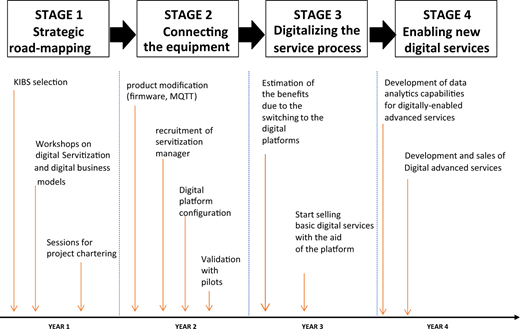
Empirical evidence showed that the DS journey was structured in four stages according to a multi-year roadmap (see Figure 1). This roadmap has been jointly developed by ALPHA and BETA during their initial interactions. More precisely, the sequence of activities to be carried out was proposed by BETA on the base of its previous experiences. ALPHA adapted this sequence to fit with the context. The structure of this roadmap greatly influenced the interplay between ALPHA and BETA, as explained in the following sub-sections.
4.1 Stage 1: strategic road-mapping
As supported by our empirical material, the strategic intentions and commitment of the managing director of ALPHA were key to setting up the stage for the DS project. His decision was boosted by the tax savings granted by the Italian Government to companies investing in connected equipment and Industry 4.0 technologies. The manager envisioned a good opportunity for offering digital services over the connected base to grow the ALPHA business. Being aware that ALPHA lacked adequate resources and skills, he selected a partner (i.e. BETA) to collaborate in the DS project. Their encounter was promoted by an external consultant, who was already into a collaboration with ALPHA. The occasion for a first meeting between ALPHA and BETA was a workshop on digital innovation organized by the local innovation district. The BETA proposal was in line with the ALPHA’s objectives as well with the financial constraints: a digital platform that could be easily set up, with little need of customization – at least in the initial stage – with a pay-as-you-go schema. No ALPHA staff should have been initially allocated full time to the DS project. BETA was therefore considered the right partner to deploy and test some pilot projects with the idea of scaling up in case of success.
In this early collaboration stage, the team covering key positions in ALPHA (e.g. Sales, Aftermarket, Engineering) was asked to be supportive to the project. They organized some meetings to share views in respect to the challenges and risks of DS. They used the BM canvas tool (Osterwalder and Pigneur, 2010) to analyse the current situation and envision the move to digitally enabled advanced services (last stage). This process revealed the possibility to generate new streams of revenues from the sales of basic and advanced digital services:
direct sales – i.e. through the e-commerce module of the digital platform – of spare parts and consumables;
sales of condition monitoring and preventive maintenance contracts; and
sales of energy and process optimization and of productivity management services whose capabilities would have been originated from the data collected through the platform.
It was, however, agreed that the company should have focused on digitizing the current (basic) service offer. To avoid conflicts, it was further decided to on-board to the DS plan the dealer network of ALPHA. The dealers were therefore informed of the intention of developing a new digital service offering that this network would have been entitled to sell. BETA deployed a branded version of the digital platform, which was named “ALPHA4YOU”. In this stage, BETA provided numerous contributions. Firstly, they helped in defining the possible BM based on the offering of digitally enabled advanced services. In doing so, ALPHA provided BETA with information about market opportunities and competitors’ moves. BETA suggested how to digitize and differentiate the actual offer of services. This interplay with BETA was crucial to unveiling prior knowledge possessed by ALPHA. BETA also contributed to a large extent in shaping the strategic roadmap, which was also dictated by the previous experiences of BETA. This company, in fact, had carried out previous projects in industries such as machine tools, ovens and production printers.
4.2 Stage 2: connect products
The second stage of this journey consisted in modifying the electronics and control software of the equipment sold to connect them to ALPHA4YOU. This was done with the aid of an external software company. Although a relevant duty, this impacted little on the DS roadmap. In fact, the technical specifications were defined entirely by BETA. More precisely, the KIBS dictated the requirements for connectivity protocols (e.g. MQTT and other IoT standards), took care of any concern regarding cybersecurity and hacker attacks and orchestrated the work of this third party. At the end, the connection to ALPHA4YOU was enabled from the effort and knowledge of BETA, and little aid was given by ALPHA beside the authorization to lead this task.
This stage was characterized by another relevant fact. Also following the suggestion of BETA, the ALPHA director hired a young manager who was entrusted with the responsibility of the DS project. Besides being the interface with BETA, this manager was asked to perform directly some technical activities on the platform. BETA trained him to deliver autonomously simple interventions (e.g. editing CSS and basic JAVA scripts, working with HTML pages) and customization (e.g. reports, workflows). Through this move, ALPHA fulfilled both the cultural (e.g. developing more digital-oriented mindset) and skill gaps (i.e. support the deployment of the digital platform). The contribution of BETA was again relevant, as they provided the technical training and supported this young professional in playing his role as DS manager withing the company’s organization.
4.3 Stage 3: digitalize the service delivery process
Soon after ALPHA4YOU went live, ALPHA launched a campaign to communicate to its customers the opportunity of having connected machines and a basic offering of digitally enabled services. The DS manager and the company director analysed the benefit of having real-time data from connected machines. These benefits were explicated in terms of potential reduction of the costs of contractual maintenance. At the light of the consistent savings, the director developed a proposal for selling packages of digitally enabled maintenance services to the buyers of new units, if these would have accepted to connect the new equipment to ALPHA4YOU. Similarly, some customers were offered extended warranty coverages. As said, the pay back of these digital services was evaluated by the DS manager who used his knowledge about the ALPHA4YOU functions to conceive the data that the platform could have provided in short, as far as the base of connected machines grows. This information was used to formulate hypotheses about the performance of the digitized service process, in terms of both efficiency (e.g. reduced intervention time, higher productivity) and effectiveness (e.g. increased first-time-fix). It was possible to estimate also the reduction of the delivery costs from the use of ALPHA4YOU. At the end, this leads to setting the prices of this new digital service offer. In addition to supporting the deployment of the platform (for which it was crucial the training released to the DS manager at previous stages), BETA contributed with indications about the actions to put in place to promote such digital offering towards the existing base of customers, as well as to avoid pitfalls with the dealers’ network.
4.4 Stage 4: develop and activate new digital product-service offerings
The objective of this last – still ongoing – stage is to develop further the offering of advanced digital services. As mentioned, the BM at this stage includes the digital sales of consumables and spare parts, and the provision of digital services such as process optimization, productivity management and gas certification. The corresponding e-commerce feature has been recently implemented through the activation of a specific ALPHA4YOU module. This pushed ahead the total sales of ALPHA, which in the last fiscal year reached their highest value (+€6m). Conversely, other advanced services are still under development, and their development is still an early exercise. This latter activity has been in fact delayed due to the impact of COVID-19. The company manager said that they want to accurately assess the financial implications of such advanced offering, before moving further. Analogously, attempts to sell the equipment as a-service have not yet been made. This is indeed the declared target of the DS roadmap originally elaborated. In this last stage, however, the contributions from BETA become more and more rarefied. ALPHA prefers, in fact, to be autonomous in its decision to hold on or move further.
5. Discussion
This case study sheds light on the processual nature of DS in SMEs and shows the contribution made by KIBS to this journey. Empirical evidence confirms that partnering with a firm that provides both professional and technology-based services can facilitate the DS of a smaller manufacturer. This is in line with the extant literature (Miles et al., 1995; D’Antone and Santos, 2016). Tables 5 and 6 generalize our case findings and connect them to the theoretical framework of Section 2. Both these tables summarize the contributions made by KIBS firms to the DS of SMEs. The first discusses these contributions in the perspective of KIBS as innovation agent. Conversely, the second table connects the identified contributions to the problems encountered by SMEs in their move to digital services. Besides integrating the answer to RQ1 that has been given in Section 2.1, these tables respond to RQ2.
6. Concluding remarks
6.1 Conclusions
Despite their role in world economy, SMEs are frequently excluded from mainstream research (Brunswicker and Vanhaverbeke, 2015). In particular, the challenges faced by smaller manufacturers in the transition to digital services have been frequently overlooked (Uden and Naaranoja, 2009; Paiola et al., 2013). Against this background, this paper investigates the problems that SMEs must address in their move to digital services and acknowledges the contributions made by KIBS firms to this transformation (Muller and Doloreux, 2009; Shearmur and Doloreux, 2013; Zhou et al., 2017). We integrate two literature streams and collect empirical material from a longitudinal, in-depth single case study to shed lights on the interplay between a KIBS firm and a small manufacturer that are partners in a DS initiative. We unveil the mechanisms through which novel knowledge and capabilities are generated to address the problems of DS in SMEs. This paper has both theoretical and managerial implications that the next section illustrates.
6.2 Theoretical and managerial contributions
Our findings confirm the relevance of KIBS firms in customers’ innovation claimed by previous studies in the industrial marketing relational perspective (Aarikka-Stenroos and Jaakkola, 2012) and enhance the extant literature maintaining that KIBS firms contribute significantly to the DS journey of SMEs. KIBS’ contributions are manifold, as they complement and supplement numerous capabilities of smaller manufacturers and affect the way in which DS is put into action (Christensen et al., 2017). Specifically, SMEs receive a combination of (customized) P-KIBS and (standardized) T-KIBS along their journey. On one side, customization allows exploring the ill-structured challenges of DS that are context- and industry-specific (Coreynen et al., 2017). On the other, the provision of standard services and pre-arranged solutions reduces the operational complexity connected to the impact of digitalization and servitization. It follows that in the case of SMEs, the theoretical distinction between the two categories of KIBS pointed out by Miles et al. (1995) (i.e. T- and P-KIBS) can be rather blurred.
In line with previous studies (Baines et al., 2020; Paiola et al., 2022a), we also found that cultural and organizational issues can be tackled through multi-year strategic roadmaps through which the company can dictate the pace of the DS journey (Hernandez Pardo et al., 2013; Confente et al., 2015). In minor businesses, it is presumably assumed that complex offerings of digitally enabled advanced services can be developed solely after consolidating the company’s “digital mindset” (i.e. development of the base of connected equipment, digitization of the offered services). This echoes the extant literature around the number and types of external relations to the evolution phase and the technological maturity of manufacturing firms (Leminen et al., 2018).
We also noticed that customized services from the KIBS partner are mostly requested in the early stage of this transformation, while standard services and pre-arranged solutions are more requested in the following stages. For instance, having a ready-to-go digital platform to connect the equipment with IoT technologies can reduce to a great extent the time to market of the basic offering of digital services when advancing through the DS roadmap. It also turned out that smaller firms prefer pay-as-you-go approaches (e.g. SaaS) in respect to the adoption of the mentioned technologies, as this requires lower investments. This seems particularly significant for radical innovations that – such as DS – have higher risks of failure (Consoli and Elche-Hortelano, 2010). Another finding from this research concerns the fact that KIBS firms, at a certain stage of this transformation, can be asked to directly orchestrate some customer’s partners that have to perform some crucial but not strategic tasks. Therefore, we claim that KIBS can also contribute to the creation and orchestration of digital business ecosystems. Lastly, our study confirmed that KIBS firms simultaneously operate as carrier (e.g. previous experiences about DS roadmap) and source (i.e. the digital platform already in place) of knowledge (den Hertog, 2000). Although less frequent, KIBS can give also access to stocks that are existing and required for DS (e.g. specifications and protocols to connect the equipment) (He and Wong, 2009). Lastly, the study confirms that KIBS can be notably attracted by the opportunity of learning from the case company. The reciprocity among the collaborating counterparts can be thus key for the success of DS.
6.3 Limitations and further research
This paper has some limitations. Our findings come from a single-case study. This affects to a large extent their analytical generalizability. Expanding the given theoretical insights in any contexts and situations is somehow questionable. Therefore, a first avenue for future research is to apply our research framework in wider case settings to compare and validate these findings. Samples could include also large firms, and in this case, it could be to address how much the company size moderates the contributions by KIBS firms with respect to the problems and stages of DS. Another avenue is to integrate the empirical investigation with quantitative data to appreciate the statistical relevance of the phenomena under study. Using case-based or survey-based research, further studies could investigate the SME contexts in which the journey to digital services progressed with apparently little or no contributions from external partner.
Because of the longer time span required to show the financial implications of DS, our case does not provide evidence on these aspects. Thus, we cannot infer anything about whether SMEs can reduce the risk of incurring negative results from DS, and how much of this mitigation is due to partnering with KIBS. This is a topic for further developing the research. The last consideration concerns regulatory and environmental factors. We confirm the importance of public funding in creating favourable contexts for innovation (i.e. digital hub, fiscal incentives for investing in digital technologies). It is indisputable that these incentives tipped the balance in favour of the DS initiatives. This also deserves future research.
Funding: The research reported in this article has been funded by the Italian Ministry of Research and Education, under the program PRIN 2015 ‐ Changing Cost and Performance Management Systems to enable business servitization and improve competitiveness of Italian manufacturing SMEs. The research has been carried out in collaboration with the initiatives of the Inter-University Research Center for Servization ASAP (www.asapsmf.org).