


More and more researchers are studying socio-emotional and character development (SECD). The rise and progress in SECD research is encouraging, but there is a critical issue with such a multidisciplinary and fast-developing field: SECD research and evaluation can be more consistent to prevent heterogeneity in definitions and disparate theoretical, measurement, and program models. After summarizing SECD-related literature, I recommend the theory of triadic influence (TTI) as a force to generate consistency and a resource to assist in guiding the design and evaluation of SECD-related programs. The theory fills a gulf in the literature that seeks an ecological theory aligned with SECD-related programs and etiology. The recommendation of the TTI stems from 3 main advantages: (1) The TTI integrates a full range of risk and protective factors in a detailed mediation and moderation framework; (2) it takes a comprehensive view of all the stakeholders in the educational system (i.e., youth, schools, families, and communities); (3) and its utility has been substantiated by empirical evidence from a variety of fields. I discuss applications of the TTI in SECD-related work and suggest improvements for etiology research and the design and evaluation of SECD programs.
Introduction
People have been talking about socio-emotional and character development (SECD) for centuries (Eisenberg & Fabes, 1998; Elias, 2009). SECD education goes back at least to Socrates in the West (Berkowitz & Bier, 2004) and Confucius in the East (Park & Peterson, 2009) and has occurred in some form in the United States since the inception of public schooling (Howard, Berkowitz, & Schaeffer, 2004; McClellan, 1999). Over the last 20 years, research and interest in SECD has intensified (Berkowitz & Bier, 2007; Dusenbury, Weissberg, Goren, & Domitrovich, 2014). Possible reasons for this trend include growing public concern about violence and drug abuse, increasing attention to “youth assets” in the research community (Benson, 1997; Larson, 2000; J. V. Lerner, Phelps, Forman, & Bowers, 2009; R.M. Lerner, 2005) and an increase in funding for SECD-related research and programming. In addition, there is growing understanding that many, if not all, health behaviors are linked (Catalano et al., 2012; Flay, 2002), and SECD-related programs have the potential to positively affect multiple behavioral domains such as conduct-related problems, social and emotional skills, and academic achievement (Catalano, Berglund, Ryan, Lonczak, & Hawkins, 2004; Durlak, Weissberg, Dymnicki, Taylor, & Schellinger, 2011). From a cost-benefit perspective, a recent report by the Center for Benefit-Cost Studies in Education at Columbia University noted that SECD interventions offer strong economic returns (Belfield et al., 2015). Indeed, researchers have suggested that SECD-related fields should become integral to education (Cohen, 2006; Elias, 2014; Elias, White, & Stepney, 2014).
As further demonstration of growing interest, numerous organizations have been established to promote SECD-related concepts, such as the Character Education Partnership (CEP; http://character.org), the Collaborative for Academic, Social, and Emotional Learning (CASEL; http://casel.org), Character Counts (http://charactercounts.org), and the European Centre for Educational Resilience (http://www.um.edu.mt/edres). United States federal, state, and local legislators have increasingly acknowledged SECD-related concepts as important components to education and civil society. The Office of Safe and Drug-Free Schools of the U.S. Department of Education has awarded Partnerships and Character Education Program grants (U.S. Department of Education, 2011). Even public figures, such as U.S. General Colin Powell, who was the first recipient of the CEP’s American Patriot of Character Award, have been candid proponents for enhancing SECD among youth (“American Patriot of Character Award,” 2009).
Even with this escalating support for SECD, practitioners and researchers have noted difficulties that schools face in trying to implement SECD-related programs in the midst of the standards-base environment of present-day U.S. public schooling. Since the No Child Left Behind Act of 2001 passed, core content standards have come to dominate teaching in an effort to improve academic scores, particularly in reading and mathematics, and schools are being judged on their record of test score improvement (Hamilton et al., 2007). Teaching aimed at the behavioral, social, emotional and character domains has narrowed, and teachers spend relatively little instructional time on them (Greenberg et al., 2003; Jones & Bouffard, 2012). This trend, however, has been mitigated in recent years as states (i.e., Illinois, Kansas, and Pennsylvania) have begun to adopt standards for SECD (Dusenbury et al., 2014). In addition, U.S. teachers understand and endorse the importance of SECD-related learning (Civic Enterprises, Bridgeland, Bruce, & Ariharan, 2013). This support for SECD is strengthened by the reality that successful implementation of common core standards requires schools to provide a safe learning environment, manage classroom behavior, prevent drug use, and other health-compromising behaviors (Flay, 2002; Fleming et al., 2005; Wentzel, 1993).
Schools are faced with yet another challenge in implementing SECD-related programming: many of the attempts to implement such programming have not been established with evidence-based practice or evaluated for effectiveness (Berkowitz & Bier, 2007; Durlak et al., 2011). Even with the challenges, many U.S. schools already use programs in an attempt to help students develop social and emotional competencies (Foster et al., 2005). Fortunately, as Berkowitz and Bier (2007) and Higgins-D’Alessandro (2012) note, we are amassing a scientific dossier which should provide a menu from which to select effective SECD-related strategies. In addition, the Collaborative for Academic, Social, and Emotional Learning (CASEL)—an international, university-based, scientific organization comprised of researchers, policymakers, educators, and practitioners—has published a guide to effective programs (CASEL, 2013). Thus, despite the previous challenges, research and resources exist to aid in the selection of evidence-based programs. The purpose of the current paper is to provide a general summary of these and other recent research findings and describe a theoretical framework with practical utility for a field with a strong empirical foundation and an expressed need for such a framework (Berkowitz & Bier, 2007). The framework can serve as an additional tool for researchers and practitioners. Indeed, a scientific field can advance by providing different models from which researchers and practitioners can choose to meet the unique needs of the populations served (R. M. Lerner, Fisher, & Weinberg, 2000). Before this discussion, however, it is useful to gain a better understanding of what SECD is.
Defining Socio-Emotional and Character Development
Theorists, researchers, practitioners, policymakers and the public often care about SECD-related programs because they are linked to the promotion of positive behaviors, such as academic skills (Elias, 2009; Flay & Allred, 2003; Flay, Allred, & Ordway, 2001; Reyes, Brackett, Rivers, White, & Salovey, 2012; Snyder et al., 2010) and the prevention of health-compromising behaviors such as substance use (Tebes et al., 2007), violence (Wilson & Lipsey, 2007), and risky sexual activity (Gavin, Catalano, David-Ferdon, Gloppen, & Markham, 2010). What is SECD? Unfortunately such a simple question lacks a simple answer. Researchers in diverse, but related fields of study frequently use different terminology to describe similar concepts. The SECD-related literature is a web of semantics, and terms often overlap and intersect (Berkowitz & Bier, 2007). Phrases that are often used as synonyms for SECD include social and emotional learning (Durlak et al., 2011; Elias et al., 1997; Merrell, 2010; Payton et al., 2000; Weissberg & O’Brien, 2004; Zins, Payton, Weissberg, & O’Brien, 2007), character education (Berkowitz & Bier, 2004, 2005, 2007), moral education (Althof & Berkowitz, 2006; Damon, 2004; McClellan, 1999), character strengths (Park, 2004; Park & Peterson, 2009), positive youth development (Catalano et al., 2004; Flay, 2002; J. V. Lerner et al., 2009; R. M. Lerner et al., 2005; Snyder & Flay, 2012; Weissberg & O’Brien, 2004), prosocial behavior (Eisenberg & Fabes, 1998; Eisenberg, Fabes, & Spinrad, 2006), ethical education (Cohen, 2006), intellectual and emotional learning (Folsom, 2005, 2006), cognitive-socio-emotional competencies (Linares et al., 2005), service learning (Markus, Howard, & King, 1993; Skinner & Chapman, 1999), positive psychology (Flay & Allred, 2010; Miller, Nickerson, & Jimerson, 2009; Seligman, 2000), and skills for successful living and learning (Flay & Allred, 2010). Table 1 includes a list of these SECD-related terms and examples of definitions that demonstrate similarities in terminology. For each term, a definition was chosen that was generally consistent with other published definitions. The definitions include a mix of developmental assets and program objectives. Some scholars have suggested the term “prosocial education” be used as an overarching term to describe the field (Higgins-D’Alessandro, 2012).
| Term | Definition | Reference |
|---|---|---|
| Character education | Intended to promote student development | Berkowitz and Bier (2007, p. 30) |
| Character strengths | A family of positive traits reflected in thoughts, feelings, and behaviors | Park (2004, p. 40) |
| Cognitive-social-emotional competencies | Self-efficacy, problem solving, and socio-emotional functioning | Linares et al. (2005, p. 406) |
| Social, emotional, ethical, and academic education (SEEAE) | Sustained pre-K–12 programmatic efforts that integrate and coordinate these [promoting children’s social-emotional competencies and ethical dispositions; and creating safe, caring participatory, and responsive school systems and homes] pedagogic and systemic dimensions | Cohen (2006, p. 202) |
| Intellectual and emotional learning | Connects five thinking operations [cognition, memory, evaluation, convergent production, and divergent production] and five qualities of character [appreciation, mastery, ethical reasoning, empathy, and reflection] | Folsom (2005, p. 75) |
| Moral education | Cognitive-developmental approaches to moral education | Althof and Berkowitz (2006, p. 499) |
| Positive psychology | Involves a change of focus from repairing what is worst in life to creating what is best | Seligman (2000, p. 418) |
| Positive youth development | The Six Cs: competence, confidence, connection, character, caring, and contribution | J. V. Lerner et al. (2009, p. 545) |
| Prosocial behavior | Voluntary behavior intended to benefit another | Eisenberg and Fabes (1998, p. 701) |
| Service learning | Curriculum-based community service that integrates classroom instruction with community service activities | Skinner and Chapman (1999, p. 3) |
| Skills for successful living and learning | The skills for learning and living in the physical, intellectual, social and emotional domains. | Flay and Allred (2010, p. 472) |
| Socio-emotional and character development (SECD) | Highlight[s] the formative role of emotion, the integrating role of character, the actualizing role of skills, and the sustaining role of context | Elias (2009, p. 838) |
| Social and emotional learning (SEL) | The ability to understand, manage, and express the social and emotional aspects of one’s life in ways that enable the successful management of life tasks such as learning, forming relationships, solving everyday problems, and adapting to the complex demands of growth and development | Elias et al. (1997, p. 2) |
For the purpose of this review, SECD is defined similarly to Berkowitz and Bier’s (2007) definition of character education, broadly defined as intending to enhance student development. This definition overlaps with behavioral skills promoted by CASEL. The group has drawn from a wide range of scientific literature to identify skills (known as the CASEL Five; see Table 2) that provide youth with fundamental tools for a democratic and autonomous society (Elias & Moceri, 2012).
| 1. | Self-awareness: recognizing one’s emotions and values, and being able to realistically assess one’s strengths and limitations. |
| 2. | Self-management: being able to set and achieve goals, and handling one’s own emotions so that they facilitate rather than interfere with relevant tasks. |
| 3. | Social awareness: showing understanding and empathy for the perspective and feelings of others. |
| 4. | Relationship skills: establishing and maintaining healthy relationships, working effectively in groups as both leader and team member, and dealing constructively with conflict. |
| 5. | Responsible decision making and problem solving: making ethical, constructive choices about personal and social behavior. |
Source:Elias and Moceri (2012).
Researchers and educators have designed numerous SECD-related programs in an attempt to provide youth with these skills. The hope is that as students develop these skills, they will increase their academic success and community involvement, while avoiding health-compromising behaviors such as substance use and violent acts (CASEL, 2003).
School-Based Strategies to Enhance Socio-Emotional and Character Development: What Works?
Recognizing that SECD programs can extend beyond schools and that they can be implemented in family- and community-based settings, the current review focuses on school-based programs for two reasons. First, the literature demonstrates that empirically supported SECD programs are often school-based (Berkowitz & Bier, 2004, 2007; Payton et al., 2008). Second, the school setting is an ideal environment to positively influence SECD because school-based programs can involve the majority of young people. It is important to note, however, that school-based SECD programs often consider approaches to behavior change that extend beyond schools. Practitioners and researchers frequently realize that schools cannot shield students from unpleasant external influences. Therefore, SECD programs may occur within schools, but programs often seek to change the whole-school climate, and include outreach to families and communities. With these types of programs in mind, numerous reviews (Berkowitz & Bier, 2007; Catalano et al., 2004; Denham & Weissberg, 2004; Weissberg & O’Brien, 2004) and a meta-analysis (Durlak et al., 2011) provide an overview of SECD programs and their general effectiveness. The inclusion of these reviews from several leaders in the field is intended to provide a summary that highlights consistency in the literature about what works among SECD-related programs.
Berkowitz and Bier (2004) carefully point out that SECD-related programs can work, but with such a wide range of programs it is necessary to take a closer look. In a systematic review of the literature, Berkowitz and Bier (2007) examined existing school-based strategies to determine what SECD programs achieve and how. They set out to uncover and explore a set of empirically sound studies of programs aimed at students from pre-K to 12th grade. In total, they found 109 research studies and five reviews (2 literature reviews and 3 meta-analyses). In the final data set for their review, they included 64 research studies of 33 effective programs and the five reviews. Overall, the authors concluded that SECD programs work when implemented broadly and with fidelity, and have a very wide-ranging impact on study outcomes. For example, programs have demonstrated effectiveness related to sociomoral cognition, prosocial behavior and attitudes, problem solving skills, substance use, violence, sexual behavior, academic achievement, and attachment to school.
Berkowitz and Bier (2007) found that effective SECD programming often includes three key content elements: (1) explicit character education, (2) social and emotional curriculum, and (3) academic curriculum integration. Effective programming also includes these key components: application of direct teaching strategies for character and ethics, interactive teaching and learning strategies (e.g., class meetings, cooperative learning, cross-age initiatives), classroom behavior management strategies, modeling and mentoring, professional development for program implementation, involvement of family and community members, community service and service learning, and schoolwide or institutional organization.
Based on its own reviews, CASEL supports these findings, concluding that effective programs are “planned, systematic, monitored, improved, and refined over time” (Weissberg & O’Brien, 2004, p. 94). That is, effective programming (1) is grounded in theory and research, (2) teaches children to apply social and emotional learning skills and ethical values, (3) enhances school bonding, (4) provides developmentally and culturally appropriate instruction, (5) helps coordinate and unify programs, (6) enhances school performance, (7) involves families and communities, (8) establishes organizational supports and policies, (9) provides staff development and support, and (10) includes ongoing evaluation and improvement (CASEL, 2003). Other researchers echo these concepts (Bond & Hauf, 2004; Dusenbury & Falco, 1995) and suggest four practices of effective programs known as SAFE practices (for sequenced, active, focused, and explicit)—a Sequenced step-by-step training approach, incorporating Active forms of learning, a Focus (and sufficient time) on social and personal skill development, and Explicit learning goals (Durlak et al., 2011; Durlak, Weissberg, & Pachan, 2010). Lapsley (2014) reverberated that SECD-related programs can work, however, they “must be comprehensive, have multiple components, address overlapping ecological contexts, be implemented early, and be sustained over time” (p. 19). Like all other education, benefits decline if SECD-enhancing efforts are not taught over multiple years (Denham & Weissberg, 2004).
Joseph Durlak and his colleagues (2011) conducted the first large-scale meta-analysis of school-based programs specifically designed to enhance students’ social and emotional development. They found that students participating in programs, compared to control-group students, demonstrated enhanced social and emotional learning skills, more positive attitudes toward self and others, better behavior, reduced emotional distress and conduct problems (including substance use and violence), and improved academic performance. Analysis of the few studies reporting follow-up data showed that effects were sustained over time, although reduced in magnitude as one would expect if temporal supports are not provided. Notably, the research showed that school staff can conduct successful programs and, as expected, analyses demonstrated that SAFE practices and implementation moderated program outcomes.
Paralleling these research findings, Lapsley (2014) called for a developmental systems perspective, whereby person-level and contextual-level variables interact in complex ways. Berkowitz and Bier (2007) recommend that programs should endeavor to systematically change classrooms and the entire school culture.To do so, the authors state, “Such a comprehensive approach demands a theoretically and empirically justified pedagogical and developmental philosophy as its basis and justification. Consequently, the component strategies need to be aligned with both the theoretical model underlying the intervention and the targeted set of outcomes for which the intervention is designed” (pp. 42–43). The theory of triadic influence (TTI) answers this call.
Other theoretical models guide intervention strategies. These include, for example, the model informing the Comer School Development Program (School Development Program Theory of Change, n.d.), the theoretical model describing the Responsive Classroom (Rimm-Kaufman, Fan, Chiu, & You, 2007), and the theory underlying the PATHS intervention (Greenberg, Kusché, & Riggs, 2004). The TTI, however, can help guide SECD intervention strategies and provides a detailed mediation and moderation framework for researchers to understand SECD. Thus, the TTI may help bring new insights into what causes SECD and how to improve it.
The Theory of Triadic Influence
Origin of the Theory of Triadic Influence
Before describing the TTI and its practical utility for SECD-related programs and research, it is useful to put it into context by covering a brief history of health-behavior theory, which is how the TTI and its application to SECD was born. Health-behavior theory has developed from research conducted by social psychologists (Noar, 2005). In the 1950s, social psychologists sought to understand behavior through the lens of theories such as stimulus response theory and cognitive theory (Janz, Champion, & Strecher, 2002). The main claim of Stimulus Response Theory is that individuals learn from events and change their behavior accordingly. The assertion of cognitive theory is that behavior stems from the subjective value placed on an outcome and the expectation that an action will result in a particular outcome. Several prominent scientists conducted the research that led to the emergence of these and other related theories.
Godfrey Hochbaum and Irwin Rosenstock were social psychologists who worked for the U.S. Public Health Service during the 1950s and 60s and later pursued academic careers in the behavioral sciences. During their employment at the U.S. Public Health Service, these two researchers sought to explain the failure of individuals to participate in disease prevention programs, such as Mycobacterium tuberculosis screening programs. This work led to the development of the health belief model, which includes the constructs of perceived susceptibility, perceived severity, perceived benefits, perceived barriers, and cues to action. Albert Bandura (1977) subsequently operationalized self-efficacy, and it was added to the health belief model, effectively demonstrating how theories can change as they become subject to additional scrutiny and empirical testing. This progression has also occurred during the development of intrapersonal theories that have been applied to health behaviors, for example, the theory of reasoned action (Fishbein & Ajzen, 1975) and its corollary, the Theory of planned behavior (Ajzen, 1985).
Frequently, these theories, along with interpersonal theories such as social learning theory (Bandura, 1977) and the social development model (Catalano & Hawkins, 1996; Hawkins & Weis, 1985), share theoretical constructs and concepts. They largely focused on proximal influences (described in detail below) of behavior, such as intention to perform a behavior, and few distal factors such as interpersonal bonding. Health-behavior theories have incorporated, for example, subjective normative beliefs, values and evaluations, knowledge and expectations, and interpersonal processes such as those included in social learning theory (Bandura, 1977). Beyond the intrapersonal and interpersonal theories, ecological models (e.g., Bronfrenbrenner, 1979) acknowledge that more distal, cultural-environmental factors influence health-related behavior. Taken together, all of these theories leave researchers and practitioners with a range of information that may be difficult to navigate.
Nearly 2 decades ago, given the complex mass of theories and variables, particularly in the substance use dossier, Petraitis, Flay, and Miller (1995) reviewed the literature to conclude that variables can be organized along two dimensions: levels of influence and streams of influence. From these findings the TTI (Flay & Petraitis, 1994; Flay, Snyder, & Petraitis, 2009) was proposed to acknowledge numerous behavioral influences and to provide a structured and testable integrated theory. The TTI was developed as an overarching theory to understand (a) what causes health-related behaviors and (b) how to effectively promote positive behavior, a primary goal of SECD programming. Although at first glance the TTI appears complicated (like behavior), it is organized in a cogent 3 × 3 framework—3 levels of influence and 3 streams of influence. Next, the levels and streams of influence are described and related to SECD, followed by a discussion on how the TTI extends prior ecological theories. For a more expansive and in-depth description of the TTI and review of empirical literature see Flay et al. (2009).
Description of the Theory of Triadic Influence
Levels of Influence
The TTI categorizes independent variables that predict behavior into three levels of influence: ultimate, distal, and proximal. Ultimate-level variables are broad and relatively stable, and they are variables that individuals have little control over such as their cultural environment. Their effects, however, are the most pervasive (influencing multiple behaviors), the most mediated, and often the most difficult for any one person or program to change, but, if changed, they are likely to have the greatest and longest lasting influence on a broad array of behaviors. These variables include politics, religions, mass media, socioeconomic status, current education policy, availability of museums and libraries, age, ethnicity, and personality. Most if not all of these variables are related to SECD. These ultimate-level variables also include the availability of good schools and after-school programs, parental values, and cultural practices. Ultimate-level variables can vary widely from place to place. For example, urban youth may face different ultimate-level variables compared to youth in rural areas.
Distal-level variables affect behavior that individuals are likely to wield some control over. The first level of distal variables is at the sociopersonal nexus that includes, for example, general self-control, bonding to parents or deviant role models, and religious participation. These are variables that can influence SECD and reflect the quality and quantity of contact between individuals and their cultural environments and social situations. A subcategory of distal-level variables called second-order distal influences are another step closer to behavior and are a set of affective/ cognitive influences termed evaluations and expectancies. They are general values and behavior-specific evaluations as well as general knowledge and specific expectations/ beliefs that arise out of the contact between individuals and their surroundings. For example, the expectations of working hard at school, combined with associating with peers who make academic success a priority, can influence attitudes and normative beliefs.
Proximal-level variables are more immediate precursors to a specific behavior and are under the control of an individual, although still influenced by the distal and ultimate variables described above. The theory contends that decisions, intentions, and experiences have a direct effect on a particular behavior. Research has consistently shown that proximal variables included in the TTI are robust predictors of behavior (Fishbein & Ajzen, 1975; Flay et al., 2009).
All three levels affect behavior, although the proximal level is usually more directly predictive of specific behaviors. For example, a decision or intention to perform a behavior such as studying is highly predictive of the actual performance of that behavior. If an adolescent intends to assist a younger sibling in learning a new skill, the adolescent may predictably perform that behavior. As a more detailed example, if an adolescent purchases a bicycle and helmet because she intends to bike to school as a way to be environmentally conscious, she is more likely to commute to school by bicycle. Many factors may play a role in influencing the decision to commute by bicycle. An example of a proximal one is that if she has the will and the skill (i.e., self-efficacy) to commute to school by bicycle, she would be more likely to perform this behavior. Other factors may be more distal, such as perceived norms about bicycling. If her peers believe cycling is only for those people who cannot afford a car or who have been legally blocked from driving one, she may be less likely to ride her bike. An example of an ultimate-level variable is the approach to cycling in the community where she resides—whether the area values more sustainable transportation and accommodates bicyclists with safe bike lanes to school.
Streams of Influence
Intrapersonal Influences. Figure 1 shows that influences of behavior can be categorized into three streams of influence—intrapersonal, interpersonal or social, and cultural-environmental—that converge on intentions and behaviors. The intrapersonal stream of the TTI (toward the left on Figure 1) begins at the ultimate level with relatively stable biological predispositions, such as testosterone levels, and personality characteristics including openness to experience, conscientiousness, extraversion, agreeableness, and neuroticism. The TTI predicts that these ultimate-level intrapersonal variables have direct effects on social/personal nexus variables in the intrapersonal stream, including self-esteem and general competencies (e.g., locus of control). These intrapersonal variables then have direct effects on variables such as self-determination and general skills. Distal influences in the intrapersonal stream are more targeted to a specific behavior, such as academic behavior in students, and include the will or determination to engage in the behavior and the perceived skills to succeed in the behavior. Finally, consistent with self-efficacy theory and the theory of planned behavior, these variables form one’s sense of self-efficacy about a particular behavior, such as completing homework after school.
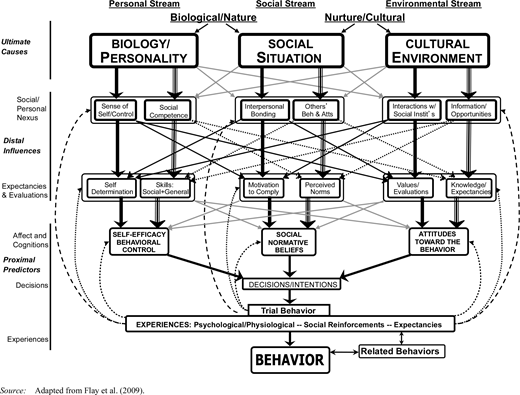
Social Influences. A similar flow exists within the interpersonal stream of the TTI. The interpersonal stream begins with ultimate-level characteristics of one’s immediate social surroundings that are largely outside the control of individuals (e.g., school and teacher quality, parenting practices during one’s childhood). It continues through social/personal nexus variables in one’s immediate social surroundings, including the strength of the interpersonal bonds with immediate role models, such as teachers and parents, and the relevant behaviors of those role models (e.g., whether family members are life-long learners). The flow then continues through variables that include motivation to comply with various role models (e.g., whether to comply more with family members or teachers or peers), and perceptions of what behaviors those role models are encouraging. Finally, consistent with the theory of reasoned action, social influences form social normative beliefs regarding the specific behavior; that is, perceptions of social pressures to engage in a particular behavior.
Cultural-Environmental Influences. The third stream of the TTI, the cultural-environmental stream, follows the same pattern as the previous two streams. It begins with broad cultural characteristics that are largely beyond an individual’s control, such as political, economic, religious, legal, mass media, and policy environments (Minkler, Wallace, & McDonald, 1995). The third stream flows into variables including the nature of the interactions people have with social institutions, such as political, legal, religious, and governing systems, and the information and values they glean from their culture (e.g., what they learn from exposure to mass media). The cultural-environmental stream then flows through variables related to the consequences one expects from a behavior, such as whether going to college is useful and how much it will cost, and how one evaluates, favorably or unfavorably, the various consequences of a behavior. Finally, consistent with the theory of reasoned action, these influences form one’s attitudes toward a specific behavior, such as civic engagement.
Cognitive and Affective Substreams and Their Interactions
In addition to the three major streams, each stream contains two substreams. One substream is more cognitive and rational in nature, based on an objective weighing of the perceived pros and cons concerning a given behavior. The other substream that influences behavior is more affective or emotional and less rational. Thus, decisions are not always rational; they may include an affective or emotional component (i.e., hot cognition) (Dahl, 2001, 2004) and be completely irrational (Ariely, 2009).
For some readers, the proximal levels of all streams (self-efficacy, social normative beliefs and attitudes) may seem like intrapersonal factors. However, these affective/cognitive factors that originate from interpersonal (social situation à social normative beliefs) or cultural-environmental (cultural environment à attitudes) factors are distinguished from those that originate within the person (biology/personality à self-efficacy). Within the TTI, each and every stream ends in affective/cognitive factors (i.e., self-efficacy, social normative beliefs, and attitudes) that influence the most proximal affective/cognitive predictor of behavior, intentions.
The theory also recognizes that influences in one path are often mediated by or moderate influences in another path. Further, the TTI recognizes that engaging in a behavior may have influences that feed back and alter the original causes of the behavior.
An Ecological View of the TTI
Figure 2 illustrates that the TTI emphasizes both ecological rings and levels of influence. The three streams of influence in the TTI and the notion of interrelated influences are similar to the rings of influence in Bronfrenbrenner’s ecological systems theory (Bronfrenbrenner, 1979). However, most conceptions of ecological systems do not consider the levels of influence within the rings. In the TTI, intrapersonal factors are seen as nested within social factors that, in turn, are nested within broader sociocultural environmental factors, just as in the basic ecological models. Within the TTI, all three rings/streams also have causal influences at multiple levels, including ultimate/underlying, distal/predisposing, and proximal/immediate. Further, as Figure 2 shows, time and development affect levels of influence, whereby lower levels often incorporate faster processes.
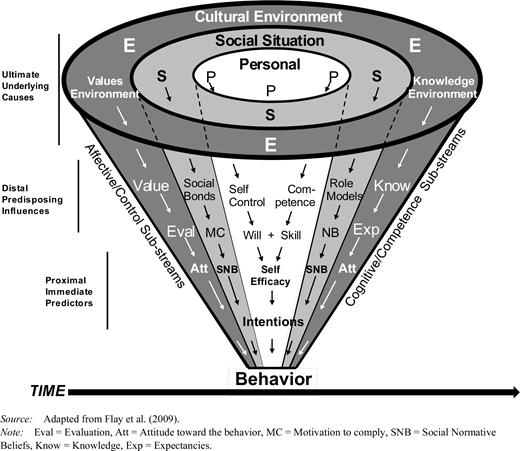
Time also influences program effects; for example, effective SECD-related programs that are not sustained or followed-up by continuous supports will likely have less impact over time (Denham & Weissberg, 2004). In sum, the TTI consists of three levels of influence, three major streams each with two substreams of influence, dozens of predictions about mediation and moderation among variables, and feedback loops.
Extant Application of the Theory of Triadic Influence
Researchers frequently acknowledge the TTI as a way to address the proximal, distal, and ultimate variables that influence behavior. Additionally, researchers from a growing number of disciplines recognize the importance of the intrapersonal, interpersonal, and cultural-environmental streams of influence. The majority of articles that reference the TTI have focused on the etiology of several behavioral domains and, most frequently, studies come from the substance use domain, with dozens of studies applying the TTI to substance use etiology and intervention research (see Flay et al., 2009 for a detailed summary). This is not a surprise as the genesis of the TTI occurred after a careful review of the substance use literature. Many recent studies recognize the importance of the TTI in integrating the variety of variables influencing health-related behavior. In reference to the SECD domain literature, one review (Flay, 2002) has acknowledged the utility of the TTI in explaining the causes of behaviors, and 11 studies from one research group (Beets et al., 2009; Flay & Allred, 2003; Flay et al., 2001; Ji et al., 2005; Lewis, DuBois, et al., 2013; Lewis, Schure, et al., 2013; Li et al., 2011; Snyder et al., 2013; F. J. Snyder et al., 2010; Snyder, Vuchinich, Acock, Washburn, & Flay, 2012; Washburn et al., 2011) have used the TTI as a guiding framework in SECD intervention research. Thus, as compared to other domains, there is much room for expansion of using the TTI among SECD-related researchers and practitioners. Some new ideas regarding SECD can originate from the TTI.
Utility of the TTI and Implications for SECD-Related Etiology and Intervention Research
Due to the multidisciplinary and often comprehensive (i.e., involving youth, school personnel, families, and communities) nature of SECD, and the varying terminology, there is little common ground in theoretical, measurement, and program models. As an overarching theory, the TTI can help provide common ground, generate homogeneity in definitions, and consistency among theoretical and measurement models (Dirks, Treat, & Robin Weersing, 2007). And such a theory can also help unscramble the complex jumble of influences on SECD-related behaviors. By integrating and organizing so many risk and protective factors, hierarchical levels, streams, substreams, mediated and moderated paths and feedback loops, the TTI has utility for researchers who are studying the etiology of SECD. It is apparent that etiology researchers who follow a more integrative (i.e., addressing multiple risk and protective factors) and comprehensive approach have much to gain by empirically testing the TTI. Indeed, developmental psychologists will likely note there are hypotheses outlined in the TTI that provide explicit predictions rather than overarching, general features common to developmental systems theories (R. M. Lerner, 2006). The theory provides dozens of testable predictions about mediation and moderation among SECD-related variables. Subsequently, this would allow scientists and practitioners to translate research into practice by identifying predisposing, enabling, and reinforcing factors that influence SECD-related behavior (Green & Kreuter, 2005) and tailoring programs to address these factors.
The TTI has much utility for SECD-related program planners and researchers who are designing and evaluating programs. The TTI can help organize and map conceptual rationales regarding SECD-related programming’s impact on school attitudes and academic performance (Durlak et al., 2011). Specifically, the TTI is helpful in selecting strategies to include in a SECD program and predicting, evaluating, and understanding a SECD program’s impact. The integrative and comprehensive theory suggests higher order descriptions and explanations of SECD, offers a detailed ecological approach to understanding and improving SECD, and suggests that an increased focus on distal and ultimate levels of influence will produce greater and longer lasting effects for SECD programs.
One example of a program that serves as a good illustration to help understand the links between the TTI and SECD is the Positive Action program (Flay & Allred, 2010). Research has shown this comprehensive, schoolwide program can improve outcomes related to SECD, including academic achievement and school quality, and reduce youth health-compromising behaviors (Bavarian et al., 2013; Beets et al., 2009; Flay & Allred, 2003; Flay et al., 2001; Lewis, DuBois, et al., 2013; Lewis, Schure, et al., 2013; Li et al., 2011; Snyder et al., 2013; F. J. Snyder et al., 2010; F. J. Snyder et al., 2012; Washburn et al., 2011). In brief, the full program includes K–12 classroom curricula (consisting of almost daily 15–20 minute lessons), a schoolwide climate development component, and family- and community-involvement components. The sequenced curricula includes an interactive approach and covers six major units on topics related to self-concept (i.e., the relationship of thoughts, feelings, and actions), physical and intellectual actions, social/emotional actions for managing oneself responsibly, getting along with others, being honest with yourself and others, and continuous self-improvement. More recently, the program has been adapted for prekindergarten children (Schmitt, Flay, & Lewis, 2014). Figure 3 demonstrates how components included in the Positive Action program map onto the TTI.
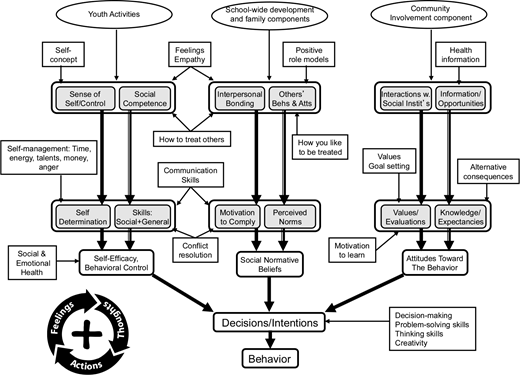
The comprehensiveness of the TTI explains the limited impact of programs with informational approaches that solely focused on didactic education (i.e., knowledge, in the middle of the TTI’s cultural-environmental stream). Value-based approaches also have often failed as they typically focus only on the lower half of the cultural-environmental stream. More recent approaches have addressed the need for social skills and self-efficacy, although, these programs may have limited results if they (1) have limited program components related to knowledge and values, and (2) fail to focus on and alter social normative beliefs. The TTI clarifies that SECD-related programs provided with adequate resources should address the intrapersonal, interpersonal, and cultural-environmental streams to have the largest impact. For example, programs should incorporate skill-, socionormative-, knowledge-, and value-based components to enhance social and emotional skills, attitudes, prosocial behaviors, and academic achievement, and reduce conduct problems and emotional distress. This recommendation parallels reviews that suggest comprehensive programs that include classroom, schoolwide, family, and community components are likely to generate greater effects than classroom-only approaches (Catalano et al., 2004; Greenberg, Domitrovich, & Bumbarger, 2001; Tobler et al., 2000). For example, Snyder and his colleagues (2012) demonstrated the Positive Action program improved overall school quality, providing evidence that a whole-school SECD focus can facilitate whole-school change. In addition, to help guide practitioners, a case study (de Palma, Aviles, Lopez, Zamora, & Ohashi, 2012) demonstrated how Positive Action was implemented as a multiple-systems strategy aligned with the TTI. For example, a schoolwide positive behavior support and discipline plan was created that included teaching SECD skills and school rules, a schoolwide assembly day, reinforcing positive student behavior, using effective classroom management, providing early prevention and intervention strategies, and addressing problems behaviors among school staff, administration, and parents.
Assumptions and Limitations
Like the interpersonal health-behavior theories, the TTI includes the assumption that health-related behaviors are directly influenced by decisions/intentions and that this is a function of an individual’s attitudes toward a particular behavior, social normative beliefs, and self-efficacy. Further, and very notably, the TTI has limitations common to any integrated theory of behavior. These limitations often relate to the complexity of the models and the difficulty of empirically testing them given current analytic techniques. A complex framework of variables does not easily lend itself to analysis. Researchers must often weigh parsimony against model misspecification (Dirks et al., 2007). While the TTI has been used by different fields as a theoretical framework in numerous intervention studies (e.g., Klepp et al., 2005; Komro et al., 2004; Wang et al., 2006) and as a guiding framework for program adaptation (Bell, Bhana, McKay, & Petersen, 2007), a complete model of the TTI as it relates to SECD etiology and interventions has not been tested. Researchers have, however, successfully tested a substance use etiology model based on the complete TTI (Bavarian et al., 2014). These and other studies demonstrate the potential the TTI holds for SECD. Advances in research methods and statistical approaches, such as advanced structural equation modeling techniques, will likely advance our understanding of SECD by accommodating the complexities of the TTI.
There may be instances where the TTI is not the most useful framework for educators seeking to implement a SECD program. For example, the Comer School Development Program (School Development Program, 1998) provides a clear-cut description of intervention strategies for educators, whereas the TTI provides a more detailed framework for SECD educators and researchers. It may be more practical for educators to use an existing evidence-based program, perhaps informed by the TTI, rather than follow the TTI. Indeed, it may be ideal for researchers and educators to take a community-based participatory approach, whereby each group is integral to intervention development, implementation, and/or, evaluation.
Future Research and Conclusions
SECD-related research and practice has shown progress over recent years, yet more work is needed. The TTI provides a useful tool in the process of advancing this work. The theory has utility for future research related to understanding the mediating and moderating mechanisms of SECD-related programs. Some program practices and components may be more important than others, and mediation and moderation analyses would assist in identifying successful approaches. Further, researchers and practitioners can relate program components and influences to the TTI in an effort to help generate more homogeneity in terminology and measures as the SECD field progresses. There is a need to develop common measures to increase consistency across diverse studies, and the continued development and use of resources such at the NIH Toolbox (http://www.nihtoolbox.org/Pages/default.aspx) will help with consistency across SECD-related studies.
Recognizing the complexities of comprehensive programs, more work should be done to examine the effects of programs that involve families and communities, and the impact of including these added components. Although examining the effects of added components has been done (Flay, Graumlich, Segawa, Burns, & Holliday, 2004), this work has been limited. Application of SECD-related research and programs addressing additional behavioral domains, such as dietary behaviors and physical activity, can be explored, even in out-of-school settings. There is evidence that SECD-related constructs, such as executive cognitive function, relate to other health outcomes such as youth food intake and physical activity (Riggs, Chou, Spruijt-Metz, & Pentz, 2010; Riggs, Spruijt-Metz, Sakuma, Chou, & Pentz, 2010). Moreover, some work has been done regarding the modification of existing, evidence-based SECD programs to address child obesity (Riggs, Sakuma, & Pentz, 2007). Utilizing the TTI framework can facilitate the full understanding of the impact of SECD programs.
In summary, there is increasing evidence that appropriately designed SECD-related programs are generally effective when carefully implemented, however, an integrated theoretical approach is helpful to better understand SECD and how to improve it. A growing number of programs seek to influence multiple determinants of behavior. The TTI is a practical tool for SECD-related programs as it includes many determinants of behavior, and researchers have much to gain by exploring the ability of the theory to explain and predict SECD. The theory integrates a full range of risk and protective factors in a testable, detailed mediation and moderation framework. Program implementers can use the TTI to better understand the design of their programs, how to evaluate them, and what results to expect. In addition, the TTI takes a comprehensive view of all the stakeholders in the educational system examining the multiple impacts on the program and the participants. Overall, the practical utility of the TTI can enhance the effectiveness of SECD-related programs and generate consistency in a relatively new, multidisciplinary area of research and programming. This can help advance a vital part of education, health, and lifelong success—social emotional and character development.
Acknowledgments: Brian R. Flay, Joy S. Kaufman, and three anonymous reviewers provided very helpful comments on previous drafts. This article is based on a portion of a dissertation submitted by the author to Oregon State University. The National Institute on Drug Abuse (T32 DA019426) and the Purdue Research Foundation provided support for the completion of this article.

