


The goal of this study was to investigate how moral development changes over time for teacher education master’s students during their year-long internship. Data on the Defining Issues Test-2 was collected at three points in time during the full-year teaching internships (beginning, end of first semester, and end of second semester). These longitudinal data were analyzed using multilevel modeling of change, finding that interns’ change trajectories differed depending on the moral judgment schema being analyzed (personal interest, maintaining norms, or post-conventional). In addition, trajectories varied as a function of gender and GRE scores. In none of the fitted models was elementary versus secondary status statistically significant, nor did intern age have an effect on the position or slope of the growth trajectories.
The goal of this study was to investigate how moral development changes over time for teacher preparation students during their year-long internship. It is important to study the moral judgment of teachers because there are links between moral reasoning and a number of desired teaching variables. Johnston (1989) found a positive relationship between moral reasoning scores and teachers’ understanding of individualized instruction. Johnston also summarized a number of previous studies that led to the conclusion that moral developmental levels are related to teachers’ understanding of curriculum, student-teacher roles, management issues, rules, and teaching practices. Chang (1994) and Cummings, Harlow, and Maddux (2007), in two comprehensive reviews of the research on moral development of teachers, have argued that teachers exhibiting higher levels of moral judgment are better able to advance student learning. Chang (1994) reviewed over 20 studies of teachers’ moral judgment in the areas of discipline, teacher’s role, relations with students, understanding of educational concepts, and performance. Representative of the findings, we summarize from four of the studies cited by Chang.
Teachers using higher levels of moral judgment encouraged students to participate in making classroom rules, and these teachers were more willing to help students understand the reasoning for rules (Johnston & Lubomudrov, 1987).
Teachers using higher levels of moral judgment viewed their roles as more democratic (MacCallum, 1993).
Teachers using higher levels of moral judgment maintained more positive relations with students and better understood students’ needs and feelings (Novogrodsky, 1977, as cited in Chang, 1994).
Teachers using higher levels of moral judgment viewed curriculum from a broader social perspective with individual student’s interests in mind (Wheaton, 1984).
O’Keefe and Johnston (1989) showed a connection between higher levels of moral reasoning and tolerance of diverse viewpoints, flexibility in teaching approaches, and finding alternative solutions. Oser’s (1992) experimental study found that teachers using advanced moral judgment were more likely to encourage students to take multiple perspectives, and these teachers were more inductive in their teaching and more learner-centered.
Prior research has studied many aspects of the 5-year teacher education program, but none have looked specifically at moral judgment. In the literature reviews of empirical studies of teacher development in moral reasoning (e.g., Cummings et al. 2007; Reiman & Oja, 2006), there are no studies of preservice teaching interns from 5-year programs. Since there is little research in this area, a major contribution of the current study of moral judgment of teaching interns in a full-year internship is to extend what is known about the five-year program and to think about implications for other teacher education programs.
Cummings et al. (2007) reviewed studies of interventions for moral development with preservice teachers. These studies show significant pre-post gains in moral judgment of undergraduates as a result of interventions based on principles like significant social-role taking and guided reflection. The intervention design principles are part of a teaching-learning framework that have been further described by Sprinthall, Reiman, and Thies-Sprinthall (1996), Oja and Reiman (1998), Reiman and Thies-Sprinthall (1998), Reiman and Johnson (2003), Reiman (2004), Senne and Rikard (2004), and Johnson and Reiman (2005). Oja and Reiman (2007) consolidated the framework to seven design principles they called the Integrated Learning Framework (ILF). Reiman and Oja (2006) analyzed 13 quasi-experimental research studies with interventions based on the design principles of the integrated learning framework. Eleven of the 13 studies used moral judgment as a dependent variable. The meta-analysis showed a moderately large average effect size (.65) for moral judgment gains, suggesting that the ILF can lead to significant positive changes in teachers’ moral judgment.
The seven applied design principles of the ILF are summarized briefly below, and we also link these principles to the key components of the full-year internship program. The connection between the ILF and components of the intervention suggested to us that the full-year internship is an intervention that may increase moral reasoning.
Design Principles of the Integrated Learning Framework are Evident in Key Components of Full-Year Internship
O Building Trust and Respecting Contexts. Educators must contextualize learning and instruction by accounting for the experiences of learners who are taking on new and expanded professional roles. This design principle includes recognizing prior knowledge and experience, developing rapport, and building collaborative and trusting relationships. This principle is evident in the full-year internship as the supervisor, cooperating teacher, intern, seminar group, and school build collaborative and trusting relationships over the internship year. A key component of the internship that illustrates this design principle is what the internship program calls: “Communities of Inquiry and Support: Clustering Interns in Partnership Schools.” Normally six interns are clustered in a partnership school. These schools have worked in a School-University Collaborative comprised of university faculty, school administrators and teachers for a number of years. Procedures surrounding placement, supervision, and assessment of interns are worked out collaboratively. Schools hold “open houses” to orient prospective interns and provide ongoing structures of support throughout the placement process. Another key component that illustrators this ILF design principle is “Careful Matching: A Choice Oriented, Matching Model for Intern Placement.” Interns must visit three schools and at least three possible classrooms during the placement process. Interns attend school open houses and meet with prospective teachers and administrators. Students make further visits to cooperating teachers of interest. After discussion and sometimes trial teaching, prospective interns choose a mutually agreeable cooperating teacher and school site. Contracts detailing expectations of both parties and the university are required. These contracts are signed after a sit-down interview with school principals and require the signatures of interns, cooperating teacher, principal, and university representative (usually the supervisor). Contextualized learning is also supported through portfolios which offer more opportunities for interns to individualize their learning based on prior and present cultural and educational experience.
O Complex New Roles and Helping Experiences. Complex new roles in real-world helping experiences cause conceptual disequilibrium that spurs reconsideration of professional judgments. Learning to interpret how others are constructing meaning from a planned experience can be an important catalyst for transformation in one’s thinking and performance. Helping others while learning new competencies tends to bolster the potential for learning and development. This design principle is fulfilled as interns assume the new role of elementary or secondary teachers. This new experience involves progressively more complex assisting and teaching by the intern over one year. Interns engage in significant new roletaking experiences in their schools and classrooms. This design principle is also evident in another key component of the internship program identified as “Teacher as Researcher and Lifelong Learner: The Research Project and Colloquium.” Through an internship research project and colloquium, interns experience the role of teacher-as-researcher and lifelong learner. Each intern undertakes a research project related to classroom or school-based issues. These projects result in an intern-led, public colloquium where interns present the results of their research and discuss results with school colleagues. Sometimes this is done in a university sponsored Teacher as Researcher Conference. Topics of the research focus on intern concerns and dilemmas in the areas of learners/learning, teachers/teaching, and schools/schooling.
O Guided inquiry includes reflection through carefully planned activities, ongoing discussions, and dialogue journals that all encourage self-assessment of one’s performance. The self-assessments and reflection activities are guided by a “more capable other.” Because one cannot assume a sophisticated capacity for reflection, Reiman (1999) developed a guided inquiry process that differentiates written responses according to one’s current preferred ways of conceptualizing and reflecting on ill-structured problems and ethical dilemmas encountered in the real-world helping experiences. This design principle is evident as the supervisor and cooperating teacher assist the intern through a guided inquiry process that includes self-assessment and reflection through carefully planned activities, ongoing discussions in weekly seminars, and journaling. Regular triad meetings for guidance include the intern and his/her cooperating teacher and supervisor. Six (or more) interns meet weekly during a common intern seminar time with their university supervisor, another key component of the internship identified as the “Community for Support and Inquiry: Weekly Seminar.” Typical weekly seminars process shared experiences, introduce pedagogical knowledge of “what works,” help interns with difficult challenges and dilemmas (management, planning, curriculum, communications, etc.), provide support and introduce new knowledge or skills at critical times during the year. Interns review the professional ethical codes from teaching organizations and write personal philosophies of teaching that include their own developing personal ethics in relation to classroom management, relationships with students, equitable teaching of all students, and so on. Weekly journaling prompts interns’ self-assessments in the guided-inquiry process, and the supervisors’ written feedback differentiates the guided-inquiry process according to the current preferred ways an intern conceptualizes, self-assesses, and reflects on ill-structured classroom problems and ethical dilemmas. Less reflective interns are provided higher structure and more conceptual scaffolds. Interns exhibiting higher conceptual complexity in their portfolios and ongoing written analyses are provided more encouragement to critically examine student needs and complex teaching tasks.
O Support and Challenge. Support (encouragement) and challenge (prompting the learner to accommodate to the new learning) are necessary; and differentiation is required to meet each learner’s conceptual needs. Learning how to manage support and challenge to meet individual needs appears to be the most difficult of the seven design principles. This design principle enables each intern to acquire new understanding and teaching strategies that enhance instruction and engagement with learners. The full-year internship presents challenges and dilemmas for interns. The intern is initially barraged with challenges to personal security, mostly from unfamiliar discipline confrontations. The teacher’s day is also filled with moral decision making: which child to help first, which to ignore in the moment, what curriculum choices to make, how to handle student-to-student confrontation, and so on. To process these morally challenging experiences the intern has a strong system for differentiated support and challenge. The intern works in a team situation with a cooperating teacher with whom there is almost constant processing and planning. The intern has a support group of five or more other interns in the same school who meet informally throughout the day and more formally in the weekly seminar. Associated with this design principle is another key internship component: “Intense Supervision —When It’s Needed: A University Supervisor Located in the Partnership School One or Two Days Per Week.” Each intern is observed by their supervisor at least once every 2 weeks. Observations are followed by three-way assessments involving the intern, cooperating teacher, and university supervisor. The intern has ready access to the university supervisor who is in the school 1 or 2 days per week, present at the weekly seminar and always available by e-mail. These systems of support and challenge exist for an entire year. Interns are supported in their current meaning making system, and when the interns demonstrate readiness, they are positively challenged to greater complexity.
O Balance. To promote development, there needs to be a balance between the new role-taking experience (action) and reflection. In our programs this means that the new experiences are sequenced with guided inquiry each week. Too great a time lag between action and reflection appears to halt the growth process. Throughout the internship year the design principle of balance is evident: there is a balance between teaching (action) and reflection on teaching. Reflection exists through journaling, supervisory conferences, and weekly seminars as already described. In addition, interns develop a program e-portfolio that they begin in earlier professional courses. The portfolio is a key component of the full-year internship identified as “Synthesis of Experience and Demonstrating Competence: The Program Portfolio.” Electronic portfolios contain the intern’s revised statement of teaching philosophy, references to university course work, a curriculum unit with reflections from teaching, artifacts and reflections from core courses, and reflections on competence in the program’s “Goals and Outcomes.” Briefly, the program goals state that graduates: (a) are knowledgeable in the subjects they teach; (b) are committed to knowing and cultivating a community of learners; (c) know how to teach subject matter to students; (d) effectively monitor student learning; (e) are thoughtful and reflective practitioners who learn from experience; (f) understand the nature of school reform and their roles as agents of change; and (g) are active members of learning and professional communities. The e-portfolio is meant to show growth, creative risk taking and competence in the 5-year program goal areas. Interns are urged to “make public your understanding of who you are as a teacher” (Handbook for the Internship and Seminar in Teaching, 2010-2011).
O Continuity. Fostering changes in reflective judgment and professional performance requires a continuous interplay between experience and inquiry. Typically at least 4 to 6 months are needed for significant learning and development. Because the internship is a full-year, the design principle of continuity of the experiences over an extended period of time is met.
O Reflective Coaching. A reflective coaching process supports the learner in attempting new skills and professional judgments in the new real-world helping role. Coaching methods by a more capable other include ascertaining prior knowledge, clarifying the rationale and evidence for new professional judgment and actions, demonstrating the new performance, providing opportunities for practice with self-assessment, and integrating observation and feedback. This design principle is evident as the intern is mentored and assisted in adapting teaching techniques and strategies by the cooperating teacher and university supervisor. A full teaching load (equal to one course) for a university supervisor is considered six interns in one school for the entire year. University faculty who are supervisors receive credit for two of four courses or 50% of their teaching load over the year. Supervisors are trained in the Clinical Supervision Model and attend biweekly discussion and training sessions with all other supervisors. Cooperating teachers can participate for free in a university graduate course titled Collaborative Models of Supervision.
The current study looks at the full-year internship as a possible intervention to advance moral judgment. It is important to identify whether moral reasoning changes in positive ways during the internship and also to identify characteristics of students with higher levels of moral reasoning. A variety of aspects of the five-year program have been studied by the program faculty and reported in the following articles on: differences of 5-year programs compared with 4-year programs for teacher certification (Andrew, 1998); emphasis on subject-field depth in professional preparation in the five-year program (Andrew, 1989); and verbal ability and teacher effectiveness (Andrew, Cobb, & Giampietro, 2005). The program faculty reported on the design of an outcome assessment of graduates (Andrew & Schwab, 1995; Barton, Andrew, & Schwab, 1994). School-university collaboration in the full-year internship and the design of communities for inquiry and support in the 5-year program have also been reported (Corcoran & Andrew, 1988; Oja, Diller, Corcoran, & Andrew, 1992; Oja, Chamberlain, Moran, & Struck, 1997; and Oja, 2003). None of these studies have looked specifically at moral judgment of teaching candidates.
Gender differences have interested moral development researchers (e.g., Rest, Narvaez, Bebeau, & Thoma, 1999; Rest, 1994; Thoma, 1986), and Bebeau and Thoma (2003, p. 37) report that gender differences in moral judgment are “very modest” for lower educational levels, but “become more pronounced as educational level increases with professional degree women scoring about 5 points higher than their male counterparts.” They suggest further study, and we wondered about the relationship of male or female status to the moral reasoning of interns in the full-year internship who are completing their professional degree (MED or MAT) in the 5-year program.
All candidates in the 5-year program take the Graduate Record Exam (GRE) as one of the criteria for admission to the university graduate school, and we had access to this data. Rest and Narvaez (1998, p. 10) reported that the Defining Issues Test was “correlated with IQ, general intelligence, achievement, and GPA (typically in the range, r = .20 to .50),” and Rest et al. (1999, p. 108) described findings that “the DIT “produces significant trends, even after controlling for verbal ability (or IQ, or general cognitive ability, etc).” We wondered about the relationship of GRE scores to moral reasoning scores of our interns. In addition, we wondered about the relationship of age and elementary or secondary teaching assignment to the moral reasoning scores of the interns.
Context of the Full-Year Internship Program
To better understand our results and the possibilities that the year-long internship might be a successful intervention for moral development, it is important to understand the nature of the internship and the context for the study.
This study examines students in their full-year internship, the capstone experience in an integrated undergraduate-graduate 5-year program. The students are enrolled in a 5-year program for teacher certification that culminates in the internship year at the graduate level. The two-semester internship counts 12 credits of a 32 credit MED or MAT degree. The 5-year program has been in operation at the university for over 30 years. The program is at a midsize state university that certifies about 175 interns per year.
Students begin the 5-year program with a semester-long experience as teaching assistants in a local public school classroom. Emphasis is on examining the nature of public school teaching and on screening for further work in teacher education.
Students with positive recommendations from cooperating teachers and university seminar leaders are allowed to continue with professional course work. Core course requirements include Human Development and Learning: Educational Psychology, Educational Structure and Change, Alternative Perspectives on the Nature of Education: Philosophy of Education, subject-specific teaching methods, and Special Education.
At the beginning of the senior year (or as post-BA students), students are considered for admission to the Graduate School for either the MED. or the MAT degree.
The final stage of the program includes the year-long internship, a program portfolio, a research project and colloquium and advanced course work. Students with an undergraduate grade point average of 3.2 or greater may do 12 credits of graduate course work during the second semester of their senior year.
Students completing this program have extremely high rates of entry and retention into teaching. Five-year follow-up studies of students from 1985-2005 show from 87% to 93% of students teaching for at least one year and from 85% to 90% of all graduates still teaching after 5 years.
A study of interns’ opinions of the full-year internship (Andrew, 2010) shows that 80% of interns over a 5-year period consider their experience as totally positive with 34% considering the experience as crucial and outstanding.
Statement of the Research Questions
In summary, both the limitations in prior research indicating no studies of moral reasoning of preservice teachers in a full-year internship and the positive relationships found in the literature between high levels of moral reasoning and teachers who are better able to advance student learning have led to the research questions addressed in the current study: (1) Does moral judgment of prospective teachers change over the course of a full-year internship? And (2) Does either the level of moral judgment or the change in moral judgment over time vary as a function of intern gender, age, GRE scores, or teaching assignment (elementary or secondary)?
Method
Dataset
The dataset is from graduate students in their yearlong internship in a 5-year undergraduate-graduate integrated program ending with teacher certification and a masters’ degree at a midsize state university in the U.S. Northeast. The interns at the time of the study were all graduate students in MED and MAT programs in Education. All were enrolled in a Seminar and Internship in Teaching Course during their full-year of internship in 2006-2007. Participation in the study was voluntary and was not a requirement for the internship nor did it affect grading or awarding credit for the internship. The interns took the Defining Issues Test (DIT-2) (described below) at the beginning of their internship year in September, 2006, at the end of the first semester of internship in December, 2006, and again at the end of the second semester of the internship year in early May, 2007.
While the full sample included 92 interns, 10 were eliminated from the analytic sample used to conduct the analyses presented below due to irregularities in responses (see below). Therefore, our analytic sample includes 82 interns. Descriptive information about these interns is presented in Table 1. Women comprise the large majority of the sample, representing 80% of the 82 interns. The sample is approximately evenly split between elementary and secondary interns (n = 39 and n = 43, respectively). The average intern was 25 years old, however ages range quite widely from a low of 21 years to a high of 51 years. Average general GRE scores for this group of interns were 448 for the verbal test, 506 for the quantitative test, and 4.38 for the analytical writing test. Standard deviations of 86 points for verbal, 127 points for quantitative, and .68 point for analytical writing indicate substantial variability across interns in GRE scores.
Descriptive Statistics for Predictor Variables (n = 82)
| Variable | n | % | M | SD | MIN | MAX |
|---|---|---|---|---|---|---|
| Gender Male | 17 | 20.73 | ||||
| Female | 65 | 79.27 | ||||
| Elementary/secondary | ||||||
| Elementary | 39 | 47.56 | ||||
| Secondary | 43 | 52.44 | ||||
| Age | 25.17 | 5.73 | 21.00 | 51.00 | ||
| GRE verbal | 448.41 | 86.43 | 230.00 | 650.00 | ||
| GRE quantitative | 506.71 | 127.31 | 220.00 | 730.00 | ||
| GRE analytical writing | 4.38 | 0.69 | 2.50 | 6.00 |
Measures
The Defining Issues Test (DIT-2) was used to measure moral judgment. Instead of an interview to measure moral reasoning, the DIT-2 is an objective paper-and-pencil test. The DIT-2 is an updated version of the original Defining Issues Test by Rest (1986). The Defining Issues Test has been studied extensively for over 25 years. Rest, Narvaez, Bebeau, and Thoma (1999, pp. 59-97) discuss theoretical and empirical issues in the approach to postconventional moral thinking. They report numerous studies of the validity of the DIT in seven criteria, and, in over 200 studies, the Cronbach’s alpha and test-retest reliability are reported to be in the upper .70s to lower .80s.
The DIT-2 is “shorter, has more streamlined instructions, purges fewer subjects for unreliability, and does not sacrifice validity—indeed, DIT-2 seems to produce slightly stronger trends on validity and reliability” (Bebeau & Thoma, 2003, p. 5). The DIT-2 presents five hypothetical moral dilemmas each followed by 12 issues which the respondent rates and ranks in order of importance in resolving the dilemma. The ratings and rankings on the DIT-2 data sheets were mechanically scored at the University of Minnesota Center for the Study of Ethical Development. The patterns of the ratings and rankings determines “estimates of the relative strength of three moral schemas: personal interest, maintaining norms, and post-conventional moral reasoning” (Rest et al. 1999, p. 6).
The personal interest schema is characterized by self-interest. For individuals scoring highly in the personal interest schema, rules are rigid, and authority and structure are paramount (Rest, 1994). The maintaining norms schema is characterized by a “need for norms” so people can act without debating every action, and a “duty orientation” to laws or religious codes” (Rest et. al, 1999, p. 38). Individuals scoring higher in the maintaining norms schema of moral judgment may value social order and harmony over larger principles of cooperation. The post-conventional schema is based upon ideals and principles that balance cooperation and group rights with autonomy and individual rights (Rest, 1994, p. 5). The elements of the post-conventional schema include the “primacy of moral criteria,” “appeal to an ideal,” and a recognition that laws can be biased (Rest et al., 1999, p. 42). In the post-conventional schema moral purposes, not conventions, are used to determine duties and rights.
Studies investigating change in moral judgment often focus on the score in the post-conventional schema, labeled the P-score or the newer N2 index which is considered an overall measure of moral development. N2 is a new index that Bebeau and Thoma (2003, p. 19) describe as “outperforming the P-score on six criteria for construct validity” and
the N2 score has two parts: the degree to which post-conventional items are prioritized (almost identical to the P score) … plus the degree to which personal interest items (lower stage items) receive lower ratings than the ratings given to post-conventional items (higher stage items).
The P score and N2 score are highly correlated with each other (r = .81). In this article we include analysis of the interns’ overall moral judgment N2 score, as well as investigation of the three schema scores, the personal interest schema, the maintaining norms schema, and the post-conventional schema score. Bebeau and Thoma ((2003, p. 35) report the following norms on N2 Index scores: University Seniors (mean N2 = 36.85, SD = 15.53); MS degree (mean N2 = 40.56, SD = 15.06); Professional Degree MED/MAT/MD./MBA/DDS (mean N2 = 44.97, SD = 14.87); and PhD/EdD Degree (mean N2 = 48.99, SD = 15.60).
In addition, we also explored variability in U-scores across the three measurement occasions. The Utilizer score (U-score) is an experimental index the represents the degree of match between items chosen as ‘most important’ on the DIT dilemma and the action choice on that dilemma. “The utilizer score is based on the idea that there are differences among people not only in their concepts of justice (as measured by the DIT), but also in the degree to which those concepts are utilized in moral decision making and behavior (Rest et al., 1999, p. 104).
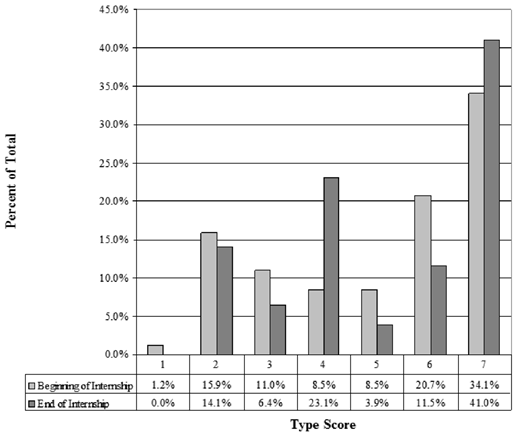
Finally, our analysis also included an investigation of developmental phase, the degree to which an intern’s patterns across schema based items in the DIT suggest a consolidated or transitional pattern. In addition to scores for the three moral schema levels, the DIT provides seven developmentally ordered moral judgment Type indicators which describe periods of consolidation within a modal schema and transition between schema (Bebeau & Thoma, 2003, p. 20). The Types are listed below; types 1, 4, and 7 are consolidated and types 2, 3, 5, and 6 are transitional.
Type 1: Predominant in personal interests schema and consolidated;
Type 2: predominant in personal interests, but transitional;
Type 3: predominant in maintaining norms, but transitional; personal interests secondary schema;
Type 4: predominant in maintaining norms schema and consolidated;
Type 5: predominant in maintaining norms schema and transitional; post-conventional secondary schema;
Type 6: predominant in post-conventional schema, but transitional;
Type 7: predominant in post-conventional schema and consolidated
Analyses
Our primary goal in this study was to understand how moral development changes over time for teacher education master’s students during their year-long internship. We began our analyses with appropriate exploratory work, investigating mean scores of each of the DIT-2 subscales (personal interest, maintaining norms, P-score, N2, and U) at the three measurement occasions: pretest, first posttest, and second posttest. During this phase, we also computed the percentages of interns in each developmental stage (Type) at each time point. Next, in order to determine whether there were average changes over time between the pretest and second posttest, we conducted paired t-tests for each subscale.
Finally, in order to simultaneously utilize the three measurement occasions to estimate growth trajectories of moral development over time, we conducted multilevel modeling of change (Graham, Singer, & Willett, 2008; Singer & Willett, 2003). Multilevel models for change allow us to address two distinct substantive questions about change over time. At level-1, we ask questions about individual change in each DIT-2 measure of moral reasoning over time, within intern. The level-1 model represents the change that we hypothesize each intern in the population will experience during the two semester internship:
In this model, Yij represents the value of a particular DIT-2 subscale scores (personal interest, maintaining norms, post-conventional P score, N2 score, U-score) for intern i at time j. The structural part of the model—in brackets—describes underlying true change for this intern as a linear1 function of the number of semesters since the first measurement occasion (SEMESTER ij). The intercept represents intern i’s true value of the outcome on the first measurement occasion (i.e., at pretest). The slope parameter, represents the true rate of change for intern i over time. Since time is measured in semesters, represents the per semester rate of change in the outcome for intern i. The stochastic part of the level-1 model is a random error term (εij) representing the scatter of the observed data around the individual true change trajectory.
Once the level-1 model has been specified, the level-2 statistical model allows us to determine whether there are systematic differences in the level-1 individual change trajectories as a function of characteristics of the interns, such as gender, elementary versus secondary status, age, and GRE scores. For example, at level-2 we ask whether initial status or rate of change (i.e., the individual growth parameters from the level-1 model) are related to gender. In addressing this question we fit the following level-2 model:
The level-2 model treats the intercept and the slope of an individual’s growth trajectory as level-2 outcomes that are associated with the predictor, FEMALE (a dummy variable that is coded 1 for females and 0 for males). The level-2 model contains four fixed effects—γ00, γ01 γ10, and γ11—that capture systematic interindividual differences in change trajectories. The level-2 residuals, ζoi and ζ1i, allow each intern’s individual growth parameters to deviate from their relevant population averages. Conditional on adjusting for 2 the impact of the level-2 predictors, σ02 represents population residual variance in true initial status and σ12 represents population residual variance in true annual rate of change, across all interns in the population.
We can modify the level-2 model to include additional predictors. In the analyses presented below, in addition to the impact of FEMALE, we also investigate the relationship between individual growth parameters and predictors ELEM (coded 1 for elementary interns and 0 for secondary interns), AGE in years, and GRE scores (verbal, quantitative, and analytical writing). Our analytic strategy involved first fitting an unconditional linear growth model, which has the same level-1 model as that described above, but contains no substantive predictors at level-2. In fitting an unconditional linear growth model, we obtained estimates of average population initial status and rate of change and simultaneously determined whether growth trajectories vary in the population. After fitting unconditional linear growth models for each moral reasoning outcome, we then investigated the impact of the intern-level characteristics as level-2 predictors. SAS PROC MIXED was used to fit all models. Summary tables report parameter estimates, standard errors, and goodness-of-fit statistics from these fitted models, and, where relevant, we include fitted plots to display our findings.
Results
Descriptive Analyses and T-Tests
Our initial exploratory analysis of the moral reasoning subscale scores is presented in Table 2. Table 2 contains means, standard deviations, and minimum and maximum values for each of the subscales for each measurement occasion, and the results of paired t-tests comparing pretest to second posttest means. The average intern scored 41.12 on the N2 index in the fall. This average increased slightly to 42.80 in December, and then increased to 44.40 in May (p < .05 for the full year increase). We investigate further this overall trend in moral judgment growth by highlighting the underlying shifts in schema preferences. On average, interns scored 25.07 on the personal interest measure of moral reasoning at the pretest time in the fall. This average declined to 23.47 in December, and then to 22.57 in May (p = .058 for the fall to spring average difference). The average intern scored 28.55 on the maintaining norms measure of moral reasoning at pretest time. Consistent with a decrease in personal interest means, the maintaining norms means increased to 31.17 in December and then to 31.77 in May (p < .05 for the fall to spring average difference). The average intern received a post-conventional P score of 42.15 at pretest. This average declined slightly to 41.50 in December, and then increased slightly to 42.39 in May; the average difference is not statistically significant. There is little difference in the U-score averages over time. In sum, our exploratory descriptive analyses of means and the results of paired t-tests exploring difference scores suggest that interns’ average overall moral judgment N2 index scores increase over time while the average personal interest schema scores decline over time and their average maintaining norms scores increase over time.
Descriptive Statistics for DIT-2 Subscale (n=82)
| Pretest | Posttest 1 | Posttest 2 | |||||||||||||
|---|---|---|---|---|---|---|---|---|---|---|---|---|---|---|---|
| Subscale | n | M | SD | MIN | MAX | n | M | SD | MIN | MAX | n | M | SD | MIN | MAX |
| Overall Measure of Moral Judgment | |||||||||||||||
| N2 Index | 82 | 41.12 | 14.18 | 12.51 | 77.55 | 81 | 42.80 | 14.50 | 5.54 | 74.37 | 78 | 44.40a | 14.45 | 5.59 | 77.59 |
| Schema Scores | |||||||||||||||
| Personal Interest | 82 | 25.07 | 11.31 | 2 | 52 | 81 | 23.47 | 11.67 | 0 | 56 | 78 | 22.57b | 12.47 | 0 | 58 |
| Maintaining Norms | 82 | 28.55 | 12.87 | 4 | 62 | 81 | 31.17 | 15.71 | 6 | 64 | 78 | 31.77c | 15.51 | 2 | 66 |
| Post-Conventional | |||||||||||||||
| P-Score | 82 | 42.15 | 15.70 | 12 | 86 | 81 | 41.50 | 16.35 | 10 | 78 | 78 | 42.39 | 17.06 | 12 | 82 |
| U-Score | 63 | 0.16 | 0.11 | 0.01 | 0.47 | 49 | 0.19 | 0.12 | 0.02 | 0.49 | 46 | 0.18 | 0.11 | 0.01 | 0.40 |
aDifference between Pretest and Posttest 2 N2 means is 2.66 (M = 2.66, SE = 1.19, p <.05). Estimated effect size = 0.19
bDifference between Pretest and Posttest 2 Personal Interest means is -2.40 (M = -2.40, SE = 1.24, p = .058). Estimated effect size = - 0.20
cDifference between Pretest and Posttest 2 Maintaining Norms means is 3.45 (M = 3.45, SE = 1.43, p <.05). Estimated effect size = 0.24.
We further investigated the consolidation and transition Type scores to help understand the relationship between the various schema scores. During the consolidation phase moral judgment information is more central to the decision-making process, moral information is prioritized, and moral decision making and actions are more coordinated (Thoma, 2006). Because the different schemas guide moral decision making in different ways, people who “are in periods of consolidation are better able to access and utilize their moral judgment schema, while those in transition can be distracted by several competing schemata” (Johnson, 2008, p. 431). Shown in Figure 1 are the distributions of Type scores at the beginning and at the end of the full-year internship. At the beginning of the internship only 1.2% of interns were consolidated at Type 1 personal interest, and at the end of the internship, none of the interns is consolidated in Type 1. There are increases from beginning to end of the internship in the consolidation phase Type 4 maintaining norms schema (8.5% to 23.1%) and Type 7 post-conventional schema (34.1% to 41.0%). In addition, we find that all of the transitional Types 2, 3, 5, and 6 have decreased. These moral judgment types may come into play during an internship experience, where interns are confronted with daily ethical dilemmas that must be handled immediately. Interns who are in transition can experience difficulty “interpreting and acting upon moral situations involving issues of fairness and justice” while interns in periods of consolidation are better able to make decisions “at a quicker pace and in a more deliberate manner” (Johnson, p. 431).
Multilevel Modeling of Change
While analysis of aggregated averages and average differences are useful exploratory techniques, they are insufficient methods for modeling individual change over time because they mask individual variability in growth trajectories. To adequately model these trajectories, we conducted individual growth modeling of the three waves of the DIT-2. For each outcome, we fit a taxonomy of multilevel models, beginning first with an unconditional linear growth model that contains no predictors other than time (measured in semesters) and then fitting progressively more complex models containing predictors gender, age, elementary/secondary status, and general GRE scores. In none of the fitted models was elementary versus secondary status statistically significant; therefore, it is not included in our summary tables. Intern age also had no effect on the position or slope of the growth trajectories, therefore, it is also not included in our summary tables. Important predictors of trajectories of moral development include gender and GRE scores. All three areas of GRE scores were tested; only the ones which remained significant are included in the summary tables.
We describe the specific findings for each outcome separately. We begin with the N2 scores because, as discussed above, N2 represents an overall measure of moral development. Next, we describe models fitted to the schema scores (personal interest, maintaining norms, and post-conventional P-scores). We found no change in U-scores over time, and no effect of any of the predictors; therefore, we present no summary table of findings from this set of analyses. In addition, because Type is a categorical variable, using it as an outcome in multilevel modeling of change is not appropriate.
N2 Index.Table 3 presents parameter estimates, standard errors, and goodness-of-fit statistics from a series of multilevel models fitted to the overall N2 scores. Model A, the unconditional linear growth model, predicts an N2 score of 41.20 at pretest, and a statistically significant increase of 1.34 points per semester (p < .05). Models B through D in Table 3 indicate that FEMALE is only a significant predictor when GRE score is also in the model—the effect of gender only emerge when we compare interns of similar GRE scores. This has to do with the correlation between gender and GRE scores—in this sample, men have higher average GRE scores than women. The final model, Model D, includes verbal GRE and FEMALE as predictors of initial status; although the rate of change in N2 score is still statistically significant (p < .05), there is no impact of either predictor on rate of change. The model estimates an average rate of change of 1.76 points per semester. At all points in time, female interns are predicted to have N2 scores 8.4 points higher than male interns, on average. In addition, we estimate that interns whose GRE scores are higher by 100 points have average N2 scores that are higher by approximately 6 points. The estimated variance in initial status has declined from 164.91 in Model A (unconditional model) to 128.71 in Model D (final model), representing a decrease of 22% in estimated variance.
Taxonomy of Fitted Multilevel Models for Change in Which Intern N2 Score is Modeled as a Function of Semester in Internship, Gender, and Verbal GRE Score (n of participants = 82; n of waves of longitudinal data = 3)
| Parameter | Model A | Model B | Model C | Model D | ||
|---|---|---|---|---|---|---|
| Fixed Effects: | ||||||
| Initial | Intercept | γ00 | 41.20*** | 37.61*** | 41.20*** | 34.55*** |
| Status | (1.55) | (3.38) | (1.44) | (2.99) | ||
| FAMALE | γ01 | 4.52 | 8.40* | |||
| (3.80) | (3.33) | |||||
| GREV | γ02 | 0.06*** | 0.06*** | |||
| (0.01) | (0.02) | |||||
| Rate of | Intercept | γ10 | 1.34* | 0.59 | 1.34* | 1.76* |
| change | (0.58) | (1.28) | (0.69) | (0.69) | ||
| FEMALE | γ11 | 0.94 | ||||
| (1.44) | ||||||
| GREV | γ12 | 0.01~ | ||||
| (0.01) | ||||||
| Variance Components: | ||||||
| Level-1: | Within-person | σ2ε | 39.15*** | 39.05*** | 39.16*** | 39.05*** |
| (6.22) | (6.22) | (6.22) | (6.20) | |||
| Level-2: | In initial status | σ20 | 164.91*** | 161.53*** | 138.09*** | 128.71*** |
| (31.28) | (30.75) | (27.16) | (25.74) | |||
| In rate of change | σ21 | 7.44~ | 7.39~ | 7.18~ | 7.52~ | |
| (5.29) | (5.26) | (5.26) | (5.29) | |||
| Goodness of fit: | ||||||
| –2LL | 1,804.2 | 1,801.6 | 1,792.2 | 1,786.8 |
Note: FEMALE = 1 for females and 0 for males. Verbal GRE score (GREV) is centered on its sample average. The model was estimated using full ML, SAS PROC MIXED.
~p <.1.
*p<.05.
**p<. 01.
***p<.001.
Personal Interest Schema.Table 4 presents parameter estimates, standard errors, and goodness-of-fit statistics from a series of multilevel models fitted to the personal interest data. Model A, the unconditional linear growth model, predicts a personal interest score of 24.99 at pretest, followed by a decline in personal interest score of 1.25 points per semester (p < .05). Model A estimates both the initial status and slope of the growth trajectory as random effects—in other words, we assume that both initial level of personal interest and rate of change in personal interest vary across interns in the population from which this sample was drawn. However, the results presented in Table 4 show that there is not statistically significant variation in rate of change; therefore, Model B removes this parameter from the model by fixing the rate of change variance. The estimates of fixed effects are essentially unchanged. Model C adds FEMALE to the multilevel model, Model D adds the GRE-verbal score (which has been centered on its mean to aid interpretation), and Model E adds both simultaneously. As with the N2 fitted models, FEMALE is only significant when GRE is in the model, reflecting the correlation between gender and GRE scores.
Taxonomy of Fitted Multilevel Models for Change in Which Intern Personal Interest Score is Modeled as a Function of Semester in Internship, Gender, and Verbal GRE Score (n of participants = 82; n of waves of longitudinal data = 3)
| Parameter | Model A | Model B | Model C | Model D | Model E | ||
|---|---|---|---|---|---|---|---|
| Fixed Effects: | |||||||
| Initial | Intercept | γ00 | 24.99*** | 24.99*** | 27.62*** | 24.98*** | 28.99*** |
| Status | (1.20) | (1.26) | (2.50) | (1.22) | (2.43) | ||
| FAMALE | γ01 | -3.33 | –5.07~ | ||||
| (2.73) | (0.33) | ||||||
| GREV | γ02 | –0.03* | –0.04** | ||||
| (0.01) | (0.48) | ||||||
| Rate of | Intercept | γ10 | –1.25* | –1.24* | –1.24* | –1.22* | –1.21* |
| change | (0.61) | (1.59) | (0.59) | (0.59) | (0.09) | ||
| Variance Components: | |||||||
| Level-1: | Within-person | σ2g | 50.96*** | 54.97*** | 54.96*** | 55.05*** | 38.31*** |
| (8.06) | (6.17) | (6.17) | (6.19) | (0.98) | |||
| Level-2: | In initial status | σ20 | 76.23*** | 83.44*** | 81.65*** | 76.17*** | 62.47*** |
| (19.72) | (16.14) | (15.85) | (15.06) | (3.30) | |||
| In rate of | σ21 | 3.99 | |||||
| change | (6.16) | ||||||
| covariance | σ01 | 2.52 | |||||
| (8.17) | |||||||
| Goodness of fit: | |||||||
| –2LL | 1,787.0 | 1,788.6 | 1,787.1 | 1,782.8 | 1,779.2 |
Note: FEMALE = 1 for females and 0 for males. Verbal GRE score (GREV) is centered on its sample average. The model was estimated using full ML, SAS PROC MIXED.
~p <.1.
*p<.05.
**p<. 01.
***p<.001.
Observation of the variance components in the bottom half of Table 4 reveals a 13.5% decrease in initial status variability in Model E, compared with Model B (unconditional linear growth model with fixed rate of change variance). This fitted model suggests that, on average, there is a decline in personal interest score over time for all interns. In addition, controlling for GRE verbal scores, female interns have lower scores on personal interest than male interns by about 5 points. There is also an impact of GRE verbal scores—on average, interns with scores that are higher by 100 points have personal interest scores that are lower by approximately 4 points.
Maintaining Norms Schema.Table 5 presents parameter estimates, standard errors, and goodness-of-fit statistics from a series of multilevel models fitted to the maintaining norms outcome. As with the analysis described above for personal interest, there is not statistically significant variation in rate of change in maintaining norms, therefore for all models presented in Table 5 there is no variance component associated with rate of change. Model A, the unconditional linear growth model, predicts a maintaining norms score of 28.81 at pre-test, followed by an increase in maintaining norms score of 1.79 points per semester (p < .05). In Model B, we estimate the impact of FEMALE on both initial status and rate of change, finding no statistically significant effects. However, as the parameter estimates associated with Model C show, there are effects of quantitative GRE score on both initial status and rate of change in maintaining norms (p < .05 and p < .10, respectively). Furthermore, as with the N2 and personal interest outcomes, after controlling for GRE scores, in Model D we find an impact of FEMALE (although only at the p < .10 level). We also tested the impact of the other GRE scores, but they were not significant when quantitative GRE score was added to the model; therefore, they are not included in Table 5. The estimated variance in initial status in Model D is 7.5% lower than for the unconditional model.
Taxonomy of Fitted Multilevel Models for Change in Which Intern Maintaining Norms Score is Modeled as a Function of Semester in Internship, Gender, and Quantitative GRE Score (n of participants = 82; n of waves of longitudinal data = 3)
| Parameter | Model A | Model B | Model C | Model D | ||
|---|---|---|---|---|---|---|
| Fixed Effects: | ||||||
| Initial | Intercept | γ00 | 28.81*** | 31.31*** | 28.82*** | 33.98*** |
| Status | (1.57) | (3.41) | (1.55) | (3.16) | ||
| FAMALE | γ01 | -3.16 | –6.15~ | |||
| (3.83) | (3.49) | |||||
| GREQ | γ02 | –0.02* | -0.03* | |||
| (0.01) | (0.01) | |||||
| Rate of | Intercept | γ10 | 1.79* | 3.19* | 1.76* | 1.76* |
| change | (0.69) | (1.52) | (0.69) | (0.69) | ||
| FEMALE | γ11 | -1.76 | ||||
| (1.71) | ||||||
| GREQ | γ12 | 0.01~ | 0.01~ | |||
| (0.01) | (0.01) | |||||
| Variance Components: | ||||||
| Level-1: | Within-person | σ2ε | 75.84*** | 75.36*** | 74.43*** | 74.43*** |
| (8.51) | (8.45) | (8.34) | (8.34) | |||
| Level-2: | In initial status | σ20 | 138.37*** | 134.52*** | 134.55*** | 128.06*** |
| (25.80) | (25.18) | (25.10) | (24.09) | |||
| Goodness of fit: | ||||||
| –2LL | 1,878.6 | 1,875.6 | 1,873.5 | 1,870.1 |
Note: FEMALE = 1 for females and 0 for males. Verbal GRE score (GREV) is centered on its sample average. The model was estimated using full ML, SAS PROC MIXED.
~p <.1.
*p<.05.
**p<. 01.
***p<.001.
The results from fitted model D indicate that the rate of increase in maintaining norms is larger for students with higher GRE scores. Furthermore, for both males and females, students with lower GRE scores tend to have higher levels of maintaining norms, although the effect of GRE on maintaining norms decreases over time. Comparing students of equivalent GRE scores, female interns have lower maintaining norms scores than male interns at all points in time. Rates of change in maintaining norms do not vary by gender.
Post-Conventional Schema.Table 6 presents parameter estimates, standard errors, and goodness-of-fit statistics from a series of multilevel models fitted to the post-conventional P score outcome. As with the analyses presented above, there is not statistically significant variation in rate of change in post-conventional P scores, so models presented in Table 6 do not include a variance parameter for this parameter. Model A, the unconditional linear growth model, predicts a P score of 41.95 at pretest, which essentially remains unchanged during the two semesters of internship. Models B through D in Table 6 indicate that neither gender nor GRE score impacts rate of change in P scores; however, there is an impact of both on initial status (p < .001 for GRE and p < .01 for FEMALE). As with the prior analyses presented in this paper, the gender effect only emerges when GRE scores are in the model. Controlling for GRE score, females have predicted P scores that are 9.8 points higher than the predicted P scores for males. Controlling for gender, interns whose GRE scores are higher by 100 points are predicted to have P scores that are higher by approximately 6 points, on average. Adding gender and GRE scores to the model results in a decrease of 20.2% in estimated initial status variation (i.e., comparing Models A and D in Table 6).
Taxonomy of Fitted Multilevel Models for Change in Which Intern Post-conventional P Score is Modeled as a Function of Semester in Internship, Gender, and Verbal GRE Score (n of participants = 82; n of waves of longitudinal data = 3)
| Parameter | Model A | Model B | Model C | Model D | ||
|---|---|---|---|---|---|---|
| Fixed Effects: | ||||||
| Initial | Intercept | γ00 | 41.95*** | 37.03*** | 41.95*** | 33.53*** |
| Status | (1.76) | (1.76) | (1.68) | (3.39) | ||
| FAMALE | γ01 | 6.21 | 10.64** | |||
| (4.26) | (3.49) | |||||
| GREV | γ02 | 0.07** | 0.07*** | |||
| (0.02) | (0.01) | |||||
| Rate of | Intercept | γ10 | –0.16 | –1.14 | –0.14 | –0.18 |
| change | (0.64) | (1.41) | (0.64) | (0.64) | ||
| FEMALE | γ11 | 1.24 | ||||
| (1.58) | ||||||
| GREV | γ12 | -0.01 | ||||
| (0.01) | ||||||
| Variance Components: | ||||||
| Level-1: | Within-person | σ2ε | 64.70*** | 64.42*** | 64.03*** | 64.64*** |
| (7.25) | (7.25) | (7.18) | (7.24) | |||
| Level-2: | In initial status | σ20 | 199.38*** | 190.68*** | 176.70*** | 158.18*** |
| (34.67) | (33.30) | (31.08) | (28.36) | |||
| Goodness of fit: | ||||||
| –2LL | 1,877.8 | 1,873.5 | 1,867.2 | 1,861.3 |
Note: FEMALE = 1 for females and 0 for males. Verbal GRE score (GREV) is centered on its sample average. The model was estimated using full ML, SAS PROC MIXED.
~p <.1.
*p<.05.
**p<. 01.
***p<.001.
Summary And Discussion
The results in this study showed that interns’ moral judgment level (N2 index) increases over time. When investigating the changes in schemas, we find that personal interest schema scores decline over the course of the full-year internship and that maintaining norms scores increase. There are no changes in the post-conventional schema scores.
The results tell us that over the full-year internship some positive things are happening regarding the development of moral judgment. As summarized earlier,
The N2 score is a new index that generally outperforms the P score on six criteria for construct validity.… The N2 score has two parts: the degree to which post-conventional items are prioritized (almost identical to the P score) plus the degree to which personal interest items (lower stage items) receive lower ratings than the ratings given to post-conventional items (high stage ratings)… From a practical perspective both kinds of progress are desirable: acquiring more sophisticated moral thinking, but also gaining greater clarity about ideas that should be rejected for their simplistic biased solutions.(Bebeau & Thoma, 2003, p. 19)
The results in the current study showing increases in N2 scores is a positive sign of moral judgment development over the full-year internship. In the literature, higher levels of moral judgment development have been associated with teachers viewing their teaching roles as more democratic, maintaining more positive relations with students, understanding better their students’ needs and feelings, viewing curriculum from a broader social perspective, teaching with individual students’ interests in mind, helping students to understand the reasons for rules, tolerating diverse viewpoints and encouraging students to take multiple perspectives (see, e.g., Chang, 1994; Cummings et al., 2007, Johnson, 2008; Johnson & Reiman, 2007; O’Keefe & Johnston, 1989; Oser, 1992; Reiman & Peace,2002).
The finding that the personal interest scores decline is important for the teaching internship because preference for personal interest items reflects more simplistic or biased judgments that would be inconsistent with the views of experts in the teaching profession. Personal interest reasoning is associated with difficulty making judgments and difficulty providing justifications that are consistent with expert opinion in one’s profession (Narvaez, 2005).
It seems that a more system-wide perspective, for example, maintaining norms or better, is necessary for understanding and incorporating the moral perspectives promoted by the profession of teaching; and our findings showed that the maintaining norms scores and overall index of moral judgment development (N2) increase as these interns progress through their full year of internship into the teaching profession. The distribution of Type scores showed increased percentage of consolidation at both the Type 4 maintaining norms schema and Type 7 post-conventional schema.
We also find that all transitional Types decreased from beginning to end of the internship, suggesting that interns in transition may have become somewhat less distracted by several competing schema. In the full-year internship typical everyday challenges for interns include respecting all students even if the student is clingy or oppositional, building trusting relationships with difficult students, providing personalized social and moral support for all students, understanding the socioemotional needs of students, using power wisely, and so on. The key components of the full-year internship (discussed earlier) include support systems for the intern to meet these everyday challenges in professional ethical ways. Case study research may help to investigate the moral reasoning of interns’ in transition as they deal with everyday dilemmas and to further identify the differentiated support they may need.
The 5-year preparation program curriculum reflects attitudes and best practices of the teaching profession. We found that the overall index of moral judgment development (N2) increased. Analysis of schema scores showed that the post-conventional schema P scores remained the same while analysis of Type scores show that consolidation at the post-conventional schema (Type 7) increases. A direction for the future may be for program faculty to consider the DIT-2 as an outcome measure. Faculty could investigate whether the program may be even more specific in planning internship curriculum that may result in further increases in post-conventional thinking. Qualitative research during the full-year internship and during the interns’ beginning years of teaching may be helpful. The No Child Left Behind Act (NCLB) has impacted all schools in recent years. Identifying interns with high P scores and interns with lower P scores for a qualitative study may be informative to questions about changes in post-conventional thinking and the effect of NCLB on professional development of beginning teachers.
Although not the focus of our current study, questions might be raised about comparisons to undergraduate 4-year programs for teacher certification. We do have preliminary evidence in a prior study (Oja, Andrew, & Connelly, 2010), but we are cautious about making any generalizations regarding the comparisons because the DIT scores and nature of the two programs are so different. For example, the full-year internship in the current study is at the master’s level while the 4-year program requires one semester of student teaching in the senior year at the bachelor’s level. DIT scores in the two programs reflected this difference in level of education. The end-of-year moral judgment development N2 index of our sample of full-year interns is similar to the norm for the level of professional degree. For the comparison sample of seniors completing one semester of student teaching from a 4-year undergraduate teacher preparation program, the post-test N2 index is similar to the norm for university seniors. Questions related to trends in 4-year programs compared to 5-year programs may be a direction for some future research as teacher educators continue to investigate what it means to be an effective teacher.
Within the general trends of increase in the overall index of moral judgment development over the full-year internship, the decrease in personal interest score and increase in maintaining norms score, there are more specific findings related to gender and GRE. Our findings related to gender and GRE are consistent with prior research with the DIT that suggests that females in professional programs have higher moral judgment scores than males, and that students with higher academic achievement levels have higher moral judgment scores. Over the course of the two semesters of the full-year internship, while there is positive growth in the overall index of moral judgment development (N2 scores) over time, on average, for all groups of students, the gender and GRE effects do not change over time. Our findings regarding the GRE effect on maintaining norms are more complex—at the beginning of the internship, students with lower GRE scores have higher scores on maintaining norms, but by the end of the internship, there is little difference in maintaining norms as a function of GRE scores. In other words, the GRE effect on maintaining norms lessens over time. This finding may be worth exploring more given that to a large extent teachers practice and teach maintaining norms behaviors.
Some questions may be asked about the GRE findings. If we find that there are higher levels of moral judgment for higher GRE students, does this suggest that interns with higher GRE scores will become better teachers? While our research shows that GRE scores are related to level of moral judgment, there is some question about whether GRE scores accurately predict teaching ability. Preliminary findings from an earlier study of interns completing their full-year internship in the same 5-year teacher education program showed no significant correlation between GRE-V scores and expert (supervisor) ratings of interns as acceptable, good, very good, or outstanding teachers (Andrew, Giampietro, & Cobb, 2005). We want to mention here that the 5-year program admissions include the GRE as just one of several criteria including: a candidate’s personal statement; the undergraduate record; letters of recommendation that address academic ability, motivation, and interpersonal skills; and recommendations from an early experience course about a candidate’s performance in teaching situations in classrooms. Academic success could be considered to be a necessary, but not sufficient condition for teaching effectiveness. Andrew, Lent, Moorhead, Moss, Singer, and Woolf (1996) found that the best predictors of success or failure in the full-year teaching internship were estimates of personal qualities as judged by experienced teachers who worked with the candidates in the early field experience. The most important qualities of outstanding interns were personal qualities (e.g., ability to deal positively with children and adults, professional commitment, willingness to work hard, enthusiasm, reflectiveness about their work, and a good sense of humor). The next most important qualities found in strong interns were content knowledge followed by knowledge of the teaching and learning process.
Significance and Limitations of the Study
We caution that we cannot generalize the results of this study to other teacher education programs. This study is particular to one university’s full-year internship. There is no comparison group, it is not an experimental study, so we do not know whether the patterns observed here are specific to this university, or whether we would find them at other places. The ability to make generalizations from this study is limited by the unique context of the study and the limited sample size. We cannot make causal conclusions, but changes do emerge for interns in this 5-year program, and it is helpful for researchers to understand these changes. For future work if these findings persist and are replicable overtime, we may learn how to treat different groups better and what kinds of interventions to take. We know from our other studies that many factors impact becoming a good teacher. Additional carefully planned studies are called for using other variables thought to be relevant to changes in moral judgment for beginning teachers. A larger study over a number of full-year internships where variables can be statistically controlled could reveal some very useful results for teacher educators.
The significance of this study is that, to our knowledge, this is the first study investigating change in moral judgment of full-year teaching interns in a 5-year program. We investigated patterns of change in moral reasoning over the two-semester internship, and used individual multilevel modeling to determine how these patterns of change vary as a function of intern characteristics. The gender and GRE effects that we found are consistent with some prior research using the Defining Issues Test of moral judgment.
Note
The model implicitly assumes that a straight line adequately represents the intern’s true change trajectory. With only three measurement occasions, as we have here, a curvilinear model is difficult to fit unless the curvature is systematic across individuals. Exploratory analyses not presented in this paper suggest that linear growth models are appropriate here.

