10-00016 San Diego stress ribbon bridge sets new record
by Tony Sánchez(November 2010)
Contribution by Peter May
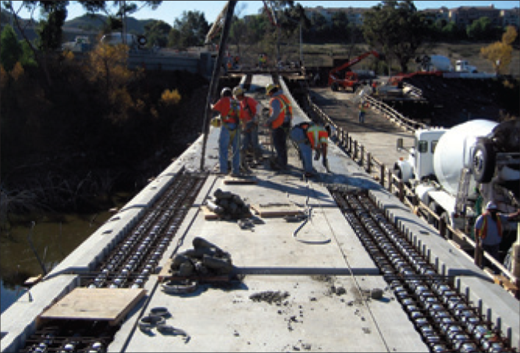
What a fun concept bridge! The only problem seems to be in the costings given. Did it really cost US $8·5 million? If yes, then this seems to work out at US $6500/m2 and not the US $50/m2 given in the paper.
Author's reply
The contributor is correct. Due to a conversion error – caused by dividing instead of multiplying to convert from US $/ft2 to US $/m2 – the bridge construction cost was incorrectly stated as US $50/m2. The actual bridge construction cost is approximately US $6500/m2 as the contributor correctly points out. Furthermore, the comparative cost for the conventional girder bridge alternative, and the cable-stayed and suspension bridge alternatives, should have been stated as US $3300–5200/m2 and US $9800–20 000/m2 respectively. T.Y. Lin International regrets the error.
10-00015 A1 Wetherby upgrade: lowering the impact of highway engineering
by Wayne Metcalfe (November 2010)
Contribution by Stuart Marchand
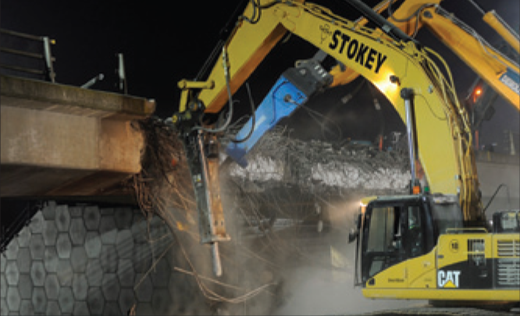
Were any steps taken to prevent the polystyrene used as void formers in the original bridge construction being blown about the countryside? And how was the polystyrene segregated to allow the crushed concrete to be recycled?
Author's reply
Suction equipment was deployed in conjunction with hand-picking methods to retrieve the polystyrene sections. During the demolition, the polystyrene generally split into pieces approximately 50 mm in diameter and these settled within 20–30 m of the demolition site and were readily recovered by hand, though this was a relatively labour-intensive element of the process. Water jets were used to control dust and this water assisted in limiting the spread of finer polystyrene particulate.
09-00058 Squeezing the heat out of London's Tube
by Matthew Botelle, Kevin Payne and Bill Redhead (August 2010)
Contribution by Richard Annett
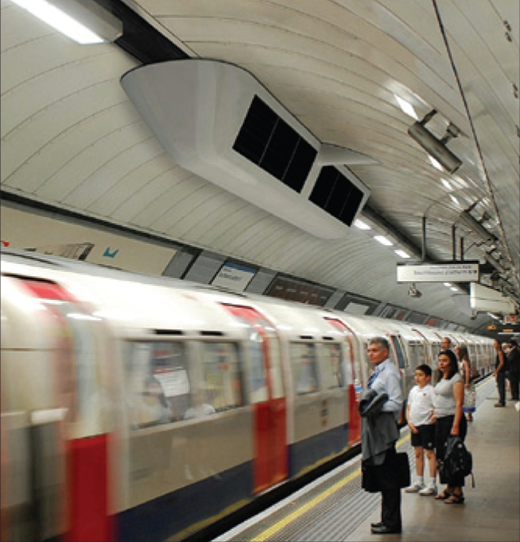
While the rest of the world tries to find innovative ways of trying to suck heat out of the atmosphere, groundwater and land, I was dismayed by the project team's apparent inability and inexperience in trying to use the excess heat. Dump it into the groundwater, dump it into the atmosphere and dump it into drainage water – what planet are they on? There was no mention of trying to pull the heat into public or private buildings or housing schemes. I hope the team gets to grips with subsequent cooling contract work and we hear about how many millions of tonnes of carbon dioxide emission have been saved.
Authors' reply
We briefly mentioned utilising recycled heat in adjacent buildings and properties in the summary and future works section at the end of the paper. There is definite interest in this sustainable approach, both from government and business, but it is more linked to the chilled-water solutions, yet to be rolled out, than the ventilation solutions currently being implemented. As also referenced in the final part of the paper, the best long-term solution will be achieved through the development of an energyoptimised solution; further minimising the heat injected into the system and thus reducing the need for it to be reused at all.
Contribution by John Curtis
Some of the overheating is self-inflicted. Most of the original tunnels were circular in cross-section, which allowed a flow of air along the sides outside and above the trafficked footways.
Many of the refurbished tunnels now have square cross-sections, reducing the widths and heights due to requirements for the choice of vertical adverts and low false ceilings, or architectural choices – this leads to less air flow and a sense of claustrophobia and possible panic. I would plead that the squaring of circular tunnels is halted and reversed.
09-00047 The history of British motorways and lessons for the future
by John Wootton (August 2010)
Contribution by J. Deacon
The paper contains much of the material found in the UK Motorway Archive but a number of pieces of information are missing. No mention is made of the early work carried out in the south Midlands on the M5 and M50. Here W. R. Thomas, county surveyor and bridgemaster of Worcestershire (who died in 2009 aged 98), was at the forefront in the construction of the early motorways. The M50 Ross spur started in April 1958 at the same time as the M1.
Contribution by Richard Barnes
The author may be interested to know that in 1946 George Strauss MP, parliamentary secretary to UK Ministry of War Transport, spoke to the Pedal Club in London and informed them that in 2 or 3 years special motorways would be built in Britain. He also told them that cycle tracks and footpaths would be built alongside such new roads to, ‘help cyclists to get to work easily and also into the country quicker and with greater safety for their runs and time trials’. Lesson for the future – politicians are not to be trusted.
Contribution by Paul Taylor
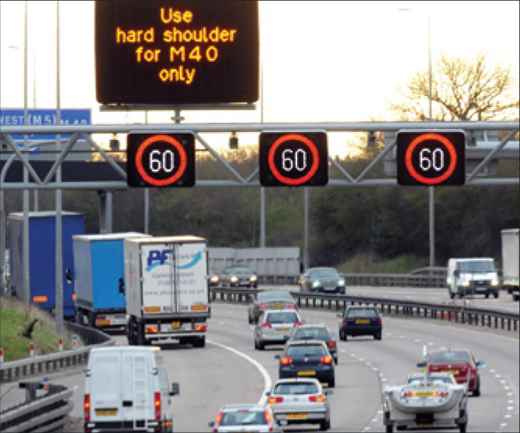
I was involved with the M20 at Wrotham Hill. In 1976 we pressed the South Eastern Road Construction Unit (Sercu) to permit full-depth construction for hard shoulders, as traffic on the M20 would be in contraflow over a significant length while temporary slip roads were removed. Eventually Sercu agreed and, as stated in the paper, full-depth hard shoulders were brought out as a national standard in 1979. We also tried to convince the powers that be to make all lanes and hard shoulders 3·6 m wide, but the idea fell on stony ground. What a benefit it would now be with hard-shoulder running.
Author's reply
My thanks to all those who have commented on my paper. I will ensure the comments are archived with appropriate accreditation. The Motorway Archive Trust is continually seeking material and any engineer who has memories, documents or other artefacts of the motorway construction era that can be archived should contact Michael Chrimes, director of engineering policy and innovation at ICE in London.
09-00041 Climate variability in civil infrastructure planning
by Peter Mason (May 2010)
Contribution by John Hutchinson
The most marked changes in the levels of Lake Victoria are shown in the paper as a rise of about 1·4 m from 1962 to 1964, attributed to a dramatic climate anomaly in east Africa. This is followed by a falling trend of 29 mm per year for the next 40 years or so, which is still continuing. Is there any evidence to indicate that, especially in view of the proximity of the Rift Valley, a contribution to the 1·4 m rise could have been made by fault movements and that much of the falling trend is the result of subsequent stimulated river erosion?
Author's reply
There seems little doubt that that sudden rise in lake level was part of a worldwide change which was reflected in east Africa by increased rainfall and run-off. Similarly, the subsequent drop in lake levels would appear to correspond to the regional climatic conditions reverting back slowly to their pre-1960s state, but with a cyclical change superimposed on that which appears to correspond to cyclical solar outputs. As the outflows are controlled, albeit in a way which matches the characteristics of the original Ripon Falls, river bed erosion does not play a part.
Full versions of these and other discussions can be read in the supplementary data to the online version of these pages at www.civilengineering-ice.com.