


This research validates that professionals across six artificial intelligence (AI)-focused Fintech business models endorse the inclusion of trust-building and addressing privacy concerns at the business model level. Trust-building and reducing privacy concerns should be one of the building blocks of a modern business model.
This research applied a mixed-method approach, analysing 12 interviews with Fintech managers and a survey of 1,452 Fintech professionals in management or other senior technology positions such as systems architects.
The analysis verified that the trust-building methods and the methods to reduce privacy concerns should be decided at the business model level.
Trust-building and reducing privacy concerns are added to the nine existing building blocks of the popular Business Model Canvas. The updated Business Model Canvas with 10 building blocks captures more accurately the six AI-focused Fintech business modes identified.
1. Introduction
Artificial intelligence (AI) is constantly creating new opportunities and financial organizations are regularly adapting their businesses to make the most of these opportunities. Previously, with some exceptions such as the emergence of the Internet, technology adoption in finance did not occur at a scale that could be considered business model innovation. While some argue that a model must be completely novel to qualify as a business model innovation, most argue that a significant scale of change across front- and back-office operations, with new services and new technologies delivering these services, is indeed change at the business model level (Iqbal et al., 2025; Tucci, 2022). With this increased importance of business model innovation, the tools that can support this process, such as the Business Model Canvas, should be updated to capture the current environment and the role of AI. This research finds support for using an extended Business Model Canvas that also covers trust and privacy across six proven, AI-focused Fintech business models.
There is wide agreement that a business model has a different focus from strategy despite them being heavily interlinked. While strategy includes how an organization reacts to competition, the business model focuses on framing the main characteristics and processes of an organization. The widely used Business Model Canvas (Osterwalder and Pigneur, 2010) identifies nine building blocks of a business model. These nine building blocks did indeed capture the key priorities of a business model for many years. However, with the increasing role of AI and the increasing volume of data it consumes, some additions to these nine building blocks are necessary to bring them up to date (Shao et al., 2026; Teng et al., 2025). Because of the high level of abstraction of these building blocks, they do not need to be updated regularly, but they may need to be updated when the business environment changes significantly. It may not be a coincidence that the popular framework with nine building blocks emerged in 2005, when the role of the Internet in business had become clearer and the Internet was more widely adopted; so now, with the similarly disruptive recent forms of AI being more widely adopted, it is a good time to extend the framework beyond its original nine building blocks.
One more building block is added to capture the increased role of AI and data. The new building block captures the trust-building methods applied and the methods utilized to reduce privacy concerns. Trust-building is added because of how central trust with all the stakeholders is to utilizing AI. Privacy concerns are important for legal and ethical reasons, but also because if users have these concerns, they will not share their data as willingly (Trabucchi et al., 2023). These can be seen as two separate issues, but they are often intertwined. In the context of Fintech, the results presented here show that they do behave in a similar way. Often, a measure taken can benefit both dimensions by increasing trust and reducing privacy concerns. This does not always occur, but there are many situations where it does. Additionally, both trust and privacy concern require a deep understanding of the user's perspective.
New business models in Fintech attempt to use the latest AI as a lever for growth. Insufficiently addressing trust and privacy can lead to pushback from customers, but also from governments in the form of stricter regulation, thereby negating the benefits of increased use of AI. Modern financial organizations are built around the capabilities of AI and the data available; therefore, they should address trust and privacy at the business model level. The research question is:
Should trust and privacy be evaluated at the business model level?
To evaluate whether the new building block is indeed necessary, it must be tested within current AI-focused business models. Even within technology-intensive financial organizations, there are several high-level business models. This research utilizes a framework with six AI-focused business models (Zarifis and Cheng, 2024).
As the nine building blocks have wide support, this research tests the new building block against each of the six AI-focused business models. The six AI-focused business models are: (1) focus on fewer finance services and disaggregate, (2) absorb AI into existing finance model, (3) incumbent financial organization expanding beyond current model, (4) dedicated finance disruptor, (5) tech company disrupting finance and (6) disruptor not focused on technology, with extensive userbase offering new financial services. The first three models involve organizations that are already active in the financial sector. The last three models are organizations that are new to offering financial services.
The mixed methods research finds support for the additional building block of trust and privacy. With the new building block added to the original Business Model Canvas (Osterwalder and Pigneur, 2010), the resulting 10 building blocks are: (1) value propositions, (2) customer relationships, (3) customer segments, (4) channels, (5) cost structure, (6) revenue streams, (7) key partnerships, (8) key activities, (9) key resources and (10) how to build trust and reduce privacy concerns. These 10 building blocks ensure that the stakeholders in an organization are focused on the most important issues when planning and implementing a new business model.
The next section presents the theoretical foundation and develops the hypotheses. This is followed by the methodology section, where the mixed methods approach, including interviews and surveys, is discussed. This is followed by the analysis, discussion and finally the conclusion.
2. Theoretical framework and proposed hypotheses
Firstly, the literature that supports the integral role of trust-building and reducing personal information privacy concerns is discussed. As there are different definitions of business models and a range of ways of using them, literature that clarifies how they are being utilized by this framework is presented. Finally, the proposed hypotheses to extend the Business Model Canvas for the six AI-focused Fintech business models are presented.
2.1 Building trust at the business model level
Because of the increased use of AI and data in finance, and the associated risks this brings, it may be necessary to consider trust-building methods at the business model level. The increased use of AI enables the analysis of more data from a broader range of stakeholders, including staff, not just customers. Agentic AI goes a step further, having more independence to develop and apply its own solutions (Farooq et al., 2026). Business models must also change more frequently due to the pace of innovation. This was not always the case in the past when business models changed far less frequently, and trust was built gradually over time.
The importance of an issue such as trust is not, in itself, sufficient justification for its inclusion at the business model level of abstraction. There are many important issues that are not addressed at the business model level. A business model is ultimately a tool to create and improve a business; therefore, something should only be included if it will benefit the completeness and effectiveness of this tool (Amit and Zott, 2015; Bouwman et al., 2020). Including trust at this level can lead to better choices and clearer plans. Building trust in the age of AI is important across many different forms of business, but the approach is not standardized. Although trust is a pervasive concern across business models, the mechanisms through which it is achieved vary considerably. There are no standard solutions, which means it must be shaped at the business model level; however, there are some typical approaches that prove effective in most cases (Weibel et al., 2023). It is necessary to identify the trust-building methods that will be employed during the development of a business model, as it may be harder to build trust if these considerations are not embedded from the outset.
In addition to trust-building being an integral part of the business model, clarifying it at this stage means it can be implemented effectively from the outset. It may not just be another important issue that needs to be addressed at some point; it may be an issue that must be baked into the business model from the start. An AI-centred Fintech requires data from consumers and the other stakeholders in its ecosystem to be effective, therefore, building trust in the most effective way from the start is critical. For example, the profitability of a Fintech relies largely on providing bundles of services beyond the core financial services (Gimpel et al., 2018). These bundles of services require agreements across the ecosystem of which the Fintech is part, and trust from the consumer in all of these different services bundled together. This common Fintech situation raises many issues for trust. For example, what if one of the bundled services undermines trust?
It is evident that all such trust issues must be planned from the outset with the main stakeholders to create the supportive ecosystem necessary (Hussain-Khan et al., 2026). To build trust across the ecosystem through which the Fintech delivers its services, the role of trust must be clearly defined for the organization, and for their partners, at the business model level. In the current Business Model Canvas if you appreciate the value of trust you would have to look at it separately in at least two sections, key partners, and the existing section customer relationships. This demotes trust to a way to implement partnerships and customer behaviours. In an AI-focused model it is one of the priorities that must be resolved first so many other processes align to it.
2.2 Reducing privacy concerns at the business model level
Personal information privacy concern can be defined as the intention of technology users to keep their personal information private and their concerns about how an organization's practices may, intentionally or unintentionally, compromise the privacy of this information (Yun et al., 2019). Privacy concerns are strongly related to trust, but remain a distinct concept. Many issues affect both in a similar way, but there may be certain issues that affect each concept differently.
As with trust, the higher the risk, the higher the personal information privacy concerns (Wang and Li, 2025). There are three main ways in which AI can exacerbate privacy concerns, one readily apparent and two less immediately obvious. The most apparent way AI increases privacy concerns is through the increase in the volume of data processed (Trabucchi et al., 2023). The two less immediately apparent ways AI heightens concern is that it possesses a greater ability to analyse data and most importantly, to act on the resulting insights. For example, some individuals fear that, directly or indirectly, an AI system can infer their health conditions, potentially leading to them being charged higher insurance premiums.
In a similar way to trust, privacy concerns have some characteristics that are consistent across many different contexts, because they derive from fundamental psychological dispositions, and some characteristics that are highly dependent on the context (Yun et al., 2019). Both the nature of the specific implementation of the technology and the environment in which it is deployed can significantly affect outcomes (Xu and Zhang, 2024). For this reason, it would not be sufficient to evaluate the role of privacy solely in the broad context of Fintech companies as a whole. Rather, privacy must be considered in the context of each of the six specific AI-focused business models (Zarifis and Cheng, 2024).
2.3 The six AI-focused Fintech business models and nine building blocks
There are two primary purposes of business model literature. The first is to support business model innovation by providing tools with which to develop a new business model (Teng et al., 2025). The second is to identify proven business models that an organization can follow directly or use as a starting point for its business model innovation. These two contributions of the literature in this area turn an ill-defined problem into a more clearly defined one.
The existing Business Model Canvas has been employed across a variety of organizational contexts, but in its current form it does not appear to be well-suited for contemporary AI-focused organizations. The nine current building blocks are: (1) value propositions, (2) customer relationships, (3) customer segments, (4) channels, (5) cost structure, (6) revenue streams, (7) key partnerships, (8) key activities and (9) key resources (Osterwalder and Pigneur, 2010).
Given the pivotal role AI plays in many businesses today, new AI-focused business models have emerged. The framework employed here includes six AI-focused Fintech business models. These are: (1) a focus on fewer financial services and disaggregation, (2) absorption of AI into an existing finance model, (3) an incumbent expanding beyond its existing model, (4) a dedicated finance disruptor, (5) a tech company disrupting finance and (6) a disruptor not focused on technology but with an extensive userbase offering new financial services (Zarifis and Cheng, 2024). The first three models involve organizations that are already active in the financial sector. The final three models represent new entrants using AI to start offering financial services.
2.4 Proposed extended business model canvas with trust and privacy planned at the business model level
The increasing role of AI and its ability to analyse more data and identify more insight than before poses challenges to trust and privacy (Hutzschenreuter et al., 2025). Trust-building and reducing privacy concerns may need to be planned for at the business model level, but current literature does not sufficiently cover this. This research evaluates if the six existing AI-focused business models (Zarifis and Cheng, 2024) should use an extended Business Model Canvas that includes the role of trust-building and reducing privacy concerns for each of the six models. Figure 1 illustrates the model showing the influence of trust and privacy on a business model's effectiveness. Business model effectiveness is defined as how well it is perceived to capture value (Biloshapka and Osiyevskyy, 2018). To evaluate if the two additional topics of trust and privacy should be considered at the business model level and added to the Business Model Canvas, twelve hypotheses are formulated here and tested in the subsequent sections:
 A diagram illustrating the influence of trust-building and reducing privacy concerns on business model effectiveness for six Fintech business models. The diagram shows two main components: Trust-building and Reducing personal information privacy concerns. Both components have arrows pointing towards Business model effectiveness for all six Fintech business models, indicating a positive influence. The diagram is repeated six times, suggesting its application to each of the six Fintech business models.
Proposed new building blocks for each of the six AI-focused Fintech business models (Zarifis and Cheng, 2024)
A diagram illustrating the influence of trust-building and reducing privacy concerns on business model effectiveness for six Fintech business models. The diagram shows two main components: Trust-building and Reducing personal information privacy concerns. Both components have arrows pointing towards Business model effectiveness for all six Fintech business models, indicating a positive influence. The diagram is repeated six times, suggesting its application to each of the six Fintech business models.Proposed new building blocks for each of the six AI-focused Fintech business models (Zarifis and Cheng, 2024)
For each of the six AI-focused business models in Fintech, the methods to build trust should be planned at the business model level to maximize its effectiveness.
For each of the six AI-focused business models in Fintech, the methods to reduce personal information privacy concerns should be planned at the business model level to maximize its effectiveness.
3. Methodology
This research brings together two theoretical frameworks, the business model literature and the building blocks of business models and adapts them to the contemporary Fintech context. Because of the strong theoretical foundation provided by these frameworks, the goal is to validate the six models that were synthesized and extended in the previous section. However, before the models can be validated, an interim step is required to clarify the role of the nine existing building blocks, as well as the newly proposed block, for each business model. The final stage is a survey of 1,452 Fintech professionals that evaluates the six models and their 10 building blocks. This approach aligns with the contingency theory of management in which managers adapt their strategies to the environment (Ayman et al., 1995). The survey tests whether respondents now believe they should employ 10 business model building blocks, as opposed to the nine that were preferred approximately twenty years ago. Thus, the research methodology comprises three steps, as illustrated in Figure 2.
 An illustration of three stages of a research methodology. The first stage involves a literature review to identify business models and building blocks. The second stage clarifies the role of trust and privacy for six business models through interviews with 12 participants. The third stage tests if trust-building and reducing privacy concerns should be planned at the business model level through a survey of 1,452 Fintech professionals.
Three stages of the methodology
An illustration of three stages of a research methodology. The first stage involves a literature review to identify business models and building blocks. The second stage clarifies the role of trust and privacy for six business models through interviews with 12 participants. The third stage tests if trust-building and reducing privacy concerns should be planned at the business model level through a survey of 1,452 Fintech professionals.Three stages of the methodology
3.1 Data collection method
3.1.1 Qualitative data collection
One challenge in the data collection was to ensure that the semi-structured interviews included professionals who were familiar with all six AI-focused business models. For this reason, twelve representative organizations corresponding to these six models were identified. Accordingly, purposive sampling of managers across all six business models was employed for the interviews. The aim was to recruit at least two interviewees familiar with each model.
The selected cases are all financial organizations that offer services in the European Union. They are not all headquartered in Europe, but they all offer services within this shared regulatory jurisdiction. Financial services are heavily shaped by regulation so having companies from the same regulatory environment ensures that the sample is more representative of the target population. For each organization, its reports, website and relevant trade press articles were studied to clarify how the 10 building blocks of a business model apply to them. As the building blocks cover fundamental characteristics that shape the identity of an organization, information on these matters is publicly available.
The semi-structured interviews were conducted online and lasted between 18 and 52 min. The interviews began with the typical demographic questions. This was followed by general questions regarding participants' organizations and their professional roles. The third section addressed the 10 building blocks. These comprised the nine existing building blocks and one newly proposed block addressing trust-building and privacy concern reduction. Finally, the participants were given the opportunity to add anything they wanted to on the issues discussed. The interviews were an opportunity to clarify managers’ perspectives on these issues and to understand how they justify their choices. The interviewee experience and demographics are presented in Tables 1 and 2.
The six business models and the related interviewee experience
| Business model | Interviewee experience |
|---|---|
| (1) Focus on less financial services and disaggregate |
|
| (2) Absorb AI into existing financial model |
|
| (3) Incumbent in finance expanding beyond model |
|
| (4) Dedicated finance disruptor |
|
| (5) Tech company disrupting finance |
|
| (6) Disruptor not focused on technology with extensive user-base |
|
Demographic information of interview participants
| Measure | Variable | Participants |
|---|---|---|
| Gender | Male | 7 |
| Female | 5 | |
| Age | 18–24 | – |
| 25–39 | 4 | |
| 40–59 | 7 | |
| 60 or older | 1 | |
| Highest education qualification | University bachelor's degree | 10 |
| University postgraduate degree | 2 | |
| Monthly income in pounds (EUR) | 3,001–5,000 | 6 |
| 5,001–7,000 | 2 | |
| Over 7,001 | 2 | |
| European nationality and European resident | 9 | |
| Without European nationality, but a European resident | 3 | |
3.1.2 Quantitative data collection
After clarifying the key themes through interviews, the resulting models of the role of trust and privacy in each of the business models had to be tested quantitatively. The survey questions were developed based on the clarity provided from the previous stages. The final second-order codes identified in the qualitative analysis served as the basis for the latent variables.
Screening checks were implemented to ensure that participants possessed relevant experience with the topics covered in the survey. The survey included a screening question asking participants whether they had experience working for a Fintech company. They were only allowed to complete the survey if they did indeed have the relevant experience. This was followed by a series of questions addressing their demographic characteristics. These are summarized in Table 3. The table shows sufficient spread across ages, education level, and income. For the main part of the survey addressing the role of trust and privacy there were three survey questions for each of the four latent variables.
Demographic information of survey participants
| Measure | Variable | Participants | |||||
|---|---|---|---|---|---|---|---|
| BM1 | BM2 | BM3 | BM4 | BM5 | BM6 | ||
| Gender | Male | 153 | 143 | 135 | 138 | 132 | 121 |
| Female | 123 | 108 | 106 | 102 | 99 | 92 | |
| Age | 18–24 | 12 | 8 | 28 | 65 | 76 | 66 |
| 25–39 | 169 | 171 | 175 | 153 | 141 | 161 | |
| 40–59 | 81 | 66 | 37 | 22 | 14 | 3 | |
| 60 or older | 14 | 6 | 1 | 0 | 0 | 0 | |
| Highest education qualification | University bachelor's degree | 182 | 201 | 209 | 211 | 195 | 180 |
| University postgraduate degree | 94 | 50 | 32 | 29 | 36 | 51 | |
| Monthly income (EUR) | 2,001–3,000 | 6 | 8 | 12 | 28 | 48 | 81 |
| 3,001–5,000 | 139 | 128 | 125 | 151 | 141 | 138 | |
| 5,001–7,000 | 121 | 111 | 101 | 61 | 42 | 11 | |
| Over 7,001 | 10 | 8 | 3 | 0 | 0 | 0 | |
| European nationality and European resident | 241 | 222 | 225 | 221 | 184 | 203 | |
| Without European nationality, but a European resident | 35 | 29 | 16 | 19 | 47 | 28 | |
As participants were not familiar with all six models, they could only respond to the model that matched their organization. Therefore, while the model only has nine measured variables it needed six separate samples, one for each model type. Based on a significance level of 1% and a minimum R2 of 0.1, the minimum sample size required for each model was determined to be 158 (Hair et al., 2021). A total of 1,531 surveys were completed; however, quality checks reduced the final sample to 1,452. The surveys rejected per model were 18, 21, 13, 7, 11 and 9, respectively. The sample sizes for each model are 276, 251, 241, 240, 231 and 213, respectively. Quality checks examined whether surveys had been completed unrealistically quickly, whether identical responses had been given across all questions, and whether all questions had been answered. As the survey did not have questions that would be difficult to answer, and it was not too long and could be completed in under five minutes, incomplete surveys were deemed low quality and excluded.
3.2 Data analysis method
Qualitative data analysis: A thematic analysis of the interviews was conducted using NVivo software (Krippendorff, 2004). The initial first-order categories of the coding were based on the literature but were then further developed to second-order codes based on the interview data (Sarker et al., 2018). The initial deductive coding created the themes of trust and privacy concerns for each of the six business models.
Quantitative data analysis: To interpret the results, PLS-SEM was implemented with the SmartPLS software. This method is well-suited to exploring and developing new models (Chin, 1998; Hair et al., 2021). PLS-SEM is less dependent on a normal distribution of the data than covariance based structural equation modelling. This characteristic can be beneficial when analysing and modelling people's beliefs across several variables in less mature models.
The typical concerns with using SmartPLS are mitigated by the mixed methods approach or addressed directly. For example, the criticism by some that when SmartPLS is applied to small samples it can cause statistical problems was addressed by having samples that are much larger than the minimal threshold.
4. Analysis
4.1 Qualitative analysis
The qualitative analysis clarified the 10 building blocks of the six business models. These 10 building blocks include the 9 existing ones (Osterwalder and Pigneur, 2010), and the new one. The insights derived from this analysis extend previous research on contemporary Fintech business models and the literature on the established building blocks of business models. The findings summarized in Table 4 demonstrate the importance of considering trust and privacy at the business model level. The findings also indicate that, while these are distinct issues, the approach to addressing them is similar. The clarity achieved at this stage enabled this research to test the validity of the new building block across the six models in the next stage.
Coding structure of qualitative analysis
| Aggregation | 1st order | 2nd order | Illustrative quotes |
|---|---|---|---|
| Building trust | High level agreement | Avoid drifting into models that destroy trust | “ … the relationships with our customers and when we change, we need to take them with us. They might not like what we become and then they will not trust us anymore.” |
| Must say no to some of AI's capabilities to protect trust | “If we are not tailoring and controlling AI to deliver reliably to our customer then thy should not trust us.” | ||
| Agreement across ecosystem on trust-building | “ … look at the different people we work with just in this country, without getting into other countries it quickly gets into the hundreds, we will not agree on everything, but we should be close on why our AI is trusted and if it is not what we should do to fix that.” | ||
| More consistent approach to trust-building | “strong operations make customers trust us, all of us know that but the narrative we provide needs to also make us trustworthy and that needs some agreement” | ||
| Identify synergies with other priorities of the model | The most important of the 10 building blocks need to have synergies | “there are synergies how we have trusting relationships with our associates and how we should have trusting relationships with our clients … ” | |
| Building trust into the technology | With trust in the business model, it is easier to integrate it into a solution | “If trust is covered in our model and strategy, it makes it easier to put values such as trust in the technology we will use.” | |
| Reducing privacy concerns | High level agreement | Avoid drifting into models that increase privacy concerns | “the temptation is to see this as a race of who can implement agentic AI faster and taking on more risk and collecting and using more data … more than what our clients want” |
| Must say no to some of AI's capabilities to protect privacy | “we are motivated by money so we find agentic AI attractive but clients will find parts of it intrusive” | ||
| More consistent approach to privacy | “ … we have clarity and narrative authority on this issue also (privacy), we all know-the mangers how to do this (reduce privacy concern) … ” | ||
| Agreement across ecosystem on privacy | “ … before we go live, we have meetings with the user experience experts, someone from marketing and a few other guys we don't just use the factory settings we need to be sure for our part and our partners we are trustworthy when people give us their data” | ||
| Identify synergies with other priorities of the model | The most important of the 10 building blocks need to have synergies | “ … the consumer experience including privacy and trust can make us think about how we operate and make deeper back-office tweaks, we are very sensitive to that, the customer is king … ” | |
| Building privacy into the technology | With privacy in the business model, it is easier to integrate it into a solution | “ … some people worry about their data, not all but some do, if we can develop a solution that protects them and we still get the job done we should do that … ” |
4.1.1 First AI-focused business model building blocks
The participants were not immediately ready to talk about the nine existing building blocks, as the terms used to label them are not necessarily the words everyone uses when discussing these issues. However, after they were given some time to think about each of the nine existing blocks, they recognized the value in considering them when designing a new business model. One participant considered eight of the existing building blocks to be issues they were regularly concerned about but saw key partnerships as an area that more senior management took care of. The same interviewee also perceived some of the building blocks as both strategic when making a new business model but also a more regular concern. Specifically, the participant identified two of the existing building blocks, customer relationships and cost structure, along with trust-building, as being of strategic significance while also representing a recurrent concern within day-to-day operations.
With regard to trust and privacy concerns, one participant pointed out that, while these considerations are strategically significant in shaping a new AI-focused business model for the organization as a whole, they must also be revisited for each country or regulatory jurisdiction the organization was active in, as they are heavily influenced by culture, values and regulation. The participant pointed out how privacy expectations within the EU are considerably higher than in most other jurisdictions. Another participant noted that trust and privacy were also heavily influential on the existing issue in the original Business Model Canvas that covered key partnerships.
4.1.2 Second AI-focused business model building blocks
The second Fintech business model can be seen as a more cautious approach to utilizing AI, in which AI is used more extensively but without redesigning the business model. It is perhaps unsurprising, therefore, that the interviewees from these organizations believe keeping their model the same is necessary to retain the trust of existing clients and build trust with new ones. One participant believed that with the increased use of AI, being a familiar and respected company that retains a broadly similar profile to what it was previously will be of greater importance than ever. Therefore, the business model should not change any more than necessary. One participant pointed out that it was not just about how the business model could build trust and reduce privacy concerns, but it was also about how the wrong choice in business model may destroy trust and increase privacy concerns. A distinction was made between the transition process and the challenges that it may create, and the final model, which may prove more detrimental to trust and privacy even after the transition period has concluded.
4.1.3 Third AI-focused business model building blocks
Organizations falling into the third model keep their existing services and processes but add additional ones to utilize new opportunities created by the latest AI. Both participants had experienced the challenges associated with trust and privacy when using AI to expand their services. Both agreed that these issues should be decided at the business model level. One participant explained that this is a critical issue and therefore must be determined by senior management as early as possible, because the actions taken may not only cause problems but also limit the options available. One participant also noted that when the organization began using AI more extensively, most staff had limited knowledge of AI or of the new services they would be offering, consequently, the new model needed to cover all the key issues so that staff could identify and address the gaps in their knowledge. In this participant's case, given that the new business model was clearly defined, the organization was able to implement a combination of informal meetings for knowledge-sharing and training courses delivered by experts from outside the organization.
4.1.4 Fourth AI-focused business model building blocks
Startups that are created with a model that is ideally suited to utilizing AI fall into this category. Their model is better at utilizing AI for some services but may not be suitable for all financial services. One participant explained that the organization needed to keep costs, and particularly staffing levels, as low as possible and had to rely heavily on key partnerships. This consideration is already reflected in the original Business Model Canvas. The participant observed that problems with trust and privacy could spread from one partner to another. Some of these issues could stem from genuine concerns, while in other cases they constituted stakeholder perceptions that lacked validity but were nevertheless damaging. The participant identified this as one of the reasons why both trust and privacy should be addressed at the business model level so that all partners could co-ordinate their approach to these issues.
4.1.5 Fifth AI-focused business model building blocks
Tech companies or tech-savvy companies that already utilize the latest AI and have a large customer base utilize this model. One participant noted that trust-building and the mitigation of privacy concerns needed to be embedded within the technology. Establishing a clear business model and identifying the processes in which AI is to be employed will make it easier to integrate trust and privacy considerations into the technology more rapidly. As these technologies are continually evolving, the solutions implemented may not be optimal from the outset, and even where they are, new challenges will continue to emerge, meaning that reaching agreement on the model and the manner in which trust and privacy are addressed will accelerate the process of responding to these issues. Finally, one participant noted that the organization had existing customers with whom a strong relationship of trust had been developed over several years, which meant that adding a new service was more straightforward.
4.1.6 Sixth AI-focused business model building blocks
The sixth business model is the most recent and involves organizations utilizing commoditized technologies. Unlike the fifth model these are not tech companies. One participant noted that the organization's principles of customer service guided its operations and that customer care constituted its unique selling point. Trust formed an integral part of these values. The same participant noted that the organization placed greater emphasis on values than on business models, acknowledging that the two were closely related. It appears that this organization employed its values to communicate the business model in a more engaging manner. The second participant noted that the standard of service should not decline with the introduction of new services, and that this could be partly achieved by maintaining similar processes, even where the service itself differed. This sense of familiarity represented one of the primary means of maintaining trust. The same participant highlighted the challenge of maintaining this sense of consistency across a range of services, especially given that these services are evolving at an increasingly rapid pace. The participant anticipated that agentic AI would bring about further significant changes, and consequently the business model must be clearly understood by all relevant stakeholders.
4.2 Quantitative analysis
4.2.1 Measurement models
A measurement model focuses on the relationship between the measured and latent variables. The relationship between the latent variables is explored with the analysis of the structural models in the next section. Based on the analysis of the measurement models, all six measurement models are supported, and the analysis can move on to the structural model.
The findings of the measurempent model analysis for the six business models are presented in Tables 5–10. The outer loadings are above the required threshold of 0.7, with the lowest for each model being 0.930 (A), 0.926 (B), 0.910 (C), 0.940 (D), 0.923 (E) and 0.935 (F). The average variance extracted (AVE) is above the required level of 0.5, as the lowest values for each model are 0.868 (A), 0.876 (B), 0.863 (C), 0.894 (D), 0.869 (E) and 0.876 (F). Therefore, both the outer loadings and AVE show a sufficient level of convergent validity. The Composite Reliability (CR) is above 0.7 with the lowest value for each model being 0.952 (A), 0.950 (B), 0.950 (C), 0.962 (D), 0.952 (E) and 0.955 (F). This indicates that there is sufficient internal consistency and individual construct reliability between the latent variable and the measured variables. The discriminant validity for all six models indicates that the measured variables have a stronger relationship with their latent variable than with any of the other variables.
Measurement model for first BM
| Variable | Loadings | CR | AVE | Discriminant validity | |||
|---|---|---|---|---|---|---|---|
| B1T | B1P | B1E | |||||
| B1T | B1T1 | 0.950 | 0.965 | 0.903 | 0.950 | ||
| B1T2 | 0.965 | ||||||
| B1T3 | 0.936 | ||||||
| B1P | B1P1 | 0.924 | 0.952 | 0.868 | 0.792 | 0.932 | |
| B1P2 | 0.941 | ||||||
| B1P3 | 0.930 | ||||||
| B1E | B1E1 | 0.948 | 0.964 | 0.900 | 0.933 | 0.894 | 0.949 |
| B1E2 | 0.938 | ||||||
| B1E3 | 0.960 | ||||||
Measurement model for second BM
| Variable | Loadings | CR | AVE | Discriminant validity | |||
|---|---|---|---|---|---|---|---|
| B2T | B2P | B2E | |||||
| B2T | B2T1 | 0.946 | 0.969 | 0.911 | 0.955 | ||
| B2T2 | 0.954 | ||||||
| B2T3 | 0.964 | ||||||
| B2P | B2P1 | 0.926 | 0.955 | 0.876 | 0.727 | 0.936 | |
| B2P2 | 0.943 | ||||||
| B2P3 | 0.940 | ||||||
| B2E | B2E1 | 0.951 | 0.964 | 0.899 | 0.901 | 0.730 | 0.948 |
| B2E2 | 0.936 | ||||||
| B2E3 | 0.957 | ||||||
Measurement model for third BM
| Variable | Loadings | CR | AVE | Discriminant validity | |||
|---|---|---|---|---|---|---|---|
| B3T | B3P | B3E | |||||
| B3T | B3T1 | 0.963 | 0.970 | 0.916 | 0.957 | ||
| B3T2 | 0.945 | ||||||
| B3T3 | 0.962 | ||||||
| B3P | B3P1 | 0.910 | 0.950 | 0.863 | 0.809 | 0.929 | |
| B3P2 | 0.928 | ||||||
| B3P3 | 0.948 | ||||||
| B3E | B3E1 | 0.962 | 0.975 | 0.929 | 0.942 | 0.911 | 0.964 |
| B3E2 | 0.963 | ||||||
| B3E3 | 0.966 | ||||||
Measurement model for fourth BM
| Variable | Loadings | CR | AVE | Discriminant validity | |||
|---|---|---|---|---|---|---|---|
| B4T | B4P | B4E | |||||
| B4T | B4T1 | 0.955 | 0.976 | 0.933 | 0.966 | ||
| B4T2 | 0.970 | ||||||
| B4T3 | 0.973 | ||||||
| B4P | B4P1 | 0.940 | 0.962 | 0.894 | 0.767 | 0.945 | |
| B4P2 | 0.941 | ||||||
| B4P3 | 0.954 | ||||||
| B4E | B4E1 | 0.961 | 0.973 | 0.922 | 0.933 | 0.876 | 0.960 |
| B4E2 | 0.958 | ||||||
| B4E3 | 0.962 | ||||||
4.2.2 Structural models
Unlike the measurement model, the structural model explores the relationship between the latent variables. The results are presented in Table 11. For the variable E, representing the effectiveness of the model, the R2 for all six models is substantial as it is above 0.75 (0.934, 0.822, 0.952, 0.933, 0.947, 0.911). The F2 values have a strong effect as they are above 0.35, apart from B2P-B2E which has a significant but with a small to moderate effect. Therefore, the analysis supports the six models, with only privacy in the second model considered to have a moderate effect while the rest have a strong effect.
Results of the structural model and hypothesis results
| Path | Sample mean | Standard deviation | Path coefficient | t-statistics | F2 | Hypothesis supported |
|---|---|---|---|---|---|---|
| B1T → B1E | 0.601 | 0.030 | 0.602** | 19.417 | 2.070 | H1a: Yes |
| B1P → B1E | 0.419 | 0.031 | 0.418** | 13.500 | 0.998 | H1b: Yes |
| B2T → B2E | 0.785 | 0.046 | 0.785** | 3.480 | 1.644 | H2a: Yes |
| B2P → B2E | 0.160 | 0.044 | 0.160* | 18.015 | 0.068 | H2b: Yes |
| B3T → B3E | 0.588 | 0.045 | 0.593** | 13.255 | 2.531 | H3a: Yes |
| B3P → B3E | 0.437 | 0.040 | 0.432** | 10.756 | 1.345 | H3b: Yes |
| B4T → B4E | 0.635 | 0.038 | 0.636** | 16.896 | 0.924 | H4a: Yes |
| B4P → B4E | 0.389 | 0.034 | 0.388** | 11.367 | 2.487 | H4b: Yes |
| B5T → B5E | 0.580 | 0.026 | 0.581** | 16.426 | 2.512 | H5a: Yes |
| B5P → B5E | 0.450 | 0.027 | 0.449** | 22.527 | 1.501 | H5b: Yes |
| B6T → B6E | 0.633 | 0.040 | 0.635** | 15.916 | 2.056 | H6a: Yes |
| B6P → B6E | 0.385 | 0.035 | 0.384** | 10.845 | 0.750 | H6b: Yes |
Note(s): *p < 0.01, **p < 0.001
5. Discussion
5.1 Contribution to theory
Updating or transforming business models to fully utilize AI is an important process in finance, Fintech and other sectors (Shao et al., 2026). This research empirically tested and found support for planning trust-building and the reduction of personal information privacy concerns at the business model level for AI-focused Fintech.
For all six AI-focused Fintech business models, planning trust-building and reducing privacy concerns at the business model level has a positive effect on the effectiveness of the business model. This represents a theoretical contribution extending the six AI-focused business models that have been validated in finance and insurance contexts (Zarifis and Cheng, 2024).
A second theoretical contribution lies in providing further evidence of the importance of both trust and privacy when using AI in finance and business model innovation (Teng et al., 2025; Trabucchi et al., 2023). This research demonstrates that both exert a significant effect across a range of business models, and that trust has a more significant effect than privacy across all models examined in this study.
For five business models, the effect of privacy is strong; however, in the second model, privacy has a significant but moderate effect. In the qualitative analysis, participants considered privacy to be important in all six models, whereas the quantitative analysis reveals that privacy is less decisive in the second model. This illustrates the value of mixed methods for exploring business models. Business models are usually only explored with either quantitative or qualitative methods on their own. The second business model is the only one out of the six where there is no fundamental change and AI is employed solely to improve efficiency and effectiveness. This suggests privacy concerns are not just influenced by the nature of the business model but also by changes to it. Individuals may absorb and accept the privacy risks associated with a given model over time, but a change to the model may be perceived as introducing additional risk.
Beyond the role of trust and privacy in the six specific Fintech business models tested, the results suggest that trust and privacy are important for most similar business models, even if they have some differences from the six tested here.
These findings are useful for companies that identify themselves as a Fintech and other financial organizations that rely heavily on AI. As financial technologies play a role across many business models beyond dedicated finance models such as retail, these findings may also have some relevance in those contexts, although this needs to be further explored. For example, an online retailer relies on several Fintech solutions to support its payment and credit options. In a competitive, partly globalized world, the Fintech solutions a retailer uses are often a key part of its service and may confer a competitive advantage. Therefore, in circumstances where a retailer relies heavily on Fintech, such organizations may also need to plan trust-building and the reduction of personal information privacy concerns at the business model level.
5.2 Contribution to practice
This research makes two practical contributions as it updates two useful tools employed to develop business models. The first involves updating the six AI-focused business models, and the second involves extending the Business Model Canvas (Osterwalder and Pigneur, 2010).
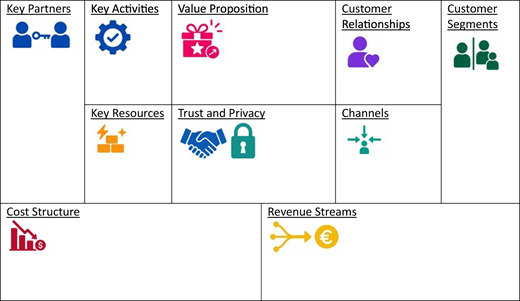
As the findings indicate that building trust and reducing privacy concerns should both be evaluated when developing a new business model, they can be combined as one additional section in the Business Model Canvas (Osterwalder and Pigneur, 2010). The updated model can not only guide an organization towards a more effective business model, but it can also guide an organization towards the capabilities they need to implement it (Tran et al., 2026), the risk management necessary and the right governance focus (Nguyen et al., 2026a, b). This widely used framework was developed at a time when the role of AI was not yet prominent. The role of AI, especially Agentic AI, along with other current developments, has challenged trust and increased privacy concerns, so these two need to be incorporated. The resulting Business Model Canvas with trust and privacy has 10 sections, as illustrated in Table 12. New graphics have been added for each building block to offer more immediate visual clarity.
Updated business model canvas with trust and privacy (based on Osterwalder and Pigneur, 2010)
6. Conclusion
This research employs a mixed-method approach, interviewing and surveying Fintech professionals. The analysis confirms that a framework of six AI-focused business models in finance should incorporate trust-building and the reduction of privacy concerns at the business model level.
Together, trust-building and the reduction of privacy concerns should constitute one of the building blocks of a modern business model. Accordingly, both considerations have been incorporated into the widely used Business Model Canvas, adding to its nine existing building blocks (Osterwalder and Pigneur, 2010). The updated Business Model Canvas more accurately captures the six AI-focused Fintech business models.
The 10 building blocks of the updated Business Model Canvas are: (1) value propositions, (2) customer relationships, (3) customer segments, (4) channels, (5) cost structure, (6) revenue streams, (7) key partnerships, (8) key activities, (9) key resources and (10) trust-building and the reduction of privacy concerns. These 10 building blocks ensure that stakeholders within an organization are focused on the most important issues when discussing and implementing a new business model.
Limitations and future research: This research has the typical limitations associated with the qualitative interviews and the quantitative survey utilized, although these have been mitigated with the use of complementary mixed methods. Additionally, these findings only apply to the financial sector in Europe, so further research can explore whether they apply to other sectors of the economy and geographic regions.

