


Ecosystem conservation programs are increasingly incorporating both preservation and restoration strategies for ensuring the flow of ecosystem services from public lands. While preservation and restoration have similar end ecological objectives, differences in these conservation types may create systematic variation in willingness to pay (WTP) for their benefits. There has also been conflicting evidence of whether or not the amount, or scope, of conservation influences the demand for environmental improvements in manners consistent with neoclassical economics (greater value for more conservation). To investigate the sensitivity of conservation values to type and scope, we conducted a meta-analysis of existing evidence. We synthesized 127 data points from 22 primary studies that provided WTP estimates for preservation, forest restoration, and freshwater restoration conducted primarily on public lands. Estimates were derived from choice experiments, contingent rankings, and dichotomous choice contingent valuation studies for conservation programs in Europe, Canada, and the U.S. from 1987 to 2013. We found strong evidence for systematic variation of WTP depending on conservation type and scope. Values for preservation were greater than both forest and freshwater restoration; and freshwater restoration was valued greater than forest restoration. Meta-estimates were found to be sensitive to scope effects, as value increased with conservation intensity but at diminishing marginal rates. We provide quantitative policy analysis in the form of within-sample predictions of mean WTP for each conservation type and scope and conclude with recommendations.
Introduction
Conservation efforts on public lands are increasingly centered on holistic approaches that maintain and repair networks of connected ecosystems. Because many public lands have been degraded by past industrial extraction however, ecosystem conservation efforts are now comprised of both preservation and ecological restoration strategies.1 Together, these conservation strategies aim to maintain or improve ecosystem structures, processes, and functions that ultimately produce biodiversity, clean drinking water, raw materials, recreational opportunities, and other services beneficial to humans. The myriad values that people hold for nature are tied to, and can be classified as diverse flows of services that ecosystems provide to mankind. These ecosystem services include provisioning services, such as timber for houses and other commodities, but are substantially comprised of non-market services such as climate regulation, provision of biodiversity, and spiritual inspiration (Pagiola et al., 2004). To the extent that decision criteria derived from economic paradigms (e.g., efficiency, or maximization of net present value) dominate planning and funding of public lands management, it is imperative that information derived from commodity and other markets are augmented with suitable information about the value of non-market goods and services provided by pristine or restored ecosystems. This broader ecosystem conservation approach requires novel scientific methods for understanding the impacts and benefits (Garber-Yonts et al., 2004).
Because values for changes in ecosystem services are not easily ascertained from market transactions, non-market valuation techniques are required. Stated preference methods are well suited for determining the demand and implicit prices for ecosystem conservation and changes in the production of services that result, due to their ability to capture existence and bequest values. However, the vast and often conflicting array of willingness to pay (WTP) estimates for ecosystem services, the cost of primary studies, and the need for timely availability of relevant estimates underscore the importance of meta-analyses. Meta-analysis provides a means to statistically quantify and integrate evidence from multiple primary studies of similar phenomena (Glass, 1976). Meta-regression analysis, or the regression of regressions, has been the preferred choice of quantitative syntheses in economics due to the ease of replication and sensitivity analysis of alternate model specifications (Stanley and Jarrell, 1989). Best practices for meta-analysis techniques in environmental valuation have been explored in general (Nelson and Kennedy, 2009) and more specifically for non-market valuation (Smith and Pattanayak, 2002). While there are a handful of meta-analyses that have synthesized willingness to pay estimates for individual or subsets of ecosystem services associated with preservation or restoration of certain ecosystem types, (e.g., Van Houtven et al., 2007; Lindhjem, 2007; Latinopoulos, 2010; Ojea and Loureiro, 2011), there have been no meta-analyses focused on synthesizing willingness to pay for various ecosystem conservation strategies. Additionally, there is mixed evidence as to the sensitivity of willingness to pay estimates to the amount of conservation. These two primary research interests need further assessment: (1) how the type of conservation (i.e., preservation or restoration) influences willingness to pay, and (2) how sensitive willingness to pay meta-estimates are to the quantity and intensity, or scope, of conservation.
The type of conservation program being offered, be it preservation or restoration, is likely to influence willingness to pay for conservation due to varying trade-offs and implications associated with each. Furthermore, different types of ecological restoration programs, such as forest or freshwater restoration, may influence willingness to pay estimates. Preservation and restoration programs have similar ecological motives (providing quality ecosystem services associated with more natural areas) and are fundamentally different from other land management strategies focused on the extraction of commodities. Despite their similarities, preservation and restoration have a number of differences. Preservation is implemented to prevent degradation, whereas restoration is implemented to fix degradation. Since preservation is typically applied to more pristine lands that have the potential to be exploited, and restoration is applied to already degraded lands, the starting point of total stocks of ecosystem services is likely to be greater for a given preservation policy site than for restoration policy sites.
The public is also likely to be sensitive to the quantity, or scope, of conservation effort, as typically conveyed in terms of changes in ecosystem services and attributes. As individuals look to maximize their well-being (and utility), levels of conservation are purchased at various prices, contributing differently to overall utility maximization. Assuming individuals have constrained budgets, they are likely to be sensitive to the cost associated with different amounts of conservation. However, the identification of scope effects for ecosystem services is complicated by various study designs and measurement differences – requiring new approaches at classifying quantities of conservation effort.
In this article, we synthesized existing values for ecosystem conservation to test fundamental hypotheses and provide within-sample predictions. Out-of-sample predictions are a further application of meta-analyses that are used to transfer synthesized benefits to new policy regions – known as the benefit transfer method (Rosenberger and Loomis, 2001). While we do not provide a benefit transfer application of our meta-regression model in this manuscript, we have set the meta-analysis up for potential benefit transfer applications in the future. We follow best practice recommendations for meta-analysis in environmental economics from Nelson and Kennedy (2009), specifically for problem definition, model specification, capturing data heterogeneity in estimation, sensitivity analysis, and applications.
Literature review and hypotheses
With regard to particular ecosystems and attributes, meta-analysis has shed light on the economic values of wetlands (Brouwer et al., 1999; Woodward and Wui, 2001), endangered species (Loomis and White, 1996), water quality improvement (Johnston et al., 2003, 2005), coastal and freshwater ecosystems (Wilson and Carpenter, 1999; Latinopoulos, 2010), and forest recreation (Rosenberger and Loomis, 2000). Recently, three meta-analyses have focused on willingness-to-pay estimates for forest ecosystem services (Lindhjem, 2007; Barrio and Loureiro, 2010; Ojea and Loureiro, 2011). Collectively these meta-analyses have advanced our understanding of the patterns implicit in willingness-to-pay estimates for various ecosystem services and their effectiveness in benefit transfer, but have produced conflicting results on scope effects and have not isolated conservation types.
Willingness to pay for ecosystems services depends on how the services are produced. Czajkowski et al. (2009) and Lehtonen et al. (2003), for example, argue that respondents seem to be concerned not only with the outcomes of conservation programs but with the means of achieving these outcomes as well (i.e., whether preservation or restoration is adopted). Christie et al. (2006), on the other hand, report that there is no evidence that the public cares how biodiversity and ecosystem services are produced. The former view, however, seems more plausible for a couple of reasons. First, certain conservation actions are likely to be preferred over others because varying opportunity costs associated with each conservation strategy are not likely to be borne uniformly by regions and socioeconomic groups. Second, preservation could be expected to command a premium because the richness and abundance of biodiversity and ecosystem services (i.e., total stocks and starting points, not necessarily marginal change achieved with conservation program) associated with intact ecosystems exceeds the corresponding levels induced by active restoration of degraded ecosystems (Benayas et al., 2009).
While preservation and restoration projects can have similar goals, they are not substitutes. As such, they can invoke different values felt for a loss or a gain that may carry more weight. Behavioral economists have confirmed loss-aversion and endowment effects (Thaler, 1980), where individuals may find that avoiding the loss of ecosystem services through preservation is of greater value than the equivalent gain of ecosystem services through restoration. Other factors may also be in play, including the differing levels of human intervention involved in preservation and restoration. Preservation is more “hands off,” while ecological restoration aims to use active, anthropogenic intervention to correct anthropogenically-caused degradation. Some people may have inherent preferences for hands-on or hands-off types of management, while others may doubt the effectiveness of our ability to provide a technological fix to degraded nature (Katz, 1992).
Scope, or embedding, effects have been separated into commodity and temporal effects; the former occurs when respondents are not sensitive to the amount of ecosystem services whereas the latter occurs when survey respondents do not adequately differentiate between a one-time payment and a series of payments (Stevens et al., 1997). Insensitivity to the scope of ecosystem services being offered has been a primary critique of the reliability of contingent valuation methods (Arrow et al., 1993). As such, scope effects concerning the sensitivity of WTP to changes in the scale of ecosystem service provision have been the focus of intense research. Kahneman and Knetsch (1992) claimed that the scope test had not been satisfied and interpreted WTP estimates as manifestations of a “warm glow effect” rather than the result of utility maximization. Their claims of scope insensitivity in valuing environmental goods spurred greater scrutiny of the topic and have been subsequently countered by other studies (Carson and Mitchell, 1993; Smith and Osborne, 1996; Carson, 1997; Veisten et al., 2004). These latter studies illustrated scope sensitivity and suggested that greater specification of the ecosystem service (i.e., attribute description) and its provision (i.e., management type) can reconcile scope concerns. Questions of how much more value should be generated by greater provision of ecosystem services are still unsettled. Diminishing marginal utility for greater ecosystem services is expected under neoclassical assumptions and researchers have illustrated value increases only up to certain thresholds of conservation, such as the minimum species population required for survival (Bulte and Van Kooten, 1999).
Testing of commodity scope effects for conservation values in meta-analyses is particularly challenging due to problems of aggregating dissimilar measures of commodities, as primary studies often portray changes in ecosystem attributes in both absolute and relative terms. Van Houtven et al. (2007) confirmed scope effects using primarily relative measurements of improvement from primary studies. Lindhjem (2007), on the other hand, could not confirm scope effects based on the absolute size of forest conservation (hectares or percentage increases). Ojea and Loureiro (2011) provide a recent approach in testing for scope effects by coding all ecosystem attribute changes, including absolute and relative measurements, into absolute measurements such as hectares of forest or wildlife population numbers. In their meta-analysis, Ojea and Loureiro (2011) confirmed scoped effects for absolute measures, but not for relative, leading to a recommendation for primary studies to utilize absolute measurement. Yet, as described in Lindhjem (2007), this approach is fraught with difficulties for ecosystem goods and services due to their complexity and the wide range of values that people hold for the same measurement. For example, Ojea and Loureiro’s (2011) approach converts a relative change in an attribute (e.g., improved bird habitat) to just the number of acres that this attribute change will occur on – losing significant information about this attribute. It is not surprising that they were unable to confirm scope sensitivity with relative measures, given their classification of primary data points.
Without prior research on WTP for type of conservation strategy, and with mixed results from prior research on WTP for scope of conservation, our investigation specifically tests the following hypotheses concerning conservation Type and Scope:
H01:; where βx = coefficient for WTP for three types of conservation (forest restoration, freshwater restoration, and preservation);
H02:; where βx = coefficient for WTP for three levels of conservation (attribute-specific, program low, program high).
This study provides the first meta-regression estimates of WTP by type of ecosystem conservation. Willingness to pay estimates for preservation and restoration on public lands were statistically inferred using data from primary studies that applied stated preference valuation methods. Results of this meta-analysis can help stated preference modelers improve research design for greater utility in meta-analyses and provide the basis for future transfer of benefits to other situations.
Meta-regression methods
It has been said that meta-analyses are as much art as science. We believe that nothing illustrates this balance more than achieving consistency in measuring and synthesizing primary data points of the same phenomenon (McFadden, 1997). This consistency is the necessary degree of meaningful combinations of primary data from identical concepts that can be adequately analyzed within a common analytical framework – consistency that is often not attained in non-market valuation meta-analyses (Smith and Pattanayak, 2002). To synthesize and compare apples to apples, we first deal with an inherent problem in meta-analyses – “the tradeoff between expanding the meta-sample to improve statistical estimation and reducing the sample to ensure comparability across studies” (Van Houtven et al., 2007).
Data selection
The concept of primary data heterogeneity (Nelson and Kennedy, 2009) includes both commodity heterogeneity (Van Houtven et al., 2007), or commodity consistency (Bergstrom and Taylor, 2006), and welfare change measure consistency (Bergstrom and Taylor, 2006). In order to adequately synthesize willingness to pay for conservation, we limited our data selection to those studies measuring similar “effect-sizes” conducted with similar valuation techniques. Other sources of data heterogeneity can include survey response rates and publication bias. Below, we detail how the data were selected and how we dealt with primary data heterogeneity.
The data for this research were compiled from 22 primary studies that were conducted from 1985 through 2013. These primary studies were found based on a literature review of primary search engines (EconLit, ScienceDirect, and Google Scholar) and web site searches that inventoried valuation studies. Specifically, these sites included the Environmental Valuation Reference Inventory (www.evri.ca), the United States Forest Service site on ecosystem services (www.fs.fed.us/ecosystemservices/index.shtml), and the Ecosystem Services Bibliography (blog.lib.umn.edu/polasky/ecosystem). Key words searched for included: willingness to pay, preservation, restoration, and conservation. Snowballing techniques were also employed as existing meta-analyses were used to find candidate studies. The studies met the following criteria: a) focused on preservation and/or restoration of forested and freshwater ecosystems primarily on public lands rather than individual species; b) used dichotomous choice contingent valuation (DCCV), choice experiment (CE), and/or contingent ranking (CR); and c) reported mean or median willingness to pay per individual or household (see Table 1). Almost all the primary studies were published in peer-reviewed journals. Given past findings on publication bias (e.g., Rosenberger and Stanley, 2006), we also scoured dissertations, book chapters, technical reports and other gray literature – finding only one suitable candidate that has been included. Full datasets are available from the authors.
Primary studies used in the analysis of willingness to pay for ecosystem conservation.
| Primary study (year of publication) | Survey Year | Elicitation formata | Ni | Adjusted WTP2010b | |||
|---|---|---|---|---|---|---|---|
| Mean | SD | Min | Max | ||||
| Adamowicz et al. (1998) | 1995 | DCCV; CE | 2 | 175.970 | 54.065 | 137.740 | 214.200 |
| Caparros et al. (2008) | 2003 | CE; CR | 7 | 65.664 | 90.686 | 0.742 | 219.343 |
| Czajkowski et al. (2009) | 2007 | CE | 7 | 5.188 | 4.578 | 2.433 | 15.455 |
| Farber and Griner (2000) | 1996 | CR | 8 | 89.449 | 51.913 | 7.644 | 169.413 |
| Garber-Yonts et al. (2004) | 1999 | DCCV: CE | 15 | 133.241 | 121.169 | 44.501 | 480.349 |
| Garrod and Willis (1997)c | 1995 | CR | 16 | 28.667 | 15.445 | 8.638 | 47.301 |
| Hagen et al. (1992) | 1992 | DCCV | 2 | 365.580 | 54.268 | 327.207 | 403.954 |
| Hailu et al. (2000) | 1995 | DCCV; CE | 4 | 141.809 | 105.636 | 65.241 | 291.004 |
| Hanley et al. (2006) | 2001 | CE | 8 | 24.262 | 17.200 | 9.129 | 50.237 |
| Holmes et al. (2004) | 2003 | DCCV | 6 | 21.183 | 27.521 | 1.292 | 63.710 |
| Kramer et al. (2004) | 1991 | DCCV | 2 | 37.351 | 11.683 | 29.090 | 45.612 |
| Lehtonen et al. (2003) | 2002 | DCCV;CE | 4 | 158.301 | 75.962 | 66.188 | 246.001 |
| Loomis (1987) | 1985 | DCCV | 2 | 156.246 | 108.505 | 79.521 | 232.970 |
| Loomis (1996) | 1995 | DCCV | 3 | 95.387 | 10.151 | 84.418 | 104.449 |
| Loomis et al. (2000) | 1998 | DCCV | 1 | 337.116 | 0 | 337.116 | 337.116 |
| Macmillan et al. (2001) | 1995 | DCCV | 6 | 29.074 | 8.949 | 20.128 | 44.449 |
| Meyerhoff et al. (2009) | 2004 | CE | 17 | 11.369 | 7.735 | 4.393 | 30.997 |
| Mueller et al. (2013) | 2011 | DCCV | 2 | 184.762 | 9.727 | 177.884 | 191.640 |
| Ovaskainen and Kniivila (2005) | 2000 | DCCV | 3 | 87.132 | 35.364 | 47.346 | 114.988 |
| Siikamaki and Layton (2007) | 1999 | CR; DCCV | 2 | 62.913 | 16.777 | 51.050 | 74.776 |
| Weber and Stewart (2009) | 2006 | DCCV; CE | 7 | 53.689 | 54.183 | 7.939 | 169.382 |
| Wilson et al. (2010) | 2006 | CR; DCCV | 3 | 71.986 | 72.644 | 16.509 | 154.212 |
| All | 127 | 70.868 | 87.845 | 0.742 | 480.349 | ||
DCCV (dichotomous choice contingent valuation); CE (choice experiment); CR (contingent ranking). Ni = Number of observations taken from primary study j.
WTP expressed in 2010 prices based on country-specific CPI followed by conversion into purchasing power parity US dollars using Penn PPI. The Penn PPI was obtained from: Alan Heston, Robert Summers and Bettina Aten, Penn World Table Version 7.1, Center for International Comparisons of Production, Income and Prices at the University of Pennsylvania, July 2012. http://pwt.econ.upenn.edu/php_site/pwt_index.php
Reported WTP estimates for Garrod and Willis (1997) were scaled up 100%, prior to purchasing power adjustment, due to reported marginal WTP at 1% increments. The scaling ensured consistency with WTP estimates from other primary studies.
The decision to focus on the type of ecosystem conservation effort rather than species was made because valuing individual species misses ecological complementarity among species and substitution effects (Loomis and White, 1996), and does not capture values for the numerous supporting ecosystem services spurred by this complementarity. Highly valued species are not necessarily the species most important for maintaining biodiversity and naturalness (Czajkowski et al., 2009). According to Montgomery (2002) the species focused approach is consistent with policies that emphasize charismatic megafauna (large animals that people relate to such as eagles, bears, and caribou) while leaving much of the landscape open for exploitation. Furthermore, forest and freshwater ecosystems were chosen due to their intertwined ecological connections and adjacency. Other ecosystem conservation types, such as the preservation and restoration of marine and desert ecosystems, were excluded due to a lack of commodity consistency and a paucity of primary studies in these realms. In order to focus strictly on type and scope of ecosystem conservation strategy, we eliminated many general economic valuations of environmental improvements that might be achieved off-site and in the markets. For example, we did not include valuations of reductions in pollution or other degradation that would be achieved by national policies focused on capping, reducing, and/or trading pollution credits or through improved industrial practices. These policy evaluations have been conducted for many environmental issues such as eutrophication, acid rain, air quality, and climate change. Our focus was on synthesizing willingness to pay for policies that would preserve or restore natural structure, function, and processes on specific landscapes (see examples in WTP Primary Data section below).
We focused on stated preference methods that utilize Hicksian consumer surplus, and did not include revealed preference methods such as travel cost and hedonic pricing that utilize Marshallian consumer surplus. Our focus on stated preference methods is due to their superior ability to incorporate non-users of the resource in question and in particular, existence and bequest values. We further restricted the stated preference valuation studies to ones that used DCCV, CE, and/or CR, because they resulted in a more homogenous dataset on willingness to pay estimates. These methods are consistent with random utility hypothesis and statistically derive willingness to pay estimates, making assumptions about underlying probability distribution and use estimation procedures for discrete choice data (e.g., logit, conditional logit, nested logit). During the past quarter century, numerous studies have quantified economic values held by households in the U.S., Canada, and Europe for ecosystem services and rare charismatic species; but a majority of the earlier studies were based on open-ended contingent valuation, payment card, and iterative bidding. A shift toward the use of dichotomous choice contingent valuation, and choice experiments in general, followed after its recommendation by the NOAA panel (see Arrow et al., 1993), despite evidence of ‘yea-saying’ in dichotomous choice studies that can lead to higher WTP estimates than traditional open-ended studies (Hanley et al., 1998).
The evolution of stated preference methods toward choice experiments is particularly important for our analysis and testing for scope effects, as choice experiments allow for overall valuation of programs, while being able to tease out valuation of individual attributes that may comprise a program (Morrison et al., 2002). Typically, choice experiments and contingent rankings require respondents to choose between different consumption bundles, described in terms of their attributes and the level taken by these attributes. A price term is usually one of these attributes. With repeated choice sets and varying attribute levels, researchers can infer the influence of individual attributes, marginal WTP for changes in attributes, and implied WTP for a total conservation program that changes more than one attribute simultaneously (Hanley et al., 1998).
Model specification
We hypothesize that willingness to pay for ecosystem conservation depends on the degree of change in ecosystem attributes and resulting services from an initial reference level, as well as on the context and socioeconomic characteristics of the affected or interested population. Our specification also includes characteristics of the valuation method as additional factors that could potentially influence willingness to pay. Formally,
In this equation, WTPij is the estimate () of willingness to pay for conservation reported in the jth primary study included in the meta-analysis. This willingness to pay is a composite measure made up of use and non-use values for the incremental change in ecosystem services. ESS0 is the initial or reference level of ecosystem service provision and ESS1 is the new level after changes are accomplished through the conservation action.2 Subtracting ESS0 from ESS1 provides the marginal change in the quality and quantity of ecosystem services resulting from the conservation action. C is a vector of variables indicating the context of the study and the socioeconomic characteristics of the subject population. And V is a vector of valuation characteristics.
We hypothesize the change in ecosystem services from ESS0 to ESS1 is strictly a result of what management action (Type) is implemented and at what intensity (Scope) it is implemented. Because the change in ecosystem service level (i.e., from ESS0 to ESS1) is ultimately dependent on the type of conservation action and the scope of action, we can reduce our equation to:
In the reduced form, T denotes the type of conservation (e.g., preservation, freshwater restoration, or forest restoration) and S denotes the scope of conservation (e.g., the frequency and intensity of ecosystem attribute changes). It is the specification of T and S in Eq. (2) that distinguishes this meta-analysis from other meta-analyses that have synthesized willingness to pay for changes in ecosystem service production. Previous meta-analyses attempted to determine differences in WTP for species or habitat type in isolation, while this study emphasizes habitat types(e.g., freshwater versus forest), how conservation is achieved (e.g., preservation versus restoration), and the level of conservation effort. The distinction is important because it is similar to how public management agencies implement land management plans and how conservation policy is framed. In the following section, we provide greater detail on the classification of type (T), scope (S), context (C), and valuation characteristics (V) for primary data points.
Willingness to pay primary data
Adjusted willingness to pay estimates for ecosystem conservation, the dependent variable in this meta-analysis, were compiled from 22 primary studies and are exhibited in Table 1 (). The primary studies employed survey techniques to convey and value tradeoffs of conservation programs in terms of changes in ecosystem and social attributes and the correlating marginal changes in ecosystem service provision. We expressed initial WTP estimates in 2010 prices using country-specific CPIs followed by conversion into PPP dollars using the Penn purchasing power parity index.
To test whether or not certain ecosystem conservation strategies were favored over others, willingness to pay estimates were classified for changes in ecosystem attributes resulting from preservation and two types of restoration: forest and freshwater. Preservation strategies were limited to forested ecosystems primarily on public lands, and inherently include both freshwater and forest resources contained in forested watersheds. We were able to categorize restoration by landscape type (forest or freshwater) because restoration projects are inevitably conducted at a finer resolution than preservation, given the different activities required to restore riparian resources and structural components of a forest. Classification of WTP for preservation, freshwater restoration, and forest restoration was straightforward for most primary studies, as they reported estimates directly for attributes for each of these conservation types (see Hanley et al., 1998; Mueller et al., 2013). When the type of ecosystem conservation was not explicitly stated, we interpolated the classification from survey and study site context provided in manuscripts. For example, Meyerhoff et al. (2009) used choice experiments to measure WTP for changes in attributes resulting from “nature-oriented silviculture.” This term, and their description of the conservation strategy to respondents, is entirely consistent with forest restoration. Others conveyed conservation strategies to respondents in terms of “biodiversity reserves” (e.g., Garber-Yonts et al., 2004) or “protected natural areas” (e.g., Wilson et al., 2010) – clearly indicating preservation strategies.
To measure scope effects in our meta-analysis, we followed the terminology and classification put forth by Hanley et al. (1998) and Caparros et al. (2008), among others. Specifically, we categorized all WTP estimates into three levels of conservation intensity: attribute-specific, program low, and program high. These levels of conservation intensity reflect: (a) the number of environmental attributes, as conveyed to respondents of primary studies, that will change due to the proposed conservation; and (b) the scale of these changes away from the status quo, as conveyed to respondents of primary studies. This classification allowed us to avoid the problem of comparing different quantities of land units (e.g., acres and river miles) and limiting our pool of estimates to absolute measurement only.3 We concluded that the primary investigators sufficiently portrayed the range of ecosystem changes that would result from conservation and that both absolute and relative measurements were important to capture.
Measures of attribute-specific WTP were determined by varying the levels of these attributes and marginal implicit prices for them. Changes in attributes were presented in either absolute terms (e.g., with preservation, woodland caribou populations would increase from 400 to 600 – Adamowicz et al., 1998, p. 67) or in relative terms (e.g., with freshwater restoration, thinning of riparian vegetation would increase from no thinning to moderate thinning – Weber and Stewart, 2009, p. 767). Attribute-specific estimates included one-step and multiple-step changes to the level, or quantity, of the attribute.4
The program low and program high categories consist of WTP data points that estimated the welfare of changing more than one attribute simultaneously. For program low, estimates were for multiple attributes simultaneously changing only one level away from the status quo.5 For program high, estimates were for multiple attributes simultaneously changing the maximum levels away from the status quo.6Table 2 illustrates data allocation by type and scope of conservation.
Summary of publications and conservation type and scope classification used in meta-analysis.
| Primary study (year of publication) | Ni | Conservation type | Conservation scope | ||||
|---|---|---|---|---|---|---|---|
| Freshwater restoration | Forest restoration | Preservation | Attribute | Program low | Program high | ||
| Adamowicz et al. (1998) | 2 | 0 | 0 | 2 | 0 | 2 | 0 |
| Caparros et al. (2008) | 7 | 0 | 7 | 0 | 3 | 2 | 2 |
| Czajkowski et al. (2009) | 7 | 0 | 0 | 7 | 6 | 0 | 1 |
| Farber and Griner (2000) | 8 | 8 | 0 | 0 | 0 | 4 | 4 |
| Garber-Yonts et al. (2004) | 15 | 3 | 0 | 12 | 12 | 3 | 0 |
| Garrod and Willis (1997) | 16 | 0 | 16 | 0 | 0 | 8 | 8 |
| Hagen et al. (1992) | 2 | 0 | 0 | 2 | 0 | 2 | 0 |
| Hailu et al. (2000) | 4 | 0 | 0 | 4 | 0 | 3 | 1 |
| Hanley et al. (2006) | 8 | 8 | 0 | 0 | 8 | 0 | 0 |
| Holmes et al. (2004) | 6 | 6 | 0 | 0 | 0 | 4 | 2 |
| Kramer et al. (2004) | 2 | 0 | 0 | 2 | 0 | 1 | 1 |
| Lehtonen et al. (2003) | 4 | 0 | 0 | 4 | 0 | 2 | 2 |
| Loomis (1987) | 2 | 2 | 0 | 0 | 0 | 1 | 1 |
| Loomis (1996) | 3 | 3 | 0 | 0 | 0 | 3 | 0 |
| Loomis et al. (2000) | 1 | 1 | 0 | 0 | 0 | 1 | 0 |
| Macmillan et al. (2001) | 6 | 0 | 6 | 0 | 0 | 6 | 0 |
| Meyerhoff et al. (2009) | 17 | 0 | 17 | 0 | 13 | 4 | 0 |
| Mueller et al. (2013) | 2 | 0 | 2 | 0 | 0 | 2 | 0 |
| Ovaskainen and Kniivila (2005) | 3 | 0 | 0 | 3 | 0 | 3 | 0 |
| Siikamaki and Layton (2007) | 2 | 0 | 0 | 2 | 0 | 1 | 1 |
| Weber and Stewart (2009) | 7 | 7 | 0 | 0 | 6 | 1 | 0 |
| Wilson et al. (2010) | 3 | 0 | 0 | 3 | 0 | 3 | 0 |
| All | 127 | 38 | 48 | 40 | 47 | 55 | 22 |
The year the primary studies’ surveys were conducted was tracked so as to capture temporal changes in willingness to pay for ecosystem conservation. Socio-demographic variables such as residency, gender, age, income, education, membership in an environmental organization, and attitude toward preservation, can influence willingness to pay for ecosystem conservation. Of sociodemographic variables, residency and income have been the focus of intense research scrutiny. Time trend, income (proxied by GDP per capita in equivalent US dollars), and country (USA versus the rest of the countries as a group) were the only contextual characteristics that we were able to use as explanatory variables in the final model.
Sample size, elicitation format (e.g., DCCV, CE, or CR), survey mode (face to face, mail, phone, or online), payment vehicle, and payment frequency are important valuation characteristics of primary studies. In this study we used sample size as a study quality indicator because some primary studies administering face to face interviews did not report a response rate. Greater response rates (one of the study quality indicators identified by the NOAA panel) are hypothesized to reduce WTP. Payment vehicles and frequency can also influence WTP. The primary studies included in this research proposed taxes, taxes and fees, and voluntary contributions to a conservation fund as payment vehicles. Payment frequency was categorized as a onetime lump-sum payment, annual payments for 5–10 years, or annual payments on a permanent basis. Survey mode was not included in the final models due to correlation with other variables. In addition, it induced heteroskedasticity in the model. See Table 3 for a complete description of all the variables used in the econometric analysis.
Variables used in the analysis of willingness to pay for ecosystem conservation.
| Variable | Description |
|---|---|
| Dependent variable | Marginal willingness to pay; initial estimates of primary study converted into 2010 prices followed by purchasing power parity dollars using Penn PPP index |
| Explanatory variables | |
| Conservation type (T) | |
| Preservation | Dummy = 1 if management strategy was preservation; else 0 |
| Forest restoration | Dummy = 1 if management strategy was forest restoration; else 0 |
| Freshwater restoration | Dummy = 1 if management strategy was freshwater restoration; else 0 |
| Conservation scope (S)a | |
| Attribute | Dummy = 1 if improvement was in a specific attribute; else 0 |
| Program low | Dummy = 1 if improvement was program low (improvement in more than attribute); else 0 |
| Program high | Dummy=1 if improvement was program high (improvement in more than one attribute); else 0 |
| Valuation characteristics (V) | |
| Sample size | Number of households (or individuals) used in estimation by primary study |
| Elicitation format | |
| Choice experiment (CE) | Dummy = 1 if choice experiment (CE), else 0 |
| Dichotomous choice (DCCV) | Dummy = 1 if contingent ranking (CR), else 0 |
| Contingent ranking (CR) | Dummy = 1 if dichotomous choice contingent valuation (DCCV), else 0 |
| CE × ASC | Dummy = 1 if WTP computation based on CE included ASC |
| Payment vehicle | |
| Tax | Dummy = 1 if payment vehicle tax, else 0 |
| Fees | Dummy = 1 if payment vehicle fees (higher utility bill), else 0 |
| Voluntary | Dummy = 1 if payment vehicle voluntary contribution, else 0 |
| Payment frequencyb | Dummy = 1 if payment was onetime lump sum payment, else 0 (the alternative was a recurring payment) |
| WTP form – household | Dummy = 1 if primary study estimated household WTP, else 0 (the alternative was individual WTP) |
| Context characteristics (C) | |
| Trend | Year 1985 (=1) through 2011 (=27); the period during which surveys by the primary studies were administered. |
| USA | Dummy = 1 if country was USA; else 0 (countries including Canada, Finland, Germany, Poland, Spain, UK were treated as a group) |
| GDP per capita | GDP per capita expressed in 2010 prices in each country followed by conversion into purchasing power dollars |
This classification encompasses improvements in a given attribute (s) in quantitative as well as qualitative terms depending on how the primary studies framed changes.
Recurring payments by households were to last for one of the three periods: 5 years, 10 years, or ongoing indefinitely.
Given the range of variables reported in primary studies and the selection of multiple data points from individual studies, multiple modeling techniques and extensive sensitivity analysis were required. Descriptive statistics of mean, range, and standard deviation for variables used in parameter estimation are presented in Table 4. The descriptive statistics illustrate an even distribution of data points among conservation Types. Of the three scope levels, attribute and program low accounted for the majority of data points as program high was about 18%. The average sample size was 320 respondents with a broad range of 70–648 observations. Half of the data points came from elicitation formats using choice experiments; the share of contingent rankings and dichotomous choice contingent valuations (DCCV) were about the same. Tax as payment vehicle was the most often used (56%) followed by fees and taxes (31%). About 40% of data points came from WTP at the household level, while lump sum payments accounted for 24% of the data points. Data points for the USA were over a third of the overall sample. Average per capita GDP in equivalent US dollars was US$35,000.
Descriptive statistics of variables used in the parameter estimation (N = 127).
| Variable | Mean | Std. Dev. | Min | Max |
|---|---|---|---|---|
| Dependent variable | ||||
| Willingness to pay: 2010 US dollar equivalents | 70.868 | 87.845 | 0.742 | 480.349 |
| Log willingness to pay: 2010 US dollar equivalents | 3.500 | 1.376 | -0.298 | 6.175 |
| Explanatory variables | ||||
| Type of conservation effort (T) | ||||
| Preservation | 0.323 | 0.469 | 0 | 1 |
| Forest restoration | 0.378 | 0.487 | 0 | 1 |
| Freshwater restoration | 0.299 | 0.460 | 0 | 1 |
| Scope of effort (S)a | ||||
| Attribute | 0.378 | 0.487 | 0 | 1 |
| Program low | 0.441 | 0.498 | 0 | 1 |
| Program high | 0.181 | 0.387 | 0 | 1 |
| Valuation characteristics (V) | ||||
| Sample size | 320.362 | 114.742 | 70 | 648 |
| Log sample size | 5.697 | 0.411 | 4.248 | 6.474 |
| Elicitation format | ||||
| Choice experiment (CE) | 0.504 | 0.502 | 0 | 1 |
| Dichotomous choice contingent valuation (DCCV) | 0.260 | 0.440 | 0 | 1 |
| Contingent ranking (CR) | 0.236 | 0.426 | 0 | 1 |
| Interaction variable (if CE with ASC) | 0.087 | 0.282 | 0 | 1 |
| Payment vehicle | ||||
| Tax | 0.567 | 0.497 | 0 | 1 |
| Fees | 0.299 | 0.460 | 0 | 1 |
| Voluntary | 0.134 | 0.342 | 0 | 1 |
| Payment frequency (Lump sum = 1) | 0.260 | 0.440 | 0 | 1 |
| WTP form (Household = 1) | 0.409 | 0.494 | 0 | 1 |
| Context characteristics (C) | ||||
| Trendb | 15.874 | 4.896 | 1 | 27 |
| USAc | 0.362 | 0.483 | 0 | 1 |
| GDP per capita | 34.614 | 9.829 | 11.748 | 50.252 |
| Log GDP per capita | 3.495 | 0.339 | 2.464 | 3.917 |
This classification encompasses improvements in a given attribute (s) in quantitative as well as qualitative terms depending on how the primary studies framed changes.
Survey years ranged from 1 (1985) to 27 (2011).
In regression analysis (Table 5) all countries except USA were grouped into one category and used to serve as an omitted category.
Estimation procedures
Given the hierarchical and correlated nature of the willingness to pay data due to multiple observations taken from individual authors, we estimated a multilevel model (MLM). In a comparative application of a traditional regression model compared to a multilevel model for woodland recreation values, Bateman and Jones (2003) found that while both sets of results generally conformed well to expectations, the conventional regression models indicated that certain authors and forests were associated with large recreation value residuals. In contrast, the MLM approach showed that these residuals were not large enough to be differentiated from variation that might be expected by chance. The finding underscored the importance of adopting such approaches to explicitly model the hierarchical nature of meta-analysis datasets.
In this study we used a two level multilevel model presented in Eq. (3).
Here the subscript i(1, …, N) refers to the level 1 unit (willingness to pay estimated by primary study i) and subscript j(1, …, M) refers to the level 2 unit (willingness to pay estimates by author j). Units at both levels are treated as a random sample from a population. The dependent variable Yij (WTPij) is regressed on intercept and on the explanatory variables with residuals , where and . Assuming separate intercepts for each author:
where and
The variances in Eqs. (3a) and (3b) are assumed to be normally distributed. To estimate the parameters in Eq. (3), we experimented with several specifications, and evaluated competing models based on fit criteria including R-squared, Akaike information criteria (AIC), Bayesian information criterion (BIC), and log likelihood at convergence. Models with higher R-squared and lower AIC, BIC, and log-likelihood are preferred. The Box–Cox transformation could not be used to identify the best model because of the inclusion of numerous dummy variables such as alternative payment vehicles and elicitation formats; these variables took 0 and 1 values and the log of zero is undefined. The semilog (log-linear) and linear-log functional forms were ultimately chosen for detailed analysis.
To ensure that the final model was robust, a set of diagnostics tests were performed. Based on Cook’s distance, none of the observations were found to have Cook’s distance greater than 1 , suggesting that none of the 127 observations were outliers or had high leverage. The model as a whole did not exhibit serious collinearity as the estimated condition number of 28.3226 was less than 100 (Gujarati, 1992), and none of the variance inflation factors (VIFs) were greater than 10 (Baum, 2006; O’Brien, 2007).7 Several variables had to be excluded from the final specification based on Pearson pair wise correlations which were significant at 1%.
Based on a Breusch–Pagan test, which tests heteroskedasticity due to specific variables, the null hypothesis of constant variance of residuals could not be rejected (p = 0.968). The Cameron and Trivedi’s IM-test, an omnibus test of heteroskedasticity and normality of residuals that does not require one to know variables causing non-constant errors, however, did detect significant heteroskedasticity (p = 0.000) and skewness (p = 0.035). Thus, the Huber-White robust standard errors were used to correct for heteroskedasticity at the group level (level 2 of multilevel model), and logarithmic transformations were used to address skewness by estimating semilog and log linear models.
A more general multilevel model allowing for non iid and heteroskedastic errors at level 1 was also estimated. The version that relaxed both the assumptions could not converge, whereas the version that allowed for heteroskedastic errors at level 1 (treating residuals as function of mode of survey) performed very poorly as judged by the R-squared and other fit statistics (AIC, BIC, log-likelihood at convergence). To assess omitted variable bias and determine whether the model was well specified, the Ramsey specification test (Stewart, 2005) failed to reject the null hypothesis of no omitted variable bias (p = 0.147), as did the linktest showing a coefficient on ‘hatsq’ that was not significant (p = 0.512).
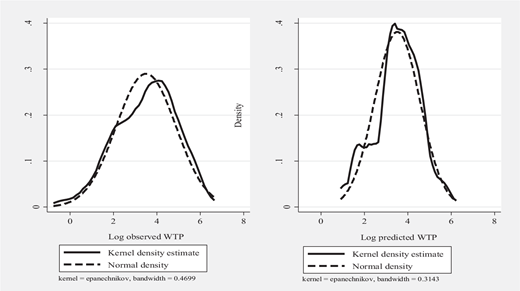
Multilevel models were estimated for both the semilog (log linear) and linear-log functional forms.8 Of the two specifications, the semilog performed better based on R-squared, overall fitness as measured by the Wald test, and precision of model parameters (p-values). The level 2 parameters were significant, suggesting that there was significant heterogeneity across the authors. Fig. 1 presents the observed and predicted distributions under the semilog specification. We focus on the results of the semilog parameter estimates throughout the rest of the manuscript.
Meta-regression results
All else equal, management strategies focused on preservation are valued more than strategies for freshwater restoration (p = 0.055), and even more as compared to forest restoration (p = 0.003). Among the two types of restoration, we found a significant difference between the coefficients on freshwater restoration and forest restoration (p = 0.05), illustrating that freshwater restoration was valued higher. With significantly different coefficients for WTP for all three conservation types, we reject the first null hypothesis (H01) and conclude that the type of conservation substantially influences WTP. Table 5 presents the complete multilevel modeling parameter estimates.
Multi-level modeling parameter estimates.a
| Semilog (log-linear) | Linear-log | |||||
|---|---|---|---|---|---|---|
| Coef. | Robust Std. Err. | P > |z| | Coef. | Robust Std. Err. | P > |z| | |
| Conservation type (T) | ||||||
| Forest restoration (β1) | –1.083 | 0.363 | 0.003 | –1.054 | 0.388 | 0.007 |
| Freshwater restoration (β2) | –0.642 | 0.335 | 0.055 | –0.557 | 0.329 | 0.091 |
| Conservation scope (S) | ||||||
| Program low (β5) | 1.348 | 0.356 | 0.000 | 1.382 | 0.388 | 0.000 |
| Program high (β6) | 1.703 | 0.618 | 0.006 | 1.764 | 0.654 | 0.007 |
| Valuation characteristics | ||||||
| Sample size (β5) | 0.002 | 0.001 | 0.201 | |||
| Log sample size (β6) | 0.608 | 0.332 | 0.067 | |||
| Elicitation format | ||||||
| Choice experiment (β7) | 0.610 | 0.336 | 0.069 | 0.516 | 0.348 | 0.138 |
| Contingent valuation (β8) | 0.501 | 0.362 | 0.167 | 0.412 | 0.394 | 0.295 |
| ASC × CE (β9) | –0.235 | 0.421 | 0.577 | –0.292 | 0.443 | 0.509 |
| Payment vehicle | ||||||
| Tex (β10) | –1.483 | 0.387 | 0.000 | –1.574 | 0.411 | 0.000 |
| Voluntary (β11) | –2.443 | 0.682 | 0.000 | –2.364 | 0.754 | 0.002 |
| Payment frequency (β12) | 1.047 | 0.439 | 0.017 | 0.928 | 0.512 | 0.070 |
| WTP form (β13) | 0.016 | 0.264 | 0.953 | 0.112 | 0.267 | 0.675 |
| Context characteristics | ||||||
| Trend (β14) | –0.079 | 0.031 | 0.010 | –0.054 | 0.032 | 0.098 |
| USA (β15) | –1.088 | 0.517 | 0.035 | –0.750 | 0.514 | 0.144 |
| GDP per capita (β16) | 0.061 | 0.014 | 0.000 | |||
| Log GDP per capita (β17) | 1.306 | 0.326 | 0.000 | |||
| Constant (β0) | 2.658 | 0.958 | 0.006 | –3.178 | 2.387 | 0.183 |
| Random-effects parameters | ||||||
| GID: Identity | ||||||
| var | 0.138 | 0.232 | 0.193 | 0.223 | ||
| 0.643 | 0.197 | 0.618 | 0.179 | |||
| Model statistics | ||||||
| Snijders/Bosker R–squared Level 1 | 0.600 | 0.585 | ||||
| Snijders/Bosker R–squared Level 2 | 0.758 | 0.725 | ||||
| AIC | 356.337 | 355.478 | ||||
| BIC | 407.533 | 406.673 | ||||
| Log-likelihood at convergence | –160.169 | –159.739 | ||||
| Wald χ2 (15) | 1664.990 | 1426.090 | ||||
| Prob > χ2 | 0.000 | 0.000 | ||||
| Number of observations | 127 | 127 | ||||
| Number of groups | 22 | 22 | ||||
STATA multi-level model syntax: xtmixed dependent variable independent variable(s) || GID:, variance robust.
Numerous studies have found that households are willing to pay more to protect certain species and charismatic megafauna. This study takes the perspective that it matters which conservation strategy (preservation, freshwater restoration, and/or forest restoration) is adopted to maintain or repair ecosystems. The estimation results suggest that preservation is valued more than freshwater restoration and forest restoration. This suggests that non-use values (existence and bequest values) associated with more intact ecosystems9 are in high demand because preservation by its very definition implies non-use or delaying the use of the resource. This may also be indicative of the relative scarcity of the landscapes that researchers in the primary studies identified (Loomis, 1987; Garrod and Willis, 1997).
There is strong evidence of scope effects as changes in individual attributes (less intensive intervention) were valued less (p = 0.000) than program low (more intensive intervention), which in turn was valued less (p = 0.006) than program high (even more intensive intervention). Thus, we could not reject our null hypothesis (H02) and see clear support for treating the valuation of ecosystem service production from conservation on par with typical market valuation of commodities, as both exhibit increasing payments for increasing goods at diminishing marginal rates. Scope effects in the temporal sense were also satisfied, as households were willing to pay more in one-time payments than in equivalent recurring payments (p = 0.017).
The findings of this study are in line with the utilitarian hypothesis that households are willing to pay more for more intensive interventions than less intensive interventions. Ojea and Loureiro (2011) argued that to be able to effectively test scope effects, measurement in absolute terms was critical. This study finds that, rather, it is how changes relative to the status quo are framed that allows meaningful measure of scope effects. Specifically, absolute measurement may not be necessary and not always possible; rather we need to preserve the scale of improvements whether reported in relative or absolute terms and qualitatively or quantitatively.
The significant (p = 0.010) negative coefficient of 0.0795 on trend (implying average annual decrease of 7.9% during the period 1985 through 2011) suggested that studies conducted recently are associated with lower willingness to pay estimates. This finding is echoed by most research and is often attributed to improvements in valuation procedures that are reducing hypothetical bias (Woodward and Wui, 2001; Johnston et al., 2005; Van Houtven et al., 2007). However, the increasing scarcity of natural landscapes over time is likely to provide an increasing effect on WTP for conservation over time. The results of our meta-regression suggest that the ‘scarcity increase’ in WTP is currently less than the decreasing effect from valuation improvements.
We found a significant positive relationship between GDP per capita and WTP for preservation and restoration activities (p = 0.000). Evaluated at the mean WTP of US$70.87 (Table 4), a $1000 increase in GDP per capita income (adjusted for country-specific purchasing power), translated into a $4.31 (=70.87 × 0.0609) increase in WTP for conservation. The coefficient on USA was significantly (p = 0.035) negative, suggesting that U.S. households have lower WTP for ecosystem conservation than their Canadian or European counterparts. We suspect that the abundance of public lands and natural areas in the U.S., as especially compared to Europe, may underlie a more relaxed perception of scarcity for nature in the U.S.
We found WTP to be sensitive to elicitation format as choice experiments were associated with greater WTP than contingent ranking. We did not find a significant relationship as to whether WTP invoked at the individual level was different than at the household level. We did, however, find sensitivity to payment vehicle, as WTP increases with fees, as opposed to taxes and voluntary contributions to funds set up for conservation activities (p = 0.000). Finally, as economic theory predicts, lump sum payments have significantly (p = 0.017) greater impact on WTP than equivalent recurring annual payments, satisfying the temporal scope effect. However, we caution that the recurring annual payment category in this study was a smorgasbord of recurring payments for 5 years, 10 years and permanently ongoing payments. We aggregated these into one category because keeping them as distinct dummy variables in the model induced significant collinearity. Testing of temporal scope effects is complex (Stevens et al., 1997). Ideally, one would need to take into account the role of time preference and associated differentials in discount rates to appropriately pool these diverse recurring payment flows into one category.
Within-sample predictions
After testing our two fundamental hypotheses, we explored the policy implications of our findings by providing within-sample predictions of mean WTP and 95% confidence intervals for all conservation types at various scope levels. This type of sensitivity analysis is recommended by Ready and Navrud (2006) when conducting international benefit transfer. While varying conservation type and scope, GDP per capita and sample size were held at their sample means whereas the rest of the variables were excluded. Because the semilog underestimates predicted values, we adjusted the results by a factor of exp (SEE2/2) as recommended by Cameron and Trivedi (2009) and Mirer (1994). The logarithms of WTP, and both the unadjusted and adjusted estimates of means and 95% confidence intervals are reported in Table 6.
Predicted mean WTP (U.S. $2010) and 95% confidence intervals: semilog specification.
| Conservation type (T) and scope (S) | |||||||||
|---|---|---|---|---|---|---|---|---|---|
| Preservation | Forest restoration | Freshwater restoration | |||||||
| AT | PL | PH | A | PL | PH | AT | PL | PH | |
| Logarithms (of $) | |||||||||
| Mean | 3.21 | 4.55 | 4.91 | 2.12 | 3.47 | 3.83 | 2.57 | 3.91 | 4.27 |
| Lower bound | 2.77 | 4.07 | 3.85 | 1.32 | 2.97 | 3.05 | 1.82 | 3.11 | 3.21 |
| Upper bound | 3.65 | 5.04 | 5.97 | 2.93 | 3.98 | 4.61 | 3.31 | 4.72 | 5.32 |
| Unadjusted dollars | |||||||||
| Mean | 24.70 | 95.06 | 135.57 | 8.36 | 32.19 | 45.91 | 13.00 | 50.04 | 71.37 |
| Lower bound | 15.89 | 58.67 | 46.74 | 3.75 | 19.40 | 21.07 | 6.19 | 22.40 | 24.89 |
| Upper bound | 38.40 | 154.01 | 393.19 | 18.64 | 53.42 | 100.06 | 27.31 | 111.78 | 204.67 |
| Adjusted dollarsa | |||||||||
| Mean | 34.07 | 131.12 | 187.01 | 11.54 | 44.41 | 63.33 | 17.94 | 69.03 | 98.45 |
| Lower bound | 21.92 | 80.93 | 64.48 | 5.18 | 26.76 | 29.06 | 8.54 | 30.90 | 34.33 |
| Upper bound | 52.96 | 212.44 | 542.37 | 25.72 | 73.69 | 138.02 | 37.67 | 154.19 | 282.33 |
Adjusted dollars were computed by multiplying unadjusted dollars by .
Focusing on the program-low adjusted predictions, we found that the WTP (in 2010 U.S. dollar equivalents) for forest restoration was between $27 and $74, with a mean of $44. The corresponding estimates for freshwater restoration were $31 to $154, with a mean of $69, and those for preservation were $81 to $212 with a mean of $131. Comparison of these predicted means to future studies and out-of-sample policy sites will help better inform policy implications.
Discussion
In this article, we synthesized willingness to pay for three distinct ecosystem conservation strategies (preservation, forest restoration, freshwater restoration) at differing levels of intensity. Our results illustrate that there is substantial demand for forest and freshwater ecosystem conservation and the associated improvement in the quality and quantity of ecosystem services. As intact, natural landscapes become scarcer and degraded landscapes become the norm, the societal demand for ecosystem conservation is likely to increase. But, this economic demand varies for individuals based on how, where, and to what degree ecosystem conservation is implemented.
The greater willingness to pay for preservation activities versus freshwater restoration and forest restoration activities may be a quantification of the old adage “an ounce of prevention is worth a pound of cure” and may indicate an understanding that ecological restoration cannot fully duplicate the quality and quantity of ecosystem services found in intact (non-degraded) landscapes. Furthermore, the preference for preservation over freshwater restoration and forest restoration may be reflecting endowment effects, where individuals place greater value on avoiding the loss of something as compared to gaining something with equivalent value. As conservation efforts increasingly incorporate preservation and restoration strategies, further analysis on the economics of conservation type is warranted along with greater monitoring to better understand to what degree the purported changes in ecosystem services were attained.
Among the two types of ecological restoration, we found freshwater restoration to be valued significantly higher than forest restoration. The general importance of water to our survival as a species may explain the higher WTP values for freshwater restoration. Forest restoration also suffers from definition problems and confusion with traditional commercial logging and thinning (Hjerpe et al., 2009). These issues may hinder respondents’ understanding of forest restoration and its non-market benefits, decreasing WTP.
Our results lend support to the theory that individuals are typically sensitive to the scope of ecosystem service provision, in both quality and quantity, resulting from conservation projects. We hypothesize that the evolution of stated preference methods from early contingent valuation (e.g. open payment card) to dichotomous choice contingent valuation – and then onto choice experiments and contingent ranking – have played a role with more accurate descriptions of the services and commodities being provided. With these newer stated preference methods, researchers are able to offer greater ranges of services and levels, resulting in a closer approximation of typical marketplaces (Adamowicz et al., 1998; Hanley et al., 1998). Likewise, our focus on type of conservation likely led to a selection of primary studies that were descriptive and clear concerning how services would be provided. Greater articulation of these two components, the “what” and the “how” for the provision of environmental goods, has been the primary response to overcoming contingent valuation results illustrating insensitivity to scope (Carson and Mitchell, 1993; Carson, 1997).
The evidence for scope sensitivity is noteworthy given the large role of public goods and nonuse values, particularly existence and bequest, which comprise the total economic value associated with ecosystem conservation synthesized in this meta-analysis. Whether or not the economic motivation is to gain “moral satisfaction” or is ideologically driven (Kahneman and Knetsch, 1992), as opposed to a more traditional economic motivation stemming from use values is largely irrelevant, as both contribute to welfare and utility in manners consistent with economic theory. We agree with Carson (1997), that it is the increase in an individual’s utility, and the illustration that individuals will pay more for greater welfare associated with conservation that matters.
A critical area for future research concerns the use of absolute versus relative measures for identifying scope effects for ecosystem service values, and their potential implications for benefit transfer. The main concern is whether or not relative measures of conservation intensity are useful for future benefit transfer applications. While we did not pursue a benefit transfer application of our results in this manuscript, we are interested in being able to generalize our results in the future to similar policy applications. In regard to the perceived precision afforded by absolute measurements for benefit transfer – and vice versa, the perceived lack of precision coming from relative measurements – we feel that the cart is being placed in front of the horse particularly in terms of understanding individual willingness to pay for conservation and subsequently generalizing results. As stated in Smith and Pattanayak (2002) and echoed in Lindhjem (2007): be careful with policy implications and remember that the primary focus is “understanding individual preferences for environmental services.”
Following this advice and in analyzing our results, we feel that relative measures of conservation scope, as used in primary studies, are extremely important means of conveying information to individual respondents of WTP surveys. And, if relative measures of conservation are important for individual valuation, they should not be ignored when looking to generalize case studies. Indeed, examples abound of benefit transfer frameworks and intermediary frameworks that heavily incorporate relative measures (e.g. Water Quality Ladder as used in Van Houtven et al., 2007). Our results suggest that individual preferences for conservation are sensitive to the number of changing attributes and the relative levels of change in these attributes away from the status quo. Because many of the primary data points used in our meta-regression reflected a mixture of both absolute and relative attribute measures, we were unable to create dummy variables for absolute and relative measures, and thus unable to isolate scope effects for each. Instead, we allocated all primary data points into a relative scope classification of attribute-specific, program low, and program high. Interestingly, this is the opposite approach of Ojea and Loureiro (2011) who forced both absolute and relative measures of scope into an absolute scope classification. Increased sample size of primary data points would allow for greater specificity of relative scope classification, particularly in terms of classifying types of attributes being measured (i.e., creating sub-classes within the three broad scope levels). We recommend further research on operationalizing scope classifications in this manner for future benefit transfer applications.
While our robust estimates clearly indicate satisfaction of both commodity and temporal scope effects in our meta-analysis, we acknowledge additional sources of error stemming from the arbitrary nature of categorizing the intensity of conservation effort based on both quantitative and qualitative descriptions of anticipated success. And while our sample size of primary studies provided good measures of statistical fitness and adequate explanatory power, greater sample sizes would allow for greater confidence in results. We recommend further research on: (a) classifying the scope of conservation efforts, particularly from qualitative and hierarchical perspectives; (b) using other study selection criteria that might increase sample size, and (c) using model specifications that incorporate additional socioeconomic characteristics, and choice experiments features (that we did not control for) such as the number of alternatives per choice set, type of alternatives (e.g., branded versus generic alternatives), number of attributes and levels, and number of choice sets.
Ecological restoration refers to the re-establishment of the characteristics of an ecosystem that were prevalent before degradation. It involves the removal or amelioration of the factor causing environmental degradation and the re-establishment of key ecosystem components to influence the rate and direction of recovery (Benayas et al., 2009). Preservation is more of a hands-off approach and specifically refers to making land unavailable for development and exploitation.
The majority of primary studies used in this meta-analysis measured WTP based on estimated changes in ecological (e.g., amount of native trees) and social attributes (e.g., amount of timber harvesting jobs) resulting from the type and scope of conservation effort. Changes in attributes were conveyed in survey text in terms of ecosystem services (e.g., increased water clarity and quality – the attribute – would provide for greater fishing and recreational opportunities – the ecosystem services). As such, the willingness to pay estimates reflect the value that respondents hold for a composite of new individual and bundled ecosystem services (ESS1) that would result from the changed attribute. That is, respondents interpret a changed attribute in terms of the associated change in ecosystem services, or the perceived change in benefits provided to them by the new level of the attribute.
As such, WTP data points for all three conservation types were generally evenly distributed throughout all three levels of scope.
This aggregation of attribute-specific estimates was necessary because, unlike program-specific categories, there were not a sufficient number of multiple-step change estimates to create attribute-specific scope effect categories (i.e., attribute low and attribute high).
For example, Adamowicz et al.’s, 1998 preservation study included five attributes (caribou populations, wilderness areas, recreation restrictions, forest industry employment, and tax p. 67) offered at four levels (quantities) each, one of which was a status quo level. They calculated program low willingness to pay estimates (p. 72) that reflect the combined valuation of all five attributes simultaneously changing one level away from the status quo.
For example, Caparrós et al.’s, 2008 forest restoration study provided program high estimates (among other estimates, p. 852) that reflect the combined valuation of five attributes simultaneously changing the maximum number of levels away from the status quo.
A VIF of 10 indicates that (all else equal) the variance of the i th regression coefficient is 10 times greater than it would have been if the i th independent variable had been linearly independent of the other independent variable in the analysis. Thus, it reveals how much the variance has been inflated by this lack of independence (O’Brien, 2007).
The semilog (also known as log-linear) involves transformation of the dependent variable, and each one-unit increase in an independent variable (X) is interpreted to increase the expected value of the dependent variable (Y) by a factor of eβ. The linearlog specification, in contrast, involves transformation of an independent variable (X), and a percent increase in it is interpreted to increase the dependent variable (Y) by a factor β/100.
It would have been helpful to interpret these findings with confidence by including a variable that differentiated between use and non-use values. However, we could not do so because very few primary studies made such distinction when framing the contingent valuation scenario and invoking respondents’ willingness to pay.
Acknowledgements
We are very grateful for suggestions and comments from anonymous reviewers and journal editors. We would like to acknowledge input from primary data authors Victor Adamowicz, Julie Mueller, and Douglas MacMillan. Additionally, we thank Trudy Ann Cameron for thoughtful comments and literature identification help from Omkar Joshi.

