As the major apparel manufacturer and exporter, China is under the pressure to tackle the environmental issue brought by the over-consumption of apparels, as the apparel and textile waste is one of the main sources of landfill contributing to solid waste. Disposing used clothes appropriately such as recycling can alleviate the problem posted by discarded apparel. This study aims to ascertain factors that influence consumers’ online recycling behavioral intentions.
This research proposed a theoretical framework via the combination of theory of planned behavior (TPB) and technology acceptance model (TAM). With 294 data collected online, the study used partial least squares structure equation modeling (PLS-SEM) and fuzzy-set qualitative comparative analysis (fsQCA) to carry out analysis to examine research hypotheses.
The study results revealed that perceived behavioral control, attitude and perceived ease of use (PEU) along with perceived usefulness (PU) can affect people’s recycling behavioral control. Moreover, PEU and PU can positively influence consumers’ attitudes toward recycling apparel online. Furthermore, the fsQCA analysis revealed heterogenous configurations to generate recycling behavioral intention, notably revealing that the environmental concern alone may not be sufficient to predict people’s recycling behavioral intention, since the combined effects of environmental concern along with other proposed variables have an impact on people’s decision.
The findings would assist the policymakers and apparel industry in better understanding consumers’ online recycling behaviors and attitudes. Moreover, the authors indicated the importance of reducing barriers and difficulties for people to engage in recycling.
Current literature is deficient in understanding consumers’ online apparel recycling behavior. As such, this study suggests policymakers and the apparel industry providing user-friendly and convenient technology for consumers to deal with unwanted clothes. Moreover, clear departure from previous research, this study combined PLS-SEM and fsQCA analysis, deriving unique insights into the complex variable relationships. The fsQCA analysis revealed heterogenous configurations to generate online apparel recycling behavior. The joint analysis revealed that consumers’ environmental concern alone will not induce their recycling behaviors. With the support of empirical data, this research contributes to a broader understanding of consumers’ behavior and factors influencing their intention to recycle apparel online.
Introduction
Concerns related to the environment are increasingly relevant in the environmentally conscious marketplace (Ha and Kwon, 2016; Laroche et al., 2001). The apparel industry is one of the world’s largest sectors, encompassing a wide range of products (e.g. clothing, footwear, accessories and textiles) and providing around 80 million both full-time and part-time employment (Castañeda-Navarrete et al., 2021). Particularly, China represents the largest apparel manufacturer and exporter as well as the world’s second largest apparel consumer market following the US (Chi, 2015; Castañeda-Navarrete et al., 2021). The country’s rapid economic development, coupled with the prevalence of the fast fashion culture and increasing purchasing power of middle-class consumers, has fueled the high demand for apparel consumption (Cao, 2022). However, the over-consumption of clothing has led to environmental concerns, as discarded clothing becomes a body of new solid waste to release hazardous chemicals (Liang and Xu, 2018; Yan et al., 2021).
Albeit China is the world’s biggest carbon dioxide (CO2) emitter with one of the highest levels of energy consumption, Chinese consumers have not yet let up their apparel consumption (Jung et al., 2020). Clothing textiles are made of natural and artificial fibers producing from non-renewable resources that cannot be easily reprocessed and reused (Paço et al., 2021). With frequent clothing purchases, consumers tend to dispose their used apparel more often to make space for new items (Yan et al., 2021). It is estimated that China generates more than 20 million tons of waste textiles and clothing each year, containing 70% of chemical fibers, with the stunning less than 10% of the reuse rate (Yang and Wang, 2013; Xu et al., 2022). Overconsumption of natural resources alone with waste resources from the apparel sector have exacerbated negative impact on the environment, threatening human life in China (Birtwistle and Moore, 2007; Li et al., 2022; Jung et al., 2020; Zhang et al., 2020).
Appropriate apparel disposal is critical to tackle apparel and textile waste and reduce its negative environmental impacts (Joung and Park-Poaps, 2013). Traditionally, consumers passed down their unwanted clothes to others or participated in donation events hosted by charity organizations as forms of disposing unwanted textiles (Zhang et al., 2020). Progressively, recycling has emerged as an effective way to reduce the chemical components of discarded apparel in the landfills (Singhal et al., 2023). To align with UN’s Sustainable Development Goal and China’s 13th Five-Year Plan goals, Chinese government has stipulated policies to encourage recycling discarded clothes, whereby community-based programs such as residential recycling bins have been placed (Zhang et al., 2020, 2024). However, it is currently unknown whether these recycling bins are effective for apparel recycling. To the authors’ best knowledge, recycling bins assigned for apparel disposing are merely formality. For instance, Hao et al. (2020) revealed that recycling bins can be easily damaged, containing a mixture of different waste. As such, people may not even be aware of these residential apparel recycling bins. Moreover, residential recycling bins are unable to collect large portions of used clothes due to the limited sizes (see Appendix 2). Consequently, unwanted clothes are still being discarded as an easy solution, ending up in the landfill (Xu et al., 2022).
As consumers become more conscious about environmental sustainability, their beliefs on the environment can have a strong relationship with their behavioral intention, as they tend to choose eco-friendly products and solutions (Borusiak et al., 2021; Ha and Kwon, 2016; Paul et al., 2016). The use of online clothing recycling platforms is more convenient and flexible than the traditional ways of disposing apparels (Zhang et al., 2020). For example, Ant Recovery (Mayi Huishou), a recyclable waste collection network in China, easily manages and recovers consumers’ waste through collecting consumers’ apparel via its online platform (Steuer and Li, 2022). Research has indicated that many Chinese online platforms have served as important channels for online donations (Li et al., 2018). However, as yet, paucity of the extant research has investigated Chinese consumers’ online apparel disposing behavior. This study attempts to contribute to the current apparel recycling literature by shedding new light on Chinese consumers’ apparel disposing behavior via online platforms, providing useful insights for policymakers and related apparel industry to design more effective solutions to deal with unwanted clothes and textile wastes. Moreover, this study contributes methodologically by integrating partial least square structure equation modeling (PLS-SEM) with fuzzy-set qualitative comparative analysis (fsQCA) to provide configurational perspective of different causal combinations on the outcome condition.
The fsQCA method is an asymmetric approach (i.e. non-linear relationships), considered as an effective way to explore joint effects and interactive relations (Ragin, 2018). The linear relationship garnered by the single-stage PLS-SEM is insufficient to predict complex decision-making process (Sharma et al., 2024). Since variance-based approach isolates the effect of every single independent variable on the desired outcome (Goyal and Popli, 2024), fsQCA is complementary to the traditional symmetric methods, providing deeper insights into variable relationships with comprehensive results (Rasoolimanesh et al., 2021). Moreover, fsQCA is a mixed and case-based combinatorial approach, which can accommodate both qualitative and quantitative data to examine entire the combinations concurrently (Kraus et al., 2018). Hence, this study is a clear departure from previous variance-based research since limited research in consumer recycling literature has utilized fsQCA in conjunction with PLS-SEM to jointly explore causal relationships. By applying a multi-stage approach, this study gains a more nuanced understanding of the intricate relationships between the proposed antecedents and the intention to recycle apparel online. As such, multiple casual conditions can be combined into distinct conditions to produce the outcome of interest (Misangyi et al., 2017).
The purpose of this study is to explore the antecedents of consumers’ intentions to recycle used apparel online. More specifically, this study tackles the following research questions:
Does environmental concern influence consumers’ perceptions and intentions to recycle used apparel?
How do variables within TPB and TAM models interact with environmental concern and moral norm and consequently, affecting individuals’ recycling intentions?
Whether the combined analysis of PLS-SEM and fsQCA can offer unique perspective on people’s apparel recycling intention?
To align with the study’s focus, the following specific objectives are followed: (1) to examine whether environmental concern can influence individuals’ attitude and intentions toward recycling used apparel; (2) to propose a conceptual framework to explore the inter-relationships among the proposed variables; (3) to identify heterogenous combinations of variables to predict individuals’ online recycling behavioral intention via the fsQCA approach.
Literature review
Conceptual framework
This study applied theory of planned behavior (TPB) (Ajzen, 1991) and technology acceptance model (TAM) (Davis et al., 1989) as theoretical bases to develop the conceptual model. Both TPB and TAM have been widely adopted to understand apparel consumers’ behaviors (Chi, 2018; Zhang et al., 2020; Zheng and Chi, 2015). Moreover, the concept of environmental concern (Song et al., 2023) is incorporated in the research model to understand whether consumers’ attitude toward environment can affect their recycling behavior. Since the apparel recycling effort contains personal morality and social responsibility, the construct of moral norms is also included in the conceptual framework. Moral norm is an extended element of TPB model (Wang et al., 2016) and the inclusion of moral norms can significantly improve the prediction of behavioral intention (Tonglet et al., 2004).
Subjective norm
Subjective norm is referred to as an individual’s perceptions of what important referent opinions should be complied with (Ajzen, 1991). Social pressure from friends, significant others and neighbors can influence individuals’ intentions (Song et al., 2023). Research has found that if individuals have more positive subjective norms toward recycling behavior, they will have a high likelihood of recycling intention (Chen and Tung, 2010). Song et al. (2023) found that subjective norms can positively influence consumers’ behavioral intention for using reuseable express packaging. Moreover, Li et al. (2022) revealed that subjective norm was positively related to people’s charity online donation intention. However, subjective norm has long been identified as the weakest link in behavioral intention model (Ajzen, 1991; Paul et al., 2016). For instance, Paul et al. (2016) revealed a non-significant relationship between subjective norm and consumers’ green product purchase intention. More research is warranted to investigate the relationship. Therefore, we propose the following hypothesis:
Subjective norm positively influences consumers’ intention of recycling apparel online.
Moral norm refers to people’s inherent belief regarding what is right or wrong and it is considered as an internal motivation which led to individuals’ self-chosen behavioral decisions (Li et al., 2022; Parker et al., 1995). People will have attitudes that are in line with their moral norms (Chan and Bishop, 2013). Previous studies have found that moral norm is related to recycling intention, the more positive of the moral norm, the higher the recycling intention (Chan and Bishop, 2013; Chen and Tung, 2010). Furthermore, Li et al. (2022) revealed that moral norm has the strongest effect in predicting online donation intention. Chan and Bishop (2013) indicated that moral norm can be a powerful antecedent of people’s conservation behavior. However, in Tonglet et al.’s (2004) study, moral norm was not a significant predictor of recycling behavior. Consumers’ recycling apparel can be deemed as a form of conservation efforts; hence, it can be hypothesized that:
Moral norm positively influences consumers’ recycling behavioral intention.
Perceived behavioral control
When individuals believe they have the ability to perform a behavior, it is known as perceived behavioral control (Ajzen, 1991). Perceived behavioral control is vital in promoting environmentally friendly behaviors, such as recycling, reducing energy consumption and green consumption behaviors (Kotyza et al., 2024). Previous research has found that perceived behavioral control can influence people’s recycling behavior (Chan and Bishop, 2013; Chen and Tung, 2010). Moreover, Li et al. (2022) revealed that perceived behavioral control can influence people’s online donation intention. In this study, perceived behavioral control refers to people’s ability to engage in online apparel recycling efforts. Based on this evidence, we propose the following hypothesis:
Perceived behavioral control positively influences consumers’ intention of recycling apparel online.
Attitude
Attitude is the extent to which individuals have negative or positive evaluations of the behavior (Ajzen, 1991). Previous studies have found a positive linkage between attitude and recycling intention (Chen and Tung, 2010; Knussen and Yule, 2008; Tonglet et al., 2004). Positive emotions can evoke affective commitment to recycle in general (Japutra and Loureiro, 2020). Consumers’ attitudes toward recycling can significantly affect their recycling behavior (Tang et al., 2011; Wai Yee et al., 2016). As such, if people have a positive attitude toward recycling, they will be more likely to have the intention to recycle. However, researchers have claimed that this linkage can be antithetical to the conventional thinking if it applies to a collectivistic culture. For example, Haj-Salem and Al-Hawari’s (2021) study failed to establish a positive link between attitude and intention to recycle in the context of Middle East, stating people’s needs and attitudes will only affect their recycling behaviors if it is in individualistic cultures. More research is warranted to examine the relationship. As such, we propose the following hypothesis:
Attitude will positively influence consumers’ intention of recycling apparel online.
Perceived usefulness and perceived ease of use
Perceived usefulness (PU) and perceived ease of use (PEU) are the two key components of TAM model to explore users’ computer acceptance behaviors (Davis et al., 1989). PU is defined as the extent to which individuals believe using a particular application system or service can fulfil and improve their job performance (Davis, 1989). Consumers’ intentions to use information technology are predicated on their PU of technology (Davis, 1989). Previous researchers revealed that PU can exert positive influences on users’ intention to adopt a system technology (Chi, 2018; Sun and Chi, 2018). On the other hand, PEU refers to the extent to which individuals expect a target system is effortless (Davis et al., 1989). That is, an application that is easy to use will likely be adopted by users (Davis, 1989).
Research found PEU can influence people’s intention behavior toward mobile hotel booking (Mohamad et al., 2021). Additionally, Zhang et al. (2024) discovered both PU and PEU have positive impact on individuals’ intention to adopt recycling vending machines. Based on the premises of TAM, both PU and PEU can influence people’s attitudes toward using a technology (Sun and Chi, 2018). The user-friendly features of technology can lead to a favorable attitude toward its use (Zhang et al., 2024). Empirical research has also indicated PU and PEU can significantly influence Chinese consumers’ attitude toward mobile commerce when shopping apparel online (Chi, 2018). In the same token, online recycling applications’ usefulness and ease of use may also enhance consumers’ attitudes. For example, Zhang et al. (2020) found that consumers’ attitudes toward recycling are positive when they feel convenient to use online-recycling platforms. Moreover, when a technology is perceived to be easy to use, users can work more efficiently and enhance their job performance and consequently, feeling usefulness of the technology (Sun and Chi, 2018). Based on the arguments, we propose:
PEU positively influences PU.
PEU positively influences consumers’ attitudes toward recycling apparel online.
PU positively influences consumers’ attitudes toward recycling apparel online.
Perceived of ease of use positively influences consumers’ intention of recycling apparel online.
PU positively influences consumers’ intention of recycling apparel online.
Environmental concern
Environmental concern is the extent to which consumers are worried about threats and damage to the environment (Lee et al., 2014). It refers to a host of environmentally related perceptions, attitudes and behaviors (Bamberg, 2003). The importance of studying environmental concern has been highlighted, as it can predict consumers’ attitude towards specific behaviors (Paul et al., 2016). While the conventional assumption posits a direct link between environmental concern and behavior, some scholars have argued that environmental concern is indirectly related to environmental behaviors, which are based on situation-specific cognition (Bamberg, 2003; Wang et al., 2016). It has been revealed in research that environmental concern indirectly influences behavioral intention via other variables, such as subjective norms, perceived behavioral control, moral norms, beliefs and attitudes (Bamberg, 2003; Borusiak et al., 2021; Song et al., 2023). Moreover, environmental concern can serve as a precursor factor of the TPB model (Wang et al., 2016).
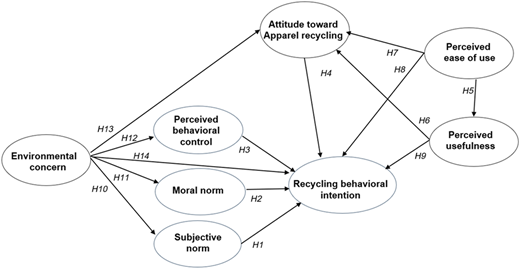
Consumers tend to purchase eco-friendly products if they are aware of environmental issues (Laroche et al., 2001). Kotyza et al. (2024) found that individuals’ beliefs of environmental concern can exert positive influences on their pro-environmental intention such as recycling and protecting the environment. Moreover, Ha and Kwon (2016) revealed consumers who have environmental concern over product reuse and recycling tend to engage in more pro-environmental behaviors. In the same token, consumers who are concerned about the environment will likely dispose of their clothing in a non-harmful way (Bianchi and Birtwistle, 2012). Previous studies have found that environmental concern and awareness can affect consumers’ clothing disposal behavior (Bianchi and Birtwistle, 2010, 2012). Moreover, Song et al. (2023) revealed that environmental concern positively influenced consumers’ intention of using reusable express packaging. Borusiak et al. (2021) revealed that environmental concern positively influences consumers’ intention of reducing single use bottled water consumption. However, it is currently unclear how environmental concern can influence people’s online apparel recycling intention. The research conceptual model is depicted in Figure 1. Based on the analyses above, we propose:
Environmental concern positively influences subjective norm.
Environmental concern positively influences moral norm.
Environmental concern positively influences perceived behavioral control.
Environmental concern positively influences attitude.
Environmental concern positively influences consumers’ intention of recycling apparel online.
Methodology
Data collection and procedures
To carry out this research, an online self-administered quantitative was created using wjx.com, a well-known survey platform in China. Participants watched a short video about using online application to recycle used clothing and completed a questionnaire based on the measurements of the constructs. The measurement scales (Table 1) were adopted from previous studies (Borusiak et al., 2021; Chen and Tung, 2010; Song et al., 2023; Sun and Chi, 2018; Tonglet et al., 2004; Liang et al., 2022). The measurement items (see Appendix 1) were mostly anchored on a seven-point scale (1 = strongly disagree to 7 = strongly agree). Additionally, questions regarding respondents’ demographic information were also included in the questionnaire. To ensure the accuracy of the questionnaire, a pre-test of 30 samples were conducted. The pre-test ensured the validity of the measurements and made sure variables of TPB and TAM models were accurately reflected on the questionnaire. The data collection period was between July 16th to July 29th, 2024. The link of the survey was sent to participants in various Chinese social media platforms (e.g. Douban, Wechat and Little Red Note). Participants voluntarily participated in the research and their identities were kept confidential. Upon completing the survey, each respondent received 2 RMB as the reward. The data collection resulted 618 responses. However, after filtering out problematic responses (i.e. empty responses, straight-liners and failure to answer attention trap questions), 294 useable responses were retained for further analysis (excluding the 30 pilot samples).
Analysis method
This study uses both PLS-SEM and fsQCA to explore the causal relationships among proposed variables of interests. PLS-SEM is a symmetric approach which allows the testing of theoretical frameworks from a prediction perspective; however, the mean-centered method of model estimation is incomplete (Rasoolimanesh et al., 2021). On the other hand, fsQCA, an asymmetric approach, can recognize equifinality (a system reaches the same final state from different conditions with different alternative paths) and explore the sufficiency of multiple configurations associated with the same outcome (Kraus et al., 2018). Different configurations can be identified via fsQCA to strengthen PLS-SEM analysis, while at the same time accounting for measurement errors. This study employed SmartPLS 3.0 to obtain hypotheses testing results of PLS-SEM and used fsQCA 3.0 to identify sufficient combinations to generate outcome.
Results
Respondent characteristics
Table 1 describes respondents’ profile. In terms of gender, male and female respondents were almost balanced. Male respondents accounted for 55.8% (n = 164), while female respondents accounted for 44.2% (n = 130). For the age, majority of the respondents were in the age bracket of 25–34 (60.5%, n = 178) and only 1.4% (n = 4) of the respondents were in the age bracket of 45–54. For education level, 64.6% (n = 190) of the respondents had bachelor’s degree and about 19.3% (n = 57) of the respondents had postgraduate degrees (either Master or Doctorate). Regarding income, 26.5% (n = 78) of the respondents had income greater than 100k less than 150k; 18.4% (n = 54) of the respondents had income greater than 150k less than 200k and 16.3% (n = 48) of the respondents had income greater than 200k. Majority of the respondents were from first and second tier cities in China (77.5%, n = 228), while only 22.5% (n = 66) of the respondents were from third to fifth tier cities in China. For the usage of the clothes, the majority of the respondents kept their clothes for 2–5 years (73.8%, n = 216), while only 12.2% (n = 36) of the respondents kept their clothes for only one year or less.
PLS-SEM measurement model assessment
To assess the measurement of PLS-SEM, reliability and validity were checked (Table 2). The factor loadings for each measurement item exceeded 0.7 (Chin, 1998). Table 3 shows the mean, standard deviation (SD) and factor loadings for each measurement item in the study. The value of Cronbach’s alpha for all constructs ranged from 0.80 to 0.91; and the value of composite reliabilities (CR) ranged from 0.88 to 0.93, demonstrating good reliability. Average variance explained (AVE) ranged from 0.65 to 0.72, demonstrating good convergent validity (Hair et al., 2019). The discriminant validity was accessed via Fornell and Larcker criteria, confirming the square root of AVE for each construct is greater than any correlations between the variables (Fornell and Larcker, 1981).
Hypothesis testing
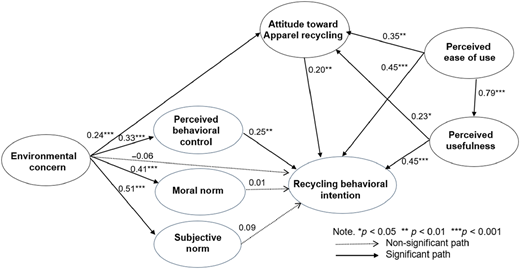
Bootstrapping with 1,000 subsamples was used to assess the significance of the proposed hypotheses (Hair et al., 2019). A t-value greater than 1.96 indicates the significance of a hypothesized path (Hair et al., 2019). The results indicated that environmental concern positively influenced subjective norm (H10, β = 0.51, p < 0.001), moral norms (H11, β = 0.41, p < 0.001), perceived behavioral control (H12, β = 0.33, p < 0.001) and attitude (H13, β = 0.24, p < 0.001), thus supporting H10–H13. However, the results did not establish a significant relationship between environmental concern and recycling behavioral intention (H14, β = −0.06, p = 0.55), thus H14 was not supported. The results found that PEU positively influenced attitude (H6, β = 0.35, p < 0.01) and PU (H5, β = 0.79, p < 0.001), thus supporting H5 and H6. PU positively influenced attitude toward online apparel recycling (H7, β = 0.23, p < 0.05) and recycling behavioral intention (H9, β = 0.45, p < 0.001), supporting H7 and H9 Moreover, PEU can positively influence recycling behavioral intention (H8, β = 0.38, p < 0.01), thus H8 was supported. Furthermore, the study results indicated that perceived behavioral control and attitude positively influenced recycling behavioral intention (H3, β = 0.25, p < 0.01; H4, β = 0.20, p < 0.01), thus supporting H3 and H4. However, subjective norm and moral norm did not exert any influence on recycling behavioral intention (H1, β = 0.09, p = 0.42; H2, β = 0.01, p = 0.92), thus H1 and H2 were not supported. Table 4 and Figure 2 describe the results of the hypothesized paths.
Results of fsQCA
To perform fsQCA, the standardized latent scores were loaded onto fsQCA 3.0. Since this study used a seven-point scale, the variables of latent construct were calibrated on 7 (full membership), 4 (crossover point) and 1 (full non-membership) (Gligor and Bozkurt, 2020). A necessity analysis was performed, indicating no required conditions (consistency and coverage greater than 0.9) can lead to consumers’ recycling behavioral intention (Rasoolimanesh et al., 2023). A truth table (Table 5) was also constructed to show all the possible configurations of conditions (i.e. environmental concern, perceived behavioral control, moral norm, subjective norm, attitude toward apparel recycling and PU) on the outcome (i.e. recycling behavioral intention). The intermediate solution of the three types of sufficient configurations was selected and the coverage and consistency should exceed 0.2 and 0.8 for each configuration (Rasoolimanesh et al., 2021).
The results of fsQCA indicated heterogeneous combinations as sufficient configurations to generate a high level of recycling behavioral intention. The fsQCA analysis produced nine different configured combinations (Table 5). Configuration 1 (∼ec*∼att*∼pu) indicates that lower levels of environmental concern, attitude toward online recycling and PU can still be a sufficient combination to generate a high level of recycling behavioral intention. Configuration 2 (∼sn*∼mn*att) reveals that low levels of subjective norm and moral norm along with a high level of attitude toward online apparel recycling can generate consumers’ recycling behavioral intention. Configuration 3 (ec*∼mn*pu) indicates high levels of environmental concerns and PU and a low level of moral norm can generate consumers’ recycling behavioral intention. Configuration 4 (∼sn*att*∼pu) shows a low level of subjective norm along with high levels of attitude toward online apparel recycling and PU can generate a high level of recycling behavioral intention. Configuration 5 (sn*pbc*mn) shows high levels of subjective norm, perceived behavioral control and moral norm can generate a high level of recycling behavioral intention. Configuration 6 (ec*sn*att) indicates high levels of environmental concern, subjective norm and attitude toward recycling online can generate consumers’ recycling behavioral intention. Configuration 7 (sn*pbc*pu) indicates high levels of subjective norm, perceived behavioral control and PU can generate consumers’ recycling behavioral intention. Moreover, configuration 8 (pbc*mn*pu) indicates high levels of perceived behavioral control, moral norm and PU will generate consumers’ recycling behavioral intention. Lastly, configuration 9 (sn*pbc*∼att) reveals that high levels of subjective norm and perceived behavioral control with a lower level of attitude toward online recycling can still possibly lead consumers to recycling their used apparel. These results demonstrated that fsQCA can identify heterogeneous outcomes by combining different configurations (Rasoolimanesh et al., 2021, 2023).
Discussion
This study proposed a theoretical framework via the combination of TPB and TAM models to ascertain the inter-relationships of environmental concern on consumers’ online apparel recycling behaviors. Based on the PLS-SEM analysis, the study revealed that environmental concern was positively associated with subjective norm, attitude, perceived behavioral control and moral norm, aligning with the studies conducted by Wang et al. (2016) and Bamberg (2003). However, this study did not establish a positive relationship between environmental concern and behavioral intention. This discrepancy may be due to the fact that environmental concern could be an indirect determinant of behavioral intention, especially through variables within TPB model (Paul et al., 2016; Wang et al., 2016). Ha and Kown (2016) suggested that environmental concern could serve as an indirect linkage for people to engage in pro-environmental behavior. As such, it can be assumed that environmental factors can positively influence an individual’s attitude towards clothing disposal, but not necessarily directly affecting clothing disposal behavior. Moreover, it can also be suggested that pollution stems from the fashion industry highlighting the fact that many people still value fashion and style rather than environmental protection (Şener et al., 2023). In general, consumers have a strong tendency to purchase new items to maintain a good self-image (Yan et al., 2021).
Furthermore, aligned with previous studies (Li et al., 2022), this study verified that perceived behavioral control could effectively determine consumers’ recycling behavioral intentions. This result implies that as long as consumers have a way to access devices for the Internet, they are more likely to engage in apparel recycling online (Zhang et al., 2020). Additionally, the findings confirmed that consumers’ attitudes toward recycling apparel online are the antecedent of recycling behavioral intention, demonstrating individuals who have positive attitudes toward recycling will likely to have the intention of recycling (Chen and Tung, 2010). However, contrary to other studies (Chen and Tung, 2010; Song et al., 2023), the current study did not actually establish the positive link between subjective norm and recycling behavioral intention. A possible explanation is that people do not necessarily consider the approval of “significant others” as a determining factor for recycling apparel online, since nowadays individuals are making their own personal decisions and choices. In particular, Chinese have been embracing western values and exhibited more individualistic behavior patterns (Han and Guo, 2018). Therefore, others’ opinions may not hold major sway in consumers’ behaviors. Moreover, the results did not reveal a positive relationship between moral norm and recycling behavioral intention, which is inconsistent with previous studies (Chan and Bishop, 2013; Cheng and Tung, 2010). This discrepancy may be explained by the fact that consumers’ moral obligation may be deactivated through denying the environmental responsibility, as disposing apparel in landfills is more convenient than recycling (Joung and Park-Poaps, 2013; Nguyen et al., 2017).
In line with previous research (Chi, 2018; Zhang et al., 2020), this study also verified that PEU can positively affect PU. Since online clothing recycling platforms are easy to use, the users can accomplish more tasks simultaneously and subsequently, they tend to perceive the technology (i.e. recycling platform) as useful. This supports the notion that the simplicity of operation can enhance individuals’ opinions about technology’s efficacy and usability (Zhang et al., 2024). Furthermore, the result revealed that both PEU and PU can affect people’s attitude toward recycling apparel online and recycling behavioral intention and this result is consistent with the previous research (Rafique et al., 2020; Zhang et al., 2020, 2024). Moreover, this result implies that when individuals believe using online clothing recycling platforms can effectively dispose of their obsolete apparel, their attitude remains positive regarding recycling apparel online and also have a high inclination of recycling.
Lastly, the outputs of the fsQCA analysis found that the antecedents to predict the recycling behavioral intention can be affected by various conditions. In contrast to PLS-SEM, the results of fsQCA identified heterogenous outcomes by combining various factors to generate consumers’ apparel recycling behavioral intention. The fsQCA analysis discovered that the results of PLS-SEM (symmetric analysis) were inconclusive. For instance, the results of PLS-SEM showed environmental concern was not a significant predictor of recycling behavioral intention, whereas the fsQCA analysis indicated that environmental concern was part of three sufficient conditions (configuration 1, 2 and 3) to generate recycling behavioral intention. This finding also explained that environmental concern alone is insufficient to predict individuals’ recycling behavioral intentions, since it needs the combined effects of environmental concern along with other variables of interests. The configurations of fsQCA provided different and nuanced insights to predict the outcome. As such, the results of fsQCA are more diverse than PLS-SEM, confirming the two approaches are complementary (Rasoolimanesh et al., 2021).
Implications
Theoretical implications
This research has several theoretical implications. Firstly, this study contributes to the current literature by investigating consumers’ online apparel recycling intention, which was not done by many studies so far (Zhang et al., 2020). This study extends the literature by integrating both TPB and TAM models to provide comprehensive analysis to better understand consumers’ online recycling intentions. Moreover, the integration of PLS-SEM and fsQCA has derived unique insights into the variable relationships. This study enhances the understanding of the complex phenomenon of people’s online apparel recycling behavior through the lens of environmental concern. As such, this study illustrated that people’s environmental concern may not necessarily guarantee recycling behavioral intention and individuals’ recycling behavioral intention may be relied upon the combined effects of environmental concern along with other proposed variable of interests (i.e. variables within TPB and TAM model and moral norms). The joint analysis of PLS-SEM and fsQCA provided a more robust method to identify optimal predictions, especially the configurational approach supports equifinality (i.e. multiple paths to the same outcome) (Douglas and Prentice, 2019).
Managerial implications
This research also provided significant implications for policymakers and related industries in addressing consumers’ unwanted apparel and sustainability issues. It is evident that consumers’ environmental concern may not necessarily lead to their recycling behavioral intention and it is imperative to acknowledge that people’s recycling intention is contingent upon a complex interplay of factors. As such, to encourage recycling intention, there is an urgent need for policymakers and related industries to enhance not only people’s environmental awareness of the implication of their consumption behaviors, but also their positive attitudes towards recycling their old apparels. People will have the intention to recycle their used clothing if they possess a positive attitude toward recycling apparel online. Moreover, policymakers and relevant industries need to smooth the recycling process to minimize any inconvenience as online platforms are more effective for recycling than physical collection bin. Additionally, policymakers can also consider reducing infrastructural barriers by combining both online and offline methods to facilitate the general public’s used apparel recycling behaviors. Furthermore, applications related to online recycling need to be well-designed and user friendly to remove difficulties for people to engage in recycling and to facilitate people’s online apparel recycling efforts. People will have a stronger intention to recycle their old apparel online when they feel the online clothing platforms are useful and easy to use. Providing incentives to the general public may also encourage consumers’ recycling behaviors; for example, people who donate certain amount of used apparel online will receive credits to exchange for rewards. However, there is a caveat to use incentives. Unlike Western counterparts, Chinese people may subject to the feeling of “lose face” if engaging in recycling clothes for any financial rewards. Some Chinese families do not even adopt pass-down items, as it is generally viewed as financial incapable to purchase new clothes (Xu et al., 2014). Hence, policymakers and related industries need to address any cultural barriers that inhibit people’s recycling behaviors.
Limitations and future studies
This study has several limitations. Firstly, it only measured respondents’ recycling intention rather than their actual behavior. The intention of consumers may not equate their actual recycling behaviors. Future research needs to access respondents’ actual behavior to understand their attitudes regarding recycling apparel online better. Secondly, the majority of respondents came from first or second-tier cities in China, where urban residents tend to be more environmentally aware and concerned compared to the general population (Yu, 2014). Residents from large cities may exhibit different apparel disposing patterns than those people from small cities or rural areas. Therefore, future research should explore a broader range of demographics to better understand diverse attitudes towards online apparel recycling. Thirdly, this study focused solely on the digital sustainability intervention within the Chinese context. To validate the generalizability of this study, future research needs to be conducted in different countries with diverse cultural backgrounds. In doing so, it can draw cultural comparisons and offer new insights. The fourth limitation is that this study only investigated people’s apparel disposing behavior via online clothing recycling platforms. As such, this may result in a less holistic perspective about consumers’ apparel disposing behaviors. Other than recycling apparel online, consumers may donate their clothing to charity or sell their clothes online as secondhand items instead. Selling second-hand clothing items online (e.g. goofish.com) has gradually become a promising marketplace to deal with used and unwanted apparels (Kim et al., 2021). Future studies need to explore a range of consumers clothing disposal behaviors rather than focusing on recycling exclusively. Additionally, future research may also need to investigate whether offering consumers incentives can facilitate their online apparel recycling. Lastly, the online data collection may have neglected people who do not use online platforms actively but practicing recycling regularly, especially elder Chinese who tend to re-use the fabrics in creative ways. Elder population may distrust online platforms. Thus, future research may need to explore whether factors such as consumer trust and data security issues may hinder consumers’ apparel donation behaviors. When engaging with online clothing recycling platforms, consumers’ privacy may be encroached, as consumers’ data are often stored without their knowledge (Vänskä et al., 2024).
Appendix 1
Measurement items
| Construct | Number of items | Measurement items |
|---|---|---|
| Song et al. (2023) and Borusiak et al. (2021) | ||
| Environmental Concern | 4 | Environmental problems are of great importance to me |
| There is no way we can ignore the problems associated with the environment | ||
| It is very important that we take care of the environment | ||
| In order to survive, humans must live in harmony with nature | ||
| Chen and Tung (2010) | ||
| Subjective Norm | 5 | Most people think I should recycle |
| Most people would think I should recycle | ||
| Most of my friends think that apparel recycling is a good thing to do | ||
| Most people who are important to me want me to engage in apparel recycling | ||
| Most of my families think that apparel recycling is a good thing to do | ||
| Tonglet (2004) | ||
| Perceived Behavioral Control | 6 | I have plenty of opportunities to recycle apparel online |
| Recycling apparel online is convenient | ||
| Recycling online is easy | ||
| I know what items can be recycled online | ||
| I know where to take my used clothes for recycling | ||
| I know how to recycle my textile waste | ||
| Tonglet (2004) | ||
| Moral Norm | 5 | I feel I should not waste anything if it could be used again |
| It would be wrong of me not to recycle my textile waste | ||
| I would feel guilty if I did not recycle my textile waste | ||
| Not recycling goes against my principles | ||
| Everybody should share the responsibility to recycle apparel waste | ||
| Tonglet (2004) | ||
| Attitude toward Online Apparel Recycling | 5 | I believe that recycling apparel online is good-bad |
| I believe recycling apparel online is useful- waste of time | ||
| I believe that recycling apparel online is sensible-not sensible | ||
| Recycling apparel online is responsible-not responsible | ||
| Recycling apparel online is hygienic-unhygienic | ||
| Sun and Chi (2018) and Zhang (2020) | ||
| Perceived Usefulness | 3 | Using online clothing recycling platform will be useful to me |
| Online clothing recycling platform contributes the betterment of my life | ||
| Using online clothing recycling platform can save my time | ||
| Sun and Chi (2018) | ||
| Perceived Ease of Use | 3 | Learning to use online clothing recycling platform will be easy for me |
| I found it easy to use online clothing recycling platform to do what I want to do | ||
| Using online clothing recycling platform will be easy | ||
| Liang et al. (2022) | ||
| Recycling Behavioral Intention | 3 | The likelihood that I would use online clothing recycling platform for clothing recycling |
| The probability that I would use online clothing recycling platform for clothing recycling | ||
| My willingness to adopt the online clothing recycling platform for clothing recycling | ||
Appendix 2
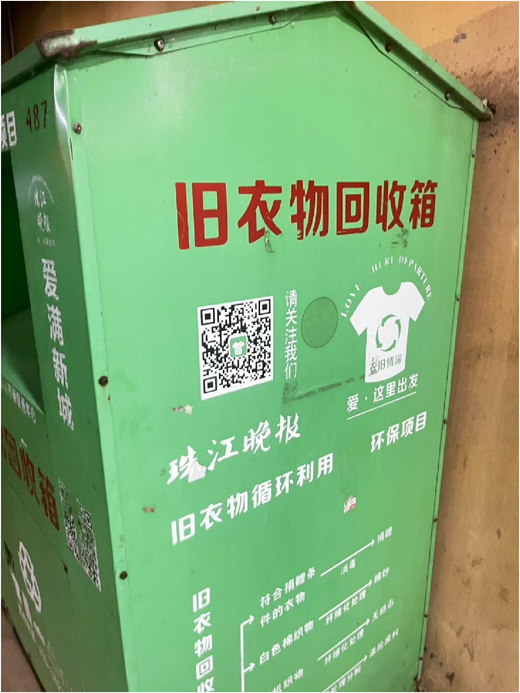
An example of residential recycling bin. Note: While conducting this research, the lead author encountered a run-down recycling bin that had been placed in a residential area in Henqing, Zhuhai, China. However, the QR code is not functioning. It remains unclear whether this recycling bin is still operational for collecting unwanted items and clothing. Nevertheless, it can be inferred that these recycling bins may merely be a formality rather than an effective waste management solution. Source(s): Authors’ own work
An example of residential recycling bin. Note: While conducting this research, the lead author encountered a run-down recycling bin that had been placed in a residential area in Henqing, Zhuhai, China. However, the QR code is not functioning. It remains unclear whether this recycling bin is still operational for collecting unwanted items and clothing. Nevertheless, it can be inferred that these recycling bins may merely be a formality rather than an effective waste management solution. Source(s): Authors’ own work