This paper presents an empirical study of a Syrian refugee workforce in textile export from Jordan. The purpose of this study is to determine the challenges of integrating Syrian refugees into the local workforce and to consider the implications of these challenges for the global supply chain aiming to create stable trade.
Data were collected via three face-to-face focus group interviews with refugee workers and managers at a clothing factory site in Al-Duleil, Zarqa. Data were analysed using the Gioia methodology.
Worker attitudes, factory environment, and government support are important factors for refugees' workforce participation. The success of integrating Syrian refugees into the Jordanian workforce was largely a matter of their attitudes, commitment and motivations for taking up manufacturing work. Misconceptions about the roles refugees will undertake were identified, which results in fewer people becoming self-sufficient through employment.
This research contributes to understanding refugees' long-term integration in the host country by investigating refugee workers' and their managers' perspectives. Considering the views of multiple stakeholders enrichs the literature on refugees' integration.
Understanding refugees' perspectives facilitates their integration in the host country which leads to improvement in their wellbeing and quality of life. More broadly, Jordan's approach to integrating refugees into the economy is seen as a development opportunity rather than a crisis to be handled.
Rather than focus on the procedures of integrating refugees in the host country, this study provides the voices of refugee migrant workers themselves, thereby offering a more complete picture of those factors shaping refugees' (dis)integration in local communities.
1. Introduction
Along with Lebanon and Turkey, Jordan is one of the countries most affected by the Syrian refugee crisis, with between 1.4 and 1.8 million refugees having flocked to the country at the peak of the crisis (UN High Commissioner for Refugees, 2021; World Bank, 2019a). By 2021, Syrian refugees comprised more than 10% of Jordan's population. Typically, refugees languish under extreme dependency, as governments and host communities often consider refugees a burden on the economy, environment, infrastructure, and security system (Jacobsen, 2005; Betts and Collier, 2015; Betts et al., 2017; Schön et al., 2018). Donor states, the European Union (EU) (which provides favourable trade options in order to prevent migration to their own countries), and the United Nations (UN) have urged Jordanian governmental groups to permanently integrate Syrian refugees into society through work opportunities (Betts and Collier, 2015). Specifically, the EU and Jordan have signed an agreement whereby Jordan will benefit from trade exchange if Jordanian manufacturers employ refugees. This creates an opportunity for stable trade between the EU and Jordan through enhancing social sustainability by promoting social good through the workforce development and social integration of Syrian refugees within Jordan's garment sector.
Although research has largely focused on the role of government, non-governmental organisations (NGOs), and humanitarian organisations and their supply chain collaboration with the destination societies in facilitating the integration of refugees (Adem et al., 2018; Heelsum, 2017), little attention has been paid to the perspective of the refugees themselves (Heelsum, 2017) due to access issues, a notable exception being Krafft et al. (2018), making the literature scant (Adem et al., 2018; Bucken-Knapp et al., 2019). Various indicators for integration have been considered, such as language acquisition, employment (Shneikat and Alrawadie, 2019), and education (Heelsum, 2017). Research on refugees and integration suggests that “employment is the single most important factor in achieving successful integration in the host society” (Guo et al., 2020, p. 532). However, little notice has been paid to forced migrants and their views of the employment opportunities in the host country. Essentially, while previous studies have considered the economic and social impact of refugee integration and employment on the host country (Shneikat and Alrawadie, 2019), a bottom-up approach reflecting the role of refugees' and employers' perspectives in the refugee integration process has been neglected. Moreover, studies of refugees are highly valuable to policymakers worldwide due to this group's statistical economic importance (Cameron, 2014).
This research aims to offer empirical insights into sustainable textile export from Jordan provided by a Syrian refugee workforce. By promoting social good through the workforce development and social integration of Syrian refugees within the garment sector in Jordan, the potential exists to enhance export opportunities to create stable trade within the global supply chain beyond Jordan–in particular the EU. These initiatives are ongoing and many stakeholders are involved, including global garment brands located in the EU, intermediaries in garment transactions or in purchasers/suppliers matchmaking, standards audit intermediaries, garment sector associations, government officials interested in growing trade between the EU and Jordan, and development practitioners interested in alleviating the Syrian refugee crisis through employment and investment programs.
Stable international trade is important for economic growth (Frankel and Romer, 1999). Békés and Muraközy (2012) refer to firms exporting their products to a given destination for a short period of time as temporary, unstable trade relationships, while stable trade relationships are classified as permanent trade. Despite their high proportion of relationships, temporary trade transactions are typically much smaller in value than permanent trade ones. Other advantages of permanent trade include a reduction in volatility that allows flows to become as operationally smooth and predictable as possible. Transparency, increased certainty about trading conditions, and equilibrium between demand and supply all contribute to making trade more stable (Rose, 2005).
By asking such research questions as what are the challenges of integrating migrant Syrian women into the local workforce from their perspective and the perspective of their managers? and what are the implications of these challenges for the global supply chain in the pursuit of creating stable trade?, this paper considers the refugee workforce and how it can contribute to the development of permanent supply chains. In so doing, this paper examines the understudied area of the intersection between refugee integration and humanitarian logistics and supply chain management (as called for by Seifert et al., 2018). In particular, the findings of this study emphasise the perspective of refugee workers of the long-term integration policies designed around them.
The paper begins by providing a short overview of the background to the crisis and outlining the importance of the topic. Next, we introduce the literature on (1) the integration of refugees into the workforce, (2) how supply chains create stable trade, and (3) women in the workforce. Research questions are presented stemming from identifying weaknesses in the literature. The methodology explains how the data were collected and the use of the Gioia analysis method, employing a qualitative approach to present detailed refugee perspectives in the findings. The discussion then compares our findings to the extant literature before conclusions are drawn. Lastly, the paper offers implications for theory and practice, notes the study's limitations, and lists future research directions.
2. Background to the crisis
Jordan is one of the countries most affected by the Syrian conflict crisis and has the second highest share of refugees, compared to its population, in the world; there are an estimated 1.5 million Syrian refugees in Jordan, although the registered number is approximately 665,000 (UNHCR, 2021). There are approximately 5.6 million Syrian refugees overall, and another 6.2 million people are displaced within Syria and require humanitarian assistance (World Vision, 2020).
The majority of Syrian refugees in Jordan live in urban areas and in poverty; that is, over 80% live below the poverty line. 51% of refugees are children and 4% are elderly. Around 80,000 Syrian refugees live 10 miles from the Syrian border in northern Jordan in the Za'atari camp, named the country's fourth largest “city” following its transformation from a gathering of tents into the largest Syrian refugee camp in Jordan (Pasha, 2020). The Government of Jordan has taken steps to initiate formal employment opportunities for Syrians by issuing over 200,000 work permits by December 2020 (Ministry of Labour Syrian Refugee Unit, 2020). This is in line with the Jordan Compact target, although it still represents only around half of the working-age refugee population (UNHCR, 2019). In the Za'atari camp specifically, many refugees claim to continue struggling to find work, surviving on limited aid or working illegally; fewer than one-fifth of them have current work permits (Oxfam, 2021).
The Jordan Compact (2016) outlined a series of major commitments aimed at improving the resilience of refugee and host communities. It focuses mainly on livelihoods and education. Women are at the forefront of this economic experiment in Jordan to find work for Syrians fleeing war (Howden et al., 2017). Factories are keen to benefit from this international aid experiment under which Jordan has been offered concessional loans and preferential trade terms in return for opening its labour market to some of the estimated 1.5 million refugees who fled there during the war in Syria. The terms of the Jordan Compact included $1.8billion in grants over three years to support infrastructure projects; a 10-year exemption (now extended) from an EU tariff barrier for producers in Jordan who met an employment quota of Syrian refugees; and a commitment from the Government of Jordan to create 200,000 “job opportunities” for Syrians.
There has been strong support for the Compact from the EU, where politicians see it as a means of persuading the millions of Syrians taking refuge in neighbouring countries to remain in the region. Jordan is thus encouraged to see it as a development opportunity. The deal gives factories access to EU markets without the usual tariff barriers. But the deal is only open to businesses that can meet the requirement of having a 25% Syrian refugee workforce. It has been difficult to get highly skilled refugees to work in the factories and further investigation is needed into why labour is scarcer than expected.
3. Literature review
Refugee studies, as a broad multi-disciplinary field of academic inquiry, have become a major focus of scholars and policymakers worldwide (Cameron, 2014). This is because statistically, refugees are an important issue and cannot be ignored (Cameron, 2014). Recent calls for further research are evident in the literature (e.g. Oloruntoba and Banomyong, 2018; Seifert et al., 2018; Özdamar et al., 2022). One issue is that governments and host communities often consider refugees a burden on the economy, environment, infrastructure, and security system (Betts et al., 2017; Hartmann, 2013; Jacobsen, 2005; Schön et al., 2018). They claim that refugees increase the pressure on resources such as land and water, especially as human crises intensify and refugee influxes increase. Consequently, host governments frequently impose restrictions on the treatment of refugees by limiting their rights, including freedom of movement or access to the local labour market (Kibreab, 2003; Betts et al., 2017), leaving encamped refugees feeling “warehoused” (Betts et al., 2017). Nevertheless, donors, as well as organisations such as the Office of the United Nations High Commissioner for Refugees (UNHCR), aiming to improve the lives of encamped refugees as well as those of host communities, invest in infrastructure and services (Jordan Response Plan, 2016). The goals of these investments are to save costs in the long run, to reinforce local capacities and sustainability, to prevent conflicts, and to increase refugee self-reliance and resilience (Jordan Response Plan, 2016). Özdamar et al. (2022) found that service design, service reachability, training serviceability, collaboration, synergy, ethical considerations and after-service care grouped together in a humanitarian service triad allows for better understanding of humanitarian assistance whereby members such as NGOs, service providers and beneficiaries contribute to value co-creation.
3.1 Integration of refugees in Jordan
Refugee rehabilitation and reintegration is an important global challenge and obtaining the perspectives of the refugees themselves can be challenging for researchers (Seifert et al., 2018). Factories have incentives to employ labour from refugee camps, which is a positive step towards reintegration. Jordan is in a strong position to develop its supply chains because of its fair-trade agreement with the EU, US free trade preferences, and because the over-$2billion apparel industry accounts for over 24% of Jordan exports (which increase yearly) (World Bank, 2019b). Directly related to the refugee crisis is Jordan's favourable export tariffs, as it is allowed to export products to Europe tariff-free until 2030 if it employs Syrian refugees. Thus, employing this group appears lucrative for both Jordan and the workforce. However, there has been negative press coverage on the lack of take-up of work, and factory owners are struggling to exploit these incentives due to the low numbers of Syrian workers. Betts and Colliers (2015) titled their work “help them help themselves” because of the difficulties of integrating the group into Jordanian society. However, Achilli (2015) explained that as a result of Jordan's restrictive policies, Syrian refugees exhibit negative coping mechanisms. These include almost half the families having one working child and Syrian families being more willing to resort to early marriage to secure a better economic future for their daughters. Dejong (1995) criticised a few of the institutionalized mechanisms that may have led to generating policy-relevant data, which might have led to some form of action to protect the poor from the negative effects of the previous economic crises.
3.2 How supply chains create stable trade
Betts and Collier (2015) argue that attention should be focused on Syria's neighbouring states, such as Jordan, Lebanon, and Turkey, which, albeit overwhelmed, have handled the problem differently. For example, in these countries, policies towards the Syrian refugee crisis are both antiquated and fuelled by panic (Betts and Collier, 2015), and instead of donors writing cheques to support humanitarian relief, viewing the “problem” as a development opportunity for creating stable trade is a better option. Essentially, “recognizing refugees as providing resources rather than just needing or depleting resources can enable more inclusion” (Finsterwalder et al., 2021, p. 247). In this instance, the EU has acted to keep Syrian refugees in Jordan by means of favourable trade options. This means that new global opportunities for trading with Jordan in the garment sector have opened up. Benefits may be gained in a manner similar to how, at the turn of the latest century, Vietnam positioned itself into global value chains for textiles by becoming an exporter of garments to the EU, Japan, and the USA (Nadvi et al., 2004). Europe in particular lacks an overview of the context in which the Jordan garment sector evolves, and of the currently ongoing sector consolidation efforts and support programs. Some assistance to textile businesses is needed to sort through the various incentives that favour purchasing in Jordan's garment sector.
Jordan offered to integrate refugees into specially created economic zones, offered them employment and autonomy, and incubated businesses in preparation for the eventual end of civil war in Syria, thus adding to Jordan's aspirations for industrial development. Adem et al. (2018) investigated international and local NGO supply chain collaboration in the context of the Syrian refugee crisis in Jordan. Their research, although based on interviews with 30 humanitarian professionals, lacks the perspective of the refugees themselves.
Current refugee assistance programs are very effective in alleviating poverty– e.g. the UNHCR cash assistance program and the World Food Programme (WFP), a food voucher program – but are not sustainable and do not foster a transition from dependence to self-reliance (World Bank, 2019a). Other solutions, such as creating a stable demand for goods that do not rely on voluntary contributions (as they are self-sustainable), are needed. Social protection on its own does not foster a transition to work and self-reliance, if access to labour markets and economic opportunities are not available.
Humanitarian logistics research often applies network theory, transitioning from a permanent state to temporary supply chain in quick-response disaster relief situations (Jahre et al., 2009). For ongoing crises such as Syrian refugee camps in Jordan attached to work opportunities such as clothing factories, the opposite can be applied. In their pursuit to create stable trade, the buyers sourcing from the EU under favourable trade deals must risk procuring from Jordan. Then, as the relationship develops over time, these supply chains can eventually become more permanent in nature and create stable trade beyond temporary trade deals. The focus must shift beyond social protection for refugees to include economic growth for both refugees and local communities in the areas hosting them. This will require continued close collaboration between humanitarian and development agencies and international partners to transform a humanitarian crisis into a development opportunity for all (World Bank, 2019a).
3.3 The women's workforce
Women represent one of the largest potential populations of adult Syrian refugees in Jordan who are unemployed and who could join the formal labour market (Kelberer, 2017). The importance of this women's workforce is highlighted by the low proportion of female-to-male participation in the workforce, the higher unemployment rate of women (although this is improving), and the types of jobs women take on, which are more likely to be crafts and trades (Tiltnes et al., 2019). There is a recognition of the need for a large-scale recruitment drive among Syrian women (Lenner and Turner, 2019), placing them in a critical position to contribute to the success of Jordan's economic experiment (Howden et al., 2017). The under-representation of Syrian women among workers with work permits stems from original low labour force participation, lack of targeted measures, and insufficient targeted communication (ILO, 2017). Some studies (e.g. Kelberer, 2017; Tiltnes et al., 2019; Lenner and Turner, 2019) found that women did not, therefore, pursue these work opportunities. However, these studies lack further details about whether the women do not find the work attractive, about remuneration, about women possessing previous (better) work experience or other cultural factors. For example, prior to migration, other sectors, including manual, factory-based labour, had seen a transition from male to female roles, such as major socio-economic changes in northwest Syria spurring men's exit from agriculture. Abdelali-Martin and Dey de Pryck (2015) found that a gradual transition of traditionally male roles to female roles in the workplace allowed for modest gains in women's empowerment without challenging intra household gender power relations. This indicates that there had been a cultural shift among male and female roles. Unfortunately, Syrian women who held good jobs in their country, such as in the educational or medical professions, find those sectors closed to migrant workers in Jordan (Kelberer, 2017; Oxfam, 2021).
In their analysis of the politics of integrating Syrian refugees into the labour market in Jordan, Lenner and Turner (2019) found that Syrian refugees expressed concerns that taking formal jobs might affect their status and reduce their opportunities to access financial assistance or resettlement. Even assurances from the UNHCR that receiving a work permit would not affect those factors had little effect. Women in particular also raised concerns about the length of journeys required to the workplace, the lack of childcare facilities in the factories, and the prospect of working with men unknown to them (Lenner and Turner, 2019). Nonetheless, Jordan has shown good progress in integrating women into its workforce, particularly in the sectors of agriculture, manufacturing, construction, and some hospitality industries (UNHCR, 2019). More remains to be done, however, in improving women's access to the labour market. Further uncovering the challenges of integrating migrant Syrian women into the local workforce from their perspective offers an important avenue for future research. Barriers to this uptake affect how much Jordan can develop and sustain better global supply chain relations, ultimately creating stable trade for the country.
3.4 Research questions
As researchers in the field have found it difficult to obtain access to the refugee voice (Kovacs et al., 2019), which is a key criticism of the Jordan Compact (Barbelet et al., 2018), our research has implications for policy development by including perspectives from the ground (e.g. those of refugees). While refugee economic integration has been studied at length in Europe and North America, there has been less focus on developing host countries, including those in the Middle East, despite the high-volume refugee flow into countries such as Jordan (Barazesh, 2021). Our study meets each of Seifert et al.'s (2018) recommendations for humanitarian logistics studies: they called specifically for empirical refugee studies in Syria's neighbouring states, combining supply-chain management and refugees and focusing on long-term solutions rather than initial disaster relief. Our study builds on the literature of Syrian refugee integration (particularly women) in Jordan for long-term and stable production leading to sustainable trade. The literature review reveals a significant gap in access to refugees, which we also face in our research. This leads to our first research question:
What are the challenges of integrating migrant Syrian women into the local workforce from their perspective and the perspective of their managers?
Our second research question considers the implications of these challenges for the supply chain in order to create stable trade between exchange parties:
What are the implications of these challenges for the global supply chain in the pursuit to create stable trade?
4. Methodology
The methodology explains how the data were collected and the focus groups were conducted in the empirical data collection phase using an exploratory, qualitative data analysis methodology advocated by Corley and Gioia (2004) and Gioia et al. (2013). The qualitative approach supports exploratory investigation into what the challenges of integrating migrant Syrian women into the local workforce from their perspective and the perspective of their managers are and the implications of these challenges for the supply chain in order to create stable trade. Since refugee voices are difficult to capture (Bucken-Knapp et al., 2019), meaning we were exploring a relatively under-investigated research area, qualitative data collection was appropriate to gain richer understanding and provide insightful analysis of the experiences of managers and workers. The justification of the Gioia analysis method and its advantages of combining informant and researcher-centric code development and providing an inductive and iterative analysis of data is explained. The methodology concludes with procedures for ensuring the trustworthiness of the data and analysis to include peer debriefing and triangulation with secondary data.
4.1 Sampling and data collection
Qualitative data were collected from refugee workers and managers using three face-to-face focus group discussions which were conducted and recorded by one researcher based in Jordan in one clothing factory in Al-Duleil, Zarqa, a specially created economic zone offering Syrians employment and autonomy and incubating businesses to support Jordan's aspirations towards industrial development. This research adopted a purposive sampling strategy whereby 24 participants were invited to take part in the research. Informants with sufficient knowledge and experience of the work we were investigating were selected as appropriate participants for this study and were known as “knowledgeable agents” (Gioia et al., 2013, p. 17). The focus groups (see Table 1) comprised (1) managers only, (2) a mixture of workers and managers, and (3) workers only. Many refugees who were contacted declined to participate in the research due to trust issues and an unwillingness to share their personal information, as some of them were working without a work permit at that time. However, due to accessibility and the nature of the work with textile material, only women refugee workers agreed to be involved in the discussions, as they comprise the majority of the workforce (Tamkeen, 2020). For example, 51% of refugees in Jordan are women and 63.6% of employed females are in the 20-to-39 age group, with 15% working in textiles (Tamkeen, 2020). Because of the demographic of those working in this particular factory, women workers under 35 were interviewed, which corresponds to the refugee 20-to-39 age group (Tamkeen, 2020). The factory management demographic was male managers with over five years' experience of hiring and working with both Jordanians and a Syrian workforce. As the three focus groups largely revealed similar attitudes and perspectives, and as we had saturated the workforce willing to come forward, the data collection was stopped.
Four different managers were included in groups one and two and eight different women workers were included in groups two and three. Focus groups to generate qualitative data were designed to be run in their own environment for a contextual setting (Flick, 2009) and were conducted during group breaks. In qualitative analysis, the focus lies on the human factor, on people's perceptions, experiences, and the meanings they place on the processes, events, and structures of their social setting (Skinner et al., 2000). For this reason, this research involves high interaction and intense or prolonged contact with people or groups in their natural “real-life” setting, and through a number of events, answers “why” and “how” things happen, integrating people's emotions, motivation, and preconceptions, as well as matters of interpersonal conflict and cooperation (Gray, 2014), thus providing the researcher with a holistic view of the study. The face-to-face focus groups encouraged strong dialogue inciting agreement or disagreement and further discussion throughout. The composition of the groups was carefully designed to incite responses that would not be muddied by other participants. A combination of workers and managers was chosen for focus group 2 to identify both agreement and discrepancy in opinion between the groups.
4.2 Focus group guide and procedure
The focus group interview protocol (Table 2) was developed in advance and included four sections: introduction, demographic, focus group procedure, and interview questions. The semi-structured focus groups focused on the perception of long-term prospects, the effectiveness of the Jordan Compact in working and social behaviour, and refugees' integration into work and life in Jordan. The focus group strategy was fluid in order to investigate topics of interest as they emerged. Due to organisational access restrictions, the research was conducted in a single factory, which cooperates with the International Labour Organisation (ILO) to employ Syrian refugee workers to benefit from the Jordan Compact. Thus all participants worked at this factory during the research period. Consent was obtained and ethical considerations maintained, including participants' consent for focus groups to be recorded and transcribed. Participants were explained the confidentiality of the research and their right to withdraw at any point during the focus groups. Focus groups began with a brief introduction by the interviewer and a summary of the research objectives. All participants agreed to have their focus group recorded after being promised that their data would remain confidential and secure and would not be shared with a third party. All questions were covered during the focus groups, and the researcher allowed participants to explain further whenever they felt the need to elaborate. Following the data collection, a Gioia thematic coding qualitative research analysis was used to carry out a conceptual analysis of key emerging themes.
4.3 Analysis and interpretation according to the Gioia methodology
All collected data were professionally translated from Arabic and transcribed. The research objective is achieved during the empirical data collection phase using an exploratory, qualitative data analysis methodology advocated by Corley and Gioia (2004) and Gioia et al. (2013). The transcripts were coded by two research team members based in the UK and Jordan, one of them the researcher who conducted the focus groups, in line with presenting a Gioia methodology data structure (see Figure 1). Data structures demonstrate transparency in examining the accounts provided by the Syrian refugee workforce. The approach advocated by Gioia et al. (2013) was used for its effective ability to theorise from and present the data. The method supports a rigorous and coherent approach to data analysis and allows for inductive, recursive analysis of data as concepts and themes emerge. For example, the approach presents both first-order concepts (i.e. an analysis using informant-centric terms and codes) and second-order themes (i.e. one using researcher-centric concepts, themes, and dimensions). Taken together, the tandem reporting of both voices – informant and researcher – allows for a “qualitatively rigorous demonstration of the links between the data” and the induction concept development and theory building (Gioia et al., 2013, p. 18). The analysis presents Gioia's data structure to show informant-centric codes, the researcher-centric second-order themes, and the aggregate dimensions that contribute to answering the research questions. The data were analysed among the research team to develop the challenges of integrating Syrian women into an open and inclusive workforce, from their perspective, and to determine the implications of these challenges for the global supply chain with the aim of creating stable trade.
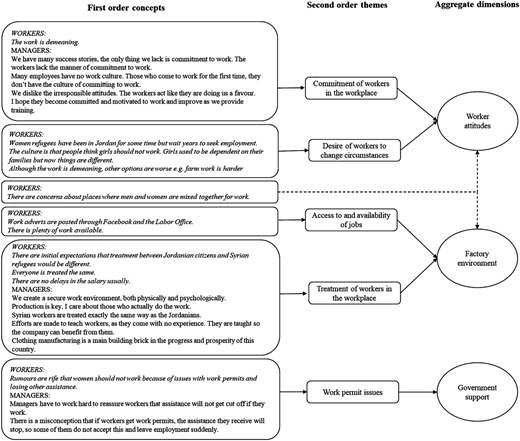
While the analysis is described as a linear process for simplicity, it was iterative in practice. The analysis began with an in-depth reading of the focus group interview transcripts to identify patterns related to the refugees' integration barriers from the refugees' and factory managers' perspectives. Initially, similarities and differences in data were identified. The common patterns were categorized using first-order codes (Gioia et al., 2013). At this stage, in vivo codes were used to “adhere faithfully to informants' terms” (Gioia et al., 2013, p. 20). Several first-order codes emerged, such as “work is demeaning”, “everyone is treated the same”, etc., after which similar first-order codes were consolidated, which led to the second-order codes. These include “commitment of workers in the workplace”, “desire of workers to change circumstances”, “access to and availability of jobs”, etc. Lastly, the aggregate dimensions were identified by iteratively moving between the data and the second-order codes. Eventually, three abstract dimensions, which reflect the main factors that shape the refugees' involvement in the workplace in the host country, emerged: worker attitude, factory environment, and government support. Figure 1 illustrates the coding process whereby the Gioia methodology uses both direct quotations and the researcher's summary to develop the data structure. Table A1 in Appendix presents further quotations demonstrating the chain of evidence.
4.4 Trustworthiness of the data and findings
The researchers took several measures to assess trustworthiness: first, Nvivo software was used to collate and assist the interviewer in finding patterns in the data, categorising different themes, and identifying various levels of codes (first order, second order, and aggregate dimensions). Second, the data coding and analysis were conducted by two authors: one from the UK and one from Jordan. In due course, the initial findings and the data interpretations were shown to the third researcher (who was not involved in the data collection and analysis) from Jordan to provide critical feedback and to take a fresh look at the data. Moreover, after the full draft of the paper was written, it was shown to another researcher who is not part of the authorship team to obtain an outsider's view of the findings, known as peer debriefing (Corley and Gioia, 2004). In addition, to the workers' perceptions, we were also able to analyse the wider implications for the supply chain beyond the factory by triangulating secondary data such as reports relating to work permit initiatives for Syrian refugees in Jordan (Kelberer, 2017; ILO, 2017) and UNHCR reports and factsheets (2019, 2021), with primary data focus group anecdotes.
5. Findings
To answer the first research question, the focus group data are presented using the Gioia methodology data structure, meaning that direct quotes or observations comprise the first-order concepts, followed by the second-order themes. The aggregate dimensions resulting from this analysis are worker attitudes, factory environment, and government support. Figure 1 shows the data structure produced from the analysis using the Gioia methodology using the Syrian refugee voice and the manager voice.
5.1 Worker attitudes
From the data, it was clear that the success of integrating refugee Syrian women into the local workforce was largely due to their attitudes and work ethic (commitment) and their motivations for taking up manufacturing work (desire to change their circumstances). A lack of workers' commitment was found: women admitted that the work was demeaning and managers believed that some workers were there to “kill time”. This resulted in factory managers coming up against attitudes to work. For example, we were told by one manager that, “as for the Syrian labourers, about fifty percent of the girls liked the clothes manufacturing jobs, and they were interested in learning. They had no experience, so we offered them training to become sewers and become productive. So, fifty percent of the girls showed interest and they learned, and they are committed. But others, as I said, receive assistance that fulfils their need and thus they do not need to go out and work. So, they just come to kill time. They are not committed to work; they do not have the sense of responsibility because the assistance they receive is enough to make a living. So, they are not responsible enough at work. They would tell us, ‘I may work for you tomorrow, but I'm not sure about the day after.’ As if they were doing us a favour. They do not need work; they come to spend time. Not everybody is like this: other people really like to work and can be productive. I can even show you many examples of people who came here without any experience and now they are leaders”.
One issue is the kind of employees that work in Al-Duleil and their skill set. One manager explains that “the common impression about the Syrian labourers, which I think is correct, is that they are very skilled. Aleppo, for example, is the mother of manufacturing. Aleppo used to have factories twenty years ago that were as big as the factories in Jordan now. However, all the skilled workers went to the north, they went to Europe. Those who came here are a different kind of people. It depends on the geographic location. Those who came here are the nomads from Dara, Raqqa and other places that used to have no manufacturing at all. They are less skilled. The skilled workers from Aleppo and Damascus went to Turkey and Germany. They crossed the sea and went there”. Managers go on to say that “there is already part of these skilled workers that came to Jordan here, but all of them work in their own businesses. They do not work in factories. There are skilled workers and skilled tailors and all that, but they all have their own businesses, they do not work in factories. Those who come to work in factories are the less fortunate”. Managers are struggling because “we cannot plan well. In our production plan, sometimes we have 100 workers in a given day, and then the next day, we suddenly find out that we only have 60. Then how will the production line be able to achieve its targets?” This has implications for meeting stable production demands.
5.2 Factory environment
Factories also have a role to play in that they must advertise jobs, offer work to the women, and meet expectations in terms of how the women are treated. This includes their training, treatment equal to citizens, and on-time payment. Workers explain that work advertisements are posted through Facebook and the Labour Office and that there is plenty of work available. They also admit that although their initial expectations that the treatment of Jordanian citizens and Syrian refugees would differ, everyone is treated the same, which is confirmed by managers. Workers also claim to be paid on time. The managers further support positive conduct in factories by trying to create a secure work environment, both physically and psychologically, and by explaining that efforts are made to teach those workers who arrive with no previous experience. They are taught skills so that the company can benefit from them, as clothing manufacturing is a primary building block in the progress and prosperity of the country.
So, while a good factory environment is important to attract workers, linked to both worker attitudes and factory environment is the cultural issue of men and women working together, which remains a problem both as perception and in reality. This cultural issue arises from a religious context whereby the work environment should not be gender-mixed due to fear of abuse and harassment. However, the factory should improve its environment to attract more workers of both genders. In Figure 1, this line is dashed, as it does not relate to a second-order theme but to two aggregate dimensions. In addition, misconceptions are a big problem in terms of understanding alternatives to textile work - these include farm work, trade-offs between working or not, and the disillusion of Syrians and local Jordanian citizens being treated differently. One worker explained, “I used to expect that there will be discrimination between the Syrians and the Jordanians, and I expected the manager to treat us in a way that's different from the way she is treating us now. But when I actually came to work, I found no discrimination among workers, whether they are Bengalis, Syrians or Jordanians. Everybody gets the same treatment”.
5.3 Government support
The ability to obtain a work permit from the employer was important but shrouded in misconceptions about losing other forms of living assistance. Misconceptions about work permits stem from rumours that other refugee assistance will be revoked once employment is secured. For example, one woman worker explained that she had heard people say “what good will it do me to get a work permit that will result in cutting off the support I receive?”. The managers believe that the women are under the impression that “they can already make as much money without having to work. This is one of the justifications the Syrians make for not being committed”. Although workers are sceptical, the managers know that “all the organizations that help our Syrian brothers do not cut off any assistance or help for them if they work” and “we have already explained this to them. We told them that the International Labour Organization, and other organizations that they receive assistance from, will not cut off the assistance or help you are receiving”. Nonetheless, work permit information asymmetries have been rife in the region for many years.
Our key findings provide insights into the attitudes of the workforce (commitment to the work and desire to change their own circumstances), factory environment (access to and availability of jobs and treatment of workers, both domestic and refugee), and work permit misconceptions. Concerns about unacquainted males and females working together in factories and the lack of knowledge about skills being taught and transferred to Syrian women are also prevalent. Therefore, uncertainty is expressed about the nature of the work (e.g. male and female integration and skills taught) and the implications of accepting work (e.g. for work permits). Both are issues that could rather easily be addressed through both formal and informal communication. The findings show that the workforce is the biggest obstacle for businesses looking to benefit from EU incentives, as the work is not attractive enough to the women, even though some of them experience high levels of poverty and have no work experience. Yet factories must employ a quota of Syrians (25%) in order to be eligible for attractive trade agreements.
6. Discussion
This empirical study identifies the challenges of integrating migrant Syrian women into the local workforce in Al-Duleil, Zarqa – a specially created economic zone – from their perspective and that of their managers. The findings show that the aggregate dimensions from the analysis are worker attitudes, factory environment, and government support. That is, it was clear from the data that the success of integrating refugee Syrian women into the local Jordanian workforce was largely a matter of their attitudes and work ethic (commitment) and their motivations for taking up manufacturing work (desire to change their circumstances). The attitudes and motivations of women to accept work have not been thoroughly examined in the literature, as much scholarly work has focused on how to get people into work, without considering why there might be barriers.
Factories have a role to play in that they must advertise jobs, offer work to the women, and meet expectations in terms of how the women are treated. This includes their training, treatment equal to citizens, and on-time payment. These findings differ from those of Lenner and Turner (2019), who found issues with the lengthy journeys required and the lack of childcare facilities in the factories (Kelberer, 2017). We also found no evidence of women being excluded from employment opportunities due to social norms dictating that they must stay close to home, as Oxfam (2021) found in their review. However, Amjad et al. (2017) and Lenner and Turner (2019) did find that women had concerns about women and men working together, as shown in our own empirical findings, which linked such issues to both worker attitudes and factory environment. Lastly, the ability to obtain a work permit from an employer was important but shrouded in misconceptions about losing other forms of living assistance. Despite some attempts at showing that this is not the case, for example by the UNHCR (2019), the problem remains ongoing. Overall, misconceptions are a major issue in terms of understanding alternatives to textile work, e.g. that of farm work, trade-offs between working or not, the disillusion of Syrians and local Jordanian citizens being treated differently, and potentially some cultural shifts regarding men and women working together.
Whereas Kelberer (2017) found that initiatives targeting women should simultaneously focus on decreasing barriers to access to work, including childcare support and vocational training or job matching where necessary, the empirical findings of this study did not find these elements problematic in terms of worker attitudes or factory environment. In fact, the workers blamed the work itself as demeaning (as women do not usually assume these roles traditionally and thus are violating their own standards). Both managers and refugees claim that there is plenty of work available (which is expected, as factories must meet their quotas of Syrian refugee workers), yet Amjad et al. (2017) found that workers did show a willingness to work, a finding not mirrored in our study. Our empirical results do concur with Kelberer's (2017) findings that environments must cater to female workers, including shifts in perceptions, but empirical results show that the practicalities and concerns of a mixed-gender workforce should be addressed.
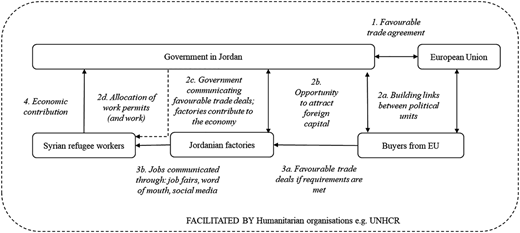
By using secondary sources (e.g. Barbelet et al., 2018; ILO, 2017; Kelberer, 2017; and UNHCR, 2019, 2021) to analyse the key players in addition to the primary data from focus groups, we were able to diagram upstream and downstream actors and their impacts on the supply chain; see Figure 2. We show an order of events, from 1 to 4 starting with the possibility of favourable trade agreements to the process of operating with a Syrian refugee workforce to the outcome of economic contribution. Noting the pressures on factories, which are at the forefront of the potentially positive impact of the initiative, they engage with the highest volume of actors and play a role in work permit perceptions (signalled by the dotted line) and work allocation. Humanitarian organisations may be able to continue to facilitate the input of a productive workforce, shown by the surrounding dotted line. Moreover, EU relationships must be established before time runs out, factories must continue to promote access to work, and the misunderstanding regarding losing one's refugee assistance if one is awarded a work permit must be addressed.
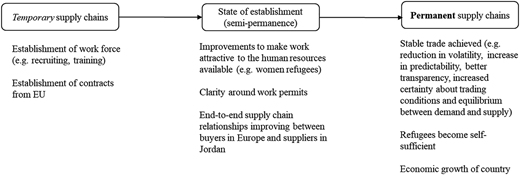
Figure 3 shows the transition from temporary to permanent supply chains, passing through a state of establishment and semi-permanence. Unlike humanitarian logistics supply networks that may begin with a permanent infrastructure and utilise temporary resources in a crisis as donor funding becomes available (Jahre and Heigh, 2008), the Jordanian refugee camps attached to factories are building up supply chains, which evolve from temporary to permanent as relationships flourish (i.e. creating stable trade and thus choosing to apply permanence to the supply chain), and the EU continues to source from Jordan as a result of positive experiences. For refugees residing in countries such as Jordan, which strive to integrate refugees into the fabric of society, refugee workers can contribute to the country's economic growth by becoming self-reliant (and moving away from needing aid). Incorporating local resources in the configuration of the permanent, stable supply chains is crucial (Matopoulos et al., 2014) and this is achieved during the state of establishment in Figure 3.
By considering the pressures on factories, which play a pivotal role in effecting the positive impact of the initiative, humanitarian organisations may be able to continue to facilitate the input of an effective workforce. Moreover, EU relationships must be established and ideally formalised into a permanent state before time runs out. The implications of these challenges for the global supply chain in aiming to create stable trade are that the supply chain cannot assume a permanent form to generate stable trade flows and long-term benefits until its temporary characteristics have been eradicated. Trade deals have already been extended to 2030 to allow more time for this process to take place. Temporary and permanent supply chain structures have been studied in humanitarian logistics research for preparedness, response, and recovery stages whereby some permanent structures could be built during the preparedness phase and temporary supply chains triggered during the response phase (Jahre et al., 2009). This study, meanwhile, considers the transition from a temporary supply chain to a permanent one in order to facilitate stable trade benefits.
This paper has discussed the integration of Syrian refugee workers in their employment in the upstream garment supply chain, an integration achieved by many stakeholders working together to create opportunities for stable trade globally, as Jordan is well positioned for worldwide logistics benefits. There are still many reasons why women are not taking up work opportunities and fulfilling the development potential of the crisis in these roles, some of which are proving challenging to overcome. These include the commitment of workers and perceptions of the work itself as potentially damaging future social security prospects, which in turn impacts the desire for people to change their circumstances and the treatment of workers (especially in terms of locals and nationals). The implications for the global supply chain aiming to create stable trade are significant, as relationships must be built now if any kind of sustainability is to be enjoyed in the future beyond the initial crisis. The results of the study are specific to the integration of refugee workers, given their reliance on other aid, which is a barrier to their taking up work.
7. Implications for theory and practice
First, from a theoretical point of view, this research contributes to the literature of humanitarian logistics and supply chain management by addressing the understudied area of the intersection between literature on refugee work and previous humanitarian supply chain studies (Oloruntoba and Banomyong, 2018; Seifert et al., 2018). This stream of research is concerned both with the actions taken towards refugee relief and disaster management (Kunz and Reiner, 2012) and with refugees' long-term integration (Pillitteri et al., 2021). This paper extends the latter by exploring refugee employment opportunities in the Middle Eastern and North African region, in particular in Jordan.
Second, unlike previous research on refugee integration, this study unpacks the perspective of refugee workers and their managers. Recent research highlighted the importance of refugee involvement and their long-term integration in the host country (Pillitteri et al., 2021). Thus, the identified refugee misconceptions regarding taking up work in garment manufacturing in Jordan suggests that refugee integration and relief programs will remain ineffective unless the perspective of the beneficiaries, in this case refugees, is taken into account.
Third, the case of manufacturers in Jordan presented in this paper provides some insights into the global supply chain management literature. As mentioned earlier, the EU and Jordan signed an agreement in which Jordan will benefit from trade exchange if Jordanian manufacturers employ refugees. This agreement could facilitate stable global trade between the EU and Jordan. In other words, if managed well, the mass migration of refugees as a potential workforce could result in the substantial development of supporting states and in wider global supply channels. By remedying refugees' misconceptions, governments could design and implement integration agreements that could support stable trade for the hosting countries (e.g. Jordan).
Fourth, our research findings identified three main elements for successful refugee integration in the host country's workforce: refugees' attitudes, factory environment, and governmental support. These findings extend previous research findings on refugee integration in the host country's workplace (Guo et al., 2020) by unpacking the micro-elements of the integration process suggesting that refugee integration and inclusion policies remain incomplete unless the voice of refugees, governmental and non-governmental support, the employment environment, and the employer's perspective are all taken into account.
From a practical standpoint, understanding the refugees' perspective should assist policymakers in tailoring their policies to beneficiaries such as refugees. Humanitarian organisations could support further integration by clarifying the identified misconceptions – for instance, by raising refugees' awareness of their rights at work and of the potential opportunities of taking up factory work. In doing so, humanitarian organisations and NGOs could support a positive outcome for the Jordan Compact and for EU recipients of garment manufacturing before EU trade incentives expire. Thus, our research findings have implications for policies being developed for refugee integration, with a wider impact on stable global supply chain production.
8. Limitations and future research directions
This study presents a specific situation in Jordan that may not be directly transferrable to other contexts. That is, refugees are employed by local companies which can reap benefits by exporting duty-free to Europe. The paper has discussed how neighbouring nations have tackled the influx of refugees differently (e.g. a humanitarian crisis in Turkey and the refusal of encampment in Lebanon to deter long-term stays), and due to the divergent reasons among the Middle Eastern countries hosting Syrian refugees, the results of this research are difficult to generalise given differing governmental perspectives and various refugee living conditions. In addition, the research methodology adopted - a qualitative study using focus groups - has a limitation in generalizing results. Larger-scale studies of the refugee voice, likely to be sponsored by humanitarian organisations, are required.
Additionally, this paper sampled manufacturers in the textile industry in Jordan. However, managers' and refugees' views may differ from one sector to another. Future research could unpack the integration of refugees in other sectors that require different skill sets. For example, a comparison case study could be conducted to investigate the role of refugee and employer perspectives in alternate sectors (e.g. both service and manufacturing).
Moreover, the refugee integration process in the host country is a long-term and complex one that depends on many factors and stakeholders (Pillitteri et al., 2021). Future research could expand the findings of this study and elaborate on the perspective of refugees regarding working in the host country over time. A longitudinal study could also identify how misconceptions can eventually be resolved. In addition, researchers could identify the antecedents and actors affecting integration misconception and their underlying factors.
Lastly, although this paper focuses on examining refugees and employers' perspectives regarding refugee working opportunities, future research could expand our findings by considering the views of various stakeholders, including humanitarian organizations and the government, for example. As the literature on humanitarian logistics suggests that various stakeholders may have differing goals and perspectives relating to the same issue, further research into these groups may enrich the literature on the intersection of refugee integration, humanitarian logistics, and supply chain management.
9. Conclusion
This research identifies the challenges affecting refugee integration into the workforce. Three focus groups were conducted comprising refugee workers and managers. The findings, analysed using the Gioia methodology, identified several misconceptions by the refugee workforce that may prevent their involvement in and acceptance of working opportunities in the Jordanian textile manufacturing industry and may thus affect their integration into the host country, Jordan. Essentially, the study provides the voices of refugee migrant workers, a perspective that previous researchers have found difficult to access. In a turbulent world where we expect to see increased (not lessened) unrest, the successes of Jordan's approach are important, especially when countries in near-identical situations, such as Turkey, respond to refugee migration differently, i.e. as a crisis rather than a development opportunity.
The mass migration of refugees is a worldwide challenge, but there are development opportunities for host countries and global supply chains if integration of the potential workforce is managed well. At present, the paid work offered to migrants is not attractive enough, and there remain misconceptions about the roles they will undertake (e.g. that they will be treated differently to Jordanians and will lose other assistance by taking up work). This results in a smaller workforce and fewer people becoming self-sufficient through employment. The implications for the wider supply chain seeking to create stable trade are significant, as relationships must be established now to ensure any kind of sustainability in the future beyond the timeline of the initial crisis. The results of the study are specific to the integration of refugee workers given their reliance on other aid, which they believe is a barrier to their taking up work. Implications for both theory and practice were introduced, and limitations and directions for future research were presented.
Funding: The authors received no funding for this research.
Data availability statement: Data are not publicly available due to ethical and privacy reasons.
Conflict of interest: No conflict of interest was reported by the authors.