Skip to article sections
Purpose

In recent years, the balanced scorecard (BSC) has received considerable interest among practitioners for managing their organization’s performance. Unfortunately existing BSC frameworks, particularly for humanitarian supply chains, lack causal relationships among performance indicators, actions, and outcomes. They are not able to provide a dynamic perspective of the organization with factors that drive the organization’s behavior toward its mission. Lack of conceptual references seems to hinder the development of a performance measurement system toward this direction. The paper aims to discuss these issues.

Design/methodology/approach

The authors formulate the interdependencies among key performance indicators (KPIs) in terms of cause-and-effect relationships based on published case studies reported in international journals from 1996 to 2017.

Findings

This paper aims to identify the conceptual interdependencies among KPIs and represent them in the form of a conceptual model.

Research limitations/implications

The study was solely based on relevant existing literature. Therefore further practical research is needed to validate the interdependencies of performance indicators in the strategy map.

Practical implications

The proposed conceptual model provides the structure of a dynamic balanced scorecard (DBSC) in the humanitarian supply chain and should serve as a starting reference for the development of a practical DBSC model. The conceptual framework proposed in this paper aims to facilitate further research in developing a DBSC for humanitarian organizations (HOs).

Originality/value

Existing BSC frameworks do not provide a dynamic perspective of the organization. The proposed conceptual framework is a useful reference for further work in developing a DBSC for HOs.

Over the last decade, efficient supply chain operations have become evident in humanitarian organizations (HOs). This is attributed to an increase of natural disasters (United Nations, 2011), coupled with declining financial support from governments, and increasing competition for scarce donations (Reyes and Meade, 2006; Santarelli et al., 2015). Measuring organization’s performance is critical for improving operations (Kaplan, 1990). This is also true for HOs. However, HOs are facing challenges in developing suitable performance measures. According to Blecken (2010), more than half of HOs (55 percent) did not monitor their performance. Only 20 percent of them measured their performance consistently and 25 percent just implemented a few measures. Common reasons for this limited practice were lack of data, complexity of field operations, high levels of decentralization and limited information technology capacity and infrastructure (Davidson, 2006; Jahre and Heigh, 2008; Blecken et al., 2009; Van der Laan, De Brito and Vergunst, 2009; Tatham and Hughes, 2011; Widera and Hellingrath, 2011; Abidi et al., 2014; Kunz et al., 2015). HOs are in need of conceptual and empirically tested performance measurement systems, as highlighted in past research publications (Van Wassenhove, 2006; Abidi et al., 2014; Abidi and Scholten, 2015).

There have been some broad investigations on performance measurement in the humanitarian supply chain (Beamon and Balcik, 2008; Abidi and Scholten, 2015; D’Haene et al., 2015; Santarelli et al., 2015; Acimovic and Goentzel, 2016). Scholars have developed measures and performance measurement frameworks for the humanitarian supply chain. To this end, a few scholars have developed performance measurement frameworks based on the supply chain operations reference (SCOR) model (Blecken, 2010; Bölsche, 2012; Lu et al., 2016). However, the SCOR model has been criticized for being difficult to be implemented in the humanitarian setting due to its complexity (Davidson, 2006). Limited studies have also focused on balanced scorecard (BSC) applications in the humanitarian supply chain. BSC is a performance measurement system for both commercial and nonprofit organizations. BSC moves beyond financial measures and incorporated non-financial metrics in the performance evaluation process. It helps organizations to translate their vision and strategy into action (Kaplan and Norton, 1992). It can be particularly valuable for performance measurement in the humanitarian supply chain which is prone to conflicting social, economic, and environmental objectives. The necessity for the development of a BSC in the humanitarian supply chain has been highlighted by De Leeuw (2010) and Santarelli et al. (2015). De Leeuw (2010) suggested the integration of system dynamics with a “strategy map” to achieve better design of performance measurement systems. A strategy map is a visual representation of cause-and-effect relationships among an organization’s strategic objectives in the BSC. It aims to link the tangible and intangible organizational assets to shareholder values through four interrelated BSC perspectives (Kaplan and Norton, 2000). Santarelli et al. (2015) provided a list of key performance indicators (KPIs) for the operational performance of HOs and suggested the application of a BSC to better monitor and control HOs’ operations. Schiffling and Piecyk (2014) developed a BSC framework, focusing on the needs and expectations of the stakeholders of HOs.

Existing performance measurement frameworks in humanitarian supply chains are based on the traditional BSC and suffer from the same deficiencies that Nørreklit (2000, 2003) recognized in commercial supply chains: unidirectional view of cause-and-effect relationships between indicators in the strategy map (Nørreklit, 2000; Barnabè and Busco, 2012), lack of clear formalization of time delay between leading and lagging indicators (Sloper et al., 1999; Linard and Dvorsky, 2001; Barnabè and Busco, 2012), and limited support for a rigorous mechanism for validation and scenario analysis of KPIs’ relationships, assumptions, parameter choices and strategy development in BSC (Bianchi and Montemaggiore, 2008; Barnabè, 2011; Barnabè and Busco, 2012). These limitations compromise the accuracy of the BSC framework, degrade the alignment between strategic objectives (Nørreklit, 2000, 2003; Akkermans and van Oorschot, 2005), and impede its successful implementation (Othman, 2006).

One possible solution approach to overcome these deficiencies is to integrate dynamic attributes from the domain of system dynamics’ into the BSC, which leads to a “dynamic” BSC. System dynamics concepts (i.e. causal loop diagrams, time delays, stock and flow models) can enrich the existing BSCs. Earlier studies have confirmed that a system dynamics-based BSC model foster a shared view of the relevant system among stakeholders (Akkermans and van Oorschot, 2005; Bianchi and Montemaggiore, 2008; Bianchi and Rivenbark, 2014). This implication is particularly relevant to the humanitarian supply chain since relief operations are influenced by a plethora of uncoordinated stakeholders with conflicting goals. In this context, system dynamics can help to engaging stakeholders in the BSC design process. Schiffling and Piecyk (2014) have remarked that “performance measurement (in humanitarian logistics) becomes difficult, as various stakeholder groups define performance in different ways.” A system dynamics-based BSC helps to include a wider range of stakeholders’ and their rivals’ policies in the BSC design process (Warren, 2002; Bianchi and Montemaggiore, 2008). System dynamics allows capturing the stakeholders’ mental models and implement these mental models into a dynamic BSC framework. Besiou et al. (2011) highlighted that system dynamics can capture the complexity of humanitarian systems, and can help humanitarian decision makers to predict the effect of their decisions on the system performance over time. Furthermore, system dynamics’ principles help to better link the strategic decisions to the operational-level activities, allowing managers to see the effect of a chosen policy at the operational level. This permits a BSC to translate strategies into operational terms, leading to a greater alignment between processes, services, competencies, and units of an organization.

Toward this end, this paper proposes a conceptual framework for the development of a dynamic balanced scorecard (DBSC) for HOs, with a focus on cause-and-effect relationships among KPIs of the humanitarian supply chain. To achieve this goal, we investigate the following research questions:

RQ1.

What are the most relevant KPIs for the humanitarian supply chain pertaining to the four perspectives of BSC?

RQ2.

What are the key linkages between these KPIs and their related performance drivers?

Through an extensive literature review, we identify a list of KPIs that have been proposed for the humanitarian supply chain and categorize them into the four perspectives of BSC, namely, beneficiaries and donors, internal processes, learning and innovation, and financial. Next, we propose a model that integrated causal relationships for the KPIs. Thus this paper seeks to provide a conceptual contribution to the field of performance measurement in the humanitarian supply chain. It is intended to be an initial step toward the development of a DBSC. It is important to note that the development of a full DBSC model requires a long development process which is beyond the scope of this paper. Moreover, additional barriers such as the complexity of data collection and analysis are not discussed in this paper and would need to be addressed in a follow-up study.

The remainder of this paper is structured as follows: in Section 2, we discuss the literature on BSC and related performance measures in the humanitarian supply chain. In Section 3, we present the methodology for developing the DBSC. In Section 4, we discuss the phases to develop a conceptual DBSC. In Section 5, we describe the conceptual design of the DBSC and interdependencies of indicators. In Section 6, we present the implications of our research and future work. Section 7 concludes the paper.

This section identifies KPIs of the humanitarian supply chain that have been proposed in the literature. We identified relevant papers through a search with the keywords “Performance indicators in humanitarian supply chain” OR “KPIs” OR “indicators in humanitarian logistics” in the following databases: Science Direct, Springer, Emerald, Wiley Interscience, Scopus, Inderscience, and Google scholar. Relevant papers and case studies published in international journals from 1996 to 2017 were reviewed.

The BSC is a well-established performance measurement system that measures the performance of organizations across four distinct perspectives: financial, customer, internal business processes, and innovation and learning (Kaplan and Norton, 1992). Each BSC perspective includes a number of leading and lagging indicators. The lagging indicators are outcome measures and they demonstrate the results of a strategy whereas the leading indicators are driver measures that indicate incremental changes that will affect the outcome measures. BSC integrates financial and non-financial indicators and therefore delivers a balanced performance measurement system. It helps managers to have detailed information about the performance of an organization rather than relying on financial measures alone. It ties the long-term strategic goals with short-term actions and it is one of the most prominent concepts in performance management and measurement (Marr and Schiuma, 2003). Since its initial introduction, BSC has undergone incremental improvements. Kaplan and Norton (2000) have introduced the concept of strategy map as a visual framework of causal relationships between strategic objectives within the four BSC perspectives. The strategy map provides a useful illustration of strategic linkages by depicting the causal links between KPIs in a visual framework. It enables managers to understand changes that lead to desired organizational outcomes (Perkins et al., 2014) and supports effective implementation of BSC in organizations (Othman, 2006).

Despite its broad acceptance among academics, there have been criticisms on the BSC conceptual and structural design. Several scholars have remarked that the traditional BSC is a static approach and the causality in BSC is unclear and not rigorously expounded (Sloper et al., 1999; Nørreklit, 2000; Linard and Dvorsky, 2001; Bianchi and Montemaggiore, 2008; Barnabè and Busco, 2012).

BSC was initially developed in profit-oriented organizations. However, nonprofit organizations have also started adopting BSC as a tool to measure and improve their performance (Kaplan, 2001). A number of studies have focused on the application of BSC to the humanitarian supply chain context (Davidson, 2006; Schulz and Heigh, 2009; De Leeuw, 2010; Schiffling and Piecyk, 2014; Widera and Hellingrath, 2016). The framework developed by Davidson (2006) was one of the first attempts to develop a scorecard to measure the performance of the logistics unit in a HO. It includes four indicators; appeal coverage (fill rate), donation-to-delivery time, financial efficiency, and assessment accuracy. De Leeuw (2010) proposed a BSC reference strategy map for HOs. Schiffling and Piecyk (2014) developed a customer-centric approach for developing a BSC using stakeholder theory. They highlighted beneficiaries and donors as the most important customer group in HOs. Abidi and Scholten (2015) evaluated the applicability of several performance measurement systems in the humanitarian supply chain and concluded that BSC holds the potential for adoption in the humanitarian supply chain management context. Widera and Hellingrath (2016) developed an IT-supported BSC that supports HOs in performance evaluation. The following subsections review and categorize the KPIs for the humanitarian supply chain based on the four BSC perspectives, namely; beneficiaries and donors, internal processes, financial, and learning and innovation.

2.1.1 Performance measures for the beneficiaries and donors perspective

The customer perspective covers aspects of two distinctive customer groups in the humanitarian supply chain, namely, beneficiaries and donors. It is important to include both in the customer group of the humanitarian supply chain in order to provide a reasonable means for performance measurement (De Leeuw, 2010; Schiffling and Piecyk, 2014). Table I lists the performance measures related to this perspective which are derived from various published literature. Beneficiaries are concerned about the speed and quality of relief that can be fulfilled by an efficient and effective humanitarian supply chain operations (Schiffling and Piecyk, 2014).

The donors’ expectations are similar to the customers’ expectations in the business supply chains: an efficient and effective supply chain that delivers maximum output for the customers’ money. Donors are concerned with maximizing the impact of their funding and how well the organizations utilize their donations. According to Tomasini et al. (2010), this is mainly judged by evaluating the overhead costs (i.e. the percentage of administration costs). Although overhead cost gives an indication about the amount of money that is directly devoted to the beneficiaries, it does not show how efficiently the money is used (Tomasini et al., 2010). The consequence is that HOs try to avoid overhead costs by cutting employees’ training costs or investments in preparedness activities (Tomasini et al., 2010).

2.1.2 Performance measures for the internal processes perspective

According to Kaplan and Norton (1992), performance indicators related to the internal processes perspective must be oriented toward fulfilling the customers’ expectations. Performance measures relevant to the beneficiaries’ and donors’ expectations can only be achieved by efficient and effective logistics operations, since logistics is the core operation of HOs (Abidi et al., 2014). Performance measures of the internal processes perspective should be aligned with the beneficiaries’ and donors’ expectations since they constitute the key customer group in the humanitarian supply chain. Table II classifies the performance measures for the internal processes perspective, into three categories: delivery time and accuracy, sourcing, and resource utilization and efficiency.

Delivery time is a critical factor in the humanitarian supply chain, especially when responding to emergencies (Berenguer, 2016). The first 72 hours after a disaster are the most critical hours where needs assessment is performed and resources are mobilized. Since the speed of HOs’ operations is critical for beneficiaries’ survival, lead-time reduction becomes fundamental (Tomasini and Van Wassenhove, 2009).

Delivery accuracy is another important part of HOs’ internal operations that helps logisticians to better plan for resource mobilization. An accurate and reliable needs assessment provides a clear snapshot of affected areas in terms of needs and requirements of the beneficiaries. It also enhances the agility of the humanitarian supply chain by being responsive to the beneficiaries’ needs (Oloruntoba and Gray, 2006). Therefore, an accurate needs assessment followed by an accurate delivery of relief items is critically important for the success of relief operations. This relies on the availability of information sharing infrastructure (Zhang et al., 2002; Darcy and Hofmann, 2003) and the level of training of employees who collect needs assessment information (Gerdin et al., 2014).

Donor management activities (providing feedback to donors in terms of statistics, pictures, and testimonials) is critically important for HOs to ensure a steady flow of funding for sustainable operations and an increased amount of donations (Sargeant et al., 2006).

Inventory and fleet management is another central component of HOs’ internal operations. Performance indicators in this category are related to the efficiency and effectiveness of logistics operations. Beamon and Balcik (2008) and Abidi et al. (2014) provided a comprehensive review of these measures.

Human resources are critically important to respond quickly to the beneficiaries’ needs. However, a common problem in the humanitarian supply chain is high staff turnover, lack of trained staff, and strong reliance on volunteers (Tomasini and Van Wassenhove, 2009; Dubey et al., 2016). Performance indicators in this category are related to the adequate training and skills of staff and volunteers for effective provision of aid to the beneficiaries (Santarelli et al., 2015).

Utilization of IT software in HOs generates visibility in the pipeline and enhances the required response by knowing the status of resources mobilized as well as those resources that are missing (Tomasini and Van Wassenhove, 2009; Kovács and Spens, 2011). Examples of such systems are HELIOS developed by Fritz Institute (2008), SUMA developed by Pan American Health Organization, and SAHANA developed by members of the Sri Lankan IT community. Furthermore, the utilization of IT software enhances coordination’s effort among multiple organizations involved in response operations (Careem et al., 2006; Currion et al., 2007).

2.1.3 Performance measures for the financial perspective

The financial perspective focuses on the management of cost, budgeting and fund management as summarized in Table III. This perspective has similarities with the financial perspective in the business supply chains, especially for the transportation and inventory costs, which constitute the major cost in HOs (Beamon and Balcik, 2008; Pedraza-Martinez and Van Wassenhove, 2013). HOs differ from business supply chains which emphasize on increasing shareholder value by strategies that increase revenue. In contrast, HOs focus more on the speed of response and the productivity of operations to use donations effectively and efficiently to meet the needs of beneficiaries (Kaplan and Norton, 2000; Tomasini and Van Wassenhove, 2009).

Fund management activities and relationships with donors play an enabling role for HOs’ survival (Kaplan, 2001). Since donors expect transparency and appropriate budgeting to monitor the use of their funding, close interaction with donors and reporting of financial performance are essential for satisfying the donors’ scrutiny and HOs’ survival (De Leeuw, 2010). This enables a steady provision of donations.

2.1.4 Performance measures for the learning and innovation perspective

The learning and innovation perspective ensures a sustainable creation of value for beneficiaries by improving the internal processes and enabling organizational growth. The measures in this perspective are related to human resource management, knowledge management, and information sharing and cooperation as shown in Table IV.

One of the greatest challenges of HOs is the high personnel turnover rate that limits their growth (Thomas, 2003; Loquercio et al., 2006; Kovács et al., 2012; Korff et al., 2015; Dubey et al., 2016). Knowledge management and adapting best practices is another challenge of HOs that hinders organizational development (Thomas, 2003; Van Wassenhove, 2006; Charles and Lauras, 2011; Tatham and Spens, 2011). Schiffling and Piecyk (2014) noted that knowledge management should be the primary focus of the learning and innovation perspective since the sustainable creation of customer value hinges on organizational learning. Nevertheless, due to the high level of employee turnover, HOs face difficulties to build contextual knowledge and relationships (Thomas, 2003; Thomas and Kopczak, 2005; Telford and Cosgrave, 2007). Investments in employee training, managing turnover, and skill development lead to better organizational development and performance (Kovács et al., 2012). Logistics is a key employee skill in HOs (Oloruntoba and Gray, 2009; Pettit and Beresford, 2009; Kovács et al., 2012). This is due to the fact that logistics encompasses a significant part of the HOs’ disaster relief activities and related costs (Van Wassenhove, 2006). Therefore, it makes sense that investment in logistics training for employees ultimately leads to efficiency and effectiveness of HOs’ operations. Kovács et al. (2012) have highlighted the importance of other employee skills such as pressure tolerance, customs clearance, fundraising, base management and interagency coordination. This perspective is greatly affected by donors since it is difficult for HOs to find funding for employee training (Van Wassenhove, 2006).

Information sharing and cooperation-related measures are also important to be considered in this perspective since they provide value for organizational growth (Van Wassenhove, 2006; Jahre et al., 2009). Kovacs and Spens (2010) noted that cooperation in humanitarian logistics requires sharing of knowledge with external parties which ultimately leads to an increase of organizational capital.

In this paper, we develop a dynamic BSC in three stages:

  1. Literature review: we conducted a systematic review of literature in which we identified KPIs that have been proposed for the humanitarian supply chain. We reviewed papers from academic journals published between 1996 and 2017.

  2. BSC: based on the literature review, we designed an exemplary BSC for the humanitarian supply chain. It provides an overview of measures in the humanitarian supply chain. We use the exemplary BSC to support the development of a DBSC.

  3. System dynamics-based BSC: based on the designed BSC and reviewed literature, we developed a reference model for interdependencies of KPI. This conceptual model integrates causal relationships among KPIs and gives an overall picture of a possible structure of a DBSC in the humanitarian supply chain.

It is important to note that system dynamics is not the only available method for mapping the causal relationships. Several methods offer similar improvement in the BSC design such as “soft operation research” methods (Jassbi et al., 2011) or “statistical methods” (e.g. path analysis) (Yang and Tung, 2006). We use the system dynamics methodology since it can be followed up by a further detailed quantitative modeling phase. System dynamics therefore enables the causal relationships to be quantified and tested more explicitly and rigorously. The methodological principles and modeling tools provided by system dynamics (i.e. causal loop diagramming and stock and flow modeling) can greatly contribute to the BSC design and strategy formulation by addressing the key BSC deficiencies. The next section elaborates on the contribution of system dynamics to overcome BSC deficiencies.

The existing BSCs in the humanitarian supply chain have deficiencies similar to the criticism that Nørreklit (2000, 2003) raised about the Kaplan and Norton (1992)’s framework. The relations among performance indicators in the strategy map do not express their dynamic relationships (Bianchi and Montemaggiore, 2008), and therefore are considered to be “static” (Sloper et al., 1999). These weaknesses may lead to a lack of alignment among strategic objectives which may lead to implementation failure (Barnabè and Busco, 2012). This risk is particularly strong for HOs, which operate in a dynamic setting. The limitations of BSC can be overcome by integrating system dynamics’ features into the static BSC.

System dynamics is a method that helps to understand the behavior of complex systems using tools such as causal loop diagramming and stock and flow diagrams (Sterman, 2000). In causal loop diagrams, variables are connected together in a feedback loop fashion using arrows denoting the direction of influence. The polarity accompanying an arrow represents the effect of influence. A feedback loop is a circular presentation of a number of connected variables whose output becomes the input in the next cycle. System dynamics uses notations such as stocks (levels) and flows (rates), together with feedback loops to represent a complex system structure. In system dynamics’ terms, stock refers to an entity that accumulates over time and it captures the “state of the system.” Stocks can only be changed by flows into and out of them. Dynamic-behavior systems arise from the interaction of positive (or reinforcing) loops and negative (or balancing) loops. The dynamic behavior of a positive loop reinforces or amplifies a change in the system, generating an exponential growth (or exponential decay), while a negative loop seeks for a balance and equilibrium, bringing the state of a system in line with a goal or a desired state. The following sections elaborate on the limitations of static BSC and contributions of system dynamics in overcoming these deficiencies.

3.2.1 Cause-and-effect relationships

The BSC assumes a one-way cause-and-effect relation among performance indicators in the strategy map (improvement in one indicator leads to improvement in another indicator), whereas in reality multiple feedback loops with different delays interact, which may cause unintended consequences and diminish the desired outcome on another indicator (Barnabè and Busco, 2012). This limitation can be overcome by capturing feedback loops among performance indicators in the strategy map using system dynamics’ tools (e.g. causal loop diagram) (Senge, 1990).

3.2.2 Time delays

Although BSC differentiates between leading and lagging indicators, it lacks a clear methodology for formulating the time delay among these indicators (Sloper et al., 1999; Linard and Dvorsky, 2001; Barnabè and Busco, 2012). Mathematical formulation of time delays in formal system dynamics’ models can help to overcome this limitation.

3.2.3 Validation and scenario analysis

The BSC provides limited support for a rigorous mechanism for validation and scenario analysis (Bianchi and Montemaggiore, 2008; Barnabè, 2011; Barnabè and Busco, 2012). This limitation can be overcome through system dynamics’ concepts such as structure validity and behavior validity tests (Barlas, 1996) to evaluate the assumption of relationships between indicators (Barnabè, 2011). Furthermore, a formal system dynamics model can be turned into a management “flight simulator” for simulation and policy analysis (Barnabè and Busco, 2012).

The integration of system dynamics with BSC leads to a so-called DBSC (Akkermans and van Oorschot, 2005; Bianchi and Montemaggiore, 2008; Barnabè, 2011). A system dynamics-based BSC is a direction toward a dynamic performance measurement system. DBSC helps to translate the organization’s vision and mission into dynamic and quantitative terms. By integrating the traditional BSC with system dynamics’ features (i.e. causal loop diagramming, stock and flow diagrams), it is possible to link crucial indicators with key operational processes, assess the relevance of selected indicators, and incorporate delays in the strategy maps to distinguish between short and long-term outcomes. Moreover, DBSC allows sensitivity analysis to test the effects of key parameters of systems on outcome indicators, and thereby makes it possible to choose an adequate scale of analysis. Furthermore, integration of the traditional BSC with system dynamics enables the creation of an “interactive learning environment” which can enhance managers’ understanding of the dynamic interdependencies of related performance indicators in the BSC. The elicitation of the interdependencies of performance drivers and outcomes enhances the managers’ learning process and, thus their ability to comprehend how different strategies might affect organizational performance over time. Integrating the traditional BSC with system dynamics is an emergent trend and a number of scholars have endeavored to develop a system dynamics-based BSC. For instance, Akkermans and van Oorschot (2005) developed a DBSC for an insurance company which led to an improved performance of the insurance company. Bianchi and Montemaggiore (2008) developed a DBSC for a municipal water company to enhance strategy design and planning which helped managers to realize the interaction between organizational performance and policy levers. Barnabè (2011) developed a DBSC for a service-based industry, which helped managers in strategic decision-making. Nonetheless, to the best of our knowledge, DBSC has not been investigated in the humanitarian supply chain.

To gain a better understanding of the anticipated outcomes of DBSC in the humanitarian supply chain, we compared a static BSC with a DBSC. The comparison was based on the established evaluation criteria (see Table V) for a “good” performance measurement system proposed by Caplice and Sheffi (1995). We referred to the work of Abidi and Scholten (2015) for this comparison since they have evaluated the static BSC in the humanitarian supply chain using the same evaluation criteria shown in Table V.

3.4.1 Comprehensiveness

Abidi and Scholten (2015) noted that the static BSC fails to consider all the constituencies’ interests, and therefore rated it as “somewhat” comprehensive. On the other hand, the DBSC can strengthen the lack of comprehensiveness of static the BSC, by capturing a wider range of customers’ interests in the development phase of BSC through group model-building projects (Vennix, 1999) and in the form of feedback loops between diverse shareholders’ views.

3.4.2 Causally oriented

Abidi and Scholten (2015) highlighted that the static BSC is causally oriented since it is able to encompass indicators that influence current (financial measures) and future (non-financial measures) performance as well as presenting the cause-and-effect relations among these indicators. Nevertheless, the static BSC assumes one-way relations among indicators. This limitation can be overcome in the DBSC using causal loop diagramming to demonstrate the balancing and reinforcing feedback loops among indicators. Therefore, DBSC should be more congruent in light of this causally oriented criterion.

3.4.3 Vertically and horizontally oriented

Abidi and Scholten (2015) noted that the static BSC is fairly vertically and horizontally integrated. BSC translates the strategic goals to the operational-level indicators and can be cascaded to the different levels of the organization, and therefore it is a vertically integrated performance measurement system. The integration of BSC with external parties is difficult as several stakeholders are involved in the humanitarian supply chain and collaboration is vital for a successful response. Ford and Sterman (1998) noted that system dynamics could capture mental models across all the levels of the organization. This helps a DBSC to cover a broader range of stakeholders’ interests vertically and horizontally.

3.4.4 Internally comparable and useful

Abidi and Scholten (2015) rated the static BSC as internally comparable. BSC allows trade-offs between the different dimensions of performance. These trade-offs can be in terms of an improvement in one indicator (e.g. reducing cycle time) and seeing the effect on another indicator (e.g. customer service level) (Caplice and Sheffi, 1995). However, DBSC incorporates system dynamics modeling in the BSC design process and allows precise analysis of trade-offs among indicators by performing sensitivity analysis. Overall, it can be anticipated that DBSC can enhance the criteria given to the static BSC due to its higher flexibility compared to the static BSC.

This section starts by presenting a conceptual example of KPIs for a BSC in the humanitarian supply chain as derived from the literature. Next, the phases to develop a conceptual DBSC are discussed.

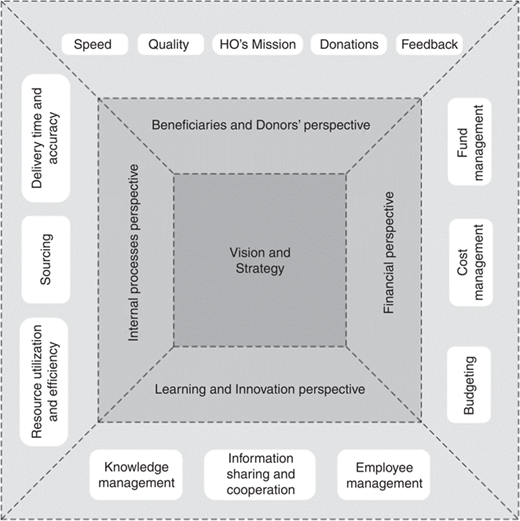
In Figure 1, we conceptualized a static BSC for the humanitarian supply chain. The performance measures identified in our literature review (Section 2) are classified into four traditional BSC perspectives to provide a cohesive view of what should be measured in the humanitarian supply chain. The developed static BSC should be valuable for practitioners as a stepping stone (first level of maturity) toward a system dynamics-based BSC. Each BSC perspective in Figure 1 encompasses categories of measures which are associated with the corresponding KPIs as discussed in Section 2.

The static BSC presented in Figure 1 can be particularly beneficial in the humanitarian supply chain since in recent years, several performance measures have been proposed for the humanitarian supply chain, making it challenging for HOs to identify and adopt the most relevant indicators to evaluate their performance. In large HOs, performance measurement deals with a large number of KPIs. Investing in the analysis and improvement of all KPIs may not be reasonable in terms of cost effectiveness and therefore selecting the most important and relevant ones becomes imperative. The static BSC framework presented in Figure 1 offers a classification of performance indicators in the humanitarian supply chain. Practitioners can use this framework and the corresponding performance indicators (Tables I-IV) to empirically investigate the selection and prioritization of the most appropriate KPIs for the performance evaluation of their supply chain.

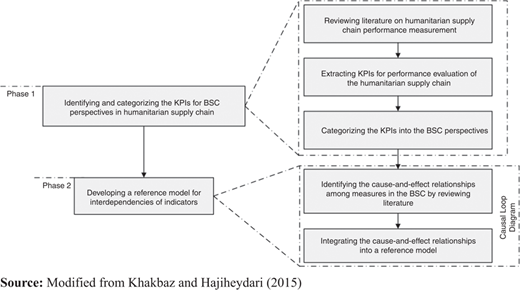
We developed our conceptual DBSC following the methodology proposed by Khakbaz and Hajiheydari (2015). Toward this end, we implemented the following two phases for developing the model, as illustrated in Figure 2:

  • In Phase 1 (Section 2), we analyzed the literature to identify the KPIs of the humanitarian supply chain related to the four perspectives of BSC. We categorized these KPIs into the four perspectives of the conceptual BSC, as shown in Figure 1.

  • In Phase 2, we developed a reference model for interdependencies of KPI for HOs. We used the conceptual BSC developed in phase 1 to develop the model. We use causal loop diagramming to capture the dynamic interdependencies of strategic resources based on the evidence found in the literature review.

In designing the conceptual DBSC, we focused on identifying the cause-and-effect relationships among the KPIs illustrated in the conceptual BSC in Figure 1. Other deficiencies of static BSC discussed in Section 3.2 are not addressed in our dynamic model and are subject of future works. We integrated these indicators into a reference model (see Figure 3). The design of our model assumes the structure of an HO with prepositioned relief items and focuses on disaster response rather than development activities. The following section elaborates on the developed model and interdependencies of indicators.

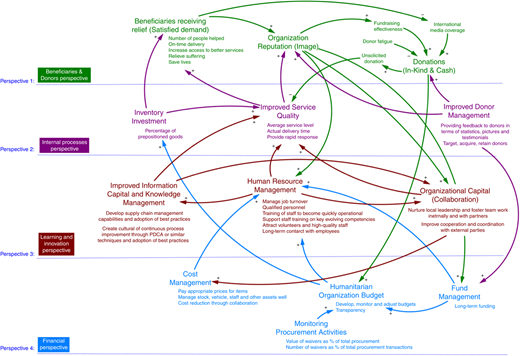
Figure 3 illustrates the conceptual model which highlights the interdependencies between KPIs. It covers the four perspectives and demonstrates the causal relationships among variables that drive the performance of HOs. The variables were derived based on the published literature as summarized in Table VI.

5.1.1 Interdependencies of indicators in the beneficiaries and donors perspective

The beneficiaries and donors perspective in Figure 3 is positioned at the top to ensure value is created for them. It is supported by the internal processes perspective and therefore important interdependencies exist between these two perspectives. For example, the improved service quality and prepositioned inventory affect the level of beneficiaries’ satisfaction. Similarly, beneficiaries that receive assistance positively affect HOs’ reputation, which is an important component of the beneficiaries and donors perspective. Reputation is generally understood as the overall evaluation of an organization by its stakeholders (Charles, 1996) and is the most important intangible asset for nonprofit organizations (Hunt and Morgan, 1995; Sarstedt and Schloderer, 2009). It also positively influences fundraising effectiveness and long-term funding (Smith and Shen, 1996; Sargeant, 1999; Brown and Slivinski, 2006). Reputation also supports partnerships with corporations (Galaskiewicz and Colman, 2006), and attracts volunteers and high-quality staff (Leete, 2006). Although there are several factors contributing to the reputation of a nonprofit organization, Sarstedt and Schloderer (2009) argued that the level of service quality is the main driver of the nonprofit organizational reputation. In other words, if HOs perform better in their operations, their reputation is positively enhanced.

Another important factor for the beneficiaries and donors perspective is the media. The media can result in positive or negative impacts on the HOs’ operation. A positive impact is observed when massive media coverage of a disaster results in greater fund allocation to HOs (Cheung and Chan, 2000; Olsen et al., 2003; Brown and Minty, 2008; Oosterhof et al., 2009; Martin, 2013; Moke and Rüther, 2015). The negative impact is when massive media coverage attracts an unintended consequence commonly known as “unsolicited donations.” This situation may heighten the pressure in the relief supply chain due to the convergence of unrequested donations that results in bottlenecks in the supply chain (Besiou et al., 2011).

In a large scale disaster, donations usually peak immediately after the disaster and recede gradually in the following weeks (Brown and Minty, 2008). This “donor fatigue” phenomenon appears when donors have exhausted their resources or become complacent toward appeals for donations (Brown and Minty, 2008; Tomasini and Van Wassenhove, 2009). This has a negative impact on the provision of sustainable funding.

5.1.2 Interdependencies of indicators in the internal processes perspective

The second perspective is related to the internal processes. The performance indicators in this perspective are related to processes that influence the level of service quality offered to beneficiaries and donors. Activities such as inventory management and donor management are some of the key factors in this perspective. To achieve process excellence, it is important for HOs to invest in donor management activities (providing feedback to donors in terms of statistics, pictures, and testimonials) to ensure a steady flow of funding for sustainable operations and an increased amount of donations (Sargeant et al., 2006). Improved donor management also improves the reputation of the organization (Thomas and Kopczak, 2005). Investing in inventory will enhance the service offered to beneficiaries.

5.1.3 Interdependencies of indicators in the learning and innovation perspective

The third perspective deals with learning and innovation in HOs. It emphasizes the importance of the employees’ skills, technology, and knowledge management as they support the internal processes (Kaplan and Norton, 2001). Employees turnover and training constitute major concerns for HOs’ growth and development (Thomas, 2003; Loquercio et al., 2006; Korff et al., 2015). The importance of logistics training has been emphasized in past studies (Thomas and Kopczak, 2005; Kovács and Tatham, 2010; Allen et al., 2013) indicating that it leads to the efficiency and effectiveness of logistics operations. This is shown with a link from investment in (training) human resources to improved service operation.

Another major component of this perspective is knowledge management. A well-developed knowledge management system provides an opportunity for HOs to share information about various aspects of organizational and operational activities (Zhang et al., 2002). According to Kovacs and Spens (2010), cooperation in humanitarian supply chains necessitates sharing of knowledge. Therefore, improving knowledge management systems can help HOs to better cooperate with external parties. This ultimately leads to an increase of organizational capital. The shared knowledge could be in the form of information about the availability of supplies, schedules of aid deliveries as well as local condition and culture (Kovacs and Spens, 2010). It is important to highlight that managing turnover in HOs helps to strengthen knowledge management since the role of employees is paramount to knowledge creation in the organization. As highlighted in Telford and Cosgrave (2007) and Kruke and Olsen (2012), high staff turnover reduces the ability of HOs to build contextual knowledge and relationships.

5.1.4 Interdependencies of indicators in the financial perspective

The fourth perspective is related to financial and cost performance of HOs. It includes performance indicators related to fund management, budgeting and cost management. In terms of fund management, the main challenge of many HOs is finding funds to finance preparedness activities such as training of staff and procedures that lead to more effective logistical operations. Donations for a disaster are earmarked for relief aid and not for training and investment preparedness strategies between disasters (Van Wassenhove, 2006). Therefore, it makes sense to hypothesize that there is a link from HO budget to investment in human resources. In addition to this link, another commonly known preparedness activity is investment in prepositioned relief items near the disaster prone areas (Kunz et al., 2014). This leads to a faster response and an increased number of people helped. This is shown by a link from HO budget to inventory investment (prepositioned relief items).

Transparency in HOs’ operations is another important element in this perspective. According to Maxwell et al. (2012), among all program support functions, procurement is by far the most commonly mentioned activity with a high risk of corruption. It is important for HOs to monitor and analyze the procurement data to monitor trends and irregularities in procurement activities which are a potential sign of corruption (Howden, 2009). HOs request bids from suppliers every time they respond to a disaster and grant the final procurement contract to the most competitive supplier (Beamon and Balcik, 2008). However, in some extreme disaster situations, HOs may request waivers of competitive bidding processes to reduce the response time (Taupiac, 2001). Such waivers of the bidding process may induce fraud in supplier selection and procurement activities. Therefore, the number of waivers of competitive bidding as a percentage of total procurement is a good measure of compliance (De Leeuw, 2016).

This paper has a number of theoretical and practical implications. In relation to theory, the paper formulates a model that provides a theoretical basis for the further development of a DBSC in HOs. The conceptual reference model integrates causal relationships among strategic resources which gives an overall picture of a possible structure of a DBSC in a humanitarian supply chain. This should give a better understanding on the interdependencies among the strategic resources. It is therefore a step toward a model that can capture delays and interactions over time between performance attributes of a humanitarian supply chain. The model offers a high-level view of operational activities and their linkages during disaster response. Capturing these links dynamically in the conceptual model offers a better view on the actual performance of humanitarian supply chain management during disaster operations. As such it serves as a valuable tool for exploring policies that may lead to operational success or failure. In disaster response operations, success or failure is due to several intertwined factors and not limited to a single factor.

Based on the conceptual reference model provided in this paper, it is possible to formulate a full DBSC for HOs using the stock and flow language of system dynamics that presents the dynamics of strategic resources, decisions rules and operational variables that govern the aid delivery process. Such DBSC integrates key operational activities together with the performance drivers of HOs in the form of reinforcing and balancing feedback loops. We propose several feedback loops in the developed reference model in Figure 3. Such feedback loops can demonstrate the effects of decisions that influence the dynamics of strategic resources. The strategic resources (such as human resources, technology, reputation, inventory) should be modeled as levels (or stocks) (Warren, 2007, 2008). This is in accordance with the dynamic resource-based view in for-profit organizations (Warren, 2002; Morecroft, 2015). The dynamics of strategic resources depend on the values of corresponding inflows and outflows which should be modeled as rates. By changing these rates, decision makers can influence the dynamics of strategic resources, performance drivers and outcome indicators (Bianchi and Rivenbark, 2014). It is important to note that adding information feedbacks and effective decision rules to the stock-and-flow structure of the DBSC is a complex and challenging process. Nevertheless, it is necessary to supplement the DBSC model with robust, realistic and effective decision rules. Toward this end, further research is needed to fully discuss the key balancing and reinforcing feedback loops of the developed reference model. Future research may include stock and flow analysis to quantitatively evaluate the complexity of a humanitarian supply chain.

In addition, the following are examples of theoretical propositions (P1-P3) derived from the proposed conceptual model (Figure 3) for further research. These propositions are supported by the literature analysis (Table VI):

P1.

HOs that have higher levels of reputation, which promote partnerships with corporations, will attract more volunteers and high-quality staff, than HOs that do not.

P2.

HOs that invest in donor management activities (providing feedback to donors in terms of statistics, pictures, and testimonials) have a higher and more constant flow of funding than HOs that do not.

P3.

HOs that spend time coordinating and collaborating with other HOs have better service quality and shorter delivery time than HOs that do not.

Approaches such as path analysis and multi-criteria decision-making may help to further clarify the interdependencies of performance indicators in the reference model. This paper also provides implications for practice. The proposed model should facilitate staff members of the organization to practically engage in decision-making toward a common goal. The reference model enables the complex interrelationships among performance drivers and outcomes to be visually analyzed. Practically, it is a step forward in the development of an evidence-based dynamic performance management tool in HOs.

This paper has proposed steps for developing a DBSC for HOs. We first categorized the KPIs related to the humanitarian supply chain into the standard BSC perspectives. The performance measures were extracted from relevant literature. We proposed a conceptual BSC that encompasses key categories of performance indicators specific to the humanitarian supply chain. It provides an integrated view of corresponding indicators according to BSC perspectives. Then, we developed a reference model that represents the key interdependencies of strategic resources. The developed model attempts to demonstrate the relationships between strategic resources and how these resources relate to the HOs’ goal in providing timely response to the beneficiaries.

DBSC is a promising tool for evidence-based performance measurement and objective evaluation of HOs’ decisions. The conceptual model developed in this paper provides the structure of a DBSC in the humanitarian supply chain and should serve as a starting reference for the development of a practical DBSC model. It is important to note that the successful development of a DBSC for the humanitarian relief setting is not a trivial matter and requires a great deal of iterative design and formulation processes which can be time-consuming and costly. Besides the long development process, lack of data can be perceived as an obstacle for the conceptual and practical advancement of performance measurement studies in the humanitarian sector. It is possible to overcome this obstacle by using available data from a database and adjusting them according to the specific requirement of a DBSC. If it is appropriately formulated, a DBSC in the humanitarian context has the potential to turn into an “interactive learning environment” to help humanitarian managers in testing the effect of alternative scenarios and thus gaining a better understanding of how the use of strategic resources may lead to high performance. This helps managers to take better strategic decisions in seeking long-term growth rather than achieving short-term goals.

This study has a number of limitations. First, the developed reference model is an approach for depicting a causal loop view of a DBSC structure for HOs in an aggregate level. Our study is not meant to conduct a comprehensive meta-analysis of all existing interdependencies among performance indicators and thereby entails a simplification of reality. Second, our approach is merely conceptual and thereby creates opportunities for future research to investigate specific applications to humanitarian cases.

This research was supported by Research Management Center at Universiti Teknologi Malaysia (GUP Grant No: Q.J130000.2624.12J68). This support is gratefully acknowledged.
Abidi
,
H.
and
Scholten
,
K.
(
2015
), “Applicability of performance measurement systems to humanitarian supply chains”, in
Klumpp
,
M.
,
de Leeuw
,
S.
,
Regattieri
,
A.
and
de Souza
,
R.
(Eds),
Humanitarian Logistics and Sustainability
,
Springer
,
Cham
, pp.
235
-
260
.
Abidi
,
H.
,
de Leeuw
,
S.
and
Klumpp
,
M.
(
2014
), “
Humanitarian supply chain performance management: a systematic literature review
”,
Supply Chain Management – An International Journal
, Vol.
19
Nos
5/6
, pp.
592
-
608
, doi: .
Acimovic
,
J.
and
Goentzel
,
J.
(
2016
), “
Models and metrics to assess humanitarian response capacity
”,
Journal of Operations Management
, Vol.
45
,
July
, pp.
11
-
29
, doi: .
Akhtar
,
P.
,
Marr
,
N.E.
and
Garnevska
,
E.V.
(
2012
), “
Coordination in humanitarian relief chains: chain coordinators
”,
Journal of Humanitarian Logistics and Supply Chain Management
, Vol.
2
No.
1
, pp.
85
-
103
, doi: .
Akkermans
,
H.A.
and
van Oorschot
,
K.E.
(
2005
), “
Relevance assumed: a case study of balanced scorecard development using system dynamics
”,
Journal of the Operational Research Society
, Vol.
56
No.
8
, pp.
931
-
941
, doi: .
Allen
,
A.M.
,
Kovács
,
G.
,
Masini
,
A.
,
Vaillancourt
,
A.
and
Wassenhove
,
L.V.
(
2013
), “
Exploring the link between the humanitarian logistician and training needs
”,
Journal of Humanitarian Logistics and Supply Chain Management
, Vol.
3
No.
2
, pp.
129
-
148
, doi: .
Apte
,
A.
,
Goncalves
,
P.
and
Yoho
,
K.
(
2016
), “
Capabilities and competencies in humanitarian operations
”,
Journal of Humanitarian Logistics and Supply Chain Management
, Vol.
6
No.
2
, pp.
240
-
258
, doi: .
Balcik
,
B.
and
Beamon
,
B.M.
(
2008
), “
Facility location in humanitarian relief
”,
International Journal of Logistics Research and Applications
, Vol.
11
No.
2
, pp.
101
-
121
, doi: .
Balcik
,
B.
,
Beamon
,
B.M.
,
Krejci
,
C.C.
,
Muramatsu
,
K.M.
and
Ramirez
,
M.
(
2010
), “
Coordination in humanitarian relief chains: practices, challenges and opportunities
”,
International Journal of Production Economics
, Vol.
126
No.
1
, pp.
22
-
34
, doi: .
Barlas
,
Y.
(
1996
), “
Formal aspects of model validity and validation in system dynamics
”,
System Dynamics Review
, Vol.
12
No.
3
, pp.
183
-
210
.
Barnabè
,
F.
(
2011
), “
A ‘system dynamics‐based balanced scorecard’ to support strategic decision making: insights from a case study
”,
International Journal of Productivity and Performance Management
, Vol.
60
No.
5
, pp.
446
-
473
, doi: .
Barnabè
,
F.
and
Busco
,
C.
(
2012
), “
The causal relationships between performance drivers and outcomes
”,
Journal of Accounting & Organizational Change
, Vol.
8
No.
4
, pp.
528
-
538
, doi: .
Beamon
,
B.M.
and
Balcik
,
B.
(
2008
), “
Performance measurement in humanitarian relief chains
”,
International Journal of Public Sector Management
, Vol.
21
No.
1
, pp.
4
-
25
,
available at:
 www.emeraldinsight.com/doi/pdfplus/10.1108/09513550810846087
Berenguer
,
G.
(
2016
), “Modeling approaches and metrics to evaluate nonprofit operations”, in
Zobel
,
C.W.
,
Altay
,
N.
and
Haselkorn
,
M.P.
(Eds),
Advances in Managing Humanitarian Operations
,
Springer International Publishing
,
Cham
, pp.
9
-
31
.
Besiou
,
M.
,
Stapleton
,
O.
and
Van Wassenhove
,
L.N.
(
2011
), “
System dynamics for humanitarian operations
”,
Journal of Humanitarian Logistics and Supply Chain Management
, Vol.
1
No.
1
, pp.
78
-
103
,
available at:
 www.emeraldinsight.com/doi/pdfplus/10.1108/20426741111122420
Bianchi
,
C.
and
Montemaggiore
,
G.B.
(
2008
), “
Enhancing strategy design and planning in public utilities through ‘dynamic’ balanced scorecards: insights from a project in a city water company
”,
System Dynamics Review
, Vol.
24
No.
2
, pp.
175
-
213
, doi: .
Bianchi
,
C.
and
Rivenbark
,
W.C.
(
2014
), “
Performance management in local government: the application of system dynamics to promote data use
”,
International Journal of Public Administration
, Vol.
37
No.
13
, pp.
945
-
954
, doi: .
Blecken
,
A.
(
2010
), “
Supply chain process modelling for humanitarian organizations
”,
International Journal of Physical Distribution & Logistics Management
, Vol.
40
Nos
8/9
, pp.
675
-
692
, doi: .
Blecken
,
A.
,
Hellingrath
,
B.
,
Dangelmaier
,
W.
and
Schulz
,
S.F.
(
2009
), “
A humanitarian supply chain process reference model
”,
International Journal of Services Technology and Management
, Vol.
12
No.
4
, pp.
391
-
413
, doi: .
Bölsche
,
D.
(
2012
), “
Performance measurement in humanitarian logistics – a process-oriented perspective
”,
paper presented at the Proceedings from the 2nd International HumLog Workshop, Essen, September 24
.
Brown
,
E.
and
Slivinski
,
A.
(
2006
), “
Nonprofit organizations and the market
”, in
Powell
,
W.W.
and
Steinberg
,
R.
(Eds),
The Nonprofit Sector: A Research Handbook
,
Yale University Press
,
New Haven, CT
, pp.
140
-
158
.
Brown
,
P.H.
and
Minty
,
J.H.
(
2008
), “
Media coverage and charitable giving after the 2004 Tsunami
”,
Southern Economic Journal
, Vol.
75
No.
1
, pp.
9
-
25
, doi: .
Burkart
,
C.
,
Besiou
,
M.
and
Wakolbinger
,
T.
(
2017
), “
The funding – humanitarian supply chain interface
”,
Surveys in Operations Research and Management Science
, Vol.
21
No.
2
, pp.
31
-
45
,
available at:
 
Caplice
,
C.
and
Sheffi
,
Y.
(
1995
), “
A review and evaluation of logistics performance measurement systems
”,
The International Journal of Logistics Management
, Vol.
6
No.
1
, pp.
61
-
74
, doi: .
Careem
,
M.
,
De Silva
,
C.
,
De Silva
,
R.
,
Raschid
,
L.
and
Weerawarana
,
S.
(
2006
), “
Sahana: overview of a disaster management system
”,
paper presented at the International Conference on Information and Automation, ICIAColombo, December 15-17
.
Charles
,
A.
and
Lauras
,
M.
(
2011
), “
An enterprise modelling approach for better optimisation modelling: application to the humanitarian relief chain coordination problem
”,
OR Spectrum
, Vol.
33
No.
3
, pp.
815
-
841
, doi: .
Charles
,
F.
(
1996
),
Reputation: Realizing Value from the Corporate Image
,
Harvard Business School Press
,
Boston, MA
.
Cheung
,
C.K.
and
Chan
,
C.M.
(
2000
), “
Social-cognitive factors of donating money to charity, with special attention to an international relief organization
”,
Evaluation and Program Planning
, Vol.
23
No.
2
, pp.
241
-
253
, doi: .
Currion
,
P.
,
Silva
,
C.d.
and
Van de Walle
,
B.
(
2007
), “
Open source software for disaster management
”,
Communications of the ACM
, Vol.
50
No.
3
, pp.
61
-
65
, doi: .
D’Haene
,
C.
,
Verlinde
,
S.
and
Macharis
,
C.
(
2015
), “
Measuring while moving (humanitarian supply chain performance measurement – status of research and current practice)
”,
Journal of Humanitarian Logistics and Supply Chain Management
, Vol.
5
No.
2
, pp.
146
-
161
, doi: .
Darcy
,
J.
and
Hofmann
,
C.
(
2003
), “
According to need?
”,
Humanitarian Policy Group Report No. 5, p. 15
.
Daugirdas
,
K.
(
2014
), “
Reputation and the responsibility of international organizations
”,
European Journal of International Law
, Vol.
25
No.
4
, pp.
991
-
1018
, doi: .
Davidson
,
A.L.
(
2006
), “
Key performance indicators in humanitarian logistics
”,
Master thesis, Massachusetts Institute of Technology, Cambridge, MA
.
De Leeuw
,
S.
(
2010
), “Towards a reference mission map for performance measurement in humanitarian supply chains”, in
Camarinha-Matos
,
L.M.
and
Boucher
,
X.
(Eds),
Proceedings of the 11th Working Conference on Virtual Enterprises
,
Berlin Springer Verlag, Berlin
, pp.
166
-
172
.
De Leeuw
,
S.
(
2016
), “
Towards sector-wide supply chain KPIs
”,
paper presented at the 27th Annual POMS Conference, Orlando, FL, May 6-9
.
Dubey
,
R.
,
Gunasekaran
,
A.
,
Altay
,
N.
,
Childe
,
S.J.
and
Papadopoulos
,
T.
(
2016
), “
Understanding employee turnover in humanitarian organizations
”,
Industrial and Commercial Training
, Vol.
48
No.
4
, pp.
208
-
214
, doi: .
Ford
,
D.N.
and
Sterman
,
J.D.
(
1998
), “
Expert knowledge elicitation to improve formal and mental models
”,
System Dynamics Review
, Vol.
14
No.
4
, pp.
309
-
340
.
Fritz Institute
(
2008
), “
Helios overview
”,
available at:
 www.fritzinstitute.org/prgTech-HELIOS_Overview.htm
Galaskiewicz
,
J.
and
Colman
,
M.S.
(
2006
), “
Collaboration between corporations and nonprofit organizations
”, in
Powell
,
W.W.
and
Steinberg
,
R.
(Eds),
The Nonprofit Sector: A Research Handbook
,
Yale University Press
,
New Haven, CT
, pp.
180
-
204
.
Galindo
,
G.
and
Batta
,
R.
(
2013
), “
Prepositioning of supplies in preparation for a hurricane under potential destruction of prepositioned supplies
”,
Socio-Economic Planning Sciences
, Vol.
47
No.
1
, pp.
20
-
37
,
available at:
 
Gerdin
,
M.
,
Chataigner
,
P.
,
Tax
,
L.
,
Kubai
,
A.
and
von Schreeb
,
J.
(
2014
), “
Does need matter? Needs assessments and decision-making among major humanitarian health agencies
”,
Disasters
, Vol.
38
No.
3
, pp.
451
-
464
, doi: .
Howden
,
M.
(
2009
), “
How humanitarian logistics information systems can improve humanitarian supply chains: a view from the field
”,
paper presented at the 6th International ISCRAM Conference, Gothenburg
.
Hunt
,
S.D.
and
Morgan
,
R.M.
(
1995
), “
The comparative advantage theory of competition
”,
Journal of Marketing
, Vol.
59
No.
2
, pp.
1
-
15
, doi: .
Jahre
,
M.
and
Heigh
,
I.
(
2008
), “
Does the current constraints in funding promote failure in humanitarian supply chains?
”,
Supply Chain Forum: An International Journal
, Vol.
9
No.
2
, pp.
44
-
54
.
Jahre
,
M.
,
Jensen
,
L.M.
and
Listou
,
T.
(
2009
), “
Theory development in humanitarian logistics: a framework and three cases
”,
Management Research News
, Vol.
32
No.
11
, pp.
1008
-
1023
, doi: .
Jassbi
,
J.
,
Mohamadnejad
,
F.
and
Nasrollahzadeh
,
H.
(
2011
), “
A fuzzy DEMATEL framework for modeling cause and effect relationships of strategy map
”,
Expert Systems with Applications
, Vol.
38
No.
5
, pp.
5967
-
5973
,
available at:
 
Kabra
,
G.
,
Ramesh
,
A.
and
Arshinder
,
K.
(
2015
), “
Identification and prioritization of coordination barriers in humanitarian supply chain management
”,
International Journal of Disaster Risk Reduction
, Vol.
13
,
September
, pp.
128
-
138
,
available at:
 
Kaplan
,
R.S.
(
1990
),
Measures for Manufacturing Excellence
,
Harvard Business Press
,
Boston, MA
.
Kaplan
,
R.S.
(
2001
), “
Strategic performance measurement and management in Nonprofit organizations
”,
Nonprofit Management and Leadership
, Vol.
11
No.
3
, pp.
353
-
370
, doi: .
Kaplan
,
R.S.
and
Norton
,
D.P.
(
1992
), “
Balanced scorecard: measures that drive performance
”,
Harvard Business Review
, Vol.
70
No.
1
, pp.
71
-
79
.
Kaplan
,
R.S.
and
Norton
,
D.P.
(
2000
), “Having trouble with your strategy? Then map it”,
Harvard Business Review
, Vol.
78
No.
5
, pp.
167
-
176
.
Kaplan
,
R.S.
and
Norton
,
D.P.
(
2001
), “
Transforming the balanced scorecard from performance measurement to strategic management: part I
”,
Accounting Horizons
, Vol.
15
No.
1
, pp.
87
-
104
.
Khakbaz
,
S.B.
and
Hajiheydari
,
N.
(
2015
), “
Proposing a basic methodology for developing balanced scorecard by system dynamics approach
”,
Kybernetes
, Vol.
44
Nos
6/7
, pp.
1049
-
1066
, doi: .
Korff
,
V.P.
,
Balbo
,
N.
,
Mills
,
M.
,
Heyse
,
L.
and
Wittek
,
R.
(
2015
), “
The impact of humanitarian context conditions and individual characteristics on aid worker retention
”,
Disasters
, Vol.
39
No.
3
, pp.
522
-
545
, doi: .
Kovacs
,
G.
and
Spens
,
K.M.
(
2010
), “
Knowledge sharing in relief supply chains
”,
International Journal of Networking and Virtual Organisations
, Vol.
7
Nos
2/3
, pp.
222
-
239
, doi: .
Kovács
,
G.
and
Spens
,
K.M.
(
2011
), “
Trends and developments in humanitarian logistics – a gap analysis
”,
International Journal of Physical Distribution & Logistics Management
, Vol.
41
No.
1
, pp.
32
-
45
, doi: .
Kovács
,
G.
and
Tatham
,
P.
(
2010
), “
What is special about a humanitarian logistician? A survey of logistic skills and performance
”,
Supply Chain Forum: An International Journal
, Vol.
11
No.
3
, pp.
32
-
41
, doi: .
Kovács
,
G.
,
Tatham
,
P.
and
Larson
,
P.D.
(
2012
), “
What skills are needed to be a humanitarian logistician?
”,
Journal of Business Logistics
, Vol.
33
No.
3
, pp.
245
-
258
, doi: .
Kruke
,
B.I.
and
Olsen
,
O.E.
(
2012
), “
Knowledge creation and reliable decision-making in complex emergencies
”,
Disasters
, Vol.
36
No.
2
, pp.
212
-
232
, doi: .
Kunz
,
N.
,
Reiner
,
G.
and
Gold
,
S.
(
2014
), “
Investing in disaster management capabilities versus pre-positioning inventory: a new approach to disaster preparedness
”,
International Journal of Production Economics
, Vol.
157
,
November
, pp.
261
-
272
, doi: .
Kunz
,
N.
,
Wassenhove
,
L.N.V.
,
McConnell
,
R.
and
Hov
,
K.
(
2015
), “
Centralized vehicle leasing in humanitarian fleet management: the UNHCR case
”,
Journal of Humanitarian Logistics and Supply Chain Management
, Vol.
5
No.
3
, pp.
387
-
404
, doi: .
Leete
,
L.
(
2006
), “
Work in the nonprofit sector
”, in
Powell
,
W.W.
and
Steinberg
,
R.
(Eds),
The Nonprofit Sector: A Research Handbook
,
Yale University Press
,
New Haven, CT
, pp.
159
-
179
.
Linard
,
K.
and
Dvorsky
,
L.
(
2001
), “
People – not human resources: the system dynamics of human capital accounting
”,
paper presented at the Operations Research Society Conference, University of Bath, September
.
Loquercio
,
D.
,
Hammersley
,
M.
and
Emmens
,
B.
(
2006
), “
Understanding and addressing staff turnover in humanitarian agencies: overseas development institute (ODI)
”,
Humanitarian practice network (HPN)
.
Lu
,
Q.
,
Goh
,
M.
and
Souza
,
R.d.
(
2016
), “
A SCOR framework to measure logistics performance of humanitarian organizations
”,
Journal of Humanitarian Logistics and Supply Chain Management
, Vol.
6
No.
2
, pp.
222
-
239
, doi: .
Marr
,
B.
and
Schiuma
,
G.
(
2003
), “
Business performance measurement – past, present and future
”,
Management Decision
, Vol.
41
No.
8
, pp.
680
-
687
, doi: .
Martin
,
J.A.
(
2013
), “
Disasters and donations: the conditional effects of news attention on charitable giving
”,
International Journal of Public Opinion Research
, Vol.
25
No.
4
, pp.
547
-
560
, doi: .
Maxwell
,
D.
,
Bailey
,
S.
,
Harvey
,
P.
,
Walker
,
P.
,
Sharbatke-Church
,
C.
and
Savage
,
K.
(
2012
), “
Preventing corruption in humanitarian assistance: perceptions, gaps and challenges
”,
Disasters
, Vol.
36
No.
1
, pp.
140
-
160
, doi: .
Medina-Borja
,
A.
and
Triantis
,
K.
(
2006
), “
A conceptual framework to evaluate performance of non-profit social service organisations
”,
International Journal of Technology Management
, Vol.
37
Nos
1/2
, pp.
147
-
161
.
Meijer
,
M.-M.
(
2009
), “
The effects of charity reputation on charitable giving
”,
Corporate Reputation Review
, Vol.
12
No.
1
, pp.
33
-
42
, doi: .
Moe
,
T.L.
,
Gehbauer
,
F.
,
Senitz
,
S.
and
Mueller
,
M.
(
2007
), “
Balanced scorecard for natural disaster management projects
”,
Disaster Prevention and Management
, Vol.
16
No.
5
, pp.
785
-
806
, doi: .
Moke
,
M.
and
Rüther
,
M.
(
2015
), “Media and humanitarian action”, in
Gibbons
,
P.
and
Heintze
,
H.
(Eds),
The Humanitarian Challenge
,
Springer
,
Cham
, pp.
253
-
263
.
Morecroft
,
J.D.
(
2015
),
Strategic Modelling and Business Dynamics: A Feedback Systems Approach
,
Wiley
,
Chichester
.
Nørreklit
,
H.
(
2000
), “
The balance on the balanced scorecard a critical analysis of some of its assumptions
”,
Management Accounting Research
, Vol.
11
No.
1
, pp.
65
-
88
,
available at:
 
Nørreklit
,
H.
(
2003
), “
The balanced scorecard: what is the score? A rhetorical analysis of the balanced scorecard
”,
Accounting, Organizations and Society
, Vol.
28
No.
6
, pp.
591
-
619
,
available at:
 
Oloruntoba
,
R.
and
Gray
,
R.
(
2006
), “
Humanitarian aid: an agile supply chain?
”,
Supply Chain Management: An International Journal
, Vol.
11
No.
2
, pp.
115
-
120
, doi: .
Oloruntoba
,
R.
and
Gray
,
R.
(
2009
), “
Customer service in emergency relief chains
”,
International Journal of Physical Distribution & Logistics Management
, Vol.
39
No.
6
, pp.
486
-
505
, doi: .
Olsen
,
G.R.
,
Carstensen
,
N.
and
Høyen
,
K.
(
2003
), “
Humanitarian crises: what determines the level of emergency assistance? Media coverage, donor interests and the aid business
”,
Disasters
, Vol.
27
No.
2
, pp.
109
-
126
.
Oosterhof
,
L.
,
Heuvelman
,
A.
and
Peters
,
O.
(
2009
), “
Donation to disaster relief campaigns: underlying social cognitive factors exposed
”,
Evaluation and Program Planning
, Vol.
32
No.
2
, pp.
148
-
157
, doi: .
Othman
,
R.
(
2006
), “
Balanced scorecard and causal model development: preliminary findings
”,
Management Decision
, Vol.
44
No.
5
, pp.
690
-
702
.
Pedraza-Martinez
,
A.J.
and
Van Wassenhove
,
L.N.
(
2013
), “
Vehicle replacement in the international committee of the red cross
”,
Production and Operations Management
, Vol.
22
No.
2
, pp.
365
-
376
, doi: .
Perkins
,
M.
,
Grey
,
A.
and
Remmers
,
H.
(
2014
), “
What do we really mean by ‘balanced scorecard’?
”,
International Journal of Productivity and Performance Management
, Vol.
63
No.
2
, pp.
148
-
169
.
Pettit
,
S.
and
Beresford
,
A.
(
2009
), “
Critical success factors in the context of humanitarian aid supply chains
”,
International Journal of Physical Distribution & Logistics Management
, Vol.
39
No.
6
, pp.
450
-
468
, doi: .
Qiang
,
P.
and
Nagurney
,
A.
(
2012
), “
A bi-criteria indicator to assess supply chain network performance for critical needs under capacity and demand disruptions
”,
Transportation Research Part A: Policy and Practice
, Vol.
46
No.
5
, pp.
801
-
812
.
Reyes
,
P.M.
and
Meade
,
L.M.
(
2006
), “
Improving reverse supply chain operational performance: a transshipment application study for not‐for‐profit organizations
”,
Journal of Supply Chain Management
, Vol.
42
No.
1
, pp.
38
-
48
.
Santarelli
,
G.
,
Abidi
,
H.
,
Klumpp
,
M.
and
Regattieri
,
A.
(
2015
), “
Humanitarian supply chains and performance measurement schemes in practice
”,
International Journal of Productivity and Performance Management
, Vol.
64
No.
6
, pp.
784
-
810
.
Sargeant
,
A.
(
1999
), “
Charitable giving: towards a model of donor behaviour
”,
Journal of Marketing Management
, Vol.
15
No.
4
, pp.
215
-
238
, doi: .
Sargeant
,
A.
,
Ford
,
J.B.
and
West
,
D.C.
(
2006
), “
Perceptual determinants of nonprofit giving behavior
”,
Journal of Business Research
, Vol.
59
No.
2
, pp.
155
-
165
, doi: .
Sarstedt
,
M.
and
Schloderer
,
M.P.
(
2009
), “
Developing a measurement approach for reputation of non-profit organizations
”,
International Journal of Nonprofit and Voluntary Sector Marketing
, Vol.
15
No.
3
, doi: .
Schiffling
,
S.
and
Piecyk
,
M.
(
2014
), “
Performance measurement in humanitarian logistics: a customer-oriented approach
”,
Journal of Humanitarian Logistics and Supply Chain Management
, Vol.
4
No.
2
, pp.
198
-
221
, doi: .
Schulz
,
S.F.
and
Heigh
,
I.
(
2009
), “
Logistics performance management in action within a humanitarian organization
”,
Management Research News
, Vol.
32
No.
11
, pp.
1038
-
1049
, doi: .
Senge
,
P.M.
(
1990
),
The Art and Practice of the Learning Organization
,
Doubleday
,
New York, NY
.
Sloper
,
P.
,
Linard
,
K.T.
and
Paterson
,
D.
(
1999
), “
Towards a dynamic feedback framework for public sector performance management
”,
paper presented at the International Conference of the System Dynamics & ANZSYS, July 20-23
.
Smith
,
D.H.
and
Shen
,
C.
(
1996
), “
Factors characterizing the most effective nonprofits managed by volunteers
”,
Nonprofit Management and Leadership
, Vol.
6
No.
3
, pp.
271
-
289
, doi: .
Sterman
,
J.D.
(
2000
),
Business Dynamics: Systems Thinking and Modeling for a Complex World
, Vol.
19
,
Irwin/McGraw-Hill
,
Boston, MA
.
Tatham
,
P.
and
Hughes
,
K.
(
2011
), “Humanitarian logistics metrics: where we are and how we might improve”, in
Christopher
,
K.
and
Tatham
,
P.
(Eds),
Humanitarian Logistics: Meeting the Challenge of Preparing for and Responding to Disasters
,
Kogan Page
,
London
, pp.
65
-
84
.
Tatham
,
P.
and
Spens
,
K.
(
2011
), “
Towards a humanitarian logistics knowledge management system
”,
Disaster Prevention and Management: An International Journal
, Vol.
20
No.
1
, pp.
6
-
26
, doi: .
Taupiac
,
C.
(
2001
), “
Humanitarian and development procurement: a vast and growing market
”,
paper presented at the International Trade Forum
, No.
4
, pp.
7
-
10
.
Telford
,
J.
and
Cosgrave
,
J.
(
2007
), “
The international humanitarian system and the 2004 Indian ocean earthquake and tsunamis
”,
Disasters
, Vol.
31
No.
1
, pp.
1
-
28
, doi: .
Thomas
,
A.
(
2003
),
Humanitarian Logistics: Enabling Disaster Response
,
Fritz Institute
,
San Francisco, CA
,
available at:
 www.fritzinstitute.org/pdfs/whitepaper/enablingdisasterresponse.pdf
Thomas
,
A.S.
and
Kopczak
,
L.R.
(
2005
), “
From logistics to supply chain management: the path forward in the humanitarian sector
”,
Fritz Institute
,
San Francisco, CA
, pp.
1
-
15
,
available at:
 www.fritzinstitute.org/pdfs/whitepaper/fromlogisticsto.pdf 
(accessed
 March 15, 2016).
Tomasini
,
R.
and
Van Wassenhove
,
L.
(
2009
),
Humanitarian Logistics
,
Palgrave Macmillan
,
Basingstoke
.
Tomasini
,
R.
,
Stapleton
,
O.
and
Van Wassenhove
,
L.N.
(
2010
), “
The challenges of matching private sector donations to the humanitarian needs and the role of brokers
”,
Working Papers Collection, Vol. 41, INSEAD, Fontainebleau, pp. 1-25
.
United Nations
(
2011
), “
Surge in demand for humanitarian assistance in high-risk environments informs general assembly debate on strengthening UN disaster relief assistance (Publication No. GA/11038)
”,
available at:
 www.un.org/News/Press/docs/2010/ga11038.doc.htm 
(accessed
 June 25, 2016).
Van der Laan
,
E.
,
De Brito
,
M.
and
Vergunst
,
D.
(
2009
), “
Performance measurement in humanitarian supply chains
”,
International Journal of Risk Assessment and Management
, Vol.
13
No.
1
, pp.
22
-
45
.
Van der Laan
,
E.A.
,
De Brito
,
M.P.
,
Van Fenema
,
P.C.
and
Vermaesen
,
S.
(
2009
), “
Managing information cycles for intra-organisational coordination of humanitarian logistics
”,
International Journal of Services Technology and Management
, Vol.
12
No.
4
, pp.
362
-
390
.
Van Wassenhove
,
L.N.
(
2006
), “
Humanitarian aid logistics: supply chain management in high gear†
”,
Journal of the Operational Research Society
, Vol.
57
No.
5
, pp.
475
-
489
.
Vennix
,
J.A.
(
1999
), “
Group model-building: tackling messy problems
”,
System Dynamics Review
, Vol.
15
No.
4
, p.
379
.
Warren
,
K.
(
2002
),
Competitive Strategy Dynamics
,
Wiley
,
Chichester
.
Warren
,
K.
(
2007
), “Strategy dynamics for nonprofit organizations”, in
Chowdhury
,
S.
(Ed.),
Next Generation Business Handbook
,
Wiley-Interscience
,
Hoboken, NJ
, pp.
431
-
449
.
Warren
,
K.
(
2008
),
Strategic Management Dynamics
,
Wiley
,
Chichester
.
Widera
,
A.
and
Hellingrath
,
B.
(
2011
), “
Performance measurement systems for humanitarian logistics
”,
paper presented at the Proceedings of the 23rd Annual NOFOMA Conference, Harstad
.
Widera
,
A.
and
Hellingrath
,
B.
(
2016
), “Making performance measurement work in humanitarian logistics: the case of an IT-supported balanced scorecard”, in
Kovács
,
G.
,
Spens
,
K.
and
Haavisto
,
I.
(Eds),
Supply Chain Management for Humanitarians: Tools for Practice
,
Kogan Page Publishers
, pp.
339
-
352
.
Willems
,
J.
,
Jegers
,
M.
and
Faulk
,
L.
(
2016
), “
Organizational effectiveness reputation in the nonprofit sector
”,
Public Performance & Management Review
, Vol.
39
No.
2
, pp.
454
-
475
, doi: .
Wynter
,
A.
(
2005
), “
Humanitarian media coverage in the digital age in the digital age
”,
Red Cross Red Crescent World Disasters Report, Kumarian Press Inc., Broomfield, CT, pp. 126-149
.
Yang
,
M.-C.
and
Tung
,
Y.-C.
(
2006
), “
Using path analysis to examine causal relationships among balanced scorecard performance indicators for general hospitals: the case of a public hospital system in Taiwan
”,
Health Care Management Review
, Vol.
31
No.
4
, pp.
280
-
288
.
Zhang
,
D.
,
Zhou
,
L.
and
Nunamaker
,
J.F.
 Jr
(
2002
), “
A knowledge management framework for the support of decision making in humanitarian assistance/disaster relief
”,
Knowledge and Information Systems
, Vol.
4
No.
3
, pp.
370
-
385
, doi: .
Licensed re-use rights only

Data & Figures

Figure 1

Conceptual BSC for the humanitarian supply chain

Figure 1

Conceptual BSC for the humanitarian supply chain

Close Figure 1
Figure 2

Phases of the development of the conceptual DBSC

Figure 2

Phases of the development of the conceptual DBSC

Close Figure 2
Figure 3

A reference model for interdependencies of key performance indicators

Figure 3

A reference model for interdependencies of key performance indicators

Close Figure 3
Table I

Performance measures for the beneficiaries and donors perspective

Beneficiaries and donors perspectivesIndicators
Beneficiaries’ concernSpeedSpeed of delivery (Van Wassenhove, 2006; Tomasini and Van Wassenhove, 2009)
Delivery date reliability (Santarelli et al., 2015)
 QualityQuality and availability of goods and services which are relevant to the needs (Schiffling and Piecyk, 2014)
Donors’ concernHO’s missionNumber of beneficiaries helped (Santarelli et al., 2015)
 DonationsHO reputation (Hunt and Morgan, 1995; Sarstedt and Schloderer, 2009; De Leeuw, 2010)
 FeedbackOn-time reporting to donors (Schulz and Heigh, 2009)
Donors’ auditing (Santarelli et al., 2015)
Table II

Performance measures for the internal processes perspective

Internal processes perspectiveIndicators
Delivery time and accuracyResponse timeAverage and minimum response time (Beamon and Balcik, 2008)
Goods-to-delivery time (Santarelli et al., 2015)
Average number of days that material is unable to be supplied (De Leeuw, 2016)
 Demand assessmentNeeds assessment accuracy (Davidson, 2006; Blecken et al., 2009)
Satisfied and non-satisfied demand (Qiang and Nagurney, 2012; Kunz et al., 2014)
SourcingDonor managementRaising the interests of key stakeholders (Moe et al., 2007)
On-time reporting to donors on usage and impact of their funds (Schulz and Heigh, 2009)
Resource utilization and efficiencyInventory resourcesDegree of warehouse and fleet utilization (Blecken et al., 2009)
Percentage of prepositioned goods (Santarelli et al., 2015)
Available stock capacity to supply (Beamon and Balcik, 2008; Schulz and Heigh, 2009)
Relief stock turnover rate (Schulz and Heigh, 2009; Van der Laan, De Brito and Vergunst, 2009)
Order fulfillment rate and cycle time (Blecken et al., 2009)
Target fill rate achievement (Beamon and Balcik, 2008; Van der Laan, De Brito and Vergunst, 2009; Kunz et al., 2014)
Mix of different types of supplies that the relief chain can provide in a specified time period (Beamon and Balcik, 2008)
 Human resourcesNumber of trained relief workers (national and international staff) (Santarelli et al., 2015)
Percentage of people engaged in dispensing aid (Santarelli et al., 2015)
 IT resourcesProcurement transactions using humanitarian logistics software (Schulz and Heigh, 2009)
Percentage of vehicles managed with fleet management software (Schulz and Heigh, 2009)
Table III

Performance measures for the financial perspective

Financial perspectiveIndicators
Cost managementTotal cost of distribution (Beamon and Balcik, 2008; Santarelli et al., 2015)
Transportation and warehousing costs (Santarelli et al., 2015)
Overhead cost (Beamon and Balcik, 2008)
BudgetingDeviation from project budget (Van Wassenhove, 2006; Schulz and Heigh, 2009)
Percentage of unused stocks at end of project (Santarelli et al., 2015; De Leeuw, 2016)
Fund managementAmount of sufficient and timely fund received from institutional and private donors (Van Wassenhove, 2006; Beamon and Balcik, 2008; Oloruntoba and Gray, 2009; Schiffling and Piecyk, 2014; Santarelli et al., 2015)
Level of fundraising (income generation) and development resources (Medina-Borja and Triantis, 2006)
Table IV

Performance measures for the learning and innovation perspective

Learning and innovation perspectiveIndicators
Knowledge managementAverage hours spent on learning logistics (Oloruntoba and Gray, 2009; Pettit and Beresford, 2009)
Average hours spent on training staff (De Leeuw, 2016)
Percentage of staff with certification (or comparable) qualification (De Leeuw, 2016)
Employee managementStaff turnover rate (Thomas and Kopczak, 2005; Blecken et al., 2009)
Level of consistency despite personnel changes (Schiffling and Piecyk, 2014)
Information sharing and cooperationDegree of information sharing and cooperation (Van der Laan, De Brito, Van Fenema and Vermaesen, 2009; De Leeuw, 2010; Schiffling and Piecyk, 2014; Santarelli et al., 2015)
Degree of supply chain ICT utilization (De Leeuw, 2010)
Table V

Evaluation criteria

CriterionDescription
ComprehensivenessThe measurement system captures all relevant constituencies and stakeholders for the process
Causally orientedThe measurement system tracks those activities and indicators that influence future as well as current performance
Vertically integratedThe measurement system translates the overall firm strategy to all decision makers within the organization and is connected to the proper reward system
Horizontally integratedThe measurement system includes all pertinent activities, functions, and departments along the process
Internally comparableThe measurement system recognizes and allows trade-offs between the different dimensions of performance
UsefulThe measurement system is readily understandable by the decision makers and provides a guide for actions to be taken
Table VI

Examples of causal relationships in the reference model

PerspectivesCausal relationshipDirection +/−References
Beneficiaries and donorsOrganization reputation→attract volunteers and high-quality staff+Leete (2006) and Sarstedt and Schloderer (2009) 
 Organization reputation→cooperation with other HOs+Daugirdas (2014) 
 Organization reputation→long-term funding+Smith and Shen (1996), Sargeant (1999) and Brown and Slivinski (2006) 
 Organization reputation→fundraising effectiveness+Cheung and Chan (2000) and Meijer (2009) 
 Donor fatigue→donations−Wynter (2005), Brown and Minty (2008) and Tomasini and Van Wassenhove (2009) 
 International media coverage→donations+Cheung and Chan (2000), Brown and Minty (2008) and Martin (2013) 
 Unsolicited donation→causes bottlenecks in the supply chain (reduces service quality)−Van Wassenhove (2006), Besiou et al. (2011) and Burkart et al. (2017) 
 Beneficiaries receiving relief (satisfied demand)→international media coverage−Besiou et al. (2011) 
Internal processesInventory investment→beneficiaries satisfaction (number of people helped, on-time delivery, increase access to better services)+Balcik and Beamon (2008) and Kunz et al. (2014) 
 Inventory investment (percentage of prepositioned goods)→improved service quality (actual delivery Time)+Balcik and Beamon (2008) and Galindo and Batta (2013)
 Improved service quality→beneficiaries satisfaction+Kovács and Tatham (2010) 
 Improved service quality→organization reputation+Sarstedt and Schloderer (2009) 
 Improved donor management→long-term funding+Sargeant et al. (2006) and Willems et al. (2016) 
 Improved donor management→donation+Sargeant et al. (2006) and Willems et al. (2016) 
 Improved donor management→organization reputation+Thomas and Kopczak (2005) and Willems et al. (2016) 
Learning and innovationOrganizational capital (collaboration)→reduces cost in relief chain+Balcik et al. (2010) and Akhtar et al. (2012) 
 Human resource management (qualified personnel having logistics knowledge)→organizational capital (Collaboration)+Thomas and Kopczak (2005), Balcik et al. (2010) and Kabra et al. (2015) 
 Improving coordination and collaboration→improved service quality (shorter delivery time)+Balcik et al. (2010) 
 Information capital and knowledge management→organizational capital (collaboration)+Howden (2009) and Kabra et al. (2015) 
 Investment in human resources→improved service quality+Kovács and Tatham (2010) and Kovács et al. (2012) 
 Managing job turnover→improves knowledge creation (contextual knowledge)+Telford and Cosgrave (2007), Thomas and Kopczak (2005), Kruke and Olsen (2012) and Apte et al. (2016) 
FinancialLong-term funding→long-term contract with employees (less turnover)+Korff et al. (2015) 
 Value of waivers as % of total procurement→transparency in HOs budget+Howden (2009) 
 Number of waivers as % of total procurement transactions→transparency in HOs budget+Howden (2009) 

Supplements

References

Abidi
,
H.
and
Scholten
,
K.
(
2015
), “Applicability of performance measurement systems to humanitarian supply chains”, in
Klumpp
,
M.
,
de Leeuw
,
S.
,
Regattieri
,
A.
and
de Souza
,
R.
(Eds),
Humanitarian Logistics and Sustainability
,
Springer
,
Cham
, pp.
235
-
260
.
Abidi
,
H.
,
de Leeuw
,
S.
and
Klumpp
,
M.
(
2014
), “
Humanitarian supply chain performance management: a systematic literature review
”,
Supply Chain Management – An International Journal
, Vol.
19
Nos
5/6
, pp.
592
-
608
, doi: .
Acimovic
,
J.
and
Goentzel
,
J.
(
2016
), “
Models and metrics to assess humanitarian response capacity
”,
Journal of Operations Management
, Vol.
45
,
July
, pp.
11
-
29
, doi: .
Akhtar
,
P.
,
Marr
,
N.E.
and
Garnevska
,
E.V.
(
2012
), “
Coordination in humanitarian relief chains: chain coordinators
”,
Journal of Humanitarian Logistics and Supply Chain Management
, Vol.
2
No.
1
, pp.
85
-
103
, doi: .
Akkermans
,
H.A.
and
van Oorschot
,
K.E.
(
2005
), “
Relevance assumed: a case study of balanced scorecard development using system dynamics
”,
Journal of the Operational Research Society
, Vol.
56
No.
8
, pp.
931
-
941
, doi: .
Allen
,
A.M.
,
Kovács
,
G.
,
Masini
,
A.
,
Vaillancourt
,
A.
and
Wassenhove
,
L.V.
(
2013
), “
Exploring the link between the humanitarian logistician and training needs
”,
Journal of Humanitarian Logistics and Supply Chain Management
, Vol.
3
No.
2
, pp.
129
-
148
, doi: .
Apte
,
A.
,
Goncalves
,
P.
and
Yoho
,
K.
(
2016
), “
Capabilities and competencies in humanitarian operations
”,
Journal of Humanitarian Logistics and Supply Chain Management
, Vol.
6
No.
2
, pp.
240
-
258
, doi: .
Balcik
,
B.
and
Beamon
,
B.M.
(
2008
), “
Facility location in humanitarian relief
”,
International Journal of Logistics Research and Applications
, Vol.
11
No.
2
, pp.
101
-
121
, doi: .
Balcik
,
B.
,
Beamon
,
B.M.
,
Krejci
,
C.C.
,
Muramatsu
,
K.M.
and
Ramirez
,
M.
(
2010
), “
Coordination in humanitarian relief chains: practices, challenges and opportunities
”,
International Journal of Production Economics
, Vol.
126
No.
1
, pp.
22
-
34
, doi: .
Barlas
,
Y.
(
1996
), “
Formal aspects of model validity and validation in system dynamics
”,
System Dynamics Review
, Vol.
12
No.
3
, pp.
183
-
210
.
Barnabè
,
F.
(
2011
), “
A ‘system dynamics‐based balanced scorecard’ to support strategic decision making: insights from a case study
”,
International Journal of Productivity and Performance Management
, Vol.
60
No.
5
, pp.
446
-
473
, doi: .
Barnabè
,
F.
and
Busco
,
C.
(
2012
), “
The causal relationships between performance drivers and outcomes
”,
Journal of Accounting & Organizational Change
, Vol.
8
No.
4
, pp.
528
-
538
, doi: .
Beamon
,
B.M.
and
Balcik
,
B.
(
2008
), “
Performance measurement in humanitarian relief chains
”,
International Journal of Public Sector Management
, Vol.
21
No.
1
, pp.
4
-
25
,
available at:
 www.emeraldinsight.com/doi/pdfplus/10.1108/09513550810846087
Berenguer
,
G.
(
2016
), “Modeling approaches and metrics to evaluate nonprofit operations”, in
Zobel
,
C.W.
,
Altay
,
N.
and
Haselkorn
,
M.P.
(Eds),
Advances in Managing Humanitarian Operations
,
Springer International Publishing
,
Cham
, pp.
9
-
31
.
Besiou
,
M.
,
Stapleton
,
O.
and
Van Wassenhove
,
L.N.
(
2011
), “
System dynamics for humanitarian operations
”,
Journal of Humanitarian Logistics and Supply Chain Management
, Vol.
1
No.
1
, pp.
78
-
103
,
available at:
 www.emeraldinsight.com/doi/pdfplus/10.1108/20426741111122420
Bianchi
,
C.
and
Montemaggiore
,
G.B.
(
2008
), “
Enhancing strategy design and planning in public utilities through ‘dynamic’ balanced scorecards: insights from a project in a city water company
”,
System Dynamics Review
, Vol.
24
No.
2
, pp.
175
-
213
, doi: .
Bianchi
,
C.
and
Rivenbark
,
W.C.
(
2014
), “
Performance management in local government: the application of system dynamics to promote data use
”,
International Journal of Public Administration
, Vol.
37
No.
13
, pp.
945
-
954
, doi: .
Blecken
,
A.
(
2010
), “
Supply chain process modelling for humanitarian organizations
”,
International Journal of Physical Distribution & Logistics Management
, Vol.
40
Nos
8/9
, pp.
675
-
692
, doi: .
Blecken
,
A.
,
Hellingrath
,
B.
,
Dangelmaier
,
W.
and
Schulz
,
S.F.
(
2009
), “
A humanitarian supply chain process reference model
”,
International Journal of Services Technology and Management
, Vol.
12
No.
4
, pp.
391
-
413
, doi: .
Bölsche
,
D.
(
2012
), “
Performance measurement in humanitarian logistics – a process-oriented perspective
”,
paper presented at the Proceedings from the 2nd International HumLog Workshop, Essen, September 24
.
Brown
,
E.
and
Slivinski
,
A.
(
2006
), “
Nonprofit organizations and the market
”, in
Powell
,
W.W.
and
Steinberg
,
R.
(Eds),
The Nonprofit Sector: A Research Handbook
,
Yale University Press
,
New Haven, CT
, pp.
140
-
158
.
Brown
,
P.H.
and
Minty
,
J.H.
(
2008
), “
Media coverage and charitable giving after the 2004 Tsunami
”,
Southern Economic Journal
, Vol.
75
No.
1
, pp.
9
-
25
, doi: .
Burkart
,
C.
,
Besiou
,
M.
and
Wakolbinger
,
T.
(
2017
), “
The funding – humanitarian supply chain interface
”,
Surveys in Operations Research and Management Science
, Vol.
21
No.
2
, pp.
31
-
45
,
available at:
 
Caplice
,
C.
and
Sheffi
,
Y.
(
1995
), “
A review and evaluation of logistics performance measurement systems
”,
The International Journal of Logistics Management
, Vol.
6
No.
1
, pp.
61
-
74
, doi: .
Careem
,
M.
,
De Silva
,
C.
,
De Silva
,
R.
,
Raschid
,
L.
and
Weerawarana
,
S.
(
2006
), “
Sahana: overview of a disaster management system
”,
paper presented at the International Conference on Information and Automation, ICIAColombo, December 15-17
.
Charles
,
A.
and
Lauras
,
M.
(
2011
), “
An enterprise modelling approach for better optimisation modelling: application to the humanitarian relief chain coordination problem
”,
OR Spectrum
, Vol.
33
No.
3
, pp.
815
-
841
, doi: .
Charles
,
F.
(
1996
),
Reputation: Realizing Value from the Corporate Image
,
Harvard Business School Press
,
Boston, MA
.
Cheung
,
C.K.
and
Chan
,
C.M.
(
2000
), “
Social-cognitive factors of donating money to charity, with special attention to an international relief organization
”,
Evaluation and Program Planning
, Vol.
23
No.
2
, pp.
241
-
253
, doi: .
Currion
,
P.
,
Silva
,
C.d.
and
Van de Walle
,
B.
(
2007
), “
Open source software for disaster management
”,
Communications of the ACM
, Vol.
50
No.
3
, pp.
61
-
65
, doi: .
D’Haene
,
C.
,
Verlinde
,
S.
and
Macharis
,
C.
(
2015
), “
Measuring while moving (humanitarian supply chain performance measurement – status of research and current practice)
”,
Journal of Humanitarian Logistics and Supply Chain Management
, Vol.
5
No.
2
, pp.
146
-
161
, doi: .
Darcy
,
J.
and
Hofmann
,
C.
(
2003
), “
According to need?
”,
Humanitarian Policy Group Report No. 5, p. 15
.
Daugirdas
,
K.
(
2014
), “
Reputation and the responsibility of international organizations
”,
European Journal of International Law
, Vol.
25
No.
4
, pp.
991
-
1018
, doi: .
Davidson
,
A.L.
(
2006
), “
Key performance indicators in humanitarian logistics
”,
Master thesis, Massachusetts Institute of Technology, Cambridge, MA
.
De Leeuw
,
S.
(
2010
), “Towards a reference mission map for performance measurement in humanitarian supply chains”, in
Camarinha-Matos
,
L.M.
and
Boucher
,
X.
(Eds),
Proceedings of the 11th Working Conference on Virtual Enterprises
,
Berlin Springer Verlag, Berlin
, pp.
166
-
172
.
De Leeuw
,
S.
(
2016
), “
Towards sector-wide supply chain KPIs
”,
paper presented at the 27th Annual POMS Conference, Orlando, FL, May 6-9
.
Dubey
,
R.
,
Gunasekaran
,
A.
,
Altay
,
N.
,
Childe
,
S.J.
and
Papadopoulos
,
T.
(
2016
), “
Understanding employee turnover in humanitarian organizations
”,
Industrial and Commercial Training
, Vol.
48
No.
4
, pp.
208
-
214
, doi: .
Ford
,
D.N.
and
Sterman
,
J.D.
(
1998
), “
Expert knowledge elicitation to improve formal and mental models
”,
System Dynamics Review
, Vol.
14
No.
4
, pp.
309
-
340
.
Fritz Institute
(
2008
), “
Helios overview
”,
available at:
 www.fritzinstitute.org/prgTech-HELIOS_Overview.htm
Galaskiewicz
,
J.
and
Colman
,
M.S.
(
2006
), “
Collaboration between corporations and nonprofit organizations
”, in
Powell
,
W.W.
and
Steinberg
,
R.
(Eds),
The Nonprofit Sector: A Research Handbook
,
Yale University Press
,
New Haven, CT
, pp.
180
-
204
.
Galindo
,
G.
and
Batta
,
R.
(
2013
), “
Prepositioning of supplies in preparation for a hurricane under potential destruction of prepositioned supplies
”,
Socio-Economic Planning Sciences
, Vol.
47
No.
1
, pp.
20
-
37
,
available at:
 
Gerdin
,
M.
,
Chataigner
,
P.
,
Tax
,
L.
,
Kubai
,
A.
and
von Schreeb
,
J.
(
2014
), “
Does need matter? Needs assessments and decision-making among major humanitarian health agencies
”,
Disasters
, Vol.
38
No.
3
, pp.
451
-
464
, doi: .
Howden
,
M.
(
2009
), “
How humanitarian logistics information systems can improve humanitarian supply chains: a view from the field
”,
paper presented at the 6th International ISCRAM Conference, Gothenburg
.
Hunt
,
S.D.
and
Morgan
,
R.M.
(
1995
), “
The comparative advantage theory of competition
”,
Journal of Marketing
, Vol.
59
No.
2
, pp.
1
-
15
, doi: .
Jahre
,
M.
and
Heigh
,
I.
(
2008
), “
Does the current constraints in funding promote failure in humanitarian supply chains?
”,
Supply Chain Forum: An International Journal
, Vol.
9
No.
2
, pp.
44
-
54
.
Jahre
,
M.
,
Jensen
,
L.M.
and
Listou
,
T.
(
2009
), “
Theory development in humanitarian logistics: a framework and three cases
”,
Management Research News
, Vol.
32
No.
11
, pp.
1008
-
1023
, doi: .
Jassbi
,
J.
,
Mohamadnejad
,
F.
and
Nasrollahzadeh
,
H.
(
2011
), “
A fuzzy DEMATEL framework for modeling cause and effect relationships of strategy map
”,
Expert Systems with Applications
, Vol.
38
No.
5
, pp.
5967
-
5973
,
available at:
 
Kabra
,
G.
,
Ramesh
,
A.
and
Arshinder
,
K.
(
2015
), “
Identification and prioritization of coordination barriers in humanitarian supply chain management
”,
International Journal of Disaster Risk Reduction
, Vol.
13
,
September
, pp.
128
-
138
,
available at:
 
Kaplan
,
R.S.
(
1990
),
Measures for Manufacturing Excellence
,
Harvard Business Press
,
Boston, MA
.
Kaplan
,
R.S.
(
2001
), “
Strategic performance measurement and management in Nonprofit organizations
”,
Nonprofit Management and Leadership
, Vol.
11
No.
3
, pp.
353
-
370
, doi: .
Kaplan
,
R.S.
and
Norton
,
D.P.
(
1992
), “
Balanced scorecard: measures that drive performance
”,
Harvard Business Review
, Vol.
70
No.
1
, pp.
71
-
79
.
Kaplan
,
R.S.
and
Norton
,
D.P.
(
2000
), “Having trouble with your strategy? Then map it”,
Harvard Business Review
, Vol.
78
No.
5
, pp.
167
-
176
.
Kaplan
,
R.S.
and
Norton
,
D.P.
(
2001
), “
Transforming the balanced scorecard from performance measurement to strategic management: part I
”,
Accounting Horizons
, Vol.
15
No.
1
, pp.
87
-
104
.
Khakbaz
,
S.B.
and
Hajiheydari
,
N.
(
2015
), “
Proposing a basic methodology for developing balanced scorecard by system dynamics approach
”,
Kybernetes
, Vol.
44
Nos
6/7
, pp.
1049
-
1066
, doi: .
Korff
,
V.P.
,
Balbo
,
N.
,
Mills
,
M.
,
Heyse
,
L.
and
Wittek
,
R.
(
2015
), “
The impact of humanitarian context conditions and individual characteristics on aid worker retention
”,
Disasters
, Vol.
39
No.
3
, pp.
522
-
545
, doi: .
Kovacs
,
G.
and
Spens
,
K.M.
(
2010
), “
Knowledge sharing in relief supply chains
”,
International Journal of Networking and Virtual Organisations
, Vol.
7
Nos
2/3
, pp.
222
-
239
, doi: .
Kovács
,
G.
and
Spens
,
K.M.
(
2011
), “
Trends and developments in humanitarian logistics – a gap analysis
”,
International Journal of Physical Distribution & Logistics Management
, Vol.
41
No.
1
, pp.
32
-
45
, doi: .
Kovács
,
G.
and
Tatham
,
P.
(
2010
), “
What is special about a humanitarian logistician? A survey of logistic skills and performance
”,
Supply Chain Forum: An International Journal
, Vol.
11
No.
3
, pp.
32
-
41
, doi: .
Kovács
,
G.
,
Tatham
,
P.
and
Larson
,
P.D.
(
2012
), “
What skills are needed to be a humanitarian logistician?
”,
Journal of Business Logistics
, Vol.
33
No.
3
, pp.
245
-
258
, doi: .
Kruke
,
B.I.
and
Olsen
,
O.E.
(
2012
), “
Knowledge creation and reliable decision-making in complex emergencies
”,
Disasters
, Vol.
36
No.
2
, pp.
212
-
232
, doi: .
Kunz
,
N.
,
Reiner
,
G.
and
Gold
,
S.
(
2014
), “
Investing in disaster management capabilities versus pre-positioning inventory: a new approach to disaster preparedness
”,
International Journal of Production Economics
, Vol.
157
,
November
, pp.
261
-
272
, doi: .
Kunz
,
N.
,
Wassenhove
,
L.N.V.
,
McConnell
,
R.
and
Hov
,
K.
(
2015
), “
Centralized vehicle leasing in humanitarian fleet management: the UNHCR case
”,
Journal of Humanitarian Logistics and Supply Chain Management
, Vol.
5
No.
3
, pp.
387
-
404
, doi: .
Leete
,
L.
(
2006
), “
Work in the nonprofit sector
”, in
Powell
,
W.W.
and
Steinberg
,
R.
(Eds),
The Nonprofit Sector: A Research Handbook
,
Yale University Press
,
New Haven, CT
, pp.
159
-
179
.
Linard
,
K.
and
Dvorsky
,
L.
(
2001
), “
People – not human resources: the system dynamics of human capital accounting
”,
paper presented at the Operations Research Society Conference, University of Bath, September
.
Loquercio
,
D.
,
Hammersley
,
M.
and
Emmens
,
B.
(
2006
), “
Understanding and addressing staff turnover in humanitarian agencies: overseas development institute (ODI)
”,
Humanitarian practice network (HPN)
.
Lu
,
Q.
,
Goh
,
M.
and
Souza
,
R.d.
(
2016
), “
A SCOR framework to measure logistics performance of humanitarian organizations
”,
Journal of Humanitarian Logistics and Supply Chain Management
, Vol.
6
No.
2
, pp.
222
-
239
, doi: .
Marr
,
B.
and
Schiuma
,
G.
(
2003
), “
Business performance measurement – past, present and future
”,
Management Decision
, Vol.
41
No.
8
, pp.
680
-
687
, doi: .
Martin
,
J.A.
(
2013
), “
Disasters and donations: the conditional effects of news attention on charitable giving
”,
International Journal of Public Opinion Research
, Vol.
25
No.
4
, pp.
547
-
560
, doi: .
Maxwell
,
D.
,
Bailey
,
S.
,
Harvey
,
P.
,
Walker
,
P.
,
Sharbatke-Church
,
C.
and
Savage
,
K.
(
2012
), “
Preventing corruption in humanitarian assistance: perceptions, gaps and challenges
”,
Disasters
, Vol.
36
No.
1
, pp.
140
-
160
, doi: .
Medina-Borja
,
A.
and
Triantis
,
K.
(
2006
), “
A conceptual framework to evaluate performance of non-profit social service organisations
”,
International Journal of Technology Management
, Vol.
37
Nos
1/2
, pp.
147
-
161
.
Meijer
,
M.-M.
(
2009
), “
The effects of charity reputation on charitable giving
”,
Corporate Reputation Review
, Vol.
12
No.
1
, pp.
33
-
42
, doi: .
Moe
,
T.L.
,
Gehbauer
,
F.
,
Senitz
,
S.
and
Mueller
,
M.
(
2007
), “
Balanced scorecard for natural disaster management projects
”,
Disaster Prevention and Management
, Vol.
16
No.
5
, pp.
785
-
806
, doi: .
Moke
,
M.
and
Rüther
,
M.
(
2015
), “Media and humanitarian action”, in
Gibbons
,
P.
and
Heintze
,
H.
(Eds),
The Humanitarian Challenge
,
Springer
,
Cham
, pp.
253
-
263
.
Morecroft
,
J.D.
(
2015
),
Strategic Modelling and Business Dynamics: A Feedback Systems Approach
,
Wiley
,
Chichester
.
Nørreklit
,
H.
(
2000
), “
The balance on the balanced scorecard a critical analysis of some of its assumptions
”,
Management Accounting Research
, Vol.
11
No.
1
, pp.
65
-
88
,
available at:
 
Nørreklit
,
H.
(
2003
), “
The balanced scorecard: what is the score? A rhetorical analysis of the balanced scorecard
”,
Accounting, Organizations and Society
, Vol.
28
No.
6
, pp.
591
-
619
,
available at:
 
Oloruntoba
,
R.
and
Gray
,
R.
(
2006
), “
Humanitarian aid: an agile supply chain?
”,
Supply Chain Management: An International Journal
, Vol.
11
No.
2
, pp.
115
-
120
, doi: .
Oloruntoba
,
R.
and
Gray
,
R.
(
2009
), “
Customer service in emergency relief chains
”,
International Journal of Physical Distribution & Logistics Management
, Vol.
39
No.
6
, pp.
486
-
505
, doi: .
Olsen
,
G.R.
,
Carstensen
,
N.
and
Høyen
,
K.
(
2003
), “
Humanitarian crises: what determines the level of emergency assistance? Media coverage, donor interests and the aid business
”,
Disasters
, Vol.
27
No.
2
, pp.
109
-
126
.
Oosterhof
,
L.
,
Heuvelman
,
A.
and
Peters
,
O.
(
2009
), “
Donation to disaster relief campaigns: underlying social cognitive factors exposed
”,
Evaluation and Program Planning
, Vol.
32
No.
2
, pp.
148
-
157
, doi: .
Othman
,
R.
(
2006
), “
Balanced scorecard and causal model development: preliminary findings
”,
Management Decision
, Vol.
44
No.
5
, pp.
690
-
702
.
Pedraza-Martinez
,
A.J.
and
Van Wassenhove
,
L.N.
(
2013
), “
Vehicle replacement in the international committee of the red cross
”,
Production and Operations Management
, Vol.
22
No.
2
, pp.
365
-
376
, doi: .
Perkins
,
M.
,
Grey
,
A.
and
Remmers
,
H.
(
2014
), “
What do we really mean by ‘balanced scorecard’?
”,
International Journal of Productivity and Performance Management
, Vol.
63
No.
2
, pp.
148
-
169
.
Pettit
,
S.
and
Beresford
,
A.
(
2009
), “
Critical success factors in the context of humanitarian aid supply chains
”,
International Journal of Physical Distribution & Logistics Management
, Vol.
39
No.
6
, pp.
450
-
468
, doi: .
Qiang
,
P.
and
Nagurney
,
A.
(
2012
), “
A bi-criteria indicator to assess supply chain network performance for critical needs under capacity and demand disruptions
”,
Transportation Research Part A: Policy and Practice
, Vol.
46
No.
5
, pp.
801
-
812
.
Reyes
,
P.M.
and
Meade
,
L.M.
(
2006
), “
Improving reverse supply chain operational performance: a transshipment application study for not‐for‐profit organizations
”,
Journal of Supply Chain Management
, Vol.
42
No.
1
, pp.
38
-
48
.
Santarelli
,
G.
,
Abidi
,
H.
,
Klumpp
,
M.
and
Regattieri
,
A.
(
2015
), “
Humanitarian supply chains and performance measurement schemes in practice
”,
International Journal of Productivity and Performance Management
, Vol.
64
No.
6
, pp.
784
-
810
.
Sargeant
,
A.
(
1999
), “
Charitable giving: towards a model of donor behaviour
”,
Journal of Marketing Management
, Vol.
15
No.
4
, pp.
215
-
238
, doi: .
Sargeant
,
A.
,
Ford
,
J.B.
and
West
,
D.C.
(
2006
), “
Perceptual determinants of nonprofit giving behavior
”,
Journal of Business Research
, Vol.
59
No.
2
, pp.
155
-
165
, doi: .
Sarstedt
,
M.
and
Schloderer
,
M.P.
(
2009
), “
Developing a measurement approach for reputation of non-profit organizations
”,
International Journal of Nonprofit and Voluntary Sector Marketing
, Vol.
15
No.
3
, doi: .
Schiffling
,
S.
and
Piecyk
,
M.
(
2014
), “
Performance measurement in humanitarian logistics: a customer-oriented approach
”,
Journal of Humanitarian Logistics and Supply Chain Management
, Vol.
4
No.
2
, pp.
198
-
221
, doi: .
Schulz
,
S.F.
and
Heigh
,
I.
(
2009
), “
Logistics performance management in action within a humanitarian organization
”,
Management Research News
, Vol.
32
No.
11
, pp.
1038
-
1049
, doi: .
Senge
,
P.M.
(
1990
),
The Art and Practice of the Learning Organization
,
Doubleday
,
New York, NY
.
Sloper
,
P.
,
Linard
,
K.T.
and
Paterson
,
D.
(
1999
), “
Towards a dynamic feedback framework for public sector performance management
”,
paper presented at the International Conference of the System Dynamics & ANZSYS, July 20-23
.
Smith
,
D.H.
and
Shen
,
C.
(
1996
), “
Factors characterizing the most effective nonprofits managed by volunteers
”,
Nonprofit Management and Leadership
, Vol.
6
No.
3
, pp.
271
-
289
, doi: .
Sterman
,
J.D.
(
2000
),
Business Dynamics: Systems Thinking and Modeling for a Complex World
, Vol.
19
,
Irwin/McGraw-Hill
,
Boston, MA
.
Tatham
,
P.
and
Hughes
,
K.
(
2011
), “Humanitarian logistics metrics: where we are and how we might improve”, in
Christopher
,
K.
and
Tatham
,
P.
(Eds),
Humanitarian Logistics: Meeting the Challenge of Preparing for and Responding to Disasters
,
Kogan Page
,
London
, pp.
65
-
84
.
Tatham
,
P.
and
Spens
,
K.
(
2011
), “
Towards a humanitarian logistics knowledge management system
”,
Disaster Prevention and Management: An International Journal
, Vol.
20
No.
1
, pp.
6
-
26
, doi: .
Taupiac
,
C.
(
2001
), “
Humanitarian and development procurement: a vast and growing market
”,
paper presented at the International Trade Forum
, No.
4
, pp.
7
-
10
.
Telford
,
J.
and
Cosgrave
,
J.
(
2007
), “
The international humanitarian system and the 2004 Indian ocean earthquake and tsunamis
”,
Disasters
, Vol.
31
No.
1
, pp.
1
-
28
, doi: .
Thomas
,
A.
(
2003
),
Humanitarian Logistics: Enabling Disaster Response
,
Fritz Institute
,
San Francisco, CA
,
available at:
 www.fritzinstitute.org/pdfs/whitepaper/enablingdisasterresponse.pdf
Thomas
,
A.S.
and
Kopczak
,
L.R.
(
2005
), “
From logistics to supply chain management: the path forward in the humanitarian sector
”,
Fritz Institute
,
San Francisco, CA
, pp.
1
-
15
,
available at:
 www.fritzinstitute.org/pdfs/whitepaper/fromlogisticsto.pdf 
(accessed
 March 15, 2016).
Tomasini
,
R.
and
Van Wassenhove
,
L.
(
2009
),
Humanitarian Logistics
,
Palgrave Macmillan
,
Basingstoke
.
Tomasini
,
R.
,
Stapleton
,
O.
and
Van Wassenhove
,
L.N.
(
2010
), “
The challenges of matching private sector donations to the humanitarian needs and the role of brokers
”,
Working Papers Collection, Vol. 41, INSEAD, Fontainebleau, pp. 1-25
.
United Nations
(
2011
), “
Surge in demand for humanitarian assistance in high-risk environments informs general assembly debate on strengthening UN disaster relief assistance (Publication No. GA/11038)
”,
available at:
 www.un.org/News/Press/docs/2010/ga11038.doc.htm 
(accessed
 June 25, 2016).
Van der Laan
,
E.
,
De Brito
,
M.
and
Vergunst
,
D.
(
2009
), “
Performance measurement in humanitarian supply chains
”,
International Journal of Risk Assessment and Management
, Vol.
13
No.
1
, pp.
22
-
45
.
Van der Laan
,
E.A.
,
De Brito
,
M.P.
,
Van Fenema
,
P.C.
and
Vermaesen
,
S.
(
2009
), “
Managing information cycles for intra-organisational coordination of humanitarian logistics
”,
International Journal of Services Technology and Management
, Vol.
12
No.
4
, pp.
362
-
390
.
Van Wassenhove
,
L.N.
(
2006
), “
Humanitarian aid logistics: supply chain management in high gear†
”,
Journal of the Operational Research Society
, Vol.
57
No.
5
, pp.
475
-
489
.
Vennix
,
J.A.
(
1999
), “
Group model-building: tackling messy problems
”,
System Dynamics Review
, Vol.
15
No.
4
, p.
379
.
Warren
,
K.
(
2002
),
Competitive Strategy Dynamics
,
Wiley
,
Chichester
.
Warren
,
K.
(
2007
), “Strategy dynamics for nonprofit organizations”, in
Chowdhury
,
S.
(Ed.),
Next Generation Business Handbook
,
Wiley-Interscience
,
Hoboken, NJ
, pp.
431
-
449
.
Warren
,
K.
(
2008
),
Strategic Management Dynamics
,
Wiley
,
Chichester
.
Widera
,
A.
and
Hellingrath
,
B.
(
2011
), “
Performance measurement systems for humanitarian logistics
”,
paper presented at the Proceedings of the 23rd Annual NOFOMA Conference, Harstad
.
Widera
,
A.
and
Hellingrath
,
B.
(
2016
), “Making performance measurement work in humanitarian logistics: the case of an IT-supported balanced scorecard”, in
Kovács
,
G.
,
Spens
,
K.
and
Haavisto
,
I.
(Eds),
Supply Chain Management for Humanitarians: Tools for Practice
,
Kogan Page Publishers
, pp.
339
-
352
.
Willems
,
J.
,
Jegers
,
M.
and
Faulk
,
L.
(
2016
), “
Organizational effectiveness reputation in the nonprofit sector
”,
Public Performance & Management Review
, Vol.
39
No.
2
, pp.
454
-
475
, doi: .
Wynter
,
A.
(
2005
), “
Humanitarian media coverage in the digital age in the digital age
”,
Red Cross Red Crescent World Disasters Report, Kumarian Press Inc., Broomfield, CT, pp. 126-149
.
Yang
,
M.-C.
and
Tung
,
Y.-C.
(
2006
), “
Using path analysis to examine causal relationships among balanced scorecard performance indicators for general hospitals: the case of a public hospital system in Taiwan
”,
Health Care Management Review
, Vol.
31
No.
4
, pp.
280
-
288
.
Zhang
,
D.
,
Zhou
,
L.
and
Nunamaker
,
J.F.
 Jr
(
2002
), “
A knowledge management framework for the support of decision making in humanitarian assistance/disaster relief
”,
Knowledge and Information Systems
, Vol.
4
No.
3
, pp.
370
-
385
, doi: .

Languages

or Create an Account

Close subscription notice
Close access options