


The purpose of this paper is to provide a decision support framework for locations identification to address network design in the domain of disaster relief supply chains. The solution approach is then applied to a real-life case about Indonesia.
An approach integrating geographic information system technology and fuzzy analytical hierarchy process has been used.
For the Indonesian case, distribution centers should be located in Pekanbaru, Surabaya, Banjarmasin, Ambon, Timika, and Manado.
The main limitation of this work is that facilities being sited are incapacitated. Inclusion of constraints over capacity would elevate the framework to a further level of sophistication, enabling virtual pool of inventory that can be used to adsorb fluctuation in the demand due to disasters.
The use case provided in this paper shows a practical example of applicability for the proposed framework. This study is able to support worldwide decision makers facing challenges related with disaster relief chains resilience. In order to achieve efficiency and effectiveness in relief operations, strategic logistics planning in preparedness is key. Hence, initiatives in disaster preparedness should be enhanced.
It adds value to the previous literature on humanitarian logistics by providing a real-life case study as use case for the proposed methodology. It can guide decision makers in designing resilient humanitarian response, worldwide. Moreover, a combination of recommendations from humanitarian logistics practitioners with established models in facility location sciences provides an interdisciplinary solution to this complex exercise.
1. Introduction
In 2013, 337 natural disasters were registered (IFRC, 2015). This is less than the average number of natural disasters registered yearly from 2004 to 2012 (390). However, the impact of natural calamities in terms of both estimated damage and number of people reported killed is still significant. In 2013, the International Red Cross estimated US$118,639 million worth in damages, with a death toll of 22,500, and nearly 100 million of people affected (IFRC, 2015). Asia has witnessed one of the most incidents of reported disasters and the highest reported number of victims (Guha-Sapir et al., 2015), with causalities over the period 2004-2013 estimated at 652,754 – 66 percent of the total worldwide figures (IFRC, 2015), and 4,625 observed disasters since the turn of this century (UN ESCAP, 2015). Further, factors such as climate change, rapid urbanization of cities located in disaster prone areas, political and social instabilities, are expected to lead to a further raise in number and scale of humanitarian crises (both man-made and natural) in future. These predictions have brought about a growing attention to humanitarian logistics, and especially the enhancement of the efficiency and effectiveness of relief operations, reduce the duplication of effort, and in general to better manage resources (Balcik and Beamon, 2008).
A widely accepted definition for humanitarian logistics has been provided by the Fritz institute which defines it as “the process of planning, implementing, and controlling the efficient, cost effective flow of and storage of goods and materials as well related information, from point of origin to point of consumption for the purpose of meeting the end beneficiary’s requirements” (Thomas and Kopczak, 2005). Hence, the objective of emergency response is to provide relief goods (water, food, medical supply, and shelter) to the disaster affected areas, to alleviate human suffering and to minimize the number of victims (Beamon, 2004).
However, given the unpredictability of natural disaster events, for achieving an effective and efficient response, the preparedness phase is critical, especially on the design of logistics operations for relief items (Duran et al., 2011). Moreover, the complexity of operational scenarios derived from the large number of stakeholders involved in those crises, the massive deployment of goods and personnel, as well as the massive financial flows to be managed, leads to the emergence of complex supply chain networks (Blecken, 2010). Specifically, relief organizations, both local and international, faced ample challenges in their relief chain design and management, such as the unpredictability of demand and short lead times (the golden window is typically 72 hours) for a wide range of supplies, lack of resources such as people, technology, transportation capacity and money (Balcik and Beamon, 2008).
From the supply chain management standpoint, disasters are events with the potential of disrupting the nodes (distribution centers (DCs)) and arcs (logistics infrastructure) of a supply chain. Disruptions might determine the delays in the implementation of relief operations, hence having a direct impact on the survival rate in the affected zones (Nahleh et al., 2013). Relief organizations and governments need to minimize the risk of supply chain disruptions, and learn the actions needed for speedy recovery, through a greater engagement in the preparatory activities that enhance their logistics resilience when responding to emergencies (Celik and Gumus, 2016). Resilience plays a critical role in the context of supply chain systems as the success of the relief operations is often determined by the capability of the system to assure a continuity of flow despite the disturbances (Hearnshaw and Wilson, 2011; Hu et al., 2015).
The lessons learnt from previous worldwide large scale emergency responses suggest that supply chain nodes, and especially their locations, affect directly disaster response performances in terms of the speed and operational sustainability (Balcik and Beamon, 2008; Roh et al., 2013). In particular, pre-positioning critical relief supplies in strategic locations can be an effective strategy to increase the robustness and resilience of the humanitarian supply chain (Rezaei-Malek et al., 2016). When responding to the sudden-onset large scale disasters events, an established prepositioned network would be highly beneficial for enhancing the agility in the mobilization of emergency supplies. The immediate benefit of this strategy lies not only in the complete elimination of the procurement phase for relief goods (Duran et al., 2011), but also the minimization of the challenges and risks associated with post-disaster supply procurement (Balcik and Beamon, 2008). However, due to the financial constraints associated with supply prepositioning, only a few organizations are currently able to support the expenses related to the operating DC across the globe (Balcik and Beamon, 2008). Under the United Nations (UN) umbrella, the World Food Program manages the United Nations Humanitarian Response Depot (UNHRD) which has five worldwide depots located across Europe (Brindisi, Italy), Africa (Accra, Ghana), Middle East (Dubai, UAE), Southeast Asia (Kuala Lumpur, Malaysia), and Latin America (Panama City, Panama). Through this network, the UNHRD is able to mobilize relief items within 24-48 hours from a request of support, as well as providing harmonization of relief items in terms of quality and quantity (UNHRD, 2016). World Vision International (2016) prepositions $2.6 billion worth of relief goods (e.g. tarpaulins, household kits), to cover up to 225,000 beneficiaries, in seven warehouses across the globe. Nevertheless, national governments (e.g. Pakistan, the Philippines) of highly disaster prone countries are also starting to recognize the need to form in-country emergency response facilities and integrate them with the global pre-position system. Should this enhance the national response capability (last mile), then this allows the non-governmental organizations (NGOs) to procure, where possible, locally, leading to several advantages such as seamless last mile/in-country distribution (e.g. no customs clearance, no delays due to congestion of international entry points for relief goods), but also support local economies (PAHO, 2001).
Although scholars have extensively addressed the theoretical developments in emergency logistics preparedness (Lu et al., 2013; Bozorgi-Amiri et al., 2013; Rawls and Turnquist, 2010), only a limited number of research with practical applications are available. Further, a few research groups have given attention to facility location in the humanitarian relief context (Roh et al., 2013), and even fewer link the conceptual developments with practice. Ito et al. (2014) discuss the prepositioning strategies and standardization, Duran et al. (2011) present supplies prepositioning with a humanitarian organization, and Degener et al. (2013) discuss the application of supply prepositioning in the setting of a small scale flood-prone area in Bangladesh.
To fill this research gap, we propose a generic and robust network design approach to disaster relief supply chains, providing a methodology to guide policy making, supported by a case about one of the world’s most disaster prone countries, Indonesia.
The remainder of the paper is structured as follows. Section 2 sets the background of the research. Attention is paid to the facility location problem in the humanitarian context and to previous investigations on multi-criteria decision making (MCDM) methods in the realm of logistics and supply chain management. The case at hand, situational analysis, problem statement, research question, data requirements, and location criteria for site selection for the case are presented in Section 3. Section 4 describes the methodology. The results are presented in Section 5. Finally, the implications are presented in Section 6.
2. Theoretical background
We review the literature on humanitarian logistics, and facility location problem in the humanitarian context, focusing our attention on two areas: facility location in the humanitarian logistics, and MCDM process with location criteria for site selection.
2.1 Humanitarian logistics and facility location in the humanitarian context
Balcik and Beamon (2008) develop a comprehensive study on DC locations for response to sudden onset calamities. Their analysis encompasses the development of a mathematical model to determine the number and locations of DC to be included in a network of emergency facilities, including considerations on inventory management at the established facilities. They have provided numerical results for the real case scenarios, based on worldwide disasters statistics.
Inventory management policies are the focus of Beamon and Kotleba (2006) whose work details the inventory management strategies for a warehouse operating in a long-term response setting in the context of humanitarian crises in South Sudan. Their model optimizes the reorder quantities based on considerations of cost efficiency. Nahleh et al. (2013) look at the facility location problem in emergency logistics from a global perspective, rather than last mile (in country) logistics. Specifically, they develop a model merging best practices in business such as just-in-time and campaign system in the disaster relief chain, with facility location problem being addressed through materials flow. The affected country will request support from the nearest regional prepositioned DC, while assisting beneficiaries, will place orders to regional warehouses to replenish relief items that are distributed to affected area. The latter level, following the same logic, will place orders to the main warehouses. The study provides the positions of all three levels of inventory warehouses, worldwide, determined via the center-of-gravity technique (Nahleh et al., 2013). Hale and Moberg (2005) look at the pre-positioning of the strategic stockpiles from the perspective of cost efficiency, proposing a secure site selection process which balances the “operational effectiveness and cost-efficiency by identifying the minimum number and possible locations of off-site storage facilities” (Hale and Moberg, 2005).
In contrast to the previous approaches, Roh et al. (2013) look at the facility location problem from the perspective of MCDM. In their research, they design a comprehensive framework for decision-making variables (location criteria) and rank them in terms of importance. On the same vein, Degener et al. (2013) also propose the use of multi-criteria methods to address facility location in a humanitarian setting. Although applied only in a small scale to a flood-prone area in Bangladesh, their use of multi-criteria methods validates the multi-criteria decision-making approach in a disaster management context. Thus, from the literature, it emerges that research addressing the strategic configuration of supply chain network is available, but none of them capture the technicalities of an actual case, particularly from the perspective of MCDM. The cases available in the literature tackle the facility location problem mostly through optimization (some cases have used MCDM) with the support of data, whereas our approach integrates quantitative and qualitative information, providing a robust and flexible methodology that can be adjusted and easily replicated in other contexts.
2.2 MCDM and location criteria for site selection
MCDM indicates a discipline of operations research that considers decision problems in a context of a number of decision criteria (Triantaphyllou et al., 1998). Specifically, MCDM includes a series of techniques “aimed at supporting decision makers faced with evaluating alternatives taking into account multiple, and often conflictive, criteria” (Thokala, 2011). A generic MCDM modeling can be developed in a multi-step approach which includes: identification of alternative solutions; definition of criteria (or attributes) against which the alternatives are to be compared; determination of scores that reflect the value of an alternative’s expected performance on the criteria (values of the location criteria for the candidate nodes); and determination of criteria weights that measure the relative values of each criterion as compared to others (Thokala, 2011).
The literature presents two approaches for identifying location attributes: macro (Hoover, 1948) and micro (Freese, 1994). This indicates that major location factors can be adopted with regional and specific site determinants (Schmenner, 1982).
Alberto (2000) studies the facility location problem in the business context using analytical hierarchy process (AHP). In his work, the traditional and logistics service-related criteria are considered and included into the framework, and the proposed location criteria are classified on seven categories: environmental aspects, incentives, flexibility to respond to demand changes, etc. Then, a real case example of a combined manufacturing and warehousing facility is provided. Similarly, Roh et al. (2013) propose the use of AHP to address the facility location problem in the humanitarian context. As mentioned, they present a comprehensive definition of key location criteria to include into the model, and starting from a set of sub-criteria, five categories of attributes consisting cooperation, national stability, cost, logistics, and location are identified. Their results highlight that the location attribute “cooperation” (e.g. host government, neighbor countries) is most important when selecting facilities. Degener et al. (2013) propose the use of the Preference Ranking Organization Method for Enrichment Evaluations (PROMETHEE) I+II with a three level decision tree to address the location planning problem for the small scale floods in Bangladesh. Their framework includes the consideration of attributes such as costs, delivery time, spatial distance, infrastructure, climate, economic aspects, and personnel aspects.
From the literature, and on expert opinions, we have selected/defined a set of eight location criteria for site selection, and we have calculated the criteria weights that measure the relative values of each criterion as compared to others for the case of Indonesia.
3. Case study
Located on the edges of several tectonic plates, two continental (Eurasian – Sunda Plate, and Australian – Sahul Shelf), and two oceanic (Philippine Sea Plate, and Pacific Plate), Indonesia is home to more than 500 volcanoes (128 of which are active) (Smithsonian Institution, 2013), and threatened by one of the most massive seismic activity in the world. Much of this activity is offshore bringing about a significant added risk of tsunamis. Apart from the natural calamities, man-made events such as forest fires, disease outbreaks, flash floods, mudslides, and droughts are the cause of civilian casualties, population displacement, loss of livelihood, property destruction, and environmental damage. Recurring small-medium scale natural disasters is thus compounded by a high risk of less frequent but very large-scale natural disasters necessitating a system wide (“Level 3[1]”) international humanitarian response. Indonesia’s size (5.200 km from east to west, spanning three time zones) and a number of islands to operate across (18.000), provide ample operational challenges for humanitarian logisticians.
3.1 Situational analysis and problem statement definition
When disasters strike, especially in remote areas of the country, the existing response capacities are invariably stretched. Besides the operational challenges brought about by the country’s geographical characteristics, the national disaster response capabilities are further limited by poor logistics infrastructure – especially in remote areas, and lack of facilities to store, handle, and consolidate humanitarian cargo for distribution in disaster affected areas. As the latter is particularly critical for the performance of relief operations (Roh et al., 2013), we look at the pre-positioning relief supplies in strategic locations across Indonesia as implementation to upgrade the national disaster response capabilities. Thus, the research question is as follows:
How to identify the most appropriate locations for establishing an efficient network of emergency response facilities in Indonesia?
In the light of Indonesia’s master plan for the growth of the country from 2011 to 2025 (Coordinating Ministry for Economic Affairs, Republic of Indonesia, 2011)[2], we assume that each (main) island[3] has to be equipped with its own emergency response facility, and there are no capacity constraints of facilities being sited. However, extensive data are required so as to comprehend the architecture of a national (Indonesian) emergency response framework, assess the national supply chain plan, and assess the status of existing logistics infrastructure (Table I).
Data required
| No. | Type | Level of granularity |
|---|---|---|
| Panel A: supply chain operational data | ||
| 1 | Disaster (recorded past events) | Type, location, duration, severity |
| 2 | Population | Overall, divided by area (up to district level), divided by gender, and divided by group ages |
| 3 | Lead time | Referred to all available lanes |
| 4 | Current transportation rates | Divided by geographic area |
| 5 | Total distribution costs | Warehousing (facility, direct labor, inventory holding) and transportation (inbound, inter-depot, and outbound) |
| 6 | Supplier | Name, type of product, shipping address/city, supplier class (e.g. is it a key supplier), purchased percentage (estimated number) |
| Panel: B: cost related data | ||
| 1 | General costs | Utilities, land, labor |
| Panel C: logistics infrastructure related data | ||
| 1 | Logistics infrastructure | Location and capacity of (i) seaports, (ii) civil airports, (iii) railways, (iv) highways, and (v) main secondary roads |
| Panel D: supporting stakeholders related data | ||
| 1 | Military | Locations and capacity of (i) military airports, (ii) logistics capacity (helicopters, trucks, warehouses, etc.) |
| 2 | Logistics service provider (LSPs) | Name, type of operations (transportation vs storage), size of operations (e.g. small, medium, large), coverage area (e.g. international, nationwide, sub-national), national primary focusing area (e.g. eastern, central, western) |
| 3 | Humanitarian stockpiles | Location, quantities divided by category of item |
| Panel E: supporting services related data | ||
| 1 | Utilities availability | Electricity, water, internet, Wi-Fi |
| 2 | Labor availability | Yes vs no |
| Panel F: national development plan-related data | ||
| 1 | General plan | Location of industrial areas, size of industrial areas, forecasted increase of population |
3.2 Location criteria for site selection – proposed framework for Indonesia
A set of eight location criteria for site selection (attributes), against which the candidate locations will be compared, has been defined and presented (Table II).
Location criteria for site selection definition
| Serial no. | Criterion | Description |
|---|---|---|
| C1 | Coverage | The geographical coverage for each hub based on travel time to reach disaster affected populations. This involves combining geographic population distribution with hazard zones |
| C2 | Access to affected zones | Lead time to reach the affected populations, based on the road distance to disaster affected zones |
| C3 | Risk | DCs should be outside of identified hazard zones |
| C4 | Access to infrastructure | DC should have access to suitable infrastructure for transport (air, sea, land), with suitable operational capacities including storage, transportation assets, commercial service providers and mechanical handling equipment’s |
| C5 | Access to corridor | The need for the DC to be located within one of the major transportation corridors as pre-identified by the Indonesian Government |
| C6 | Congestion | Heavily congested facilities (airports) and corresponding road access is a negative criterion |
| C7 | Costs | Transportation costs for resupplying DCs and running operations from the respective locations (includes sending goods from the hub to affected areas) |
| C8 | National development plan (NDP) | Proximity to economic centers identified in the National Master Plan for the Acceleration and Expansion of Indonesia – Economic Development 2011-2025, which includes expansion of logistics infrastructure to support the economic activities |
Considering that the selected attributes are different in nature, and independent, a criterion-specific approach to assess the locations’ expected performance on the criteria will be implemented:
C1 – coverage
The scores that reflect the value of a location’s expected performance on C1 is defined as the exposed population to natural calamities within a 200 km radius from each candidate location. The figures of population exposed to major earthquakes, tsunami, volcanoes, landslides, droughts, and floods (UN OCHA, 2011; BNPB, 2012; Cepeda, 2011; Relief Web, 2000/2010) are determined within the aforementioned areas, and the coverage index. Given that severe sudden onset disasters requiring an L3 response are mainly found in the major earthquakes, tsunamis, and volcanic eruptions, and that some areas are simultaneously exposed to these risks, the population exposed will be determined as a weighted sum, with the disaster type being the weight.
C2 access to affected zone
The scores that will reflect the value of a location’s expected performance on C2 is defined as the linear distance between the candidate location and the demand point (WCoG) of reference. In the determination of this index, a linear distance will be considered over the route distance since air operations are usually preferred over ground operations especially in the immediate aftermath of the calamity.
C3 risk
From the definition of C1 – coverage, the scores that will reflect the value of a location’s expected performance on C3 is defined as the level of a location’s exposure to natural calamities. First, there will be an assessment of the nodes’ exposure to independent risks (earthquakes (UN OCHA, 2011), tsunami (UN OCHA, 2011), volcanoes, landslides (BNPB, 2012), droughts (Cepeda, 2011), and floods (Relief Web, 2000/2010)), followed by a combination of results through a weighted sum, with the disaster type being the weighting factor (to determine the risk exposure index).
C4 access to infrastructure
The scores that will reflect the value of a location’s expected performance on C4 is defined as a location’s accessibility to suitable infrastructure to support air (airports), ground (logistics center), and maritime operations (seaports). Considering that response facilities are required to guarantee an uninterrupted flow of relief supplies especially in the immediate aftermath of the event, airport accessibility and proximity to existing DCs will be considered as higher priority in the computation compared to the proximity to seaports. The infrastructure index is the weighted sum, with infrastructure type being the weighting factor.
C5 access to corridor
The scores that will reflect the value of a location’s expected performance on C5 is defined as a location’s accessibility to transportation corridors as identified by the National Government on its “Master Plan, Acceleration and Expansion of Indonesia, Economic Development 2011-2025” (Coordinating Ministry for Economic Affairs, Republic of Indonesia, 2011). This index will be representative of the proximity of the candidate nodes to a major transportation corridors identified in the national government’s plan.
C6 congestion
The scores that will reflect the value of a location’s expected performance on C6 is defined as a location’s congestion level (current/peacetime) for the candidate city’s civil airport. In times of emergency, the airport is required to absorb extra traffic due to relief cargo, emergency rescue flights, and military operations (Air Cargo, 2015). Thus, it is important to locate the DC in proximity to airport facilities equipped with appropriate operational capacities, possibly not congested. To measure the level of congestion of facilities, the volume of passengers transiting through Indonesian airports in 2014 by the Airport Council International Organization and the Indonesian Department of Transport (Ministry of Transportation, Indonesia, 2015) are used, and matched against the number of available runways.
C7 cost
The scores that will reflect the value of a location’s expected performance on C7 is defined on a location’s transportation costs. Specifically, the transportation cost for relief items from the main gateway of the geographic area of reference (see Footnote 4) to the candidate city, and the transportation cost from the candidate city to the WCoG of reference (demand points) will be considered.
C8 National Development Plan (NDP)
The scores that will reflect the value of a location’s expected performance on C8 is defined on a location’s future development plans on the basis of the NDP. The index is calculated as weighted sum of: proximity to at least one of the economic centers identified by the government in the “National Master Plan for the Acceleration and Expansion of Indonesia – Economic Development 2011-2025,” proximity to existing industrial cluster, and proximity to port (sea and air) under new development/expansion.
4. Methodology
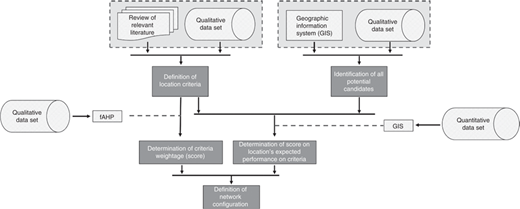
A novel approach that integrates geographic information system (GIS) and fuzzy analytic hierarchical process (fAHP) has been developed using the following multi-step approach:
identify all potential candidate cities (network nodes), using advanced spatial analysis (GIS) and inputs from local supply chain experts;
define a comprehensive set of location criteria for site selection against which the alternatives are to be compared, using the literature and inputs from local supply chain experts;
determine criteria weightage (score) that measures the relative importance of each criterion compared to others, using a cross-comparison of the location criteria and fAHP;
determine scores that reflect the value of a location’s expected performance on the criteria, using GIS; and
define network configuration, using a cross-comparison of candidates and score of location criteria.
Figure 1 shows the methodological framework.
4.1 GIS technology
GIS technology enables to the “capture, manage, analyze, and display all forms of geographically referenced information” in a software environment (ESRI, 2016). It helps to analyze the geographical component of the data, hence a key tool to address the research question of this study. Specifically, GIS will be used to support the initial identification of the cities/locations deemed suitable to locate the network of emergency response facilities, and to perform geographic analysis of data to support step (4) of framework of methodology described above. The latter, core strength of GIS technology will include a spatial analysis such as the quantification of the population threatened by disasters, determination of a distance matrix between the potential nodes and strategic logistics infrastructure (airports, heliports, ports, highways, and railways), determination of geographical coverage for each DC based on travel time to reach the disaster affected population, determination of lead time to reach pre-identified demand points, and the determination of WCoG.
4.1.1 Center-of-gravity technique
As discussed, the main challenge for humanitarian logistics practitioners lies in the uncertainty of demand, particularly concerning the affected zones which are known only after a disaster has occurred (Nahleh et al., 2013). However, to design an efficient and effective relief chain, logistics planning should take place before the disaster strikes (preparedness). This requires critical estimation for the locations of the potential demand points. One way to do this is to determine those as central locations on a map relative to all other locations (Russel and Taylor, 2010). In other words, through the WCoG, it is possible to determine a central location in a geographic area based on distance and weights. In this study, one demand point per (main) island is determined through the WCoG, with the use of Caliper Maptitude Mapping Software ver. 2015, based on the formulas:
where xj, yj are the coordinates of potential demand point at center of gravity for island j, j=1, 2, …, 6; xi, j, yi, j the coordinates of capital city for regency i located on island j. Only the regencies (districts) exposed to the risk of major calamities are considered; and Wi, j the population for regency i on island j.
4.2 fAHP
The fAHP is used to determine the criteria weightage (score), and the criteria will be compared using linguistic terms shown in Table III. These factors will then be used to make the pairwise comparison matrices. The weights of the location criteria for site selection are found from these matrices using the synthetic extent value method described later.
Linguistic terms and corresponding triangular fuzzy numbers (TFN)
| Numerical values | Definition | Fuzzy triangular scale |
|---|---|---|
| 1 | Equally important (Eq. Imp) | (1, 1, 3) |
| 3 | Weakly important (W. Imp) | (1, 3, 5) |
| 5 | Fairly important (F. Imp) | (3, 5, 7) |
| 7 | Strongly important (S. Imp) | (5, 7, 9) |
| 9 | Absolutely important (A. Imp) | (7, 9, 11) |
4.2.1 Synthetic extent value method
Let C={C1, C2, …, Cn} be the criteria set, where n is the number of criteria and A={A1, A2, …, Am} be the alternatives set, where m is the number of decision alternatives. Let , i=1, …, n where (j=1, …, m) are TFNs. The value of the fuzzy synthetic extent Si with respect to criteria j is defined as follows:
where · denotes fuzzy multiplication and the superscript −1 denotes the fuzzy inverse (Tang, 2011).
More details on fAHP can be found in Tang and Lin (2011).
5. Results
To collect the qualitative information from practitioners for the identification of all potential candidate cities (network nodes), and determination of criteria weightage (score), a survey (sample in Appendix) was distributed to the respondents during the direct face-to-face interviews at an ad-hoc workshop held in Jakarta, Indonesia, in January 2016. As the participants were mostly Indonesians, and not all were fluent in English, the questionnaires were administered in both English and Bahasa, Indonesia. The questionnaire was pretested on two different samples of respondents. The first sample was composed of five research fellows from a research institute of a university in Singapore. The other group comprised five humanitarian logistics specialists working in the country office for Indonesia with the leading UN agency for logistics operations. After the pre-tests, the questionnaire was revised to suit the Indonesian setting. In total, 115 responses were collected, 47 responses were discarded due to being incomplete or incorrectly filled, and another 29 had to be excluded due to statistical bias. Thus, only 39 responses were relevant and the sample characteristics are shown in Table IV. Since the responses were in the form of pairwise comparisons, a consistency ratio to verify the level of consistency of data was required. The value of this indicator is equal to 0.0852, hence the data are considered accepted (maximum acceptable value is 0.1) (Finan and Hurley, 1997).
Sample characteristics
| Sector | n | % |
|---|---|---|
| Government | 17 | 44 |
| Humanitarian organizations | 8 | 21 |
| Private sector | 8 | 21 |
| Academia | 6 | 15 |
| Total | 39 | 100 |
On the quantitative data (Table I), the data collection took place from September 2015 to January 2016, over several workshop sessions held in Jakarta, Indonesia.
5.1 Measurement of constructs –results on criteria weightage (score)
On the dimensionality of the location criteria for site selection, our results suggest the proposed framework of Table II. The Indonesian supply chain experts believe that the proposed eight criteria are sufficient to address the RQ1, and no further criteria are required. Table V shows the criteria weightage.
Weightage of Location criteria for site Location calculated through fAHP
| S/n | Criterion | Weight | Rank |
|---|---|---|---|
| C2 | Access to affected zones | 0.2155 | 1 |
| C3 | Risk | 0.2081 | 2 |
| C1 | Coverage | 0.1813 | 3 |
| C4 | Access to infrastructure | 0.1666 | 4 |
| C5 | Access to corridor | 0.0972 | 5 |
| C6 | Congestion | 0.0476 | 6 |
| C7 | Costs | 0.0461 | 7 |
| C8 | National development plan (NDP) | 0.0376 | 8 |
The results show that criteria C2 (access to affected zones), C3 (risk), C1 (coverage), and C4 (access to infrastructure) are considered more important than the remaining attributes. The combination of their scores (weights) forms 77.15 percent of total, making the four criteria the main ones affecting the decision-making process on DC locations across Indonesia. In contrast, to a typical business setting, in the humanitarian context, the cost factor (C7) ranks low (4 percent of total score).
5.2 Measurement of constructs – results on location’s expected performance on the criteria
In order to define the most appropriate network configuration for Indonesia, the scores that reflect the value of a location’s expected performance on the attributes need to be determined. Here, an analysis of results by criterion is detailed. A value of “1” is assigned to the city which, within the geographic area of reference, is expected to perform the best on that specific attribute.
C1 – coverage
Coverage index has been determined based on the population exposed to natural calamities within a ring of 200 km from the candidate location. The figures on the population exposed are determined first as the exposure to independent risk (earthquakes (UN OCHA, 2011), tsunami (UN OCHA, 2011), volcanoes, landslides (BNPB, 2012), droughts (Cepeda, 2011), and floods (Relief Web, 2000/2010), followed by a combination of results through a weighted sum, with the disaster type being the weight. The values of the weights used in the weighted sum are based on the interviews with the local supply chain experts and, respectively, equal to 0.39 for earthquake, 0.39 for tsunami, 0.15 for volcanic eruptions, 0.05 for floods, 0.1 for drought, and 0.01 for landslide. The exposure to the haze and peatland fires are not considered in this phase since all alternative locations within the areas of Kalimantan and Sumatra (which are the only two areas of interest) can be assumed in the midterm to be equally exposed. A higher value on the population exposed translates to a better suitability for the location to be a node of the national emergency response network, as the DC would be able to serve more individuals.
Potential locations compared against C1 – coverage
| Potential locations (nodes) | Geographic area | Exposed population | Coverage index |
|---|---|---|---|
| Pekanbaru | Sumatra | 2,810,290 | 1.00 |
| Medan | 2,160,919 | 0.77 | |
| Bengkulu | 1,821,717 | 0.65 | |
| Palembang | 606,895 | 0.22 | |
| Semarang | Java-Bali-NTT-NTB | 19,120,702 | 1.00 |
| Surabaya | 15,460,194 | 0.81 | |
| Denpasar | 5,994,239 | 0.31 | |
| Jakarta | 5,782,666 | 0.30 | |
| Banjarmasin | Kalimantan | 4,065,681 | 1.00 |
| Balikpapan | 2,907,139 | 0.72 | |
| Samarinda | 2,896,602 | 0.71 | |
| Pontianak | 68,307 | 0.02 | |
| Ternate | Maluku | 1,783,135 | 1.00 |
| Ambon | 882,639 | 0.49 | |
| Timika | Papua | 405,910 | 1.00 |
| Sorong | 299,731 | 0.74 | |
| Palau Biak | 260,162 | 0.64 | |
| Manokwari | 248,267 | 0.61 | |
| Jayapura | 203,670 | 0.50 | |
| Manado | Sulawesi | 3,156,142 | 1.00 |
| Makassar | 1,394,782 | 0.44 |
Example of spatial data and population figures of Pekanbaru, Sumatra
| Potential locations (nodes) | Geographic area | Average longitude | Average latitude | Population within 200 km radius |
|---|---|---|---|---|
| Pekanbaru | Sumatra | 101.44 | 0.50 | 7,932,034 |
To determine the figures of population within a radius of 200 km width from the candidate, the Caliper Maptitude Mapping Software ver. 2015 was used (Figure 2).
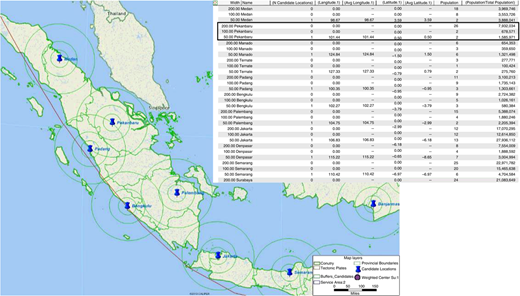
To determine the percentage of the population exposed to the risk, the exposure to independent risk has been assessed by overlaying hazard risks maps (Figure 3) with Figure 2.
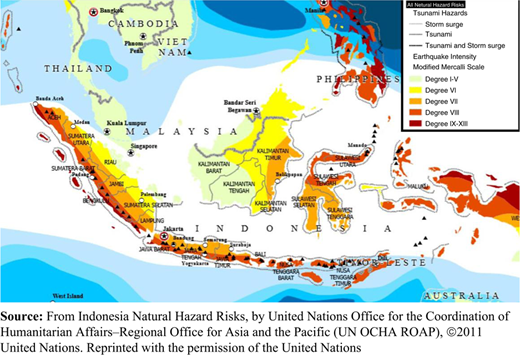
Then, the overall figures of population exposed have been determined using a weighted sum (Table VIII).
Example of calculation for risk exposed population in the case of Pekanbaru
| Earthquakesa | Tsunami | Volcanic eruptions | Landslides | Floods | Droughts | Total | |
|---|---|---|---|---|---|---|---|
| Population | 2,914,059 | 3,852,715 | 0 | 2,870,202 | 2,379,610 | 2,356,597 | 2,810,290 |
| Weights | 0.39 | 0.39 | 0.15 | 0.01 | 0.05 | 0.01 |
Note: aEarthquake intensity in the range of I-XII in modified Mercalli Scale
In this paper, we provide the example of detailed computations on C1 – coverage, and for Pekanbaru.
C2 access to affected zones
For each of the geographic areas under analysis, a WCoG representing the demand point is determined (Table IX and Figure 4).
WCoG coordinates
| Geographic area | Longitude (°) | Latitude (°) | Closest city |
|---|---|---|---|
| Sumatra | 100.79 | −0.9014 | Padang |
| Java, Bali, NTT, NTB | 113 | −8.1 | Lumajang |
| Kalimantan | 115.53 | −2.34 | Pematang |
| Maluku | 128.24 | −1.22 | Fluk |
| Papua | 136.14 | −2.86 | Kimi |
| Sulawesi | 121 | 0.53 | Marisa |
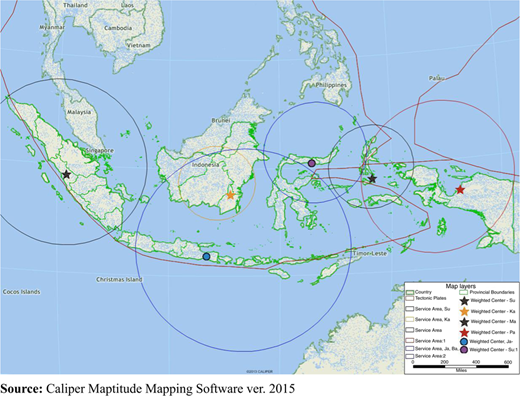
To compute the access to affected zone index, the linear distance between the candidate location and the WCoG of reference is used. Smaller values on the linear distance translate to a better suitability for the location to be a node of the national emergency response network.
From Table X, looking at criterion C2 separately, the nodes to select would be Pekanbaru for Sumatra, Surabaya for Java – Bali – East Nusa Tenggara (NTT) – West Nusa Tenggara (NTB), Banjarmasin for Kalimantan, Ternate for Maluku, Timika for Papua, and Manado for Sulawesi.
Potential locations compared against C2 – “Access to affected zones”
| Potential locations | Geographic area | Linear distance to reference WCoG approximation (km) | Access to affected zones index |
|---|---|---|---|
| Pekanbaru | Sumatra | 160 | 1.00 |
| Bengkulu | 335 | 0.48 | |
| Palembang | 502 | 0.32 | |
| Medan | 544 | 0.29 | |
| Surabaya | Java-NTT-NTB | 109 | 1.00 |
| Denpasar | 200 | 0.55 | |
| Semarang | 340 | 0.32 | |
| Jakarta | 737 | 0.15 | |
| Banjarmasin | Kalimantan | 165 | 1.00 |
| Balikpapan | 176 | 0.94 | |
| Samarinda | 260 | 0.63 | |
| Pontianak | 731 | 0.23 | |
| Ternate | Maluku | 240 | 1.00 |
| Ambon | 288 | 0.83 | |
| Timika | Papua | 220 | 1.00 |
| Palau Biak | 202 | 0.92 | |
| Manokwari | 320 | 0.69 | |
| Jayapura | 510 | 0.43 | |
| Sorong | 577 | 0.38 | |
| Manado | Sulawesi | 250 | 1.00 |
| Makassar | 700 | 0.36 |
C3 risk
Risk exposure represents the risk of the node affected by a natural disaster. Hence, a lower exposure to risk of the natural calamities translates to a better suitability for the location to be a node of the emergency response network. We use the same approach as that for C1 – coverage and the same values for the weights of independent risks have been used (0.39 for earthquake, 0.39 for tsunami, 0.15 for volcanic eruptions, 0.05 for floods, 0.1 for drought, and 0.01 for landslide).
The index “Risk Suitability per Geographic” is a relative measure showing the suitability of a specific location within the respective geographic area. Considering that C3 – risk is one of the most relevant attributes (score 0.2081), as shown in Table XI, C3 will have a significant impact on the final rank of the network nodes.
Potential locations compared against C3 – “Risk exposure”
| Potential locations (nodes) | Geographic area | Risk exposure | Suitability index | Risk suitability per geographic area |
|---|---|---|---|---|
| Pekanbaru | Sumatra | 0.21 | 0.79 | 1.00 |
| Palembang | 0.21 | 0.79 | 1.00 | |
| Medan | 0.23 | 0.77 | 0.90 | |
| Bengkulu | 0.80 | 0.20 | 0.26 | |
| Surabaya | Java, Bali, NTT, NTB | 0.27 | 0.73 | 1.00 |
| Semarang | 0.29 | 0.71 | 0.92 | |
| Jakarta | 0.44 | 0.56 | 0.62 | |
| Denpasar | 0.95 | 0.05 | 0.29 | |
| Pontianak | Kalimantan | 0.06 | 0.94 | 1.00 |
| Banjarmasin | 0.24 | 0.76 | 0.23 | |
| Samarinda | 0.34 | 0.66 | 0.16 | |
| Balikpapan | 0.36 | 0.64 | 0.15 | |
| Ambon | Maluku | 0.43 | 0.57 | 1.00 |
| Ternate | 0.55 | 0.45 | 0.79 | |
| Timika | Papua | 0.31 | 0.69 | 1.00 |
| Jayapura | 0.40 | 0.60 | 0.77 | |
| Sorong | 0.46 | 0.54 | 0.67 | |
| Manokwari | 0.46 | 0.54 | 0.66 | |
| Palau Biak | 0.49 | 0.51 | 0.62 | |
| Makassar | Sulawesi | 0.36 | 0.64 | 1.00 |
| Manado | 0.56 | 0.44 | 0.64 |
C4 access to infrastructure
The infrastructure index reflects the location’s accessibility to suitable infrastructure to support air (airports), ground (logistics center), and maritime operations (seaports). Computations have been performed at two levels, the national level with the so-called “Infrastructure accessibility Index – Overall” (it compares all locations, independently of their geographic position), and the geographic area level with the so-called “Infrastructure Index” (it compares locations within the same area). To combine the location’s expected performance on the several infrastructure types within a common indicator, a weighted sum will be performed, with infrastructure type being the weighting factor. Also, the weights used in the weighted sum are based on the interviews with the local SC experts and are set to 0.4 for proximity to airport, 0.4 for proximity to existing industrial area, and 0.2 for proximity to port. Looking at candidate location Balikpapan in Kalimantan, the location has an overall accessibility index of 0.77[5], which is translated making this node the performing best within Kalimantan with regard to C4, an infrastructure index value equal to “1.”
Table XII highlights a significant heterogeneity on the infrastructure development/availability across Indonesia, with Sumatra and Java-Bali-NTT-NTB being more developed in terms of infrastructure.
Potential locations compared against C4 Access to infrastructures
| Potential locations (nodes) | Geographic area | Infrastructure accessibility index – overall | Infrastructure index |
|---|---|---|---|
| Medan | Sumatra | 1.00 | 1.00 |
| Pekanbaru | 0.71 | 0.71 | |
| Bengkulu | 0.61 | 0.61 | |
| Palembang | 0.431 | 0.43 | |
| Jakarta | Java, Bali, NTT, NTB | 1.00 | 1.00 |
| Surabaya | 0.92 | 0.92 | |
| Makassar | 0.92 | 0.92 | |
| Semarang | 0.76 | 0.76 | |
| Balikpapan | Kalimantan | 0.77 | 1.00 |
| Pontianak | 0.61 | 0.79 | |
| Banjarmasin | 0.51 | 0.66 | |
| Samarinda | 0.35 | 0.45 | |
| Ambon | Maluku | 0.61 | 1.00 |
| Ternate | 0.48 | 0.78 | |
| Jayapura | Papua | 0.61 | 1.00 |
| Sorong | 0.55 | 0.89 | |
| Palau Biak | 0.35 | 0.57 | |
| Manokwari | 0.35 | 0.57 | |
| Timika | 0.28 | 0.46 | |
| Denpasar | Sulawesi | 0.87 | 1.00 |
| Manado | 0.63 | 0.72 |
C5 access to corridor
Accessibility to corridor reflects the vicinity of the candidate nodes to the major transportation corridors identified. It is assigned “1” to the candidates located within a major transportation corridors identified in the aforementioned government’s plan, “0” otherwise. The results are summarized in Table XIV.
Rank of nodes through weighted location criteria for site selection
| Location criteria | ||||||||||
|---|---|---|---|---|---|---|---|---|---|---|
| Potential locations | Geographic area | C1 | C2 | C3 | C4 | C5 | C6 | C7 | C8 | Score |
| Pekanbaru | Sumatra | 1.00 | 1.00 | 1.00 | 0.71 | 1.00 | 0.252 | 0.72 | 1.00 | 0.902 |
| Medan | 0.77 | 0.29 | 0.90 | 1.00 | 1.00 | 0.095 | 1.00 | 1.00 | 0.742 | |
| Bengkulu | 0.65 | 0.48 | 0.26 | 0.61 | 1.00 | 1.000 | 0.42 | 1.00 | 0.578 | |
| Palembang | 0.22 | 0.32 | 1.00 | 0.43 | 1.00 | 0.244 | 0.36 | 0.72 | 0.539 | |
| Surabaya | Java, Bali, NTT, NTB | 0.81 | 1.00 | 1.00 | 0.92 | 1.00 | 0.220 | 0.87 | 1.00 | 0.909 |
| Semarang | 1.00 | 0.32 | 0.93 | 0.76 | 1.00 | 1.000 | 0.90 | 1.00 | 0.793 | |
| Denpasar | 0.31 | 0.55 | 0.29 | 1.00 | 1.00 | 0.204 | 0.59 | 1.00 | 0.572 | |
| Jakarta | 0.30 | 0.15 | 0.62 | 1.00 | 1.00 | 0.125 | 1.00 | 1.00 | 0.569 | |
| Banjarmasin | Kalimantan | 1.00 | 1.00 | 0.23 | 0.66 | 1.00 | 0.041 | 1.00 | 0.72 | 0.726 |
| Balikpapan | 0.72 | 0.94 | 0.16 | 1.00 | 1.00 | 0.020 | 0.30 | 0.58 | 0.664 | |
| Samarinda | 0.71 | 0.64 | 0.17 | 0.45 | 1.00 | 1.000 | 0.25 | 0.72 | 0.558 | |
| Pontianak | 0.02 | 0.23 | 1.00 | 0.79 | 1.00 | 0.075 | 0.09 | 1.00 | 0.535 | |
| Ambon | Maluku | 0.50 | 0.83 | 1.00 | 1.00 | 1.00 | 0.504 | 1.00 | 1.00 | 0.849 |
| Ternate | 1.00 | 1.00 | 0.78 | 1.00 | 0.00 | 1.000 | 0.00 | 0.84 | 0.805 | |
| Timika | Papua | 1.00 | 1.00 | 1.00 | 0.46 | 1.00 | 0.572 | 0.18 | 0.72 | 0.841 |
| Jayapura | 0.50 | 0.43 | 0.77 | 1.00 | 1.00 | 0.236 | 1.00 | 0.84 | 0.696 | |
| Sorong | 0.74 | 0.38 | 0.67 | 0.89 | 1.00 | 0.566 | 0.41 | 1.00 | 0.685 | |
| Manokwari | 0.61 | 0.69 | 0.66 | 0.57 | 1.00 | 0.629 | 0.64 | 0.72 | 0.675 | |
| Palau Biak | 0.64 | 0.92 | 0.62 | 0.57 | 0.00 | 1.000 | 0.05 | 0.30 | 0.636 | |
| Manado | Sulawesi | 1.00 | 1.00 | 0.64 | 0.72 | 1.00 | 1.000 | 0.53 | 1.00 | 0.857 |
| Makassar | 0.44 | 0.36 | 1.00 | 0.92 | 1.00 | 0.617 | 1.00 | 1.00 | 0.729 | |
| Criteria Weightage | 0.18 | 0.22 | 0.21 | 0.17 | 0.10 | 0.05 | 0.05 | 0.04 | ||
C6 congestion
To find the values of airport congestion to compare different localities, computations are performed at two levels, national level with the so-called “Index Runway Utilization – Overall” (it compares all locations, independently of their geographic position), and geographic area level with the so-called “Airport Congestion Index” (it compares localities within the same geographic area). We find that the most congested facility is Jakarta airport (Table XIII).
Potential locations compared against C6 congestion
| Potential locations (nodes) | Geographic area | No. of passengers in 2014 | No of available runways | Density of passengers per runway | Index runway utilization – overall | Airport congestion index |
|---|---|---|---|---|---|---|
| Bengkulu | Sumatra | 736,315 | 1 | 736,315 | 0.03 | 1.00 |
| Pekanbaru | 2,917,084 | 1 | 2,917,084 | 0.10 | 0.25 | |
| Palembang | 3,015,312 | 1 | 3,015,312 | 0.11 | 0.24 | |
| Medan | 7,737,551 | 1 | 7,737,551 | 0.28 | 0.10 | |
| Semarang | Java, Bali, NTT, NTB | 3,528,572 | 1 | 3,528,572 | 0.13 | 1.00 |
| Surabaya | 16,071,633 | 1 | 16,071,633 | 0.57 | 0.22 | |
| Denpasar | 17,272,287 | 1 | 17,272,287 | 0.61 | 0.20 | |
| Jakarta | 56,267,898 | 2 | 28,133,949 | 1.00 | 0.13 | |
| Samarinda | Kalimantan | 150,000 | 1 | 150,000 | 0.01 | 1.00 |
| Pontianak | 2,002,121 | 1 | 2,002,121 | 0.07 | 0.07 | |
| Banjarmasin | 3,686,485 | 1 | 3,686,485 | 0.13 | 0.04 | |
| Balikpapan | 7,554,124 | 1 | 7,554,124 | 0.27 | 0.02 | |
| Ternate | Maluku | 500,000 | 1 | 500,000 | 0.02 | 1.00 |
| Ambon | 992,112 | 1 | 992,112 | 0.04 | 0.50 | |
| Palau Biak | Papua | 314,651 | 1 | 314,651 | 0.01 | 1.00 |
| Manokwari | 500,000 | 1 | 500,000 | 0.02 | 0.63 | |
| Timika | 550,000 | 1 | 550,000 | 0.02 | 0.57 | |
| Sorong | 555,768 | 1 | 555,768 | 0.02 | 0.57 | |
| Jayapura | 1,333,625 | 1 | 1,333,625 | 0.05 | 0.24 | |
| Manado | Sulawesi | 2,596,997 | 1 | 2,596,997 | 0.09 | 1.00 |
| Makassar | 8,417,743 | 2 | 4,208,872 | 0.15 | 0.62 |
C7 cost
Cost index reflects the value of a location’s expected performance in terms of transportation cost for relief items from the main gateway of the geographic area of reference (see footnote 4) to the candidate city, and transportation cost from the candidate city to the WCoG of reference (demand points) will be considered. Data on costs are taken from searate.com (SeaRates, 2016) and values refer to the transportation costs of a five tons track. The results are summarized in Table XIV.
C8 NDP
The index is calculated as the weighed sum of proximity to at least one economic center identified in the “National Master Plan for the Acceleration and Expansion of Indonesia – Economic Development 2011-2025,” proximity to existing industrial cluster, and proximity to port (sea, and air) under new development/expansion. To combine the location’s expected performance on the three components within a common indicator, a weighted sum will be performed, with asset type being the weighting factor. Weights are determined based on the interviews with the local SC experts and, respectively, equal to 0.4 for proximity to economic center, 0.4 for proximity to existing industrial area, and 0.2 for proximity to port (sea, and air) under new development/expansion. The results are summarized in Table XIV.
5.3 Measurement of constructs –results on network configuration
To rank the candidates, and to define the network configuration, the nodes are grouped and compared with respect to their locations in: Sumatra; Java, Bali, NTT, NTB; Kalimantan; Maluku; Papua; and Sulawesi (Table VII). For operational capacity consideration, we have merged the islands of Java, Bali, NTT, and NTB, but we considered separately as Maluku and Papua. These assumptions guarantee a balanced coverage of the disaster prone areas. The results of computations are summarized in Table XIV.
The results show that the DCs should be located in Pekanbaru for Sumatra, Surabaya for Java-Bali-NTT-NTB, Banjarmasin for Kalimantan, Ambon for Maluku, Timika for Papua, and Manado for Sulawesi.
These locations are able to guarantee: faster relief operations (timeliness of response to the demand), and low exposure of facilities to natural hazards, high coverage of population threatened by natural calamities, and easy access to suitable infrastructure for transport. The top performing candidates for the geographic areas of Sumatra, Java-Bali-NTT-NTB, Kalimantan, Papua, and Sulawesi perform better than the respective second best alternative. However, with regard to Maluku, both alternatives Ambon and Ternate can be considered as suitable, although Ambon is better performing in terms of exposure to natural calamities.
5.4 Cross-comparisons of network configurations
To test the model on the operational emergency response capacity and structure, a sensitivity analysis of the two different network configurations – basic configuration, and “High Infrastructure Capacities” – is undertaken. The need of including this second scenario comes from the operational considerations related to unloading processes of humanitarian cargo. Specifically, in emergencies, entry points of relief items (seaports and airports) need to be equipped with (heavy) mechanical handling equipment (main deck/high loaders) so that vessels/aircrafts unloading operations are facilitated. In this configuration, the model is tested under a scenario wherein the nodes require more infrastructural capacity. As the importance of criterion C4 access to infrastructure, based on practitioner suggestions its weightage has been increased to 0.5610, while the remaining seven location criteria have decreased proportionally (Table XV).
DC location criteria for site selection – sensitivity analysis – weightage comparison
| S/n | Criterion | Reference weighta | High infrastructure capabilitiesb |
|---|---|---|---|
| C1 | Coverage | 0.1813 | 0.1241 |
| C2 | Access to affected zones | 0.2155 | 0.1641 |
| C3 | Risk | 0.2081 | 0.1541 |
| C4 | Access to infrastructure | 0.1666 | 0.5610 |
| C5 | Access to corridor | 0.0972 | 0.0441 |
| C6 | Congestion | 0.0476 | 0 |
| C7 | Costs | 0.0461 | 0 |
| C8 | National development plan (NDP) | 0.0376 | 0 |
Notes: aReference weightage refer to criteria weightage of basic configuration; bhigh infrastructure capabilities refer to criteria weightage of high infrastructure capabilities scenario
The computations resulted in a new network configuration composed of Medan (Sumatra), Surabaya (Java, Bali, NTT, NTB), Banjarmasin (Kalimantan), Ambon (Maluku), Jayapura (Papua), Makassar (Sulawesi). Compared to the basic scenario, the main differences consist on location for Sumatra, Papua, and Sulawesi, and an analysis of each alternative is presented in Table XVI.
Comparison of solutions
| Comments | ||||
|---|---|---|---|---|
| Geographic area | Basic scenario | Sensitivity | Pros | Cons |
| Sumatra | Pekanbaru | Medan | Pekanbaru | |
| Proximity to disaster affected zones Low exposure to disasters | River port with limited capacity, and it cannot accommodate heavier vessels Airport lacks mechanical handling equipment for wide-bodied aircrafts | |||
| Medan | ||||
| Airport with mechanical handling equipment for wide-bodied aircrafts Port with enough capacity to accommodate also heavier vessels | Relatively far from disaster affected zones | |||
| Papua | Timika | Jayapura | Timika | |
| Low exposure to disasters | Limited infrastructures capacities | |||
| Jayapura | ||||
| Best commercial hub for Papua Good infrastructure capacities in place | High exposure to earthquake | |||
| Sulawesi | Manado | Makassar | Manado | |
| Proximity to disaster affected zones (assuming coverage of Sulawesi only) | Exposure to natural disasters Limited infrastructures capacity | |||
| Makassar | ||||
| Good infrastructure capacities in place Low Exposure to disasters | Relatively far from disaster affected zones (assuming coverage of Sulawesi only) | |||
6. Conclusion
For this paper, we have defined, weighted, and ranked eight location criteria for site selection. The solution approach provides a practicable decision support framework for locations to government officials (e.g. National Disaster Management Agencies), international and local NGOs, UN agencies, whom might be dealing with similar problem. Decision makers are to focus their efforts on strategic planning of relief operations, with the aim at enhancing supply chains resilience and robustness. For this, the preposition of strategic stockpiles at key localities can be a good strategy to look at.
This study has a few limitations. The sample size is limited. A larger sample size would have provided deeper insights. A wider sample of supply chain experts can be employed to reinforce the results for the case at hand. Second, we have assumed uncapacitated facilities to be located. The constraint over capacity represents not only the size of DCs, but also the space and logistics capacity (transportation) available in the area of which the facilities are located.
Future studies may extend this research by considering a richer network analysis, and an assessment of network responsiveness. In this regard, a number of emergency scenarios can be developed, and used to stress test the network robustness. The outcomes of this analysis could include identification of primary and secondary (backup) DCs to activate in the immediate aftermath of a major event, leading to better strategic planning, especially on the upstream supply chain optimization[6]. Another area to explore would be the inclusion into the model of information related with emergency stockpiles belonging to all humanitarian agencies. This would facilitate logistics planning, and the micro-distribution optimization. With micro-distribution, the downstream supply chain offers good potential for optimization. Identification and mapping of dispatching points for relief goods (e.g. convenient stores, places of worships, schools, etc.) within highly disaster prone areas prior to a disaster event strikes can impact significantly on the outcomes of relief operations.
The authors thank the United Nations World Food Programme Indonesia, and especially Daniel Adriaens, Head of Emergency Preparedness & Response, and Ian Figgins, Logistics Officer of Emergency Preparedness & Response, who provided data and expertise that greatly assisted the research. The authors would also like to thank the anonymous reviewers for their suggestions in improving the quality of the paper. This research did not receive any grant from funding agencies in the public, commercial, or not-for-profit sectors.
Notes
In the global humanitarian system’s classification, “L3” denotes the response to the most severe, large-scale humanitarian crisis.
In view of potentials and strategic roles of each major island of the nation, six economic corridors, each of those with its own development theme, can be identified across the country.
Sumatra, Java-Bali-East Nusa Tenggara-West Nusa Tenggara, Kalimantan, Maluku, Papua, and Sulawesi.
It is assumed to be the corresponding with the capital city of the geographic area: Medan (Sumatra), Jakarta (Java-Bali, NTT, NTB), Banjarmasin (Kalimantan), Ambon (Maluku), Jayapura (Papua), and Makassar (Sulawesi).
Result are based on: proximity to airport – Sultan Aji Muhammad Sulaiman Airport of Balikpapan, recently upgraded, is the biggest airport in East Indonesia able to process ten million passengers per year (DBS Group Research Equity, 2015) and ranks 7 on Indonesia by passenger traffic (Airport Council International, 2015), proximity to existing industrial area – Balikpapan is considered as a logistics hub of Kalimantan (DBS Group Research Equity, 2015), and proximity to seaport – port of Balikpapan has three major bottlenecks small harbor, and small dry dock, and limited repairs (ports.com, 2014).
Upstream SC refers to the SC leg between suppliers/backup DCs and primary DC. Downstream SC refers to SC leg between primary DC and affected area.
References
Further reading
Appendix
The survey was divided into three main sections. In the first section, responders were asked to assess the importance of each location criterion defined in Table II (sample of questions in Table AI). In the second section, responders compared the location criteria of Table II, pairwise. In the final section, responders were asked to suggest potential candidate cities (network nodes).
Sample of questions to assess the importance of each standalone location criterion
| Criteria | Questions | Scale | Comments | ||||
|---|---|---|---|---|---|---|---|
| 1 | 2 | 3 | 4 | 5 | |||
Coverage | How much coverage, in terms of size of population exposed to natural disasters, affects the decision for locating a Humanitarian Response Facility (HRF)? | ||||||
Access to affected zones | How do you rate the accessibility to the affected areas as an important factor while locating a HRF? | ||||||
Risk | How much risk of natural calamities is a concern for locating the HRF and how important is to locate the response facility in a disaster free zone? | ||||||
Access to infrastructure | How does the availability of required infrastructure impact on the decision making process related with locating a HRF and to what extend the following categories are important? | ||||||
• Proximity of the HRFs to main existent logistics hubs of the country | |||||||
• Proximity of the HRFs to major airports and seaports | |||||||
• Operational Capacity of logistics service providers at those infrastructures | |||||||
• Accessibility to identified transportation corridor | |||||||
• Congestion of those infrastructures or corridors. | |||||||
Access to Corridor | How important is for HRF to be located within one of the major transportation corridors as pre- identified by the Indonesian Government? | ||||||
Congestion | How much congestion of roads and key facilities influence the decision on HRF location? | ||||||
Cost | To what extend should transportation costs influence the decision of location for a HRF? | ||||||
National development plan | To what extent is the country's development plan is a concern for locating the HRF? | ||||||

