


The purpose of this paper is to evaluate the effectiveness of humanitarian logistics training for the Finnish Red Cross (FRC) Emergency Response Unit (ERU) delegates, and the factors that influence its success. The managerial purpose of this research is to support the FRC in improving their Logistics ERU Foundation training. Additionally, this research provides humanitarian organisations, engaged in emergency response efforts, insights for logistics training design.
This is a case study examining the FRC, with qualitative data being collected in a field study, utilising participant observation and in-context interview techniques for rich data collection.
This research evaluated the effectiveness of the Logistics ERU Foundation training of the FRC by adapting the four-level training evaluation model by Kirkpatrick and transfer of training theories. The research has contributed to Gralla et al.’s (2015) call for further research in evaluating what people learn from humanitarian logistics trainings and in documenting and sharing experiences with specific training programs.
The conceptual framework serves as a basis for exploratory qualitative investigation of training transfer, from the perspectives of trainees, facilitators and human resource personnel.
This research contributes to the humanitarian community by identifying gaps in Red Cross Logistics ERU training and to the development of curricula content relating to Red Cross logistics response phase operations. Additionally, this gives other humanitarian organisations, operating in the response phase of natural disasters, insights for logistics training design.
1. Introduction
A gap analysis in humanitarian logistics by Kovács and Spens (2011) revealed that humanitarian logistics training tends to concentrate around logistics functions and focus more on operational level problems than on the strategic level related to supply chain design and improvement. Furthermore, management training and development of soft skills, such as relationship building, coordination, local sourcing and understanding of local cultures, tend to fall out from the scope of training programs.
Gralla et al. (2015) analysed the Logistics Response Team training of the World Food Programme, in order to identify critical aspects of its success and to facilitate the design of future trainings. Their study concludes that future research should evaluate what people learn from training exercises by developing more targeted metrics. In addition, the study highlights that there is no routine approach to documenting or sharing the extensive knowledge of the facilitators that manage humanitarian logistics trainings. There is a need for a more systematic approach to capture knowledge and codify good practices in the humanitarian community.
The aim of this research is to evaluate the effectiveness of humanitarian logistics training for the Finnish Red Cross (FRC) Emergency Response Unit (ERU) delegates, and the factors that influence its success. By adapting Kirkpatrick’s four-level model for training evaluation and transfer of training theories a conceptual framework is presented which serves as a basis for the empirical part of the study. The managerial purpose is to support the FRC in improving their Logistics ERU Foundation training. Additionally, this gives other humanitarian organisations, engaged in emergency response efforts, insights for logistics training design.
The following research questions are designed in order to achieve the aim and purpose of this research:
How do trainees, facilitators and human resource (HR) personnel perceive the efficacy of the Logistics ERU Foundation training of FRC in Kirkpatrick’s four levels?
Which factors influence training transfer of Logistics ERU Foundation training?
The paper is structured as follows. It starts with a review of literature on transfer of learning. This is followed by the research design, introduction of the case study, the FRC and the Logistics ERU Foundation training, while providing an overview of the training content. The empirical evaluation of the effectiveness of the Logistics ERU Foundation training is then presented. The paper ends with conclusions and suggestions for further research.
2. Importance of training in humanitarian logistics
Within the humanitarian logistics community, there have been many calls to improve training, education and professionalisation (Allen et al., 2013; Aruna et al., 2016; Bölsche, Klumpp and Abidi, 2013). Bölsche et al. (2013, p. 101) pointed out that “Humanitarian logistics education will not avoid disasters like droughts, storms, floods or earthquakes – but it can be the key to lower the number of affected people and economic damages”. Thomas and Mizushima (2005, p. 22) stated over a decade ago that “there is a lack of professionalization of the logistics function”. Ever since their statement there has been an increasing number of activities dealing with humanitarian logistics competencies, training and education (Tatham and Altay, 2013; Kovács et al., 2012). Kovács and Tatham (2010) also point out that there is an increasing professionalisation of humanitarian logisticians; training and education should receive special attention, since these can improve relief logistics operations which in turn leads to reaching out to more victims of humanitarian disasters (Lu et al., 2013; Bölsche et al., 2013). This general aim of upskilling has been taken forward in the logistics domain, where the ability of managers to put in place and operate an agile supply chain in the complex and unstable post-disaster international context clearly requires a high level of professional skills, competence and knowledge (Kovács and Spens, 2009; Tatham and Christopher, 2014).
Training of humanitarian logisticians for disaster relief operations is a demanding task, since each response operation is different due to various shapes of disasters in different contexts, all around the world. Therefore, it is essential that, in addition to logistics concepts, training measures also need to include adaptive thinking skills, management skills and prepare logisticians to work under pressure. Because of this, a simulated emergency response exercise is used by many humanitarian organisations as a training method to prepare logisticians for unexpected situations (Gralla et al., 2015).
A gap analysis in humanitarian logistics by Kovács and Spens (2011), Kunz and Reiner (2012) and Leiras et al. (2014) revealed that humanitarian logistics trainings tend to concentrate around logistics functions and focus more on operational level problems than on the strategic level related to supply chain design and improvement. Furthermore, management training and development of soft skills, such as relationship building, coordination, local sourcing and understanding of local cultures, tend to fall out from the scope of training programs.
Compounding the challenge and complexity in the humanitarian arena, there is good evidence of a high turnover of humanitarian workers in field operations (Heaslip, 2013), which leads to much tacit field experience and knowledge being lost from the institutional memory bank. Since there is no “structured knowledge system that allows information to be shared among people and for it to be transmitted from one occurrence to another” (Cozzolino, 2012, p. 28), there is a dearth of information and learning from past disasters and unsuccessful/successful solutions. This has HR implications for humanitarian agencies as they seek constantly to recruit, select, train and retain competent humanitarian logisticians.
3. Transfer of training
Training of humanitarian logisticians for disaster relief operations is a demanding task, since each response operation is different due to different types of disasters in different contexts, all around the world. It is essential that, in addition to logistics concepts, training measures also need to include adaptive thinking skills, management skills and prepare logisticians to work under pressure. Because of this, a simulated emergency response exercise is used by many humanitarian organisations as a training method to prepare logisticians for unexpected situations (Gralla et al., 2015).
Tonhäuser and Büker (2016) conducted a comprehensive overview regarding empirical research on the major determinants of transfer of training in formalised vocational training. They differentiated the determinants on the organisational level (work environment), learning field level (training design) and individual level (trainee characteristics).
3.1 Work environment
Grossman and Salas (2011) suggest that the most important factor within the work environment is social support. Support by colleagues and superiors has been empirically proven to have significant influence on transfer success by numerous studies (Tonhäuser and Büker, 2016). Furthermore, receiving feedback from peers has been confirmed to have a significant positive impact on training transfer (Van den Bossche et al., 2010). Post-training activities such as organisational support by providing booster training and sessions to discuss transfer progress have also been proven to facilitate training transfer (Baldwin and Ford, 1988; Tannenbaum and Yukl, 1992).
3.2 Training design
Saks and Belcourt (2006) posit that measures taking place before, during and after training programs have all significant influence on training transfer. However, supportive training transfer activities in the work environment taking place before and after the training are proven to facilitate training transfer more than activities during the training intervention. Saks and Belcourt (2006) identified that training experiences and conditions that closely resemble the actual work environment had a significant positive influence on training transfer. This training strategy is an effective way to facilitate the proper use of learned knowledge and skills on the job (Grossman and Salas, 2011).
3.3 Trainee characteristics
The motivation of trainees to attend trainings has a critical impact on the training outcomes and effectiveness (Tai, 2006; Tannenbaum and Yukl, 1992). Failure to benefit from trainings might be a cause of low motivation even if the trainee is able to learn the course content (Tsai and Tai, 2003). According to Burke and Hutchins (2007), self-efficacy has consistently shown positive influence on transfer of training. Individuals with low self-efficacy in challenging situations are more likely to discontinue their effort, while individuals with high self-efficacy are more likely to put more effort in confronting with the challenge (Robbins and Judge, 2009). The higher the self-efficacy of the trainee is, the more confident he/she will be in the ability to acquire KSAs and make use of the learned KSAs from training interventions (Grossman and Salas, 2011).
3.4 Kirkpatrick’s four levels of evaluation
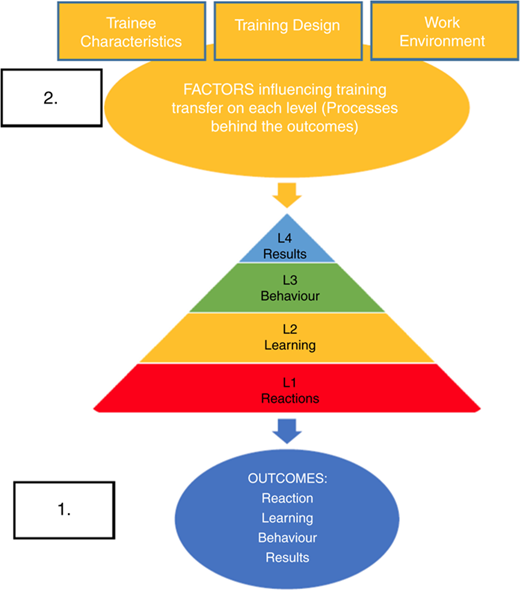
Training and transfer outcomes can be measured by assessing training effectiveness. This can be achieved by adopting the hierarchical four level model created by Donald Kirkpatrick (Salas et al., 2012). The four levels (reactions, learning, behaviour and results) represent the sequence of how the evaluation should progress, as each level impacts the next one. The first level is the easiest to adopt, but as the evaluator moves to the next level, the process becomes more demanding and time-consuming.
As in the Kirkpatrick and Kirkpatrick (2006) evaluation model, reaction represents the participants’ emotional (enjoyment and satisfaction) response to the training; learning represents post-training changes in participants’ skills, knowledge and attitudes; behaviour, which can also be defined as the “transfer measure”, concerns measuring changes in behaviour that take place when participants have returned from the training to the work environment; and results include measuring the impact from changes in learning and behaviour on trainees.
The following conceptual framework (Figure 1) represents the training evaluation process of this research. The aim is to evaluate the training outcomes (1.) on each level (reaction, learning, behaviour and results), and the factors (2.) that have an impact on the training outcomes from multiple perspectives.
4. Research design
Case study method can be adopted in situations when the study focuses on contemporary events, does not require control of behavioural events and attempts to answer “how” research questions (Yin, 2009). The research aim of evaluating the Logistics ERU Foundation training as well as the first research question starting with “how” implies that the aim of this research is mainly of exploratory character. The second research question also implies a descriptive type of study, as the aim is to identify and describe factors that influence training transfer of the Logistics ERU Foundation training.
In this case study, the unit of analysis is the FRC Logistics ERU Foundation course and the intention is to describe the unit “in depth and detail, holistically, and in context” (Patton, 2015, p. 64). To achieve this, the “how” research question provides insight and a deeper understanding about the unit of analysis.
To acquire information-rich respondents, ten participants of the Logistics ERU Foundation training were selected purposefully according to their expertise and experience from Logistics ERU operations. The sample includes respondents who have been on several missions after the Logistics ERU Foundation course, as well as respondents who have facilitated these training interventions. To get contrasting views about the training programme, respondents that had not yet taken part in Logistics ERU operations, but attended only the training, were heard as well. Table I presents the sample of participants. The total number of trainees in a Logistics ERU Foundation course is approximately between 20–25 participants. As seen from Table II, there are three different respondent groups, which allowed to capture multiple perspectives of the training programme.
Table of respondents
| Respondent | Role | Year of Logistics ERU training(s) (* = as a trainee) | Logistics ERU operations | Interview duration |
|---|---|---|---|---|
| MF | Main facilitator and HR | 2005*, 2008, 2010, 2012, 2014, 2016 | 3 | 1 h 26 min |
| TO | Training officer and HR | 2012*, 2014, 2016 | None | 1 h 19 min |
| FT1 | Facilitator and trainee | 2008*, 2010, 2012 | 4 | 55 min |
| FT2 | Facilitator and trainee | 2010*, 2012 | 1 | 1 h 06 min |
| FT3 | Facilitator and trainee | 2014*, 2016 | 1 | 1 h 20 min |
| T1 | Trainee | 2008* | 3 | 1 h 22 min |
| T2 | Trainee | 2008* | 6 | 1 h 15 min |
| T3 | Trainee | 2012* | 1 | 1 h 02 min |
| T4 | Trainee | 2016* | 1 | 1 h 26 min |
| T5 | Trainee | 2016* | None | 59 min |
Summary of data collection methods and techniques
| Data collection methods | Techniques |
|---|---|
| Primary data: semi-structured interviews | 3 interview guides Participant information sheet Two pilot interviews Conceptual framework Direct observation Photo elicitation Projective technique Audio recording Transcribing interviews |
| Secondary data: organisation documents | Logistics ERU Foundation course content and photos |
FRC documents, including photos that concern the Logistics ERU Foundation training, were used as supporting material for the semi-structured interviews. For this research, three different interview guides were developed: one for the main facilitator and training officer (HR personnel); one for facilitators and delegate trainees; and one for delegate trainees. The interview guide for the main facilitator and training officer focussed mainly on the design and planning of the Logistics ERU Foundation course. In addition, the “reaction level” of Kirkpatrick’s evaluation model and topics concerning factors influencing training transfer were also covered in the first interview guide. The second interview guide for facilitators and delegate trainees focussed on factors influencing training transfer from a facilitator perspective, and Kirkpatrick’s four levels as well as factors influencing training transfer from a trainee point of view. The third interview guide for delegate trainees included Kirkpatrick’s four levels and factors influencing training transfer from a trainee perspective.
The interview questions were also developed based on the Logistics ERU Foundation course content. For instance, respondents who had participated in the 2014 or 2016 training were additionally asked about the deployment simulation exercise. The application of semi-structured interviews allowed probing questions and the adoption of a conversational style (Patton, 2015). At the end of the interviews, the respondents were given the chance to speak more freely without being limited to a predetermined topic.
To ensure that the questions in the interview guides were understandable, two pilot interviews were conducted as recommended by Fisher (2007). Furthermore, as Silverman (2011) advices, the interviews were also audio recorded and transcribed to facilitate the coding and analysis of the research data. The interview guide, course schedule and a participant information sheet were sent to all respondents before the interviews, to prepare the respondents and to explain the purpose of this study. Table II presents a summary of the data collection methods and techniques used in this study.
As suggested by Braun and Clarke (2006), thematic analysis was used to identify themes from the research data of this study. According to Golden-Biddle and Locke (2007), theme identification can be conducted on a latent level which reveals the underlying phenomenon of the subject under study. The constructionist paradigm in this thesis speaks for understanding themes on a latent level.
The deductive research approach of this research implies that the concepts in the conceptual framework – that speculate about cause and effect relationships – are tested through the case study. Thus, the concepts become the headings for the coding process (Fisher, 2007). In the initial stage of data analysis, the main themes were taken from the first and second research question.
The main themes for the first research are: reaction, learning, behaviour and results. The main themes associated with the second research question are factors influencing training transfer: trainee characteristics, training design and work environment, which were assigned under the four-level head themes. These headings were then tested through the case study.
As recommended by Braun and Clarke (2006), the interview data were first transcribed into written form. In this way, the data analysis could already start during the transcription of the interviews, which allowed a thorough understanding of the raw data.
Fisher (2007) also recommends that the analysis is done as the researcher goes along rather than after all interviews have been conducted, since themes will be emerging all the time and therefore need to be recognised and taken account of. In this manner, the analysis involves a constant moving back and forward between the research stages of data collection, coding and analysis (Braun and Clarke, 2006). Thus, the transcription, coding and interpretation process started already after the first interview, which allowed writing down ideas already at the onset of the empirical stage of this study. This, in turn, facilitated the analysis of the following interview. Table III presents a summary of the analysis and coding approaches used in this study.
Summary of analysis and coding approaches
| Analysis method | Coding approach |
|---|---|
| Thematic analysis Moving back and forth between data collection, transcription, coding and interpretation | RQ1: Main themes (reaction, learning, behaviour and results) were developed deductively from the conceptual framework whereas “abstract” and “specific” level themes were developed both inductively and deductively within each main theme |
| RQ2: Abstract level themes (trainee characteristics, training design and work environment were developed deductively from the conceptual framework within each main theme of reaction, learning, behaviour and results. Specific level themes were developed both inductively and deductively within each abstract theme |
The data from the interviews were analysed using the computer-assisted qualitative data analysis software (application: Atlas.ti). The examination followed the approach of Roulston (2010, p. 12), which recommends the following criteria for coding qualitative data: “setting/context, definition of the situation, perspectives held by the subjects, participants’ ways of thinking about people and objects, processes, activities, events, strategies, relationships and social structure (of talk), narrative and methods (research procedures)”.
To code the data, the first interview was loaded from the primary documents folder into the reading pane of Atlas.ti, a computer programme used principally in qualitative research or qualitative data analysis. The transcription was read several times and handwritten notes were taken. Next, a set of codes and categories was then defined and assigned to the text, reflecting where patterns, concepts and activity were reoccurring. The codes and categories were then linked to conceptual themes or “families” in Atlas.ti. The codes were abbreviated for ease of use and then subsequently employed as working templates for the other transcripts. Codes, categories and themes were added or removed as the investigation progressed.
5. The case: FRC Logistics ERU Foundation training
The FRC, founded in 1877, belongs to one of the largest civic organisations in Finland and its objective is to assist and support the most vulnerable people both domestically and internationally. ERUs are a part of the international humanitarian aid that the organisation provides. FRC ERUs are created to respond to the needs of other Red Cross Red Crescent National Societies that are facing humanitarian crises in the immediate aftermath of natural disasters. The ERU system is based on knowledge, experience and standards and the personnel that are deployed on ERU operations consist of volunteers from the international personnel reserve roster of FRC. The roster consists roughly of 1,000 members with diverse professional backgrounds. Approximately 400 of these members have received specialized ERU training (Finnish Red Cross, 2016a).
FRC has different ERUs that can be deployed around the world, depending on the need of the disaster relief operation; RC Emergency Clinic, Surgical/General field hospital, Logistics, Relief, IT and communication, and emergency shelter unit are examples of the various ERUs that the FRC is prepared to provide globally (Finnish Red Cross, 2016a). As a result of the ERU system, FRC delegates have over the years, saved thousands of lives and alleviated the suffering of hundreds of thousands of the most vulnerable people around the globe (Finnish Red Cross, 2016a).
To become an FRC delegate, the applicant must first pass a week-long basic training course (Finnish Red Cross, 2016b). However, to be able to take part in an ERU mission, the applicant needs to additionally go through a general ERU Induction course as well as a specialized ERU Foundation training which content depends on the candidate’s profession. In other words, to become an active member of the international reserve, the applicant needs to take part in at least these three courses.
This research focuses on the Logistics ERU Foundation course, which is a part of the FRC’s specialized ERU Foundation training. The aim of the training is to prepare participants for their roles as members of FRC Logistics ERU. The Logistics ERU team consists of delegates with different roles, such as team leader (TL), supply chain administrator (SCA), warehouse/transport and air operations (AirOps) delegate. These “primary roles” are assigned either before or during the Logistics ERU Foundation training, depending on the participants’ professional background and experience. This means that, if the delegate trainee has a professional background for instance in business warehousing, it is likely that he/she will become an ERU Warehouse delegate and so on. Having said this, the desired behaviours include that the delegate trainees are capable to apply at least the learned material that relate to their own delegate role, and to understand how their assigned delegate role is related to the other logistics ERU team members.
Getting participants familiarised with ERU logistics deployment approach of the RC/RC Movement, the ERU concept, IFRC policies, procedures, documentation and systems relating to ERU logistics in the field are one of the core themes of the training programme. In addition, preparing delegate trainees for teamwork and work in high-stress environments are objectives of the course, which is emphasised through group work exercises, the deployment simulation exercise, “meet a delegate” sessions and intense and long days.
A Logistics ERU refresher training is also provided by FRC every second year with the intention to help recall learnings from the Logistics ERU Foundation training. Participants are asked about the desired content before the refresher session. Sometimes, if there are any major changes in ERU procedures, these are also added as content to the refresher training.
6. The design of the logistics ERU foundation training
The course content is decided in the “ERU working group” which consists of IFRC, ICRC and all National Societies that maintain ERUs. This implies that the main facilitator of FRC cannot modify or add contents to the Logistics ERU Foundation course without discussing with the “ERU working group”. For example, IFRC policies count as mandatory course content since ERUs operate under IFRC, and therefore cannot be altered. However, there is a list of various sessions that National Societies can choose between. As an example, job safety rules are not included in the training, when they are mandatory in British Red Cross’s Logistics ERU training. The fact that FRC has been providing Logistics ERUs for over a decade entails that there is a lot of cumulated experience from the field which can be considered when planning the next trainings.
In order to make the training intervention a memorable and enjoyable event, practical exercises are implemented as much as possible besides the more theoretical sessions. This provides balance to the theoretical and sometimes heavy in-class sessions. The practical group exercises also include some fun elements to enhance the team atmosphere; such as building Legos blindfolded. Social evenings are also included in the training programme to boost the team spirit.
6.1 Feedback to support the development of the training programme
The training content is evaluated at the end of each training day by the participants. In addition, an electronic survey is sent to all participants after the training. The feedback is then considered when planning the next Logistics ERU Foundation course. For instance, the 2016 training received some unfavourable feedback from participants, regarding the Cash Transfer Program (CTP) session, since it was considered too basic. This stems from the pre-training briefing material, which already included a CTP online course. Thus, the next training will include a CTP session that will go more into depth and include also some practical group exercises. Another example is the deployment simulation exercise, which got positive feedback during the 2016 training, but many participants thought it should be longer. This will be taken into consideration by adding an extra day to the next Logistics ERU Foundation course.
Finally, at the end of each Logistics ERU rotation, delegates fill an “end of mission report”, where challenges and technical issues are addressed. The data from this report are also used to improve future trainings.
7. Findings and discussion
To answer the first research question, this section begins by presenting the training outcomes of the Logistics ERU Foundation course in Kirkpatrick’s four levels. To answer the second research question, a presentation of factors influencing training transfer outcomes is given. Table IV demonstrates the themes developed under Kirkpatrick’s four levels that represent the training outcomes. In total, 7 abstract level themes and 44 specific level themes were developed inductively and deductively during the coding process across all three perspectives of main facilitator and training officer (HR personnel), facilitators and delegate trainees, and delegate trainees. The main facilitator and training officer contributed only to themes under the Reaction level. The numbers (1, 2 and 3) after the themes under the Reaction level in Table IV indicate which respondent group contributed to what theme. However, since the respondents gave somewhat different responses under the Learning, Behaviour and Results levels, respondent codes are indicated for each specific level theme. Each theme is further elaborated and analysed under each Kirkpatrick level in the following sections.
Thematic map presenting training outcomes
| Kirkpatrick level | Main theme | Specific level theme 1=Main facilitator and Training officer 2=Facilitators and Trainees 3=Trainees |
|---|---|---|
| Reaction | A positive emotional response (1, 2, 3) | Location and facilities (1, 2, 3) Schedule (1, 2, 3) Facilitators (1, 2, 3) Course content and training module (1, 2, 3) Practical exercises (1, 2, 3) Deployment simulation exercise (1, 2, 3) Social interaction (1, 2, 3) |
| Unfavourable reactions | Intensive schedule (1, 2, 3) Distance between training and accommodation (1, 3) Customs facilitators (1, 3) Cash transfer session (1, 3) Deployment simulation exercise too short (1, 3) Cultural and gender issues (2) | |
| Learning | Knowledge development | IFRC standards and procedures (FT1, FT2, FT3, T1, T2) DMIS and FedNet (FT2, FT3) Military assets (FT2) Customs and clearance (T2) Cash transfer program (T4) Logs ERU finance (T5) |
| Skill development | Logic (FT1. FT2, FT3, T3) Forklift (FT2) Warehouse document use (FT3) Tracking and tracing (T2) Teamwork (T3, T4, T5) Operating as AirOps (T4) ERU equipment use (T5) | |
| Attitude development | Positive and flexible attitude (FT2) Tolerating uncertainty (FT£) Patience (T1) Self-confidence (T3, T4) Red Cross service-mindset (T4, T5) | |
| Behaviour | Transfer success | Knowledge and skill transfer to work environment: Logic (FT1, FT2, T3, T4) IFRC standards & procedures (FT1) Teamwork skills (FT2, T3, T4) Fleet management (T2) Finance (T3) |
| Transfer failure: Warehouse document use (FT3) Procurement (FT1, T2) Logic (FT3) | ||
| Results | Personal | Improved self-esteem (T2) Teamwork skills (Ft1, FT2, FT3, T2, T3, T4) Better tolerance to uncertainty (FT3) |
7.1 Reaction
7.1.1 A positive emotional response
All respondents reacted positively to the training intervention and various themes were categorised under the abstract level theme of – a positive emotional response – which is supported by the following quotations of all three respondent groups. When the main facilitator and training officer (HR personnel) were asked about what kind of feedback they generally receive from the trainees, they replied:
It is mainly positive and mostly it concerns that there should be more exercises and less theory. But this is something we are aware of, but it is a must to go through theory as well. […] Trainees seem mostly tired but happy after an intensive week.
(Respondent MF)
Good [laughter] feedback is mostly about that there is a lot of content and the days are very long, but then it is still positive; very intensive and tough but still much on the positive side.
(Respondent TO)
The “Facilitators and trainees” respondent group also confirmed this with the following example quotation:
Well, I have met many of those who have taken part in the course afterwards. The Logistics ERU course is one of the courses that people speak about; we have a lot of courses, but this course functions well as a reference in a discussion. It has an effect that stays in memory.
(Respondent FT2)
Furthermore, a positive emotional response emerged from the “Trainees” respondent group, which backs up the previous quotations:
If I remember correctly, I have participated in 23 FRC courses, also as a facilitator. The logistics training was one of the most effective trainings. I have nothing negative to say about the course.
(Respondent T1)
The good things can be remembered more easily, but I can’t recall anything negative about the training.
(Respondent T2)
I feel like this was one of the best courses that has left me a good feeling from doing things together in a team. Teamwork worked out very well.
(Respondent T3).
Overall, it was an extremely good course. A few small things to criticize […] but considering that there is a lot of material to digest in a short time frame […] I think it was quite a good success.
(Respondent T5)
The facilitators received mainly positive feedback from most respondents as they were easily approachable and due to their pedagogical skills and professional know-how:
Red Cross personnel are usually good facilitators and good speakers […].
(Respondent TO)
I remember there were many examples about cooperation in the Logic session, with [Facilitator]. She had worked in Panama and had interesting examples about cooperation with different stakeholders […] I remember her humorous and open attitude.
(Respondent FT2)
I think the facilitators were nice people, you could have fun conversations with them during the dinners or in the sauna […] even if they had a kind of “leader role”, they could still easily have this relaxed social interaction with the trainees during spare time. I think they managed these long days exemplarily so that people wouldn’t get tired.
(Respondent T5)
Respondents reacted positively towards the course content and training methods. A theme that emerged under this category is practical exercises, such as forklift driving, ERU equipment use and group exercises. These gave good balance to the sometimes considered heavy in-class sessions:
Forklift driving is favoured amongst participants, especially amongst people who have never tried it. It is seen as exciting when they get to try new things, and when you are excited your learning is also better.
(Respondent TO)
Well planned content with good balance of practice and theory. I have nothing negative to say.
(Respondent FT1)
It was the first time I drove the forklift [laughter], so it was a lot of fun. It was a fun and giving course, and it’s always like that with these practical exercises which definitely gives a positive experience. The content was definitely good.
(Respondent FT2)
I think everyone liked the forklift exercise [laughter] […] I think it is a memorable exercise for many.
(Respondent FT3)
The practical things were impressive […] I mean this ERU equipment. It was refreshing to do fun practical things outdoors and not only sit inside the classroom.
(Respondent T1)
Group exercises we had yes, and I remember this one where you had to choose a warehouse location […] This one was good.
(Respondent T2)
I’m very satisfied with the content. I got what I was looking for […] It was good to do practical exercises with all sorts of equipment. In the Logic session, we were all using computers so you could do these hands-on exercises. So, these worked also well.
(Respondent T3)
Discussions about the deployment simulation exercise emerged several times during the interviews and it received for the most part positive feedback from all respondents who had taken part in this exercise. It was considered a good final rehearsal, where all learned material could be put into practice:
Simulation exercise has received positive feedback […] It has been considered a good way to learn and rehearse those things that have been taught during the week.
(Respondent TO)
The field exercise comes up first in my mind, which was very well organized.
(Respondent FT3)
Deployment exercise was well organized and I was on fire during the exercise.
(Respondent T4)
7.1.2 Unfavourable reactions
Although the reaction towards the training intervention was mainly positive, it did also receive some criticism from each respondent group. Even if the respondents were mainly satisfied with the schedule, the fact that it is intensive and includes extended training days, makes it tiresome for most of its participants:
Unfavourable reactions of course because the course is long, so you get tired. From time management we get negative feedback if sessions go overtime.
(Respondent TO)
Usually after this kind of long course, you are quite tired. So, it’s nice to get back home. This Logistics ERU course, is an extremely extensive and intensive training intervention.
(Respondent FT1)
Sometimes I was a bit tired, so these days were extensive, it felt like I was sitting in class too much.
(Respondent T3)
I remember the coffee breaks had to be shortened sometimes.
(Respondent T4)
The cash transfer session in 2016 was considered too basic by three respondents. Mainly because the pre-reading material before the training intervention already covered all the material that was brought up during the CTP session:
I expected more from the CTP session. It resembled too much the pre-reading material. I was disappointed because my expectations were so high.
(Respondent T5)
Four respondents mentioned that the deployment simulation exercise was too short and perhaps because of this there was not enough of time to give proper simulation instructions for the trainees. One respondent mentioned that it was a bit confusing to know what the main goal of the simulation was:
It is very short.
(Respondent T4)
[…] it felt like no one had a clear picture of where to start from. So, I think the means were a bit weak to start with the simulation exercise, so this was something I felt like was a problem. […] the instructions could have been better before the exercise started. […] At one point I was thinking is this some kind of a test to see how we react under pressure […] but if the point was to rehearse the learned material about how warehouse documentation goes with goods flows, the exercise did not work out well, because of inadequate preparations and instructions.
(Respondent T5)
In conclusion, despite some unfavourable reactions or critique, all respondents shared a positive emotional response towards the Logistics ERU Foundation training. Overall, each respondent group’s responses regarding most of the themes were in line with each other under the Reaction level. As mentioned by Kirkpatrick and Kirkpatrick (2006), the Reaction level was the easiest level to evaluate and the respondents in this study also seemed to have quite effortlessly answered the interview questions, after they had refreshed their memory by looking at the training schedules and photos. The outcome results under the Reaction level did match with the aim of designing and planning the Logistics ERU Foundation training in a way that makes trainees react favourably to it.
7.2 Learning
7.2.1 Knowledge development
Knowledge development included amongst other things: IFRC standards and procedures, DMIS & FedNet, military assets, customs and clearance, CTP and Logs ERU Finance. These specific level themes are presented in Table IV together with respondent codes to indicate who developed what knowledge. The factors that influenced on knowledge development were for instance, practical exercises and professional facilitators. Here are three example responses when trainees were asked about what knowledge they gained during the training:
Definitely introduction to IFRC and Logistics ERU opened up for me what the ERU system is designed for. Knowledge building for me was also DMIS and FedNet and especially this emergency items catalogue […].
(Respondent FT2)
Of course, you learn about Red Cross standards, so this was very interesting as you had no previous knowledge about it. We had practical supply chain exercises about these in the imaginary country “Zuboumba”.
(Respondent T1)
I think the customs and clearance stayed in my memory well because I did not have any earlier knowledge about this and the facilitator (from 2012 course) was good […] she knew what she was talking about and had a well-prepared presentation and was able to give answers to trainees’ questions.
(Respondent T3)
7.2.2 Skill development
Skill development occurred within the following areas: Logic, forklift driving, warehouse document use, tracking and tracing, teamwork, operating as AirOps and ERU equipment use. Most of the respondents mentioned to have gained skills in Logic and teamwork. Unsurprisingly, teamwork skills were improved through group work exercises:
For me Logic was a positive learning experience […] so I learned the system and felt like I was confident in using it. So, the biggest operative value for me professionally was definitely Logic.
(Respondent FT3)
7.2.3 Attitude development
What comes to attitude development, respondents mentioned learning within the following areas: positive and flexible attitude, tolerating uncertainty, patience, self-confidence and Red Cross service-mindset. Here are three example quotations about tolerating uncertainty through the simulation exercise, Red Cross service-mindset and self-confidence:
Tolerating uncertainty. And this was good in the field exercise; just as you thought you had control over the situation the time was turned to the next day and we were supposed to forget about everything we had done and kind of start from the beginning again.
(Respondent FT3)
This service-mindset, so that you do your job in the best possible way so that you can help those in need. Maybe self-confidence to your own doings.
(Respondent T4)
Everyone cannot operate as they please, you have these special game rules for how things are done. Money flow is an example. And then in general you have these Red Cross principles and values that you need to keep in mind.
(Respondent T5)
In conclusion, knowledge, skill and attitude development was somewhat different between each respondent. However, the Learning level did match with the Logistics ERU Foundation training goals when considering the course content and the focus on teamwork skills and work in unpredictable high-stress job environments. Unsurprisingly, respondents from the earlier training interventions had difficulties in remembering what they had learned during the course. Knowledge, skills and attitude development under the Learning level seemed to have been quite different between the respondents. Exclusively, knowledge and skill development, such as DMIS & FedNet, customs and clearance, CTP, logs ERU finance and Logic, was at least to some extent dependent on the trainee’s professional background and personal interests, which meant that trainee’s learned at least knowledge and skills relating to their assigned delegate role. For instance, one trainee (FT2) that had an IT background and knew that the delegate role will be within SCA showed interest towards Logic use and learned maybe more about this than about a topic, such as warehousing, which is not as relevant for this role. Another example is Respondent T5, whose delegate role is also within SCA, who said to have learned about Logs ERU Finance, which is an important task of an SCA delegate. This is in line with the desired results or main objective of the Logistics ERU Foundation training when considering that trainees should at least learn course content relating to their own delegate.
7.3 Behaviour
7.3.1 Transfer success
Several specific level themes emerged under the abstract level theme, transfer success. These themes indicate the degree to which learning affected trainees in logistics ERU operations. The specific level theme, knowledge and skill transfer to work environment, included the following themes: Logic, IFRC standards and procedures, teamwork skills, fleet management and finance.
All respondents who had been assigned as SCA delegates, who mainly operate with Logic, mentioned that learning to use Logic had helped them in their logistics ERU operations:
If I relate to my mission in Nepal […] I learned from the course that Logic is not a multiuser friendly system […] understanding how you operate with Logic when there are many users, has definitely had an impact on how we worked as a team with Logic in the field.
(Respondent FT2)
Three respondents mentioned that the development of teamwork skills had supported them in logistics ERU operations. The following is an example of a quotation regarding teamwork skills:
Team play, you learn this through the exercises and you see how other people act […] it is very useful and important in the field when you are working under pressure, you might be tired and so on. So, if team play does not work inside your team it will become extremely straining to work.
(Respondent T4)
One respondent, assigned as Warehouse and Transport delegate, mentioned that getting an understanding of IFRC fleet management had helped the respondent during a logistics ERU operation in Haiti:
An understanding, especially in fleet management […] the importation of vehicles through the vehicle rental program in Haiti was difficult. But, you got an understanding of how the whole operation can be affected by these kinds of issues.
(Respondent T2)
To summarise the Behaviour level, there was a transfer of skills and knowledge to the logistics ERU work environment of Logic, IFRC standards and procedures, teamwork skills, fleet management and finance. Obviously, the transfer of skills and knowledge was different depending on each respondent’s logistics ERU delegate role, if excluding IFRC standards and procedures and teamwork skills. However, the transfer failure themes, namely, warehouse document use, Logic and procurement, indicate that without support from more experienced logistics ERU delegates in the field, it would be challenging, if not impossible, to work within these areas, since training sessions within these topics only partially matched with the needs of the ERU work environment.
The transfer success of knowledge and skills (excluding IFRC standards and procedures and teamwork skills) to logistics ERU job environment was different among the respondents depending on the assigned delegate role. The results of the Behaviour level indicate both knowledge and skill transfer to the work environment as well as transfer failure. As respondents mentioned about partially applying knowledge and skills in the field, such as Logic skills, and the emerging transfer failure themes, it can be concluded that the outcomes of this Kirkpatrick level indicate that there is some room for training design improvement, since some training sessions did not fully match with the needs of the logistics ERU work environment.
7.4 Results
7.4.1 Personal
The abstract level theme, personal, indicates any personal changes that the trainees had after the course and logistics ERU operations. Specific level themes, such as improved self-esteem, teamwork skills and better tolerance to uncertainty, were reported by the respondents:
The experience has definitely had an impact on my self-esteem. Like I said, I was familiar with ICRC, but did not know if the Federation is different, so there was this uncertainty regarding the difference. So at least self-esteem has been improved, since I now know the difference between the two.
(Respondent T2)
Respondents said that teamwork skills had been improved through the course and field experience:
Understanding the difference of each delegate role inside the team. Each role is very important for the team to function.
(Respondent FT3)
The course and field experience has affirmed the importance of teamwork to me.
(Respondent T3)
ERU mission and training has particularly taught me about teamwork and that is what is needed if there is an emergency situation in Finland when considering my regular job task here. […] From the simulation exercise I also understood that communication inside the team is important and that the logistics team needs to have a unified understanding so that those in need can be served in the best possible way.
(Respondent T4)
Most respondents reported improvement in teamwork skills through the training and field experience. This can be considered a good result on a personal level, since teamwork is one of the core skills that are needed in logistics ERU operations.
To answer the second research question themes that relate to factors influencing training transfer outcomes are summarised in Table V. Correspondingly to the previous training outcomes is summarised in Table IV, themes were developed under each level of the Kirkpatrick model. Six abstract level themes were developed in accordance with the conceptual framework and 18 specific level themes were created both deductively and inductively during the coding process across all three respondent group perspectives. Those themes that only had a few contributors are indicated with the respondent code.
Thematic map presenting factors influencing training transfer outcomes
| Kirkpatrick level | Main theme | Specific level Theme 1=Main facilitator and training officer 2=Facilitators and Trainees 3=Trainees |
|---|---|---|
| Reaction and Learning | Trainee characteristics | Motivation (1, 2, 3) Experience (2, 3) |
| Training design Measures during training | Training content aligned with the actual job task (1, 2, 3) Error management (1, 2, 3) Development discussion (1, 2, 3) Aged computer software (Logic) (FT2, T5) Lack of personal feedback (FT1, FT2, T3) | |
| Pre-training measures | Pre-course briefing (1, 2, 3) Development discussion (2, 3) | |
| Post-training measures | Training evaluation (1, 3) | |
| Behaviour and Results | Trainee characteristics | Self-efficacy (2, 3) |
| Work environment | Social support (2, 3) Feedback from peers (2, 3) Booster training (1, 2, 3) Context in country of operation (1, 2, 3) Time between training and mission (1, 2, 3) Briefing material for operations (TO, FT2) |
7.5 Reaction and learning
7.5.1 Trainee characteristics
Trainee characteristics measured personal attributes that have an influence on trainee reaction and learning during the Logistics ERU Foundation training. Specific level themes, under trainee characteristics, are motivation and experience. The specific level theme, motivation, revealed that most trainees were highly motivated to participate in the Logistics ERU Foundation training and to work as Logistics ERU delegates. This has a positive influence on trainee reaction and learning, since motivation has a significant influence on training transfer according to previous studies (Tai, 2006; Tannenbaum and Yukl, 1992).
The main facilitator and training officer confirmed the high motivation of trainees by mentioning that trainees express their motivation by easily approaching facilitators and by asking questions about future logistics ERU job opportunities:
During the development discussions with trainees, they usually ask: “what should I do to be selected for logistics ERU operations”. Some might also ask about how to get on longer ERU missions.
(Respondent MF)
People easily ask questions from facilitators in all kinds of situations; in the sauna, during coffee breaks and so on […] I think this is very good and shows that trainees are motivated and excited.
(Respondent TO)
When the respondents were asked about why they applied to become a Logistics ERU delegate, one of the respondents expressed motivation by being interested to work in humanitarian disasters. In addition, the values of FRC matched with the respondent’s ideology:
What got me into the humanitarian sector, was that I already from an early stage thought it would be interesting to work in disasters, I think this is my nature. And as a facilitator, I have always been interested in facilitating courses. […] The principles and values of Finnish Red Cross are close to my ideology […] so doing what they do is something I value.
(Respondent FT2)
Most of the respondents’ motivation was in line with the previous quotation since working for a humanitarian cause was mentioned many times:
We just lived in Singapore when the 2004 tsunami hit, and we got to follow the event nearby. Because of this event I would have wanted to help the victims in Achan, with the reconstruction. What is really cool in this sector is the value of the work; that you are really doing a job that matters.
(Respondent T1)
A specific level theme that emerged during the coding process is experience. This theme refers to earlier Red Cross know-how or to strong professional background that all trainees had before they attended the Logistics ERU Foundation training. Some of the respondents did not have a logistical background, but most said that their professional experience from either earlier Red Cross missions or Red Cross trainings or from their daily jobs in Finland supported their learning during the Logistics ERU Foundation training:
I have gotten used to the fact that nothing is ready and that you always need to improvise in your job; my earlier job experience supported my learning a lot during the training.
(Respondent T5)
Undoubtedly, this supports the learning during the training, since you already have some background knowledge about FRC. Other respondents said:
I had a strong ICRC background since 2000, so I already had an understanding about Red Cross logistics.
(Respondent T2)
It was an advantage for me since I already had been on a logistics ERU operation before the training, so it was easy for me to absorb what was being taught there.
(Respondent T4)
Thus, the professional experience of trainees can be classified as a factor that had a positive influence on training transfer of the Logistics ERU Foundation course.
7.5.2 Training design
Training design measured factors influencing trainee reaction and learning pre-training, during the training and after the training. Measures during the training that were evaluated were: training content aligned with the actual job task, error management and development discussion. Themes that emerged from the interview data were: intensive days, aged computer software (Logic) and lack of personal feedback.
An important factor to evaluate is how well the training content is aligned with the actual job task, since this has been proven to facilitate training transfer in the training environment; measures during training (Saks and Belcourt, 2006; Holton et al., 2000; Bates et al., 2000). When the main facilitator and training officer were asked if they perceive the training content meets the skills and knowledge needed in logistics ERU operations, they both considered the content to match with logistics ERU operations:
I think it matches, the knowledge and skills we can teach in the course.
(Respondent MF)
I think it matches, what I heard from people coming from missions, especially this 2016 course.
(Respondent TO)
Respondent TO also mention that the deployment simulation exercise is an effective way to simulate an ERU operation:
Even if you were in the Danish training centre, at some point during the simulation exercise it really felt like you would have been somewhere in Pakistan discussing with a local transport company’s boss. So, in this sense you get immersed in the exercise and I think this is really good.
(Respondent TO)
Furthermore, Respondent MF points out:
Usually, facilitators do not even approach their presentations without bringing examples from their logistics ERU experiences.
(Respondent MF)
However, some respondents brought up some challenges with aligning course content with the actual job task, because of the various contexts where each ERU operation takes place and due to differing professional backgrounds of trainees:
Five days is not really enough, because most of the things you learn in the field, since each operation is different depending on the country […] this can’t be taught in a course, so in this sense the course content does not entirely match with the job task. Another problem is that trainees have so different professional backgrounds and knowledge in logistics. Thus, it is important that there is always another more experienced person who can help during the first logistics ERU operation.
(Respondent FT1)
The evaluation of trainee characteristics indicated that most of the respondents from the facilitators and trainees and trainees respondent group had high motivation to participate in the Logistics ERU Foundation training. The interview data also revealed that earlier experience of each individual seemed to have facilitated learning during the training.
The evaluation of training design – measures during the training – revealed that the respondents were both satisfied and unsatisfied in terms of training content aligned with the actual job task. For instance, the deployment simulation exercise was considered useful, since it mimicked the actual job environment. This is in accordance with Gralla et al. (2015), who state that a simulated emergency response exercise is a useful training method to prepare logisticians for unexpected situations.
7.6 Behaviour and results
7.6.1 Trainee characteristics
Trainee characteristics evaluated personal attributes that make training transfer more likely to occur in logistics ERU operations. A specific level theme, under trainee characteristics, is self-efficacy, which measured the trainees’ confidence in their abilities to make use of the learned KSAs from the Logistics ERU Foundation training. Studies, for instance, by Burke and Hutchins (2007) showed that high self-efficacy of the trainee has a positive influence on training transfer.
When the respondents were asked whether they felt confident or not, directly after the course, all trainees said they were “more on the confident side” of applying the learned knowledge and skills in logistics ERU operations. However, two respondents mentioned that they were not very confident with using Logic:
The general feeling was confident and then there are those specific areas that I did not feel very confident with, such as Logic and warehouse document use.
(Respondent T5)
7.6.2 Work environment
The work environment included the evaluation of factors influencing training transfer in logistics ERU operations. Factors, such as social support, feedback from peers and booster training were measured since all play an important role in training transfer in the work environment (Grossman and Salas, 2011; Tonhäuser and Büker, 2016; Van den Bossche et al., 2010; Tannenbaum and Yukl, 1992).
When the respondents were asked if they received support during logistics ERU operations, almost everyone were content with the social support during their missions and the TL was mentioned several times as being helpful:
If thinking from a perspective of learning things, it certainly continues in the field, so I think we did support each other well, and especially our Team leader supported us.
(Respondent FT2)
Training content aligned with the actual job task under the abstract level theme training design, all respondents mentioned the issue with “going by the book”, since each operation is so unique; for instance, local authorities and unexpected situations can often result in situations when you cannot apply the learned knowledge and skills from the Logistics ERU training. Therefore, the context in the country of operation can have a negative influence on training transfer because of various operational environments. Undeniably, the context in the country of operation makes it challenging to match training content with the actual job task. The following example quotation describes this challenge:
Each mission is unique. There are so many different situations that it is sometimes difficult to apply the learned knowledge and skills […] the environments can be so different and the praxis of authorities can cause tremendous problems.
(Respondent T1)
Another factor that emerged from the interview data is time between training and mission, which refers to the time between the Logistics ERU Foundation training and the logistics ERU operation. The longer the time between the training and mission, the more it becomes challenging to remember the learned knowledge and skills from the course. Six respondents mentioned the challenge with remembering the learned knowledge and skills, because of the long time between the course and logistics ERU operation:
I would prefer going directly after the training when you still remember things from course. So, it took over one year before I went to Haiti in 2010. Therefore, you did forget a bit. However, I started remembering things during the operation quite quickly.
(Respondent T1)
The final specific level theme that emerged is “briefing material before operations”, which refers to trainees being active and rehearsing the learned knowledge and skills before they go on logistics ERU operations. As Respondent TO points out, this depends so much on the delegate, whether he/she is active enough to rehearse course material for instance during the flight before the mission. One respondent also mentioned the importance of the manual for Logic:
Logic manual is an example, that you have a reference point you can go back to also after the training.
(Respondent FT2)
Trainee characteristics evaluated the trainees’ self-efficacy directly after the training intervention. The results revealed that all respondents were more on the confident side of applying the learned knowledge and skills in the job environment. Thus, the self-efficacy of the respondents facilitated training transfer of the Logistics ERU Foundation course. Nevertheless, it is important to bear in mind that these responses might not be very reliable, since some respondents had difficulties in remembering the training intervention. The work environment included the evaluation of social support, feedback from peers and booster training which all have an influence on trainee behaviour and results. The results showed that most respondents received adequate social support and feedback from peers in the work environment. In addition, most respondents had participated in the booster training, which they thought was useful. Therefore, it can be concluded that all these factors had a positive influence on training transfer of Logistics ERU Foundation training.
Other factors under the work environment that emerged from the interview data and had a negative influence on the Behaviour and Results level are context in the country of operation and time between training and mission. Many respondents mentioned that these both factors make it challenging to apply the learned knowledge and skills in logistics ERU operations.
8. Managerial implications
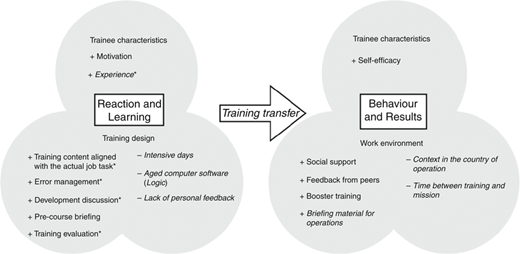
Figure 2 represents the factors that have an influence on training transfer of Logistics ERU Foundation training according to Kirkpatrick’s four levels. Those factors that had a positive influence on training transfer are marked with a “+”, while factors affecting training transfer negatively are marked with a “−”. Thus, when considering the improvement of future Logistics ERU Foundation trainings, factors indicated with a “−”should receive attention. Factors that would need some adjustment or improvement are marked additionally with a “*”. Improvement suggestions are elaborated in Table VI. Themes in italics (in Figure 2) emerged inductively from the interview data.
Managerial implications
| RQ1 and RQ2 themes | Recommendations |
|---|---|
| Unfavourable reactions | |
| Intensive schedule | Avoid shortening coffee and lunch breaks Vent the classroom in Kalkku to get fresh air Implement break exercises during in-class sessions to prevent tiredness |
| Cash transfer session in 2016 | Should be more advances than the pre-reading assignment |
| Presentation slides during in-class sessions | Prepare presentation slides well, avoid using long texts and use more pictures and figures to make the presentation easier to digest |
| Deployment simulation exercise too short | Explain the main goal of the deployment simulation exercise and give clear instructions before starting the exercise The exercise should be longer as this would enable applying the learned content more broadly |
| Cultural and gender issues | Could be worth to have some other evening activities |
| Transfer failure | |
| Warehouse document use | Implement more practical exercises involving warehouse document use |
| Procurement | During the procurement session, explain how procurement is done in the first rotation, when there is no time to do three bids Explain who is responsible for procurement and how strictly you need to follow Federation policies |
| Logic | Implement as much as possible of exercise involving the use of Logic Make sure an experienced Logic-user is available to support a first-timer in the field |
| Factors influencing training transfer | |
| Experience | Even if the respondents had experience that supported their learning, some did not have any previous experience in logistics. Hence, it would be worth considering that people should have at least some basic knowledge in logistics when accepting trainees to the course, since it is more challenging to match course content with the learning needs of trainees with such various backgrounds |
| Training content aligned with the actual job task | Since each operation is so different it would be important to bring as much as possible of these real-life examples to the course Like the transfer failure theme, procurement session should cover how to do procurement in an emergency Bring more real-life examples about what usually happens during the different rotations; honest examples about when it has not been possible to apply Federation policies in challenging situations Consider the teaching of cooperation skills and leadership skills Support from more experienced delegates is essential in the field To be able to operate with confidence as an SCA delegate, it would be good to additionally complete trainings such as Finance and Admin course as well as the Relief course. The warehouse session could include an exercise in a real warehouse tent/warehouse, where actual goods would be stored and moved together with the warehouse documents |
| Error management | Give adequate feedback/error management during and after the deployment simulation exercise, so that trainees will know how they have performed |
| Development discussion | Worth considering to implement the development discussion before the actual training, since then trainees would know their future placement and would possibly be more motivated and concentrated during sessions that concern their delegate role. If possible, the development discussion could be a bit longer |
| Training evaluation | To get more legitimate and brisk feedback from trainees about the effectiveness of the Logistics ERU Foundation course, it would be worth to place each training day’s evaluation to the next morning and/or place a final evaluation at the end of the course |
| Intensive days | Same as intensive schedule |
| Aged computer software (Logic) | Encourage IFRC to update Logic to an online version |
| Lack of personal feedback | Even if it might be challenging to implement personal feedback due to limited resources, trainees could be provided more feedback during group exercises by having for example an ‘observer’ who would intervene whenever needed Feedback could also be provided through an evaluation of the participant’s performance during the course |
| Context in the country of operation | Like the earlier factor -training content aligned with the actual job task- it is important to bring forth examples during the training about unexpected situations in the field, such as situations when local authorities have caused challenges |
| Time between training and mission | As it can take a long time before delegates go on logistics ERU operations after the training intervention, rehearsal of the learned training content is fundamental. Therefore, it is essential that FRC provides its delegates with adequate briefing material before operations as well as reminds its delegates about coming booster trainings (Logistics ERU Refresher training) |
Improvement suggestions for the Logistics ERU Foundation training are listed based on the analysis of RQ1 and RQ2. First, recommendations can be done based on the unfavourable reactions and transfer failure themes (RQ1 themes). Second, recommendations can be done based on the factors influencing training transfer (RQ2 themes) presented in Figure 2. Accordingly, Table VI demonstrates recommendations for FRC.
In addition to the recommendations in Table VI, due to the fact that it is challenging to design a training programme that would last longer than seven days and because of the difficulty of matching training content with the actual job task, another suggestion would be to provide additional specialized training depending on the assigned delegate role; for instance, a warehouse delegate would receive at a later point in time after the Logistics ERU Foundation course, one or two extra days training including ERU warehousing sessions. Another example would be an SCA delegate who would receive supplementary training within topics, such as Logic use and ERU Finance.
RQ1 themes under the Behaviour level – the transfer measure – revealed that there were both knowledge and skill transfer to work environment as well as transfer failure. Even if respondents reported behaviour change with Logic use, some still seemed a bit unconfident with using the software in the work environment without the support from more experienced delegates. Additionally, there was transfer failure of warehouse document use, Logic and procurement.
Evaluation of RQ2 theme – training content aligned with the actual job task – under the Reaction and Learning level also revealed that the training content matches only partially with the actual job task. Even if the main facilitator, training officer and two other respondents considered the course content to match with logistics ERU operations, other respondents thought some sessions could be better aligned with the work environment. For instance, sessions including Logic, procurement, warehousing and warehouse document use were considered to be slightly misaligned with the actual job task. In addition, some respondents thought the training should include more real-life examples about what to expect during the different rotations, since now the training focuses a bit too much on how things go in the perfect world. In addition, cooperation skills and leadership skills, which are both needed in ERU operations, were noted to be lacking from the training as well. One respondent also mentioned that the Logistics ERU Foundation course alone without other specialized FRC courses would not have been enough to prepare for the SCA delegate role. Finally, concerning the specific level theme, training content aligned with the actual job task, one respondent said that the warehouse session was somewhat lacking, since knowledge about warehouse document use was left unclear at the end of the course.
Furthermore, even if there were many factors that had a positive influence on training transfer of the Logistics ERU Foundation training, some RQ2 work environment themes that should be noted are context in the country of operation and time between training and mission. These both factors made it challenging to apply the learned knowledge and skills in logistics ERU operations and thus contributing negatively on preparing delegates for ERU operations. Because of the time between training and mission, post-training support, such as social support, booster training and briefing material for operations, play a critical role in not forgetting the learned knowledge and skills. In addition, the challenge with the context in the country of operation is in line with the suggestion of including more real-life examples in the training.
9. Conclusions
This research has filled a research gap in revising humanitarian logistics training by identifying gaps in existing education offers (Bölsche et al., 2013). Furthermore, this research has contributed to Gralla et al.’s (2015) call for further research in evaluating what people learn from humanitarian logistics trainings and in documenting and sharing experiences with specific training programs.
This research evaluated the effectiveness of the Logistics ERU Foundation training of FRC by adopting the four-level training evaluation model by Kirkpatrick and transfer of training theories. As suggested by Holton (1996) and Bates (2004), the Kirkpatrick model was made more robust by evaluating both outcomes of the four levels as well as factors behind the outcomes. In addition, multiple perspectives were included in the training evaluation by interviewing trainees, facilitators and HR personnel.
In the first section of the analysis, the findings revealed that, at least from the outcomes of the Reaction, Learning and Results level, the Logistics ERU Foundation course was effective when considering each respondent’s perspective. The overall reaction towards the course was positive as all respondents expressed how much they liked the training. The positive reaction and attitude of trainees also seemed to have facilitated training transfer of the Logistics ERU Foundation training, which is in line with what the Kirkpatrick model suggests. The evaluation of the Learning level showed that knowledge, skill and attitude development was somewhat different between each respondent, which was partially dependent on each respondent’s occupational background and personal interests. However, the Learning level did match with the Logistics ERU Foundation training goals when considering the course content and the focus on teamwork skills and work in unpredictable high-stress job environments. The Results level-outcomes showed that personal level improvements were in line with skills needed in logistics ERU operations.
On the other hand, the evaluation of the Behaviour level outcomes revealed that some respondents were not able to optimally apply the learned knowledge and skills in logistics ERU operations. These results are in accordance with Tonhäuser and Büker (2016) who state that vocational trainings suffer from the transfer of training problem, which implies that trainees do not apply the acquired skills optimally in the workplace.
In the second section of the analysis, this research evaluated and identified multiple factors that influence training transfer of the Logistics ERU Foundation training. The results showed that despite many factors having a positive influence on training transfer, some factors had a negative impact on the training transfer outcomes. In addition, some factors require adjustment or improvement as presented in Figure 2. For instance, the factor, context in the country of operation, revealed that because of the various operational environments where logistics ERU operations take place, it is challenging to match the course content with the knowledge and skills needed in the actual job task. This is in line with the fact that humanitarian logistics faces a challenge because the practice environments develop faster than logistics skills and competencies (Bölsche et al., 2013).
To ensure effective training transfer of the Logistics ERU Foundation course, further research is needed to evaluate the pre-training measures as well as the Logistics ERU Refresher training of FRC. Furthermore, other Red Cross National Societies’ logistics training programs should be evaluated in order to improve relief efforts of IFRC. Suggestions for further research include conducting longitudinal studies by implementing the Kirkpatrick model to evaluate the effectiveness of the FRC Logistics ERU Foundation course. This would enable the evaluation of a single training intervention and add more rigour to the evaluation of the Learning, Behaviour and Results levels.
In conclusion, despite the comprehensive delegate-to-facilitator feedback loop and experience in designing multiple FRC Logistics ERU Foundation courses, based on the identification of the above-mentioned gaps, it can be concluded that the Logistics ERU Foundation training has prepared delegates for ERU operations only partially. Again, this is in line with Tonhäuser and Büker (2016) and Rosenberg (2013), who state that the main challenge of training programs is that trainees do not apply the acquired skills optimally in the workplace and that without post-training support there is a risk of training transfer failure.

