This study aims to explore the ontological aspects of corporate social responsibility (CSR) (the integration of conventional CSR with dimensions of CSR derived from the Qur’an and Sunnah), leading to the conceptualization of a methodological framework for Islamic social responsibility (ISR) or social accounting.
The research uses a qualitative approach, namely, a literature study, by conducting interpretative (content analysis) of texts in CSR books written by past scholars, annual reports of public companies in Indonesia in 2021, the Qur’an and Sunnah, using the Islamic rational burhani method and maqosyid sharia.
The research findings indicate that the ISR methodology can be developed by integrating or internalizing the elements of ayat kauniyah (existing CSR theories or concepts) with the CSR elements found in the Qur’an and Sunnah, using the Islamic rationalist approach and maqashid sharia methodology. Ontologically, the universe is the creation of the One and Only (monism), so every element within it has similarities and patterns that can be combined/integrated. The results of this ISR methodology are further referred to as the ISR methodology based on Monism (IMM).
The study uses an interpretative paradigm by using rational reasoning and maqashid al-sharia when constructing the ISR methodology foundation, which may result in speculative values when implemented empirically. Therefore, further research is recommended to test this empirically or through experimentation.
The results of this study offer a new concept that can be used as a methodological foundation for developing ISR. The IMM positions social responsibility not only based on economic rationality but also considers social and religious motives, so that CSR can be implemented correctly in accordance with its original spirit and be more humanistic and egalitarian.
The IMM produces CSR that is not only corporate-oriented but also stakeholder-oriented, thereby enhancing the value and effectiveness of CSR for society at large, with a humanistic and egalitarian content for society in a sustainable manner.
The distinction of this research is demonstrated by the integration procedure between conventional science (CSR) and Islamic science, which ontologically originates from a single monism of existence, namely, Allah SWT. The integration procedure involves the internalization of elements from kauliyah and kauniyah verses that share similarities and patterns, using the Islamic rationality of burhani and maqashid sharia.
1. Introduction
In line with the hiroh (strengthening) demands and implementation of corporate social responsibility (CSR) in parts of the world, it still leaves methodological issues as a science (Anam et al., 2022; Banarjee, 2008; Wati et al., 2022), the scientific building is not yet strong, and tends to be pragmatic (Arrigoni, 2019). The implication is that when it is reduced to certain techniques, it encounters difficulties and the field of study or discipline is less established (Carroll, 2016; Guo et al., 2019; Kostyuk et al., 2013). For example, when intending to develop CSR boundaries, CSR dimensions, CSR performance measures and others often widen and go beyond the main boundaries (Meynhardt and Gomez, 2019; Vărzaru et al., 2021) overlapping occurs, where at certain times CSR enters the field of certain scientific studies, and at other times enter into studies of other scientific fields (Baker and Modell, 2019; Changar and Atan, 2021). On certain occasions, CSR is considered to be a discipline of accounting, management science, health science and environmental science, and on other occasions it is considered to be another discipline. Therefore, it requires a strong scientific building, both from the aspects of ontology, epistemology and axiology (Carroll and Brown, 2018; Carroll and Shabana, 2010). Ontology provides a strong foundation for CSR because it discusses the origins of knowledge, so that philosophically it has strong basic ingredients as a basis for existence (Ippoliti, 2021; Keshavarzi and Ghaffary, 2023; Sheena Smart et al., 2023). Ontology discusses the nature of science, the basic ingredients of knowledge and examines what CSR really is (Müller et al., 2022; Nguyen et al., 2023; Nimani et al., 2022). In this way, CSR has strong definition of the existence, because it is already known what it really is.
Similar conditions also occur when the echoes of Islamic CSR (ISR) develop in line with the development of the sharia industry (Wati et al., 2022; Antonelli et al., 2024). On the one hand, it triggers the development of knowledge in the field of social accounting, Islamic social disclosure, Islamic CSR performance index and its kind, but on the other hand, the methodological aspects are still weak (Franzoni and Allali, 2018; Zhang et al., 2022). From an Islamic point of view, the dimensions of CSR have existed since Islam appeared on earth (Wang and Pala, 2021; Pintol and Allui, 2020). Islam teaches the balance of life in the world and the hereafter, benefiting others, helping each other, zakat, infaq, shodakoh, encouragement to be responsible in various aspects of life and prohibits causing damage to the face of the earth (Helfaya and Easa, 2022; Nugraheni and Khasanah, 2019). According to Islamic teachings, CSR existed when Rasulullah SAW received a mandate from Allah SWT, which was only conceptualized as Islamic CSR in the last decade (Helfaya and Easa, 2022; Shahabuddin et al., 2018). Even if this is seen from the basis of scientific construction, it is still very weak. It is necessary to reconstruct the concept of Islamic CSR so that its dimensions are truly grounded and tested as a scientific science. Methodologically, ISR dimensions can be traced in the Qur’an and the Sunnah of the Prophet (Helfaya and Easa, 2022). The Qur’an contains the grand concept of Islamic CSR which can be explored ontologically and adequately.
The purpose of the research is to unravel and find a new methodological construction, namely, the integration of Islamic science with conventional science in the field of social accounting from the aspects of ontology and epistemology, especially on the topic of Islamic corporate social responsibility (ISR). The significance of this research is the discovery of the construction or anatomy of a new social accounting ontologies which are the scientific basis for compiling the limits and development of ISR so that the implementation of ISR reflects Islamic and humanist values. The difference between this research and previous research is the integration of Islamic values into CSR that uses the Islamic methodology of Burhani and Maqashid Al-Sharia. The contribution of this research is the formulation of a new methodology that can be used as a reference in the development of social accounting science, especially ISR. Meanwhile, practically (non-academic) this research contributes to formulating ISR implementation policies that are more humanist or take into account the contextuality of stakeholders. This research is in the form of a literature study, namely, carrying out the ontology and epistemology conception of CSR from the Al-Qur’an, Sunnah, related literature and previous research in the field of CSR. Data is in the form of secondary, with data collection techniques using documentation. Data analysis techniques use content analysis and interpretive.
2. Literature review
2.1 Ontology, epistemology and axiology
Discussing the methodology layer of science means talking about philosophy, which cannot be separated from the three main branches of science, namely, ontology, epistemology and axiology. Ontology is a branch of science, which specifically discusses the basic nature of the world view (Arrigoni, 2019; Keshavarzi and Ghaffary, 2023). Talking at this level means discussing the essence or existence of an existence (Ramoglou, 2021). The essence of something is the actual state of something that exists (Müller et al., 2022; Musmini et al., 2019; Walton and Zhang, 2013). Ontology discusses activities to seek and find the deepest meaning of something, seek and find answers behind something called the value of reality (Bryer, 2023; Ippoliti, 2021), there is an effort to find the core contained in every answer behind something called the value of a reality (Lawson and Morgan, 2021; Lukka and Becker, 2023). CSR ontology, seeking the real value of CSR from what exists (Arrigoni, 2019). CSR ontology, looking for the reality value of CSR from what it is (Arrigoni, 2019). Based on the logic of ontology, looking for the essence of existence or the true value of ISR can be traced from the teaching sources that explain, namely, the Al-Qur’an and As-Sunnah, which are the primary sources of Islamic teachings (Helfaya and Easa, 2022). As it is said that Allah SWT is one, a place to ask, not begotten and begotten and there is no equal to Him (QS. Al-Ihlas: 1–4). He is the substance that created everything in the heavens and on earth, the alternation of day and night and its signs (QS. Ali Imron: 190–191). Everything exists only because of His will (QS. Al-Qamar: 49).
Besides aspects of the nature of existence (ontology), another branch of knowledge that discusses ways or methods of acquiring knowledge is epistemology. Epistemology is a branch of philosophy that discusses or highlights ways, techniques or procedures for acquiring knowledge (Anderson et al., 2022). It discusses a systematic or methodical process for finding the truth contained in the object of scientific study (Rasmuin, 2019). If ontology discusses the nature of truth or value, epistemology discusses how to find the essence of existence or philosophy which discusses the occurrence of knowledge, the source of its origin of knowledge, boundaries, characteristics and validity of knowledge (Athifah and Adinugraha, 2022; Atmaja and Mustopa, 2020).
The third branch of philosophy that explores the existential value is the axiological phase (Anderson et al., 2022), which talks about the benefits (value) of mastered knowledge (Moon et al., 2021). The knowledge that has been mastered, is studied as the highest utilization or maximum benefit for maximum good and policy (Makassar and Barru, 2017). Axiology talks about the purpose of science itself, which is to touch on the nature and true benefits (Müller et al., 2022). Islam recognizes that science is not value-free, and this is different from the perspective of capitalist science which considers science to be value-free (Rasmuin, 2019). Islam believes that all creations of the Kholiq (creatures, including knowledge) exist by the will of Allah and are still under His intervention (QS Ali Imron: 191). The character of knowledge in the stages is formed and formulated without liberating and adapting to the cultural values, morals of a society, the environment, the background that surrounds it, so that it has a useful value for society to achieve prosperity.
2.2 Islamic social responsibility or social accounting
The development of science which is marked by the increasingly advanced industrialization brings a new face to the world. Industrialization makes a major contribution to individuals, groups and countries (Manning et al., 2020; Ullah and Jamali, 2010). It can provide a source of profit in the form of increasing tax revenues, national income, opening job vacancies, per capita income and the like (Carroll, 2016; Jati et al., 2020). Behind it all, industrialization also has negative impacts that can threaten the sustainability of future generations (Banerjee, 2011; Ermawati et al., 2021; Bigoni et al., 2023), such as water pollution, air pollution, water pollution, environmental damage, emergence of deadly viruses, social inequality and its kind (de Olde and Valentinov, 2019; Nazari et al., 2017). Companies must be responsible for the impacts that arise by increasing social responsibility (CSR) (Retolaza et al., 2020). CSR is the company’s responsibility and concern for social and environmental problems due to the negative impacts of its operations (Carroll and Brown, 2018; Franzoni and Allali, 2018).
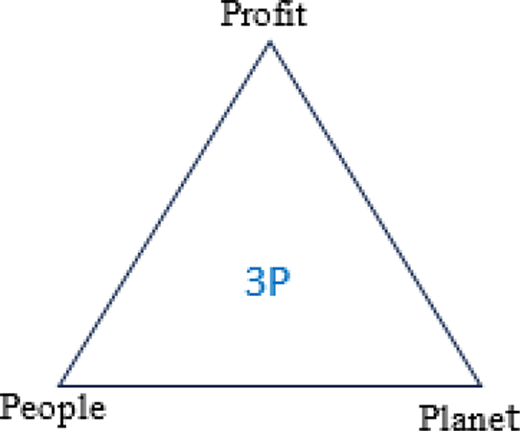
Elkington states that there are three elements of operational responsibility, further called the triple bottom line, which do not negate each other but complement each other, which are: (1) planet (environment); (2) people (society in the broadest sense); and (3) profit (profit), as illustrated by: (1) planet (environment); (2) people (society in a broad sense); and (3) profit, as described below.
Figure 1 shows that the domains of corporate responsibility include three, namely, responsibility to shareholders to create profits to ensure the company’s going concern and provide economic value to owners, responsibility to society at large (people), namely, contributing to society and responsibility for sustainability or environmental sustainability. The three domains of responsibility must be carried out together synergistically because they do not negate each other but complement each other [Banerjee, 2008; Carroll, 2016; Elkington – 1999 Acceleration of Relative Electrons via Drift-resonant Interaction (1).pdf, n.d.]. Carroll and Shabana (2010) complete the logic of the company’s responsibility to stakeholders not only in the three domains (profit, planet and people), but the company must also be responsible ethically, legally and discretionary. The combination of several responsibilities is actually how to manage the company must be oriented towards sustainability and contribute to social and environmental protection in an ethical manner (Carroll and Brown, 2018; Hadi and Udin, 2021; Muis et al., 2021; Antonelli et al., 2024).
In the context of the legitimacy of Islam as a way of life that directs the development of Islamic-based industries to organize a more blessed life, it raises corporate responsibility based on Islamic ethics and norms. This context then gave rise to a new concept, namely the concept of Islamic corporate social responsibility (ISR). This is because, whatever form the company takes, either sharia-based or conventional, it directly or indirectly has a negative social and environmental impact (Shahabuddin et al., 2018). From there the company must be responsible for the impact. The company is the party that benefits the most from resource exploitation, while directly or indirectly the community must bear the social costs (Carroll and Brown, 2018; Bigoni and Mohammed, 2023).
Social costs also appear as a burden for implementing CSR as a form of responsibility for social and environmental impacts (El Mosaid and Boutti, 2012; Nugrahanti, 2018; Retolaza et al., 2020). Companies are open to charging costs for charity and environmental recovery (Lukka and Becker, 2023; Ortega et al., 2018; Antonelli et al., 2024). That is where accounting began to develop, not just mainstream accounting as legitimacy for economic events, but the emergence of social accounting, which produces accountability for negative social and environmental impacts (Aparaschivei, 2007; Rodrigues et al., 2021; Bigoni et al., 2021). Social accounting is accounting for generating accountability due to environmental damage and social inequality (negative externalities) (Gómez-Villegas and Larrinaga, 2023; Lukka and Becker, 2023; Standaert et al., 2021). At this point, there is a public demand for companies so that responsibility is not only measured economically, but extends to social and environmental responsibility.
3. Research method
The research approach is qualitative in the form of literature studies, namely, to describe and analyse in depth in the text of the Qur’an, As-Sunnah and CSR reference books, and other reference sources by contextualizing the phenomenon in the 2021 annual report of companies going public in Indonesia, capturing the ontological basis of Islamic social responsibility (ISR). The data of this research are primary data, namely, the text of the Al-Quran and the text of As-Sunnah, which, because of its nature has maintained its purity since it was revealed until the end of time, and secondary data in the form of related references and annual reports published by the company, with data collection techniques using documentation. Primary data is the main source in the form of the Al-Qur’an, Assunah and CSR concepts and theories from experts, while secondary data is in the form of the 2021 annual report from companies listed on the Indonesian stock exchange. Data analysis uses content analysis and interprets the texts of the Al-Qur’an, As-Sunnah reference books, and annual reports with Irfani and maqashid sharia reasoning to find relevance between elements, which are then integrated between elements to draw conclusions about the basic ideas of ISR.
4. Result
4.1 Verses of the Qur’an that have the essence of social responsibility
Al-Qur’an as the divine word is the basis for humans to worship and muamalah. Judging from its character, the Qur’an contains knowledge that is broader than the ocean, in it contains a grand theory and a grand concept which can be used as a basis for the development of theories and concepts. The development of Islamic theory is important, because the knowledge that is formulated is a confirmation that Allah SWT is the substance that is the creator of all that is in the heavens and the earth. Table 1 below explains the various verses of the Quran that serve as sources for the reduction of Islamic CSR dimensions to be integrated or used as material for formulating the ontology of Islamic CSR:
Table 1 above explains the basic concepts derived from the Qur’an, which will later be used or derived to form the dimensions of Islamic CSR. These dimensions will be integrated or internalized by first identifying common characteristics with the CSR dimensions derived from the verses of the Qur’an. They are grouped into five basic CSR concepts from the Qur’an, namely, the dimensions of divinity, unlimited power, accountability and sincerity, God’s nature, people, environment, economic and human rights.
4.2 As-Sunnah that has the essence of social responsibility
Similar to the logic of the Qur’an, As-Sunnah is also a source of law and a basis for the empirical behaviour of the people. It can be said that As-sunnah is an empirical procedure from the Qur’an so that it is easy to practice. As-Sunnah is more empirical than the Qur’an, because it is the uswah hasanah of the Prophet for the revelations he received so that it is easier to apply in the religious life of his people. In the context of knowledge development, As-Sunnah also offers a grand theory and a grand concept which can be a source of theory formulation. With the help of Irfani’s reasoning and Maqashid Al-Sharia, As-Sunnah is broken down into CSR elements and with integration procedures, a new concept of ISR is formulated. Table 2 below explains the basic concept of As-sunnah, which forms the basis for deriving the dimensions of Islamic CSR, as follows:
Table 2 above explains the basic concept of CSR derived from the Sunnah. The basic concept of Islamic CSR will later be broken down or derived into CSR dimensions and become material for internalization with CSR that has already formed Islamic CSR.
4.3 Views of scientists and experts on social responsibility content
Table 3 below explains the concepts and theories of CSR that have been formulated by experts. The formulation of contemporary CSR theory departs from a response to phenomena related to the negative impact of industrialization which results in environmental gradations and social inequality. As a form of responsibility, the company must act equally because it is he who exploits and gains profit, while society and the environment must bear the social costs. The conventional CSR methodologically is built from a nomothetic and value-free capitalist philosophy. The size attached is monetary or economic rational, not paying attention to transcendental elements. For further explanation, Table 3 below explains the concepts and theories of CSR from various scientists as described below:
Table 3 above shows the mapping of CSR according to experts, such as: GRI (2016), Gray (1995), Carrol Carroll (1991) and Elkington (1999). The CSR concepts from these earlier scholars are then interpreted for similarities or compatibility among their elements to be integrated or internalized with Islamic CSR from the Qur’an and Sunnah, thereby forming Islamic CSR.
5. Discussion
5.1 Monism of existence and ontology of responsibility
Responsibility ontology can be traced from the monism logic of existence which explains the nature of existence (being). Monism of existence provides the argument that existence exists in a single substance that is different from the others. The structure of its existence has its own elements, which cannot be achieved by human ratios because it is beyond the reach of human thought (rational metaphysics). His existence has absolute authority, including the authority to create other existences, such as humans, minds and others. Monism comes from the Greek word monos which means single or alone (Müller et al., 2022). Understanding monism, there are several theoretical views that discuss it, giving rise to variations in understanding, such as (The Archives of Bertrand Russell, 2025):
Everything that exists in the universe is described from the activities of one basic element, namely Allah SWT.
Everything in nature originates or sources from a single final source.
The essence of all existence is one source, and the essence from which all reality originates is one, and there cannot be two.
The monism theory of thought recognizes that there is only one existence as the origin of the existence of the universe. This single substance exists, is free and stands alone which is the dominant principal source of determining other existences (Shim and Kim, 2021). There, it is the only true existential status that is single (unitary), and is not limited and not divided (Aguinis and Glavas, 2012). Parmades argues that the only true being is the one, which is infinite and invisible (The Archives of Bertrand Russell, 2025), Parmanides argues that the existence of a single being inhabits all existence that does not change and is not touched by change. According to The Archives of Bertrand Russell, n.d. that the essence of monism of existence is in fact a single unchangeable one and its meaning will remain the same.
In Islam’s view, the monism of existence is none other than the monotheism of existence which recognizes that the existence of Allah is a single substance that is not divided into matter because His oneness is different from the others (Pintol and Allui, 2020). The unity of existence (behaviour) is based on a philosophy of partiality (faith) in which the formulation of existence (behaviour) consists of elements of God that differ in position and character from the existence of nature, thought, and humans (Atmaja and Mustopa, 2020). The foundation of faith also recognizes that the unified elements of being have different levels of existence, that all formations of existence form a structure of existence (Zhang et al., 2022). In the eyes of Islam, existence stems from the almighty form of everything, namely, Allah SWT. There, being is believed to be the creator who is the origin of the existence of something with all its divine nature, the place of return and the centre of responsibility for everything (Helfaya and Easa, 2022). With a philosophical basis, the existence (form) of God is believed to be in a position as a core component in the composition of existence and to be the central point as the creator of nature and reason. The monism of the existence of Allah SWT is not space and time, based on the philosophy of partiality (faith) of Allah SWT, there is no need to doubt His existence, His power that created the universe (His creatures), is childless and begotten as explained in QS: Al-Ihlas (see Table 4).
The existence of nature according to monotheism of existence is a form (existence) other than God (Allah SWT) which has its own position, element and character that is outside of God. Nature in its position was created and can change according to the context and era. Philosophical thought, including Greek philosophy, says that in being there is a unity between reason and nature. There, nature has a fixed order, with laws that are known by reason as the verses of the Qauniyah from the existence (existence) of The Sublimely Exalted of Allah SWT. Nature, with the law of order, can be digested by reason, created by Allah SWT to interact in a balanced way with one another for the welfare of the people. Allah said “Seek what Allah has bestowed upon you (happiness) in the Hereafter, and do not forget your happiness from worldly (enjoyment) and good deeds (to others) as Allah has done good, to you, and do not do damage in (the face of) the earth” (QS. Al-Qashash: 77) (let you spread out to get sustenance (QS. Al-Jumuah: 10), and Allah created day and night and sent down rain for a great lesson for people who have vision (QS. An-Nur: 44).
Allah SWT orders us to help each other as the word explains (QS AlMaidah: 2) that in our fortune there is a share belonging to the poor (QS. Adz Dzariyat: 19). From there, it is clear that exploring in a balanced way to benefit from the results of the business permissible in Islamic teachings, but must still pay attention to the needs of others (QS. Al-Baqarah: 267). Observing the contents of the Divine Word implies that the monism of the existence of Allah SWT becomes an ontology of responsibility for both individuals and groups. Based on the ontology of Islamic monism that there are two areas of accountability, namely, accountability is divine and accountability is human. Both forms of responsibility are human obligations for the resources they manage as a response to the teachings of the creator. If this response is not carried out, it can have an impact on worldly and ukhrowiyah consequences.
The monism of the existence of Islam (Allah SWT) is the ontological basis for the existence of corporate operational responsibility, that humans are created both individually and in groups (organisations), given the freedom to use the resources created by Him responsibly. The utilization of these resources should be based ethically and in accordance with the norms set by Him. They can use economically and non-economically in harmony, accord and balance, so that the level of human and corporate responsibility is not only economic, but also environmental, legal, ethical and discretionary. The ontology of monism in the existence of Islam is central to the accountability of all corporate actions both in the world and the hereafter from various dimensions. This is where ISR is constructed, based on the monism of existence, the responsibility of the company is not only economically, but up to the social, environmental, ethical, legal and Sharia aspects.
From the epistemological aspect, based on the monism of Islamic existence, the procedure of science methodology becomes unique, namely, the combination of empirical, interpretive or hermetic, with the methodology of Islamic science, in this context for example by using Burhani reasoning. Al- Quran and Al-Handis with hermetic and interpretive methodology and considering burhani reasoning found the grand concept of Islamic accountability. Integration and internalization with scientific opinions and empirical facts, led to the empiricisation of a new concept of ISR that is operational.
5.2 Social and environmental responsibility according to Islam
The existence of nature in Islam that Allah SWT is the only substance that created the heavens and the earth as explained in (QS. Hud: 7) It is He who created day and night, material and immaterial (QS. Al-Isra’: 12, QS. Al Qashash: 73, QS. An-Naml: 86, Ali Imran: 190). Humans as caliphs’ fil-ard are delegated to manage and use as much as possible for the prosperity of the people (QS. Al-Hijr: 19–20), and must also be cared for and prohibited from causing damage to the earth (QS: QS. Al-Qhasas: 77), for human actions towards nature will be held accountable (QS. Al-Isra’: 36). Every human being is responsible not only to Allah SWT, but also to his creatures [QS. Az Zariyat: Therefore, humans must maintain and make the best use of it and protect it from damage (QS. Shad: 27–28)], and must be accountable for the impact it causes (QS. Al-Ahzab: 15, QS. Al-Isra’: 36). Observing the substance of the verses above, it can be seen that there are two levels of human responsibility, namely, responsibility to God and responsibility to humans for all the resources they have managed. This responsibility absolutely must be carried out, to ensure the harmony and harmony of nature.
Nevertheless, the facts show that the impact of industrialization has entered a new phase, namely, the emergence of negative externalities, in the form of environmental and social decline or gradations. Industrialization gave rise to deadly viruses, global warming, air pollution, water pollution, climate change, environmental damage, unemployment, social inequality and the like. According to the Islamic point of view, these actions that cause environmental damage are acts of denial and disgrace, as explained in (QS. Al A’raf: 56, QS. Al A’raf: 74, QS. Al Baqarah: 11, QS. Al Baqarah: 30, QS. Al Baqarah: 60, Al Qashas: 77, QS. Ar Rum: 41, QS. Yunus: 41). Looking at this context, to avoid negative externalities, the realm of corporate responsibility must be shifted, not only measured on an economic rational basis, but up to social responsibility and environmental responsibility as one unit. This does not mean that existing companies do not carry out social and environmental responsibility (CSR), but they have consistently carried out responsibilities, even in the last decade the echoes of CSR have been included in community development programs. CSR has become part of the company’s strategy, so that its implementation has developed at various levels and is very broad.
The development of CSR echoes is not without problems. As a result of the initial intention of CSR which has shifted from its initial spirit, the implemented CSR is based more on certain motives, especially economic motives (Pintol and Allui, 2020). Opportunistic and economic rational attitude, CSR is not to help society and the environment, but is issued because of the hope of having economic feedback (Nazari et al., 2017). Expenditure is based more on economic intentions, to build legitimacy, to build competition and promotion, so that CSR comes out of the initial marwah which is charity (Helfaya and Easa, 2022). CSR implementation is not able to empower the community, and CSR programs are less linear with community needs (Manning et al., 2020). Not to mention if the company is in a Shari’ah-based industry, the implementation of CSR is not in accordance with the religious spirit. Islam teaches that assets owned include the rights of the poor and orphans (QS. Adz-Dzaariyat: 19, QS. Al Baqarah: 267) companies have the obligation of zakat, infaq and alms from the nisab of assets owned (QS. AlMunafiqun: 10, QS. Al Baqarah: 177, QS. Al Baqarah: 262–264, QS. Al Baqarah: 267, QS. Al Baqarah: 270–271, QS. Al Baqarah: 276, QS. At-Taubah: 34–35, QS. At-Taubah: 79, QS. At-Taubah: 103, QS. Al Hadid: 18, QS. An Nisa: 36, QS. An Nisa: 114) and companies must have the obligation to protect the environment from damage (QS. Al Baqarah: 22, QS. Al Baqarah: 205, QS. Al-A’raf: 56, QS. Al-A’raf: 85) all of that must be done sincerely, wholeheartedly and voluntarily.
It requires the construction of Islamic CSR that is in line with the principles of Sharia which is able to solve problems that occur in society and the environment. CSR in an Islamic perspective is none other than the inner power of Islamic teachings themselves (Helfaya and Easa, 2022). Islam was brought by the Prophet Muhammad SAW for the safety of the world and the hereafter, which is operationally demonstrated by the aim of Shari’ah (Maqashid Shari’ah), namely, the benefit of business for its surroundings which is not just the pursuit of profit (Koleva, 2021). Islam encourages business, and it is a commendable work and is not merely permitted by Islam, but is a response to divine orders, as explained in (QS. An-Nisa’: 29, QS. Al-Jumu’ah: 9, QS. Al-Jumu 'ah: 11, QS. AnNur: 37, QS. Ash-Shaff: 10, QS. At Taubah: 24, QS. At Taubah: 111, QS. Fatir: 29, QS. Al Baqarah: 254, QS. Al Baqarah: 275, QS. Ibrahim: 31, QS. Al-Munafiqun: 10, QS. Al-Ahzab: 27). CSR is a corporate responsibility that is in line with Islamic teachings in implementing the four axioms, namely, monotheism, equilibrium, free will and responsibility. Islamic CSR is the company’s responsibility to God Almighty as the sole creator and to social, environmental and economic interests based on sincere intentions without being motivated by motives or rewards. The implementation of Islamic CSR is free from pressure because of its position to help others based on divine intentions. The dimension of Islamic CSR is grouped into a transcendental dimension as a divine response and an empirical dimension which is a response to factual phenomena.
Table 5 above explains the findings of ISR and CSR dimensions that can be implemented as acts of assistance to the community and the environment.
5.3 Construction of the Islamic social responsibility methodology
Islamic scientific methodology is considered by many to be weak and its reliability is debated. The stability of Islamic scientific methodology is not as strong as the capitalist scientific method which has basic parameters, namely rational and empirical (positivism). For this reason, it is necessary to formulate the construction of a CSRI methodology that has an established scientific ontology and epistemology foundation. Building a CSRI methodology framework must begin with aspects of scientific ontology which are the basic ingredients of a science. This can be seen from the monism of existence (monotheistic philosophy), that the eternal and single source of existence which is the source of other existences is Allah SWT. He is the only subtance and there is no equal to Him, who is childless and begotten, omnipotent (QS. Al-Ikhlas: 1–4), ruler of heaven and earth (QS. Al-Baqarah: 2, QS. Ali Imran: 109, QS. Ali Imran: 129, QS. Ali Imran: 180, QS. Ali-imran: 189, QS. An Nisa: 126, QS. An Nisa: 131–132, QS. An Nisa: 170–171, QS. Al Maidah: 17, QS. Al Maidah: 120). It is Allah who created the heavens and the earth, and all creatures (QS. Al Baqarah: 29, QS. Al Anbiya: 30, QS. Fushshilat: 9–12, WS. Az-Zariyat: 47, QS. Hud: 7, QS. Al Sajdah: 4, QS. At Thalaq: 12). Everyone must be responsible to Allah SWT, for the use of His natural creation (QS. Al Muddassir: 38, QS. Al Isra: 36, QS. An Nahl: 90, QS. At Tahrim: 6) to inform monotheism (monism of existence) and the power of Allah. Allah gives signs of His greatness, as stated in the verses of Allah SWT in the Al-Qur’an (qauliyah verse), and also forms the nature of His creation (qauniyah verse).
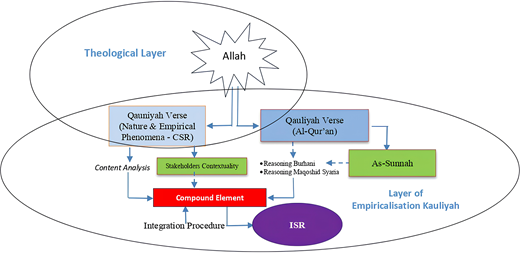
Figure 2 explains the ISR scientific methodology procedure, namely ISR methodology based on Monism (IMM), which is a combination of Islamic science and existing CSR by using Islamic Burhani methodology and Maqashid Sharia while still paying attention to the philosophical foundations of science (ontology). In terms of the ontological basis (the basic science material), debating the ontological layers between CSR and ISR is actually unnecessary and not difficult to unravel. Both sciences are ontologically sourced from one substance, namely, Allah SWT as a form of monism of a single and absolute existence (theological layer). CSR (Ayat Qauniyah), which is considered value-free, capitalist, nomothetic and deterministic (does not recognize the transcendental and is free from value), is actually a creation of Allah SWT as a monism of existence. Likewise, ISR, which is considered by some scientists as a value requirement, especially the value of divinity with the divine dimension (transedental), is also a creation of Allah SWT as a monism of existence. This means that both when viewed from the aspect of ontology are one, the difference lies in the touch of the transcendental aspect when formulating social accounting (ISR). Both scientific terms have the same elements, so that with certain methodological formulations the science can be united (integrated). Here, it is very clear that the formulation of ontology in ISR cannot be separated or even both are sourced from one existence. Allah SWT is the Almighty Ahad, the Almighty khodim and jadid, the creator of the universe that no one can equal it (ontology). The monism of his existence, creating what exists other than him, which means that other than Allah SWT is his creation. This is the ontological basis of CSR and ISR integration. Both are signs of the existence of Allah SWT (the monism of existence).
The procedure for integrating these two scientific terms (CSR and ISR) is carried out by combining interpretative content analysis with the methods of Islamic science, Burhani reasoning and Maqashid Sharia into a single scientific method. The existing science of social accounting (CSR) is presented as an answer to the negative impact of industry which is ontologically sourced from nature (qauniyah) which has the law of causality, value-free, nomothetic and capitalist, is a creation of Allah because of its existence outside the monism of Allah SWT. On the other hand, the extension of Allah SWT is also shown by qauliyah verses in the form of the Qur’an, in relation to CSR, including QS. Al Baqarah: 185, QS. Ali Imran: 190, QS. Hajj: 46. Thus, the two verses (qauniyah and qauliyah) can be integrated with the following steps:
Finding theories and concepts from kauniyah verses (CSR theory) by using the extended content analysis procedure. The content analysis procedure is expanded to include steps to understand the text to find the meaning behind it, in this case the CSR theories and concepts that have been formulated by experts and scientists previously. Extended content analysis includes critical analysis of empirical phenomena, especially those that intersect with the company’s alignment with society and the environment (contextuality of stakeholders). At the end of this procedure, elements of CSR that have similar content that can be filled with transcendental elements are found, which will later be integrated.
Find concepts and elements of ISR from the Qur’an (qauliyah verses) and As- Sunnah, with the following procedure:
Epistemology (reasoning) Burhani
Allah SWT sent down revelation (Al-Qur’an) to the prophet Muhammad SAW to be conveyed to his people which contains provisions, teachings, prohibitions and provisions to regulate the behaviour of his people. There, it contains countless concepts, which in implementing its content, the Prophet Muhammad SAW gave an example through hadith. The grand concept contained in the Qur’an and Assunnah can be the basis for finding a grand theory that is theoretically operational and certain techniques help solve practical problems. In Islamic methodology, analysing qauliyah verses and As-Sunnah into ISR elements can use burhani and bayani reasoning. Burhani reasoning views that the texts in the Qur’an and As-Sunnah guide how humans behave and carry out daily activities (Arrigoni, 2019). Burhani reasoning analyses concepts and elements in the Qur’an and Sunnah connected with elements in conventional theory (CSR) using the maqhosid sharia procedure to produce a new ISR concept.
Burhani epistemology guides reasoning based on approaches and spiritual experiences and direct ratios of visible (empirical) reality (Nuhanovi and Deli, 2019). Here the ratio is used to explain spiritual and empirical experiences. Burhani reasoning is based on critical thinking activities in determining a concept or proposition in a deductive way, where the proposition is linked to one another based on axioms that have been proven correct. ISR concepts derived from the Qur’an and As-Sunnah to have empirical productivity value, it must be connected to the context of empirical phenomena (companies and society).
The steps in Burhani reasoning are as follows:
Reading the Qur’an and As-Sunnah by understanding their meaning and meaning carefully.
Sorting the content in the Qur’an and As-Sunnah into concepts, variables or dimensions of ISR that are qath’i (certain) and dzanni (assumptions).
Conducting in-depth analyses on concepts, variables, and dimensions of CSR that are dzanni (assumptions) into concepts, variables, and dimensions of ISR that are certain.
Classifying ISR concepts, variables and dimensions according to certain characteristics.
Including the dimension of spiritual experience in the consideration of determining the characteristics of ISR.
Finding common elements in each group and finding relationships between components or elements for integration. This can use analogy (qiyas), istidlal bi al-syahid ala al-ghaib (analogical reasoning between the sensory and transcendentworlds) and tasybih (comparison).
Developing the meaning (ma’qulat) of ISR by contextualizing the external object (CSR phenomenon) and stakeholders.
Formulating statements (ibarat), namely, the formation of propositions or notions.
Determining the reasoning (tahlilan) in the form of an arrangement of propositions in the form of relationships between existing premises.
Maqashid Al-Sharia
Maqashid Sharia is a method for understanding the meaning, purpose, secrets and matters behind the formation of law. Maqashid sharia is a fundamental concept that exists to create and maintain benefits for mankind. The concept of maqasid sharia, the scholars agree to be a reference for realizing good while avoiding evil or drawing benefits and rejecting harm (dar’u al-mafasid wal jalb al-masalih). In essence, maqasid sharia is a concept that brings benefit to the people in carrying out muamalah. According to Iman Ghozali, muamalah as the implementation of the Qur’an and As-Sunnah is free from all harm but brings benefits. In terms of Maqashid Sharia, Iman Ghazali divides the benefits into five, including: (1) protecting religion (hifdz ad-Din); (2) guarding the soul (hifdz an-Nafs); (3) maintaining reason (hifdz al-Aql); (4) guarding property (hifdz al-Maal); and (5) protecting offspring (hifdz an-Nasl). In that context, by using the Maqashid Sharia concept, concepts derived from the Al-Qur’an and As-Sunnah can be conceptualized as CSRI, or even the elements contained therein have the potential to be integrated with elements in conventional CSR which have compound similarities. Therefore, the maqashid sharia procedure can be a method in integrating CSR scholarship. The steps in implementing maqhosid shari’ah in ISR are as follows:
Assist in the Burhani procedure in parsing the nash in the Qur’an and As-Sunnah into concepts, variables and dimensions of ISR that have benefits and alignments with religion, protecting property/environment, soul, mind and offspring/community by considering commands and prohibitions (mujarrad al amr wa an nahy al ibtida’i at tasrihi).
Assisting the Burhani procedure in parsing the nash in the Qur’an and As-Sunnah into concepts, variables and dimensions of ISR by paying attention to the illat.
Assisting in the Burhani procedure in parsing the texts in the Qur’an and As-Sunnah into concepts, variables and dimensions of ISR with regard to the derived maqashid (at tabi’ah).
Assisting and ensuring that in the Burhani procedure, there is no shar’i explanation (sukut ash sayri’).
Considering the steps or procedures of the ISR methodology, the distinction of the research is demonstrated by the construction of the IMM, where the procedure begins with the enrichment of qaulaiyah and qauniyah verses through content analysis, thereby identifying elements that share common patterns or regularities as the foundational material to be integrated. The integration process is carried out by using the procedures of burhani reasoning and maqhasid sharia, thereby ensuring that ISR holds meaningful and productive value in supporting the community and the environment.
6. Conclusion
Based on the monism ontology of existence that the existence of nature comes from the One, namely Allah SWT, then integrating the methodology of social accounting science (CSR) with Islamic science methodology (Burhani reasoning and Maqashid Al-Sharia) to realize humanist science is not something that is impossible. The unification makes accounting science more humanist, as in the form of Islamic, humanist and contextual ISR implementation with stakeholders. Methodologically, the procedure starts from the unification of kauniyah verses (existing CSR theories and concepts, empirical phenomena and contextual stakeholders) integrated with kauliyah verses (Al-Qur’an) and As-Sunnah by using Islamic science method procedures (Burhani reasoning and Maqashid Al-Sharia) found a new concept of ISR. The findings and distinction of this research is the presence of the IMM construction, which is a combination of scientific methodology and Islamic methodology (Burhani and Maqashid Sharia) that produces a new ISR concept that incorporates the Islamic dimension (transcendental) so that it becomes humanistic and contextual science. Practically, the research contributes to providing a new frame of reference for how to design social accounting, such as formulating the implementation of ISR (formulating its dimensions) based on sincerity of intention and meaning to be right in favour of not only shareholders but also stakeholders, so that sustainable development occurs. The new concept of ISR, keeping CSR and ISR from being uprooted from their roots.
7. Limitation and recommendation
The research has been conducted to the fullest extent possible; however, there are still limitations and weaknesses, particularly in the practical or empirical application of the IMM. This is because the research still contains speculative elements, as it was constructed using an interpretative method that draws on Burhani reasoning and Maqashid Sharia. Further research is recommended to develop more operational procedures, and if deemed necessary, experiments using this integration method should be conducted.