The relationship between knowledge management, business performance and gamification remain underexplored in the scientific literature, despite the potential connection and growing interest due to the increasing adoption of gamification in organizations. The purpose of this paper is twofold: first, to enhance the current literature on the relationship between knowledge management and gamification, and second, to leverage this relationship to unlock business performance through gamification.
A unique theoretical framework based on intellectual capital, knowledge management, value cocreation and stakeholder engagement specifically applied to gamification has been developed and tested by analyzing a sample of 176 scientific articles, including case studies, simulations and pilot projects. A classification tree methodology has then guided the identification of strategic implementation models.
As a result, nine strategic implementation models based on knowledge management and gamification have been developed using a machine learning algorithm. This will support organizations wishing to unlock business potential.
From a theoretical perspective, this paper contributes to understanding knowledge management practices leveraging intellectual capital, stakeholder engagement and value cocreation by using gamification.
This paper can support entrepreneurs in understanding mechanisms to unlock business potentials leveraging knowledge management and gamification to cocreate greater value. Also, managers can be operationally supported in unlocking business potentials by understanding the potential of intellectual capital and knowledge management and the stakeholder engagement practices to cocreate greater value using gamification.
This paper’s unique theoretical framework aims to enhance knowledge management practices with gamification. Also, the adoption of a classification tree to design strategic business models to unlock business potential is quite original.
1. Introduction
Knowledge becomes valuable only when effectively managed. Darroch and McNaughton (2002) define knowledge management (KM) as a managerial capability essential for strategically leveraging knowledge to achieve sustained organizational success (du Plessis, 2007). In innovation contexts, knowledge is fundamental for generating new knowledge (Herkema, 2003) or integrating diverse knowledge sources (Petruzzelli et al., 2018). Similarly, structured knowledge systems and information resources are critical for organizational survival in business management contexts (Ferreira et al., 2020).
The literature extensively documents the relationship between KM and organizational performance, both directly and indirectly. Scholars have explored KM processes in relation to firm performance (Chen et al., 2010; Lee et al., 2013), emphasizing KM capability (Ho, 2008; Hsiao et al., 2011) and KM capacity (Lin and Kuo, 2007), and underscoring KM’s role in fostering innovation (Byukusenge et al., 2017; Lai et al., 2021). Recent studies identify KM engagement as a determinant of knowledge worker productivity (Firdaus et al., 2024), underscoring stakeholder engagement as critical for resource exchange (Freeman, 1984; Morsing and Schults, 2006).
Gamification, defined as the application of game elements in nongame contexts, has gained prominence as a strategy to foster employee engagement, stimulate motivation and promote higher-level organizational contributions (Karsan and Kruse, 2011; Kapp, 2012). Unlike simple employee satisfaction, effective engagement motivates individuals to exert discretionary effort aligned with organizational goals (Karsan and Kruse, 2011). Consequently, enhanced employee engagement through gamification can strengthen KM practices by facilitating knowledge sharing.
Gamification serves as a strategic resource for enhancing psychological and cognitive engagement (Deterding et al., 2011; Banerjee et al., 2023), bridging digital divides (Varma et al., 2021) and positively influencing employee engagement, entrepreneurial orientation and overall firm performance (Rezaei and Ortt, 2018; Elidjen et al., 2022). However, perspectives vary on gamification’s effectiveness, ranging from optimistic forecasts to skeptical views about its sustainability (Gartner Research, 2012; Pettey and Van der Meulen, 2012).
Research exploring the intersection between KM and gamification reveals that game elements can significantly improve KM practices. They do so by encouraging intrinsic motivation to share knowledge, enhancing enterprise collaboration systems and boosting overall KM performance, engagement and service quality (Swacha, 2015; Suh and Wagner, 2017; Malingkas and Ce, 2020; Friedrich et al., 2020).
Over the past decade, games and gamification have increasingly influenced business performance across diverse sectors, including health care (Sardi et al., 2017), education (Kalogiannakis et al., 2021; Khaldi et al., 2023), marketing (Merhabi et al., 2021), logistics (Warmelink et al., 2020), services (Huotari and Hamari, 2017; Ciuchita et al., 2023), innovation (Gimenez‐Fernandez et al., 2021), manufacturing (Keepers et al., 2022), human resources (Thomas et al., 2022), tourism (Xu et al., 2017) and freight (Tomé Klock et al., 2021).
The role of digitalization in facilitating knowledge exchange via gamification remains debated. While digital technologies potentially enhance knowledge sharing (Mabey and Zhao, 2017; Lanzolla et al., 2021), their effectiveness heavily depends on internal preparatory processes (Antonelli, 2017). Conversely, inadequate gamification design can hinder effective knowledge exchange and value cocreation, leading to issues like knowledge hiding (Newell et al., 2001). Despite numerous empirical studies using case analyses, simulations and statistical models to evaluate gamification impacts (Araújo and Pestana, 2017), optimal configurations of game elements and their business applications remain unclear. Recent systematic reviews have emphasized identifying critical design elements and implementation contexts (Ciuchita et al., 2023; Riar et al., 2022; Cammarano et al., 2023a, 2023b; Wanick and Bui, 2019). However, integrated implementation models are still lacking.
Although the relevance of gamification to KM and stakeholder engagement is acknowledged, research on its role in fostering value cocreation through knowledge sharing to unlock organizational potential remains limited. With the aim to cover this gap, this paper explores relationships among intellectual capital (IC), KM, gamification and value cocreation facilitated by stakeholder engagement. The research questions (RQs) guiding this study are:
How can intellectual capital enhance KM practices, value cocreation processes and stakeholder engagement to unlock business potential via gamification?
How do gamification design elements facilitate successful business practices, and what are their benefits in specific business contexts?
To answer these questions, we first develop a theoretical model integrating KM, gamification and IC, emphasizing stakeholder engagement actions (Freeman, 1984) and IC dimensions (human, relational and structural) to facilitate value cocreation (Prahalad and Ramaswamy, 2000, 2003, 2004a, 2004b). Applying gamification principles, our model seeks to increase knowledge sharing, reduce knowledge hiding and promote continuous knowledge creation.
Building on Nonaka and Takeuchi’s (1995)SECI model, this framework extends knowledge transformation processes, enabling dynamic interactions of tacit and explicit knowledge within gamified collaborative environments involving internal and external stakeholders. This fosters ongoing innovation and aligns with contemporary paradigms such as open innovation and digital knowledge platforms, enhancing traditional KM frameworks rather than replacing them.
Second, we empirically test this model through a rigorous content analysis of 176 scientific articles focusing on business cases, simulations and pilot projects. Gamification practices identified in the literature were systematically classified according to:
business functions;
design elements (type of game, game elements, platforms); and
impacts on business performance.
The resulting data set enabled the development of a classification tree to determine robust implementation models aligned with our theoretical framework.
Consequently, nine specific implementation models emerged, each characterized by distinct combinations of gamification design elements, business functions and intended impacts. Practically, this research provides a structured approach to selecting gamification strategies that maximize returns and simplify decision-making in organizational contexts.
The remainder of the paper is structured as follows: Section 2 outlines the theoretical framework and details gamification design elements. Section 3 explains the methodology, including data collection and classification tree analysis. Section 4 presents results, while Section 5 discusses theoretical and managerial implications. Finally, the paper concludes with final remarks and suggestions for future research directions in Section 6.
2. Theoretical framework
2.1 Intellectual capital
IC is fundamental for organizations adopting a knowledge-driven approach (Kucharska, 2022), as it constitutes the foundation, as stock, of KM (Bontis et al., 2002; Bontis, 2004; Duodu and Rowlinson, 2019; Dahiyat et al., 2023). The interdependence between IC and KM is well established: “there is no knowledge without IC and vice versa” (Kucharska, 2022, p. 122; also, Rastogi, 2000; Kucharska, 2022). However, a key challenge remains in developing integrated IC-KM models. Each IC component (human, relational, structural and renewal capital) supports organizations in achieving strategic and operational goals. Human capital represents a dynamic balance of knowledge, skills and attitudes (Kirschner, 2015) or abilities (Youndt and Snell, 2004; Subramaniam and Youndt, 2005; Crook et al., 2011). It is also assumed that human capital is related to the skills and tacit knowledge developed and held by managers and employees (Youndt et al., 1996; Carmeli and Tishler, 2004; Hatch and Dyer, 2004; Subramaniam and Youndt, 2005; Chen et al., 2009; Kucharska, 2022). Some of this knowledge is tacit and part of this knowledge can be not shared, hidden or underevaluated, and it represents an untapped potential that can impact the competitive advantage of the organizations. Human and relational capital coexist within a stakeholder framework, where intangible assets (in combination with tangibles) serve as key enablers of knowledge creation. Strengthening stakeholder engagement involves enhancing both human and relational capital. By leveraging structural capital and integrating gamification with internal and external stakeholders, organizations can stimulate knowledge exchange, maximize sharing and reduce knowledge hiding, creating conditions for value cocreation. A practical example is collaborative problem-solving and mutual learning through gamified knowledge sharing in an open innovation process. IC, therefore, constitutes a reservoir of critical knowledge resources with significant potential to drive competitive advantage.
2.2 Knowledge management
Knowledge is widely recognized as a fundamental pillar of competitive advantage (Quinn, 1992; Doz, 1996; Teece, 1998; Chen et al., 2009; Friedrich et al., 2020). The ability to generate and use knowledge is one of the most critical strategic resources for organizations to achieve sustainable competitive advantages (Nonaka, 1990, 1991, 1994; Nonaka and Takeuchi, 1995; Nonaka and Toyama, 2003). According to Ahuja and Katila (2001), an organization’s ability to apply new knowledge in decision-making, problem-solving and innovation depends on how it structures its knowledge base.
From a systems thinking perspective, organizations function as networks consisting in reticules of interconnected elements both within and beyond their boundaries. These reticules form the foundation for strategic and tactical decision-making, where knowledge is created, skills are refined and managerial and employee capabilities are tested and developed. The competitive advantage of an organization emerges from its ability to manage and capitalize on these interactions effectively.
New knowledge creation requires dynamic and ethical interactions that foster long-term relationships within and between organizations. The process follows a socialization-based spiral, where tacit knowledge emerges through shared experiences in daily interactions “which is the process of converting new tacit knowledge through shared experiences in day-to-day social interaction,” Nonaka and Toyama, 2003, p. 4). Giddens (1984) differentiates between “discursive consciousness,” which generates explicit knowledge through rationalization and “practical consciousness,” which underlies tacit knowledge embedded in routine actions (Nonaka and Toyama, 2003, p. 4). Tacit and explicit knowledge dynamically evolve within an organization’s network of interactions, directly influencing its competitive advantage. To capitalize on these opportunities, organizations should implement effective KM systems that foster knowledge sharing, mitigate knowledge hiding and facilitate knowledge capture and transfer. Gamification serves as a mechanism to enhance these processes, improving both organizational and market performance.
By linking KM to gamification, the transformation of tacit and explicit knowledge can be accelerated. The SECI model (Nonaka and Takeuchi, 1995) suggests that knowledge exchange should extend beyond organizational boundaries into gamified collaborative spaces involving external stakeholders. When aligned with stakeholder engagement and value cocreation frameworks, this approach amplifies knowledge generation, fostering greater innovation and an expanded knowledge ecosystem. Through the integration of internal insights, external contributions or a blend of both, gamification sustains motivation and iteration in knowledge-sharing processes, creating a more dynamic and enriched organizational learning environment.
2.3 Value cocreation
Value cocreation is crucial for organizational viability and is widely recognized in the literature as arising through interactions among multiple stakeholders, encompassing both human-to-human (Vargo and Lusch, 2004, 2008) and human-to-technology dimensions (Barile et al., 2024). Building on the foundational work of Prahalad and Ramaswamy (2000, 2003, 2004a, 2004b), value cocreation is conceptualized as the interactive coconstruction of personalized experiences involving active dialogues among multiple actors (Prahalad and Ramaswamy, 2004a).
Value is cocreated by leveraging operant resources to act on operand resources (Vargo and Lusch, 2004, 2008). The first “are employed to act on operand resources” and the second “on which an operation or act is performed to produce an effect” (Vargo and Lush, 2004, p. 2) have distinct characteristics: operant resources are informational and dynamic, while operand resources are physical and static (Edvardsson et al., 2011; Kwon, 2023). Consequently, operant resources align with structural capital, whereas operand resources relate to human capital.
This study conceptualizes value cocreation as a process embedded within managerial and relational activities, involving multiple stakeholders to enhance organizational performance. Within service science, “co-creation is seen at the core of the theoretical development of a service systems science” (Galvagno and Dalli, 2014, p. 650). Specifically, value cocreation enhances KM, gamification and IC, thus facilitating knowledge generation and unlocking business potential. Rooted in Prahalad and Ramaswamy’s (2000, 2004a, 2004b) cocreation theory, this model leverages stakeholder, human and IC engagement to integrate diverse knowledge sources. This integration reduces knowledge hiding and fosters collaborative innovation by using structural capital and gamification.
2.4 Stakeholder engagement
According to stakeholder theory (Freeman, 1984), stakeholder engagement refers to the effort to understand and explain the relationships between an organization and its stakeholders − such as employees, customers, suppliers, competitors and local communities − as well as the outcomes these relationships produce (Kujala et al., 2022, p. 137). Stakeholder engagement has been examined through various perspectives, including innovation (Goodman et al., 2017; Bendell and Huvaj, 2020; Scuotto et al., 2020; Watson et al., 2020; Alvarez and Sachs, 2021) and learning and knowledge creation (Desai, 2018; Mitchell et al., 2022).
Stakeholder engagement can have both strategic and organizational impacts, contributing to value cocreation, knowledge generation and reputation enhancement (Kujala et al., 2022). Policies aimed at continuously improving stakeholder engagement facilitate socialization and interactions among internal and external actors. These interactions serve as a precondition for establishing a KM system that fosters knowledge sharing and creation. Through this system, knowledge elements can be effectively captured and disseminated via gamification, ultimately enhancing organizational and market performance. By successfully implementing this process, value will be continuously cocreated, potentially leading to a significant enhancement of competitive advantage. Stakeholder engagement thus plays a pivotal role in strengthening KM, gamification and IC, fostering value cocreation and unlocking business potential.
Examples of stakeholder engagement policies leveraging gamification and IC can be found across various industries. In health care, hospitals implement gamified training programs for medical staff, enhancing knowledge retention and collaboration while strengthening structural capital. In education, universities use gamified platforms to engage students and faculty in cocreating learning experiences, fostering relational capital and collective knowledge generation. In manufacturing, companies adopt gamified quality control systems, encouraging employees to actively contribute to process optimization and innovation. In retail, brands integrate gamification into customer loyalty programs, enhancing consumer engagement and codeveloping personalized solutions. In sustainability, firms use gamified platforms to involve stakeholders in environmental initiatives, promoting knowledge sharing and responsible practices. These policies, by aligning gamification with structural and relational capital, create dynamic ecosystems where IC is continuously developed, enhancing value cocreation and driving long-term competitive advantage.
2.5 Type of game
Games have always been considered an enduring form of entertainment. They play a crucial role in fostering individuals’ development, learning, well-being and socialization. Historically, the importance of games in the business context has emerged in various models and has influenced different aspects of business by providing benefits such as team building, learning, motivation, customer engagement and retention (Riar et al., 2022). The strategic use of games has helped to create a more positive working environment, improve the effectiveness of business initiatives and create meaningful relationships with employees and customers (Koivisto and Hamari, 2019). However, recently the format and technology of games have changed completely. Indeed, several types of games have emerged in the business context such as serious games, gamified environments, simulations and advergames. Each of them has specific characteristics and applications in the business context.
Serious games are designed to offer an engaging gaming experience while primarily serving educational or informational purposes (Larson, 2020). They are designed to teach, train or engagingly communicate specific concepts. These games serve purposes such as employee training, increasing awareness of social issues and encouraging specific behavioral outcomes (Van Dijk et al., 2015; Benitez et al., 2022). For example, Jackson et al. (2020) analyzed the serious game, Resilience Challenge, in which players have to solve problems in clinical practice. The game equips medical personnel with adaptive skills and decisiveness in decision-making while also serving as a valuable tool for comparing decisions among medical professionals in specific scenarios.
Gamified environments involve incorporating game elements and dynamics into nongame contexts (Deterding et al., 2011). Compared to serious games, gamified environments require a strategic vision applied to the nongame context (Wanick and Bui, 2019). The main objective of gamified environments is to motivate, engage and reward people for performing certain actions or achieving specific goals (Plangger et al., 2022). They can be used to enhance employee training, incentivize employees, promote customer interaction or improve productivity. Several case studies are presented in the literature that aim to highlight the benefits of using gamification in business contexts. For instance, Ohlig et al. (2021) analyzed how gamification can be useful for the supply of materials for truck production. The employee team is responsible for maintaining an uninterrupted supply of materials and ensuring that any missing items are promptly made available.
A further type of game that is increasingly emerging in business contexts is simulation. Specifically, it refers to a game that simulates real-world or hypothetical scenarios. Simulations are designed to provide realistic experiences that enable users to learn or develop specific skills. They are used for strategic planning or scenario analysis (Gatti et al., 2019). For example, Steinberger et al. (2017) created a driving simulation for drivers in various delivery routes. Within the different scenarios, boredom stimuli are included to simulate the actual emotional performance of a driver over long delivery routes and to prepare him correctly for work (Perano et al., 2023).
Finally, advergames are created to promote a specific product, brand or service. They are designed to engage users in a fun and entertaining way, while at the same time communicating an advertising or promotional message (Vashisht and Royne, 2019). The main objective is to increase brand awareness, engage consumers and promote interaction with the product or service (Rialti et al., 2022).
2.6 Game elements
Game elements represent the game mechanics, i.e. the tools through which the player performs actions within the game (Toda et al., 2019). Table 1 outlines the various game elements applicable to different game types, along with brief descriptions. These elements are valuable in business settings as they enhance participation, encourage target behaviors, support learning and promote social interaction (Lier and Breuer, 2020). Badges and points are widely recognized to incentivize customers to regularly purchase products from a company (Cavusoglu et al., 2021). In addition, gamification is used to engage customers to post reviews to achieve certain rewards or earn points to demonstrate their competence (Bravo et al., 2021). Game elements can also be used for training employees to facilitate their learning of competencies and skills. For example, goals, levels and feedback can motivate and engage employees to improve their skills and increase company productivity (Silic et al., 2020). Several case studies based on points or rankings reward employees who complete projects early (Spahrbier et al., 2022). Applications based on quizzes, challenges or levels can improve competencies in specific professional areas and promote the achievement of sustainability goals (Alcivar and Abad, 2016).
2.7 Game platforms
Game platforms are systems that foster the creation, distribution and execution of games and interactive experiences. These platforms have become increasingly important in the business world as they offer opportunities to exploit game elements to engage customers, motivate employees and achieve business goals (Kittur and Islam, 2021). Table 2 presents the main game platforms with a brief description. In addition to the traditional game platforms, such as computer games and video games, mobile applications have been broadly used recently. They easily involve customers and employees due to the widespread use of smartphones (Cammarano et al., 2023a, 2023b; Varriale et al., 2023). For instance, Oppong-Tawiah et al. (2020) used a mobile application that engages employees and encourages them to reduce their electricity consumption by allowing them to monitor their consumption from their smartphones and receive information on energy-saving practices. However, classic gaming platforms such as software, computer games and video games provide more immersiveness and a better gaming experience for the end user (Priyadi et al., 2023). The difference between these gaming platforms lies mainly in their nature and the purpose for which they are used. The term software refers to computer programs designed to perform specific business activities (Herranz et al., 2019). Computer games and video games are electronic games used for training, team building or brand promotion purposes. The main difference between video games and computer games lies in the platform on which they are run. Video games are typically designed to run on game consoles such as PlayStation, Xbox or Nintendo, while computer games are designed to run on computers. Websites can easily include gamification elements. For example, Van Toorn et al. (2022) designed a gamified website for knowledge creation and sharing within an organization, where users should follow company rules and accumulate badges and receive notifications. Board games are increasingly used for business training, team building or as a marketing tool. For instance, the game “Innotin,” developed from the well-known board game Monopoly, was used in a coding lab for new product development. This platform increased creativity and knowledge among employees and improved the ease of learning (Parjanen and Hyypiä, 2019). Live streaming enables the creation of real-time gaming experiences that actively engage participants (Scheibe, 2018), and can be leveraged by e-commerce platforms to enrich the consumer shopping journey. It provides participants with a real-time viewing experience to obtain product information and offers opportunities for communication and social interaction between a streamer and viewers (Li et al., 2021).
2.8 Theoretical framework
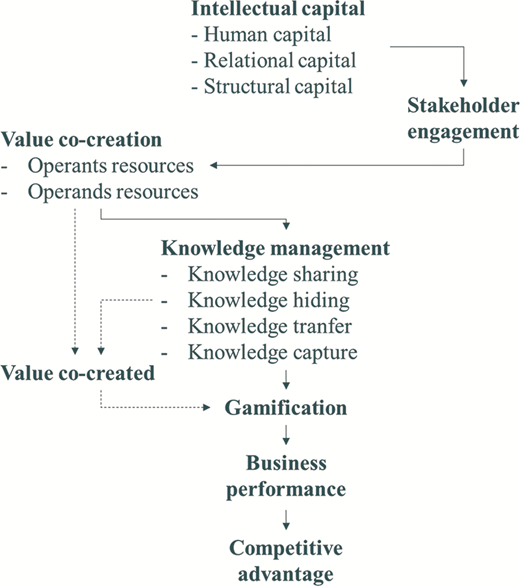
The main gap detected from the research problem highlighted in the introduction section attempts to the unexplored mechanism through which KM can unlock business practices and improve performance by using gamification. To this aim and considering the content developed in this section, we build our framework considering the nexus between:
IC and its components;
KM;
value cocreation mechanism and finally; and
stakeholder engagement (Figure 1).
The integration of these four theoretical domains (human capital, stakeholder engagement, KM and value cocreation) leads to the emergence of key elements. These elements stem from a process in which value, cocreated through human capital and activated by targeted stakeholder engagement, enhances knowledge sharing and capture. This knowledge is then transferred through gamification to unlock new or improved business practices.
By strategically leveraging structural, relational and human capital within a well-designed KM system, organizations can increase knowledge sharing, minimize knowledge hiding and facilitate the cocreation and dissemination of valuable knowledge assets. These elements, once processed and evaluated by top managers and managers, will be included in gamification and used to be transferred. Finally, organizational and market performance will be enhanced impacting the firms’ competitive advantage.
3. Material and methods
The study aims at understanding first how to enhance KM practices to impact business practices through gamification and second, how design elements contribute to the establishment of successful business practices and what benefits they bring to business contexts. To achieve this goal, successful business practices using gamification elements in specific business contexts were identified and classified from the literature to build a new database. This section describes how the analysis was conducted.
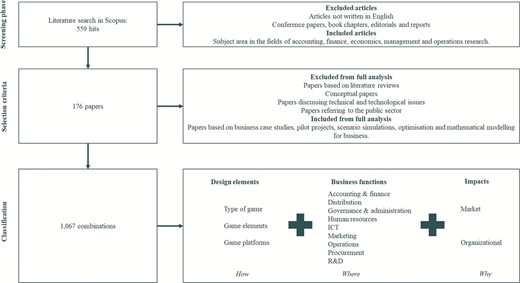
The literature review was conducted using the Scopus database in 2023, which aggregates content from sources such as Springer, IEEE, Taylor & Francis and SAGE. Relying on a single, comprehensive database enhances the replicability, rigor and transparency of the analysis (Paré et al., 2015). Scopus was chosen for its broad multidisciplinary coverage, strict inclusion of high-quality peer-reviewed publications and consistent accessibility for academic research (Bramer et al., 2016; Festa et al., 2018). Conference articles, book chapters, editorials and industrial reports were excluded from the analysis. The subject area considered is related to the fields of accounting, finance, economics, management and operations research within Q1 and Q2 Scimago Journal Ranking and ISI Web of Science.
The literature search yielded 559 results, which were further checked for inclusion or exclusion using the following criteria. The exclusion criteria relate to:
articles based on literature reviews;
conceptual articles;
articles discussing technical and technological implementation; and
articles referring to the public sector.
Conversely, we included articles based on:
business case studies;
pilot projects;
scenario simulations; and
optimization or mathematical modeling, as they provide concrete, context-specific insights into how gamification is applied in real-world business environments.
These empirical contributions allow for the identification of design requirements, business functions and impacts, which are essential for developing robust, practice-oriented strategic models through data-driven analysis. Therefore, the inclusion and exclusion criteria were meticulously designed to prioritize practical applications and emphasize the measurable impacts of gamification. This approach ensures that the analysis remains grounded in real-world contexts, offering actionable insights and tangible evidence of gamification’s effectiveness. By focusing on practical cases, the study aims to bridge the gap between theoretical frameworks and their implementation, while the emphasis on measurable impacts strengthens the reliability and relevance of the findings for both academic and business professionals. Table 3 provides the search strategy adopted, detailing the specific query string used as well as the inclusion and exclusion criteria used to guide the selection of relevant studies. This structured approach ensured transparency, reproducibility and alignment with the research objectives.
Therefore, the article was judged suitable when it is clear how gamification design elements (i.e. type of game, game elements and game platforms) are implemented within the business functions of an organization to achieve a specific impact (i.e. market or organizational). The business functions considered refer to the primary and support areas within an organization inspired by Porter’s (1990) classification. They are accounting & finance, distribution, governance & administration (G&A), human resources (HR), information and communication technology (ICT), marketing, operations, procurement and research and development (R&D). In addition, the specific impacts that the use of gamification brings to organizations have been identified. Market impacts involve the external context of the company, such as the market in which it operates and its customers, competitors and suppliers. They can affect the organization’s competitive position, market share, growth opportunities and profitability. They may require the organization to adapt its market strategy, revise prices or products, improve positioning or develop new business partnerships. Organizational impacts involve the organization itself, including its internal processes and operations, and organizational structure.
After the inclusion and exclusion phase of the described criteria, 176 articles were deemed suitable for the analysis process. The literature search procedure is shown in Figure 2. After the identification of the relevant literature, the papers were analyzed by identifying business practices supported by the design elements described above in specific business contexts to achieve a certain performance. First, the analysis involved the classification of gamification design elements in the business environment, i.e. type of game (serious games, gamification, advergames and simulations), game elements (see Table 1) and game platforms (see Table 2). Second, the procedure identified in which business functions these design elements were implemented. Finally, the final goal in terms of market or organizational impacts was identified.
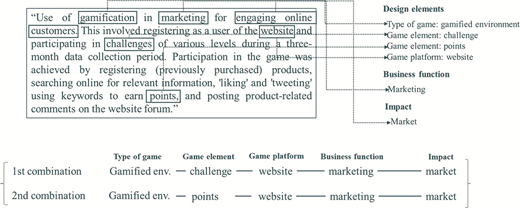
This procedure resulted in a coded matrix in which these five elements were considered for each selected article. The aim is to identify effective implementation models that integrate specific design elements and business contexts to generate targeted outcomes. Within the same article, the use of gamification may involve more than one design element. In the same way, gamification can be implemented in more than one business function and achieve different types of impact. Therefore, the matrix based on the 176 articles generated 1,067 combinations of type of game − game elements − game platforms − business functions − impacts. Figure 3 shows a classification example of a business practice based on the use of gamification in marketing to engage online customers (Harwood and Garry, 2015). In this case, the business function is marketing, and the impact is “market,” whereas the design elements are gamified environment, website and two game elements: challenges and points. Therefore, the same business practice is counted as two combinations since two discriminating game elements are present. This coded matrix will serve as the initial data set for training the classification tree outlined in the next section, aiming to identify successful implementation models that include these design elements.
3.1 Classification tree
Given the 1,067 combinations of categorical variables (such as game type, game elements, platforms, business functions and impacts), the identification of implementation models based on these design elements calls for a data analytics technique capable of revealing relationships among variables in an accessible way. This approach helps generate meaningful implementation models applicable to business contexts. This research used a classification tree, a technique rooted in machine learning (Kashani and Mohaymany, 2011). It handles both continuous and categorical data and is not affected by collinearity problems (Omerašević and Selimović, 2020). The classification tree involves a nonparametric analysis that builds a tree structure based on sequential optimization, using a training process to automatically identify a combination of independent variables to explain a dependent variable (Jesudoss Hynes et al., 2021). Starting from a root node, the algorithm recursively partitions it into subtrees according to the characteristics of the independent variables. Each path in the tree defines a classification rule based on the data (Guan et al., 2017). At each step, the classification tree partitions the data set by selecting values of the independent variable that maximize similarity in the dependent variable within each group while enhancing differences between groups (Kaparthi and Bumblauskas, 2020). A significant disadvantage of this methodology is that it presents accuracy problems when considering multicategory dependent variables (Jesudoss Hynes et al., 2021). The proposed classification tree will use impact as the dependent variable, with two categorical variables being market and organizational impact. SPSS software was used to conduct the analysis using the classification and regression tree method (CART) (Breiman, 2017). The CART method divides the root node into child nodes according to the independent variable which improves homogeneity. It continues the process for each child node until all elements in each group have the highest achievable homogeneity (Durica et al., 2019). This method will be used to intercept the most important independent variables, i.e. design elements and business functions, that influence business performance. In this work, node partitioning was interrupted for the following conditions:
the node reports 100% of the instances within the same label as the dependent variable (pure node);
the maximum number of partitioning levels was reached (for the CART method five);
the number of instances within a parent node is less than 70;
the following partition would result in a new child with less than 20 instances; and
the minimum difference in purity improvement (0.0001) as measured by the Gini index was reached.
A minimum threshold of 20 instances per node was established to ensure statistical stability, thereby avoiding nodes derived from overly small and unrepresentative samples that could undermine the reliability of generalizations. Moreover, this threshold limits excessive node fragmentation, preserving the robustness of the results. Given the data set’s total of 1,067 combinations, this value corresponds to approximately 2% of the total, striking an optimal balance between granularity and statistical significance. In addition, setting a low threshold for purity improvement ensures that further splits occur only when meaningful, thus avoiding overly specific nodes that may capture noise rather than relevant patterns. This strategy is particularly effective for data sets with numerous combinations, as it reduces the risk of generating overly complex and less generalizable decision trees. Furthermore, this threshold facilitates the detection of significant patterns while avoiding excessive fragmentation of the data. Model accuracy is the ratio of the count of classified data to the total number of observations, i.e. between 0% and 100% (Kaparthi and Bumblauskas, 2020). In literature, the accuracy of a classification tree is considered appropriate at percentages above 50% (Hu et al., 2017; Champahom et al., 2019); some studies suggest ratios above 70% (Dong and Zhou, 2020). Regarding training methods, the data set was split into a training and a test set. A training set was established at 70% and a test set at 30%. Therefore, to ensure analytical rigor and mitigate the risk of overfitting, a set of model robustness criteria was implemented in the classification tree procedure. Table 4 summarizes these key criteria, which were designed to enhance the model’s accuracy, interpretability and generalizability.
4. Results
This section provides the descriptive statistics of the variables considered in this study. The following tables aim to inform how the types of game, game elements, game platforms, business functions and impact, are relevant within the data set.
Table 5 shows the count and percentage of combinations by type of game in line with the approach used by Koivisto and Hamari (2019), Ciuchita et al. (2023) and Yang et al. (2023). In our study, the type of game most used for business is the gamified environment, which covers 83% of the sample. Serious and simulation games typically demand more advanced development and design efforts compared to gamified environments. Developing a fully featured game with sophisticated graphics, complex mechanics and high realism entails considerable time and financial resources. In contrast, gamified environments are more easily integrated into existing platforms such as mobile applications or websites, whereas serious games, simulations and advergames often necessitate dedicated software or specialized platforms.
Table 6 presents the game elements identified in descending order. The most frequently used game elements for gamification design are points, leaderboards, rewards, badges and feedback. Points and leaderboards can stimulate the desire to achieve specific goals. While rewards and badges can provide a sense of gratification and recognition for efforts made. Feedback can increase engagement and motivation by allowing people to see the results of their actions in real time. These game elements are readily applicable across various business contexts and can be seamlessly integrated into existing systems, including digital platforms and management information systems.
At the bottom of Table 6, there are game elements that are less adopted in business contexts such as game rounds, increasing difficulty, dice, board and cards. The low applicability of these game elements is due to the need for more detailed planning and management than other simpler game elements such as points or badges. Some game elements, such as dice or cards, might be more associated with games of chance rather than business contexts. These game elements may require an experience with role-playing games that not all employees may be familiar with or may not appreciate as valuable tools to achieve aspirational business goals.
Table 7 shows how often game platforms are implemented within the business contexts. Mobile apps and websites are broadly used. They offer an intuitive and easily accessible user experience. It is possible to monitor user engagement, collect behavioral information, measure progress and determine achievements. The least-used game platforms are video games and live streaming. These platforms are often aimed at a specific audience of gaming enthusiasts or viewers of streaming content. They are mainly aimed at entertaining people and provide features that are not necessary for business purposes.
Table 8 presents the results associated with the use of gamification in the various business functions. The business functions in which gamification is most widely implemented are human resources and operations, covering 85.7% of the total. Gamification has been less studied in areas such as procurement, G&A and ICT. These business environments involve complex and regulated processes. Activities in these areas require careful management of company procedures, policies and regulations, and often involve considerable amounts of money that firms may wish to optimize. The introduction of gamification may be complex and require appropriate design to integrate effectively with existing procedures.
Finally, our analysis identified 385 combinations in which gamification is used for market impacts and 682 combinations for organizational impacts. This finding supports the view that the majority of business case studies, pilot projects and simulations on gamification are primarily focused on generating internal business impacts. These include employee engagement, training and development, change management, performance monitoring and the enhancement of internal collaboration. However, gamification can help employees improve their performance with customers and become a tool for customer engagement or market satisfaction.
4.1 Classification tree analysis
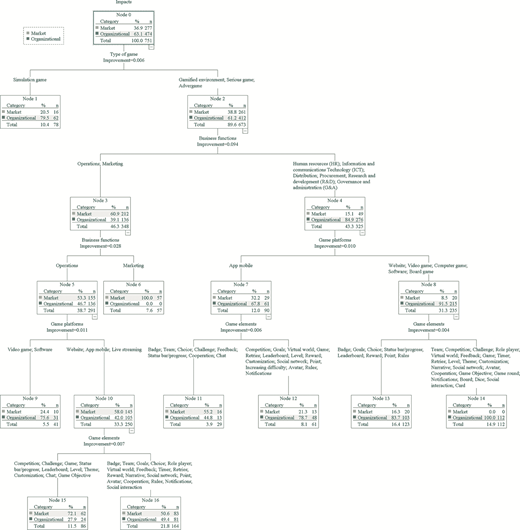
In this section, the results of the classification tree are presented. The classification tree analysis explores relationships between design elements, business contexts and achieve impacts, enabling the identification of effective implementation models. This last is related to the use of gamification based on both the design elements and the business contexts to be considered so that a specific impact can be achieved. For instance, a particular game element may be applicable exclusively within a specific business context or may be effective only in achieving a particular type of impact. Our analysis identifies gamification implementation models that would enable companies to understand what the ideal setting of design elements is, to be implemented in their business. The dependent variable we selected is the type of impact, consisting of two alternative labels, namely, positive improvements in market (“market”) and organizational (“organizational”) performance. The independent variables are the type of game, game elements, game platforms and business functions. From the output provided by SPSS, 17 nodes were obtained, of which 9 were terminals (Figure 4). The depth of the tree is 5, and it appears that all four independent variables were used to create the classification tree. Another noteworthy finding is that the relationship between the type of game, game elements and their impact is shaped by the specific business functions where gamification is implemented. This would indicate to managers that certain design elements may only be applied in some specific business contexts or to achieve certain impacts.
Table 9 shows the quality of the training model developed. The overall accuracy of the training set is 76.4%. For the test model, the accuracy is 75.6%. Therefore, the training model can predict a test model with good approximation. The overall risk estimate shows that the model incorrectly predicts in fewer than 30% of the cases (Table 10). According to the literature by Champahom et al. (2019), the model performs reasonably well in classifying the impact on business performance resulting from the design elements and business functions in which the gamification is implemented.
Figure 4 shows the graphical output. A description of each node and the steps of the tree construction process will be provided below. The nine terminal nodes can be considered robust and established examples of implementation models for various business contexts. To facilitate the readability of the text, they have been reported in bold.
Node 0 is split into two child nodes based on the “type of game” variable. The left branch (Node 1) corresponds to simulation games and is predominantly associated with organizational impacts. Node 2 encompasses all other game types and also shows a prevalence of organizational impacts. This initial split is particularly meaningful, as it suggests that different game types may be linked to distinct business outcomes. In particular, terminal Node 1 indicates that simulation games are applicable across various business contexts to enhance organizational performance. Considering terminal Node 1, the use of simulation games in business contexts can be applicable in any business context to improve organizational impacts. Simulation provides participants with the opportunity to encounter realistic scenarios, make decisions in a controlled environment and acquire knowledge and practical skills in an engaging manner. This encourages participants to develop problem-solving and decision-making skills that are flexible to multiple business contexts. It enables organizations to test different strategies, tactics or scenarios in different business functions without having to face the actual consequences directly, reducing the potential risks of failure. Node 2 is subsequently split into Nodes 3 and 4 based on the “business functions” variable, yielding a purity improvement of 0.094, indicating a 9.4% increase in within-group homogeneity as measured by the Gini index. Node 3 is linked to the operations and marketing functions and is primarily associated with market impacts. Conversely, Node 4 encompasses all remaining business functions and is predominantly associated with organizational impacts. Node 3 is then subdivided into Node 5 − associated with operations − and the terminal Node 6 associated with marketing where the prevailing impact is “market” (Pure node). This terminal node indicates how gamified environments, advergames and serious games are used in marketing solely to improve market performance.
Node 5 is divided into terminal Nodes 9 and 10 according to the variable game platforms with a purity improvement of 0.011. Terminal Node 9 differs from Node 10 not only by the presence of different game platforms but also by their use in terms of impact. For terminal Node 9, the predominant impact is organizational, while for terminal Node 10, the predominant impact is market. Considering Node 9, it appears that the game platforms used in operations to achieve organizational impact are video games and software. The use of these game platforms within operations is primarily intended to enhance efficiency, support employee training and foster skills development. Project management software facilitates activity planning and monitoring, while video games can automate data collection or streamline repetitive tasks. In the case of Node 10, platforms such as websites, live streaming and mobile applications are used within operational functions to generate market-related impacts. These platforms facilitate brand awareness creation and product promotion to drive market impact. Companies can communicate the benefits of their products and generate interest and participation from potential customers. Node 10 is further split according to game elements into Nodes 15 and 16, both terminal with a purity improvement of 0.007. The two nodes differ in the use of specific game elements. Node 15 includes elements that are more oriented toward market-related impacts, such as competition, challenge, game dynamics, status bars/progress indicators, leaderboards, levels, themes, customization, chat features and defined game objectives. In contrast, Node 16 presents a more balanced use of elements aimed at both organizational and market impacts. Node 4, associated with all other business functions, was divided according to game platforms into Nodes 7 and 8 with a 0.010 improvement. Node 7 is characterized by using mobile apps, while Node 8 includes websites, video games, computer games, software and board games. Although the game platforms in Node 8 are primarily geared toward generating organizational impacts, mobile applications stand out as tools capable of achieving market-oriented outcomes. Accordingly, Node 7 is further divided into terminal Nodes 11 and 12, based on the specific game elements used, with a purity improvement of 0.006. Terminal Node 11 indicates game elements that are more market impact-oriented. Status bar/progress and badge within the company’s mobile apps allow employees to monitor their progress, the level of their achievement of goals and to be recognized for their performance. These elements contribute to a sense of personal fulfillment and satisfaction, improving employee motivation and productivity by providing better customer service. In addition, feedback allows employees to receive ratings, recommendations and recognition of their performance. Within terminal Node 12, there are game elements that predominantly contribute to organizational impacts. They are competition, goals, virtual world, retries, leaderboard, level, reward, customization social network, point, increasing difficulty, avatar rules and notifications. They can create an interactive and engaging environment that stimulates employee participation, improving employee motivation and productivity.
Finally, Node 8 is divided into two terminal Nodes 13 and 14 according to game elements with 0.004 improvement. Both are oriented toward achieving organizational impact, however, in different ways. For example, in terminal Node 13, goals provide clear direction and a sense of purpose, helping employees to focus on activities relevant to achieving the organization’s goals. This can positively influence the effectiveness of business functions and employee productivity. Adopting choices can favor a sense of responsibility and involvement, allowing employees to personalize the experience and tailor it to their needs. Several game elements are included in pure terminal Node 14 that aim to achieve organizational impacts in different ways. The integration of a leaderboard, team, challenge and competition can create healthy competition among employees, promoting active participation and team spirit. The use of a virtual world within game platforms can provide immersive experiences in which employees can interact and experience specific scenarios or simulations. This can promote learning, creativity and understanding of complex business processes.
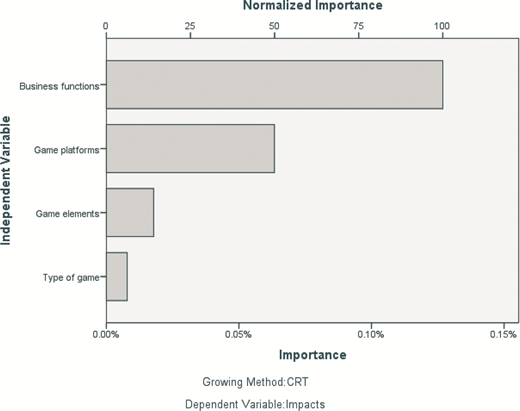
Figure 5 shows the importance of each independent variable. It emerges that the impact is mainly influenced by the business function, with 100% normalized importance. Therefore, the game platforms−impact relationship is strongly influenced by the business function. However, other variables, each with varying degrees of influence, contribute to the model and are essential for implementing gamification in business contexts.
Tables 11 and 12 describe the summary information for the terminal nodes, with specific information on gain, response and index percentage for each target category. “Node N” is the count of elements within the node and “Node %” is the weight of the node on the entire data set. “Gain N” is the number of instances in each terminal node that contain the target category and “Gain %” shows the weight of the node on the total number of instances that carry out the target category. “Response” is the percentage of instances within each node that possess the target category. Nodes with a response ratio of 100% are pure nodes. “Index” is the ratio of the response ratio of the target category within the focal node to the overall percentage of cases within the entire data set reporting the target category. Index values above 100% show that within the focal node, the concentration of the target category is higher than the entire data set.
According to the index indicator, Nodes 6, 15 and 11 capture the main opportunities for achieving market performance, when compared to the other nodes. Moreover, according to the gain indicator analysis, they jointly cover over 45% of the business practices that improve market performance, i.e. three out of ten nodes are focused on this target variable. They have mobile apps as a characteristic element. Indeed, these game platforms lead to a greater impact on the market because the customer is facilitated to use them compared to others and because they are easily accessible from smartphones and tablets.
In terms of organizational impact, Nodes 1, 13 and 14 are the most influential, covering more than 50% of the opportunities to improve organizational performance. Nodes 13 and 14 are adopted within business functions that interface less with final customers. Game platforms facilitate the implementation of gamification in business contexts such as software, computer games and board games because they are more easily implemented within the business software infrastructure.
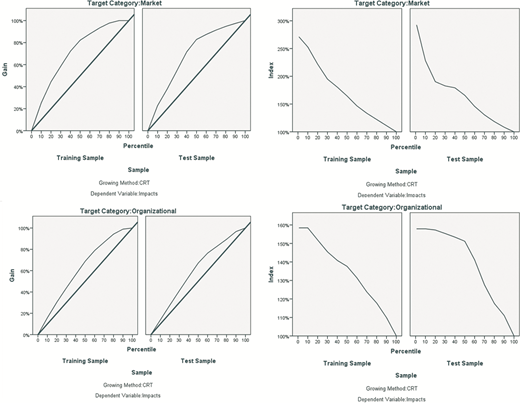
Figure 6 shows the Gain and the Index graph. The former suggests that the classification is reliable because the curves showing the cumulative “Gain %” values approach 100% rather quickly. Similarly, the Index graphs suggest that the classification is good because the Index values start above 100% and gradually decrease.
The nine most significant combinations of the variables resulting from the classification tree are shown in Table 13, with the combination count reported as node size. It represents the most frequent impact category for each node to identify the most relevant combinations across design elements, business functions and impacts.
5. Discussion
This paper develops and tests a theoretical framework linking IC, KM, value cocreation and stakeholder management as a foundation for gamification-driven decision-making. By leveraging structural and human capital within a robust KM system, organizations can enhance knowledge sharing, reduce knowledge hiding and generate new knowledge elements. These elements serve as inputs for gamification strategies aimed at improving organizational and market performance.
The study identifies key design elements for implementing gamification in business contexts. While previous research has examined case studies and pilot projects to assess gamification’s impact (Jackson et al., 2020; Ohlig et al., 2021), literature reviews have explored its applications across sectors such as human resources, marketing, production and logistics (Warmelink et al., 2020; Merhabi et al., 2021; Thomas et al., 2022). However, existing studies primarily list design elements without analyzing their optimal combinations in business practices.
By bridging theory and practice, this research evaluates gamification implementations to determine their effects on business performance and propose successful strategic models. The findings highlight the crucial role of IC − including its human, structural and relational components − in enhancing stakeholder engagement and improving knowledge-sharing processes, thereby reducing knowledge hiding and fostering value cocreation.
Using a classification tree analysis, the study establishes links between key variables, identifying optimal conditions for effective gamification design. In line with research advocating gamification as a standard rather than an option (Nenadić, 2019), this paper presents nine strategic implementation models ready for adoption by businesses.
5.1 Design elements for gamification
One of the main shortcomings in previous gamification studies is the lack of a coherent conceptualization and clear differentiation of game types, such as simulation games, advergames and serious games (Warmelink et al., 2020). The type of game plays a pivotal role in business applications, as it directly influences effectiveness across different contexts. In contrast to previous studies that have often neglected simulation and serious games, this research highlights their importance as fundamental components of gamification design. These games are used under specific conditions to model complex organizational processes, enabling participants to engage in scenario-based learning that enhances decision-making, critical thinking and analytical skills. Their emphasis on realistic system representations allows users to explore operational mechanisms and refine strategic competencies.
The choice of game platforms further determines the impact of gamification on business performance. The classification tree analysis reveals that video games, specialized software, computer-based applications and board games are predominantly used to enhance organizational performance. These platforms facilitate interactive engagement, employee training, team-building and skill development, fostering internal collaboration and efficiency. Conversely, websites, mobile applications and live-streaming platforms demonstrate a dual impact on both market engagement and internal operations. As versatile communication and marketing tools, they enable companies to engage large customer bases while simultaneously optimizing internal workflows and strengthening interdepartmental collaboration.
Game elements also serve as defining parameters within implementation models, shaping their effectiveness based on business objectives (Khan et al., 2020). Although points, badges, levels and leaderboards are widely recognized in the literature as core components of gamification (Huotari and Hamari, 2017), other elements (such as avatars, progress bars and customization options) have also been shown to enhance user engagement and amplify impact (Koivisto and Hamari, 2019). However, Helmefalk (2019) critiques the overreliance on conventional game mechanics, noting that many industry professionals mistakenly assume that their implementation alone guarantees business success.
This study provides a more comprehensive perspective on gamification design elements by identifying additional mechanisms that influence business outcomes. The classification tree results indicate that progress indicators, status bars, badges and chat functionalities are particularly effective in driving market impact. Notably, chat functionalities emerge as a key engagement tool, fostering real-time communication, knowledge sharing and interactive collaboration. These elements not only strengthen customer relationships and service responsiveness but also enhance internal knowledge exchange and stakeholder connectivity, ultimately contributing to a more cohesive and innovation-driven business environment.
5.2 Area of implementation and potential impacts
The existing gamification literature has predominantly focused on game elements while overlooking the business contexts in which gamified interactions occur (Ciuchita et al., 2023). Considering contextual factors is essential for identifying effective design elements and optimizing gamification strategies. To date, research has primarily examined gamification within education, crowdsourcing and health care (Laut et al., 2017; Basile et al., 2023), whereas its application across broader business domains remains underexplored. Addressing this gap, this study identifies the business functions where gamification is implemented, distinguishing between those that serve market-oriented objectives (e.g. marketing) and those primarily benefiting organizational processes (e.g. human resources, R&D, procurement, distribution, accounting and finance, general administration and ICT).
Unlike previous studies that neglected key operational and support functions, such as manufacturing, business strategy, finance and ICT support (Warmelink et al., 2020), this research provides a comprehensive analysis of all business functions where gamification is applied. In marketing, gamification is well established as a tool for enhancing customer engagement and loyalty (Hsu and Chen, 2018). In contrast, in HR, R&D and procurement, gamification fosters employee engagement, innovation, process efficiency and collaboration (Bitrián et al., 2021; Thomas et al., 2022). Within operations, the choice of game platform and elements determines whether gamification yields market-oriented, organizational or dual benefits. The classification tree analysis underscores the crucial role of implementation areas, revealing how business functions serve as determinant variables for successful technology adoption.
The classification tree identifies five terminal nodes linked to organizational impact (Nodes 1, 9, 12, 13 and 14) and four terminal nodes associated with market impact (Nodes 6, 11, 15 and 16). The findings indicate that the effectiveness of gamification is highly context-dependent, with the exception of simulation games, which demonstrate cross-functional applicability. Consequently, for gamification to achieve the intended business impact, it is imperative to carefully design game elements based on the specific business function and contextual requirements.
5.3 Strategic implementation models for gamification
Table 14 presents the core insights of this study, outlining nine strategic gamification implementation models for business adoption. Unlike previous literature reviews (Warmelink et al., 2020; Merhabi et al., 2021; Thomas et al., 2022), this study uses machine learning techniques to define optimal combinations of gamification design elements within specific business functions to achieve either organizational or market performance. While the nine strategic implementation models developed through the classification tree provide actionable pathways for gamification adoption, it is important to acknowledge that their effectiveness and business impact are not uniform across contexts. Each model reflects a unique configuration of design elements, business functions and technological platforms, yielding differentiated outcomes based on the specific environment in which it is applied.
The analysis reveals distinct implementation patterns within business contexts. Market-oriented models (Nodes 6, 11, 15 and 16) emphasize socialization, interaction and customer engagement, while organizational models (Nodes 12, 13 and 14) focus on employee motivation, progression and reward systems. For example, market-oriented models such as Nodes 6 and 15 are highly effective in B2C settings, particularly in marketing departments, due to their reliance on mobile applications and gamified environments that enhance customer interaction. These models are best suited to industries where consumer engagement, loyalty-building and brand visibility are strategic priorities. In contrast, organizational impact models such as Nodes 1 and 14 demonstrate their strength in internal training, process optimization and knowledge transfer. They rely on simulation games or software-based platforms, making them more applicable in manufacturing, logistics or HR settings.
The performance of each model should therefore be interpreted relative to its contextual fit. While all models were derived from robust empirical evidence and validated through a machine learning approach, their real-world implementation requires managers to critically evaluate organizational readiness, digital infrastructure, user receptiveness and strategic priorities. For instance, models that rely on advanced platforms such as simulation games may be less accessible to small and medium-sized enterprises (SMEs) with limited resources, whereas models leveraging mobile apps can scale more easily across diverse organizational sizes.
This synoptic model provides managers and practitioners with a structured approach to understanding where, how and why gamification should be implemented, offering a data-driven framework to optimize business outcomes.
Each of these models can inform practical strategies for managers. For example, in market impact-oriented models, gamified environments are particularly effective in marketing to boost customer engagement and brand loyalty. A mobile app that rewards users with points and badges for actions like attending events or sharing content on social media can strengthen customer−brand relationships. This approach enhances brand perception and drives sales, proving especially effective in sectors such as retail and entertainment (Node 6). Mobile applications can transform how employees engage in training and develop new skills. An example could involve a business app offering gamified training courses, with weekly objectives and badges for achieving milestones. These tools boost individual motivation and enhance employees’ specific skills, resulting in positive impacts on the quality of service delivered to customers. In industries such as retail or hospitality, where direct customer interaction is critical, this approach has the potential to substantially improve customer satisfaction (Node 11). Competitions and challenges can serve as powerful tools for engaging customers and promoting products. For example, an e-commerce company could organize an online competition where participants earn points by completing purchases or answering product-related quizzes. These initiatives drive engagement and incentivize repeat purchasing behaviors, making them particularly suitable for consumer-oriented sectors such as electronics or fashion retail. Moreover, mobile apps excel in engaging consumers by leveraging their global accessibility and capacity to provide personalized user experiences. For managers, integrating features such as push notifications and real-time rewards offers a powerful means to enhance customer loyalty and drive desired consumer behaviors (Nodes 15 and 16).
Considering models oriented toward organizational impact, simulation games offer a valuable opportunity to enhance managerial decision-making and critical thinking skills. These games can replicate complex business scenarios, such as managing operational crises or optimizing supply chains, providing participants with a risk-free environment to explore strategies. For instance, a company can use simulations to train employees in problem-solving processes or resource management, allowing them to test and refine their skills (Node 1).
In operations, video games and gamified software play a crucial role in enhancing productivity and efficiency. These tools can automate repetitive tasks or facilitate the monitoring of operational key performance indicators (KPIs) via interactive dashboards. For example, a software application that tracks production activities might incorporate missions and rewards to encourage employee participation and motivation. Likewise, video games can provide hands-on training for personnel on new machinery or processes, offering an engaging learning experience. This blend of customizable technologies proves especially effective in high-intensity industries such as manufacturing and logistics (Node 9).
In human resources, game elements like leaderboards, rewards and levels can motivate employees to complete training programs or engage in professional development. For instance, internal competitions that reward teams or individuals for quickly reaching targets can foster a more dynamic and productive work environment. This approach supports collaboration and knowledge sharing, particularly within distributed teams or in contexts where maintaining employee motivation is challenging (Node 12).
The use of goal-driven games with defined objectives and decision-making opportunities can also strengthen strategic planning and execution. For example, role-playing games that simulate project management scenarios allow participants to explore various strategies and assess their outcomes. This method promotes creativity and deeper employee involvement, making it especially valuable in fields such as consulting or complex project management (Node 13). Virtual worlds and team games provide immersive environments ideal for team building and training. A company, for example, could design a virtual environment where employees collaborate to tackle complex challenges, enhancing team cohesion and reinforcing a sense of belonging. This approach is equally applicable to simulating complex business processes, such as the rollout of new information technology systems, providing participants with practical experience in a secure and controlled setting (Node 14).
6. Conclusions
This paper develops a theoretical framework to improve business performance that leverages IC, KM, value cocreation, stakeholder engagement and gamification opportunities. Traditionally, organizations select key elements to strengthen their competitive advantage. However, by emphasizing human capital as a core component of stakeholder management, they can cocreate greater value and foster more effective knowledge sharing and creation, ultimately supporting the development of gamification strategies that enhance business performance.
In testing the theoretical framework, the study identified nine strategic implementation models for using gamification within business contexts to achieve specific business performance. The analysis considered different design elements − such as type of game, game elements and game platforms − areas of implementation, i.e. business functions, and impacts achieved. The proposed model that integrates KM, gamification, stakeholder engagement and IC to unlock business potentials, has significant economic, societal and policy implications, driving innovation, collaboration and knowledge democratization. In relation to the economic impact, the model is able to enhance business performance by improving knowledge sharing, reducing silos and accelerating innovation. It fosters competitive advantage through stakeholder-driven knowledge cocreation, reducing costs and increasing market relevance. At the industry level, it is able to promote knowledge spillovers and technology transfer, strengthening digital transformation and economic resilience. In relation to societal impacts, by encouraging continuous learning and digital engagement, the model is able to upskill the workforce and foster knowledge democratization, reducing information asymmetry. It can support digital inclusion, empower marginalized groups and enhance public trust through transparency and collaborative decision-making. Governments and nonprofit organizations can leverage the model to drive social innovation and citizen engagement. In relation to policy implications, the model highlights the need for updated knowledge governance policies, ensuring intellectual property protection, ethical data management and regulatory frameworks for digital collaboration. Policymakers should support lifelong learning initiatives, open innovation ecosystems and public−private partnerships to maximize the model’s potential in education, business and public services. The proposed model presents a transformative shift in knowledge-driven economies, fostering innovation, inclusivity and digital resilience. However, its full potential depends on effective governance, investment in digital infrastructure and regulatory alignment to ensure sustainable and ethical KM practices.
6.1 Theoretical implications
The developed model advances existing theories by redefining knowledge creation, value cocreation and engagement dynamics. This framework, which is unique in the literature, enables us to view gamification as a catalyst that enhances and valorizes knowledge, thereby influencing business performance and ultimately fostering competitive advantage.
Our findings demonstrate how gamification significantly enhances knowledge sharing, stakeholder engagement and IC management, thus providing a robust extension of the SECI model (Nonaka and Takeuchi, 1995). Specifically, the developed framework illustrates the practical potential of gamification to enrich tacit-explicit knowledge conversion processes, fostering interactive, stakeholder-driven knowledge ecosystems that can be beneficially applied beyond the immediate organizational context into educational settings and interdisciplinary KM practices. For instance, in the context of educational innovation, enhancing stakeholder engagement practices can facilitate more effective knowledge sharing, conceived as value-in-use distributed among multiple actors. This process enables the cocreation or renewal of academic programs. In such cases, the value is cocreated by the organization offering the courses, ultimately benefiting end users such as students, families and society at large.
Unlike traditional KM models that emphasize intrinsic motivation, this model introduces gamification as an extrinsic driver, reinforcing engagement through game mechanics and incentives. This extends the behavioral theory of knowledge sharing, demonstrating how digital engagement tools shape cognitive and social interactions in KM.
Expanding Freeman’s (1984) stakeholder theory, the model reframes stakeholders as active cocreators, emphasizing bidirectional knowledge flows and collaborative innovation. This strengthens relational capital and positions KM as a networked, value-generating process beyond firm boundaries.
IC is an extraordinary asset sometimes underevaluated but if correctly valued, it can be considered one of the best investments to enhance business performance. Also, if engagement will be assumed as an internal process to both internal and external stakeholders, value cocreation processes can be facilitated. Traditional IC models define knowledge assets as human, structural and relational capital. This model introduces a dynamic, cocreation perspective, where engagement continuously shapes IC development, enhancing organizational adaptability and innovation capacity.
Aligned with Chesbrough’s (2003) open innovation framework, the model connects KM with external knowledge networks, fostering knowledge diversity and cocreated business models. In addition, it contributes to digital transformation theories, demonstrating how gamification accelerates learning and knowledge diffusion in organizational settings.
The proposed model advances multiple theoretical domains by enhancing knowledge-sharing processes, integrating gamification as a KM enabler and redefining IC through engagement and cocreation. The model presents a paradigm shift from static knowledge repositories to interactive, gamified and stakeholder-driven knowledge ecosystems, bridging KM, innovation and digital transformation theories. This theoretical integration lays the foundation for future research on engagement-driven KM models in both academic and practical applications.
This work underscores the role of gamification as an emerging technology that fosters learning and supports the development of sustainable skills. Specifically, the integration of design elements, has demonstrated effectiveness in educational contexts by enhancing student engagement and stimulating creative imagination (Duggal et al., 2021b; Duggal and Gupta, 2020). These principles can also be applied to KM processes, encouraging active stakeholder participation and advancing organizational and collaborative objectives.
6.2 Practical implications
Practical implications are for entrepreneurs and managers to evaluate the opportunity to adopt and improve a KM system linked to specific stakeholder engagement policies aimed at stimulating knowledge sharing and creation. Including approaches such as gamification within broader strategies can play a key role in fostering stakeholder engagement, promoting the adoption of technological solutions and enhancing collaboration and value creation (Duggal et al., 2021a; Khakpour and Colomo-Palacios, 2021). Knowledge will be captured and processed to be evaluated. If this knowledge has the potential to impact the business performance, it will be transferred as input for the gamification operations. This process will have some positive impact, that is, by improving knowledge sharing, it is possible to reduce knowledge hiding; also, stakeholders, once engaged, will be more involved and empowered within the organizational activities and the sense of belonging will be improved. This portrait is useful for business purposes, as it considers the peculiarities of the business context, gamification design elements and expected impact that are focal when companies evaluate the adoption of gamification. The results highlight practical opportunities for both public authorities and firms. First, they can help raise awareness of the importance of IC and its influence on KM practices. Second, they offer insights into the significant role of gamification in stakeholder engagement, and how enhanced engagement can, in turn, drive value cocreation processes. To bridge the gap between theoretical insights and practical applications, this section proposes a checklist designed to support managers in evaluating the suitability of gamification for their specific organizational needs. This checklist provides a structured approach to guide the adoption process, ensuring alignment with organizational objectives and maximizing the impact of gamification initiatives. Specifically, the following checklist should be adhered to:
What specific outcomes does the organization aim to achieve (i.e. market or organizational impact)? Are these objectives aligned with the overall business strategy?
Which departments or business functions would benefit most from gamification (i.e. HR for employee training, marketing for customer engagement)?
What type of games and game elements (i.e. leaderboards, rewards, challenges, points) best address the identified objectives?
Which game platforms (i.e. mobile apps, websites, software) are most accessible and effective for the intended users?
Are there existing resources, skills and stakeholder buy-in to support gamification adoption? Is there a need for additional training or infrastructure development?
Finally, the results (particularly the nine groups of combinations identified through the classification tree) can be regarded as reliable and validated models. These models may support companies in overcoming resistance to adopting gamification, which often stems from perceived risks associated with changing existing business processes and operations. The strategic implementation models identified through our classification tree analysis provide clear, evidence-based pathways for managers seeking to leverage gamification effectively within their organizations. Crucially, these models offer practical insights not only for enhancing internal processes but also for informing public policy initiatives aimed at fostering open innovation, enhancing workplace engagement and stimulating economic growth through improved stakeholder collaboration and cocreated value.
In line with previous studies (Khakpour et al., 2023; Sestino et al., 2023; Sestino and D’Angelo, 2024), the findings of this study further underscore the potential of gamification as a powerful catalyst for addressing the challenges associated with digital transformation.
6.3 Social implications
This research underscores gamification’s broader societal benefits, particularly its role in democratizing knowledge, reducing information asymmetries and enhancing digital inclusivity. By facilitating stakeholder engagement and fostering collaborative, transparent decision-making processes, gamification can significantly contribute to social good, enhancing workplace satisfaction, innovation ecosystems and public trust. This highlights the potential for policymakers to adopt gamification as a tool for social innovation and citizen empowerment.
Also, beyond purely organizational contexts, gamification carries significant social implications, particularly through its impact on broader innovation ecosystems. By promoting active participation, collaboration and knowledge sharing across various stakeholders, gamification strengthens local and regional ecosystems, enabling sustained knowledge exchange, creativity and collective learning.
For example, municipalities adopting gamified platforms for civic engagement have seen greater community involvement in urban planning and environmental sustainability projects. Similarly, non-governmental organizations (NGOs) and government institutions have effectively used mobile-based gamification to overcome digital divides, delivering crucial health-care information to remote or marginalized communities.
Furthermore, gamified approaches positively influence employment resilience and workforce development. Industries such as technology and manufacturing, for instance, successfully apply gamification to continuously upskill employees, enhancing lifelong learning and adaptability to rapidly changing markets. This contributes to improved employment quality and reduces vulnerability to economic fluctuations.
From a policy viewpoint, incorporating gamification within digital transformation strategies is advisable. Promoting public−private partnerships that use gamification can foster regional innovation, democratize knowledge access and support inclusive development. Thus, gamification emerges not merely as a management instrument, but as a socially transformative tool capable of enhancing quality of life, fostering robust innovation ecosystems and nurturing resilient, knowledge-driven communities.
6.4 Methodological implications
Regarding methodological implications, the approach adopted (grounded in the theoretical framework) enables the classification of scientific articles by identifying business practices related to gamification. This, in turn, provides valuable insights for outlining the state of the art concerning gamification design elements and their application across various business contexts. Although information is recorded within categorical variables, this set of variables ensures data standardization and comparability. The article proposes the use of the classification tree to identify nine strategic implementation models in which gamification can be successfully used within companies. From the analysis of the results, the accuracy levels are adequate, and the methodology can find the most relevant combinations between categorical variables.
To ensure transparency and rigor in the execution of the study, performance metrics were used to evaluate the predictive accuracy and statistical robustness of the classification tree. The model achieved a classification accuracy of 76.4% on the training set and 75.6% on the test set, indicating strong generalization performance across unseen data. Moreover, risk estimates confirmed that the error rate remained below 30%, underscoring the reliability of the model in distinguishing between market and organizational impacts. Additional metrics such as Gain and Index were computed for each terminal node. These indicators allowed us to assess the relative contribution of each model to the prediction of impact categories. For instance, Nodes 6, 11 and 15 reported Gain percentages that jointly accounted for over 45% of all market-impact cases in the data set, highlighting their practical relevance. Similarly, Nodes 1, 13 and 14 emerged as dominant contributors to organizational performance, collectively covering over 50% of all internal impact cases. The Index values for these nodes exceeded 130%, confirming that the target category was significantly overrepresented compared to the average distribution in the data set. These metrics support the internal validity of the tree structure and demonstrate that the proposed implementation models are not only theoretically grounded but also empirically robust. By providing granular insights into which design elements and business functions most strongly predict impact, the classification tree offers a replicable, data-driven foundation for strategic decision-making in gamification initiatives.
6.5 Limitations
This study presents certain limitations related to the nature of the sample and the methodological approach. The sample was limited to scientific articles from the Scopus database, excluding other scientific databases and nonacademic sources such as company reports, white papers and industry data. Integrating these additional sources could have provided a more comprehensive understanding of gamification practices in real-world business contexts. Methodologically, while the classification tree proved effective in identifying relevant combinations of variables, no comparative analysis was conducted using alternative techniques, such as regression models or neural networks, which could have offered a more robust validation of the findings. Although the information was derived from a robust empirical foundation (including case studies, simulations and pilot projects), it still requires further validation in real-world operational settings to assess the effectiveness of the models in specific business contexts.
In addition to methodological limitations, this study acknowledges boundary conditions that may restrict the generalizability of the nine strategic models. First, the models are grounded in academic literature rather than empirical observation or field experimentation. While the data set comprises business cases, pilot projects and simulations, these sources may not fully capture the diversity and complexity of real-world business environments. Therefore, the models should be regarded as structured prototypes rather than universally applicable solutions. Moreover, the successful implementation of each model depends on several contextual enablers, including the organization’s digital maturity, the strategic alignment of business functions involved and the cultural receptivity to gamification. For example, high-impact models such as Node 15 require mobile infrastructure and strong digital engagement from users. In organizations with low levels of digital literacy or rigid hierarchical structures, these models may face adoption barriers. In addition, the classification tree does not capture longitudinal variations in performance, nor does it account for external moderators such as regulatory constraints, sector-specific norms or user demographics.
6.6 Future research directions
Future research should explore the specific moments in which value is effectively cocreated at the intersection of gamification practices, IC and KM, as well as identify the key enablers that can unlock business potential within KM processes. In addition, investigations into the design parameters of gamification that influence participant behavior in organizational settings are needed. Empirical validation of the nine strategic models identified in this study represents another critical direction, with particular attention to multidisciplinary and cross-sector applications. Real-world field experiments could offer valuable insights into the effectiveness of these gamification strategies across diverse contexts, contributing to both theoretical refinement and evidence-based policymaking aimed at maximizing their societal and organizational impact.