Drawing on self-determination theory, this paper examines whether daily need-supportive versus need-thwarting behaviours from leaders and colleagues independently predict employees’ work effort through daily need satisfaction and frustration.
In total, 68 South African employees completed daily diaries for 10 days (557 days-level observations). The data were analysed using multilevel structural equation modelling.
The results revealed a dual-process model in which daily need-supportive behaviours of the leader and colleagues independently boosted work effort via need satisfaction. Daily need-thwarting behaviours were negatively related to work effort via need frustration. Both sources of interpersonal behaviours mattered for need-based experiences, but daily need satisfaction showed a stronger association with work effort than daily need frustration.
Organisations should prioritise interventions to enhance daily need-supportive interactions for colleagues and leaders.
This study is among the first to isolate the within-person impacts of vertical and horizontal need-related behaviours – capturing both the “bright” (supportive) and “dark” (thwarting) sides – in the South African context.
Self-determination theory (SDT; Deci and Ryan, 2000) argues that basic psychological needs are important for employee effort, defined as what employees do and how hard they try to complete their work. Within SDT, three essential needs have been identified: autonomy, competence, and relatedness. Their satisfaction is a prerequisite for employees to thrive and put effort into their work (Van den Broeck et al., 2016). Research has shown that employees' basic needs can be satisfied through social interactions. However, much is to be learned about how interactions with others may relate to employees' basic needs and improve employee effort. This paper aims to contribute to this line of work in six ways.
First, we provide a balanced examination of human functioning by employing a dual-process model that considers both need satisfaction and frustration. Organisational research often focuses solely on need satisfaction (the “bright” pathway) while neglecting the significant negative impacts of need frustration (the “dark” pathway), which has been well-documented in non-work contexts (see Bartholomew et al., 2011). To fully account for the bright and dark sides of human functioning (Rouse et al., 2020), we focus on both the bright and dark pathways in our research.
Second, we expand on SDT research by broadening the scope of need support studied. Most SDT studies have focused on leadership styles such as transformational, empowering, and servant leadership, or general social support, which were not originally developed to influence need-based experiences. As a result, these approaches may not fully address all basic psychological needs (Van den Broeck et al., 2016; Van den Broeck and Slemp, 2023). Much research highlights leader autonomy support, while competence and relatedness needs remain underexplored (Ryan and Deci, 2017; Rocchi et al., 2017). Our study fills this gap by examining overall need support, including support for competence (e.g. recognising employee achievements) and relatedness (e.g. showing concern for employee welfare). We also innovate by examining need-thwarting behaviours, which actively frustrate basic needs, rather than merely lacking support.
Third, in addition to expanding the scope of need-related behaviours, we assessed the value of examining horizontal (i.e. colleague) and vertical (i.e. leader) support. Although there is extensive research on the independent associations of leadership and colleague support with employee need satisfaction (Van den Broeck et al., 2016), studies concurrently examining both types of support are limited. Furthermore, no studies to our knowledge have used similar measures to assess the need-related behaviours of both leaders and colleagues, which is necessary for understanding their independent contributions. By modelling both sources on the same metric and within the same day, we provide the first within-person test of whether vertical and horizontal agents supply unique or redundant motivational resources – an open question in SDT – and allow us to test their relative contributions daily. Building on a recent meta-analysis that highlights the value of both vertical and horizontal support across various domains (Slemp et al., 2024), our study investigates the concurrent main effects of need-supporting and -thwarting behaviours from leaders and colleagues in the workplace.
Fourth, we emphasise work effort as an important outcome. While between-person studies have shown that need satisfaction contributes positively to performance and persistence (Ryan and Deci, 2017), there is a lack of within-person empirical research on this topic. Our study addresses this gap by examining the daily interactions between employees and their colleagues and leaders and their correlation with daily work effort. Unlike performance, which is outcome-oriented, work effort focuses on employee inputs, providing a more nuanced view of workplace dynamics at a micro-level.
Fifth, our study advances the literature from a methodological standpoint by adopting a within-person perspective. Traditional research often treats social interactions, need-based experiences, and work effort as static, focusing solely on individual differences while overlooking variability within individuals. By examining within-person fluctuations, we uncover the micro-level mechanisms of SDT. Given that interactions and need satisfaction fluctuate daily (Kelemen et al., 2020), our study provides insights into how daily variations in need satisfaction and frustration are influenced by social interactions. Furthermore, we explored how these daily fluctuations in need satisfaction and frustration affect employee outcomes, such as work effort, and whether these effects are additive.
Finally, our examination of SDT’s principles within the South African context contributes to the growing body of cross-cultural evidence supporting the theory.
This study contributes to SDT and managerial psychology by exploring the impact of daily leader and colleague need-supporting and -thwarting behaviours on employee effort through need satisfaction and frustration. We expand the focus beyond autonomy support to address all three basic needs, examining the broader spectrum of need-supportive and thwarting behaviours in organisations and whether negative impacts outweigh positive ones (Hobfoll et al., 2018), and whether each source makes a unique contribution to these bright- and dark-pathway processes. Our within-person approach highlights daily motivational processes, reflecting real-world variability. Additionally, by studying SDT in a non-Western context (Lynch, 2023), we enhance its cross-cultural relevance and applicability.
Hypothesis development
Self-Determination Theory (SDT; Deci and Ryan, 2000) explains human motivation and functioning by linking interpersonal environments to the satisfaction or frustration of basic psychological needs. Satisfying or frustrating these needs affects well-being and performance (Deci et al., 2017), forming the basis of the dual-process model, which highlights both the “bright” and “dark” sides of need-based experiences (Coxen et al., 2023; Warburton et al., 2020).
Need-supportive behaviours: a bright pathway
The basic psychological needs theory, one of SDT’s mini-theories, mentions that three needs should be satisfied for optimal functioning (Deci and Ryan, 2000; Ryan and Deci, 2017; Vansteenkiste et al., 2020). Autonomy is the need to feel in control of one’s actions and to act out of personal choice, and is satisfied when behaviour feels self-endorsed. Competence is the need to effectively master tasks and develop skills, and is satisfied when one feels capable. Relatedness is the need to feel connected to others and is satisfied when one feels accepted by others. SDT holds that need satisfaction occurs in social environments where significant others support these needs (Warburton et al., 2020).
Both leaders and colleagues play a key role in supporting employees’ needs at work (Jungert et al., 2020; Mokgata et al., 2023). When these key workplace figures encourage initiative, show empathy, offer praise and guidance, and express genuine care, employees feel more autonomous, competent, and connected (Ryan and Deci, 2019).
Employee perceptions of the relationships with others in the workplace vary daily (Ellis et al., 2019). Employees, for example, may perceive others in the workplace as supportive one day but less supportive (or even need-thwarting) the next. Behaviour changes may result from mood changes or differences in employees' daily tasks. On some days, employees engage in tasks that are less prone to managerial control and elicit more positive interaction and feedback from others compared to other days. As a result, their needs are more satisfied. As such, needs are context-responsive (Vansteenkiste et al., 2020), implying that their satisfaction may vary daily (see Coxen et al., 2021). Hence, we propose the following hypothesis:
Daily need-supportive (a) leader and (b) colleague behaviours positively relate to daily need satisfaction.
At a within-person level, it is well established that daily need satisfaction enhances positive employee outcomes (see Coxen et al., 2021, for a review). We argue that one such outcome is work effort, defined as the amount of energy employees invest in tasks, which comprises their persistence in completing tasks, the amount of effort (i.e. doing their best), working hard, and where they devote their effort (De Cooman et al., 2009). Although the links between need satisfaction and work effort have not received much attention empirically, we expect that when employees have freedom in their work, they will take more ownership of and responsibility for those tasks, resulting in a more significant effort for successful task execution. They can also decide where to invest their energy, making their actions more effortful.
Similarly, when employees feel capable of completing tasks, they will invest more effort and will be able to persevere in an activity. A recent study found that students who felt more competent were likelier to persist in task completion (Pelikan et al., 2021). Following the social exchange theory (SET; Blau, 1964), it may also be suggested that when employees feel connected and cared for by significant others, they may exert more effort to nurture those positive interactions.
Daily need-supportive (a) leader and (b) colleague behaviours are positively related to daily work effort via daily need satisfaction.
Need-thwarting behaviours: a dark pathway
SDT scholars have also argued that need satisfaction has a flip side, referred to as need frustration (Vansteenkiste and Ryan, 2013), often resulting in less optimal functioning and even ill-being. Need satisfaction and frustration should, thus, be assessed as two distinct constructs (Vansteenkiste and Ryan, 2013). Autonomy frustration occurs when people feel forced to do tasks they would not choose. Competence frustration occurs when they feel ineffective. Relatedness frustration occurs when people feel excluded from groups they wish to belong to.
Need frustration occurs when key figures in the interpersonal environment actively thwart employee needs (Warburton et al., 2020). Leaders and colleagues may indeed not always have the opportunity to be need-supportive (Ellis et al., 2019) and may (un)intentionally behave in ways that actively frustrate employee needs on some days (Ryan and Deci, 2017). These behaviours involve controlling, dismissing others' opinions, focusing on mistakes, and acting cold and distant (i.e. thwarting needs) (Bhavsar et al., 2019). It can be argued that when leaders and colleagues behave in ways that thwart employee needs, these employees will feel that their needs are undermined, resulting in need frustration.
Daily need-thwarting (a) leader and (b) colleague behaviours positively relate to daily need frustration.
Need frustration has been linked to adverse employee outcomes (Deci et al., 2017) but can also reduce favourable employee outcomes (Rouse et al., 2020). It can be argued that when employees' needs are frustrated, they will exert less effort. Although this link has not been established empirically, we based our argument on the following: when employees are in a situation where others try to control them, they feel forced to do things that they would not normally do at work (as it is externally imposed), which will transpire in lower work effort. They will also be unable to decide where to invest their energy, making their actions less effortful. A recent study found that less autonomy could increase student procrastination (Pelikan et al., 2021). In such instances, employees avoid the activity altogether, showing no direction, effort, or perseverance.
Similarly, when employees feel insecure about their abilities, they might decide not to engage in the activity, reduce their effort, or give up before it is completed. This reduced effort may be because of an avoidance defence mechanism employees use when they lack confidence (or are uncertain about the outcome of the effort) (Vansteenkiste and Ryan, 2013). Finally, relatedness frustration is associated with feelings of alienation from significant others (Ryan and Deci, 2017). Reciprocity is an important exchange rule, and employees likely reciprocate the behaviours of leaders (Blau, 1964). This social exchange is not always positive, which means that when employees feel that significant others are cold towards them, they will reciprocate by exerting less effort.
Daily need-thwarting (a) leader and (b) colleague behaviours are negatively related to daily work effort via daily need frustration.
Given that psychological resource loss typically has a more profound and immediate impact than gains (Hobfoll et al., 2018), we expect need frustration to affect work effort more than satisfaction.
Daily need frustration is more strongly associated with work effort than daily need satisfaction.
Methods
Participants and procedures
This study was conducted in South Africa with ethics approval from the first author’s institution (NWU-00880–21-A4). Participants were recruited via Prolific and were required to be full-time employees of South African small to medium enterprises with at least a secondary school qualification. After consenting, 87 participants completed a demographic questionnaire and were instructed to download the ExpiWell application for daily surveys over 10 working days. Surveys were available from 16:00 to 21:00, with 73 participants starting the daily surveys and 68 completing between three and 10 days, resulting in 557 responses. Participants received up to €12.68 for full participation, equivalent to 5.8 hamburgers in South Africa (World Population Review, 2024).
Participants were mostly African (58.8%) and female (70.6%). Most had English as their first language (55.9%) or obtained a secondary school qualification (58.8%). Additionally, 41.2% held a post-secondary school qualification. The mean age was 29.07 (SD = 7.41), and the mean tenure was approximately 3.5 years. On average, participants had reported to their current manager for approximately 2.5 years. A significant portion, 35.3%, never worked remotely, while 10.3% always worked from home. Others mix traditional and remote work to varying degrees: 14.7% worked from home once every few weeks, 14.7% did so weekly, and 25% worked remotely several times a week. Most came from the finance, real estate, and business services (34.3%) or community, social, and personal services (13.4%).
The need satisfaction and frustration data were previously published in a well- and ill-being study (Coxen et al., 2023). Here we pair them with leader and colleague behaviours to examine their indirect links to work effort.
Measures
Daily variables were measured using shortened surveys adapted for daily use (e.g. “today … ”) from existing instruments (see Appendix 1). Items were selected based on representing all scale dimensions, high factor loadings from previous studies, and content validity (Ohly et al., 2010). The selected items were applicable across diverse work settings, including remote and traditional office environments. Surveys were conducted in English, the primary business language in South Africa, where passing English as a second language is required for secondary school qualification.
Perception of need-supportive and thwarting behaviours. Participants were asked to rate the extent to which they agreed that “their direct manager” and “colleagues” displayed certain interpersonal behaviours using the Tripartite Measure of Interpersonal Behaviours-Coach (TMIB-C; Bhavsar et al., 2019). We selected three items for need-supportive behaviours (e.g. “understands my perspective”) and need-thwarting behaviours (e.g. “belittles my abilities”). Participants rated the extent to which their leaders and colleagues satisfied or frustrated their basic needs using a seven-point Likert-type scale, ranging from 1 (strongly disagree) to 7 (strongly agree).
Basic psychological needs. The Basic Psychological Need Satisfaction and Frustration Scale – Work Domain (BPNSFS; Chen et al., 2015; Schultz et al., 2015) measured participants' basic psychological need satisfaction and frustration. The 12-item BPNSFS-diary measure (Van der Kaap-Deeder et al., 2020), consisting of six subscales, was used. We selected six items for each of the two dimensions, need satisfaction and need frustration, using a five-point scale ranging from 1 (not all true) to 5 (totally true). Example items include “ … I felt confident that I could do things well” (need satisfaction) and “ … I felt forced to do many things I wouldn’t choose to do” (need frustration).
Work effort. The Work Effort Scale (WESC; De Cooman et al., 2009) was used to measure the extent of employees' efforts toward their current jobs regarding direction, intensity, and persistence. The original WESC was shortened to a three-item instrument, using one item from each dimension. It uses a seven-point Likert-type scale, ranging from 1 (fully disagree) to 7 (fully agree). Example items include “ … I did my best to do what was expected of me” and “ … I thought of myself as a hard worker”.
Data analysis
Mplus 8.8 (Muthén and Muthén, 1998–2017) was used to analyse the data. The data were nested in a two-level structure: 10 daily measurements nested within persons. A multilevel confirmatory factor analysis (MLCFA) was conducted to determine whether the predictor, mediator, and outcome variables were distinct. An MLCFA helps to examine whether items load onto their respective factors at the within- and between-person levels. The omega coefficient, which considers both levels of analysis, was used to assess the reliability of the daily measures (Geldhof et al., 2014). The intraclass coefficients (ICCs) were calculated to determine the amount of within- and between-person variance of the constructs.
Multilevel mediation path analysis was used for hypothesis testing, specifically referring to the procedures of 1-1-1 multilevel mediation (Preacher et al., 2011). The variables were modelled utilising their respective observed (i.e. mean) scores, and a robust maximum likelihood estimator (MLR) was employed. Path modelling was used due to the small number of respondents and to avoid overly complex modelling. To compare effects, Satorra-Bentler scaled chi-square (χ2) difference tests were conducted to determine if the fit of simpler (constrained) models was worse than that of more complex (unconstrained) models. If a simpler model does not significantly worsen the fit (as indicated by a non-significant p-value), it suggests that the constraints (and hence, the simpler model) were reasonable.
Results
Preliminary analyses
The MLCFA showed that items loaded onto their respective factors at both levels of analysis. It showed acceptable fit (χ2 = 579.10; df = 335; CFI = 0.93; TLI = 0.91; RMSEA = 0.04; SRMR within = 0.05; SRMR between = 0.10). One daily colleague support item had a slightly negative residual variance, which was set to zero at the between level (as recommended by Mplus support). Negative residual variances, particularly at the between-level, are not uncommon in models fitted with smaller samples (Van Alphen et al., 2022). The ICCs revealed the following within-person variance of the variables: need-supportive leader (58.5%) and colleague (55.7%) behaviour, need-thwarting leader (54.2%) and colleague (53.1%) behaviour, need satisfaction (56.4%) and frustration (62.9%), and work effort (55.2%).
Table 1 shows the study variables' means, standard deviations, percentage of within-person variance (1-ICC), reliability coefficients, and within- and between-person correlations. All scales demonstrated acceptable within-person reliability, except for need frustration (ω = 0.42). Within-person reliability refers to the internal consistency of a participant’s responses over time (Nezlek, 2017). According to Nezlek (2017), standard reliability cut-offs are not applicable here because day-level measures, with fewer items and frequent responses, typically show lower reliability coefficients.
Hypotheses testing
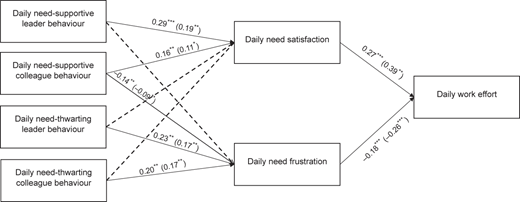
The structural model showed good model fit (χ2 = 7.59; df = 4; CFI = 0.99; TLI = 0.92; RMSEA = 0.04; SRMR within = 0.02; SRMR between = 0.002). The parameter estimates of the paths are shown in Figure 1. The results of the indirect effects are presented in Table 2.
Support was found for Hypotheses 1a and b, as both (H1a) daily need-supportive leader (Est. = 0.29 [0.15; 0.42], p < 0.001) and (H1b) colleague (Est. = 0.16 [0.06; 0.25], p = 0.009) behaviours each related positively to daily need satisfaction. The results showed that daily support from both managers and colleagues had similar influences on daily need satisfaction (∆χ2 SB = 1.03; df = 1; p = 0.31). Colleague support also predicted lower daily need frustration (Est. = −0.14, CI [–0.21, −0.06], p = 0.003), while leader support showed only a non-significant trend (Est. = −0.13, CI [–0.27, 0.00], p = 0.10). The significant chi-square difference (∆χ2 SB = 53.33; df = 1; p < 0.001) and the stronger positive beta for need satisfaction (β = 0.29) compared to the weaker negative beta for need frustration (β = −0.13) indicate that leader need-supportive behaviour has a greater impact on enhancing need satisfaction than on reducing need frustration. Furthermore, the significant chi-square difference (∆χ2 SB = 13.94; df = 1; p < 0.001) and the stronger positive beta for need satisfaction (β = 0.16) compared to the weaker negative beta for need frustration (β = −0.14) indicate that colleague need-supportive behaviour has a greater impact on enhancing need satisfaction than on reducing need frustration. Support was also found for Hypotheses 2a and b. Daily need satisfaction indirectly affected the relationship between daily need-supportive leader behaviours and daily work effort (H2a) (Est. = 0.07 [0.03; 0.12], p = 0.007). Daily colleague supportive behaviours were also related to daily work effort via daily need satisfaction (H2b) (Est. = 0.04 [0.01; 0.07], p = 0.03). Additionally, significant indirect effects were found for daily need-supportive leader (Est. = 0.02 [0.001; 0.04], p = 0.09) and colleague (Est. = 0.02 [0.005; 0.044], p = 0.04) behaviours on work effort through daily need frustration.
Hypotheses 3a and b were supported, as both daily need-thwarting leader (H3a) (Est. = 0.23 [0.10; 0.37], p = 0.004) and colleague (H3b) (Est. = 0.20 [0.10; 0.30], p = 0.001) behaviours each related positively to daily need frustration. These thwarting behaviours had equally detrimental effects on daily need frustration (∆χ2 SB = 0.002; df = 1; p = 0.96). Interestingly, neither leaders’ (Est. = −0.01 [−0.10; 0.08], p = 0.85) nor colleagues’ (Est. = −0.09 [−0.16; 0.02], p = 0.18) need-thwarting behaviour affected daily need satisfaction. The significant chi-square difference (∆χ2 SB = 74.43; df = 3; p < 0.001) indicates that need-supportive and need-thwarting behaviours (from both leaders and colleagues) have unequal effects on daily need frustration, with need-thwarting behaviours showing stronger absolute associations (0.23 and 0.20) than need-supportive behaviours (−0.13 and −0.14), suggesting a more pronounced impact on increasing need frustration. Support was found for Hypotheses 4a and b. Daily need frustration indirectly affected the relationship between daily need-thwarting leader behaviours and daily work effort (H4a) (Est. = −0.05 [-0.08; −0.01], p = 0.03). Daily colleague thwarting behaviours also related to daily work effort via daily need frustration (H4b) (Est. = −0.04 [-0.07; −0.02], p = 0.01). The indirect effects from daily need-thwarting behaviours through daily need satisfaction were not meaningful.
Contrary to Hypothesis 5, the results showed that daily need satisfaction (Est. = 0.27 [0.19; 0.36], p < 0.001) was a stronger predictor of daily work effort than daily need frustration (Est. = −0.18 [−0.26; −0.10], p < 0.001), as confirmed by the significance of the chi-square difference test (∆χ2 SB = 44.40; df = 1; p < 0.001).
Exploratory models
We estimated two interaction terms (i.e. Leader Support × Colleague Support and Leader Support × Colleague Thwarting) in exploratory models to assess their unique contributions to daily need satisfaction and need frustration. The multilevel structural model demonstrated acceptable fit: χ2(6) = 14.32, CFI = 0.97, TLI = 0.81, RMSEA = 0.05, SRMR (within) = 0.02, and SRMR (between) = 0.005.
None of the interaction effects were statistically significant. For daily need satisfaction, the interaction between leader support and colleague support was not significant (B = −0.01, SE = 0.03, β = −0.02, p = 0.69), nor was the interaction between leader thwarting and colleague thwarting (B = 0.05, SE = 0.04, β = 0.06, p = 0.23). Similarly, for daily need frustration, neither the support (B = −0.02, SE = 0.03, β = −0.02, p = 0.39) nor the thwarting (B = 0.004, SE = 0.05, β = 0.005, p = 0.94) interaction was significant. All main-effect conclusions remained unchanged after adding the interaction terms. These findings suggest that the impact of leader and colleague behaviours on employees’ need satisfaction and frustration is additive rather than interactive.
Discussion
This study examined how daily leader and colleague behaviours – either supporting or thwarting – impacted employees' daily work effort. The study helped address important associations between daily interpersonal behaviours, psychological needs, and work effort, operating along both bright and dark pathways, with evidence of the interplay between these pathways.
Findings support SDT (Deci et al., 2001) by showing that daily need-supportive leader and collegial behaviours were positively associated with daily need satisfaction. Thus, when managers and colleagues allowed employees to take initiative, recognised their efforts, and took an interest in them, they experienced more autonomy, competence, and relatedness. The influence of supportive behaviours on need satisfaction was comparable across leaders and colleagues and stronger than their influence on reducing need frustration. This finding underscores the value of interpersonal support beyond autonomy support. Although autonomy support is often included as the only antecedent due to its universal impact on the needs (see Deci et al., 2001), actively supporting other needs also benefits overall need-based experiences (Slemp et al., 2021).
Daily need satisfaction, in turn, predicted higher work effort, aligning with SDT research linking need satisfaction to favourable outcomes (see Coxen et al., 2021 for a review), with work effort being a favourable outcome (De Cooman et al., 2009) in our study. While the bright pathway mainly operates through need satisfaction, need-supportive behaviours also reduce need frustration, leading to increased work effort. This suggests an interplay where need-supportive behaviours indirectly contributed to higher work effort by enhancing satisfaction and reducing frustration. These results align with SDT and suggest that supportive daily interactions generate more work effort. Reciprocity (Blau, 1964) likely explains this link: feeling supported, cared for, and encouraged may prompt employees to reciprocate through persistence and exertion. Additionally, behavioural regulation helps explain the increased effort of satisfied employees. For example, on days when employees felt that their needs were met and their frustrations were minimised due to the support of others, they found their work tasks more meaningful (i.e. internalised behaviours) and exerted more effort.
Need-thwarting behaviours from both sources were strongly (and equally) related to increased frustration, but not to reduced satisfaction – suggesting separate pathways. Furthermore, these behaviours had a stronger absolute effect on increasing need frustration than need-supportive behaviours had on reducing it, indicating a more pronounced negative impact on employees' psychological states. SDT scholars posit that need frustration, the flip side of need satisfaction stems from active thwarting (Warburton et al., 2020). Thus, when leaders and colleagues belittle, control, or exclude employees, they feel alienated and obligated. This finding highlights the need to examine both supportive and thwarting behaviours, as individuals can experience need satisfaction and frustration simultaneously within the same environment (Bartholomew et al., 2011).
Daily need-thwarting behaviours reduced daily work effort via daily need frustration. Thus, on days when employees felt that their needs were frustrated by others, they were less inclined to persist. This aligns with the idea that need frustration leads to “giving up” (Coxen et al., 2023). According to SET (Blau, 1964), poor treatment discourages reciprocity, explaining reduced effort in response to need-thwarting behaviours.
This study supports a dual-process model: both daily need-supportive and need-thwarting behaviours independently shape need-based experiences, regardless of source. Non-significant leader × colleague interactions confirm additive effects. It also highlights an important interplay between the bright and dark pathways. While need-supportive behaviours enhance work effort by increasing need satisfaction, they also reduce need frustration, contributing to positive work outcomes. Conversely, need-thwarting behaviours decrease work effort mainly by elevating need frustration without diminishing need satisfaction. Therefore, unlike between-person studies that show more diverse patterns (see Huyghebaert-Zouaghi et al., 2021, 2023), the effects on work effort are “mirrored” – positive for need satisfaction and negative for need frustration (also Bidee et al., 2016, p. 909). Moreover, our within-person findings demonstrate that while need satisfaction and frustration influence work effort in opposite directions, the mechanisms driving these effects are unique and not simply inverses of one another.
Our study also found that while daily need frustration was lower on average, it was more variable than need satisfaction. Yet, need satisfaction had a stronger link to work effort, challenging Hobfoll et al.'s (2018) view that short-term resource loss outweighs gain. Because consistent fulfilment of autonomy, competence, and relatedness appears more motivating than sporadic frustration is demotivating, organisations should prioritise sustained need satisfaction while managing occasional frustrations. Using a South African sample, we showed SDT’s cross-cultural relevance, especially the role of interpersonal support in enhancing work effort, countering claims that SDT is Western-centric.
Practical implications
This study shows that leaders' and colleagues' daily behaviours significantly shape need-based experiences and work effort. They should thus consciously support employees' needs by involving them in daily decisions, granting autonomy, and offering development opportunities. Recognising achievements and showing genuine care fosters satisfaction and effort. Organisations can implement training to promote need-supportive behaviours (e.g. using informational language, explaining task rationales, and validating feelings) across all three needs (Slemp et al., 2021). While need frustration occurs less often, its variability and sensitivity to adverse events highlight the importance of consistently creating environments that facilitate ongoing need satisfaction. Since need satisfaction shows a stronger correlation with work effort than need frustration, organisations should focus on maintaining stable, supportive conditions rather than sporadically addressing frustration.
Limitations and future directions
This study has several limitations. First, while an intensive longitudinal design was used, daily measures were not temporally separated, resulting in repeated cross-sectional data and limiting causal inferences. Although the variables were statistically related and theoretically plausible (Spector, 2019), future research should temporally separate constructs, measuring multiple times throughout the workday.
Second, exclusive reliance on employee self-reports raises common-method concerns. However, recall bias is minimised in diary studies as participants report their current states (Liebenberg et al., 2022). We incorporated Podsakoff et al.'s (2024) recommendations to reduce CMV, and an MLCFA analysis confirmed construct distinctness. Future work could add trait controls, address impression management, and collect observer ratings of interpersonal behaviours. Our MLCFA supported the construct validity of the shortened, face-valid instruments designed to reduce respondent burden. Future SDT and broader research could benefit from fully validated diary measures for testing within-person hypotheses.
Third, the study’s sample (e.g. mainly young females) may not represent the broader working population, though it likely reflects the gender distribution in relevant sectors (Statista, 2024). There is no evidence that these demographics influenced the results. Future research should replicate these findings in more diverse samples to enhance generalisability and explore whether online need-supportive or -thwarting behaviours impact need satisfaction or frustration as strongly as in-person interactions. Exploratory models, including leader × colleague interactions, were non-significant and left the additive main-effects unchanged. Future studies with larger, better-powered samples could revisit these potential cross-source dynamics.
The study aggregated daily need satisfaction, frustration, and need-supportive/thwarting behaviours. Future research should use a diary design to track daily fluctuations and disaggregate these into autonomy, competence, and relatedness to assess their distinct effects. Additionally, the study focused solely on external support or hindrance of employee needs, neglecting the role of individuals in supporting their own needs (Mokgata et al., 2023; Putter et al., 2024). Future studies should include individuals as need-supportive agents and consider personality factors influencing need-support or thwarting. Given that need satisfaction predicts daily work effort, future research should also examine less optimal behaviours, like procrastination, to explore whether need frustration better predicts negative outcomes compared to need satisfaction.
Conclusion
This study examined the effects of daily leader and colleague behaviours on employees’ work effort through need support and thwarting. Results confirmed that need support and thwarting influenced work effort via need satisfaction and frustration, with need satisfaction showing a stronger link to work effort. These findings emphasise the importance of fostering leaders and colleagues as daily supportive agents in the workplace.
Author contributions
All authors contributed to the study’s conception and design. Lynelle Coxen acted as the primary researcher, as this study forms part of her doctoral research. Leoni van der Vaart, Anja Van den Broeck, Sebastiaan Rothmann, and Bert Schreurs acted as supervisors. They played an advisory role, assisting in the study’s conceptualisation, interpreting the research results, and refining the manuscript. Thus, material preparation, data collection, and analysis were performed by Lynelle Coxen. Lynelle Coxen wrote the first draft of the manuscript and all authors commented on subsequent versions. All authors read and approved the final manuscript for publication.
Declarations
The authors declare that this paper is not under consideration elsewhere. This paper forms part of the corresponding author’s doctoral study, which she has passed.
Some variables in the current dataset have been used before in the authors’ previous study (which also forms part of the corresponding author’s doctoral study). However, the dependent variables differ between the two studies, and the research objectives were different. Only the predictor variables in the previous study are used in this study as a mediating variable.
Disclosure statement
The authors have no conflict of interest (either financial or non-financial) to disclose. Ethics approval for the study was obtained from the North-West University (NWU-00880–21-A4). Participants provided written informed consent to participate in the study voluntarily.
The authors would like to thank all participants for contributing to this study.