


This paper explores the phenomenon of organizational maverickism, proposing that mavericks, alongside innovators and entrepreneurs, play a crucial role in driving transformational change. While the actions of innovators and entrepreneurs as change agents are well understood, this paper focuses predominantly on how the practices of mavericks also provide significant contributions to achieving game-changing organizational outcomes.
A literature review and conceptual paper highlighting the beneficial nature of maverickism to organizational change efforts, positioning maverickism as a valid change agent role alongside entrepreneurship and innovation.
The positively deviant nature of mavericks has high potential for creating radical organizational change strategies. Organizational change is more likely to be successful when the entrepreneurial, innovator and maverick mindsets are used to their optimum advantage.
From this conceptual paper and its arguments, new research directions to guide theory building and organizational practice are identified.
When organizational managers and leaders more fully understand the beneficial practices of mavericks, they are more likely to actively employ them in more meaningful roles as organizational change agents, together with innovators and entrepreneurs.
This paper closes the knowledge gap in understanding maverickism that is an under-researched and under-theorized phenomenon. The arguments in this paper identify a number of areas for future research.
Introduction
In their compelling call to action, Ergene et al. (2021, p. 103) argue that organizational leaders must challenge themselves and their followers to adopt more unconventional approaches to solve issues for which they are unfamiliar and unprepared. However, thinking and behaving in more nonconformist ways is difficult because organizations have well-established and entrenched norms that suppress unconventional behaviors (Yi et al., 2016). Additionally, most employees are denied opportunities to influence any rethinking of organizational strategies (Caldwell, 2003; Jordan, 2019; Pedersen and Andersen, 2021). This failure by leadership to engage more fully with a diverse range of employees limits the development and utilization of organizational capabilities for thinking and acting outside of existing approaches, which is essential for fostering new ways of organizing. Without such engagement, organizations risk stagnation and the inability to evolve and thrive in an ever-changing environment.
In the strategy and change management fields, for instance, our knowledge of how individual organizational actors contribute to strategy-making and change-making is limited to understanding the actions of a small group of often elite players, including senior executives and top management team members (Vaara and Whittington, 2012). However, it is the peripheral players in organizations who are more likely to pursue opportunities that give rise to new ideas and innovations, as they are not pressured to conform to the same degree as the core elite (Cattani and Ferriani, 2008). These peripheral players often act as change agents, leveraging their freedom from scrutiny to explore alternative and unconventional approaches to achieving goals, which are largely overlooked by the elite.
This paper focuses on three specific and closely linked change agent types, selected due to their propensity to be leadership outliers: the innovator, the entrepreneur and the less studied and understood organizational maverick. When recognized, endorsed and supported by organizational leaders, these different change agents have the potential to influence the adoption of more radical approaches to envisioning change. This is often due to their positioning outside of appointed leadership roles.
Caldwell’s (2003, p. 140) extensive review of the change agent literature observes that “there is no universal model of change agency or a single type of change agent with a fixed set of competencies.” However, innovators, entrepreneurs and mavericks share one significant common trait: proactivity – defined as “the relatively stable tendency to effect environmental change” (Bateman and Crant, 1993, p. 103). Motivated by situations of ambiguity, proactive behavior is change-oriented and future-focused. Change agents with this trait think, plan, calculate and act in advance, anticipating future events before they occur. As Grant and Ashford (2008) point out, in an increasingly global and uncertain work environment, promoting proactivity is more important than ever before, as this behavior promotes the type of creativity, innovation and change required for organizations to remain competitive and relevant.
In addition to identifying points of similarity that entrepreneurs, innovators and mavericks bring to transformational change, this paper also aims to reveal how these three change agents differ in their particular focus and practices. Each one of these change agents approaches situations with a unique proactive mindset, utilizing different skillsets or similar skills but in diverse ways to affect change. By understanding their similarities and differences, this paper provides practical insights that organizational leaders can use to strategically leverage the strengths of each of these change agents in order to drive the type of transformational change that leads to more resilient and dynamic organizations.
Objectives and research questions
This paper is another step in unpacking the theoretical puzzle of why most large-scale change efforts fail (Worley and Mohrman, 2014; Al-Haddad and Kotnour, 2015). Rather than emphasizing the structural, cultural, or technical barriers, we focus on the failure to understand and utilize the capabilities of the range of change agents available to organizational leaders, specifically innovators, entrepreneurs and mavericks. We propose that successful transformational change only occurs when these three change agents are recognized, promoted, supported and allowed to bring their unique set of practices to organizations. This position aligns with Waggoner’s (2020) call to account more for the interpersonal processes required in change efforts, an area currently underexplored in the organizational change literature. Additionally, this analysis reflects ideas being discussed under organizational change capability (Montreuil, 2024), including how finite resources, such as the number and diversity of employees, need to be recognized and judiciously managed, making their utilization a critical consideration in managing complex change.
The paper is organized in three distinct parts. While significant literature informs our understanding of the dispositions and behaviors of innovators and entrepreneurs (e.g. McFadzean et al., 2005; Zhao, 2005), the literature on the phenomenon of maverickism has not received similar attention regarding its connection to organizational change. The first part of the paper provides a literature review investigating the nature of maverickism, its key attributes and behaviors (dispositions) and how, at its core, maverickism adheres to the concept of positive deviance (also known as constructive deviance). This stands in contrast to other forms of disruptive deviance viewed more negatively within workplaces (e.g. corporate deviants, saboteurs and production deviants; Appelbaum et al., 2007).
With this more informed understanding of maverickism, the second part of this paper examines the key similarities and critical differences between the three change roles of innovators, entrepreneurs and mavericks as well as defining the potential beneficial convergence offered by all three. The third and final part of the paper highlights issues for future theorizing and research based on a preliminary framework that describes the relationships between the change agency provided by innovators, entrepreneurs and mavericks.
The paper addresses four research questions:
What are the attributes and behaviors of maverick employees?
How are maverick employees different from those employees who demonstrate negatively deviant (dysfunctional) workplace behaviors?
What are the similarities and differences in the dispositions and behaviors of innovators, entrepreneurs and mavericks?
What dispositions and behaviors of innovators, entrepreneurs and mavericks can be fostered and developed individually and collectively to promote more successful outcomes around large-scale organizational change?
Maverickism unveiled
Attributes and behaviors: a review
The existing literature describes a consistent set of characteristics that position the conceptualization of maverickism around its potential and positive contributions to organizations and societies. Creativity is a central feature of maverickism, resulting in higher creativity levels even at low trait expression than those without it (Silva et al., 2025). Additional maverick contributions include unorthodox and out-of-the-box thinking (Clouse, 1997; Khoury, 2013), a willingness to challenge and break rules (Jones et al., 2016), the ability to question assumptions and see beyond perceived limitations and barriers (Cheverton et al., 2000; Gardiner and Jackson, 2012), a fearless challenging of the status quo (Clouse, 1997; Ray et al., 1997; Charlton, 2008; Jones et al., 2012) and a tenacious drive to achieve new and unprecedented solutions to complex issues (Baddeley, 2018; Jordan et al., 2021). Mavericks are also highly driven to make things happen in new or unique ways (Clouse, 1997; Cheverton et al., 2000), especially when they believe current practices are not delivering desired results.
Due to their broad set of values arising from an often eclectic range of life experiences (Jordan, 2019), mavericks are credited with the ability to see beyond what is generally accepted as known and knowable by the majority of conformists. Guided by this, they demonstrate a high degree of perseverance (Gardiner and Jackson, 2012) to forge ahead in ways that have not been previously conceived (Cheverton, 2000). When embraced by organizations, mavericks are often regarded positively as “rebels with a cause” (Blohowiak, 1992; Cheverton, 2000; Kelly and Medina, 2014; Gino, 2018), showing loyalty, passion and commitment to a bigger picture agenda (Clouse, 1997). As Jordan (2019) argues, these core characteristics of mavericks highlight a goal-focused drive purposefully directed toward making a difference. Given this, mavericks see organizational outcomes as something needing to be justified and validated as the “right” or “proper” direction, rather than being left unchallenged as is the normal practice when complying with dominant organizational decision-making norms.
Kelly and Medina (2014) maintain that while mavericks are often perceived as rebels seeking to disrupt, in fact they are rebelling against dated and redundant systems, structures, people and processes that are barriers to achieving markedly better organizational outcomes. Similar to institutional social entrepreneurs, they challenge established norms and conventions through the development of roles and building networks and alliances, both internally and externally that support their nonconformist ideas and behaviors (Patriotta and Hirsch, 2016). Mavericks are workplace nonconformers who challenge the rules and status quo, not to be contrarian, but because they see existing rules and processes as obstacles to achieving extraordinary outcomes.
Additionally, while in a particular context maverickism is related to an individual, it is also about a mindset that can be applied to ideation and problem-solving. Identification of individual mavericks and maverick mindsets therefore becomes increasingly subjective (i.e. identified through the perception of others), rather than objective (i.e. meeting a specific check list of indicators). It is also highly unlikely that any two mavericks share the same complete set of behavioral characteristics or display them in the same way, highlighting the unique individuality of mavericks (Baddeley, 2018; Jordan, 2019). In this sense, maverickism is a heterogeneous set of combined behaviors (or practices) unique to an individual person or context (Jordan et al., 2021). Therefore, as individual mavericks display a diverse combination of behavioral characteristics and skills rather than consistently displaying the same set and intensity of behaviors across all contexts, identifying mavericks and the maverick mindset becomes more challenging.
Contextual and temporal factors at play further complicate this identification process, as context and timing influence whether or not someone is perceived as a maverick at a particular time and place. For example, in some organizational cultures, such as innovative start-up companies and the creative industries, behaviors like out-of-the-box thinking are the norm and expected of all employees as part of the everyday workplace culture (Jones et al., 2016). Additionally, the beneficial value of the maverick skillset emerges over time, with an individual potentially being perceived negatively for many years prior to achieving the success which garners them broader respect (Ray et al., 1997; Gardiner and Jackson, 2012). Alternatively, in other contexts, a maverick individual may not always choose to challenge the status quo due to other issues, events or priorities (Jordan, 2019). In these situations, maverick behaviors are less likely to be interpreted as unique, positive or beneficial. In fact, individuals exhibiting norm-violating behaviors at certain times may be judged to have a negative and damaging effect on organizational performance and reputation, irrespective of their intentions. Therefore, understanding the role of context and timing is essential to the recognition of a maverick’s success in delivering outcomes judged to be novel or different. As Patriotta and Hirsch (2016) observe in their analysis of maverick artists, individuals cannot be defined over time solely as one type of individual (i.e. conformists, conventional novices or mavericks) whose approaches conform to or deviate from, the normative expectations of the day.
Negatively and positively deviant mavericks
Appelbaum et al. (2007, p. 586) make the important distinction that, while there are positively deviant workplace behaviors that “honorably violate,” there are also negative behaviors that “violate organizational norms, policies or internal rules.” There is abundant literature depicting the negative labels attributed to mavericks. For instance, maverick employees are often described as difficult to work with (Carlson, 2012; Isaacson, 2012), with supervisors reporting that they are a challenge to manage due to their disruptive questioning of conventional structures, procedures and systems in organizations (Blohowiak, 1992; Cheverton, 2000). They are judged as difficult by mainstreamers and other conformists who want to minimize organizational disruption (Clouse, 1997; Ray et al., 1997; Charlton, 2008). Many see mavericks as misfits who do not fit the expected mold of most organizational cultures (Clay and Phillips, 2015). Cheverton (2000) goes so far as to suggest they may have a martyr complex, as they care more about an idea becoming reality than getting credit for it.
Exploring the concern that maverick behaviors are not that desirable, Table 1 situates the study of maverickism within the broader negative deviance literature, summarizing the key findings around five broad characteristics commonly identified in the literature. As can be seen, comparisons to other categories of negatively deviant workplace behavior (e.g. employee sabotage, organizational miasma, insidious workplace behavior) reveal that mavericks share characteristics with many of these other forms. Similar negative behaviors, especially within the categories of workplace deviance, employee deviance and employee sabotage, include engaging in disruptive actions, violating organizational norms, rule breaking and risk-taking.
Negative deviance – comparing key characteristics of forms of negative workplace behavior with maverickism
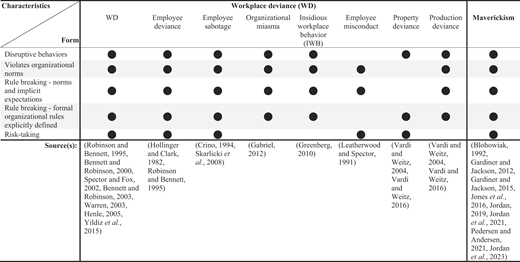 |
On the other hand, returning to Appelbaum et al.’s (2007, p. 586) distinction, there is also evidence in the literature of positively deviant workplace behaviors by maverick employees (Table 1). In contrast to negative deviant behavior, maverick actions are not willfully destructive but rather a form of positive deviance bounded by hyper-norms (Vadera et al., 2013; Jordan et al., 2021). It is the motivations behind maverick actions that are significant, rather than judgments based solely on the outcomes of their actions. In an in-depth study of university-based mavericks, Jordan (2019) found that the mavericks’ adherence to motivations rooted in higher-order values gave organizational leaders confidence in providing them with personal support and greater workplace freedom. This further justifies their actions as a form of positive deviance, in contrast to their negatively disruptive counterparts.
Table 2 highlights the many commonalities that mavericks share with other positively deviant agents such as whistleblowers, functional disobedients and tempered radicals. These shared characteristics include being rebels with a cause, providing benefits to the dominant group, an altruistic or “do no harm” orientation, and conformity to a hyper-norm or higher-order purpose. However, while mavericks share characteristics with other forms of positive deviance, such as functional behaviors, providing benefit, being altruistically oriented and supporting higher order values. They also demonstrate additional unique behaviors. For instance, other forms of positive deviance do not necessarily require agents to “think out-of-the-box” or engage in “creative problem-solving” to achieve their goals. Although mavericks adopt a similar stance toward social responsibility as tempered radicals, they do not necessarily use the subtle “push and prod” path to radical change, that is, synonymous with tempered radicalism (Meyerson, 2004). In addition, mavericks demonstrate more out-of-the-box thinking and unorthodox behaviors than displayed by both tempered radicals and whistleblowers (Near and Miceli, 1987, 1995; Meyerson, 2004; Jordan, 2019). While rule-breaking is a key characteristic of maverickism and pro-social rule-breaking, the latter is limited to breaking written rules and does not extend to the violation of implicit organizational norms (Fleming, 2020).
Positive deviance – comparing key characteristics of forms of positive workplace behavior with maverickism
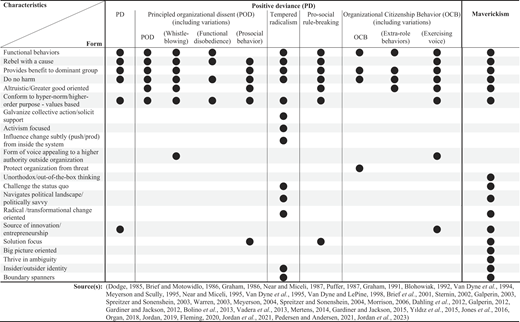 |
Table 3 summarizes the key differences between these positively deviant mavericks with their positive (functional) workplace behaviors and workplace deviants with more negative (dysfunctional) workplace behaviors. Key points of difference center on: (1) motivations for change, with mavericks valuing organizational priorities, while workplace deviants act out of self-interest; (2) motivations for acts of rebellion, with mavericks rebelling against systems that impact employees’ organizational effectiveness, while workplace deviants focus on individual performance; (3) motivation to challenge the status quo, with mavericks challenging norms that limit organizational thinking, while workplace deviants challenge norms that they personally disagree with purely out of self-interest; (4) attitudes around bureaucratic engagement, with mavericks strategically engaging with bureaucracy to improve it, while workplace deviants often avoid or undermine it and (5) external perceptions, with mavericks seen as constructive rebels, while workplace deviants are seen as destructive agitators.
Summary of key differences between maverick deviance and workplace deviance
| Maverick deviance (positively positioned) | Workplace deviance (negatively positioned) | |
|---|---|---|
| Value-behavior relationship | Values based behaviors aligned with delivering organizational outcomes or broader societal expectations | Behaviors based on individual needs, wants and desires |
| Motivations for rebellion | Rebels-with-a-cause rebelling against systems, structures, people and processes that impede all employees’ performance | Rebels rebelling against systems, structures, people and processes that get in their way around individual performance |
| Status quo | Constructively challenges norms to bring awareness to organizations of the assumptions behind decisions which are reinforcing constrained and limited thinking | Challenges norms that they find constraining or disagreeable |
| Bureaucratic engagement | Politically savvy, successfully navigating internal politics and bureaucracy | May clash with internal politics and bureaucracy in the desire to fulfill their own agenda |
| External perception | Seen to operate in a functional and beneficial way. May be perceived as somewhat troublesome prior to achieving the success which garners them respect and recognition | Perceived as troublesome, maladaptive and/or dysfunctional |
Source(s): Derived from review of literature presented in Tables 1 and 2
Innovators, entrepreneurs and mavericks
In this second part of the paper, our focus transitions to building a clearer conceptual distinction between the constructs of innovation, entrepreneurship and maverickism. Our specific objective is to clarify understanding of the attitudes and behaviors specific to each change agent role and how they can be fostered and developed individually and collectively to promote more successful outcomes in large-scale organizational change. Various scholars (see Shane and Venkataraman, 2000; Landström et al., 2013; Maritz and Donovan, 2015; Grillitsch, 2019) have noted that the organizational terms innovator and entrepreneur are used indiscriminately, conjointly and interchangeably in the academic and general literature, despite innovation and entrepreneurialism having evolved as separate fields of research. Given the size and prominence of the innovation and entrepreneurship literature, it is important to highlight key points from this literature to inform this three-way comparison of these organizational roles.
As discussed previously, mavericks are predominantly nonconformists, driven to push boundaries and challenge the status quo (Blohowiak, 1992; Gardiner and Jackson, 2012; Jordan et al., 2021). However, the same cannot be said for innovators and entrepreneurs. For instance, innovators predominantly focus on creating new and novel improvements to what currently exists (Drucker, 2007; Crossan and Apaydin, 2010) in an effort to solve problems (Scott and Bruce, 1994; Satell, 2017) and are described as more opportunity-focused than risk-focused (Drucker, 2007), which stands in contrast to the mavericks focus on defying norms.
As captured in Kirton’s (1976) adaption-innovation theory, individuals are creative and solve problems and can be located on a continuum ranging from adaptive to innovative. In order to manage diversity and change among a conglomerate of cognitive styles, Kirton (2003) emphasizes that leaders must have the capacity to capitalize on the creativity of the team in regard to the members’ ability to solve problems. Understanding the cognitive styles of those who are adaptors and innovators has the potential to enhance organizational cultures by fostering openness to change and diversity. Adaptors prefer to “do things better,” focusing on solving problems rather than finding them, seeking solutions in conventional ways, rarely challenging the rules, completing detailed work over long spells and providing a safe base for the innovator’s riskier operations. In contrast, innovators are undisciplined, preferring to “do things differently.” They approach tasks in surprising ways, having low self-doubt when generating new ideas, applying themselves in short bursts and providing the dynamics to bring about periodic revolutionary change. While appearing similar to mavericks in their desire to do things differently, the innovator mindset differs from mavericks as it is “ideas”-focused, rather than “norm”-focused.
In examining innovation and innovative companies, Christensen (1997) argues that the logical, competent decisions of management, which are critical to their success, are also the reasons why companies fail. New challenges require new processes, and these innovations necessitate different people or groups interacting differently and at a different pace than before. Leaders need to pull relevant people out of the existing organization and create new organizational boundaries around a new group of innovators. The focus and scope of these groups of innovators is to transition from applying conventional sustaining technologies to applying disruptive technologies to the business problems that client organizations are facing. The core challenge is that this application often results in worse product performance in the short term but opens up new possibilities that these client organizations did not know about while delivering new commercial opportunities in existing or new markets for enterprises that develop access to disruptive technologies. This distinction highlights that while both mavericks and innovators drive significant change, mavericks do so by breaking conventions and rejecting conventional practices, whereas innovators, particularly disruptive innovators, do so by introducing groundbreaking technologies or processes.
Likewise, entrepreneurs are driven predominantly by optimization and commercialization (see Schumpeter, 1947; Gartner, 1985; Koutonin, 2013; Silver, 2013), identifying gaps in the market to exploit for the mutual benefit of themselves and consumers (Landström et al., 2012). Entrepreneurship research often focuses on how individuals identify and seize opportunities (McMullen and Shepherd, 2006). However, their actions do not necessarily require pushing or challenging organizational norms to achieve their goals. People with entrepreneurial mindsets and behaviors tend to be independent and self-reliant, demonstrating these behaviors in their daily lives (Covin and Lumpkin, 2011; Pidduck et al., 2023). In their review of the construct of individual entrepreneurial orientation, Clark et al. (2023) identify these dispositional and behavioral features. They define individual entrepreneurial orientation as “autonomous, proactive, innovative, competitive, and risk-taking dispositions and behaviors that individuals exhibit when pursuing value creating opportunities” (Clark et al., 2023, p. 351).
In advancing opportunities for value creation, entrepreneurs confront challenges when it comes to accessing resources for their endeavors, frequently finding themselves in resource deficit situations due to the uncertainty and risk associated with their activities (Fisher et al., 2016). In response, entrepreneurs often rely on a creative use of existing resources to pursue opportunities through urgent, unconventional and novel ways to generate alternative resources to overcome resourcing hurdles (Fisher et al., 2020; Williams et al., 2021). These boundary-breaking behaviors (Fisher, 2023) enable them to generate and capture unexpected sources of value in the process of entrepreneurship. Under conditions of resource constraint, imperfect knowledge and uncertainty, entrepreneurs also engage in sensemaking to take action despite turbulence and confusion (Weick, 1995).
Furthermore, while it is widely understood that entrepreneurship generates economic growth through innovation and technical change (Schumpeter, 1934; Shane et al., 2003; Guzman et al., 2020), it does not mean that an entrepreneur is an innovator or contributes directly to the development of innovations (Grillitsch, 2019; Piñeiro-Chousa et al., 2020). Rather, as Grillitsch (2019) and Drucker (2007) point out, the entrepreneurial contribution to community, organizational and societal change lies in how entrepreneurs identify and utilize the inventions (i.e. new things) and innovations (i.e. improved things) developed by others. Entrepreneurs focus their efforts on identifying inventions and innovations or facilitating the development and innovation processes and then optimizing and commercializing the outputs to fill identified gaps in the market. This is also the case for social entrepreneurs, though instead of optimizing for commercialization, they optimize and make available solutions that generate social value and address critical societal needs (Luke and Chu, 2013).
Likewise, innovation is not always linked to entrepreneurialism. Innovators are not necessarily driven to bring their ideas and concepts to commercial fruition (Landström et al., 2012; Grillitsch, 2019). This is particularly true for incremental forms of innovation where “entrepreneurship is not required if it becomes evident that efficiency or effectiveness can be enhanced by changing routines and processes, or, in other words, if implementing such a change does not pertain to uncertainty” (Grillitsch, 2019, p. 684).
Table 4 provides a summary of the key points of convergence and divergence from the academic literature between the role types of innovators, entrepreneurs and mavericks. Tables 1–3 provide the key findings for mavericks, which inform the points made in Table 4. While not an exhaustive list, the literature in Table 4 was purposively chosen to represent common understandings for each role. The table highlights the shared characteristics across the three change agent roles, including proactivity, creativity, resourcefulness, out-of-the-box thinking and a highly driven nature (see Clouse, 1997; Vecchio, 2003; Taylor and LaBarre, 2006; Gardiner and Jackson, 2012; Howard, 2012; Pofeldt, 2014; Parker and Bindl, 2017). However, as highlighted in Table 4, studies reveal significant differences in their orientation toward the creation and application of new ideas and concepts; the predominant focus of their endeavors; what they are driven to achieve and other indicative key characteristics. These distinctions are important as they allow researchers and organizational leaders to better understand the elements of each role and how they can individually and collectively support organizational outcomes.
Similarities and differences–innovators, entrepreneurs and mavericks
| Key characteristics | Innovator | Maverick | Entrepreneur |
|---|---|---|---|
| Orientation |
|
|
|
| Focus |
|
|
|
| Drive |
|
|
|
| Key indicative characteristics: role specific |
|
|
|
| Key indicative characteristics: common to all |
|
|
|
|
|
| Clouse (1997), Vecchio (2003), Taylor and LaBarre (2006), Battilana et al. (2009), Gardiner and Jackson (2012), (2012), Germain (2013), Khoury (2013), Pofeldt (2014), Robinson (2014), Parker et al. (2019), Jordan et al. (2021, 2023) | |||||
Discussion
This analysis of entrepreneurs, innovators, and mavericks is motivated by evidence that many large-scale change efforts fail to meet their planned objectives (Bordia et al., 2004; Hay et al., 2020). One explanation is that organizations and their leaders have failed to enlist proactive employees such as innovators, entrepreneurs and mavericks. These individuals, especially during periods of situational ambiguity, turbulence and uncertainty, build influential social networks, promote creativity and negotiate change (Parker et al., 2006; Grant and Ashford, 2008). Linked to this failure of leadership is a passive rather than active view of employees. These proactive employees should be recognized as active agents of change who can shape, expand and partner with leaders to determine how development and change unfold in organizations.
Organizations have access to, but rarely fully utilize, the combined attributes and skills of all three change agent roles – innovators, entrepreneurs and mavericks – to create and deploy both incremental and more radical change solutions. This “change agent triad” offers organizations the ambidexterity and adaptability required to identify and challenge aspects of the status quo that limit organizational decision-making and effectiveness. However, a key assertion from this integrative analysis of the existing literature is that innovators and entrepreneurs, without the additional benefit of a maverick (or maverick mindset) and their associated behaviors, predominantly contribute more to incremental “doing what we do better” type endeavors (Shane et al., 2003; Drucker, 2007; Bessant et al., 2014). Specifically, the innovator is more oriented toward creation, focusing on developing novel improvements to ideas, concepts and products aimed at creative solutions to problems (Drucker, 2007). In contrast, the entrepreneur is more oriented toward application (e.g. commercialization and optimization), focusing on identifying opportunities to apply inventions and innovations (Schumpeter, 1947; Koutonin, 2013). This is not to deny that they may also shift their focus the other way at times, but rather, it is not their predominant orientation.
In contrast to these outcomes, mavericks predominantly take a radical “doing things differently” orientation, playing a significant role in developing “out-of-the-box” endeavors (Jordan et al., 2021). Their disruptive nature pushes beyond the limits of current thinking in the pursuit of new and unique possibilities. Unfettered by structural restraints imposed by organizations (Gardiner and Jackson, 2012; Jordan, 2019), their efforts focus on both the creation and application of disruptive and “never thought of before” ideas (Cheverton, 2000). In short, although there are overlaps between these three change agent types, each role provides its own unique benefits to communities, organizations and their societies.
Another objective from this analysis was to provide a guiding conceptual framework for future research into the roles of innovators, entrepreneurs and mavericks in change management. Figure 1 presents this framework with its two key dimensions of change focus and orientation. This framework proposes that although the roles of innovator and entrepreneur are different, they are complementary with commonalities existing between them. An individual may be both an innovator and entrepreneur (or display the mindset of both), thus exhibiting characteristics usually attributed to one or the other. However, their combined behavioral skillset tends to lean more strongly toward one role over the other, as depicted in specific descriptive terminology used in the literature, such as “innovative entrepreneurs” and “entrepreneurial innovators” (e.g. Schumpeter, 1934; Schumpeter, 1947; Grillitsch, 2019; Guzman et al., 2020). While the literature reveals that such combinations of the innovator and entrepreneurial roles achieve both incremental and more radical change, we propose that it is the maverick mindset that adds the disruptive element required for a more sustained and radical approach to innovation and entrepreneurship. When the behavioral characteristics and mindset of maverick and innovator are intertwined as “maverick innovators,” these individual agents operate as unique problem solvers who challenge the status quo through new pathways to solve complex and challenging organizational problems. On the other hand, “maverick entrepreneurs” are more risk-taking change agents, focused on identifying opportunities to apply innovative ideas in radically unique ways for the overall benefit of others. We propose that when all three change agents (or mindsets) are present and interconnected, the resulting organizational benefits are “game-changing” (see Figure 1).
 The diagram shows a two-by-two shaded grid. The vertical axis on the left represents “FOCUS”, with “Incremental” at the bottom and “Radical” at the top. The horizontal axis at the bottom represents “ORIENTATION”, with “Creation” on the left and “Application” on the right. The grid consists of three overlapping circles. The top circle is labeled “MAVERICK”, the bottom-left circle is labeled “INNOVATOR”, and the bottom-right circle is labeled “ENTREPRENEUR”. All three circles overlap in the center, forming a small triangular shaded intersection representing the shared space between all three roles. The “Maverick” circle sits in the upper region aligned with the “Radical” focus. The “Innovator” circle sits lower on the left near “Incremental” focus and “Creation” orientation. The “Entrepreneur” circle sits lower on the right, aligned with “Incremental” focus and “Application” orientation. Dashed lines outline the overlapping regions between “Innovator” and “Maverick”, “Maverick and ”Entrepreneur,“ and ”Innovator and Entrepreneur.“
Maverick, innovator and entrepreneur – change focus and orientation
The diagram shows a two-by-two shaded grid. The vertical axis on the left represents “FOCUS”, with “Incremental” at the bottom and “Radical” at the top. The horizontal axis at the bottom represents “ORIENTATION”, with “Creation” on the left and “Application” on the right. The grid consists of three overlapping circles. The top circle is labeled “MAVERICK”, the bottom-left circle is labeled “INNOVATOR”, and the bottom-right circle is labeled “ENTREPRENEUR”. All three circles overlap in the center, forming a small triangular shaded intersection representing the shared space between all three roles. The “Maverick” circle sits in the upper region aligned with the “Radical” focus. The “Innovator” circle sits lower on the left near “Incremental” focus and “Creation” orientation. The “Entrepreneur” circle sits lower on the right, aligned with “Incremental” focus and “Application” orientation. Dashed lines outline the overlapping regions between “Innovator” and “Maverick”, “Maverick and ”Entrepreneur,“ and ”Innovator and Entrepreneur.“Maverick, innovator and entrepreneur – change focus and orientation
Limitations, future research and practice
A major limitation of this paper is that the conceptual arguments and positions adopted require further testing through qualitative and quantitative data gathering that allows for a more detailed account of the characteristics of each role or mindset, in relation to delivering change. In particular, the study of maverickism offers new pathways into empirical investigations into the design and implementation of successful radical strategy and change management. As Pedersen and Andersen (2021) argue, the study of maverickism offers an entry point to better understand those conditions that encourage more interactive strategy processes between intended and emergent strategy-making within organizational settings. Additionally, the study of maverickism aligns with notions of core competencies and dynamic capabilities, which have brought a stronger focus to strategy theory and investigations into how adaptability, agility, learning and entrepreneurial thinking influence how organizations develop and sustain their competitive advantage (Hughes et al., 2021).
Future strategy-as-practice research needs to understand how a wider variety of actors gain their agency in influencing strategy and change practices (Vaara and Whittington, 2012). The literature, related arguments and the emerging conceptual framework (Figure 1) in this paper contribute to the growing attention on the role of different change agents who each (or mindsets which) contribute to the new thinking and required behaviors that keep organizations evolving and sustainable. Compared to the innovator and entrepreneur, as argued in our preliminary conceptual framework, the maverick employee remains underutilized as a source of focus and orientation around organizational change. In future research, the Bourdieusian (1990) construct of capitals provides a novel lens to investigate the opportunity for organizations to access not only the traditionally valued capitals of the more conforming mainstreamers but also the valued substitute capitals offered by innovators, entrepreneurs and mavericks for thinking about creativity, innovation and radical change (Jordan et al., 2023).
Finally, there are several implications for organizational practice. In an increasingly interconnected world, leaders across government, industry, profit and not-for-profit organizations must adapt effectively to rapidly evolving market conditions to remain competitive and relevant (Waddock et al., 2015; Pereira et al., 2023). However, doing so requires organizations to step outside comfort zones and fundamentally change the way they operate. This extends to the need to move beyond incremental change processes, which often result in only temporary solutions to complex structural and cultural issues, toward more revolutionary and deeper changes required to remain viable in turbulent times. There are many benefits to supporting the behaviors not only of innovators and entrepreneurs but also mavericks, which are essential for more radical transformational change (Jordan et al., 2023). The objective is to identify behaviors that enable organizations to outperform or to find better solutions to pervasive problems, challenging deep-seated assumptions that reinforce constrained and limited thinking (Mainemelis, 2010). The unique differences of each role (or mindset) contribute individually, pair in numerous ways to emphasize strengths (e.g. innovative maverick) or combine to form a “game-changer triad.” Understanding these various combinations helps organizations and their leaders to better gauge which change agent role is most needed at any time to identify, design and deliver the most appropriate change efforts. Organizations aiming to enhance their agility and adaptability need to suspend negative judgments about their often disruptive and nonconformist maverick employees and to be more open to the positive contributions that they offer. In opening up more fully to the range of strategic choices available, Sternin (2002, p. 58) points out, it is time that organizations look to “a few ‘deviant’ individuals whose uncommon behaviors or practices enable them to outperform or find better solutions to pervasive problems than their neighbors with whom they share the same resource base.”
We would like to thank the anonymous reviewers for their insightful comments and suggestions, which have significantly improved the quality of this paper.

