Skip to Main Content
Purpose

This study explores perceptions towards neurodivergent co-workers and leaders by assessing attributions of warmth, competence and social distance.

Design/methodology/approach

We use a vignette methodology with 467 participants with work experience who were presented with a short lay-language description of neurotypical as well as neurodivergent (ADHD, dyslexia, autism and intellectual giftedness) potential co-workers and leaders. Participants were asked to assess (typical) individuals with these conditions in terms of their expected warmth and competence in a co-worker or leadership role, as well as their expected social distance towards neurodivergent employees at work.

Findings

Neurodivergent individuals were generally rated lower on competence and warmth, except for those with intellectual giftedness, who received higher ratings on both warmth and competence. Social distance was significantly higher toward neurodivergent individuals, especially in leadership roles, highlighting how discrimination is amplified by social-role stereotypes. Only ascribed competence mediated the effect of neurodivergence on social distance, suggesting performance-based biases in work settings. Prior experience with neurodivergent peers and self-identification as neurodivergent had limited moderating effects.

Practical implications

Our findings reveal the nuanced role of social role stereotypes in shaping inclusion efforts and underscore the need for targeted interventions addressing leadership perceptions and competence-based stigma.

Originality/value

This is the first study that empirically applies the Stereotype Content Model across various neurodivergent conditions and examines how role-based perceptions operate within workplace hierarchies.

Modern organizations increasingly recognize neurodiversity and the inclusion of neurodivergent people as key elements in their diversity management practices (van Rijswijk et al., 2025a). This development suggests a growing awareness that neurological differences, including conditions such as autism, ADHD, dyslexia, and intellectual giftedness, can be viewed as evolutionarily-rooted human variations rather than shortcomings, disabilities, or disorders (Hennekam and Follmer, 2024). Moreover, in recent years, several studies have shown that a neurodiverse workforce can offer a competitive advantage (Austin and Pisano, 2017; Axbey et al., 2023; van Rijswijk et al., 2025b), as neurodivergent employees can contribute with a wide range of vital competencies, particularly in contexts that demand creativity, innovation, and novel approaches to solving complex problems. Against this background, an increasing number of organizations are developing active hiring strategies to attract neurodivergent talent (Agha et al., 2024; Austin and Pisano, 2017), yet discrimination against neurodivergent employees persists, and its underlying interpersonal dynamics are underexplored and poorly understood (van Rijswijk et al., 2025a; van Rijswijk and Curşeu, 2026).

Despite the increased awareness and documented benefits that neurodivergent talent can offer organizations, a report by McDowall et al. (2023) shows that 55% of neurodivergent employees are concerned about stigma and discrimination from co-workers, and 65.7% about stigma and discrimination from management. In addition, unemployment rates among this occupational minority remain very high. For autism, for example, unemployment rates are 86% in the United States and Canada, 71% in the United Kingdom, 72% in Israel, and 72.7% in Australia (Bury et al., 2024; Sparkes et al., 2022), among the highest for disabled workers. Although the social acceptance of various mental health issues has increased in recent decades (Hughes, 2024; Pescosolido et al., 2021), this does not seem to be the case for neurodivergent conditions.

A growing body of research on neurodiversity in the workplace provides clear evidence of the discrimination neurodivergent individuals encounter (Khassawneh, 2025; Turnock et al., 2022; van Rijswijk et al., 2025a; van Rijswijk and Curşeu, 2026), yet little attention has been paid to the deeper underlying mechanisms that explain such biases. While scholarly attention has primarily centered on access to employment (e.g. hiring policies) and the consequences of such discrimination (e.g. productivity losses and broader social implications) (Davies et al., 2023; Mellifont, 2021), neurodivergent workers particularly face discrimination in the everyday interactions that shape their perceived legitimacy as colleagues and leaders. This gap in understanding is especially salient given that effective leadership is often associated with qualities such as emotional intelligence, charisma, and social fluency that may be expressed differently by neurodivergent individuals (Howes, 2023; Williams et al., 2024).

Without a better understanding of the discriminative tendencies against neurodivergent people at work, these structural behaviors persist, and inclusion efforts risk perpetuating existing biases (Turnock et al., 2022; van Rijswijk et al., 2025a). Although the literature to date shows that role congruence expectations shape perceptions of effectiveness, particularly regarding leadership (Eagly and Karau, 2002; Koenig et al., 2011), little attention has been devoted to exploring how the incongruence between leadership expectations and typical attributes associated with neurodivergent individuals impacts discrimination. In line with the Social Roles Theory (Eagly and Karau, 2002), we argue that when typical attributes associated with neurodivergent individuals diverge from conventional stereotypes, whether as co-workers or leaders, neurodivergent individuals are perceived as less legitimate, competent, or socially adept, regardless of their actual performance.

In this vignette study, we build on the Stereotype Content Model (Cuddy et al., 2008; Fiske et al., 2002) to explore how warmth and competence attributes ascribed to typical individuals with autism, ADHD, dyslexia, and intellectual giftedness shape social distance as a proxy for their perceived legitimacy as co-workers and leaders. To our knowledge, this is the first study to empirically apply the Stereotype Content Model to various neurodivergent conditions, including intellectual giftedness, and to explore these role-based perceptions within workplace hierarchies. By investigating how these perceptions influence willingness to engage with neurodivergent individuals across varying degrees of workplace proximity, we aim to shed light on the subtle interpersonal biases that may undermine their workplace inclusion.

Perceptions of co-workers and leaders are shaped by shared societal stereotypes (Fiske, 2018). The cognitive attributes associated with various social categories cluster along two orthogonal dimensions, namely warmth and competence, as consistently validated in the Stereotype Content Model (SCM; Fiske et al. (2002)). The warmth dimension of the SCM reflects perceived relational closeness, friendliness, and trustworthiness, while the competence dimension captures the capability to perform effectively, intelligence, and usefulness (Cuddy et al., 2008; Fiske et al., 2002). These dimensions are especially relevant to assessing interpersonal perceptions in workplace settings, as interpersonal and task contributions are key performance dimensions in modern organizations (Bor, 2020). While the SCM has traditionally been applied to broad social categories such as gender, age, or ethnicity (Cuddy et al., 2007), its relevance extends to less visible and often marginalized identities, including neurodiversity. The SCM provides a useful framework for understanding generalized social perception tendencies and neurodiversity scholars emphasize that these perceptions are shaped by dominant deficit-based narratives (Kapp et al., 2013). The term neurodiversity refers to natural variations in cognitive functioning, viewing conditions like autism and ADHD as a logical evolutionary result and, therefore, part of normal human diversity (Armstrong, 2010; Singer, 1999). The neurodiversity paradigm advocates a social model of disability, framing challenges as arising from a misfit between individuals and environments (Singer, 1999). Individuals whose neurological functioning diverges from societal norms are called neurodivergent and represent about 15–20% of the workforce, while those aligning with these norms are called neurotypical (Legault et al., 2021). Neurodivergent individuals are often perceived as deviating from normative expectations in behavior, communication, or task execution (Gray, 2002; Shifrer, 2013; van Rijswijk and Curşeu, 2026), and as such, they tend to be perceived as scoring lower on the SCM dimensions of warmth and competence. Research shows that autistic individuals are stereotyped as lacking empathy or social reciprocity and responsiveness (Butler and Gillis, 2011; Draaisma, 2009) as well as lacking adaptability and engaging in rigid or inflexible behaviors at work (Brouwers et al., 2025; Draaisma, 2009). Moreover, because ADHD is associated with impulsivity and distractibility, such co-workers tend to be perceived as unpredictable and less reliable collaboration partners (Mueller et al., 2012). In terms of competence, because individuals with ADHD and dyslexia are known to experience struggles with their education and sometimes have difficulties in performing their organizational tasks reliably (Knight, 2021; Kofler et al., 2018), they tend to be perceived as scoring lower on competence than neurotypical individuals. Although many neurodivergent individuals exhibit exceptional ability in specific domains (Armstrong, 2010; Austin and Pisano, 2017), we expect that such nuances are often overlooked in social perception due to dominant deficit-based narratives socially shared in modern societies (Goodley, 2016). Therefore, we hypothesize the following:

H1.

Potential co-workers with ADHD, dyslexia, or autism are rated lower on warmth than neurotypical co-workers.

H2.

Potential co-workers with ADHD, dyslexia, or autism are rated lower on competence than neurotypical co-workers.

The scope of neurodivergence is increasingly understood as extending beyond clinically diagnosed conditions to encompass a wider spectrum of cognitive differences related to cognitive minorities (Stenning and Rosqvist, 2021; van Rijswijk and Curşeu, 2026). Within this broader framework, intellectual giftedness has been proposed as a particular form of neurodivergence, especially in scholarly efforts on “twice-exceptionality,” where giftedness coexists with other conditions such as autism or ADHD (Baum et al., 2021; David and Gyarmathy, 2023). Gifted individuals often exhibit atypical neurodevelopmental patterns, such as asynchronous development and atypical executive functions (Bucaille et al., 2022), and the challenges they may encounter in normative and neurotypical-oriented workplaces, such as difficulties in maintaining meaningful relationships and participating in informal social occasions (van Casteren et al., 2021), show significant overlap with those of other neurodivergent conditions. Therefore, we include intellectual giftedness as one of the conditions that we explore in this study. However, in contrast to the neurodivergent conditions that we discussed earlier, intellectually gifted individuals are predominantly associated with a positive outlook as they are expected to have high intelligence and high academic achievement (Golle et al., 2023). Because intellectual giftedness has such a positive halo effect (i.e. cognitive bias where a single positive attribute leads to overly positive judgments in unrelated domains), we expect that perceived cognitive superiority enhances both perceived competence and interpersonal warmth (Rinn and Plucker, 2019).

H3.

Potential co-workers with intellectual giftedness are rated higher on warmth and competence than neurotypical co-workers.

Individuals with neurodivergent conditions such as ADHD, dyslexia, and autism are frequently marginalized as they tend to be misunderstood and tied to stigmatizing negative stereotypes (Gottardello et al., 2025; Masuch et al., 2019; Turnock et al., 2022). Individuals with ADHD are perceived as being unpredictable and disruptive due to their impulsivity (Masuch et al., 2019; Mueller et al., 2012), people with autism are often perceived as unreliable, lacking empathy, and behaving distantly in social interactions (Draaisma, 2009; Hebron and Humphrey, 2014), while co-workers or leaders with dyslexia may be perceived as lacking collaboration skills (Gerber et al., 2004; McNulty, 2003). According to the Construal-Level Theory (CLT; Trope and Liberman (2010)), these negative shared stereotypes can foster social distance towards co-workers and leaders, and over time, they can have exclusionary effects and institutionalize marginalization. In line with our expectations for warmth and competence, we expect that social distance will be lower for gifted co-workers compared to neurotypical ones.

H4.

Social distance in relation to potential co-workers with ADHD, dyslexia, or autism is higher than in relation to neurotypical potential co-workers.

H5.

Social distance in relation to potential co-workers with intellectual giftedness is lower than in relation to neurotypical potential co-workers.

Given the power distance tied to organizational hierarchies, we expect that, in general, employees report a higher social distance towards a typical leader compared to a typical co-worker, and we will further refer to this difference as the leadership social distance gap. This leadership social distance gap is also reflected in the general trends reported in the Special Eurobarometer 535 Discrimination in the EU (European Union, 2023), showing that participants tend to report a higher acceptance of people with disability as their direct work colleague than for accepting people with disability in leading public roles. Concerning neurodivergent individuals, we expect that role congruency expectations influence the magnitude of this leadership social distance gap. According to the Social Role Theory of Leadership (SRTL; Eagly and Karau (2002)), people in leading roles carry heightened expectations for competence as well as heightened social skills and emotional intelligence to engage effectively in social influence, communicate a vision, and lead. In other words, because typical leaders are expected to score high on warmth and competence (Bor, 2020), such expectations are incongruent with the perceptions of warmth and competence associated with ADHD, autism, and dyslexia (Khassawneh, 2025; Roberson et al., 2021), while they are congruent with the perceptions of the typical perceptions of giftedness. All in all, we expect an elevated leadership social distance gap for ADHD, autism, and dyslexia, as well as a reduced leadership social distance gap for intellectual giftedness.

H6.

The social distance gap in relation to potential leaders with ADHD, dyslexia, or autism is higher than in relation to potential co-workers with the same neurodivergent conditions.

H7.

The social distance gap in relation to potential leaders with intellectual giftedness is lower than in relation to potential co-workers with the same neurodivergent condition.

In line with the Intergroup Contact Theory (ICT), direct personal experience with members of a stigmatized group can reduce prejudice and social distance by fostering empathy and reducing uncertainty in prospective social interactions (Pettigrew and Tropp, 2006, 2008). In workplace settings, prior interaction with neurodivergent colleagues can deepen someone's knowledge about and experience with neurodivergent conditions, challenging stereotypes and humanizing differences, particularly when those interactions are positive or cooperative (Nestorowich et al., 2022). Therefore, we hypothesize:

H8.

Previous experience with neurodivergent co-workers alleviates differences in perceived social distance in relation to potential (a) co-workers and (b) leaders with neurodivergent conditions.

Consistent with the Social Identity Theory (SIT; Turner and Tajfel (1986)), individuals are more likely to express empathy and reduce social distance toward members of groups with which they identify. People who self-identify as neurodivergent may have personal experience with stigma or social rejection and may be more attuned to the challenges of inclusion. A logical consequence of this would be that respondents with a neurodivergent condition will report a lower social distance towards potential neurodivergent co-workers:

H9.

Self-identification as neurodivergent alleviates differences in perceived social distance in relation to potential (a) co-workers and (b) leaders with neurodivergent conditions.

Following the SCM, social perceptions are primarily shaped by judgments of warmth and competence that drive emotional and behavioral responses to co-workers and leaders (Fiske et al., 2002). As such, warmth and competence explain social distance tendencies at work, as effective work contains both competence and warmth elements. Social groups perceived as low in warmth or competence tend to elicit avoidance, pity, or discomfort, contributing to greater social distance (Cuddy et al., 2007, 2008). In line with previous arguments, neurodivergent individuals are subjected to negative socially shared stereotypes. As neurodivergent individuals tend to be perceived as scoring lower on warmth and competence, we propose that these two fundamental dimensions of interpersonal perception mediate the relationship between neurodivergence and social distance across all conditions examined in our study.

H10.

Perceived warmth and competence explain the effect of neurodivergence on social distance in relation to all neurodivergent conditions.

This study employed a vignette methodology to examine interpersonal perceptions of potential co-workers and leaders with various neurodivergent conditions. A total of 467 participants (an average age of 38.58 years, SD = 10.02, and 249 women), all with work experience (M = 15.61 years, SD = 9.69), participated voluntarily in the study. Students enrolled in a Bachelor program were asked to collect data as an assignment that was part of their practical coursework. They distributed the survey in their own social networks, and the aggregated results were debriefed and discussed during a session on social stereotypes in work contexts. Participants were asked to report their age, gender, and education (professional school N = 5, high school N = 44, college N = 5, bachelor N = 225, master N = 155, PhD N = 17). Participants first read a brief introduction defining neurodivergence as differences in cognitive processes relative to what is considered typical, encompassing conditions such as autism, ADHD, intellectual giftedness, and dyslexia. They were then presented with short, lay-language descriptions of ADHD, dyslexia, giftedness, autism, and a neurotypical individual (defined as someone whose thinking aligns with societal norms or with what is considered typical in society). After each description, participants were asked to evaluate the expected warmth and competence of individuals with such conditions and the expected social distance under various work circumstances. Because the manipulation of neurodivergent conditions was carried out within subjects, we did not include specific manipulation checks in order to streamline the procedure. The text of the vignettes are presented in the Appendix. In terms of manipulations, the neurodivergent conditions were manipulated within subjects such that each participant had to read and assess all five conditions presented above, while the potential employee status was manipulated between subjects, such that 239 participants were asked to rate a potential co-worker, while 228 participants were asked to rate a potential leader. The study was approved by the Ethical Review Board of Babeş-Bolyai University, Cluj-Napoca, Romania.

Warmth was assessed by using three bipolar pairs of attributes selected from the list of social perception dimensions presented by Cuddy et al. (2008), namely malevolent = 1 to benevolent = 10, hostile = 1 to trustworthy = 10, and immoral = 1 to righteous = 10. Cronbach's alpha for these attributes ranged from 0.88 to 0.95, indicating a good internal consistency of the scale across all neurodiversity conditions.

Competence was assessed using three bipolar pairs of attributes selected from Cuddy et al. (2008), namely incompetent = 1 to competent = 10, unintelligent = 1 to intelligent = 10, and useless = 1 to helpful = 10. Cronbach's alpha for these attributes ranged from 0.90 to 0.95, indicating a good internal consistency of the scale across all neurodiversity conditions.

Social distance was assessed using an adapted Bogardus scale that included four different degrees of social proximity potentially experienced at work (same company but working in a different building, same company and working in the same building, same team but working in a different office, same team working in the same office). Participants were asked to rate the extent to which they would accept a potential co-worker or leader with each of the five neurodiversity conditions described above, and we used five Likert scale intervals as described in Mather et al. (2017). The Bogardus scales accurately capture discriminatory tendencies across various social categories, and by combining the ranking of proximity at work with the Likert intervals, we could compute a weighted score of social distance as described in Mather et al. (2017) and used in previous research (Curşeu et al., 2023). The four items were recoded to reflect actual social distance, and then we assigned item weights from 1 (teammate working in the same office) to 4 (co-worker working in a different building). The final score was computed as a sum of the four weighted item scores for each of the neurodiversity conditions. Cronbach's alpha for the social distance scale ranged from 0.86 to 0.89, showing good internal consistency across all neurodiversity conditions.

Participants were also asked to report whether they had previous experience with colleagues at work having one of the four neurodivergent conditions (ADHD, giftedness, dyslexia, and autism). Moreover, participants were asked to report whether they consider themselves to have any of the four neurodivergent conditions described above. As previous research shows that self-identification as neurodivergent accurately captures the cognitive differences associated with neurodivergent conditions (van Rijswijk and Curşeu, 2025), we consider self-identification as an accurate indicator of neurodivergence in our sample. Previous experience with neurodivergent co-workers and self-identification were rated as dummy variables (1 = presence vs. 0 = absence) of experience and self-identified neurodivergence, respectively. Overall, 205 participants reported having worked with neurodivergent colleagues, while 162 participants reported having at least one of the four neurodivergent conditions. The study was carried out in Romania and a recent qualitative study shows that only around 19% of Romanian companies included in the study expressed a clear intention to hire neurodivergent employees in the future (Autism Voice, 2024), and findings from the Special Eurobarometer on discrimination (European Union, 2023) indicate that around 62% of Romanian participants report feeling comfortable working with a colleague with a disability compared to the EU average of 85%. All in all, the social acceptance of employees with disability is still problematic in the cultural context in which the study was conducted.

The means, standard deviations, and correlations are presented in Table 1.

Because the type of neurodivergent conditions was manipulated within participants, we used the neurotypical target as a baseline for comparison and, using a paired sample t-test, compared the means reported for warmth, competence, and social distance for the neurotypical potential co-worker with the means for warmth, competence, and social distance reported for the potential co-workers with neurodivergent conditions. The results of the paired samples comparisons between neurotypical and the four neurodivergent conditions for warmth and competence are presented in Table 2.

As indicated in Table 2, potential co-workers with ADHD or autism were rated significantly lower on warmth than neurotypical co-workers, while those with dyslexia were rated significantly higher on warmth compared to neurotypical ones. These results offer only partial support for Hypothesis 1, as the results for dyslexia, although revealing significant differences, are not aligned with what we hypothesized.

For competence, the results were fully aligned with Hypothesis 2, showing that potential co-workers with ADHD, dyslexia, or autism are perceived as less competent than neurotypical individuals (see Table 2). For giftedness as a particular form of neurodivergence, we hypothesized the opposite effects, such that neurotypical individuals will be evaluated lower on competence and warmth compared to potential co-workers with giftedness, and as illustrated by the significant differences in means reported in Table 2, Hypothesis 3 was fully supported by the data.

With respect to social distance, as hypothesized, participants reported significantly higher social distance towards potential co-workers with ADHD, dyslexia, or autism as compared with neurotypical co-workers, therefore Hypothesis 4 was fully supported. Participants, however, reported lower social distance towards potential co-workers with giftedness as compared to neurotypical ones, offering full support for Hypothesis 5.

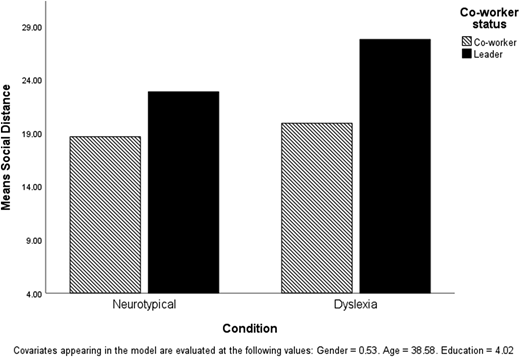
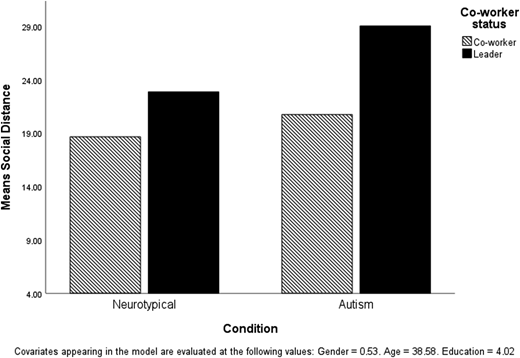
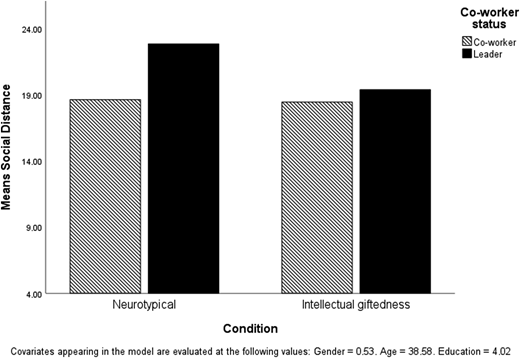
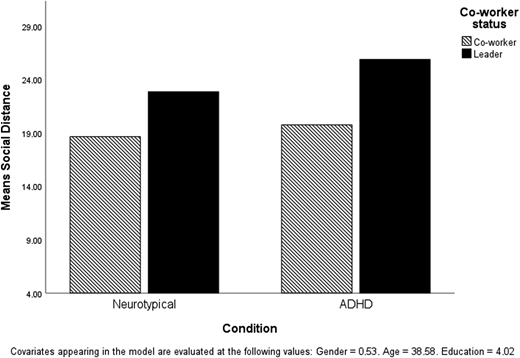
To test the moderating effects hypothesized in Hypotheses 6 to 9 for social distance, we ran a mixed models ANCOVA, with the specific neurodivergent condition as within-participants factor and the co-worker status (leader vs. co-worker), previous experience with neurodivergent colleagues (present vs. absent), and self-identified neurodivergence (neurodivergent vs. neurotypical) as between-subjects factors. We manipulated co-worker status between subjects to prevent potential carryover and contrast effects and to preserve the ecological validity of role-based evaluations. We entered gender, age, and education as control variables in the analysis. The dependent variable was social distance, and significant within-between interaction effects are interpreted as supportive of the hypothesized moderation effects. Our preliminary analyses supported the leadership social distance gap for neurotypical targets, showing that the social distance perceived in relation to the co-workers (M = 19.01, SD = 10.79) was significantly lower than the social distance perceived in relation to the leaders (M = 23.64, SD = 10.27), (F(1,456) = 14.86, p < 0.001, η2 = 0.03, observed power 0.97). Concerning the co-worker status moderation (the leadership social distance gap) for the neurodivergent conditions, the within-between interaction effects were significant for ADHD (F(1,456) = 4.87, p = 0.03, η2 = 0.01, observed power = 0.60), for dyslexia (F(1,456) = 16.29, p < 0.001, η2 = 0.03, observed power = 0.98), for autism (F(1,456) = 16.61, p < 0.001, η2 = 0.04, observed power = 0.98) and for intellectual giftedness (F(1,456) = 21.94, p < 0.001, η2 = 0.05, observed power 0.99). Overall, the pattern of results as depicted in figures 1–3 supports Hypothesis 6, showing that leader status accentuates the social distance associated with the three neurodivergent conditions in comparison to the potential neurotypical co-worker (the significant interaction reveals an elevated leadership social distance gap for the neurodivergent conditions). As depicted in Figure 4, this pattern of results also supports Hypothesis 7, showing that the leadership social distance gap was attenuated for intellectual giftedness.

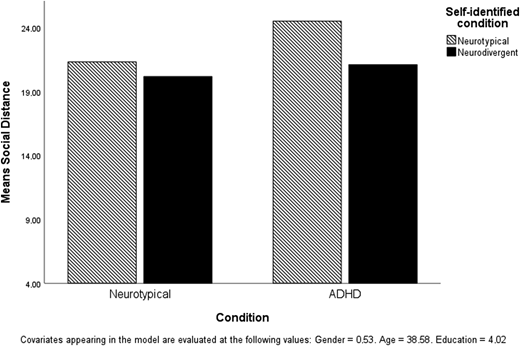
Regarding previous experience with neurodivergent colleagues, the interaction effects were marginally significant for dyslexia (F(1,456) = 3.25, p = 0.07, η2 = 0.007, observed power = 0.44), while the results were not significant for all the other conditions, rendering no support for Hypothesis 8. Concerning the moderating role of self-identified neurodivergence, for ADHD, the interaction effect was significant (F(1,456) = 6.50, p = 0.01, η2 = 0.01, observed power = 0.72), while the remaining interaction effects were not significant. All in all, Hypothesis 9 received only weak support for ADHD (the interaction effect is depicted in Figure 5). As depicted in Figure 5, respondents who are self-identified as neurodivergent tend to report lower social distance for co-workers with ADHD as compared to neurotypical respondents.

To test the mediation effects, we used the MEMORE macro developed for SPSS by Amanda Montoya (2019). The MEMORE procedure tests mediation in repeated measures designs, and it allowed us to estimate the extent to which the difference in social distance reported between neurotypical and neurodivergent potential co-workers is explained by the differences in warmth and competence ascribed to the same co-workers. We simultaneously entered warmth and competence as mediators to account for the covariance between the two scores. The MEMORE analyses were conducted for each of the four neurodivergent conditions separately, and the reference category in each of these mediation analyses was the scores reported for the neurotypical potential co-worker. The difference in social distance between neurotypical and the potential co-worker with ADHD was only explained by competence as the indirect effect did not include zero (indirect effect 0.34, SE = 0.16, 95% CI[0.08; 0.71]), while the indirect effect via warmth included zero, therefore was deemed as not significant (indirect effect 0.15, SE = 0.10, 95% CI[−0.05; 0.36]). The difference in social distance between neurotypical and the potential co-worker with dyslexia was also explained by competence as the indirect effect did not include zero (indirect effect 0.65, SE = 0.17, 95% CI[0.33; 1.03]), while the indirect effect via warmth included zero, therefore was not significant (indirect effect −0.11, SE = 0.14, 95% CI[−0.39; 0.15]). Finally, the difference in social distance between neurotypical and the potential co-worker with autism was also explained by competence as the indirect effect did not include zero (indirect effect 0.89, SE = 0.27, 95% CI[0.43; 1.49]), while the indirect effect via warmth included zero, therefore was deemed not significant (indirect effect 0.04, SE = 0.07, 95% CI[−0.09; 0.19]). Given this pattern of results, Hypothesis 10 was only supported for competence, as all the indirect effects mediated by warmth differences were not significant.

Our study builds on the two-dimensional SCM of Fiske et al. (2002) to explore how the warmth and competence attributes shape social distance toward neurodivergent leaders and co-workers across neurodivergent conditions. Because neurodivergent individuals are often seen as differing from typical norms in behavior, communication, and social embeddedness, we expected that employees with ADHD, dyslexia, or autism would be rated lower on warmth compared with their neurotypical co-workers. Although we found support for this expectation for ADHD and autism, we found the opposite effect for dyslexia, since our results show that people with this condition are perceived as warmer than their neurotypical peers. This pattern of results, although surprising, aligns with recent results showing that people with dyslexia are less biased in social perception (Cross et al., 2024), report lower psychological maladjustment, work-related stress, enhanced psychological resources and need satisfaction compared to other neurodivergent conditions (van Rijswijk and Curşeu, 2026). As a compensatory strategy, individuals with dyslexia may rely more heavily on other competencies, which can lead to the above-average development of social skills such as interpersonal sensitivity that may be perceived as warmth (Eide and Eide, 2023). This divergence from our first hypothesis challenges the assumption that all neurodivergent conditions are perceived through a similar social lens, pointing to the importance of refining SCM in the context of neurodivergence to account for intra-group variability. A possible explanation for this effect lies in the enhanced emotional capacities of individuals with dyslexia, particularly in the domain of empathy. Although empathy seems a complex, multifaceted construct that is difficult to unveil in relation to dyslexia (Gabay and Goldfarb, 2016), several studies suggest a positive association between dyslexia and heightened emotional empathy (Palser et al., 2021; Sturm et al., 2021), which may trigger perceptions of interpersonal warmth in social interactions. However, since the ‘less biased argument' for dyslexia only accounts for warmth, it is likely that additional factors related to competence contribute to the positive effect observed on social distance towards co-workers with dyslexia, compared to neurotypical individuals.

Consistent with the third hypothesis, our findings indicate that intellectually gifted individuals are positively perceived, exhibiting elevated ratings on both warmth and competence dimensions compared to neurotypical individuals. Scholars have long been divided on whether intellectually gifted individuals experience impaired or enhanced emotional and social development (Pinxten et al., 2023). While some researchers documented difficulties experienced by intellectually gifted individuals in these areas (Barber and Mueller, 2011; Jung and Gross, 2014; Vialle and Ciarrochi, 2007), others highlight more nuanced socio-emotional capacities and adaptation among the intellectually gifted (Falck, 2019; Papadopoulos, 2020; Robinson and Noble, 1991). The similar pattern of results concerning intellectual giftedness and dyslexia for warmth is consistent with recent empirical evidence showing that the two conditions are linked to comparatively favorable relatedness, autonomy and competence outcomes and better psychological adjustment at work (van Rijswijk and Curşeu, 2026), indicating a strength-based profile across perceptual and well-being dimensions (Pinxten et al., 2023).

In line with our fourth and fifth hypotheses, we found that the social distance in relation to potential co-workers with ADHD, dyslexia, or autism is higher compared to neurotypical peers, while the social distance in relation to potential intellectually gifted co-workers is lower than that of neurotypical ones. These findings suggest that, despite growing awareness and advocacy around neurodiversity, stigmatizing attitudes in work contexts persist for neurodivergent conditions, seeing neurodivergent employees as less capable and socially skilled in doing their job compared to their neurotypical peers. Although some neurodivergent conditions can have implications on how people organize their tasks or on how they engage in social interactions, our study focuses on potential co-workers instead of evaluations of actual experiences, therefore our results suggest that social prejudice against neurodivergent individuals can, in principle persist independent of real interpersonal experiences at work. These results are consistent with previous research showing indications of socially shared stereotyping and prejudice toward neurodivergent individuals (Mueller et al., 2012; Whelpley et al., 2021). The positive effect of intellectual giftedness on the social distance of potential co-workers is in line with our positive warmth and competence results for this particular neurodivergent condition. As we found negatively biased tendencies for ADHD, dyslexia, and autism, the opposing results for intellectual giftedness should not be interpreted only in a positive light, as they may also obscure the challenges intellectually gifted individuals face; the high expectations it sets can be unrealistically high and difficult for new co-workers to meet (Plucker and Levy, 2001), which may lead to long-term relational negative consequences.

We found that social distance toward potential leaders with ADHD, dyslexia, or autism is greater than toward potential co-workers with the same neurodivergent conditions. This finding supports the tenets of the SRTL, that expectations for leaders regarding both competence and warmth are higher than for co-workers. It also highlights a significant barrier for neurodivergent individuals in attaining leadership positions. While neurodivergent individuals with ADHD, autism, or dyslexia already face negative social role stereotypes when seeking employment, these results suggest that this barrier is even higher when pursuing leadership roles. Since there are only a few studies that investigate neurodivergent leadership (Roberson et al., 2021; Williams et al., 2024), part of this higher social distance may stem from the lack of scholarly knowledge that is developed about the manifestations and (dis)advantages of this form of leadership. In contrast to these findings regarding ADHD, autism, and dyslexia, but consistent with our expectations and previously discussed results on warmth and competence, we found that the social distance gap is smaller for individuals with intellectual giftedness when perceived as potential leaders compared to when perceived as potential co-workers. This finding may reflect the common perception that intellectually gifted individuals possess adaptive and ethical leadership qualities (Sternberg, 2021) and that such leaders, being associated with higher status and competence, are met with lesser social distance (Rogers, 2009). However, this finding carries ambivalent implications for leadership: although perceptions of exceptional ability can provide access to these roles, they may also create overstated demands, leading to tension or exhaustion when leaders are unable to meet these expectations.

We found no significant evidence that previous experience with neurodivergent co-workers alleviates differences in perceived social distance towards potential leaders and co-workers. Moreover, for most neurodivergent conditions (except for ADHD), being neurodivergent oneself does not significantly affect the level of social distance experienced toward potential neurodivergent co-workers and leaders. These findings are not in line with what we expected based on the tenets of ICT and SIT, not with the scarce empirical evidence showing that knowledge of the neurodivergent conditions, whether or not derived from earlier experiences with neurodivergent colleagues, can improve perceptions of warmth and competence and reduce prejudices as antecedents of social distance (Nestorowich et al., 2022; Pettigrew and Tropp, 2008). The absence of significant moderation effects suggests that the mechanisms proposed by these theories may operate differently in the context of neurodiversity at work. A plausible explanation for this result is that our operationalization of prior experience was too generic, as it only captures the presence of contact but does not consider the quality, duration, or context of these interactions. Previous experience with neurodivergent colleagues alone seems not to be sufficient to reduce social distance; the nature and quality of relationship may be more important precursors of reduced bias toward neurodivergent employees. In a similar vein, SIT effects may be limited because neurodivergence does not necessarily constitute a salient or cohesive social identity; neurodivergent conditions such as autism, ADHD, and dyslexia differ substantially, and individuals who identify with one condition may not perceive other neurodivergent individuals as part of their in-group. Employees with autism, for example, may not have accurate and extensive knowledge about other neurodivergent conditions needed to recognize and avoid broader societal biases in their own thinking. In sum, our results imply that both theories require contextual refinement to reflect the complexity of neurodivergent identities and the conditions under which social contact and shared identity reduce social distance.

In our final hypothesis, we only found support for competence as an explanation of the effect of neurodivergence on social distance. This fundamental insight provides a more nuanced understanding of the SCM in relation to neurodivergence in a work context, as our results show that social distance in relation to potential neurodivergent co-workers and leaders is mainly driven by perceptions of competence. The absence of a significant mediating effect through warmth may be interpreted by the importance of competence in workplace evaluations, where task performance and capability are typically prioritized over interpersonal qualities when assessing potential colleagues or leaders. Our findings expand current research on stigma and prejudice in the workplace regarding neurodiversity by showing that competence biases fuel such practices. For instance, Whelpley et al. (2021) show that autistic individuals often experience doubts about their abilities during job interviews and the feeling their professional competencies are ignored by the interviewer. Furthermore, Gottardello et al. (2025) show that intersectional identities (e.g. neurodivergence combined with ethnicity) can amplify stereotyping and marginalization. In short, we can conclude that ascribed competence is the primary driver of social distance for neurodivergent co-workers. However, these patterns may vary across cultural or organizational contexts, where social norms and inclusion practices could moderate the link between competence perceptions and social distance.

As illustrated by the large effect sizes reflected in the Cohen's d values for the paired samples comparisons, our findings highlight potential discrimination faced by neurodivergent employees, and we offer several recommendations for organizations to reduce biases against neurodivergent employees and create more neuro-inclusive work environments. First, as our results show that perceived competence is the primary driver of social distance toward neurodivergent individuals, interventions should focus on challenging deficit-based biases, underscoring the actual performance and added value of neurodivergent co-workers and leaders. Organizations could review their hiring practices to uncover potential unconscious biases in evaluating neurodivergent candidates' competencies, such as reliance on performance expectations and assessments norms, primarily developed in relation to neurotypical cognitive profiles. In addition, they can use structured awareness campaigns with evidence-based data on neurodivergent performance outcomes and highlight measurable contributions to team innovation and problem-solving (van Rijswijk et al., 2025b). For instance, incorporating case studies and video accounts from neurodivergent employees and leaders into onboarding and leadership training can help challenge stereotypes and promote a more accurate appreciation of their contributions and capabilities. Second, as we found an even greater social distance toward neurodivergent leaders, organizations should reconsider their leadership competence profiles to make room for neurodivergent leadership. Since the number of neurodivergent leaders is still scarce compared to neurotypical peers, existing expectations about the competence of leaders based on neurotypical stereotypes will persist, which will not reduce the social distance toward potential neurodivergent leaders. To address this, organizations must revise their competency profiles for management positions to account for differences in cognitive styles and decision-making approaches and align the evaluation criteria for these positions accordingly. Third, contrary to our expectations, prior experience with neurodivergent colleagues did not reduce social distance, suggesting that social interaction alone may not always be sufficient to reduce bias. Organizations could consider focusing on a deeper, meaningful engagement by developing, for instance, mentorship programs and high task interdependence in projects, combined with providing actionable knowledge about collaboration in neurodiverse teams that allow neurodivergent and neurotypical colleagues to build a deeper mutual understanding and respect. Such mentorship programs could incorporate structured reflection sessions and guided dialog facilitated by trained neurodiversity-specialized coaches. Fourth, organizations can take further steps at the policy level, for example, by running bias audits and creating more diverse leadership pipelines, to address systemic barriers to neuro-inclusion. These actions can reveal hidden biases in everyday work processes and help ensure fair access to leadership roles for neurodivergent employees. Importantly, bias audits should include intersectional measures that show how neurodivergence overlaps with other marginalized identities, such as gender, race, or ethnicity. This matters because people who are both neurodivergent and part of other occupational minorities often face multiple layers of disadvantage in hiring, promotion, and leadership opportunities (van Rijswijk et al., 2025a). Intersectionality theory reminds us that these overlapping identities create unique challenges that cannot be understood by looking at each identity separately. Using an intersectional lens can guide more targeted strategies, like tailored leadership development programs or recruitment practices that explicitly address overlapping forms of marginalization, so inclusion efforts respond to the real barriers neurodivergent employees encounter.

While vignette-based methodologies are valuable for isolating the causal effect particular variables and mitigating social desirability bias, they may fall short in representing the true complexity of real-life interactions (Collett and Childs, 2011). In this study, participants assessed hypothetical scenarios rather than drawing from their own lived experiences, which could constrain the ecological validity of the findings. Moreover, because the manipulation of neurodivergent conditions was carried out within participants, we aimed to streamline the procedure and did not include a direct manipulation check after each vignette, a fact that limits the confidence that participants internalized neurodivergent labels as expected. Although the sample size was commendable and demographically varied, the overrepresentation of participants with bachelor's and master's degrees may limit the generalizability of our findings to the broader workforce population. Future research could consider other research designs to reproduce our results and evaluate whether these limitations affect our findings. Another limitation of our study, as well as an opportunity for future research, is the attention to the intersectionality with other (more visible) forms of identity, such as race or gender. Given that intersectional identities can compound bias (Connor et al., 2023), future research could adopt an intersectional lens to better understand the complex workings of prejudice against neurodivergent employees. Besides that, since we found no significant impact of previous experiences with neurodivergent co-workers on social distance, future research could explore whether the depth and duration of those relationships help explain this outcome. Lastly, future research could investigate the cultural generalizability of our findings, and cross-cultural explorations could explore how neurodivergent conditions are perceived across cultures and identify cross-cultural differences in prejudice and social distance (Keating et al., 2024).

The supplementary material for this article can be found online.
Agha
,
Z.
,
Banerjee
,
N.
,
Hebl
,
M.
,
Khan
,
M.
,
Nittrouer
,
C.
,
Vincent
,
N.
and
Zhou
,
C.
(
2024
), “Motivations to hire neurodiverse workers”, in
Patton
,
E.
and
Santuzzi
,
A.M.
(Eds),
Neurodiversity and Work: Employment, Identity, and Support Networks for Neurominorities
,
Springer Nature Switzerland
,
Cham
, pp. 
131
-
155
, doi: .
Armstrong
,
T.
(
2010
),
Neurodiversity: Discovering the Extraordinary Gifts of Autism, Adhd, Dyslexia, and Other Brain Differences
,
Da Capo Lifelong Books
,
Cambridge
.
Austin
,
R.D.
and
Pisano
,
G.P.
(
2017
), “
Neurodiversity as a competitive advantage
”,
Harvard Business Review
, Vol. 
95
No. 
3
, pp. 
96
-
103
, doi: .
Autism Voice
(
2024
), “
Integrarea persoanelor neurodivergente pe piața muncii din România
”,
available at:
 https://institut.autismvoice.ro/studiu-integrarea-persoanelor-neurodivergente-pe-piata-muncii-din-romania/ (
accessed
 8 May 2025).
Axbey
,
H.
,
Beckmann
,
N.
,
Fletcher-Watson
,
S.
,
Tullo
,
A.
and
Crompton
,
C.J.
(
2023
), “
Innovation through neurodiversity: diversity is beneficial
”,
Autism
, Vol. 
27
No. 
7
, pp. 
2193
-
2198
, doi: .
Barber
,
C.
and
Mueller
,
C.T.
(
2011
), “
Social and self-perceptions of adolescents identified as gifted, learning disabled, and twice-exceptional
”,
Roeper Review
, Vol. 
33
No. 
2
, pp. 
109
-
120
, doi: .
Baum
,
S.M.
,
Schader
,
R.M.
and
Owen
,
S.V.
(
2021
),
To Be Gifted and Learning Disabled: Strength-Based Strategies for Helping Twice-Exceptional Students with Ld, Adhd, Asd, and More
,
Routledge
,
New York
, doi: .
Bor
,
A.
(
2020
), “
Evolutionary leadership theory and economic voting: warmth and competence impressions mediate the effect of economic perceptions on vote
”,
The Leadership Quarterly
, Vol. 
31
No. 
2
, 101295, doi: .
Brouwers
,
E.P.M.
,
Bergijk
,
M.
,
van Weeghel
,
J.
,
Detaille
,
S.
,
Kerkhof
,
H.
and
Dewinter
,
J.
(
2025
), “
Barriers to and facilitators for finding and keeping competitive employment: a focus group study on autistic adults with and without paid employment
”,
Journal of Occupational Rehabilitation
, Vol. 
35
No. 
1
, pp. 
54
-
65
, doi: .
Bucaille
,
A.
,
Jarry
,
C.
,
Allard
,
J.
,
Brochard
,
S.
,
Peudenier
,
S.
and
Roy
,
A.
(
2022
), “
Neuropsychological profile of intellectually gifted children: a systematic review
”,
Journal of the International Neuropsychological Society
, Vol. 
28
No. 
4
, pp. 
424
-
440
, doi: .
Bury
,
S.M.
,
Hedley
,
D.
,
Uljarević
,
M.
,
Li
,
X.
,
Stokes
,
M.A.
and
Begeer
,
S.
(
2024
), “
Employment profiles of autistic people: an 8-year longitudinal study
”,
Autism
, Vol. 
28
No. 
9
, pp. 
2322
-
2333
, doi: .
Butler
,
R.C.
and
Gillis
,
J.M.
(
2011
), “
The impact of labels and behaviors on the stigmatization of adults with asperger's disorder
”,
Journal of Autism and Developmental Disorders
, Vol. 
41
No. 
6
, pp. 
741
-
749
, doi: .
Collett
,
J.L.
and
Childs
,
E.
(
2011
), “
Minding the gap: meaning, affect, and the potential shortcomings of vignettes
”,
Social Science Research
, Vol. 
40
No. 
2
, pp. 
513
-
522
, doi: .
Connor
,
P.
,
Weeks
,
M.
,
Glaser
,
J.
,
Chen
,
S.
and
Keltner
,
D.
(
2023
), “
Intersectional implicit bias: evidence for asymmetrically compounding bias and the predominance of target gender
”,
Journal of Personality and Social Psychology
, Vol. 
124
No. 
1
, pp. 
22
-
48
, doi: .
Cross
,
L.
,
Atherton
,
G.
and
Nicolson
,
R.I.
(
2024
), “
People with dyslexia or dyscalculia are less biased: results of a preregistered study from over 450,000 people on the implicit association test
”,
Neurodiversity
, Vol. 
2
, 27546330241288164, doi: .
Cuddy
,
A.J.
,
Fiske
,
S.T.
and
Glick
,
P.
(
2007
), “
The bias map: behaviors from intergroup affect and stereotypes
”,
Journal of Personality and Social Psychology
, Vol. 
92
No. 
4
, pp. 
631
-
648
, doi: .
Cuddy
,
A.J.C.
,
Fiske
,
S.T.
and
Glick
,
P.
(
2008
), “Warmth and competence as universal dimensions of social perception: the stereotype content model and the bias map”, in
Advances in Experimental Social Psychology
,
Academic Press
, pp. 
61
-
149
, doi: .
Curşeu
,
P.L.
,
Coman
,
A.D.
,
Panchenko
,
A.
,
Fodor
,
O.C.
and
Rațiu
,
L.
(
2023
), “
Death anxiety, death reflection and interpersonal communication as predictors of social distance towards people infected with covid 19
”,
Current Psychology
, Vol. 
42
No. 
2
, pp. 
1490
-
1503
, doi: .
David
,
H.
and
Gyarmathy
,
E.
(
2023
), “Neurodiversity and supporting the autistic-gifted child and adolescent”, in
David
,
H.
and
Gyarmathy
,
E.
(Eds),
Gifted Children and Adolescents through the Lens of Neuropsychology
,
Springer International Publishing
,
Cham
, pp. 
71
-
87
, doi: .
Davies
,
J.
,
Heasman
,
B.
,
Livesey
,
A.
,
Walker
,
A.
,
Pellicano
,
E.
and
Remington
,
A.
(
2023
), “
Access to employment: a comparison of autistic, neurodivergent and neurotypical adults' experiences of hiring processes in the United Kingdom
”,
Autism
, Vol. 
27
No. 
6
, pp. 
1746
-
1763
, doi: .
Draaisma
,
D.
(
2009
), “
Stereotypes of autism
”,
Philosophical Transactions of the Royal Society B: Biological Sciences
, Vol. 
364
No. 
1522
, pp. 
1475
-
1480
, doi: .
Eagly
,
A.H.
and
Karau
,
S.J.
(
2002
), “
Role congruity theory of prejudice toward female leaders
”,
Psychological Review
, Vol. 
109
No. 
3
, pp. 
573
-
598
, doi: .
Eide
,
B.L.
and
Eide
,
F.F.
(
2023
),
The Dyslexic Advantage (Revised and Updated): Unlocking the Hidden Potential of the Dyslexic Brain
,
Penguin
,
New York
.
European Union
(
2023
), “
Special eurobarometer 535 – discrimination in the European Union
”,
available at:
 https://europa.eu/eurobarometer/surveys/detail/2972 (
accessed
 5 May 2025).
Falck
,
S.
(
2019
),
Extreme Intelligence: Development, Predicaments, Implications
,
Routledge
,
London
, doi: .
Fiske
,
S.T.
(
2018
), “
Stereotype content: warmth and competence endure
”,
Current Directions in Psychological Science
, Vol. 
27
No. 
2
, pp. 
67
-
73
, doi: .
Fiske
,
S.T.
,
Cuddy
,
A.J.C.
,
Glick
,
P.
and
Xu
,
J.
(
2002
), “
A model of (often mixed) stereotype content: competence and warmth respectively follow from perceived status and competition
”,
Journal of Personality and Social Psychology
, Vol. 
82
No. 
6
, pp. 
878
-
902
, doi: .
Gabay
,
Y.G.S.-T.S.
and
Goldfarb
,
L.
(
2016
), “
Cognitive and emotional empathy in typical and impaired readers and its relationship to reading competence
”,
Journal of Clinical and Experimental Neuropsychology
, Vol. 
38
No. 
10
, pp. 
1131
-
1143
, doi: .
Gerber
,
P.J.
,
Price
,
L.A.
,
Mulligan
,
R.
and
Shessel
,
I.
(
2004
), “
Beyond transition: a comparison of the employment experiences of american and canadian adults with ld
”,
Journal of Learning Disabilities
, Vol. 
37
No. 
4
, pp. 
283
-
291
, doi: .
Golle
,
J.
,
Schils
,
T.
,
Borghans
,
L.
and
Rose
,
N.
(
2023
), “
Who is considered gifted from a teacher's perspective? A representative large-scale study
”,
Gifted Child Quarterly
, Vol. 
67
No. 
1
, pp. 
64
-
79
, doi: .
Goodley
,
D.
(
2016
),
Disability Studies: An Interdisciplinary Introduction
,
Sage
,
London
.
Gottardello
,
D.
,
Calvard
,
T.
and
Song
,
J.-W.
(
2025
), “
When neurodiversity and ethnicity combine: intersectional stereotyping and workplace experiences of neurodivergent ethnic minority employees
”,
Human Resource Management
, Vol. 
64
No. 
3
, pp. 
841
-
859
, doi: .
Gray
,
D.E.
(
2002
), “
Everybody just freezes. Everybody is just embarrassed': felt and enacted stigma among parents of children with high functioning autism
”,
Sociology of Health and Illness
, Vol. 
24
No. 
6
, pp. 
734
-
749
, doi: .
Hebron
,
J.
and
Humphrey
,
N.
(
2014
), “
Exposure to bullying among students with autism spectrum conditions: a multi-informant analysis of risk and protective factors
”,
Autism
, Vol. 
18
No. 
6
, pp. 
618
-
630
, doi: .
Hennekam
,
S.
and
Follmer
,
K.
(
2024
), “
Neurodiversity and hrm: a practice-based review and research agenda
”,
Equality, Diversity and Inclusion: An International Journal
, Vol. 
43
No. 
7
, pp. 
1119
-
1129
, doi: .
Howes
,
S.S.
(
2023
), “
Emotional intelligence in autistic adults: a review with considerations for employers
”,
Sustainability
, Vol. 
15
No. 
9
,
7252
, doi: .
Hughes
,
S.
(
2024
), “
Attitudes to mental illness: 2023 summary report
”.
Jung
,
J.Y.
and
Gross
,
M.U.M.
(
2014
), “Highly gifted students”, in
Plucker
,
J.
and
Callahan
,
C.
(Eds),
Critical Issues and Practices in Gifted Education: What the Research Says
, (2nd ed.) ,
Prufrock Press
,
Waco
, pp. 
305
-
314
.
Kapp
,
S.K.
,
Gillespie-Lynch
,
K.
,
Sherman
,
L.E.
and
Hutman
,
T.
(
2013
), “
Deficit, difference, or both? Autism and neurodiversity
”,
Developmental Psychology
, Vol. 
49
No. 
1
, pp. 
59
-
71
, doi: .
Keating
,
C.T.
,
Hickman
,
L.
,
Geelhand
,
P.
,
Takahashi
,
T.
,
Leung
,
J.
,
Monk
,
R.
,
Schuster
,
B.
,
Rybicki
,
A.
,
Girolamo
,
T.M.
,
Clin
,
E.
,
Papastamou
,
F.
,
Belenger
,
M.
,
Eigsti
,
I.-M.
,
Cook
,
J.L.
,
Kosaka
,
H.
,
Osu
,
R.
,
Okamoto
,
Y.
and
Sowden-Carvalho
,
S.
(
2024
), “
Cross-cultural variation in experiences of acceptance, camouflaging and mental health difficulties in autism: a registered report
”,
PLoS One
, Vol. 
19
No. 
3
,
e0299824
, doi: .
Khassawneh
,
O.
(
2025
), “
Harnessing the potential of neurodiversity: inclusive leadership and high-quality relationships as drivers of organizational commitment and support
”,
Journal of Organizational Effectiveness. People and Performance
, pp. 
1
-
19
, doi: .
Knight
,
C.
(
2021
), “
The impact of the dyslexia label on academic outlook and aspirations: an analysis using propensity score matching
”,
British Journal of Educational Psychology
, Vol. 
91
No. 
4
, pp. 
1110
-
1126
, doi: .
Koenig
,
A.M.
,
Eagly
,
A.H.
,
Mitchell
,
A.A.
and
Ristikari
,
T.
(
2011
), “
Are leader stereotypes masculine? A meta-analysis of three research paradigms
”,
Psychological Bulletin
, Vol. 
137
No. 
4
, pp. 
616
-
642
, doi: .
Kofler
,
M.J.
,
Sarver
,
D.E.
,
Harmon
,
S.L.
,
Moltisanti
,
A.
,
Aduen
,
P.A.
,
Soto
,
E.F.
and
Ferretti
,
N.
(
2018
), “
Working memory and organizational skills problems in adhd
”,
Journal of Child Psychology and Psychiatry
, Vol. 
59
No. 
1
, pp. 
57
-
67
, doi: .
Legault
,
M.
,
Bourdon
,
J.-N.
and
Poirier
,
P.
(
2021
), “
From neurodiversity to neurodivergence: the role of epistemic and cognitive marginalization
”,
Synthese
, Vol. 
199
No. 
5
, pp. 
12843
-
12868
, doi: .
Masuch
,
T.V.
,
Bea
,
M.
,
Alm
,
B.
,
Deibler
,
P.
and
Sobanski
,
E.
(
2019
), “
Internalized stigma, anticipated discrimination and perceived public stigma in adults with adhd
”,
ADHD Attention Deficit and Hyperactivity Disorders
, Vol. 
11
No. 
2
, pp. 
211
-
220
, doi: .
Mather
,
D.M.
,
Jones
,
S.W.
and
Moats
,
S.
(
2017
), “
Improving upon bogardus: creating a more sensitive and dynamic social distance scale
”,
Survey Practice
, Vol. 
10
No. 
4
, pp. 
1
-
9
, doi: .
McDowall
,
A.
,
Doyle
,
N.
and
Kiseleva
,
M.
(
2023
), “
Neurodiversity at work 2023: demand, supply and a gap analysis
”,
available at:
 https://eprints.bbk.ac.uk/id/eprint/50834/22/50834c.pdf
McNulty
,
M.A.
(
2003
), “
Dyslexia and the life course
”,
Journal of Learning Disabilities
, Vol. 
36
No. 
4
, pp. 
363
-
381
, doi: .
Mellifont
,
D.
(
2021
), “
Facilitators and inhibitors of mental discrimination in the workplace: a traditional review
”,
Studies in Social Justice
, Vol. 
15
No. 
1
, pp. 
59
-
80
, doi: .
Montoya
,
A.K.
(
2019
), “
Moderation analysis in two-instance repeated measures designs: probing methods and multiple moderator models
”,
Behavior Research Methods
, Vol. 
51
No. 
1
, pp. 
61
-
82
, doi: .
Mueller
,
A.K.
,
Fuermaier
,
A.B.M.
,
Koerts
,
J.
and
Tucha
,
L.
(
2012
), “
Stigma in attention deficit hyperactivity disorder
”,
ADHD Attention Deficit and Hyperactivity Disorders
, Vol. 
4
No. 
3
, pp. 
101
-
114
, doi: .
Nestorowich
,
D.L.
,
Lupien
,
S.P.
and
Madaus Knapp
,
V.
(
2022
), “
Perceptions of behaviors associated with asd in others: knowledge of the diagnosis increases empathy and improves perceptions of warmth and competence
”,
European Journal of Investigation in Health Psychology and Education
, Vol. 
12
No. 
11
, pp. 
1594
-
1606
, doi: .
Palser
,
E.R.
,
Morris
,
N.A.
,
Roy
,
A.R.K.
,
Holley
,
S.R.
,
Veziris
,
C.R.
,
Watson
,
C.
,
Deleon
,
J.
,
Miller
,
Z.A.
,
Miller
,
B.L.
,
Gorno-Tempini
,
M.L.
and
Sturm
,
V.E.
(
2021
), “
Children with developmental dyslexia show elevated parasympathetic nervous system activity at rest and greater cardiac deceleration during an empathy task
”,
Biological Psychology
, Vol. 
166
, 108203, doi: .
Papadopoulos
,
D.
(
2020
), “
Psychological framework for gifted children's cognitive and socio-emotional development: a review of the research literature and implications
”,
Journal for the Education of Gifted Young Scientists
, Vol. 
8
No. 
1
, pp. 
305
-
323
, doi: .
Pescosolido
,
B.A.
,
Halpern-Manners
,
A.
,
Luo
,
L.
and
Perry
,
B.
(
2021
), “
Trends in public stigma of mental illness in the US, 1996-2018
”,
JAMA Network Open
, Vol. 
4
No. 
12
,
e2140202
, doi: .
Pettigrew
,
T.F.
and
Tropp
,
L.R.
(
2006
), “
A meta-analytic test of intergroup contact theory
”,
Journal of Personality and Social Psychology
, Vol. 
90
No. 
5
, pp. 
751
-
783
, doi: .
Pettigrew
,
T.F.
and
Tropp
,
L.R.
(
2008
), “
How does intergroup contact reduce prejudice? Meta-analytic tests of three mediators
”,
European Journal of Social Psychology
, Vol. 
38
No. 
6
, pp. 
922
-
934
, doi: .
Pinxten
,
W.L.F.-v.
,
Derksen
,
J.J.L.
and
Peters
,
W.A.M.
(
2023
), “
The psychological world of highly gifted young adults: a follow-up study
”,
Trends in Psychology
. doi: .
Plucker
,
J.A.
and
Levy
,
J.J.
(
2001
), “
The downside of being talented
”,
American Psychologist
, Vol. 
56
No. 
1
, pp. 
75
-
90
, doi: .
Rinn
,
A.N.
and
Plucker
,
J.A.
(
2019
), “
High-ability college students and undergraduate honors programs: a systematic review
”,
Journal for the Education of the Gifted
, Vol. 
42
No. 
3
, pp. 
187
-
215
, doi: .
Roberson
,
Q.
,
Quigley
,
N.R.
,
Vickers
,
K.
and
Bruck
,
I.
(
2021
), “
Reconceptualizing leadership from a neurodiverse perspective
”,
Group and Organization Management
, Vol. 
46
No. 
2
, pp. 
399
-
423
, doi: .
Robinson
,
N.M.
and
Noble
,
K.D.
(
1991
), “Social-emotional development and adjustment of gifted children”, in
Wang
,
M.C.
and
Reynolds
,
M.C.
(Eds),
Handbook of Special Education: Research and Practice
,
Pergamon Press
,
Elmsford
, pp. 
57
-
76
.
Rogers
,
K.B.
(
2009
), “Leadership giftedness: is it innate or can it be developed?”, in
Shavinina
,
L.V.
(Ed.),
International Handbook on Giftedness
,
Springer Netherlands
,
Dordrecht
, pp. 
633
-
645
, doi: .
Shifrer
,
D.
(
2013
), “
Stigma of a label: educational expectations for high school students labeled with learning disabilities
”,
Journal of Health and Social Behavior
, Vol. 
54
No. 
4
, pp. 
462
-
480
, doi: .
Singer
,
J.
(
1999
), “Why can't you be normal for once in your life? From a problem with no name to the emergence of a new category of difference”, in
M
,
C.
and
S
,
F.
(Eds),
Disability Discourse
,
Open University Press
,
Buckingham
, pp. 
59
-
70
.
Sparkes
,
I.
,
Riley
,
E.
,
Cook
,
B.
and
Machuel
,
P.
(
2022
), “
Outcomes for disabled people in the UK: 2021
”,
available at:
 https://www.ons.gov.uk/peoplepopulationandcommunity/healthandsocialcare/disability/articles/outcomesfordisabledpeopleintheuk/2021 (
accessed
 13 September 2025).
Stenning
,
A.
and
Rosqvist
,
H.B.
(
2021
), “
Neurodiversity studies: mapping out possibilities of a new critical paradigm
”,
Disability and Society
, Vol. 
36
No. 
9
, pp. 
1532
-
1537
, doi: .
Sternberg
,
R.J.
(
2021
), “A new model of giftedness emphasizing active concerned citizenship and ethical leadership that can make a positive, meaningful, and potentially enduring difference to the world”, in
Sternberg
,
R.J.
and
Ambrose
,
D.
(Eds),
Conceptions of Giftedness and Talent
,
Springer International Publishing
,
Cham
, pp. 
407
-
424
, doi: .
Sturm
,
V.E.
,
Roy
,
A.R.K.
,
Datta
,
S.
,
Wang
,
C.
,
Sible
,
I.J.
,
Holley
,
S.R.
,
Watson
,
C.
,
Palser
,
E.R.
,
Morris
,
N.A.
,
Battistella
,
G.
,
Rah
,
E.
,
Meyer
,
M.
,
Pakvasa
,
M.
,
Mandelli
,
M.L.
,
Deleon
,
J.
,
Hoeft
,
F.
,
Caverzasi
,
E.
,
Miller
,
Z.A.
,
Shapiro
,
K.A.
,
Hendren
,
R.
,
Miller
,
B.L.
and
Gorno-Tempini
,
M.L.
(
2021
), “
Enhanced visceromotor emotional reactivity in dyslexia and its relation to salience network connectivity
”,
Cortex
, Vol. 
134
, pp. 
278
-
295
, doi: .
Trope
,
Y.
and
Liberman
,
N.
(
2010
), “
Construal-level theory of psychological distance
”,
Psychological Review
, Vol. 
117
No. 
2
, pp. 
440
-
463
, doi: .
Turner
,
J.C.
and
Tajfel
,
H.
(
1986
), “
The social identity theory of intergroup behavior
”,
Psychology of Intergroup Relations
, Vol. 
5
, pp. 
7
-
24
.
Turnock
,
A.
,
Langley
,
K.
and
Jones
,
C.R.G.
(
2022
), “
Understanding stigma in autism: a narrative review and theoretical model
”,
Autism in Adulthood
, Vol. 
4
No. 
1
, pp. 
76
-
91
, doi: .
van Casteren
,
P.A.J.
,
Meerman
,
J.
,
Brouwers
,
E.P.M.
,
van Dam
,
A.
and
van der Klink
,
J.J.L.
(
2021
), “
How can wellbeing at work and sustainable employability of gifted workers be enhanced? A qualitative study from a capability approach perspective
”,
BMC Public Health
, Vol. 
21
No. 
1
, p.
392
, doi: .
van Rijswijk
,
J.
and
Curşeu
,
P.L.
(
2025
), “
Formal versus self-identified neurodivergence: a comparative study in work environments
”,
Behavioral Sciences
, Vol. 
15
No. 
4
, p.
420
, doi: .
van Rijswijk
,
J.
and
Curşeu
,
P.L.
(
2026
), “
Neurodivergence and well-being: the fulfillment of fundamental psychological needs, work-related stress, and life satisfaction in work contexts
”,
British Journal of Psychology
, bjop.70057, doi: .
van Rijswijk
,
J.
,
Curşeu
,
P.L.
and
van Oortmerssen
,
L.A.
(
2025a
), “
The salience of the invisible: insights into the evolution, workings, and relational challenges of employee neurodiversity networks
”,
Employee Relations: The International Journal
, Vol. 
47
No. 
7
, pp. 
1121
-
1140
, doi: .
van Rijswijk
,
J.
,
Curşeu
,
P.L.
and
van Oortmerssen
,
L.A.
(
2025b
), “
Unlocking neurodiversity: the role of horizontal differentiation and social cognitive integration as antecedents of team performance
”,
Team Performance Management: International Journal
, Vol. 
31
Nos
3/4
, pp. 
116
-
132
, doi: .
Vialle
,
W.L.H.P.C.
and
Ciarrochi
,
J.
(
2007
), “
On being gifted, but sad and misunderstood: social, emotional, and academic outcomes of gifted students in the wollongong youth study
”,
Educational Research and Evaluation
, Vol. 
13
No. 
6
, pp. 
569
-
586
, doi: .
Whelpley
,
C.E.
,
Banks
,
G.C.
,
Bochantin
,
J.E.
and
Sandoval
,
R.
(
2021
), “
Tensions on the spectrum: an inductive investigation of employee and manager experiences of autism
”,
Journal of Business and Psychology
, Vol. 
36
No. 
2
, pp. 
283
-
297
, doi: .
Williams
,
N.
,
Bragger
,
J.
and
Myszko
,
Z.
(
2024
), “
(neuro)diversifying organizations: the case for developing autistic leaders
”,
Consulting Psychology Journal
, Vol. 
76
No. 
1
, pp. 
1
-
19
, doi: .
Published by Emerald Publishing Limited. This article is published under the Creative Commons Attribution (CC BY 4.0) license. Anyone may reproduce, distribute, translate and create derivative works of this article (for both commercial and non-commercial purposes), subject to full attribution to the original publication and authors. The full terms of this license may be seen at Link to the terms of the CC BY 4.0 licence.

Supplementary data

Data & Figures

Figure 1
A vertical bar chart compares the mean social distance for neurotypical and A D H D groups by co-worker and leader.The vertical axis is labeled “Means Social Distance” and ranges from 4.00 to 29.00 in increments of 5 units. The horizontal axis is labeled “Condition” and contains two categories: “Neurotypical” on the left and “A D H D” on the right. A legend appears in the upper right labeled “Co-worker status”. A diagonally lined bar represents “Co-worker”. A solid black bar represents “Leader”. For the category “Neurotypical”, the diagonally lined bar representing “Co-worker” is positioned at 19. The solid black bar representing “Leader” is positioned at 23. For the category “ADHD”, the diagonally lined bar representing “Co-worker” is positioned at 20. The solid black bar representing “Leader” is positioned at 26. Below the chart, a label reads: “Covariates appearing in the model are evaluated at the following values: Gender equals 0.53, Age equals 38.58, Education equals 4.02”. Note: All numerical data values are approximated.

The interaction effect between co-worker status and ADHD neurodivergence on social distance. Source: Authors' own work

Figure 1
A vertical bar chart compares the mean social distance for neurotypical and A D H D groups by co-worker and leader.The vertical axis is labeled “Means Social Distance” and ranges from 4.00 to 29.00 in increments of 5 units. The horizontal axis is labeled “Condition” and contains two categories: “Neurotypical” on the left and “A D H D” on the right. A legend appears in the upper right labeled “Co-worker status”. A diagonally lined bar represents “Co-worker”. A solid black bar represents “Leader”. For the category “Neurotypical”, the diagonally lined bar representing “Co-worker” is positioned at 19. The solid black bar representing “Leader” is positioned at 23. For the category “ADHD”, the diagonally lined bar representing “Co-worker” is positioned at 20. The solid black bar representing “Leader” is positioned at 26. Below the chart, a label reads: “Covariates appearing in the model are evaluated at the following values: Gender equals 0.53, Age equals 38.58, Education equals 4.02”. Note: All numerical data values are approximated.

The interaction effect between co-worker status and ADHD neurodivergence on social distance. Source: Authors' own work

Close modal
Figure 2
A vertical bar chart for social distance scores for neurotypical and dyslexia groups by co-worker and leader roles.The vertical axis is labeled “Means Social Distance” and ranges from 4.00 to 29.00 in increments of 5 units. The horizontal axis is labeled “Condition” and contains two categories: “Neurotypical” on the left and “Dyslexia” on the right. A legend appears in the upper right labeled “Co-worker status”. A diagonally lined bar represents “Co-worker”. A solid black bar represents “Leader”. For the category “Neurotypical”, the diagonally lined bar representing “Co-worker” is positioned at 19. The solid black bar representing “Leader” is positioned at 23. For the category “Dyslexia”, the diagonally lined bar representing “Co-worker” is positioned at 20. The solid black bar representing “Leader” is positioned at 28. Below the chart, a label reads: “Covariates appearing in the model are evaluated at the following values: Gender equals 0.53, Age equals 38.58, Education equals 4.02”. Note: All numerical data values are approximated.

The interaction effect between co-worker status and dyslexia neurodivergence on social distance. Source: Authors' own work

Figure 2
A vertical bar chart for social distance scores for neurotypical and dyslexia groups by co-worker and leader roles.The vertical axis is labeled “Means Social Distance” and ranges from 4.00 to 29.00 in increments of 5 units. The horizontal axis is labeled “Condition” and contains two categories: “Neurotypical” on the left and “Dyslexia” on the right. A legend appears in the upper right labeled “Co-worker status”. A diagonally lined bar represents “Co-worker”. A solid black bar represents “Leader”. For the category “Neurotypical”, the diagonally lined bar representing “Co-worker” is positioned at 19. The solid black bar representing “Leader” is positioned at 23. For the category “Dyslexia”, the diagonally lined bar representing “Co-worker” is positioned at 20. The solid black bar representing “Leader” is positioned at 28. Below the chart, a label reads: “Covariates appearing in the model are evaluated at the following values: Gender equals 0.53, Age equals 38.58, Education equals 4.02”. Note: All numerical data values are approximated.

The interaction effect between co-worker status and dyslexia neurodivergence on social distance. Source: Authors' own work

Close modal
Figure 3
A vertical bar chart compares the mean social distance toward co-workers and leaders for neurotypical and autism conditions.The vertical axis is labeled “Means Social Distance” and ranges from 4.00 to 29.00 in increments of 5 units. The horizontal axis is labeled “Condition” and contains two categories: “Neurotypical” on the left and “Autism” on the right. A legend appears in the upper right labeled “Co-worker status”. A diagonally lined bar represents “Co-worker”. A solid black bar represents “Leader”. For the category “Neurotypical”, the diagonally lined bar representing “Co-worker” is positioned at 19. The solid black bar representing “Leader” is positioned at 23. For the category “Autism”, the diagonally lined bar representing “Co-worker” is positioned at 21. The solid black bar representing “Leader” is positioned at 29. Below the chart, a label reads: “Covariates appearing in the model are evaluated at the following values: Gender equals 0.53, Age equals 38.58, Education equals 4.02”. Note: All numerical data values are approximated.

The interaction effect between co-worker status and autism neurodivergence on social distance. Source: Authors' own work

Figure 3
A vertical bar chart compares the mean social distance toward co-workers and leaders for neurotypical and autism conditions.The vertical axis is labeled “Means Social Distance” and ranges from 4.00 to 29.00 in increments of 5 units. The horizontal axis is labeled “Condition” and contains two categories: “Neurotypical” on the left and “Autism” on the right. A legend appears in the upper right labeled “Co-worker status”. A diagonally lined bar represents “Co-worker”. A solid black bar represents “Leader”. For the category “Neurotypical”, the diagonally lined bar representing “Co-worker” is positioned at 19. The solid black bar representing “Leader” is positioned at 23. For the category “Autism”, the diagonally lined bar representing “Co-worker” is positioned at 21. The solid black bar representing “Leader” is positioned at 29. Below the chart, a label reads: “Covariates appearing in the model are evaluated at the following values: Gender equals 0.53, Age equals 38.58, Education equals 4.02”. Note: All numerical data values are approximated.

The interaction effect between co-worker status and autism neurodivergence on social distance. Source: Authors' own work

Close modal
Figure 4
A bar chart compares social distance toward co-workers and leaders for neurotypical and intellectually gifted individuals.The vertical axis is labeled “Means Social Distance” and ranges from 4.00 to 24.00 in increments of 5 units. The horizontal axis is labeled “Condition” and contains two categories: “Neurotypical” on the left and “Intellectual giftedness” on the right. A legend appears in the upper right labeled “Co-worker status”. A diagonally lined bar represents “Co-worker”. A solid black bar represents “Leader”. For the category “Neurotypical”, the diagonally lined bar representing “Co-worker” is positioned at 19. The solid black bar representing “Leader” is positioned at 23. For the category “Intellectual giftedness”, the diagonally lined bar representing “Co-worker” is positioned at 19. The solid black bar representing “Leader” is positioned at 20. Below the chart, a label reads: “Covariates appearing in the model are evaluated at the following values: Gender equals 0.53, Age equals 38.58, Education equals 4.02”. Note: All numerical data values are approximated.

The interaction effect between co-worker status and giftedness neurodivergence on social distance. Source: Authors' own work

Figure 4
A bar chart compares social distance toward co-workers and leaders for neurotypical and intellectually gifted individuals.The vertical axis is labeled “Means Social Distance” and ranges from 4.00 to 24.00 in increments of 5 units. The horizontal axis is labeled “Condition” and contains two categories: “Neurotypical” on the left and “Intellectual giftedness” on the right. A legend appears in the upper right labeled “Co-worker status”. A diagonally lined bar represents “Co-worker”. A solid black bar represents “Leader”. For the category “Neurotypical”, the diagonally lined bar representing “Co-worker” is positioned at 19. The solid black bar representing “Leader” is positioned at 23. For the category “Intellectual giftedness”, the diagonally lined bar representing “Co-worker” is positioned at 19. The solid black bar representing “Leader” is positioned at 20. Below the chart, a label reads: “Covariates appearing in the model are evaluated at the following values: Gender equals 0.53, Age equals 38.58, Education equals 4.02”. Note: All numerical data values are approximated.

The interaction effect between co-worker status and giftedness neurodivergence on social distance. Source: Authors' own work

Close modal
Figure 5
A vertical bar chart illustrates the mean social distance ratings by self-identified neurotype across two conditions.The vertical axis is labeled “Means Social Distance” and ranges from 4.00 to 24.00 in increments of 5 units. The horizontal axis is labeled “Condition” and contains two categories: “Neurotypical” on the left and “A D H D” on the right. A legend appears in the upper right labeled “Self-identified condition”. A diagonally lined bar represents “Neurotypical”. A solid black bar represents “Neurodivergent”. For the category “Neurotypical”, the diagonally lined bar representing “Neurotypical” is positioned at 21. The solid black bar representing “Neurodivergent” is positioned at 20. For the category “A D H D”, the diagonally lined bar representing “Neurotypical” is positioned at 25. The solid black bar representing “Neurodivergent” is positioned at 21. Below the chart, a label reads: “Covariates appearing in the model are evaluated at the following values: Gender equals 0.53, Age equals 38.58, Education equals 4.02”. Note: All numerical data values are approximated.

The interaction effect between self-identified neurodivergence and ADHD neurodivergence on social distance towards potential co-workers with ADHD. Source: Authors' own work

Figure 5
A vertical bar chart illustrates the mean social distance ratings by self-identified neurotype across two conditions.The vertical axis is labeled “Means Social Distance” and ranges from 4.00 to 24.00 in increments of 5 units. The horizontal axis is labeled “Condition” and contains two categories: “Neurotypical” on the left and “A D H D” on the right. A legend appears in the upper right labeled “Self-identified condition”. A diagonally lined bar represents “Neurotypical”. A solid black bar represents “Neurodivergent”. For the category “Neurotypical”, the diagonally lined bar representing “Neurotypical” is positioned at 21. The solid black bar representing “Neurodivergent” is positioned at 20. For the category “A D H D”, the diagonally lined bar representing “Neurotypical” is positioned at 25. The solid black bar representing “Neurodivergent” is positioned at 21. Below the chart, a label reads: “Covariates appearing in the model are evaluated at the following values: Gender equals 0.53, Age equals 38.58, Education equals 4.02”. Note: All numerical data values are approximated.

The interaction effect between self-identified neurodivergence and ADHD neurodivergence on social distance towards potential co-workers with ADHD. Source: Authors' own work

Close modal
Table 1

Means, standard deviations, and correlations

MeanSD12345678910
1.Gender0.530.4991         
2.Age38.5810.0190.0511        
3.Education4.021.2320.0890.107*1       
4.Work experience (years)15.61209.692090.0300.920**0.0181      
5.CW status0.490.500−0.013−0.063−0.055−0.0391     
6.Self-identified ND0.34690.47649−0.103*−0.230**−0.152**−0.241**−0.0191    
7.Previous experience ND0.43900.49679−0.055−0.047−0.089−0.012−0.191**0.271**1   
8.ADHD warmth6.73232.060010.129**−0.069−0.008−0.093*−0.0280.099*0.0421  
9.ADHD competence7.03642.080720.182**−0.0520.001−0.091*−0.0370.109*0.105*0.795**1 
10.Giftedness warmth7.44752.172640.163**0.0530.0080.029−0.066−0.0720.0020.692**0.657**1
11.Giftedness competence8.58241.995600.122**0.0490.0020.024−0.087−0.0430.0470.580**0.622**0.778**
12.Dyslexia warmth7.43752.133500.175**0.0160.041−0.003−0.055−0.0160.0550.728**0.726**0.821**
13.Dyslexia competence6.87512.166280.197**0.0500.0120.009−0.0200.0280.0650.663**0.710**0.738**
14.Autism warmth6.87942.184930.110*−0.0130.050−0.038−0.0700.0070.0580.774**0.689**0.747**
15.Autism competence6.80012.157710.088−0.0540.044−0.076−0.0630.0380.104*0.662**0.700**0.626**
16.Neurotypical warmth7.05642.052350.151**0.0320.0580.009−0.079−0.0680.0050.702**0.667**0.835**
17.Neurotypical competence7.25272.011980.186**0.0480.0170.023−0.056−0.0700.0010.639**0.670**0.797**
18.ADHD SD23.584611.97793−0.109*0.141**−0.0200.144**0.260**−0.153**−0.154**−0.250**−0.275**−0.118*
19.Neurotypical SD21.276210.77903−0.164**0.046−0.0580.0620.215**−0.051−0.097*−0.161**−0.136**−0.151**
20.Giftedness SD19.621010.45591−0.184**0.047−0.0460.0680.063−0.067−0.053−0.144**−0.142**−0.141**
21.Dyslexia SD24.625312.44830−0.129**0.083−0.0790.104*0.326**−0.084−0.179**−0.171**−0.203**−0.192**
22.Autism SD25.680912.60181−0.123**0.117*−0.0480.131**0.356**−0.124**−0.173**−0.188**−0.205**−0.115*
1112131415161718192021
1.Gender           
2.Age           
3.Education           
4.Work experience (years)           
5.CW status           
6.Self-identified ND           
7.Previous experience ND           
8.ADHD warmth           
9.ADHD competence           
10.Giftedness warmth           
11.Giftedness competence1          
12.Dyslexia warmth0.742**1         
13.Dyslexia competence0.632**0.838**1        
14.Autism warmth0.634**0.788**0.736**1       
15.Autism competence0.537**0.683**0.718**0.816**1      
16.Neurotypical warmth0.690**0.799**0.718**0.730**0.629**1     
17.Neurotypical competence0.698**0.773**0.730**0.685**0.625**0.886**1    
18.ADHD SD−0.150**−0.132**−0.135**−0.232**−0.202**−0.143**−0.125**1   
19.Neurotypical SD−0.234**−0.143**−0.097*−0.180**−0.135**−0.201**−0.201**0.730**1  
20.Giftedness SD−0.200**−0.105*−0.080−0.132**−0.078−0.107*−0.113*0.699**0.797**1 
21.Dyslexia SD−0.199**−0.230**−0.269**−0.227**−0.213**−0.191**−0.185**0.708**0.723**0.619**1
22.Autism SD−0.142**−0.138**−0.147**−0.252**−0.310**−0.124**−0.102*0.760**0.658**0.600**0.733**

Note(s): ND = neurodivergence, SD = social distance, CW = co-worker; gender was coded as a dummy variable (0 = men, 1 = women), self-identified neurodivergence was coded as a dummy variable (0 = neurotypical, 1 = neurodivergent), previous experience with neurodiversity was coded as a dummy variable (0 = no previous experience with ND, 1 = with previous experience with ND)

p < 0.10; *p < 0.05; **p < 0.01; ***p < 0.001

Source(s): Authors’ own work
Table 2

Results of paired-sample t-tests

VariableWarmthCompetenceSocial distance
NeurotypicalM = 7.06, SD = 2.05M = 7.25, SD = 2.01M = 21.28, SD = 10.78
Mean(SD)t (p)Cohen's dMean(SD)t (p)Cohen's dMean(SD)t (p)Cohen's d
ADHD6.73 (2.06)4.42 (p < 0.001)1.597.04 (2.04)2.81 (p = 0.003)1.6723.58 (11.98)−5.91 (p < 0.001)8.45
Giftedness7.45 (2.17)−6.93 (p < 0.001)1.228.58 (2.00)−18.44 (p < 0.001)1.5619.62 (10.46)5.28 (p < 0.001)6.79
Dyslexia7.44 (2.14)−6.20 (p < 0.001)1.336.88 (2.17)5.29 (p < 0.001)1.5524.63 (12.45)−8.24 (p < 0.001)8.80
Autism6.88 (2.18)2.45 (p = 0.007)1.566.80 (2.16)5.41 (p < 0.001)1.8125.68 (12.60)−9.71 (p < 0.001)9.82

Note(s): Cohen's d is reported with Hedge's correction

Source(s): Authors’ own work

Supplements

Supplementary data

References

Agha
,
Z.
,
Banerjee
,
N.
,
Hebl
,
M.
,
Khan
,
M.
,
Nittrouer
,
C.
,
Vincent
,
N.
and
Zhou
,
C.
(
2024
), “Motivations to hire neurodiverse workers”, in
Patton
,
E.
and
Santuzzi
,
A.M.
(Eds),
Neurodiversity and Work: Employment, Identity, and Support Networks for Neurominorities
,
Springer Nature Switzerland
,
Cham
, pp. 
131
-
155
, doi: .
Armstrong
,
T.
(
2010
),
Neurodiversity: Discovering the Extraordinary Gifts of Autism, Adhd, Dyslexia, and Other Brain Differences
,
Da Capo Lifelong Books
,
Cambridge
.
Austin
,
R.D.
and
Pisano
,
G.P.
(
2017
), “
Neurodiversity as a competitive advantage
”,
Harvard Business Review
, Vol. 
95
No. 
3
, pp. 
96
-
103
, doi: .
Autism Voice
(
2024
), “
Integrarea persoanelor neurodivergente pe piața muncii din România
”,
available at:
 https://institut.autismvoice.ro/studiu-integrarea-persoanelor-neurodivergente-pe-piata-muncii-din-romania/ (
accessed
 8 May 2025).
Axbey
,
H.
,
Beckmann
,
N.
,
Fletcher-Watson
,
S.
,
Tullo
,
A.
and
Crompton
,
C.J.
(
2023
), “
Innovation through neurodiversity: diversity is beneficial
”,
Autism
, Vol. 
27
No. 
7
, pp. 
2193
-
2198
, doi: .
Barber
,
C.
and
Mueller
,
C.T.
(
2011
), “
Social and self-perceptions of adolescents identified as gifted, learning disabled, and twice-exceptional
”,
Roeper Review
, Vol. 
33
No. 
2
, pp. 
109
-
120
, doi: .
Baum
,
S.M.
,
Schader
,
R.M.
and
Owen
,
S.V.
(
2021
),
To Be Gifted and Learning Disabled: Strength-Based Strategies for Helping Twice-Exceptional Students with Ld, Adhd, Asd, and More
,
Routledge
,
New York
, doi: .
Bor
,
A.
(
2020
), “
Evolutionary leadership theory and economic voting: warmth and competence impressions mediate the effect of economic perceptions on vote
”,
The Leadership Quarterly
, Vol. 
31
No. 
2
, 101295, doi: .
Brouwers
,
E.P.M.
,
Bergijk
,
M.
,
van Weeghel
,
J.
,
Detaille
,
S.
,
Kerkhof
,
H.
and
Dewinter
,
J.
(
2025
), “
Barriers to and facilitators for finding and keeping competitive employment: a focus group study on autistic adults with and without paid employment
”,
Journal of Occupational Rehabilitation
, Vol. 
35
No. 
1
, pp. 
54
-
65
, doi: .
Bucaille
,
A.
,
Jarry
,
C.
,
Allard
,
J.
,
Brochard
,
S.
,
Peudenier
,
S.
and
Roy
,
A.
(
2022
), “
Neuropsychological profile of intellectually gifted children: a systematic review
”,
Journal of the International Neuropsychological Society
, Vol. 
28
No. 
4
, pp. 
424
-
440
, doi: .
Bury
,
S.M.
,
Hedley
,
D.
,
Uljarević
,
M.
,
Li
,
X.
,
Stokes
,
M.A.
and
Begeer
,
S.
(
2024
), “
Employment profiles of autistic people: an 8-year longitudinal study
”,
Autism
, Vol. 
28
No. 
9
, pp. 
2322
-
2333
, doi: .
Butler
,
R.C.
and
Gillis
,
J.M.
(
2011
), “
The impact of labels and behaviors on the stigmatization of adults with asperger's disorder
”,
Journal of Autism and Developmental Disorders
, Vol. 
41
No. 
6
, pp. 
741
-
749
, doi: .
Collett
,
J.L.
and
Childs
,
E.
(
2011
), “
Minding the gap: meaning, affect, and the potential shortcomings of vignettes
”,
Social Science Research
, Vol. 
40
No. 
2
, pp. 
513
-
522
, doi: .
Connor
,
P.
,
Weeks
,
M.
,
Glaser
,
J.
,
Chen
,
S.
and
Keltner
,
D.
(
2023
), “
Intersectional implicit bias: evidence for asymmetrically compounding bias and the predominance of target gender
”,
Journal of Personality and Social Psychology
, Vol. 
124
No. 
1
, pp. 
22
-
48
, doi: .
Cross
,
L.
,
Atherton
,
G.
and
Nicolson
,
R.I.
(
2024
), “
People with dyslexia or dyscalculia are less biased: results of a preregistered study from over 450,000 people on the implicit association test
”,
Neurodiversity
, Vol. 
2
, 27546330241288164, doi: .
Cuddy
,
A.J.
,
Fiske
,
S.T.
and
Glick
,
P.
(
2007
), “
The bias map: behaviors from intergroup affect and stereotypes
”,
Journal of Personality and Social Psychology
, Vol. 
92
No. 
4
, pp. 
631
-
648
, doi: .
Cuddy
,
A.J.C.
,
Fiske
,
S.T.
and
Glick
,
P.
(
2008
), “Warmth and competence as universal dimensions of social perception: the stereotype content model and the bias map”, in
Advances in Experimental Social Psychology
,
Academic Press
, pp. 
61
-
149
, doi: .
Curşeu
,
P.L.
,
Coman
,
A.D.
,
Panchenko
,
A.
,
Fodor
,
O.C.
and
Rațiu
,
L.
(
2023
), “
Death anxiety, death reflection and interpersonal communication as predictors of social distance towards people infected with covid 19
”,
Current Psychology
, Vol. 
42
No. 
2
, pp. 
1490
-
1503
, doi: .
David
,
H.
and
Gyarmathy
,
E.
(
2023
), “Neurodiversity and supporting the autistic-gifted child and adolescent”, in
David
,
H.
and
Gyarmathy
,
E.
(Eds),
Gifted Children and Adolescents through the Lens of Neuropsychology
,
Springer International Publishing
,
Cham
, pp. 
71
-
87
, doi: .
Davies
,
J.
,
Heasman
,
B.
,
Livesey
,
A.
,
Walker
,
A.
,
Pellicano
,
E.
and
Remington
,
A.
(
2023
), “
Access to employment: a comparison of autistic, neurodivergent and neurotypical adults' experiences of hiring processes in the United Kingdom
”,
Autism
, Vol. 
27
No. 
6
, pp. 
1746
-
1763
, doi: .
Draaisma
,
D.
(
2009
), “
Stereotypes of autism
”,
Philosophical Transactions of the Royal Society B: Biological Sciences
, Vol. 
364
No. 
1522
, pp. 
1475
-
1480
, doi: .
Eagly
,
A.H.
and
Karau
,
S.J.
(
2002
), “
Role congruity theory of prejudice toward female leaders
”,
Psychological Review
, Vol. 
109
No. 
3
, pp. 
573
-
598
, doi: .
Eide
,
B.L.
and
Eide
,
F.F.
(
2023
),
The Dyslexic Advantage (Revised and Updated): Unlocking the Hidden Potential of the Dyslexic Brain
,
Penguin
,
New York
.
European Union
(
2023
), “
Special eurobarometer 535 – discrimination in the European Union
”,
available at:
 https://europa.eu/eurobarometer/surveys/detail/2972 (
accessed
 5 May 2025).
Falck
,
S.
(
2019
),
Extreme Intelligence: Development, Predicaments, Implications
,
Routledge
,
London
, doi: .
Fiske
,
S.T.
(
2018
), “
Stereotype content: warmth and competence endure
”,
Current Directions in Psychological Science
, Vol. 
27
No. 
2
, pp. 
67
-
73
, doi: .
Fiske
,
S.T.
,
Cuddy
,
A.J.C.
,
Glick
,
P.
and
Xu
,
J.
(
2002
), “
A model of (often mixed) stereotype content: competence and warmth respectively follow from perceived status and competition
”,
Journal of Personality and Social Psychology
, Vol. 
82
No. 
6
, pp. 
878
-
902
, doi: .
Gabay
,
Y.G.S.-T.S.
and
Goldfarb
,
L.
(
2016
), “
Cognitive and emotional empathy in typical and impaired readers and its relationship to reading competence
”,
Journal of Clinical and Experimental Neuropsychology
, Vol. 
38
No. 
10
, pp. 
1131
-
1143
, doi: .
Gerber
,
P.J.
,
Price
,
L.A.
,
Mulligan
,
R.
and
Shessel
,
I.
(
2004
), “
Beyond transition: a comparison of the employment experiences of american and canadian adults with ld
”,
Journal of Learning Disabilities
, Vol. 
37
No. 
4
, pp. 
283
-
291
, doi: .
Golle
,
J.
,
Schils
,
T.
,
Borghans
,
L.
and
Rose
,
N.
(
2023
), “
Who is considered gifted from a teacher's perspective? A representative large-scale study
”,
Gifted Child Quarterly
, Vol. 
67
No. 
1
, pp. 
64
-
79
, doi: .
Goodley
,
D.
(
2016
),
Disability Studies: An Interdisciplinary Introduction
,
Sage
,
London
.
Gottardello
,
D.
,
Calvard
,
T.
and
Song
,
J.-W.
(
2025
), “
When neurodiversity and ethnicity combine: intersectional stereotyping and workplace experiences of neurodivergent ethnic minority employees
”,
Human Resource Management
, Vol. 
64
No. 
3
, pp. 
841
-
859
, doi: .
Gray
,
D.E.
(
2002
), “
Everybody just freezes. Everybody is just embarrassed': felt and enacted stigma among parents of children with high functioning autism
”,
Sociology of Health and Illness
, Vol. 
24
No. 
6
, pp. 
734
-
749
, doi: .
Hebron
,
J.
and
Humphrey
,
N.
(
2014
), “
Exposure to bullying among students with autism spectrum conditions: a multi-informant analysis of risk and protective factors
”,
Autism
, Vol. 
18
No. 
6
, pp. 
618
-
630
, doi: .
Hennekam
,
S.
and
Follmer
,
K.
(
2024
), “
Neurodiversity and hrm: a practice-based review and research agenda
”,
Equality, Diversity and Inclusion: An International Journal
, Vol. 
43
No. 
7
, pp. 
1119
-
1129
, doi: .
Howes
,
S.S.
(
2023
), “
Emotional intelligence in autistic adults: a review with considerations for employers
”,
Sustainability
, Vol. 
15
No. 
9
,
7252
, doi: .
Hughes
,
S.
(
2024
), “
Attitudes to mental illness: 2023 summary report
”.
Jung
,
J.Y.
and
Gross
,
M.U.M.
(
2014
), “Highly gifted students”, in
Plucker
,
J.
and
Callahan
,
C.
(Eds),
Critical Issues and Practices in Gifted Education: What the Research Says
, (2nd ed.) ,
Prufrock Press
,
Waco
, pp. 
305
-
314
.
Kapp
,
S.K.
,
Gillespie-Lynch
,
K.
,
Sherman
,
L.E.
and
Hutman
,
T.
(
2013
), “
Deficit, difference, or both? Autism and neurodiversity
”,
Developmental Psychology
, Vol. 
49
No. 
1
, pp. 
59
-
71
, doi: .
Keating
,
C.T.
,
Hickman
,
L.
,
Geelhand
,
P.
,
Takahashi
,
T.
,
Leung
,
J.
,
Monk
,
R.
,
Schuster
,
B.
,
Rybicki
,
A.
,
Girolamo
,
T.M.
,
Clin
,
E.
,
Papastamou
,
F.
,
Belenger
,
M.
,
Eigsti
,
I.-M.
,
Cook
,
J.L.
,
Kosaka
,
H.
,
Osu
,
R.
,
Okamoto
,
Y.
and
Sowden-Carvalho
,
S.
(
2024
), “
Cross-cultural variation in experiences of acceptance, camouflaging and mental health difficulties in autism: a registered report
”,
PLoS One
, Vol. 
19
No. 
3
,
e0299824
, doi: .
Khassawneh
,
O.
(
2025
), “
Harnessing the potential of neurodiversity: inclusive leadership and high-quality relationships as drivers of organizational commitment and support
”,
Journal of Organizational Effectiveness. People and Performance
, pp. 
1
-
19
, doi: .
Knight
,
C.
(
2021
), “
The impact of the dyslexia label on academic outlook and aspirations: an analysis using propensity score matching
”,
British Journal of Educational Psychology
, Vol. 
91
No. 
4
, pp. 
1110
-
1126
, doi: .
Koenig
,
A.M.
,
Eagly
,
A.H.
,
Mitchell
,
A.A.
and
Ristikari
,
T.
(
2011
), “
Are leader stereotypes masculine? A meta-analysis of three research paradigms
”,
Psychological Bulletin
, Vol. 
137
No. 
4
, pp. 
616
-
642
, doi: .
Kofler
,
M.J.
,
Sarver
,
D.E.
,
Harmon
,
S.L.
,
Moltisanti
,
A.
,
Aduen
,
P.A.
,
Soto
,
E.F.
and
Ferretti
,
N.
(
2018
), “
Working memory and organizational skills problems in adhd
”,
Journal of Child Psychology and Psychiatry
, Vol. 
59
No. 
1
, pp. 
57
-
67
, doi: .
Legault
,
M.
,
Bourdon
,
J.-N.
and
Poirier
,
P.
(
2021
), “
From neurodiversity to neurodivergence: the role of epistemic and cognitive marginalization
”,
Synthese
, Vol. 
199
No. 
5
, pp. 
12843
-
12868
, doi: .
Masuch
,
T.V.
,
Bea
,
M.
,
Alm
,
B.
,
Deibler
,
P.
and
Sobanski
,
E.
(
2019
), “
Internalized stigma, anticipated discrimination and perceived public stigma in adults with adhd
”,
ADHD Attention Deficit and Hyperactivity Disorders
, Vol. 
11
No. 
2
, pp. 
211
-
220
, doi: .
Mather
,
D.M.
,
Jones
,
S.W.
and
Moats
,
S.
(
2017
), “
Improving upon bogardus: creating a more sensitive and dynamic social distance scale
”,
Survey Practice
, Vol. 
10
No. 
4
, pp. 
1
-
9
, doi: .
McDowall
,
A.
,
Doyle
,
N.
and
Kiseleva
,
M.
(
2023
), “
Neurodiversity at work 2023: demand, supply and a gap analysis
”,
available at:
 https://eprints.bbk.ac.uk/id/eprint/50834/22/50834c.pdf
McNulty
,
M.A.
(
2003
), “
Dyslexia and the life course
”,
Journal of Learning Disabilities
, Vol. 
36
No. 
4
, pp. 
363
-
381
, doi: .
Mellifont
,
D.
(
2021
), “
Facilitators and inhibitors of mental discrimination in the workplace: a traditional review
”,
Studies in Social Justice
, Vol. 
15
No. 
1
, pp. 
59
-
80
, doi: .
Montoya
,
A.K.
(
2019
), “
Moderation analysis in two-instance repeated measures designs: probing methods and multiple moderator models
”,
Behavior Research Methods
, Vol. 
51
No. 
1
, pp. 
61
-
82
, doi: .
Mueller
,
A.K.
,
Fuermaier
,
A.B.M.
,
Koerts
,
J.
and
Tucha
,
L.
(
2012
), “
Stigma in attention deficit hyperactivity disorder
”,
ADHD Attention Deficit and Hyperactivity Disorders
, Vol. 
4
No. 
3
, pp. 
101
-
114
, doi: .
Nestorowich
,
D.L.
,
Lupien
,
S.P.
and
Madaus Knapp
,
V.
(
2022
), “
Perceptions of behaviors associated with asd in others: knowledge of the diagnosis increases empathy and improves perceptions of warmth and competence
”,
European Journal of Investigation in Health Psychology and Education
, Vol. 
12
No. 
11
, pp. 
1594
-
1606
, doi: .
Palser
,
E.R.
,
Morris
,
N.A.
,
Roy
,
A.R.K.
,
Holley
,
S.R.
,
Veziris
,
C.R.
,
Watson
,
C.
,
Deleon
,
J.
,
Miller
,
Z.A.
,
Miller
,
B.L.
,
Gorno-Tempini
,
M.L.
and
Sturm
,
V.E.
(
2021
), “
Children with developmental dyslexia show elevated parasympathetic nervous system activity at rest and greater cardiac deceleration during an empathy task
”,
Biological Psychology
, Vol. 
166
, 108203, doi: .
Papadopoulos
,
D.
(
2020
), “
Psychological framework for gifted children's cognitive and socio-emotional development: a review of the research literature and implications
”,
Journal for the Education of Gifted Young Scientists
, Vol. 
8
No. 
1
, pp. 
305
-
323
, doi: .
Pescosolido
,
B.A.
,
Halpern-Manners
,
A.
,
Luo
,
L.
and
Perry
,
B.
(
2021
), “
Trends in public stigma of mental illness in the US, 1996-2018
”,
JAMA Network Open
, Vol. 
4
No. 
12
,
e2140202
, doi: .
Pettigrew
,
T.F.
and
Tropp
,
L.R.
(
2006
), “
A meta-analytic test of intergroup contact theory
”,
Journal of Personality and Social Psychology
, Vol. 
90
No. 
5
, pp. 
751
-
783
, doi: .
Pettigrew
,
T.F.
and
Tropp
,
L.R.
(
2008
), “
How does intergroup contact reduce prejudice? Meta-analytic tests of three mediators
”,
European Journal of Social Psychology
, Vol. 
38
No. 
6
, pp. 
922
-
934
, doi: .
Pinxten
,
W.L.F.-v.
,
Derksen
,
J.J.L.
and
Peters
,
W.A.M.
(
2023
), “
The psychological world of highly gifted young adults: a follow-up study
”,
Trends in Psychology
. doi: .
Plucker
,
J.A.
and
Levy
,
J.J.
(
2001
), “
The downside of being talented
”,
American Psychologist
, Vol. 
56
No. 
1
, pp. 
75
-
90
, doi: .
Rinn
,
A.N.
and
Plucker
,
J.A.
(
2019
), “
High-ability college students and undergraduate honors programs: a systematic review
”,
Journal for the Education of the Gifted
, Vol. 
42
No. 
3
, pp. 
187
-
215
, doi: .
Roberson
,
Q.
,
Quigley
,
N.R.
,
Vickers
,
K.
and
Bruck
,
I.
(
2021
), “
Reconceptualizing leadership from a neurodiverse perspective
”,
Group and Organization Management
, Vol. 
46
No. 
2
, pp. 
399
-
423
, doi: .
Robinson
,
N.M.
and
Noble
,
K.D.
(
1991
), “Social-emotional development and adjustment of gifted children”, in
Wang
,
M.C.
and
Reynolds
,
M.C.
(Eds),
Handbook of Special Education: Research and Practice
,
Pergamon Press
,
Elmsford
, pp. 
57
-
76
.
Rogers
,
K.B.
(
2009
), “Leadership giftedness: is it innate or can it be developed?”, in
Shavinina
,
L.V.
(Ed.),
International Handbook on Giftedness
,
Springer Netherlands
,
Dordrecht
, pp. 
633
-
645
, doi: .
Shifrer
,
D.
(
2013
), “
Stigma of a label: educational expectations for high school students labeled with learning disabilities
”,
Journal of Health and Social Behavior
, Vol. 
54
No. 
4
, pp. 
462
-
480
, doi: .
Singer
,
J.
(
1999
), “Why can't you be normal for once in your life? From a problem with no name to the emergence of a new category of difference”, in
M
,
C.
and
S
,
F.
(Eds),
Disability Discourse
,
Open University Press
,
Buckingham
, pp. 
59
-
70
.
Sparkes
,
I.
,
Riley
,
E.
,
Cook
,
B.
and
Machuel
,
P.
(
2022
), “
Outcomes for disabled people in the UK: 2021
”,
available at:
 https://www.ons.gov.uk/peoplepopulationandcommunity/healthandsocialcare/disability/articles/outcomesfordisabledpeopleintheuk/2021 (
accessed
 13 September 2025).
Stenning
,
A.
and
Rosqvist
,
H.B.
(
2021
), “
Neurodiversity studies: mapping out possibilities of a new critical paradigm
”,
Disability and Society
, Vol. 
36
No. 
9
, pp. 
1532
-
1537
, doi: .
Sternberg
,
R.J.
(
2021
), “A new model of giftedness emphasizing active concerned citizenship and ethical leadership that can make a positive, meaningful, and potentially enduring difference to the world”, in
Sternberg
,
R.J.
and
Ambrose
,
D.
(Eds),
Conceptions of Giftedness and Talent
,
Springer International Publishing
,
Cham
, pp. 
407
-
424
, doi: .
Sturm
,
V.E.
,
Roy
,
A.R.K.
,
Datta
,
S.
,
Wang
,
C.
,
Sible
,
I.J.
,
Holley
,
S.R.
,
Watson
,
C.
,
Palser
,
E.R.
,
Morris
,
N.A.
,
Battistella
,
G.
,
Rah
,
E.
,
Meyer
,
M.
,
Pakvasa
,
M.
,
Mandelli
,
M.L.
,
Deleon
,
J.
,
Hoeft
,
F.
,
Caverzasi
,
E.
,
Miller
,
Z.A.
,
Shapiro
,
K.A.
,
Hendren
,
R.
,
Miller
,
B.L.
and
Gorno-Tempini
,
M.L.
(
2021
), “
Enhanced visceromotor emotional reactivity in dyslexia and its relation to salience network connectivity
”,
Cortex
, Vol. 
134
, pp. 
278
-
295
, doi: .
Trope
,
Y.
and
Liberman
,
N.
(
2010
), “
Construal-level theory of psychological distance
”,
Psychological Review
, Vol. 
117
No. 
2
, pp. 
440
-
463
, doi: .
Turner
,
J.C.
and
Tajfel
,
H.
(
1986
), “
The social identity theory of intergroup behavior
”,
Psychology of Intergroup Relations
, Vol. 
5
, pp. 
7
-
24
.
Turnock
,
A.
,
Langley
,
K.
and
Jones
,
C.R.G.
(
2022
), “
Understanding stigma in autism: a narrative review and theoretical model
”,
Autism in Adulthood
, Vol. 
4
No. 
1
, pp. 
76
-
91
, doi: .
van Casteren
,
P.A.J.
,
Meerman
,
J.
,
Brouwers
,
E.P.M.
,
van Dam
,
A.
and
van der Klink
,
J.J.L.
(
2021
), “
How can wellbeing at work and sustainable employability of gifted workers be enhanced? A qualitative study from a capability approach perspective
”,
BMC Public Health
, Vol. 
21
No. 
1
, p.
392
, doi: .
van Rijswijk
,
J.
and
Curşeu
,
P.L.
(
2025
), “
Formal versus self-identified neurodivergence: a comparative study in work environments
”,
Behavioral Sciences
, Vol. 
15
No. 
4
, p.
420
, doi: .
van Rijswijk
,
J.
and
Curşeu
,
P.L.
(
2026
), “
Neurodivergence and well-being: the fulfillment of fundamental psychological needs, work-related stress, and life satisfaction in work contexts
”,
British Journal of Psychology
, bjop.70057, doi: .
van Rijswijk
,
J.
,
Curşeu
,
P.L.
and
van Oortmerssen
,
L.A.
(
2025a
), “
The salience of the invisible: insights into the evolution, workings, and relational challenges of employee neurodiversity networks
”,
Employee Relations: The International Journal
, Vol. 
47
No. 
7
, pp. 
1121
-
1140
, doi: .
van Rijswijk
,
J.
,
Curşeu
,
P.L.
and
van Oortmerssen
,
L.A.
(
2025b
), “
Unlocking neurodiversity: the role of horizontal differentiation and social cognitive integration as antecedents of team performance
”,
Team Performance Management: International Journal
, Vol. 
31
Nos
3/4
, pp. 
116
-
132
, doi: .
Vialle
,
W.L.H.P.C.
and
Ciarrochi
,
J.
(
2007
), “
On being gifted, but sad and misunderstood: social, emotional, and academic outcomes of gifted students in the wollongong youth study
”,
Educational Research and Evaluation
, Vol. 
13
No. 
6
, pp. 
569
-
586
, doi: .
Whelpley
,
C.E.
,
Banks
,
G.C.
,
Bochantin
,
J.E.
and
Sandoval
,
R.
(
2021
), “
Tensions on the spectrum: an inductive investigation of employee and manager experiences of autism
”,
Journal of Business and Psychology
, Vol. 
36
No. 
2
, pp. 
283
-
297
, doi: .
Williams
,
N.
,
Bragger
,
J.
and
Myszko
,
Z.
(
2024
), “
(neuro)diversifying organizations: the case for developing autistic leaders
”,
Consulting Psychology Journal
, Vol. 
76
No. 
1
, pp. 
1
-
19
, doi: .

Languages

or Create an Account

Close Modal
Close Modal