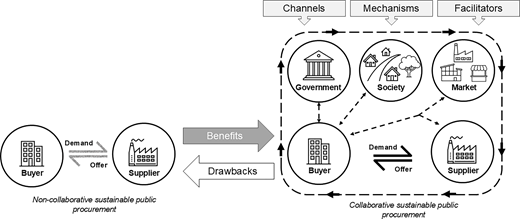
Sustainable public procurement (SPP) uses governments’ purchasing power to incorporate sustainability into commercial relationships between public buyers and suppliers. Collaboration between stakeholders can contribute to SPP implementation, but there is still limited research helping understand when to collaborate in SPP. This paper aims to provide depth on collaboration between stakeholders in SPP.
This paper discusses who collaborates with whom (collaboration channels), how to collaborate (mechanisms), why and why not collaborate (benefits and drawbacks), and who can facilitate collaboration in SPP. This research is based on semi-structured interviews with SPP practitioners from different contexts. Grounded Theory was used to support the research design, including data collection and analysis.
This paper offers a systemic approach interconnecting collaboration channels, mechanisms, benefits, drawbacks, and facilitators. This systematisation sheds light on decision-making processes towards collaborative initiatives, considering different contexts. The implementation of collaborative SPP initiatives may be determined by individual commitment and organisational capacity to navigate the legal and bureaucratic pathways to SPP.
This research offers a practical tool for planning, assessing, and improving collaborative SPP initiatives. Practitioners can use the 27 benefits to build the case for collaboration; the 10 drawbacks to mitigate risks; the 15 mechanisms to develop interaction formats for each procurement phase; and the stakeholder classification to engage potential collaborators.
This paper provides a more complete understanding of collaboration in SPP. The paper offers a categorisation of SPP stakeholders and a framework that contributes to decisions on collaborating, which require balancing benefits and drawbacks. Collaboration can break the public procurement walls, but it is not a silver bullet for addressing the complexity of SPP.
1. Introduction
Sustainable public procurement (SPP) aims to promote sustainable production and consumption (UNEP, 2021) by using governments’ purchasing power as a lever to develop more sustainable business models (McCrudden, 2004). SPP plays a strategic role in promoting sustainable practices that can be incorporated by the private sector (Brammer and Walker, 2011) by pursuing a variety of objectives related to socio-economic development (Behravesh et al., 2022). Several countries have supported SPP initiatives (UNEP, 2023), considering their potential to contribute to sustainability efforts (van Berkel and Schotanus, 2021; Preuss, 2009). SPP initiatives have to be undertaken through a holistic approach that balances the sustainability dimensions (i.e. economic, environmental, social and time) (Lozano et al., 2024).
SPP initiatives can require intense efforts in gathering information and translating it into sustainable procurement requirements and supplier selection criteria (Igarashi et al., 2015), considering several elements added to the public procurement system (Thai, 2001) when sustainability is considered (Lozano et al., 2024). For example, the SPP system entails sustainability dimensions (Preuss, 2009) and sustainability specifications of products and services (Caranta, 2023; Edquist and Zabala-Iturriagagoitia, 2021). Stakeholders’ interactions also compose SPP (Behravesh et al., 2022), which adds more challenges to its implementation (Oliveira et al., 2020) but also leverages the potential of developing sustainability through collaboration (Lozano, 2008).
Several disciplinary approaches have been supporting SPP understanding and implementation (Lozano et al., 2024), including a managerial one that entails efforts to understand how organisations can change to undertake SPP (Erridge and Greer, 2002; Leal Filho et al., 2019; Testa et al., 2016). Organisational changes can be fostered by drivers (Harris and Crane, 2002), which are forces that can contribute to change initiatives (Bamford and Forrester, 2003). Several drivers for SPP have been identified in the change management literature (Amann et al., 2014; Grandia et al., 2015; Preuss, 2009; Shaikh and Channa, 2022), including leadership (Brammer and Walker, 2011; Leal Filho et al., 2019), policies and guidelines (Allen, 2021; Sattari et al., 2022) and collaboration between stakeholders (Preuss, 2009; Sattari et al., 2022; Sparrevik et al., 2018).
Collaboration between stakeholders can contribute to SPP by promoting knowledge-sharing (Berg et al., 2022; Johnson and Klassen, 2022) and fostering the co-development of sustainable solutions (Alhola and Nissinen, 2018; Behravesh et al., 2022; Sparrevik et al., 2018), especially when supported by facilitators (Lozano et al., 2020) – overcoming cultural and operational walls hindering joint actions between public organisations and other stakeholders (Erridge and Greer, 2002). Collaborative SPP can involve governmental agencies (Berg et al., 2022; Erridge and Greer, 2002), companies and other market organisations (Bortz et al., 2024; Lingegård et al., 2021) and society actors (Alhola and Nissinen, 2018; Kristensen et al., 2021). Collaboration in SPP initiatives occurs through mechanisms such as stakeholder dialogues (Alhola and Nissinen, 2018; Sparrevik et al., 2018) and public consultations (Edquist and Zabala-Iturriagagoitia, 2012; Holma et al., 2020) – mostly aimed at providing mutual learning (Johnson and Klassen, 2022; Kristensen et al., 2021; Lingegård et al., 2021) and co-creation of procurement requirements (i.e. specifications and criteria) (Sattari et al., 2022; Sonnino, 2009). However, collaboration between stakeholders in SPP demands additional work (Berg et al., 2022; Holma et al., 2020), increases time to finish procurement processes (Lozano et al., 2020), and raises risks of supplier dependency (Erridge and Greer, 2002) and bias due to limited stakeholder participation (e.g. potential bias towards one solution by developing procurement specifications without considering a broad range of stakeholders) (Bratt et al., 2013) – legal principles of equal treatment and transparency are important in any dialogue between stakeholders in SPP (Lozano et al., 2020).
Research on collaboration between stakeholders in SPP has offered frameworks for understanding the role of collaboration (c.f. Holma et al., 2020; Witjes and Lozano, 2016), but there are still limited efforts dedicated to providing a holistic approach to this topic. For example, the literature has not yet provided a systemic understanding of collaboration in SPP (Kabra et al., 2023; Rejeb et al., 2023), including and interconnecting collaboration elements (see Elia et al., 2020; Lozano et al., 2021) that have been considered separately, such as who collaborates with whom (Kristensen et al., 2021), why and why not collaborate (Guarnieri and Gomes, 2019), and how to collaborate (Sönnichsen and Clement, 2020; Uttam and Roos, 2015). There is also a research gap in exploring the facilitators’ perspective on implementing collaborative SPP initiatives (Lozano et al., 2020), which are additional elements contributing to establishing collaboration (Berg et al., 2022).
The absence of a systemic approach to such collaboration elements in the SPP context can hinder efforts to understand when to collaborate, which remains an underexplored topic (Guarnieri and Gomes, 2019; Santos and Cabral, 2022). Most recent literature highlights this gap; for instance, Ograh et al. (2025) propose that limited collaboration between stakeholders is the main reason sustainable criteria fail to be integrated into supplier selection (e.g. due to a lack of knowledge on sustainable practices), whilst Kozuch et al. (2026) identify a gap in overcoming barriers to SPP implementation and call for collaborative action (e.g. between public buyers) and capacity-building (e.g. to assess market readiness) as responses.
Research on collaboration between stakeholders in SPP has also focused mainly on exploring Global North countries’ experiences, such as Finland (Alhola and Nissinen, 2018; Holma et al., 2020), Sweden (Sattari et al., 2022; Uttam and Roos, 2015) and the UK (Erridge and Greer, 2002), with an absence of studying Global South countries’ perspectives. There is a call for exploring different contexts of collaboration in SPP (Johnson and Klassen, 2022; Sattari et al., 2022) – considering that different accountability developments and legal frameworks can foster or hinder interactions between stakeholders (Behravesh et al., 2022).
This paper aims to provide depth on collaboration between stakeholders in SPP by analysing who collaborates with whom, how to collaborate, why and why not collaborate, and facilitators of collaboration, providing an understanding that interconnects such elements, based on collaboration theory and contributing to shedding light on when to collaborate. Although previous research has contributed to understanding collaboration in SPP through different theoretical lenses, such as stakeholder tensions (Johnson and Klassen, 2022), triadic structures and meaningful involvement (Holma et al., 2020), and translation theory and travel of ideas (Sattari et al., 2022), there is still a research gap in applying collaboration theory to the SPP context. Collaboration theory entails concepts and principles related to intense joint actions between stakeholders (Gajda, 2004; Jamal and Getz, 1995; Wood and Gray, 1991) and can contribute to unveiling the elements that compose collaborative SPP initiatives by being process- and system-oriented (Gray, 1985). For instance, collaboration theory can help to organise elements such as who collaborates, how to collaborate, and why collaborate through a holistic approach (Elia et al., 2020).
This study is based on empirical data from two different world regions – including a country in Europe (Sweden) and another in South America (Brazil), offering a comparative approach to the topic. The data were collected through semi-structured interviews and analysed using Grounded theory’s constant comparative analysis, supported by an inductive approach aimed at providing a more complete understanding of collaborative SPP initiatives.
This paper is structured in six sections. After this introduction, the second section discusses stakeholders, collaboration theory, and collaboration in SPP. Section 3 presents the research methods and their limitations. Section 4 shows the research findings according to the collected data. Section 5 discusses the research findings and offers a new understanding of collaboration in SPP. The last section concludes this paper and presents future research topics.
2. Towards a collaborative sustainable public procurement
Stakeholders are individuals, groups and organisations who can affect or are affected by an organisation’s value creation (Bryson, 2004; Freeman, 1984; Parmar et al., 2010). According to (Freeman, 1984), stakeholders can be divided into internal (e.g. employees, managers) and external (e.g. customers, suppliers, governments), the former contributing to building interactions between an organisation and its external stakeholders.
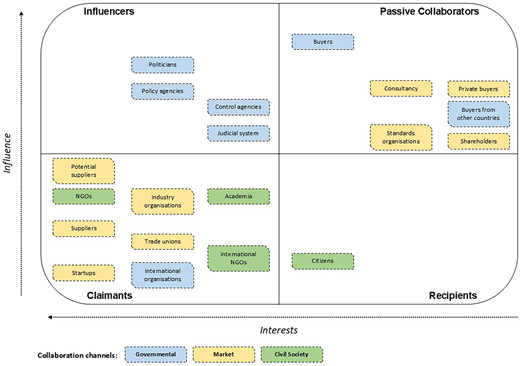
Research on categorising stakeholders has been developing frameworks for understanding stakeholders’ interests and influence in organisational systems by considering stakeholder relevance, legitimacy, and responsibility (Fassin, 2009; Miles, 2017; Mitchell et al., 1997; Siems et al., 2023). (Miles, 2017) proposed a categorisation to understand stakeholders’ influence and interests, based on elements such as the nature of claim (e.g. contractual, informal), nature of relationship (e.g. market, social), frequency of contact (e.g. high frequency relating to trust and involvement), and influencing strategy (e.g. active stakeholders affecting decisions). This categorisation classifies stakeholders in a) influencers, b) claimants, c) passive collaborators, and d) recipients. Influencer stakeholders hold sufficient power and legitimacy to influence an organisation, developing active strategies to guarantee their interests. Claimant stakeholders actively pursue their interests, but lack the guaranteed power to influence an organisation. Passive collaborator stakeholders can contribute to an organisation’s performance regardless of their interest and power to influence the organisation – this classification derives from a stricto sensu understanding of collaboration, related to passiveness. Recipient stakeholders are affected by an organisation, without having or exercising influence on the organisation’s strategy and activities.
Classifying stakeholders according to their influence and interests in an organisation can be relevant to understanding contexts of joint actions between stakeholders – there have been research efforts on mapping and organising stakeholders in public procurement (Kamann, 2007; Oliveira et al., 2020), contributing to developing knowledge on this topic by applying stakeholder theory. However, there is still a research gap in organising understandings on how collaborative efforts (in lato sensu) can be developed to influence organisational systems, shifting from an organisational (i.e. autocentred) to a systemic perspective on the reasons for interacting, offered by collaboration theory (see Lozano, 2008).
2.1 Collaboration theory
Collaboration between stakeholders is a process aimed at proposing joint responses to common problems (Gray, 1985; Vangen and Huxham, 2003) by creating new solutions and understandings through interactions with a high level of involvement (Denise, 1999; Lozano, 2007). The growing complexity of problems faced by organisations (Dyllick and Hockerts, 2002; Gray and Wood, 1991; O’Toole, 1995) has been demanding solutions based on knowledge built from different perspectives (McNamara, 2012; Webb, 1991), which requires intense joint actions between stakeholders (Gray and Wood, 1991; Lozano, 2008).
Joint actions between stakeholders can be based on at least three levels of involvement: 1) coordination, 2) cooperation, and 3) collaboration. Coordination stands for joint actions promoted by formal or informal authorities (Webb, 1991), which orchestrate efforts from different stakeholders towards a common goal (Bedwell et al., 2012; Denise, 1999). Cooperation denotes joint actions based on common interests (McNamara, 2012), in which each stakeholder has its own goals but foresees benefits in working together (Axelrod, 1984). Collaboration means joint actions motivated by shared goals and interests and collective responsibility (Bedwell et al., 2012; McNamara, 2012), using divergent insights and spontaneity (Denise, 1999; Lozano, 2007) to build intense and interdependent interactions (Gray, 1985). The three levels of involvement are grounded on communication, by which stakeholders can transfer information and agree on shifting from acting individually to acting together (Denise, 1999; Lozano, 2007).
Gajda (2004) proposed five principles of collaboration between stakeholders. Firstly, collaboration is imperative to understand and address complex issues. Secondly, collaboration has been labelled by different names (e.g. joining forces, partnerships, strategic alliances) but comprises a complex process of working together to develop relationships, through a multitude of arrangements. Thirdly, collaboration is a journey entailing different levels of integration between stakeholders, from sharing information to unifying structures. Fourthly, collaboration depends on personal relations and emotional connections, requiring trust development and conflict acknowledgement. Finally, collaboration develops in stages, such as 1) assembling and forming, 2) planning and defining roles and strategies, 3) implementing, and 4) assessing and improving.
Collaboration between stakeholders requires transdisciplinarity and long-term thinking (Lozano, 2007), which can contribute to setting problems, establishing clear directions, and providing structures to support and sustain joint actions (Gray, 1985). Successful collaboration initiatives can build feedback loops that pave the way for future joint actions (Bedwell et al., 2012). However, collaboration efforts can be hindered by several factors (Lozano et al., 2021), including lack of needs alignment (Lozano, 2007), lack of trust (Webb, 1991), and lack of personnel collaboration commitment (Huxham, 1993).
Collaboration has the potential to contribute to sustainability efforts by supporting interdependent decisions that can benefit the whole system (Lozano, 2007), co-developing sustainability solutions (Johnson and Klassen, 2022), and improving the environmental and social performance of organisations (Niesten et al., 2017). According to Elia et al. (2020), collaborative arrangements for sustainability entail four main elements: focus (what), collaborators (who), mechanisms (how), and benefits (why) – orchestrated through a governance structure. Lozano et al., 2021) add a fifth element to this topic: collaboration for sustainability has benefits but also drawbacks (why not), which should be balanced to reach optimal collaboration – collaboration costs impose limits to the growth of collaboration.
Research on collaboration in sustainability includes studies on corporate sustainability (Fobbe and Hilletofth, 2021; Lozano et al., 2021), circular economy (Köhler et al., 2022), and SPP (Holma et al., 2020; Johnson and Klassen, 2022).
2.2 Collaboration in sustainable public procurement
Collaboration between stakeholders in SPP can promote the development of more sustainable business models and supply chains (Behravesh et al., 2022; Witjes and Lozano, 2016) and foster the co-creation of sustainability-oriented products and services (Lingegård et al., 2021). Collaboration can also improve the knowledge flow through meaningful interactions between stakeholders (Holma et al., 2020). Interactions between stakeholders are a systemic element of SPP and contribute to incorporating sustainability in the connection between demand (i.e. buyer’s needs) and offer (i.e. supplier’s products and services) (as proposed by Lozano et al., 2024), which leverages the potential of developing sustainability-friendly solutions through collaboration (Behravesh et al., 2022).
Research has been providing frameworks for understanding collaboration between stakeholders in SPP, including a circular approach to reduce raw materials’ use and waste generation (Witjes and Lozano, 2016), a proposal for involving multiple stakeholders with the support of facilitators (Lozano et al., 2020), and a model for early involvement of stakeholders (Holma et al., 2020). However, there is still a research gap in providing a holistic approach to this topic, considering who collaborates (collaboration channels), how to collaborate (collaboration mechanisms), why collaborate (benefits), why not collaborate (drawbacks), and who can help establish and maintain collaboration (facilitators).
SPP guidelines have been proposing collaboration mainly between public buyers and suppliers, among public buyers, and between buyers and governmental agencies (e.g. UNEP, 2022). However, several stakeholders can participate in collaborative SPP initiatives (Oliveira et al., 2020), which justifies efforts to provide a more complete understanding and organisation of collaboration channels. Governmental stakeholders collaborating in SPP include public buyers (Erridge and Greer, 2002; Preuss and Walker, 2011; Sattari et al., 2022) and policy agencies (Berg et al., 2022; Daugbjerg, 2023). Market stakeholders include suppliers (Sonnino, 2009; Witjes and Lozano, 2016), potential suppliers (Behravesh et al., 2022; Johnson and Klassen, 2022; Lingegård et al., 2021), and consultancies (Bortz et al., 2024; Testa et al., 2012). Society stakeholders include academia (Alhola and Nissinen, 2018; Behravesh et al., 2022; Sparrevik et al., 2018), citizens (i.e. end-users) (Alhola and Nissinen, 2018; Sonnino, 2009), the natural environment (Lozano et al., 2020), and non-governmental organisations (Behravesh et al., 2022; Kristensen et al., 2021). The collaboration channels in SPP proposed by the literature can be defined as intragovernmental (c.f. Erridge and Greer, 2002; Kristensen et al., 2021), government + market (see Uttam and Roos, 2015; Witjes and Lozano, 2016), government + society (c.f. Daugbjerg, 2023; Sonnino, 2009), and government + market + society (see Alhola and Nissinen, 2018; Lozano et al., 2020).
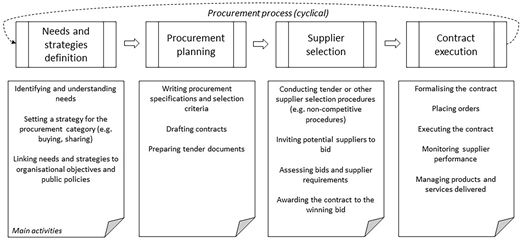
SPP stakeholders can interact at different stages in each procurement process (Edquist and Zabala-Iturriagagoitia, 2012; Holma et al., 2020). The procurement process can be organised into four main phases (based on UNEP, 2021), although the first two preparatory phases can be combined to set a cyclical three-phase model described as preparation-purchasing-performing (3P-model) (Grandia et al., 2023): 1) needs and strategies definition, 2) procurement planning, 3) supplier selection, and 4) contract execution. Each phase comprises several activities; for example, writing procurement specifications (Lozano et al., 2024) during the procurement planning phase. The cyclical characteristic explicitly present the timeliness of procurement procedures, by which procurement decisions taken in a process (e.g. how long a product will be used) and lessons learned from contract execution (e.g. how challenges in implementing a service can be avoided in the future) may influence the next process aimed at buying similar products and services (Grandia et al., 2023; Igarashi et al., 2015; Thai, 2001). Figure 1 presents the cyclical four-phase procurement process, including some of the main activities in each phase.
The procurement process can be strengthened through collaboration between stakeholders (Holma et al., 2020; Lozano et al., 2020). The SPP literature proposes the mechanisms for collaboration presented in Table 1, organised into the procurement phases. The literature presents these mechanisms as starting points for building interactions and establishing intense joint actions. Each mechanism was presented in its practical context and considers legal principles of equal treatment and transparency, which are sine qua non for developing collaborative initiatives in SPP.
Research on collaboration in SPP has proposed several benefits for building meaningful interactions in this context, including developing innovative and sustainable solutions (Alhola and Nissinen, 2018; Behravesh et al., 2022; Edquist and Zabala-Iturriagagoitia, 2012; Holma et al., 2020) and mutual learning (Daugbjerg, 2023; Kristensen et al., 2021; Witjes and Lozano, 2016). Table 2 collates the main benefits of collaboration between stakeholders in SPP according to the literature (24 in total). The drawbacks of collaborating in this context were also discussed by the literature, including coordination costs (Lozano et al., 2020) and increasing work (Berg et al., 2022; Sparrevik et al., 2018). The main drawbacks of collaboration between stakeholders proposed by SPP research (ten in total) are presented in Table 3.
There is also limited research on the role of facilitators in building collaboration in SPP, despite guidelines suggesting a multi-stakeholder approach for SPP implementation that includes facilitators as a relevant element in promoting joint actions (UNEP, 2022; World Bank, 2021). Facilitators of collaboration in SPP are individuals (Alhola and Nissinen, 2018; Lozano et al., 2020) and organisations (Berg et al., 2022; Daugbjerg, 2023) aimed at driving collaboration forward by overcoming its challenges (Lozano et al., 2020). Individuals acting as facilitators can be project members working outside the procurement team (Lozano et al., 2020) and consultants contributing to understanding the market (Alhola and Nissinen, 2018). Organisations can perform a facilitator role by translating, transferring, and creating knowledge between stakeholders – as observed by Berg et al. (2022) in a public agency and by Daugbjerg (2023) in an industry organisation.
The collaboration channels, mechanisms, benefits, drawbacks, and facilitators identified in previous SPP research efforts and categorised contribute to building this paper’s theoretical framework, used to support theory-building efforts and strengthen data collection and analysis. This framework also provides an additional data set to be used as a comparison source when analysing empirical data, as proposed in the methods section.
3. Methods
Inductive approaches are suitable for deriving theories from data (Lowndes et al., 2018; Saunders et al., 2019), guiding research through a theory-building journey (Creswell, 2009). Underresearched social phenomena may require efforts to generate theories (Saunders et al., 2019; Schutt, 2012), including defining key concepts (Lowndes et al., 2018) and proposing frameworks for understanding actors, interactions, and processes within their contexts (Creswell, 2009). Theories can be further complemented and tested (Saunders et al., 2019), contributing to the development of disciplines and study fields (Lowndes et al., 2018; McNabb, 2015).
Grounded theory (GT) is a research strategy based on an inductive approach (Saunders et al., 2019) and designed to generate theory from a set of data (Corbin and Strauss, 1998; Glaser and Strauss, 1967). GT aims to analyse, interpret, and explain social phenomena (Corbin and Strauss, 1998; McNabb, 2015), considering the meanings that social actors provide to their experiences, interactions, and realities (Creswell, 2009; Williams, 2007). This research strategy supports the gathering and analysis of qualitative data (Glaser and Strauss, 1967; McNabb, 2015) and allows researchers to analyse the data whilst the data is collected (Corbin and Strauss, 1998; Saunders et al., 2019). The coding or categorisation of data is essential to this strategy (Corbin and Strauss, 1998; McNabb, 2015), as is the process of constant comparison between the data and the categories (Creswell, 2009; Glaser and Strauss, 1967; Saunders et al., 2019).
GT was initially designed to start developing categories solely from the collected data (Saunders et al., 2019; Williams, 2007), ignoring previous literature to avoid “contamination” of concepts (Glaser and Strauss, 1967). However, researchers have been acknowledging that concepts and categories found in previous literature can contribute to identifying research gaps, enhancing comparisons, and increasing theoretical sensitivity (Creswell, 2009; Mills et al., 2006; Tummers and Karsten, 2012). Previous literature can also be used in GT to confirm research findings and extend the body of knowledge (Corbin and Strauss, 1998). This GT’s informed approach requires reviewing the literature throughout the entire research process (Thornberg, 2012).
This research uses GT to analyse collaboration between stakeholders in SPP, adopting an inductive approach to provide depth to the topic and propose a more complete understanding of this social phenomenon. In this paper, GT was used to build theory on an underexplored topic through an immersive data collection and analysis journey, using the theoretical framework discussed in the literature review section to support theory-building efforts. The use of empirical data is part of this research’s design – as is the informed approach aimed at enhancing the research by adding categories from previous literature into the data analysis process (as a comparison source) and theoretical discussion (confirming research findings and refining the body of knowledge).
This research also entails elements of a comparative study, aiming at understanding collaboration in different SPP contexts and contributing to answering a call for developing comparisons between contexts of SPP implementation (Cheng et al., 2018; Sattari et al., 2022), including Global North and South countries (Vejaratnam et al., 2020). Comparative studies in social sciences are aimed at improving our understanding of social phenomena by comparing data between times and places (Ragin, 2014; Schutt, 2012). Comparative studies can vary from comparing a large number of contexts or cases – suitable for using sophisticated statistical analysis of extensive sets of quantitative data – to a small one (e.g. two) (Lowndes et al., 2018). Comparative studies including a small number of contexts can be used to build theories by analysing similarities and differences (Ragin, 2014), approaching contexts more holistically (Lowndes et al., 2018). Such studies can provide cross-context conclusions comprising similarities and differences in characteristics influencing a social phenomenon in multiple contexts (Schutt, 2012; Yin, 2014).
3.1 Data collection
The empirical data used by this research to analyse collaboration between stakeholders in SPP were collected through semi-structured interviews. The interviews were conducted with SPP professionals from different countries: 12 interviewees from Brazil and 10 from Sweden.
The choice of these countries was justified by the opportunity to explore the phenomenon of collaboration in different SPP contexts, including legal frameworks and bureaucratic cultures. Both countries have been working on promoting SPP practices (UNDP, 2022; UNEP, 2017; World Bank, 2021) considering their expressive government purchasing power: around 12,5% of Brazil’s GDP (Ribeiro and Inácio Júnior, 2019) or US$240 billion in 2022 and 18,3% of Sweden’s GDP (Upphandlingsmyndigheten and Konkurrensverket, 2020) or US$107bn in 2022. However, their approaches to implementing SPP have been different (more praxis-driven in Brazil and policy-driven in Sweden) (Santos et al., 2024). For example, Brazilian SPP has adopted supporting and mandatory regulations (e.g. in a national school feeding program, local governments must spend at least 45% of national-transferred resources on family farm products) monitored by control agencies (i.e. valuing coercive power) but depends mainly on practitioner efforts due to structural gaps at national and local levels (e.g. lack of national encouragement and monitoring by policy agencies, lack of strategic positioning of procurement in public organisations) (Mazzucato et al., 2024; Oliveira et al., 2020). Swedish SPP has adopted non-mandatory regulations (e.g. in a national organic food programme, local governments can adopt their own goals and strategies) supported by national goals, policies, and structures, but it depends mainly on local willingness to set and implement their own policies (i.e. valuing discretionary power) (Bryngemark et al., 2023; Daugbjerg, 2023; Hunka et al., 2023).
The interviewees were chosen considering the following criteria: 1) SPP professionals, 2) recent working experience at public organisations, and 3) contributing to the implementation of SPP. The interviewees have been working with various procurement categories, interacting with heterogeneous stakeholders and market maturity levels. The set of interviewees represented a total of 15 different organisations (nine from Brazil and six from Sweden) working as public buyers, contributing to providing diverse insights into the analysed phenomenon.
Four semi-structured interviews with external practitioners working at organisations acting as SPP facilitators were additionally conducted to increase the validity of the data and its analysis by triangulation (Saunders et al., 2019). The interviewees were chosen considering their experience in organisations working in different country contexts, such as a research institute developing SPP projects in multiple continents and a non-governmental organisation interacting with public buyers and suppliers from several countries. One interviewee was working in a parliamentary group that performed a facilitator role in the German context and had previous experience in a research institute that works as an SPP facilitator in several contexts (including Brazil).
Table 4 presents the interviewees’ professional profiles. The academic and professional networks of the authors were used to grant access to the interviewees.
The 26 interviews were carried out from October 2022 to May 2023 and most of them (23) were done digitally, via Zoom – three were done in person. The interviews ranged between 45 min and 2 h and were conducted in different languages: Portuguese for the Brazilian interviewees and English for the German and Swedish ones. The interviews were transcribed in their original languages by native and fluent speakers, aiming at reducing language nuances while managing and analysing the collected data. The data collection was finished after reaching conceptual saturation (Corbin and Strauss, 2008; Saunders et al., 2019), when categories and central categories were clearly understood and the latest data provided by the interviewees did not reveal new insights (e.g. absence of new codes emerging from BR12, EX4 and SE10 interviews).
After the transcriptions, the interviewees were identified by a code to guarantee anonymity: the Brazilian professionals with a BR followed by a number (e.g. BR1, BR2), the external practitioners with EX followed by a number (e.g. EX1, EX2), and the Swedish professionals with SE followed by a number. The collected data was categorised with the support of NVivo 1.0 (QSR, 2020).
3.2 Data analysis
GT’s constant comparative analysis was used to analyse the collected data, following the four stages proposed by Corbin and Strauss (1998): 1) coding, 2) building categories, 3) integrating central categories, and 4) developing a grounded theory. At the first stage, the data were coded by creating conceptual headings (e.g. each collaboration benefit, including in-vivo codes by using terms from the data, such as “mutual learning”), constantly comparing them for similarities and differences (e.g. how a collaboration mechanism such as direct contact differs from stakeholder dialogue). The concepts identified in the literature review were used as an additional data source in this analysis process (e.g. each collaboration benefit, channel, drawback, and mechanism), being coded after the conceptual headings emerged from the data.
At the second stage, relationships between the codes were identified to build categories and subcategories (e.g. contract execution-related mechanisms), continuously comparing them with the data (e.g. organising collaboration mechanisms into the procurement stages). At the third stage, central categories were identified by integrating categories and their properties (e.g. consolidating collaboration benefits, channels, drawbacks, and mechanisms, considering their categories). Finally, the categories and their relationships were used to provide a new understanding of the topic (e.g. proposing a framework for understanding collaboration between stakeholders in SPP, comprising the collaboration elements categorised and considering their contribution to support decision-making processes aimed at deciding when to collaborate).
The data analysis process included discussions between the researchers on each code that emerged from the data, the categories built and their integration potential, and the identified central categories. The research team also discussed the interconnections between categories and central categories to provide a new understanding of collaboration in SPP, focusing on building concepts and understandings that could add to existing theories on the topic. The data were analysed in their original languages (Portuguese and English). Only a minimum translation was done during the data analysis (following the lessons by Corbin and Strauss, 2008). For instance, the data in Portuguese was coded in English, following the language of the research report.
3.3 Research limitations
This research’s method has limitations affecting the reliability and validity of the research findings due to the use of interviews as a data collection technique (Saunders et al., 2019). For example, the interviewees’ selection criteria (e.g. SPP practitioners, external practitioners working in SPP facilitators) may be a threat related to participation bias. The interviewer’s engagement with SPP and sustainability may also be a threat – related to observer bias. The use of a second language (English) to carry out the interviews with the German and Swedish interviewees may lead to cultural and language nuances. The limited number of interviews may limit the external validity of the findings.
The use of previous research to support data analysis in GT (e.g. to identify research gaps, enhance categorisation, and improve theoretical sensitivity) has pitfalls that may also pose limitations to this research’s method. In this context, pitfalls that should be acknowledged and treated to strengthen research quality include overlooking certain issues, selecting data according to literature findings, and hindering new insights (Tummers and Karsten, 2012).
This research’s design also leads to limitations. For instance, despite analysing different contexts of collaboration in SPP, this research does not aim to describe and explain Brazilian and Swedish approaches to establishing collaboration in SPP (e.g. why such countries have different approaches). The analysis of different contexts used in this paper was aimed at identifying similarities and differences in the studied social phenomena. This paper also aims to provide a more general knowledge of collaborative SPP initiatives, trying to build a systemic understanding that can be used and adapted in different procurement contexts. For example, this paper does not investigate the effects of different procurement procedures in collaborative SPP initiatives, allowing a focus on general aspects of implementing collaboration that can be further explored through narrowed lenses (i.e. considering legal and bureaucratic contexts). Another limitation of this research is related to the absence of suppliers’ perspectives on the topic, considering that the interviews were applied to SPP practitioners mainly working in public organisations.
4. Findings
The interviewees’ responses were organised and presented according to the following central categories, integrated following GT’s methods:
channels of collaboration between stakeholders in SPP (i.e. who collaborates);
mechanisms for collaborating in SPP (i.e. how to collaborate);
benefits and drawbacks of collaboration between stakeholders in SPP (i.e. why and who not collaborate); and
facilitators of collaboration in SPP.
4.1 Collaboration channels
The interviewees mentioned 20 stakeholders that can contribute to SPP through collaboration with public buyers. Of the 20 mentioned stakeholders, 17 were cited as collaborators and 3 were mentioned as potential collaborators. Of the 17 collaborators, 13 were also cited by some interviewees as potential collaborators in their contexts. At the government group, stakeholders such as other public buyers (including central purchasing bodies), politicians, and policy agencies were mentioned as collaborating in developing SPP initiatives. At the market group, potential suppliers, industry organisations, and suppliers are examples of stakeholders collaborating in SPP. Stakeholders such as start-ups, shareholders, and standards organisations were cited solely as potential collaborators. Society stakeholders were also mentioned as collaborating in SPP initiatives, including academia, NGOs, and citizens. The most cited stakeholders were potential suppliers (market group, 17 mentions), other public buyers (government group, 13 mentions), and academia (society group, 12 mentions).
The list of stakeholders that are collaborating or could collaborate in SPP, according to the interviewees, is presented in Table 5. The understanding of who collaborates with whom can be relevant to explore further elements of collaboration by, for instance, supporting a better understanding of how, why and why not collaborate.
The stakeholders mentioned by the interviewees were collaborating through different collaboration channels. The collaboration channels, according to the interviewees’ responses, are 1) intragovernmental, 2) government + market, 3) government + society, and 4) government + market + society. For example, a public buyer collaborating with a control agency to increase the legitimacy of SPP initiatives illustrates an intragovernmental channel. A public buyer collaborating with potential suppliers to understand the market readiness embodies a government + market channel, providing a joint solution (e.g. a shared understanding of the market readiness) to a common problem (e.g. unsuccessful procurement processes in which the buyer demands products and services that the market stakeholders are not ready to offer). An example of using the government + society channel is a public buyer collaborating with academia to support decision-making processes. The government + market + society channel can be illustrated by a public buyer, a supplier, and an NGO collaborating to develop sustainability requirements.
4.2 Collaboration mechanisms
The interviewees mentioned 14 mechanisms for collaborating in SPP (listed in Table 6), which can be organised into the procurement phases (i.e. needs and strategies definition, procurement planning, supplier selection and contract execution) in which they occur. These mechanisms have been developed by practitioners considering their procurement regulations, procedures, and best practices, abiding by legal principles of equal treatment (e.g. publishing open invitations to public audiences) and transparency (e.g. recording meetings for auditing purposes).
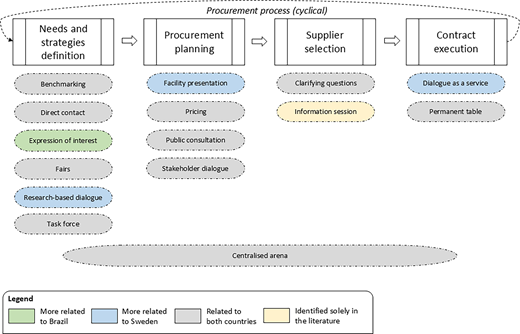
At the needs and strategies definition phase, the interviewees highlighted the following collaboration mechanisms: a) benchmarking, b) direct contact, c) expression of interest, d) fairs, e) research-based dialogue, and f) task force. Benchmarking includes connections with other buyers (public and private) to learn from their experience in developing sustainable procurement. Direct contact entails pre-procurement interactions between stakeholders, such as informal (e.g. phone calls, e-mails, conference meetings) and formal (i.e. scheduled and recorded meetings) contacts. Expression of interest comprises an open procedure, initiated by buyers and transparent, by which potential suppliers can propose studies and solutions that can be used in defining a procurement strategy – with due remuneration only by a future supplier and if the procurement strategy is based on the proposed study and solution. Fairs include events hosted by market actors and aimed at connecting stakeholders and presenting innovative solutions. Research-based dialogue entails interactions between stakeholders based on data collection techniques, such as interviews and observations. Task force comprises formal and informal groups of stakeholders aimed at developing procurement knowledge (e.g. procurement requirements) in a specific procurement category.
At the procurement planning phase, the collaboration mechanisms mentioned by the interviewees were a) facility presentation, b) princing and market research, c) public consultation, and d) stakeholder dialogue. Facility presentation entails invitations to potential suppliers aimed at presenting buyers’ facilities and clarifying procurement requirements. Pricing and market research comprises formal supplier mapping and inquiry about prices, considering the procurement requirements, when interactions may evolve to discussions on improving specifications and criteria. Public consultation includes formal consultation with stakeholders using electronic platforms and e-mails. Stakeholder dialogue entails in-person and online interactions (e.g. public audiences, streamed, recorded, and published meetings) between stakeholders.
At the supplier selection phase, only one mechanism was mentioned by the interviewees: clarifying questions. This mechanism entails interactions from the tender announcement to the presentation of bids, when questions posed by stakeholders to buyers can lead to reflections on improving the procurement process and contribute to jointly solving a common problem of unsuccessful procurement processes, in which buyers remain without needs fulfilment, suppliers are prevented from selling products and services, and society stakeholders are not positively influenced by public policies that depend on such processes.
At the contract execution phase, the interviewees mentioned two mechanisms: a) dialogue as a service and b) permanent table. Dialogue as a service includes interactions between buyers, suppliers, and other stakeholders (e.g. citizens and end-users) aimed at improving the contract execution (e.g. customising execution according to needs), based on socio-cultural specifications included in the procurement requirements. SE6 exemplified this mechanism:
It is possible to include some kinds of stakeholder engagements in the procurement. When I made a procurement of hearing aid equipment for children, I wrote the criteria that when a child needs hearing equipment, the supplier must present three different options. Then the child can use these options for a couple of days and then decide: okay, this works best for me.
Permanent table entails contract monitoring arenas in which stakeholders can promote better execution and conflict resolution.
The interviewees also mentioned one collaboration mechanism that encompasses the four procurement phases: the centralised arena. This mechanism comprises the development of a collaboration arena hosted by formal (e.g. centralised procurement body) or informal (e.g. international buyers network) arrangements. This arena promotes structured interactions between stakeholders aimed at improving governance resources (e.g. regulations, systems, etc) and preparing joint procurement processes. Whilst preparing joint procurement processes, the centralised arena can promote collaborative environments capable of contributing to the four procurement phases by:
promoting studies for understanding needs and strategies for each category;
developing sustainability requirements and contract clauses while planning specific procurement processes;
selecting suppliers for several buyers; and
fostering joint contract monitoring and conflict resolution.
Collaboration arenas can contribute to developing personnel’s commitment to collaborative approaches and organisational capacity to build further collaboration.
Centralised arenas can also include international collaboration, as noted by SE4:
We are revising our due diligence contract clauses for sustainable supply chains. We’ve been doing that together with the Swedish national procurement agency. But we also contacted our Nordic counterparts, like the Norwegian national procurement agency and big procurement agencies. They came to Stockholm last autumn, and now we’re going to Copenhagen to meet them there.
These arenas can also attract stakeholders organically, as BR2 highlighted:
The centralised procurement arrangement we have been developing contributes to fostering collaboration between stakeholders. Other public buyers are noticing our centralised arrangement, identifying that we have been interacting with market stakeholders, and asking to join efforts with us, aiming at receiving collaboration benefits.
The most cited collaboration mechanisms were direct contact (needs and strategies definition, 12 mentions), fairs (needs and strategies definition, 8 mentions), public consultation (supplier selection, 8 mentions), and centralised arena (8 mentions).
4.3 Benefits and drawbacks of collaboration in sustainable public procurement
The interviewees mentioned 26 benefits of collaboration between stakeholders in SPP (see Table 7). Of the 26 mentioned benefits, 11 can be organised into the procurement phases mainly impacted by the collaborations. There were 15 benefits related to the four procurement phases, contributing to the whole procurement cycle and governance.
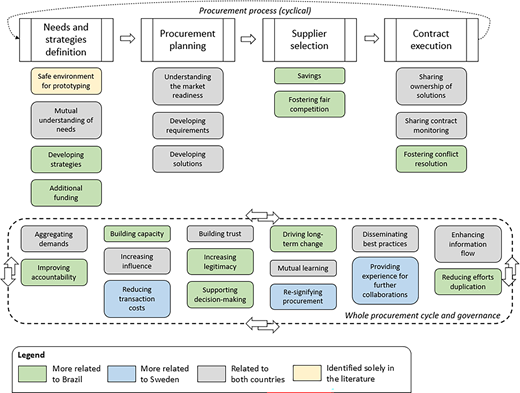
At the needs and strategies definition phase, the interviewees mentioned three benefits of collaboration between stakeholders in SPP: 1) additional funding, 2) developing procurement strategies, and 3) mutual understanding of needs. Collaboration can provide additional funding for SPP, including obtaining financial resources from fines paid by companies that violated labour rights, with the support of judicial systems. Collaboration between stakeholders can also contribute to the development of procurement strategies – including buying, renting, sharing, or not buying decisions – by expanding and multiplying the perspectives on each procurement category. Collaboration can also develop a mutual understanding of needs, which can improve the SPP processes by sharing expectations that can be considered at the subsequent procurement phases (e.g. developing specifications to meet citizens’ needs unveiled by a collaborative approach).
At the procurement planning phase, three benefits of collaboration between stakeholders in SPP were mentioned by the interviewees: 1) developing solutions, 2) developing procurement requirements, and 3) understanding the market readiness. Collaboration in SPP can contribute to developing innovative and sustainable solutions by joining experiences from potential suppliers, other buyers, and society representatives. Collaboration in SPP can develop procurement requirements (e.g. sustainability specifications and criteria) with the support of stakeholders’ knowledge, harmonising requirements for buyers, contributing to suppliers’ understanding of demands, and facilitating joint efforts in contract monitoring. Collaboration in SPP can also provide an understanding of the market readiness for each procurement category, balancing the buyers’ demand with the suppliers’ offer capacity.
At the supplier selection phase, the interviewees mentioned two benefits of collaboration between stakeholders in SPP: 1) fostering fair competition and 2) savings. Collaboration between stakeholders can foster fair competition in SPP by reducing bias in developing solutions and requirements (e.g. academia mediating discussions between buyers and potential suppliers; providing transparency of procurement procedures to potential suppliers). Collaboration in SPP can also promote savings through joint and centralised procurement.
At the contract execution phase, three benefits of collaboration between stakeholders in SPP were mentioned by the interviewees: 1) fostering conflict resolution, 2) sharing contract monitoring, and 3) sharing ownership of solutions. Collaboration can foster conflict resolution in SPP by improving the stakeholders’ understanding of the conflict and allowing a collective building of potential solutions. Collaboration can build a shared contract monitoring between stakeholders, including buyers, citizens, control agencies, and NGOs, aimed at assessing sustainability outcomes and needs fulfilment. Collaboration in SPP can also promote shared ownership of solutions, in which buyers, suppliers, and other stakeholders are dedicated to jointly delivering the contracts’ sustainability goals.
The interviewees mentioned 15 benefits of collaboration between stakeholders in SPP that are related to the whole procurement cycle and governance: a) aggregating demands, b) building capacity, c) building trust, d) disseminating best practices, e) driving long-term change, f) enchacing information flow, g) improving accountability, h) increasing influence, i) increasing legitimacy, j) mutual learning, k) providing experience for further collaborations, l) reducing efforts duplication, m) reducing transaction costs, n) ressignificating procurement, and o) support decision-making.
Aggregating demands comprises joint procurement efforts by buyers aimed at increasing their purchasing power and leveraging their impact in SPP initiatives. Building capacity includes the development of the capacity to address complex issues in SPP. Building trust entails the encouragement of stakeholders to participate in SPP initiatives. Disseminating best practices is related to the incorporation of successful SPP initiatives shared by other stakeholders and the establishment of sustainability standards within market sectors. Driving long-term change comprises the establishment of a collaborative basis for supporting systemic changes entailing governmental, market, and society stakeholders. Enhancing information flow includes open communication between stakeholders that can improve access, quantity, and quality of information regarding sustainability issues in procurement. Improving accountability encompasses the inclusion of control agencies and citizens in the procurement processes aimed at strengthening accountability efforts.
Increasing influence is related to a stakeholders’ coalition influencing the procurement system, such as demanding improved regulations. Increasing legitimacy entails the inclusion of society stakeholders in the procurement processes, resulting in a better acceptance and understanding of SPP initiatives by citizens. Mutual learning comprises the promotion of knowledge sharing and new understandings based on multiple perspectives. Providing experience for further collaborations is linked to the development of collaboration commitment and engagement skills. Reducing efforts duplication entails the use of shared resources (e.g. personnel) to promote tasks benefiting multiple stakeholders, resulting in less workload in SPP initiatives. Reducing transaction costs is related to facilitated contact with key stakeholders, providing easier access to information and decision-makers. Ressignificating procurement includes interactions providing an understanding of public procurement as a strategic function contributing to sustainability efforts, beyond an operational and time-consuming tool. Support decision-making comprises multiple perspectives providing a better understanding of risks and supporting decision-making processes.
The most cited benefits for collaboration between stakeholders in SPP were mutual learning (whole cycle, 17 mentions), developing sustainability requirements (planning phase, 12 mentions), and disseminating best practices (whole cycle, 11 mentions).
The interviewees also mentioned 8 drawbacks of collaboration between stakeholders in SPP (c.f. Table 8), representing costs and risks to which the SPP initiatives are exposed when stakeholder collaboration contributes to implementing SPP. Of the 8 mentioned drawbacks, 1 mainly impacts the procurement planning phase and 7 are related to the whole procurement cycle and governance.
At the procurement planning phase, the interviewees mentioned the drawback of developing bias due to limited stakeholder participation. This drawback includes a risk of hindering procurement competition and favouring a few suppliers when limited perspectives and interactions induce buyers to write restrictive procurement requirements. This bias, developed by limited perspectives during collaborative initiatives, can harm the equal treatment of potential suppliers.
The 7 drawbacks of collaboration between stakeholders in SPP that are related to the whole procurement cycle and governance, as mentioned by the interviewees, are: a) accountability erosion, b) coordination costs, c) developing supplier dependency, d) exposing stakeholders to inefficiency and corruption risks, e) increasing procurement time, f) increasing work, and g) using information against stakehoders.
Accountability erosion is linked to collaboration initiatives without a suitable structure, which can result in eroded control and transparency, such as in non-accountable actors (e.g. industry organisations) influencing public buyers’ decision-making processes towards their benefit without being held accountable. Coordination costs are related to efforts on governing collective actions, including additional efforts to assure isonomy (e.g. equal access), balancing stakeholders’ expectations, building consensus when applicable, fostering stakeholders’ participation, and managing centralised procurement. Supplier dependency can be developed because collaboration can foster suppliers’ monopolistic behaviour in providing sustainability solutions when market readiness and buyers’ efforts in overcoming information asymmetry are limited. Stakeholders can be exposed to inefficiency (e.g. artificial engagements, green- and socialwashing) and corruption (including collusion between potential suppliers) risks when there is a lack of control, process management, and risk management in collaborative initiatives. Procurement time can be increased because collaboration requires additional time for establishing mechanisms, managing interactions, and balancing stakeholders’ interests. Collaboration may increase work because it can be resource-intensive and intensify personnel’s workload, affecting small organisations in special. Using information against stakeholders is related to granting access to information that can be used by stakeholders against each other.
The most cited drawbacks of collaboration between stakeholders in SPP were coordination costs (whole cycle, 12 mentions), developing bias due to limited stakeholder participation (procurement planning, 10 mentions), and increasing work (whole cycle, 8 mentions).
4.4 Facilitators of collaboration in sustainable public procurement
Several interviewees (BR1, BR3, BR4, BR6, BR7, BR9, BR10, EX1, EX2, EX3, EX4, SE4, SE5, SE7, and SE10) highlighted the role of facilitators in contributing to establishing and maintaining collaboration between stakeholders in SPP. According to the interviewees, individual facilitators (mentioned by BR4, BR9, BR10, EX1, SE5 and SE7) are engaged in building connections between stakeholders, mobilising internal resources for collaboration initiatives and stimulating stakeholder participation. The interviewees also highlighted that organisations working as facilitators of collaboration can balance stakeholders’ interests, build collaboration mechanisms, develop collaboration commitment, engage other stakeholders, and reduce information asymmetry. Organisational facilitators were mentioned by BR1, BR3, BR6, BR7, BR9, BR10, EX1, EX2, EX3, EX4, SE4, and SE10. Examples of organisational facilitators include academia, international organisations, the judicial system, NGOs, and policy agencies.
The perspectives from the external practitioners working in organisational facilitators can illustrate the facilitators’ role. For instance, EX1, who was working in a research institute, mentioned an experience aimed at engaging stakeholders and building collaboration mechanisms:
The projects we’ve been working on are very related to linking people, making them collaborate. People do really network and learn from each other: what they are doing and also how they could relate this to their own procurement context. It’s not just the procurement officers and governments but also people from academia, the private sector, and NGOs. We try to support procurement officers and their struggles to procure sustainably. We also organised exchanges where we matched them and organised online meetings where they presented their procurement situations to each other. Then they also discuss the procurement challenges they are facing and how they are trying to overcome them. The idea of that is that they learn from each other and don’t have to invent the wheel again.
EX2, who was working in an NGO, mentioned an experience aimed at reducing information assimetry:
They asked me about the remediation process: ‘If you find violations, do we have to end the contract?’ And I said: ‘No, why would you end the contract? It’s a contract violation, but that’s kind of this old-school perspective. You have the possibility to engage a supplier and to try to remediate the situation’. That’s basically how we understand due diligence. This is the central part that we provide, we can monitor their supply chains, we can help them to understand where the factories are, where the risks are, what violations we find in specific factories, and then work on remediation. We also, obviously, support them in strategic discussions during tendering or setup of tendering.
EX4, who was working in a parliamentary group, also presented an experience of facilitators engaging stakeholders and building collaboration mechanisms:
Here we have public agencies that promote the issue and have the mandate to address municipalities and try to bring them to use more SPP criteria and have better practices regarding this. They make promotional videos, approach multiple stakeholders and policymakers, and organise conferences. And they supply municipalities with NGOs that can help, or they bring them together, financing the whole exchange.
5. Discussion
Collaboration between stakeholders can contribute to SPP initiatives by developing joint solutions and understanding through meaningful interactions. The findings of this research propose a more complete understanding of collaboration in SPP by analysing its elements, providing depth to collaboration channels (i.e. who collaborates with whom in SPP initiatives?), mechanisms (i.e. how to collaborate in SPP?), benefits and drawbacks of collaboration (i.e. why and why not collaborate in SPP?), and facilitators (i.e. who can contribute to establishing and maintaining collaboration in SPP?).
The collaboration channels identified by this research include 1) intragovernmental (in agreement with Erridge and Greer, 2002; Kristensen et al., 2021), 2) government + market (concurring with Uttam and Roos, 2015; Witjes and Lozano, 2016), 3) government + society (in agreement with Daugbjerg, 2023; Sonnino, 2009), and 4) government + market + society (c.f. Alhola and Nissinen, 2018; Lozano et al., 2020). The organisation of collaborators into collaboration channels contributes to providing a systemic understanding of the topic and offers a catalogue of possible channels – and stakeholders – that can be considered for positioning research and supporting practical efforts. The diversity of stakeholders that have been collaborating and who could collaborate in SPP, according to the interviewees (20 in total), suggests that efforts can be continuously taken to explore the potential stakeholders in each collaboration channel, according to the different practical contexts. Neither the literature nor this research’s findings identified a collaboration channel of market + society in SPP, indicating a preponderance of government-led collaboration processes – although further research may explore market and society perspectives to validate this proposition.
The collaboration channels can be complemented by a classification of the 20 stakeholders listed by this paper into influencers, claimants, passive collaborators, and recipients (see Miles, 2017). This classification, based on a public buyer’s perspective and presented in Figure 2, was considered to present stakeholder influence, including the number of interviewees mentioning collaborative efforts with each stakeholder, and interests in SPP. The figure also organises stakeholders into collaboration channels, showing that governmental stakeholders have notable influence in SPP (including other public buyers, which are passive collaborators but can join efforts and purchasing power) and some market (e.g. potential suppliers, industry organisations) and civil society (e.g. NGOs, academia) stakeholders are more engaged in promoting their interests in this system. Of the 20 stakeholders categorised, 17 were mentioned as part of collaborative arrangements (exceptions were shareholders, standards organisations, and start-ups, who were identified solely as potential collaborators), including citizens, usually associated with a more passive role in SPP systems (c.f. Oliveira et al., 2020). This categorisation of stakeholders according to organisational influence and interests in SPP can be useful to understand the potential of developing collaborative initiatives and efforts to engage with stakeholders who could become collaborators. This framework can be useful for, through collaboration theory’s systemic approach to joint actions, understanding a wide range of stakeholders (within the collaboration channels) as potential collaborators that may be engaged to positively influence their systems. Figure 2 should therefore be understood as a diagnostic map of positions considering the research contexts, which can be combined with the collaboration elements to foster SPP implementation (e.g. identifying which mechanisms best suit the engagement of each stakeholder type, proposing organisational facilitators’ mobilisation of passive collaborators).
This research also sheds light on the similarities and differences between the collaboration channels in both contexts analysed (Brazil and Sweden). Public buyers from both countries have been collaborating with other buyers (including from different countries), policy agencies, industry organisations, potential suppliers, suppliers, academia, and international NGOs. However, public buyers from Brazil have been more engaged with control agencies (e.g. increasing legitimacy), judicial system organisations (e.g. obtaining additional funding for procurement processes from companies’ labour fines), and private buyers (e.g. bypassing suppliers to understand the market readiness) when compared to Swedish ones – suggesting a praxis-driven SPP implementation (c.f. Santos et al., 2024) and valuing coercive power (concurring with the findings by Oliveira et al., 2020). In this context, connections with potential collaborators such as international organisations, politicians, citizens, and local NGOs could be further explored. Public buyers from Sweden have been more engaged with international organisations (e.g. developing contract terms through reference groups that include representatives from the International Labour Organisation and the Organisation for Economic Co-operation and Development), politicians (e.g. increasing influence), trade unions (e.g. mutual learning), citizens (e.g. understanding needs), and local NGOs (e.g. developing solutions) when compared to Brazilian ones – suggesting a policy-driven SPP implementation (c.f. Santos et al., 2024) and valuing discretionary power (in agreement with Bryngemark et al., 2023; Daugbjerg, 2023; Hunka et al., 2023). Potential collaborators that could be explored further in Sweden include consultancies and standards organisations. Stakeholders not mentioned by the interviewees from each context (including shareholders, mentioned solely by external practitioners) could also be engaged to develop a more complete approach to the collaboration channels.
This paper compiles 15 collaboration mechanisms, which were organised into the procurement phases in which they occur. All the procurement phases have collaboration mechanisms that have been used to implement collaborative SPP initiatives. The collaboration mechanisms include:
Eight mechanisms identified by previous research: 1) direct contact (in agreement with Behravesh et al., 2022), 2) fairs (concurring with Daugbjerg, 2023), 3) task force (in agreement with Edquist and Zabala-Iturriagagoitia, 2012), 4) facility presentation (c.f. Holma et al., 2020), 5) public consultation (concurring with Edquist and Zabala-Iturriagagoitia, 2012; Holma et al., 2020), 6) stakeholder dialogue (c.f. Alhola and Nissinen, 2018; Edquist and Zabala-Iturriagagoitia, 2012; Holma et al., 2020; Kristensen et al., 2021; Lozano et al., 2020; Sparrevik et al., 2018), 7) information session (not mentioned by the interviewees but identified in the literature, c.f. Holma et al., 2020; Lozano et al., 2020; Uttam and Roos, 2015), and 8) permanent table (concurring with Sonnino, 2009); and
Seven new collaboration mechanisms identified by this research, expanding the literature: 1) expression of interest, 2) research-based dialogue, 3) benchmarking, 4) pricing, 5) clarifying questions, 6) dialogue as a service, and 7) centralised arena.
Figure 3 presents the collaboration mechanisms (i.e. how to collaborate) in SPP, highlighting how they relate to the contexts analysed (Brazil and Sweden), therefore suggesting which mechanisms could be better explored in each context – considering the influence of legal frameworks and bureaucratic culture in developing such mechanisms. There are more similarities than differences between collaboration mechanisms used in both contexts – although each mechanism can be implemented through different procedures (e.g. more attention to streaming, recording, and publishing stakeholder dialogues in Brazil), which can derive from each country’s accountability developments and legal frameworks (c.f. Behravesh et al., 2022).
One of the new collaboration mechanisms identified by this research comprises the four procurement phases: the centralised arena. Although centralised arrangements for improving procurement practices have been studied by SPP research (see Erridge and Greer, 2002), this paper contributes to the topic by highlighting the potential of these arrangements to work as collaboration arenas. Collaboration arenas in SPP can be defined as formal or informal arrangements that promote structured interactions between stakeholders, aimed at improving governance resources and joint procurement processes whilst developing individual commitment and organisational capacity for collaboration.
The question regarding why and why not collaborate in SPP can be addressed by balancing the benefits and drawbacks of collaboration. This paper identifies 27 benefits of collaboration in SPP (i.e. why collaborate), presented in Figure 4 – considering how each benefit has been more related to each context analysed (Brazil and Sweden), suggesting gaps that could be better explored by them (e.g. re-signifying procurement in Brazil, obtaining additional funding in Sweden). The benefits were organised into the procurement phases, considering that 15 of the 27 benefits are related to the whole procurement cycle and governance whilst 12 mainly impact specific procurement phases. The 27 benefits include:
23 benefits mentioned by the interviewees and also identified in the literature (see Table 2), such as mutual learning (in agreement with Daugbjerg, 2023; Edquist and Zabala-Iturriagagoitia, 2012; Erridge and Greer, 2002; Johnson and Klassen, 2022; Kristensen et al., 2021; Lingegård et al., 2021; Lozano et al., 2020; Witjes and Lozano, 2016), developing sustainability requirements (i.e. criteria and specifications) (concurring with Alhola and Nissinen, 2018; Bortz et al., 2024; Bratt et al., 2013; Lozano et al., 2020; Sattari et al., 2022; Sonnino, 2009; Testa et al., 2012; Witjes and Lozano, 2016), and disseminating best practices (c.f. Berg et al., 2022; Lingegård et al., 2021).
Three benefits mentioned solely by the interviewees, expanding the literature: additional funding, increasing influence, and re-signifying procurement; and
One benefit not mentioned by the interviewees but identified in the literature (see Table 2): safe environment for prototyping (c.f. Johnson and Klassen, 2022).
This paper also compiles ten drawbacks of collaboration between stakeholders in SPP, representing costs and threats that may be imposed on the collaborators (i.e. why not collaborate). Some of the drawbacks are intrinsic to collaborative arrangements development (concurring with Lozano et al., 2021), such as coordination costs (i.e. costs of governing joint actions) (in agreement with Elia et al., 2020; Wood and Gray, 1991). Other drawbacks are more related to organisational contexts (c.f. Lozano et al., 2021), such as accountability erosion (resulting from inadequate structure) and developing supplier dependency (which may result from lack of market readiness and limited buyer’s efforts to overcome information asymmetry). Practitioners developing collaborative SPP initiatives should assess potential drawbacks considering the contexts of involved organisations and prioritise efforts in building organisational structures to minimise intrinsic and context-related drawbacks.
Half of the drawbacks were mentioned by interviewees from both contexts (Brazil and Sweden), including developing bias due to limited stakeholder participation, coordination costs, exposing stakeholders to inefficiency and corruption risks, increasing procurement time, and increasing work. Public buyers from Brazil have been identifying more drawbacks in their collaborative arrangements in comparison with the Swedish ones, including developing supplier dependency and using information against stakeholders. Drawbacks such as disclosing information that could cause a loss of commercial advantage, impeding new actors’ entry, and accountability erosion were not mentioned by practitioners from both contexts. Non-identified drawbacks can be a hidden threat to collaborative initiatives, justifying efforts to assess each arrangement, considering their practical context.
The drawbacks of collaboration can also be organised into the procurement phases; however, only 1 drawback (developing bias due to limited stakeholder participation) can be related to a single procurement phase (procurement planning). The other nine drawbacks are related to the whole procurement cycle and governance. The ten drawbacks include:
Eight drawbacks mentioned by the interviewees and also identified in the literature (see Table 3), such as coordination costs (in agreement with Lozano et al., 2020), developing bias due to limited stakeholder participation (concurring with Bratt et al., 2013), and increasing work (in agreement with Berg et al., 2022; Holma et al., 2020; Sparrevik et al., 2018).
Two drawbacks not mentioned by the interviewees but identified in the literature (see Table 3): 1) disclosing information that could cause a loss of commercial advantage (see Uttam and Roos, 2015) and 2) impeding new actors’ entry (c.f. Erridge and Greer, 2002).
The analysis of the benefits and drawbacks of collaboration suggests that several challenges of SPP can be tackled by using collaborative approaches (e.g. co-developing requirements based on a shared understanding of the latest sustainability practices, concurring with Ograh et al., 2025). However, there are limits to which aspects of SPP can be addressed through collaboration, and costs to be considered whilst structuring collaborative initiatives in SPP. This research’s findings contribute to the understanding that there are costs and threats in collaborating that should be considered and addressed by organisations – which must balance benefits and drawbacks to reach optimal collaboration, as proposed by Lozano et al. (2021).
This paper also organises the role of facilitators in contributing to establishing and maintaining collaboration between stakeholders in SPP. Previous research identified that facilitators can be individuals and organisations engaged in building collaborative SPP initiatives. The findings of this research support the concept of individual facilitators (c.f. Alhola and Nissinen, 2018; Lozano et al., 2020) as employees working to build connections between stakeholders, mobilise internal resources to collaborative initiatives, and stimulate stakeholder participation. This research also highlights the role of organisations working as facilitators of collaboration (c.f. Berg et al., 2022; Daugbjerg, 2023), contributing by balancing stakeholders’ interests, building collaboration mechanisms, developing collaboration commitment, engaging other stakeholders, and reducing information asymmetry. Organisational and individual facilitators were mentioned by interviewees from both contexts analysed (Brazil and Sweden).
Although the countries where the main interviewees were positioned (Brazil and Sweden) have different legal frameworks and bureaucratic cultures, the findings of this research suggest the idea that collaboration in SPP can occur in different contexts. Despite minor discrepancies in the interviewees’ responses (e.g. only practitioners from one country mentioned a specific collaboration mechanism), the practitioners from both countries were aligned towards the use of collaborative approaches to implement SPP. This alignment indicates that collaboration initiatives may not be determined by context but by individual commitment and organisational capacity to navigate the legal and bureaucratic pathways to SPP. The non-deterministic role of contexts in developing collaboration between stakeholders in SPP was also confirmed by the perspective of the interviewed external practitioners working at organisational facilitators. This finding resonates with Kozuch et al. (2026), who propose that the transition from intention to action in SPP depends on capacity and capability, not simply on regulatory context.
Collaboration between stakeholders in SPP can be defined as a process aimed at proposing joint responses to the complexity of SPP initiatives by creating new solutions and understandings through interactions with a high level of involvement (concurring with Denise, 1999; Lozano, 2007). Collaboration between stakeholders in SPP (in its different labels, c.f. Gajda, 2004) focuses on improving the connection between demand (i.e. buyer’s needs) and offer (i.e. supplier’s products and services) by joining knowledge and efforts from government, market, and society stakeholders (in agreement with Behravesh et al., 2022; Lozano et al., 2024). Organisations engaged with SPP can decide when to collaborate by analysing the benefits and drawbacks of collaboration in their contexts, evaluating their expertise in using established collaboration mechanisms and the need to develop new ways of collaborating, and assessing the availability of individual and organisational facilitators. Collaboration may not be necessary in every SPP initiative and procurement process, but should be used to drive SPP implementation according to each organisation’s capacity and context, balancing benefits and drawbacks and considering other collaboration elements.
This research proposes a framework for Understanding Collaboration between Stakeholders in SPP – UnCoStake (sounding encosta aqui in Brazilian Portuguese, which means “pull over here” and represents the idea that SPP individual efforts can be disrupted and improved through joint actions). The UnCoStake integrates five collaboration elements into a decision-support structure: channels (who collaborates), mechanisms (how to collaborate), benefits (why collaborate), drawbacks (why not collaborate), and facilitators (who supports collaboration). The framework is presented in Figure 5, which can also support decision-making processes towards breaking the public procurement walls and establishing collaborative SPP initiatives. This framework explicitly considers collaboration elements and their interconnections. In this framework, the collaboration benefits contribute to moving from non-collaborative to collaborative SPP implementation, whilst drawbacks hinder such collaborative efforts. The UnCoStake highlights that the demand and offer connection is clearer and stronger in collaborative SPP initiatives, representing benefits such as mutual understanding of needs and co-creation of solutions. In such initiatives, collaboration channels, mechanisms, and facilitators foster interactions between the stakeholders. The UnCoStake also represent collaboration channels by considering government, market, and society stakeholders.
The UnCoStake can be used by practitioners to plan collaborative SPP initiatives. The 27 expected benefits can be considered to support decision-making towards implementing such initiatives – and prioritised according to the benefits more related to their country context (e.g. Global North and South countries). The ten potential drawbacks can be acknowledged – fostering organisational structure development and context assessment to better tackle and understand them. The 4 collaboration channels can be developed to amplify the number and types of stakeholders involved, considering the classification of stakeholders according to their influence and interests in SPP. The 15 mechanisms can be applied to provide a broad set of ways to implement collaboration – considering contextual influence. Facilitators from the two types (individual and organisational) can be identified and empowered to establish and maintain collaboration. The framework can also be used to assess and follow up initiatives, providing a pathway to improve collaborative arrangements, such as balancing benefits and drawbacks to reach optimal collaboration.
The UnCoStake may represent the first attempt to systematise and interconnect the five elements of collaboration between stakeholders in SPP, considering that previous efforts have been mostly dedicated to analysing specific elements of this process, such as collaboration channels (e.g. buyer + buyer and centralised procurement, see Erridge and Greer, 2002). The UnCoStake adds to collaboration theory by explicitly considering six elements of collaboration for sustainability: focus (what; in this case, SPP), channel (who), mechanisms (who), why (benefits), why not (drawbacks), and who can facilitate collaboration (expanding the frameworks proposed by Elia et al., 2020; Lozano et al., 2021). The UnCoStake adds to the SPP literature by providing a holistic approach to collaboration and contributes to collaboration for sustainability by applying its concepts to a specific process (i.e. SPP). The UnCoStake also contributes to SPP practice by highlighting the main elements of a collaborative approach to SPP that organisations may explore to develop successful initiatives.
6. Conclusions
SPP aims to use governments’ purchasing power to develop more sustainable business models, promoting sustainable production and consumption. SPP has been implemented with the support of several disciplinary approaches, including a managerial one that identified collaboration between stakeholders as an important driver for organisational changes towards SPP. Collaboration between stakeholders can improve SPP initiatives through knowledge sharing and co-development of sustainable solutions. However, there is still limited research on providing a holistic understanding of collaboration elements.
This research provides a more complete understanding of collaboration between stakeholders in SPP by exploring the phenomenon of collaboration in different countries, contributing to answering previous calls for comparing and understanding contexts in SPP. This paper analysed 26 semi-structured interviews, including 12 with SPP professionals from Brazil, 10 with SPP professionals from Sweden, and 4 with external practitioners working in SPP facilitators (from Germany and Sweden).
This paper adds to the collaboration theory and extends SPP research by offering a systematisation of the collaboration elements in the SPP context, including collaboration channels (i.e. who collaborates with whom), mechanisms (i.e. how to collaborate), and benefits and drawbacks (i.e. why and why not collaborate). The role of facilitators in contributing to establishing and maintaining collaborative SPP initiatives was also considered to provide a holistic approach to the topic. This paper contributes by collating 4 collaboration channels, 15 collaboration mechanisms, 27 benefits of collaboration, 10 drawbacks of collaboration, and 2 types of facilitators.
This paper also contributes to stakeholder theory by applying a categorisation of potential collaborators according to their influence and interests in the SPP system. The framework organising SPP stakeholders into influencers, claimants, passive collaborators, and recipients can be used to understand efforts needed to develop collaborative arrangements, considering an extended range of stakeholders – through collaboration theory’s lenses, considering stakeholders as potential collaborators independently of their initially perceived influence and interests in the system.
This paper also contributes to collaboration theory by offering a systematisation of the collaboration elements in the SPP context. This research proposes a framework for understanding collaboration between stakeholders in SPP – UnCoStake, which organises the collaboration elements and provides a more complete understanding of decision-making processes towards collaborative SPP initiatives, contributing to answering questions on when to collaborate in SPP. The implementation of collaborative SPP initiatives may be determined by individual commitment and organisational capacity to navigate the legal and bureaucratic pathways to SPP.
The paper also adds to the SPP literature by offering definitions of key concepts regarding collaboration between stakeholders in SPP. Collaboration between stakeholders is a process aimed at proposing joint responses to the SPP complexity and can be implemented in different contexts. Collaboration requires a high level of involvement and can create new solutions and understandings through meaningful interactions. Collaboration between stakeholders can break the public procurement walls and contribute to sustainability efforts, but it is not a silver bullet for addressing the complexity of SPP.
The paper can also contribute to SPP practitioners’ efforts. The UnCoStake framework offers a practical tool for planning, assessing, and improving collaborative SPP initiatives. Practitioners can analyse the 27 benefits according to their contexts and use them to build the case for collaboration in their organisations; the 10 drawbacks can support risk-assessment initiatives (e.g. to anticipate and mitigate risks in collaborative initiatives); the 15 mechanisms can be used to develop interaction formats for each procurement phase; and the stakeholder classification can be adapted to each public buyer’s context to identify and engage potential collaborators. The finding that collaboration is shaped by individual commitment and organisational capacity also suggests that public buyers can develop collaborative approaches regardless of their legal and bureaucratic environment, provided they invest in internal capacity building (e.g. developing strategies to overcome barriers to collaboration in the SPP context).
Further research may provide an understanding of organisational changes towards collaborative SPP, including the drivers for, barriers to collaboration, and strategies to overcome such barriers. The market and society stakeholders’ perspectives on collaboration in SPP could be explored to provide depth on the topic and identify eventual collaboration led by non-governmental stakeholders. The collaboration elements could be explored in more country contexts, aiming at understanding their alignment in using collaborative approaches to implementing SPP. The influence of legal frameworks and bureaucratic cultures in collaboration mechanisms, considering Global North and South countries, could be explored by case studies aimed at providing depth on such mechanisms. Legal comparative research could also be conducted to shed light on the different procedures used to implement collaboration mechanisms, considering changes in the SPP process according to each procedure. Collaboration drawbacks (e.g. coordination costs, developing supplier dependency) could be analysed through case studies considering how organisations are working to minimise them. The interconnections between the elements of collaboration in SPP (e.g. links between mechanisms, benefits, and drawbacks) could be explored by surveys, as linkages between collaboration benefits and stakeholders. Comparative studies can be carried out to provide depth on the non-deterministic role of contexts in developing collaboration between stakeholders in SPP. More research efforts on Global South countries’ approaches to implementing SPP and collaboration are also needed, such as using inductive designs aimed at building theories considering their contexts (e.g. in-depth single case studies, action research, grounded theory) and deductive designs (e.g. surveys) testing and expanding more general frameworks (such as the UnCoStake). The UnCoStake can be used to support case studies that may focus on how organisations can build individual commitment and organisational capacity to implement collaborative SPP initiatives.