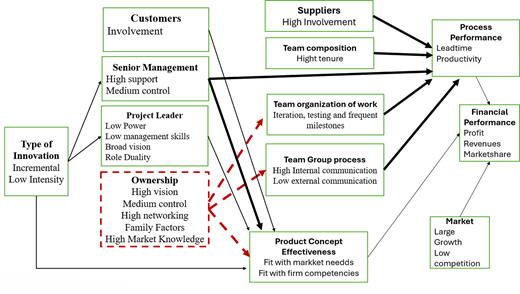
This study aims to explore the differences between large companies and family SMEs in the development of sustainable and innovative products, focusing on critical success factors specific to each type of company.
The analysis is based on a multiple case study, examining two Italian companies in the textile sector. Semistructured interviews were conducted with managers and members of product development teams, supplemented by secondary data. The analysis was carried out through thematic coding and cross-case comparison, with the aim of identifying recurring patterns and size-related differences. A benchmarking approach was used to highlight similarities and divergences in sustainable product development processes.
The findings reveal that ownership plays a crucial role in family-owned SMEs, significantly impacting ideation, strategic partnerships and sustainable product development processes. Ownership not only facilitates constant idea exchange but also drives strategic connections and collaborations essential for innovation. The study, using Brown and Eisenhardt’s framework, highlights how ownership influences team dynamics, work organization and supplier integration, which are pivotal for NPD. Unlike large firms, family-owned SMEs lack formalized cross-functional teams, relying on senior management for external communication and maintaining agility through an iterative approach. This structure enhances adaptability, supporting rapid product innovation aligned with the company’s sustainable mission.
This study offers an exploratory and context-specific contribution by examining how family ownership influences sustainable product development (SPD) and how firm size shapes the expression of critical success factors (CSFs). Rather than claiming statistical generalizability, the study generates in-depth insights into the mechanisms – such as ownership-driven ideation, informal coordination and supplier integration, that explain how and why size and ownership matter. By focusing on Italian family firms, the research also highlights the role of culturally embedded traits such as practical problem-solving, resourcefulness and artisanal creativity, extending international NPD frameworks to a specific national setting.
1. Introduction
New product development (NPD) has long been recognized as a key driver of organizational growth and competitiveness (Golder and Mitra, 2018). As consumer preferences continue to shift, integrating sustainable and “green” elements has become an essential condition for successful innovation (Dogbe et al., 2020). Innovation that neglects environmental dimensions is increasingly unattractive to firms (Behnam and Cagliano, 2016), while green innovation is now widely perceived as a means to combine sustainable growth with competitive advantage (Song and Yu, 2018). Accordingly, environmental sustainability in innovation processes is broadly acknowledged as a cornerstone of contemporary growth models (Dangelico, 2016), as reflected in the expanding body of literature on this subject (Zubeltzu‐Jaka et al., 2018). Recent reviews emphasize that innovation must increasingly be understood through a sustainability-oriented lens. Adams et al. (2016), for instance, systematically classify sustainability-oriented innovation (SOI) into cultural, learning and external linkage dimensions, thereby broadening traditional approaches to innovation management. At the same time, contributions from marketing science (Hauser et al., 2006) highlight the importance of iterative processes, short learning cycles and structured routines for codevelopment with external stakeholders such as suppliers and customers. Integrating these perspectives makes it possible to update classical NPD models, such as Brown and Eisenhardt (1995), by connecting them with more recent approaches that emphasize collaboration, adaptability and sustainability. Despite the extensive literature on innovation and NPD, empirical studies identifying critical success factors (CSFs) for sustainable product development in SMEs remain scarce. Most contributions provide broad frameworks (Belmonte-Ureña et al., 2021; Panda et al., 2022), yet they often fail to account for firm size or family ownership. Nevertheless, prior research has shown that family firms can be particularly effective in embedding environmental values into innovation strategies (Craig and Dibrell, 2006), although structural constraints may influence how such strategies are enacted.
The Italian context adds further relevance. Family SMEs are often characterized by a practical, hands-on approach to problem solving, by resourcefulness-creatively turning constraints into opportunities-and by a long-standing tradition of artisanal creativity that fosters incremental and bespoke innovation (Guilbault, 2021). These cultural and organizational traits provide an original lens through which to interpret the dynamics of green NPD, allowing international theoretical frameworks to be extended and adapted to a specific national setting.
Against this backdrop, the present study seeks to explore how critical success factors for sustainable product development manifest in family-owned firms, with particular attention to the role of ownership and the influence of organizational size. The comparative qualitative design, based on two family firms operating in the textile sector, does not aim at statistical generalization but rather at generating rich, context-specific insights into the mechanisms through which ownership and firm size shape ideation, team organization and supplier integration. In this way, the research extends and updates Brown and Eisenhardt’s (1995) framework by incorporating the dimensions of sustainability-oriented innovation (Adams et al., 2016) and by drawing on recent developments concerning cross-boundary coordination and iterative codevelopment processes (Hauser et al., 2006). In doing so, this study does not merely replicate what is already known about the role of size and ownership in new product development. Instead, it offers three original contributions. First, it highlights how family ownership acts not only as a governance structure but also as an active driver of ideation, team organization and supplier partnerships, mechanisms that remain underexplored in prior research. Second, by focusing on the Italian textile sector, the study reveals how culturally embedded traits such as practical problem-solving, resourcefulness and artisanal creativity shape sustainability-oriented product development in distinctive ways. Third, the comparative lens adopted here uncovers differences between SMEs and large enterprises that go beyond resource availability, pointing to variations in processes, informal coordination and relational capital. These context-specific insights extend international frameworks of NPD and enrich the broader scholarly debate on sustainable innovation.
The remainder of the article is structured as follows. Section 2 reviews the relevant literature on sustainable new product development, family firms and organizational size, and introduces the theoretical background extending Brown and Eisenhardt’s (1995) model. Section 3 outlines the research design and methodology. Section 4 presents the empirical findings from the two case studies, while Section 5 discusses these results in light of the theoretical framework and recent contributions on sustainability-oriented innovation. Finally, Section 6 highlights the theoretical and managerial implications, acknowledges the study’s limitations and outlines avenues for future research.
2. Literature review
Barney (1991) suggests that successful innovation is deeply rooted in a company’s unique resources and capabilities, which must be valuable, rare and challenging to replicate to secure a competitive edge. Effectively harnessing these resources allows firms to adapt more readily to diverse future challenges. Previous research indicates that companies can enhance their environmental responsibilities and develop green human capital, supporting more sustainable environmental management practices (Chen et al., 2006; Chang, 2011). Growing interest in green product development is evident in recent reviews (Dangelico, 2016; Luiz et al., 2016), which also highlight considerable variation in global research focus, with European countries such as Germany, the UK, the Netherlands, Italy and France leading in this field. Studies classify the motivations for green product development into internal drivers, external influences and firm-specific attributes. As noted by Dangelico (2016), frequently analyzed internal motivations include the prospect of gaining a competitive advantage (Lee and Kim, 2011; Pujari and Wright, 1999), expanding market share through new opportunities (Keskin et al., 2013; Triebswetter and Wackerbauer, 2008), enhancing profitability (Dangelico and Pujari, 2010), reducing costs (Horbach et al., 2012; Keskin et al., 2013), improving corporate image (Rennings et al., 2006) and pursuing innovation that boosts product quality (Keskin et al., 2013; Rennings et al., 2006).
Additional factors, though less frequently covered, play crucial roles in driving green product development. These include implementing targeted policies and strategies at both the organizational and product levels (Albino et al., 2009; Driessen et al., 2013), fostering corporate ethics and an environmental ethos (Chang, 2011; Chen et al., 2012) and responding to internal stakeholder pressures from top management, managers, employees and shareholders (Chen et al., 2012; Huang et al., 2009). Technological competencies (Kammerer, 2009; Tsai et al., 2012), aspirations for technological superiority (Triebswetter and Wackerbauer, 2008) and commitments to environmental leadership (Chen et al., 2012) are also key motivators.
Moreover, the tendencies toward uncertainty avoidance and risk aversion play important roles in green product development (Leonidou et al., 2013; Wagner, 2009). In addition, a company’s marketing orientation (Tsai et al., 2012) and the formation of strategic, long-term alliances with key supply chain partners or buyers (Lee and Kim, 2011) are crucial for advancing green initiatives. Regarding external drivers, the most frequently examined are environmental regulations and policies (Leenders and Chandra, 2013; Liu et al., 2011), as well as market demand and pressure from stakeholders (Chen et al., 2012; Horbach et al., 2012). Other influential external factors include the political and cultural environment (Conway and Steward, 1998), media focus on environmental impacts (Pujari and Wright, 1999; Visser et al., 2008) and technology developments outside the firm’s control (Kivimaa, 2007). Additionally, competitive pressures, including the rise of rival green products (Conway and Steward, 1998; Green et al., 1994) and networking with eco-conscious stakeholders, other firms and industry initiatives (Cainelli et al., 2011) are acknowledged as external motivators.
Green product innovations are diverse, differing considerably in terms of novelty and distinctiveness. Although research generally supports the view that green products benefit both the environment and a company’s market and financial outcomes (Pujari, 2006), there remains limited exploration of which specific green innovations are most impactful. According to Kurapatskie and Darnall (2013), substantial innovations in products and processes often yield higher financial returns than incremental changes. Dangelico et al. (2017) similarly argue that more radical green innovations positively affect market performance.
Finally, multiple studies address firm-specific attributes that influence eco-friendly product development. Frequently analyzed factors include company size (Leonidou et al., 2013), foreign ownership (Cainelli et al., 2011; Guoyou et al., 2013) and the adoption of environmental management systems (EMS) (Leenders and Chandra, 2013).
In summary, although prior studies identify internal resources, environmental strategies and firm-specific attributes as determinants of green product development, important gaps remain. In particular, the joint role of family ownership and organizational size has received limited attention, despite its relevance for both SMEs and larger enterprises. Recent contributions emphasize sustainability-oriented innovation as a multidimensional process encompassing cultural, learning and relational dimensions (Adams et al., 2016; Gamble et al., 2021), yet they seldom address how these elements manifest in family-owned contexts. This study addresses this gap by investigating how ownership and size condition the emergence of critical success factors in sustainable NPD, thereby refining established theoretical models and offering in-depth qualitative insights into mechanisms that remain underexplored.
2.1 Family firms for green new product development
Family ownership and management create a distinctive context for sustainable innovation, characterized by a long-term value orientation and a strong sense of responsibility toward stakeholders. In particular, family firms tend to adopt more proactive environmental strategies compared to their nonfamily counterparts, demonstrating greater sensitivity to social and environmental sustainability issues (Delmas and Gergaud, 2021). Chen and Huan (2022), in their analysis of green innovative product development in family firms, highlight the role of market knowledge defined as the structured set of information concerning customers, competitors and key partners (Li and Calantone, 1998). The results of their study indicate that, although such knowledge fosters the development of knowledge-governance capability, this does not automatically translate into innovation. Organizational barriers typical of family SMEs such as strong centralized decision-making, the presence of informal structures and the lack of systematic knowledge-sharing mechanisms tend to hinder the effective transformation of knowledge into innovative outputs (Biscotti et al., 2018; Massaro et al., 2016). Furthermore, the socio-emotional components of family ownership, including emotional attachment to the firm, identity-based values and personal involvement, significantly influence knowledge management practices (Brinkerink, 2018; Chirico and Salvato, 2016; Kammerlander and Ganter, 2015). In parallel, Gamble et al. (2021) highlight how the intergenerational transmission of family values, combined with an organizational culture rooted in trust and transparency, fosters co-creation processes with external stakeholders, thereby strengthening the firm’s socio-emotional legitimacy and its ability to develop sustainable products. Long-term relationships with customers, suppliers and local communities often territorially rooted and based on social trust constitute an intangible asset that can compensate for the aforementioned structural limitations (Lionzo and Rossignoli, 2013). Brand trust emerges as a central strategic resource for family SMEs. It is built over time through the consistency between declared values, product quality and customer commitment. The companies analyzed by Gamble et al. (2021) recognize the importance of the brand as a competitive lever, working to transform reputation and trust into a long-term sustainable advantage.
2.2 The effect of organizational size on green new product development
Numerous studies have examined firm-specific attributes that influence the development of eco-friendly products. Among the most frequently considered factors is organizational size (Leonidou et al., 2013). Overall, firm size is recognized as a key structural variable in understanding the dynamics underlying green new product development (GNPD), although empirical findings often appear inconsistent and heavily shaped by contingent variables. A substantial body of literature suggests that larger firms tend to possess more abundant resources, specialized expertise and complex organizational structures – elements that can facilitate the adoption of environmental and technological innovations (Kimberly and Evanisko, 1981; Damanpour, 1992; Hitt et al., 1990). In particular, the availability of human and financial capital enables large firms to support substantial investments in research and development, marketing and infrastructure, allowing them to more effectively absorb the risks associated with innovation processes (Nord and Tucker, 1987; Camisón-Zornoza et al., 2004). However, a stream of research has also highlighted the structural limitations of large firms, which are often characterized by high levels of bureaucracy, slow decision-making processes and resistance to change (Hage, 1980; Aldrich and Auster, 1986). Small and medium-sized enterprises (SMEs), by contrast, are generally considered more flexible and responsive, capable of quickly adapting to changes in the competitive environment and introducing both incremental and radical innovations with greater agility (Damanpour, 1996). This theoretical ambivalence has led some scholars to argue that there is no linear relationship between firm size and innovation, and instead advocate for a contingency approach that considers the interaction of structural, strategic and environmental variables (Aiken et al., 1980). Within this perspective, the contribution of Olson et al. (1995) highlights that the performance of development projects is not determined by firm size per se, but rather by the organization’s ability to adapt coordination mechanisms to the level of innovation required. In this context, large firms often appear to be at an advantage, as they are more likely to possess dedicated resources that enable an effective “fit” between project type and organizational configuration (Olson et al., 1995, p. 59; Wheelwright and Clark, 1992). Supporting this view, Lawler (1997) argues that large size can still represent a source of competitive advantage, provided it is accompanied by appropriate organizational structures and the strategic use of technology. From a synthesis standpoint, the meta-analysis by Camisón-Zornoza et al. (2004) contributes to clarifying the debate, confirming the existence of a positive and significant relationship between organizational size and innovation capability, particularly with regard to the adoption of technological and process innovations. Despite these developments, studies about green innovation adoption specifically within family firms are sparse (Scott-Young, 2013), with little focus on green innovation development, leaving this area largely underexplored.
Additionally a considerable amount of research examines product development processes in large-scale industries (March-Chorda et al., 2002). Yet, empirical studies exploring critical success factors (CSFs) specific to product development within SMEs are limited. Given SMEs’ crucial role in economic growth and job creation, identifying these CSFs is vital, as it can significantly impact national economic success (Belmonte-Ureña et al., 2021). Most available studies provide broad frameworks for identifying CSFs in product development but often overlook the unique attributes related to different sector sizes and types.
The literature therefore reveals mixed findings on the role of certain firm-specific traits in sustainable product development, while other potentially significant attributes – such as family ownership status or firm size – remain insufficiently studied. Rather than aiming to resolve these inconsistencies in a generalizable way, this study seeks to shed light on how these characteristics may shape sustainable product development in specific contexts. Accordingly, our research question is framed in exploratory terms:
How do critical success factors for sustainable product development manifest in family-owned firms, and in what ways does organizational size influence their emergence in SMEs versus large enterprises?
To investigate this question, we build on and extend the Brown and Eisenhardt (1995) framework, conducting a comparative case study of one SME and one large family-owned firm in the textile sector. This qualitative design does not aim at statistical generalization but provides an opportunity to generate in-depth insights into the mechanisms through which ownership and size interact with green new product development processes.
2.3 Theoretical background: an extension of Brown and Eisenhardt’s integrated product development model
Brown and Eisenhardt’s (1995) integrated product development model emphasizes the intricate interplay between various actors, such as the project team, senior management, suppliers and customers, that influence the success of product development initiatives. The model synthesizes insights from several streams of research, integrating factors that drive process performance, product effectiveness and, ultimately, financial success. More recent contributions highlight the need to frame product development not only in terms of process efficiency and outcomes but also through the lens of sustainability-oriented innovation (Adams et al., 2016), which emphasizes the cultural, learning and external linkage dimensions of innovation. Similarly, Hauser et al. (2006) call attention to the importance of boundary-spanning routines, spiral and overlapping processes and cross-functional collaboration as fundamental extensions of earlier models.
Here are the elements that constitute the model:
Team composition: The project team is central to product development, transforming abstract ideas into concrete product designs. The effectiveness of this team is shaped by its composition, group processes and work organization. Studies by Ancona and Caldwell (1990, 1992a, 1992b) underscore the importance of cross-functional teams composed of members from different organizational areas such as engineering, marketing and production. These teams benefit from diverse perspectives, enhancing the flow of information and problem identification during the development process. Additionally, as identified by Katz and Tushman (1981), gatekeepers play a crucial role in facilitating communication between the team and external sources. These individuals bring in valuable external information and ensure that the team remains connected to broader organizational and market developments, improving the process’s speed and quality. The tenure of team members also affects the team’s performance. While longer tenure can enhance cohesiveness and mutual understanding, teams that have worked together for too long may become insular, limiting the inflow of new information (Allen, 1971; Katz, 1982). Therefore, a moderate tenure level is ideal, balancing familiarity with openness to innovation. Completing this picture, the literature highlights that different configurations may emerge in family SMEs. In particular, empirical evidence provided by De Massis et al. (2016) shows that, in high-performing contexts, part-time teams composed of staff who combine innovation work with their routine activities are more effective in terms of both outcomes and organizational efficiency. This configuration reflects the specificities of family governance, which is characterized by a centralized decision-making environment, consolidated interpersonal relationships and a strongly concentrated power structure. In such contexts, the absence of formal barriers is offset by informal coordination mechanisms based on trust, relational proximity and mutual knowledge among team members.
Group process and team organization of work: The effectiveness of the team group process is driven by internal communication, which improves the team’s cohesion and ensures that critical information is shared seamlessly within the group. As Allen (1977) emphasized, effective communication structures reduce misunderstandings, streamline workflows and enhance productivity. Simultaneously, external communication with stakeholders such as suppliers, customers and other parties broadens the team’s perspective, bringing new insights to inform design decisions. This external communication is precious when task-oriented, as it provides actionable information from various viewpoints. Moreover, external communication holds political value, allowing teams to lobby for additional resources from senior management (Katz and Tushman, 1981). Brown and Eisenhardt (1995) refer to the organization of work within the team as a problem-solving strategy, which also plays a critical role. In stable industries, extensive planning and overlapping development processes where different stages of development, such as design and testing, co-occur help reduce errors and ensure efficient progression. In more uncertain environments, however, teams may benefit from frequent iteration and testing, with shorter milestones allowing for flexibility and rapid learning from experience (Clark and Fujimoto, 1991; Clark et al., 1987). This iterative approach resonates with the prescriptive views of Hauser et al. (2006), who emphasize that effective NPD requires recurrent feedback loops, spiral processes and structured codevelopment practices to accelerate learning and reduce rework.
Project leader: The project leader is the pivotal link between the project team and senior management. Imai et al. (1984) and Quinn (1987) highlighted the importance of having project leaders with substantial decision-making authority, organizational influence and hierarchical power. Such leaders are adept at improving process performance by securing necessary resources, motivating team members and navigating the organizational landscape to remove obstacles. These leaders also possess a clear vision for the product, synthesizing organizational competencies and market strategies into a coherent and actionable product concept (Clark et al., 1987). Project leaders facilitate the technical aspects of product development and ensure that the team aligns with broader organizational objectives while allowing team members the autonomy to innovate within the defined vision. The literature thus highlights how project leaders must combine managerial skills, long-term vision and relational abilities to support the project and ensure its recognition within the organization (Ancona and Caldwell, 1992b; Shane et al., 1995). However, in some successful family SMEs, these responsibilities are distributed across multiple roles: the operational management of the project is entrusted to external managers with technical expertise, while the internal promotion of the project – including political support and team protection – is carried out by family members (De Massis et al., 2016). This division of tasks makes it possible to overcome the potential lack of independent internal managerial profiles, while preserving family control over strategic decisions, thereby creating a hybrid structure that combines operational effectiveness with internal legitimacy.
Senior management: The support of the senior management is a critical success factor in product development. This support is manifested in providing financial and political resources vital to the project’s success (Rothwell et al., 1974). Senior management also provides a clear vision for the product, which helps to align the project team’s efforts with organizational goals. However, it must exercise restraint, allowing the project team sufficient autonomy to make decisions and solve problems independently (Hayes, 1988). This balance between guidance and independence, referred to as subtle control by Hayes (1988), is critical for maintaining team motivation and creativity while ensuring the development process remains on track. It encourages innovation and ensures the team remains engaged and motivated throughout development.
Suppliers and customers: The involvement of suppliers and customers plays an instrumental role in both speeding up the product development process and enhancing the effectiveness of the final product. Studies by Imai et al. (1984) demonstrated that higher supplier involvement early in the development process reduces design complexity and helps identify potential issues before they become significant problems. Similarly, the involvement of customers in the product development process ensures that the product aligns with market needs and customer preferences, thereby increasing the likelihood of success. The timing and extent of supplier and customer involvement are critical; early engagement helps identify problems sooner, while involvement at later stages ensures that the product concept remains aligned with the firm’s strategic goals and competencies (Brown and Eisenhardt, 1995). In family-owned SMEs, suppliers are not merely functional partners within the value chain, but play a strategic role in value co-creation. The study by Gamble et al. (2021) demonstrates that supplier relationships – when based on shared values, mutual trust and long-term collaboration – can enhance innovative capacity and contribute to the perceived quality of the final product and service. While the literature has emphasized geographical proximity and direct communication as distinctive features in the relationships between family firms and their suppliers (Campopiano and De Massis, 2015), it emerges that it is above all the assimilation of family values and the culture of reciprocity that generate sustainable competitive advantages (Basco, 2014; Clinton, 2018; Sinfield et al., 2011). In this perspective, relational supplier management becomes a strategic lever, particularly in terms of integration into process and technological innovation efforts. Similarly, customer involvement in new product development ensures better alignment with market needs and consumer preferences. The literature highlights how input from end users enables firms to validate design solutions, improve product acceptance and strengthen competitive positioning (Brown and Eisenhardt, 1995). The study by Gamble et al. (2021) emphasizes that, in family SMEs, the establishment of authentic and long-lasting relationships with customers is a distinctive feature, built on trust, transparency and strong value alignment. In this context, service and product quality is not perceived solely in functional terms, but is also associated with a personalized and emotional experience, often reinforced by the family identity of the brand (Lionzo and Rossignoli, 2013; Segaro, 2012; Kontinen and Ojala, 2011). This capacity for adaptation and closeness to the customer allows family firms to strengthen customer loyalty and respond more agilely to market dynamics. In conclusion, integration with suppliers and customers emerges as a critical lever to capture the value generated by innovation (Ettlie and Reza, 1992).
Process performance and product concept effectiveness: The combination of effective team composition, project leadership, senior management support and external involvement leads to improved process performance and product concept effectiveness. As defined by lead time and productivity, process performance directly influences the speed and efficiency of product development. Faster processes reduce costs and provide firms with greater strategic flexibility, allowing them to respond more swiftly to market changes (Clark and Fujimoto, 1991). The product concept’s effectiveness, driven by the inputs of project leaders, senior management and customer involvement, ensures that the final product aligns with market needs and leverages the firm’s core competencies. Products that fit well with market demands and the firm’s capabilities are more likely to achieve commercial success (Cooper, 1979; Cooper and Kleinschmidt, 1987).
Financial performance: The ultimate measure of success in product development is financial performance, which is influenced by both process performance and product effectiveness. Efficient processes result in lower production costs and faster time-to-market, which contribute to higher profits. Similarly, products that offer a unique advantage in terms of quality, cost or innovation and align with customer needs are more likely to achieve solid financial returns (Clark and Fujimoto, 1991). Additionally, the characteristics of the market, such as its size, growth potential and competition level, further shape the product’s financial performance. Products introduced into large and growing markets with low competition are more likely to capture significant market share and drive higher revenues.
Type of innovation: In addition to the elements outlined in the model by Brown and Eisenhardt (1995), the literature has highlighted further factors that influence new product development success, among which is the type of innovation. Innovation orientation represents a crucial element in the processes of new product development, particularly within family firms. In family-run businesses, this propensity is strongly influenced by ownership structure, intergenerational culture and succession dynamics, often generating a tension between preserving identity and the need for change (Grundström et al., 2012). Internal successions tend to favor incremental innovations, while external stimuli – such as interactions with customers and stakeholders – can trigger more radical innovations (Abdellatif et al., 2010; Verhees and Meulenberg, 2004). The literature distinguishes between various types of innovation, each with distinct effects on the product development process. Innovation intensity, for instance, reflects how deeply innovation is embedded in the firm’s strategy and culture (Koschatzky, 1999; LaForet and Tann, 2006). Furthermore, it is essential to differentiate between incremental innovations – which bring progressive improvements to existing products or processes – and radical innovations, which introduce disruptive changes based on new technologies or approaches (O’Reilly and Tushman, 2008; Chandy et al., 2003; Mosey et al., 2002; Grundström et al., 2012). The modes through which innovation takes place may also vary: an “established” one, where the firm adopts well-tested innovation processes as part of its routine operations; and a “new” one, which relies on alternative ways of innovating inspired by visionary thinking rather than current methods(Grundström et al., 2012). In family SMEs, the choice of innovation type depends on competitive pressure and the ability of the top management team to acquire and combine new and existing knowledge. The intensity of information search is essential to accurately interpret data and make effective decisions (Li et al., 2013; Aiman-Smith et al., 2005; Kahneman and Tversky, 1973). Overall, the type of innovation adopted is shaped by the characteristics of the top management team (TMT), which – through its openness, experience and ability to integrate new information – guides the direction and intensity of innovation. In line with this, sustainability-oriented innovation frameworks (Adams et al., 2016) suggest that the type and intensity of innovation in family SMEs are also shaped by organizational culture and external linkages, highlighting how ownership and firm size condition the ways in which innovation practices are embedded into product development processes. This, in turn, affects key variables of the Brown and Eisenhardt framework, such as product concept effectiveness and project leadership profile, which also reflect the entrepreneurial family’s openness to innovation and the involvement of senior management.
3. Methodology
The methodology of this study relies on a multiple-case analysis approach. Although this method has certain limitations, particularly in terms of reliability and validity (Ginsberg and Abrahamson, 1991; Yin, 2003a, 2003b), it enables an in-depth exploration of the complex phenomenon under investigation, capturing its subtler dimensions. This capacity for detailed insight renders case analysis especially suitable for the objectives of this research (Eisenhardt, 1989). To increase robustness over single-case approaches, the study involves two companies (Yin, 1994). As Mintzberg (1979, p. 585) observed, “No matter how small our sample or what our interest, we have always sought to enter organizations with a well-defined focus, systematically collecting specific types of data.” The cases were intentionally selected in line with qualitative research goals (Glaser and Strauss, 1965; Silverman, 2000). This research draws from prior qualitative studies (Karjalainen and Snelders, 2010; Brockman et al., 2010; Mabert et al., 1992), which use small-sample analyses to develop theories on NPD. In addition, the methodological design is aligned with more recent contributions on design-led innovation (Townson, Matthews and Wrigley, 2016), where the researcher, acting as an innovation catalyst, collaborates directly with organizational members to foster customer-inspired insights and organizational change. Although our study does not adopt an embedded action research design, it shares with this stream of research the emphasis on iterative engagement with multiple stakeholders, the exploration of barriers and opportunities and the coconstruction of knowledge to strengthen theory-building in complex environments. This perspective is also consistent with more recent work on design orientation and integration (Nusem et al., 2019), which highlights that organizational change in innovation contexts is often nonlinear and requires a gradual progression from awareness to action. While our study does not replicate their longitudinal action research design, it similarly acknowledges that understanding the dynamics of sustainable new product development involves iterative learning processes and the progressive involvement of diverse organizational actors. The objective here is to pinpoint the factors impacting business practice implementation and outcomes, both internally and externally.
This study adopts theoretical sampling as its methodological approach (Eisenhardt, 2021). This method is based on the intentional selection of cases where the focal phenomenon is likely to occur and where, through their similarities and differences, the cases can meaningfully contribute to building robust theory (Eisenhardt, 1989). Specifically, the sampling design follows a polar types logic (Martin and Eisenhardt, 2010). The research focuses on two firms operating in the textile sector, both family-owned, but representing opposite ends of the spectrum in terms of organizational size: one small-to-medium-sized enterprise (SME) and one large firm. The selection criteria included industry type, product category, firm size and ownership structure (Silverman, 2000). Both companies develop sustainable products through outsourcing and strategic partnerships. This methodological choice is based on the assumption that, while sharing relevant characteristics, the differences in firm size can clearly reveal distinct dynamics and processes, thereby enabling a deeper understanding of the phenomenon under study. Such an approach helps to mitigate alternative explanations and enhances the analytical generalizability of the findings, as emphasized in prior studies (Eisenhardt, 2021; Langley and Abdallah, 2015). As highlighted by Eisenhardt (1989), case selection is essential for theory-building, as a carefully defined population allows for strategic sampling, controlling extraneous factors and setting boundaries for generalization. The adoption of theoretical sampling allows researchers to focus on cases where the phenomenon of interest is “transparently observable” (Pettigrew, 1998; Glaser and Strauss, 1967). Studies such as those by Harris and Sutton (1986) and Gersick (1988) have shown that selecting extreme cases and polar types, particularly when working with a limited number of cases, facilitates replication within categories, thus extending or refining emerging theory. The two firms selected – both well-established and recognized for their success in developing sustainable new products in the textile sector – are therefore representative of their respective categories. However, as is common in qualitative research based on theoretical sampling, the findings of this study are analytically generalizable to firms with similar characteristics, but not statistically generalizable to fundamentally different contexts (Yin, 2003a, 2003b; Becker, 1990). Data were gathered from January 2023 to September 2024 through interviews led by a research team. Subsequently, during March–April 2025, the data set was iteratively updated through additional interviews and the analysis of company documents, with the aim of integrating and refining the emerging evidence. Involving multiple researchers strengthens the study’s creative potential, as team members contribute diverse insights, enriching data quality and boosting confidence in results through converging observations. Differing perspectives also safeguard against premature conclusions (Eisenhardt, 1989). Executives, managers and employees engaged in the GNPD process at both companies were interviewed. For Company A, interviews included the owner, senior manager, team project leader and product team members; for Company B, the owner, senior manager and members of the R&D team, along with a junior sustainability analyst, were interviewed. Following data collection, a structured cross-case analysis categorized and compared findings to highlight variable impacts on SMEs within the GNPD process, providing a coherent and comprehensive view of the dynamics involved. Each enterprise’s GNPD process served as the analysis unit. Semistructured interviews enabled rich, flexible narratives in the style of “active interviewing” (Holstein, 1995), encouraging participants to reflect on their experiences. The interviews, lasting from 30 min to 2 h, were digitally recorded, transcribed, anonymized and supplemented by secondary data, such as company documents and additional corporate information. These secondary data sources enhanced the verification of interview findings, ensuring a more objective data collection process (Yin, 2003a, 2003b). Nonverbal dynamics, in addition to verbal responses, were also considered by observing interactions between employees. The primary results were later discussed with some interviewees to confirm their validity. Including multiple respondents from each company offered a comprehensive view of the GNPD processes, addressing possible retrospective biases (Golden, 1992; Schwenk, 1984) through comparative analyses and participant guidance on actual behaviors.
3.1 Company profile
Firm A is a family-run SME specializing in the retail of tailored clothing for both men and women. Established in Naples, Italy, in 1914, the company initially began as a small artisan shop, importing printed silk from England. Over the years, the firm has maintained its headquarters in Naples, where all its products are designed and handcrafted, combining traditional craftsmanship with modern innovation. The company operates five stores across Italy, located in cities such as Naples, Milan, Rome and Turin, and has expanded internationally with three additional boutiques – one in London and two in Tokyo. Throughout the decades, Firm A has broadened its product range, particularly in men’s fashion, offering items like shirts, ties, cufflinks, watches and leather bags. In 2010, it extended its offerings to include a women’s line, starting with silk scarves and later adding wallets, handbags and other leather accessories in various sizes. In 2020, the company embraced digital transformation by launching an e-commerce platform, which quickly grew to represent 17% of its total revenue by 2023. The firm employed 48 people in 2022, with an annual revenue of €16m, which increased to €18m the following year. In addition to its core tailoring business, Firm A has diversified its portfolio, offering a wide range of clothing and accessories, including shirts, blouses, jackets, pants, skirts, sports uniforms, workwear and various outerwear and service apparel.
Firm B is an Italian family-owned company that generated €169m in revenue in 2023 and employs 826 people. The company specializes in the design and production of pajamas, lingerie and beachwear for women, men and children, and also engages in the wholesale distribution of clothing and footwear. Founded in 2001 by a Neapolitan entrepreneur, the company emerged from the vision of capitalizing on the growing potential of the lingerie and retail markets, embarking on a successful entrepreneurial challenge. Over the years, the brand has opened numerous stores, now operating 601 locations in 35 countries, 478 of which are in Italy. Additionally, it manages 11 online stores and is present on 15 marketplaces.
A comparative overview of the main characteristics of Firms A and B is presented in Table 1.
4. Results
4.1 Suppliers
The two companies analyzed both outsourced the supply for the development of the sustainable products under study. In particular, Company A developed a line of products made from a fibre called liocel, which is made from orange peels and mixed with silk. In this case, the production of the fabric is entrusted to suppliers, while the company takes care of the printing of customized motifs. The second collection (following the success of the first) includes ties, pocket squares and scarves. As the senior management pointed out in an interview:
The suppliers, i.e. those who make the fabric, are 100 per cent involved in the project […]. The collaboration we established allowed us to support them in the development of this raw material, which is used to create one of our most popular products on the market.
The relationship with the suppliers was initiated directly by the owners, who were looking for partners to develop an innovative and sustainable product, and managed the process themselves. As an SME, Firm A sees ownership directly involved in product development, working closely with management to bring projects to fruition. However, despite the success of the products, one of the main problems encountered was a slow process, as the supplier was a start-up with limited production capacity:
One of the main problems was the slow delivery from the moment the order was placed. This was largely due to the limited capacity to produce large quantities of this fabric […]. There were production limitations that prevented us from promoting and further developing the collection.
Nevertheless, the company has developed a synergistic collaboration with the supplier, based on dimensional and structural affinities that have fostered a flexible and adaptable codesign process. Indeed, a significant problem for Company A, as an SME, is the difficulty in finding suppliers willing to work with low quantities. Many potential suppliers require higher production minimums than the company can absorb. As one member of the product team explained:
We produce quantities that are not high, and some suppliers are not suitable for us because they require production minimums that are too high, which the company cannot handle.
This understanding, free from the constraints of large-scale production, has strengthened mutual trust. As highlighted by one of the managers:
Since the suppliers are also an SME, we built a synergistic relationship. The small size of both companies allowed us to develop an adaptable collaboration, without the typical constraints of large-scale production.
Finally, the supplier audit for Company A is outsourced to external consultants and is not managed internally.
With regard to Company B, there are similarities in the relationship with suppliers compared to Company A, related to the family character of both, but there are also differences due to the different company size. Company B has developed a line of products made of recycled nylon from fishing nets and 100% recycled spandex, and a second line of circular products with 51% certified recycled polyester, made with a printing technique that allows the use of both sides of the fabric without the use of water. Like Company A, production is outsourced to an external laboratory. However, as explained by the junior analyst interviewed:
The external laboratory is a real research centre, located close to our headquarters, with different functions and professional figures involved […]. In addition to the laboratory part, there is another location where we organise advanced training courses for the textile sector.
Unlike Company A and Company B has an R&D team dedicated to these products, which is in direct contact with suppliers, without intermediation by the ownership, even for special and innovative projects. A member of the R&D team stated:
To select suppliers, we travel abroad, both to Europe and Asia. Some suppliers contact us directly […]. For example, they write me a message and I request information about the company and the company profile, and then we arrange a meeting.
Finally, unlike Company A, the audit of suppliers is managed internally, by personnel belonging to the company’s own team.
In summary, in both cases, the involvement and relationship with suppliers significantly influence the performance of the processes. For SMEs, the selection and management of suppliers are often mediated directly by ownership, which has a central role, especially for innovative projects. Company A, not having high production volumes, only interfaces with suppliers who do not require too high minimum production quantities, which may slow down processes and affect performance. Company B, on the other hand, being more structured, manages supply in a more sectorial and direct manner, without the intermediation of ownership and has more resources and time to experiment with innovative processes with external laboratories.
4.2 Team composition, team organization of work, team group process
In Company A, the product team consists of three persons, organized in an informal and unstructured manner. One of the figures concentrates on purchasing and product development for the physical shops, another figure performs similar functions for the e-commerce side and the third one is mainly concerned with the stylistic aspects, managing shootings, model selection and style matching according to the collections. Company A does not have a dedicated research and development department nor a specific section for innovation and sustainability. In this context, the competences of the team are rather homogeneous and there is no clear distinction of tasks or delineation of roles.
In the team, there is a figurehead, who holds more responsibility due to accumulated experience and who is coordinated by the management and supervised by the ownership. Although this person plays a leadership role, there is no specific requirement for advanced academic skills required by management. As reported by senior management:
It is not strictly necessary for our people to have a degree in business or engineering disciplines […]. We value experience and the companies in which these people have worked much more.
The absence of a gatekeeper figure is compensated for by ownership, which directly performs this role, gathering information from outside. Relationships within the team are characterized by a high degree of informality, fostering constant collaboration. The team leader works closely with the owner and has been with the company for 23 years, while the other team members have been working together for 10 years, thus consolidating a strong spirit of synergy. However, the inclusion of young recruits, following the generational change typical of family businesses, initially generated major internal confrontations.
The organization of work is not rigidly planned; meetings are not fixed in advance but take place through continuous communication, without defined deadlines, in an iterative process. When there are special projects or specific problems, extraordinary meetings are convened. A member of the product team explained:
We talk to each other every day, both in person and by email, while with ownership we meet less frequently. In particular, we meet with ownership when we have to present new collections.
External communication, especially with suppliers, takes place mainly in the initial phase of project development and in the final phase or in the case of special collaborations. For ordinary projects, the product team directly handles contact with suppliers.
Firm B, on the other hand, being larger, has an entirely different organization. NPD is carried out by several specialized teams: the Research and Development (R&D) team, the style team and the CSR and Innovation team. The R&D team, which consists of five people and deals mainly with sustainable materials, processes and innovations, has much more structured skills than Firm A. The company also invests significantly in internal employee training. As one member of the group reported:
The Firm invests a lot in training. For example, I took a four-year course to become an IACC color consultant.
Similarly, to Firm A, ownership plays a key role in the selection of the necessary people and skills, and the presence of the family at the helm is evident in both strategic choices and interpersonal relationships. However, the organization of Firm B is much more structured: the R&D team presents innovative projects to the managing director twice a year and once a year material trends and work on basic products. Every season, there is a discussion with the style office. The process was described by the Team Leader as follows:
The RandD team presents innovative projects to the CEO twice a year. In addition, once a year we present material trends and our work on basic products. Each season, we work with the style department to plan colors and develop collections. After the approval of the managing director, the collaboration with the style office for the realisation of the designs begins. Some projects are followed by our team from start to finish.
The overall analysis highlights substantial differences between the two companies, especially with regard to the degree of formalization of internal relationships and the structuring of required competences. In Firm A, a typical SME, interactions are more informal and activities less planned, with greater direct involvement of ownership in day-to-day management and special projects.
As stated by the ownership:
Being an SME is an advantage in some respects: our leaner structure allows us to be more agile in decision-making.
In contrast, Firm B, due to its size, adopts a more sectoralized and organized management, which allows detailed planning and constant and structured collaboration between the various departments.
4.3 Project leader
In Firm A, the figure of the project leader does not appear clearly defined in terms of hierarchy. Although there is a product team leader, the role derives mainly from experience and responsibility rather than from formal authority over the other two team members. The project leader maintains a direct and close relationship with the ownership, without the intermediation of management, as revealed during the interviews:
The product team leader started working at the company at the age of 18 and grew professionally alongside the owner, who trained her personally. She is like his eyes; she knows his tastes perfectly and has been his ally in every aspect […]. The hierarchy is not rigid; everyone has separate tasks to avoid overlapping.
This suggests that the project leader’s leadership is based on authority and earned trust, rather than on formal, hierarchical authority. Consequently, the project leader does not exercise direct control over the organization of work or team processes, as tasks are divided equally, without subordinate relationships. In this context, it is the management that directs the processes and relationships within the company. Moreover, in Company A, responsibilities are distributed across different roles. Specifically, management explains:
The team leader has primarily operational skills. Managerial aspects are instead handled by the ownership and the management. The team leader is in charge of execution but works in close synergy with those who define the strategy.
In this case, responsibilities are clearly distributed, and roles are distinctly defined: the team leader mainly plays an operational role, while the internal promotion of the project – including strategic support and team protection – is entrusted to the family ownership. The latter steers the direction and ensures alignment with the overall company vision, creating a form of role duality.
In contrast, in enterprise B, although an apparently equal relationship between the group members emerged in the interviews, the observations revealed a different reality. The degree of authority of the project leader is more pronounced than in enterprise A. This discrepancy was particularly evident through the observation of attitudes and interactions during the interviews: in the first case, the interviews were conducted separately, whereas in the second case they were conducted jointly with the project leader present.
In the context of enterprise B, the project leader exercises a supervisory function over the other group members, and a more defined hierarchical structure is perceived. This implies that the leader has a significant influence both in the division of tasks and in the general organization of work, to the extent of impacting the overall performance of the team. In this scenario, one can apply the framework of Brown and Eisenhardt (1995), which emphasises the relationship between leadership and effective team coordination. However, in the case of SMEs, particularly family-run ones, this relationship becomes less evident, if not completely nonexistent, since the tasks of the project leader in a large company are often comparable to those of senior management in a small company.
4.4 Senior management
As Brown and Eisenhardt (1995) also state, senior management must perform both a supervisory function and implement discrete supervision. In practice, senior management must ensure its presence during all phases of development, intervening when necessary, but leaving ample autonomy to employees to allow them to express themselves to the full. Too rigid and pressing control, in fact, could compromise the team’s performance, limiting individual capabilities.
In both companies analyzed, senior management adopts a collaborative approach in managing relations with its team:
MS Firm A: “There is constant confrontation; the office allows us to confront each other often…”
MS Enterprise B: “It is a collaborative process, a kind of round table. Each of us comes up with ideas and, if a team member finds something interesting, we explore it together.”
Collaboration, therefore, is the fundamental starting point for an effective development process. Firm B’s senior management adds:
We used to be in two offices, but we saw that it wasn’t working and got together. Being all together allows us to immediately identify if an idea or fabric is not working. We are here and we confront each other.
This emphasizes the importance of continuous confrontation within a research and development team to combine ideas and skills and thus achieve the best possible result.
Of course, guidance and control are necessary to meet the timeframe and market requirements. In fact, the senior management of Firm A states:
I try to make sure that the objectives are understood and that the team follows and shares the directives. Obviously, the reactions are not always the same for each person; it is important to make it clear that the ultimate goal is to achieve the set results, even when a firmer relationship is needed.
As both companies are family-owned, the continuous confrontation with ownership is another key element for success. As the senior manager of Firm B confirms:
We still have the CEO and our manager, to whom we report on activities.’ The senior management of enterprise A also states: ‘They talk to me first, but there is still a confrontation with ownership.
In summary, the success of a new sustainable product is based on the balance between confrontation and discreet control, which allow the team to express itself to the best of its ability under the guidance of senior management.
4.5 Customer
The customer is the beating heart of every company, as confirmed by the statements of Firm B’s ownership:
[…] at the centre of our philosophy is the customer, for whom we create durable, high quality products, capable of generating happiness and well-being.’ also as stated by the project leader[…] Our goal is to create products with added value that consumers can perceive […]
Customers therefore represent a driving force that guides companies towards constant innovation. Both analyzed companies adopt a proactive approach in responding to market needs, carefully observing changes and new emerging needs. As pointed out in the interview with the owner of Firm A:
Actually, the project was born before all this sensitivity to eco-sustainability was born.
In parallel, Firm B is committed to guiding consumers towards sustainable choices:
The company helps to spread awareness about the importance of sustainability, positively influencing both consumers and the entire business ecosystem. […] the brand is committed to creating a conscious customer journey, educating consumers about the importance of choosing sustainable products and reducing the overall environmental impact.
The regulatory push has also played a central role in the development of innovative and sustainable products. As stated by Firm B’s junior analyst:
We started with a legislative environment that in the coming years will push us to optimise production, reducing the use of raw materials and making the most of those already in use.
Companies show a marked sensitivity towards sustainability, and both regulations and consumer preferences are a continuous push for improvement. However, a difference emerges in the way the two companies assess and analyze customer behavior. In Firm B, consumer research is structured and formal; as the senior manager stated:
We have a person who acts as an intermediary between us and the RandD department. This person visits shops to explain the characteristics of the products, touring all over Italy. We also use focus groups conducted by external companies, involving people of different ages and regions of Italy. Consumer feedback is collected by a psychologist, giving us valuable information on how to improve our products and communication.
In an SME, the process is less formalized but still oriented towards listening to the customer:
We have a large customer database, and our customer care collects all feedback. The manager of each store communicates with us to understand the customer’s reaction to new products or collections. We are now also structuring communication and marketing, sending newsletters to engage the customer more, not just in-store.
Moreover, the relationship with customers in Company A is long-term and characterized by a strong relational bond, typical of family-owned SMEs, built on mutual trust. As a member of the product team stated:
Trust in the brand is essential. Our customers expect very high quality standards. This makes us extremely careful before launching a new product. Our reputation is perceived as a guarantee, and this is even more true in the case of sustainable products. The risk of greenwashing is real, but the strength of the brand helps convey authenticity.
Ultimately, to ensure the success of an innovative and sustainable product, companies must closely monitor consumer preferences and feedback, continuously adapting their concepts and strategies.
4.6 Type of innovation
The type of innovation represents another critical factor in new product development processes, particularly within family businesses. In Company A, innovation is predominantly incremental, focused on introducing sustainable materials to reissue already established iconic products, rather than developing entirely new product categories. As stated by the business development manager:
We use new materials, but to reproduce our most iconic products. We haven’t introduced completely new types, so it’s not a case of radical innovation.
This approach highlights how the choice of incremental innovation allows the company to maintain strong consistency between the product concept and corporate identity, increasing the likelihood of market acceptance and reducing the risk of internal misalignment. Although not revolutionary, the concept proves effective as it enhances existing products without confusing loyal customers. Innovation-related activities are not carried out through a formalized process but are instead integrated into strategic discussions involving the ownership, management and product team. As the project leader states:
We have several meetings a year with the ownership, management, and product team. During these meetings, we also review the progress on sustainable innovation.
In this configuration, senior management acts as a sponsor of incremental innovation, balancing the need for continuity with targeted openness to change. The ongoing generational transition represents an additional driver of renewal, supported by a continuity of values and vision:
The generational transition is underway. The junior ownership has brought new ideas, which have been fully embraced by the senior ownership. It’s a process of renewal supported by continuity.
In Company A, the direct involvement of operational management emerges as a key element. Management is personally engaged, provides operational support to the product team and actively participates in decision-making processes. In this context, the role of the project leader takes on the characteristics of an operational and cultural facilitator rather than a radical innovator, acting as a mediator between corporate continuity and pressures for change, maintaining a balance between brand identity and openness to sustainable solutions.
In contrast, in the case of Company B, the approach to innovation is significantly more structured and systematic. The new product development process takes place through constant collaboration between the Research and Development team and the design department, following a clearly defined seasonal planning:
Each season, we collaborate with the design department on color planning and collection development. Once we receive approval from the CEO, the collaboration with the design team begins to bring the projects to life.
This testimony clearly highlights the central role of top management in guiding innovation processes: the CEO’s approval marks a key moment in the transition from concept to operational project, ensuring strategic alignment, internal coherence and quality control.
Moreover, the formal classification of products into four distinct categories – innovative, sustainable, regular and sustainable-innovative – reflects a mature strategic orientation toward innovation and sustainability. This categorization demonstrates a full integration of innovation within the organizational culture and serves as an indicator of high innovation intensity, that is, the extent to which innovation is embedded in the company’s strategies and processes.
In summary, both cases involve incremental innovation. However, while in Company A innovation appears sporadically and with low intensity, in Company B it takes on an institutionalized dimension, supported by structured mechanisms and high intensity. This is facilitated by the larger organizational size, which enables the adoption of a formalized innovation structure.
4.7 Ownership
The comparison between the two family-owned businesses highlights a crucial and innovative element in the context of developing new sustainable products: the central role of ownership, understood as the family, in guiding every phase of the process. This aspect, which adds to the framework by Brown and Eisenhardt, represents a significant contribution to understanding the success of a new product in family businesses. Ownership does not simply provide financial resources but acts as a real driver, promoting ideas, coordinating execution and, above all, playing a decisive role in assembling and organizing the team.
One of the most significant aspects that emerges from the interviews is the central role of ownership in the composition and organization of the team. Thanks to their deep knowledge of employees’ skills and personalities, the owners manage to effectively allocate human resources within the company. As highlighted by the words of the senior management of Firm B, the transfer of an employee from designer to researcher in the R&D sector was made possible by the trust of the ownership, which insisted on investing in his training despite initial doubts:
I have a lot of respect for him. At first, I was doubtful about his transfer to RandD, but the ownership insisted and wanted to invest in his training.
Another example is provided by the project leader of Firm A, who describes how an employee was transferred from the store to the product team thanks to the ownership’s intuition:
[…] there’s another member of the product team who has been with the company for more than ten years. She was in the store, but was absorbed into the product team because the ownership saw in her certain qualities suited for the team.
This ability to understand individual potential and to adapt team organization to the company’s needs clearly signals the fundamental role that ownership plays in human resource management. Their long-term vision does not only focus on optimizing daily work but also promotes the professional growth of employees through targeted training programs.
Another relevant aspect concerns the ownership’s ability to create and cultivate strategic partnerships, essential for innovation and GNPD. As highlighted by the junior analyst of Firm B:
“Thanks to the connections of the Head of CSR and Innovation, a partnership was established with the COT center and Radici to work on innovative materials,” demonstrating the value of the relational networks created by the ownership.
A similar case occurred in Firm A in the development of the innovative product under review. As described by senior management:
The project was an initiative of the ownership, who discovered this field during one of their many conferences.
Furthermore, the role of ownership also extends to the effectiveness of the product concept. Ownership is often the driving force that conceives and directs the development of innovative ideas, as shown by their active involvement in creating new sustainable products and in seeking innovative technological solutions and materials. Through constant participation in events and conferences, ownership can identify collaboration opportunities that enrich the company with new skills and ideas.
Moreover, the role of the family becomes even more central in the development of new sustainable products. In family firms, in fact, the development of sustainable innovations is strongly influenced by specific “family factors”, such as a long-term value orientation and a strong sense of responsibility toward stakeholders. These elements translate into a corporate culture deeply oriented toward sustainability and innovation.
In this regard, the ownership of Company A states:
Family values are certainly fundamental and represent the foundation on which the company’s orientation toward sustainability is built. […] There is, therefore, an internal, value-driven push that guides business decisions.
The same applies to Company B, as confirmed by the words of a Junior Analyst:
All sustainability-related initiatives originate from the ownership, which has been the main driving force from the very beginning. This push also stems from their active involvement in various European textile sector committees, through which they have developed a broad and in-depth understanding of the regulatory landscape.
Finally, in the case of Company A, it also emerged that the ownership plays a crucial role in managing market knowledge. In the absence of a formalized system, it is the ownership itself that gathers and oversees information related to customers, suppliers and new technologies, relying on personal relationships, skills and direct experience. As highlighted in the interview with a manager:
The ownership is constantly up to date on market dynamics, emerging customer needs and new available technologies, demonstrating a strategic and proactive vision in identifying innovation opportunities.
This is equally true for Company B, where the ownership also possesses a comprehensive understanding of market conditions.
As stated by the ownership:
In a market where consumers, especially the younger generations, place increasing importance on transparency and commitment to sustainability, the company responds proactively by integrating these values at the core of its business model.
In this case, therefore, company size does not represent a determining factor, as even in larger-scale contexts, family-related factors continue to exert a significant influence on the development of new sustainable products (GNPD). Moreover, in both firms, it is the ownership, thanks to its deep market knowledge, that introduces innovations within the organization.
5. Discussion
The findings underscore the pivotal role of ownership in family-owned enterprises, illustrating how it influences not only daily operations but also acts as a key catalyst for ideation processes and the formation of strategic partnerships, both of which are essential for sustainable product development.
These findings are consistent with the sustainability-oriented innovation framework proposed by Adams et al. (2016), which emphasizes the role of organizational culture and external linkages in embedding sustainability into innovation processes. In our cases, ownership-driven ideation and trust-based supplier relationships exemplify these dimensions, showing how family firms translate them into practice.
In both case studies, ownership emerges as an active driver of idea generation, fostering a continuous flow of creative inputs and encouraging experimentation. This direct involvement of the owning family is not limited to oversight but extends to enabling conditions where team members feel empowered to contribute new ideas, aligning with the firm’s long-term vision and values.
In parallel, strategic partnerships particularly with suppliers are shown to be actively initiated and cultivated by the owning family, especially in the SME. These collaborations are not transactional but rooted in trust-based, long-term relationships, facilitating the joint development of sustainable solutions. In the SME context, the owner’s direct mediation enhances the personalization, flexibility and mutual adaptation of such partnerships conditions rarely observed in larger, more bureaucratic firms. These elements ownership-driven ideation and owner-facilitated strategic partnerships – represent central and original findings of this study. They reflect distinctive patterns of sustainable product development in family-owned firms, particularly SMEs, where informal structures and relational capital substitute formalized innovation procedures.
The research further highlights that ownership significantly influences the effectiveness of product concept ideation, team work processes and work organization – key elements that drive the creation of innovative and sustainable products. A long-term value orientation and a strong sense of responsibility towards stakeholders, as expressed through the organizational culture and strategic choices of the family ownerships examined, emerge as fundamental levers for promoting the development of new sustainable products. These findings are consistent with those of Gamble et al. (2021), who emphasize that the intergenerational transmission of family values, combined with a culture rooted in trust and transparency, enhances the firm’s ability to develop sustainable products. In our study, this approach is evident not only in the strategic push towards sustainability led by ownership, but also in the ability of family owners to maintain long-standing, trust-based relationships with customers, suppliers and local stakeholders. Such relationships, deeply embedded in the local context and nurtured by relational social capital, constitute a valuable intangible resource that helps compensate for the lack of formal structures typically found in family-owned SMEs, as also noted by Lionzo and Rossignoli (2013). This research further underscores how ownership significantly shapes the effectiveness of product concept ideation, team group processes and work organization – core elements that underpin the development of innovative and sustainable products. By adopting the interpretative framework proposed by Brown and Eisenhardt (1995), the study explores the critical factors driving sustainable product development in family-owned SMEs, highlighting the central role of suppliers, team composition and senior management’s influence in the success of new sustainable products. Although the Brown and Eisenhardt (1995) model offers a robust lens for analyzing NPD processes, subsequent research highlights the need to integrate sustainability-oriented perspectives (Adams et al., 2016). Our findings contribute to this extension by showing how ownership and firm size shape sustainability practices within NPD, thus enriching the explanatory power of the original framework. In addition, our cases echo marketing-science insights on how organizations adopt tools and methods for innovation (Hauser et al., 2006), linking process choices to contextual constraints typical of family SMEs.
Consistent with prior research by Imai et al. (1984), Brown and Eisenhardt (1995), De Massis et al. (2015) and Gamble et al. (2021), the study emphasizes the indispensable role of suppliers in the sustainable product development process and in the co-creation of value. Suppliers play a central role in both SMEs and large enterprises, albeit through different mechanisms. This pattern is consistent with evidence on cross-boundary innovation management, whereby codevelopment with key suppliers improves product creativity and speed to market in resource-constrained contexts (Hauser et al., 2006).
In SMEs, ownership directly oversees the selection and integration of suppliers into the product development process, whereas in larger firms, these activities are typically managed by specialized operational teams. Organizational size thus emerges as a relevant factor, as supplier relationships in SMEs are mediated directly by the owners – unlike in larger companies, where such direct mediation is absent. The analysis further reveals that supplier collaboration tends to be closer, more relational and more strategically oriented in SMEs. This is largely due to the specific needs of these firms, particularly in terms of smaller production volumes and lower minimum order quantities, which demand a higher degree of adaptability and coordination from suppliers compared to what is typically required in large enterprises. By analyzing team composition and roles within family-owned SMEs, the study reveals distinctive dynamics compared to those observed in larger firms. While prior research by Ancona and Caldwell (1990, 1992b) emphasizes the value of cross-functional teams composed of members with diverse backgrounds (e.g. engineering, marketing, production), this study finds that teams in SMEs are generally formed without extensive functional heterogeneity. Moreover, intermediary roles such as gatekeepers – identified by Katz and Tushman (1981) as crucial for facilitating external communication – are largely absent. Instead, external communication is typically managed directly by senior management or ownership, ensuring open and continuous channels with external stakeholders. Team members’ tenure also plays a significant role in group dynamics: longer tenure can enhance cohesion, although overly extended tenures may lead to team isolation and reduced access to new information (Allen, 1971; Katz, 1982). In family-owned SMEs, the informal structure and less clearly defined roles, characteristic of family governance (De Massis, 2016), contrast with the more formal and specialized structures typical of larger firms. While this informality offers greater flexibility, it may also limit access to specialized knowledge. In examining work organization and processes, the study identifies a widely adopted iterative and adaptive approach within SMEs, aligning with the concept of work organization as a problem-solving strategy proposed by Brown and Eisenhardt (1995). Consistent with the findings of Clark and Fujimoto (1991) and Clark et al. (1987), teams in family-owned SMEs benefit from continuous iteration and frequent testing, with short-term milestones that enhance agility and foster rapid experiential learning. This iterative approach is a core element of their adaptability, enabling teams to respond effectively to emerging challenges and refine product concepts in real time. These observations align with prescriptive views of spiral and overlapping product-development processes that prioritize rapid feedback loops and early testing, particularly suitable for SMEs operating under uncertainty (Hauser, Tellis and Griffin, 2006). Finally, the research highlights the central role of management in steering green product development within family-owned SMEs. In line with the findings of Hayes (1988), senior management provides a clear and compelling vision for sustainable products, aligning project teams with broader organizational objectives. This leadership function is particularly pronounced in family-owned SMEs, where the direct involvement of management ensures that sustainability initiatives remain consistent with the company’s mission and values, thereby fostering an environment conducive to innovation and sustainable product development. A key role is played by the trust customers place in the brand, which becomes even more critical in the case of innovative sustainable products due to the heightened risk of greenwashing. These findings are consistent with the existing literature (Gamble et al., 2021; Lionzo and Rossignoli, 2013; Segaro, 2012; Kontinen and Ojala, 2011). Finally, the firm’s orientation toward innovation is strongly influenced by variables such as ownership structure, intergenerational culture and succession dynamics, often generating a tension between the desire for continuity and the need for change. As highlighted in the family business literature, the type of innovation adopted largely depends on the top management’s ability to integrate existing and new knowledge, as well as the extent to which the organization seeks stimuli and information from the external environment (Grundström, et al., 2012; O’Reilly and Tushman, 2008). This approach reinforces existing scholarly insights, which suggest that effective new product development processes require dynamic coordination between leadership, cross-functional teams and clearly defined timeframes. Overall, the type of innovation adopted is shaped by the characteristics of the top management team (TMT), which, through its openness, experience and ability to integrate new information, guides the direction and intensity of innovation. This, in turn, influences key variables in the Brown and Eisenhardt framework, such as the effectiveness of product concept development and the project leadership profile, reflecting both the entrepreneurial family’s openness to innovation and the direct involvement of senior management.
Overall, our findings suggest that the contribution of this study lies in uncovering mechanisms rather than confirming general patterns. By articulating how ownership involvement, organizational size and culturally embedded practices interact in shaping sustainable NPD, the paper adds new layers to established theory. Specifically, we show that informal coordination, trust-based supplier relationships and artisanal creativity can substitute for formal structures, enabling family SMEs to pursue sustainability-oriented innovation despite resource constraints. These insights move the debate beyond the generic observation that size and ownership matter, specifying the “how” and “why” of their influence in ways that are contextually grounded yet theoretically transferable. In this sense, the study provides novel theoretical propositions that complement existing research and lay the groundwork for future empirical testing.
Table 2 provides a structured overview of the results, consolidating the key mechanisms identified in this study.
The analysis revealed an adaptation of the Brown and Eisenhardt (1995) framework for family-owned businesses, which is depicted in Figure 1.
6. Implications
The research offers valuable theoretical implications. It provides empirical evidence supporting the validity of the Brown and Eisenhardt (1995) model in the context of sustainable new product development, while extending it with sustainability-oriented perspectives (Adams et al., 2016). Our study enriches this framework by showing how family ownership and firm size critically shape cultural alignment, resource orchestration and stakeholder trust in green NPD. In this regard, the application of the model within the family business context broadens the antecedents of sustainable new product development. The research highlights the need to include the role of “ownership” as a critical variable in determining the development of sustainable products by family firms. This is particularly relevant in SMEs, where the entrepreneur plays an active role in the ideation process of new products and in external communication. Moreover, ainable initiatives remain aligned with the company’s mission and values, fostering an environment conducive to innovation and sustainable product development.
The findings of this study offer a valuable contribution not only to the academic literature but also to managerial practice, outlining concrete operational insights for family-owned SMEs engaged in sustainable innovation processes. The implications identified are numerous and can be translated into strategic actions aimed at enhancing the competitiveness and resilience of family firms, while leveraging their unique organizational characteristics. A first area of intervention concerns the formalization of the ownership’s innovative role. The study shows that founders or family owners do not merely oversee or finance innovation activities but act as active drivers of the innovation process, influencing idea generation, resource allocation, external relationship management and the definition of strategic vision. To fully exploit this potential, businesses may integrate the family’s vision into strategic and innovation planning, establish dedicated innovation committees involving family members and promote targeted training on green and digital issues for ownership groups. Secondly, it is essential to structure relationships with suppliers and external partners more systematically. Family firms can map and select strategic partners based on shared values and sustainability orientation, entering into flexible yet clearly defined agreements aimed at codevelopment. Active participation in local clusters or territorial networks can also support the emergence of collaborative innovation, even in the absence of economies of scale. As highlighted by Nusem et al. (2019), design integration requires not only internal alignment but also systematic collaboration with external stakeholders, whose engagement facilitates the transition from conceptual interest to actionable innovation. In the Italian context, this collaborative orientation is further reinforced by a distinctive capacity for resourcefulness, that is, the ability of firms to creatively adapt to resource constraints and transform limitations into opportunities. Likewise, Italy’s long tradition of artisanal creativity fosters pragmatic, incremental and bespoke approaches to product innovation, enabling family SMEs to codevelop tailored solutions with partners and networks while preserving their distinctive identity. Family SMEs can thus reinforce this trajectory by codifying and formalizing external partnerships, ensuring that collaboration becomes a structured driver of sustainable innovation.
From an organizational standpoint, the study recommends adopting agile and iterative models that allow greater flexibility and responsiveness to change. In practical terms, SMEs can institutionalize short, recurrent learning cycles (e.g. monthly sprints, lightweight stage-gates with early prototypes), reflecting spiral/overlapping product development practices shown to accelerate feedback and reduce rework (Hauser et al., 2006). Lightweight digital tools can facilitate project management and internal communication, while short work cycles and frequent reviews, such as monthly or product-based sprints, enhance decision-making agility. In this context, setting up dedicated, even temporary, micro R&D units allows firms to focus resources on specific projects with an experimental yet results-oriented mindset. Another key implication is the development of distributed and relational leadership. Family firms can implement mentoring programs across generations, foster the emergence of informal leadership roles and activate management development initiatives focused on communication, change management and bridging the gap between ownership and operational teams. This finding is consistent with Townson et al. (2016), who identify the development of internal design-thinking capabilities as a key imperative for sustaining organizational transformation. Their study shows that engaging leaders, managers and employees in design-led processes not only builds shared competencies but also nurtures a more inclusive and participatory innovation culture, an aspect particularly relevant in the family business context. Similarly, Nusem et al. (2019) emphasize that organizations evolve from awareness to action by gradually embedding design capabilities across hierarchical levels. This emphasis on structured collaboration complements evidence from marketing-science on cross-boundary coordination in NPD, reinforcing that stable routines for external codevelopment are pivotal to convert concept-level interest into implementable sustainable solutions (Hauser et al., 2006). In family SMEs, this staged progression is strongly connected to the practical spirit that characterizes Italian entrepreneurship, where problem-solving is hands-on and concrete. This pragmatism allows distributed leadership to translate quickly into operational change, ensuring that innovative practices move beyond isolated initiatives to become integrated throughout the entire firm. In hybrid governance structures, effective leadership relies less on formal hierarchy and more on trust, personal authority and the capacity to lead change while preserving the firm’s cultural identity. Developing distributed leadership and intergenerational mentoring thus mirrors this staged progression and further reinforces the integration of innovation practices across the whole organization. In hybrid governance structures, effective leadership relies less on formal hierarchy and more on trust, personal authority and the capacity to lead change while preserving the firm’s cultural identity. In hybrid governance structures, effective leadership relies less on formal hierarchy and more on trust, personal authority and the capacity to lead change while preserving the firm’s cultural identity. Client relationship management also emerges as a strategic dimension requiring greater structure. In family firms, such relationships are often built on trust and long-term personal bonds, but this demands consistency between corporate values, communication and product quality. To mitigate reputational risks, particularly those related to greenwashing, it is essential to systematically collect customer feedback through interviews, surveys or customer journey mapping and translate this feedback into tangible improvements. External communication should reflect the company’s actual sustainable practices, avoiding any misalignment between narrative and reality. In terms of product innovation, the study highlights a preference among family SMEs for incremental approaches, improving existing offerings by integrating sustainable materials or processes rather than launching radical innovations. While this reduces perceived risk and protects brand identity, introducing more structured innovation practices – such as seasonal planning and performance indicators – can help assess the impact of new products and guide future developments more effectively. Finally, internal skill development is a critical managerial lever. The proximity between ownership and employees enables the recognition and enhancement of individual potential through personalized growth paths. Managers should formalize such pathways by fostering intergenerational knowledge transfer, strengthening technical and managerial capabilities and building an organizational environment that rewards self-training, curiosity and grassroots innovation through internal recognition and incentive systems. In summary, the findings suggest that the strength of family SMEs lies in their ability to combine identity, trusted relationships and operational flexibility. However, to address the challenges of sustainability and innovation effectively, it is necessary to reinforce organizational structures and managerial capabilities by integrating traditional values with modern and sustainable tools. By incorporating these culturally embedded notions – practical spirit, resourcefulness and artisanal creativity – this study extends international models of NPD by illustrating how sustainability-oriented innovation is shaped by local traditions and organizational cultures. This perspective not only enhances the originality of our contribution but also enriches the broader debate on how contextual factors influence the implementation of sustainable product development. This perspective complements Adams et al. (2016) by showing how culturally embedded notions specific to the Italian context enrich the broader understanding of sustainability-oriented innovation. Finally, although exploratory in nature, this qualitative study provides a valuable basis for future large-scale empirical investigations. By generating context-specific insights and theoretical propositions, it opens avenues for quantitative research – such as cross-industry surveys, longitudinal analyses or structural equation modeling – that can test the relationships suggested here. In doing so, our findings contribute not only to the refinement of theory but also to the cumulative advancement of knowledge on how ownership and organizational size shape sustainability-oriented product development.
The actions discussed here offer a practical roadmap to support this transformation. In this journey, public policy can also play an enabling role by promoting access to sustainable suppliers, supporting training initiatives and fostering the development of local innovation ecosystems. This exploratory study presents several limitations that constrain the generalizability of its findings. First, the analysis focuses on a small number of case studies, two Italian family-owned firms operating in the textile sector, which limits the ability to extend the results to other sectors and geographic contexts. While the use of theoretical sampling and polar types allows for an in-depth examination of internal dynamics, it does not enable statistical generalization. Furthermore, the sector-specific scope and national context (Italy) may overlook contextual variables relevant in other industries or cultural environments. Finally, as is often the case in qualitative research, there is a potential risk of subjective bias stemming from both the narratives of interviewees and the researchers’ interpretation of the data. Future research could build upon these findings by expanding the empirical base through cross-industry and cross-country comparisons. Investigating family-owned firms across different sectors, such as manufacturing, agribusiness or technology, would help to validate the critical success factors identified in this study and assess their general applicability. Moreover, comparative studies conducted in different cultural and institutional contexts could shed light on how national regulatory environments, market maturity and societal values influence sustainable product development practices in family firms. In addition, using mixed-method designs, combining qualitative case studies with large-scale surveys or performance-based metrics, could enhance the robustness of results and allow for statistical testing of hypotheses generated by this study. This would facilitate a better understanding of how variables such as ownership involvement, team composition or supplier integration quantitatively impact innovation outcomes. Finally, further investigation into the role of family governance models and succession planning in shaping innovation intensity and typology (incremental vs radical) could deepen our theoretical comprehension of innovation in family SMEs. Understanding how intergenerational transmission of values and leadership styles affects strategic orientation would be particularly relevant in designing targeted policies and support programs for sustainable innovation in the family business sector.