The rapid evolution of artificial intelligence (AI) is transforming education and creating new challenges for school leadership. The purpose of this study is to examine how principals' leadership for AI adoption has been represented in recent scholarship and to reconceptualize the framework of professional capital in light of these developments.
Methodologically, the study adheres to the PRISMA 2020 Guidelines to conduct a systematic review of 37 peer-reviewed articles published up to July 2025. Data were extracted and synthesized using a framework-based coding process guided by Hargreaves and Fullan's (2015) concept of professional capital. Studies were coded deductively into human, social, and decisional capital, with inductive analysis identifying new themes specific to the AI era.
The findings reveal that all three capitals remain central but are being reshaped. Human capital now encompasses AI literacy, techno-ethical knowledge, and continuous learning. Social capital extends beyond school communities to include partnerships with technology providers, policymakers, and parents. Decisional capital is increasingly defined by human-in-the-loop oversight, algorithmic judgment, and adaptive contextualization. These transformations suggest that professional capital in the AI era is no longer static but is instead integrative and future-oriented.
The study's originality lies in proposing the concept of digital-adaptive capital, an emergent meta-capacity that combines technological fluency, ethical discretion, and adaptive responsiveness. This reconceptualization extends professional capital theory and offers a framework for preparing and supporting principals to lead schools through conditions of continual technological change.
Introduction
The rapid evolution of artificial intelligence (AI) is profoundly reshaping education in ongoing and significant ways. The pace of AI innovation suggests that schools will face continuous waves of technological change (Tuomi, 2022; Holmes et al., 2022). Recent advances in generative AI, adaptive learning platforms, and predictive analytics underscore that school leaders must not only respond to current tools but also prepare for sustained, iterative innovation (Crompton and Burke, 2023; Selwyn, 2021). In this context, questions about how AI can and should be integrated into schooling cannot be separated from the question of leadership. Principals, as the key instructional and organizational leaders of schools, are at the forefront of navigating these transformations (Day et al., 2020; Hallinger et al., 2025).
Despite growing scholarly attention to AI in education, relatively little is known about how principals lead this transformation. This study extends existing research on technology integration and technology leadership. Frameworks such as Technological Pedagogical Content Knowledge (TPACK) emphasize that effective technology use requires integrating technological, pedagogical, and content knowledge in a manner sensitive to context, rather than treating technology as a supplementary instructional tool (Koehler et al., 2013; Mishra and Koehler, 2006). Research focused on leadership demonstrates that school leaders influence technology integration by establishing a clear vision, fostering professional development, creating supportive organizational conditions, addressing infrastructure and ethical considerations, and aligning technology use with instructional objectives (Richardson et al., 2012; Dexter, 2018). Additionally, Cho and Wayman (2015) caution against deterministic interpretations of technology implementation, noting that its outcomes are shaped by organizational sensemaking, communication, planning, and adaptation to specific contexts. Research on school leadership and technology integration has underscored the pivotal role of principals in driving digital innovation (Dexter, 2023; Abedi and Ametepey, 2024). Much of the existing research on leadership and technology integration has framed principals' roles in broad terms, focusing on innovation, infrastructure, or professional learning (Dexter, 2023; Abedi and Ametepey, 2024). What remains underexplored is how principals mobilize their professional resources, relationships, and judgment in the face of AI's ongoing and unpredictable impacts—a gap that invites revisiting and potentially extending existing theories, such as professional capital (Yuni et al., 2025; Göçen and Döğer, 2025).
To address this gap, the purpose of this study is to systematically review scholarship on principals' leadership for AI adoption in schools and to consider how these findings contribute to the ongoing development of professional capital theory. Two guiding questions frame the review: (1) How are principals' human, social, and decisional capitals represented in relation to AI adoption? (2) Do these representations suggest a need to reconceptualize professional capital, and if so, in what ways?
To pursue these questions, the study adopts the framework of professional capital (Hargreaves and Fullan, 2015) as a lens for analysis. Professional capital conceptualizes leadership through the interplay of human, social, and decisional resources, emphasizing that effective leadership is not merely technical but relational and judgment-based. Moreover, the unique demands of AI adoption, including rapid technological change, ethical dilemmas, and contextual adaptation, call for a reconsideration of professional capital (Polat et al., 2025; Meng and Sermsri, 2024). This study, therefore, draws on the review findings to explore how principals' human, social, and decisional capital are being reshaped and, ultimately, to propose the notion of digital-adaptive professional capital as a way to understand leadership in the AI era. Before outlining the rationale and method of the review, the next section clarifies how AI is conceptualized in this study, since different AI applications carry different implications for principals' leadership and professional capital.
Conceptualizing AI in this review
AI is conceptualized in this review as a heterogeneous socio-technical domain rather than a single technology (Ho, 2025). This domain encompasses systems that automate, augment, or mediate educational work. In K–12 schools, such systems include predictive analytics and early-warning systems, adaptive learning platforms and intelligent tutoring systems, automated assessment tools, generative AI and large language models, speech-to-text and text-to-speech applications, translation and accessibility tools, AI-supported simulations and immersive environments, learning analytics dashboards, and surveillance-oriented systems such as facial recognition or behavior monitoring (Akgun and Greenhow, 2022; Holmes et al., 2022; Howard et al., 2022; Luckin, 2018; Zawacki-Richter et al., 2019). The emergence of agentic AI systems further complicates this landscape, as these technologies can complete multi-step tasks with limited human intervention. This development raises additional questions regarding delegation, oversight, and accountability.
These AI applications have distinct implications for principals' leadership. Predictive analytics foreground questions of data quality, bias, and intervention decisions (Howard et al., 2022; Meng and Sermsri, 2024; Bixler and Ceballos, 2025). Adaptive learning systems raise issues of curriculum alignment, teacher agency, and equitable access (Luckin, 2018; Marino et al., 2023; Yuni et al., 2025). Generative AI introduces concerns about authorship, academic integrity, hallucination, and epistemic reliability (Karakose and Tülübas, 2023; Richardson et al., 2025). Accessibility tools involve inclusion, linguistic justice, and privacy (Marino et al., 2023; Hossain, 2025). Simulation and media-generation tools require attention to pedagogical purpose, representation, and intellectual property (Holmes et al., 2022; Selwyn, 2021). Surveillance systems heighten concerns about consent, proportionality, trust, and student rights (Akgun and Greenhow, 2022; Krishnan et al., 2024; Polat et al., 2025). Accordingly, AI is treated as a family of technologies whose leadership implications vary according to purpose, data sensitivity, degree of automation, transparency, and educational consequence. This distinction is central to the argument, as different forms of AI reshape principals' human, social, and decisional capital in distinct ways. This conceptualization informed the review's search, screening, and coding processes by sensitizing the analysis to both broad references to AI adoption and specific references to particular AI applications.
Motives for the review
The integration of AI into schooling is no longer confined to isolated tools but spans multiple instructional, administrative, communicative, and governance functions that shape principals' leadership. Research shows that AI is being used to support instructional guidance through adaptive learning platforms and personalized feedback (Arar et al., 2025; Meng and Sermsri, 2024; Göçen and Döğer, 2025), inform strategic decision-making with predictive analytics and risk modeling (Bixler and Ceballos, 2025; Igbokwe, 2023), streamline administrative functions such as scheduling and reporting (Adams and Thompson, 2025; Wang, 2021), and enhance professional development and stakeholder communication (Karakose and Tülübas, 2024; Arannilewa and Kelvin-Nwanwa, 2025). These examples illustrate that principals are not only adopting new technologies but are also reconfiguring how they mobilize expertise, build relationships, and exercise judgment.
Against this backdrop, a systematic review offers distinct scholarly value. First, while interest in AI and school leadership is growing rapidly, this body of work is still fragmented across disciplines, methodologies, and conceptual orientations. A review provides a means to consolidate this scattered knowledge and establish what is currently known about principals' leadership in the AI era (Page et al., 2021; Tuomi, 2022). Second, much of the existing research frames principals' contributions in broad terms of innovation or digital leadership without deep theoretical anchoring. Employing the framework of professional capital (Hargreaves and Fullan, 2015) allows a more precise analysis of how principals' human, social, and decisional resources are described in relation to AI adoption.
Third, systematic mapping of the literature makes it possible to surface gaps and inconsistencies that would otherwise remain implicit—for example, limited attention to ethical leadership, human-in-the-loop oversight, or partnerships with technology providers (Holmes et al., 2022; Polat et al., 2025). Finally, beyond synthesis, this review also seeks to contribute to conceptual development by proposing digital-adaptive capital as an integrative dimension of professional capital in the AI era. In this way, the study advances both the consolidation of existing evidence and the refinement of leadership theory, thereby aligning with the wider academic purposes of systematic reviews: to synthesize existing knowledge, identify gaps, and inform both theory and practice (Page et al., 2021; Boell and Cecez Kecmanovic, 2015).
Theoretical lens: professional capital
The concept of professional capital was first articulated by Hargreaves and Fullan (2015) as a way of understanding how educational quality and leadership are sustained through the interaction of three forms of capital: human, social, and decisional. Human capital refers to the knowledge, skills, and expertise that teachers and leaders acquire through training and experience. Social capital emphasizes the networks of trust, collaboration, and reciprocity that enable professionals to work effectively together. Decisional capital concerns the ability to exercise sound judgment in complex and uncertain circumstances, drawing not only on technical knowledge but also on professional wisdom and ethical reasoning. Together, these capitals underscore that effective leadership is not merely an individual trait, but rather a collective, relational, and judgment-based practice. Since its introduction, the notion of professional capital has been extended across a wide range of contexts, from teacher development and collective professionalism (Hargreaves and O'Connor, 2018), to principal well-being and resilience (Beausaert et al., 2023), to systemic capacity-building (Chen, 2023) and leadership during crisis (Stone-Johnson and Weiner, 2020; Yamak and Chaaban, 2022). These studies demonstrate the versatility of the framework and its capacity to capture how professional resources are mobilized under evolving educational conditions.
Within the growing body of research on principal leadership, professional capital has been shown to illuminate how leaders sustain their work and support others. In terms of human capital, studies highlight that principals' expertise is not fixed but adaptive, encompassing the ability to guide teacher learning, foster innovation, and maintain stability in times of disruption. During the COVID-19 pandemic, for instance, principals' ability to reassure staff, provide psychological support, and maintain a sense of continuity was crucial to sustaining teaching and learning (Stone-Johnson and Weiner, 2020; Yamak and Chaaban, 2022). Mentoring by experienced leaders has similarly been shown to reinforce human capital by strengthening novice principals' confidence and capacity to lead (Chen, 2023).
Social capital has also emerged as a critical dimension of principals' work. Collegial trust, collaboration, and perceptions of organizational justice are strongly associated with both principals' own well-being and the professional engagement of their staff (Beausaert et al., 2023). At the same time, principals' external networks, whether with colleagues, parents, supervisors, or policymakers, extend their ability to respond to challenges and to mobilize collective resources (Chen, 2023). Such findings underscore the dual importance of internal and external relationships, with social capital functioning both as a protective factor that buffers against workload pressures and as a generative resource that fosters resilience and innovation.
Decisional capital is closely tied to principals' authority and professional identity. Research shows that principals' judgment is often constrained by centralized directives, particularly during crises such as COVID-19, when autonomy is reduced and discretion is limited (Stone-Johnson and Weiner, 2020). However, other studies suggest that principals can enhance decisional capital by involving teachers and parents in interpreting and adapting external mandates, thereby creating shared ownership of decisions and fostering collective responsibility (Yamak and Chaaban, 2022). System leaders and mentors also play a role in cultivating reflective judgment, demonstrating that decisional capital can be developed across a professional community rather than being confined to individual leaders (Chen, 2023).
Existing technology leadership frameworks provide a critical foundation for this analysis. The TPACK framework posits that effective technology integration requires the flexible combination of technological, pedagogical, and content knowledge within specific contexts, rather than viewing technology as an external addition to teaching (Koehler et al., 2013; Mishra and Koehler, 2006). Leadership-oriented frameworks extend this perspective to the organizational level. For instance, Richardson et al. (2012) identify technology leadership as encompassing vision-building, fostering a digital-age learning culture, providing professional support, promoting systemic improvement, ensuring equity, upholding legal and ethical standards, and cultivating digital citizenship. Dexter's (2018) systems-of-practice model similarly conceptualizes information technology leadership as setting directions for technology use, building relationships and developing personnel, and structuring the organization to support instructional technology use. Cho and Wayman (2015) further argue that effective technology implementation requires leaders to balance planning with adaptation, communication, and organizational sensemaking. These frameworks demonstrate that technology leadership is inherently relational, instructional, organizational, and contextual. However, they were primarily developed in relation to educational technology and information systems, rather than AI systems capable of generating, classifying, predicting, recommending, and partially automating educational actions. Consequently, this study applies the concept of professional capital to investigate not only leaders' technological knowledge, but also how they mobilize knowledge, relationships, and judgment in response to the unique socio-technical challenges posed by AI.
These scholarships demonstrate that professional capital provides a robust and flexible theoretical lens for examining principals' leadership. It emphasizes that leadership effectiveness depends not only on technical expertise but also on relational trust and professional judgment. However, existing research has largely applied the framework in traditional or crisis-driven contexts, leaving unexplored the question of how professional capital operates in the emerging reality of artificial intelligence in schools. As AI tools become increasingly embedded in instruction, administration, and communication, the framework must be reconsidered. Human capital now encompasses not only pedagogical expertise but also digital literacies, data competencies, and ethical sensitivity to the implications of AI (Luckin, 2018; Zawacki-Richter et al., 2019). Social capital extends beyond school communities to encompass partnerships with technology providers, digital professional networks, and AI-mediated interactions with stakeholders (Selwyn, 2021; Göçen and Döğer, 2025). Decisional capital, moreover, requires principals to balance human judgment with algorithmic recommendations, navigating questions of fairness, transparency, and accountability (Williamson and Eynon, 2020; Holmes et al., 2022).
For this reason, professional capital offers both a foundation and a challenge for this review. It provides a well-established framework for analyzing principals' leadership; yet the distinctive demands of AI adoption call for its reconceptualization. By framing this study through the lens of professional capital, we can systematically examine how principals' human, social, and decisional resources are being transformed in the AI era and propose the notion of digital-adaptive professional capital as a way to capture the evolving nature of leadership in technologically mediated schools.
Methodology
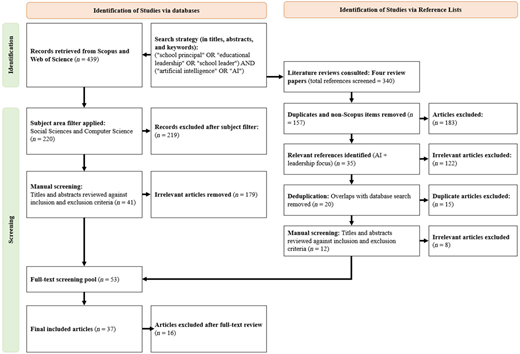
This study followed the PRISMA 2020 guidelines (Page et al., 2021) to systematically review research on principals' leadership in the adoption of AI in schools (see Figure 1).
Identification
In alignment with the previously outlined conceptualization of artificial intelligence, studies were deemed relevant if they examined data-driven, machine learning, algorithmic, or generative technologies employed to automate, augment, or inform instructional, administrative, communicative, or leadership practices within K–12 settings (Ho, 2025; Tan et al., 2025). During the screening and coding process, the specific AI application discussed in each study was documented when available. Studies that addressed AI adoption or AI-enabled educational technologies in a broader sense were also included if they focused on school leadership.
To capture the intersection of school leadership and artificial intelligence, the search was conducted in Scopus and Web of Science, two databases with strong interdisciplinary coverage in education, technology, and leadership. Publications up to July 2025 were considered, with particular attention to the post-2018 period, reflecting the rapid expansion of AI applications in education. The Boolean search string, (“school principal” OR “educational leadership” OR “school leader”) AND (“artificial intelligence” OR “AI”), was adapted for each database, with filters applied to restrict results to peer-reviewed English-language journal articles. To supplement this, a backward reference search of relevant review papers identified additional sources not indexed in the initial search. All results were compiled and screened for eligibility, with duplicates and inclusion status tracked systematically in Excel.
Screening
Inclusion and exclusion criteria
To maintain focus, clear inclusion and exclusion criteria were applied during the screening process. Studies were included if they examined the role of school principals or educational leaders in relation to the integration of AI within K–12 education. Studies were excluded if they did not involve school leadership, focused solely on the technical development of AI tools without educational application, or were limited to higher education contexts. Non-academic sources, such as editorials, blog posts, and opinion pieces without scholarly rigor, were also excluded. These criteria ensured that the final set of studies provided relevant insights into how AI adoption intersects with the work of school principals and educational leaders.
Abstract and full-text screening
The review process began with 439 records retrieved from Scopus and Web of Science. After applying subject-area filters (Social Sciences and Computer Science), 220 records remained. Titles and abstracts were then screened against the inclusion and exclusion criteria, reducing the pool to 41. To supplement the database search, the reference lists of four relevant review papers (340 cited sources) were examined. After removing duplicates and non-Scopus items, 35 references were considered potentially relevant. Deduplication with the database pool and further abstract screening reduced this set to 12, but none provided unique additions beyond the database search. Following full-text review, 16 articles were excluded, resulting in 37 studies that met the criteria for inclusion.
Data coding and thematic synthesis
After full-text screening, all 37 included articles were thoroughly reviewed and systematically extracted into a structured coding matrix using Excel. The matrix captured bibliographic information, study context, education level, research aim, methodology, AI application or technology discussed, leadership role or practice described, key findings, and excerpts pertinent to principals' human, social, and decisional capital. This structure facilitated both descriptive mapping of the literature and thematic analysis of the representation of principals' professional capital in the context of AI adoption.
The coding process was conducted in two stages. Initially, deductive coding was applied, guided by Hargreaves and Fullan's (2015) framework of professional capital. Text segments were categorized as human capital if they referenced principals' knowledge, skills, AI literacy, data literacy, ethical knowledge, or professional learning; as social capital if they addressed collaboration, trust, stakeholder engagement, teacher participation, parent or community relationships, or external partnerships; and as decisional capital if they involved judgment, discretion, oversight, ethical decision-making, interpretation of AI outputs, or contextual adaptation. Subsequently, within each deductive category, inductive coding identified recurrent subthemes specific to AI leadership. For instance, within human capital, recurring patterns were grouped as AI proficiency, technological-adaptive capacity, techno-ethical knowledge, and learning capacity.
Analytic decisions were informed by iterative comparisons among the extracted evidence, the professional capital framework, and emerging AI-specific themes. When an excerpt could reasonably align with more than one form of capital, it was coded based on its primary function within the article. For example, references to teacher collaboration were coded as social capital, while references to a principal's judgment regarding AI-generated recommendations were coded as decisional capital, even if ethical considerations were present. Overlapping cases were documented in analytic memos and revisited during subsequent coding rounds to ensure consistency. The coding matrix underwent multiple reviews, with codes refined, merged, or separated as patterns became more apparent. This process facilitated the progression from first-order patterns in the literature to higher-order thematic clusters and, ultimately, to the proposed construct of digital-adaptive capital.
Findings
Human capital in principals' leadership for AI adoption in schools
Eighteen studies (e.g. Akgun and Greenhow, 2022; Igbokwe, 2023; Yuni et al., 2025) examined principals' human capital in relation to AI leadership. Four themes emerged: AI proficiency, technological-adaptive capacity, techno-ethical knowledge, and learning capacity (see Table 1). Together, these findings suggest that human capital in the AI era goes beyond traditional professional knowledge, positioning principals as both educational leaders and critical mediators of AI adoption (Fullan et al., 2024; Yuni et al., 2025). For example, the growing use of generative AI for lesson planning, feedback, writing, and assessment requires principals to understand both the pedagogical possibilities of these tools and risks related to hallucinated content, academic integrity, privacy, and unreliable or biased outputs (Karakose and Tülübas, 2023; Ho, 2025; Richardson et al., 2025). This positions principals not as technical experts, but as informed interpreters who can guide responsible AI use in schools.
AI proficiency
A recurring claim in the literature is that principals require a foundational proficiency in AI systems and data-driven technologies. Studies emphasize the need for understanding AI applications such as adaptive learning platforms, automated assessment, and personalized learning systems (Akgun and Greenhow, 2022; Igbokwe, 2023; Yuni et al., 2025). Beyond practical familiarity, principals are expected to monitor advances in emerging technologies, including virtual assistants and facial recognition tools, which are increasingly shaping educational environments (Moravec and Martínez-Bravo, 2023; Kesim et al., 2025; Renta-Davids et al., 2025). Data literacy is also a critical element, encompassing the ability to interpret predictive analytics, assess data quality, and apply insights responsibly (Meng and Sermsri, 2024; Bixler and Ceballos, 2025; Adams and Thompson, 2025). Several authors emphasize the importance of awareness of algorithmic limitations, highlighting the role of principals in addressing bias, ensuring transparency, and maintaining human-in-the-loop oversight (Krishnan et al., 2024; Dieterle et al., 2024; Kilcoyne, 2024; Richardson et al., 2025; Ali et al., 2024). These studies argue that AI proficiency is no longer optional technical knowledge but a core part of human capital for school leadership (Akgun and Greenhow, 2022; Richardson et al., 2025).
Technological–adaptive capacity
Technological–adaptive capacity is framed as the bridge between principals' technical proficiency and their ability to lead systemic change (Fullan et al., 2024; Karakose and Tülübas, 2024). Scholars argue that effective leaders must communicate a clear vision for AI integration and mobilize teacher commitment around that vision (Howard et al., 2022; Fullan et al., 2024; Yuni et al., 2025). Leadership is increasingly described in visionary terms, involving curriculum redesign, innovation in teaching practices, and the use of agile planning tools to manage rapid change (Moravec and Martínez-Bravo, 2023; Kesim et al., 2025; Karakose and Tülübas, 2024; Halomoan et al., 2024). Modeling technology use and motivating teachers are also highlighted as essential practices, demonstrating how principals' own engagement with digital tools can influence schoolwide adoption (Hejres, 2022; Abedi and Ametepey, 2024). Across these studies.
Techno-ethical knowledge
The literature consistently underscores that principals' human capital must encompass ethical awareness in relation to AI. Several studies emphasize the responsibility of school leaders to address privacy, autonomy, surveillance, and fairness when AI systems are implemented (Akgun and Greenhow, 2022; Polat et al., 2025). Others highlight the promotion of digital rights and responsible AI use as part of the principals' leadership role (Krishnan et al., 2024; Polat et al., 2025). This techno-ethical dimension reflects a shift in human capital, where principals are not only skilled users of technology but also ethical stewards guiding its responsible application in schools (Krishnan et al., 2024; Polat et al., 2025).
Learning capacity
Human capital is portrayed as dynamic rather than static, with emphasis on principals' commitment to continuous learning about AI. Studies note that principals must stay informed about the limitations of AI, algorithmic biases, and evolving ethical implications (Akgun and Greenhow, 2022; Göçen and Döğer, 2025; Meng and Sermsri, 2024). This learning orientation ensures that principals remain responsive to rapid technological developments and can adapt their practices in light of new knowledge (Göçen and Döğer, 2025; Meng and Sermsri, 2024).
Social capital in principals' leadership for AI adoption in schools
The review identifies social capital as a critical dimension of principals' leadership in guiding schools through the adoption of AI. In AI-mediated schooling, this capital becomes especially important because AI adoption often affects multiple stakeholder groups at once. For example, when a school considers adopting an AI-enabled learning platform, principals may need to mediate among teachers concerned about professional autonomy, parents concerned about student data privacy, students affected by unequal access to devices or connectivity, and external vendors promoting efficiency claims (Ho and Lee, 2025). Such situations require principals to build trustful dialogue, involve stakeholders in AI-related decision-making, and negotiate external partnerships rather than treating AI adoption as a purely technical procurement issue (Akgun and Greenhow, 2022; Karakose and Tülübas, 2024; Ho, 2025). Fifteen of the included studies addressed social capital, which clustered into three themes: collaborating with teachers, community engagement for students, and external partnerships (see Table 2). These themes highlight that successful AI adoption in schools depends not only on principals' individual expertise and mobilizing trust, networks, and collective action within and beyond the school community (Fullan et al., 2024; Karakose and Tülübas, 2024).
Collaborating with teachers
A central strand of the literature emphasizes principals' collaboration with teachers as a foundation for AI adoption (Hejres, 2022; Karakose and Tülübas, 2024). Studies have noted that building trust and collaboration with teachers reduces resistance and fosters the co-creation of AI practices, particularly through peer mentoring and shared experimentation (Tyson and Sauers, 2021; Abedi and Ametepey, 2024; Marrone et al., 2025; Song et al., 2025). Involving teachers in decision-making about AI integration is also highlighted as a way to enhance ownership and collective responsibility for change (Hejres, 2022; Karakose and Tülübas, 2024; Richardson et al., 2025). Additionally, principals are expected to support teachers' professional development and peer learning on AI tools, thereby strengthening staff capacity to engage with emerging technologies (Akgun and Greenhow, 2022; Marino et al., 2023; Song et al., 2025; Bower et al., 2025).
Community engagement for students
Another theme highlights the role of principals in engaging parents and students as part of the adoption of AI in schools. Communicating with parents about the use of AI, privacy, and learning implications is identified as essential for building trust and addressing concerns about data and surveillance (Adams and Thompson, 2025; Karakose and Tülübas, 2024; Richardson et al., 2025). Principals are also encouraged to actively involve students in AI-enhanced learning, not only as users of technology but as participants in shaping equitable access and practices (Yuni et al., 2025; Marino et al., 2023; Hossain, 2025; Richardson et al., 2025). By engaging both parents and students, principals extend their social capital beyond staff collaboration to the broader school community, ensuring that AI adoption is inclusive and responsive to stakeholder concerns (Adams and Thompson, 2025; Yuni et al., 2025).
External partnerships
The literature also highlights external partnerships as a significant form of social capital in principals' leadership. Collaborating with AI enterprises, research institutions, and policymakers is seen as a way to secure resources, guidance, and legitimacy for AI adoption at the school level (Liua et al., 2021; Moravec and Martínez-Bravo, 2023; Kesim et al., 2025). Networking with community organizations, NGOs, and innovation hubs further expands principals' access to AI-related practices and strategies, promoting the exchange of expertise across institutional boundaries (Moravec and Martínez-Bravo, 2023; Huang et al., 2025; Renta-Davids et al., 2025). These studies collectively argue that principals' social capital extends into external networks, enabling them to align school-level AI initiatives with broader educational, technological, and policy ecosystems (Liua et al., 2021; Renta;Davids et al., 2025).
Decisional capital in principals' leadership for AI adoption in schools
Four themes emerged across the literature: human oversight, ethical discretion, algorithmic judgment, and adaptive contextualization (see Table 3). These themes illustrate that principals' decisional capital is the linchpin that ensures AI adoption in schools is not only efficient but also ethical, trustworthy, and contextually responsive (Richardson et al., 2025; Fullan et al., 2024). For example, an AI-supported early-warning system may identify students as being at risk based on patterns in attendance, assessment, behavior, or engagement data (Dieterle et al., 2024). Rather than accepting these outputs as neutral or definitive, school leaders must evaluate whether the recommendations are educationally meaningful, assess the potential for reproducing bias, determine appropriate communication strategies with teachers and families, and identify forms of support that do not stigmatize students (Akgun and Greenhow, 2022; Howard et al., 2022; Ho, 2025).
Human oversight
A recurring theme in the literature is the role of principals as human overseers of AI systems. Rather than replacing professional decision-making, AI is viewed as a tool that should support, rather than substitute for, human judgment in school leadership (Kilcoyne, 2024; Richardson et al., 2025). Principals are expected to strike a balance between automation and empathy, ensuring that decisions reflect not only data outputs but also the lived realities of students and teachers (Ali et al., 2024; Göçen and Döğer, 2025). Studies affirm that AI adoption involves maintaining human oversight as a safeguard against over-reliance on automated systems (Kilcoyne, 2024; Göçen and Döğer, 2025).
Ethical discretion
Another strand of findings highlights the ethical dimension of principals' decision-making. Leadership decisions are expected to prioritize student welfare, equity, and inclusivity when using AI tools (Polat et al., 2025; Adams and Thompson, 2025). Principals must also navigate complex ethical dilemmas surrounding privacy, surveillance, and bias in AI systems (Krishnan et al., 2024; Akgun and Greenhow, 2022). The literature suggests that principals weigh these dilemmas carefully, making context-sensitive choices that protect students and promote fairness in the adoption of AI (Polat et al., 2025; Krishnan et al., 2024).
Algorithmic judgment
Principals' decisional capital is also reflected in their ability to interpret algorithmic recommendations critically. Several studies emphasize the importance of professional skepticism, urging leaders to verify AI outputs before taking action (Meng and Sermsri, 2024; Dieterle et al., 2024). This includes recognizing the limitations of AI models and preventing over-reliance on automated insights, which may not account for contextual nuances in schools (Richardson et al., 2025; Göçen and Döğer, 2025). These findings suggest that algorithmic judgment—the ability to question, verify, and balance AI recommendations—is a defining feature of principals' decisional capital (Meng and Sermsri, 2024; Richardson et al., 2025).
Adaptive contextualization
Studies highlight that adaptive contextualization enables principals to integrate AI in ways that are both innovative and contextually legitimate (Yuni et al., 2025; Fullan et al., 2024). Studies emphasize that effective leaders apply professional judgment to align AI adoption with local needs and cultural expectations (Karakose and Tülübas, 2024; Yuni et al., 2025). This often requires striking a balance between innovation and tradition, ensuring that technological change does not erode community values or undermine existing educational practices (Fullan et al., 2024; Halomoan et al., 2024).
Discussion
This review set out to examine how principals' leadership is represented in the emerging literature on AI in schools, and to consider how the framework of professional capital can be adapted to this new context. The analysis demonstrates that the demands of AI substantially reshape each capital. Human capital now entails AI literacy, techno-ethical awareness, and continuous learning. Social capital extends beyond internal collaboration to encompass ecosystem partnerships and equity-driven networking. Decisional capital is redefined through algorithmic judgment, human-in-the-loop oversight, and adaptive decision-making. These transformations suggest that principals' professional capital in the AI era necessitates rethinking not as a simple extension of existing categories, but as a reconceptualization that responds to the distinctive challenges and opportunities presented by AI-driven education.
Professional capital
The findings underscore both continuity and transformation in the framework of professional capital. Continuity is evident in the enduring relevance of human, social, and decisional capital as the core dimensions of principals' leadership (Hargreaves and Fullan, 2015). Each remains essential for sustaining effective practice and collective professionalism in schools. At the same time, the analysis reveals significant transformations driven by the integration of AI into educational systems.
Human capital
The findings highlight that human capital continues to underpin principals' leadership but is being redefined in the context of AI adoption. Beyond pedagogical and managerial expertise (Hargreaves and Fullan, 2015), principals now require AI literacy to evaluate technological possibilities and risks (Luckin, 2018; Holmes et al., 2022), as well as techno-ethical knowledge to navigate issues of bias, privacy, and accountability (Williamson and Eynon, 2020). This extends human capital from traditional professional competence to a dynamic blend of technical fluency and ethical discernment, aligning with broader debates on digital leadership, where leaders are expected not only to understand technology but also to model critical and responsible use. Importantly, because AI is developing rapidly and unpredictably, these capabilities cannot be acquired once and for all; they imply continuous professional learning and adaptive growth for principals, ensuring that leadership capacity evolves in tandem with technological change.
Social capital
Social capital also remains central to principals' work, yet its scope has widened in the AI era. Trust and collaboration within schools remain crucial (Hargreaves and Fullan, 2015), but principals are increasingly expected to engage with external stakeholders, including technology providers, policymakers, and community members (Akgun and Greenhow, 2022; Selwyn, 2019). Building these partnerships involves negotiating power dynamics and ensuring that AI adoption aligns with values of equity and justice. This suggests that social capital is no longer confined to professional networks within the school but extends into broader ecosystems where decisions about AI are made and contested (Karakose and Tülübas, 2024). Engaging effectively in these evolving networks requires principals to continually learn, not only about AI itself but also about the perspectives, expertise, and expectations of diverse stakeholders, so that their leadership remains responsive and credible in dynamic contexts.
Decisional capital
Decisional capital, traditionally associated with the wisdom and judgment accumulated through professional experience (Hargreaves and Fullan, 2015), is undergoing profound change. Principals are now required to interpret and act upon data generated by AI systems, balancing algorithmic outputs with contextual knowledge and ethical reflection (Göçen and Döğer, 2025). This introduces the necessity of human-in-the-loop oversight, where leaders must critically evaluate technological recommendations rather than accept them at face value (Holmes et al., 2022). Adaptive decision-making becomes vital as principals navigate novel uncertainties and unintended consequences of AI use (Karakose and Tülübas, 2024; Yuni et al., 2025). In this way, decisional capital is reshaped into a hybrid form of professional judgment that integrates human discretion with algorithmic tools.
The stretch: digital-adaptive capital
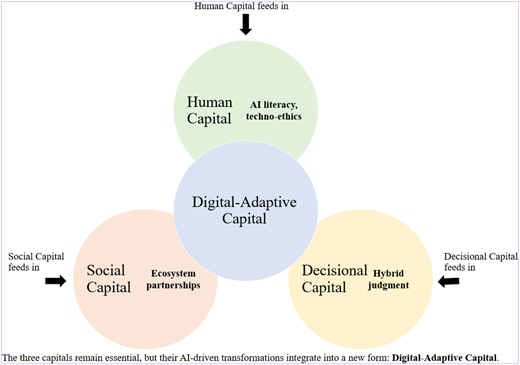
While the framework of professional capital continues to provide a valuable structure, its components are being reshaped in ways that reflect the distinctive challenges and possibilities of AI adoption (Selwyn, 2019; Perrotta et al., 2021). While human, social, and decisional capital continue to be identifiable and essential, their AI-driven reshaping points toward an emergent meta-capacity. In several of the studies reviewed, principals were not only developing AI literacy and ethical awareness but also integrating these with collaborative networks and hybrid judgment practices (e.g. Adams and Thompson, 2025; Dieterle et al., 2024; Halomoan et al., 2024; Polat et al., 2025). These patterns suggest the need for what we term digital-adaptive capital (See Figure 2).
Digital-adaptive capital refers to the ability of school leaders to integrate technological fluency, ethical discretion, and adaptive responsiveness into their professional practice. This proposed construct captures how principals must not only possess enhanced human, social, and decisional resources but also integrate them to navigate the socio-technical complexities of AI in schools. Such a reconceptualization aligns with calls in the broader leadership literature to rethink professional frameworks in light of digitalization and datafication (Williamson and Eynon, 2020). Leaders must simultaneously cultivate new forms of knowledge (such as AI literacy and ethics), mobilize expanded networks (across schools, communities, and technology providers), and exercise hybrid judgment (balancing data-driven outputs with contextual expertise). The findings from this review demonstrate that principals are increasingly required to navigate these capitals in combination (Akgun and Greenhow, 2022; Richardson et al., 2025; Yuni et al., 2025).
Digital-adaptive capital is conceptually related to, yet distinct from, established constructs such as digital literacy, TPACK, Technology Leadership and Content Knowledge, technology leadership standards, and adaptive expertise. Digital literacy emphasizes individuals' abilities to access, evaluate, use, create, and communicate with digital technologies. TPACK addresses teachers' integration of technological, pedagogical, and content knowledge for effective instruction, whereas TLACK extends technology-related knowledge to leadership by focusing on leaders' understanding of how information technology supports instructional objectives and how school conditions facilitate meaningful use (Koehler et al., 2013; Dexter, 2018). Technology leadership standards and related scholarship underscore the significance of vision, culture, infrastructure, professional learning, equity, ethics, and digital citizenship (Richardson et al., 2012). Adaptive expertise highlights flexible problem-solving in uncertain or novel contexts. Digital-adaptive capital builds upon these frameworks but is distinguished by its professional-capital orientation. It encompasses not only what leaders know or can do at a specific time, but also the accumulated, mobilizable, and renewable resources that enable principals to integrate technological fluency, ethical discretion, relational capacity, and contextual judgment amid ongoing AI-driven change. Thus, digital-adaptive capital is intended as an extension of professional capital theory for environments where AI systems increasingly influence instructional, administrative, and organizational decision-making, rather than as a replacement for existing technology leadership frameworks.
This distinction addresses a prevalent limitation in technology research: the tendency to conceptualize technology as a generic object of adoption rather than as a set of material and social practices with specific affordances, constraints, and consequences (Orlikowski and Iacono, 2001). Earlier technology leadership frameworks have already shown that successful integration requires vision-setting, teacher learning, organizational support, and contextual adaptation (Richardson et al., 2012; Dexter, 2018; Cho and Wayman, 2015). However, AI introduces distinctive leadership challenges because it can classify learners, generate educational content, recommend or automate interventions, mediate access to learning, and operate through data-intensive, often opaque systems. These characteristics shift principals' responsibilities from supporting technology use to governing algorithmic systems that may influence assessment, intervention, surveillance, communication, and accountability. The central issue is not merely whether teachers adopt a tool, but how school leaders maintain educational purpose, equity, transparency, and human agency as AI systems increasingly participate in pedagogical and organizational decisions (Akgun and Greenhow, 2022; Holmes et al., 2022; Howard et al., 2022; Orlikowski and Iacono, 2001; Williamson and Eynon, 2020).
Recognizing AI as a heterogeneous socio-technical domain reinforces the argument for digital-adaptive capital, as AI in education comprises multiple systems with distinct pedagogical, organizational, and ethical implications rather than a single, stable tool (Holmes et al., 2022; Luckin, 2018; Zawacki-Richter et al., 2019). If AI were a uniform tool, leadership preparation could be limited to technical training. However, the literature demonstrates that principals face varied leadership demands depending on whether AI is applied for prediction, personalization, generation, accessibility, surveillance, or simulation (Akgun and Greenhow, 2022; Howard et al., 2022; Karakose and Tülübas, 2023; Marino et al., 2023; Richardson et al., 2025). Predictive analytics requires leaders to integrate data literacy with ethical decision-making, as these systems rely on data quality, classification practices, and judgments regarding when and how to respond to risk indicators (Howard et al., 2022; Meng and Sermsri, 2024; Bixler and Ceballos, 2025). Generative AI necessitates balancing innovation with academic integrity and epistemic reliability, given ongoing concerns about authorship, hallucination, bias, and the reliability of AI-generated content (Ho and Lee, 2025; Karakose and Tülübas, 2023; Richardson et al., 2025). Adaptive learning systems demand alignment between personalization and teacher agency, particularly regarding curriculum coherence, instructional judgment, and equitable access (Luckin, 2018; Marino et al., 2023; Yuni et al., 2025). Surveillance technologies require community legitimacy and rights-based governance due to issues related to privacy, consent, proportionality, trust, and student rights (Akgun and Greenhow, 2022; Krishnan et al., 2024; Polat et al., 2025). In the future, the emergence of agentic AI may further intensify questions of delegation, oversight, and accountability as educational systems adopt tools capable of completing multi-step tasks with minimal human intervention. Digital-adaptive capital encapsulates the integrative capacity to navigate diverse AI contexts, interpret the specific affordances and risks of each system, and uphold educational purpose, ethical responsibility, and human oversight.
Conceptualizing digital-adaptive capital as a qualitatively new dimension highlights a theoretical contribution of this study. It suggests that professional capital in the AI era cannot be fully understood through additive changes to the three capitals but requires recognition of the integrative and future-oriented capacities that principals must develop. This reconceptualization aligns with broader arguments about adaptive expertise in education (Darling-Hammond and Bransford, 2005), complexity leadership in uncertain environments (Uhl-Bien and Arena, 2018), and the ethical governance of AI in schools (Holmes et al., 2022; Williamson and Eynon, 2020).
Implication
Theoretical implications
This review advances the theory of professional capital (Hargreaves and Fullan, 2015) by proposing digital-adaptive capital as an integrative dimension of principals' leadership in the AI era. The findings demonstrate that human, social, and decisional capital are not only reshaped individually but also increasingly intertwined in practice, requiring leaders to integrate AI literacy, ethical discretion, and adaptive judgment simultaneously (Adams and Thompson, 2025; Richardson et al., 2025; Yuni et al., 2025). This reconceptualization contributes to leadership theory in three ways. First, it extends professional capital beyond additive change, positioning it as a dynamic framework responsive to socio-technical transformation. Second, it aligns with broader theoretical work on adaptive expertise (Darling-Hammond and Bransford, 2005) and complexity leadership (Uhl-;Bien and Arena, 2018), situating principals' leadership within conditions of uncertainty and rapid innovation. Third, it connects with scholarship on the ethical governance of AI in education (Holmes et al., 2022; Williamson and Eynon, 2020), underscoring that professional capital in the AI era must explicitly integrate ethical reasoning and future-oriented responsiveness.
Practical implications
The concept of digital-adaptive capital also provides a framework for guiding leadership preparation, professional learning, and policy development. For leadership preparation programs, the findings suggest a need to move beyond technical training toward curricula that integrate AI literacy, ethical awareness, and adaptive problem-solving (Fullan et al., 2024; Akgun and Greenhow, 2022). For professional development, the framework emphasizes the importance of cultivating principals' ability to critically evaluate AI tools, foster inclusive decision-making with staff, parents, and students, and build partnerships with technology providers and policymakers (Selwyn, 2019; Karakose and Tülübas, 2024). For example, studies included in the review indicate that principals utilize human capital to develop AI literacy and data literacy, enabling them to interpret predictive analytics responsibly rather than accepting automated recommendations without scrutiny (Meng and Sermsri, 2024; Bixler and Ceballos, 2025). Principals also leverage social capital by engaging teachers, parents, and external partners in discussions regarding AI integration, privacy, and equitable access, which helps build legitimacy and reduce resistance to implementation (Akgun and Greenhow, 2022; Karakose and Tülübas, 2024; Richardson et al., 2025). Additionally, principals apply decisional capital by maintaining human oversight of AI-generated recommendations and tailoring AI use to local school needs, cultural expectations, and student welfare (Göçen and Döğer, 2025; Polat et al., 2025; Yuni et al., 2025). For policy and system leaders, digital-adaptive capital provides a lens for designing standards and accountability frameworks that ensure AI adoption aligns with the educational values of equity, transparency, and justice (Polat et al., 2025; Holmes et al., 2022). These practical implications underline that principals' leadership in the AI era cannot be reduced to managerial efficiency but must be supported as a form of ethical and adaptive professionalism.
Limitations and future research
While the synthesis followed a systematic process, the rapid evolution of AI means that relevant studies are continually emerging; the findings, therefore, capture a moment in time rather than a definitive picture (Tuomi, 2022). As AI technologies continue to evolve rapidly, the research agenda must remain adaptable, ensuring that leadership frameworks evolve in tandem with the realities of AI-driven schooling. There is a need for empirical testing of digital-adaptive capital in diverse school contexts, using both qualitative and quantitative designs to examine how the construct operates in practice (Adams and Thompson, 2025; Richardson et al., 2025).
The findings of this review open several directions for further research. First, studies should investigate how principals develop AI proficiency and techno-ethical knowledge over time, examining what forms of professional learning most effectively build human capital for AI leadership. Second, more attention is needed to the dynamics of social capital in the AI era, for instance, how principals negotiate relationships with technology providers, policymakers, and parents, and how these partnerships influence equitable implementation. Third, the findings highlight the importance of decisional capital as hybrid judgment, where principals balance algorithmic recommendations with contextual and ethical considerations. Future research could explore how principals exercise such judgment in real decision-making scenarios, including the tensions between efficiency, transparency, and inclusivity.
Finally, the notion of digital-adaptive capital proposed in this review warrants empirical study. Researchers could test its usefulness as an analytic construct by examining whether it captures leadership practices that go beyond human, social, and decisional capital in AI-infused contexts. Mixed-methods and longitudinal studies, in particular, would allow exploration of how digital-adaptive capacities are cultivated, sustained, or challenged across time and contexts. Comparative international research could also assess whether digital-adaptive capital manifests differently across policy systems and cultural settings. By grounding future inquiry in these directions, scholars can refine the construct and assess its relevance for both theory and practice, ensuring that professional capital theory remains responsive to the challenges of AI-driven schooling.
Conclusion
This review examined how principals' leadership is represented in emerging scholarship on AI in schools and reconsidered the framework of professional capital for this new context. It showed that human, social, and decisional capital remain central but are being reshaped by AI's demands, leading to the proposal of digital-adaptive capital. The study's originality lies in framing digital-adaptive capital as more than an update of existing dimensions: it is an integrative meta-capacity that combines technological fluency, ethical discretion, and adaptive responsiveness. This extends professional capital theory and aligns it with wider perspectives on adaptive and complexity leadership. As AI technologies continue to evolve without pause, digital-adaptive capital offers a framework for understanding and supporting principals' leadership in conditions of ongoing change. It highlights the need for school leaders who can not only adopt new tools but also sustain ethical, inclusive, and adaptive practices in the face of continual technological transformation.