Skip to article sections
Purpose

This study examines the association between unemployment and mental health within the Nordic context, a region characterized by strong social welfare systems. By analyzing multiple mental health outcomes, the study seeks to identify vulnerabilities as well as potential protective factors specific to this setting.

Design/methodology/approach

A quantitative panel design is employed to investigate the relationship between unemployment and mental health in five Nordic countries over the period 1970–2020. Using a panel fixed-effects regression model, the study provides a comprehensive understanding of unemployment’s impact across a wide range of mental health indicators.

Findings

Unemployment shows a significant positive association with most mental health disorders in the Nordic countries, with the exception of alcohol use disorders. The results suggest that robust Nordic institutional arrangements may mitigate some of the adverse mental health impacts of unemployment, indicating a potential buffering effect.

Originality/value

This study offers a novel and comprehensive panel analysis of the unemployment–mental health relationship in the Nordic region, covering multiple mental health indicators over a long timeframe. It contributes to the literature by examining this association within a distinctive institutional context and by identifying potential mitigating factors.

In the Nordic region, mental health problems constitute the leading cause of disability among working-age adults.[1] Several reviews and meta-analyses that consolidate and combine the findings of over a century of studies on the psychological impacts of unemployment have been published (Amin et al., 2023; Arena et al., 2023; Kinicki et al., 2002; McKee-Ryan et al., 2005; Murphy and Athanasou, 1999). High unemployment is recognized as a severe problem in many Nordic nations, not just for society but also for those unemployed. A viewpoint emerges in opinion surveys; unemployment is thought to have high costs when individuals are asked which problem they regard as the most severe in the Nordic region (Olofsson and Wadensjö, 2012). One key point is that unemployment costs may deteriorate mental health or well-being among the jobless and their families, which is why studies on the link between unemployment and mental health have piqued people’s attention (Dooley and Prause, 2003).

Mental health is defined as “a state of well-being in which an individual recognizes his abilities, can cope with normal stresses of life, can work productively, and can contribute to his community” (World Health Organization, 2018), while mental health disorder is defined as “the loss of mental health due to a mental disorder” (European Observatory on Health Systems and Policies, 2019). Mental disorders and work absenteeism are two interrelated conditions that have garnered the attention of researchers and policymakers (Norder et al., 2017), as poor mental health commonly impacts daily activities and is associated with lower educational attainment, low income, and poor physical health (Norder et al., 2017; de Vries et al., 2018). Employment status significantly influences an individual’s mental health and well-being (Herbig, Dragano, and Angerer, 2013; Waddell and Burton, 2006). Harnois and Gabriel (2000) found that job seekers were three times more likely to experience distress than employed individuals.

The World Mental Health Report by the WHO in 2022 examines global guidelines for mental health in the labour market. It reveals that in 2019, out of the one billion people with mental disorders, 15% of working-age adults experienced mental health problems. The report discusses guidelines for conducting studies in European countries and emphasizes the use of screening tools for identifying and managing depression, psychological issues, and stress-related disorders (World Health Organisation, Regional Office for Europe, 1998). [2] The WHO Comprehensive Mental Health Action Plan for 2013–2030 highlights the importance of mental health, focusing on objectives such as leadership and governance, comprehensive services, promotion and prevention strategies, and research. Mental health encompasses emotional, psychological, and social well-being, impacting thoughts, feelings, actions, stress management, relationships, and decision-making. Mental health indicators include various disorders and substance abuse. However, the relationship between unemployment and mental health indicators in Nordic countries remains poorly understood.

The recession has caused increased layoffs and a rise in the unemployment rate. Eisenberg and Lazarsfeld’s theory of the psychological effects of unemployment suggests that it tends to make people more emotionally unstable. The association between unemployment and mental health is extensively examined in the literature (Milner, Page, and LaMontagne, 2014; Paul and Moser, 2009). Backhans and Hemmingsson (2012) analyze cohort-based survey data from Stockholm, Sweden, and show that the impact of unemployment is more substantial for men, those working overtime, those with high social support or low control at their previous job, self-employed and those with a low occupational class or low previous wage. Amin, Korhonen, and Huikari (2023) present a strong connection between unemployment and mental health at the municipality level in Finland, especially for males between 25 and 64 years of age, not for younger or older males, nor among females. Sigurðardóttir et al. (2023) conducted a study in Iceland to examine the relationship between sociodemographic factors and symptoms of depression, anxiety, stress, and psychiatric medication use. The study found that lower sociodemographic status was associated with worse mental health, and males had higher depression scores compared to females. On the other hand, higher education, living with someone, and financial security were associated with better mental health.

The situation for young people in the Nordic region is mixed. Significant challenges remain, despite enjoying better physical health and material living conditions than their European counterparts. High unemployment rates persist among young people in several Nordic countries, and a notable portion fail to complete upper secondary education. Additionally, there appears to be an increasing prevalence of mental illness, long-term loneliness, and depression among the youth. Another concerning trend is the growing number of young individuals being granted disability pensions early in life. The question arises as to why these crucial indicators are moving in the wrong direction and what measures can be taken to address these issues.

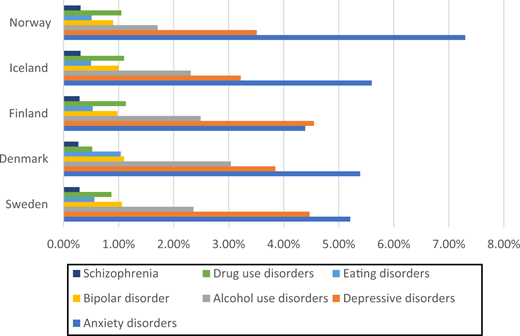
Figure 1 depicts the prevalence of various types of mental health problems in Nordic countries, including anxiety disorder, depressive disorder, bipolar disorder, alcohol use disorder, drug use disorders, eating disorders, and schizophrenia. Among the Nordic countries, Norway has the highest prevalence of anxiety disorders, affecting over 7% of the population, followed by Iceland, Denmark, and Sweden with rates above 5%, and Finland with the lowest prevalence. Depressive disorder is most prevalent in Finland and Sweden, with rates exceeding 4%, followed by Iceland, Norway, and Denmark, with rates above 3%. In terms of alcohol use disorders, Denmark ranks highest at approximately 3%, while Iceland, Finland, and Sweden have rates above 2%, and Norway has the lowest rate, exceeding 1%. The prevalence of other mental health problems, such as schizophrenia, drug use disorders, eating disorders, and bipolar disorder, ranges from 0 to 2% across all Nordic countries. Overall, these findings highlight the significant impact of mental disorders in the Nordic countries.

Many social scientists have emphasized that unemployment is a fundamental cause of various economic and health issues (Braveman and Gottlieb, 2014). Moreover, they argue that the consequences of long-term unemployment are more severe than short-term unemployment. Unemployment can harm individuals in terms of their motivation, morale, and skills, as well as their overall well-being and health. This adverse effect is well-documented. If long-term unemployment continues to rise, it can contribute to persistently high levels of unemployment. Consequently, the costs associated with unemployment are expected to increase in the future (Braveman and Gottlieb, 2014; Renahy et al., 2018).

The Nordic countries have become a global benchmark for higher economic development, gender equality, environmental sustainability, and innovation. However, they also face significant challenges in dealing with the rapid increase in mental health problems. Studies by Björklund and Eriksson (1998); Wahlbeck et al. (2011) highlight the magnitude of these challenges. Notably, many young people in the Nordic countries are affected by mental health issues, and local authorities are struggling to recruit sufficient staff to meet the welfare needs of the growing elderly population, as reported by Andersson et al. (2021); and Rehn-Mendoza (2020). Consequently, the significance of the psychological impact of unemployment has grown. The instrumental view of work has diminished, making a person’s occupation and employment status increasingly crucial for their social standing. Additionally, more significant investment in human capital means that periods of unemployment now result in greater welfare losses than in the past, as Krebs and Scheffel (2013) observed.

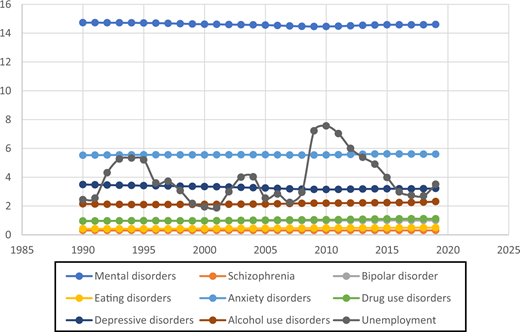
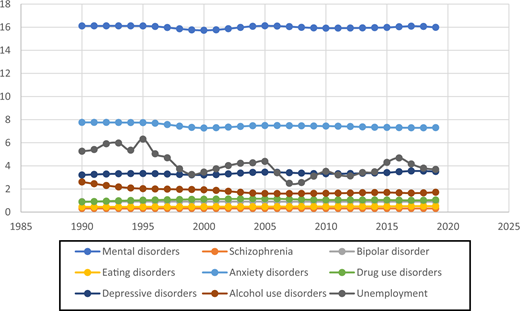
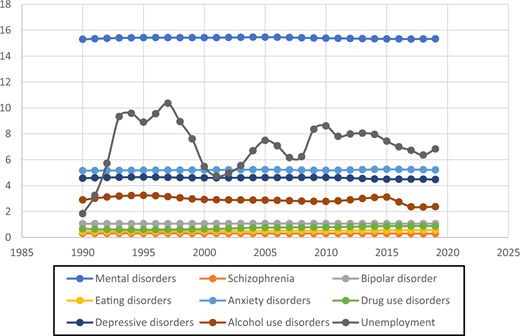
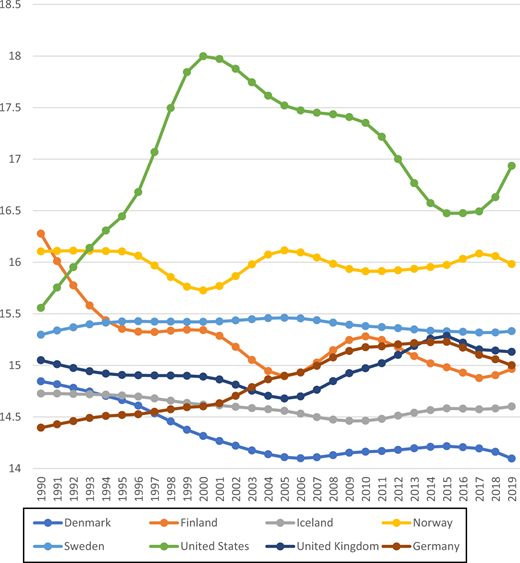
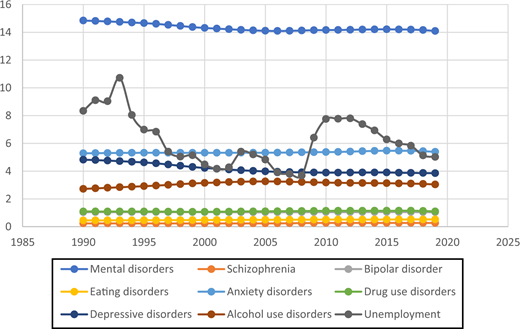
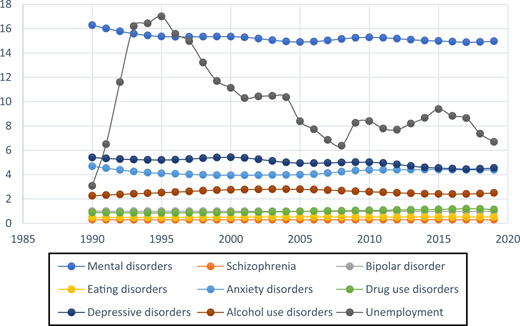
Figures 2–6 depict the changes in the unemployment rate and different types of mental health disorders in Nordic countries from 1990 to 2020. Initially, there was an increasing trend in unemployment rates in Denmark, Finland, and Sweden, although the rate fluctuated significantly throughout the period. The prevalence of mental health disorders remains consistently high across all five Nordic countries, with anxiety disorders, depressive disorders, and eating disorders being particularly prominent. The figure illustrates the significant fluctuations in unemployment rates and various mental health issues in the region. Nordic Countries, as shown in Figure 7, exhibit moderate-to-high levels of mental disorder prevalence (e.g., 15–20%) and stable trends, which can be attributed to both their well-developed welfare systems and high reporting rates.

Many researchers believe that beyond GDP and the use of economic indicators, there has been increasing attention to understanding and quantifying human and social growth in recent decades (Bleys, 2012; Frijters et al., 2020; Jean-Paul and Martine, 2018). This research is in connection with the Sustainable Development Goals (SDGs) [3] of the United Nations, such as Goal 3: Good health and well-being. SDGs 10 and 11 aim to reduce inequality and make cities and communities more sustainable. Lifestyle-related and socioeconomic variables that affect morbidity, such as overweight and obesity, cigarette smoking, and alcohol use, must be further addressed since they now threaten to offset the beneficial results obtained in terms of early deaths (World Health Organization, 2018).

The WHO recognized mental health and psychosocial well-being as crucial aspects of overall health in 1978, and this topic has since been addressed in various UN resolutions. In 2015, mental health was included for the first time in the Sustainable Development Goals (SDGs). The SDGs emphasize the need to address the socioeconomic factors contributing to mental health problems to reduce their global impact significantly. It is essential to prioritize mental health as both a means and an objective of global development within an integrated development agenda, especially considering that previous international development initiatives, such as the Millennium Development Goals, did not encompass mental health. Dybdahl and Lien (2017) argue that efforts to eliminate poverty, prevent conflicts and disasters, and promote education must prioritize mental health, as poor mental health and unfulfilled human potential pose significant risks to achieving the SDGs. Achieving the SDGs requires interdisciplinary and intersectoral solutions, creating an opportunity to address mental health comprehensively. Since the SDGs are universal and encompass multiple sectors, mental health concerns everyone, including even those in the wealthiest countries, as mental health problems can affect individuals and families. Consequently, it is worth considering whether increasing unemployment in welfare states like the Nordic countries may impact mental health.

Mental disorders encompass impairments in cognitive, emotional, and behavioral functioning. According to the World Health Organization (WHO) [4], approximately one out of every eight people worldwide lives with a mental disorder. The prevalence of mental health disorders, including anxiety and depressive disorders, is estimated using data from the Global Burden of Disease (GBD) report published by the Institute for Health Metrics and Evaluation (IHME). The GBD (2022) categorizes mental disorders into various forms, including depressive disorders, anxiety disorders, bipolar disorder, schizophrenia, autism spectrum disorders, conduct disorder, attention deficit hyperactivity disorder, eating disorders, idiopathic developmental disorders, intellectual disability, and other mental disorders (Correll et al., 2023). The data presented in this study aligns with the International Classification of Diseases (ICD-10 & 11) by the WHO. The estimates are derived from various sources, including medical and national records, epidemiological data, surveys, and meta-regression modelling. While previous studies have explored mental health using indicators such as suicide rates, homicide rates, registered psychiatric patients, and length of stay in psychiatric hospitals, limited research has specifically analyzed mental health in terms of mental disorders, including depressive disorder, anxiety disorder, bipolar disorder, and schizophrenia.

High unemployment benefits and universal healthcare, which can relieve the psychological burden of job loss, are also characteristic of the Nordics. To give an example, the replacement rates of unemployment insurance in these countries are among the highest in the world, and access to mental healthcare is widely secured, even though the waiting times and the decentralisation of services differ. Other major reforms that occurred during the study period (1970–2020) include the changes of unemployment benefits in Sweden and Finland during the 1990s (Bergmark and Palme, 2003; Kangas and Kvist, 2018) and the scaling up of community-based mental health services through the so-called Open Care model (Ruud and Friis, 2021). Such institutional characteristics differ significantly from less universal systems in liberal economies, such as the U.S., where unemployment is frequently combined with loss of health insurance (Bambra and Eikemo, 2009). Nevertheless, in the Nordic region, there is also a disparity, as in Denmark, the system has been coined as flexicurity, where there is an active labour market policy, whereas in Iceland, there has been a tendency to be more reliant on family support historically (Eydal and Gíslason, 2013). The panel design of this study will enable us to test the idea that these institutional differences moderate the relationship between unemployment and mental health.

In line with the study methodology, it was found that mental health disparities in Nordic countries are especially stark by employment status in existing household surveys. As an example, as shown in the European Health Interview Survey [5], the prevalence of self-reported depression symptoms was 18.4% in case of the unemployed in Sweden, compared to 8.1% in case of the employed. In Finland, the percentages were 22.1 and 9.7 among the unemployed and employed persons, respectively.

Limited literature exists that explores the empirical relationship between unemployment and mental health disorders, specifically in Nordic countries. Moreover, there is a lack of research that has investigated the association between unemployment and schizophrenia, specifically in Nordic nations. Hence, this study aims to answer the following research question: How is unemployment associated with mental health in Nordic countries? Therefore, this study aims to address the gap by investigating the comprehensive empirical relationship between unemployment and various mental health disorders, including bipolar disorder, anxiety disorder, depressive disorder, drug disorders, schizophrenia, and alcohol disorders.

This study is structured as follows: Section 1 represents the introduction, Chapter 2 presents the theoretical framework, Section 3 presents the research methodology and data source, Section 4 explores the empirical findings, and Section 5 summarizes the conclusions based on the empirical findings.

Recent evidence shows that there are persisting links between unemployment and poor mental well-being across all ages and genders, and especially in the case of long-term unemployment (Franke et al., 2024). There are strong connections between unemployment and anxiety, depression and bipolar disorder, and demographic-specific connections to drug use and eating disorders (Yang et al., 2024). Balogh et al. (2025) showed that unemployment causes mental health problems in the UK. The literature shows that the causal relationship between unemployment and mental health raises conceptual and methodological problems through time series data (Norström, 1995), cross-sectional data (Chen et al., 2012; Skinner et al., 2023), and longitudinal data (Gedikli et al., 2023; Krug and Prechsl, 2022; Murphy and Athanasou, 1999). In essence, unemployment is not a well-defined and uniform condition. However, the time spent unemployed (short-term or long-term) is a prominent factor to consider (Dooley and Prause, 2003).

Most cross-sectional studies have used a typical method of comparing mental well-being between the two groups, i.e. unemployed and employed or short-term and long-term jobless. Is there a link between unemployment and mental health in Nordic countries? Or is it the other way around? After selecting the types of mental health and unemployment to focus on, the methodological issue is determining the empirical link between the two variables and whether unemployment causes mental illness (Björklund and Eriksson, 1998; Zhang and Bhavsar, 2013). At the same time, most longitudinal studies address the causality between unemployment and mental health. Thus, if a group of individuals is laid off because of a company closure and their mental health deteriorates, the direction of causation is most likely from unemployment to mental health (Murphy and Athanasou, 1999). Overall, longitudinal data studies demonstrate strong correlations between unemployment and declining mental health; we are considerably more likely to infer that there are impacts of unemployment. It is unreasonable to believe that cyclical or structural variations in unemployment are caused by variations in mortality rates or mental health (Norström, 1995).

To explore this relationship, Jin, Shah and Svoboda (1997) found that jobless people have higher health-related symptoms than employed people. They concluded the following realistic mechanisms that embed the adverse effects of unemployment on health:

  • disrupted social relationships, which lead to increased risk behaviours (alcohol consumption and poor diet);

  • stress; and

  • a precipitated trauma-related reaction, like those triggered by other losses.

These processes would support the concept that unemployment causes mental and physical health issues, which are linked to higher death rates (Jin et al., 1997), depression, anxiety, and schizophrenia (Ang, Rekhi, and Lee, 2020; Mangalore and Knapp, 2007) smoking, high-risk alcohol intake, poor diet, reduced physical activity (Bartley, 1994), however, the reciprocal causation relationship with alcohol-related problems is also widely accepted (Henkel, 2011).

In Sweden, long-term unemployment is linked to poor self-rated health in women and excessive alcohol intake in males (Harryson, Novo, and Hammarström, 2012). In Finland, the risk of mental health problems was higher among jobless persons than among employed people, approximately 2.0-fold for mood disorders and more than 2.5 times for alcohol-related illnesses (Virtanen et al., 2007). Jin, Shah, and Svoboda (1997) argued that unemployment decreases alcohol use due to a lack of money and increases consumption due to greater leisure time or a poor coping response.

Unemployment often leads to self-doubt, low self-esteem, and powerlessness. These emotional struggles can contribute to the development or recurrence of eating disorders, particularly in middle-aged individuals. The stress associated with job search and unemployment can trigger binge eating behaviours and other unhealthy coping mechanisms. Unemployment-related stress, combined with existing mental health issues, can further exacerbate these challenges. Individuals with eating disorders may experience social disability and higher rates of unemployment, comparable to individuals with severe and chronic mental health disorders such as schizophrenia and personality disorders (Harrison, Mountford, and Tchanturia, 2014; Rymaszewska et al., 2007; Sy et al., 2013).

To demonstrate the link between work and bipolar disorder, Marwaha, Durrani, and Singh (2013) revealed that unemployment rates in persons with bipolar disorder are substantially higher than in the general population. [6] Other studies indicated that bipolar disorder and schizophrenia are among the most severe mental disorders due to the significant decline in everyday functioning, such as participation in work, social relationships, and the ability to live independently, and the drop occurs already early in life (Parellada et al., 2017; Strassnig et al., 2018).

Table 1 presents a comprehensive summary of relevant literature arranged in a manner that aids in conducting a more accurate analysis.

Several studies discuss the empirical relationship between mental health and unemployment in Nordic countries. This study explores this relationship using comprehensive data on mental health, such as mental disorders, depression disorder, anxiety disorder, bipolar disorder, and schizophrenia. Heggebø, K. (2022) conducted a study in Norway to investigate the health consequences of unemployment. The study found that unemployed men are more likely to have hospital admissions than unemployed women. Moreover, unemployed men also experience higher rates of excess mortality compared to unemployed women. In Finland, unemployment is strongly linked to poverty and inequality, which together exacerbate negative health outcomes (Amin, 2023, 2025). Hannerz, H., Burr, H., Soll-Johanning, H., et al. (2022) did not find significant differences in the risk of developing mental illness between fixed-term contract workers and the unemployed in the general population of Denmark. Thus, they suggest that fixed-term contracts may be as detrimental as unemployment. This study aims to fill a significant gap in the literature by examining the relationship between unemployment and multiple mental health disorders in Nordic countries. Despite being known as welfare states with high per capita income, these countries continue to face high rates of mental health issues. The study will rigorously investigate the association between unemployment and various mental health indicators, including anxiety, depression, schizophrenia, eating disorders, and substance misuse. By addressing this research gap, the study seeks to provide a deeper understanding of why mental health problems persist in Nordic countries and contribute to the existing knowledge on the topic.

According to Jahoda (1981, 1982), in the latent deprivation model, unemployment leads to deprivation and unhappiness; according to this model, distress among the unemployed results from a lack of five employment functions. These are time structure, social contact, collective purpose, status, and activities. Based on Jahoda’s hypothesis, Warr (1987) and Warr (2011) created a model that included nine (later 12) environmental elements, which are also thought to be vital for mental health but are not readily available to jobless individuals. Eisenberg and Lazarsfeld (1938) represent the stage theory; a jobless person passes through many phases in adapting to his or her new circumstances, with economic hardship and uncertainty, in particular, negatively impacting the individual’s subjective well-being. According to certain theoretical viewpoints, this work satisfies the basic psychological requirements essential for mental health.

This expression refers to whether unemployment in the early adult age harms a person’s subsequent work career in the form of lower income or puts them at a higher risk of future unemployment. Several studies have explored such effects, including those conducted in the Nordic countries (Hammer, 2000). The traditional sociological paradigm is the economic deprivation model. Unemployed individuals will have less money, worsening the conditions for a healthy life. Numerous studies continue to reveal a relationship between unemployment and poor health. Economic deprivation theory is one of the most often used models in contemporary research (Jahoda, 1981, 1988). According to the stress model/theory, psychosocial triggers (such as job loss) are combined with a psychobiological program (which includes the impacts of prior environmental and genetic variables) to induce the stress mechanism, which results in disease precursors. Coping and social support play a significant role in modulating the stress reaction in more recent versions of the model (Brenner and Mooney, 1983).

Most researchers on health-related selection and social causal hypotheses about unemployment backed up both theories: social causation of the disease is defined as the origin of sickness caused by social factors and social interactions. This definition suggests that disease is caused by factors beyond just human biological elements. According to the health selection theory, health can impact the same characteristics that drive social stratification. Those with identified mental illnesses were less likely to re-enter the workforce, and their health was more likely to deteriorate while they were unemployed. On the other hand, in social causality theory, reemployment appeared to lower the prevalence of mental health disorders to the same level as steady employment. (Claussen, 1999). In addition to the selection-cause hypothesis, a composite effect has been proven as an explanatory factor between unemployment and poor health (Kroll, Müters, and Lampert, 2016). When contemplating preventive interventions to improve the health of jobless persons, keep in mind the unequal distribution of unemployment and health throughout society.

Consequently, we postulate the following hypothesis.

H1.

Unemployment is significantly positively associated with the prevalence of mental disorders in Nordic countries.(unemployment–health relationship).

The relationship between unemployment and mental health is complex and multifaceted, and simplistic categorisations are insufficient to explain its consequences (Ezzy, 1993; Hammer, 2000). High unemployment rates in Nordic countries are seen as a significant societal problem with substantial costs. Despite the recognized importance of this issue, empirical studies examining the association between unemployment and mental health in Nordic countries are scarce. This lack of research is surprising given the growing interest in the topic and the need for quantitative assessments of the consequences of unemployment. Consequently, there is a need for empirical investigations to determine the impact of unemployment on mental health in Nordic countries and to identify the mechanisms through which this relationship manifests. Addressing this knowledge gap will contribute to a better understanding of the unemployment-mental health nexus in Nordic countries.

This section describes the approaches and methods employed in the empirical analysis of this study. The panel data approach is commonly used to investigate the relationship between mental health and unemployment, as it allows for a comprehensive examination of this nexus. However, understanding the specific impact of unemployment on mental health is not straightforward and lacks a simple theory to rely on. It is worth exploring broad hypotheses to shed light on the consequences for mental health. It is important to note that the unemployed population is not homogeneous, and some individuals may experience more severe effects than others. Unfortunately, our database does not contain specific data on individual variations within the unemployed population. The study utilizes data from five Nordic countries covering 1970–2020. However, the availability of data on unemployment spans the entire period, while data on various mental health disorders are only available from 1990 to 2020. This limited data availability constrains conducting more detailed analyses, mainly due to the small sample size.

Data currently available from population-based mental health studies are often limited to a few specific mental health disorders. Fortunately, the Institute for Health Metrics and Evaluation (IHME) from the University of Washington provides estimates of the prevalence of a wide range of mental health disorders across all age groups based on a wide variety of data sources and a set of assumptions in their IHME’s Global Burden of Disease (GBD). This is currently one of the only sources that produce global-level estimates across most countries on the prevalence and disease burden of mental health. [7]

To explore the association between unemployment and mental health in Nordic countries, we adopted the standard specification and followed the model proposed by Tøge (2016) and Farré, Fasani, and Mueller (2018):

where:

MH = mental health;

GLOB = globalization;

GDPPCG = per capita growth in income;

OSC = out-of-school children; and

INST and DEMO = institutions and various democratic variables, respectively.

The mental health disorders category comprises a range of disorders, including depression, anxiety, bipolar disorders, schizophrenia, intellectual developmental disability, and alcohol and drug use disorders. Mental and drug use disorders are frequently discussed worldwide: One in eight persons (12.5%) suffers from one or more mental or substance use disorders [8]. The prevalence and consequences of mental health problems are the primary topics of this entry (with substance use and alcohol use disorders covered in individual entries). However, it is valuable as a primer for understanding the overall incidence and burden resulting from the comprehensive Institute for Health Metrics and Evaluation (IHME) and WHO categories.

The percentage of the labor force that is unemployed but is looking for work is referred to as unemployment. Significant inefficiencies in resource allocation are indicated by high and persistent unemployment. For many economies, youth unemployment is a significant policy concern. A comfortable transition to the workforce is becoming increasingly elusive for young people today, and this uncertainty and disappointment can negatively impact people, communities, economies, and society. Data on unemployment are sourced from the World Bank’s World Development Indicators (WDI).

The annual percentage growth rate of GDP per capita based on constant local currency. Aggregates are based on constant 2010 US dollars. GDP at the purchaser’s price is the sum of the gross value added by all resident producers in the economy plus any product taxes, and minus any subsidies not included in the value of the products. It is calculated without making deductions for the depreciation of fabricated assets or for the depletion and degradation of natural resources.

Out-of-school children are the number of primary-school-age children not enrolled in primary or secondary school. Data on education are collected by the UNESCO Institute for Statistics from official responses to its annual education survey. All data are mapped to the International Standard Classification of Education (ISCED) to ensure international education programs’ comparability. The current version was formally adopted by UNESCO Member States in 2011).

Urban population refers to people living in urban areas defined by national statistical offices. Data are collected and smoothed by the United Nations Population Division. Urban population refers to people living in urban areas defined by national statistical offices. The indicator is calculated using World Bank population estimates and urban ratios from the United Nations World Urbanisation Prospects. Percentages of urbanization are the number of persons residing in an area defined as ‘urban’ per 100 total population.

The KOF Globalisation Index measures globalization’s economic, social, and political dimensions. Globalization in economic, social, and political fields has been on the rise since the 1970s, receiving a particular boost after the end of the Cold War. It is used to monitor changes in the level of globalization of different countries over a long period. Globalization exhibits both positive and negative associations with mental health, reflecting its complex and multifaceted impacts (Amin, 2024). The index measures globalization on a scale from 1 to 100.

We used the International Country Risk Guide (ICRG) database to construct the institutional quality index (INST). The database is updated monthly for 140 countries and offers financial, political, and economic risk information and projections. We used the five most important indicators of the ICRG database, i.e. government stability, law and order, corruption, bureaucratic quality, and investment profile, as used by Amin and Murshed (2022), Hasan and Murshed (2017) and Baltagi, Demetriades, and Law (2009).

Data on multiple democratic factors have been obtained from the Varieties of Democracy (V-Dem) institute database, which is publicly accessible at www.v-dem.net/en/Link to a PDF of the cited article.. The V-Dem project separates five top-level democratic principles: electoral, liberal, participatory, deliberative, and egalitarian. All these democracy indexes have a scale from 0 to 1. Greater values indicate a higher level of democracy. The V-Dem democracy indexes are dynamic and track minute shifts in politics and the standards of various democratic institutions from year to year.

The present study uses a balanced panel data set of the five Nordic countries (Denmark, Finland, Iceland, Norway, Sweden) over the period 1970–2020, to study the relationship between unemployment and mental health. Since the data is multi-country and time-series in nature, a panel data framework is suitable since it recognizes cross-sectional and time variation, as well as controlling for unobserved heterogeneity. The study used the fixed-effects (FE) model, which controls for unobserved and country-specific characteristics that are fixed over time, such as cultural norms, institutional arrangements, which are potential biases of the estimates if they are correlated with the explanatory variables (Gujarati and Porter, 2009). The Hausman specification test supports this choice because it revealed that the FE estimator is superior to the random-effects (RE) estimator. The RE model was similarly estimated, and results are only presented on the FE because they give consistent estimates in the presence of correlation between regressors and individual effects.

The basic model is:

where:

αi (i = 1….N) = unknown intercept for each entity [n entity-specific intercepts that are also known as the individual impact of individual heterogeneity, and it indicates the unobservable variable that accounts for the fundamental differences between various nations, which are denoted by (i)];

Yit = dependent variable (DV), denotes mental health disorders with i = entity and time t = time (for t = 1….T, i = 1….N);

Xit = independent variables (IVs);

β = coefficient for those IVs;

at = unobserved individual effect that is independent of time; and

vit = error term (unobserved time-variant factor).

Unobserved variables are allowed to have any relationship with the observed variables in a fixed effects model (Allison, 2009). A description of variables and their expected signs can be seen in Table 2.

We begin our analysis by exploring the association between unemployment and mental health in Nordic countries. Table 3 presents the descriptive statistics of the dependent and independent variables used in our empirical findings. Mental health (MH) is assessed through various indicators, including mental disorders (MD), depressive disorder (DD), anxiety disorder (AD), alcohol use disorder (AUD), bipolar disorder (BD), drug use disorder (DUD), eating disorders (Ed.), and schizophrenia (S). The mean values for MD, DD, AD, AUD, BD, DUD, Ed., and S are 15.11, 4.08, 5.56, 2.51, 0.99, 0.98, 0.48, and 0.29, respectively. However, the mean value for the variable UN (unemployment) is 5.52. Additionally, the mean values of the control variables, such as globalization index (GLOB), income per capita growth (GDPPCG), urbanization (URBAN), and out-of-school children (OSC), are 51.27, 1.94, 82.4, and 1.31, respectively. Institutional quality (INST) and the level of democracy variables are also included in our empirical analysis, with the mean value of institutional quality being 21.63. The variables representing different types of democracies, including electoral democracy (EDEM), liberal democracy (LDEM), deliberative democracy (DDEM), egalitarian democracy (EDEM), and participatory democracy (PDEM), have mean values of 0.88, 0.83, 0.81, 0.82, and 0.65, respectively. The means, medians, and standard deviations of all the variables indicate that the data are well-organized and suitable for empirical analysis. For a detailed description, definition, and expected sign of each variable, please refer to Table 2. A complete list of all acronyms used in the study is given in Table A1 in Appendix.

Table 4 highlights the robust relationship between unemployment and different types of mental health disorders, excluding control variables. Our findings demonstrate a significant positive association between unemployment and mental disorders, bipolar disorders, schizophrenia, anxiety disorders, eating disorders, and depressive disorders. However, the association is found to be insignificant for alcohol disorders. Despite being known as welfare states, Nordic countries still face significant challenges in terms of mental health issues. Our results underscore the importance of unemployment as a critical factor contributing to mental health disorders in these countries.

Table 5 presents the relationship between mental health disorders and unemployment, taking into account institutional factors and various democratic variables. The analysis reveals a strong and significant positive association between unemployment and mental health disorders. Our results indicate that a significant deterioration in mental health accompanies increased unemployment in Nordic countries. At a 1% level of significance, each unit increase in unemployment is associated with a worsening of mental health by 0.041, 0.044, 0.038, 0.039, 0.040, 0.035, and 0.043 units for the respective disorders. Our results are similar to the literature that unemployment is a significant cause of deprivation (Renahy et al., 2018), mental health problems (Norström et al., 2019), and reduced life satisfaction (Richter et al., 2020). However, Karolaakso et al. (2020) argued that white-collar employees were more likely to suffer from mental illness.

Mental health risks are amplified by globalization and GDP growth (Table 5), possibly through increasing the income inequality and job insecurity that are prevalent in other high-income economies (Amin, 2024; Karolaakso et al., 2020). Nonetheless, such effects are mitigated within Nordic institutions so that structural risks can be mediated through policy. Additionally, the traditional Nordic working life model, based on national wage coordination and negotiation mechanisms, faces challenges. This is particularly evident in sectors exposed to foreign competition, where the discussion framework may be affected. The lack of organization among employers and employees in these industries can increase social inequality. While the Nordic labour market and nations have historically exhibited substantial levels of generalised trust, these may be weakened due to growing social inequalities and reduced employee participation in decision-making processes within the labour market (Torp and Reiersen, 2020).

In summary, despite being the wealthiest countries in terms of income, Nordic countries experience higher rates of anxiety compared to poorer nations. The WHO World Mental Health Survey consortium reveals that individuals in Nordic countries struggle with excessive and uncontrollable fear and worries, leading to mental health issues. Trust and security play vital roles in maintaining good health, and a lack of trust can pose occupational and public health risks. Increasing financial disparities and inequalities in working conditions and environments contribute to social inequalities in health, which directly and negatively impact the well-being of workers and the overall population (Torp and Reiersen, 2020). Consequently, these societal differences may widen, with some benefiting from knowledge, technology, and the power to influence events, while others lag, feeling confused, frustrated, hopeless, and unable to keep pace with development and self-actualization.

The results also indicate that urbanization, institutions, and the level of democracy have a significant negative relationship with mental health. Our results contradict the findings of Srivastava (2009) that increasing urbanization affects mental health through increased stress, overcrowded and polluted environments, high levels of violence, and reduced social support. However, in the case of Nordic countries with greenhouse space and access to nature, active space for exercise, prosocial places to encourage positive social interaction, safety in the city, good transportation and connection, a less dense population where urbanization has a negative association with mental health disorders, however, well-organized institutions may be able to minimize mental disorders by giving equitable opportunities, developing and implementing policies for public benefit, managing resources, and providing services more efficiently and effectively.

Table 6 presents the findings regarding the relationship between unemployment and depressive disorders in the five Nordic countries. The results indicate a positive association between both unemployment and GDP per capita with depressive disorders. This suggests that higher levels of unemployment and GDP per capita are linked to an increased prevalence of depressive disorders in these countries. In Nordic countries, increasing unemployment increases the number of depressive disorders. At a 1% significance level, unemployment pushes the depressive disorders by 0.054, 0.059, 0.048, 0.050, 0.053, 0.046, and 0.054 units, respectively. Our results are similar to those of Wanberg (2012), who showed that unemployment may lead to depression because of loss of social interaction and status, as well as the stress of losing jobs. Furthermore, Galambos, Barker, and Krahn (2006) show that in adults, long experiences of unemployment may increase with depression throughout the transition.

GDP per capita in Nordic countries also shows a weak but positive association with depressive disorders. As for per capita income in Nordic countries, the value of individualism may exacerbate this distress by attributing weight status more to personal control and responsibility than external factors. Increasing GDP does not necessarily mean that economic development or overall social well-being also increases. However, GDP, sometimes without healthy policies, causes negative consequences, including mental disorders. It can be seen in Nordic countries, where they have higher GDP growth and a sound healthcare system, but it is necessary to prevent mental health disorders instead of treating them. It needs to develop health-related policies, especially mental health policies, to control this severe issue. It is also seen in Nordic countries, where they have much focus on providing mental health facilities, including antidepressant medications that may contribute to the weight gain observed in those suffering from depression (Fava and Kendler, 2000). The results also indicate that the excellent quality of the institutions may help reduce depressive disorders, while various forms of democracy show an insignificant association with depressive disorders.

Table 7 examines the association between anxiety disorders and the unemployment rate in Nordic countries. The analysis reveals a significant positive relationship between unemployment and anxiety disorders. This implies that higher levels of unemployment are associated with an increased risk of experiencing anxiety disorders in the Nordic countries. A 1% increase in unemployment was associated with corresponding increases in anxiety disorders, ranging from 0.015–0.016 units. The literature shows that unemployment is another name for anxiety disorders. Unemployment lowers self-esteem, leading to worry and self-doubt. According to Seligman’s PERMA theory of well-being, those emotions of “helplessness” occur when people think they have little control over major life events, such as finding a desired job. Long periods of hopelessness can lead to depression. Unemployment can harm a person’s emotional well-being, such as work disappointment or unanticipated health issues. Globalization has also been associated with an increase in anxiety disorders.

The prevailing global culture promotes imperialist principles of expansion, competitiveness, and dominance, leading to oppressive regimes. It discourages constructive social connections and collaboration, favoring a competitive mindset where resources are limited, and success is concentrated in a small portion of the population. This winner-take-all system rewards abnormal behavior and values such as obedience to authority, manipulation, and a lack of empathy.

Furthermore, GDP growth per capita, urbanization, and institutions have significantly reduced anxiety disorders. Our findings contradict previous research that suggests that urbanization harms mental health due to increasing stresses and variables such as an overcrowded and polluted environment, high levels of violence, and a lack of social support. The number of diseases and deviancies linked to urbanization is staggering. Severe mental problems, depression, substance addiction, alcoholism, criminality, family breakdown, and estrangement are among the disorders. Depressive disorders and dementia are both the foremost leading contributors of all disability-adjusted life years (DALYs) for one-quarter and one-sixth of all disability-adjusted life years (DALYs). Institutions collaborate with states to address mental health issues. The federal government regulates systems and providers in mental health, protects customer rights, funds services, and promotes research and innovation.

Table 8 reveals a significant association between unemployment and schizophrenia in Nordic countries. The findings suggest that unemployment plays a significant role as significant factor contributing to the occurrence of schizophrenia. As the 1% of unemployment, schizophrenia increased by 0.001, 0.001, 0.001, 0.001, 0.001, 0.0008, and 0.001, respectively. Unemployment may be a significant cause of lost productivity that has a substantial impact on the total costs associated with schizophrenia. Unemployment is a significant cause of schizophrenia among individuals in Nordic countries by following a social norm for the general population. GDPPC growth and institutions both have a significantly negative relationship with schizophrenia in Nordic countries.

Table 9 demonstrates a significant relationship between the unemployment rate and bipolar disorder in Nordic countries. The findings indicate that unemployment is a notable factor contributing to the occurrence of bipolar disorder in these countries. A 1% increase in unemployment may cause bipolar disorders by 0.0015, 0.0014, 0.0013, 0.0014, 0.0015, 0.0017, and 0.0012 units (Table 9 column 1–7), respectively. Bipolar disorder has a significant economic cost impact since it practically impacts the working age of a person’s life. It also includes indirect costs, such as lost production, job loss, and unemployment. Unemployment and job-related issues are common among people with bipolar illness. According to the National Depressive and Manic-Depressive Association (NDMDA), around 60% of people with bipolar illness are jobless, even if they have a college diploma.

Table 10 presents the association between the unemployment rate and eating disorders in Nordic countries. The results reveal a significant link, indicating that unemployment is a significant contributing factor to the occurrence of eating disorders in these countries. A 1% increase in unemployment may cause Unemployment, which is also a significant cause of eating disorders. Unemployment frequently results in a time of self-doubt, including poor self-esteem and powerlessness, but losing a job at a later age may be worse. It leaves individuals feeling unappreciated and powerless, with the clock ticking on financial stability and retirement seeming ever farther out of reach. Eating disorders may turn unemployment into a deadly cycle of disordered eating that harms a person’s mental and physical health.

In Nordic countries, at an adult age, unemployment accompanies more stress or unhappy emotions that develop into eating disorders in unemployed individuals. Body image problems can also occur while unemployed, when one’s self-worth is already poor. To compete with younger job seekers, middle-aged people may be motivated to go to extremes to reduce weight or otherwise manage their food intake. Eating disorders usually have a specific function for those who suffer from them. Preoccupation with food and weight might give a jobless person something to aim for each day, giving them a feeling of success and purpose. Eating disorders provide a structure and objectives for persons who feel out of control of their situation, which is why disordered eating practices commonly emerge while unemployed.

Table 11 displays the association between the unemployment rate and drug disorders in Nordic countries. The findings demonstrate a significant relationship, suggesting that unemployment is a significant factor contributing to the occurrence of drug disorders in these countries. A 1% increase in unemployment may cause drug disorders by 0.0048, 0.0033, 0.0064, 0.0054, 0.0039, 0.0034, and 0.0065 units (Table 11 Column 1–7) respectively. Nordic countries provide the opportunity for most young people to engage in various healthful activities to avoid indulging in disordered eating patterns or other hazardous coping techniques. Finding a rewarding activity might give a healthy release during times of stress. Mindfulness activities might also help people relax and be more creative. Engaging in the community can be incredibly fulfilling and serve as a pleasant diversion from the stresses of unemployment. Getting to know diverse groups of individuals in the community can also aid in the job hunt in the long run. Our findings are consistent with a previous study that revealed that when the country’s unemployment rates rose, there was an increase in drug use disorders, including marijuana and cocaine usage, during the recession, especially among unemployed households.

Table 12 presents the association between the unemployment rate and alcohol use disorders in Nordic countries. The results indicate a weak but significant negative association between the two variables. This suggests that higher levels of unemployment are associated with a slight decrease in the prevalence of alcohol use disorders in the Nordic countries. This might be because the Nordic countries are widely recognized for their robust social welfare systems, which offer comprehensive unemployment compensation and a wide range of social support services. This successfully minimizes the financial and psychological strain linked to unemployment, thus perhaps decreasing the likelihood of turning to alcohol as a means of dealing with it. Unemployment has been found to reduce alcohol disorder, as non-employment significantly reduces both alcohol consumption and symptoms of dependence, likely due to an income effect (Ettner, 1997). A previous study by Henkel (2011) has linked being jobless or working part-time to higher stimulant alcohol usage. Our findings support that alcoholic disorders are higher among people who are stressed financially. In Nordic countries, according to the self-medication model of drinking, alcohol is used to cope with psychological discomfort. Depression, anxiety, and psychological discomfort have all been linked to economic difficulties under unemployment. Some people may develop issues with alcohol and drugs because of self-medication as a result of financial stress. Except for marijuana/hashish, cocaine, and stimulants, our findings are comparable to those of Herbig et al. (2013), who showed that the link between the unemployment rate and alcohol consumption was essentially similar (symmetric impact) for economic downturns and upturns. They suggested that, at least for some drugs, regardless of the present economic condition, the unemployment rate is continuously related to treatment admissions.

Children who are not in school have a substantial positive link with mental health problems. According to the OECD (2013), the proportion of early school leavers among 20–24-year-olds in Finland (9%) and Sweden (7%) is much lower than the OECD average and much lower than in Denmark (13%), Norway (19%), and Iceland (22%). At the same time, the proportion of 20–24-year-olds not in education or employment in Norway (8%), Iceland (8%), and Denmark (9%), compared to Finland (15%) and Sweden (17%), is lower, indicating the differences in labor market system and young employment levels in the Nordic nations. According to OECD statistics, gender inequalities among Nordic nations are relatively minimal.

It is also well-documented that higher education provides more opportunities for employment and income than lower education. Those people who are less educated also see poor health and less well-being among them, and higher levels of education tend to result in better health and well-being outcomes (Frijters et al., 2020; World Health Organization, 2018). In all Nordic nations, those with greater levels of education are more likely to report being in good or excellent health. Those with less education are also more likely to report being in poor or very poor health. Individuals with primary or lower secondary school education as their most significant level of education are more than twice as likely to report being in poor or appalling health as those with higher education in Finland and Denmark. Higher-educated people have also been discovered to live longer (Bjørsted, Bova, and Dahl, 2016; Jokinen et al., 2020). There may also be a fact that lower levels of education tend to be more likely to engage in behaviors such as alcohol consumption and nicotine use, as well as a higher likelihood of being overweight (Östergren et al., 2019).

However, contrary to expectations, Nordic welfare states, which have a strong safety net, demonstrate a consistent mental health issue that is related to unemployment. This tends to confirm our theory that even in robust economies, psychological well-being is disproportionately impacted by macroeconomic shocks. The adverse correlation between mental disorders and urbanization (e.g., 0.082 for depressive disorders) is contrary to the stress-based model of Srivastava (2009), yet in line with the Nordic urban planning approach of green space and social cohesion (Torp and Reiersen, 2020).

We find a strong correlation between unemployment and a range of mental disorders in Nordic countries. Remarkably, unemployment is closely connected to depressive disorders (r = 0.054–0.059, p < 0.01), anxiety disorders (r = 0.012–0.017, p < 0.05), and schizophrenia (r = 0.001, p < 0.01), accordingly with previous research on the economic unsteadiness and the mental health (Renahy et al., 2018; Norstrom et al., 2019). Nevertheless, there is an inverse relationship in alcohol use disorders, and this is probably because of Nordic welfare buffers (Ettner, 1997). The findings support the idea of unemployment as a systemic risk factor, yet the quality of institutions and urbanisation reduce some of its impacts.

In conclusion, our findings provide compelling evidence for a significant positive association between unemployment and mental disorders in Nordic countries, as hypothesized. This association was observed for various mental health dimensions, including anxiety disorders, depressive disorders, schizophrenia, bipolar disorders, eating disorders, and drug use disorders. Our results suggest that well-functioning institutional arrangements can mitigate unemployment’s detrimental impact on mental health. These findings underscore the need for continued efforts by governments in Nordic countries to strengthen their social safety nets and support systems, thereby promoting mental well-being among their citizens.

This study explicitly probes the psychological effect of unemployment theory by examining the relationship between unemployment and mental health in Nordic countries (Sweden, Norway, Denmark, Finland, and Iceland) using balanced panel data from 1970 to 2020. The fixed-effects estimation has a substantial and robust indication of a positive and significant relationship between unemployment and the presence of mental health disorders such as anxiety, depression, substance-use disorder, and other mental conditions. These results remain robust across model specifications, demonstrating that despite the progressive welfare states, unemployment has a vast and quantifiable negative impact on mental health. This study adds definitive evidence to the unemployment and mental health literature by offering empirical support to the theoretical assumption that job loss causes psychological distress through the process of loss of income, social role disruption and loss of self-esteem. Such a finding suggests that robust welfare systems are worthwhile but not sufficient to protect populations against the mental health impacts of unemployment.

The evidence suggests that unemployment is not only an economic issue but also a health policy priority, necessitating integrated policies that coordinate labour market and mental health policies to ensure employment generation programs improve both economic and psychological welfare. This involves the provision of targeted job creation and active labor market programming of vulnerable populations and regions that are most impacted by the unemployment mental health nexus, integration of mental health services including early screening, counselling and referrals into unemployment support systems, and enhancing social protection, in terms of increased unemployment benefits, retraining opportunities and job transition programmed to reduce the psychological costs of job loss.

Future studies should employ disaggregated and longitudinal data to determine heterogeneous effects in demographic groups, discover causal pathways, and test how differences in institutions mediate the unemployment and mental health association. Comparative research outside the Nordic context would aid the evaluation of the external validity of these findings and guide policies of relevance to the world as a whole.

The authors have seen and agree with the manuscript's contents, and there is no financial interest to report.

[1.]

For more detail see the report of “State of the Nordic region 2020” wellbeing, health and digitalisation edition Anna Lundgren, Linda Randall and Gustaf Norlén (eds.). Nord 2020:052 ISBN 978-92-893-6791-2 (PDF) http://dx.doi.org/10.6027/nord2020-052 © Nordic Council of Ministers 2020.

[2.]

For more detail, please see www.who.int/publications/i/item/9789240049338

[3.]

For more detail see wwwwho.int/mental_health/SDGs/en/

[4.]

World Health Organization. (2022, June 8). Mental disorders. www.who.int/news-room/fact-sheets/detail/mental-disorders
[6.]

Seven actions towards a mental health organization: a seven-step guide to workplace mental health; World Economic Forum’s Global Agenda Council on Mental Health 2014-2016; 2016. Available at: www.mqmentalhealth.org/articles/global-agenda-council-mental-health-seven-actions

[7.]

The GBD acknowledges the clear data gaps which exist on mental health prevalence across the world: despite being the 5th largest disease burden at a global level (and within the top three across many countries), detailed data is often lacking. This is particularly true of lower income countries. Moreover, the range of epidemiological studies the IHME draw upon for global and national estimates are unequally distributed across disorders, age groups, countries and epidemiological parameters.

[8.]

World Health Organization. (2022, June 8). Mental disorders. www.who.int/news-room/fact-sheets/detail/mental-disorders
Ahnquist
,
J
, and
Wamala
,
S.P.
(
2011
), “
Economic hardships in adulthood and mental health in Sweden. the swedish national public health survey 2009
”,
BMC Public Health
, Vol.
11
No.
1
, p.
11
.
Allison
,
P.D.
(
2009
),
Fixed Effects Regression Models
,
SAGE publications
.
Amin
,
S.
,
Korhonen
,
M.
and
Huikari
,
S.
(
2023
), “
Unemployment and mental health: an instrumental variable analysis using municipal-level data for Finland for 2002–2019
”,
Social Indicators Research
, Vol.
166
No.
3
, pp.
627
-
643
, doi: .
Amin
,
S.
(
2024
), “
Globalisation and mental health: is globalisation good or bad for mental health? Testing for quadratic effects
”,
Health Economics, Policy and Law
, Vol.
19
No.
1
, pp.
119
-
150
, doi: .
Amin
,
S.
and
Murshed
,
S.M.
(
2022
), “
Diversity matters in the world of finance: does ethnic and religious diversity hinder financial development in developing countries
”,
The Developing Economies
, Vol.
63
, No.
3
, pp.
262
-
284
.
Amin
,
S.
(
2025
), “
Uncovering the health divide: examining the influence of poverty risk and income inequality on health outcomes in over 300 finnish municipalities
”,
The European Journal of Health Economics
, doi: .
Andersson
,
C.
,
Stenfors
,
C.U.D.
,
Lilliengren
,
P.
,
Einhorn
,
S.
and
Osika
,
W.
(
2021
), (
1953
), [Database][“
Benevolence–associations with stress, mental health, and Self-Compassion at the workplace
”,
Frontiers in Psychology
, Vol.
12
, doi:
Ang
,
M.S.
,
Rekhi
,
G.
and
Lee
,
J.
(
2020
), “
Vocational profile and correlates of employment in people with schizophrenia: the role of avolition
”,
Frontiers in Psychiatry
, Vol.
11
, doi: .
Arena
,
A.F.
,
Mobbs
,
S.
,
Sanatkar
,
S.
,
Williams
,
D.
,
Collins
,
D.
,
Harris
,
M.
,
Harvey
,
S.B.
and
Deady
,
M.
(
2023
), “
Mental health and unemployment: a systematic review and meta-analysis of interventions to improve depression and anxiety outcomes
”,
Journal of Affective Disorders
, Vol.
335
, doi:
Backhans
,
M.C
, and
Hemmingsson
,
T.
(
2012
), “
Unemployment and mental health—who is (not) affected?
”,
European Journal of Public Health
, Vol.
22
No.
3
, pp.
429
-
433
, doi: .
Baltagi
,
B.H.
,
Demetriades
,
P.O.
and
Law
,
S.H.
(
2009
), “
Financial development and openness: evidence from panel data
”,
Journal of Development Economics
, Vol.
89
No.
2
, pp.
285
-
296
, doi: .]
Balogh
,
R.
,
De Moortel
,
D.
,
Gadeyne
,
S.
,
Vanderleyden
,
J.
,
Warhurst
,
C.
and
Vanroelen
,
C.
(
2025
), “
Is it the past or the present? Employment quality, unemployment history, psychological distress and mental wellbeing in the United Kingdom
”,
International Journal of Social Determinants of Health and Health Services
, Vol.
55
No.
3
, pp.
289
-
302
, doi: .
Bambra
,
C.
and
Eikemo
,
T.A.
(
2009
), “
Welfare state regimes, unemployment and health: a comparative study of the relationship between unemployment and self-reported health in 23 european countries
”,
Journal of Epidemiology & Community Health
, Vol.
63
No.
2
, pp.
92
-
98
, doi: .
Bergmark
,
Å.
and
Palme
,
J.
(
2003
), “
Welfare and the unemployment crisis: Sweden in the 1990s
”,
International Journal of Social Welfare
, Vol.
12
No.
2
, pp.
108
-
122
, doi: .
Bartley
,
M.
(
1994
), “
Unemployment and ill health: understanding the relationship
”,
Journal of Epidemiology & Community Health
, Vol.
48
No.
4
, pp.
333
-
337
, doi: .
Björklund
,
A
, and
Eriksson
,
T.
(
1998
), “
Unemployment and mental health: evidence from research in the nordic countries
”,
Scandinavian Journal of Social Welfare
, Vol.
7
No.
3
, pp.
219
-
235
, doi: .
Bjørsted
,
E.
,
Bova
,
E.
and
Dahl
,
S.
(
2016
), “
Lessons learnt from the nordics: how to fight Long-Term unemployment
”,
Intereconomics
, Vol.
51
No.
3
, pp.
172
-
178
, doi: .
Bleys
,
B.
(
2012
), “
Beyond GDP: classifying alternative measures for progress
”,
Social Indicators Research
, Vol.
109
No.
3
, pp.
355
-
376
. doi: .
Braveman
,
P
, and
Gottlieb
,
L.
(
2014
), “
The social determinants of health: it’s time to consider the causes of the causes
”,
Public Health Reports®
, Vol.
129
No.
1_suppl2
, pp.
19
-
31
. doi:
Brenner
,
M.H
, and
Mooney
,
A.
(
1983
), “
Unemployment and health in the context of economic change
”,
Social Science & Medicine
, Vol.
17
No.
16
, pp.
1125
-
1138
, doi: .
Chen
,
Li
,
W.
,
Li
,
J.
,
He
,
L.
,
Wu
,
Z.
,
Yan
. and
W.
,
Tang
. (
2012
), “
Mental health, duration of unemployment, and coping strategy: a Cross-Sectional study of unemployed migrant workers in Eastern China during the economic crisis
”,
BMC Public Health
, Vol.
12
No.
1
, pp.
1
-
12
, doi: .
Claussen
,
B.
(
1999
), “
Health and Re-Employment in a Five-Year follow-up of Long-Term unemployed
”,
Scandinavian Journal of Public Health
, Vol.
27
No.
2
, pp.
94
-
100
, doi: .
Correll
,
C.U.
,
Solmi
,
M.
,
Cortese
,
S.
,
Fava
,
M.
,
Højlund
,
M.
,
Kraemer
,
H.C.
,
McIntyre
,
R.S.
,
Pine
,
D.S.
,
Schneider
,
L.S.
and
Kane
,
J.M.
(
2023
), “
The future of psychopharmacology: a critical appraisal of ongoing phase 2/3 trials, and of some current trends aiming to De‐risk trial programmes of novel agents
”,
World Psychiatry
, Vol.
22
No.
1
, pp.
48
-
74
, doi: .
Dooley
,
D.
and
Prause
,
J.
(
2003
),
The Social Costs of Underemployment: Inadequate Employment as Disguised Unemployment
,
Cambridge University Press
.
Dybdahl
,
R
, and
Lien
,
L.
(
2017
), “
Mental health is an integral part of the sustainable development goals
”,
Prev Med Commun Health
, Vol.
1
No.
1
, pp.
1
-
3
.
Eisenberg
,
P
, and
Lazarsfeld
,
P.F.
(
1938
), “
The psychological effects of unemployment
”,
Psychological Bulletin
, Vol.
35
No.
6
, p.
358
, doi: .
Ettner
,
S.L.
(
1997
), “
Measuring the human cost of a weak economy: does unemployment lead to alcohol abuse?
”,
Social Science & Medicine
, Vol.
44
No.
2
, pp.
251
-
260
, doi: .
European Observatory on Health Systems and Policies
(
2019
),
OECD/EU (2018), Health at a Glance: Europe 2018: State of Health in the EU Cycle
,
OECD Publishing
.
Eydal
,
G.B.
and
Gíslason
,
I.V.
(
2013
), “Family policies: the case of Iceland”, In
Handbook of Family Policies across the Globe
,
Springer
, pp.
109
-
124
.
Ezzy
,
D.
(
1993
), “
Unemployment and mental health: a critical review
”,
Social Science & Medicine
, Vol.
37
No.
1
, pp.
41
-
52
, doi: .
Franke
,
A.G.
,
Schmidt
,
P.
and
Neumann
,
S.
(
2024
), “
Association between unemployment and mental disorders: a narrative update of the literature
”,
International Journal of Environmental Research and Public Health
, Vol.
21
No.
12
, p.
1698
, doi: .
Farré
,
L.
,
Fasani
,
F.
and
Mueller
,
H.
(
2018
), “
Feeling useless: the effect of unemployment on mental health in the great recession
”,
IZA Journal of Labor Economics
, Vol.
7
No.
1
, pp.
1
-
34
, doi: .
Fava
,
M
, and
Kendler
,
K.S.
(
2000
), “
Major depressive disorder
”,
Neuron
, Vol.
28
No.
2
, pp.
335
-
341
, doi: .
Ferreira
,
V.R.
,
Jardim
,
T.V.
,
Sousa
,
A.L.L.
,
Rosa
,
B.M.C.
and
Jardim
,
P.C.V.
(
2019
), “
Smoking, alcohol consumption and mental health: data from the Brazilian study of cardiovascular risks in adolescents (ERICA)
”,
Addictive Behaviors Reports
, Vol.
9
, p.
100147
, doi: .
Frijters
,
P.
,
Clark
,
A.E.
,
Krekel
,
C.
and
Layard
,
R.
(
2020
), “
A happy choice: wellbeing as the goal of government
”,
Behavioural Public Policy
, Vol.
4
No.
2
, pp.
126
-
165
, doi: .
Galambos
,
N.L.
,
Barker
,
E.T.
and
Krahn
,
H.J.
(
2006
), “
Depression, Self-Esteem, and anger in emerging adulthood: Seven-Year trajectories
”,
Developmental Psychology
, Vol.
42
No.
2
, p.
350
, doi: .
GBD 2019 Mental Disorders Collaborators
(
2022
), “
Global, regional, and national burden of 12 mental disorders in 204 countries and territories, 1990–2019: a systematic analysis for the global burden of disease Study 2019
”,
The Lancet Psychiatry
, Vol.
9
No.
2
, pp.
137
-
150
.
Gedikli
,
C.
,
Miraglia
,
M.
,
Connolly
,
S.
,
Bryan
,
M.
and
Watson
,
D.
(
2023
), “
The relationship between unemployment and wellbeing: an updated meta-analysis of longitudinal evidence
”,
European Journal of Work and Organizational Psychology
, Vol.
32
No.
1
, pp.
128
-
144
, doi: .
Gujarati
,
D.N.
and
Porter
,
D.C.
(
2009
),
Basic Econometrics
, (5th edition) ,
McGraw-Hill Irwin
,
New York
.
Hammer
,
T.
(
2000
), “
Mental health and social exclusion among unemployed youth in scandinavia. A comparative study
”,
International Journal of Social Welfare
, Vol.
9
No.
1
, pp.
53
-
63
, doi: .
Harnois
,
G.
and
Gabriel
,
P.
(
2000
), “
Mental health and work: impact, issues and good practices
”.
Harrison
,
A.
,
Mountford
,
V.A.
and
Tchanturia
,
K.
(
2014
), “
Social anhedonia and work and social functioning in the acute and recovered phases of eating disorders
”,
Psychiatry Research
, Vol.
218
Nos
1-2
, pp.
187
-
194
, doi:
Harryson
,
L.
,
Novo
,
M.
and
Hammarström
,
A.
(
2012
), “
Is gender inequality in the domestic sphere associated with psychological distress among women and men? Results from the Northern swedish cohort
”,
Journal of Epidemiology and Community Health
, Vol.
66
No.
3
, pp.
271
-
276
, doi: .
Hasan
,
M.R
, and
Murshed
,
S.M.
(
2017
), “
Does civil war hamper financial development?
”,
Defence and Peace Economics
, Vol.
28
No.
2
, pp.
188
-
207
, doi: .
Heggebø
,
K.
(
2022
), “
Gendered health consequences of unemployment in Norway 2000–2017: a register-based study of hospital admissions, health-related benefit utilisation, and mortality
”,
BMC Public Health
, Vol.
22
No.
1
, p.
2447
.
Henkel
,
D.
(
2011
), “
Unemployment and substance use: a review of the literature
”,
Current Drug Abuse Reviewse
, Vol.
4
No.
1
, pp.
4
-
27
, doi: .
Herbig
,
B.
,
Dragano
,
N.
and
Angerer
,
P.
(
2013
), “
Health in the Long-Term unemployed
”,
Deutsches Ärzteblatt International
, Vol.
110
No.
23–24
, p.
413
, doi: .
Hiilamo
,
H.
(
2014
), “
Is income inequality ‘toxic for mental health’? An ecological study on municipal level risk factors for depression
”,
PLoS ONE
, Vol.
9
No.
3
, p.
e92775
, doi: .
Jahoda
,
M.
(
1981
), “
Work, employment, and unemployment: values, theories, and approaches in social research
”,
American Psychologist
, Vol.
36
No.
2
, p.
184
, doi: .
Jahoda
,
M.
(
1982
), “
Employment and unemployment
”,
Cambridge Books
.
Jahoda
,
M.
(
1988
), “
Economic recession and mental health: Some conceptual issues
”,
Journal of Social Issues
, Vol.
44
No.
4
, pp.
13
-
23
, doi: .
Jean-Paul
,
F.
and
Martine
,
D.
(
2018
),
Beyond GDP Measuring What Counts for Economic and Social Performance: Measuring What Counts for Economic and Social Performance
,
OECD Publishing
.
Jin
,
R.L.
,
Shah
,
C.P.
and
Svoboda
,
T.J.
(
1997
), “
The impact of unemployment on health: a review of the evidence
”,
Journal of Public Health Policy
, Vol.
18
No.
3
, pp.
275
-
301
, doi: .
Jokinen
,
J.
,
Nilsson
,
K.
,
Karlsdóttir
,
A.
,
Heleniak
,
T.
,
Kull
,
M.
,
Stjernberg
,
M.
,
Borges
,
L.A.
,
Norlén
,
G.
,
Randall
,
L.
and
Grunfelder
,
J.
(
2020
),
State of the Nordic Region 2020
,
Nordic Council of Ministers
.
Joutsenniemi
,
K.
,
Martelin
,
T.
,
Martikainen
,
P.
,
Pirkola
,
S.
and
Koskinen
,
S.
(
2006
), “
Living arrangements and mental health in Finland
”,
Journal of Epidemiology & Community Health
, Vol.
60
No.
6
, pp.
468
-
475
, doi: .
Karolaakso
,
T.
,
Autio
,
R.
,
Näppilä
,
T.
,
Nurmela
,
K.
and
Pirkola
,
S.
(
2020
), “
Socioeconomic factors in disability retirement due to mental disorders in Finland
”,
European Journal of Public Health
, Vol.
30
No.
6
, pp.
1218
-
1224
, doi:
Kangas
,
O.
and
Kvist
,
J.
(
2018
), “Nordic welfare states”,
Routledge Handbook of the Welfare
,
Routledge
, pp.
124
-
136
Kinicki
,
A.J.
,
McKee-Ryan
,
F.M.
,
Schriesheim
,
C.A.
and
Carson
,
K.P.
(
2002
), “
Assessing the construct validity of the job descriptive index: a review and Meta-Analysis
”,
Journal of Applied Psychology
, Vol.
87
No.
1
, p.
14
, doi: .
Krebs
,
T
, and
Scheffel
,
M.
(
2013
), “
Macroeconomic evaluation of labor market reform in Germany
”,
IMF Economic Review
, Vol.
61
No.
4
, pp.
664
-
701
, doi: .
Kroll
,
L.E.
,
Müters
,
S.
and
Lampert
,
T.
(
2016
), “
Arbeitslosigkeit und ihre auswirkungen auf die gesundheit
”,
Bundesgesundheitsblatt - Gesundheitsforschung - Gesundheitsschutz
, Vol.
59
No.
2
, pp.
228
-
237
, doi: .
Krug
,
G
, and
Prechsl
,
S.
(
2022
), “
Do changes in network structure explain why unemployment damages health? Evidence from german panel data
”,
Social Science & Medicine
, Vol.
307
, p.
115161
, doi: .
Lunau
,
T.
,
Bambra
,
C.
,
Eikemo
,
T.A.
,
van Der Wel
,
K.A.
and
Dragano
,
N.
(
2014
), “
A balancing act? Work–life balance, health and Well-Being in european welfare states
”,
European Journal of Public Health
, Vol.
24
No.
3
, pp.
422
-
427
, doi: .
Mangalore
,
R
, and
Knapp
,
M.
(
2007
), “
Cost of schizophrenia in England
”,
The Journal of Mental Health Policy and Economics
, Vol.
10
No.
1
, pp.
23
-
41
.
Marwaha
,
S.
,
Durrani
,
A.
and
Singh
,
S.
(
2013
), “
Employment outcomes in people with bipolar disorder: a systematic review
”,
Acta Psychiatrica Scandinavica
, Vol.
128
No.
3
, pp.
179
-
193
, doi: .
Mauramo
,
E.
,
Lahti
,
J.
,
Lallukka
,
T.
,
Lahelma
,
E.
,
Pietiläinen
,
O.
and
Rahkonen
,
O.
(
2019
), “
Changes in common mental disorders and Diagnosis-Specific sickness absence: a Register-Linkage follow-up study among finnish municipal employees
”,
Occupational and Environmental Medicine
, Vol.
76
No.
4
, pp.
230
-
235
, doi: .
McKee-Ryan
,
F.
,
Song
,
Z.
,
Wanberg
,
C.R.
and
Kinicki
,
A.J.
(
2005
), “
Psychological and physical Well-Being during unemployment: a Meta-Analytic study
”,
Journal of Applied Psychology
, Vol.
90
No.
1
, p.
53
, doi: .
Milner
,
A.
,
Page
,
A.
and
LaMontagne
,
A.D.
(
2014
), “
Cause and effect in studies on unemployment, mental health and suicide: a Meta-Analytic and conceptual review
”,
Psychological Medicine
, Vol.
44
No.
5
, pp.
909
-
917
, doi:
Mishina
,
K.
,
Tiiri
,
E.
,
Lempinen
,
L.
,
Sillanmäki
,
L.
,
Kronström
,
K.
and
Sourander
,
A.
(
2018
), “
Time trends of finnish adolescents’ mental health and use of alcohol and cigarettes from 1998 to 2014
”,
European Child & Adolescent Psychiatry
, Vol.
27
No.
12
, pp.
1633
-
1643
, doi:
Murphy
,
G.C
, and
Athanasou
,
J.A.
(
1999
), “
The effect of unemployment on mental health
”,
Journal of Occupational and Organizational Psychology
, Vol.
72
No.
1
, pp.
83
-
99
, doi:
Nagasu
,
M.
,
Kogi
,
K.
and
Yamamoto
,
I.
(
2019
), “
Association of socioeconomic and Lifestyle-Related risk factors with mental health conditions: a Cross-Sectional study
”,
BMC Public Health
, Vol.
19
No.
1
, p.
13
, doi: .
Norder
,
G.
,
van der Ben
,
C.A.
,
Roelen
,
C.A.M.
,
Heymans
,
M.W.
,
van der Klink
,
J.J.L.
and
Bültmann
,
U.
(
2017
), “
Beyond return to work from sickness absence due to mental disorders: 5-Year longitudinal study of employment status among production workers
”,
European Journal of Public Health
, Vol.
27
No.
1
, pp.
79
-
83
, doi: .
Norström
,
F.
,
Waenerlund
,
A.-K.
,
Lindholm
,
L.
,
Nygren
,
R.
,
Sahlén
,
K.-G.
and
Brydsten
,
A.
(
2019
), “
Does unemployment contribute to poorer health-related quality of life among swedish adults?
”,
BMC Public Health
, Vol.
19
No.
1
, pp.
1
-
12
, doi: .
Norström
,
T.
(
1995
), “
Alcohol and suicide: a comparative analysis of France and Sweden
”,
Addiction (Abingdon, England)
, Vol.
90
No.
11
, pp.
1463
-
1469
, doi: .
Olofsson
,
J.
and
Wadensjö
,
E.
(
2012
),
Youth, Education and Labour Market in the Nordic Countries
,
Friedrich-Ebert-Stiftung
,
International Dialogue
.
Östergren
,
O.
,
Martikainen
,
P.
,
Tarkiainen
,
L.
,
Elstad
,
J.I.
and
Brønnum-Hansen
,
H.
(
2019
), “
Contribution of smoking and alcohol consumption to income differences in life expectancy: evidence using danish, finnish, norwegian and swedish register data
”,
Journal of Epidemiology and Community Health
, Vol.
73
No.
4
, pp.
334
-
339
, doi: .
Parellada
,
M.
,
Gomez-Vallejo
,
S.
,
Burdeus
,
M.
and
Arango
,
C.
(
2017
), “
Developmental differences between schizophrenia and bipolar disorder
”,
Schizophrenia Bulletin
, Vol.
43
No.
6
, pp.
1176
-
1189
, doi: .
Paul
,
K.I
, and
Moser
,
K.
(
2009
), “
Unemployment impairs mental health: meta-Analyses
”,
Journal of Vocational Behavior
, Vol.
74
No.
3
, pp.
264
-
282
, doi: .
Pulkki-Råback
,
L.
,
Kivimäki
,
M.
,
Ahola
,
K.
,
Joutsenniemi
,
K.
,
Elovainio
,
M.
,
Rossi
,
H.
,
Puttonen
,
S.
,
Koskinen
,
S.
,
Isometsä
,
E.
and
Lönnqvist
,
J.
(
2012
), “
Living alone and antidepressant medication use: a prospective study in a Working-Age population
”,
BMC Public Health
, Vol.
12
No.
1
, p.
8
, doi: .
Rehn-Mendoza
,
N.
(
2020
), “
Mental health and Well-Being of unaccompanied minors: a nordic overview
”.
Renahy
,
E.
,
Mitchell
,
C.
,
Molnar
,
A.
,
Muntaner
,
C.
,
Ng
,
E.
,
Ali
,
F.
and
O’Campo
,
P.
(
2018
), “
Connections between unemployment insurance, poverty and health: a systematic review
”,
European Journal of Public Health
, Vol.
28
No.
2
, pp.
269
-
275
, doi: .
Richter
,
E.P.
,
Brähler
,
E.
,
Stöbel-Richter
,
Y.
,
Zenger
,
M.
and
Berth
,
H.
(
2020
), “
The Long-Lasting impact of unemployment on life satisfaction: results of a longitudinal study over 20 years in east Germany
”,
Health and Quality of Life Outcomes
, Vol.
18
No.
1
, pp.
1
-
7
, doi: .
Ruud
,
T.
and
Friis
,
S.
(
2021
), “
Community-based mental health services in Norway
”,
Consortium Psychiatricum
, Vol.
2
No.
1
, p.
47
, doi: .
Rymaszewska
,
J.1.
,
Jarosz-Nowak
,
J.
,
Kiejna
,
A.1.
,
Kallert
,
T.
,
Schützwohl
,
M.
,
Priebe
,
S.
,
Wright
,
D.
,
Nawka
,
P.
and
Raboch
,
J.
(
2007
), “
Social disability in different mental disorders
”,
European Psychiatry
, Vol.
22
No.
3
, pp.
160
-
166
, doi:
Sigurðardóttir
,
S.
,
Aspelund
,
T.
,
Guðmundsdóttir
,
D.G.
,
Fjorback
,
L.
,
Hrafnkelsson
,
H.
,
Hansdóttir
,
I.
and
Juul
,
L.
(
2023
), “
Mental health and sociodemographic characteristics among icelanders, data from a Cross-Sectional study in Iceland
”,
BMC Psychiatry
, Vol.
23
No.
1
, pp.
1
-
11
, doi: .
Skinner
,
A.
,
Osgood
,
N.D.
,
Occhipinti
,
J.-A.
,
Song
,
Y.J.C.
and
Hickie
,
I.B.
(
2023
), “
Unemployment and underemployment are causes of suicide
”,
Science Advances
, Vol.
9
No.
28
, doi: .
Srivastava
,
K.
(
2009
), “
Urbanization and mental health
”,
Industrial Psychiatry Journal
, Vol.
18
No.
2
, p.
75
, doi: .
Strassnig
,
M.
,
Kotov
,
R.
,
Fochtmann
,
L.
,
Kalin
,
M.
,
Bromet
,
E.J.
and
Harvey
,
P.D.
(
2018
), “
Associations of independent living and labor force participation with impairment indicators in schizophrenia and bipolar disorder at 20-Year Follow-Up
”,
Schizophrenia Research
, Vol.
197
, pp.
150
-
155
, doi: .
Sy
,
R.
,
Ponton
,
K.
,
De Marco
,
P.
,
Pi
,
S.
and
IsHak
,
W.W.
(
2013
), “
Quality of life in anorexia nervosa: a review of the literature
”,
Eating Disorders
, Vol.
21
No.
3
, pp.
206
-
222
, doi:
Tøge
,
A.G.
(
2016
), “
Health effects of unemployment in Europe (2008–2011): a longitudinal analysis of income and financial strain as mediating factors
”,
International Journal for Equity in Health
, Vol.
15
No.
1
, pp.
1
-
12
.
Torp
,
S
, and
Reiersen
,
J.
(
2020
), “
Globalization, work, and health: a nordic perspective
”,
International Journal of Environmental Research and Public Health
, Vol.
17
No.
20
, p.
7661
, doi:
Viertiö
,
S.
,
Kiviruusu
,
O.
,
Piirtola
,
M.
,
Kaprio
,
J.
,
Korhonen
,
T.
,
Marttunen
,
M.
and
Suvisaari
,
J.
(
2021
), “
Factors contributing to psychological distress in the working population, with a special reference to gender difference
”,
BMC Public Health
, Vol.
21
No.
1
, pp.
1
-
17
, doi: .
Virtanen
,
M.
,
Vahtera
,
J.
,
Pentti
,
J.
,
Honkonen
,
T.
,
Elovainio
,
M.
and
Kivimäki
,
M.
(
2007
), “
Job strain and psychologic distress: influence on sickness absence among finnish employees
”,
American Journal of Preventive Medicine
, Vol.
33
No.
3
, pp.
182
-
187
, doi: .
Vries
,
H d.
,
Fishta
,
A.
,
Weikert
,
B.
,
Rodriguez Sanchez
,
A.
and
Wegewitz
,
U.
(
2018
), “
Determinants of sickness absence and return to work among employees with common mental disorders: a scoping review
”,
Journal of Occupational Rehabilitation
, Vol.
28
No.
3
, pp.
393
-
417
, doi:
Waddell
,
G.
and
Burton
,
A.K.
(
2006
), “
Is work good for your health and Well-Being?
”.
Wahlbeck
,
K.
,
Westman
,
J.
,
Nordentoft
,
M.
,
Gissler
,
M.
and
Laursen
,
T.M.
(
2011
), “
Outcomes of nordic mental health systems: life expectancy of patients with mental disorders
”,
British Journal of Psychiatry
, Vol.
199
No.
6
, pp.
453
-
458
, doi: .
Wanberg
,
C.R.
(
2012
), “
The individual experience of unemployment
”,
Annual Review of Psychology
, Vol.
63
No.
1
, pp.
369
-
396
, doi: .
Warr
,
P.
(
2011
),
Work, Happiness, and Unhappiness
,
Psychology Press
.
Warr
,
P.
(
1987
),
Work, Unemployment, and Mental Health
,
Oxford University Press
.
Wieclaw
,
J.
,
Agerbo
,
E.
,
Bo Mortensen
,
P.
,
Burr
,
H.
,
Tuchsen
,
F.
and
Bonde
,
J.P.
(
2008
), “
Psychosocial working conditions and the risk of depression and anxiety disorders in the danish workforce
”,
BMC Public Health
, Vol.
8
No.
1
, p.
9
, doi: .
World Health Organization
(
1998
), “Wellbeing measures in primary health care/the DepCare Project: report on a WHO meeting: Stockholm, Sweden, 12–13 February 1998”, in
Wellbeing Measures in Primary Health Care/the DepCare Project: Report on a WHO Meeting: Stockholm, Sweden
.
World Health Organization
(
2018
), “World health statistics 2018: monitoring health for the SDGs”,
Sustainable Development Goals
,
World Health Organization
.
World Health Organization
(
2022
), “Mental disorders”, available at: Mental disordersLink to a PDF of the cited article.
Yu
,
S.
(
2018
), “
Uncovering the hidden impacts of inequality on mental health: a global study
”,
Translational Psychiatry
, Vol.
8
No.
1
, p.
98
, doi: .
Yang
,
Y.
,
Niu
,
L.
,
Amin
,
S.
and
Yasin
,
I.
(
2024
), “
Unemployment and mental health: a global study of unemployment’s influence on diverse mental disorders
”,
Frontiers in Public Health
, Vol.
12
, p.
1440403
, doi: .
Zhang
,
S
, and
Bhavsar
,
V.
(
2013
), “
Unemployment as a risk factor for mental illness: combining social and psychiatric literature
”,
Advances in Applied Sociology
, Vol.
3
No.
2
, p.
131
, doi: .
Bould
,
H.
,
Koupil
,
I.
,
Dalman
,
C.
,
DeStavola
,
B.
,
Lewis
,
G.
and
Magnusson
,
C.
(
2015
), “
Parental mental illness and eating disorders in offspring
”,
International Journal of Eating Disorders
, Vol.
48
No.
4
, pp.
383
-
391
. doi: .
Published by Emerald Publishing Limited. This article is published under the Creative Commons Attribution (CC BY 4.0) licence. Anyone may reproduce, distribute, translate and create derivative works of this article (for both commercial and non-commercial purposes), subject to full attribution to the original publication and authors. The full terms of this licence maybe seen at Link to the terms of the CC BY 4.0 licenceLink to the terms of the CC BY 4.0 licence.

Data & Figures

Figure 1
A bar chart compares prevalence of schizophrenia, bipolar, anxiety, depressive, drug use, alcohol use, and eating disorders in Nordic countries.The bar chart shows the prevalence of selected mental disorders in Norway, Iceland, Finland, Denmark, and Sweden. Disorders include schizophrenia, bipolar disorder, anxiety disorders, depressive disorders, drug use disorders, alcohol use disorders, and eating disorders. Norway has the highest rate of eating disorders at over 7 percent. Iceland, Finland, Denmark, and Sweden also show eating disorder prevalence above 5 percent. Depressive disorders are consistently high, around 4 to 5 percent across all countries. Alcohol use disorders are around 2 to 3 percent. Schizophrenia, bipolar disorder, drug use disorders, and anxiety disorders each account for about 1 percent or less.

Mental Health Status in Nordic Countries (2019)

Source: Original design by the authors, based on data from IHME, Global Burden of Disease, published by Our World in Data. Data retrieved from: ‘https://ourworldindata.org/mental-healthLink to a PDF of the cited article. [Online Resource]

Figure 1
A bar chart compares prevalence of schizophrenia, bipolar, anxiety, depressive, drug use, alcohol use, and eating disorders in Nordic countries.The bar chart shows the prevalence of selected mental disorders in Norway, Iceland, Finland, Denmark, and Sweden. Disorders include schizophrenia, bipolar disorder, anxiety disorders, depressive disorders, drug use disorders, alcohol use disorders, and eating disorders. Norway has the highest rate of eating disorders at over 7 percent. Iceland, Finland, Denmark, and Sweden also show eating disorder prevalence above 5 percent. Depressive disorders are consistently high, around 4 to 5 percent across all countries. Alcohol use disorders are around 2 to 3 percent. Schizophrenia, bipolar disorder, drug use disorders, and anxiety disorders each account for about 1 percent or less.

Mental Health Status in Nordic Countries (2019)

Source: Original design by the authors, based on data from IHME, Global Burden of Disease, published by Our World in Data. Data retrieved from: ‘https://ourworldindata.org/mental-healthLink to a PDF of the cited article. [Online Resource]

Close Figure 1
Figure 2
A line chart tracks mental disorders, specific conditions, and unemployment from 1990 to 2020 Denmark.The line chart shows prevalence trends of mental disorders and unemployment between 1990 and 2020. Overall mental disorders remain constant around 15 percent. Depressive disorders and anxiety disorders both remain near 5 percent. Schizophrenia is steady around 3 percent. Eating disorders, bipolar disorder, drug use disorders, and alcohol use disorders stay between 1 and 2 percent. Unemployment fluctuates widely, peaking at around 11 percent in the mid-1990s, falling to 3 percent around 2005, then rising again to 10 percent around 2010 before dropping below 6 percent after 2015.

Unemployment and Mental Health in Denmark 1990–2019

Source: Original design by the authors

Figure 2
A line chart tracks mental disorders, specific conditions, and unemployment from 1990 to 2020 Denmark.The line chart shows prevalence trends of mental disorders and unemployment between 1990 and 2020. Overall mental disorders remain constant around 15 percent. Depressive disorders and anxiety disorders both remain near 5 percent. Schizophrenia is steady around 3 percent. Eating disorders, bipolar disorder, drug use disorders, and alcohol use disorders stay between 1 and 2 percent. Unemployment fluctuates widely, peaking at around 11 percent in the mid-1990s, falling to 3 percent around 2005, then rising again to 10 percent around 2010 before dropping below 6 percent after 2015.

Unemployment and Mental Health in Denmark 1990–2019

Source: Original design by the authors

Close Figure 2
Figure 3
A line chart shows prevalence trends of mental disorders, specific conditions, and unemployment from 1990 to 2020 Finland.The chart tracks mental disorder prevalence alongside unemployment from 1990 to 2020. Mental disorders remain stable at around 15 percent. Anxiety disorders and depressive disorders are consistent near 5 percent. Schizophrenia stays at about 3 percent. Eating disorders, drug use disorders, and bipolar disorder each remain close to 1 percent. Alcohol use disorders are steady at around 2 percent. Unemployment rises sharply from 3 percent in 1990 to 17 percent in the mid-1990s, then declines to 10 percent in the early 2000s, before falling below 7 percent by 2020.

Unemployment and Mental Health in Finland 1990–2019

Source: Original design by the authors

Figure 3
A line chart shows prevalence trends of mental disorders, specific conditions, and unemployment from 1990 to 2020 Finland.The chart tracks mental disorder prevalence alongside unemployment from 1990 to 2020. Mental disorders remain stable at around 15 percent. Anxiety disorders and depressive disorders are consistent near 5 percent. Schizophrenia stays at about 3 percent. Eating disorders, drug use disorders, and bipolar disorder each remain close to 1 percent. Alcohol use disorders are steady at around 2 percent. Unemployment rises sharply from 3 percent in 1990 to 17 percent in the mid-1990s, then declines to 10 percent in the early 2000s, before falling below 7 percent by 2020.

Unemployment and Mental Health in Finland 1990–2019

Source: Original design by the authors

Close Figure 3
Figure 4
A line chart shows lower prevalence mental disorders and unemployment trends from 1990 to 2020 Ireland.The chart presents prevalence of selected mental disorders and unemployment between 1990 and 2020, scaled for conditions under 8 percent. Anxiety disorders and depressive disorders remain steady near 5 percent. Schizophrenia holds around 3 percent. Eating disorders, drug use disorders, and alcohol use disorders stay between 1 and 2 percent. Bipolar disorder varies, peaking at nearly 8 percent around 2010, before falling to around 3 percent by 2020. Unemployment fluctuates widely, ranging from 2 to 7 percent across the period.

Unemployment and Mental Health in Ireland 1990–2019

Source: Original design by the authors

Figure 4
A line chart shows lower prevalence mental disorders and unemployment trends from 1990 to 2020 Ireland.The chart presents prevalence of selected mental disorders and unemployment between 1990 and 2020, scaled for conditions under 8 percent. Anxiety disorders and depressive disorders remain steady near 5 percent. Schizophrenia holds around 3 percent. Eating disorders, drug use disorders, and alcohol use disorders stay between 1 and 2 percent. Bipolar disorder varies, peaking at nearly 8 percent around 2010, before falling to around 3 percent by 2020. Unemployment fluctuates widely, ranging from 2 to 7 percent across the period.

Unemployment and Mental Health in Ireland 1990–2019

Source: Original design by the authors

Close Figure 4
Figure 5
A line chart shows prevalence of mental disorders, specific conditions, and unemployment between 1990 and 2020 Norway.The line chart tracks mental disorder prevalence and unemployment from 1990 to 2020. Mental disorders remain stable at around 16 percent. Anxiety disorders are constant at 7 to 8 percent, while depressive disorders remain at 3 percent. Alcohol use disorders stay close to 2 percent. Schizophrenia, bipolar disorder, eating disorders, and drug use disorders remain around 1 percent or less. Unemployment fluctuates more, rising to over 6 percent in the early 1990s, dropping below 3 percent around 2000, rising again near 5 percent in 2010, and then declining to around 3 percent after 2015.

Unemployment and Mental Health in Norway 1990–2019

Source: Original design by the authors

Figure 5
A line chart shows prevalence of mental disorders, specific conditions, and unemployment between 1990 and 2020 Norway.The line chart tracks mental disorder prevalence and unemployment from 1990 to 2020. Mental disorders remain stable at around 16 percent. Anxiety disorders are constant at 7 to 8 percent, while depressive disorders remain at 3 percent. Alcohol use disorders stay close to 2 percent. Schizophrenia, bipolar disorder, eating disorders, and drug use disorders remain around 1 percent or less. Unemployment fluctuates more, rising to over 6 percent in the early 1990s, dropping below 3 percent around 2000, rising again near 5 percent in 2010, and then declining to around 3 percent after 2015.

Unemployment and Mental Health in Norway 1990–2019

Source: Original design by the authors

Close Figure 5
Figure 6
A line chart shows stable mental disorder prevalence and fluctuating unemployment from Sweden 1990 to 2020.The chart presents prevalence of mental disorders and unemployment between 1990 and 2020. Mental disorders stay constant near 15 percent. Anxiety disorders remain at 5 percent. Depressive disorders stay close to 4 percent. Alcohol use disorders average around 2 percent. Schizophrenia, bipolar disorder, eating disorders, and drug use disorders remain at 1 percent or less. Unemployment rises steeply from 2 percent in 1990 to 10 percent by 1995, then falls to 5 percent around 2000, rises again to 8 percent in 2010, and declines to around 6 percent by 2020.

Unemployment and Mental Health in Sweden1990–2019

Source: Original design by the authors

Figure 6
A line chart shows stable mental disorder prevalence and fluctuating unemployment from Sweden 1990 to 2020.The chart presents prevalence of mental disorders and unemployment between 1990 and 2020. Mental disorders stay constant near 15 percent. Anxiety disorders remain at 5 percent. Depressive disorders stay close to 4 percent. Alcohol use disorders average around 2 percent. Schizophrenia, bipolar disorder, eating disorders, and drug use disorders remain at 1 percent or less. Unemployment rises steeply from 2 percent in 1990 to 10 percent by 1995, then falls to 5 percent around 2000, rises again to 8 percent in 2010, and declines to around 6 percent by 2020.

Unemployment and Mental Health in Sweden1990–2019

Source: Original design by the authors

Close Figure 6
Figure 7
A line chart compares unemployment rates in Denmark, Finland, Iceland, Norway, Sweden, United States, United Kingdom, and Germany from 1990 to 2019.The chart shows unemployment rates across eight countries between 1990 and 2019. The United States rises sharply from 15.5 percent in 1990 to over 18 percent by 2000, then declines steadily to 16.5 percent by 2015 before rising again towards 17 percent in 2019. Norway stays between 16 and 16.5 percent. Sweden declines from 16 percent in 1990 to below 14.5 percent by 2010, then increases slightly to 14.7 percent. Denmark holds steady near 15.3 percent. Finland drops from 16.3 percent in 1990 to 15 percent by 2005, then stabilises. Iceland remains low and flat at around 14.5 percent. The United Kingdom rises from 14.8 percent in 1990 to above 15.5 percent by 2015, then declines slightly. Germany rises gradually from 14.3 percent in 1990 to above 15.5 percent by 2015, then declines slightly by 2019.

Mental Disorder Prevelance in US, UK, Germany, and Nordic Countries 1990–2019

Source: Original design by the authors

Figure 7
A line chart compares unemployment rates in Denmark, Finland, Iceland, Norway, Sweden, United States, United Kingdom, and Germany from 1990 to 2019.The chart shows unemployment rates across eight countries between 1990 and 2019. The United States rises sharply from 15.5 percent in 1990 to over 18 percent by 2000, then declines steadily to 16.5 percent by 2015 before rising again towards 17 percent in 2019. Norway stays between 16 and 16.5 percent. Sweden declines from 16 percent in 1990 to below 14.5 percent by 2010, then increases slightly to 14.7 percent. Denmark holds steady near 15.3 percent. Finland drops from 16.3 percent in 1990 to 15 percent by 2005, then stabilises. Iceland remains low and flat at around 14.5 percent. The United Kingdom rises from 14.8 percent in 1990 to above 15.5 percent by 2015, then declines slightly. Germany rises gradually from 14.3 percent in 1990 to above 15.5 percent by 2015, then declines slightly by 2019.

Mental Disorder Prevelance in US, UK, Germany, and Nordic Countries 1990–2019

Source: Original design by the authors

Close Figure 7
Table 1

Overview of literature

AuthorsPurposeSample/regionsOutcome measuresMethodologyMain themes
Krug and Prechsl (2022) Examine the relationship between unemployment and healthGermanSelf-rated health, mental health, physical health, number of doctor visits, and the number of cigarettes smokedFixed effect regressionUnemployment harms health. The share of unemployed among strong bonds increases after unemployment. Network size and composition are associated with some, but not all, health outcomes
Viertiö et al. (2021) Investigate the factors that contribute to psychological distress in the working population, with particular reference to gender differencesFinnish regional health Mental Health Inventory-5 (MHI-5)Logistic regressionWomen reported more psychological distress than men, respectively. Loneliness, job dissatisfaction, and family-work conflict were associated with the highest risk of psychological distress
Richter et al. (2020) To examine how the frequency of experiencing unemployment affects life satisfaction and whether their relationship changes over timeGermanyQuestionnaire on life satisfactionA longitudinal study surveyed a sample annually from 1987–2016This study concluded that the adverse effects of unemployment on life satisfaction increase with the time spent unemployed
Norström et al. (2019) To examine how unemployment impacts health-related quality of life among swedish adultsSwedenQuality-adjusted life year (QALY) scores were derived from the EQ-5D responsesCross-sectional studyThe study indicated that the health deterioration from unemployment is likely to be large, as the estimated effect implies an almost 10% worse health (in absolute terms) from being unemployed compared to being employed
Nagasu, Kogi, and Yamamoto (2019) To clarify the associations of socioeconomic status (SES)-related variables and lifestyle factors with mental health conditions among Japanese adults aged 40–69JapanGeneral Health Questionnaire (GHQ-12)Binary logistic regression analysesLow levels of household disposable income and unhealthy lifestyle factors were significantly associated with mental health conditions
Mauramo et al. (2019) Examine the associations between changes in common mental disorders (CMD) and subsequent diagnosis-specific sickness absence (SA) among midlife and ageing municipal employeesFinlandData from the helsinki health surveys, social insurance institution of Finland, on diagnosis-specificCox regression modellingThe strongest associations were observed for repeated CMD and SA due to mental diagnoses
Ferreira et al. (2019) To investigate the association of psychological distress and alcohol consumption, tobacco use, and exposure to secondhand smoke (SHS) among adolescentsMunicipalities in BrazilPsychological distress was defined as a score <3 Points in GHQ-12Cross-sectional analysis, multiple logistic regression modellingThe study concluded that smoking (passively and actively) and the consumption of alcoholic beverages are associated with psychological distress in the adolescent population
Mishina et al. (2018) To examine changes in self-reported mental health problems, smoking, and alcohol habits among finnish adolescentsFinlandThe strengths and difficulties questionnaire includes questions about their alcohol and smoking habits Regression analysisThe findings showed that females reported less hyperactivity and conduct problems, and males reported fewer peer problems and better prosocial skills. The only mental health problem that showed a significant increase was emotional symptoms among women
Yu (2018) To demonstrate the correlation between social inequality and gender disparities in mental health 122-countriesThe ratio of female to male depressive disorder rates, GDP, the GINI index, and the gender inequality indexRegression analysisThis study shows a significant correlation between gender inequality and gender disparities in mental health. The GINI index is significantly associated with rates of male but not female depressive disorders. Gender disparities in depressive disorders are associated with the wealth of a country 
Lunau et al. (2014) To determine the association between poor work–life balance and poor health in a variety of european countries, and to explore the variation of work–life balance between european countries 27-European countriesWHO-5 well-being index and self-rated general health indicatorsLogistic multilevel modelsEmployees reporting a poor work–life balance reported more health problems. The associations were very similar for both men and women. The best overall work–scandinavian men and women report a life balance
Hiilamo (2014) To examine whether changes in the municipal gini index or the share of people living in relative poverty were linked to changes in the use of antidepressants in several finnish municipalitiesFinnish municipalitiesProportion of antidepressants, gini coefficientregression analysis 1995–2010The study concluded that more young adult females used antidepressants in municipalities where relative poverty had increased. Changes in the gini index were not positively associated with changes in antidepressant use in the municipalities
Pulkki-Råback et al. (2012) To examine whether living alone predicts the use of antidepressant medication and whether socioeconomic, psychosocial, or behavioral factors explain this associationFinlandFinns of working age from the baseline survey, psychosocial factors, socio-demographic factors, and health behaviorsRegression analysisThe study concluded that people living alone may be at increased risk of developing mental health problems. The public health value is recognizing that people who live alone are more likely to have material and psychosocial problems that can contribute to excess mental health problems in this population group
Ahnquist and Wamala (2011) Investigate the associations between economic hardships and mental health problemsSwedenpsychological distress (GHQ-12), low household incomeLogistic regression analysisThe study indicates that current economic difficulties were significantly associated with mental health problems, while low income was not
Wieclaw et al. (2008) Examine the risk of depressive and anxiety disorders according to psychosocial working conditions in a large population-based sampleDenmarkJob exposure matrix, psychiatric patients diagnosed with depressive or anxiety disordersRegression analysisExposures to psychosocial work related to the risk of depressive and anxiety disorders differ between the sexes. Low job control was associated with an increased risk of anxiety disorders in men
Joutsenniemi et al. (2006) Establish the extent and determinants of mental health differences by living arrangement in terms of psychological distress and psychiatric disordersFinlandCross-sectional health survey in Finland on married, cohabiting, living with others other than a partner, and living aloneRegression analysisThe study concluded that living arrangements are strongly associated with mental health, particularly among men. Information on living arrangements, social support, unemployment, and alcohol use can facilitate early-stage recognition of poor mental health in primary care
Source(s): Original design by the authors
Table 2

Description of the variables used and their expected signs in the regression

Variable typeSymbolsVariable description/definitionDatabase used
Dependent variablesMental disordersMHShare of the population with mental health disorders out of the total population. According to the IHME, it includes anxiety disorders, depression disorders, schizophrenia, drug and alcohol disorders, bipolar disorders, and eating disorders
Depressive disordersDEDepressive disorders range in severity from disaggregation to moderate persistent depression (dysthymia) to major depressive disorder (MDD) (severe)
Anxiety disordersADPhobias, social anxiety, obsessive-compulsive disorder (OCD), posttraumatic stress disorder (PTSD), and generalized anxiety disorders are examples of anxiety disorders
Alcohol use disordersAUDAnnual average alcohol consumption of alcohol, expressed per person aged 15 years or older, reported in litres of pure alcohol per year
Bipolar disorderBDBipolar disorder is a condition in which a person’s mood and activity levels are affected by a wide range of factors, ranging from low energy and activity (mania) to hypomania (hypomania) or depression
Drug use disordersDUDAccording to the UNODC’s categorization, opiates, cocaine, amphetamines, and cannabis are the illegal drug classes that are utilized in worldwide statistics
Eating disordersEDEating disorders are mental diseases characterized by abnormal eating practices. As a result, this encompasses a wide range of disordered eating behaviors; a considerable proportion of eating disorders come under the definitions of anorexia nervosa or bulimia nervosa
SchizophreniaSSchizophrenia is characterized by echoes of thought, insertions or withdrawal, and broadcasting of thoughts. It can cause hallucinations, delusions of control, influence, or passivity, or hallucinations of body parts moving or reacting abnormally
Independent variables (IV)SymbolsVariable description/definitionExptd. SignDatabase used
unemploymentUN% of the unemployed population (out of the total population)+/−WDI
GDP per Capita growthGDPPCGGDP per capita, PPP (constant 2017 international $)+/−WDI
Globalization indexGLOBThe KOF globalization index measures the economic, social, and political aspects of globalization+/−KOF GLOBALIZATION INDEX
UrbanizationURBAN% of urbanisation population (out of the total population)+/−WDI
Out-of-school childOSC% of children out of schoolWDI
InstitutionsINSTThe institutional variable is comprised of the sum of the five most essential governance metrics: (1) government stability, (2) law and order, (3) corruption, (4 bureaucracy quality, and (5) investment profile+/−ICRG
Varieties of democracyDEMOElectoral democracy (elecdem), liberal democracy (liberdem), deliberative democracy (delibdem), egalitarian democracy (egalitdem), participatory democracy (participdem)+/−Varieties of Democracy Dataset v11
Source(s): Original design by the authors
Table 3

Descriptive statistics

VariableMeanMedianMaximumMinimumSDSumObs.
MD15.1108215.2119716.2765414.096140.6211412266.623150
DD4.0844114.001525.4219253.1477670.714821612.6617150
AD5.5630745.326697.75753.9400551.070832834.4612150
AUD2.511712.5086643.25971.6003220.499131376.7564150
BD0.9950790.9906521.0682780.8981430.056717149.2618150
DUD0.980581.028541.192930.5944870.154379147.0871150
ED0.4842690.4810180.5586940.420470.03221272.64033150
S0.2908210.3021580.308270.2363650.02271443.62317150
UN5.5224315.135170.93.0377581203.89218
GLOB51.2785143.4066888.6195129.1255718.1946311486.39224
GDPPCG1.9419162.0351587.096154−8.513032.419357434.9892224
URBAN82.4245883.69793.85563.7046.9518620606.14250
OSC1.3187920.870118.8586202.039218225.5135171
INST21.6351730.7537.79167015.73425408.792250
EDEM0.8836640.8880.9190.7740.026854220.916250
LDEM0.8385520.8530.8920.7270.043739209.638250
DDEM0.819620.8560.8870.6670.066963204.905250
EDEM0.827720.83250.8760.7130.03905206.93250
PDEM0.6530640.6510.730.5590.040165163.266250
Note(s):

Mental health data taken from the Institute of Health Metrics and Evaluation (IHME), Global Burden of Disease, published online at OurWorldInData.org. Retrieved from: ‘https://ourworldindata.org/mental-healthLink to a PDF of the cited article. [online resource]. Mental health illnesses are complicated and come in a variety of shapes and sizes, including eating disorders, schizophrenia, bipolar disorder, and depression. The underlying Source(s) of the data used to create these definitions are generally in line with the WHO International Classification of Diseases (ICD-10) system

Source(s): Original design by the authors
Table 4

Fixed-effects (FE) estimates of unemployment on mental health

 VariablesMDDDADSBDEDDUDAUD
UN0.0071** (0.0085)0.0282*** (0.0097)0.0261*** (0.0060)0.0001** (0.0003)0.0018*** (0.0003)0.0010** (0.0004)0.0074** (0.0029)−0.0079 (0.0106)
C15.068*** (0.0552)3.9112*** (0.0633)5.7275*** (0.0392)0.2895*** (0.0024)0.9838*** (0.0021)0.4782*** (0.0030)1.0274*** (0.0193)2.4666*** (0.0690)
Obs.149149149149149149149149
R-squared0.9470.9470.9910.9240.9900.9390.8960.872
Time FEYesYesYesYesYesYesYesYes
Year FEYesYesYesYesYesYesYesYes
Note(s):

Robust standard errors in parentheses, ***p < 0.01, **p < 0.05, *p < 0.10

Source(s): Original design by the authors
Table 5

Fixed effect (FE) estimates of unemployment on mental disorders

VariablesDept. Mental disorders (MD)
(1)(2)(3)(4)(5)(6)(7)
UN0.0415*** (0.0083)0.0444*** (0.0081)0.0381*** (0.0086)0.0390*** (0.0084)0.0401*** (0.0083)0.0354*** (0.0083)0.0436*** (0.0085)
GLOB0.0075** (0.0034)0.0071** (0.0033)0.0060* (0.0035)0.0061* (0.0035)0.0063* (0.0035)0.0055* (0.0034)0.0075** (0.0034)
GDPPCG2.17E-*** (6.54E-)1.94E-*** (6.38E-)1.93E-*** (6.73E-)2.07E-*** (6.54E-)2.18E-*** (6.51E-)1.60E-** (6.60E-)2.64E-*** (7.57E-)
URBAN−0.0286** (0.0122)−0.0247** (0.0118)−0.0362*** (0.0132)−0.0332*** (0.0125)−0.0298** (0.0121)−0.0412*** (0.0125)−0.0249** (0.0125)
OSC0.0094 (0.0080)0.0069 (0.0078)0.0082 (0.0080)0.0076 (0.0080)0.0077 (0.0080)0.0084 (0.0077)0.0104 (0.0080)
INST−0.024*** (0.0085)
EDEM−3.8767 (2.6878)
LDEM−3.7965 (2.5276)
DDEM−1.2433 (0.8833)
EDEM−3.826 (1.2945)
PDEM−1.6187 (1.3284)
C10.917*** (0.9937)10.659*** (0.9648)13.963*** (2.3316)13.914*** (2.2263)11.929*** (1.2225)13.509*** (1.2981)12.053*** (1.3612)
Obs.138138138138138138138
R-squared0.9740.9760.9750.9750.9750.9760.975
Time FEYesYesYesYesYesYesYes
Year FEYesYesYesYesYesYesYes
Note(s):

Robust standard errors in parentheses, ***p < 0.01, **p < 0.05, *p < 0.10

Source(s): Original design by the authors
Table 6

Fixed-effects (FE) estimates of unemployment on depressive disorders

VariablesDept. Depressive disorders (DD)
(1)(2)(3)(4)(5)(6)(7)
UN0.0543*** (0.0094)0.0599*** (0.0084)0.0486*** (0.0096)0.0504*** (0.0094)0.0538*** (0.0095)0.0464*** (0.0092)0.0544*** (0.0096)
GLOB0.0037 (0.0039)0.0029 (0.0034)0.0013 (0.0039)0.0015 (0.0039)0.0032 (0.0040)0.0011 (0.0037)0.0037 (0.0039)
GDPPCG4.84E-*** (7.38E-)4.40E-*** (6.59E-)4.43E-*** (7.49E-)4.69E-*** (7.29E-)4.85E-*** (7.41E-)4.11E-*** (7.34E-)4.87E-*** (8.59E-)
URBAN−0.0828*** (0.0137)−0.0752*** (0.0122)−0.0957*** (0.0147)−0.0899*** (0.0139)−0.0833*** (0.0138)−0.0989*** (0.0139)−0.0826*** (0.0142)
OSC0.0066 (0.0090)0.0016 (0.0080)0.0046 (0.0089)0.0038 (0.0090)0.0060 (0.0092)0.0053 (0.0086)0.0066 (0.0091)
INST−0.046*** (0.0088)
EDEM−6.5344** (2.9891)
LDEM−5.8634** (2.8197)
DDEM−0.4379 (1.0046)
EDEM−4.900*** (1.4399)
PDEM−0.100*** (1.5083)
C−5.9160*** (1.1199)−6.414*** (0.9974)−0.7819 (2.5930)−1.2874 (2.4835)−5.559*** (1.3903)−2.595*** (1.4438)−5.8454 (1.5457)
Obs.138138138138138138138
R-squared0.9750.9800.9760.9760.9750.9770.975
Time FEYesYesYesYesYesYesYes
Year FEYesYesYesYesYesYesYes
Note(s):

Robust standard errors in parentheses, ***p < 0.01, **p < 0.05, *p < 0.10

Source(s): Original design by the authors
Table 7

Fixed effect (FE) estimates of unemployment on anxiety disorders

VariablesDept. Anxiety disorders (AD)
(1)(2)(3)(4)(5)(6)(7)
UN0.0154*** (0.0049)0.017*** (0.0048)0.0129** (0.0051)0.014*** (0.0050)0.016*** (0.0049)0.015*** (0.0051)0.012** (0.0049)
GLOB0.0096*** (0.0020)0.0098*** (0.0020)0.0106*** (0.0021)0.0103*** (0.0021)0.0089*** (0.0021)0.0097*** (0.0021)0.0097*** (0.0020)
GDPPCG−1.85E-*** (3.89E-)−1.72E*** (3.81E-)−1.67E*** (3.99E-)−1.80E*** (3.91E-)−1.85E*** (3.87E-)−1.82E*** (4.10E-)−1.25E*** (4.37E-)
URBAN−0.0684*** (0.0072)−0.066*** (0.0070)−0.073*** (0.0078)−0.070*** (0.0074)−0.067*** (0.0072)−0.069*** (0.0077)−0.0731 (0.0079)
OSC0.0050 (0.0047)0.0064 (0.0046)0.0058 (0.0047)0.0058 (0.0048)0.0038 (0.0048)0.0050 (0.0048)0.0062 (0.0046)
INST−0.013*** (0.0051)
EDEM−2.772* (1.5915)
LDEM1.7170 (1.5110)
DDEM−0.8117 (0.5244)
EDEM0.1707 (0.8036)
PDEM−2.081* (0.7680)
C11.871*** (0.5912)12.018*** (0.5757)9.6934*** (1.3806)10.516*** (1.3309)12.532*** (0.7258)11.755*** (0.8057)13.333*** (0.7870)
Obs.138138138138138138138
R-squared0.9770.9970.9970.9970.9970.9970.997
Time FEYesYesYesYesYesYesYes
Year FEYesYesYesYesYesYesYes
Note(s):

Robust standard errors in parentheses, ***p < 0.01, **p < 0.05, *p < 0.10

Source: Original design by the authors
Table 8

Fixed-effect (FE) estimates of unemployment on schizophrenia

VariablesDept. Schizophrenia (S)
(1)(2)(3)(4)(5)(6)(7)
UN0.0014*** (0.0004)0.001*** (0.0004)0.001*** (0.0004)0.001*** (0.0004)0.001*** (0.0004)0.0008** (0.0003)0.001*** (0.0004)
GLOB0.0010 (0.0001)0.009 (0.0001)0.009 (0.0001)0.009* (0.0001)0.009 (0.0001)0.008 (0.0001)0.001 (0.0001)
GDPPCG−1.99E*** (3.19E-)−1.91E*** (3.17E-)−1.88E*** (3.29E-)−1.96E*** (3.21E-)−1.96E*** (3.21E-)−1.49E*** (2.90E-)−2.14E*** (3.71E-)
URBAN−0.0003 (0.0005)−0.0002 (0.0005)−0.0007 (0.0006)−0.0005 (0.0006)−0.0005 (0.0006)−0.001 (0.0005)−0.0002 (0.0006)
OSC0.0001 (0.0003)0.0002 (0.0003)0.0002 (0.0003)0.0002 (0.0003)0.0002 (0.0003)0.0002 (0.0003)0.0001 (0.0003)
INST−0.0008** (0.0004)
EDEM−0.1796 (0.1312)
DDEM0.1251 (0.1240)
EDEM−0.329*** (0.0568)
PDEM−0.051*** (0.0650)
C0.4875*** (0.0484)0.4966*** (0.0479)0.3463*** (0.1138)0.3887*** (0.1092)0.3887*** (0.1092)0.2644*** (0.0570)0.4513 (0.0666)
Obs.138138138138138138138
R-squared0.9540.9560.9550.9550.9550.9660.954
Time FEYesYesYesYesYesYesYes
Year FEYesYesYesYesYesYesYes
Note(s):

Robust standard errors in parentheses, ***p < 0.01, **p < 0.05, *p < 0.10

Source: Original design by the authors
Table 9

Fixed-effects (FE) estimates of unemployment on bipolar disorder

VariablesDept. Bipolar disorders (BD)
(1)(2)(3)(4)(5)(6)(7)
UN0.0015*** (0.0002)0.0014*** (0.0002)0.0013*** (0.0002)0.0014*** (0.0002)0.0015*** (0.0002)0.0017*** (0.0002)0.0012*** (0.0002)
GLOB0.0003*** (0.0001)0.0003*** (0.0001)0.0004*** (0.0001)0.0004*** (0.0001)0.0003*** (0.0001)0.0003*** (0.0002)0.0003*** (9.48E-)
GDPPCG1.21E-*** (2.05E-)1.30E*** (1.96E-)1.08E-*** (2.06E-)1.17E*** (2.03E-)1.21E*** (2.05E-)1.38E-*** (0.0001)6.23E*** (2.07E-)
URBAN−0.0035*** (0.0003)−0.003*** (0.0003)−0.0031*** (0.0004)−0.0033*** (0.0003)−0.0035*** (0.0003)−0.0039*** (0.0003)−0.0031*** (0.0003)
OSC0.0002 (0.0002)0.0003 (0.0002)0.0001 (0.0002)0.0001 (0.0002)0.0002 (0.0002)0.0002 (0.0002)0.0001 (0.0002)
INST−0.009*** (0.002)−0.2054** (0.0823)
EDEM
LDEM−0.1537** (0.0783)
DDEM0.0135 (0.0278)
EDEM−0.1144** (0.0406)
PDEM−0.203*** (0.0364)
C1.2469*** (0.0310)1.2567*** (0.0295)1.4083*** (0.0714)1.3683*** (0.0690)1.2359*** (0.0385)1.1694*** (0.0407)1.1037*** (0.0373)
Obs.138138138138138138138
R-squared0.9970.9970.9970.9970.9970.9970.977
Time FEYesYesYesYesYesYesYes
Year FEYesYesYesYesYesYesYes
Note(s):

Robust standard errors in parentheses, ***p < 0.01, **p < 0.05, *p < 0.10

Source(s): Original design by the authors
Table 10

Fixed effect (FE) estimates of unemployment on eating disorders

VariablesDept. Eating disorders (ED)
(1)(2)(3)(4)(5)(6)(7)
UN0.0010** (0.0005)0.0013** (0.0005)0.0009* (0.0005)0.0009* (0.0005)0.0009** (0.0005)0.0001** (0.0004)0.0012** (0.0005)
GLOB−0.0002 (0.0002)−0.0002 (0.0002)−0.0002 (0.0002)−0.0002 (0.0002)−0.0002 (0.0002)−0.0004 (0.0001)−0.0002 (0.0002)
GDPPCG1.07E-** (4.45E-)8.42E-** (4.14E-)9.96E** (4.62E-)1.04E** (4.49E-)1.07E-** (4.45E-)2.52E-** (3.75E-)1.61E-*** (5.07E-)
URBAN−0.0045*** (0.0008)−0.004*** (0.0007)−0.004*** (0.0009)−0.004*** (0.0008)−0.004*** (0.0008)−0.002*** (0.0007)−0.004*** (0.0008)
OSC0.0004 (0.0005)0.0001 (0.0005)0.0003 (0.0005)0.0003 (0.0005)0.0003 (0.0005)0.0002 (0.0004)0.0005 (0.0005)
INST−0.002*** (0.0005)
EDEM−0.1179 (0.1843)
LDEM−0.1138 (0.1734)
DDEM−0.0610 (0.0603)
EDEM−0.5435** (0.0736)
PDEM−0.1867** (0.0890)
C0.8203*** (0.0675)0.7948*** (0.0625)0.9130*** (0.1598)0.9102*** (0.1527)0.8700*** (0.0835)1.1885*** (0.0738)0.9515*** (0.0912)
Obs.138138138138138138138
R20.9510.9590.9520.9520.9520.9690.953
Time FEYesYesYesYesYesYesYes
Year FEYesYesYesYesYesYesYes
Note(s):

Robust standard errors in parentheses, ***p < 0.01, **p < 0.05, *p < 0.10

Source(s): Original design by the authors
Table 11

Fixed effect (FE) estimates of unemployment on drug use disorders

VariablesDept. Drug use disorders (DUD)
(1)(2)(3)(4)(5)(6)(7)
UN0.0048* (0.0032)0.0033** (0.0030)0.0064* (0.0033)0.0054** (0.0033)0.0039** (0.0031)0.0034* (0.0033)0.0065** (0.0031)
GLOB0.0086*** (0.0013)0.0087*** (0.0012)0.0092*** (0.0013)0.0089*** (0.0013)0.0078*** (0.0013)0.0081*** (0.0013)0.0086*** (0.0012)
GDPPCG1.57E*** (2.53E)1.69E-*** (2.40E-)1.69E*** (2.58E-)1.60E-*** (2.54E-)1.58E-*** (2.47E-)1.45E-*** (2.62E-)1.97E-*** (2.84E-)
URBAN−0.0219*** (0.0047)−0.020*** (0.0044)−0.025*** (0.0050)−0.023*** (0.0048)−0.021*** (0.0046)−0.019*** (0.0049)−0.025*** (0.0047)
OSC0.0036 (0.0031)0.0049* (0.0029)0.0042 (0.0030)0.0041 (0.0031)0.0025 (0.0030)0.0034 (0.0030)0.0044 (0.0030)
INST−0.011*** (0.0032)
EDEM1.8769 (1.0313)
LDEM0.9838 (0.9819)
DDEM−0.799** (0.3348)
EDEM−0.8373 (0.5146)
PDEM−1.371*** (0.4977)
C1.5424*** (0.3836)1.6681*** (0.3632)0.0677*** (0.8946)0.7658 (0.8649)2.1927*** (0.4634)2.1097*** (0.5160)2.505*** (0.5101)
Obs.138138138138138138138
R20.9400.9470.9420.9410.9440.9420.945
Time FEYesYesYesYesYesYesYes
Year FEYesYesYesYesYesYesYes
Note(s):

Robust standard errors in parentheses, ***p < 0.01, **p < 0.05, *p < 0.10

Source(s): Original design by the authors.
Table 12

Fixed effect (FE) estimates of unemployment on alcohol use disorders

VariablesDept. Alcohol use disorders (ALCD)
(1)(2)(3)(4)(5)(6)(7)
UN−0.0209 (0.0113)−0.0189* (0.0114)−0.0191 (0.0118)−0.0178 (0.0115)−0.0157 (0.0105)−0.0105 (0.0110)−0.0277* (0.0111)
GLOB−0.0039 (0.0047)−0.0041 (0.0046)−0.0031 (0.0049)−0.0021 (0.0048)0.0005 (0.0044)−0.0004 (0.0045)−0.0041 (0.0045)
GDPPCG−2.51E-*** (8.87E-)−2.67E*** (8.90E-)−2.38E** (9.21E-)−2.38E*** (8.88E-)−2.52E*** (8.21E-)−1.54E* (8.72E-)−4.05E*** (9.87E-)
URBAN−0.1089*** (0.0165)−0.111*** (0.0165)−0.113*** (0.0181)−0.114*** (0.0170)−0.113*** (0.0153)−0.130*** (0.0165)−0.096*** (0.0163)
OSC0.0235** (0.0108)0.0252** (0.0109)0.0228** (0.0109)0.0212* (0.0109)0.0168 (0.0102)0.0218** (0.0102)0.0266** (0.0105)
INST−0.0165 (0.0119)
EDEM2.0723 (3.6763)
LDEM4.7138 (3.4330)
DDEM−4.673 (1.1136)
EDEM−6.460 (1.7113)
PDEM−5.346 (1.7322)
C13.370*** (1.3471)13.194*** (1.3470)11.742*** (3.1891)9.6495*** (3.0237)9.5667*** (1.5413)8.993*** (1.7162)9.6160*** (1.7751)
Obs.138138138138138138138
R-squared0.9300.9310.9300.9310.9400.9380.936
Time FEYesYesYesYesYesYesYes
Year FEYesYesYesYesYesYesYes
Note(s):

Robust standard errors in parentheses, ***p < 0.01, **p < 0.05, *p < 0.10

Source(s): Original design by the authors
Table A1

List of acronyms

AcronymFull form
ADAnxiety disorders
AUDAlcohol use disorders
BDBipolar disorders
DDDepressive disorders
DEMODemocracy variables (composite)
DUDDrug use disorders
EDEating disorders
EDEMElectoral democracy
FEFixed effects
GDPPCGGDP per Capita Growth
GLOBGlobalization index
ICRGInternational country risk guide
IHMEInstitute for health metrics and evaluation
INSTInstitutional quality
LDEMLiberal democracy
MDMental disorders
MHMental health
OSCOut-of-school children
PDEMParticipatory democracy
SSchizophrenia
UNUnemployment rate
URBANUrbanization rate
V-DemVarieties of democracy project
WDIWorld development indicators
WHOWorld health organization
Source(s): By author

Supplements

References

Ahnquist
,
J
, and
Wamala
,
S.P.
(
2011
), “
Economic hardships in adulthood and mental health in Sweden. the swedish national public health survey 2009
”,
BMC Public Health
, Vol.
11
No.
1
, p.
11
.
Allison
,
P.D.
(
2009
),
Fixed Effects Regression Models
,
SAGE publications
.
Amin
,
S.
,
Korhonen
,
M.
and
Huikari
,
S.
(
2023
), “
Unemployment and mental health: an instrumental variable analysis using municipal-level data for Finland for 2002–2019
”,
Social Indicators Research
, Vol.
166
No.
3
, pp.
627
-
643
, doi: .
Amin
,
S.
(
2024
), “
Globalisation and mental health: is globalisation good or bad for mental health? Testing for quadratic effects
”,
Health Economics, Policy and Law
, Vol.
19
No.
1
, pp.
119
-
150
, doi: .
Amin
,
S.
and
Murshed
,
S.M.
(
2022
), “
Diversity matters in the world of finance: does ethnic and religious diversity hinder financial development in developing countries
”,
The Developing Economies
, Vol.
63
, No.
3
, pp.
262
-
284
.
Amin
,
S.
(
2025
), “
Uncovering the health divide: examining the influence of poverty risk and income inequality on health outcomes in over 300 finnish municipalities
”,
The European Journal of Health Economics
, doi: .
Andersson
,
C.
,
Stenfors
,
C.U.D.
,
Lilliengren
,
P.
,
Einhorn
,
S.
and
Osika
,
W.
(
2021
), (
1953
), [Database][“
Benevolence–associations with stress, mental health, and Self-Compassion at the workplace
”,
Frontiers in Psychology
, Vol.
12
, doi:
Ang
,
M.S.
,
Rekhi
,
G.
and
Lee
,
J.
(
2020
), “
Vocational profile and correlates of employment in people with schizophrenia: the role of avolition
”,
Frontiers in Psychiatry
, Vol.
11
, doi: .
Arena
,
A.F.
,
Mobbs
,
S.
,
Sanatkar
,
S.
,
Williams
,
D.
,
Collins
,
D.
,
Harris
,
M.
,
Harvey
,
S.B.
and
Deady
,
M.
(
2023
), “
Mental health and unemployment: a systematic review and meta-analysis of interventions to improve depression and anxiety outcomes
”,
Journal of Affective Disorders
, Vol.
335
, doi:
Backhans
,
M.C
, and
Hemmingsson
,
T.
(
2012
), “
Unemployment and mental health—who is (not) affected?
”,
European Journal of Public Health
, Vol.
22
No.
3
, pp.
429
-
433
, doi: .
Baltagi
,
B.H.
,
Demetriades
,
P.O.
and
Law
,
S.H.
(
2009
), “
Financial development and openness: evidence from panel data
”,
Journal of Development Economics
, Vol.
89
No.
2
, pp.
285
-
296
, doi: .]
Balogh
,
R.
,
De Moortel
,
D.
,
Gadeyne
,
S.
,
Vanderleyden
,
J.
,
Warhurst
,
C.
and
Vanroelen
,
C.
(
2025
), “
Is it the past or the present? Employment quality, unemployment history, psychological distress and mental wellbeing in the United Kingdom
”,
International Journal of Social Determinants of Health and Health Services
, Vol.
55
No.
3
, pp.
289
-
302
, doi: .
Bambra
,
C.
and
Eikemo
,
T.A.
(
2009
), “
Welfare state regimes, unemployment and health: a comparative study of the relationship between unemployment and self-reported health in 23 european countries
”,
Journal of Epidemiology & Community Health
, Vol.
63
No.
2
, pp.
92
-
98
, doi: .
Bergmark
,
Å.
and
Palme
,
J.
(
2003
), “
Welfare and the unemployment crisis: Sweden in the 1990s
”,
International Journal of Social Welfare
, Vol.
12
No.
2
, pp.
108
-
122
, doi: .
Bartley
,
M.
(
1994
), “
Unemployment and ill health: understanding the relationship
”,
Journal of Epidemiology & Community Health
, Vol.
48
No.
4
, pp.
333
-
337
, doi: .
Björklund
,
A
, and
Eriksson
,
T.
(
1998
), “
Unemployment and mental health: evidence from research in the nordic countries
”,
Scandinavian Journal of Social Welfare
, Vol.
7
No.
3
, pp.
219
-
235
, doi: .
Bjørsted
,
E.
,
Bova
,
E.
and
Dahl
,
S.
(
2016
), “
Lessons learnt from the nordics: how to fight Long-Term unemployment
”,
Intereconomics
, Vol.
51
No.
3
, pp.
172
-
178
, doi: .
Bleys
,
B.
(
2012
), “
Beyond GDP: classifying alternative measures for progress
”,
Social Indicators Research
, Vol.
109
No.
3
, pp.
355
-
376
. doi: .
Braveman
,
P
, and
Gottlieb
,
L.
(
2014
), “
The social determinants of health: it’s time to consider the causes of the causes
”,
Public Health Reports®
, Vol.
129
No.
1_suppl2
, pp.
19
-
31
. doi:
Brenner
,
M.H
, and
Mooney
,
A.
(
1983
), “
Unemployment and health in the context of economic change
”,
Social Science & Medicine
, Vol.
17
No.
16
, pp.
1125
-
1138
, doi: .
Chen
,
Li
,
W.
,
Li
,
J.
,
He
,
L.
,
Wu
,
Z.
,
Yan
. and
W.
,
Tang
. (
2012
), “
Mental health, duration of unemployment, and coping strategy: a Cross-Sectional study of unemployed migrant workers in Eastern China during the economic crisis
”,
BMC Public Health
, Vol.
12
No.
1
, pp.
1
-
12
, doi: .
Claussen
,
B.
(
1999
), “
Health and Re-Employment in a Five-Year follow-up of Long-Term unemployed
”,
Scandinavian Journal of Public Health
, Vol.
27
No.
2
, pp.
94
-
100
, doi: .
Correll
,
C.U.
,
Solmi
,
M.
,
Cortese
,
S.
,
Fava
,
M.
,
Højlund
,
M.
,
Kraemer
,
H.C.
,
McIntyre
,
R.S.
,
Pine
,
D.S.
,
Schneider
,
L.S.
and
Kane
,
J.M.
(
2023
), “
The future of psychopharmacology: a critical appraisal of ongoing phase 2/3 trials, and of some current trends aiming to De‐risk trial programmes of novel agents
”,
World Psychiatry
, Vol.
22
No.
1
, pp.
48
-
74
, doi: .
Dooley
,
D.
and
Prause
,
J.
(
2003
),
The Social Costs of Underemployment: Inadequate Employment as Disguised Unemployment
,
Cambridge University Press
.
Dybdahl
,
R
, and
Lien
,
L.
(
2017
), “
Mental health is an integral part of the sustainable development goals
”,
Prev Med Commun Health
, Vol.
1
No.
1
, pp.
1
-
3
.
Eisenberg
,
P
, and
Lazarsfeld
,
P.F.
(
1938
), “
The psychological effects of unemployment
”,
Psychological Bulletin
, Vol.
35
No.
6
, p.
358
, doi: .
Ettner
,
S.L.
(
1997
), “
Measuring the human cost of a weak economy: does unemployment lead to alcohol abuse?
”,
Social Science & Medicine
, Vol.
44
No.
2
, pp.
251
-
260
, doi: .
European Observatory on Health Systems and Policies
(
2019
),
OECD/EU (2018), Health at a Glance: Europe 2018: State of Health in the EU Cycle
,
OECD Publishing
.
Eydal
,
G.B.
and
Gíslason
,
I.V.
(
2013
), “Family policies: the case of Iceland”, In
Handbook of Family Policies across the Globe
,
Springer
, pp.
109
-
124
.
Ezzy
,
D.
(
1993
), “
Unemployment and mental health: a critical review
”,
Social Science & Medicine
, Vol.
37
No.
1
, pp.
41
-
52
, doi: .
Franke
,
A.G.
,
Schmidt
,
P.
and
Neumann
,
S.
(
2024
), “
Association between unemployment and mental disorders: a narrative update of the literature
”,
International Journal of Environmental Research and Public Health
, Vol.
21
No.
12
, p.
1698
, doi: .
Farré
,
L.
,
Fasani
,
F.
and
Mueller
,
H.
(
2018
), “
Feeling useless: the effect of unemployment on mental health in the great recession
”,
IZA Journal of Labor Economics
, Vol.
7
No.
1
, pp.
1
-
34
, doi: .
Fava
,
M
, and
Kendler
,
K.S.
(
2000
), “
Major depressive disorder
”,
Neuron
, Vol.
28
No.
2
, pp.
335
-
341
, doi: .
Ferreira
,
V.R.
,
Jardim
,
T.V.
,
Sousa
,
A.L.L.
,
Rosa
,
B.M.C.
and
Jardim
,
P.C.V.
(
2019
), “
Smoking, alcohol consumption and mental health: data from the Brazilian study of cardiovascular risks in adolescents (ERICA)
”,
Addictive Behaviors Reports
, Vol.
9
, p.
100147
, doi: .
Frijters
,
P.
,
Clark
,
A.E.
,
Krekel
,
C.
and
Layard
,
R.
(
2020
), “
A happy choice: wellbeing as the goal of government
”,
Behavioural Public Policy
, Vol.
4
No.
2
, pp.
126
-
165
, doi: .
Galambos
,
N.L.
,
Barker
,
E.T.
and
Krahn
,
H.J.
(
2006
), “
Depression, Self-Esteem, and anger in emerging adulthood: Seven-Year trajectories
”,
Developmental Psychology
, Vol.
42
No.
2
, p.
350
, doi: .
GBD 2019 Mental Disorders Collaborators
(
2022
), “
Global, regional, and national burden of 12 mental disorders in 204 countries and territories, 1990–2019: a systematic analysis for the global burden of disease Study 2019
”,
The Lancet Psychiatry
, Vol.
9
No.
2
, pp.
137
-
150
.
Gedikli
,
C.
,
Miraglia
,
M.
,
Connolly
,
S.
,
Bryan
,
M.
and
Watson
,
D.
(
2023
), “
The relationship between unemployment and wellbeing: an updated meta-analysis of longitudinal evidence
”,
European Journal of Work and Organizational Psychology
, Vol.
32
No.
1
, pp.
128
-
144
, doi: .
Gujarati
,
D.N.
and
Porter
,
D.C.
(
2009
),
Basic Econometrics
, (5th edition) ,
McGraw-Hill Irwin
,
New York
.
Hammer
,
T.
(
2000
), “
Mental health and social exclusion among unemployed youth in scandinavia. A comparative study
”,
International Journal of Social Welfare
, Vol.
9
No.
1
, pp.
53
-
63
, doi: .
Harnois
,
G.
and
Gabriel
,
P.
(
2000
), “
Mental health and work: impact, issues and good practices
”.
Harrison
,
A.
,
Mountford
,
V.A.
and
Tchanturia
,
K.
(
2014
), “
Social anhedonia and work and social functioning in the acute and recovered phases of eating disorders
”,
Psychiatry Research
, Vol.
218
Nos
1-2
, pp.
187
-
194
, doi:
Harryson
,
L.
,
Novo
,
M.
and
Hammarström
,
A.
(
2012
), “
Is gender inequality in the domestic sphere associated with psychological distress among women and men? Results from the Northern swedish cohort
”,
Journal of Epidemiology and Community Health
, Vol.
66
No.
3
, pp.
271
-
276
, doi: .
Hasan
,
M.R
, and
Murshed
,
S.M.
(
2017
), “
Does civil war hamper financial development?
”,
Defence and Peace Economics
, Vol.
28
No.
2
, pp.
188
-
207
, doi: .
Heggebø
,
K.
(
2022
), “
Gendered health consequences of unemployment in Norway 2000–2017: a register-based study of hospital admissions, health-related benefit utilisation, and mortality
”,
BMC Public Health
, Vol.
22
No.
1
, p.
2447
.
Henkel
,
D.
(
2011
), “
Unemployment and substance use: a review of the literature
”,
Current Drug Abuse Reviewse
, Vol.
4
No.
1
, pp.
4
-
27
, doi: .
Herbig
,
B.
,
Dragano
,
N.
and
Angerer
,
P.
(
2013
), “
Health in the Long-Term unemployed
”,
Deutsches Ärzteblatt International
, Vol.
110
No.
23–24
, p.
413
, doi: .
Hiilamo
,
H.
(
2014
), “
Is income inequality ‘toxic for mental health’? An ecological study on municipal level risk factors for depression
”,
PLoS ONE
, Vol.
9
No.
3
, p.
e92775
, doi: .
Jahoda
,
M.
(
1981
), “
Work, employment, and unemployment: values, theories, and approaches in social research
”,
American Psychologist
, Vol.
36
No.
2
, p.
184
, doi: .
Jahoda
,
M.
(
1982
), “
Employment and unemployment
”,
Cambridge Books
.
Jahoda
,
M.
(
1988
), “
Economic recession and mental health: Some conceptual issues
”,
Journal of Social Issues
, Vol.
44
No.
4
, pp.
13
-
23
, doi: .
Jean-Paul
,
F.
and
Martine
,
D.
(
2018
),
Beyond GDP Measuring What Counts for Economic and Social Performance: Measuring What Counts for Economic and Social Performance
,
OECD Publishing
.
Jin
,
R.L.
,
Shah
,
C.P.
and
Svoboda
,
T.J.
(
1997
), “
The impact of unemployment on health: a review of the evidence
”,
Journal of Public Health Policy
, Vol.
18
No.
3
, pp.
275
-
301
, doi: .
Jokinen
,
J.
,
Nilsson
,
K.
,
Karlsdóttir
,
A.
,
Heleniak
,
T.
,
Kull
,
M.
,
Stjernberg
,
M.
,
Borges
,
L.A.
,
Norlén
,
G.
,
Randall
,
L.
and
Grunfelder
,
J.
(
2020
),
State of the Nordic Region 2020
,
Nordic Council of Ministers
.
Joutsenniemi
,
K.
,
Martelin
,
T.
,
Martikainen
,
P.
,
Pirkola
,
S.
and
Koskinen
,
S.
(
2006
), “
Living arrangements and mental health in Finland
”,
Journal of Epidemiology & Community Health
, Vol.
60
No.
6
, pp.
468
-
475
, doi: .
Karolaakso
,
T.
,
Autio
,
R.
,
Näppilä
,
T.
,
Nurmela
,
K.
and
Pirkola
,
S.
(
2020
), “
Socioeconomic factors in disability retirement due to mental disorders in Finland
”,
European Journal of Public Health
, Vol.
30
No.
6
, pp.
1218
-
1224
, doi:
Kangas
,
O.
and
Kvist
,
J.
(
2018
), “Nordic welfare states”,
Routledge Handbook of the Welfare
,
Routledge
, pp.
124
-
136
Kinicki
,
A.J.
,
McKee-Ryan
,
F.M.
,
Schriesheim
,
C.A.
and
Carson
,
K.P.
(
2002
), “
Assessing the construct validity of the job descriptive index: a review and Meta-Analysis
”,
Journal of Applied Psychology
, Vol.
87
No.
1
, p.
14
, doi: .
Krebs
,
T
, and
Scheffel
,
M.
(
2013
), “
Macroeconomic evaluation of labor market reform in Germany
”,
IMF Economic Review
, Vol.
61
No.
4
, pp.
664
-
701
, doi: .
Kroll
,
L.E.
,
Müters
,
S.
and
Lampert
,
T.
(
2016
), “
Arbeitslosigkeit und ihre auswirkungen auf die gesundheit
”,
Bundesgesundheitsblatt - Gesundheitsforschung - Gesundheitsschutz
, Vol.
59
No.
2
, pp.
228
-
237
, doi: .
Krug
,
G
, and
Prechsl
,
S.
(
2022
), “
Do changes in network structure explain why unemployment damages health? Evidence from german panel data
”,
Social Science & Medicine
, Vol.
307
, p.
115161
, doi: .
Lunau
,
T.
,
Bambra
,
C.
,
Eikemo
,
T.A.
,
van Der Wel
,
K.A.
and
Dragano
,
N.
(
2014
), “
A balancing act? Work–life balance, health and Well-Being in european welfare states
”,
European Journal of Public Health
, Vol.
24
No.
3
, pp.
422
-
427
, doi: .
Mangalore
,
R
, and
Knapp
,
M.
(
2007
), “
Cost of schizophrenia in England
”,
The Journal of Mental Health Policy and Economics
, Vol.
10
No.
1
, pp.
23
-
41
.
Marwaha
,
S.
,
Durrani
,
A.
and
Singh
,
S.
(
2013
), “
Employment outcomes in people with bipolar disorder: a systematic review
”,
Acta Psychiatrica Scandinavica
, Vol.
128
No.
3
, pp.
179
-
193
, doi: .
Mauramo
,
E.
,
Lahti
,
J.
,
Lallukka
,
T.
,
Lahelma
,
E.
,
Pietiläinen
,
O.
and
Rahkonen
,
O.
(
2019
), “
Changes in common mental disorders and Diagnosis-Specific sickness absence: a Register-Linkage follow-up study among finnish municipal employees
”,
Occupational and Environmental Medicine
, Vol.
76
No.
4
, pp.
230
-
235
, doi: .
McKee-Ryan
,
F.
,
Song
,
Z.
,
Wanberg
,
C.R.
and
Kinicki
,
A.J.
(
2005
), “
Psychological and physical Well-Being during unemployment: a Meta-Analytic study
”,
Journal of Applied Psychology
, Vol.
90
No.
1
, p.
53
, doi: .
Milner
,
A.
,
Page
,
A.
and
LaMontagne
,
A.D.
(
2014
), “
Cause and effect in studies on unemployment, mental health and suicide: a Meta-Analytic and conceptual review
”,
Psychological Medicine
, Vol.
44
No.
5
, pp.
909
-
917
, doi:
Mishina
,
K.
,
Tiiri
,
E.
,
Lempinen
,
L.
,
Sillanmäki
,
L.
,
Kronström
,
K.
and
Sourander
,
A.
(
2018
), “
Time trends of finnish adolescents’ mental health and use of alcohol and cigarettes from 1998 to 2014
”,
European Child & Adolescent Psychiatry
, Vol.
27
No.
12
, pp.
1633
-
1643
, doi:
Murphy
,
G.C
, and
Athanasou
,
J.A.
(
1999
), “
The effect of unemployment on mental health
”,
Journal of Occupational and Organizational Psychology
, Vol.
72
No.
1
, pp.
83
-
99
, doi:
Nagasu
,
M.
,
Kogi
,
K.
and
Yamamoto
,
I.
(
2019
), “
Association of socioeconomic and Lifestyle-Related risk factors with mental health conditions: a Cross-Sectional study
”,
BMC Public Health
, Vol.
19
No.
1
, p.
13
, doi: .
Norder
,
G.
,
van der Ben
,
C.A.
,
Roelen
,
C.A.M.
,
Heymans
,
M.W.
,
van der Klink
,
J.J.L.
and
Bültmann
,
U.
(
2017
), “
Beyond return to work from sickness absence due to mental disorders: 5-Year longitudinal study of employment status among production workers
”,
European Journal of Public Health
, Vol.
27
No.
1
, pp.
79
-
83
, doi: .
Norström
,
F.
,
Waenerlund
,
A.-K.
,
Lindholm
,
L.
,
Nygren
,
R.
,
Sahlén
,
K.-G.
and
Brydsten
,
A.
(
2019
), “
Does unemployment contribute to poorer health-related quality of life among swedish adults?
”,
BMC Public Health
, Vol.
19
No.
1
, pp.
1
-
12
, doi: .
Norström
,
T.
(
1995
), “
Alcohol and suicide: a comparative analysis of France and Sweden
”,
Addiction (Abingdon, England)
, Vol.
90
No.
11
, pp.
1463
-
1469
, doi: .
Olofsson
,
J.
and
Wadensjö
,
E.
(
2012
),
Youth, Education and Labour Market in the Nordic Countries
,
Friedrich-Ebert-Stiftung
,
International Dialogue
.
Östergren
,
O.
,
Martikainen
,
P.
,
Tarkiainen
,
L.
,
Elstad
,
J.I.
and
Brønnum-Hansen
,
H.
(
2019
), “
Contribution of smoking and alcohol consumption to income differences in life expectancy: evidence using danish, finnish, norwegian and swedish register data
”,
Journal of Epidemiology and Community Health
, Vol.
73
No.
4
, pp.
334
-
339
, doi: .
Parellada
,
M.
,
Gomez-Vallejo
,
S.
,
Burdeus
,
M.
and
Arango
,
C.
(
2017
), “
Developmental differences between schizophrenia and bipolar disorder
”,
Schizophrenia Bulletin
, Vol.
43
No.
6
, pp.
1176
-
1189
, doi: .
Paul
,
K.I
, and
Moser
,
K.
(
2009
), “
Unemployment impairs mental health: meta-Analyses
”,
Journal of Vocational Behavior
, Vol.
74
No.
3
, pp.
264
-
282
, doi: .
Pulkki-Råback
,
L.
,
Kivimäki
,
M.
,
Ahola
,
K.
,
Joutsenniemi
,
K.
,
Elovainio
,
M.
,
Rossi
,
H.
,
Puttonen
,
S.
,
Koskinen
,
S.
,
Isometsä
,
E.
and
Lönnqvist
,
J.
(
2012
), “
Living alone and antidepressant medication use: a prospective study in a Working-Age population
”,
BMC Public Health
, Vol.
12
No.
1
, p.
8
, doi: .
Rehn-Mendoza
,
N.
(
2020
), “
Mental health and Well-Being of unaccompanied minors: a nordic overview
”.
Renahy
,
E.
,
Mitchell
,
C.
,
Molnar
,
A.
,
Muntaner
,
C.
,
Ng
,
E.
,
Ali
,
F.
and
O’Campo
,
P.
(
2018
), “
Connections between unemployment insurance, poverty and health: a systematic review
”,
European Journal of Public Health
, Vol.
28
No.
2
, pp.
269
-
275
, doi: .
Richter
,
E.P.
,
Brähler
,
E.
,
Stöbel-Richter
,
Y.
,
Zenger
,
M.
and
Berth
,
H.
(
2020
), “
The Long-Lasting impact of unemployment on life satisfaction: results of a longitudinal study over 20 years in east Germany
”,
Health and Quality of Life Outcomes
, Vol.
18
No.
1
, pp.
1
-
7
, doi: .
Ruud
,
T.
and
Friis
,
S.
(
2021
), “
Community-based mental health services in Norway
”,
Consortium Psychiatricum
, Vol.
2
No.
1
, p.
47
, doi: .
Rymaszewska
,
J.1.
,
Jarosz-Nowak
,
J.
,
Kiejna
,
A.1.
,
Kallert
,
T.
,
Schützwohl
,
M.
,
Priebe
,
S.
,
Wright
,
D.
,
Nawka
,
P.
and
Raboch
,
J.
(
2007
), “
Social disability in different mental disorders
”,
European Psychiatry
, Vol.
22
No.
3
, pp.
160
-
166
, doi:
Sigurðardóttir
,
S.
,
Aspelund
,
T.
,
Guðmundsdóttir
,
D.G.
,
Fjorback
,
L.
,
Hrafnkelsson
,
H.
,
Hansdóttir
,
I.
and
Juul
,
L.
(
2023
), “
Mental health and sociodemographic characteristics among icelanders, data from a Cross-Sectional study in Iceland
”,
BMC Psychiatry
, Vol.
23
No.
1
, pp.
1
-
11
, doi: .
Skinner
,
A.
,
Osgood
,
N.D.
,
Occhipinti
,
J.-A.
,
Song
,
Y.J.C.
and
Hickie
,
I.B.
(
2023
), “
Unemployment and underemployment are causes of suicide
”,
Science Advances
, Vol.
9
No.
28
, doi: .
Srivastava
,
K.
(
2009
), “
Urbanization and mental health
”,
Industrial Psychiatry Journal
, Vol.
18
No.
2
, p.
75
, doi: .
Strassnig
,
M.
,
Kotov
,
R.
,
Fochtmann
,
L.
,
Kalin
,
M.
,
Bromet
,
E.J.
and
Harvey
,
P.D.
(
2018
), “
Associations of independent living and labor force participation with impairment indicators in schizophrenia and bipolar disorder at 20-Year Follow-Up
”,
Schizophrenia Research
, Vol.
197
, pp.
150
-
155
, doi: .
Sy
,
R.
,
Ponton
,
K.
,
De Marco
,
P.
,
Pi
,
S.
and
IsHak
,
W.W.
(
2013
), “
Quality of life in anorexia nervosa: a review of the literature
”,
Eating Disorders
, Vol.
21
No.
3
, pp.
206
-
222
, doi:
Tøge
,
A.G.
(
2016
), “
Health effects of unemployment in Europe (2008–2011): a longitudinal analysis of income and financial strain as mediating factors
”,
International Journal for Equity in Health
, Vol.
15
No.
1
, pp.
1
-
12
.
Torp
,
S
, and
Reiersen
,
J.
(
2020
), “
Globalization, work, and health: a nordic perspective
”,
International Journal of Environmental Research and Public Health
, Vol.
17
No.
20
, p.
7661
, doi:
Viertiö
,
S.
,
Kiviruusu
,
O.
,
Piirtola
,
M.
,
Kaprio
,
J.
,
Korhonen
,
T.
,
Marttunen
,
M.
and
Suvisaari
,
J.
(
2021
), “
Factors contributing to psychological distress in the working population, with a special reference to gender difference
”,
BMC Public Health
, Vol.
21
No.
1
, pp.
1
-
17
, doi: .
Virtanen
,
M.
,
Vahtera
,
J.
,
Pentti
,
J.
,
Honkonen
,
T.
,
Elovainio
,
M.
and
Kivimäki
,
M.
(
2007
), “
Job strain and psychologic distress: influence on sickness absence among finnish employees
”,
American Journal of Preventive Medicine
, Vol.
33
No.
3
, pp.
182
-
187
, doi: .
Vries
,
H d.
,
Fishta
,
A.
,
Weikert
,
B.
,
Rodriguez Sanchez
,
A.
and
Wegewitz
,
U.
(
2018
), “
Determinants of sickness absence and return to work among employees with common mental disorders: a scoping review
”,
Journal of Occupational Rehabilitation
, Vol.
28
No.
3
, pp.
393
-
417
, doi:
Waddell
,
G.
and
Burton
,
A.K.
(
2006
), “
Is work good for your health and Well-Being?
”.
Wahlbeck
,
K.
,
Westman
,
J.
,
Nordentoft
,
M.
,
Gissler
,
M.
and
Laursen
,
T.M.
(
2011
), “
Outcomes of nordic mental health systems: life expectancy of patients with mental disorders
”,
British Journal of Psychiatry
, Vol.
199
No.
6
, pp.
453
-
458
, doi: .
Wanberg
,
C.R.
(
2012
), “
The individual experience of unemployment
”,
Annual Review of Psychology
, Vol.
63
No.
1
, pp.
369
-
396
, doi: .
Warr
,
P.
(
2011
),
Work, Happiness, and Unhappiness
,
Psychology Press
.
Warr
,
P.
(
1987
),
Work, Unemployment, and Mental Health
,
Oxford University Press
.
Wieclaw
,
J.
,
Agerbo
,
E.
,
Bo Mortensen
,
P.
,
Burr
,
H.
,
Tuchsen
,
F.
and
Bonde
,
J.P.
(
2008
), “
Psychosocial working conditions and the risk of depression and anxiety disorders in the danish workforce
”,
BMC Public Health
, Vol.
8
No.
1
, p.
9
, doi: .
World Health Organization
(
1998
), “Wellbeing measures in primary health care/the DepCare Project: report on a WHO meeting: Stockholm, Sweden, 12–13 February 1998”, in
Wellbeing Measures in Primary Health Care/the DepCare Project: Report on a WHO Meeting: Stockholm, Sweden
.
World Health Organization
(
2018
), “World health statistics 2018: monitoring health for the SDGs”,
Sustainable Development Goals
,
World Health Organization
.
World Health Organization
(
2022
), “Mental disorders”, available at: Mental disordersLink to a PDF of the cited article.
Yu
,
S.
(
2018
), “
Uncovering the hidden impacts of inequality on mental health: a global study
”,
Translational Psychiatry
, Vol.
8
No.
1
, p.
98
, doi: .
Yang
,
Y.
,
Niu
,
L.
,
Amin
,
S.
and
Yasin
,
I.
(
2024
), “
Unemployment and mental health: a global study of unemployment’s influence on diverse mental disorders
”,
Frontiers in Public Health
, Vol.
12
, p.
1440403
, doi: .
Zhang
,
S
, and
Bhavsar
,
V.
(
2013
), “
Unemployment as a risk factor for mental illness: combining social and psychiatric literature
”,
Advances in Applied Sociology
, Vol.
3
No.
2
, p.
131
, doi: .
Bould
,
H.
,
Koupil
,
I.
,
Dalman
,
C.
,
DeStavola
,
B.
,
Lewis
,
G.
and
Magnusson
,
C.
(
2015
), “
Parental mental illness and eating disorders in offspring
”,
International Journal of Eating Disorders
, Vol.
48
No.
4
, pp.
383
-
391
. doi: .

Languages

or Create an Account

Close subscription notice
Close access options