


The maintenance of public transport systems, for example trains, buses and airplanes, plays a crucial role in ensuring their availability, safety and cost-effectiveness in their respective means of transport. Effective maintenance planning and control (MPC) not only reduce operational disruptions in these public transport systems but also optimize resource allocation and minimize overall costs. However, with the increasing complexity of today’s public transport networks, there is a growing need for advanced, data-driven maintenance approaches. In this regard, artificial intelligence (AI) has emerged as powerful technology in MPC. AI leverages historical and real-time data to predict potential failures, optimize maintenance schedules and improve decision-making processes.
This study systematically reviews and examines existing research on AI approaches for MPC across public transport sectors. The preferred reporting items for systematic literature reviews and meta-analysis (PRISMA) guidelines are employed to ensure a transparent and structured screening process. Descriptive analysis are performed to present emerging research trends, while detailed content analysis synthesizes the findings of the most relevant articles in the research domain.
The analysis results show that most of the research focuses on the specific aspects such as predicting the remaining useful life and faults diagnoses, in isolation. However, in practice, MPC involves a complex coordination of many activities, for example inspection, resource allocation and workforce and tasks scheduling. Therefore, the authors believe that there is still need for more holistic solutions that can integrate maintenance activities and shopfloor constraints, moving beyond single-component predictions to system-level maintenance optimization that could be validated in real maintenance facilities.
The original contribution of this work is to provide the state of the art of AI in MPC for public transport.
1. Introduction
The maintenance planning and control (MPC) of public transport systems (e.g. trains, buses, airplanes) is one of the most critical elements of transport management, aligning maintenance activities with operational objectives. Therefore, maintenance managers continually seek better decision-support tools to ensure optimized maintenance programs, thereby reducing unplanned work during maintenance execution on shop floor. To date, maintenance organizations often lack tools and decision support models to assist in effective and efficient decision-making in this context (Bukhsh et al., 2019). One of the studies indicates that ineffective maintenance strategies can diminish productive capacity by 5–20%, while unplanned downtime costs organizations approximately $50 billion annually (Coleman et al., 2017). Furthermore, as public transport networks become increasingly complex, there is a growing need for advanced, data-driven maintenance approaches. To address these challenges, artificial intelligence (AI) has emerged as a powerful tool for maintenance management. The most common task of AI in this domain is prediction, followed by assessing the current system state and allocating resources, including scheduling and planning (Jevinger et al., 2024).
There is extensive literature available on the use of AI techniques for maintenance in public transport. However, most of the research to date is very specific, focusing on certain aspects of maintenance such as predicting remaining useful life (RUL) and fault diagnosis, which have been significant focus areas. For instance, a combination of convolutional neural network and long short-term memory (LSTM) networks has been used to predict the RUL of aircraft engines (Hermawan et al., 2020). Advanced deep learning techniques, such as merged LSTM networks and time series analysis, have proven particularly effective in predicting the RUL of automotive systems (Chen et al., 2021; Giordano et al., 2022). Similarly, machine learning (ML) models and multi-agent systems have been utilized to enhance maintenance accuracy and efficiency in rail sector (Putra et al., 2021; Rokhforoz and Fink, 2021). Other studies have explored various AI and ML approaches (e.g. artificial neural networks, support vector machines, linear regression) to address fault diagnosis in public transport (Davari et al., 2021; Demidova, 2020; Giobergia et al., 2018).
Some studies focus specifically on certain maintenance issues in rail sector, such as monitoring wheel condition on high-speed trains (Ye et al., 2022) and fault diagnosis of train engine bearings (Zou et al., 2021). In addition, certain publications extend beyond traditional maintenance topics, such as applying AI for battery health monitoring in vehicles (Liu et al., 2021), enhancing vehicle cybersecurity (Kavousi-Fard et al., 2020) or optimizing coupling processes in trains (Ji et al., 2021). One study describes a big data analytics approach for proactively optimizing rail vehicle maintenance (Albakay et al., 2019). By analyzing large volumes of operational data, maintenance cycles can be optimized, faults can be predicted and patterns can be discovered. A simulation platform was developed in this work to model various train components and generate data for analysis. Furthermore, models have been developed to improve rail vehicle maintenance strategies through data mining (Prabhakaran et al., 2022). The work presents an automated platform for prioritizing maintenance actions in the Indian metro system.
Beyond the public transport sector, various AI models have also been applied in general maintenance scenarios. For instance, reinforcement learning (RL)–based maintenance policy outperforms traditional maintenance policies (Rodríguez et al., 2022). A case study demonstrated that RL is an effective method for maintenance scheduling even when only limited lifecycle data are available (Liu et al., 2022). Maintenance decisions can be made more efficiently by scheduling tasks based on the system’s current condition using dynamic modeling techniques like Q-learning (Rasay et al., 2024). Furthermore, fuzzy rules and artificial neural networks have been proposed for identifying and locating rolling element bearing defects. Experiments show that these methods are sensitive and reliable in detecting flaws in bearing components such as rolling elements, inner race and outer race (Jayaswal et al., 2011).
Although wide range of research available in the literature, however, there has been no systematic study focusing on the use of AI methods for MPC specifically in public transport sectors. To fill this gap, this study conducts a systematic literature review (SLR) to establish the state of the art of AI in MPC for public transport. The goal is to synthesize current research and identify trends and gaps, thereby informing future research that could improve the efficiency of maintenance strategies of transport systems.
2. Research methodology and methods
In this paper, a SLR has been conducted to present the status quo of AI in MPC in public transport sectors. The complete research methodology is presented in Figure 1. Initially, PRISMA guidelines were followed for article collection and analysis. PRISMA is a broadly used method for conducting SLR across various fields (David et al., 2023). Publications from the Web of Science and Science Direct databases were used for the SLR. First, articles are screened according to inclusion and exclusion criteria to ensure relevance to AI-driven maintenance in the public transport sector. The selected studies were then subjected to detailed analysis to extract insights into the AI models used in MPC of public transport.
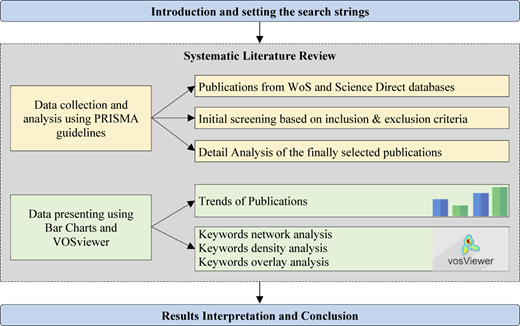
Following the collection and analysis of literature, the bar charts and VOSviewer software tools were utilized for data visualization and presentation of research findings effectively. The use of bar charts allows for a clear representation of publication trends, showcasing the growth and evolution of research in AI-driven maintenance over time. This trend analysis helps in understanding how research interest in this field has progressed and whether there has been a significant increase in contributions over recent years. VOSviewer, on the other hand, was employed for advanced bibliometric analysis given its user-friendly mapping and visually appealing graphics (Van Eck and Waltman, 2010). In particular, VOSviewer was used for keyword network analysis, keyword density analysis and keyword overlay visualization. These analyses map the relationships between frequently occurring terms in the selected papers, providing insights into dominant research themes, emerging trends and potential areas for research.
3. Data collection and analysis
As part of the data collection, relevant research articles were identified using the Web of Science and Science Direct databases. The search strategy primarily focused on AI and maintenance in public transport. Thus, the search string incorporated keywords related to AI technologies, maintenance applications and specific transport sectors (as outlined in Table 1). For instance, the keywords AI and ML were used to capture the technological aspect. Since ML is a part of AI, therefore it was explicitly included as a technological keyword in the string. Also, abbreviations are generally not much recommended in search strings. However, AI and ML are the most popular used terms, and some of the authors have used these abbreviations in their article’s titles. Therefore, they were also specifically kept in the search strings.
Characteristics of the search string
| Keywords (technologies) | Keywords (applications) | Keywords (sectors) | Language | Document type |
|---|---|---|---|---|
| Artificial intelligence (AI) | Maintenance planning | Aviation/Airplane | English |
|
| Machine learning (ML) | Maintenance control | Automotive/Vehicle | ||
| Maintenance scheduling | Railway/Rail |
Furthermore, the term maintenance on its own is quite broad, so it was combined with specific aspects like planning, control or scheduling to narrow down the application context to our theme. To ensure coverage of all relevant sectors, terms denoting the transport modes, that is airplane, vehicle and rail, were also added along with the sectors names to the search string. Only English language documents, including journal articles, review articles, conference proceedings and book chapters, were considered. The combination of these terms using the Boolean operators “AND” and “OR” was used to ensure that only articles mentioning AI or ML, maintenance (planning/control/scheduling) and the public transport domains (aviation/automotive/rail/vehicle) in their title, abstract or keywords were retrieved.
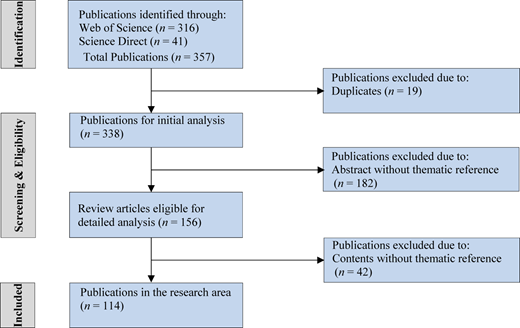
Using the search strategy, a total of 357 publications were obtained and imported into Zotero (a reference management tool) for screening. The PRISMA framework was employed to ensure a transparent and structured screening process, as illustrated in Figure 2. After removing 19 duplicate entries, 338 unique articles remained for initial evaluation. These papers were arranged, and their abstracts and titles were closely reviewed before being ranked according to their applicability to the topic of AI-driven maintenance planning/scheduling/control in public transport. As a result of this relevance ranking, 182 articles that lacked a clear thematic connection to maintenance planning/scheduling/control with AI were excluded. This left 156 articles, which were then subjected to full-text review. Upon reading the full content of these 156 articles, an additional 42 were excluded because they did not provide sufficient thematic relevance (e.g. they mentioned in their abstracts or keywords but did not substantively address maintenance planning/scheduling/control). One hundred and fourteen articles were ultimately chosen for detailed analysis after being determined to be the most relevant.
4. Results and discussion
In this section, we first present a descriptive analysis of the SLR findings, offering insights into publication trends and keyword analyses. This is followed by a comprehensive content analysis of the full texts of the selected studies. By integrating both descriptive and content-based approaches, we aim to provide a holistic understanding of the existing literature and its implications for future research directions.
4.1 Descriptive analysis
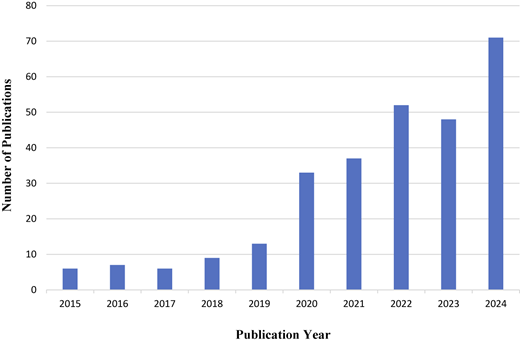
Descriptive analysis is a useful approach for examining large volumes of scientific literature to uncover trends and patterns. The initial database search identified 338 distinct publications on AI in MPC in public transport. Therefore, bibliometric analyses were performed to explore and present the overall research trends in this field. It is noteworthy that the majority of research in this domain has been conducted in the last 10 years. The collected data indicates that the identified publications include 250 journal articles, 85 conference proceedings and 3 book chapters, with most contributions appearing from 2015 onward. Figure 3 depicts the development of relevant research from 2015 through 2024. The publication trend shows a consistent increase in the number of studies each year, suggesting growing interest and development in AI for maintenance planning/scheduling/control in public transport, that is aviation, automotive and rail sectors.
Since the identified data are in large quantity, this work makes use of network visualization software, for example VOSviewer, to better design and visualize the bibliometric networks. VOSviewer provides three different perspectives on the results, that is network, overlay and density visualizations, and offers a range of visualization perspectives across several platforms. It also boasts visually appealing graphics and easy-to-use maps. The following is a detailed presentation of the comprehensive analysis results:
4.1.1 Analysis of keywords
In this section, co-occurrences of keywords in the chosen 338 articles have been examined. Figure 4 presents the comprehensive findings of the analysis, including the frequency of keyword occurrences and their relationships with other keywords. A criterion was established to choose only terms with a frequency of ≥4 in order to produce more precise and superior visualization results. Out of 2025 keywords, 75 were identified using this criterion with the given occurrence threshold. Node size in the graphic represents a keyword’s frequency, while connecting lines indicate the keywords’ co-occurrences.
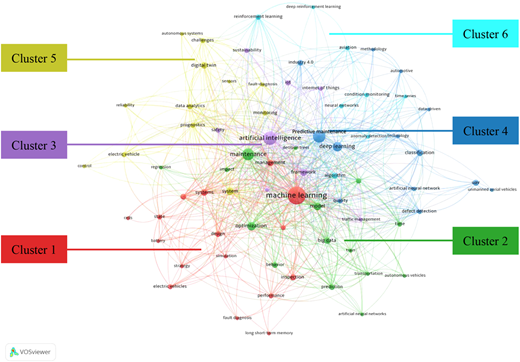
As AI, ML and maintenance are the primary terms in the theme under emphasis and were intentionally included in the search strings, they are the most commonly occurring co-occurring keywords and rank highest in the order as follows: ML (occurrences: 76, total link strength: 180), AI (occurrences: 44, total link strength: 125) and maintenance (occurrences: 34, total link strength: 104). The results further show that predictive maintenance, deep learning and optimizations are the most frequent keywords that appear along our main searched theme with 38, 22 and 17 occurrences respectively; hence, these can be considered as the most recurring terms in the field.
Keywords in Cluster 1, that is fault diagnosis, simulation and design, indicate a strong focus on using ML algorithms to predict failures, optimize maintenance schedules and simulate system behavior for better decision-making. On the other hand, keywords such as systems, strategy and performance suggest a focus on integrating ML into broader maintenance frameworks, emphasizing strategic planning and performance analysis. Therefore, the associated research papers in this cluster aim to enhance the efficiency and reliability of maintenance processes using ML-based methodologies. Keywords in Cluster 2, that is big data, artificial neural networks and quality, suggest the use of large-scale data collection and analysis to improve maintenance decisions. The presence of terms like prediction, inspection and train highlights the development of predictive models for equipment failure and quality assurance. Additionally, computer vision and transportation indicate specific technological applications for visual inspections and public transport systems. Therefore, the associated research papers in this cluster likely focus on utilizing big data tools to extract actionable insights for maintenance optimization in diverse domains.
Keywords in Cluster 3, that is AI, predictive maintenance and framework, highlight the creation of overarching systems that utilize AI for maintenance decision-making. Terms such as management, decision trees and classification indicate the use of AI algorithms to automate and optimize maintenance tasks. Additionally, impact, technology and algorithm suggest that the research addresses the broader implications and technological advancements in maintenance practices. Therefore, the associated research papers in this cluster likely aim to design AI-powered frameworks that improve the efficiency and effectiveness of maintenance systems. Keywords in Cluster 4 such as neural networks, condition monitoring and anomaly detection highlight the use of deep learning (DL) algorithms to detect patterns and anomalies in system behavior, enabling early fault detection. Keywords such as time series, defect detection and unmanned aerial vehicle (UAV) suggest the application of DL in processing complex data types (e.g. time-series data) for identifying defects and monitoring remote systems like UAVs. Therefore, the associated research papers in this cluster likely focus on leveraging DL’s capabilities to improve the accuracy and reliability of predictive maintenance.
Keywords in Cluster 5, that is digital twin, data analytics and sensors, suggest a focus on creating virtual models of physical systems to simulate, monitor and analyze real-time operational data. Additionally, terms like reliability, prognostics and safety indicate a focus on ensuring the reliability and safety of systems through predictive analytics. Keywords like challenges and sustainability point to addressing broader issues, such as the adoption of digital twins in diverse maintenance contexts. Therefore, the associated research papers in this cluster likely aim to enhance maintenance practices through virtual modeling and data-driven insights. Keywords in Cluster 6, that is RL, deep RL and condition monitoring, indicate the application of RL algorithms to learn optimal maintenance strategies based on system conditions. Other terms, such as methodology, aviation and Internet of Things (IoT), suggest applications in specific domains like aviation and IoT-enabled systems. The inclusion of industry 4.0 reflects the alignment of this research with advanced manufacturing and maintenance paradigms. Therefore, the associated research papers in this cluster likely focus on using RL to dynamically adapt maintenance strategies to real-time system conditions.
Furthermore, the density visualization illustrated in Figure 5 provides a heatmap representation of keyword distribution in the research domain of AI in maintenance of public transport. The intensity of colors signifies the concentration and significance of specific terms, with red and yellow areas indicating higher density, indicating areas where research has been concentrated. It is depicted from the visualization that predictive maintenance and deep learning have the largest density with respective total link strengths of 95 and 49 following the primary themes of AI, ML and maintenance. These can therefore be regarded as the most important in the field of study.
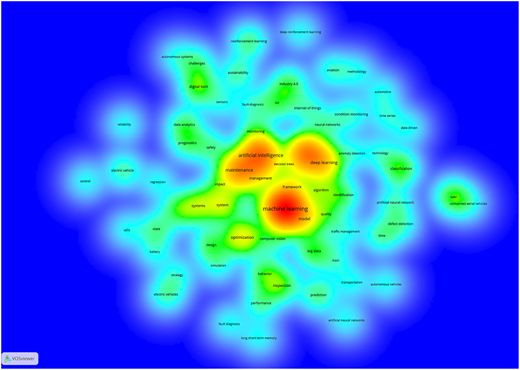
Beyond the central cluster, terms such as RL and deep RL appear with relatively low density. However, this does not imply that they are insignificant within the research field. A detailed content analysis in Section 4.2 reveals that the number of articles in this domain is also substantial, despite the lower keyword density in the visualization. The lower density is primarily due to the fact that most papers in this domain use specific algorithmic terms, such as Q-learning and deep Q-learning, rather than the broader category names.
4.1.2 Trend in the application domain
The keyword overlay visualization by VOS viewer shows the temporal trend of research themes in the application domain. As illustrated in Figure 6, it highlights how certain topics have gained prominence in recent years. In 2020–2021, research emphasis the application of AI algorithms in maintenance, with specific focus on fault diagnosis and autonomous maintenance systems. In this period, traditional AI techniques such as expert systems and basic classifiers could be applied to detect equipment faults and support maintenance decision-making. There was also interest in using AI for control systems related to maintenance operations, laying the groundwork for more autonomous maintenance processes.
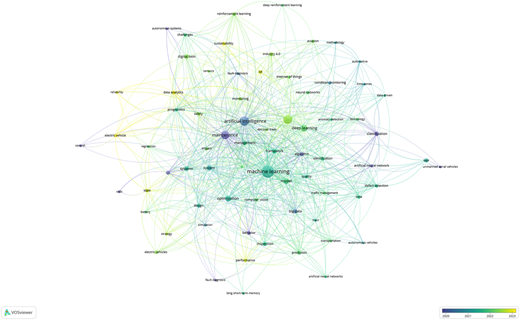
In 2022 and 2023, the focus shifted more distinctly toward ML models, especially advanced methods like deep learning and RL, in the context of predictive maintenance. In this period, applied deep neural networks such as deep convolutional neural networks and recurrent neural networks, to better predict failures and estimate RUL of components. At the same time, RL is used to optimize maintenance scheduling and resource allocation, treating maintenance planning as a sequential decision-making problem. The literature in this period reflects an increase in data-driven predictive maintenance approaches, leveraging the increasing availability of sensor data and computational power to train complex models.
By 2023 and beyond, there is a clear trend toward integrating IoT technologies and large-scale data analytics into AI-based maintenance systems. Moreover, sustainability and reliability have become prominent considerations: current research often discusses how AI-driven maintenance contributes to more sustainable operations and ensures higher reliability of transport services. In summary, the overlay analysis indicates a timeline where early AI applications in maintenance (fault diagnosis and automation) have evolved into sophisticated predictive maintenance solutions with deep learning and RL and are now moving further into IoT-enhanced, sustainable maintenance strategies.
4.2 Content analysis
Comprehensive content analysis is performed to synthesize insights from the final selection of 114 articles. The focus of the detailed analysis is on how AI has been applied in maintenance planning, scheduling or control within public transport sectors, that is aviation, railway and automotive. As an initial step, the articles were categorized based on the type of maintenance strategy or aspect they addressed, as shown in Figure 7. It was found that maintenance scheduling is the most common focus, with 39 of the 114 articles concentrating on scheduling maintenance activities. This is followed closely by maintenance planning and prognostics, with 35 articles focusing on planning maintenance activities or predicting maintenance needs. A smaller subset of the articles explicitly dealt with maintenance control and maintenance decision support systems, that is three articles in each category. It is worth to note that these articles on maintenance planning/scheduling/control does not specifically mention the type of maintenance and thus are kept in general maintenance type. Besides these, condition-based maintenance, which often involves fault diagnosis and real-time condition monitoring, was addressed in eight articles, and predictive maintenance was the focus in five articles.
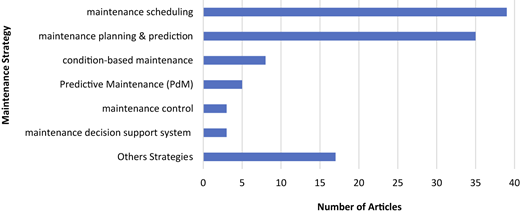
Overall, in these articles, the researchers have prioritized the when and what of maintenance, that is deciding maintenance timing and identifying what needs fixing to reduce unplanned downtime and efficiently manage maintenance workloads. Furthermore, the comprehensive results from the content analysis are compiled into two aspects, that is based on the clusters and applications domain. These analyses are described in detail in Sections 4.2.1 and 4.2.2, respectively.
4.2.1 Clusters analysis
From the VOSviewer classification of keywords into six clusters, as analyzed in Section 4.1.1, we infer that each cluster reflects a distinct research theme. Therefore, in this section, we analyzed and named these clusters based on AI- and ML-specific techniques, that is Cluster 1: ML for maintenance, Cluster 2: big data analysis for maintenance optimization, Cluster 3: AI-based frameworks for maintenance, Cluster 4: deep learning in predictive maintenance, Cluster 5: digital twins and data analytics in maintenance and Cluster 6: RL for maintenance. The detail classification is illustrated in Table 2.
Classification of clusters
| No | Cluster title | Records | Overlapping clusters |
|---|---|---|---|
| Cluster 1 | Machine learning for maintenance | 29 | – |
| Cluster 2 | Big data analysis for maintenance optimization | 5 | Clusters 4 and 5 |
| Cluster 3 | Artificial intelligence-based frameworks for maintenance | 4 | – |
| Cluster 4 | Deep learning in predictive maintenance | 9 | Clusters 2 and 5 |
| Cluster 5 | Digital twins and data analytics in maintenance | 3 | Clusters 2 and 4 |
| Cluster 6 | Reinforcement learning for maintenance | 64 | – |
By analyzing the articles in accordance with these clusters, we observe that RL forms the largest category comprising 64 papers in the research domain. This large share is due to the occurrence of sequential decision problems that is well addressed by RL. Additionally, classical ML algorithms (i.e. support vector machine, random forests and Bayesian classifiers) form a significant portion with 29 articles, for tasks like fault diagnostics and RUL prediction. A number of papers in this cluster have also applied statistical methods such as genetic algorithms for scheduling, Bayesian networks for decision support and fuzzy logic for maintenance policy. Four of the articles have presented AI frameworks to tackle maintenance optimization. The remaining overlapping clusters, that is big data analysis for maintenance optimization, deep learning in predictive maintenance, digital twins and data analytics in maintenance, mostly focus on data analytics in predictive maintenance. Below, we summarize these with most notable articles in each cluster:
Machine learning for maintenance
This cluster includes articles that apply classical ML techniques for fault diagnosis, RUL prediction and maintenance planning. For example, Pebrianti et al. (2024) apply deep convolutional neural networks to aircraft maintenance by analyzing image and sensor data to predict component failures. This work underlines how advanced ML techniques can foresee maintenance needs in aerospace, enhancing safety and reducing costly unplanned downtime. Similarly, Ferdous et al. (2024) demonstrate a practical ML application in railway maintenance by analyzing sensor data to predict track and train component needs. This case study shows how ML algorithms can pinpoint issues before failures occur, directly aligning with proactive maintenance and reduced downtime in rail systems.
In another study, Mohan et al. (2021) propose a ML approach within a total productive maintenance framework to virtually eliminate unexpected equipment breakdowns. By predicting failures and scheduling timely interventions, it highlights ML’s role in optimizing maintenance schedules and maximizing equipment availability. Additionally, Samanta and Williamson (2023) review ML methods for estimating the RUL of lithium-ion batteries in electric vehicles and devices. By focusing on battery health prognostics, it shows how ML-driven predictions inform maintenance and replacement schedules, ensuring the reliability of battery-dependent systems.
Big data analysis for maintenance optimization
Articles in this cluster focus on the use of big data and analytics to improve maintenance decision-making and optimization. They involve processing large volumes of sensor data and applying advanced data analytics techniques to optimize maintenance schedules and asset management. For instance, Consilvio et al. (2024) present a framework using big data to intelligently schedule and prioritize metro system maintenance activities. By analyzing vast operational datasets, it minimizes service disruptions, illustrating how big-data analytics can optimize maintenance timing for better continuity. Kabashkin (2024) proposes a novel iceberg approach that combines extensive aircraft sensor data, AI and even blockchain to monitor both obvious and hidden system faults. By using big data analytics, this paper shows how deep insights can be gained to optimize aircraft maintenance strategies and avoid unexpected failures.
Furthermore, Oh and Kim (2023) develop a platform using LSTM networks to analyze massive streams of automotive sensor and fault data for predictive maintenance of electronic control units. By handling large-scale vehicle data, the system predicts electronic failures before they happen, thus reducing breakdowns in vehicle fleets. Similarly, Kabashkin and Susanin (2024) propose a data analytics framework that integrates aircraft component performance data over time to inform maintenance and replacement decisions. By analyzing big data across the component life cycle, the model optimizes maintenance schedules (e.g. when to overhaul or retire parts) to improve safety and cost-effectiveness in aviation maintenance.
AI-Based frameworks for maintenance
This cluster consists of studies that develop integrated frameworks using AI to support maintenance operations. Lu et al. (2024) introduce an AI-based framework combining ML with model-based methods to monitor the health of vehicle control systems. This integrated approach acts as a maintenance framework by detecting anomalies and incipient faults in vehicles, showcasing how hybrid AI can guide maintenance decisions in complex automotive systems. In another study, Hinostroza et al. (2024) present a framework that uses AI planning algorithms to coordinate an unmanned ground vehicle (UGV) for autonomous inspections of industrial facilities. By integrating scheduling, navigation and inspection tasks, this system can carry out routine maintenance inspections without human intervention, improving safety and consistency in operations.
Furthermore, Massaro et al. (2020) introduce a custom smart electronic control unit equipped with AI algorithms as part of a framework for bus fleet maintenance. Installed on buses, this intelligent device continuously monitors vehicle health data and predicts failures, enabling a fleet-wide maintenance strategy that schedules service only when needed and thereby improves vehicle availability. Additionally, Sanz et al. (2021) propose an Industry 4.0 maintenance framework (BiDrac) implemented in an automotive paint shop. It connects IoT sensors, robotics and AI analytics to monitor equipment and product quality in real time. The paper highlights how this framework enables predictive maintenance and quick reconfiguration in the paint process, minimizing downtime and defects.
Deep learning in predictive maintenance
This cluster highlights studies using deep learning techniques for predictive maintenance. For instance, Chaudhuri and Ghosh (2024) present an ensemble of deep learning models that analyze large-scale telematics and sensor data from vehicle fleets to predict failures. By blending multiple deep learning techniques, the system improves prediction accuracy, underscoring how deep learning can optimize fleet maintenance schedules and reduce breakdowns by learning from big data. Kim et al. (2024) propose a deep learning model based on a hybrid transformer architecture to detect anomalies in railway air-conditioning systems. By learning complex patterns from time-series sensor data, this deep model can predict the heating, ventilation, and air conditioning (HVAC) faults early, showcasing a cutting-edge approach that directly improves predictive maintenance in rail operations. Moreover, Patil et al. (2023) provide a thorough analysis of how ML and deep learning techniques are applied to predictive maintenance in automotive manufacturing and machinery. It covers various deep learning use cases and highlights best practices, thereby solidifying the understanding of deep learning’s pivotal role in modern maintenance regimes.
Digital twins and data analytics in maintenance
Papers in this cluster involve the use of digital twin technology and data analytics for maintenance purposes. For example, Vashishth et al. (2025) explore how digital twin technology is used in logistics and transport systems to monitor asset conditions in real time. It shows that by analyzing data streams through a digital twin, operators can optimize maintenance schedules and anticipate issues before they occur, thus improving reliability in supply chains. In another study, Nuvvula et al. (2024) introduce a strategy for managing an electric vehicle fleet that uses predictive analytics on vehicle and charging data to optimize operations. A key part of this strategy is predictive maintenance: by analyzing usage patterns and battery performance at scale, the framework schedules maintenance and charging in synergy with renewable energy availability, improving both vehicle uptime and energy efficiency. Similarly, Jafari and Byun (2022) present a digital twin framework for lithium-ion batteries where the twin model uses battery management system data to predict the battery’s state-of-charge and state-of-health. This approach directly aids maintenance by providing accurate prognostics for battery life and performance, allowing timely maintenance or replacements in electric vehicles and energy storage systems.
Reinforcement learning for maintenance
This cluster includes research using RL to solve maintenance planning and scheduling problems. Razzaghi et al. (2024) provide an overview of how RL techniques are being applied to maintenance problems in aviation. It highlights used cases like optimizing aircraft maintenance scheduling and real-time decision-making for repairs, illustrating RL potential to learn optimal maintenance policies (e.g. when to service an aircraft component) through trial-and-error training on data or simulations. Similarly, Huang et al. (2023) introduce a multi-agent deep RL framework that enables a team of UGVs to form formations and cooperate on tasks. While the focus is on formation control, this has strong relevance to maintenance scenarios such as coordinated robotic inspection or cleaning. The RL-trained UGVs can efficiently cover and survey large facilities together, improving the scale and effectiveness of autonomous maintenance operations.
Furthermore, Liu et al. (2022) explore a RL approach to making maintenance and operation decisions that consider the entire product lifecycle. In terms of maintenance, the paper shows how RL agent can learn a strategy that balances maintenance timing and resource use to maximize sustainability outcomes such as minimizing waste and downtime.
4.2.2 Application domain analysis
In this section, we analyzed the finally selected papers by application domain to provide insights into how AI is being tailored to the maintenance needs of aviation, railway and automotive sectors. Tables 3–5 present the top 10 most relevant or notable articles in each of these domains, summarizing their objectives, the AI models used, the maintenance aspect addressed and their main outcomes. The summarized articles highlight the practical impact of AI-driven maintenance approaches in public transport. In aviation, deep RL and probabilistic RUL estimation have been instrumental in optimizing maintenance intervals and reducing aircraft downtime, while explainable AI techniques enhance decision transparency. Railway applications focus on predictive maintenance through ML models for track degradation, defect detection and maintenance scheduling, improving reliability and service continuity. The automotive sector focuses on vehicle health monitoring, where deep learning and anomaly detection techniques enhance fault diagnosis and fleet management.
Top 10 most relevant articles in aviation
| Source | Objectives | AI models | Maintenance aspect | Short outcomes |
|---|---|---|---|---|
| Tseremoglou et al. (2023) | To optimize maintenance schedules by predicting the remaining useful life of components | DRL and MILP | Maintenance scheduling | The proposed MILP model produces more stable maintenance schedules and reduces maintenance ground time compared to other methods |
| Vos et al. (2023) | Maximize fleet availability while minimizing maintenance costs | RL | Maintenance scheduling | Demonstrated that RL-based policy can improve overall fleet availability, though the large action space in scheduling poses computational challenges |
| Ribeiro et al. (2022) | To develop interactive tools that enable human planners to design and visualize condition-based maintenance plans using ML support | ML integrated with a RL agent | Maintenance planning (condition-based maintenance) | Introduced a novel human–computer interaction approach that helps maintenance planners interact with an ML agent, leading to more reliable maintenance plans and better user understanding of AI-driven recommendations |
| Lee and Mitici (2023) | Leverage DRL and RUL prognostics for proactive aircraft maintenance decision-making | DRL combined with probabilistic RUL estimation | Predictive maintenance scheduling | Showed that a DRL approach can optimize maintenance timing by using RUL predictions, thereby reducing unscheduled downtime and improving maintenance efficiency |
| Tseremoglou and Santos (2024) | To schedule aircraft maintenance under uncertainty | DRL | Maintenance scheduling (condition-based maintenance) | Demonstrated that a deep RL algorithm can handle uncertain system information and still improve maintenance scheduling decisions, achieving higher availability under partial observability conditions |
| Dangut et al. (2022) | Improve fault prediction in aircraft systems by addressing class imbalance in maintenance data | BACHE algorithm with ML classifiers | Predictive maintenance | The proposed approach improved fault detection accuracy by balancing rare failure cases in the dataset, leading to more reliable identification of infrequent but critical failures |
| Kabashkin and Susanin (2024) | Support decisions on repair or replacement of aircraft components throughout their life cycle | Decision-support model (ML-based prognostics) | Maintenance planning | Provided a model that optimizes component maintenance and replacement timing over its life cycle, resulting in improved long-term fleet reliability and cost savings |
| Zhou et al. (2022) | Predict spare parts demands and plan component replacements by identifying competing failure risks in fleet equipment | Hybrid learning algorithm (statistical reliability models with ML) | Maintenance planning and spare parts management | Improves prediction of component failures and corresponding spare part needs, enabling efficient component replacement strategies and reduced downtime across the fleet |
| Rahim et al. (2020) | To minimize the life-cycle maintenance costs for critical aircraft components through optimized planning | AI-assisted optimization model | Maintenance planning | Developed a maintenance planning strategy that reduces overall costs for critical components by optimizing inspection and replacement intervals without compromising safety |
| Dang et al. (2024) | To enhance the transparency of AI-driven maintenance scheduling decisions using explainable AI techniques | Explainable AI integrated with maintenance scheduling algorithms | Maintenance scheduling (condition-based maintenance) | Demonstrated that providing causal explanations for AI-recommended maintenance schedules increases user trust and understanding, while still achieving efficient scheduling of aircraft maintenance |
Note(s): DRL: Deep reinforcement learning; MILP: mixed-integer linear programming; RL: reinforcement learning; ML: machine learning; RUL: remaining useful life; DSM: decision-support model; AI: artificial intelligence; CBM: condition-based maintenance; SVM: support vector machine
Top 10 most relevant articles in rail
| Source | Objectives | AI models | Maintenance aspect | Short outcomes |
|---|---|---|---|---|
| Kaewunruen et al. (2021) | To optimize long-term rail renewal and maintenance schedules using deep reinforcement learning | DRL | Renewal and maintenance planning | The DRL approach generated cost-effective maintenance and renewal plans that reduced the risk of failures, showing promise in automating complex planning decisions for rail infrastructure upkeep |
| Famurewa et al. (2017) | Develop diagnostic, predictive and prescriptive analytics for railway infrastructure maintenance | Data analytics framework | Maintenance decision support | Showcased an analytics approach that diagnoses faults, predicts failures and prescribes maintenance actions, improving decision-making for infrastructure upkeep and reliability |
| Khouzani et al. (2017) | Model track geometry degradation stochastically for optimized maintenance scheduling | Stochastic degradation modeling | Maintenance planning | The model forecasts track geometry deterioration over time, helping planners schedule maintenance (e.g. tamping) at optimal times to balance cost and safety |
| Gao et al. (2018) | Integrate multiple rail inspection data sources to detect surface and sub-surface defects | DF and ML | Predictive maintenance | Improved defect detection accuracy by combining diverse data (e.g. ultrasonic, visual inspections), enabling earlier identification of rail flaws and reducing the risk of failures |
| Gerum et al. (2019) | To develop a data-driven policy for scheduling railway maintenance activities predictively | ML | Maintenance scheduling | Demonstrated that using data-driven models to schedule track maintenance can effectively prevent failures (like track buckling or breaks) and optimize maintenance intervals |
| Hu and Liu (2016) | To predict railway track geometry degradation using machine learning | SVM | Preventive maintenance scheduling | The SVM model accurately predicted track geometry degradation trends, aiding proactive planning of maintenance before track quality falls below safety thresholds |
| Zhang et al. (2020) | Predict the occurrence of broken rails using machine learning techniques | ML classification (e.g. random forest) | Maintenance planning | Achieved the ability to identify high-risk track segments for rail breaks, allowing preventive repairs to be scheduled and significantly enhancing railway safety |
| Li et al. (2014) | Analyze factors affecting train delays and network speed using machine learning | ML | Maintenance scheduling and planning | Identified maintenance-related factors that impact network velocity (on-time performance), informing adjustments to maintenance schedules to reduce delays and improve overall service punctuality |
| Lasisi and Attoh-Okine (2019) | Enhance the accuracy of rail defect predictions using ensemble learning methods | EML | Condition-based maintenance scheduling | Ensemble models improved the precision of defect detection and prediction, leading to more targeted maintenance actions and more efficient use of repair resources on the railway network |
| Mohammadi and He (2022) | Monitor rail corrugation and predict track wear to extend the service life of tracks and rolling stock | ML | Maintenance planning | Enabled early detection of rail corrugation issues, allowing timely grinding maintenance and prolonging the lifespan of track and wheel assets |
Note(s): ML: Machine learning; DF: data fusion; SVM: support vector machine; EML: ensemble machine learning, DRL: deep reinforcement learning
Top 10 most relevant articles in automotive
| Source | Objectives | AI model | Maintenance aspect | Short outcomes |
|---|---|---|---|---|
| Jakobsson et al. (2020) | Predict the remaining useful life of heavy mining vehicles based on their usage data | NN | Predictive maintenance | The model accurately forecasts vehicle component life using operational data, enabling proactive maintenance scheduling and reducing unexpected heavy vehicle breakdowns |
| Gong et al. (2023) | Diagnose and monitor electric vehicle faults using indirect measurements combined with AI | AI-driven signal processing | Predictive maintenance | The proposed methodology quickly and accurately detects EV motor and battery faults using only indirect signals, improving maintenance response times and reducing the need for additional sensors |
| Gugaratshan et al. (2023) | To continuously update reliability, availability, maintainability models of vehicles using in-service sensor data | ML | Maintenance planning | Demonstrated that incorporating real-time multi-variate sensor data into reliability models significantly improves failure prediction and optimizes maintenance timing for critical vehicle subsystems (e.g. brakes, engine) |
| Chen et al. (2021) | Predict automotive maintenance needs by integrating deep learning models with GIS data | Deep Learning (e.g. CNN/LSTM) | Predictive maintenance | Successfully predicts when and where vehicle maintenance is required by analyzing operational routes and environmental conditions, allowing timely, location-aware maintenance actions for vehicle fleets |
| Giordano et al. (2022) | Evaluate and derive best practices for implementing predictive maintenance in an automotive production environment | ML | Predictive maintenance | Highlighted effective data-driven maintenance strategies (and common pitfalls) in a real automotive case study, providing guidance on data quality, model selection and integration for future implementations |
| Giobergia et al. (2018) | Use large volumes of sensor data from vehicles to predict component failures in advance | Data mining and ML | Predictive maintenance | Showed that mining high-dimensional vehicle sensor data can uncover early warning patterns for component failures, thereby improving fault detection and enabling maintenance to be scheduled before breakdowns occur in automotive fleets |
| Liu et al. (2021) | To diagnose faults in electric/hybrid vehicles using enhanced machine learning algorithms | Improved ML algorithm (e.g. enhanced SVM/ANN) | Predictive maintenance | The improved machine learning model accurately identifies battery and motor anomalies in new energy vehicles, contributing to more reliable operation and timely maintenance of electric vehicle fleets |
| Kavousi-Fard et al. (2020) | To detect anomalies in vehicle operation data for both security and reliability purposes | DL | Anomaly detection | The model detects abnormal patterns in vehicle data (potentially indicating component faults or cyber-attacks) with high accuracy, providing an early warning system that can trigger maintenance or security interventions promptly |
| Ji et al. (2021) | Identify anomalies in the clutch operation of hybrid electric vehicles using machine learning | ML | Condition monitoring | Successfully detected unusual clutch engagement patterns that indicate wear or faults in hybrid vehicle transmissions, enabling targeted preventive maintenance for the clutch system |
| Aeddula et al. (2024) | Apply AI-driven predictive maintenance in autonomous vehicle fleets as part of a product-service system strategy | AI-driven analytics framework | Predictive maintenance/maintenance planning | The research identified practical considerations, limitations and potential improvements for implementing AI-based maintenance in autonomous vehicle services, demonstrating the approach’s significance in enhancing fleet reliability and informing effective PSS design |
Note(s): NN: Neural network; AI: artificial intelligence; ML: machine learning; CNN: convolution neural network; LSTM: long short-term memory; GIS: geographic information system; SVM: support vector machine; ANN: artificial neural network; DL: deep learning
5. Conclusion and future directions
5.1 Summary
This SLR provided a comprehensive overview of AI applied to MPC in public transport. The systematic review has revealed several important findings, emerging trends and applications of AI for MPC in public transport. First, the descriptive analysis shows that the volume of research in this area has grown consistently in the past decade, indicating increasing interest in the research domain. We observed that a large portion of studies focuses on AI in predictive and condition-based maintenance approaches to predict equipment failures and condition monitoring, respectively. Maintenance scheduling and planning are the dominant theme in those papers that align with the overall drive toward minimizing downtime and avoiding failures through better insights.
Secondly, regarding the AI techniques used, our cluster analysis highlights that no single method dominates the field; instead, a variety of approaches are being tried and often combined. RL has gained attention for formulating maintenance as a sequential decision problem, showing promise especially in maintenance scheduling scenarios. Deep learning has been applied for many predictive maintenance tasks due to its ability to model complex patterns in sensor data. Classical ML methods (like SVMs, random forests and Bayesian models) are used for fault diagnosis, RUL prediction and maintenance planning. Moreover, a number of articles uses hybrid approaches, for example combining physics-based models with AI to support maintenance operations.
Finally, from the analysis of application domains, we found that AI-driven maintenance offers significant benefits across aviation, railway and automotive domains, including improved failure prediction, optimized maintenance scheduling, reduced downtime and enhanced decision support for maintenance. The analysis of application domains indicates that while there are common maintenance focused themes across these sectors, each sector also has unique priorities. In aviation, AI applications often revolve around high-precision prognostics for critical components and optimizing fleet maintenance schedules to avoid any unscheduled grounding of aircraft. The aviation sector has also been exploring explainable AI to maintain trust in automated decision aids for maintenance scheduling. In the railway sector, most of the work has targeted sensor-based condition monitoring and defect detection, as well as scheduling models that plan maintenance slots around train operations. In the automotive sector, the focus has been on leveraging the data from vehicles to implement predictive maintenance that can reduce operational costs.
The main limitation of this study is the restriction of the literature search to Web of Science and Science Direct. While these databases ensure high-quality research, they may exclude relevant studies published in other major databases such as IEEE Xplore, Scopus and domain-specific conference proceedings. To address this limitation, future research should broaden the coverage to the above mentioned databases and repositories which is particularly important for rapidly evolving fields such as AI and maintenance optimization. Expanding the search strategy would enable a more comprehensive capture of domain-specific contributions.
5.2 Implications for research, practice and society
Despite the progress in the research area, there is no dedicated AI-based MPC system. Most of the research focuses on the specific aspects, that is predicting the RUL, faults diagnoses, decision support systems for repair and replacement and so on, in isolation. However, in practice, MPC involves a complex coordination of many activities, for example inspection, identifying required material and components, resource allocation and workforce and tasks scheduling. Therefore, the authors believe that there is a need for more holistic solutions that can integrate maintenance activities and shopfloor constraints, moving beyond single-component predictions to system-level maintenance optimization. Such MPC system will assist maintenance managers in end-to-end planning; from detection of a need to scheduling and execution of maintenance, and can be validated in real maintenance facilities. In real world settings, MPC would require coordination across organizational units, legacy information systems and human decision makers. However, the lack of holistic, end-to-end solutions is still a big implementation challenge which limits the practical transferability of AI models to operational maintenance facilities.
On a societal level, such efficient and intelligent maintenance planning in public transport can directly contribute to increased system reliability, reduced delays, cost savings and enhanced safety. Public acceptance of AI in transport maintenance can grow if systems are developed with transparency, operational accountability and clear socio-technical integration. Furthermore, sustainable maintenance practices enabled by AI would also help extend asset lifespans and reduce environmental impacts across transport networks. However, beyond technical integration challenges, the implementation of AI-based maintenance systems is strongly influenced by regional and contextual factors. For example, in Europe, AI adoption is often controlled by strict regulatory environments, strong labor protections and high expectations for transparency and explainability. Also, regulations related to data protection, safety certification and ethical AI, particularly in safety critical domains such as public transport, can slow down the deployment of such AI-based MPC systems.
This work is conducted as part of D4M research project with financial support from the German Federal Ministry of Digital Transformation and Government Modernization under the mFUND Projects; Grant number 01FV2064A.

