This study investigates resident and visitor trail use near the regional township of Atherton, Australia, to advance understanding of how regional outdoor recreation systems can better balance community wellbeing, visitor use and environmental sustainability.
Data were collected from 153 respondents. The study investigated trail user characteristics, preferences and support for sustainable management strategies, comparing resident and visitor perspectives across different recreation user groups.
Visitors showed greater support for a voluntary code of conduct than resident users. Mountain bikers expressed stronger endorsement of sustainable park management than walkers. The study also found that women's participation in mountain biking increased compared to earlier research.
This paper contributes to the growing literature on outdoor recreation by applying health, leisure studies and sustainability perspectives to a regional trail context. It examines resident–visitor differences in management perceptions and highlights the interconnected roles of wellbeing, user diversity and environmental governance in nature-based recreation planning.
Introduction
Outdoor recreation is expanding globally, delivering multidimensional benefits including improved physical and mental health, stronger social participation, and regional economic development (Zhang et al., 2024). Proximity to trails is important, as access to nearby nature supports regular activities such as walking, running, and mountain biking linked to positive health outcomes (Lee and Lee, 2015; Pickering and Rossi, 2016). It also contributes to local economies through nature-based tourism and events, with evidence of visitor expenditure and economic multipliers from activities such as mountain biking and ultra-trail running (Newsome et al., 2016). However, constrained or poorly aligned recreation provision can undermine both wellbeing and economic participation (Gupta et al., 2023).
Despite growth in the sector, key gaps remain in how recreation areas are managed equitably and sustainably for residents and visitors. First, while health benefits are well established (Coventry et al., 2021; Parkinson et al., 2025), research often adopts a generalised approach that overlooks the specific needs and behaviours of resident users, limiting insights for inclusive planning. Second, growing user diversity in peri-urban and regional trail systems has intensified conflicts between recreationists, particularly walkers and mountain bikers (Farías-Torbidoni et al., 2023; Neumann and Mason, 2019; Pickering and Rossi, 2016), with pressures compounded by increased visitation and demographic change (Parkinson et al., 2025). Third, environmental, social, and economic dimensions of sustainability are frequently treated separately, constraining integrated responses to rising recreational demand and trade-offs between conservation and access.
To contribute to this area of research, this study examines trail use near the regional town of Atherton in Australia by drawing on perspectives from health promotion, leisure research, and sustainability scholarship. The study compares residents and visitors across three objectives: (1) characterising user profiles and participation patterns; (2) assessing trail preferences, recreation specialisation, and perceptions of safety; and (3) examining attitudes toward environmental impacts and sustainable management (Farías-Torbidoni et al., 2023; Neumann and Mason, 2019). Guided by Recreation Specialisation Theory (RST), the study further explores how differing levels of specialisation are associated with attitudes toward management and preferred trail attributes, providing contextual evidence to inform more sustainable recreation planning (Bryan, 2000; Van Deursen et al., 2025).
Literature review
Health promotion and resident wellbeing
Health promotion theory conceptualises health not merely as the absence of illness, but as a positive resource for everyday life produced through supportive environments that enable individuals and communities to improve their health and wellbeing (Larson and Hipp, 2022). This approach is particularly relevant to outdoor recreation, where access to safe, high-quality natural spaces near residential areas has been shown to increase physical activity, enhance mental health, and contribute to overall wellbeing (Larson and Hipp, 2022; Zhang et al., 2024). While nature-based recreation is widely recognised for its health benefits, increased access does not necessarily produce equitable wellbeing outcomes. Experiences vary across demographic groups and locations, highlighting issues of inclusivity, social impact and competing land uses (McCool and Mandic, 2025). In regional areas, tensions often arise between resident wellbeing, tourism development, and conservation priorities.
Outdoor recreation spaces also support social connection, a key determinant of wellbeing through shared leisure, volunteering, and community engagement (Douglas et al., 2017). Previous research demonstrates strong links between physical activity, social participation, and perceptions of safety (Wolf et al., 2015). Yet trail research has largely prioritised visitor experiences and destination attractiveness over residents' everyday use (Rossi et al., 2016). This emphasis overlooks the ways in which residents' engagement with local trails can foster place attachment, which Williams and Vaske (2003) conceptualise as comprising both place dependence (functional value) and place identity (emotional and symbolic meanings). This reflects a broader tendency to frame communities as stakeholders affected by tourism rather than primary users of recreation infrastructure. Given that residents are the most frequent users of local trails, their experiences are central to equitable access and sustained health benefits. Understanding their characteristics, preferences, and usage patterns is therefore essential for effective and inclusive trail management.
Recreation specialisation theory in leisure research
To account for the diversity of recreationists in shared spaces, this study draws on RST (Bryan, 2000; Van Deursen et al., 2025). RST conceptualises recreation participation along a continuum from casual users to highly experienced and committed participants. However, the framework is not uncontested, with scholars questioning its assumed linear progression and capacity to capture the complexity of recreation experiences (Scott and Shafer, 2001). In trail-based recreation contexts, increasing diversity among walkers, runners, hikers and mountain bikers has intensified management complexity and user conflict arising from differing expectations and perceptions of appropriate trail use (Farías-Torbidoni et al., 2023; Neumann and Mason, 2019; Pickering and Rossi, 2016).
RST offers a valuable lens for understanding differences in users' skills, preferences, behaviours, and attitudes towards management and conservation. More specialised recreationists often demonstrate greater environmental awareness and support for management interventions (Van Deursen et al., 2025), although they may resist restrictions on preferred experiences. Research has largely overlooked differences between residents and visitors, particularly in regional destinations where tourism and local recreation intersect. This gap is important as nature-based destinations face increasing pressures from carrying capacity, crowding, and contested access to shared resources (Gonson et al., 2018; Marion, 2016). Ignoring these differences risks oversimplifying user needs and privileging tourism over community use and ecological resilience.
Sustainable management and environmental perceptions
Sustainable management of common resources, including forests and recreation areas, requires understanding the interactions between ecological systems and the people who use them. Ostrom's (2009) Social-Ecological Systems (SES) framework explains how communities can self-organise and govern shared resources sustainably over the long term. From a stewardship perspective, sustainability encompasses both social equity and intergenerational responsibility. Social equity ensures fair access to outdoor spaces, programs, and benefits across different groups (Jennings et al., 2016), while intergenerational responsibility maintains ecosystems and community livelihoods over time rather than extracting short-term gains (Yadav, 2026). In outdoor recreation, achieving these objectives requires collaborative, systems-based governance and adaptive management across agencies, jurisdictions, and volunteer organisations to coordinate maintenance, resource allocation, and hazard management (Cerveny et al., 2022; McCool and Mandic, 2025). Although collaborative governance and co-management are increasingly recognised as mechanisms for balancing conservation and recreation, their theoretical development remains limited (Sarhan et al., 2024).
The ecological integrity of trails is vulnerable to erosion, vegetation loss, habitat disturbance, and other environmental impacts (D'Antonio et al., 2013; Miller et al., 2022). However, visitors differ considerably in how they perceive these impacts. Some recreationists underestimate their environmental footprint, while others recognise issues such as trail degradation, congestion, and habitat damage (Lynn and Brown, 2003; White et al., 2008). These differing perceptions influence support for management strategies and conservation initiatives and are shaped by prior experience, expectations, and recreation specialisation. Environmental conditions also affect visitor satisfaction and return intentions, i.e. trail quality, maintenance, and perceived environmental health (Ferguson et al., 2022). However, improving recreation experiences can increase demand and intensify sustainability pressures, creating tensions between access and conservation goals (Thomas and Reed, 2019). Despite growing attention to these issues globally, there remains limited empirical research examining how resident users perceive and negotiate these tensions within regional trail systems where tourism and everyday community use coexist.
Methods
Study location
Herberton Range State Forest and Baldy Mountain Forest Reserve are adjoining nature reserves located on the outskirts of Atherton, a regional township in North Queensland, Australia. They include the Atherton Forest Mountain Bike Park, Baldy Yabi Circuit Walk, and a 4WD track providing access to basic camping sites beyond designated recreation zones. The area is accessible via sealed and gravel roads. Atherton has a population of 11,582 and is embedded within a broader network of smaller rural towns and agricultural land (AreaSearch, 2024).
The trail systems
Walking and mountain biking trails use graded classification systems, ranging from Grade 1 (no experience required) to Grade 5 (specialised skills required), and level systems from “very easy” to “extreme” (Queensland Government, 2025). The Baldy Yabi Circuit Walk comprises an 8.5 km network of mostly steep, Grade 4 trails for experienced walkers, with three scenic lookouts and dog access on leash permitted. The Atherton Forest Mountain Bike Park includes around 55 km of trails ranging from “easy” to “intermediate”. Management of the circuit walk is undertaken by the Queensland Parks and Wildlife Service (QPWS) while the mountain bike park is co-managed with the Tableland Cycle Sports cycling club (Queensland Government, 2024).
Questionnaire design and measures
The questionnaire was informed by scholarship in health promotion, leisure studies, and sustainability. It collected data on demographics, trail design preferences, physical activity, social participation, safety perceptions, recreation specialisation, and attitudes toward park management. Variables in Table 1 were drawn from research on physical activity participation, recreation specialisation, social connectedness, and support for protected area management (Bryan, 2000; Douglas et al., 2017; Hartig et al., 2014; Manning, 2011).
The survey included closed- and open-ended questions with binary, categorical, and 5-point scale responses. It was pilot tested with outdoor recreation users and academic colleagues to assess clarity, wording, and flow, with minor refinements made. Construct reliability was supported through the grouping of conceptually related items under broader domains, including perceived safety, recreational participation, and park management attitudes. The survey instrument also drew on previously established measures and was refined through pilot testing to enhance clarity and content validity. Ethical approval was granted by the James Cook University Human Research Ethics Committee (H7512).
Recruitment
Respondents were recruited through multiple channels, including social media, trailhead posters, community information boxes along walking trails, local businesses, flyers distributed to community organisations, and the local council's business email network. Individuals were invited to complete a 10–15-minute survey via a QR code to an online questionnaire administered using Qualtrics XM. Respondents who preferred a paper-based format could request a survey by email or telephone. An information statement was provided at the commencement of both the online and paper surveys, and informed consent was obtained prior to participation. A non-probability convenience sampling approach was used because the total population of trail users was unknown and no comprehensive visitor database existed for the study site.
Respondents were classified as residents or visitors using the Tourism Satellite Account criteria, which define same-day visitors as travelling more than 50 km round trip or overnight visitors as travelling more than 40 km from their usual residence (Australian Bureau of Statistics, 2024). Accordingly, those living within 40 km of the study location were classified as residents, and those beyond as visitors. This threshold also reflects the regional context, with Atherton functioning as the primary service centre for surrounding communities, while Cairns, located approximately 80 km away, represents a broader regional market. This distinction helps differentiate local users from regional visitors.
Data analysis
Chi-Square analysis was used to compare binary and categorical variables, as well as scaled responses, against the independent variables: resident/visitor, walkers/mountain bikers, and male/female. Descriptive statistics were used to summarise participant characteristics and recreational preferences. In addition to bivariate analysis, effect sizes were calculated where appropriate to evaluate the strength of statistically significant associations and provide a more meaningful interpretation of results than significance testing alone.
A total of 174 responses were collected, of which 21 surveys with less than 50% completion were excluded, resulting in a final sample of 153 respondents. Given the unknown total number of trail users, the sample size for this study was estimated using G*Power. A power analysis protocol was conducted using an alpha level of 0.05 and a statistical power of 0.80, indicating a minimum required sample of 143 respondents. The final sample therefore exceeded the minimum recommended threshold for statistical analysis. However, the sample size remains modest and geographically limited to a regional area of North Queensland. As such, the findings should be interpreted as context-specific and exploratory rather than broadly representative of all outdoor recreation users in Australia.
Given the non-random sampling design, normal distribution could not be assumed; therefore, non-parametric statistics were used, with all quantitative analyses conducted in SPSS Statistics. Open-ended responses were extracted into NVivo and deductively coded under three pre-determined categories: resident access to nature for health and wellbeing, visitor specialisation characteristics, and sustainable park management. Qualitative data were reviewed iteratively to ensure consistency and rigour in coding and interpretation.
Results
Demographic profile of respondents
Table 2 presents the demographics of the 153 respondents. Among resident trail users (N = 91), participation was evenly split between walkers (n = 45) and mountain bikers (n = 46). There was a clear divide between the choice of activity among resident trail users and by gender. Sixty percent of resident walkers were women, while 71% of resident mountain bikers were men (χ2(1, N = 91) = 5.23, p = 0.005, V = 0.24). This suggests that participation preferences are gendered across trail-based recreation activities. Visitor origins are outlined in the table. The trail users who identified as visitors to the reserve (n = 62) were mostly mountain bikers (n = 53).
Residents' access to nature for health and wellbeing
Results indicate that access to the reserves supports residents' physical activity, social participation, and perceived safety. Physical activity was measured through frequency of use, duration, and perceived exertion, with the reserves contributing meaningfully to overall activity levels. Table 3 shows that resident users visited at least weekly and were physically active for 61–90 minutes per visit on average. All resident mountain bikers (100%) and most walkers (96%) reported moderate to vigorous intensity, reflecting the influence of the mountainous terrain. This suggests that trail characteristics shape not only participation but also exercise intensity.
Chi-square analyses examined social participation variables including club membership (yes/no), volunteering (often/when needed vs never), and participation style (with others vs alone). Resident mountain bikers reported higher club membership and volunteering rates than resident walkers, and this pattern remained when visiting mountain bikers were included (Table 4). These results indicate stronger identity-based social networks among mountain bikers, consistent with higher recreation specialisation. No significant gender differences were found across any social participation variables, including club membership, volunteering, or participation style.
Perceptions of trail safety were lower among women residents (n = 41) than men (n = 50). Among women, 56.1% (n = 23) reported feeling safe “always”, 39% (n = 16) “most of the time”, and 4.9% (n = 2) reported feeling unsafe. In contrast, all male respondents reported feeling safe either “always” (78%, n = 39) or “most of the time” (22%, n = 11), with no reports of feeling unsafe. Across all trail users, women still reported significantly lower perceived safety than men (χ2(2, N = 152) = 11.41, p = 0.003). These findings indicate that perceived safety acts as an important social constraint on recreation engagement.
Trail users valued the opportunity to bring their pet dogs on the trails. However, qualitative responses highlighted safety issues about unleashed dogs, wild dogs, and snakes. Although park regulations require all dogs to be leashed, compliance was inconsistent which can undermine perceptions of safety and trail enjoyment. Several respondents described negative experiences with dogs when asked what they disliked about the trails:
People do not always leash their dogs, and I have had them jump up at me. (Female, 39, a resident dog walker)
Fear of wild dogs. (Female, 41, a resident walker)
Proximity to outdoor recreation was appreciated by resident trail users, as it provided convenient access to visit frequently. Many respondents highlighted the close location of the reserves to Atherton township as a key feature that enhanced the appeal and useability of the trails. Resident trail users shared the following comments:
The trail is close to home. (Male, 59, a resident mountain biker)
I enjoy being able to do a bushwalk that is close to town. (Female, a resident walker)
Recreation specialisation characteristics
Recreation specialisation was assessed through experience level, frequency of use, social participation, overnight trips, and social media engagement. Open-ended responses also highlighted the role of local accommodation experiences, suggesting that overnight stays and associated services contribute to specialised use patterns.
Trail users identified their experience as “casual,” “beginner/novice,” or “experienced/expert/competitive.” Most respondents (75%, n = 114) classified themselves as “experienced/expert/competitive,” including 81% of mountain bikers (n = 80) and 63% of walkers (n = 34) (χ2(2, N = 153) = 12.28, p = 0.002). This suggests the trail system primarily serves more committed users than novice participants. Gender differences were also evident, with 87% of men versus 54% of women identifying as highly experienced (χ2(2, N = 152) = 21.56, p < 0.001).
Visitation patterns indicated high engagement among non-local users. Many visiting walkers and mountain bikers travelled more than 40 km to access the reserves, suggesting the area functions as a destination recreation setting rather than solely a local community asset. Over half of visiting walkers (55%, n = 5) and 49% (n = 26) of visiting mountain bikers used the trails more than once per month (Table 5). Overnight travel was common, with 62.7% (n = 96) of respondents reporting at least one overnight trip for their activity. Mountain bikers were more likely to undertake overnight travel (74.7%, n = 74) than walkers (40.7%, n = 22) (χ2(1, N = 153) = 17.29, p < 0.001, V = 0.34). No significant gender differences were observed (χ2(1, N = 152) = 2.15, p = 0.143, V = 0.12).
Many of the respondents used social media to post about their recreational experiences at the trails (N = 152). Forty-four percent (n = 67) reported “always or frequently” using social media to post about their outdoor activities, 17% (n = 26) reported posting “occasionally or rarely”, and 39% (n = 59) reported “never” posting on social media. Mountain bikers were considerably more likely to use social media to record and share their outdoor recreational activity online. Half of mountain bikers (52%, n = 51) always or frequently used social media compared to walkers (30%, n = 16) (χ2(2, N = 152) = 17.27, p < 0.001, V = 0.34). This pattern reflects the identity-expression and community-building dimensions associated with specialised recreation participation.
Trail user attitudes towards responsible park management
Trail users expressed diverse attitudes towards park management strategies, trail design preferences and trail conditions. To examine these attitudes, Mann-Whitney U tests were conducted to assess differences between user groups, and their level of support for three key park management strategies: (1) implementing a voluntary code of conduct; (2) applying trail user restrictions to conserve the natural environment; and (3) enforcing trail closures when trails are too wet or damaged. Responses were measured using a five-point Likert scale ranging from 1 (“not important at all”) to 5 (“extremely important”).
Overall, support for sustainable park management strategies ranged from “moderately important” to “extremely important,” depending on the strategy. Visiting recreationists showed stronger support for a voluntary code of conduct compared to local users (Table 6).
Mountain bikers' stronger support for management interventions suggests greater acceptance of regulatory approaches among more specialised users.
Trail users identified several opportunities to improve trail infrastructure and design, including features that would increase technical challenge and enhance user experiences. Trail design was important to both walkers and mountain bikers. Resident walkers, regardless of gender, generally preferred a naturalistic trail setting with minimal infrastructure and valued the physical challenge provided by the steep terrain:
The Baldy-Yabi trails aren't the typical near-to-town “easy” walks. They push me and challenge me. The paths aren't neat and tidy; they are bush tracks and should stay this way. (Female, 39, a resident walker)
I don’t enjoy the stairs instead of natural gradient on walking trails. (Female, 51, a resident walker)
Two key themes emerged in mountain bikers' trail design preferences. First, mountain bikers consistently emphasised the importance of technical features and varying levels of difficulty as central to their experience and skill development. While some participants expressed satisfaction with the existing trail variety, others called for more advanced and challenging features. As they noted:
Good mix of technical features and flowing trails. (Male, 67, a resident mountain biker)
There is a variation in technical features and degree of difficulty. Atherton has trails to suit any level of ability. (Female, age was not provided, a visiting mountain biker)
Need more technical challenges, more black diamond trails for advanced riders. (Male, age was not provided, a visiting mountain biker)
Second, mountain bikers valued both the connectivity of trails within the park and their linkage to the township centre. They described how they could link different trails in the mountain biking park depending on skill level. This shows many mountain bikers know the trails very well:
The trails are designed for mountain biking, they offer a range of options, e.g. if I want an easy ride with not much climbing or a harder ride with more climbing and a fun descent. They offer a range of surfaces. I can do different trails depending on how much time I have. (Female, age was not provided, a resident mountain biker)
Excellent variety of trail types. Good consistent climbs to access descents. Very easy access to the trailhead/trail network. (Male, age was not provided, a visiting mountain biker)
Walkers and mountain bikers provided mixed assessments of trail conditions, ranging from satisfaction with upkeep to concerns about insufficient maintenance and potential safety risks. Reports of poor maintenance were often associated with negative experiences. These contrasting experiences are reflected in the following comments:
Used to love the flow, the technical aspects and the number and quality of the trails - but they need more maintenance and upkeep. (Male, 43, a visiting mountain biker)
Clear trails to feel safe from snakes. (Male, no age provided, a resident walker)
Appreciation of nature and scenery was the most frequently mentioned theme among respondents. It was clear resident trail users and visitors sought a natural experience while partaking in their activity. Responses demonstrate that recreation experiences were valued not only for physical activity but also for sensory and emotional engagement with natural environments:
I enjoy the scenery, smells and birds of the forest and the physical activity, being in the outdoors. (Male, 47, a resident mountain biker)
Being at one in the bush. Enjoying the birds/other animals and plants. (Female, 53, a visiting mountain biker)
Good views to take in and enjoy and most of all the fauna and those magnificent rainforest trees where birds sing. Also, the many flowers that change with the seasons make the walk so enjoyable. (Male, age was not provided, a resident walker)
The absence of toilet facilities at the reserves was identified as a concern for several trail users. Toilets were considered a basic amenity that should be provided at the trailheads or adjacent car parks to support visitor comfort and convenience. Trail users confirmed the need for toilets:
The biggest thing I hear all the time is, I wish there was a toilet here. A simple drop toilet would suffice. (Male, 50, a visiting mountain biker)
There is no toilet at the car park!!!! There SHOULD be! (Female, 41, a resident walker)
Discussion
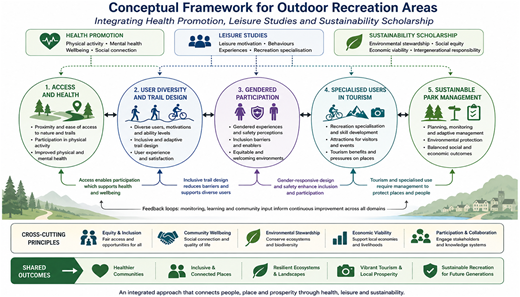
The findings indicate that resident and visitor differences shape wellbeing, trail preferences, and support for management, demonstrating the need for integrated recreation planning. By integrating health promotion, RST and sustainable park management, this study demonstrates that outdoor recreation areas operate as socio-ecological systems shaped by user diversity, behavioural patterns, and environmental conditions (Ostrom, 2009). Although situated in regional Australia, the findings have relevance for recreation destinations facing increasing user diversity and competing demands from residents and visitors. These findings are discussed in relation to five interrelated themes: access and community wellbeing, user diversity and trail design, gendered participation, specialised users in tourism, and sustainable park management (see Figure 1).
Access to outdoor recreation and community wellbeing
Consistent with health promotion theory, the findings reinforce the importance of accessible natural environments in supporting physical activity and broader wellbeing outcomes (Coventry et al., 2021; Parkinson et al., 2025; Zhang et al., 2024). Rather than simply confirming established associations between green space access and activity, the results suggest a more functionally specific mechanism: proximity to trail networks appears to shape not only participation rates but also the duration of engagement in physical activity (Table 3). This extends existing evidence by indicating that local infrastructure does not merely enable activity but may actively structure the intensity and routine nature of health-promoting behaviours, strengthening arguments for place-based approaches in health promotion theory.
The social dimension of recreation was also important. The strong volunteer and club participation observed among mountain bikers suggests that recreation spaces contribute to social cohesion as well as physical health outcomes (Douglas et al., 2017). However, these benefits are unevenly distributed across user groups, highlighting an important equity tension within recreation planning. While specialised user groups such as mountain bikers generate strong social networks and advocacy capacity, walking remains the most accessible and inclusive form of activity, requiring minimal financial or skill-based investment. Taken together, the findings have transferability beyond the specific case study context. They support a broader conceptual proposition that the health impacts of outdoor recreation infrastructure are mediated by both spatial accessibility and user-group characteristics.
Managing diverse abilities and trail experience expectations
Managing trail systems for users with differing experience levels remains challenging (Farías-Torbidoni et al., 2023). The variation in perceived trail difficulty observed in this study, where some users experienced sections as insufficiently demanding while others found them overly challenging, reinforce the need for differentiated trail design strategies that accommodate a range of abilities and preferences. These findings reinforce the relevance of RST in explaining how involvement shapes expectations of trail conditions (Van Deursen et al., 2025), while extending its application by linking perceived mismatches to spatial design constraints rather than user preferences alone.
Differentiated trail design can improve both user experience and inclusion. Providing easy-grade trails can reduce barriers for beginners and underrepresented groups, enhancing the social sustainability of outdoor recreation. Differences between walkers and mountain bikers further demonstrate the complexity of managing shared trail systems. Mountain bikers prioritised technical features, trail connectivity, and physical challenge, whereas walkers preferred more naturalistic environments. Rather than relying solely on spatial segregation or user education (Farías-Torbidoni et al., 2023; Neumann and Mason, 2019), effective trail governance requires adaptive, multi-graded systems that accommodate diverse recreation needs within shared landscapes. Trail design therefore functions as negotiated infrastructure, where inclusion, experience differentiation, and conflict mitigation are integrated through planning.
Gendered participation and inclusive recreation
Gender differences in trail use were evident across user groups. Women comprised just over half of walking trail users, consistent with previous research (Farías-Torbidoni et al., 2023; Lynn and Brown, 2003). Mountain biking remained more male-dominated, reflecting findings that men typically participate more frequently and travel further (Pickering and Rossi, 2016). Women were also more likely to self-identify as beginners, supporting evidence that perceived competence, safety, and belonging influence participation (Wolf et al., 2015). However, the relatively high proportion of women mountain bikers in this study (48%) exceeds earlier estimates of 12–17% (Farías-Torbidoni et al., 2023; Pickering and Rossi, 2016), suggesting increasing diversity despite ongoing structural and cultural barriers. This pattern may reflect local contextual factors, such as trail design that accommodates a range of skill levels, or regional demographic characteristics, although these factors were not directly examined. It may also indicate broader shifts in mountain biking participation as initiatives to improve accessibility and representation encourage more women to engage with the sport.
The findings are relevant to other multi-use trail systems seeking to increase participation diversity. They suggest that infrastructure provision alone is insufficient to address inequities, as participation is influenced by the interaction of environment, safety, and perceived competence. Targeted initiatives, including women-only events, skills training, and safety programs, have been shown to reduce barriers (Derose et al., 2018). The results support gender-responsive management approaches that promote inclusion through both physical design and social programming.
Specialised users, tourism, and regional development
The study highlights the social and economic importance of specialised recreationists, particularly mountain bikers, within regional tourism systems, and the contrasting roles of residents and visitors in shaping trail use dynamics. Multi-use trail networks can extend tourism seasons, support local businesses, and foster community pride and place identity (Klizentyte et al., 2025; Williams and Vaske, 2003), but these benefits depend on balancing visitor-driven economic activity with residents' everyday recreation needs. Consistent with RST, mountain bikers demonstrated higher levels of involvement through overnight travel, advanced skills, and active social media engagement. These behaviours align with research identifying them as experience-oriented tourists seeking challenge, novelty, and skill development (Moularde and Weaver, 2016). Their use of social media to share trail experiences reinforces social identity and destination visibility, positioning them as informal destination marketers and amplifying place exposure beyond the local region.
The findings are relevant to other regional and rural trail-based destinations seeking to integrate recreation and tourism development. Specialised user groups can function as both economic contributors and destination amplifiers, particularly where digital engagement is high. However, the resident–visitor distinction highlights an important management tension: increased visitor visibility and demand can intensify pressure on trail systems primarily used by local residents. This requires more deliberate capacity planning that accounts for dual-use pressures, including maintenance investment, environmental protection, and equitable access for residents and visitors (Marion, 2016; Ostrom, 2009). The benefits of specialisation are therefore contingent on governance approaches that integrate tourism promotion with resident-focused recreation planning and sustainable trail management.
Sustainable park management and user support
Mountain bikers demonstrated more positive attitudes toward park management strategies than walkers (see Table 6). Consistent with RST, highly specialised users are often more supportive of management actions that sustain the resources central to their activity (Bryan, 2000; Van Deursen et al., 2025). High levels of club membership, volunteerism, and travel among mountain bikers suggest that social identity and stewardship norms influence management support. In the Atherton Forest Mountain Bike Park context, formal partnerships and club structures appear to foster custodianship and encourage support for sustainable management. Furthermore, familiarity with trail networks and support for voluntary codes of conduct suggest opportunities for distributed stewardship, where users help identify environmental and maintenance issues (Marion, 2023; Pietilä and Fagerholm, 2016). This positions recreation spaces as co-managed systems in which user expertise complements formal management.
The findings are transferable to other trail-based recreation settings seeking to balance tourism and environmental sustainability. Specialised user groups can contribute to governance where ecological integrity is maintained through co-management approaches (Cerveny et al., 2022; Sarhan et al., 2024). However, ongoing challenges such as trail degradation, maintenance demands, and non-compliance with regulations, including dog restrictions, highlight the limits of user stewardship alone. Inconsistent compliance can compromise safety and environmental outcomes (Kellner et al., 2020), reinforcing the need for integrated strategies that combine infrastructure investment, education, and enforcement.
Conclusion, limitations, and further research
As outdoor recreation participation grows in regional areas, the findings support integrated approaches linking health promotion, leisure studies, and sustainable park management. Rather than treating these domains as separate, the study demonstrated that user characteristics, behaviours, and preferences interact with environmental conditions and management factors to shape both recreational experiences and broader wellbeing outcomes. This highlights that outdoor spaces offer inclusive recreation opportunities where health, experience quality, and sustainability are co-produced. Several practical implications emerge. Expanding access to recreation areas can support community health and wellbeing but should be accompanied by inclusive design and attention to safety perceptions. Recognising user diversity and levels of specialisation is important for developing adaptive trail management strategies that reduce conflict and enhance satisfaction. Engaging specialised users, particularly mountain bikers, may also strengthen regional tourism and stewardship initiatives.
Several limitations should be considered. Self-reported visitation data may be subject to recall bias, while the non-probability sampling approach and uneven subgroup representation limit generalisability. In addition, the voluntary nature of participation may have introduced self-selection bias, whereby more engaged or experienced trail users, particularly female mountain bikers, were more likely to participate, potentially contributing to their overrepresentation in the sample. Also, formal reliability statistics were not calculated, which should be considered a limitation of the study. Data collection outside the peak season may also reduce the applicability of the findings to periods of higher visitation. Finally, the exploratory design relied on descriptive and bivariate analyses, which identify patterns but do not fully capture more complex relationships among recreation specialisation, wellbeing, and sustainability attitudes.
Future research should examine seasonal and longitudinal patterns of use and evaluate specific management interventions. Comparative studies across multiple trail systems and regions would help assess the transferability of the integrated framework beyond the Australian context and identify context-specific and generalisable patterns of recreation behaviour and management. Further investigation is needed into the co-management roles of recreation clubs and user groups to better understand their contributions to stewardship and governance. Future research could also examine the pathways linking recreation participation, wellbeing outcomes, and pro-environmental attitudes to better understand how health, leisure, and sustainability objectives reinforce one another in regional trail systems. Research exploring barriers to women's participation and perceptions of safety remains important for advancing equity in outdoor recreation. Larger and more diverse samples would also enable the use of multivariate techniques, such as regression, factor analysis, and structural equation modelling, to better understand relationships among recreation participation, wellbeing outcomes, and sustainability attitudes.
We thank Jenni Judd and Colin Macgregor for their helpful feedback on an earlier draft of this paper.