

Volunteers at child helplines play an important role in providing support for children, so keeping them satisfied during encounters is crucial to continue helping children. The purpose of this study is to understand how children’s perceptions of instrumental and emotional support (partner effects) influence volunteer encounter satisfaction, and whether this effect is moderated by a volunteer’s previous encounter experience and levels of interpersonal and service-offering adaptiveness.
The sample consisted of 377 dyads of 116 volunteers and 377 children from online service encounters at a child helpline. Questionnaires were used to measure satisfaction, support and volunteer adaptiveness. A multilevel model was estimated to test the hypothesized moderation effects.
This study revealed that the instrumental support partner effect positively influenced volunteer encounter satisfaction. This relationship was stronger when the previous encounter was less satisfying or for volunteers with higher interpersonal, but not higher service-offering, adaptiveness. Negative effects on the relationship between the emotional support partner effect and volunteer encounter satisfaction were found after a less satisfying previous encounter or for volunteers with higher interpersonal adaptiveness.
This study contributes to the services and volunteerism literature by providing a unique perspective on the interpersonal influence between volunteers and children during service encounters. In the context of child helplines, this paper illustrates how volunteer encounter satisfaction is a function of the intricate interplay between children’s perceptions of the service encounter and volunteers’ perceptions of previous experiences and their adaptiveness.
Introduction
Child helplines offer support and information to children for a wide variety of issues such as abuse and violence, bullying, sexuality, family, homelessness, health and discrimination (Fukkink et al., 2016; Potter and Hepburn, 2003). As such, child helplines fulfill the United Nations mandate that all children be heard. In 2017, child helplines in 146 countries received over 24 million contacts from children in need of care and protection (Child Helpline International, 2017), and these numbers are rising rapidly (Van Dolen and Weinberg, 2017). To help meet this growing demand, helplines have introduced online chat as another method of communication. Compared to phone-mediated counseling, online chat makes it more difficult, but not impossible, to detect cues (Hancock et al., 2008) from children.
To perform well in this challenging and evolving context, helplines invest a substantial part of their budget into training volunteers extensively on how to provide social support to each child in the form of instrumental (e.g. advice) and emotional (e.g. empathy) support. Like many other non-governmental organizations, child helplines face the challenges of limited resources and volunteer turnover (Nencini et al., 2015; Sundram et al., 2018; Yanay and Yanay, 2008). So, it is crucial for the helplines to retain their well-trained volunteers to continue offering this important service to children – in fact, helplines’ resources are so stretched that more than half of the calls received cannot be answered (Child Helpline International, 2017).
Even with extensive training, this work can be quite stressful for volunteers, who often face burdensome experiences when interacting with children (Cyr and Dowrick, 1991; Kinzel and Nanson, 2000). Difficult interactions can be mentally and emotionally taxing, thereby reducing volunteer satisfaction (Bennett and Barkensjo, 2005; Garner and Garner, 2011). Nonetheless, helpline volunteers want to remain as long as they can find positive aspects of their role (Sundram et al., 2018). While sources of satisfaction at the organizational (e.g. social support from colleagues) and individual (e.g. personal development) levels are well-documented in both the services marketing (Gounaris and Boukis, 2013; Yi et al., 2011) and volunteerism literature (Garner and Garner, 2011; Lorente-Ayala et al., 2019), relatively less is known about how volunteers may derive satisfaction at the encounter level. This is surprising as helpline volunteers spend most of their time at work interacting with clients.
From notable exceptions in the services literature, it is known that employee encounter satisfaction is influenced by the customer’s perceptions of the experience. Employees are more likely to evaluate the encounter favorably when customers perceive higher levels of social support (Van Dolen et al., 2002) and satisfaction (Frey et al., 2013; Yi et al., 2011; Zablah et al., 2016). This specific phenomenon of interpersonal influence is called partner effects (Kenny and Cook, 1999), whereby an employee’s encounter satisfaction is influenced by the customer’s reactions to the employee’s service provision (Carlson and Miller, 1987). As partner effects occur at the encounter level, studying them in the context of child helplines should yield insight into how volunteers derive satisfaction from each service encounter.
The conservation of resources (COR) theory (Hobfoll, 1989) can be applied to understand how partner effects function during encounters. COR theory posits that individuals want to maintain their current resources, and they will invest these resources to recover from resource loss or to gain resources. By viewing children’s perceptions of social support as a resource, volunteers could acquire this resource via partner effects. Also, COR theory holds that the way resources function depends on the situation and the individual, so it is necessary to consider the context (Hobfoll, 2002; Hobfoll et al., 2018). Therefore, we explore two possible boundary conditions of partner effects on helpline volunteer encounter satisfaction. First, as helpline volunteers frequently experience burdensome encounters, we investigate the moderating effect of previous encounter satisfaction on partner effects. This offers insight on how helpline volunteers can recover lost resources from a less satisfying encounter when they help the next child. Second, as some personal characteristics (e.g. disposition) can facilitate effective management of resources (Halbesleben et al., 2009), we consider volunteer adaptiveness (interpersonal and service-offering adaptiveness) as a factor that may affect resources. Highly adaptive individuals are more sensitive to others (Gwinner et al., 2005) and may be more prone to the influence of their interaction partners and therefore more strongly affected by partner effects.
The purpose of this study is to understand how partner effects from instrumental and emotional support influence child helpline volunteer encounter satisfaction, and whether these effects are moderated by the volunteer’s experience with the previous encounter and by the volunteer’s levels of interpersonal and service-offering adaptiveness. In doing so, this study aims to make a number of contributions to the current literature. First, its setting is distinctive: a child helpline, which is an inclusive service that can be contacted for free, anonymously and without the consent of caregivers. Service encounters take place between vulnerable children and volunteers who are frequently exposed to highly emotional and distressful situations (Kinzel and Nanson, 2000; Rosenbaum et al., 2017; Van Dolen and Weinberg, 2017). Unlike most services marketing research on encounters between fully empowered customers and paid employees, the focus here is on a very specific type of service provision, most closely linked with volunteerism. By investigating child helplines, this study answers the call for more research on volunteer well-being (Kitchingman et al., 2018) and well-being in health care and social services (Anderson and Ostrom, 2015; Ostrom et al., 2015).
Second, this study contributes to the services literature by adding to the growing knowledge of how COR theory can be applied to service encounters (Nicholls and Mohsen, 2019; Stock, 2016). Specifically, we find that perceived social support may serve as a resource for volunteers through partner effects, with benefits contingent upon one’s previous encounter experience and adaptiveness (Halbesleben et al., 2014; Hobfoll et al., 2018; Neff et al., 2012). This result provides counterevidence to the assumption that a negative employee–customer spiral has a negative spillover effect on the next encounter (Groth and Grandey, 2012).
Finally, while much is known about the antecedents and consequences of volunteerism, considerably less research explores the actual experience of volunteering (Wilson, 2012). We contribute to this gap by leaning on findings and theory from the services literature to better understand volunteers’ experiences during interactions (Kitchingman et al., 2018).
The paper first discusses volunteer encounter satisfaction and the partner effects of social support. Outlined next is how a volunteer’s previous encounter satisfaction and adaptiveness might influence the strength of these partner effects. This is followed by the description of the study and model testing. The paper concludes with discussion of the results, implications and future research opportunities.
Literature review
Volunteer encounter satisfaction
While job satisfaction has been broadly defined as “the pleasurable emotional state resulting from the appraisal of one’s job” (Locke, 1969, p. 316), this study defines volunteer encounter satisfaction as the level of personal reward that a child helpline volunteer gains from a service encounter with a child. It is well-known that volunteers are less likely to leave when they derive satisfaction from volunteering (Bennett and Barkensjo, 2005; Garner and Garner, 2011). More recently, the volunteer literature has placed attention on studying how satisfaction is influenced by the work that volunteers are doing in addition to the enduring focus on understanding the motivators of starting to volunteer and the consequences of volunteering (Hidalgo and Moreno, 2009; Stukas et al., 2009; Wilson, 2012). While research documents positive effects on volunteer satisfaction from training, social support and social integration (Hidalgo and Moreno, 2009), less is understood about volunteer satisfaction from encounters with clients (Wilson, 2012). At the encounter level, qualitative research finds that volunteers feel satisfied from “making a difference, helping the caller, and phone calls ending on a positive note” (Sundram et al., 2018, p. 8). However, there is scarce quantitative evidence to corroborate these findings within the volunteerism literature. As these individual encounters are a significant part of the volunteer job, child helpline volunteers must be able to derive satisfaction from them, and not just from organizational-level factors such as support and recognition (Stukas et al., 2009).
Partner effects of social support
Support can be divided into two different categories (Cutrona, 1990; Cutrona and Russell, 1990). Instrumental support refers to assisting individuals to address or solve problems (Beehr and McGrath, 1992; Cutrona and Russell, 1990; Van Dolen et al., 2002), while emotional support refers to fostering interpersonal relationships and trying to alleviate negative emotions brought on by stressful events without directly trying to solve the problems (Beehr and McGrath, 1992; Cutrona, 1990; Sindahl et al., 2019). When providing emotional support, helpline employees are trained to establish rapport but not to comfort children to the extent that they fail to discuss the problem that prompted them to contact the helpline (Sindahl, 2013). Research suggests that one type of support may be more beneficial than the other based on the nature of the problem. For instance, when a problem can be controlled by the child (e.g. eating disorders or friendships), instrumental support is advised, whereas emotional support is better suited for problems out of the child’s control (e.g. abuse or parents arguing) (Cutrona, 1990; Rains et al., 2017; Sindahl et al., 2019; Van Dolen and Weinberg, 2017). It is up to volunteers to determine how much of each type of support to give to each child (Gilat and Rosenau, 2011).
Providing social support during service encounters can strongly impact the experience for both the support provider and receiver (Sundram et al., 2018; Van Dolen et al., 2002). Service interactions are dyadic processes in which the service provider and receiver influence each other’s thoughts, emotions and behaviors (Kenny et al., 2006). This process goes by many names, such as partner effects (Jeon and Choi, 2012; Kenny and Cook, 1999), crossover (Westman et al., 2004; Zimmermann et al., 2011) and conscious contagion (Hennig-Thurau et al., 2006). According to the services marketing literature, when customers are happy with the encounter and/or type of support they received from a service employee, the service employee’s own evaluation of the encounter is more favorable (Frey et al., 2013; Van Dolen et al., 2002; Yi et al., 2011; Zablah et al., 2016).
These partner effects, when positive, may serve as resources for volunteers during service encounters, as COR theory proposes (Hobfoll, 1989; Hobfoll et al., 2018). Resources are context-dependent and have been defined as “anything perceived by the individual to help attain his or her goals” (Halbesleben et al., 2014, p. 1338). For instance, social support is a helpful resource for employees in addressing job demands (Halbesleben, 2006; Kurtessis et al., 2017), and perceptions and evaluations of others can act as resources. That is, resources such as performance self-esteem (Neff et al., 2012) and engagement (Bakker and Xanthopoulou, 2009) can transfer from one person to another. Also, research by Zimmermann et al. (2011) demonstrated that customers can serve as a resource for employees when positive customer behaviors enhance service employees’ positive affect.
In light of the research on partner effects and COR theory, it is likely that volunteers at the child helpline benefit from the partner effects of instrumental and emotional support. When children signal that they feel supported, the encounter is a satisfying experience for the volunteer as it achieves the goal of supporting children (Sindahl et al., 2019).
Boundary conditions of the partner effects
The context is key in COR theory because the ways that resources are preserved and built up can vary significantly according to the individual and the situation (Halbesleben et al., 2014; Hobfoll et al., 2018). The value and relevance of a resource depend on the circumstances (Hobfoll et al., 2000). Also, the manner in which a resource is used can change under different conditions (Hobfoll et al., 2018). Therefore, we expect boundary conditions to apply in our context. We investigate two contextual factors that are potentially relevant to child helpline encounters: volunteers’ previous encounter satisfaction and volunteer adaptiveness.
Previous encounter satisfaction
A volunteer’s previous encounter experience potentially affects the subsequent encounter (Yue et al., 2016). The psychological working environment for volunteers at child helplines is typically demanding and affectively intense (Sindahl, 2013); the topics discussed are severe, the counseling often seems to be a small step toward appropriate help, and the one-time nature of the contact leaves volunteers unsure of the effectiveness of the support they gave to a child (Cyr and Dowrick, 1991; Sindahl, 2013). For instance, a child might contact the helpline because he/she is subject to abuse at home or is having suicidal thoughts. However, it may turn out that the child is not yet ready to seek professional help from social services, or the child abruptly disconnects from the chat. Such scenarios may lead helpline volunteers to experience negative feelings such as anger, guilt, frustration (Cyr and Dowrick, 1991; Kinzel and Nanson, 2000) and powerlessness (Sindahl, 2013). Although helpline volunteers know that this happens, they still feel less satisfied after an encounter in which they felt that they could not provide support sufficiently.
According to mood regulation theory (Larsen, 2000), volunteers will try to ease this negative feeling (i.e. feeling less satisfied). Based on this theory, individuals attempt to alleviate negative affect by engaging in specific activities that will create a positive state or emotional well-being (Chuang et al., 2019; Larsen, 2000; Tice and Bratslavsky, 2000). The number of ways one can relieve negative feelings at work is limited by display rules – the organization’s expectations of which emotions and behaviors are appropriate to express in a service encounter (Ashforth and Humphrey, 1993; Grandey, 2000). Thus, mood regulation strategies such as venting or walking away from the situation (Morris and Reilly, 1987) would be seen as inappropriate. Under these conditions, the negative-state relief model (Baumann et al., 1981; Cialdini and Kenrick, 1976; Manucia et al., 1984) outlines an appropriate way to relieve negative feelings that adheres to display rules. The model suggests that individuals will engage in helping behaviors toward others to feel better because it feels good to help (Baumann et al., 1981; Cialdini and Kenrick, 1976; Manucia et al., 1984). Indeed, several studies show that negative experiences and feelings lead to increased altruistic (Glomb et al., 2011) and helping behaviors (Ilies et al., 2013; Yue et al., 2016).
At child helplines, if a volunteer had a less satisfying experience with a child, he/she would be motivated to alleviate this negative state during the next encounter with a child. To adhere to display rules at the helpline, the negative-state relief model holds that the most feasible method for volunteers to feel better is by helping others (i.e. the next child). Providing social support during the next encounter could reduce negative feelings by receiving positive reactions (Carlson and Miller, 1987; Chuang et al., 2019) from the child (i.e. partner effects). Therefore, we hypothesize the following:
The partner effects from (a) instrumental support and (b) emotional support on volunteer encounter satisfaction are stronger when the volunteer’s previous encounter experience was less satisfying.
Adaptiveness
The second contingency examined in this study is volunteer adaptiveness. Currently, child helplines connect children with whichever volunteer is free at the time rather than routing them to volunteers who are specialized to provide support on certain topics (Sindahl, 2013). This means that support may be needed for drastically different problems from one child to the next, so being adaptive could help volunteers better adjust to each encounter.
In the domain of services marketing, researchers have examined the ways that service employees intentionally and effortfully modify their behavior with the goal of increasing customer satisfaction by better meeting customer needs (Bettencourt and Gwinner, 1996; Gwinner et al., 2005; Weitz et al., 1986). Gwinner et al. (2005) defined and tested two interrelated, yet distinct, dimensions of adaptiveness. Interpersonal adaptiveness refers to altering the manner in which they interact with a customer via interpersonal aspects such as approach, presentation and style (Bettencourt and Gwinner, 1996; Gwinner et al., 2005). It is important for volunteers to show that they can listen continuously to children, but this can be quite difficult in an online chat when visual and verbal cues cannot be used (Hancock et al., 2008; Sindahl, 2013). Thus, volunteers must send messages to children to demonstrate that they are listening while also providing space for children to take the time to reflect and articulate (Sindahl, 2013). Interpersonal adaptiveness can be very helpful for volunteers in finding the appropriate balance.
Second, service-offering adaptiveness refers to customizing the final service being delivered to meet an individual customer’s specific desires (Bettencourt and Gwinner, 1996). Child helpline volunteers are expected to give instrumental and/or emotional support as the “service offering.” Service-offering adaptiveness may be useful if volunteers personalize the type of support for each child, i.e. instrumental or emotional; and even within the type of support, further personalization is possible. For example, if the nature of a child’s problem would best be addressed with instrumental support (Cutrona, 1990), the volunteer may then decide that the child would feel more supported if he/she received only one piece of advice rather than multiple perspectives on the problem.
Compared to interpersonal adaptiveness, service-offering adaptiveness is limited by the nature of the child’s problem and the child’s willingness to accept support. Volunteers may have trouble offering the optimal configuration of support if children refuse to give up their anonymity so that the helpline can intervene in an emergency situation. In contrast, interpersonal adaptiveness is not dependent on the child helpline’s resources, and there are countless ways for volunteers to personalize the interpersonal aspect of each encounter. From this perspective, helpline volunteers are far more limited in the ways they can express service-offering adaptiveness than interpersonal adaptiveness. This two-dimensional conceptualization of adaptiveness is useful for volunteers at child helplines because an underlying process of both forms is cue detection, which aids in determining a child’s preferences (Bettencourt and Gwinner, 1996).
According to COR theory, disposition (e.g. conscientiousness) can be a resource that helps people to manage their other resources (Halbesleben et al., 2009). In this vein, adaptiveness is considered a key resource for this purpose (Hobfoll, 2002; Ployhart and Bliese, 2006; Thoits, 1994). That is, a volunteer who is more adaptive is better able to gain resources during interactions with children (e.g. picking up on the positive energy from children when they feel supported). This makes adaptiveness a highly relevant disposition to consider when studying partner effects.
Being adaptive during an encounter starts with volunteers detecting cues from children to identify their preferences for both the interpersonal interaction and the service offering. It is well known that individuals vary in their ability to detect cues and emotions in others (Brach et al., 2015; Hancock et al., 2008; Hennig-Thurau et al., 2006), so helpline volunteers who are high in adaptiveness are better at detecting and reacting to cues from children. As a result, we argue that higher adaptiveness also allows volunteers to be more perceptive of children’s reactions to the support. In other words, the partner effects from instrumental and emotional support are expected to have a stronger influence on volunteer encounter satisfaction for volunteers with higher adaptiveness. The conceptual model and hypotheses for this study are depicted in Figure 1.
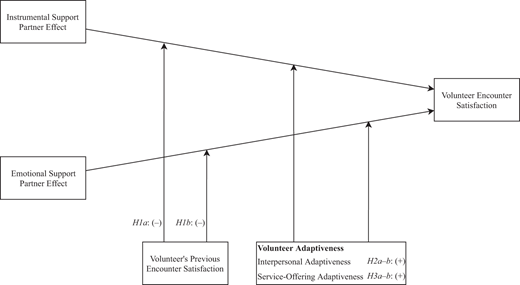
The partner effects from (a) instrumental support and (b) emotional support on volunteer encounter satisfaction are stronger for volunteers who are higher in interpersonal adaptiveness.
The partner effects from (a) instrumental support and (b) emotional support on volunteer encounter satisfaction are stronger for volunteers who are higher in service-offering adaptiveness.
Methodology
Sample
This study is based on a sample of Danish volunteers and children/young people who had an encounter via online chat at a Danish child helpline in 2016. The helpline’s 450 trained volunteers have professional backgrounds in working with children. All of them received information regarding the study and were asked to participate. After each online session, volunteers asked if the child would be willing to answer several questions about the encounter and sent the questionnaire. It was clearly stressed that this questionnaire was anonymous and voluntary. Volunteers were also asked to complete a questionnaire about the encounter after each interaction with a child. Upon completion of the study, another questionnaire was sent (in 2017) to the volunteers who participated in the original study; this later questionnaire measured volunteers’ adaptiveness. There was concern that the volunteers might have changed their self-reported experiences after each encounter to be more reflective of the items used to measure adaptiveness. Therefore, the second questionnaire was not distributed until data collection was complete to prevent these possible demand characteristics from biasing the results of the first questionnaire (McCambridge, 2015; McCambridge et al., 2012). Other data collected were the age and sex of the children and volunteers, along with the length of time volunteers had been involved with the helpline.
Characteristics of participants
In total, questionnaires were collected from 146 helpline volunteers and 567 of the children with whom they interacted. The volunteers were rated by an average of 4.4 children (range = 1-23). To be able to estimate the volunteers’ previous encounter satisfaction, the analyses only included volunteers who were rated by at least two children. With this criterion, 116 volunteers and 377 children were identified.
Of the 116 helpline volunteers, 85.6 per cent were female, 12 per cent were male and 2.4 per cent did not report their sex. Volunteers’ mean age was 44 years (standard deviation [SD] = 19.61). At the time of data collection, they had an average of 2.4 years of experience with the helpline (SD = 2.05). Of the 377 children, 74.9 per cent were female, 24 per cent were male and 1.1 per cent did not report their sex. The mean age of the children who participated was 15 years (SD = 2.53). While this sample appears to be skewed toward females, previous studies on helplines have also found this to be representative of those who contact the helplines (Fukkink and Hermanns, 2009a, 2009b; Sindahl et al., 2019; Van Dolen and Weinberg, 2017).
Measures
To increase the likelihood of survey completion, single-item measures were used. Although there is concern about using single-item measures compared to multi-item scales (Diamantopoulos et al., 2012; Postmes et al., 2012), the use of single-item measures is accepted, and even recommended for studies that collect dyadic data (Fuchs and Diamantopoulos, 2009) and for participants who are difficult to recruit and/or have low response rates (Drolet and Morrison, 2001; Fukkink and Hermanns, 2009a, 2009b; Van Dolen and Weinberg, 2017). The questionnaire was developed in collaboration with child helplines and has been used as a standard quality measurement by helplines for years (Stoilova et al., 2019). It consists of adapted questions based on past studies to suit the child-helpline context (Stoilova et al., 2019). The questionnaires were developed in English, then translated into Danish, back-translated into English, compared with the original questions, and approved by the researchers.
For the first questionnaire – which measured support and volunteer encounter satisfaction – five-point Likert-type scales were used; for the children, the scale had a smiley face at one end and a sad face at the other in accordance with recommendations for surveying children (de Leeuw, 2011). To measure encounter satisfaction, volunteers were asked: “How satisfied are you with your session with the child?” on a scale ranging from 1 (Not satisfied at all) to 5 (Completely satisfied). For instrumental support, children were asked: “Did the counselor give you information and advice?” on a scale ranging from 1 (No information or advice) to 5 (Lots of information and/or advice). Emotional support was measured by asking the children to answer the following: “The counselor […] ” with a scale ranging from 1 ([…] did not care about me) to 5 ([…] cared for me a lot). As an individual’s own perceptions influence his/her evaluation of an encounter (Donavan et al., 2004; Franke and Park, 2006), volunteers also reported their own ratings of emotional and instrumental support after each encounter to serve as control variables in the analysis.
Volunteers’ adaptiveness was measured with three items from the interpersonal adaptiveness scale and three from the service-offering adaptiveness scale developed by Gwinner et al. (2005). To assess measurement validity, a confirmatory factor analysis was run on the measurement model for volunteer adaptiveness using the lavaan package in R (Rosseel, 2012). Because of low factor loadings, one measure was removed from interpersonal adaptiveness and one from service-offering adaptiveness. Based on the recommended thresholds by Hu and Bentler (1999), the goodness-of-fit measures suggest that the model adequately fits the data (χ2/df = 1.274, p = 0.259, comparative fit index = 0.998, nonnormed fit index = 0.987, goodness-of-fit index = 0.995, root-mean-square error of approximation = 0.057). The standardized factor loadings are all statistically significant (p < 0.001). Both constructs meet the suggested thresholds for composite reliability of 0.7 and average variance extracted of 0.5 (Hair et al., 2010). The final items for interpersonal adaptiveness were “I often adjust my personality from one child to the next” and “I act differently at different times, depending on the situation.” The final items for service-offering adaptiveness were “I can easily suggest a wide variety of services to meet each child’s needs” and “I vary the actual support session on a number of dimensions depending on the needs of the child”.
Previous encounter satisfaction was measured by creating a lagged variable from volunteer encounter satisfaction. This means that the volunteer’s rating of satisfaction from the preceding encounter was included as a new variable. Descriptive statistics and correlations of the study variables are presented in Table I.
Descriptive statistics and correlations among variables in the study
| Variables | M | SD | 1 | 2 | 3 | 4 | 5 |
|---|---|---|---|---|---|---|---|
| 1. Volunteer encounter satisfaction | 4.41 | 0.78 | |||||
| 2. Instrumental support partner effect | 3.97 | 1.26 | 0.41** | ||||
| 3. Emotional support partner effect | 3.87 | 1.33 | 0.38** | 0.80** | |||
| 4. Previous encounter satisfaction | 4.33 | 0.86 | 0.10* | 0.04 | 0.08 | ||
| 5. Interpersonal adaptiveness | 5.28 | 1.28 | 0.01 | −0.04 | −0.10 | 0.04 | |
| 6. Service-offering adaptiveness | 5.78 | 0.89 | 0.02 | 0.02 | 0.00 | −0.03 | 0.49** |
Notes:
*p <* 0.05; **p < 0.01
Data analysis
The data were dyadic and represented a one-with-many (i.e. many children nested within one volunteer) reciprocal design (i.e. both volunteers and children were rated) (Kenny et al., 2006). Multilevel modeling (MLM) is often used to analyze dyadic data such that the volunteer–child dyads represent level 1 and are nested within volunteers at level 2. In MLM, it is common to take the group mean of a level-1 predictor variable, X, and use it as a level-2 predictor variable, Z (Van Dolen et al., 2002). However, when working with dyadic data, it is recommended that the person’s X variable and his/her dyad partner’s X be included as level-1 predictors (Kenny and Kashy, 2011). Therefore, predictor scores were grand mean-centered rather than group mean-centered. This analysis was run in R with the lme4 package (Bates et al., 2015) using maximum likelihood.
Model building
Following the procedures described by Hox et al. (2017) for model selection, the full model was built up in stages. First, the intercept-only model was estimated in which the intercept was allowed to vary (Kenny et al., 2006). From this intercept-only model, an intraclass correlation coefficient (ICC) for the volunteer data was 0.15 and significant. The ICC for volunteers showed that 15 per cent of the variance in volunteer satisfaction ratings was attributable to the volunteer.
In the second step, the control variables and fixed predictors were added. At level 1, volunteer variables were age, sex, experience, previous encounter satisfaction and ratings of instrumental and emotional support. Child variables were age, sex and ratings of instrumental and emotional support. Another control variable added to the model was conversation length. At level 2, volunteer interpersonal and service-offering adaptiveness variables were added, along with the number of children who evaluated the volunteer. Volunteer age was found to have a significant negative effect on volunteer encounter satisfaction (b = −0.01, p <* 0.001). In line with past findings (Van Dolen et al., 2002; Zimmermann et al., 2011), we observe significant positive effects on volunteer encounter satisfaction from volunteers’ perceptions of instrumental support (b = 0.33, p < 0.001) and emotional support (b = 0.27, p <* 0.001). When adding these predictors, model fit significantly increased, Δχ2(14) = 261.63, p < 0.001.
In the third and final step, the hypothesized two-way interactions between predictor variables were added. When adding these two-way interactions, model fit increased, Δχ2(6) = 18.05, p <* 0.01. The results of the three models are presented in Table II.
Multilevel estimates for volunteer encounter satisfaction
| Model 1 (Intercept) | Model 2 (Main effects) | Model 3 (Interaction effects) | |
|---|---|---|---|
| Intercept | 4.40** | 4.27** | 4.25** |
| Volunteer age | −0.01** | −0.01** | |
| Volunteer gender | 0.13 | 0.12 | |
| Volunteer experience | 0.02 | 0.02 | |
| Child age | 0.02 | 0.02 | |
| Child gender | 0.01 | 0.01 | |
| Number of chats | 0.00 | 0.00 | |
| Conversation length | 0.00 | 0.00 | |
| Volunteer emotional support | 0.27** | 0.27** | |
| Volunteer instrumental support | 0.33** | 0.31** | |
| Instrumental support partner effect | 0.11** | 0.11** | |
| Emotional support partner effect | 0.03 | 0.04 | |
| Previous encounter satisfaction | −0.03 | −0.02 | |
| Interpersonal adaptiveness | 0.02 | 0.01 | |
| Service-offering adaptiveness | −0.02 | −0.01 | |
| Instrumental support partner effect × volunteer previous satisfaction | −0.10* | ||
| Emotional support partner effect × volunteer previous satisfaction | 0.09 | ||
| Instrumental support partner effect × interpersonal adaptiveness | 0.11** | ||
| Emotional support partner effect × interpersonal adaptiveness | −0.08* | ||
| Instrumental support partner effect × service-offering adaptiveness | −0.12* | ||
| Emotional support partner effect × service-offering adaptiveness | 0.06 | ||
| Random effects | |||
| σ2 (level-1 variance) | 0.52 | 0.27 | 0.25 |
| τ00 (intercept variance) | 0.09 | 0.04 | 0.04 |
| ICC | 0.15 | 0.12 | 0.12 |
| Marginal R2 | 0.00 | 0.51 | 0.53 |
| Conditional R2 | 0.15 | 0.57 | 0.59 |
| Deviance | 874.689 | 613.064 | 595.017 |
| log-likelihood | −437.345 | −306.532 | −297.509 |
Notes:
Regression coefficients are unstandardized; *p < 0.05; **p <* 0.01
Results
Previous encounter satisfaction
H1 predicted that a positive influence from the partner effects of instrumental and emotional support on volunteer encounter satisfaction would be stronger when the volunteer’s previous encounter satisfaction was low. The results revealed significant interaction effects of volunteers’ previous encounter satisfaction on children’s evaluations of instrumental support (b = −0.10, p < 0.05) and emotional support (b = 0.09, p = 0.05). When previous encounter satisfaction was low, the effect from instrumental support was stronger, thereby supporting H1a. Contrary to our expectations, the effect from emotional support on satisfaction was weaker when previous encounter satisfaction was low, so H1b was not supported.
Interpersonal adaptiveness
H2 predicted that higher levels of interpersonal adaptiveness would strengthen the positive influence from the partner effects of instrumental and emotional support on volunteer satisfaction. Significant interaction effects emerged of interpersonal adaptiveness on instrumental support (b = 0.11, p <* 0.01) and emotional support (b = −0.08, p < 0.05). When volunteers had higher levels of interpersonal adaptiveness, the effect from instrumental support was stronger. Therefore, H2a is supported. However, the effect on volunteer encounter satisfaction was weaker from emotional support when volunteers had higher levels of interpersonal adaptiveness, so H2b is not supported.
Service-offering adaptiveness
H3 predicted that higher levels of service-offering adaptiveness would strengthen the positive effects from the partner effects of instrumental and emotional support on volunteer encounter satisfaction. The interaction effect of service-offering adaptiveness on instrumental support was significant and negative (b = −0.12, p <* 0.01). When volunteers had higher levels of service-offering adaptiveness, the effect on volunteer encounter satisfaction was weaker from instrumental support. Therefore, H3a is not supported. There was not a significant interaction effect of service-offering adaptiveness on emotional support (b = 0.06, p = 0.22). Thus, the strength of the effect from emotional support on encounter satisfaction was not influenced by volunteers’ levels of service-offering adaptiveness, so H3b is not supported.
Discussion
The aim of this study was to understand how the encounter satisfaction experienced by child helpline volunteers is impacted by the partner effects of instrumental and emotional support and whether boundary conditions could be identified for this influence. With the application of COR theory (Hobfoll, 1989; Hobfoll et al., 2018) in the idiosyncratic context of service encounters at child helplines, previous encounter satisfaction and volunteer adaptiveness were investigated as relevant contingencies on how volunteers can gain resources through their interactions with children. We expected that when previous encounter satisfaction was low, helpline volunteers would try to return to a more positive state by drawing on the next child’s experience of support as a resource. Also, we expected that helpline volunteers with higher levels of adaptiveness would be more perceptive of, and therefore more susceptible to, the partner effects of children.
Regarding the boundary condition of previous encounter satisfaction, we find that its interaction with the instrumental support partner effect was significant and negative, as hypothesized. This is in accordance with the theorized effect from COR theory (Hobfoll, 1989; Hobfoll et al., 2018) and the negative-state relief model (Baumann et al., 1981; Cialdini and Kenrick, 1976; Manucia et al., 1984). After a less satisfying encounter, the support as perceived by the next child has a stronger influence on the volunteer because it may act as a resource to regain satisfaction. In this way, the partner effect allows volunteers to recover resources in the form of providing instrumental support to feel more satisfied.
The nature of the interaction between previous encounter satisfaction and the emotional support partner effect was significant and positive. This suggests that the partner effect from emotional support is weaker on volunteer satisfaction when the volunteer’s previous encounter was less satisfying. Under this condition, the current child’s reaction to emotional support has less effect on the volunteer’s current encounter satisfaction. While unexpected, this result seems to reflect what is known about the consequences of service failure. One possible explanation is that the volunteer was ruminating on the poor previous encounter and was less focused on the emotional cues from current child (Baranik et al., 2016; Wang et al., 2013). Alternatively, this relationship could signal a maladaptive coping mechanism in response to the dissatisfying previous encounter, such as retaliation or withdrawal (Walker et al., 2014).
Regarding the boundary effect of adaptiveness, the interaction effect between interpersonal adaptiveness and the instrumental support partner effect was significant and positive, as hypothesized. Thus, volunteers with higher interpersonal adaptiveness are more strongly affected by the instrumental support partner effect. In line with COR theory (Hobfoll, 1989; Hobfoll et al., 2018), interpersonal adaptiveness may therefore function as a beneficial resource for volunteers by making them more susceptible to instrumental support partner effects. Those high on interpersonal adaptiveness are able to gain more satisfaction through the instrumental support that the child feels he or she received during the encounter.
However, the interaction effect between interpersonal adaptiveness and the emotional support partner effect was significant and negative, suggesting that the partner effect from emotional support has a weaker influence on encounter satisfaction for volunteers with higher interpersonal adaptiveness. The finding was unexpected but may be because of the way volunteers are trained to provide emotional support: provide empathy but not to the degree that the child no longer feels anxious enough to discuss the problem (Sindahl, 2013). For volunteers with higher interpersonal adaptiveness, this task of remaining “clinical” in their role as counselors may conflict with their disposition to personalize the interaction to fulfill the child’s desires. Thus, in the context of providing emotional support, interpersonal adaptiveness may make volunteers less open to detecting cues from children. In turn, volunteers are less strongly affected by the partner effects of emotional support.
Similarly, the interaction effect between service-offering adaptiveness and the instrumental support partner effect was significant and negative. This suggests that, contrary to our expectations, the partner effect from instrumental support is weaker for volunteers with higher service-offering adaptiveness. The ways of customizing instrumental support are limited by factors such as the child’s willingness to disclose personal information (in the event a referral or intervention is needed). As a result, volunteers with higher service-offering adaptiveness may disagree with a child’s positive reaction to instrumental support because they believe there is a better option that was not feasible. Thus, volunteers with high service-offering adaptiveness are less affected by the partner effect of instrumental support and thereby gain less satisfaction from it during an encounter.
Finally, the interaction effect between service-offering adaptiveness and the emotional support partner effect was positive but not significant. This suggests that the influence of the emotional support partner effect is not stronger for volunteers with a higher service-offering adaptiveness disposition. Emotional support is the most beneficial type of support for uncontrollable problems (Cutrona, 1990), which are the types of problems most frequently discussed at child helplines (Sindahl et al., 2019). Child helpline volunteers are trained to give emotional support for these problems through active listening and providing empathy (Sindahl, 2013). It is likely that these forms of emotional support do not need to be further personalized to the child, so service-offering adaptiveness is not a significantly helpful resource in these situations.
Overall, we conclude that the partner effects of social support do influence volunteer encounter satisfaction. We identified moderating effects on this relationship from a volunteer’s previous encounter satisfaction (a situational factor) and from a volunteer’s levels of adaptiveness (a personality factor). By empirically testing these boundary conditions, this study demonstrates the importance of viewing COR theory in context (Halbesleben et al., 2014; Hobfoll, 2002; Hobfoll et al., 2018). The finding that volunteer encounter satisfaction is affected by previous encounter satisfaction provides another perspective on customer–employee spirals (Stock et al., 2016; Wolter et al., 2019). Contrary to the assumption that negative exchanges between a customer and employee have a negative spillover effect on the next service encounter (Groth and Grandey, 2012), we suggest that there are circumstances under which the spillover has an opposite effect (i.e. when the employee can gain resources in the next encounter).
Finally, by applying insights from the services literature to the volunteerism context, we show that helpline volunteers can derive satisfaction from the children they support and can use them as psychological resources during service encounters (Zimmermann et al., 2011). Thus, when investigating volunteer satisfaction at the encounter level, it is important to consider intricate interplay between partner effects from the current encounter, earlier experiences and individual adaptiveness.
Practical implications
As stated in the introduction, child helplines invest much of their budgets on extensive training for volunteers. Therefore, it is important for helplines to retain their well-trained volunteers by ensuring their satisfaction during encounters with children (Garner and Garner, 2011; Kinzel and Nanson, 2000; Stukas et al., 2009). This study has several implications for helplines and their volunteers with regard to maintaining encounter satisfaction.
First, as the results have shown the potential benefits that perceived instrumental support may have on volunteer encounter satisfaction for those with high interpersonal adaptiveness or for those with less satisfying previous encounters, helpline volunteers should ensure that children really perceive that they received good instrumental support. At child helplines, instrumental support typically refers to sharing information and advice with children and giving referrals to other agencies when needed (Fukkink and Hermanns, 2009a; Sindahl, 2013). Additionally, volunteers need to feel that they can help clients effectively to feel satisfied with their volunteer work (i.e. participation efficacy) (Galindo-Kuhn and Guzley, 2002). To better facilitate this, we recommend ensuring that volunteers have easy access to all tools, information and resources necessary to provide excellent instrumental support.
Second, given that volunteers’ previous encounter satisfaction has an impact on the current encounter, it is worthwhile for child helplines to consider implementing a feedback tool for volunteer encounter satisfaction. In those instances when a volunteer indicates that he/she is not satisfied with the encounter, he/she can be helped by a colleague or manager in providing support during the next encounter. As our findings suggest that emotional support does not have a stronger effect on volunteer encounter satisfaction after a less satisfying previous encounter, such a tool would be especially helpful to buffer negative consequences of providing emotional support in the next encounter.
Finally, it is known that engaging in adaptive behaviors requires volunteers to actively search for cues from the child to determine how best to meet his/her needs. Such perception requires a great amount of effort and resources from volunteers (Baard et al., 2012; Gwinner et al., 2005). Currently, child helplines do not focus on training volunteers for adaptiveness. However, training volunteers to improve the antecedents of adaptiveness (e.g. sensitivity to others and customer knowledge) would make it easier for less adaptive volunteers to detect cues and personalize encounters while helping children (Bettencourt and Gwinner, 1996; Gwinner et al., 2005). Also, a monitoring system could help by highlighting text in the chat during an encounter. If words related to “advice” and “information” for instrumental support and “care” for emotional support could be highlighted in chat messages from the child, it may help the volunteers to provide the best possible support. Such a tool may also help them to better read and sense the changes in the perception of the child, thereby influencing volunteer satisfaction.
Limitations and future directions
Relevant limitations in this study point to future research opportunities. First, the social-service context of the child helpline differs from services that are more “traditional,” as it does not involve financial transactions, and the consumers in the sample are children instead of adults. It is known that children may behave differently as consumers compared to adults (Hook et al., 2017), so future research collecting dyadic data in a more “traditional” service setting in which children are consumers and in a social-service setting in which adults are consumers would be interesting. In this way, researchers can detect whether the findings from the present study are more likely specific to the social-service setting or to the age of this sample.
Additionally, the use of multi-item scales to measure constructs is favored over single-item measures because it is not possible to assess the reliability and validity of a single item (Diamantopoulos et al., 2012; Fuchs and Diamantopoulos, 2009; Postmes et al., 2012). At the same time, using single-item measures is more practical for researchers and managers because they minimize participant refusal and reduce costs in collecting and processing data (Bergkvist and Rossiter, 2007; Drolet and Morrison, 2001). To resolve this, we recommend that future research on vulnerable populations first validate a single-item measure against a multi-item scale to ensure validity before collecting data (Bergkvist and Rossiter, 2007; Diamantopoulos et al., 2012).
The interpersonal and service-offering adaptiveness constructs are considered dispositions “because they indicate a level of “readiness” to act in a certain way in response to appropriate stimuli” (Wilson, 2012, p. 179). However, there are other conceptualizations of adaptiveness (i.e. ability or skill) that can improve over time with use and practice (Baard et al., 2012; Ployhart and Bliese, 2006). While the conceptualizations of adaptiveness used in this study are assumed to be stable, future research may find new and insightful results by examining adaptiveness as something that can increase with time and training. An alternative characteristic that may be highly relevant in this context is resilience.
Individuals often state that they began volunteering because of altruistic motivations (e.g. wanting to do good and help others) (Sundram et al., 2018). As the negative-state relief model was developed to describe egoistic motivations (i.e. people engage in helping behaviors with the goal of feeling better about themselves) (Baumann et al., 1981; Cialdini and Kenrick, 1976), the results of this study suggest that volunteers’ intentions to stay could be more egoistic than altruistic. Research in the volunteerism literature could investigate how volunteers reconcile the two types of motivations or when egoistic motivations become a stronger determinant of retention than altruistic motivations.
Finally, a possible alternative explanation for the inconsistent findings of the interaction effects may lie in an external force affecting the service encounter. A future study on satisfaction at child helpline may consider measuring a shared external force such as the nature of the problem (e.g. controllability) (Cutrona, 1990), which may help to further explain which pairings of volunteer adaptiveness and social support are most beneficial to volunteers after a less satisfying service encounter.
The authors gratefully acknowledge Trine Sindahl for her help with the data collection and David A. Kenny for his statistical support.

