


Motivated by the psychoevolutionary theory, this study investigated the impact of a biophilic environment in hospital rooms presented in virtual reality (VR) to simulated patients on perceived healing. It explored how varying degrees of nature exposure through window views, indoor plants and green-themed décor, influenced patients’ recovery perceptions, offering insights into evidence-based healthcare design.
A total of 12 VR scenarios of a hospital room were created, manipulating biophilic design elements. Participants rated the extent to which each scenario was perceived to contribute to the ability to heal after undergoing a hospital patient transportation narrative and acute external stressor process. The ratings were analyzed using full-profile conjoint and group conjoint analyses.
The results demonstrated that views of dense green nature from the window, abundant indoor plants and green colored room décor had the highest utility scores among attributes influencing the room’s perceived contribution to healing. In contrast, views of adjacent buildings and the hospital building envelope were negatively associated with perceived healing.
Higher saturation of a green environment and interior design in hospitals, including views of nature from windows, higher quantities of indoor plants and prevalence of green-colored décor, can potentially boost patients’ healing confidence and psychological recovery, supporting their overall therapeutic experience.
This study explores simulated patients’ perceptions of hospital room environments in VR, focusing on biophilic and verdant environments. It examines views of nature, buildings and the sky through windows, presence of plants and interior design features including green walls.
Introduction
In recent years, enhancing patient healing has become a strategic focus for healthcare professionals (Suess and Mody, 2018a, b; Tekin and Urbano Gutiérrez, 2023). Research increasingly shows that healthcare environments significantly impact patients’ psychological and physical outcomes, underscoring the importance of creating supportive and healing spaces in medical service settings (Evans and McCoy, 1998; Gesler, 2003; Holte et al., 2011; Shumaker and Reizenstein, 1982; Verderber and Fine, 2000; Raanaas et al., 2012, 2016). For acutely-ill patients, the hospital room – where they spend most of their time – plays a pivotal role in psychological recovery, pain management and stress reduction (Andrade and Devlin, 2015; Ulrich, 2001; Ulrich et al., 2008). Many healthcare facilities are now embracing biophilic design, incorporating natural elements into built spaces, to enhance the healing environment (Tekin and Urbano Gutiérrez, 2023). This approach aims to optimize patient experience and promote better health outcomes.
A growing body of evidence suggests that biophilic design elements, such as window views of nature, indoor plants and green-themed decor, contribute to stress reduction and psychological well-being (e.g. Bringslimark et al., 2009; Lindal and Hartig, 2013, 2015; Masoudinejad and Hartig, 2020; Michels et al., 2022; Totaforti, 2018; Ulrich, 2008). Window views featuring a blue sky, and abundant green foliage and trees have been linked to reduced patient stress and improved recovery rates (Bringslimark et al., 2009; Grinde and Patil, 2009; Grinde and Patil, 2009; Hartig et al., 2011; Honold et al., 2016; Masoudinejad and Hartig, 2020; Pati et al., 2016; Ulrich, 1991, 1984a, b; Van den Berg et al., 2003, 2016). Green colored interiors (Joye and Van den Berg, 2011), potted plant-filled spaces and indoor gardens at hospitals have been linked to reduced stress (Marcus, 2007; Marcus and Sachs, 2013; Park and Mattson, 2008; Pretty, 2004; Raanaas et al., 2010). Architecture and building facades have also been identified as altering patients’ window view and affecting their healing times (Lindal and Hartig, 2013; de la Fuente Suárez and Martínez-Soto, 2022).
These findings indicate that, collectively, biophilic hospital room attributes can play a critical role in fostering healing experiences among patients. However, while extensive research exists on the individual effects of window views, plant immersion and interior decor attributes, studies analyzing the combined influence of these hospital room features remain limited. Moreover, evidence suggests that individuals spending longer times in hospitals on average are associated with increased vulnerability to environmental stressors, as extended exposure to institutional settings can intensify psychological fatigue, anxiety and emotional distress (Ulrich, 2001; Dijkstra et al., 2006; Malenbaum et al., 2008). Patients who spend more time in clinical environments may become more attuned to the quality of their surroundings, particularly in relation to comfort, connection to nature and perceived control. Further research utilizing multivariate techniques to understand how individuals who spend more time in hospitals and with higher hospitalization frequency perceive multiple room attributes is therefore warranted, as it can inform hospital design to optimize visual surroundings for patient recovery in extended stay situations, offering both theoretical insights and practical applications (Lindal and Hartig, 2013; Masoudinejad and Hartig, 2020; Nadal et al., 2010; Van den Berg et al., 2016).
To this end, the objective of this study was to assess the extent to which the hospital room environment was perceived to contribute to the enhanced of healing of acutely ill patients, with a particular focus on biophilic attributes. To achieve this, we employed conjoint analysis to evaluate how factors including window views, plants and interior design influenced perceived experiences of simulated patients. Participants were exposed to hospital room environments presented through VR headsets following an acute stressor and transportation narrative video, prompting them to imagine themselves as the patient presented in the scenes, allowing for a more controlled simulated evaluation of the impact various biophilic attributes have relative to others in the hospital room. We systematically varied green nature elements, visibility of adjacent buildings through the window, the hospital building’s enclosure obstructing nature views, depth of sky view, immersion in plants and green-colored room décor. Respondents evaluated environments based on the extent to which they perceived the room would contribute to their ability to heal, enabling us to quantify the relative contribution of each attribute to those perceptions through a subsequent conjoint analysis. Additionally, we explored whether these factors had differential effects on individuals who indicated they spent more days on average hospitalized, ensuring a comparison of key environmental elements that would be significantly more important for individuals who are more frequently hospitalized, or spending more time in hospitals on average.
However, it is crucial to acknowledge that simulated patients may not react to biophilic stimuli in a manner similar to acutely ill hospitalized patients. Thus, transferring the implications of these findings to acute care settings requires careful validation. Our study on a non-hospitalized population aims to provide broad insights into the psychological benefits of biophilic environments that are purported to enhance healing. In doing so, this research builds upon the psychoevolutionary theory (PET) framework (Kaplan and Kaplan, 1989; Kaplan, 1992a, b; Plutchik, 1980; Thake et al., 2017; Ulrich, 1983; Ulrich et al., 1991), which emphasizes the interplay between human evolution and the healing potential of natural environments.
Literature review
Integrating natural elements into building design is a foundational principle of biophilic design, which emphasizes the incorporation of nature into the built environment to enhance human well-being (Rosenbaum et al., 2018). In healthcare settings, where patients often experience heightened stress and physiological challenges, biophilic design has emerged as a critical strategy for fostering restoration and improving clinical outcomes.
Hospital inpatients frequently face adverse health conditions, including increased inflammation, compromised immune function and delayed wound healing, which can prolong recovery and strain coping mechanisms (Gannon et al., 2023). Psychological stress has been shown to exacerbate these physiological challenges. For instance, Kiecolt-Glaser et al. (2015) found that individuals experiencing high stress exhibited significantly slower wound healing rates than those with lower stress levels. Similarly, chronic stress-induced immune dysregulation and elevated inflammation can prolong hospital stays and increase susceptibility to complications (Segerstrom and Miller, 2004). Given these risks, designing hospital environments that mitigate stress and enhance psychological resilience is a crucial consideration for patient care.
Biophilic design
A growing body of research highlights the therapeutic benefits of nature-based design elements in healthcare settings. For example, access to healing gardens near ICUs has been shown to provide a restorative effect, significantly reducing patient stress levels and improving psychological well-being (Ulrich et al., 2020). By integrating elements such as plants, trees, flowers and other foliage, hospitals can create environments that promote relaxation, cognitive restoration and emotional stability.
In a study by Park and Mattson (2009a, b), hospitalized patients who were exposed to nature views or indoor plants reported lower levels of pain, anxiety and fatigue compared to those in environments lacking natural elements. This underscores the psychological benefits of nature integration, suggesting that even passive exposure to greenery can enhance patient comfort and resilience. Likewise, Raanaas et al. (2010) found that patients with window views of natural landscapes experienced shorter recovery times and required fewer pain medications, demonstrating tangible physiological advantages associated with nature exposure.
Additionally, Joye and Van den Berg (2011) examined the role of visual exposure to nature, finding that elements such as greenery and water features led to a significant reduction in stress biomarkers, including cortisol levels, while also improving overall mood. These findings suggest that a biophilic hospital design can actively counteract the physiological and psychological burden of hospitalization, fostering a more supportive and healing environment.
In short, the integration of biophilic design in hospital environments harnesses the restorative power of nature, significantly improving patient recovery, stress reduction and psychological well-being. By cultivating a therapeutic and calming atmosphere, hospitals can enhance clinical outcomes, reduce recovery times and improve overall patient satisfaction. Given the growing evidence supporting its benefits, biophilic design should be considered an essential component of a hospital room, including natural window views, plants and decor that fosters physical relaxation and cognitive resilience.
Psychoevolutionary theory (PET)
PET highlights the deep-rooted biological bond between humans and nature, proposing that evolutionary adaptations have conditioned individuals to perceive natural environments as intrinsically restorative, safe and essential for survival and well-being (Kellert, 2012). According to PET, human cognitive and affective systems have evolved to favor natural settings due to their historical significance in providing resources, shelter and refuge. Supporting this theory, extensive research has demonstrated that exposure to nature elicits psychological and physiological benefits, including stress reduction, enhanced cognitive functioning and accelerated healing (Ulrich, 1984a, b).
Biophilic design in healthcare: PET as a theoretical lens
The beneficial effects of biophilic elements in hospital room design can be understood through the framework of PET, which suggests that natural stimuli trigger restorative responses, thereby reducing stress and enhancing well-being. PET explains why individuals experience improved psychological and physiological outcomes in healthcare environments enriched with biophilic features, such as green spaces, natural light and organic materials (Kaplan and Kaplan, 1989; Kaplan, 1992a, b; Plutchik, 1980; Thake et al., 2017; Ulrich, 1983; Ulrich et al., 1991).
Ulrich et al. (1991, 2008) argue that humans possess an innate predisposition for restorative responses to natural environments, a trait that has evolved due to the adaptive advantages nature provided for survival. PET posits that natural elements symbolize fundamental survival cues, fostering a sense of security, cognitive ease and emotional stability (Joye and Van den Berg, 2011; Thake et al., 2017, 2020). This theory suggests that hospital environments incorporating biophilic elements can optimize patients’ cognitive and affective processes by offering an ideal balance of stimulation and sensory richness conducive to healing.
From a PET perspective, hospital room designs that integrate natural elements (such as green trees, grass, plants) enhance perceptions of safety, comfort and connection to the environment. This aligns with evolutionary predispositions that associate natural landscapes with resource abundance, protection and overall well-being. PET suggests that the sensory richness and dynamic qualities of natural elements help reduce stress levels and facilitate recovery, making nature-inspired interior environments particularly beneficial for hospital patients.
While research indicates that exposure to biophilic hospital settings can lead to lower stress biomarkers (e.g. cortisol reduction), improved mood, enhanced cognitive functioning and faster recovery times (Kaplan and Kaplan, 1989; Ulrich et al., 1991), gaps remain in understanding the strength specific visual and perceptual factors have, relative to others, on healing outcomes in clinical settings. Further investigation is necessary to identify which design elements – such as window views, plant arrangements or color schemes – most effectively support patient well-being and recovery.
Based on PET, we explore how various hospital room elements influence patient healing and how evidence-based design strategies can be developed to maximize the restorative potential of healthcare environments. Understanding the cognitive and affective responses elicited by specific natural design features will be critical in refining hospital spaces to foster optimal patient recovery, reduce psychological distress and enhance overall well-being.
View of green nature
Extensive research has demonstrated that window views of natural environments play a crucial role in improving various patient outcomes, including stress reduction, enhanced relaxation, improved psychological well-being, shorter hospitalization durations and accelerated healing (Bringslimark et al., 2009; Grinde and Patil, 2009; Ulrich, 1991; Van den Berg et al., 2016). Among these, views featuring green natural elements, particularly trees and plant life, have been strongly associated with significant improvements to restoration (Grinde and Patil, 2009; Hartig et al., 2011; Honold et al., 2016; Van den Berg et al., 2003, 2016).
Moreover, having trees and vegetation close to windows – along with thoughtful design considerations like window size and positioning – has been found to enhance patients’ sense of connection with the outdoors, which in turn promotes stress reduction and supports emotional healing (Ozdemir, 2010; Raanaas et al., 2012, 2016; Ulrich, 1984a, b; Verderber and Reuman, 1987). In addition to greenery, the visual appeal of landscapes visible through windows – such as water features, hills or mountains – has been associated with increased relaxation and improved restorative experiences (Astell-Burt et al., 2022a, b; Briki and Majed, 2019; Guzzo et al., 2022; Klompmaker et al., 2022; Richardson et al., 2012; Yin et al., 2022). Similarly, views of the open sky, when unobstructed, have been recognized for their role in lowering stress levels, fostering a sense of spaciousness, calm and mental ease (Masoudinejad and Hartig, 2020; Pati et al., 2016).
The colors of nature visible through hospital windows – particularly shades of green, blue and earthy brown – have been found to significantly enhance well-being (Coleman and Kearns, 2015; Joye and Van den Berg, 2011; Memari et al., 2021; Shin et al., 2022; Van den Berg et al., 2016; Yin et al., 2022). Among these, greenery has been the most consistently associated with positive health outcomes, reinforcing the idea that exposure to lush natural landscapes contributes to psychological and physiological recovery. Patients who have access to green nature views from their hospital rooms experience shorter hospital stays and fewer post-surgical complications, highlighting the tangible benefits of biophilic hospital design (Ulrich, 1984a, b). In one of the earliest studies on this topic, Ulrich (1979) demonstrated that exposure to green, natural environments significantly alleviated negative emotions in patients while simultaneously enhancing positive emotional states. These findings have been repeatedly confirmed in subsequent research, showing that the presence of green vegetation is strongly associated with reductions in physiological stress markers, such as lower blood pressure, decreased heart rate and reduced cortisol levels (Heerwagen and Orians, 1986; Pati et al., 2016; Klompmaker et al., 2022).
View of building envelope and adjacent buildings
Ulrich (1984a, b) proposed that windows serve as beneficial distractions by eliciting positive emotions and alleviating anxiety and stress in patients. Building on this, studies grounded in the Prospect-Refuge Theory (Appleton, 1996) argue that people are innately drawn to expansive views that provide broad visibility and openness, as these views facilitate environmental assessment, lower feelings of uncertainty and help individuals identify safe retreat areas (Stamps, 2008; Ulrich, 1983). In line with this perspective, Killova and Lehto (2016) reported that the perceived openness of natural landscapes in tourism settings was positively linked to their restorative potential, while Ozdemir (2010) demonstrated that greater window openness and wider natural vistas enhanced perceptions of spaciousness and contributed to stress relief.
From an alternative evolutionary perspective, humans may exhibit a preference for environments characterized by limited visual depth and enclosure formed by building envelopes, as these configurations may enhance feelings of privacy and safety. Conversely, open views of nature, while often considered restorative, might evoke a sense of exposure and vulnerability (Heerwagen and Orians, 1995; Orians, 1986; Scupelli et al., 2007; Stamps, 2008). Supporting this notion, Asgarzadeh et al. (2014) found that perceptions of spaciousness were linked to feelings of oppressiveness in urban settings, specifically in relation to buildings, trees, sky and ground surfaces in Tokyo. Complementary findings suggest that building enclosures, by offering horizontal surfaces with visual complexity, may counteract monotony and contribute to a more stimulating environment (Nadal et al., 2010; Stamps, 2002; Van den Berg et al., 2016). Attention restoration has been supported through soft-fascination and viewing of physical elements such as buildings (Huisman et al., 2012; Lindal and Hartig, 2013; Ohly et al., 2016; Ulrich, 1981; Van Den Berg et al., 2016; Zarghami et al., 2019). Nonetheless, the findings from a majority of studies consistently demonstrate that nature scenes are more influential in restoration than architectural elements, buildings surfaces or urban skylines (Lindal and Hartig, 2015; Ulrich et al., 1991; Van den Berg et al., 2016). Thus, the relationship between environmental openness and enclosure, as influenced by architectural elements within the window view, and outcomes such as healing, is multifaceted and remains insufficiently understood.
Plant immersion
A growing body of research highlights the therapeutic value of incorporating plants and gardens into hospital public spaces, showing positive impacts on patient wellbeing (Marcus, 2007; Marcus and Sachs, 2013; Park and Mattson, 2008; Pretty, 2004; Raanaas et al., 2010). Likewise, evidence suggests that having plants within patient rooms enhances the healing atmosphere of these environments. Drawing on the PET, which asserts that humans possess an inherent tendency to seek connections with nature – shaped by evolutionary experiences in lush, vegetated settings – the visual inclusion of indoor greenery in hospital rooms is believed to support psychological restoration (Gillis and Gatersleben, 2015; Kellert et al., 2011; Ryan et al., 2014; Tekin et al., 2023; Totaforti, 2018; Ulrich, 2008). Research has shown that integrating biophilic design elements, such as indoor plants, enhances patient experiences by fostering a sense of belonging, tranquility and connection to the natural world (Bringslimark et al., 2009; Dijkstra et al., 2008; Hall and Knuth, 2019; Park and Mattson, 2008, 2009a, b; Raanaas et al., 2016).
The restorative benefits of plants may also stem from the spatial enclosure they provide, as larger plants can create a sense of shelter and refuge – an especially valuable feature in hospital environments where patients often face elevated stress and feelings of uncertainty (Joye and De Block, 2011). This natural form of enclosure can mitigate anxiety, providing a psychologically safe and calming atmosphere that enhances emotional resilience during healing. Furthermore, placing plants in outdoor window planters allows patients to maintain a visual connection to nearby natural elements, even in rooms without direct access to greenery (Wohlwill, 1983). This design strategy provides a beneficial psychological distraction, creating a sense of “being away” from the immediate stressors of the hospital environment (Raanaas et al., 2011; Hall and Knuth, 2019; Lindal and Hartig, 2013; Masoudinejad and Hartig, 2020).
Green room décor
The color theme of hospital room interiors plays a crucial role in fostering psychological restoration and promoting healing (Sengke and Atmodiwirjo, 2017). Research suggests that color influences mood, stress levels and cognitive function, making it a key consideration in evidence-based healthcare design. Biologically, humans have an innate attraction to the color green, a preference deeply rooted in evolutionary adaptation to natural environments that provided resources, safety and sustenance (Briki and Majed, 2019; Joye and Van den Berg, 2011; Memari et al., 2021). The PET underscores the importance of nature in human survival and well-being, explaining why green environments and design elements are often associated with relaxation, health and emotional balance (Joye and Van den Berg, 2011). Consequently, green color schemes are frequently recommended for healthcare settings, as they evoke feelings of serenity, tranquility and renewal, reinforcing their therapeutic potential in patient-centered design. This aligns with growing evidence suggesting that exposure to green hues enhances psychological well-being, reducing stress and anxiety while promoting cognitive restoration (Briki and Majed, 2019; Joye and Van den Berg, 2011; Memari et al., 2021).
Building upon the PET and the established literature on biophilic design in healthcare environments, this study aims to examine how specific hospital room attributes influence acutely ill patients’ perceptions of healing. While extensive research has demonstrated the restorative benefits of nature exposure, there remain gaps in understanding how various biophilic elements – such as window views, plant immersion, green décor and spatial enclosure – interact to shape patient well-being. Based on the existing literature and PET’s theoretical underpinnings, the following research question is put forth:
What are the relative contributions and interactions of different biophilic design elements in hospital rooms to the perceived healing of acutely ill patients?
How do biophilic design attributes in hospital rooms influence acutely-ill patients’ perceptions of healing, as explained through Psychoevolutionary Theory (PET)?
In addition, specifically determining whether nature window views, window view obstruction from the hospital building, indoor plants, green décor, adjacent buildings in view and depth of sky view – matter more or less to someone who is more frequently hospitalized and spends more time in a hospital, on average, compared to others; the following additional research question is put forth:
Do these perceptions differ significantly between individuals who spend more days on average in hospitals?
Figure 1 represents the attributes and hypothesized framework developed based on the PET, explored in this study.
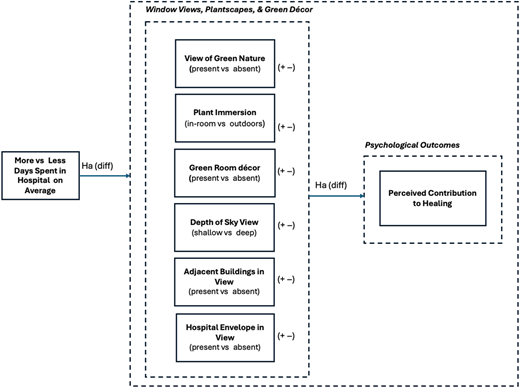
Proposed framework of psychological healing in a biophilic hospital room. Credit: Created by the authors’ of this study
Proposed framework of psychological healing in a biophilic hospital room. Credit: Created by the authors’ of this study
Methodology
Study design and procedure
To answer the research questions, a multi-stage procedure was conducted. The first part of the study involved specification of six room attributes based on the tenets of the PET, and elements tested on cognitive healing outcomes in past literature and fractional factorial design methods to systematically vary attributes across 12 scenarios that were then developed using 3D visualization software. The second part of the study involved simulated acute-illness patient respondents evaluating 12 hospital room scenarios (n = 188) in virtual reality (VR). The third part of the study involved testing the evaluations using conjoint analysis techniques for interpreting utility part-worth estimates and importance scores.
Part I – development of hospital room scenarios
Selection of attributes
Firstly, six attributes with two levels each including nature window views, adjacent buildings and building enclosures in window view, depth of sky, plantscapes and green colored room décor were identified based on previous studies that have shown they elicit recovery in patients (e.g. Masoudinejad and Hartig, 2020; Van den Berg et al., 2016). The selection process was guided by the PET, which underscores the role of specific environmental conditions in enhancing wellbeing, restoration and healing (Ulrich, 1983), with particular consideration for the acute-care patient context and environmental stressors affecting hospital patients. To uphold academic rigor and ensure relevance, a systematic expert review was conducted with senior scholars specializing in environmental psychology, public health, healthcare interior design and architecture. This multi-step process began with identifying an initial set of hospital room attributes from peer-reviewed literature on biophilic design, stress recovery and healthcare environments. These attributes were then cross-validated against empirical findings demonstrating their impact on patient recovery outcomes, including stress alleviation and cognitive restoration. A structured review process was implemented to confirm that the six selected attributes were theoretically grounded, empirically validated and contextually appropriate for evaluation in an acute-care hospital setting. Faculty experts provided detailed feedback on the clarity, specificity and operationalization of each attribute, ensuring they were distinct, measurable and relevant to patient recovery. Upon completion of the expert review, the six attributes were explicitly defined for subsequent conjoint analysis.
The two levels of the first attribute of a window view provided different views of nature. The first level offered a high-density green view from the window, while the second level had no visible nature. The second attribute included two levels of buildings adjacent to the hospital in view. Level one included buildings in the window view, whereas level two did not. The third attribute was the building enclosure and had two levels of absence of the hospital’s building architecture or presence in varying degrees of configuration from the window. The fourth attribute, plant immersion, included two levels of either a collection of large indoor plants in the hospital room or outdoor window box planters. The fifth attribute was depth of view, with two levels of either a more open view with the visible horizon and sky or a shallow view with narrow sky visibility. The sixth attribute was the incorporation of green wall color and décor scheme into the room. The first level included green wall color and art, and the second level had neutral wall colors and no art. The attributes and their corresponding levels are outlined in a summary of the attributes and their respective levels are presented in Table 1.
Selected attributes and levels
| Attribute | Level 1 | Level 2 | |
|---|---|---|---|
| 1. | Green nature in view | Green in view (visible nature, trees, etc.) | No green in view |
| 2. | Buildings in view | No other adjacent buildings in view | Adjacent buildings in view |
| 3. | Building enclosure | Hospital building envelope invisible | Hospital building envelope visible |
| 4. | Plant immersion | Large in-room potted plants | Outdoor plants (i.e. window garden or plants in close proximity to window) |
| 5. | Depth of sky in view | Deep view- can see horizon and blue sky | Shallow view- cannot see horizon and blue sky |
| 6. | Green room decor | Green wall color | No green wall color |
Note(s): The attributes for the room scenarios were determined based on a review of the environmental psychology and healthcare environment literature (Park and Mattson, 2008, 2009a, b; Hartig et al., 2011; Masoudinejad and Hartig, 2020; Van den Berg et al., 2016), and literature on Psychoevolutionary Theory (Ulrich, 1981) and soft fascination in ART (Kaplan, 1995)
Source(s): Created by the authors of this study
Adapting methods from Millar and Baloglu (2011), Suess and Mody (2017), Suess et al. (2024) and Guzzo et al. (2022), choice profiles were created to test the individual and collective effects of the attributes and levels thereof in a VR environments using a fractional factorial method and rendering techniques to develop the scenarios in 3D. The SPSS conjoint design tool was used to specify an orthogonal design and reduce possible combinations of 12 variables from the levels of window views, plantscape and green décor into 12 profiles from which 3D hospital room models were built using Rhino 17 software and rendered through Enscape. The number of profiles exceeded the number of parameters recommended by Xu and Yuan (2001). The base hospital room model was developed to exact scale from measurements taken from a hospital room at the Clinical Simulation Lab at the Health Sciences Center of (Texas A&M University). The 12 room scenarios with manipulated attributes (as shown in Appendix A) were exported to a desktop computer at the Human Behavior Lab in the Department of Agricultural Economics at Texas A&M University. Then using Enscape, a software plug-in for Rhino v.7 that can render 360-degree building information models with hyper-realistic features in real-time, participants viewed the models using a Varjo XR-3 VR headset with parallax correction.
Participants viewed the 12 profiles in randomized order and rated each on how strongly they felt that the room they were seeing contributed to the sense of being able to heal. Before evaluating the scenarios, participants watched a short film designed to immerse them in the perspective of a patient in a hospital setting and induce external stress processing. This approach, based on narrative transportation, aimed to enhance the relevance and depth of their evaluations by engaging and prompting them to imagine themselves as an acutely-injured patient, and to emotionally connect with the patient experience. A total of 188 participants simulated the patient experience and evaluated the profiles.
Given patients could be situated on different floors within a hospital; to account for changes in window views, floor level heights were systematically varied allowing for a view of the sky, tree line height, building rooftops and facades of adjacent buildings to vary on an upper and lower level, thus, increasing representation of measurements of the perceptual indicators of openness, depth of sky, enclosure from the building envelope and visual complexity from building horizontal surfaces, pathways, grass, trees and foliage (see Appendix A for details on the scenarios).
Data collection
Adults who were over 18 years of age were invited to participate in the study via bulk email using the SONA internal system of the the Human Behavior Laboratory in the Department of Agricultural Economics at Texas A&M University. The recruitment was stratified across various factors such as age, gender and race categories in the local surrounding communities of College Station, TX. Many participants were already part of the registered subject panel in the SONA system, which had features to manage quota sampling. The recruitment email included a description of the study, information about the Varjo XR-3 VR device, an informed consent sheet and screening criteria for subjects at risk of complications from VR headsets and devices using lithium batteries. Participants were screened for various health conditions (pregnancies, pacemakers, eye conditions, vertigo, migraines), and if they agreed to participate, they scheduled a time slot with the Principal Investigator or a designated Research Assistant. Upon completion of the study, participants received $25 cash, and their names, email links and payment receipts were kept confidential by the research team. A total of 188 subjects participated in the study, with each evaluation of the scenarios and completion of the self-administered survey lasting 29–54 min. The data were collected from October 15th, 2022, to December 21st, 2022 (Approved IRB ID: IRB2022-0337D Reference Number: 139,137).
Narrative transportation
Before evaluating the 12 hospital room scenarios in the VR headset, participants were instructed by the Principal Investigator or a designated Research Assistant to sit on a chair, calibrated to a galvanic skin response device, and instructed to view an approximately five-minute video designed for the study based on a narrative transportation process by which viewers become absorbed or lost in a story (Ellis et al., 2024; Freeman et al., 2024; Jiang et al., 2022; Lindsey, 2017). Studies employing video-based story telling from 2 to 10 min have been effective in narrative transportation studies (Cao et al., 2021; Moore and Miller, 2020); the present study’s video lasted approximately 3 min, prompting the viewer to imagine themselves as the central character, experiencing extremes of a rollercoaster accident, surgery, leading up to hospitalization. Viewers were asked to imagine themselves in recovery from a major orthopedic rehabilitative surgery at the end of the video (YouTube Link: https://youtu.be/82069oHaKoE). To induce a psychological state of stress, the rollercoaster accident story was chosen over other accident stories to minimize psychological harm by triggering recall of more commonly experienced accidents and hospitalizations (Memari et al., 2021). The video combined animation and Canva stock film footage of a rollercoaster accident, ambulance to a trauma center, surgery and in-patient post-surgery care for paralysis. The video was intensified with ominous music to increase tensions and the affective auditory stress process (Yehuda, 2011). A self-reported stress indicator was measured both before and after viewing the videos, in addition to the galvanic skin response device measurement.
Survey measurement
Immediately following the video in which respondents were prompted to think of themselves as a patient in recovery and evaluation of stressful thoughts invading their mind, participants were presented with the hospital room scenarios randomized for order by the Principal Investigator or Research Assistant, one at a time, viewed through the Varjo X3 VR headset, and asked to rate on a scale (1–10) “How strongly do you feel a sense of being able to heal in the space you are seeing now?” Following the rating of each of the 12 hospital room scenarios, they answered additional questions on a survey conducted on iPads, which included a measure of “sense of presence in virtual reality” to assess the extent to which participants felt that the VR hospital room effectively simulated a real-life setting. Additionally, demographic questions were included such as age, income, education, gender, race and nights hospitalized in the past 5 years.
Results
Demographic profile
The sample demographic information is presented in Table 2. Out of the 188 participants, 56.68% were women. The age distribution shows that 14.36% were aged 18–25 years, 33.51% were aged 26–34 years, 18.09% were aged 35–54 years, 5.43% were aged 55–64 years and 7.98% were aged 65 years or older. Approximately 45.74% of the participants reported an income of $60,000 or less, with 19.2% earning between $45,000 and $60,000. Educational attainment varied with 13% of the participants having a high school education, 29.62% had some college education, while 42.26% and 15.14% had attended college and graduate school respectively. The majority of participants (66.54%) reported working at least part-time. Ethnicity distribution indicated that 65.96% of the participants were White/Caucasian, 5.0% Black/African American, 24.06% Asian and 0% American Indian/Alaskan Native. The Hispanic background was identified by 14.4% of the sample. International countries were represented by 27 participants, with Mexico, India, Korea, China and Kenya being the countries indicated.
Demographic profile of respondents
| Demographic category | Number | % |
|---|---|---|
| Gender | ||
| Male | 80 | 42.78 |
| Female | 106 | 56.68 |
| Non-binary/third gender | 1 | 0.53 |
| Prefer not to answer | 0 | 0 |
| Age (years) | ||
| 18–24 | 27 | 14.36 |
| 25–34 | 63 | 33.51 |
| 35–44 | 34 | 18.09 |
| 44–54 | 20 | 10.64 |
| 55–64 | 29 | 15.43 |
| 65 or older | 15 | 7.98 |
| Income (yearly) | ||
| Less than $25,000 | 22 | 11.7 |
| $25,000–$49,999 | 33 | 17.55 |
| $50,000–$74,999 | 31 | 16.49 |
| $75,000–$99,999 | 27 | 14.36 |
| $100,000–$149,999 | 39 | 20.74 |
| $150,000 or more | 24 | 12.77 |
| Prefer not to say | 12 | 6.38 |
| Education | ||
| Grade school | 4 | 0.67 |
| High school | 74 | 12.31 |
| Some college | 178 | 29.62 |
| College | 254 | 42.26 |
| Graduate school | 91 | 15.14 |
| Employment status | ||
| Employed full time | 345 | 57.4 |
| Employed part time | 91 | 15.14 |
| Unemployed looking for work | 54 | 8.99 |
| Unemployed not looking for work | 23 | 3.83 |
| Retired | 34 | 5.66 |
| Student | 43 | 7.15 |
| Disabled | 11 | 1.83 |
| Ethnicity | ||
| White/Caucasian | 124 | 124 |
| Black/African American 68 | 9 | 9 |
| Asian | 45 | 45 |
| Native Hawaiian/Other Pacific Islander | 0 | 0 |
| American Indian/Alaskan Native | 0 | 0 |
| Prefer not to answer | 9 | 9 |
| Hispanic | ||
| Yes | 27 | 14.44 |
| No | 160 | 85.56 |
| Overall, how many nights have you spent in a hospital in the last 5 years? | ||
| I have not been hospitalized | 133 | 70.74 |
| 1–5 nights | 47 | 25 |
| 6–10 nights | 4 | 2.13 |
| 11–15 nights | 1 | 0.53 |
| 16–19 nights | 1 | 0.53 |
| 20 nights or more | 2 | 1.06 |
Source(s): Created by the authors of this study
Conjoint analysis
To analyze the data, a full-profile conjoint analysis technique was used. The technique involved calculating part-worth estimates to determine the utility of each attribute to perceived healing among the scenarios, as well as scores ranking the relative importance of each attribute to the outcome of perceived healing. Additional conjoint analyses compared groups of respondents by dividing the sample into two sub-samples based on days spent hospitalized in the past 5 years. Pairwise comparisons were then conducted to determine significant differences in evaluations for those who had spent more time as a hospitalized patient. Pairwise comparison tests were used to assess significant differences in the conjoint part-worth estimates and importance scores among the groups.
Hospital room attributes contribution to improved healing
The Pearson’s R (0.996) and Kendall’s Tau (0.970) showed high correlation coefficients, with p-values <0.001, indicating a strong relationship between observed and estimated preferences. The conjoint model fit the data well and demonstrated the ability of the model to consistently predict the set of attribute evaluations for the measured outcome (Hair et al., 2010). The part-worth utility scores for the six attributes and their 12 levels, which reflected the extent to which the hospital room was perceived to contribute to the ability to heal, are presented in Table 3. Part-worth scores are comparable to multiple regression coefficients, where values represent the relative contribution of each level of an attribute to the overall room’s perceived contribution to ability to heal score. Positive values indicate that the attribute had a stronger effect relative to its other level, and higher overall scores among the attributes reflect their relative importance compared to other attributes on the measurement of the combined effect of biophilic attributes on perceived ability to heal.
Part-worth scores
| Attributes and levels | Part-worth score Extent to which hospital room contributes to the ability to heal | |
|---|---|---|
| Green nature in view | Green nature in view | 0.534 |
| No green nature in view | −0.534 | |
| Buildings enclosure | No building enclosure in view | 0.214 |
| Building enclosure in view | −0.214 | |
| Plant immersion | Indoor plants | 0.483 |
| Outdoor plants (i.e. window garden/planters) | −0.483 | |
| Depth of sky in view | Deep view of sky | 0.049 |
| Shallow view of sky | −0.049 | |
| Buildings in view | No other adjacent buildings in view | 0.094 |
| Adjacent buildings in view | −0.094 | |
| Green room décor | Green color scheme | 0.305 |
| No green color scheme | −0.305 | |
| (Constant) | 5.743 | |
Source(s): Created by the authors of this study
Green nature in the window view was highly valued and had the largest positive impact when present in the hospital room (part worth score = 0.534). Having no building exterior visible in the window view positively contributed to perceptions of ability to heal, highlighting the amplified effect of an unobstructed view, allowing for denser proportions of green and sky (part worth score = 0.214). Abundant indoor plants were perceived to contribute to the ability to heal more positively than abundant outdoor plants in a window garden (part worth score = 0.483). Deeper views of the sky provided a small positive effect, although the impact was minimal (part-worth = 0.049). Other buildings in view were relatively undesirable (part-worth = −0.094). Finally, green color décor schemes inside the hospital room were regarded as a positive factor (part worth score = 0.305). Overall, the 5.743 baseline utility reflected an overall positive sentiment toward a biophilic hospital room environment (standard error = 0.034).
The importance scores for the conjoint analysis represent the relative significance of each attribute in influencing the extent to which the hospital room contributed to perceived healing. These scores were calculated based on the range of part-worth utilities for each attribute and shown in Table 4.
Relative attribute importance scores
| Extent to which hospital room contributes to the ability to heal | ||
|---|---|---|
| Attributes | Importance score | Rank |
| Green nature in view | 31.83 | 1 |
| Plant immersion | 28.79 | 2 |
| Green room décor | 18.17 | 3 |
| Building enclosure | 12.72 | 4 |
| Buildings in view | 5.58 | 5 |
| Depth of sky view | 2.91 | 6 |
Source(s): Created by the authors of this study
Green nature in view was the most significant attribute in shaping perceptions. It accounted for 31.83% of the total influence of the room’s effect on perceived healing, followed by 28.79% from immersion in plants. Thus, ensuring views from the window of greenery such as treetops, bushes/shrubs, grassed areas, plants and gardens, is a critical priority for improving the hospital room environment’s visual appeal and a patient’s confidence in their ability to heal, as it has the highest weight. The room’s green color themed design or features account for 18.17% of the influence. While not as critical as the view of greenery from window or plants, room-specific features still play a significant role in shaping perceptions. The building enclosure or boundary-related elements of the hospital have a moderate level of importance when absent, contributing 12.72%. Unobstructed views allow a higher proportion of green nature to be visible from a patient’s hospital room window, in effect magnifying the importance of the view of green nature. Adjacent buildings hold 5.58% importance, and of lower concern to be out of a patient’s window view compared to the hospital building enclosures, nevertheless further emphasizing the importance of unobstructed views of green nature, and higher proportions of greenery, and plants. 50.14% represents the combined contribution of green nature in view, with no building enclosures obstructing nature in view in view and no adjacent buildings in view. Depth of sky was the least important, with 2.91% contribution, thus it would seem that the skyline and visible horizon had minimal impact on perceptions relative to other attributes tested, by comparison to green nature attributes which were considered higher priority than a deeper view with higher proportions of visible blue sky.
Group comparison of prior hospitalizations
We divided the sample into two distinct groups based on number of nights spent in a hospital in the past five years. The first group included 133 participants who indicated they had not been hospitalized, while 56 indicated one or more nights spent in a hospital. For each group, a separate conjoint analysis was performed. While the sample sizes were unequal, this does not inherently prevent comparison of scores in full profile conjoint analysis, and 56 in the sample of previously hospitalized respondents exceeded the minimum required for a design with six attributes, two levels each, as calculated by: N ≥ 500/A × L where A is the number of attributes and L is the average number of levels per attribute. Conjoint analyses showed that the model fit well for both groups and effectively predicted the contribution of the attributes to the perceived healing of the hospital room, as evidenced by the high Pearson’s R and Kendall’s tau statistics values (Hair et al., 2010). The values for the group that had not been hospitalized were 0.992 and 0.931, while the values for the group that was previously hospitalized were 0.995 and 0.962. These results were significant (p < 0.001). Table 5 presents the part-worth scores for the six attributes across the 12 levels for each group and the z-scores from pairwise comparisons of the coefficients and standard errors. The baseline utililty scores for the groups were 5.686 and 5.779 (standard error ranged 0.039 – 0.045).
Part-worth estimates: not previously hospitalized versus previously hospitalized
| Attributes and levels | Part-worth score Extent to which hospital room contributes to the ability to heal Not previously hospitalized (n = 133) | Part-worth score Extent to which hospital room contributes to the ability to heal Previously hospitalized (n = 56) | z-score | |
|---|---|---|---|---|
| Green nature in view | Green nature in view | 0.531 | 0.540 | −0.151 |
| No green nature in view | −0.531 | −0.540 | 0.151 | |
| Buildings enclosure | No building enclosure in view | 0.200 | 0.237 | −0.621 |
| Building enclosure in view | −0.200 | −0.237 | 0.621 | |
| Plant immersion | Indoor plants | 0.475 | 0.504 | −0.487 |
| Outdoor plants (i.e. window garden/planters) | −0.475 | −0.504 | 0.487 | |
| Depth of sky in view | Deep view of sky | 0.068 | 0.001 | 1.125 |
| Shallow view of sky | −0.068 | −0.001 | −1.125 | |
| Buildings in view | No other adjacent buildings in view | 0.100 | 0.079 | 0.353 |
| Adjacent buildings in view | −0.100 | −0.079 | −0.353 | |
| Green room décor | Green color scheme | 0.263 | 0.397 | −2.25* |
| No green color scheme | −0.263 | −0.397 | 2.25* | |
| (Constant) | 5.779 | 5.686 | ||
Note(s): * = p < 0.05
Source(s): Created by the authors of this study
Results indicated utility scores for green views of nature, views unobstructed by buildings, plant immersion, and green decor were higher for the previously hospitalized group. Pairwise comparisons revealed green room décor stood out as a feature where previously hospitalized respondents indicated a significantly stronger utility (p < 0.05) to perceived healing compared to those who were not hospitalized. This suggests that green room décor may play a unique role in influencing the perceptions of individuals experiencing more time in hospitals, potentially related to their healing experiences or associations with health and recovery. It could be worth exploring further why the green interior design features and color scheme resonate more strongly with respondents as their hospitalization instances increase. The importance scores for the group conjoint analysis representing the relative significance of each attribute in influencing the extent to which the hospital room contributed to perceived healing among the groups of varying hospitalizations and their differences are shown in Table 6.
Relative attribute importance scores
| Extent to which hospital room contributes to the ability to heal | ||||
|---|---|---|---|---|
| Not previously hospitalized | Previously hospitalized | |||
| Attribute | Importance score | Rank | Importance score | Rank |
| Green nature in view | 32.440 | 1 | 30.711 | 1 |
| Plant immersion | 29.021 | 2 | 28.680 | 2 |
| Green room decor | 16.045 | 3 | 22.589 | 3 |
| Building enclosure | 12.238 | 4 | 13.452 | 4 |
| Buildings in view | 6.099 | 5 | 4.484 | 5 |
| Depth of sky view | 4.157 | 6 | 0.085 | 6 |
Source(s): Created by the authors of this study
For both groups, green nature in view was the most important attribute, with the highest importance scores (32.440 for those not previously hospitalized and 30.711 for those previously hospitalized). Plant immersion ranked the second in importance for both groups (29.021 and 28.680), demonstrating that the presence of plants (preferably indoor plants in the hospital room) is another highly valued feature, further highlighting the role of biophilic design in promoting healing. Respondents who were previously hospitalized (22.589) place significantly more importance on green room décor (e.g. green interior wall color schemes) compared to those not previously hospitalized (16.045). Depth of sky view was notably less important for the previously hospitalized group, with a negligible importance score of 0.085 compared to 4.157 for those not previously hospitalized. This could indicate that patients with prior hospitalizations focus more on the immediate environmental features (e.g. potted plants and green colored interior design) rather than expansive views of the horizon and skyline. Both groups ranked buildings in view as the least important attribute (ranks 5 and 6). This suggests that window views (unobstructed) by building elements, or (the absence of) adjacent buildings in view have lower influence on perceptions of a room’s contribution to healing compared to the verdant elements like views of green nature, green room color and immersion in plants. It is evident that both groups of respondents highly prioritize more saturated biophilic environments, reinforcing the importance of natural elements and green-colored design in healing-supportive environments. Notably, differences in importance scores for sky views among groups suggest that prior hospitalization experiences may shape the higher associations of more saturated green environments with healing. Our results could guide design decisions to emphasize green colored décor in hospital rooms, as they potentially enhance psychological comfort, particularly indicated by those more familiar with hospital environments. While many attributes were consistent across both groups, findings from the study can contribute to the literature by highlighting how prior hospitalizations influence perceived healing qualities associated with biophilic features.
Discussion
This study contributes to the fields of environmental psychology and evidence-based design by exploring how hospital room environments influence patient recovery. As patient-centered design strategies increasingly incorporate biophilic principles, it becomes essential to examine how biophilic elements and window views jointly affect healing outcomes. Although prior research (Park and Mattson, 2008, 2009a, b; Hartig et al., 2011; Masoudinejad and Hartig, 2020; Raanaas et al., 2010, 2012; Ulrich, 1984a, b; Van den Berg et al., 2016) and foundational work grounded in the PET (Plutchik, 1980; Ulrich, 1981) have shaped the selection of relevant environmental features, this study offers a novel approach by employing full-profile conjoint analysis to assess how individuals evaluate hospital multiple room features – including window views, indoor greenery and naturalistic décor - collectively and relative to each other.
By applying VR-based experimental design, this study extends prior research on biophilic healthcare environments by systematically quantifying the relative contributions of simulated biophilic elements to perceived healing. While previous studies have confirmed the general benefits of nature integration in hospitals (Ulrich, 1984a, b; Park and Mattson, 2008), this study examined how patients balance window views, plants and décor when judging a room’s healing effect. Moreover, by using a patient narrative and stress-inducing process before VR exposure, we made patient evaluations more realistic, ensuring our findings reflect real psychological responses in a healthcare setting. In addition, to enhance ecological validity, we conducted a preliminary expert validation with healthcare design specialists, ensuring that furniture, lighting conditions and spatial layouts mirrored real hospital environments. Additionally, participants evaluated hospital rooms while primed with a heightened sense of stress and vulnerability.
This study offers a valuable contribution by integrating perspectives from the PET into simulated hospital room environments. Historically, humans have consistently incorporated natural elements into their surroundings, and a body of research has demonstrated that nature-inspired visuals are particularly effective in reducing stress compared to other environmental features (Ulrich et al., 1991; Ulrich, 2000; Van den Berg et al., 2016). Despite theoretical support from PET for incorporating nature into hospital design, healthcare settings have traditionally prioritized pharmaceutical interventions and clinical outcomes, often overlooking complementary therapeutic strategies that support recovery (Marcus and Barnes, 1999; Marcus and Sachs, 2013; Suess and Mody, 2018a, b). Consequently, a growing number of studies now emphasize the importance of connecting natural elements with healthcare design to promote therapeutic benefits. Evidence indicates that features such as views of nature, indoor plants and green-themed décor can support psychological restoration and enhance healing, underscoring the need for their broader inclusion in healthcare environments. PET (Kaplan and Kaplan, 1989; Ulrich, 1983) highlights the fact that human affinity for nature is rooted in evolutionary adaptations that favored survival in verdant environments. This study builds upon PET by exploring how specific biophilic elements in hospital rooms (e.g. window views, plants, green décor) trigger differential restorative responses. While PET has been widely applied in environmental psychology, its application in immersive virtual environments remains underexplored. By using VR simulations, we tested whether perceived healing effects align with PET predictions in an ecologically valid hospital room setting, advancing the theoretical underpinnings of biophilic healthcare design.
This study revealed that the views of nature greenery, presence of plants and green-themed décor yielded the highest utility values in participants’ perceptions of healing. Among these, the view of green nature ranked as the most influential factor, with an importance score of 31.83. This result aligns with prior research by Pizam (2015) and Kaplan (1992a, b), which emphasized the therapeutic impact of natural window views. Specifically, such views may enhance recovery by offering visual openness, fostering a sense of connection with nature and providing aesthetically pleasing stimuli that promote soft fascination. Supporting this, studies by Velarde et al. (2007) and Ulrich (1981) found that green landscapes produce more significant stress-reduction effects than other natural elements. Similarly, research by Van den Berg et al. (2010, 2015) further confirms the restorative potential of green environments surrounding the home for improved mental health. Our findings reveal a hierarchy of biophilic elements in promoting perceived healing, with window views of green nature and indoor plant immersion emerging as the most influential attributes, followed by green room decor.
However, providing vast nature views may not be feasible for all hospitals due to the significant capital investment required. Therefore, hospitals can increase the proportion of green nature in the window view by enhancing the landscaping around the property and directly on the hospital building via window boxes or terraces. Prior research has shown that adding a variety of potted plants, flowers in a window box or gardens on building rooftops and balconies can enhance wellbeing in the absence of a broader view of natural landscape. The present study emphasizes the need for pragmatic landscape elements that maximize opportunities for views of green nature (Masoudinejad and Hartig, 2020; Peters and Masoudinejad, 2022).
Plants also had high relative importance in promoting healing in the same group of participants (28.68). Studies by Park and Mattson (2008) and Park et al. (2002) found that plants and flowers in a hospital room can reduce reported pain levels and improve overall well-being. Other studies have also shown that plants can reduce stress and anxiety, combat depression, counteract physical discomfort, improve mood, attention and cognitive performance (Fjeld, 2000; Hall and Knuth, 2019; Han and Ruan, 2019). Therefore, the findings of these studies and the present study suggest that plants also have measurable benefits in a hospital room and are an affordable and easy-to-implement solution.
The results suggest that choosing specific interior design features, such as green wall color and artwork, is important from an interior design perspective. Green color is both visually appealing and symbolic of nature. In the present study, green wall décor was the third most important feature ranked by participants. Moreover, while green décor was generally well-received by participants, those who reported having prior hospitalizations placed significantly more value on green wall color and décor (22.589 compared to 16.045). This suggests that people who have spent more time in hospitals may be more aware of interior design details, possibly as a way to cope with being in a confined space. PET may underlie the stronger contribution of green color to perceived healing to this group, in that green symbolizes the color of a particular natural environment that represents adaptive benefits for survival (Joye and Van den Berg, 2011; Thake et al., 2017, 2020; Ulrich, 1991, 2008). Nevertheless, regardless of the duration of a hospital stay, the consistent preference for green over neutral tones and conventional room décor underscores the positive influence of green hues in enhancing patients’ confidence in their ability to recover. Window views unobstructed by the building envelope also held slightly more importance to this group.
To explore how individuals perceive the healing potential of window views, plant features and green-themed décor in simulated hospital rooms, this study introduced a set of propositions and a conceptual framework grounded in PET. As hospital designers increasingly prioritize intentional room views and landscape architects advocate for green nature interventions, the findings offer a foundation for deeper investigation into patients’ lived experiences of hospital environments. The use of conjoint experimental methods in this context allows for the isolation of the specific effects of building views and nature-based elements, providing a useful platform for future research to explore restorative environments through alternative methodological approaches (Mannathai et al., 2025; Suess et al., 2024; Suess and Maddock, 2025).
Finally, unlike prior studies that relied on post-occupancy surveys or observational assessments of healing environments, our study employs VR-based conjoint analysis to isolate and assess individual and combined effects of biophilic elements. This method allows us to precisely quantify the relative importance of nature views, plants and green décor, offering a customizable and replicable approach for healthcare architects, strategic marketers and designers.
Practical implications
The findings of the present study offer valuable insights and specific design recommendations for hospital administrators, healthcare facility developers and policymakers. Incorporating biophilic design principles into hospital room environments can serve not only as a patient-centric approach but also as a strategic element for improving patient outcomes and hospital operations. Hospital administrators can leverage biophilic room design to highlight their commitment to patient care, using such designs as a key differentiator in attracting prospective patients. By integrating natural elements, such as window views of greenery, plantscapes and other restorative attributes, hospitals can create environments that promote patient well-being, potentially enhancing recovery rates and reducing hospital stays.
From a practical perspective, this approach aligns with evidence-based design (EBD) principles, which advocate for the integration of environmental factors to optimize patient outcomes. For instance, Ulrich’s (1986) seminal research demonstrated that patients with access to views of trees spent 8.5% less time in terms of postoperative days in the hospital than patients without such views. Similar contemporary studies have also documented reductions in hospital stays associated with exposure to nature and restorative environmental features. While the present study did not directly measure outcomes such as accelerated healing times or cost savings, it provides a foundational framework for future research to empirically validate the relationship between individual biophilic attributes and their combined effects on perceived and actual healing outcomes.
The implications extend beyond patient healing to operational efficiencies and cost management. By fostering expedited recovery, biophilic design can help reduce the overall length of hospital stays, contributing to significant cost savings for healthcare facilities. Reduced recovery times can also alleviate strain on hospital resources, freeing up beds and staff time for other patients. Additionally, these design enhancements may lead to higher patient satisfaction scores, which are increasingly tied to hospital reimbursement rates and reputational metrics.
Additionally, this study suggests that simulations and virtual scenarios could be used in future research to predict how patients perceive and experience healing in biophilic environments. These tools could help validate the efficacy of specific design elements and refine strategies for optimizing hospital room environments. By focusing on evidence-based practices, researchers can advance the understanding of how biophilic design contributes to patient healing and well-being.
Hospital administrators and developers are encouraged to view biophilic design not only as an operational improvement but also as a marketing and branding opportunity. Highlighting the use of nature-inspired design in promotional materials and patient communications can position hospitals as innovative and patient-centered institutions. In an increasingly competitive healthcare landscape, such features can differentiate a hospital and attract patients seeking optimal care environments.
Furthermore, to ensure real-world applicability, hospitals can adopt a tiered biophilic design strategy that balances cost considerations with patient well-being. High-impact, low-cost interventions include introducing potted plants in patient rooms and optimizing outdoor landscaping to maximize window exposure to green spaces, offering an immediate and cost-effective way to enhance perceived healing. Medium-impact interventions can involve prioritizing unobstructed window placements in new hospital designs, ensuring greater spatial openness and connection to nature, which has been indicated to significantly improve patient recovery perceptions. For facilities undergoing major renovations, high-cost, long-term investments (e.g. rooftop gardens and interior green walls) may be incorporated, providing sustained psychological and physiological values and benefits over time. By implementing such strategies, hospitals may be able to create evidence-based healing environments that support patient recovery while considering budget constraints.
In conclusion, the present study underscores the importance of incorporating biophilic elements into hospital room design. Researchers are encouraged to build upon these findings by empirically testing the relationship between biophilic attributes and actual healing outcomes, further substantiating the role of biophilic design in reducing recovery times and improving patient well-being. The potential for cost savings, coupled with enhanced patient experiences, makes biophilic design a compelling and practical approach for the future of healthcare facility design.
Limitations and future research
This study faced certain limitations inherent to the conjoint analysis method, particularly in the selection of attributes – window views, plantscapes and green décor – used to simulate hospital environments conducive to healing. To mitigate respondent fatigue, the number of attributes and levels was deliberately capped at six, following the guidelines for traditional full-profile conjoint analysis suggested by Hair et al. (2010). However, this constraint meant that several potentially influential environmental features were excluded. Future studies should consider incorporating a broader range of “hard” design features, such as organic wood textures, natural masonry, wallpaper and linens, water installations, interior gardens, rooftop terraces with greenery, vertical gardens and green roofs on neighboring buildings. Ambient factors like artificial lighting, nature-inspired audio (e.g. bird calls, soft music), multiple colors, natural landscape (rocks, flowers, mountain peaks, lakes,) and digital nature simulations should also be integrated (Cooke et al., 2005; Dalke et al., 2006; Harris et al., 2010; Pati et al., 2016; Ratcliffe et al., 2013; Ulrich et al., 2003).
Although this study utilized VR to simulate hospital room settings, future research would benefit from deploying more interactive, high-resolution VR systems that allow for greater immersion and visual realism (Ashley Verzwyvelt et al., 2021; Browning et al., 2020; Dunston et al., 2007; Shin et al., 2022). Additionally, in situ testing in actual hospital rooms using biometric sensors could provide more robust data on physiological and emotional responses such as pain levels and stress reduction (Ulrich et al., 1991; Ulrich-Lai and Herman, 2009; Van Den Berg and Custers, 2011).
Further theoretical development is encouraged, particularly refining the conceptual framework (Figure 1) by drawing from isovist theory (Benedikt, 2022), a spatial analysis approach with vantage points used in architectural studies. Isovist fields representing the volume of space visible from a given point, obstacles, limits of visibility, angles, and compacteness – can be precisely modeled to optimize restorative spatial design (Hillier and Shu, 2000; Sengke and Atmodiwirjo, 2017). The current study suggests that the spatial configuration of hospital interiors and the outdoor environment visible through windows dynamically influence perceived openness and enclosure, thus shaping the restorative experience. Future work could involve 3D-modeled hospital rooms integrated with isovist mapping and VR eye-tracking to examine exactly what patients see from their field of view. Isovist analysis can then be used to quantify visual angles and evaluate how these affect patient perception and wellbeing (Sengke et al., 2017; Sengke and Atmodiwirjo, 2017).
The supplementary material for this article can be found online.
This paper forms part of a special section “Crafting Immersive Service Experiences: Bridging Fiction and Reality”, guest edited by Yupal Shukla, Suresh Malodia, Werner H. Kunz, Maria Francesca.

