Skip to Main Content
Purpose

This paper attempts to examine drivers of tourism development by affording a framework that sustains economic growth and protects the local environment. It develops evaluative and predictive models to measure city performance. Further, a strategy-based model of low carbon cities (SMLC) is used to demonstrate possible tourism development scenarios. The model was applied to the city of Surakarta to operationalize city's transformation towards sustainability.

Design/methodology/approach

The research methodology is constructed on three interrelated components: theoretical framework, analytical methods and SWOT. First, the authors have initiated this study by an understanding of linkages between planning and tourism. Second, the SMLC has been used to test sustainable tourism in the city of Surakarta. Third, Strength-Weakness-Opportunity-Threat (SWOT) analysis was applied to formulize the recommendations.

Findings

When evaluated by the static SMLC model, the city of Surakarta was categorized as an unsustainable touristic city. However, when the dynamic SMLC was applied, the city of Surakarta was categorized as a sustainable touristic city under a high economy scenario. By reason of the methodological and analytical frameworks and the dynamic SMLC, the city of Surakarta could be promoted to a sustainable touristic city after applying opportunity-seeking strategy and policies.

Practical implications

The paper concludes with policy implications to realign city plan and support sustainable tourism development in the city of Surakarta.

Originality/value

This paper attempts to develop a framework for sustainable tourism as it operates in the city of Surakarta by (1) introducing the sustainable touristic city concept, (2) definition and characters, (3) evaluative and predictive models using the SMLC to measure city performance of the city of Surakarta and (4) rigorous and relevant insight into the magnitude of the benefits of tourism.

As one of the fastest-growing industry in the world, tourism promotes local economic development, especially in developing countries. Regarding to the role as a driving force of economic development in developing countries, tourism promotes three important goals, following income generation, employment increase and foreign-exchange earnings. Tourism contributes to income distribution for local population due to tourist direct spending to local business, which is dominated by the bazaar economy or informal sector (Alam and Reddy, 2016).

At an individual level, this growth brings a negative effect to the socio-environment if the stakeholders do not have a proper policy measurement. A holistic planning and strong commitment from stakeholders has to be affirmed to reduce socio-environment pressure and increase resource efficiency (Pan et al., 2018). The United Nations responded to this situation by adjoining the concept of sustainability to tourism development to reduce the negative impact of excessive tourism activities and promote green growth and social equitability (UNWTO, 2007).

Tourism inside a city can be promoted by the development of MICE (meeting, incentives, conference and exhibition), which could become a competitive advantage for a city provided that attractive tourist destinations offer new original cultural experience (Croes et al., 2021). However, the impact on the vulnerable heritage area should be addressed by the government from the beginning (Lepp and Gibson, 2008). Urban development pressure like office and commercial buildings development and land-use change become a massive threat to heritage preservation.

Unfortunately, rapid growth in Surakarta's tourism sector has resulted in negative impacts on the environment (Bujdosó et al., 2015). The development of hotels, restaurants and retails without proper land use control has threatened the habitat, residential areas and the city centre. Heritage dwellings that form one of the main attractions in the city centre are under enormous development pressure (City of Surakarta, 2015).

The environment as the major source of attraction can be endangered due to tourism growth if it is not supported with a proper plan. It should be protected to maintain its sustainability for further growth of tourism, hence economic development. Similarly with historical-cultural heritage, this is definitely important to preserve every element of heritage area to keep its originality and local value (Maksin, 2010). Regarding to sustainable tourism concept, the plan should address all aspects to minimize impact of tourism growth to cultural and social impacts, at the same time maximize the economic benefit for conservation and local communities (Su et al., 2018). Supported by itself, economy growth will enable the municipality to develop better infrastructure and increase participation of local community in tourism development.

Most tourism development studies address planning, implementation and evaluation. However, there appears to be a gap in the mechanism to formulate a proper strategy to achieve sustainable tourism goal (Butowski, 2012). Performance measurement has become fundamental for policymakers and planners to make evidence-based decisions. The use of data allows cities to not only measure their performance but compare and benchmark themselves empirically against other international cities (Freeman, 2017). The theory and practice continue to evolve towards new global challenges and urban development paradigms. From time to time, city plans are reviewed, city targets revisited, policies reconsidered and procedures amended.

This research gives rigorous and relevant insight into the magnitude of the benefits of tourism, hence helping decision-makers to implement investment policies at the same time protect local interest. It evaluates and predicts future trajectories of current policies to realign city plans and proposes recommendations for the improvement of Surakarta's tourism. The scenario-based approach offers a systematic scenario building strategy using customization of value setting in each parameter, which overcomes a traditional scenario planning approach. It provides a flexible and open approach that considers multiple-strategy possibilities (Wulf et al., 2010).

This paper attempts to develop a framework for sustainable tourism as it operates in the city of Surakarta by (1) introducing the sustainable touristic city concept (STC), (2) definition and characters, (3) evaluative and predictive models using SMLC (strategy-based model for low carbon cities) to measure city performance of the city of Surakarta and (4) rigorous and relevant insight into the magnitude of the benefits of tourism. This endeavour could help decision-makers to realign city plans and improve Surakarta's tourism.

Berno and Bricker (2001) divided tourism into three kinds of business: Primary trades (attractions, travel agencies, transportation, accommodation and restaurants); secondary trades (entertainment and leisure activities), tertiary trades (public sector services, fuel and manufacturing). It benefits in jobs, especially local businesses through a multiplier effect, restructuring local economies and stimulating infrastructure development. However, tourisms' cost is manifested in low paid seasonal jobs, congestion and expensive infrastructure that is dependent on tourism's intensity. Moreover, the local economy becomes vulnerable to tourism's market changes (e.g. global crisis, natural disaster and pandemic). Therefore, the municipality must determine the tourism capacity and set a maximum number of visitors to avoid environmental degradation.

There is a conflict between the preservation of the environment and economic growth, primarily the result of extensive infrastructure to support mass tourism, for example, the construction of airports, roads, bridges and harbours, which requires many materials through natural resource exploitation (Bjork, 2001). Moreover, the economic growth that is caused by tourism will attract more people to live adjacent to tourism sites to get the advantage of employment creation, leading eventually to rapid urbanization. Building development should be regulated strictly to preserve the authenticity of the heritage site and its visual aesthetic, thus keep the environment at an adequate level of sustainability (Bowitz and Ibenholt, 2009). The spatial analysis of attraction is based on tourism resources and accessibility (Sousa and Martín, 2015).

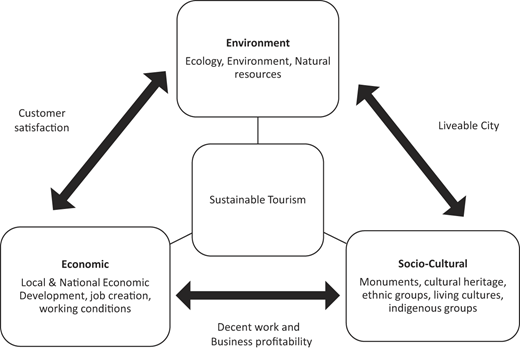
The definition of sustainable tourism is plausible and multi-faceted (Bramwell and Lane, 1993; Butler, 1993; Payne, 1993; Tosun, 2001). The United Nations World Tourism Organization (UNWTO) defines sustainable tourism as tourism that takes full account of its current and future economic, social and environmental impacts, addressing the needs of the visitors, industry, environment and host communities (UNEP-WTO, 2005). Further, the UNEP-WTO (2005) established three dimensions of STD (economy, social and environmental) that must be affirmed in suitable balance to guarantee long-term sustainability (Figure 1).

The economic viability of tourism is contingent intensely on conserving the quality of the local environment. It is crucial to achieving a visitor's need and providing opportunities without sacrificing economic sustainability purpose.

The social sustainability has a strong correlation with the cultural richness of host communities, and it has a strong bearing on environmental aspects in terms of the built environment and cultural dimensions of society's interaction with nature. Preserving the cultural heritage-built environment, respect the socio-cultural authenticity of host communities and contribute to inter-cultural understanding and tolerance.

Environmental resource management should be the primary goal for host communities. By conserving access to freshwater and preventing environmental degradation, some countries, such as Malaysia, were able to preserve natural resources and establish Tourism National Key Economic Areas that are designated to restrict touristic impacts.

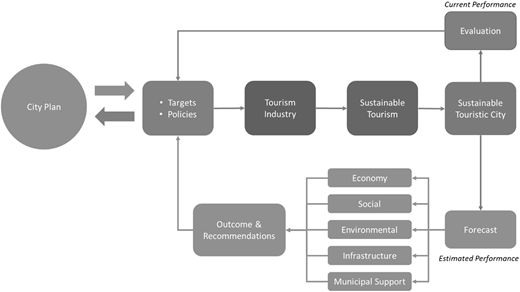
The researchers view the sustainable touristic city as a city that has existing and potential tourism resources, city plan and development proposals, a strategy which accounts for economic, social and environmental impacts and meets the needs of present and future generations. The sustainable touristic city is part of sustainable tourism within the city area. It addresses five essential interacting factors: economy, social, environmental, infrastructure and municipal support (Figure 2).

Infrastructure construction for tourism might impact on vulnerable heritage area due to modernity. Municipal support in establishing an integrated approach to policy, regulation and tourism management and secure positive benefits is essential. Effective governance, policies, frameworks and tools need to be in place to plan to guide the development of sustainable tourism (Bramwell, 2015).

A limited set of indicators has been selected from UNWTO (2017a, b) to measure the performance of sustainable touristic cities (Table 1). The chosen indicators ought to correlate with urban development indicators, otherwise would be excluded. From this set of sustainable touristic city indicators, a selection of key indicators will be made in Section 4 to measure the city's performance.

The primary function of the government in a sustainable touristic city framework is to deal with city planning and regulation of development, land use planning, environmental protection, employment, provision of infrastructure and socio-economic services. A total of four elements appear to be operational in touristic cities: tourism development theme, stakeholders, municipal authorities and infrastructure. Development theme is usually translated into a city branding to provide a clear planning direction and nurture a sense of belonging to society. With a multitude of actions, the municipality undertakes city plan formulation and policy implementation.

Implementation strategies for sustainable tourism development require cross-sectoral linkages, institutional and structural challenges faced by tourism sectors. The effective operations of the tourism economy largely depend on the institutional arrangements and structural frameworks within the entire socio-economic system (Demarco, 2016). To ensure broad participation and consensus building, the development of sustainable tourism requires strong political leadership, as well as the informed participation of all relevant stakeholders (UNEP-WTO, 2005). Synergies should be developed (among institutional networks, along with public–private–people participation). Collaboration among stakeholders can lead to an improvement in the tourism sector's performance (Pan et al., 2018).

Tourism contributed 5.93% to the total gross domestic product (GDP) of Surakarta city in 2013. This proportion is estimated to grow to 6.6% by the year 2028 (Statistics of Surakarta Municipality, 2018). Moreover, the strategic location of Surakarta in the centre of interchange route between Central Java, Yogyakarta and East Java reinforces the competitive advantage of the city featured in good accessibility and transferability. Unfortunately, rapid growth in Surakarta's tourism sector has resulted in negative impacts on the heritage area. Heritage dwellings that form one of the main attractions in the city centre are under development pressure (City of Surakarta, 2015).

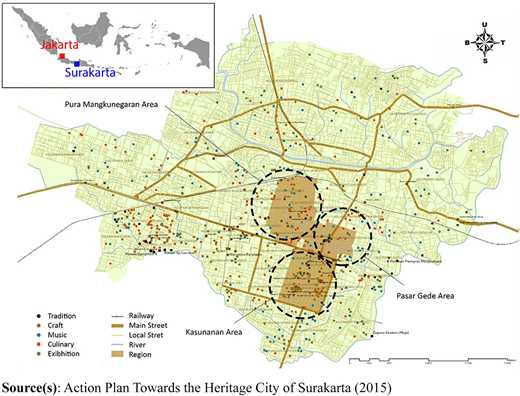
Based on the Decree of the Mayor of Surakarta No. 646/1–2/1/2013 and Municipality Law No. 5/1992, there are 69 buildings of cultural heritage (City of Surakarta, 2013). In addition to the area that has been established by the government of Surakarta, there are several other cultural areas mentioned in the book heritage Surakarta “Physical Traces of Solo City”. The most attractive tourism destinations of Surakarta city are Kasunanan, Pura Mangkunegaran and Pasar Gede area (Figure 3). This area is the centre of Javanese culture, which requires majority concern to be conserved and restored. These areas contain museums, heritage buildings, indigenous villages and exhibition buildings.

The city of Surakarta is currently carrying out the vision of developing a town as the “Eco-cultural city”. It is a guide for Surakarta city to develop strong cultural roots, economic independence, quality public space with a clean environment and adequate infrastructure. To realize the vision of the city, the development strategy of Surakarta city focuses on four components, namely ecology, inheritance, the economy and the structure for growth.

The research methodology is constructed on three interrelated components, namely theoretical framework, analytical methods and SWOT. First, the authors have initiated this investigation by an understanding of sustainable tourism, urban planning and the linkages between planning and tourism to establish a definition and criteria of the sustainable touristic city, together with key performance indicators.

Second, the SMLC model of Hasyimi and Azizalrahman (2018) has been used to test sustainable tourism in the city of Surakarta. This model is twofold: a static model featuring direct input–output evaluation and a dynamic model exhibiting an input with multiple outputs, calculated according to particular strategies. The authors have applied the SMLC on tourism because of its contributory impact on carbon emissions. While the static model attempts to extrapolate current conditions, the dynamic model forecasts future trajectories.

Third, SWOT analysis was applied to frame the recommendations to inform Surakarta's city plan and tourism policies.

This assessment begins with data normalization which consists of two stages: (1) calculation of sustainable touristic city (STC) index and (2) calculation of score of each key performance indicator (Azizalrahman and Hasyimi, 2018). The STC index ranges from −1 for the worst to 1 for the best performance. The calculation of data normalization can be seen in Eqs (1) and (2).

(1)
(2)

where  yi is normalized data of assessed object on i indicator, xi is the original value of the object on ith indicator, max {xi} is the highest value in ith indicator and xb is benchmark value of ith indicator. Whereas Eq. (1) is used for indicators with positive impacts on carbon emissions, Eq. (2) is used for indicators with negative effects on carbon emissions.

The calculation of the cumulative score of the proposed STC evaluation model is shown in Eq. (3).

(3)

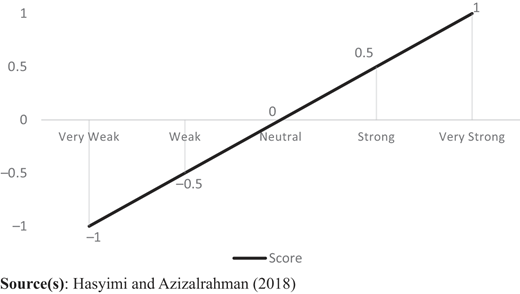
where St is the total score of the assessed city, wc is the weight factor of c category and Sc is a total score of yic in cth that category. To calculate a cumulative STC index score, first, equal weight is applied to all key performance indicators (KPIs) by dividing it uniformly to six to ensure that they have equal importance. Moreover, this study has advanced the results of STC model by formulating a contrastive analysis of the position of tourism and defining the relation between tourism function and sustainable development in four categories: very weak, weak, strong and very strong (Figure 4).

Based on the analysis of KPIs, the scenario building process is conducted. A model is proposed to assess the performance of a certain city, whether its scores over or under the benchmark. A total of four strategies are proposed consisting of different sets of scenarios for forecasting purpose: passive intervention, problem-solving, trend modifying and opportunity seeking. By using the calculation in Eqs (1)–(3), the cumulative score in each strategy is calculated to show under which method the score starts to be neutral (exceed 0), see Figure 5.

First, the passive intervention strategy forecasts future output without any intervention whatsoever. Second, the problem-solving recognizes the indicator(s) which is still under 0 then chooses this as the development priority. Third, the trend modifying strategy seeks to induce changes based on the global trend. In this study, according to WTTC (2017b), the authors assume that the direction of tourism will grow approximately 3% annually. Fourth, the opportunity-seeking strategy addresses current tourism problems and put forth policies to try and tackle the issues. A case in point is economic development that tends to decline environment sustainability.

Built on scenarios of the economy, social and environmental, the strategies are divided into two different growth rates: low and high for each sector. The growth rate is built according to the studies of Fong (2009), Vaz et al. (2012) and Fang et al. (2018). When three sectors and two growth rates are combined, six scenarios will be formed (Table 2).

Before formulating a generic sustainable touristic city model, the KPIs were derived from UNEP-WTO (2005) and published research. First, a set of simple and available sustainability indicators were selected. Second, quantifiable indicators were used. This study uses the technique of Azizalrahman and Hasyimi (2018a) to normalize calculation of KPIs. In this research, the authors are considering two benchmarks to measure the performance of sustainable tourism city: first, international targets from research studies and credible international organization and second, a benchmark for each indicator according to the mean value of selected cities (GEF–World Bank, 2018).

The proposed method has calculated the current score of each target sector, economic, environmental and social to show which sector is under or over performing. Annual growth of 3% is assumed, the percentage which is similar to the projection of World Travel and Tourism Council (WTTC). In total, six KPIs were selected, and benchmarks were calculated (Table 3). A set of simple quantifiable indicators from the above were used to build a generic sustainable touristic city model. Two types of benchmarks were considered: Targets set out by credible international organizations, such as UNWTO and UNEP, and a benchmark for each indicator calculated from the mean values of pilot cities.

The result of the application of static STC model to the city of Surakarta can be seen in Table 3. Based on the evaluation score (−0.197), which, according to the sustainability scale of this study, suggested that the city is not sustainable. From the list of six KPIs, four indicators have underperformed: the daily intensity of tourist use, contribution to GDP, employment contribution and hotel occupancy due to the following scores (−0.366), (−0.269), (−0.585) and (−1.000). On the other hand, social carrying capacity has scored (0.968), a figure that falls beyond the benchmark of 0.5 on the scale of sustainability. Likewise, the pollutant emissions level has scored (0.0731) because Surakarta is a small town with limited traffic demand and industrial activities.

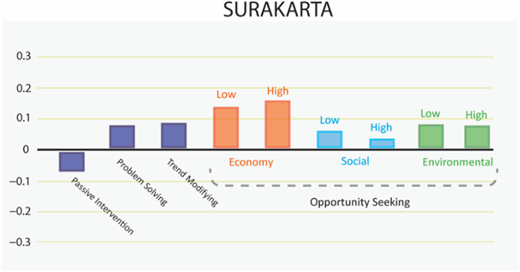
The result of the application of dynamic STC model to the city of Surakarta can be seen in Table 4. Under a passive strategy, Surakarta has underperformed and therefore cannot be considered a sustainable city. It must be recalled, however, that the passive intervention strategy does not adopt any measures to tackle the current problems of tourism. However, under the strategy of (1) problem-solving, (2) trend modifying and (3) opportunity seeking, the city performs well and can be considered sustainable due to the achievement of the corresponding scores: (0.080), (0.084) and (0.157). Future tourism policy should focus on the economic scenario, the predictive score of which is (0.157). Based on this scenario, an increase of 5% of GDP contribution to tourism in the city of Surakarta would lead to a 5% rise in employment and 21% in hotel occupancy. Accordingly, municipal authorities can focus their efforts on the economy and employment. Figure 6 presents the graphical illustration of Table 4.

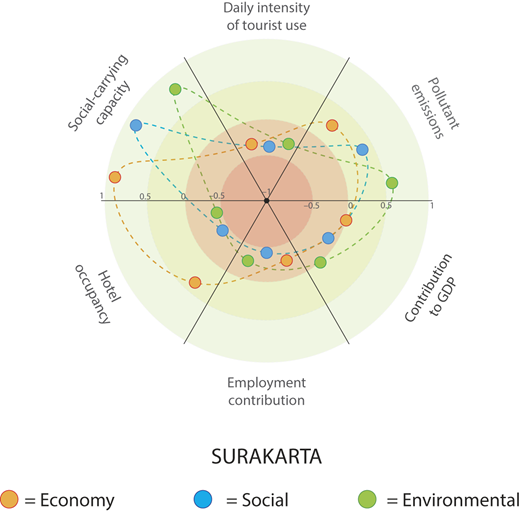
To visualize sectors and indicators, the investigators have proposed metrics for touristic cities. This was obtained by rotating the sustainable touristic city performance scale around its x-axis. In total, four zones are constructed: very weak, weak, neutral, strong and very strong. Zones were then divided into six sectors (intensity of tourist use, pollutant emissions, contribution to GDP, employment contribution, hotel occupancy and social capacity) representing key performance indicators. By plotting and connecting scores, the STC metrics could be had. The authors have applied sustainability metrics, the graph of which confirms that tourism development that is centred on the economy improves the performance of all indicators (Figure 7).

Figure 7 shows key indicators, the daily intensity of tourist use, pollutant emissions, contribution to GDP, employment contribution and social carrying capacity are relatively similar to low social and high environmental scenarios. However, when indicators are measured under a high economy scenario, the performance in the hotel occupancy goes far beyond the social and environmental scenarios and eventually, sustainable tourism.

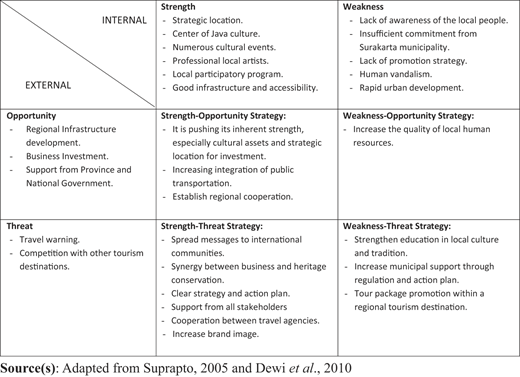
This section seeks to discuss policy implications that could direct the development of Surakarta to a sustainable touristic city. Implications are greatly influenced by KPIs, namely the daily intensity of tourist uses, pollutant emissions, the contribution of tourism to GDP, employment contribution, hotel occupancy and social carrying capacity. SWOT analysis was used to identify and then formalize the strategies and directions to realize sustainable tourism (Figure 8). It must be noted, however, that this vision is in line with the city's master plan with emphasis on tourism as a driver for vision realization.

The components of SWOT were examined to frame recommendations that relate to tourism strategies (Falcone, 2019). According to Strength-Opportunity, it suggests that the municipality should push Surakarta's inherent strength, especially cultural assets and its strategic location for investment. It also recommends that cooperation within Surakarta and its surrounding areas would enhance connectivity through the integration of public transportation system. By recognizing Threat-Opportunity, it suggests increasing the quality of local human resources through intensive training in communication and hospitality.

Under Threat-Strength, the municipality should increase the support by formulating relevant regulations and operationalizing action plan to strengthen education, local character, tour packaging, Internet marketing and social media. Threat-Weakness would initially establish Surakarta city branding as a touristic city and nurture a sense of belonging in the heritage area. It also provides the municipality with a clear strategy and action plan to differentiate between built-up and heritage area. An increase in the economic benefit of tourism development requires robust marketing strategy to spread messages to the international community that Indonesia is safe and friendly to tourists.

Sustainable tourism affects long-term profitability by reforming policy, institutional and regulatory conditions that govern business activity (UNWTO, 2017b), as well as through well-tempered price policies and diverse products. Practice guidelines and regulations should be proposed in accordance with national visions and legislation. For instance, promoting the foreign direct investment (FDI) could effectively improve market awareness, economic stability, quality control, skill/knowledge levels and technology transfer. Moreover, the provision of adequate economic instruments from the government can enhance public investment and finance of sustainable tourism. Financial mechanisms, such as incentives, eco-taxes and charges from tourists, can motivate the private sector to change their operations towards sustainability (World Tourism Organization, 2017). Strategies should seek the economy-led strategy to promote the city of Surakarta's to a sustainable touristic destination.

Information, education and promotion are viewed as essential elements to sustain heritage sites in the city of Surakarta. This effort can be carried out as a campaign to increase local participation in preservation. When the current performance of the city of Surakarta is measured with static STC model, the result is weak (−0.366), with a daily intensity of tourist use (4.76 tourists/km/day), compared to the benchmark (89.41 tourists/km/day). However, the city's performance using the dynamic STC model is higher (−0.298) with the daily intensity of tourist use (20.39 tourists/km/day). The score is still undesirable due to a larger gap between the current condition and target. Pedersen (2002) believes that by advancing the campaign strategy, the quality of its content and implementation plan would become more effective and efficient towards the sustainable touristic city goals. Surakarta 2011–2031 master plan calls for the execution of the following strategy (City of Surakarta, 2012):

  • Identification of potential and distance of each tourism spot together with its mobilization network and facilities;

  • Strengthening the branding strategy, rejuvenating heritage assets and increasing cultural event and festival programs;

  • Improving integration of city infrastructure to support tourism activities;

  • If possible, considering densification inside the zone within the land-use mix development framework by adding supporting facilities that are still needed;

  • Giving priority for local people to develop their business inside the tourism zone by giving specific incentive like lower tax or more straightforward process to get a business permit.

Based on the static STC model, the current performance of tourism contribution to GDP scored (−0.269), which resulted in a contribution of 5.93%. Then by applying the dynamic STC model, the score reached (0.007) thereby contributing (10.52%) to the economy. Minimizing income leakages should increase the proportion of the economic contribution to local GDP and ensure tourism's integration and linkages with other sectors. This mechanism can be developed by addressing the type of business that is usually run by the local community (tour operators, food produces, transport services, guides, etc.).

To increase the proportion of the economic contribution of tourism to local GDP, the local government should consider minimizing income leakages and ensuring well-integration alongside other sectors. There are two types of leakages. First, the leakage which occurs due to profit return by external investors or business owners through the purchase made by tourists outside the destination and by the purchase of imported goods. Second, the leakage may occur if the income earned within the local community is spent outside the city.

Surakarta has a strong carbon emissions performance (0.073), which is supported by a good public transportation network. The entire city has been serviced with bus routes and is planned to start railway service. According to the static STC model, the current performance is categorized as a strong performance with a score of (0.073) and carbon emissions (2.03 ton/capita), compared to the benchmark of (2.19 ton/capita). By applying the dynamic STC model under the high economy scenario, the score is predicted to reach (0.276) and carbon emissions level at (1.59 ton/capita), which in turn go in line with the carbon reduction target of Indonesia.

A general policy line is to improve accessibility to and within destinations using less-polluting transport modes and to manage tourist traffic in ways that will minimize congestion and adverse impacts on local communities and environments. However, the actual provision of transport infrastructure and public transport services is clearly an important area of action on its own right. Examples of physical infrastructure measures are included as follows:

Regarding infrastructure for visitors in protected areas, particular precaution is necessary for vulnerable natural attributes. Within these protected areas, various types of green infrastructures and practices, such as green street (tree planting on streets), bioswales, permeable vegetated surfaces, detention basins and green corridors, can logically be incorporated under a national program (Plummer et al., 2013). The key concept of implementing green infrastructure for sustainable tourism is the strategic use of both the existing natural elements and newly constructed elements to provide benefits of open space and visual aesthetic.

Based on the static STC model, the current performance of employment contribution stands at (−0.535), resulting in a contribution of 1.3% to employment. By focusing on the economic scenario in the dynamic STC model, the score can be raised to −0.374 by increasing the employment rate on tourism to 4.4%. The author realizes that an increase in employment rate is challenging to achieve because of the large gap between current performance and the benchmark (9.9%).

Labour absorption rate in the accommodation sector showed a promising performance. In 2016, there were 3,432 workers in hotel business consisting of 2,017 permanent workers (1,548 men and 469 women) and 1,396 seasonal workers (1,030 men and 366 women). Based on these data, men workers still dominate the employment sector, and there is room to empower women workers by opening more job opportunities (ILO, 2017). The action plan of the Heritage City of Surakarta (2015) addresses economic development of Surakarta as a driver to sustainability.

It is imperative to increase the quality of workers through education and workshops to nurture local labour in hotel service and management. Giving more opportunity for the local community to get a job in this sector means reducing externalities. The local economy will grow positively because the income will be spent on family living inside the city area. The action plan of the Heritage City of Surakarta (2015) calls for realizing maximum economic development by the following measures:

  • Conducting a study of the distribution of tourism employment that potentially runs by the local community (e.g. hotel, restaurant, tourist guide, driver, etc.);

  • Organizing more training for the local community, English skills and tourism services and

  • Improving the local creative industry's quality and innovation.

In 2016, Surakarta city had 44 registered hotels of different stars and 112 inns, concentrated in the city centre and surrounding golden triangle area. These hotels and inns can accommodate approximately 12,929 visitors. Four years later, there were 1,382,166 visitors in which 15,072 were foreigners (Statistics of Surakarta Municipality, 2016).

According to the static STC model, Surakarta hotel occupancy scored (−1.000) compared with a benchmark of (71.23%) and an occupancy rate of (49%). By applying the dynamic STC model in a high economy scenario, the score could be promoted to (0.419), with the proviso that the hotel occupancy rate reaches (78.35%).

A strategy to increase the number of hotel occupancy could be obtained by a set of building and operation standards. Employers should facilitate training for their employees to improve hospitality services. Increase variance of price, by giving tourists more choices could increase the number of tourists from different levels of income. Internet marketing could boost the number of tourist by providing information about accommodation and promotion/discount for their member. To increase hotel occupancy, efforts that can be made are as follows:

  • Establishing the standard of services and building in each type of hotel;

  • Enhancing the front-man skill through training in service manner and language;

  • Encouraging hotel owners to join a website that offers online booking and travelling blog and

  • Managing hotel distribution to the location that is adjacent to a tourism spot or accessible tourism spot or transportation hub.

Based on the static STC model, the current performance of social-carrying capacity is solid (0.968) compared to the benchmark (4.6%). By applying high economy scenario in the dynamic STC model, the performance will decrease to (0.921), but still higher than the benchmark.

The Golden Triangle, as a conservation area, should be able to sustain themselves and provide room for local communities to participate through synergistic interactions. City of Surakarta (2015) encourages local participation in every phase of tourism development. Communities which are not involved directly in tourism activities still have an essential role in supervising the implementation of a city plan. Likewise, the roles of stakeholders to promote social-carrying capacity, according to City of Surakarta (2013), are

  • Maintaining a focus on the community as the center of the tourism development strategy to ensure local ownership of projects and retention of profits;

  • Encouraging widespread community participation in tourism planning processes;

  • Raising awareness among tourists to encourage them to appreciate and respect the sites they visit and

  • Facilitating voluntary contributions from tourists and tourism enterprises for responsible initiatives.

The STC model was applied to the city of Surakarta to evaluate and predict current and future trajectories. When evaluated by the static SMLC model, the city of Surakarta was categorized as an unsustainable touristic city. However, when the dynamic SMLC was applied, the city of Surakarta was categorized as a sustainable touristic city under the high economy scenario. Contribution of tourism in economy development will enable the municipality to develop better infrastructure and motivate local community to involve in the tourism service and heritage preservation because they find it increases the number of jobs and promotes local business growth.

STC results together with SWOT analysis and Surakarta's city plan have informed policies that could give development to sustainability status. The guidelines regarding this scenario call municipal authorities to increase the number of tourists by spreading information through city branding and online campaigns. Thus, local income, hotel occupancy rate and employment rate could increase.

To maintain sustainability in local economic development, the municipality should consider proving communication platform to develop value co-creation with related stakeholders and engage participation. The municipality is also required to protect the revenue from leakages which are twofold. First, proportion of the profit return by external investors and business owners who purchase imported goods. Second, the income earned within the local community as much as it can does not spent outside the city. The local government could formalize some policies to minimize it by (1) supporting local business owner with business coaching and financial support; (2) ensuring that a fair proportion of total tourist expenditure is distributed locally; (3) prioritizing employment of local labour, also by holding workforce building capacity and (4) strengthening the local supply chain.

In the future, it might be found that the best scenario shift from the high economy scenario to high social scenario or high environmental scenario due to tourism growth will reach the peak tolerance of sustainability in which if the high economy scenario is being applied, it would worsen the social and environmental aspect. At this point, the municipality should continuously re-evaluate the condition and formulize a new strategy to respond future uncertainty.
Alam
,
S.
and
Reddy
,
S.
(
2016
), “
Annals of tourism research the impact of tourism on income inequality in developing economies : does Kuznets curve hypothesis exist ?
”,
Annals of Tourism Research
,
Elsevier
, Vol.
61
, pp.
111
-
126
, doi: .
Azizalrahman
,
H.
and
Hasyimi
,
V.
(
2018a
), “
Data in Brief Dataset normalization for low carbon cities in a multi-criteria evaluation model
”,
Data in Brief
,
Elsevier
, Vol.
18
, pp.
1111
-
1116
, doi: .
Azizalrahman
,
H.
and
Hasyimi
,
V.
(
2018b
), “
Towards a generic multi-criteria evaluation model for low carbon cities
”,
Sustainable Cities and Society
, Vol.
39
, pp.
275
-
282
, doi: .
Berno
,
T.
and
Bricker
,
K.
(
2001
), “
Sustainable tourism development: the long road from theory to practice
”,
International Journal of Economic Development
, Vol.
3
No.
3
, pp.
1
-
18
.
Bjork
,
P.
(
2001
), “
Sustainable tourism development, fact or fiction in small tourism Companies ?
”,
Liiketaloudellinen aikakauskirja: LTA3/01
, pp.
328
-
345
,
available at:
 http://lta.lib.aalto.fi/2001/3/lta_2001_03_a2.pdf.
Bowitz
,
E.
and
Ibenholt
,
K.
(
2009
), “
Economic impacts of cultural heritage – research and perspectives
”,
Journal of Cultural Heritage
,
Elsevier Masson SAS
, Vol.
10
No.
1
, pp.
1
-
8
, doi: .
Bramwell
,
B.
(
2015
), “
Theoretical activity in sustainable tourism research
”,
Annals of Tourism Research
,
Elsevier
, Vol.
54
, pp.
204
-
218
, doi: .
Bramwell
,
B.
and
Lane
,
B.
(
1993
), “
Sustainable tourism: an evolving global approach
”,
Journal of Sustainable Tourism
, Vol.
1
No.
1
, pp.
1
-
5
.
Bujdosó
,
Z.
,
Dávid
,
L.
,
Tözsér
,
A.
,
Kovács
,
G.
,
Major-Kathi
,
V.
,
Uakhitova
,
G.
,
Katona
,
P.
and
Vasvári
,
M.
(
2015
), “
Basis of heritagization and cultural tourism development
”,
Procedia-Social and Behavioral Sciences
, Vol.
188
, pp.
307
-
315
, doi: .
Butler
,
R.W.
(
1993
), “Tourism–an evolutionary perspective”,
Tourism and Sustainable Development: Planning, Monitoring, Managing
.
Butowski
,
L.
(
2012
),
Sustainable Tourism-A Model Approach. In Visions for Global Tourism Industry–Creating and Sustaining Competitive Strategies
,
InTech
,
Rijeka
, pp.
1
-
19
, .
City of Surakarta
(
2012
), “
Master plan of the city of Surakarta 2011-2031
”,
available at:
 http://perpustakaan.bappenas.go.id/lontar/opac/themes/bappenas4/templateDetail.jsp?id=127000&lokasi=lokal.
City of Surakarta
(
2013
), “
Book of heritage traces of the city of Surakarta
”,
available at:
 https://www.scribd.com/document/323178634/Jejak-Jejak-Kota-Solo.
City of Surakarta
(
2015
),
Action Plan towards the Heritage City of Surakarta 2015-2035
.
Croes
,
R.
,
Ridderstaat
,
J.
,
Bąk
,
M.
and
Zientara
,
P.
(
2021
), “
Tourism specialization, economic growth, human development and transition economies : the case of Poland
”,
Tourism Management
, Vol.
82
,
104181
, doi: .
Demarco
,
D.
(
2016
), “
Sustainable urban development perspectives in the era of tourism experience
”,
Procedia - Social and Behavioral Sciences
,
The Author(s)
, Vol.
223
, pp.
335
-
341
, doi: .
Falcone
,
P.M.
(
2019
), “
Tourism-based circular economy in Salento (South Italy): a SWOT-ANP analysis
”,
Social Science
, Vol.
8
No.
7
, p.
216
, doi: .
Fang
,
D.
,
Zhang
,
X.
,
Yu
,
Q.
,
Jin
,
T.C.
and
Tian
,
L.
(
2018
), “
A novel method for carbon dioxide emission forecasting based on improved Gaussian processes regression
”,
Journal of Cleaner Production
, Vol.
173
, pp.
143
-
150
, doi: .
Fong
,
W.
,
Matsumoto
,
H.
and
Lun
,
Y.
(
2009
), “
Application of System Dynamics model as decision making tool in urban planning process toward stabilizing carbon dioxide emissions from cities
”,
Building and Environment
,
Elsevier
, Vol.
44
No.
7
, pp.
1528
-
1537
, doi: .
Freeman
,
G.
(
2017
), “The origin and implementation of the smart-sustainable city concept: the case of Malmö, Sweden”,
IIIEE Theses - Lund University Libraries
,
Lund
,
available at:
 http://lup.lub.lu.se/student-papers/record/8924149.
GEF - World Bank
(
2018
), “
Urban sustainability framework
”,
Washington DC, available at:
 http://documents.worldbank.org/curated/en/339851517836894370/pdf/123149-Urban-Sustainability-Framework.pdf.
Hasyimi
,
V.
and
Azizalrahman
,
H.
(
2018
), “
A strategy-based model for low carbon cities
”,
Sustainability
, Vol.
10
No.
12
, p.
4828
, doi: .
ILO
(
2017
),
ILO Guidelines on Decent Work and Socially Responsable Tourism
,
International Labour Office
,
Geneva
.
Lepp
,
A.
and
Gibson
,
H.
(
2008
), “
Sensation seeking and tourism: tourist role, perception of risk and destination choice
”,
Tourism Management
, Vol.
29
No.
4
, pp.
740
-
750
, doi: .
Maksin
,
M.
(
2010
), “
Challenges, responses and partnership for achieving sustainable tourism and heritage preservation
”,
SPATIUM International Review
No.
22
, pp.
11
-
18
.
Pan
,
S.Y.
,
Gao
,
M.
,
Kim
,
H.
,
Shah
,
K.J.
,
Pei
,
S.L.
and
Chiang
,
P.C.
(
2018
), “
Advances and challenges in sustainable tourism toward a green economy
”,
Science of the Total Environment
, Vol.
635
, pp.
452
-
469
, doi: .
Payne
,
R.
(
1993
), “Sustainable tourism: suggested indicators and monitoring techniques”,
Tourism and Sustainable Development: Monitoring, Planning, Managing
,
University of Waterloo
,
Waterloo
, pp.
249
-
254
.
Pedersen
,
A.
(
2002
),
Managing Tourism at World Heritage Sites: A Practical Manual for World Heritage Site Managers
,
World Heritage Center
,
Paris
.
Plummer
,
R.
,
Armitage
,
D.R.
and
de Loë
,
R.C.
(
2013
), “
Adaptive comanagement and its relationship to environmental governance
”,
Ecology and Society
, Vol.
18
No.
1
, p.
21
, doi: .
Sousa
,
A.
and
Martín
,
M.I.
(
2015
), “
Spatial patterns of cultural tourism in Portugal
”,
Tourism Management Perspectives
,
Elsevier
, Vol.
16
, pp.
107
-
115
, doi: .
World Tourism Organizations
(
2017
), “
Making tourism a tool to fight poverty: ten years of the ST-EP Initiative
”, p.
16
,
available at:
 https://www.unwto.org/archive/global/publication/making-tourism-tool-fight-poverty-ten-years-st-ep-initiative-0.
Statistics of Surakarta Municipality
(
2016
), “
Statistics of hotel occupancy rate of Surakarta 2016. Surakarta
”,
available at:
 https://surakartakota.bps.go.id/pressrelease/2017/01/03/85/perkembangan-pariwisata-dan-transportasi-udara-di-kota-surakarta-bulan-november-2016.html.
Statistics of Surakarta Municipality
(
2018
), “
Surakarta city in figure 2018. Surakarta
”,
available at:
 https://surakartakota.bps.go.id/pressrelease/2019/02/01/136/pengembangan-pariwisata-dan-transportasi-udara-di-kota-surakarta-pada-bulan-desember-2018.html.
Su
,
R.
,
Bramwell
,
B.
and
Whalley
,
P.A.
(
2018
), “
Annals of Tourism Research Cultural political economy and urban heritage tourism
”,
Annals of Tourism Research
,
Elsevier
, Vol.
68
, pp.
30
-
40
, doi: .
Tosun
,
C.
(
2001
), “
Challenges of sustainable tourism development in the developing world: the case of Turkey
”,
Tourism Management
, Vol.
22
No.
3
, pp.
289
-
303
, doi: .
UNEP-WTO
(
2005
), “
Making tourism more sustainable. A guide for policy makers
”,
Environment: Science and Policy for Sustainable Development
, Vol.
54
No.
2
, p.
222
,
doi: 92-807-2507-6
.
UNWTO
(
2007
), “
Climate change and tourism
”,
available at:
 http://sdt.unwto.org/content/faq-climate-change-and-tourism.
UNWTO
(
2017a
), “
Benchmark report 2017 – world summary
”,
available at:
 https://www.wttc.org/-/media/files/reports/benchmark-reports/regional-reports-2017/world.pdf.
UNWTO
(
2017b
),
UNWTO Tourism Highlights 2017 Edition
,
United Nations World Tourism Organization
,
Madrid
.
Vaz
,
E.
,
Nijkamp
,
P.
,
Painho
,
M.
and
Caetano
,
M.
(
2012
), “
A multi-scenario forecast of urban change: a study on urban growth in the Algarve
”,
Landscape and Urban Planning
, Vol.
104
No.
2
, pp.
201
-
211
, doi: .
WTTC
(
2017
), “
Travel and Tourism: global economic impact and issue 2018
”,
available at:
 https://www.statista.com/statistics/233223/travel-and-tourism--total-economic-contribution-worldwide/.
Wulf
,
T.
,
Meissner
,
P.
and
Stubner
,
S.
(
2010
), “
A scenario-based approach to strategic planning – integrating planning and process perspective of strategy
”,
Management
No.
6
, p.
32
.
Suci
,
S.D.P.
(
2011
),
Promosi kota solo sebagai kota budaya
,
Surakarta, Digilib UNS
.
Suprapto
,
A.
(
2005
), “Analisis Penawaran dan Permintaan Wisata Dalam Pengembangan Potensi Pariwisata di Keraton Surakarta Hadiningrat (Doctoral dissertation)”,
Diponegoro University
,
Semarang
,
available at:
 http://eprints.undip.ac.id/16524.
Published in Journal of Tourism Futures. Published by Emerald Publishing Limited. This article is published under the Creative Commons Attribution (CC BY 4.0) licence. Anyone may reproduce, distribute, translate and create derivative works of this article (for both commercial and non-commercial purposes), subject to full attribution to the original publication and authors. The full terms of this licence may be seen at http://creativecommons.org/licences/by/4.0/legalcode

Data & Figures

Figure 1
A diagram showing the relationships between environmental, economic, and socio-cultural pillars of sustainable tourism.The diagram illustrates the core components and interactions of sustainable tourism. At the center is a rounded rectangle labeled “Sustainable Tourism”, representing the main concept connecting three key sustainability pillars. Above the center is a box labeled “Environment”, with the description “Ecology, Environment, Natural resources”. At the bottom left is a box labeled “Economic”, described as “Local and National Economic Development, job creation, working conditions”. At the bottom right is a box labeled “Socio-Cultural”, with the description “Monuments, cultural heritage, ethnic groups, living cultures, indigenous groups”. Arrows connect the three outer pillars, forming a triangular relationship. The arrow between Environment and Economic is associated with “Customer satisfaction”, the arrow between Environment and Socio-Cultural is associated with “Liveable City”, and the arrow between Economic and Socio-Cultural is associated with “Decent work and Business profitability”.

Sustainable tourism development framework

Figure 1
A diagram showing the relationships between environmental, economic, and socio-cultural pillars of sustainable tourism.The diagram illustrates the core components and interactions of sustainable tourism. At the center is a rounded rectangle labeled “Sustainable Tourism”, representing the main concept connecting three key sustainability pillars. Above the center is a box labeled “Environment”, with the description “Ecology, Environment, Natural resources”. At the bottom left is a box labeled “Economic”, described as “Local and National Economic Development, job creation, working conditions”. At the bottom right is a box labeled “Socio-Cultural”, with the description “Monuments, cultural heritage, ethnic groups, living cultures, indigenous groups”. Arrows connect the three outer pillars, forming a triangular relationship. The arrow between Environment and Economic is associated with “Customer satisfaction”, the arrow between Environment and Socio-Cultural is associated with “Liveable City”, and the arrow between Economic and Socio-Cultural is associated with “Decent work and Business profitability”.

Sustainable tourism development framework

Close modal
Figure 2
A framework diagram linking city planning, tourism development, evaluation, and sustainability indicators.The diagram presents a conceptual framework illustrating the relationship between city planning, tourism development, sustainability evaluation, and policy feedback. On the left side, a circular node labeled “City Plan” connects with a rectangular box including two bullet points labeled “Targets” and “Policies” through two opposite arrows, indicating a two-way relationship between planning and policy direction. From this rectangular box, the process flows to “Tourism Industry”, then to “Sustainable Tourism”, and finally to “Sustainable Touristic City” on the right. Above the final stage, a box labeled “Evaluation” represents current performance assessment, connected by an upward arrow from “Sustainable Tourism”. “Evaluation” connects back to “Targets and Policies”, forming a feedback loop. From “Sustainable Touristic City”, a downward arrow leads to “Forecast”, representing estimated future performance. To the left of the forecast stage, five evaluation dimensions are listed vertically: Economy, Social, Environmental, Infrastructure, and Municipal Support. These indicators feed into a box labeled “Outcome and Recommendations” on the lower left. Finally, “Outcome and Recommendations” connects back to “Targets and Policies”, forming a feedback loop.

Sustainable touristic city framework

Figure 2
A framework diagram linking city planning, tourism development, evaluation, and sustainability indicators.The diagram presents a conceptual framework illustrating the relationship between city planning, tourism development, sustainability evaluation, and policy feedback. On the left side, a circular node labeled “City Plan” connects with a rectangular box including two bullet points labeled “Targets” and “Policies” through two opposite arrows, indicating a two-way relationship between planning and policy direction. From this rectangular box, the process flows to “Tourism Industry”, then to “Sustainable Tourism”, and finally to “Sustainable Touristic City” on the right. Above the final stage, a box labeled “Evaluation” represents current performance assessment, connected by an upward arrow from “Sustainable Tourism”. “Evaluation” connects back to “Targets and Policies”, forming a feedback loop. From “Sustainable Touristic City”, a downward arrow leads to “Forecast”, representing estimated future performance. To the left of the forecast stage, five evaluation dimensions are listed vertically: Economy, Social, Environmental, Infrastructure, and Municipal Support. These indicators feed into a box labeled “Outcome and Recommendations” on the lower left. Finally, “Outcome and Recommendations” connects back to “Targets and Policies”, forming a feedback loop.

Sustainable touristic city framework

Close modal
Figure 3
A map of Surakarta showing cultural activity locations, major roads, rivers, and key heritage areas.The city map of Surakarta, Indonesia, illustrates the spatial distribution of cultural activities and important urban features. In the upper-left corner, an inset map of Indonesia highlights the locations of Jakarta and Surakarta, with Jakarta marked in red and Surakarta marked in blue. The main map displays the street network of Surakarta with main streets shown as thick brown lines, local streets as thin light lines, railway lines as dark linear tracks, and rivers as blue curved lines. A compass rose appears in the upper-right corner, indicating north, south, east, and west directions. Across the city, numerous colored dots represent different categories of cultural activities. According to the legend at the bottom left, black dots represent Tradition, brown dots represent Craft, blue dots represent Music, red dots represent Culinary, and green dots represent Exhibition. Three major heritage districts are emphasized with dashed circular boundaries and shaded brown regions. These areas correspond to the “Pura Mangkunegaran Area” in the northern-central part of the city, the “Kasunanan Area” in the southern-central part, and the “Pasar Gede Area” toward the eastern-central section. These highlighted zones show a higher concentration of cultural activity points. Additional labeled landmarks appear within the city, including locations such as “Makam Daksopuro”, “Museum Radya Pustaka”, and “Rumah B p Soemino”. A scale bar is shown at the bottom right indicating map distance from 0 to 3640 meters.

Tourism priority areas in Surakarta city

Figure 3
A map of Surakarta showing cultural activity locations, major roads, rivers, and key heritage areas.The city map of Surakarta, Indonesia, illustrates the spatial distribution of cultural activities and important urban features. In the upper-left corner, an inset map of Indonesia highlights the locations of Jakarta and Surakarta, with Jakarta marked in red and Surakarta marked in blue. The main map displays the street network of Surakarta with main streets shown as thick brown lines, local streets as thin light lines, railway lines as dark linear tracks, and rivers as blue curved lines. A compass rose appears in the upper-right corner, indicating north, south, east, and west directions. Across the city, numerous colored dots represent different categories of cultural activities. According to the legend at the bottom left, black dots represent Tradition, brown dots represent Craft, blue dots represent Music, red dots represent Culinary, and green dots represent Exhibition. Three major heritage districts are emphasized with dashed circular boundaries and shaded brown regions. These areas correspond to the “Pura Mangkunegaran Area” in the northern-central part of the city, the “Kasunanan Area” in the southern-central part, and the “Pasar Gede Area” toward the eastern-central section. These highlighted zones show a higher concentration of cultural activity points. Additional labeled landmarks appear within the city, including locations such as “Makam Daksopuro”, “Museum Radya Pustaka”, and “Rumah B p Soemino”. A scale bar is shown at the bottom right indicating map distance from 0 to 3640 meters.

Tourism priority areas in Surakarta city

Close modal
Figure 4
A line chart showing score values corresponding to strength levels from very weak to very strong.The chart presents a horizontal scale of qualitative strength levels mapped to numerical scores. The horizontal axis lists five categories from left to right: “Very Weak”, “Weak”, “Neutral”, “Strong”, and “Very Strong”. The vertical scale ranges approximately from negative 1 to 1, with intermediate labels including negative 0.5, 0, and 0.5. A diagonal line labeled “Score” connects the corresponding values for each category. The line begins at “Very Weak” with a score of negative 1, rises to negative 0.5 at “Weak”, reaches 0 at “Neutral”, increases to 0.5 at “Strong”, and ends at 1 at “Very Strong”. Vertical guidelines connect each category label to its corresponding score value on the diagonal line. Note: All the numerical data values are approximated.

Classification of sustainable touristic cities

Figure 4
A line chart showing score values corresponding to strength levels from very weak to very strong.The chart presents a horizontal scale of qualitative strength levels mapped to numerical scores. The horizontal axis lists five categories from left to right: “Very Weak”, “Weak”, “Neutral”, “Strong”, and “Very Strong”. The vertical scale ranges approximately from negative 1 to 1, with intermediate labels including negative 0.5, 0, and 0.5. A diagonal line labeled “Score” connects the corresponding values for each category. The line begins at “Very Weak” with a score of negative 1, rises to negative 0.5 at “Weak”, reaches 0 at “Neutral”, increases to 0.5 at “Strong”, and ends at 1 at “Very Strong”. Vertical guidelines connect each category label to its corresponding score value on the diagonal line. Note: All the numerical data values are approximated.

Classification of sustainable touristic cities

Close modal
Figure 5
A flow diagram showing stages from current situation to opportunity seeking.The diagram presents a horizontal process flow consisting of five rounded rectangular boxes connected by right-pointing arrows, illustrating a progression of strategic response stages. From left to right, the boxes are labeled “Current Situation”, “Passive Intervention”, “Problem Solving”, “Trend Modifying”, and “Opportunity Seeking”.

Strategies of sustainable touristic city model

Figure 5
A flow diagram showing stages from current situation to opportunity seeking.The diagram presents a horizontal process flow consisting of five rounded rectangular boxes connected by right-pointing arrows, illustrating a progression of strategic response stages. From left to right, the boxes are labeled “Current Situation”, “Passive Intervention”, “Problem Solving”, “Trend Modifying”, and “Opportunity Seeking”.

Strategies of sustainable touristic city model

Close modal
Figure 6
A bar chart shows intervention levels and opportunity-seeking indicators for economic, social, and environmental dimensions.The bar chart illustrates sustainability intervention and opportunity-seeking indicators for Surakarta. The title “SURAKARTA” appears at the top center of the chart. The vertical axis represents normalized indicator values ranging approximately from negative 0.3 to 0.3, with horizontal grid lines marking values such as negative 0.2, negative 0.1, 0, 0.1, 0.2, and 0.3. A horizontal line at 0 separates negative and positive values. On the left side of the chart, three purple bars represent intervention categories. The first bar, labeled “Passive Intervention”, extends slightly below zero with a value near negative 0.06. The second bar, labeled “Problem Solving”, rises above zero to about 0.08. The third bar, labeled “Trend Modifying”, is slightly higher at approximately 0.09. On the right side of the chart, a group of bars labeled “Opportunity Seeking” is indicated by a dashed bracket beneath the bars. These bars are grouped into three categories: Economy, Social, and Environmental. Under Economy, two orange bars labeled “Low” and “High” appear. The Low bar reaches approximately 0.13, while the High bar reaches about 0.16. Under Social, two blue bars labeled “Low” and “High” are shown. The Low bar reaches approximately 0.06, and the High bar reaches around 0.03. Under Environmental, two green bars labeled “Low” and “High” appear. The Low bar reaches approximately 0.08, and the High bar is slightly lower at around 0.07. Note: All the numerical data values are approximated.

Graphical result of the application of dynamic STC model in the city of Surakarta

Figure 6
A bar chart shows intervention levels and opportunity-seeking indicators for economic, social, and environmental dimensions.The bar chart illustrates sustainability intervention and opportunity-seeking indicators for Surakarta. The title “SURAKARTA” appears at the top center of the chart. The vertical axis represents normalized indicator values ranging approximately from negative 0.3 to 0.3, with horizontal grid lines marking values such as negative 0.2, negative 0.1, 0, 0.1, 0.2, and 0.3. A horizontal line at 0 separates negative and positive values. On the left side of the chart, three purple bars represent intervention categories. The first bar, labeled “Passive Intervention”, extends slightly below zero with a value near negative 0.06. The second bar, labeled “Problem Solving”, rises above zero to about 0.08. The third bar, labeled “Trend Modifying”, is slightly higher at approximately 0.09. On the right side of the chart, a group of bars labeled “Opportunity Seeking” is indicated by a dashed bracket beneath the bars. These bars are grouped into three categories: Economy, Social, and Environmental. Under Economy, two orange bars labeled “Low” and “High” appear. The Low bar reaches approximately 0.13, while the High bar reaches about 0.16. Under Social, two blue bars labeled “Low” and “High” are shown. The Low bar reaches approximately 0.06, and the High bar reaches around 0.03. Under Environmental, two green bars labeled “Low” and “High” appear. The Low bar reaches approximately 0.08, and the High bar is slightly lower at around 0.07. Note: All the numerical data values are approximated.

Graphical result of the application of dynamic STC model in the city of Surakarta

Close modal
Figure 7
A radar chart showing economic, social, and environmental tourism indicators for Surakarta.The radar (spider) chart illustrates the sustainability performance of tourism in Surakarta across several indicators. The chart is circular and divided into six axes, each representing a different tourism-related indicator. At the top axis, the label reads “Daily intensity of tourist use”. Moving clockwise, the other axes are labeled “Pollutant emissions”, “Contribution to G D P”, “Employment contribution”, “Hotel occupancy”, and “Social-carrying capacity”. The chart contains three colored datasets, each represented by circular markers connected with dashed lines: the orange markers and dashed line represent Economy indicator, the blue markers and dashed line represent Social indicator, and the green markers and dashed line represent Environmental indicator. Concentric colored rings form the background, representing different value ranges from the center outward. Numerical values along the axes include negative 1, negative 0.5, 0, 0.5, and 1, indicating the normalized scale used for comparing indicator performance. Across the axes, the three categories show different patterns: The economic indicators (orange) extend relatively outward toward the axes for Contribution to G D P with a value near 0.9, Pollutant emissions with the value near 0.2, Hotel occupancy with the value near 0.4, Social-carrying capacity with the value near 0.6, Daily intensity of tourist use with the value near negative 0.3, and Employment contribution with the value near negative 0.2. The social indicators (blue) show moderate values across the axes, with Pollutant emissions near 0.4, Contribution to G D P near negative 0.1, Employment contribution near negative 0.4, Hotel occupancy near negative 0.4, Social-carrying capacity near 0.9, and Daily intensity of tourist use near negative 0.4. The environmental indicators (green) extend outward on Pollutant emissions with a value near 0.6 and Social-carrying capacity with a value near 0.8, while showing Contribution to G D P near 0, Employment contribution near negative 0.25, Hotel occupancy near negative 0.4, and Daily intensity of tourist use near negative 0.3. At the bottom center of the figure, the label “SURAKARTA” identifies the location being analyzed. Below the chart is a legend showing the color mapping: orange equals Economy, blue equals Social, and green equals Environmental. Note: All the numerical data values are approximated.

STC metrics for the city of Surakarta

Figure 7
A radar chart showing economic, social, and environmental tourism indicators for Surakarta.The radar (spider) chart illustrates the sustainability performance of tourism in Surakarta across several indicators. The chart is circular and divided into six axes, each representing a different tourism-related indicator. At the top axis, the label reads “Daily intensity of tourist use”. Moving clockwise, the other axes are labeled “Pollutant emissions”, “Contribution to G D P”, “Employment contribution”, “Hotel occupancy”, and “Social-carrying capacity”. The chart contains three colored datasets, each represented by circular markers connected with dashed lines: the orange markers and dashed line represent Economy indicator, the blue markers and dashed line represent Social indicator, and the green markers and dashed line represent Environmental indicator. Concentric colored rings form the background, representing different value ranges from the center outward. Numerical values along the axes include negative 1, negative 0.5, 0, 0.5, and 1, indicating the normalized scale used for comparing indicator performance. Across the axes, the three categories show different patterns: The economic indicators (orange) extend relatively outward toward the axes for Contribution to G D P with a value near 0.9, Pollutant emissions with the value near 0.2, Hotel occupancy with the value near 0.4, Social-carrying capacity with the value near 0.6, Daily intensity of tourist use with the value near negative 0.3, and Employment contribution with the value near negative 0.2. The social indicators (blue) show moderate values across the axes, with Pollutant emissions near 0.4, Contribution to G D P near negative 0.1, Employment contribution near negative 0.4, Hotel occupancy near negative 0.4, Social-carrying capacity near 0.9, and Daily intensity of tourist use near negative 0.4. The environmental indicators (green) extend outward on Pollutant emissions with a value near 0.6 and Social-carrying capacity with a value near 0.8, while showing Contribution to G D P near 0, Employment contribution near negative 0.25, Hotel occupancy near negative 0.4, and Daily intensity of tourist use near negative 0.3. At the bottom center of the figure, the label “SURAKARTA” identifies the location being analyzed. Below the chart is a legend showing the color mapping: orange equals Economy, blue equals Social, and green equals Environmental. Note: All the numerical data values are approximated.

STC metrics for the city of Surakarta

Close modal
Figure 8
A SWOT analysis table outlining strengths, weaknesses, opportunities, threats, and related strategies for cultural tourism.The illustration shows a SWOT analysis matrix organized into a large table combining internal and external factors with corresponding strategies. The layout is divided into sections labeled “Internal” and “External”, and further categorized into “Strength”, “Weakness”, “Opportunity”, and “Threat”, along with strategic responses derived from these factors. At the top-left corner, a diagonal cell divides the labels “INTERNAL” and “EXTERNAL”, indicating the relationship between internal and external analysis components. The “Strength” column lists internal advantages of the region: “Strategic location”, “Center of Java culture”, “Numerous cultural events”, “Professional local artists”, “Local participatory program”; and “Good infrastructure and accessibility”. The “Weakness” column lists internal limitations: “Lack of awareness of the local people”, “Insufficient commitment from Surakarta municipality”, “Lack of promotion strategy”, “Human vandalism”, and “Rapid urban development”. Under the “Opportunity” section (external factors), three opportunities are listed: “Regional infrastructure development”, “Business investment”, and “Support from provincial and national government”. “Strength–Opportunity Strategy”: This strategy section explains how strengths can be used to take advantage of opportunities: “It is pushing its inherent strength, especially cultural assets and strategic location for investment”, “Increase integration of public transportation”, and “Establish regional cooperation”. “Weakness–Opportunity Strategy”: This strategy addresses how opportunities can help overcome weaknesses: “Increase the quality of local human resources”. The “Threat” section lists external risks: “Travel warning” and “Competition with other tourism destinations”. “Strength–Threat Strategy”: Strategies using strengths to counter threats include “Spread messages to international communities”, “Synergy between business and heritage conservation”, “Clear strategies and action plans”, “Support from all stakeholders”, “Cooperation between travel agencies”, and “Increase brand image”. “Weakness–Threat Strategy”: Strategies addressing weaknesses while mitigating threats include “Strengthen education in local culture and tradition”, “Increase municipal support through regulations and action plans”, and “Tour package promotion within a regional tourism destination”.

SWOT analysis of Surakarta

Figure 8
A SWOT analysis table outlining strengths, weaknesses, opportunities, threats, and related strategies for cultural tourism.The illustration shows a SWOT analysis matrix organized into a large table combining internal and external factors with corresponding strategies. The layout is divided into sections labeled “Internal” and “External”, and further categorized into “Strength”, “Weakness”, “Opportunity”, and “Threat”, along with strategic responses derived from these factors. At the top-left corner, a diagonal cell divides the labels “INTERNAL” and “EXTERNAL”, indicating the relationship between internal and external analysis components. The “Strength” column lists internal advantages of the region: “Strategic location”, “Center of Java culture”, “Numerous cultural events”, “Professional local artists”, “Local participatory program”; and “Good infrastructure and accessibility”. The “Weakness” column lists internal limitations: “Lack of awareness of the local people”, “Insufficient commitment from Surakarta municipality”, “Lack of promotion strategy”, “Human vandalism”, and “Rapid urban development”. Under the “Opportunity” section (external factors), three opportunities are listed: “Regional infrastructure development”, “Business investment”, and “Support from provincial and national government”. “Strength–Opportunity Strategy”: This strategy section explains how strengths can be used to take advantage of opportunities: “It is pushing its inherent strength, especially cultural assets and strategic location for investment”, “Increase integration of public transportation”, and “Establish regional cooperation”. “Weakness–Opportunity Strategy”: This strategy addresses how opportunities can help overcome weaknesses: “Increase the quality of local human resources”. The “Threat” section lists external risks: “Travel warning” and “Competition with other tourism destinations”. “Strength–Threat Strategy”: Strategies using strengths to counter threats include “Spread messages to international communities”, “Synergy between business and heritage conservation”, “Clear strategies and action plans”, “Support from all stakeholders”, “Cooperation between travel agencies”, and “Increase brand image”. “Weakness–Threat Strategy”: Strategies addressing weaknesses while mitigating threats include “Strengthen education in local culture and tradition”, “Increase municipal support through regulations and action plans”, and “Tour package promotion within a regional tourism destination”.

SWOT analysis of Surakarta

Close modal
Table 1

Selected indicators of sustainable touristic city

AspectsIndicators
EconomicContribution of tourism to GDP
Contribution of tourism employment to total employment in the city
Hotel occupancy
Duration of stay
EnvironmentalLand-use planning, including tourism
The intensity of tourist usage
Pollutant emissions
Waste treatment
SocialEducation
A campaign about local identity
Stakeholders involvement
Sustaining population level
Social-carrying capacity
InfrastructureAccess to the destination
Public transportation
IT support for operational and promotion
Security, health and financial services
Municipal supportFinancial allocation
Tourism adoption in master plan
Promotion and branding
Table 2

Scenarios of sustainable touristic city development

KPISymbolEffectEconomySocialEnvironmental
LowHighLowHighLowHigh
Intensity of tourist useI1++10%+20%−25%−50%−10%−20%
Pollutant emissionsI2−5%−10%+5%+10%+25%+50%
Contribution of tourism to GDPI3++5%+10%−5%−10%+5%+10%
Employment contributionI4++5%+10%−5%−10%+5%+10%
Hotel occupancyI5++5%+10%−5%−10%−5%−10%
Social-carrying capacityI6−10%−20%+10%+20%+10%+20%
Table 3

Result of the application of static STC model to Surakarta city

IndicatorsCodeParameterBenchmarkDataScore
Daily intensity of tourist usesI1Total tourists per unit area89.41 tourist/km/day4.76 tourist/km/day−0.366
Pollutant emissionsI2Level of CO22.19 ton/capita2.03 ton/capita0.073
Contribution of tourism to GDPI3Percentage of GDP attributable to the activities of Hotels and Restaurants10.4%5.93%−0.269
Employment contributionI4Percentage of the employee in the tourism sector to the total volume of employment in the city9.9%1.3%−0.585
Hotel occupancyI5% average room used71.23%49.02%−1.000
Social-carrying capacityI6Ratio of tourist to locals4.5%14.87%0.968
Total score−0.197
Table 4

Result of the application of dynamic STC model to Surakarta city

KPIPassive interventionProblem- solvingTrend modifyingOpportunity seeking
EconomySocialEnvironment
Result 1Result 2Result 3Result 4
I1−0.354−0.336−0.313−0.298−0.349−0.327
I20.3420.3420.3420.2760.4080.671
I3−0.259−0.050−0.0500.007−0.1080.007
I4−0.553−0.401−0.401−0.374−0.429−0.374
I5−0.5700.0000.0000.412−0.412−0.412
I60.9290.9280.9280.9210.9420.935
Total−0.0780.0800.0840.1570.0090.083

Supplements

References

Alam
,
S.
and
Reddy
,
S.
(
2016
), “
Annals of tourism research the impact of tourism on income inequality in developing economies : does Kuznets curve hypothesis exist ?
”,
Annals of Tourism Research
,
Elsevier
, Vol.
61
, pp.
111
-
126
, doi: .
Azizalrahman
,
H.
and
Hasyimi
,
V.
(
2018a
), “
Data in Brief Dataset normalization for low carbon cities in a multi-criteria evaluation model
”,
Data in Brief
,
Elsevier
, Vol.
18
, pp.
1111
-
1116
, doi: .
Azizalrahman
,
H.
and
Hasyimi
,
V.
(
2018b
), “
Towards a generic multi-criteria evaluation model for low carbon cities
”,
Sustainable Cities and Society
, Vol.
39
, pp.
275
-
282
, doi: .
Berno
,
T.
and
Bricker
,
K.
(
2001
), “
Sustainable tourism development: the long road from theory to practice
”,
International Journal of Economic Development
, Vol.
3
No.
3
, pp.
1
-
18
.
Bjork
,
P.
(
2001
), “
Sustainable tourism development, fact or fiction in small tourism Companies ?
”,
Liiketaloudellinen aikakauskirja: LTA3/01
, pp.
328
-
345
,
available at:
 http://lta.lib.aalto.fi/2001/3/lta_2001_03_a2.pdf.
Bowitz
,
E.
and
Ibenholt
,
K.
(
2009
), “
Economic impacts of cultural heritage – research and perspectives
”,
Journal of Cultural Heritage
,
Elsevier Masson SAS
, Vol.
10
No.
1
, pp.
1
-
8
, doi: .
Bramwell
,
B.
(
2015
), “
Theoretical activity in sustainable tourism research
”,
Annals of Tourism Research
,
Elsevier
, Vol.
54
, pp.
204
-
218
, doi: .
Bramwell
,
B.
and
Lane
,
B.
(
1993
), “
Sustainable tourism: an evolving global approach
”,
Journal of Sustainable Tourism
, Vol.
1
No.
1
, pp.
1
-
5
.
Bujdosó
,
Z.
,
Dávid
,
L.
,
Tözsér
,
A.
,
Kovács
,
G.
,
Major-Kathi
,
V.
,
Uakhitova
,
G.
,
Katona
,
P.
and
Vasvári
,
M.
(
2015
), “
Basis of heritagization and cultural tourism development
”,
Procedia-Social and Behavioral Sciences
, Vol.
188
, pp.
307
-
315
, doi: .
Butler
,
R.W.
(
1993
), “Tourism–an evolutionary perspective”,
Tourism and Sustainable Development: Planning, Monitoring, Managing
.
Butowski
,
L.
(
2012
),
Sustainable Tourism-A Model Approach. In Visions for Global Tourism Industry–Creating and Sustaining Competitive Strategies
,
InTech
,
Rijeka
, pp.
1
-
19
, .
City of Surakarta
(
2012
), “
Master plan of the city of Surakarta 2011-2031
”,
available at:
 http://perpustakaan.bappenas.go.id/lontar/opac/themes/bappenas4/templateDetail.jsp?id=127000&lokasi=lokal.
City of Surakarta
(
2013
), “
Book of heritage traces of the city of Surakarta
”,
available at:
 https://www.scribd.com/document/323178634/Jejak-Jejak-Kota-Solo.
City of Surakarta
(
2015
),
Action Plan towards the Heritage City of Surakarta 2015-2035
.
Croes
,
R.
,
Ridderstaat
,
J.
,
Bąk
,
M.
and
Zientara
,
P.
(
2021
), “
Tourism specialization, economic growth, human development and transition economies : the case of Poland
”,
Tourism Management
, Vol.
82
,
104181
, doi: .
Demarco
,
D.
(
2016
), “
Sustainable urban development perspectives in the era of tourism experience
”,
Procedia - Social and Behavioral Sciences
,
The Author(s)
, Vol.
223
, pp.
335
-
341
, doi: .
Falcone
,
P.M.
(
2019
), “
Tourism-based circular economy in Salento (South Italy): a SWOT-ANP analysis
”,
Social Science
, Vol.
8
No.
7
, p.
216
, doi: .
Fang
,
D.
,
Zhang
,
X.
,
Yu
,
Q.
,
Jin
,
T.C.
and
Tian
,
L.
(
2018
), “
A novel method for carbon dioxide emission forecasting based on improved Gaussian processes regression
”,
Journal of Cleaner Production
, Vol.
173
, pp.
143
-
150
, doi: .
Fong
,
W.
,
Matsumoto
,
H.
and
Lun
,
Y.
(
2009
), “
Application of System Dynamics model as decision making tool in urban planning process toward stabilizing carbon dioxide emissions from cities
”,
Building and Environment
,
Elsevier
, Vol.
44
No.
7
, pp.
1528
-
1537
, doi: .
Freeman
,
G.
(
2017
), “The origin and implementation of the smart-sustainable city concept: the case of Malmö, Sweden”,
IIIEE Theses - Lund University Libraries
,
Lund
,
available at:
 http://lup.lub.lu.se/student-papers/record/8924149.
GEF - World Bank
(
2018
), “
Urban sustainability framework
”,
Washington DC, available at:
 http://documents.worldbank.org/curated/en/339851517836894370/pdf/123149-Urban-Sustainability-Framework.pdf.
Hasyimi
,
V.
and
Azizalrahman
,
H.
(
2018
), “
A strategy-based model for low carbon cities
”,
Sustainability
, Vol.
10
No.
12
, p.
4828
, doi: .
ILO
(
2017
),
ILO Guidelines on Decent Work and Socially Responsable Tourism
,
International Labour Office
,
Geneva
.
Lepp
,
A.
and
Gibson
,
H.
(
2008
), “
Sensation seeking and tourism: tourist role, perception of risk and destination choice
”,
Tourism Management
, Vol.
29
No.
4
, pp.
740
-
750
, doi: .
Maksin
,
M.
(
2010
), “
Challenges, responses and partnership for achieving sustainable tourism and heritage preservation
”,
SPATIUM International Review
No.
22
, pp.
11
-
18
.
Pan
,
S.Y.
,
Gao
,
M.
,
Kim
,
H.
,
Shah
,
K.J.
,
Pei
,
S.L.
and
Chiang
,
P.C.
(
2018
), “
Advances and challenges in sustainable tourism toward a green economy
”,
Science of the Total Environment
, Vol.
635
, pp.
452
-
469
, doi: .
Payne
,
R.
(
1993
), “Sustainable tourism: suggested indicators and monitoring techniques”,
Tourism and Sustainable Development: Monitoring, Planning, Managing
,
University of Waterloo
,
Waterloo
, pp.
249
-
254
.
Pedersen
,
A.
(
2002
),
Managing Tourism at World Heritage Sites: A Practical Manual for World Heritage Site Managers
,
World Heritage Center
,
Paris
.
Plummer
,
R.
,
Armitage
,
D.R.
and
de Loë
,
R.C.
(
2013
), “
Adaptive comanagement and its relationship to environmental governance
”,
Ecology and Society
, Vol.
18
No.
1
, p.
21
, doi: .
Sousa
,
A.
and
Martín
,
M.I.
(
2015
), “
Spatial patterns of cultural tourism in Portugal
”,
Tourism Management Perspectives
,
Elsevier
, Vol.
16
, pp.
107
-
115
, doi: .
World Tourism Organizations
(
2017
), “
Making tourism a tool to fight poverty: ten years of the ST-EP Initiative
”, p.
16
,
available at:
 https://www.unwto.org/archive/global/publication/making-tourism-tool-fight-poverty-ten-years-st-ep-initiative-0.
Statistics of Surakarta Municipality
(
2016
), “
Statistics of hotel occupancy rate of Surakarta 2016. Surakarta
”,
available at:
 https://surakartakota.bps.go.id/pressrelease/2017/01/03/85/perkembangan-pariwisata-dan-transportasi-udara-di-kota-surakarta-bulan-november-2016.html.
Statistics of Surakarta Municipality
(
2018
), “
Surakarta city in figure 2018. Surakarta
”,
available at:
 https://surakartakota.bps.go.id/pressrelease/2019/02/01/136/pengembangan-pariwisata-dan-transportasi-udara-di-kota-surakarta-pada-bulan-desember-2018.html.
Su
,
R.
,
Bramwell
,
B.
and
Whalley
,
P.A.
(
2018
), “
Annals of Tourism Research Cultural political economy and urban heritage tourism
”,
Annals of Tourism Research
,
Elsevier
, Vol.
68
, pp.
30
-
40
, doi: .
Tosun
,
C.
(
2001
), “
Challenges of sustainable tourism development in the developing world: the case of Turkey
”,
Tourism Management
, Vol.
22
No.
3
, pp.
289
-
303
, doi: .
UNEP-WTO
(
2005
), “
Making tourism more sustainable. A guide for policy makers
”,
Environment: Science and Policy for Sustainable Development
, Vol.
54
No.
2
, p.
222
,
doi: 92-807-2507-6
.
UNWTO
(
2007
), “
Climate change and tourism
”,
available at:
 http://sdt.unwto.org/content/faq-climate-change-and-tourism.
UNWTO
(
2017a
), “
Benchmark report 2017 – world summary
”,
available at:
 https://www.wttc.org/-/media/files/reports/benchmark-reports/regional-reports-2017/world.pdf.
UNWTO
(
2017b
),
UNWTO Tourism Highlights 2017 Edition
,
United Nations World Tourism Organization
,
Madrid
.
Vaz
,
E.
,
Nijkamp
,
P.
,
Painho
,
M.
and
Caetano
,
M.
(
2012
), “
A multi-scenario forecast of urban change: a study on urban growth in the Algarve
”,
Landscape and Urban Planning
, Vol.
104
No.
2
, pp.
201
-
211
, doi: .
WTTC
(
2017
), “
Travel and Tourism: global economic impact and issue 2018
”,
available at:
 https://www.statista.com/statistics/233223/travel-and-tourism--total-economic-contribution-worldwide/.
Wulf
,
T.
,
Meissner
,
P.
and
Stubner
,
S.
(
2010
), “
A scenario-based approach to strategic planning – integrating planning and process perspective of strategy
”,
Management
No.
6
, p.
32
.
Suci
,
S.D.P.
(
2011
),
Promosi kota solo sebagai kota budaya
,
Surakarta, Digilib UNS
.
Suprapto
,
A.
(
2005
), “Analisis Penawaran dan Permintaan Wisata Dalam Pengembangan Potensi Pariwisata di Keraton Surakarta Hadiningrat (Doctoral dissertation)”,
Diponegoro University
,
Semarang
,
available at:
 http://eprints.undip.ac.id/16524.

Languages

or Create an Account

Close Modal
Close Modal