


The study aims to investigate the consumers' behavioral intention toward green hotels. The tendency of individuals to afford green hotels is further escalating with progressing coronavirus disease-2019 (COVID-19) pandemic recurring waves. The increased worry of consumers toward health, hygiene and the climate is acquiring momentum and transforming how consumers traditionally perceive green hotels.
The study has recommended an integrated framework incorporating various research fields as attitude-behavior-context theory, theory of planned behavior (TPB) and moderating influences to study the associations among the antecedents of consumers' behavioral intention toward green hotels. The study comprised the participation of 536 respondents residing in the Delhi and National Capital Region (NCR) of India. The data analysis strategy involved the use of structural equation modeling (SEM) analysis to test the proposed research framework.
The results and findings of the study indicated a significant influence of fear and uncertainty of the COVID-19 pandemic and environmental concern on green trust. The results also revealed the considerable impact of green trust on willingness to pay premium, attitude and subjective norms, which significantly influenced behavioral intention. The analysis also revealed the moderating influence of environmental concern in the relationship of green trust and behavioral intention.
The study has recommended significant theoretical. The theorists may use this research framework to analyze better the transforming consumer behavior trends toward green hotels in the ongoing fearful and uncertain COVID-19 pandemic scenario.
The study has recommended significant managerial implications. The industry practitioners may also utilize the framework to sustain the hotel business and bring new strategic insights into practice to combat the impact of the pandemic and simultaneously win consumers' trust in green hotels.
Although the researchers have previously emphasized consumers' intention toward green practices embraced by hotels, the impact of the COVID-19 pandemic on the green hotel industry gained noticeable attention from researchers. Furthermore, there is a scarcity of literature providing insights on the behavioral dynamism of hotel customers' trust, attitude and willingness to pay for green hotels during the repetitive waves of the COVID-19 pandemic. The study will support the existing literature gap by enlightening the associations among the various antecedents of green hotels' behavioral intention, COVID-19 and environmental concern.
Introduction
The COVID-19 pandemic has severely affected all business sectors worldwide, and the hotel sector remained among the worst affected ones. Like the vast majority of the ventures experiencing pandemic impacts, hospitality is also going to confront significant transformations expectedly. Liew (2020) concluded a sharp, quick fall in the tourism sector's productivity during the outbreak of the uncertain COVID-19 pandemic. The benchmarks achieved by the hotel industry before the intrusion of the COVID-19 pandemic globally are probably going to be recuperated back till the 2023 post-pandemic scenario (Krishnan et al., 2020). As far as China's hotel industry is concerned, it was the first to have a face-off with the COVID-19 infection and projected to be the first to reflect the indications of stabilization. However, the Indian hotel industry comparatively appears to stay fragile till 2021 as well (Dogra, 2020). The transformation of industrial activities toward climate-friendly green strategic approaches likewise noticed a halt during the spread of COVID disease. The hotel sector also got engaged with confronting the acute downfall in business than underlining the adoption of green hotels albeit green hotels will remain the foundation for the long-term sustainability of the hotel business (Hanson, 2020). The researchers also suggested the arguments of Balaji et al. (2019) that eco-friendly measures and green practices of hotels may result in favorable customers' sentiments about hotels' efforts for environmental concerns. Also, the market practices, such as green innovations, should be emphasized as core capabilities needed to work on societal transformations (Sigala, 2016).
The researchers need to extend further accentuation on the impact of environmental concerns on hotel business (Han et al., 2009, 2010). The effects of coronavirus infection further added dynamism into how the hotels were customarily working on maintaining hygiene and cleanliness. The research on hotel industry customers also revealed that the customers are trending to slant toward green hotels due to enhanced environmental concerns and brand trust, which is consequently because of fear and uncertainty of COVID-19 (Jian et al., 2020). The researchers further urged that this has strengthened customers' increased sacrifices and willingness to stay at green hotels during their traveling schedules. Pekovic (2021) also contended that green pull motives are significantly associated with the overall satisfaction level of travelers.
Hotel customers were more disposed toward their core context of staying at hotels instead of thinking about environment supportive actions earlier (Chen and Chang, 2013). The fear and uncertainty of coronavirus have developed customers' favorable attitudes toward hotels' green practices (Gossling et al., 2020; Jian et al., 2020). The behavioral intention of customers toward green hotels (Chaudhary, 2018; Hu et al., 2019; Yadav et al., 2019) have been reinforced drastically after the breakdown of the COVID-19 pandemic (Altuntas and Gok, 2021; Jiang and Wen, 2020).
The present study proposed an integrated framework of diverse fields of research as ABC Theory (Guagnano et al., 1995), TPB (Ajzen, 1991) and moderating influences (Tandon et al., 2020) to explore the consumer perception toward green hotels during the effects of COVID-19 pandemic. The hospitality literature indicates the need for hospitality researchers to work in research clusters consisting of researchers with assorted disciplines. The researchers will thus control the barriers arising due to focused single discipline research hindering the administration of specific crucial issues of the hospitality industry that requires cross-functional research and further finding better insights for tackling such issues (Okumus et al., 2018). The present study aimed following main objectives to achieve through the proposed framework:
To study the association of consumers' green trust and behavioral intention toward green hotels;
To study the roles of TPB components in the association of green trust and behavioral intention toward green hotels;
To explore the role of consumers' willingness to pay and fear and uncertainty of COVID-19 in the association of green trust and behavioral intention toward green hotels and
To investigate the moderating influence of environmental concern in the relationship of green trust and behavioral intention toward green hotels.
Theoretical review
The investigations of behavioral dispositions associated with environmental balance gained significant momentum in the past (Bamberg, 2003; Prakash and Pathak, 2017). The outbreak of the COVID-19 pandemic catalyzed the focused drive of customers toward environmentally supportive green practices, health and hygiene orientated courses, social distancing and fine dining at restaurants (Gossling et al., 2020). The experience of pandemics' uncertainties further raised the consumers' confidence level and interest in environmentally facilitating commodities and amenities (Ho et al., 2020). The industry needs a revival of strategies to rebuild customers' faith in the travel and hotel industries, as investigations have revealed that now the customers are found to be more worried while traveling and staying. The customers may show an uplifting attitude toward traveling and staying at venues reporting a few COVID-19 cases and even thinking to get vaccinated to achieve safe traveling and staying at hotels (Gursoy and Chi, 2020). Hotels are now emphasizing more on local customers during the COVID-19 pandemic than ever before when these hotels focus on foreigners as a source of profitability (Yacoub and ElHajjar, 2021).
The TPB provides the fundamentals of understanding consumers' buying behavior toward products and services. Researchers have widely adopted TPB to evaluate the behavioral intention of consumers toward green practices of the hotel industry (Han et al., 2010; Verma and Chandra, 2018; Wang et al., 2018; Yadav et al., 2019). Consumers' behavioral intention is the tendency of consumers to behave explicitly toward a product or a service (Yadav et al., 2019). TPB indicated that the consumers' attitudes and subjective norms constitute the vital cognitive impetuses of their behavioral intention. Ajzen (1991) defined attitude as the common favorable pre-disposition of consumers toward a specific behavior and subjective norm as the expected recommendation an individual tends to experience from the proximal societal linkages such as companions and relatives on the inevitable decision-making process.
Further, the ABC theory proposed that consumers' behavioral intention also results from a blend of specific attitudinal and situational determinants. Thus, the present theory used green trust and willingness to pay premium as situational determinants in the proposed framework to study behavioral intention in connection with attitudinal factors proposed by TPB theory (Yadav et al., 2019). Green hotels inculcate amicable environmental practices to underpin ecologically defensive measures (Green Hotels Associations, 2021). Green trust is “a willingness to depend on a product, service, or brand based on the belief or expectation resulting from its credibility, benevolence, and ability about its environmental performance” (Chen, 2010, p. 309). Slevitch et al. (2013) suggested that hotels emphasized products and services that correspond to an eco-friendly mechanism for projecting their green image. However, Berezan et al. (2013) indicated that the consumers focus more on functionally sophisticated green processes for justifying a hotels' green image, such as conserving energy and water. While Choi et al. (2015, p. 90) indicated existing disparities among the green practices of hotels that accord consumers' trust, others have argued that the intensity of consumers' trust toward a green hotel impacts their buying behaviors (Chen and Chang, 2013). Willingness to pay premium alludes to the extent of consumers' resilience to pay extra for green hotels (Chaudhary, 2018).
The fear of the COVID-19 pandemic is the emotional state of an individual corresponding to which individual encounters psychological issues such as depression and anxiety due to the perceived negative consequences of possibly getting infected with the coronavirus. Also, the uncertainty of COVID-19 pandemic corresponds to that cognitive state of an individual, which causes mental quandary to that individual due to rising infected cases in the community, lack of clinical help, increased unemployment and mercurial future outcomes of the pandemic (Jian et al., 2020; Koster et al., 2021; Yadegaridehkordi et al., 2020). Bitan et al. (2020) argued that the fear of COVID-19 is related to stress, anxiety and depression. As far as the researchers discuss the environmental concern, it is the extent of the willingness of an individual to accept the significance of environmental protection and extend the possible contribution for the same (Chaudhary, 2018; Paul et al., 2016; Prakash and Pathak, 2017).
Significant research indicates the uprising consumption trends toward green hotels. The previous research studies suggested that the green encounters of green hotel visitors significantly affect their ubiquitous hotel satisfaction (Yu et al., 2017). Apart from consumers' attitudinal factors, the importance of environmental concern also adds weightage to consumers' appetite toward green hotels. The breakdown of the COVID-19 pandemic has catalyzed the need further to investigate the ongoing strategic restructuring of the hospitality industry worldwide.
Building research framework
Green trust, attitude, subjective norms and behavioral intention
Wu and Chen (2005) examined the impact of trust on the technology acceptance model (TAM) while studying users' online tax adoption behavior. The researchers established that the users' trust arose as a significant antecedent of both the attitude and subjective norm, significantly influencing behavioral intention toward online tax usage. An empirical investigation on university students occupied with computer courses unveiled that their trust greatly influences their participative attitude. Their participative attitude, in turn, affects their participative intention (Fang et al., 2009). In a study evaluating the usage of eco-friendly packaged products in India, the consumers' attitude significantly impacts purchase intention (Prakash and Pathak, 2017). A recent research study on eco-friendly hotels recommended that these hotels may persuade travelers to opt for pro-sustainable substitutes by utilizing sensual communication through social media (Kapoor et al., 2021). The quantitative study conducted by Ciftci and Çizel (2020) revealed that attitude components significantly predicted the online trust of tourists toward online travel intermediaries. Also, an investigation assessing the green hotel usage behavior in India indicated a significant role of green trust in the adoption behavior of consumers toward green hotels. The previous research suggests that the travelers' green trust is related to their attitude and subjective norms, which are further associated with their behavioral intention toward green hotels (Yadav et al., 2019). The perceived knowledge of COVID-19 likewise essentially impacted the tourists' subjective norms and attitudes which significantly affected their behavioral intention (Han et al., 2020). In a study of the attitude, green trust and purchase intention in the ongoing COVID-19 breakout environmental scenario, the attitude influences green trust, affecting consumers' purchase intention (Latip et al., 2020).
The conceptual groundwork of the examined literature enlightened the researchers in this study to propose as follows:
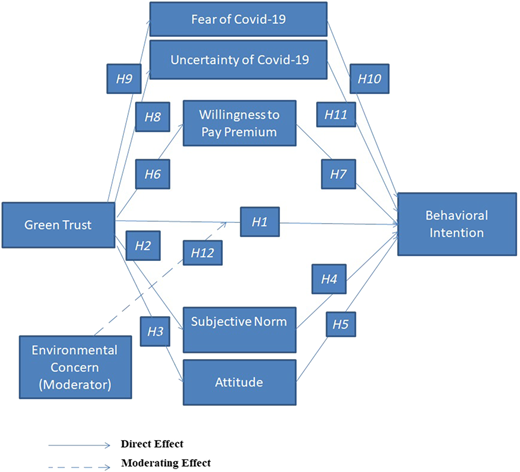
Green trust significantly influences the behavioral intentions toward green hotels.
Green trust significantly affects the subjective norms toward green hotels.
Green trust significantly affects the attitude toward green hotels.
Subjective norms significantly influence the behavioral intentions toward green hotels.
Attitude significantly influences the behavioral intentions toward green hotels.
Green trust, willingness to pay premium and behavioral intention
Past research studies showed that green trust significantly affects the customers' willingness to pay premium for green hotels (Balaji et al., 2019; Yadav et al., 2019). A considerable volume of research also indicated that the willingness to pay premium significantly influences customers' behavioral intention concerning green hotels (Agag, 2019; Balaji et al., 2019; Yadav et al., 2019). In findings of a study based on hotel guests' standpoint toward green practices employed by the hotel industry, the more the guests were worried about the environment, the more they were willing to pay premium for green drives of hotels (Kang et al., 2012). The hospitality literature also indicated a significantly higher inclination of customers of certified green restaurants toward sharing their perspectives on green practices in contrast with non-certified green restaurant customers (Park et al., 2018). The researchers have likewise advised that the customers' willingness to pay premium toward green hotels further elevated during the COVID-19 outbreak (Jian et al., 2020).
Accordingly, the researchers propose the accompanying hypotheses on the foundation of pointed disquisition as follows:
Green trust significantly influences the willingness to pay premium toward green hotels.
Willingness to pay premium significantly affects the behavioral intention toward green hotels.
Green trust, fear and uncertainty of COVID-19 and behavioral intention
Gupta et al. (2021) studied the behavioral intention of Indian tourists using the health belief model. They argued that the tourists who have low efficacy and possesses high vulnerability for COVID-19 exposure abstain from heading out to India during the rising cases of COVID-19. The quest on the consumption of individual protective medical equipment in China during the COVID-19 outbreak caused consumers to favor online buying intention of equipment (Addo et al., 2020).
Jian et al. (2020) assessed the association of fear and uncertainty of COVID-19, behavioral intention toward green hotels and trust in green hotels. The study results highlighted that the fear and uncertainty of COVID-19 increased the customers' trust toward green hotels, which, in turn, enhanced their intention to stay at green hotels.
Thus, the researchers propose as follows:
Green trust significantly influences fear of COVID-19.
Green trust significantly influences the uncertainty of COVID-19.
Fear of COVID-19 significantly influences behavioral intention toward green hotels.
Uncertainty of COVID-19 significantly influences behavioral intention toward green hotels.
Environmental concern and antecedents of behavioral intention
The customers who are more prone to environmental protection concerns have a more optimistic attitude, which further enhances behavioral intentions (Hoang et al., 2019). The researchers have suggested that the fear and uncertainty of COVID-19 and the environmental concern of hotel customers influences their brand trust, which, in turn, contributes significantly toward their willingness to pay premium and thus behavioral disposition toward green hotels (Jian et al., 2020). Also, brand attitude mediates the relationship of brand knowledge and the brand performance in the restaurants utilizing green practices (Liu et al., 2020) and among trust and intentions of travelers (Zainal et al., 2017).
The environmental concern moderates the association of attitude and behavioral intention in previous studies (Cachero-Martínez, 2020; Hoang et al., 2020). Attitude, willingness to pay and environmental concern impacted behavioral intention (Prakash and Pathak, 2017). A study investigating hotel managers in India revealed that the environmental concern and attitude significantly impact the emerging Indian green hotel practices implementation (Verma and Chandra, 2018). A survey study based on TPB theory proposed that the online social media followers' attitudes and subjective norms significantly influence their behavioral intention, which significantly impacts their behavior (Harb et al., 2019). An empirical study utilizing SEM analysis on 559 respondents in Taiwan revealed that the consumers' environmental concern affects a significant impact on their subjective norms and attitude, both of which also casts a significant influence on their intention to avail services of green hotels (Chen and Tung, 2014). Yadav et al. (2019) recommended that the absence of attitude, willingness to pay premium and subjective norms prompt the decreased inclination of travelers for having a positive behavioral intention for green hotels.
Consequently, the existing literature supports the researchers in proposing the accompanying hypotheses as follows:
Environmental concern moderates the relationship between green trust and behavioral intention in a manner that the relationship is more potent when environmental concern is higher.
Figure 1 represents the conceptual framework proposed in this study.
Methodology
Collection of data
The data included 536 respondents of Delhi and the NCR of India. The researchers kept the criteria of respondents in the sample population as respondents having travel and stay experience to any outstation destination in the last year. The respondents reply through emails and social media platforms such as LinkedIn by utilizing a survey questionnaire developed on the Google Form platform. The data collection from study participants was more appropriate using Internet tools since the ongoing COVID-19 epidemic has made contactless life and social distancing a need of the time. The participants offer a week to respond to the survey questionnaire at their convenience. The researchers gave the survey questionnaire to 1,000 people, out of whom 536 responded, revealing a response rate of 53.6%, showing the appropriateness of the rate of submitted responses (Johnson and Owens, 2003) for a survey type investigation. There were no missing responses since data gathering involved the “required” option of the Google Form settings, ensuring that respondents respond to all fields before submitting the answered Google Form. The researchers also used Harman's single factor test (Harman, 1976) to evaluate common method bias (Podsakoff et al., 2003) and found that the responses were free of common method bias.
The following Table 1 represents the demographic profile of the participants of this investigation;
Demographic profile of the respondents
| Attribute | Categorical level | Number of respondents | Proportion |
|---|---|---|---|
| Gender | Male | 322.00 | 60.07 |
| Female | 214.00 | 39.92 | |
| Age (years) | 0–30 | 107.00 | 19.96 |
| 30–45 | 322.00 | 60.07 | |
| 45–60 | 75.00 | 13.99 | |
| 60+ | 32.00 | 5.97 | |
| Education | Graduate | 43.00 | 8.02 |
| PG | 364.00 | 67.91 | |
| Doctorate | 118.00 | 22.01 | |
| Other | 11.00 | 2.05 | |
| Experience (years) | 0–5 | 182.00 | 33.95 |
| 6–10 | 172.00 | 32.08 | |
| 11–15 | 96.00 | 17.91 | |
| 16–20 yrs | 54.00 | 10.07 | |
| 21–25 yrs | 32.00 | 5.97 |
Note(s): N = 536
Survey instruments
The standard instruments included in this study are constructs adopted in previous research work in various organizational settings. The researchers had the four-item scale with items acquired from Kilbourne and Pickett (2008) to measure environmental concern. The four-item scale proposed by Bitan et al. (2020) to collect data for fear of COVID-19 and the three-item scale suggested by Andrews (2008) to collect responses for the uncertainty of COVID-19. The three-item scale for each of the subjective norms and the behavioral intention for green hotels and five-item scale for attitude with items acquired from Chen and Tung (2014) and Han et al. (2010) to gather responses for these constructs. The four items from Choi et al. (2015) were used to collect responses for green trust. Also, a three-item scale from Rahman and Reynolds (2016) was used to measure willingness to pay premium.
Data analysis strategy
The researchers included confirmatory factor analysis (CFA) to assess the measurement model and (SEM analysis to examine the proposed hypotheses in this study. The researchers perform data analysis using Statistical Package for the Social Sciences (SPSS) 25.0 and Analysis of Moment Structures (AMOS) 25.0 software in this study.
Results and observations
The authors assess the reliability of the constructs used in this study from Cronbach's alpha (Cronbach, 1951) and composite reliability (Fornell and Larcker, 1981). The results (Table 2) revealed that the measures of reliabilities for all the constructs are more than the recommended threshold value of 0.70. Consequently, the scales utilized in this study emerge as adequately reliable. The researchers do not consider the third item of the environmental concern construct having low-factor loading from the data analysis exercise to avoid the impact of a less significant response scale on the comprehensive study. Further, average variance extracted (AVE) was used to assess the validity of the scales. The AVE values of all the constructs emerge out as more than 0.50 (Table 2), and in this manner, the scales utilized in the study possessed adequate validity. The noteworthy observations about reliability, validity, correlations and descriptive statistics are present in Table 2.
Correlations, reliability, average variance extracted (AVE) and descriptive statistics
| S. no. | Study variables | X’ | µ’ | 1 | 2 | 3 | 4 | 5 | 6 | 7 | 8 | 9 | 10 | 11 |
|---|---|---|---|---|---|---|---|---|---|---|---|---|---|---|
| 1 | Gender | 1.40 | 0.49 | |||||||||||
| 2 | Age | 1.71 | 0.85 | 0.35* | ||||||||||
| 3 | Education | 2.18 | 0.59 | 0.39** | 0.35* | |||||||||
| 4 | Green trust | 2.18 | 0.93 | 0.07 | 0.13 | 0.18 | 0.54 | |||||||
| 5 | Willingness to pay premium | 3.15 | 0.89 | 0.19 | 0.01 | 0.12 | 0.61** | 0.56 | ||||||
| 6 | Subjective norm | 2.84 | 0.82 | 0.22 | 0.12 | 0.09 | 0.43** | 0.39** | 0.52 | |||||
| 7 | Attitude | 3.65 | 0.84 | 0.12 | 0.04 | 0.01 | 0.46** | 0.26* | 0.24* | 0.54 | ||||
| 8 | Fear of COVID-19 | 3.19 | 0.87 | 0.15 | 0.02 | 0.06 | 0.11* | 0.05* | 0.14* | 0.19* | 0.54 | |||
| 9 | Uncertainty of COVID-19 | 3.62 | 0.92 | 0.06 | 0.05 | 0.01 | 0.06* | 0.01* | 0.13* | 0.08* | 0.58** | 0.53 | ||
| 10 | Environmental concern | 2.83 | 0.67 | 0.12 | 0.06 | 0.18 | 0.04* | 0.10* | 0.02 | 0.23* | 0.35* | 0.26* | 0.54 | |
| 11 | Behavioral intention | 3.51 | 0.89 | 0.07 | 0.04 | 0.12 | 0.44** | 0.21* | 0.31* | 0.50* | 0.04* | 0.24* | 0.25* | 0.56 |
Note(s): **p < 01, *p < 05,
Average variance extracted (AVE) are mentioned across parentheses diagonally,
X’: mean and µ’: standard deviation
The factor loadings of all the items of the constructs used in this study remain significant as reported in Table 3, which also justifies the adequate validity of the proposed constructs.
Indicators of reliability and validity of study constructs
| Study construct | Construct item | Factor loading | Cronbach's alpha | Composite reliability |
|---|---|---|---|---|
| Green trust | I feel that green hotels' environmental commitments are generally reliable | 0.80 | 0.84 | 0.85 |
| I feel that green hotels' environmental performances are generally dependable | 0.83 | |||
| I feel that green hotels environmental arguments are trustworthy | 0.82 | |||
| I feel that green hotels keep the environmental promises and commitment they make | 0.75 | |||
| Willingness to pay premium | It is not acceptable for me to pay more for a green hotel* | 0.82 | 0.80 | 0.75 |
| I am willing to pay more for a green hotel | 0.81 | |||
| I am willing to spend an extra amount of money in order to stay at a green hotel | 0.70 | |||
| Subjective norm | People important to me, think that I should stay at a green hotel | 0.74 | 0.89 | 0.81 |
| Most people who are important to me would want me to choose green hotels while traveling | 0.81 | |||
| People whose opinion I value would want me to stay at green hotels | 0.82 | |||
| Attitude | For me staying at a green hotel while traveling is (differential scale) | – | 0.86 | 0.84 |
| Extremely bad/extremely good | 0.80 | |||
| Extremely undesirable/extremely desirable | 0.83 | |||
| Extremely unpleasant/extremely pleasant | 0.82 | |||
| Extremely foolish/extremely wise | 0.80 | |||
| Extremely unfavorable/extremely favorable | 0.79 | |||
| Fear of COVID-19 | I am afraid of the coronavirus | 0.83 | 0.88 | 0.74 |
| It makes me uncomfortable to think about the coronavirus | 0.82 | |||
| I am afraid of losing my life because of the coronavirus | 0.84 | |||
| When watching news and stories about the coronavirus on social media, I become nervous or anxious | 0.87 | |||
| Uncertainty of COVID-19 | I perceive the context of COVID-19 as very complex | 0.90 | 0.74 | 0.86 |
| I perceive the context of COVID-19 as unpredictable | 0.88 | |||
| U I perceive the context of COVID-19 as changing rapidly | 0.84 | |||
| Environmental concern | I am very concerned about the environment | 0.80 | 0.79 | 0.82 |
| I would be willing to reduce my consumption to help protect the environment | 0.78 | |||
| Major social changes are necessary to protect the natural environment | 0.83 | |||
| Anti-pollution laws should be enforced more strongly | 0.88 | |||
| Behavioral intention | I am willing to stay at a green hotel while travelling | 0.76 | 0.74 | 0.78 |
| I will make an effort to stay at a green hotel when traveling | 0.77 | |||
| I plan to stay at a green hotel for my next vacation | 0.87 |
Note(s): *Reverse scored item
The proposed model was found to be having good fit with the responses as found during CFA. Eight-factor solution was found from the measurement model of this study as X2 (188) = 360.001, CFI = 0.97, TLI = 0.83, IFI = 0.97, NFI = 0.95, RMSEA = 0.04, SRMR = 0.04 and PClose = 0.000. Comparative fit index (CFI), Tucker-Lewis index (TLI), Incremental fit index (IFI), Normed Fit Index (NFI), Root mean square error of approximation (RMSEA), Standardized root mean square residual (SRMR) were used to evaluate the model fit in this study. Also, the SEM analysis results revealed the good fit between the model and the data, as: X2 (196) = 398.001, CFI = 0.96, TLI = 0.81, IFI = 0.97, RMSEA = 0.04 and SRMR = 0.04.
Evaluation and testing of the research framework
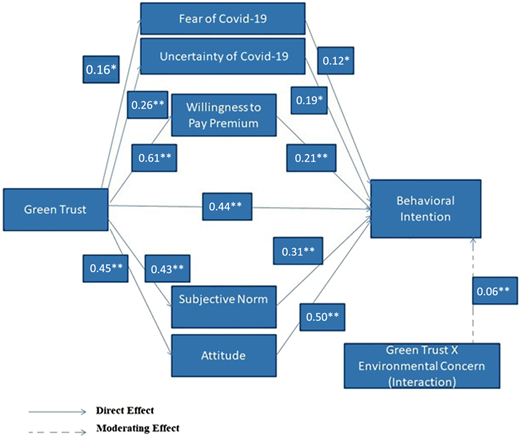
The researchers assess the hypotheses proposed in this study using effects and the significance of these effects between the constructs obtained from the SEM analysis. Table 4 contains all the results of the analysis. Hypothesis 1 found support as the green trust of the consumers was observed to impact their behavioral intention significantly (E = 0.44 and p < 0.01). Also, Hypotheses 2, 3 and 6 were supported as consumers' green trust was found to impact their subjective norm (E = 0.43 and p < 0.01), attitude (E = 0.45 and p < 0.01) and willingness to pay premium (E = 0.61 and p < 0.01). The Hypotheses 4, 5 and 7 were also supported as subjective norm (E = 0.31 and p < 0.05), attitude (E = 0.50 and p < 0.01) and willingness to pay premium (E = 0.21 and p < 0.05) were observed to impact behavioral intention toward green hotels significantly.
Structural equation modeling (SEM) analysis for testing proposed framework
| Constructs and direction of effect | Direct effects (standardized) |
|---|---|
| Green trust → behavioral intention | 0.44** |
| Green trust → subjective norm | 0.43** |
| Green trust → attitude | 0.45** |
| Green trust → willingness to pay premium | 0.61** |
| Green trust → fear of COVID-19 | 0.16* |
| Green trust → uncertainty of COVID-19 | 0.26** |
| Fear of COVID-19 → behavioral intention | 0.12* |
| Uncertainty of COVID-19 → behavioral intention | 0.19* |
| Willingness to pay premium → behavioral intention | 0.21* |
| Subjective norm → behavioral intention | 0.31* |
| Attitude → behavioral intention | 0.50** |
Note(s): **p < 0.01; *p < 0.05 and N = 536
Hypotheses 8, 9, 10 and 11 found support from the findings obtained from SEM analysis as the green trust found to be significantly influencing fear (E = 0.16 and p < 0.05) and uncertainty (E = 0.26 and p < 0.01) of COVID-19. Also, fear (E = 0.12 and p < 0.05) and uncertainty (E = 0.19 and p < 0.05) of COVID-19 further found to be significantly influencing the behavioral intention toward green hotels.
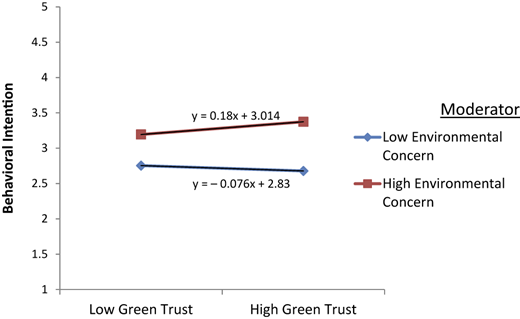
The researchers examine the moderating influence of environmental concern in the relationship of green trust and behavioral intention toward green hotels using the three criteria suggested by Baron and Kenny (1986). At first, the moderator environmental concern does not relate directly to the dependent variable behavioral intention. Second, the interaction (Green Trust × Environmental Concern) was significant, and third, the moderator environmental concern functions as an independent variable. Thus, all the three criteria recommended were satisfied. Also, researchers evaluate the moderating influence using the moderated SEM (MSEM) approach suggested by Ping Jr (1995) to test the moderating influence. The results of the analysis show a good model fit with the data, as X2 [120] = 170.980, CFI = 0.96, IFI = 0.98, RMSEA = 0.02 and SRMR = 0.04. Also, the interaction coefficient was found to be significant (B = 0.064 and p < 0.01). The results thus show that the relationship between green trust and behavioral intention is stronger when environmental concern is higher. Conclusively, Hypothesis 12 is supported.
Figure 2 represents the moderating impact of environmental concern in the relationship between green trust and behavioral intention toward green hotels. The figure indicates that environmental concern strengthens the positive relationship between green trust and behavioral intention.
The conceptual framework proposed in this study was subsequently verified hypothetically and empirically and addressed in Figure 3.
Discussion
The popularity of green practices adopted by the hotel industry is expanding considerably with time. Additionally, the consumers with a tendency toward environmental protection concerns possess increased favorableness toward green hotels after the spread of the COVID-19 infection. This study has proposed a novel framework for future research enthusiasts to examine consumers' behavioral intention toward green hotels. There is a colossal deficit of accessible literature with an exploratory emphasis on moderating influences of environmental concern (Cachero-Martínez, 2020).
This study empirically validates the association between consumers' green trust and their behavioral intention. The study found support from previous literature, such as Rai and Nayak (2019, p. 29) found that brand trust is the vital determinant in the building of emotional commitment of customers toward a hospitality brand. The study also indicated significant influences of fear and uncertainty of the COVID-19 pandemic on consumers' green behavioral intention (Altuntas and Gok, 2021; Jian et al., 2020; Jiang and Wen, 2020). The study also upheld the existing literature on the significant impacts of green trust and willingness to pay premium, attitude and subjective norms. The study also indicates the significant effect of these antecedents on consumers' behavioral intentions toward green hotels. The study also adds the innovative finding of moderating effect of environmental concern in the association of green trust and behavioral intention to the existing literature. This study shows that the consumers' green trust casts an increasingly significant influence on behavioral intention toward green hotels when consumers have more significant environmental concerns than the lower ones. These results further extend support to the findings of the past examinations (Balaji et al., 2019; Han et al., 2020; Jian et al., 2020; Verma and Chandra, 2018; Wang et al., 2018; Yadav et al., 2019).
Subsequently, this study enriches the accessible hospitality literature by featuring different vital determinants of consumers' behavioral intention and the moderating impact of environmental concern in the proposed framework during the surging wave of the ferocious COVID-19 pandemic.
Theoretical implications
This study has proposed valuable theoretical contributions in the area of the hotel industry. This study has suggested an extended theoretically and empirically validated framework of antecedents of consumers' behavioral intentions toward green hotels in India. This proposed framework is a unique integrated framework of diverse research theories, such as TPB theory, ABC theory and moderating influences. The framework has well supported the past research works (Cachero-Martínez, 2020; Chaudhary, 2018; Chen and Chang, 2013; Han et al., 2010, 2020; Yadav et al., 2019).
Further, it is evident from the review of hospitality literature that many studies explored the antecedents of the behavioral intention of consumers toward hotels. Yet, the available research on the association of the behavioral intention of travelers and the green practices adopted by hotels during environmental vulnerabilities such as COVID-19 are not many. Accordingly, this study fills this gap of current literature too.
Additionally, this study contributed critical highlights on the roles of fear and uncertainty of COVID-19 pandemic on the proposed framework of behavioral intention of consumers toward green hotels. The results also support those research studies associated with environmentally supportive activities by integrating environmental concerns in the proposed framework. Postma and Yeoman (2021, p. 74) recommended the future tourism sector acquire strategic foresight and scenario planning competence to generate adaptive capacity to achieve advantage from natural contingencies through resilience rather than making efforts to avoid their damaging effects. Thus, the study results are vital for researchers exploring future tourism strategies and policies that can build resilience toward vulnerabilities such as the COVID-19 pandemic.
Finally, the study is a significant endeavor to bring researchers' attention to the strategic restructuring of the hospitality industry, which is one of the most barely hit industries during repeating COVID-19 pandemic waves (Craven et al., 2021).
Managerial implications
This study indicates some exceptionally valuable implications for hotel industry managers. This study suggests that subjective norms and attitude impacts travelers behavioral intentions positively. Subsequently, the hotel managers need to alter their traditional health and cleanliness practices so that consumers may perceive them as adequate as per the continuous pandemic situation, such as implementing and featuring contactless and mobile app-based services. Second, communication is an important ingredient in accomplishing sustainability and building green capacities (McCartney and Leong, 2018). Thus, the hotel managers must maintain effective communication with employees concerning their enhancements in green strategies. Jamal and Budke (2020) suggested that viable communication of precise insights about the diseases such as coronavirus will support travelers from various dilemmas and the disclosure of scientific data and recommended precautions will make a concrete approach of practitioners toward future tourism at both domestic and global level. A study conducted by McKinsey on 5,000 employees during the second wave of COVID-19 revealed that effective communication with employees will improve their productivity at work (Craven et al., 2021).
Consequently, this recommendation will make employees more confident and productive. The second wave of the COVID-19 pandemic has indicated the role of COVID-19 that is probably going to make mindfulness regarding health issues among the consumers each time there is the redundant influx of COVID-19 or such infectious diseases in future. A health belief model-based study revealed that tourists tend to avoid traveling to India during the COVID-19 spread due to vulnerability of exposure to coronavirus infection (Gupta et al., 2021). Thus, the study recommends hotel managers implement green practices such as online booking, contactless payments, dining with social distancing and providing local customers with a chance to stay and enjoy a safe and recreational environment to invigorate their minds in a time of the pandemic. Such practices will enhance travelers' trust toward green hotels and improve their tendency toward environmental concerns, further resulting in their increased attitudinal pre-dispositional behavioral intention toward green hotels.
Simultaneously, the study results on willingness to pay premium and subjective norms help the researchers recommend hotel managers increase positive communication regarding hotels' green practices through social media. As, during the pandemic time, the population is highly interested in knowing the trends in social media, it could be an opportunity for hotels' marketing managers to add the significance of green hotel practices in the behavioral buying criteria of hotel consumers.
Limitations of the study and directions for future research
Although this study extends recommendations and results of high worth for theoretical and managerial purposes, the study still has some limitations that future researchers can emphasize.
At first, the study is survey-based and doesn't add anything experimentally, whereas the experimental research on green hotels may add more critical values in terms of results and findings. Such as investigating how a green practice supported with an artificial intelligence-based application in a controlled hotel setting influences the green trust and behavior of hotel visitors can be a valuable experimental study. Second, this study is a one-time study conducted during the second wave of the COVID-19 pandemic. Although a longitudinal study to detect consumers' behavioral intention toward green hotels during recurring waves of the pandemic will give more reliable findings.
Further, this study indicated some antecedents of the behavioral intention of travelers during COVID-19. Still, an expanded focus on assessing different factors that may impact the future of travel and tourism is of prime importance for future research. As, while connecting the present, past and future of tourism amid the COVID-19 pandemic, Higgins-Desbiolles et al. (2021, p. 9) concluded that “[…] COVID-19's interruption invites us to look to tourism's past to help us in our imaginings to enable a better future.” Illustratively, Matiza (2020) suggested future tourism industry practitioners explore the association of perceived risk and the COVID-19 pandemic to predict the post-pandemic behavior of travelers.
Dolnicar et al. (2015) expressed concern over researchers' emphasis on behavioral intention to comprehend the satisfaction-behavioral intention linkage. Since such a link provides supportive machinery for tourism industry leaders to augment their market strategies, future tourism industry researchers need to validate behavioral intentions' role in travelers' response to the tourism industry. The researchers further contended that the contribution of behavioral intentions of tourists toward destinations is rather complex than as understood by the researchers and need investigation of other determinants that are responsible for tourists' actual behavior. The researcher also indicated the required emphasis of researchers on optimum usage of constructs to measure behavioral intention to avoid common method bias, which can prompt vagueness in findings and results of the studies. Accordingly, this study has empirically investigated the behavioral intentions of travelers during the COVID-19 pandemic. Future researchers should stress assessing actual behavior rather than behavioral intentions, which seems to be a complex proxy for actual behavior during environmental uncertainties and pandemics such as the COVID-19 pandemic.
Subsequently, future researchers may focus on many such aspects to further expand the horizon of green hotel research.

