Generative artificial intelligence (GenAI) plays a crucial role in academic sustainability as it enables personalized learning experiences and fosters innovative problem-solving approaches. Based on the technology readiness index (TRI) and the expectancy–confirmation model (ECM), this study aims to propose and validate a research model that examines the nexus between individual technology-related traits, performance expectancy, confirmation of expectations, satisfaction and continuance intention to use GenAI for learning purposes. Furthermore, the mediating and moderating mechanisms of habit on the relationship between satisfaction and continuance intention are clarified.
Data were collected through paper-based questionnaires administered to 419 higher education students from universities in Hanoi, using a non-probability convenience sampling technique. Partial least squares structural equation modeling was used for empirical analysis.
Results show that optimism and innovativeness positively influence performance expectancy and confirmation of expectations. Insecurity negatively influences confirmation of expectations, while discomfort negatively affects performance expectancy. The study confirms the positive relationships between confirmation of expectations, performance expectancy, satisfaction and continuance intention, as proposed by the ECM. Interestingly, habit serves as both a positive mediator and a negative moderator in the relationship between satisfaction and continuance intention.
This research contributes to understanding higher education students' behavior toward GenAI usage for learning in the post-adoption stage. The findings confirm that individual characteristics predict ECM variables, advancing our understanding of ECM antecedents and TRI outcomes. Notably, this study reveals the dual role of habit in the satisfaction-continuance intention relationship: habit positively mediates the effect of satisfaction on continuance intention and negatively moderates the same relationship. These findings enrich the literature on the mechanisms and boundary conditions affecting the relationship between satisfaction and continuance intention.
1. Introduction
Recent advancements in generative artificial intelligence (GenAI) have transformed higher education by offering tailored learning experiences that enhance students' academic performance (Huang and Tan, 2023). GenAI employs advanced deep learning techniques to generate human-like content, including texts, images, and other formats in response to user prompts (Lim et al., 2023). A global student survey found that up to 40% of students have incorporated GenAI into their studies, while over 60% expressed interest in integrating AI literacy into their curriculum (Singh and Paiva, 2025). Despite its growing popularity, the proliferation of GenAI in education has sparked concerns regarding plagiarism, content authenticity, and problems related to cognitive capabilities (Kasneci et al., 2023; Klimova and Pikhart, 2025), suggesting that students may lack the competencies to use these tools appropriately.
Nevertheless, GenAI offers distinctive educational benefits, including reduced academic pressure, improved time management, and adaptive learning support (Tan et al., 2024). Students have employed GenAI tools to automate various tasks, such as solving exam-style questions, completing homework assignments, and drafting academic essays (O'Connor, 2022) as these tools provide personalized feedback, virtual tutoring, and support in developing writing skills (Huang and Tan, 2023). GenAI also has the potential to assist teachers in providing students with more tailored and efficient learning experiences (Pradana et al., 2023). Consequently, educational institutions and technology developers are actively working to minimize academic misconduct and promote responsible GenAI use (Pedro et al., 2019). UNESCO emphasized that when responsibly governed, GenAI can strengthen inclusive and equitable education and contribute directly to Sustainable Development Goal 4 by improving instructional quality and reducing learning disparities (Pedro et al., 2019). Given this coexistence of opportunities and concerns, recent literature has explored students' continuance intention (CI) to use GenAI technologies for academic purposes, questioning whether sustainable long-term adoption in higher education is feasible (Singh and Paiva, 2025; Tan et al., 2024). Literature also address the need to examine how humans and GenAI technologies can integrate to accomplish educational goals through a human-centered approach that ensures technological advancements align with pedagogical objectives and student aspirations (Pradana et al., 2023).
The expectation-confirmation model (ECM) has a long-standing history of explaining continuance usage behavior of information technology (IT) products (Saxena and Doleck, 2023). ECM reads users' continuance intention not merely as a reflection of satisfaction and perceived usefulness but also as motivated by predetermined expectations and the degree to which these expectations are confirmed (Bhattacherjee, 2001). Bhattacherjee (2001) argued that unlike technology-based theories such as the Technology acceptance model (TAM), Theory of planned behavior (TPB), and Unified theory of acceptance and use of technology (UTAT), which focus on initial adoption of innovation, ECM components more accurately capture post-adoption behavior. This is because its emphasis on confirmation and satisfaction directly reflects users' evaluations after forming expectations about system usage. Prior studies have employed ECM as a theoretical foundation for understanding users' continuance intention of educational technologies, including GenAI tools (Singh and Paiva, 2025). This theory is particular relevant for GenAI usage, as learners engage with such tools to achieve specific academic goals, such as obtaining feedback, synthesizing information, or supporting collaborative learning (Saxena and Doleck, 2023; Duong et al., 2023). Students generate prompts on GenAI tools, expecting these prompts will yield answers to their academic tasks. Their decision to continue using GenAI therefore depends heavily on whether actual outcomes confirm these expectations, making ECM an appropriate theoretical foundation for explaining GenAI continuance intention. However, the application of ECM into students' continuance intention of GenAI for academic purposes requires extensions as key factors from the original model may be inadequate to capture the multidirectional nature of user behavior (Zhou, 2017).
First, several scholars have suggested that extending the ECM with other theoretical frameworks provides a more holistic understanding of technology continuance intention in educational settings (Saxena and Doleck, 2023; Shah et al., 2023). ECM has been extended by incorporating cognitive (Shah et al., 2023) and social perspectives (Saxena and Doleck, 2023). However, individual-related characteristics remain underexplored in ECM-based research despite playing a crucial role in shaping perceived usefulness, which is a key component of ECM (Lin et al., 2007). Prior research indicates that personal innovativeness influences technology use (Tan et al., 2024), while students may simultaneously exhibit skepticism toward GenAI due to concerns about information accuracy and privacy risks (Pedro et al., 2019). These dual forces suggest that a more nuanced framework is needed to capture both the motivating and inhibiting factors that shape students' technology adoption decisions.
To address this gap, this study integrated the Technology readiness index (TRI) as an antecedent to ECM construct comprising individual technology-readiness traits including both motivate (optimism and innovativeness) and inhibit (discomfort and insecurity) the adoption toward emerging technologies (Parasuraman, 2000). This dual-factor structure directly addresses the complexity of student perceptions toward GenAI, acknowledging that students may simultaneously feel optimistic about GenAI's potential while experiencing discomfort with its uncertainties. By combining ECM's post-adoption evaluation with TRI's emphasis on individual predispositions, the TRI-ECM integration provides a comprehensive framework for understanding students' continuance intention to use GenAI. TRI also has been widely adopted to evaluate students' readiness for m-learning (Kampa, 2023), AI-based systems (Nouraldeen, 2023), and e-learning platforms (Kaushik and Agrawal, 2021).
Second, the original ECM focuses on conscious evaluations without accounting for unconscious responses that may influence continuance intention. Research shows that when a technology becomes widely adopted, CI may be shaped by habit (Bae, 2018). Habit is an automatic tendency formed through repeated behavior and represents an unconscious factor that predicts technology continuance intention (Jasperson et al., 2005). Once habit is established, CI may no longer rely heavily on satisfaction-based evaluations (Nguyen et al., 2022). Prior research has examined habit in multiple roles as an antecedent (Hsu and Lin, 2015), moderator (Limayem and Cheung, 2011), or mediator (Dai et al., 2020), yet these studies have produced fragmented insight that do not fully capture habit's complex relationship with satisfaction and CI. Nguyen et al. (2022) validated habit's dual role as both moderator and mediator in the context of online food delivery services and called for further validation in other technological contexts.
This study responds to this call by incorporating habit into the ECM-TRI framework to test its moderating effect on the satisfaction-to-continuance intention relationship in the educational settings. This extension is particularly relevant for GenAI usage, as students engage in frequent and prolonged interactions with these tools throughout their learning process, creating conditions for habit formation. However, excessive reliance on GenAI through habitual use may paradoxically weaken the positive relationship between satisfaction and continuance intention, as use become automatic and routine, potentially leading to digital fatigue, reduced critical thinking, and diminished human interaction (Klimova and Pikhart, 2025). This suggests that habit acts as a boundary condition on the translation from students' satisfaction into continuance intention of GenAI tools. Thus, this study extends the current literature on post-adoption behavior of GenAI tools for academic purposes (Saxena and Doleck, 2023; Tan et al., 2024) by investigating the dual role of habit in the link between satisfaction and continuance intention.
In summary, this study develops an integrated model predicting students' continuance intention to use GenAI for academic purposes, combining TRI – ECM and the dual role (mediator and moderator) of habit. This research advances knowledge on post-adoption behavior and GenAI usage in several ways. First, it clarifies how technology readiness dimensions affect students' continuance intention to use GenAI for academic purposes. Second, by combining a dual conscious and unconscious lens into a unified model, it reveals the multidirectional nature of students' continuance intention. Third, it conducts mediation and moderation analyses, providing a comprehensive understanding of the underlying mechanism and boundary condition of the impact of satisfaction on students' usage continuance intention. The findings offer practical insights for stakeholders, such as educators, GenAI developers, and academic institutions, to foster technology-enabled education.
2. Theoretical framework and hypothesis development
2.1 Expectation-confirmation model
The expectation-confirmation theory, initially proposed by Oliver (1980), provides a foundational framework for understanding consumer satisfaction and post-purchase behavior based on four key constructs: initial expectations, perceived performance, confirmation, and satisfaction. In the context of information systems (IS) usage, Bhattacherjee (2001) adapted this into the expectation-confirmation model for IS continuance intention. ECM focuses on post-acceptance variables, namely (1) confirmation, (2) perceived usefulness, and (3) satisfaction, on the premise that pre-adoption expectation is inherently captured through users' confirmation and satisfaction evaluations.
This study operationalizes perceived usefulness as performance expectancy to capture broader outcomes. Perceived usefulness is defined as “the degree to which a person believes that using a particular system would enhance his or her performance” (Davis, 1989), and primarily reflects extrinsic and utilitarian benefits derived from IS system usage (Lin et al., 2012). Since IS use yields multiple benefit types, performance expectancy from the UTAUT encompasses users' perceived benefits that users associate with technology use (Venkatesh et al., 2012), extending outcome beliefs to experiential, hedonic, and social applications. Performance expectancy here refers to perceived advantages that higher education students believe GenAI offers for learning, such as enhancing academic performance, creativity, and learning experience (Duong et al., 2023). This construct has been widely applied in prior educational research studies (Hoi, 2020; Duong et al., 2023).
In educational contexts, existing literature suggests that extending ECM with other theoretical models can capture more comprehensive insights into students' continued technology use (Saxena and Doleck, 2023; Shah et al., 2023). Two theoretical approaches underlie CI when integrated with ECM: (1) cognitive factors and (2) social factors. As shown in Table 1, cognitive determinants are represented by perceived ease of use and perceived usefulness derived from TAM; while emotional dimensions of learning motivations are captured through flow theory (Lee, 2010; Shah et al., 2023). Regarding social aspects, scholars have integrated normative pressure such as social norms and perceived behavioral control, adapted from TPB into ECM (Saxena and Doleck, 2023). Despite these advancements, individual characteristics remain overlooked although personal technology-related traits play crucial role in explaining IS continuance intention as student exhibit both attraction toward and skepticism about innovation adoption (Tan et al., 2024; Pedro et al., 2019). Hence, this study incorporates TRI into the proposed research model.
2.2 Technology readiness index (TRI)
Proposed by Parasuraman (2000), the Technology readiness index measures people's reactions toward a new technology-based product or service. Technology readiness is defined as “people's propensity to embrace and use technologies for accomplishing goals in home life and at work” (Parasuraman, 2000). TRI is a multidimensional construct comprising two drivers (i.e. optimism and innovativeness) and two inhibitors (i.e. discomfort and insecurity) (Parasuraman and Colby, 2007).
In education, TRI has been used to characterize learners' technology readiness (Elliott et al., 2008; Lai, 2008; Kaushik and Agrawal, 2021; Rahmat et al., 2022). Drivers and inhibitors operate independently, meaning individuals possess distinct combinations of technology-related traits (Parasuraman, 2000). Optimism reflects positive views of technology's efficiency benefits, while innovativeness captures willingness to adopt new technology early. Students, especially younger generations as early adopters, frequently show positive technology traits (Habes et al., 2024). More innovative students are more likely to explore new technologies (Geng et al., 2019; Kaushik and Agrawal, 2021).
Nevertheless, discomfort refers to a feeling of lack of control or being overwhelmed when using technology, whereas insecurity involves skepticism regarding its reliability or safety. Parasuraman and Colby (2015) categorize technology users into five segments – explorers, pioneers, skeptics, paranoids, and laggards – based on levels of motivation and inhibition. In education settings, skeptics, who represent low motivation and low inhibition, often adopt technology once benefits are apparent, whereas those high in insecurity or discomfort require reassurance or simplified interfaces to engage (Elliott et al., 2008; Lai, 2008).
2.3 Hypothesis development
2.3.1 The relationship between TRI dimensions and performance expectancy
While prior research has examined TRI dimensions and performance expectancy in IS products such as mobile services (Lin et al., 2007), ubiquitous media (Dadvari and Do, 2019), and e-health (Leung and Chen, 2019), this relationship remains unvalidated in educational technology settings. GenAI in learning presents dual aspects. On the one hand, GenAI offers reduced academic pressure, improved time management, and adaptive learning support (Tan et al., 2024). Students have employed GenAI tools to automate various tasks, such as solving exam-style questions, completing homework assignments, and drafting academic essays (O'Connor, 2022) to enhance academic performance, On the other hand, GenAI also holds concerns about academic integrity, ethical implications, and misinformation (Giannakos et al., 2025; Kasneci et al., 2023) that might affect its perceived usefulness, causing skeptical students to avoid to use it. Therefore, the study proposes the following hypotheses:
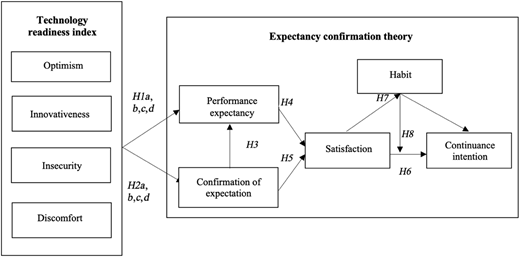
Drivers, namely (a) optimism and (b) innovativeness, have a positive effect on the performance expectancy of Gen AI.
Inhibitors, namely (c) insecurity and (d) discomfort, have a negative effect on the performance expectancy of Gen AI.
2.3.2 The relationship between TRI dimensions and confirmation of expectation
Parasuraman (2000) indicates that individual characteristics play a central role during the decision-making process. The ECT posits that individual psychological traits shape how expectations are formed and subsequently confirmed through actual experience (Oliver, 1980). According to ECT, confirmation of expectation occurs when a product performs in line with or exceeds users' prior expectations, whereas disconfirmation may lead to rejection. Previous studies demonstrate that TRI dimensions (optimism, innovativeness, discomfort, and insecurity) represent key psychological traits that significantly shape user expectations in technological contexts (Chen et al., 2013; Leung and Chen, 2019). Accordingly, this study proposes the following hypotheses:
Drivers, including (a) optimism and (b) innovativeness have a positive effect on confirmation of expectation
Inhibitors, including (c) insecurity and (d) discomfort, have a negative effect on confirmation of expectation.
2.3.3 Post-adoption stage and continuance intention to use GenAI
The ECM posits that user satisfaction with a technology is shaped by confirmation of expectation and perceived usefulness (also referred to as performance expectancy) (Bhattacherjee, 2001). Confirmation significantly influences perceived usefulness (Bhattacherjee, 2001). In information system continuance, confirmation occurs when experiences meet or exceed expectations, fostering satisfaction (Lee, 2010). Drawing on cognitive dissonance theory, users experiencing better-than-expected performance may revise their initial usefulness perceptions upward to align with real experience, thereby reinforcing perceived usefulness over time (Bhattacherjee, 2001).
Research demonstrates that satisfaction drives repurchase and continuance intention (Lee, 2010; Yu et al., 2024). User satisfaction reflects users' overall assessment of the difference between expectation and actual performance (Chen et al., 2013). Students form expectations based on prior information, and satisfaction arises when their experience matches or exceeds those expectations, reinforcing continued use. Based on TAM, students who perceive technology as easy to learn and practical are more likely to adopt it (Yu et al., 2024). When students find GenAI tools both user-friendly and effective in enhancing learning outcomes while saving time and effort, they report higher satisfaction and demonstrate stronger CI (Yu et al., 2024). Therefore, this study proposes the following hypothesis:
Confirmation of expectation has a positive effect on performance expectancy
Performance expectancy has a positive effect on satisfaction
Confirmation of expectation has a positive effect on satisfaction
Satisfaction has a positive effect on continuance intention
2.3.4 The effect of habit on the relationship between satisfaction and continuance intention
Habit is a critical construct in understanding post-adoption information technology usage (Deng et al., 2023). It refers to learned sequences of actions that become automatic responses to specific situations (Venkatesh et al., 2023). This automaticity reduces cognitive effort in decision-making and increases the likelihood of repeated behavior (Tan et al., 2024).
In the post-adoption stage, satisfaction is a well-established predictor of continuance intention (Tan et al., 2024). However, this relationship may not be entirely direct (Deng et al., 2023). Grounded in instrumental conditioning theory, behaviors that yield rewarding outcomes are more likely to be repeated over time, gradually becoming routine (Venkatesh et al., 2023). When users have satisfactory experiences with a product or service, they are more likely to unconsciously repeat the same usage behavior (Lee, 2022). Habit forms when individuals repeatedly respond to stable contexts in pursuit of goals, with positive outcomes reinforcing both the behavior and the satisfaction derived from it (Lee, 2022). Empirical studies show that once IS users are satisfied with a technology, habit significantly increases their intention to continue using it (Deng et al., 2023). Therefore, this study proposes the following hypothesis:
Habit positively mediates the relationship between satisfaction and continuance intention to use GenAI
Jasperson et al. (2005) identified two feedback loops in post-adoption behavior: conscious reflection on early experiences and habitual use as technology becomes routine. In educational settings, the frequent and prolonged use of GenAI tools driven by its capabilities of enhancing academic performance, create conditions for habit formation. When behavior becomes habitual, conscious evaluations diminish, potentially weakening the effect of satisfaction on CI (Nguyen et al., 2022). Cognitive load theory derived from Sweller (1988) further supports this tendency, as habit serves as a mechanism to reduce cognitive efforts during information processing (Venkatesh et al., 2023); thereby encouraging routine use rather than deliberate decision-making. Consequently, students may continue using GenAI out of routine rather than ongoing satisfaction. Therefore, this study proposes the following hypothesis:
Habit negatively moderates the relationship of satisfaction and continuance intention to use GenAI.
The conceptual model is presented in Figure 1.
3. Methodology
3.1 Research context
Vietnam is experiencing substantial growth in generative AI adoption in the educational sector, attracting considerable academic interest (Bui et al., 2025; Duong, 2024). However, research on post-adoption behavior in Vietnamese education remains scarce (Duong, 2024). The emphasis on digital transformation and AI integration in Vietnamese education is essential for enhancing teaching quality, supporting educational reforms, and promoting international collaboration. Vietnam has developed an ambitious national AI strategy, with government ministries actively cultivating high-quality AI expertise (Lin and Ming, 2025). Therefore, investigating higher education students' continuance intention to use generative AI for educational purposes will provide valuable theoretical insights for countries seeking to facilitate effective AI implementation in the educational sector.
3.2 Measures
The measurement items for each variable were borrowed from previous research to ensure their reliability and validity. Table 2 presents all constructs and items. All of the items were measured using a five-point Likert scale, ranging from “strongly disagree” (1) to “strongly agree” (5). Since the original items were developed in English, a forward-backward translation procedure by three bilingual experts was employed to ensure linguistic equivalence (Brislin, 1970). Two rounds of pretest were conducted to ensure the questionnaire's suitability for the research context. Initially, five scholars familiar with the research topic, who are researchers in the field of human-technology interaction, were invited to assess the questionnaire's content validity. The second round consisted of a pilot test with 25 higher education students who had prior experience with generative AI tools, including ChatGPT and Notion AI. These participants assessed the clarity and wording of items, the logical sequence of questions, and the estimated completion time. Minor refinements were implemented based on their feedback, including reordering certain questions to improve flow.
3.3 Sampling and data collection
Without a sampling frame or higher education student list, this study employed a non-probability convenience sampling technique. Two approaches determined the minimum sample size. First, following the common guideline of 10 observations per parameter, the measurement model has 33 parameters, requiring a minimum of 330 responses (Bentler and Chou, 1987). Second, with an unknown population, we followed Cochran's (1977) recommendation, establishing 384 as the required minimum.
Target respondents were higher education students enrolled at universities in Hanoi who had experience using generative AI for the study purpose. Hanoi was selected for data collection due to its high concentration of universities and colleges, housing over 97 universities and 33 colleges – around a third of Vietnam's total (Vu et al., 2024). From September 2023 to January 2024, paper-based questionnaires were distributed to higher education students at five large universities in Hanoi, with 100 questionnaires per university. Class teachers and supervisors from the research team's personal networks assisted in distribution by delivering questionnaires to students in their higher education classes. To ensure participants met the target demographics, two filtering questions and a clear definition of generative AI (including examples of popular tools in Vietnam) were placed at the beginning of the questionnaire to verify that respondents were (1) higher education students and (2) had used generative AI for study. Data were collected form human participants in compliance with the ethical standards of the Declaration of Helsinki. Of the 451 surveys collected, 32 were discarded for missing responses or providing consistent answers. The remaining 419 responses were retained for final analysis. Table 3 summarizes the sample characteristics.
3.4 Data analysis
The SmartPLS 4 software was used to perform partial least squares structural equation modeling (Ringle et al., 2012) to test both the measurement and structural model. PLS-SEM was chosen because it is suitable for analyzing comprehensive models involving moderating effects (Henseler et al., 2009). Additionally, Ringle et al. (2012) suggested that PLS-SEM is preferable for theory development studies. Since this study investigates the precursors of ECT components and the outcomes of the TRI components, it can be considered an extension of both theories. Furthermore, PLS-SEM has gained considerable traction in marketing research (Nguyen et al., 2025).
4. Results
4.1 Common method bias
Common method bias could be an issue since participants evaluated all survey items simultaneously. To address this, several preventive measures were applied following Podsakoff et al. (2012). Respondents were assured of confidentiality and anonymity. Class teachers and supervisors explicitly informed them that the survey was for academic purposes only. Respondents were told there were no right or wrong answers and that their opinions were valued. Participation was voluntary, and students could withdraw at any time. As a post hoc statistical check, Harman's single-factor test was conducted to assess the presence of CMB. The results showed that the largest factor accounted for 30.74% of the total variance, which is less than the 50% threshold for CMB concern (Podsakoff et al., 2012).
4.2 Assessment of measurement model
Internal consistency reliability, convergent and discriminant validity were evaluated in the measurement model assessment. As shown in Table 4, all items have outer loadings over 0.70, and Cronbach's alpha and composite reliability (CR) of all concepts exceeded 0.70, which confirmed the reliability and demonstrated sufficient internal consistency (Hair et al., 2019). The average variance extracted (AVE) for each concept was greater than 0.50, thus demonstrating a satisfactory convergent validity for all constructs.
The discriminant validity was confirmed as the square root of the AVE values for each construct exceeded their highest correlations with other constructs (Table 5), satisfying the Fornell and Larcker criterion (Fornell and Larcker, 1981). Furthermore, the Heterotrait-Monotrait (HTMT) values for all constructs in Table 6 were less than 0.85 (Henseler et al., 2015). These findings collectively indicate that the discriminant validity criteria were acceptable.
4.3 Hypothesis testing
The research model's quality was evaluated through the coefficient of determination () and Stone-Geisser (). According to the results in Table 7, the values for five endogenous constructs, which are PE, confirmation of expectation, satisfaction, habit, and CI, varied from 0.290 to 0.476, respectively. All values exceeded 0.26, suggesting a moderate level of variance explained by these constructs. Additionally, the values were all above 0, further confirming the predictive relevance of the exogenous latent variables.
Next, the significance of the hypotheses was assessed by a bootstrapping procedure with 5,000 sub-samples. The VIF values of the inner model were less than 5, indicating the absence of multicollinearity in the current study (Hair et al., 2019).
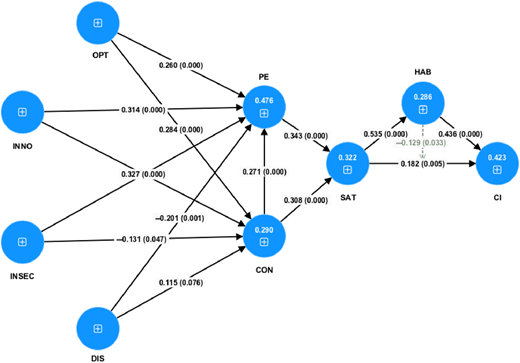
The structural model assessment results are summarized in Table 8 and illustrated in Figure 2. Optimism (β = 0.260, p < 0.001) and innovativeness (β = 0.314, p < 0.001) both positively influenced higher education students' performance expectancy (PE), supporting H1a and H1b. However, insecurity (β = 0.089, p = 0.153) showed no significant effect, failing to support H1c. Discomfort (β = −0.201, p < 0.05) negatively affected performance expectancy, supporting H1d.
Optimism (β = 0.284, p < 0.001) and innovativeness (β = 0.327, p < 0.001) were also positively related to confirmation of expectations, supporting H2a and H2b. Insecurity negatively influenced confirmation of expectations (β = −0.131, p < 0.05), supporting H2c, while discomfort (β = 0.115, p = 0.076) had no significant impact, thus H2d was not supported.
Confirmation of expectation was positively related to PE (β = 0.271, p < 0.001), supporting H3. Both PE (β = 0.343, p < 0.001) and confirmation of expectation (β = 0.308, p < 0.001) positively influenced students' satisfaction, confirming H4 and H5.
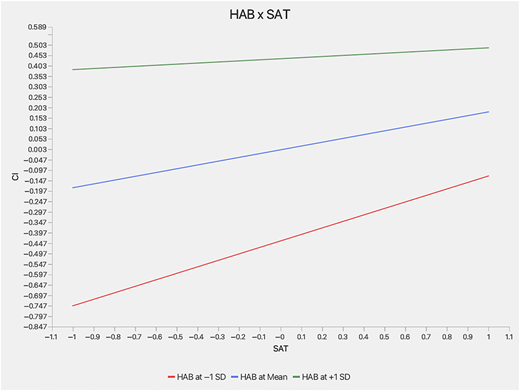
Satisfaction positively affected CI using generative AI for study (β = 0.182, p < 0.01), supporting H6. It was also positively associated with students' habit of using generative AI (β = 0.535, p < 0.001), which in turn was positively related to CI (β = 0.436, p < 0.001). The indirect effect of satisfaction on CI through habit was significant (β = 0.233, p < 0.001, CI = [0.177, 0.302]), confirming H7. Finally, the interaction effect between satisfaction and habit was significantly and negatively related to CI (β = −0.129, p < 0.05), confirming H8. Figure 3 depicts the negative moderating effect of habit on the relationship between satisfaction and CI to use GenAI for learning.
5. Discussion of findings and implications
5.1 Discussion of main findings
The primary purpose of this study was to provide comprehensive insights into higher education students' continuance intention to use GenAI. The research integrates the TRI and the ECM to examine how personal technology-related traits influence users' post-adoption behavior.
First, the results show that TRI drivers (innovativeness and optimism) are critical factors in predicting performance expectancy (PE) and confirmation of expectations. Students with higher levels of innovativeness and optimism are more likely to embrace technology in their studies. Innovativeness demonstrated the strongest positive influence on both performance expectancy and confirmation of expectations. This supports the notion that innovative students tend to be early adopters who actively integrate new technologies like GenAI into their studies, perceiving these tools as beneficial for their academic growth (Kaushik and Agrawal, 2021; Habes et al., 2024).
Second, the study found a significant negative effect of discomfort on PE and insecurity on confirmation of expectations. Students who are identified with a high level of discomfort reflecting feelings of lacking control are less likely to believe GenAI can enhance their academic performance. Similarly, students skeptical about technology express greater concerns that GenAI will not meet their initial expectations. These concerns align with broader doubts about GenAI regarding academic integrity, privacy, intellectual property, and misinformation (Giannakos et al., 2025; Kasneci et al., 2023; Pedro et al., 2019)
Third, surprisingly, the effect of insecurity and discomfort on PE were non-significant. One possibility is that the inclusion of other drivers overshadows the effect of insecurity. In the educational context, this may suggest that while some students initially feel uneasy or uncertain about using GenAI tools, such concerns tend to diminish as they become more familiar with the technology and recognize its academic benefits. The non-significant relationship between discomfort and confirmation is also supported by the findings of Humbani and Wiese (2019). A possible explanation is that since TRI was developed from an American perspective, its effect may vary across cultural contexts, particularly in developing countries, where personality traits and technology adoption patterns differ.
Fourth, all hypotheses derived from the ECM were supported, consistent with prior research on CI in educational settings (Lee, 2010; Shah et al., 2023). Satisfaction emerged as a significant predictor of CI, with higher satisfaction levels predicting stronger CI. This finding reaffirms the relationship between satisfaction and CI in educational technology contexts, supporting empirical results validated across various domains (Chen et al., 2013; Leung and Chen, 2019). Notably, PE had the strongest effect on satisfaction, aligning with prior findings by Yu et al. (2024).
Finally, this study validates the dual role of habit on the relationship between satisfaction and CI through both mediation and moderation analysis. Habit significantly mediates and negatively moderates this relationship in the context of GenAI usage among higher education students. Habits form when individuals repeatedly engage in goal-driven behavior within stable contexts and receive positive reinforcement, strengthening both the behavior and the satisfaction derived from it. As behavior becomes automatic, users act with less conscious evaluation (Nguyen et al., 2022). The negative moderating effect of habit in this study extends previous work by Hsu et al. (2015) and Nguyen et al. (2022), which demonstrate that strong habit diminish the reliance on satisfaction in shaping continued use.
5.2 Theoretical implications
This study contributes to the growing literature by offering multi-perspective framework on the nature of continuance intention in educational settings, particularly regarding the application of emerging technologies such as GenAI. TRI captures personal technology-related traits that shape conscious evaluations in the post-adoption stage, while habit represents an unconscious pathway to sustained use, functioning as both mediator and moderator.
First, by integrating TRI constructs with ECM, this study advances current knowledge on ECM antecedents and TRI outcomes, also responding to the call of having personal traits in explaining IS adoption within educational contexts (Shah et al., 2023). TRI captures individual technology-related traits (both motivators and inhibitors), reflecting the ambivalent nature of students' perceptions toward innovation. By combining ECM's focus on post-adoption evaluations with TRI's emphasis on individual predispositions, the integrated TRI–ECM framework offers a more comprehensive explanation of students' continuance intention to use GenAI for academic purposes. While prior research has focused on incorporating cognitive and social factors into ECM, our research enriches the literature by TRI, individual traits, as antecedents. The findings validate that the unified TRI-ECM model appropriately explains users' technology continuance intention.
Second, this study lies in its validation of habit's dual role, thereby extending existing literature by examining its effect in the post-adoption phase. While satisfaction is widely recognized as a strong predictor of CI (Bhattacherjee, 2001), habit can modify this relationship. Specifically, habitual use may weaken the direct effect of satisfaction on continued use as previously satisfying behaviors become automatic routines. By examining both the mediating and moderating effects of habit, this study offers a more nuanced understanding of the mechanisms and boundary conditions underlying the satisfaction–continuance intention relationship. Moreover, the findings highlight the multifaceted nature of habit, validating that students' decisions to continue using GenAI for academic purposes are shaped by both conscious and unconscious behavioral processes (Nguyen et al., 2022).
5.3 Managerial implications
The study offers several practical implications for fostering sustained use of GenAI among higher education students. The unified TRI-ECM framework indicates that innovativeness emerged as the strongest predictor, having a significantly positive effect on both performance expectancy and confirmation of expectation. Institutions can leverage this by segmenting students into five groups: explorers, pioneers, skeptics, paranoids, and laggards (Parasuraman and Colby, 2007), each requiring tailored strategies. For example, highly innovative students (explorers and pioneers) should be encouraged as peer mentors, serving as role models to promote adoption among more hesitant users.
Furthermore, students should enhance their technology competencies by developing an accurate understanding of GenAI's role as a complementary support tool rather than a replacement for learning (Duong et al., 2023). Since performance expectancy emerged as the strongest predictor of satisfaction among ECM constructs, structured training programs should be implemented to familiarize students with GenAI's functionality and appropriate academic applications, shaping their expectations about the benefits of using GenAI.
Moreover, the study highlights the critical role of habit in the relationship between satisfaction and CI to use GenAI. To address this, educational institutions should assess students' usage frequency to identify varying levels of habitual use and develop relevant strategies accordingly. Special attention should be given to students with low habit formation, as they are at the stage of developing habitual behavior. Institutions should design value-driven stimuli that promote reflective use, thereby increasing the frequency of GenAI use.
6. Limitations and future research direction
This research, while contributing valuable insights, has several limitations that warrant consideration in future studies. First, the exclusive focus on higher education students suggests the need to include postgraduate cohorts in subsequent studies. The varying academic demands across educational levels would likely yield meaningful comparative data regarding GenAI adoption patterns. Second, the study's broad approach to GenAI usage would benefit from domain-specific investigation, such as examining its application in language acquisition or STEM disciplines, potentially revealing context-dependent variables that influence adoption. Third, in terms of methodology, the cross-sectional design introduces potential response bias concerns. Future research would be strengthened by longitudinal approaches that more accurately capture actual usage patterns over time. Finally, the reliance on convenience sampling and the focus on the Vietnamese higher education context may limit the generalizability of the findings to other countries. Future studies should adopt more rigorous sampling methodologies and conduct cross-cultural investigations to validate the proposed model across different educational systems and socio-cultural environments to enhance external validity and provide more representative results.