Skip to article sections
Purpose

This study examines whether value-based trust arises from the metaphorical and experiential image of a business city and whether it serves as a key antecedent of business executives’ satisfaction, regardless of the city's management model.

Design/methodology/approach

A mixed-methods approach is adopted. First, the Zaltman Metaphor Elicitation Technique is used to explore executives' perceptions and mental associations of business cities. Next, a quantitative model is developed and tested using structural equation modeling with data from 1,801 managers of foreign firms in two Latin American cities.

Findings

The findings extend network governance, innovation ecosystem and smart and sustainable city models by showing that, beyond institutional and technological structures, a business city's competitiveness also depends on how these structures are perceived in terms of image, trust and satisfaction by visiting executives. This represents a clear and significant advance in both the theory and practice of business city management.

Originality/value

This study integrates three constructs that the literature has typically treated separately or mainly in tourism contexts rather than from a business city management perspective: a city's metaphorical and experiential image, value-based corporate trust and business executives’ satisfaction. Its value lies in the managerial implications, which distinguish global trends–where business destination management typically relies on established infrastructure, stable regulatory frameworks and institutionalized city-branding strategies–from Latin American contexts, where business city management must prioritize a more basic but strategically important agenda focused on reducing perceived risk, building trust and creating holistic experiences for business executives.

Global business travel spending is projected to reach USD 2 trillion by 2028 (Statista, 2025a, b). In Latin America and the Caribbean, Santiago, Chile and Mexico City are major hubs of investment and business activity (Statista, 2025a, b). Chile's quarterly gross domestic product (GDP) is approximately USD 95 billion (BCC, 2025), and the country ranks 42nd in the World Competitiveness Ranking, which assesses economic performance, government efficiency, business efficiency, and infrastructure (IMD, 2025). Over the same period, Mexico's GDP is around USD 1.8 trillion (INEGI, 2025), ranking 55th. According to the Global Cities Index—which evaluates economy, human capital, quality of life, environment, and governance—Santiago ranks 160th and Mexico City 253rd (OE, 2025). These figures underscore the regional importance of both cities for business and investment and highlight the need for policies and urban strategies that enhance their competitiveness and attractiveness for executives and investors.

A business city's urban competitiveness—and, thus, its attractiveness—can be shaped through different management models. The literature identifies three prominent approaches: network governance theory, which emphasizes coordination among actors (Klijn et al., 2025); the innovation and entrepreneurship ecosystem approach, which highlights the interdependence of actors in generating innovation (Inacio Junior et al., 2025); and the smart and sustainable city model, which focuses on leveraging technology and data to enhance sustainability, quality of life, and resilience (Hansen et al., 2025).

Despite extensive research on these models, a gap remains. Current approaches conceptualize urban competitiveness as the result of coordinated interactions among multiple actors, supported by institutional frameworks, technological capacity, and collective resources, but they largely overlook visits by business executives intending to invest. This raises the following research question: What role do visits by potential investing executives play in shaping urban competitiveness beyond traditional interactions among public, private, and social actors?

Evidence from the UK suggests that a city qualifies as a business destination when it provides the infrastructure, services, and attributes needed to support corporate travel for meetings, conferences, conventions, and exhibitions (Bradley et al., 2002). Studies from Indonesia and South Africa indicate that a city's image emerges from the interplay of environmental characteristics, spatial patterns, socioeconomic attributes, and metaphorical elements that shape lasting perceptions (Chan et al., 2021; Das, 2016). Research from Jerusalem, Rome, and Trieste further shows that visitors value not only physical qualities but also the attention they receive, leisure and tourism offerings, safety, public services, and opportunities for recreation and entertainment—all key determinants of urban image (Gilboa et al., 2015). Together, these dimensions generate cognitive (Jafar and Ahmad, 2024), emotional (Chen et al., 2022), functional (Singh et al., 2023), hedonic (Trinanda et al., 2022), and symbolic (Maspoli, 2025) experiences for business travelers in both on-site and digital environments.

Although the literature recognizes both the metaphorical elements representing a city's physical qualities and the multiple experiential dimensions perceived by visitors, limited research examines whether and how these two sets of factors coincide, converge, or overlap in shaping a business city's image. Do common metaphorical and experiential elements allow for an integrated measurement of a business city's image, or do these elements constitute distinct constructs that require separate instruments?

Much of the literature suggests that trust in a city considered a business destination—such as Iskandar Puteri—depends on a combination of environmental factors. These include economic stability and a qualified workforce (Ong et al., 2022), robust infrastructure, as in Dubai (Almarri and Boussabaine, 2025), transparent governance, as highlighted in Indonesia (Hartanto et al., 2021), and a favorable business environment that supports sustainable, resilient management aligned with corporate goals (Florez-Jimenez et al., 2024). In the United States, trust in local partners and employees also contributes to perceptions of reliability and reduces risk for investors and firms (Brockman et al., 2022; Tang and Yang, 2024). Additionally, cities that promote social cohesion, guarantee safety (Haque et al., 2022), and ensure regulatory transparency—which helps control transaction costs and improve business performance (Riedmann-Streitz et al., 2025; Sun et al., 2025)—build a stronger foundation of trust, making them more attractive for investment and long-term growth, as seen in several Latin American and Caribbean cities (Keefer and Scartascini, 2022).

Despite the prominence of these environmental factors, an important theoretical and empirical gap remains. Few studies treat trust in the city as a corporate construct—that is, as trust attributed to the city itself based on value-based dimensions. Specifically, research integrating dimensions such as honesty, benevolence, and perceived competence of business executives in forming urban trust is scarce. Addressing this gap would clarify how value judgments held by key actors—such as executives and business leaders—interact with environmental conditions to generate trust, thereby enriching explanatory models and informing public policies aimed at attracting investment. This raises the question: To what extent do the value-based dimensions of trust attributed to a business city—honesty, benevolence, and competence—as perceived by business executives shape urban trust as a corporate construct?

Additionally, the literature shows that business executives’ satisfaction when visiting a city—whether in person or online—depends on a combination of factors encompassing work-related infrastructure, leisure, and well-being. Studies in the Persian Gulf, Portugal, and Beijing highlight the importance of efficient work infrastructure as a foundation for urban satisfaction (Alakoum and Nica, 2024; Cardoso et al., 2022) and suggest that when complemented by recreational and cultural activities, it helps mitigate the burdens of business travel (Madeira et al., 2023; Park, 2024; Zhu et al., 2023).

Other key factors identified in Medellín and China's Hainan province include convenient logistics and transportation (Aïdi and Fabry, 2024; Li et al., 2023a, b), productive meeting spaces and services, high-quality accommodation, as in Can Tho (Nguyen Huu et al., 2024), effective connectivity, and timely responses to business needs through reliable systems and information. Personal well-being, including safety and favorable environmental conditions, has been highlighted in cities across Europe, North America, and Asia (Gretzel and Koo, 2021), while opportunities aligned with personal interests, such as restaurants and attractions, have been documented in Greece, Thailand, and Portugal (Vlachou and Savvinopoulou, 2022; Yasami et al., 2022; Coelho et al., 2022). These factors collectively contribute to business executives' satisfaction, as demonstrated in Seoul (Ryu and Kwon, 2021).

Despite these insights, a theoretical gap persists in business city research. While literature identifies key environmental factors influencing executives' satisfaction, few studies conceptualize or measure satisfaction as a holistic experiential perception emerging from the combined evaluation of these factors. This limits understanding of the relative contribution of integrated perceptions and constrains the design of precise urban interventions and policies aimed at enhancing business visitors' satisfaction. This raises the question: How can executive satisfaction in business cities be conceptualized and measured as a holistic experiential perception emerging from the combined evaluation of environmental factors?

Most studies address image, trust, and satisfaction in isolation or in leisure- and tourism-oriented contexts (Hassan and Soliman, 2021; Kusumah, 2024; Li and Yang, 2022; Maldonado-López et al., 2024; Wang et al., 2024; Zhao et al., 2024), rather than in business tourism or decision-making contexts. Research rarely empirically examines city image—comprising metaphorical elements and multiple experiential dimensions—together with corporate trust in the city, defined by value-based dimensions, and business manager satisfaction. This raises the question: How do city image (metaphorical and experiential dimensions), corporate trust in the city (honesty, benevolence, and competence), and business manager satisfaction interact empirically in business decision-making contexts?

In line with these gaps, this study aims to develop a mixed-order metric integrating the dimensions identified in the literature within the comparative context of Mexico City and Santiago de Chile, as perceived by managers of foreign firms visiting business and investment districts. Specifically, we examine trust as a precursor to managerial satisfaction in the business city context, hypothesizing that a city's image as a business hub shapes trust attributions, thereby enhancing and predicting managerial effectiveness and business satisfaction.

Few studies have explored the psychological components underpinning business city image in depth. Our qualitative methodology addresses this gap by using metaphors, which are crucial for designing competitive and efficient business cities, as they illuminate functional and emotional dimensions directly linked to executives' cognitive experiences. Marinao-Artigas et al. (2025) highlighted relationships among perceived quality, reputation, trust, satisfaction, and business tourist loyalty in Mexico City and Santiago de Chile. Building on this, our study seeks a deeper understanding of the underlying cognitions and metaphors that shape executives' experiences within business destinations.

Similarly, Lai and Cole (2024) analyzed Hong Kong in terms of international image, local pride, trust, and smart city initiatives. However, their study focused on the cognitive perceptions and experiences of local residents, whereas our research draws insights from foreign business executives visiting business cities. Research on Bratislava and other Slovak cities examined the relationship between emotional attachment among visitors and residents and the perceived image of the city (Manyiwa et al., 2018), but the business domain was not the primary focus, distinguishing our study. A study in Vilnius emphasized urban cultural heritage, local traditions, and cultural preservation in defining a city's image or brand (Černikovaitė and Karazijienė, 2020). Our study aims to foster a similar reflection in the Latin American context while considering socioeconomic and psychological factors more comprehensively.

Within this context, our study examines whether value-based trust is a consequence of a business city's metaphorical and experiential image and whether it serves as a key antecedent of business executives' satisfaction, regardless of the city's management model.

This research is original in integrating three constructs that the literature has typically treated separately or in predominantly tourism-oriented contexts rather than from a business city management perspective: the city's metaphorical and experiential image, value-based corporate trust, and business executives' satisfaction.

This study makes a theoretical contribution by enriching explanatory models of urban competitiveness based on visitors' corporate experiences and offers practical guidance for public policies and urban interventions aimed at attracting and retaining investment in Latin American business cities.

It addresses three main gaps: (1) it incorporates the perspectives of foreign business executives in evaluating business cities; (2) within a single analytical framework, it integrates urban image (metaphorical and experiential), value-based corporate trust, and managerial satisfaction in business decision-making contexts rather than purely tourism contexts; and (3) it provides comparative empirical evidence for two key regional cities—Mexico City and Santiago de Chile—generating actionable insights for urban competitiveness strategies and policies targeting the business travel segment.

Management of a business city can be approached from three perspectives. From a network governance perspective (Klijn et al., 2025), it is conceived as a coordination process in which decisions, resources, and responsibilities are shared among interdependent actors—multilevel governments, firms, social organizations, and universities—through relatively stable networks of interaction, negotiation, and cooperation (Pulido-Gómez et al., 2025), extending beyond state hierarchies or market mechanisms (Abel, 2025).

From the innovation and entrepreneurship ecosystem perspective (Inacio Junior et al., 2025), a business city is understood as a territorial fabric in which innovation and firm creation emerge from dynamic interactions among entrepreneurs, companies, universities (Audretsch et al., 2025), government, and investors, mediated by formal and informal institutions (Bakry et al., 2025). Within this framework, innovative performance depends less on individual capabilities and more on the quality of relationships, complementarities, and rules structuring the ecosystem. From the perspective of smart and sustainable cities (Hansen et al., 2025), management is conceptualized as a planning model integrating digital technologies, data, and innovative solutions to achieve environmental sustainability (Riedmann-Streitz et al., 2025), social equity, and economic viability. The goal is to enhance urban services, citizen participation, and quality of life (Kotagiri, 2025), with particular emphasis on city resilience (Li and Lu, 2025).

Findings from India highlight place image as a key factor in tourism success through social media (Khatoon and Choudhary, 2024). Evidence from Australia characterizes image as an abstract, subjective, and holistic concept encompassing the set of impressions and experiences associated with a place (Bui et al., 2022). Studies in Malaysia emphasize that, cognitively, destination image consists of the beliefs, ideas, and impressions people hold about a place (Lam et al., 2024), while further evidence from India suggests that, emotionally, it integrates the knowledge, biases, and affective responses an individual experiences toward a place (Jose et al., 2024).

In the branding domain, brand image encompasses the functional, experiential, and symbolic benefits perceived by consumers (Ghorbani and Westermann, 2025). Following Moraga et al. (2012), this study proposes that the image of a business city is a holistic construct composed of cognitive, emotional, functional, hedonic, and symbolic experiences of business managers.

Cognitive experience refers to perceptions of physical and territorial characteristics (Beerli and Martín, 2004), while emotional experience captures the affective reactions and emotional states generated by services, attributes, and the atmosphere of a place (Royo-Vela and Garzón-Paredes, 2023). Functional experience reflects evaluations of the usefulness and performance of environmental attributes for business activities (Akel and Armağan, 2021). Hedonic experience represents the pleasure, enjoyment, and fantasy associated with services and interactions within a place (Zhu et al., 2025). Finally, symbolic experience encompasses benefits related to the construction of the individual or social self-derived from a relationship with the city (Yang et al., 2025). This conceptualization enables a comprehensive measurement of business city image and provides guidance for operationalizing each dimension empirically.

Findings from Indonesia indicate that trust has become a central element in relationships among actors in the tourism market and constitutes a key competitive advantage (Huddin et al., 2024). In the context of a destination, evidence from Malaysia shows that trust involves the expectation that actors, both individual and institutional, will behave reliably, thereby reducing the perceived vulnerabilities of visitors and economic agents (Wong et al., 2024). Defined as the belief that the counterpart possesses integrity and reliability, trust plays a decisive role in interactions between the tourist or agent and the destination (Sirdeshmukh et al., 2002).

Consequently, residents and institutions in a business city are expected to display the basic attributes that business executives perceive as the foundations of trust. Following Morgan and Hunt (1994), these attributes are honesty, benevolence, and competence. Honesty refers to the belief that a counterpart keeps its word, fulfills promises and obligations, and acts sincerely (Sanzo et al., 2003). Benevolence denotes the belief that the other party seeks one's interests and well-being, demonstrating a willingness to help and foster positive relationships (Beveridge and Höllerer, 2023). Competence is the perception that a counterpart has the skills, knowledge, and capabilities necessary to perform its functions effectively (Moin et al., 2023), with collaboration, innovation, and best practices in risk management serving as key indicators of competence in public–private partnerships (Memari et al., 2025).

In line with Artigas et al. (2017), this study conceptualizes trust as a construct composed of honesty, benevolence, and competence in the business environment. Treating trust in value-based terms allows for a more precise capture of its cognitive and affective sources: honesty reflects ethical and truth-related aspects, benevolence reflects favorable intentions toward economic actors, and competence reflects the ability to meet expectations. This specification enhances both theoretical validity and empirical sensitivity.

Evidence from emerging economies indicates that visitor satisfaction is a key determinant of destination success, contributing to loyalty, likelihood of return and recommendation, willingness to pay, and visitor retention (Amissah et al., 2021). Findings from China suggest that visitor satisfaction is a cognitive–affective–conative state resulting from the tourism experience (Li et al., 2023a, b), with the interaction between cognitive and emotional components being crucial for generating memorable experiences (Hosany et al., 2022).

From a psychological perspective, satisfaction can be conceived as a state of full emotional well-being (Langeland, 2023), largely grounded in cognitive evaluations of experienced destinations, as found in the United States (Acharya et al., 2023). Building on studies from Kuala Lumpur and Indonesia and given the central role of cognitive and affective appraisals, this study emphasizes cognitive–affective satisfaction as a visitor's response to the various stimuli offered by the destination (Rasoolimanesh et al., 2025). Empirical evidence from Amsterdam shows that both tangible and intangible elements are decisive in achieving satisfaction in local destinations (Romão et al., 2015), and distinctive attributes of international destinations, such as those in Korea, also generate high levels of satisfaction among visitors (Ryu and Kwon, 2021).

A qualitative study was conducted using in-depth interviews and metaphor creation through the Zaltman Metaphor Elicitation Technique (ZMET) methodology. The ZMET is a method for constructing mental maps or models of behavior that reveal participants' feelings, emotions, and thoughts in depth (Zaltman, 1997). This methodology elicits memories and thoughts through metaphors, stories, and images. Our rationale for investigating deep feelings, motivations, and thoughts related to business cities—as well as the underlying meanings and emotions expressed through image associations, stories, narratives, metaphors, and words—stems from our aim to collect rich and detailed data that can provide deeper insight into the complex phenomena associated with “trust.” Qualitative studies can reveal nuanced perceptions and experiences that often remain unnoticed in quantitative research (Lyon et al., 2015). Such approaches are particularly valuable for exploring the deeper contexts and motivations underlying specific behaviors or attitudes. For example, focus groups can uncover subtle connections and group dynamics that surveys often fail to capture (Lai et al., 2025). Examining city image, Eid and Elbanna (2018) first applied qualitative methods to identify the distinctive characteristics of a non-Western city, which were later refined and validated through quantitative analyses.

Some advantages of using ZMET include its use of advanced image-based techniques to uncover both explicit and implicit thoughts and emotions, providing greater validity and reliability than traditional approaches (Chen, 2006, 2008). This enables a more accurate understanding of the complex and evolving nature of trust in a business city. When combined with quantitative methods in a mixed-methods research design, ZMET allows for a more precise exploration of subtle perceptions related to trust and the image of a business city. This integration enhances understanding by combining the richness of qualitative insights with the breadth of quantitative testing. The insights gained can inform city image promotion initiatives, policy development, and community engagement (Brandt and De Mortanges, 2011; Gamarra-Olortegui et al., 2023).

The ZMET methodology consists of the following stages.

  1. Image collection (pre-interview preparation): Before the in-depth interview, participants are asked to select and gather 8–10 images representing their deep feelings, motivations, and thoughts related to business cities. This process allows them to construct a unique perspective based on their life histories, articulated through a timeline and narrative expressed in both linguistic and visual codes. Using this material, participants then engage in the prepared interviews, both consciously and unconsciously.

  2. Visual narratives: Once the images are collected, participants meet with the researcher. In this stage, they are asked to tell a story about each image. These narratives could be factual, referring to the origin of the images, in which case the interviewer focuses on eliciting participants' opinions and emotional responses to events. Alternatively, participants could imagine or construct narratives. The interviewer retains the flexibility to ask follow-up questions aligned with the study objectives.

  3. Missing images: In the next stage, participants are asked whether they expected to find any images that were absent. They then describe the missing images, commenting on their content and meaning.

  4. Elimination of redundancies: Participants and the researcher jointly remove the most similar or recurrent images that convey the same meaning.

  5. Creation of constructs: Participants are asked to sort and group the images into three to four clusters based on their meaning, perception, content, and interpretation. This stage is significant because it marks a transition from cognitive processes linked to emotions, memories, and personal feelings to conceptualization and abstraction. Image classification at this stage guides the researcher's subsequent categorization.

  6. Construction of metaphors: Participants are asked to rewrite or reimagine some images by adding elements not explicitly present in the original images. This process, known as metaphor creation, allows the researcher to access participants' deeper thoughts and emotions. During this stage, participants engage in reflection, using metaphors that shape their interpretations, narratives, and actions.

  7. Sensory images: Participants describe deep emotions, feelings, and thoughts using the senses—color, sound, smell, taste, and touch—linking them to the images. This sensory-imagery phase provides access to the concrete experiences through which participants conceive and remember their lived experiences. These accounts could refer to both generalizable life events and specific cases related to their relationship with the object of study.

  8. Vignette creation: Participants develop a story or narrative about business cities and themselves, establishing an intimate dialog with the business city as the unit of study. This is known as the vignette stage.

  9. Collage production: In the final stage, participants produce a summary collage showing how they connect the business city to their lifestyle. The preceding steps generated extensive sets of photographs and narratives from each interviewee, which are provided as supplementary materials for this article.

The input data for the ZMET methodology were collected between August and October 2022 through in-depth, on-site interviews. These interviews were conducted in the metropolitan area of Mexico City—the largest city in Mexico—as well as in the states of Mexico, Chiapas, Quintana Roo, and Veracruz. Participants also included individuals from other countries, such as Panama and the United States.

A total of 47 respondents participated, comprising 23 men and 24 women, ranging in age from 18 to 62 years, with an average age of 40 years. According to AMAI (2018), the sample belongs to the A/B (monthly household income: above US$5,000) and C+ (monthly household income: between US$2,058 and US$4,999) socioeconomic levels. Mexico City, the capital of Mexico, has a metropolitan population of approximately 23 million inhabitants.

3.1.1 Results

Interviewees expressed their thoughts, feelings, ideas, and emotions by creating metaphors and using self-selected images in accordance with the ZMET. From this qualitative study, the constructs were defined, and the outcomes were coded by gender (male and female). Constructs shared by both genders were identified. Numerical values were assigned to each construct to indicate the number of recurrences observed in the in-depth ZMET interviews.

The classified constructs were grouped into business city attributes: functional consequences, derived from the business city's functional attributes; psychosocial consequences, derived from attributes related to the interviewees’ internal experiences; and values, derived from deep personal cognitive processes arising from both functional and psychosocial consequences (Christensen and Olson, 2002).

The extraction of Attributes, Functional Consequences, Psychosocial Consequences, and Values as classification constructs was justified by their consistent and repeated emphasis across participant interviews. These categories emerged as salient themes because participants frequently referred to elements within each domain, indicating their central role in shaping perceptions of trust and engagement with business cities. The recurrence of these references across genders, regions, and individual contexts demonstrates their robustness as core dimensions for classifying perceptions and experiences, providing a methodologically sound basis for designating them as primary constructs.

The following tables present the words and phrases mentioned for each construct category, the number of mentions (in parentheses), and the authors' classifications by gender and similarity in Mexico City.

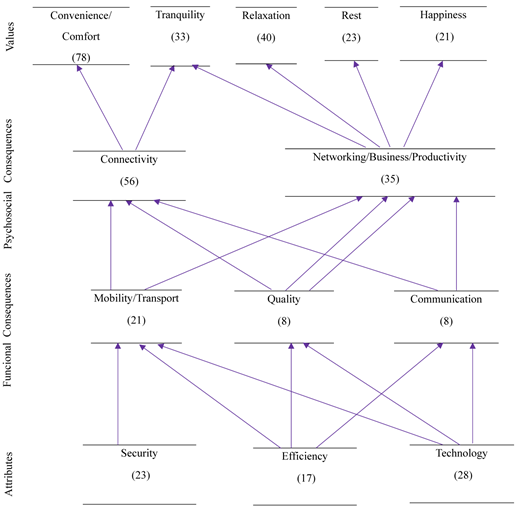
Subsequently, hierarchical maps were generated based on the coded information and the classification of constructs shown in Tables 1 – 3 Following Zaltman (1997), participants’ thoughts and words were considered. Figure 1 presents hierarchical maps containing the most relevant findings expressed through metaphors, stories, and images. The numerical values of mentions for each construct obtained from the different interviewees are shown in parentheses.

Attributes. The most relevant positive findings regarding attributes across both genders were “Technology” (28), “Security” (23), and “Efficiency” (17). These results suggest that technologically advanced infrastructure, safety, and operational efficiency are fundamental elements in generating trust in business cities. They highlight the multidimensional and cross-cutting nature of trust, providing a foundation for comparative and cross-cultural research.

From a managerial perspective, prioritizing these attributes can guide urban planning, investment strategies, and policy interventions aimed at enhancing a city's business attractiveness. Emphasizing security and efficiency fosters resident well-being and social cohesion, while technological advancements improve accessibility and service delivery. The convergence of these priorities among participants reflects emerging global expectations for reliable business cities and points to the need for further exploration of context-specific norms and perceptions.

Functional consequences. Findings for functional consequences were largely positive for both genders, despite the constant need to rely on and adapt to “Mobility/Transportation” (21), “Quality” (8), and “Communication” (8). These results indicate that participants perceived the operational aspects of business cities positively, even amid dynamic urban conditions. The key dimensions—mobility/transportation, quality, and communication—highlight the fundamental role of efficient infrastructure, reliable services, and effective information flow in generating functional trust.

From an academic perspective, these findings underscore the interaction between environmental opportunities and individuals' adaptability in urban business contexts. From a managerial standpoint, they stress the importance of investing in transport networks, service quality, and communication channels to support smooth business operations. Socially, these attributes enhance residents' daily experiences and access to resources, while culturally, they reflect shared expectations of urban functionality as a prerequisite for trust and engagement in business environments.

Psychosocial consequences. For psychosocial consequences, the most prominent findings across genders were “Connectivity” (56) and “Networking/Business/Productivity” (35). These results suggest that urban environments are not only functional spaces but also socially and professionally integrative arenas that shape interactions, collaborations, and collective productivity. They emphasize the significance of relational and networked dimensions in understanding trust and engagement in business contexts. Culturally, these outcomes reflect how cities mediate lifestyles and professional practices, facilitating access to diverse social and business networks while shaping norms around collaboration and productivity. From a business perspective, fostering connectivity through strategic urban design, coworking spaces, and communication infrastructure can enhance economic outcomes and the perceived psychosocial value of the city. These findings underscore the role of business cities in supporting social cohesion, intercultural exchange, and a vibrant urban culture that integrates professional and personal spheres.

Values. Regarding values, both genders most prominently expressed “Convenience/Comfort” (78) and “Tranquility.” These findings suggest that, beyond functional and psychosocial aspects, urban environments are deeply evaluated in terms of personal well-being, lifestyle quality, and experiential satisfaction. Academically, this underscores the importance of incorporating affective and value-laden constructs into models of city trust and business engagement. Culturally, the results highlight how local norms and expectations shape perceptions of comfort, ease of access, and peacefulness in both professional and everyday urban experiences. From a managerial perspective, designing cities that balance convenience, accessible services, and supportive environments can enhance residents' lived experiences while increasing the city's attractiveness for business actors.

3.1.2 Insights by gender

  • Women:

  1. expressed more openness and provided more detailed insights than men.

  2. showed particular concern for the security aspects of business cities.

  3. regarded business cities as essential and necessary.

  4. placed special emphasis on tranquility and relaxation.

Female participants demonstrated greater openness and communicativeness, providing reflections that often included observations about male counterparts. Security emerged as a central concern, with women emphasizing the safety and reliability of business cities. They consistently framed urban environments as essential for professional activity, while also valuing tranquility and relaxation. These insights indicate that women integrate both functional and affective dimensions into their evaluations of business cities, balancing practical requirements with well-being and lifestyle considerations.

  • Men:

  1. focused on learning about cultural aspects and experiences in business cities.

  2. showed a strong interest in technological aspects.

  3. reported feeling stress and anxiety during business trips.

Male participants emphasized the experiential and cultural dimensions of engaging with business cities, highlighting the importance of learning and immersing themselves in the local context. Their narratives revealed a pronounced interest in technological infrastructure and advancements, reflecting a focus on efficiency and modernization. Simultaneously, men frequently reported experiencing stress and anxiety during business trips, suggesting that despite functional and cognitive engagement with these cities, the pressures of professional mobility remain significant.

3.1.3 Discursive sampling

“For me, it is essential that the staff [are] always very cordial, effective, and attentive because it makes me feel comfortable, cared for, and relaxed.” (Female, 60 years).

This comment highlights the importance of attentive and courteous service as a key aspect of the urban experience, reinforcing the study's findings on convenience, comfort, and tranquility. The ZMET methodology shows how affective and relational dimensions shape trust in business cities, demonstrating that high-quality human interactions enhance well-being, reduce stress, and support positive perceptions of the city environment.

“It reminds me of the media and how easy it is to communicate with others. A business city needs fast communication, a good internet connection, and a strong phone signal that does not take long to connect. It also reminds me of the technological advancement of a business city.” (Female, 19 years).

This statement emphasizes the centrality of technological infrastructure and communication efficiency in shaping perceptions of business cities. Functional dimensions such as internet connectivity, mobile reliability, and technological advancement directly influence trust and engagement. For younger participants, seamless integration of technology is integral not only to professional productivity but also to the overall experience of a business city.

“It represents a city with extensive fiber-optic and communication networks, where communication between companies or business partners does not pose a disadvantage.” (Male, 54 years).

This reflection underscores the critical role of robust communication infrastructure, particularly fiber-optic connectivity, in supporting business operations. Reliable and efficient communication channels contribute to trust and confidence in business interactions. For this participant, seamless technological connectivity minimized operational disadvantages, highlighting that advanced infrastructure is a key determinant of a city's attractiveness and effectiveness as a business environment.

“The importance of physical and mental well-being is shown in this image, with a space for collaborative training. A business city should offer places that promote health and social gatherings. For me, bonds and connections must be generated between coworkers or new people, strengthening collaboration and well-being.” (Male, 20 years).

This statement underscores the significance of well-being and collaborative spaces in shaping business city experiences. The ZMET methodology demonstrates how psychosocial and functional dimensions—such as health-promoting areas, social interaction, and teamwork—contribute to trust, engagement, and productivity. The emphasis on fostering connections and collaboration illustrates that urban environments supporting both personal well-being and professional networking enhance the overall value and effectiveness of a business city, particularly among younger participants.

3.1.4 Seven Giant Metaphors

Within the ZMET methodology, the authors proposed using the “Seven Giant Metaphors,” which consist of metaphors about balance, transformation, journey, container, connection, resource, and control (Zaltman and Zaltman, 2008). During this study, the Seven Giant Metaphors were identified. Balance: “The spa and relaxing massages allow me to feel calm, de-stressed, and peaceful after a tiring day at work” (Female, 60). Transformation: “For me, it is essential that staff are always friendly, efficient, and attentive, as this makes me feel comfortable, cared for, and relaxed” (Female, 60). Travel: “A business city should offer places that promote health and social gatherings. For me, bonds and connections should be created between coworkers or new people, strengthening collaboration and well-being” (Male, 20). Container: “It represents a city with extensive fiber-optic networks, where communication between companies or business partners does not pose a disadvantage” (Male, 54). Connection: “Having a cell phone or a computer with internet access allows you to feel connected to other people in the world, including people you do not know. Connection is the most important thing” (Female, 19). Resource: “It reminds me of the media and how easy it is to communicate with others. A business city needs fast communication, a good internet connection, and a reliable phone signal. It also reminds me of technological advancements in a business city. The importance of physical and mental well-being is shown in this image, with space for collaborative training” (Female, 19). Control: “In the business city you travel to, it is necessary to have variety so you can choose what you want to eat and maintain control over your diet and your habits” (Male, 54).

Both genders also presented images and metaphors expressing emotional and hedonic symbols linked to sensory marketing, including feelings about soft textures, aromas, and cultural experiences. Functional aspects such as facilities, mobility, transportation, and communication are relevant in planning and designing business cities. Additionally, attributes such as competitiveness and efficiency are essential for a city to be considered a viable business option, as these elements foster trust. Designing marketing strategies that deliver on promises and ensure that business cities act honestly and empathetically toward future visitors is crucial.

The qualitative findings informed the design of a quantitative questionnaire by identifying the key dimensions and emotional, sensory, and functional aspects to be measured. This integration ensures that the instrument captures the most relevant perceptions and experiences of stakeholders, enabling systematic and empirical analysis to support decision-making in the management and promotion of business cities.

The articulation between the ZMET findings and the quantitative model strengthens the theoretical contribution in two key ways: (1) it extends the literature on urban competitiveness and business cities by proposing an explanatory framework in which managerial confidence and satisfaction are seen as outcomes of meaning configurations (metaphors and images), rather than solely as results of “objective” environmental attributes; and (2) it deepens the image-trust-satisfaction models by demonstrating that these relationships are not generic, but are anchored in specific experiential dimensions (cognitive/functional vs. emotional/hedonic/symbolic), linked to distinct facets of trust (competence vs. benevolence/honesty). In other words, using ZMET not only enriched the exploratory phase but also provided the conceptual architecture that we subsequently tested quantitatively, giving the proposed model greater robustness and theoretical depth.

To understand why value-based trust arises from the experiential image of a business city and serves as a key antecedent of business manager satisfaction, this study's theoretical model was tested in Santiago de Chile, and Mexico City, both of which are important business destinations in Latin America.

3.2.1 Hypotheses

Image-trust. Several studies have consistently shown that the image of an object (destination, country, brand, or company) functions as a significant antecedent of trust, supporting the expectation that the image of a business city enhances perceived trust in it. In tourism research, Siregar et al. (2021) reported that the image of a destination improves visitor trust, while Shen et al. (2022) found a similar effect when the image refers to a country, suggesting that this phenomenon is not limited to micro levels but applies to broader territorial scales. Additional studies (e.g. Chen and Phou, 2013) have also confirmed the positive relationship between destination image and trust. Beyond tourism, marketing research points in the same direction: Kim and Chao (2019) showed that brand image increases brand trust, and Flavian et al. (2005) found that the corporate image of online financial services positively influences consumer trust. In these studies, image is often operationalized as a unidimensional construct that signals quality and reliability. Theoretically, a positive image reduces uncertainty and perceived risk, generates favorable expectations, and serves as a cognitive heuristic that facilitates the decision to trust. Therefore, we propose the following hypothesis.

H1.

The image of a business city directly and positively influences perceived trust in the city.

Trust-satisfaction. The literature consistently shows a relationship between satisfaction and trust in tourism contexts, although the reported causal direction is not unanimous. Several tourism studies indicate that tourist satisfaction increases trust in a destination (Jeaheng et al., 2020; Loureiro and González, 2008; Wu et al., 2018), demonstrating a strong association between the two variables and suggesting possible reciprocity. However, research examining the reverse direction shows that trust can precede satisfaction (Al-Ansi and Han, 2019; Radu and Dobrescu, 2014), indicating that trust may function as an expectation or heuristic that shapes the subsequent evaluation of the experience. This bidirectional relationship is also observed outside tourism: in electronic banking, consumer satisfaction predicts trust (Chu et al., 2012), while in consumer marketing, trust in an eco-friendly brand can lead to higher satisfaction (Zhang et al., 2022). In most of these studies, trust was treated as a unidimensional construct that reduces uncertainty and guides user or customer expectations. Theoretically, based on expectation-confirmation theory and the perceived risk reduction approach, greater prior trust in the actor or setting (in this case, the business city) generates favorable expectations and lowers perceived risk. When the experience aligns with these expectations, the final evaluation (satisfaction) is higher. Therefore, based on empirical evidence supporting the plausibility of the trust → satisfaction direction in analogous contexts and on clear theoretical mechanisms, we propose the following hypothesis.

H2.

Perceived trust in a business city directly and positively influences business managers' satisfaction.

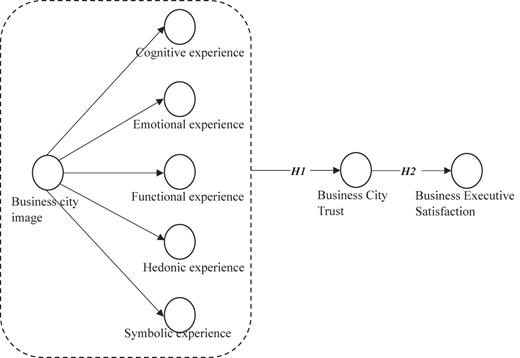
Schematically (Figure 2).

3.2.2 Instrument

Given the high risk of bias and limited generalizability associated with using a non-probability convenience sample, a thorough item refinement and validation procedure was applied; each step contributed to ensuring that the research objectives were met.

This study used scales from previous research to identify critical incidents and administered a questionnaire covering each construct and its respective factors. The questionnaire was initially administered to a non-probabilistic convenience sample of 30 individuals in Santiago de Chile and 30 in Mexico City. This procedure allowed us to confirm and complement the factors of each construct. Following De Wulf and Odekerken-Schröder (2003), each scale was refined. Feedback was obtained through focus groups composed of business tourists and interviews with tour operators and travel agency managers in Santiago and Mexico City. Following Zaichkowsky (1985), experts rated each item according to its dimension as clearly representative, somewhat representative, or non-representative. Items with a high level of consensus were retained (Lichtenstein et al., 1990), facilitating the identification of indicators that best reflected the scale dimensions. A pretest was then conducted using the initial questionnaire, which was administered to a non-probabilistic convenience sample of 50 individuals in each city. Exploratory factor analysis was performed using these data, and Cronbach's alpha was calculated for each resulting dimension. The final scale was obtained through this procedure. Items were written as statements and answered using a seven-point Likert scale (Table 4).

3.2.3 Sampling

Using the final questionnaire, translated between English and Spanish as needed, 1,801 managers of foreign companies who visited the business districts and investment clusters in person between November 2022 and January 2023 were interviewed. Of these, 441 were from Santiago de Chile, and 1,360 were from Mexico City (Table 5). In Santiago, managers were interviewed upon arrival at the Sanhattan Financial District and the Ciudad Empresarial Financial Center, both of which are well-recognized and valued by foreign business visitors. In Mexico City, interviews were conducted at the Banamex Centre, Expo Bancomer Santa Fe, the Bankers Club, and the Industrialists Club.

3.2.4 Data analysis

A psychometric analysis of the data was conducted to verify the validity, reliability, and dimensionality of the scales (Deng and Dart, 1994). Using SPSS version 26, confirmatory factor analysis (CFA) and reliability analyses were performed, including Cronbach's α, composite reliability, and average variance extracted (AVE). Varimax rotation (Brown, 2009) was applied to components that did not align with the expected dimensions. All components showed optimal dimensionality, with values greater than 0.4 (Larwood et al., 1995), so no indicators needed to be removed from the scale. Using CFA (Table 6) and following the criteria outlined by Jöreskog and Sörbom (1993), we assessed whether each indicator contributed to a good fit with the theoretical model.

Indicators showing weak convergence with their latent variables were evaluated using Student's t-tests (t > 2.28, p < 0.001). Standardized coefficients were required to exceed 0.5, and the coefficient of determination (R2) had to be greater than 0.3. Following this procedure, no indicators were eliminated. Reliability was further assessed using three tests: Cronbach's α (threshold 0.7), composite reliability of the construct (threshold 0.7) (Jöreskog, 1971), and univariate normality via skewness and kurtosis tests. All variables had absolute skewness and kurtosis values below 3 (Suki and Suki, 2013). As shown in Table 7, all reliability parameters met the minimum established values.

Next, discriminant validity was assessed using AVE >0.5 (Fornell and Larcker, 1981) and AVE > maximum shared variance (MSV) (Hair et al., 2010). Most construct relationships met these criteria, as shown in Table 8. However, the MSV between Coe and Trc (r2 = 0.78) and between Coe and Sye (r2 = 0.79) exceeded the AVE of Coe (0.58) and Sye (0.74), indicating potential issues with discriminant validity. This suggests that these dimensions share a substantial portion of their variance. Despite this, we maintained the theoretical distinction between the constructs because: (a) they are conceptually distinct in the literature, and (b) further analysis indicated high correlation rather than perfect collinearity between related facets of cognitive, symbolic, and trust experiences. To assess robustness, models were estimated by successively excluding the conflicting dimensions (Coe, Sye), confirming that the key effects (image → trust → satisfaction) remained consistent in magnitude and significance. Collinearity indices (variance inflation factors (VIFs)) were also checked: Coe–Trc VIF = 1.0, Coe–Sye VIF = 1.0, indicating no severe multicollinearity problems (Becker et al., 2015).

Next, validity was assessed by examining content and construct validity. The scales demonstrated adequate content validity, as they were developed through a literature review and critical incident analysis with business tourism experts. This process was supplemented and refined based on feedback from focus groups associated with business tourism. To determine whether the “business city image” functioned as a holistic construct, the rival models procedure (Steenkamp and Van Trijp, 1991) was applied. Specifically, a one-dimensional (first-order) model was compared with a holistic (second-order) model. The results (Table 9) indicate that the second-order model provided a better fit than the first-order model.

To identify the presence of common method variance (CMV) in the data, and following Sajons (2020), an analysis was conducted using the software AMOS SPSS version 26. The procedure included an independent variable (common factor) and two instrumental variables (z1, z2) incorporated into the structural equation model (SEM). According to the literature, a correlation among these three variables combined with unacceptable model fit would indicate the presence of CMV (Antonakis et al., 2010). However, the analysis showed no correlation among the three variables, and the model fit values were acceptable (IFI = 0.914; CFI = 0.914; RMSEA = 0.080; χ2 = 7965.8).

Consequently, no CMV was detected in this study. Overall, the results indicate that the proposed model exhibits a reasonable degree of validity.

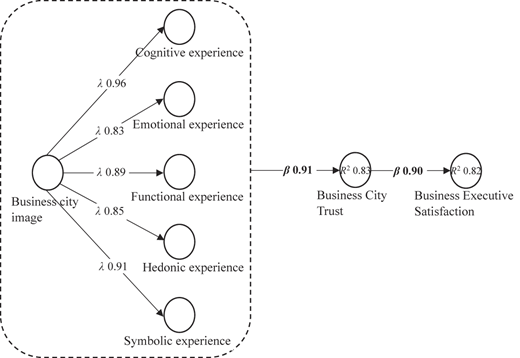
Key indicators were obtained using a SEM to evaluate this study's assumptions. The fit indices for the overall model (Figure 3) fell within acceptable ranges (IFI = 0.952, CFI = 0.952, RMSEA = 0.061, Normed χ2 = 7.65).

As shown in Figures 2 and 3, the standardized β coefficients support the hypothesized relationships between constructs. First, the image of the business city has a direct and positive effect on the trust perceived by business managers (β = 0.91, p < 0.001), supporting the theoretical proposition that a favorable image—measured through cognitive, emotional, functional, hedonic, and symbolic experiences—increases perceptions of honesty, benevolence, and competence in the environment (Artigas et al., 2017; Morgan and Hunt, 1994). Second, trust is directly and positively related to cognitive satisfaction among business managers (β = 0.90, p < 0.001), confirming that perceiving a trustworthy environment leads to more favorable assessments of the business experience in the city (Giese and Cote, 2000; Langeland, 2023). The model explains a substantial portion of the variance in trust (R2 = 0.83) and satisfaction (R2 = 0.82), indicating strong explanatory power of the exogenous variables.

To evaluate the mediating role of trust between the image of the business city and business manager satisfaction, analyses were conducted in JAMOVI version 2.6.4 (Table 10) for (1) image → trust, (2) trust → satisfaction, and (3) image → satisfaction.

The results show that the indirect effect of the business city's image on manager satisfaction through trust was significant (β = 0.765, p < 0.001). With trust included as a mediator, the direct effect of image on satisfaction remained significant (β = 0.492, p < 0.001). The total effect of image on satisfaction was also significant (β = 1.256, p < 0.001), indicating that trust partially mediates the relationship, accounting for 60.9% of the effect.

Gender distinctions were incorporated in the exploratory ZMET phase to capture metaphors and mental images reflecting different perspectives, enhancing content validity of the generated items. In the quantitative phase, the main analysis was presented in aggregate form to evaluate the overall theoretical model. Complementary analyses included invariance testing and gender comparisons. To assess the impact of gender on the overall model, a moderation analysis was conducted.

Multigroup gender moderation was tested using AMOS SPSS version 26, and invariance between men and women was examined to determine whether significant differences existed in the relationships proposed by the theoretical model. The χ2 of the unrestricted model (χ2 = 224.749; df = 2; p < 0.05) was compared with the χ2 of the same model under restrictions (χ2 = 234.3; df = 4; p < 0.05) (Yu and Shek, 2014). The analysis revealed a significant difference between models (Δχ2 = 9.55; Δdf = 2; p < 0.05), indicating that the groups differ at the model level.

As shown in Table 11, a comparison of χ2 and CR at the path level indicates that only the Image → Trust path meets the established criteria (χ2 = 233.1 > 231.38; 99% confidence level) and has a Z-score of 0.000. This finding demonstrates a significant difference between men and women for this path (Byrne, 2004), indicating that gender moderates the effect of image on trust (β = 0.846).

Our results complement models of network governance, innovation ecosystems, and smart and sustainable cities by showing that, beyond institutional and technological architecture, the competitiveness of a business city also depends on how that architecture translates into image, trust, and satisfaction from the perspective of visiting business executives. This represents a clear and significant advance in the theory and practice of business-city management. Specifically, this study highlights the role of trust in a business city as both an antecedent of executive satisfaction and a consequence of the city's image. Using the ZMET methodology, this study provides empirical insights into how functional and psychosocial elements underpin trust, emphasizing that urban environments must strategically integrate efficiency, well-being, and symbolic value to remain competitive in attracting global business leaders. The findings reinforce the notion that business tourism is not only a key driver of international economic flows but also a domain in which the city's image becomes a strategic asset. As defined by Bradley et al. (2002), business tourism includes travel for corporate meetings, conferences, and exhibitions. Current global forecasts estimate that business travel expenditures will exceed US$1.8 trillion by 2027 (Statista, 2023). Within this growing market, a business city's ability to generate and maintain trust represents a significant competitive advantage (Warrington et al., 2000). Our study confirms this perspective by showing that trust emerges as a multidimensional construct composed of honesty, benevolence, and competence (Morgan and Hunt, 1994), echoing prior research on tourism and business trust (Fyall et al., 2003; Sirdeshmukh et al., 2002).

The findings also allow us to both build upon and differentiate our approach from the classic literature on destination marketing and place branding. While traditional place branding models have focused on creating an attractive image for tourists and residents—centered on symbolic, cultural, or identity-related attributes of the location (Kavaratzis and Hatch, 2013)—our concept of a “business city” shifts the emphasis to corporate trust as the central element linking image and behavior. This perspective implies that a city's brand is not assessed solely in terms of awareness, differentiation, or emotional attachment, but as a relational asset that reduces perceived risk, facilitates investment decisions, and influences executives' willingness to commit resources to the territory. From this viewpoint, the city becomes more than a “destination” to be consumed; it becomes a corporate partner whose brand is evaluated based on honesty, benevolence, and institutional competence. Thus, emphasizing value-based trust and holistic managerial expertise extends traditional destination marketing models in at least three ways:

First, it redefines the target audience for place branding: the primary focus is no longer tourists or residents, but corporate decision-makers who evaluate the city as a platform for operations, investments, and long-term relationships. Second, the brand's content is reconfigured. In classic models, city branding relies on identity attributes such as heritage, culture, and lifestyle; in a business city, these elements remain relevant but are subordinate to perceptions of operational reliability and ethics, including work-oriented infrastructure and services, regulatory quality, transparency, stability, security, and the responsiveness of local stakeholders. Third, it introduces relational and risk-based logic, largely absent from traditional destination marketing. Corporate trust extends beyond a favorable attitude toward the city; it functions as a mechanism for managing risk in high-stakes decisions, such as opening subsidiaries, signing long-term contracts, or relocating teams. From this perspective, the business city brand ceases to be merely a communication tool and is instead understood as a relational device that reduces uncertainty about the future behavior of local actors and institutions.

This study highlights the importance of business cities integrating functional efficiency with emotional well-being in their design and services. Attributes such as mobility, accessibility, and communication must be combined with elements that foster trust, comfort, and engagement. The ZMET study revealed gender differences in perceptions of business cities. Men emphasized technological advancements and opportunities for cultural learning but also associated business travel with stress and anxiety. Women, in contrast, placed greater value on safety, emotional well-being, and the necessity of business cities for their professional activities. These findings align with previous research showing that visitors evaluate destinations not only on functional attributes, such as services and infrastructure (Beerli and Martín, 2004), but also on emotional and symbolic dimensions (Milman and Pizam, 1995; Stern et al., 2001).

Three key metaphors emerged: connection, balance, and control. These reflect how business cities are perceived as global communication hubs, spaces for maintaining work-life balance, and environments that foster autonomy. These insights contribute to the limited body of qualitative research on the psychological components of business city images (Marinao-Artigas et al., 2025), expanding on prior studies that primarily emphasized structural or reputational factors. Unlike research focusing on residents or local pride (Lai and Cole, 2024; Manyiwa et al., 2018), our findings highlight the perspectives of international managers, enriching cross-cultural understanding of business city evaluation.

Functional and emotional aspects shape experiences in business cities in complementary ways. Attributes such as technology, safety, and efficiency enhance comfort and productivity, while psychosocial outcomes, including connectivity, networking, and engagement, are fundamental to professional interactions. These results align with Gilboa et al. (2015), who found that visitors value safety, leisure, and public services. At the same time, deeper values ​​such as comfort, tranquility, and well-being were especially significant for women. By linking these values ​​to satisfaction, our study contributes to the growing literature showing that managerial satisfaction is not merely a transactional outcome, but a cumulative evaluation shaped by both tangible and intangible stimuli (Lam et al., 2004; Romão et al., 2015).

Having concluded the first study, the second confirmed the existence of common elements or dimensions—metaphorical and experiential—that allow for an integrated measurement of a business city's image, which should not be treated as distinct constructs requiring separate measurement instruments. A link was found between the cognitive and functional dimensions of image and the perception of institutional competence, as well as the local actors who build trust in the business city. This finding aligns theoretically with those of Sirdeshmukh et al. (2002) and Beerli and Martín (2004). A business city perceived—especially by female executives—as having strong resources, infrastructure, and technical capabilities fosters the belief that local agents possess the necessary skills to support business activities. The positive impact of the emotional and symbolic experience in the business city on benevolence and honesty, which underpin trust, enhances female executives' perceptions of the favorable and ethical behavior of the community and institutions. This finding is consistent with Royo-Vela and Garzón-Paredes (2023) and Yang et al. (2025).

Similarly, examining the effect of hedonic experience on trust shows that hedonic experiences in a business district help reduce perceived risk and strengthen the affective disposition—particularly among female executives—to trust local actors and institutions. Hedonic experiences create emotional bonds and feelings of well-being that lower perceptions of vulnerability and risk, promoting more benevolent judgments toward the environment and its agents. Consequently, the hedonic component of a business city's image indirectly contributes to executives' satisfaction by facilitating positive and less cautious evaluations of the environment's quality and reliability. In summary, the various dimensions of image positively influence different facets of trust (for example, competence via cognitive/functional channels and benevolence and honesty via emotional, symbolic, and hedonic channels), which explains why a generally favorable image—especially among female executives—increases business executives' trust.

Furthermore, the value dimensions of trust attributed to a business city—honesty, benevolence, and competence as perceived by executives—constitute urban trust as a corporate construct. Similarly, executive satisfaction in business cities can be conceptualized and measured as a holistic experiential perception emerging from the combined evaluation of environmental factors. When examining the effect of trust on satisfaction, prior perceptions of honesty, benevolence, and competence condition subsequent evaluations of the experience at the destination or city. Trust reduces uncertainty and facilitates favorable comparisons between expectations and outcomes, thereby enhancing executives’ satisfaction (Langeland, 2023; Giese and Cote, 2000). Trust acts as a strategic bridge between image and satisfaction: image shapes expectations and perceptions of actors’ and institutions’ attributes and behaviors, which then form trust, translating into positive cognitive evaluations (satisfaction). Path analysis shows a significant indirect effect (image → trust → satisfaction), providing robust empirical support for the proposed theoretical model.

Therefore, given that the image of a business city influences business manager satisfaction both directly and indirectly through trust, this pattern confirms the importance of image as an antecedent to evaluative judgments (Beerli and Martín, 2004; Giese and Cote, 2000) and demonstrates that trust functions as a relevant mechanism for translating image perceptions into cognitive appraisals (Morgan and Hunt, 1994; Sirdeshmukh et al., 2002). The distinctive contribution of this study lies in disaggregating the business city's image into cognitive, functional, emotional, hedonic, and symbolic dimensions as foundations of trust based on honesty, benevolence, and competence, thereby identifying differentiated pathways through which business executive satisfaction is generated.

Reviewing the existing literature also underscores the international relevance of these findings. While studies conducted in Hong Kong (Lai and Cole, 2024) and Bratislava (Manyiwa et al., 2018) have focused on citizens’ pride or emotional attachment, this study's findings emphasize trust, psychosocial outcomes, and value orientation among foreign managers in Latin America. Research on Vilnius highlighted cultural heritage and traditions as key drivers of city image (Černikovaitė and Karazijienė, 2020), whereas our results point to technological infrastructure, security, and well-being as central elements in the Latin American context. This difference reflects not a contradiction but a contextual extension: whereas European studies emphasize cultural preservation, the findings suggest that, in emerging business centers, trust and functional efficiency are critical for attracting international business travel.

International comparisons further show that, beyond the Latin American context, countries such as the United States, India, Australia, Malaysia, and Indonesia emphasize different core aspects of destination perception, including image, trust, and satisfaction. In India, place image plays a central role in tourism success on social media, similar to patterns observed in European and Asian contexts. Australia highlights the holistic nature of destination image, aligning with comparable approaches in Europe. Indonesia emphasizes trust as a central element in tourism relationships, an aspect also valued in mature markets such as the United States and Europe. Meanwhile, in destinations such as China and the Netherlands, satisfaction is closely linked to cognitive and emotional experiences, indicating that these dimensions are broadly shared across global tourism contexts.

This study demonstrates a synergistic, empirical, and simultaneous relationship among city image (metaphorical elements and experiential dimensions), corporate trust in the city—based on honesty, benevolence, and competence—and business executives’ satisfaction in corporate decision-making contexts. The theoretical contributions of this study specifically highlight the formalization of trust in urban contexts. “Trust in the business city” is shown to be a holistic construct that encompasses perceptions of honesty, benevolence, and competence. This provides greater theoretical precision and confirms and extends the findings of Artigas et al. (2017) by conceptualizing the city as an institutional actor. The theory of place image is further developed by defining the image of a business city as holistic, encompassing cognitive, emotional, functional, hedonic, and symbolic dimensions. This approach integrates perspectives from tourism, branding, and urban management, building on and extending the work of Moraga et al. (2012). The use of holistic constructs improves the explanation of results by enabling the decomposition of effects, such as identifying which image dimensions best predict trust or satisfaction, enhancing explanatory power, and supporting more refined theoretical hypotheses regarding cognitive–emotional mechanisms.

The high correlation between the cognitive, symbolic, and trust dimensions should be interpreted as evidence that, in the context studied, managers experience these components as closely integrated rather than as an indication of measurement deficiencies. A conceptual bridge is established between branding and urban governance by focusing on business managers’ perceptions. In this way, this study links place branding theories with stakeholder and governance perspectives, positioning image and trust as key relational resources for local competitiveness. This study also contributes to measurement theory by contrasting holistically measured constructs (image and trust) with satisfaction measured unidimensionally, providing empirical evidence on the appropriate level of conceptual aggregation for different constructs in applied research. The methodological contribution lies in the innovative use of ZMET to explore metaphors and mental imagery, enabling the identification of deep symbolic content that informs the proposed dimensions. This approach strengthens content validity and provides a robust qualitative foundation for the development of dimension-specific items. The sequential integration of ZMET with a structured survey constitutes a form of methodological triangulation that reduces the risk of construct bias and captures both explicit and implicit meanings. In the exploratory phase, gender was explicitly considered by incorporating women's perspectives to ensure that the generated items reflected nuances and metaphors specific to this group, which is often underrepresented in conventional research.

At the managerial level, the results offer distinct implications for Latin American contexts compared with global trends. In mature global markets (the United States, Europe, and developed Asia), business destination management typically builds on consolidated infrastructure, relatively stable regulatory frameworks, and institutionalized city-branding strategies. In these environments, managerial priorities focus on refining the value proposition—such as sectoral specialization, innovation, sustainability, and premium experiences—and competing for specific niches of corporate travelers. Trust tends to be partially taken for granted, and efforts concentrate on cultivating reputation and differentiation. In Latin America, however, the findings suggest that business city management should prioritize a different, more foundational yet strategic agenda. First, it should reduce perceptions of risk through clear signals of institutional competence, transparency, and predictability, including regulation, security, and stability of rules and regulations. Second, it should explicitly build trust based on shared values—honesty, benevolence, and competence—by integrating municipalities, investment promotion agencies, and the private sector into coherent messages and practices. Third, designing holistic management experiences requires going beyond simply ensuring that services function smoothly during the trip.

In the Latin American context, where perceived risk is generally higher, urban managers and private actors should carefully manage the entire executive experience chain, including airport arrival, transfers, check-in, meeting spaces, connectivity, logistical support, leisure, and rest. This chain should integrate both functional attributes—such as security, punctuality, technological infrastructure, and regulatory clarity—and emotional and symbolic attributes, including a sense of welcome, respectful treatment, hospitality, and a curated cultural offering. In addition, managers should design specific products for business travelers, such as safe door-to-door routes, personalized assistance, and one-stop services for administrative procedures, to reduce friction and reinforce perceptions of control, balance, and connection identified in the ZMET study. In this way, the city does not merely “welcome” the executive but actively orchestrates a coherent experience aimed at generating trust and satisfaction, aligning with global trends while responding to vulnerabilities and opportunities specific to Latin American contexts.

The proposed holistic constructs enable researchers to assess how different dimensions (e.g. cognitive vs. symbolic) explain trust, satisfaction, and business performance in cities. The observed overlap among cognitive, symbolic, and trust dimensions suggests avenues for future research focused on refining measurement instruments and testing higher-order or two-factor models across contexts and samples. The use of ZMET also supports mixed-method research on cultural metaphors and the validation of emerging items in transnational and longitudinal studies. Experimental designs and targeted interventions may assess whether improvements in specific dimensions enhance perceived trust and business investment. Factorial invariance testing and subgroup analyses can facilitate comparisons across industries, firm sizes, and city types, contributing to more generalizable theory. Examining organizational outcomes, such as retention, expansion, and networks, as well as the effects of place-branding policies, can further translate theory into practical guidance for investors, managers, and decision-makers.

Future research should apply probabilistic sampling to validate and extend these findings. Comparative studies in Asia, Europe, and North America would clarify cultural differences in perceptions of business cities. Finally, future research should examine how digital infrastructure, sustainability, and hybrid work arrangements shape the evolving image and perceived reliability of business cities.

Although the study offers notable theoretical and methodological advances—particularly in the holistic formalization of image and trust and the sequential integration of ZMET and survey methods—the findings derive from a Latin American context, which may limit their applicability to other institutional or cultural settings. While ZMET enhances depth and content validity, it relies on intensive qualitative procedures with small samples and context-specific results, limiting population representativeness. In addition, small subgroup sizes or non-stratified sampling may constrain statistical power and generalizability across sectors and firm sizes.

The supplementary material for this article can be found online.
Abel
,
D.
(
2025
), “
The role of networked governance for local climate policy output. Evidence from Europe
”,
Environmental Politics
, Vol. 
35
No. 
2
, pp. 
1
-
23
, doi: .
Acharya
,
S.
,
Mekker
,
M.
and
Singleton
,
P.A.
(
2023
), “
Validating the satisfaction with travel scale and measuring long-distance recreational travel satisfaction
”,
Transportation Research Part F: Traffic Psychology and Behaviour
, Vol. 
95
, pp. 
1
-
17
, doi: .
Aïdi
,
N.
and
Fabry
,
N.
(
2024
), “
Beyond the certification of smart tourism destination: insights from the city of Medellín in Colombia
”,
International Journal of Tourism Cities
, Vol. 
10
No. 
2
, pp. 
577
-
603
, doi: .
Akel
,
G.
and
Armağan
,
E.
(
2021
), “
Hedonic and utilitarian benefits as determinants of the application continuance intention in location-based applications: the mediating role of satisfaction
”,
Multimedia Tools and Applications
, Vol. 
80
No. 
5
, pp. 
7103
-
7124
, doi: .
Al-Ansi
,
A.
and
Han
,
H.
(
2019
), “
Role of halal-friendly destination performances, value, satisfaction, and trust in generating destination image and loyalty
”,
Journal of Destination Marketing and Management
, Vol. 
13
, pp. 
51
-
60
, doi: .
Alakoum
,
A.
and
Nica
,
E.
(
2024
), “Innovating urban environments: the impact of smart city technologies on employee performance, quality of life, and service”, in
The Emerald Handbook of Smart Cities in the Gulf Region: Innovation, Development, Transformation, and Prosperity for Vision 2040
, pp. 
53
-
68
, doi: .
Aldas-Manzano
,
J.
,
Ruiz-Mafe
,
C.
,
Sanz-Blas
,
S.
and
Lassala-Navarre
,
C.
(
2011
), “
Internet banking loyalty: evaluating the role of trust, satisfaction, perceived risk, and frequency of use
”,
Service Industries Journal
, Vol. 
31
No. 
7
, pp. 
1165
-
1190
, doi: .
Almarri
,
K.
and
Boussabaine
,
H.
(
2025
), “
Critical success factors for public–private partnerships in smart city infrastructure projects
”,
Construction Innovation
, Vol. 
25
No. 
2
, pp. 
224
-
247
, doi: .
AMAI
(
2018
), “
Niveles socio económicos 2018
”,
AsocWWWiación Mexicana de Agencias de Investigación de Mercado y Opinión Pública (The Mexican Association of Marketing Research and Public Opinion Agencies), available at:
 https://www.amai.org/NSE/index.php?queVeo=2018
Amissah
,
E.F.
,
Addison-Akotoye
,
E.
and
Blankson-Stiles-Ocran
,
S.
(
2021
), “Service quality, tourist satisfaction, and destination loyalty in emerging economies”, in
Marketing Tourist Destinations in Emerging Economies: towards Competitive and Sustainable Emerging Tourist Destinations
,
Springer International Publishing
,
Cham
, pp. 
121
-
147
, doi: .
Antonakis
,
J.
,
Bendahan
,
S.
,
Jacquart
,
P.
and
Lalive
,
R.
(
2010
), “
On making causal claims: a review and recommendations
”,
The Leadership Quarterly
, Vol. 
21
No. 
6
, pp. 
1086
-
1120
, doi: .
Artigas
,
E.M.
,
Yrigoyen
,
C.C.
,
Moraga
,
E.T.
and
Villalón
,
C.B.
(
2017
), “
Determinants of trust towards tourist destinations
”,
Journal of Destination Marketing and Management
, Vol. 
6
No. 
4
, pp. 
327
-
334
, doi: .
Audretsch
,
D.B.
,
Khurana
,
I.
,
Dutta
,
D.K.
and
Tamvada
,
J.P.
(
2025
), “
Creating effective university innovation and entrepreneurial ecosystems: a commitment system perspective
”,
The Journal of Technology Transfer
, Vol. 
50
No. 
1
, pp. 
169
-
191
, doi: .
Bakry
,
D.
,
Daim
,
T.
,
Alzahrani
,
S.
,
Dabic
,
M.
and
Yesilada
,
B.
(
2025
), “
Exploring innovation ecosystems to facilitate the adoption of sustainable entrepreneurship: looking beyond the Western world
”,
Journal of Small Business Management
, Vol. 
63
No. 
1
, pp. 
337
-
387
, doi: .
Banco Central de Chile. BCC
(
2025
), “
PIB chile
”,
available at:
 https://www.bcentral.cl/contenido/-/details/informe-de-politica-monetaria-junio-2025
Becker
,
J.M.
,
Ringle
,
C.M.
,
Sarstedt
,
M.
and
Völckner
,
F.
(
2015
), “
How collinearity affects mixture regression results
”,
Marketing Letters
, Vol. 
26
No. 
4
, pp. 
643
-
659
, doi: .
Beerli
,
A.
and
Martín
,
J.D.
(
2004
), “
Factors influencing destination image
”,
Annals of Tourism Research
, Vol. 
31
No. 
3
, pp. 
657
-
681
, doi: .
Beveridge
,
A.J.
and
Höllerer
,
M.A.
(
2023
), “
Theorizing organizational benevolence
”,
Organization Science
, Vol. 
34
No. 
5
, pp. 
1864
-
1886
, doi: .
Bradley
,
A.
,
Hall
,
T.
and
Harrison
,
M.
(
2002
), “
Selling cities: promoting new images for meetings tourism
”,
Cities
, Vol. 
19
No. 
1
, pp. 
61
-
70
, doi: .
Brandt
,
C.
and
De Mortanges
,
C.P.
(
2011
), “
City branding: a brand concept map analysis of a university town
”,
Place Branding and Public Diplomacy
, Vol. 
7
No. 
1
, pp. 
50
-
63
, doi: .
Brockman
,
P.
,
El Ghoul
,
S.
,
Guedhami
,
O.
and
Zheng
,
Y.
(
2022
), “
Does social trust affect international contracting? Evidence from foreign bond covenants
”,
Journal of International Business Studies
, Vol. 
53
No. 
6
, pp. 
1011
-
1044
, doi: .
Brown
,
J.D.
(
2009
), “
Principal components analysis and exploratory factor analysis and ndash definitions, differences, and choices
”,
Statistics
, Vol. 
13
No. 
1
, pp. 
26
-
30
, doi: .
Bui
,
V.
,
Alaei
,
A.R.
,
Vu
,
H.Q.
,
Li
,
G.
and
Law
,
R.
(
2022
), “
Revisiting tourism destination image: a holistic measurement framework using big data
”,
Journal of Travel Research
, Vol. 
61
No. 
6
, pp. 
1287
-
1307
, doi: .
Byrne
,
B.M.
(
2004
), “
Testing for multigroup invariance using AMOS graphics: a road less traveled
”,
Structural Equation Modeling
, Vol. 
11
No. 
2
, pp. 
272
-
300
, doi: .
Cardoso
,
R.
,
Sobhani
,
A.
and
Meijers
,
E.
(
2022
), “
The cities we need: towards an urbanism guided by human needs satisfaction
”,
Urban Studies
, Vol. 
59
No. 
13
, pp. 
2638
-
2659
, doi: .
Černikovaitė
,
M.
and
Karazijienė
,
Ž.
(
2020
), “
City brand image formation by urban heritage initiatives. Management
”,
Journal of Contemporary Management Issues
, Vol. 
25
No. 
Special issue
, pp. 
29
-
42
, doi: ,
available at:
 https://hrcak.srce.hr/244141
Chan
,
A.
,
Suryadipura
,
D.
and
Kostini
,
N.
(
2021
), “
City image: city branding and city identity strategies
”,
Review of Integrative Business and Economics Research
, Vol. 
10
, pp. 
330
-
341
.
Chen
,
P.J.
(
2006
), “
Sport tourists’ loyalty: a conceptual model
”,
Journal of Sport and Tourism
, Vol. 
11
Nos
3-4
, pp. 
201
-
237
, doi: .
Chen
,
P.J.
(
2008
), “
Exploring unspoken words: using ZMET to depict family vacationer mental models
”,
Advances in Hospitality and Leisure
, Vol. 
4
, pp. 
29
-
51
, doi: .
Chen
,
C.F.
and
Phou
,
S.
(
2013
), “
A closer look at destination: image, personality, relationship and loyalty
”,
Tourism Management
, Vol. 
36
, pp. 
269
-
278
, doi: .
Chen
,
H.
,
Wang
,
Y.
and
Li
,
N.
(
2022
), “
Research on the relationship of consumption emotion, experiential marketing, and revisit intention in cultural tourism cities: a case study
”,
Frontiers in Psychology
, Vol. 
13
, pp. 
1
-
13
, doi: .
Chi
,
C.G.Q.
and
Qu
,
H.
(
2008
), “
Examining the structural relationships of destination image, tourist satisfaction and destination loyalty: an integrated approach
”,
Tourism Management
, Vol. 
29
No. 
4
, pp. 
624
-
636
, doi: .
Choi
,
M.
,
Law
,
R.
and
Heo
,
C.Y.
(
2016
), “
Shopping destinations and trust–tourist attitudes: scale development and validation
”,
Tourism Management
, Vol. 
54
, pp. 
490
-
501
, doi: .
Christensen
,
G.L.
and
Olson
,
J.C.
(
2002
), “
Mapping consumers’ mental models with ZMET
”,
Psychology and Marketing
, Vol. 
19
No. 
6
, pp. 
477
-
501
, doi: .
Chu
,
P.Y.
,
Lee
,
G.Y.
and
Chao
,
Y.
(
2012
), “
Service quality, customer satisfaction, customer trust, and loyalty in an e-banking context
”,
Social Behavior and Personality: an International Journal
, Vol. 
40
No. 
8
, pp. 
1271
-
1283
, doi: .
Coelho
,
A.
,
Bairrada
,
C.
,
Simão
,
L.
and
Barbosa
,
C.
(
2022
), “
The drivers of the city brand equity comparing citizens’ and tourists’ perceptions and its influence on the city attractiveness: the case of the city of Coimbra
”,
International Journal of Hospitality and Tourism Administration
, Vol. 
23
No. 
2
, pp. 
242
-
268
, doi: .
Das
,
D.K.
(
2016
), “
Engendering creative city image by using information communication technology in developing countries
”,
Urban Planning
, Vol. 
1
No. 
3
, pp. 
1
-
12
, doi: .
De Wulf
,
K.
and
Odekerken-Schröder
,
G.
(
2003
), “
Assessing the impact of a retailer's relationship efforts on consumers’ attitudes and behavior
”,
Journal of Retailing and Consumer Services
, Vol. 
10
No. 
2
, pp. 
95
-
108
, doi: .
Deng
,
S.
and
Dart
,
J.
(
1994
), “
Measuring market orientation: a multi‐factor, multi‐item approach
”,
Journal of Marketing Management
, Vol. 
10
No. 
8
, pp. 
725
-
742
, doi: .
Eid
,
R.
and
Elbanna
,
S.
(
2018
), “
A triangulation study to assess the perceived city image in the Arab Middle East context: the case of Al-Ain in the UAE
”,
Tourism Planning and Development
, Vol. 
15
No. 
2
, pp. 
118
-
133
, doi: .
Flavian
,
C.
,
Guinaliu
,
M.
and
Torres
,
E.
(
2005
), “
The influence of corporate image on consumer trust: a comparative analysis in traditional versus internet banking
”,
Internet Research
, Vol. 
15
No. 
4
, pp. 
447
-
470
, doi: .
Florez-Jimenez
,
M.P.
,
Lleo
,
A.
,
Danvila-del-Valle
,
I.
and
Sanchez-Marin
,
G.
(
2024
), “
Corporate sustainability, organizational resilience and corporate purpose: a triple concept for achieving long-term prosperity
”,
Management Decision
, Vol. 
62
No. 
7
, pp. 
2189
-
2213
, doi: .
Fornell
,
C.
and
Larcker
,
D.F.
(
1981
), “
Evaluating structural equation models with unobservable variables and measurement error
”,
Journal of Marketing Research
, Vol. 
18
No. 
1
, pp. 
39
-
50
, doi: .
Fyall
,
A.
,
Callod
,
C.
and
Edwards
,
B.
(
2003
), “
Relationship marketing: the challenge for destinations
”,
Annals of Tourism Research
, Vol. 
30
No. 
3
, pp. 
644
-
659
, doi: .
Gamarra-Olortegui
,
A.
,
Hernández-López
,
J.
,
Paredes León
,
F.J.
and
Angulo-Contejana
,
M.E.
(
2023
), “
Using ZMET to explore brand awareness of creative entrepreneurship trade fairs
”,
LACCEI
, Vol. 
1
No. 
8
.
Ghorbani
,
M.
and
Westermann
,
A.
(
2025
), “
Exploring the role of packaging in the formation of brand images: a mixed methods investigation of consumer perspectives
”,
The Journal of Product and Brand Management
, Vol. 
34
No. 
2
, pp. 
186
-
202
, doi: .
Giese
,
J.L.
and
Cote
,
J.A.
(
2000
), “
Defining consumer satisfaction
”,
Academy of Marketing Science Review
, Vol. 
1
No. 
1
, pp. 
1
-
22
.
Gilboa
,
S.
,
Jaffe
,
E.D.
,
Vianelli
,
D.
,
Pastore
,
A.
and
Herstein
,
R.
(
2015
), “
A summated rating scale for measuring city image
”,
Cities
, Vol. 
44
, pp. 
50
-
59
, doi: .
Gretzel
,
U.
and
Koo
,
C.
(
2021
), “
Smart tourism cities: a duality of place where technology supports the convergence of touristic and residential experiences
”,
Asia Pacific Journal of Tourism Research
, Vol. 
26
No. 
4
, pp. 
352
-
364
, doi: .
Hair
,
J.F.
,
Black
,
W.C.
,
Babin
,
B.J.
and
Anderson
,
R.E.
(
2010
),
Multivariate Data Analysis
,
Pearson Prentice Hall
,
Upper Saddle River, NJ
.
Hansen
,
M.M.
,
Koonsanit
,
K.
and
Kulmala
,
V.
(
2025
), “
How can data contribute to smart city innovation: a study from Thailand's smart city initiatives
”,
Frontiers in Sustainable Cities
, Vol. 
6
, pp. 
1
-
16
, doi: .
Haque
,
A.B.
,
Bhushan
,
B.
and
Dhiman
,
G.
(
2022
), “
Conceptualizing smart city applications: requirements, architecture, security issues, and emerging trends
”,
Expert Systems
, Vol. 
39
No. 
5
, pp. 
1
-
23
, doi: .
Hartanto
,
D.
,
Dalle
,
J.
,
Akrim
,
A.
and
Anisah
,
H.U.
(
2021
), “
Perceived effectiveness of e-governance as an underlying mechanism between good governance and public trust: a case of Indonesia
”,
Digital Policy, Regulation and Governance
, Vol. 
23
No. 
6
, pp. 
598
-
616
, doi: .
Hassan
,
S.B.
and
Soliman
,
M.
(
2021
), “
COVID-19 and repeat visitation: assessing the role of destination social responsibility, destination reputation, holidaymakers' trust, and fear arousal
”,
Journal of Destination Marketing and Management
, Vol. 
19
, pp. 
1
-
11
, doi: .
Hirschman
,
E.C.
and
Holbrook
,
M.B.
(
1982
), “
Hedonic consumption: emerging concepts, methods, and propositions
”,
Journal of Marketing
, Vol. 
46
No. 
3
, pp. 
92
-
101
, doi: .
Hosany
,
S.
and
Gilbert
,
D.
(
2010
), “
Measuring tourists emotional experiences toward hedonic holiday destinations
”,
Journal of Travel Research
, Vol. 
49
No. 
4
, pp. 
513
-
526
, doi: .
Hosany
,
S.
,
Sthapit
,
E.
and
Björk
,
P.
(
2022
), “
Memorable tourism experience: a review and research agenda
”,
Psychology and Marketing
, Vol. 
39
No. 
8
, pp. 
1467
-
1486
, doi: .
Huddin
,
M.N.
,
Kurnia
,
D.
,
Deviyantoro
,
D.
and
Nafiudin
,
N.
(
2024
), “
The relationship between customer experience, customer satisfaction, customer trust, and customer loyalty in tourism destination
”,
Diponegoro International Journal of Business
, Vol. 
6
No. 
2
, pp. 
142
-
154
, doi: .
International Institute for Management Development, IMD
(
2025
), “
World competitiveness center
”,
available at:
 https://www.imd.org/centers/wcc/world-competitiveness-center/rankings/world-competitiveness-ranking/rankings/wcr-rankings/#_tab_Rank
Inacio Junior
,
E.
,
Dionisio
,
E.A.
and
Gimenez
,
F.A.P.
(
2025
), “
Entrepreneurial ecosystem patterns and its determinants and outputs: a necessary condition analysis to the Brazilian entrepreneurial cities
”,
Journal of Entrepreneurship in Emerging Economies
, Vol. 
17
No. 
2
, pp. 
418
-
452
, doi: .
Instituto Nacional de Estadísticas y GeografíaINEGI
(
2025
), “
PIB México
”,
available at:
 https://www.inegi.org.mx/temas/pib/
Jafar
,
R.M.S.
and
Ahmad
,
W.
(
2024
), “
Tourist loyalty in the metaverse: the role of immersive tourism experience and cognitive perceptions
”,
Tourism Review
, Vol. 
79
No. 
2
, pp. 
321
-
336
, doi: .
Jarvenpaa
,
S.L.
,
Shaw
,
T.R.
and
Staples
,
D.S.
(
2004
), “
Toward contextualized theories of trust: the role of trust in global virtual teams
”,
Information Systems Research
, Vol. 
15
No. 
3
, pp. 
250
-
267
, doi: .
Jeaheng
,
Y.
,
Al-Ansi
,
A.
and
Han
,
H.
(
2020
), “
Impacts of Halal-friendly services, facilities, and food and beverages on Muslim travelers' perceptions of service quality attributes, perceived price, satisfaction, trust, and loyalty
”,
Journal of Hospitality Marketing and Management
, Vol. 
29
No. 
7
, pp. 
787
-
811
, doi: .
Jenkins
,
O.H.
(
1999
), “
Understanding and measuring tourist destination images
”,
International Journal of Tourism Research
, Vol. 
1
No. 
1
, pp. 
1
-
15
, doi: .
Jöreskog
,
K.G.
(
1971
), “
Statistical analysis of sets of congeneric tests
”,
Psychology
, Vol. 
36
No. 
2
, pp. 
109
-
133
, doi: .
Jöreskog
,
K.G.
and
Sörbom
,
D.
(
1993
), “
Lisrel 8: structural equation modeling with the SIMPLIS command language
”,
Scientific Software International
.
Jose
,
A.
,
Rejikumar
,
G.
,
Asokan Ajitha
,
A.
,
Mathew
,
S.
and
Chakraborty
,
U.
(
2024
), “
Destination image and perceived meaningfulness for visitor loyalty: a strategic positioning of Indian destinations
”,
Tourism Recreation Research
, Vol. 
49
No. 
3
, pp. 
577
-
596
, doi: .
Kavaratzis
,
M.
and
Hatch
,
M.J.
(
2013
), “
The dynamics of place brands: an identity-based approach to place branding theory
”,
Marketing Theory
, Vol. 
13
No. 
1
, pp. 
69
-
86
, doi: .
Keefer
,
P.
and
Scartascini
,
C.G.
(
2022
), “Trust: the key to social cohesion and growth in Latin America and the Caribbean”, in
Trust: The Key to Social Cohesion and Growth in Latin America and the Caribbean
,
Inter-American Development Bank
,
Washington, DC
,
available at:
 https://savearchive.zbw.eu/termsofuse
Khatoon
,
N.
and
Choudhary
,
F.
(
2024
), “
Strategizing green destination image through social media functionality: a study of the tourism industry
”,
Business Strategy and Development
, Vol. 
7
No. 
1
, pp. 
1
-
11
, doi: .
Kim
,
R.B.
and
Chao
,
Y.
(
2019
), “
Effects of brand experience, brand image and brand trust on brand building process: the case of Chinese millennial generation consumers
”,
Journal of International Studies
, Vol. 
12
No. 
3
, pp. 
9
-
21
, doi: .
Klijn
,
E.H.
,
Koppenjan
,
J.
,
Spekkink
,
W.
and
Warsen
,
R.
(
2025
),
Governance Networks in the Public Sector
,
Taylor & Francis
, pp. 
1
-
283
, doi: .
Kotagiri
,
A.
(
2025
), “Smart cities: IoT and data analytics for sustainable urban development”, in
Cutting-Edge Solutions for Advancing Sustainable Development: Exploring Technological Horizons for Sustainability-Part 1
,
Bentham Science
, pp. 
231
-
248
, doi: .
Kusumah
,
E.P.
(
2024
), “
Sustainable tourism concept: tourist satisfaction and destination loyalty
”,
International Journal of Tourism Cities
, Vol. 
10
No. 
1
, pp. 
166
-
184
, doi: .
Lai
,
C.M.T.
and
Cole
,
A.
(
2024
), “
International perception and local pride in smart city development: the case of Hong Kong
”,
TRaNS: Trans -Regional and -National Studies of Southeast Asia
, Vol. 
12
No. 
2
, pp. 
201
-
220
, doi: .
Lai
,
C.M.T.
,
Cole
,
A.
and
Stivas
,
D.
(
2025
), “
Understanding trust in the smart city through focus groups in Hong Kong
”,
Urban Science
, Vol. 
9
No. 
4
, p.
123
, doi: .
Lam
,
S.Y.
,
Shankar
,
V.
,
Erramilli
,
M.K.
and
Murthy
,
B.
(
2004
), “
Customer value, satisfaction, loyalty, and switching costs: an illustration from a business-to-business service context
”,
Journal of the Academy of Marketing Science
, Vol. 
32
No. 
3
, pp. 
293
-
311
, doi: .
Lam
,
J.M.
,
Makhbul
,
Z.K.M.
,
Aziz
,
N.A.
and
Ahmat
,
M.A.H.
(
2024
), “
Incorporating multidimensional images into cultural heritage destination: does it help to explain and analyse better?
”,
Journal of Cultural Heritage Management and Sustainable Development
, Vol. 
14
No. 
4
, pp. 
563
-
580
, doi: .
Langeland
,
E.
(
2023
), “Emotional well-being”, in
Maggino
,
F.
(Ed.),
Encyclopedia of Quality of Life and Well-Being Research
,
Springer
,
Cham
, doi: .
Larwood
,
L.
,
Falbe
,
C.M.
,
Kriger
,
M.P.
and
Miesing
,
P.
(
1995
), “
Structure and meaning of organizational vision
”,
Academy of Management Journal
, Vol. 
38
No. 
3
, pp. 
740
-
769
, doi: .
Li
,
R.
and
Lu
,
Y.
(
2025
), “
Toward a resilient and smart city: analysis on enablers for smart city resilience using an integrated DEMATEL–ISM–ANP method
”,
Technological Forecasting and Social Change
, Vol. 
215
, pp. 
1
-
16
, doi: .
Li
,
X.
and
Yang
,
X.
(
2022
), “
Tourist trust toward a tourism destination: scale development and validation
”,
Asia Pacific Journal of Tourism Research
, Vol. 
27
No. 
6
, pp. 
562
-
580
, doi: .
Li
,
F.
,
Shang
,
Y.
and
Su
,
Q.
(
2023a
), “
The influence of immersion on tourists' satisfaction via perceived attractiveness and happiness
”,
Tourism Review
, Vol. 
78
No. 
1
, pp. 
122
-
141
, doi: .
Li
,
X.
,
Tang
,
J.
and
Huang
,
J.
(
2023b
), “
Place-based policy upgrading, business environment, and urban innovation: evidence from high-tech zones in China
”,
International Review of Financial Analysis
, Vol. 
86
, pp. 
1
-
10
, doi: .
Lichtenstein
,
D.R.
,
Netemeyer
,
R.G.
and
Burton
,
S.
(
1990
), “
Distinguishing coupon proneness from value consciousness: an acquisition-transaction utility theory perspective
”,
Journal of Marketing
, Vol. 
54
No. 
3
, pp. 
54
-
67
, doi: .
Lin
,
C.H.
,
Morais
,
D.B.
,
Kerstetter
,
D.L.
and
Hou
,
J.S.
(
2007
), “
Examining the role of cognitive and affective image in predicting choice across natural, developed, and theme-park destinations
”,
Journal of Travel Research
, Vol. 
46
No. 
2
, pp. 
183
-
194
, doi: .
Loureiro
,
S.M.C.
and
González
,
F.J.M.
(
2008
), “
The importance of quality, satisfaction, trust, and image in relation to rural tourist loyalty
”,
Journal of Travel and Tourism Marketing
, Vol. 
25
No. 
2
, pp. 
117
-
136
, doi: .
Lyon
,
F.
,
Möllering
,
G.
and
Saunders
,
M.N.
(
2015
), “Introduction. Researching trust: the ongoing challenge of matching objectives and methods”, in
Handbook of Research Methods on Trust
,
Edward Elgar Publishing
, pp. 
1
-
22
.
Madeira
,
A.N.
,
Rodrigues
,
R.I.
,
Palrão
,
T.
and
Santos
,
V.R.
(
2023
), “
The influence of web summit attendees’ age and length of stay on leisure activity preferences and city image
”,
International Journal of Event and Festival Management
, Vol. 
14
No. 
3
, pp. 
326
-
343
, doi: .
Maldonado-López
,
B.
,
Ledesma-Chaves
,
P.
and
Gil-Cordero
,
E.
(
2024
), “
Cross-border destination image for sustainable tourism development in peripheral areas
”,
Journal of Travel and Tourism Marketing
, Vol. 
41
No. 
4
, pp. 
614
-
639
, doi: .
Manyiwa
,
S.
,
Priporas
,
C.V.
and
Wang
,
X.L.
(
2018
), “
Influence of perceived city brand image on emotional attachment to the city
”,
Journal of Place Management and Development
, Vol. 
11
No. 
1
, pp. 
60
-
77
, doi: .
Marinao-Artigas
,
E.
,
Barajas-Portas
,
K.
and
Valenzuela-Fernandez
,
L.
(
2025
), “
Antecedents of business tourist loyalty: the moderating role of familiarity and emotional and cognitive experiences
”,
Review of Managerial Science
, Vol. 
19
No. 
11
, pp. 
3297
-
3331
, doi: .
Maspoli
,
R.
(
2025
), “Symbolic value”, in
Encyclopedia of Tourism
,
Springer Nature Switzerland
,
Cham
, pp. 
1025
-
1026
, doi: .
Memari
,
A.
,
Ogunmakinde
,
O.E.
and
Skulmoski
,
G.
(
2025
), “
Strategies for improving supply chain efficiency in public-private partnership infrastructure projects
”,
Management Decision
, Vol. 
64
No. 
13
, doi: .
Milman
,
A.
and
Pizam
,
A.
(
1995
), “
The role of awareness and familiarity with a destination: the central Florida case
”,
Journal of Travel Research
, Vol. 
33
No. 
3
, pp. 
21
-
27
, doi: .
Moin
,
S.M.A.
,
Devlin
,
J.
and
McKechnie
,
S.
(
2023
), “
Introducing a composite measure of trust in financial services
”,
Service Industries Journal
, Vol. 
43
No. 
11-12
, pp. 
896
-
922
, doi: .
Moraga
,
E.T.
,
Artigas
,
E.A.M.
and
Irigoyen
,
C.C.
(
2012
), “
Development and proposal of a scale for measuring the image of touristic destinations (IMATUR)
”,
Review of Business Management
, Vol. 
14
No. 
45
, pp. 
400
-
418
, doi: .
Morgan
,
R.M.
and
Hunt
,
S.D.
(
1994
), “
The commitment-trust theory of relationship marketing
”,
Journal of Marketing
, Vol. 
58
No. 
3
, pp. 
20
-
38
, doi: .
Nguyen Huu
,
T.
,
Nguyen Ngoc
,
H.
,
Nguyen Dai
,
L.
,
Nguyen Thi Thu
,
D.
,
Truc
,
L.N.
and
Nguyen Trong
,
L.
(
2024
), “
Effect of tourist satisfaction on revisit intention in Can Tho City, Vietnam
”,
Cogent Business and Management
, Vol. 
11
No. 
1
, pp. 
1
-
15
, doi: .
Nicoletta
,
R.
and
Servidio
,
R.
(
2012
), “
Tourists' opinions and their selection of tourism destination images: an affective and motivational evaluation
”,
Tourism Management Perspectives
, Vol. 
4
, pp. 
19
-
27
, doi: .
Oleary
,
S.
and
Deegan
,
J.
(
2003
), “
People, pace, place: qualitative and quantitative images of Ireland as a tourism destination in France
”,
Journal of Vacation Marketing
, Vol. 
9
No. 
3
, pp. 
213
-
226
, doi: .
Ong
,
H.B.
,
Chong
,
L.L.
,
Choon
,
S.W.
,
Tan
,
S.H.
,
Yeap
,
P.F.
and
Mohd Hatta
,
K.N.
(
2022
), “
Retaining skilled workers through motivation: the Malaysian case
”,
Cogent Business and Management
, Vol. 
9
No. 
1
, pp. 
1
-
9
, doi: .
Park
,
S.
(
2024
), “
Strategies for coping with business travel stressors: enhancing business travel satisfaction through leisure activities
”,
International Journal of Tourism Research
, Vol. 
26
No. 
4
, e2683, doi: .
Pulido-Gómez
,
S.
,
de Jong
,
J.
and
Rivkin
,
J.W.
(
2025
), “
Cross-sector collaboration in cities: learning journey or blame game?
”,
Journal of Public Administration Research and Theory
, Vol. 
35
No. 
2
, pp. 
117
-
132
, doi: .
Radu
,
A.C.
and
Dobrescu
,
A.I.
(
2014
), “
A model for assessing tourists' satisfaction of the existing information on online environment
”,
Procedia Economics and Finance
, Vol. 
10
, pp. 
16
-
22
, doi: .
Rasoolimanesh
,
S.M.
,
Chee
,
S.Y.
and
Ari Ragavan
,
N.
(
2025
), “
Tourists' perceptions of the sustainability of destination, satisfaction, and revisit intention
”,
Tourism Recreation Research
, Vol. 
50
No. 
1
, pp. 
106
-
125
, doi: .
Riedmann-Streitz
,
C.
,
Streitz
,
N.
,
Antona
,
M.
,
Marcus
,
A.
,
Margetis
,
G.
,
Ntoa
,
S.
,
Rau
,
P.L.P.
and
Rosenzweig
,
E.
(
2025
), “
How to create and foster sustainable smart cities? Insights on ethics, trust, privacy, transparency, incentives, and success
”,
International Journal of Human-Computer Interaction
, Vol. 
41
No. 
4
, pp. 
2491
-
2522
, doi: .
Romão
,
J.
,
Neuts
,
B.
,
Nijkamp
,
P.
and
Van Leeuwen
,
E.
(
2015
), “
Culture, product differentiation and market segmentation: a structural analysis of the motivation and satisfaction of tourists in Amsterdam
”,
Tourism Economics
, Vol. 
21
No. 
3
, pp. 
455
-
474
, doi: .
Royo-Vela
,
M.
and
Garzón-Paredes
,
A.
(
2023
), “
Effects of heritage on destination image: multi-method research based on an appraisal approach to emotional response in-situ
”,
Journal of Heritage Tourism
, Vol. 
18
No. 
4
, pp. 
31
-
555
, doi: .
Ryu
,
C.
and
Kwon
,
Y.
(
2021
), “
Elements that affect foreign tourists’ satisfaction: a case study in Seoul, Korea
”,
Urban Design International
, Vol. 
26
No. 
2
, pp. 
197
-
207
, doi: .
Sajons
,
G.B.
(
2020
), “
Estimating the causal effect of measured endogenous variables: a tutorial on experimentally randomized instrumental variables
”,
The Leadership Quarterly
, Vol. 
31
No. 
5
, pp. 
1
-
17
, doi: .
Sanzo
,
M.J.
,
Santos
,
M.L.
,
Vázquez
,
R.
and
Álvarez
,
L.I.
(
2003
), “
The effect of market orientation on buyer – seller relationship satisfaction
”,
Industrial Marketing Management
, Vol. 
4
No. 
32
, pp. 
327
-
345
, doi: .
Servidio
,
R.
(
2015
), “
Images, affective evaluation, and personality traits in tourist behaviour: an exploratory study with Italian postcards
”,
Tourism Management Perspective
, Vol. 
16
, pp. 
237
-
246
, doi: .
Shen
,
Y.
,
Jo
,
W.
and
Joppe
,
M.
(
2022
), “
Role of country image, subjective knowledge, and destination trust on travel attitude and intention during a pandemic
”,
Journal of Hospitality and Tourism Management
, Vol. 
52
, pp. 
275
-
284
, doi: .
Singh
,
N.
,
Yu
,
J.
,
Ariza-Montes
,
A.
and
Han
,
H.
(
2023
), “
Exploring the impact of functional, symbolic, and experiential image on approach behaviors among state-park tourists from India, Korea, and the USA
”,
Humanities and Social Sciences Communications
, Vol. 
10
No. 
1
, pp. 
1
-
14
, doi: .
Sirdeshmukh
,
D.
,
Singh
,
J.
and
Sabol
,
B.
(
2002
), “
Consumer trust, value, and loyalty in relational exchanges
”,
Journal of Marketing
, Vol. 
66
No. 
1
, pp. 
15
-
37
, doi: .
Siregar
,
M.R.
,
Siregar
,
M.I.
,
Saputra
,
J.
,
Muzammil
,
A.
and
Muhammad
,
Z.
(
2021
), “
The mediating role of service quality, tourists' satisfaction and destination trust in the relationship between destination image and tourist revisiting intention
”,
Journal of Environmental Management and Tourism
, Vol. 
12
No. 
6 (54)
, pp. 
1603
-
1616
, doi: .
Sirgy
,
M.J.
and
Su
,
C.
(
2000
), “
Destination image, self-congruity, and travel behavior: toward an integrative model
”,
Journal of Travel Research
, Vol. 
38
No. 
4
, pp. 
340
-
352
, doi: .
Snepenger
,
D.
,
Snepenger
,
M.
,
Dalbey
,
M.
and
Wessol
,
A.
(
2007
), “
Meanings and consumption characteristics of places at a tourism destination
”,
Journal of Travel Research
, Vol. 
45
No. 
3
, pp. 
310
-
321
, doi: .
Statista
(
2023
), “
Business travel spending worldwide outlook
”,
available at:
 https://www.statista.com/statistics/1093324/business-travel-spending-worldwide-outlook/
Statista
(
2025b
), “
Leading-financial-centers-Latin-America
”,
available at:
 https://www.statista.com/statistics/370365/leading-financial-centers-latin-america/
Steenkamp
,
J.B.E.
and
Van Trijp
,
H.C.
(
1991
), “
The use of LISREL in validating marketing constructs
”,
International Journal of Research in Marketing
, Vol. 
8
No. 
4
, pp. 
283
-
299
, doi: .
Stern
,
B.
,
Zinkhan
,
G.M.
and
Jaju
,
A.
(
2001
), “
Marketing images: construct definition, measurement issues, and theory development
”,
Marketing Theory
, Vol. 
1
No. 
2
, pp. 
201
-
224
, doi: .
Suki
,
N.M.
and
Suki
,
N.M.
(
2013
), “
Service quality vs. customer satisfaction: perspectives of visitors to a public university library
”,
International Journal of Economics and Management Engineering
, Vol. 
7
No. 
2
, pp. 
338
-
342
.
Sun
,
Y.
,
Su
,
K.
,
Cai
,
W.
and
Bai
,
M.
(
2025
), “
Is transparency in sustainability the fruit of business trust: evidence from sustainability disclosure?
”,
International Journal of Finance and Economics
, Vol. 
30
No. 
3
, pp. 
2407
-
2426
, doi: .
Tang
,
T.
and
Yang
,
L.
(
2024
), “
Shaping corporate ESG performance: role of social trust in China's capital market
”,
China Finance Review International
, Vol. 
14
No. 
1
, pp. 
34
-
75
, doi: .
Trinanda
,
O.
,
Sari
,
A.Y.
,
Cerya
,
E.
and
Riski
,
T.R.
(
2022
), “
Predicting place attachment through selfie tourism, memorable tourism experience and hedonic well-being
”,
International Journal of Tourism Cities
, Vol. 
8
No. 
2
, pp. 
412
-
423
, doi: .
Vlachou
,
C.
and
Savvinopoulou
,
M.
(
2022
), “
Food tours businesses: main factors in designing a gastronomic experience
”,
Open Journal of Business and Management
, Vol. 
10
No. 
6
, pp. 
2996
-
301
, doi: .
Wang
,
X.
,
Mou
,
N.
,
Zhu
,
S.
,
Yang
,
T.
,
Zhang
,
X.
and
Zhang
,
Y.
(
2024
), “
How to perceive tourism destination image? A visual content analysis based on inbound tourists' photos
”,
Journal of Destination Marketing and Management
, Vol. 
33
, pp. 
1
-
15
, doi: .
Warrington
,
T.B.
,
Abgrab
,
N.J.
and
Caldwell
,
H.M.
(
2000
), “
Building trust to develop competitive advantage in e‐business relationships
”,
Competitiveness Review: An International Business Journal
, Vol. 
10
No. 
2
, pp. 
160
-
168
, doi: .
Wong
,
L.W.
,
Tan
,
G.W.H.
,
Ooi
,
K.B.
and
Dwivedi
,
Y.
(
2024
), “
The role of institutional and self in the formation of trust in artificial intelligence technologies
”,
Internet Research
, Vol. 
34
No. 
2
, pp. 
343
-
370
, doi: .
Wu
,
H.C.
,
Cheng
,
C.C.
and
Ai
,
C.H.
(
2018
), “
A study of experiential quality, experiential value, trust, corporate reputation, experiential satisfaction, and behavioral intentions for cruise tourists: the case of Hong Kong
”,
Tourism Management
, Vol. 
66
, pp. 
200
-
220
, doi: .
Yang
,
S.
,
Isa
,
S.M.
,
Ramayah
,
T.
and
Abbasi
,
G.A.
(
2025
), “
Predicting Chinese tourists' revisit intention through destination personality, destination image and destination self-congruity: a case study in Glasgow, UK
”,
European Journal of International Management
, Vol. 
26
No. 
2
, pp. 
308
-
333
, doi: .
Yasami
,
M.
,
Phetvaroon
,
K.
and
Zhu
,
H.
(
2022
), “
International tourists' choices and satisfaction of small restaurants in Thailand: the influence of food safety indicators
”,
Journal of Foodservice Business Research
, Vol. 
25
No. 
5
, pp. 
499
-
532
, doi: .
Yu
,
L.
and
Shek
,
D.T.
(
2014
), “
Testing factorial invariance across groups: an illustration using AMOS
”,
International Journal on Disability and Human Development
, Vol. 
13
No. 
2
, pp. 
205
-
216
, doi: .
Zaichkowsky
,
J.L.
(
1985
), “
Measuring the involvement construct
”,
Journal of Consumer Research
, Vol. 
12
No. 
3
, pp. 
341
-
352
, doi: .
Zaltman
,
G.
(
1997
), “
Rethinking market research: putting people back
”,
Journal of Marketing Research
, Vol. 
34
No. 
4
, pp. 
424
-
437
, doi: .
Zaltman
,
G.
and
Zaltman
,
L.H.
(
2008
),
Marketing Metaphoria: what Deep Metaphors Reveal About the Minds of Consumers
,
Harvard Business Press
,
Boston, MA
.
Zhang
,
J.A.
,
Chen
,
S.
,
Walton
,
S.
and
Carr
,
S.
(
2022
), “
Green brand ambidexterity and consumer satisfaction: the symmetric and asymmetric approach
”,
Journal of Consumer Marketing
, Vol. 
39
No. 
5
, pp. 
488
-
50
, doi: .
Zhao
,
Y.
,
Zhan
,
Q.
,
Du
,
G.
and
Wei
,
Y.
(
2024
), “
The effects of involvement, authenticity, and destination image on tourist satisfaction in the context of Chinese ancient village tourism
”,
Journal of Hospitality and Tourism Management
, Vol. 
60
, pp. 
51
-
62
, doi: .
Zhu
,
H.
,
Zhang
,
S.
and
Yu
,
W.
(
2023
), “
Improving urban recreational business district (RBD) from the perspective of visitors' satisfaction and perception
”,
Asian Geographer
, Vol. 
40
No. 
1
, pp. 
37
-
58
, doi: .
Zhu
,
N.
,
Xu
,
H.
,
Zhang
,
X.
and
Chen
,
L.
(
2025
), “
A study on the influence of rural tourism's perceived destination restorative qualities on loyalty based on SOR model
”,
Frontiers in Psychology
, Vol. 
16
, pp. 
1
-
13
, doi: .
Bagozzi
,
R.P.
and
Yi
,
Y.
(
1988
), “
On the evaluation of structural equation models
”,
Journal of the Academy of Marketing Science
, Vol. 
16
No. 
1
, pp. 
74
-
94
, doi: .
Siregar
,
M.R.
,
Muhammad
,
I.S.
,
Jumadil
,
S.
,
Abdul
,
M.
,
Zikri Snepenger
,
D.
,
Snepenger
,
M.
,
Dalbey
,
M.
and
Wessol
,
A.
(
2007
), “
Meanings and consumption characteristics of places at a tourism destination
”,
Journal of Travel Research
, Vol. 
45
No. 
3
, pp. 
310
-
321
, doi: .
Published by Emerald Publishing Limited. This article is published under the Creative Commons Attribution (CC BY 4.0) licence. Anyone may reproduce, distribute, translate and create derivative works of this article (for both commercial and non-commercial purposes), subject to full attribution to the original publication and authors. The full terms of this licence may be seen at Link to the terms of the CC BY 4.0 licence.

Supplementary data

Data & Figures

Figure 1
A hierarchical path diagram shows the relationship between categories and values.The path diagram is divided into four horizontal levels labeled on the left and shows hierarchy from bottom to top. The bottom level is labeled “Attributes” and contains the text labels “Security (23)”, “Efficiency (17)”, and “Technology (28)”. Directional arrows point upward from this level to the “Functional Consequences” level. From “Security”, a single arrow points to “Mobility or Transport”. From “Efficiency”, three arrows point to “Mobility or Transport”, “Quality”, and “Communication”. From “Technology”, three arrows point to “Mobility or Transport”, “Quality”, and “Communication”. The “Functional Consequences” level contains “Mobility or Transport (21)”, “Quality (8)”, and “Communication (8)”. Arrows proceed from this level to the “Psychosocial Consequences” level. Specifically, from “Mobility or Transport”, arrows point to “Connectivity” and “Networking or Business or Productivity”. From “Quality”, one arrow points to “Connectivity” and two arrows point to “Networking or Business or Productivity”. From “Communication”, arrows point to “Connectivity” and “Networking or Business or Productivity”. The “Psychosocial Consequences” level contains “Connectivity (56)” and “Networking or Business or Productivity (35)”. Arrows proceed to the top level labeled “Values”. From “Connectivity”, arrows point to “Convenience or Comfort” and “Tranquility”. From “Networking or Business or Productivity”, arrows point to “Tranquility”, “Relaxation”, “Rest”, and “Happiness”. The “Values” level contains “Convenience or Comfort (78)”, “Tranquility (33)”, “Relaxation (40)”, “Rest (23)”, and “Happiness (21)”.

Hierarchy map, men and women

Figure 1
A hierarchical path diagram shows the relationship between categories and values.The path diagram is divided into four horizontal levels labeled on the left and shows hierarchy from bottom to top. The bottom level is labeled “Attributes” and contains the text labels “Security (23)”, “Efficiency (17)”, and “Technology (28)”. Directional arrows point upward from this level to the “Functional Consequences” level. From “Security”, a single arrow points to “Mobility or Transport”. From “Efficiency”, three arrows point to “Mobility or Transport”, “Quality”, and “Communication”. From “Technology”, three arrows point to “Mobility or Transport”, “Quality”, and “Communication”. The “Functional Consequences” level contains “Mobility or Transport (21)”, “Quality (8)”, and “Communication (8)”. Arrows proceed from this level to the “Psychosocial Consequences” level. Specifically, from “Mobility or Transport”, arrows point to “Connectivity” and “Networking or Business or Productivity”. From “Quality”, one arrow points to “Connectivity” and two arrows point to “Networking or Business or Productivity”. From “Communication”, arrows point to “Connectivity” and “Networking or Business or Productivity”. The “Psychosocial Consequences” level contains “Connectivity (56)” and “Networking or Business or Productivity (35)”. Arrows proceed to the top level labeled “Values”. From “Connectivity”, arrows point to “Convenience or Comfort” and “Tranquility”. From “Networking or Business or Productivity”, arrows point to “Tranquility”, “Relaxation”, “Rest”, and “Happiness”. The “Values” level contains “Convenience or Comfort (78)”, “Tranquility (33)”, “Relaxation (40)”, “Rest (23)”, and “Happiness (21)”.

Hierarchy map, men and women

Close modal
Figure 2
A theoretical model links “Business city image” to “Business City Trust”, and “Satisfaction” with hypothesis labels.The theoretical model shows a dashed boundary on the left with six circles. Inside the boundary, a circle on the far left is labeled “Business city image”. From this circle, five arrows point toward five separate circles arranged in a vertical column to the right. The top arrow points to a circle labeled “Cognitive experience”. The second arrow points to a circle labeled “Emotional experience”. The third arrow points to a circle labeled “Functional experience”. The fourth arrow points to a circle labeled “Hedonic experience”. The fifth arrow points to a circle labeled “Symbolic experience”. From the right edge of the dashed boundary, a horizontal arrow labeled “H 1” points to a circle labeled “Business City Trust”. A final horizontal arrow labeled “H 2” points from that circle to the last circle on the right, which is labeled “Business Executive Satisfaction”.

Theoretical model

Figure 2
A theoretical model links “Business city image” to “Business City Trust”, and “Satisfaction” with hypothesis labels.The theoretical model shows a dashed boundary on the left with six circles. Inside the boundary, a circle on the far left is labeled “Business city image”. From this circle, five arrows point toward five separate circles arranged in a vertical column to the right. The top arrow points to a circle labeled “Cognitive experience”. The second arrow points to a circle labeled “Emotional experience”. The third arrow points to a circle labeled “Functional experience”. The fourth arrow points to a circle labeled “Hedonic experience”. The fifth arrow points to a circle labeled “Symbolic experience”. From the right edge of the dashed boundary, a horizontal arrow labeled “H 1” points to a circle labeled “Business City Trust”. A final horizontal arrow labeled “H 2” points from that circle to the last circle on the right, which is labeled “Business Executive Satisfaction”.

Theoretical model

Close modal
Figure 3
A structural model shows “Business city image” leading to five experience types, “Business City Trust”, and satisfaction.The structural model shows a dashed boundary on the left with six circles. Inside the boundary, a circle on the far left is labeled “Business city image”. From this circle, five arrows point toward five separate circles arranged in a vertical column to the right. The top arrow is labeled “lambda 0.96” and points to a circle labeled “Cognitive experience”. The second arrow is labeled “lambda 0.83” and points to a circle labeled “Emotional experience”. The third arrow is labeled “lambda 0.89” and points to a circle labeled “Functional experience”. The fourth arrow is labeled “lambda 0.85” and points to a circle labeled “Hedonic experience”. The fifth arrow is labeled “lambda 0.91” and points to a circle labeled “Symbolic experience”. From the right edge of the dashed boundary, a horizontal arrow labeled “beta 0.91” points to a circle labeled “Business City Trust” which contains the text “R-squared 0.83”. A final horizontal arrow labeled “beta 0.90” points from that circle to the last circle on the right, which is labeled “Business Executive Satisfaction” and contains the text “R-squared 0.82”.

Structural model

Figure 3
A structural model shows “Business city image” leading to five experience types, “Business City Trust”, and satisfaction.The structural model shows a dashed boundary on the left with six circles. Inside the boundary, a circle on the far left is labeled “Business city image”. From this circle, five arrows point toward five separate circles arranged in a vertical column to the right. The top arrow is labeled “lambda 0.96” and points to a circle labeled “Cognitive experience”. The second arrow is labeled “lambda 0.83” and points to a circle labeled “Emotional experience”. The third arrow is labeled “lambda 0.89” and points to a circle labeled “Functional experience”. The fourth arrow is labeled “lambda 0.85” and points to a circle labeled “Hedonic experience”. The fifth arrow is labeled “lambda 0.91” and points to a circle labeled “Symbolic experience”. From the right edge of the dashed boundary, a horizontal arrow labeled “beta 0.91” points to a circle labeled “Business City Trust” which contains the text “R-squared 0.83”. A final horizontal arrow labeled “beta 0.90” points from that circle to the last circle on the right, which is labeled “Business Executive Satisfaction” and contains the text “R-squared 0.82”.

Structural model

Close modal
Table 1

Codification and classification of constructs men

AttributesFunctional consequencesPsychosocial consequencesValues
Accessible (2)
Pretty (1)
Cafeterias/restaurants (6)
Warm (3)
Convention center (4)
Digital (1)
Disruptive (2)
Buldings/hotels/hospitals(6)
Efficiency (7)
Cold (3)
Futuristic (6)
Essential/Necessary (4)
Luxury (3)
Modern (4)
New (3)
Smell (3)
Fast (2)
Security (3)
Soft (1)
Technology (22)
Smooth (1)
Location (2)
Traveling (3)
Nice(1)
Quality (4)
Communication (2)
Global connection (2)
Coexist (3)
Chronological (1)
Training (2)
Experience/Culture (7)
Flexibility (2)
It Works (1)
Inefficient (1)
Mobility/Transport (10)
Business opportunities (4)
Punctuality (2)
Solidity (2)
Remote work (1)
Agreements (2)
Trapped (1)
Business closure (1)
Collaboration (2)
Competitiveness (1)
Community (1)
Connectivity (19)
Trust (3)
Growth (2)
Dislike (3)
Disaster (1)
Cultural (1)
Have fun/Entertainment (5)
Stress/anxiety (8)
Success (6)
Exploration (4)
Uncertainty (4)
Incompetent (1)
Social interaction (3)
Useless (1)
Team Bonds (1)
Freedom (2)
Music (2)
Networking/Business/Productivity (12)
Membership (2)
Social progress (1)
Job performance (1)
Sell (1)
Satisfaction (8)
Friendship (1)
Work and culture (5)
Wellbeing (4)
Calm (1)
Convenience/Comfort (18)
Commitment (2)
Creativity (1)
Disappointed (1)
Rest (8)
Money (1)
Excitement (5)
Energy (1)
Balance (2)
Happiness (7)
Failure (1)
Innovation (8)
Investments (1)
Freedom (1)
Goals (1)
Nature (2)
Pleasure (1)
Relaxation (2)
Health (3)
Mental health (1)
Sincerity (1)
Tranquility (7)
Table 2

Codification and classification of constructs women

AttributesFunctional consequencesPsychosocial consequencesValues
Accessible (2)
Updated (1)
Suitable (3)
Friendly (2)
Attention (3)
Nice (6)
Cafeterias/Restaurants (2)
Warm (2)
Supported (1)
Coordinate (2)
Delicious (1)
Efficiency (10)
Easy (4)
Formal (3)
Cold (1)
Functional (1)
Futuristic (1)
Illuminated (2)
Essential/Necessary (10)
Interesting (2)
Luxury (5)
Less typical (1)
Not too spicy (1)
New (4)
Smell (2)
Uncommon (1)
Practical (2)
Productive (2)
Fast (2)
Security (20)
Simple (2)
Soft (5)
Technology (6)
Adaptability (4)
Quality (4)
Change (1)
Communication (6)
Concentration (12)
Coexist (1)
Discounts (1)
Immediate (1)
More developed (3)
Mobility/Transport (11)
Order (1)
Organization (1)
Soon
Let it no take long to load (1)
Service (2)
Vital (3)
Exhausting (1)
Enjoyable (2)
Tiredness (3)
House (4)
Catharsis (1)
Cultural (3)
Connectivity(37)
Trust (2)
Pamper me (5)
Destress (6)
Destination (1)
Have fun/Entertainment (5)
Owner (1)
Balance (1)
Stress/Anxiety (7)
Exclusive (1)
Success (4)
Family (3)
Disturb (1)
Nerves (1)
Networking/Business/Productivity (23)
Can't live (2)
Leisure (1)
Lost (1)
Seriousness (2)
Hard work (1)
Transition (1)
Optimal treatment (1)
Satisfaction (3)
Nice (6)
Enjoyable (1)
Self-care (1)
Wellbeing (8)
Good (4)
Calm (5)
Convenience/Comfort (60)
Growth (5)
Rest (15)
Money (3)
Excitement (4)
Energy (2)
Balance (1)
Effort (2)
Hope (1)
Stability (2)
Happiness (14)
Essential (4)
Innovation (7)
Pleasure (1)
Relaxation (38)
Tranquility (26)
Transformation (4)
Table 3

Codification and classification of constructs similarities between men and women

AttributesFunctional consequencesPsychosocial consequencesValues
Accesible (4)
Nice (7)
Cafeterias/restaurants (8)
Warm (5)
Efficiency (17)
Cold (4)
Essential/Necessary (14)
Luxury (8)
New (7)
Smell (5)
Fast (4)
Security (23)
Soft (6)
Technology (28)
Quality (8)
Communication (8)
Coexist (4)
Mobility/Transport (21)
Connectivity (56)
Cultural (4)
Have fun/Entertainment (10)
Stress/Anxiety (15)
Success (10)
Networking/Business/Productivity (35)
Satisfaction (11)
Wellbeing (12)
Calm (6)
Convenience/Comfort (78)
Rest (23)
Money (4)
Excitement (9)
Energy (3)
Balance (3)
Happiness (21)
Innovation (15)
Pleasure (2)
Relaxation (40)
Tranquility (33)
Table 4

Measurement scales

Image
Cognitive experience
Coe1I'd visit this city for its safe facilitiesChi and Qu (2008), Lin et al. (2007) 
Coe2I'd visit this city for its comfortable facilities
Coe3I'd visit this city for its cultural attractions
Coe4I'd visit this city for its historical attractions
Emotional experience
Eme1I'd visit this city because is livelyServidio (2015), Nicoletta and Servidio (2012) 
Eme2I'd visit this city because is pleasant
Eme3I'd visit this city because is happy
Eme4I'd visit this city because is enthusiastic
Functional experience
Fue1I'd visit this city because I think it is convenient to knowOleary and Deegan (2003), Hosany and Gilbert (2010) 
Fue2I'd visit this city because I think it is designed for me
Fue3I'd visit this city because I think it is better than other similar cities
Hedonic experience
Hee1I'd visit this city because I think it is enthusiasticSnepenger et al. (2007), Hirschman and Holbrook (1982) 
Hee2I'd visit this city because I think it is ideal to observe how others have fun
Hee3I'd visit this city because I think it is to enjoy life
Hee4I'd visit this city because I think it helps to escape the daily routine
Hee5I'd visit this city because I think it helps to forget the problems
Symbolic experience
Sye1I'd visit this city because I think it reflects who I amSirgy and Su (2000), Jenkins (1999) 
Sye2I'd visit this city because I think it is related to my lifestyle
Sye3I'd visit this city because I think it is similar to my social status
Sye4I'd visit this city because I think it represents my social group
Sye5I'd visit this city because I think it is visited by people similar to me
Trustworthy city
Trc1I'd visit this city because it assumes its commitmentsHassan and Soliman (2021), Choi et al. (2016), Jarvenpaa et al. (2004) 
Trc2I'd visit this city because it's clear and opportune
Trc3I'd visit this city because it's reliable
Trc4I'd visit this city for its transparency
Trc5I'd visit this city because it cares about the welfare of its visitors
Trc6I'd visit this city because it knows how its decisions affect visitors
Trc7I'd visit this city because it acts for the benefit of the visitors
Trc8I'd visit this city because it is open to the needs of visitors
Trc9I'd visit this city because it has the ability to carry out its activities 
Trc10I'd visit this city because it has knowledge of its activities 
Trc11I'd visit this city because it has the ability to carry out its activities
Trc12I'd visit this city because it offers precise information on its activities
Business executive satisfaction
Bes1I'd visit this city because is the best to be visitedAldas-Manzano et al. (2011), Loureiro and González (2008) 
Bes2I'd visit this city because it's what one expects to know
Bes3I'd visit this city because it meets my expectations
Bes4I'd visit this city because it is just as one thinks
Bes5I'd visit this city because it's the best choice
Table 5

Sample profile

Gender %Civil status %
Male56.9Single52.9
Female41.8Married41.7
Other1.2Other marital status5.4
Total100Total100
Age %Studies %
Between 18 to 244.3University studies1.9
Between 25 to 3490.3Postgrade78.6
Over 355.4Incomplete University Studies19.5
Total100Total100
Employment situation %Family income US$ %
Working16Income Under the 187579.6
Look for Work58Income Over the 187514.8
Student26Don't know/No answer5.6
Total100Total100

Note(s): *1US$ = 798.6 Chilean pesos as of May 19, 2023

**1US$ = 17.78 Mexican pesos as of May 19, 2023

Table 6

Factorial confirmatory analysis of scales

ScalesVariablesFactor loadingsExplained variance (%)Eigenvalues %Standard error
Business city imageCognitive experienceCoe10.87768.972.791.52
Cee20.9471.27
Coe30.9101.31
Coe40.7941.44
Emotional experienceEme10.80975.963.031.18
Eme20.8521.46
Eme30.8881.40
Eme40.8851.35
Functional experienceFue10.88981.032.431.16
Fue20.8731.44
Fue30.8811.44
Hedonic experienceHee10.86576.493.821.36
Hee20.8841.30
Hee30.9011.29
Hee40.8621.25
Hee50.8611.44
Symbolic experienceSye10.86679.163.961.67
Sye20.8641.60
Sye30.9171.64
Sye40.9241.61
Sye50.8761.48
Business city trustTrc10.93681.639.791.65
Trc20.9471.58
Trc30.9491.77
Trc40.9401.81
Trc50.9521.79
Trc60.9561.79
Trc70.9521.69
Trc80.9091.50
Trc90.9091.43
Trc100.9081.40
Trc110.9161.62
Trc120.9071.95
Business executive satisfactionBes10.93486.144.311.78
Bes20.9391.61
Bes30.9101.50
Bes40.9181.51
Bes50.9391.69
Table 7

Reliability of constructs

ScalesVariablesFactor loadCronbach's alphaComposite reliabilityUnivariate normality
SkewKurtosis
Business city imageCognitive experienceCoe10.8110.850.92−1.150.488
Coe20.722−1.2271.409
Coe30.725−1.3581.846
Coe40.800−1.3371.596
Emotional experienceEe10.9150.890.90−1.2781.728
Ee20.893−0.7160.055
Ee30.825−0.717−0.006
Ee40.695−0.8840.513
Functional experienceFue10.880.880.90−1.0951.188
Fue20.95−1.1580.954
Fue30.78−1.1971.045
Hedonic experienceHee10.8740.920.93−1.041.065
Hee20.824−1.121.555
Hee30.874−1.0671.279
Hee40.865−1.1691.645
Hee50.864−1.0951.202
Symbolic experienceSye10.8630.930.93−0.8840.047
Sye20.932−1.0790.615
Sye30.921−1.1420.731
Sye40.785−1.1780.795
Sye50.794−1.2621.206
Trustworthy cityTrc10.8350.980.99−0.902−0.022
Trc20.873−0.9450.022
Trc30.916−0.899−0.205
Trc40.916−0.928−0.179
Trc50.933−0.946−0.108
Trc60.931−0.862−0.296
Trc70.907−0.902−0.058
Trc80.847−0.9510.288
Trc90.804−1.0340.684
Trc100.775−1.0270.676
Trc110.867−1.0570.426
Trc120.915−0.973−0.299
Business executive satisfactionBes10.9260.960.96−1.0860.161
Bes20.913−1.2320.847
Bes30.866−1.2381.034
Bes40.885−1.1660.835
Bes50.925−1.150.498
Table 8

Discriminant validity: AVE – MSV

AVE/MSVTrcCoeSyeHeeFueEmeBes
Trc0.71*0.780.700.600.660.570.81
Coe 0.58*0.790.680.750.650.64
Sye  0.74*0.610.670.580.58
Hee   0.74*0.580.720.50
Fue    0.76*0.530.55
Eme     0.70*0.47
Bes      0.82*

Note(s): *AVE > MSV

Table 9

Multidimensional analysis

Business city image
IndicatorsRecommended valueFirst-orderSecond order
AbsoluteNCP - Non-Centrality ParameterMinimum9221.0762794.441
ECVI - Expected Cross-Validation IndexMinimum4.7401.828
RMSEA - Root Mean Square Error of Approximation<0.080.1150.070
IncrementalNFI - Normed Fit IndexHigh (close to 1)0.7690.934
IFI - Incremental Fit IndexHigh (close to 1)0.7730.940
CFI - Comparative Fit IndexHigh (close to 1)0.7730.940
ParsimonyAIC Akaike Information CriterionMinimum8536.0763291.441
Normed χ2Minimum44.49711.873
Table 10

Mediation estimates

EffectLabelEstimateSE95% confidence intervalZp-value% Mediation
LowerUpper
Indirecta × b0.7650.02980.7060.82325.7<0.00160.9
Directc0.4920.03220.4290.55515.3<0.00139.1
Totalc + a × b1.2560.01941.2181.29464.7<0.001100.0
Table 11

Multigroup gender moderation test

RelationshipsDifferences ×2 (df)Critical ratios (CR)
(>±1.96)Estimates
99% confidence (c)MaleFemale
Z-scoreββ
Image – trust233.1**231.38** (3df)0.000***0.846***0.846***
Trust – satisfaction225.9**1.067*0.853***0.878***

Note(s): *** p-value <0.001; ** p-value <0.05; * not significant

Supplements

Supplementary data

References

Abel
,
D.
(
2025
), “
The role of networked governance for local climate policy output. Evidence from Europe
”,
Environmental Politics
, Vol. 
35
No. 
2
, pp. 
1
-
23
, doi: .
Acharya
,
S.
,
Mekker
,
M.
and
Singleton
,
P.A.
(
2023
), “
Validating the satisfaction with travel scale and measuring long-distance recreational travel satisfaction
”,
Transportation Research Part F: Traffic Psychology and Behaviour
, Vol. 
95
, pp. 
1
-
17
, doi: .
Aïdi
,
N.
and
Fabry
,
N.
(
2024
), “
Beyond the certification of smart tourism destination: insights from the city of Medellín in Colombia
”,
International Journal of Tourism Cities
, Vol. 
10
No. 
2
, pp. 
577
-
603
, doi: .
Akel
,
G.
and
Armağan
,
E.
(
2021
), “
Hedonic and utilitarian benefits as determinants of the application continuance intention in location-based applications: the mediating role of satisfaction
”,
Multimedia Tools and Applications
, Vol. 
80
No. 
5
, pp. 
7103
-
7124
, doi: .
Al-Ansi
,
A.
and
Han
,
H.
(
2019
), “
Role of halal-friendly destination performances, value, satisfaction, and trust in generating destination image and loyalty
”,
Journal of Destination Marketing and Management
, Vol. 
13
, pp. 
51
-
60
, doi: .
Alakoum
,
A.
and
Nica
,
E.
(
2024
), “Innovating urban environments: the impact of smart city technologies on employee performance, quality of life, and service”, in
The Emerald Handbook of Smart Cities in the Gulf Region: Innovation, Development, Transformation, and Prosperity for Vision 2040
, pp. 
53
-
68
, doi: .
Aldas-Manzano
,
J.
,
Ruiz-Mafe
,
C.
,
Sanz-Blas
,
S.
and
Lassala-Navarre
,
C.
(
2011
), “
Internet banking loyalty: evaluating the role of trust, satisfaction, perceived risk, and frequency of use
”,
Service Industries Journal
, Vol. 
31
No. 
7
, pp. 
1165
-
1190
, doi: .
Almarri
,
K.
and
Boussabaine
,
H.
(
2025
), “
Critical success factors for public–private partnerships in smart city infrastructure projects
”,
Construction Innovation
, Vol. 
25
No. 
2
, pp. 
224
-
247
, doi: .
AMAI
(
2018
), “
Niveles socio económicos 2018
”,
AsocWWWiación Mexicana de Agencias de Investigación de Mercado y Opinión Pública (The Mexican Association of Marketing Research and Public Opinion Agencies), available at:
 https://www.amai.org/NSE/index.php?queVeo=2018
Amissah
,
E.F.
,
Addison-Akotoye
,
E.
and
Blankson-Stiles-Ocran
,
S.
(
2021
), “Service quality, tourist satisfaction, and destination loyalty in emerging economies”, in
Marketing Tourist Destinations in Emerging Economies: towards Competitive and Sustainable Emerging Tourist Destinations
,
Springer International Publishing
,
Cham
, pp. 
121
-
147
, doi: .
Antonakis
,
J.
,
Bendahan
,
S.
,
Jacquart
,
P.
and
Lalive
,
R.
(
2010
), “
On making causal claims: a review and recommendations
”,
The Leadership Quarterly
, Vol. 
21
No. 
6
, pp. 
1086
-
1120
, doi: .
Artigas
,
E.M.
,
Yrigoyen
,
C.C.
,
Moraga
,
E.T.
and
Villalón
,
C.B.
(
2017
), “
Determinants of trust towards tourist destinations
”,
Journal of Destination Marketing and Management
, Vol. 
6
No. 
4
, pp. 
327
-
334
, doi: .
Audretsch
,
D.B.
,
Khurana
,
I.
,
Dutta
,
D.K.
and
Tamvada
,
J.P.
(
2025
), “
Creating effective university innovation and entrepreneurial ecosystems: a commitment system perspective
”,
The Journal of Technology Transfer
, Vol. 
50
No. 
1
, pp. 
169
-
191
, doi: .
Bakry
,
D.
,
Daim
,
T.
,
Alzahrani
,
S.
,
Dabic
,
M.
and
Yesilada
,
B.
(
2025
), “
Exploring innovation ecosystems to facilitate the adoption of sustainable entrepreneurship: looking beyond the Western world
”,
Journal of Small Business Management
, Vol. 
63
No. 
1
, pp. 
337
-
387
, doi: .
Banco Central de Chile. BCC
(
2025
), “
PIB chile
”,
available at:
 https://www.bcentral.cl/contenido/-/details/informe-de-politica-monetaria-junio-2025
Becker
,
J.M.
,
Ringle
,
C.M.
,
Sarstedt
,
M.
and
Völckner
,
F.
(
2015
), “
How collinearity affects mixture regression results
”,
Marketing Letters
, Vol. 
26
No. 
4
, pp. 
643
-
659
, doi: .
Beerli
,
A.
and
Martín
,
J.D.
(
2004
), “
Factors influencing destination image
”,
Annals of Tourism Research
, Vol. 
31
No. 
3
, pp. 
657
-
681
, doi: .
Beveridge
,
A.J.
and
Höllerer
,
M.A.
(
2023
), “
Theorizing organizational benevolence
”,
Organization Science
, Vol. 
34
No. 
5
, pp. 
1864
-
1886
, doi: .
Bradley
,
A.
,
Hall
,
T.
and
Harrison
,
M.
(
2002
), “
Selling cities: promoting new images for meetings tourism
”,
Cities
, Vol. 
19
No. 
1
, pp. 
61
-
70
, doi: .
Brandt
,
C.
and
De Mortanges
,
C.P.
(
2011
), “
City branding: a brand concept map analysis of a university town
”,
Place Branding and Public Diplomacy
, Vol. 
7
No. 
1
, pp. 
50
-
63
, doi: .
Brockman
,
P.
,
El Ghoul
,
S.
,
Guedhami
,
O.
and
Zheng
,
Y.
(
2022
), “
Does social trust affect international contracting? Evidence from foreign bond covenants
”,
Journal of International Business Studies
, Vol. 
53
No. 
6
, pp. 
1011
-
1044
, doi: .
Brown
,
J.D.
(
2009
), “
Principal components analysis and exploratory factor analysis and ndash definitions, differences, and choices
”,
Statistics
, Vol. 
13
No. 
1
, pp. 
26
-
30
, doi: .
Bui
,
V.
,
Alaei
,
A.R.
,
Vu
,
H.Q.
,
Li
,
G.
and
Law
,
R.
(
2022
), “
Revisiting tourism destination image: a holistic measurement framework using big data
”,
Journal of Travel Research
, Vol. 
61
No. 
6
, pp. 
1287
-
1307
, doi: .
Byrne
,
B.M.
(
2004
), “
Testing for multigroup invariance using AMOS graphics: a road less traveled
”,
Structural Equation Modeling
, Vol. 
11
No. 
2
, pp. 
272
-
300
, doi: .
Cardoso
,
R.
,
Sobhani
,
A.
and
Meijers
,
E.
(
2022
), “
The cities we need: towards an urbanism guided by human needs satisfaction
”,
Urban Studies
, Vol. 
59
No. 
13
, pp. 
2638
-
2659
, doi: .
Černikovaitė
,
M.
and
Karazijienė
,
Ž.
(
2020
), “
City brand image formation by urban heritage initiatives. Management
”,
Journal of Contemporary Management Issues
, Vol. 
25
No. 
Special issue
, pp. 
29
-
42
, doi: ,
available at:
 https://hrcak.srce.hr/244141
Chan
,
A.
,
Suryadipura
,
D.
and
Kostini
,
N.
(
2021
), “
City image: city branding and city identity strategies
”,
Review of Integrative Business and Economics Research
, Vol. 
10
, pp. 
330
-
341
.
Chen
,
P.J.
(
2006
), “
Sport tourists’ loyalty: a conceptual model
”,
Journal of Sport and Tourism
, Vol. 
11
Nos
3-4
, pp. 
201
-
237
, doi: .
Chen
,
P.J.
(
2008
), “
Exploring unspoken words: using ZMET to depict family vacationer mental models
”,
Advances in Hospitality and Leisure
, Vol. 
4
, pp. 
29
-
51
, doi: .
Chen
,
C.F.
and
Phou
,
S.
(
2013
), “
A closer look at destination: image, personality, relationship and loyalty
”,
Tourism Management
, Vol. 
36
, pp. 
269
-
278
, doi: .
Chen
,
H.
,
Wang
,
Y.
and
Li
,
N.
(
2022
), “
Research on the relationship of consumption emotion, experiential marketing, and revisit intention in cultural tourism cities: a case study
”,
Frontiers in Psychology
, Vol. 
13
, pp. 
1
-
13
, doi: .
Chi
,
C.G.Q.
and
Qu
,
H.
(
2008
), “
Examining the structural relationships of destination image, tourist satisfaction and destination loyalty: an integrated approach
”,
Tourism Management
, Vol. 
29
No. 
4
, pp. 
624
-
636
, doi: .
Choi
,
M.
,
Law
,
R.
and
Heo
,
C.Y.
(
2016
), “
Shopping destinations and trust–tourist attitudes: scale development and validation
”,
Tourism Management
, Vol. 
54
, pp. 
490
-
501
, doi: .
Christensen
,
G.L.
and
Olson
,
J.C.
(
2002
), “
Mapping consumers’ mental models with ZMET
”,
Psychology and Marketing
, Vol. 
19
No. 
6
, pp. 
477
-
501
, doi: .
Chu
,
P.Y.
,
Lee
,
G.Y.
and
Chao
,
Y.
(
2012
), “
Service quality, customer satisfaction, customer trust, and loyalty in an e-banking context
”,
Social Behavior and Personality: an International Journal
, Vol. 
40
No. 
8
, pp. 
1271
-
1283
, doi: .
Coelho
,
A.
,
Bairrada
,
C.
,
Simão
,
L.
and
Barbosa
,
C.
(
2022
), “
The drivers of the city brand equity comparing citizens’ and tourists’ perceptions and its influence on the city attractiveness: the case of the city of Coimbra
”,
International Journal of Hospitality and Tourism Administration
, Vol. 
23
No. 
2
, pp. 
242
-
268
, doi: .
Das
,
D.K.
(
2016
), “
Engendering creative city image by using information communication technology in developing countries
”,
Urban Planning
, Vol. 
1
No. 
3
, pp. 
1
-
12
, doi: .
De Wulf
,
K.
and
Odekerken-Schröder
,
G.
(
2003
), “
Assessing the impact of a retailer's relationship efforts on consumers’ attitudes and behavior
”,
Journal of Retailing and Consumer Services
, Vol. 
10
No. 
2
, pp. 
95
-
108
, doi: .
Deng
,
S.
and
Dart
,
J.
(
1994
), “
Measuring market orientation: a multi‐factor, multi‐item approach
”,
Journal of Marketing Management
, Vol. 
10
No. 
8
, pp. 
725
-
742
, doi: .
Eid
,
R.
and
Elbanna
,
S.
(
2018
), “
A triangulation study to assess the perceived city image in the Arab Middle East context: the case of Al-Ain in the UAE
”,
Tourism Planning and Development
, Vol. 
15
No. 
2
, pp. 
118
-
133
, doi: .
Flavian
,
C.
,
Guinaliu
,
M.
and
Torres
,
E.
(
2005
), “
The influence of corporate image on consumer trust: a comparative analysis in traditional versus internet banking
”,
Internet Research
, Vol. 
15
No. 
4
, pp. 
447
-
470
, doi: .
Florez-Jimenez
,
M.P.
,
Lleo
,
A.
,
Danvila-del-Valle
,
I.
and
Sanchez-Marin
,
G.
(
2024
), “
Corporate sustainability, organizational resilience and corporate purpose: a triple concept for achieving long-term prosperity
”,
Management Decision
, Vol. 
62
No. 
7
, pp. 
2189
-
2213
, doi: .
Fornell
,
C.
and
Larcker
,
D.F.
(
1981
), “
Evaluating structural equation models with unobservable variables and measurement error
”,
Journal of Marketing Research
, Vol. 
18
No. 
1
, pp. 
39
-
50
, doi: .
Fyall
,
A.
,
Callod
,
C.
and
Edwards
,
B.
(
2003
), “
Relationship marketing: the challenge for destinations
”,
Annals of Tourism Research
, Vol. 
30
No. 
3
, pp. 
644
-
659
, doi: .
Gamarra-Olortegui
,
A.
,
Hernández-López
,
J.
,
Paredes León
,
F.J.
and
Angulo-Contejana
,
M.E.
(
2023
), “
Using ZMET to explore brand awareness of creative entrepreneurship trade fairs
”,
LACCEI
, Vol. 
1
No. 
8
.
Ghorbani
,
M.
and
Westermann
,
A.
(
2025
), “
Exploring the role of packaging in the formation of brand images: a mixed methods investigation of consumer perspectives
”,
The Journal of Product and Brand Management
, Vol. 
34
No. 
2
, pp. 
186
-
202
, doi: .
Giese
,
J.L.
and
Cote
,
J.A.
(
2000
), “
Defining consumer satisfaction
”,
Academy of Marketing Science Review
, Vol. 
1
No. 
1
, pp. 
1
-
22
.
Gilboa
,
S.
,
Jaffe
,
E.D.
,
Vianelli
,
D.
,
Pastore
,
A.
and
Herstein
,
R.
(
2015
), “
A summated rating scale for measuring city image
”,
Cities
, Vol. 
44
, pp. 
50
-
59
, doi: .
Gretzel
,
U.
and
Koo
,
C.
(
2021
), “
Smart tourism cities: a duality of place where technology supports the convergence of touristic and residential experiences
”,
Asia Pacific Journal of Tourism Research
, Vol. 
26
No. 
4
, pp. 
352
-
364
, doi: .
Hair
,
J.F.
,
Black
,
W.C.
,
Babin
,
B.J.
and
Anderson
,
R.E.
(
2010
),
Multivariate Data Analysis
,
Pearson Prentice Hall
,
Upper Saddle River, NJ
.
Hansen
,
M.M.
,
Koonsanit
,
K.
and
Kulmala
,
V.
(
2025
), “
How can data contribute to smart city innovation: a study from Thailand's smart city initiatives
”,
Frontiers in Sustainable Cities
, Vol. 
6
, pp. 
1
-
16
, doi: .
Haque
,
A.B.
,
Bhushan
,
B.
and
Dhiman
,
G.
(
2022
), “
Conceptualizing smart city applications: requirements, architecture, security issues, and emerging trends
”,
Expert Systems
, Vol. 
39
No. 
5
, pp. 
1
-
23
, doi: .
Hartanto
,
D.
,
Dalle
,
J.
,
Akrim
,
A.
and
Anisah
,
H.U.
(
2021
), “
Perceived effectiveness of e-governance as an underlying mechanism between good governance and public trust: a case of Indonesia
”,
Digital Policy, Regulation and Governance
, Vol. 
23
No. 
6
, pp. 
598
-
616
, doi: .
Hassan
,
S.B.
and
Soliman
,
M.
(
2021
), “
COVID-19 and repeat visitation: assessing the role of destination social responsibility, destination reputation, holidaymakers' trust, and fear arousal
”,
Journal of Destination Marketing and Management
, Vol. 
19
, pp. 
1
-
11
, doi: .
Hirschman
,
E.C.
and
Holbrook
,
M.B.
(
1982
), “
Hedonic consumption: emerging concepts, methods, and propositions
”,
Journal of Marketing
, Vol. 
46
No. 
3
, pp. 
92
-
101
, doi: .
Hosany
,
S.
and
Gilbert
,
D.
(
2010
), “
Measuring tourists emotional experiences toward hedonic holiday destinations
”,
Journal of Travel Research
, Vol. 
49
No. 
4
, pp. 
513
-
526
, doi: .
Hosany
,
S.
,
Sthapit
,
E.
and
Björk
,
P.
(
2022
), “
Memorable tourism experience: a review and research agenda
”,
Psychology and Marketing
, Vol. 
39
No. 
8
, pp. 
1467
-
1486
, doi: .
Huddin
,
M.N.
,
Kurnia
,
D.
,
Deviyantoro
,
D.
and
Nafiudin
,
N.
(
2024
), “
The relationship between customer experience, customer satisfaction, customer trust, and customer loyalty in tourism destination
”,
Diponegoro International Journal of Business
, Vol. 
6
No. 
2
, pp. 
142
-
154
, doi: .
International Institute for Management Development, IMD
(
2025
), “
World competitiveness center
”,
available at:
 https://www.imd.org/centers/wcc/world-competitiveness-center/rankings/world-competitiveness-ranking/rankings/wcr-rankings/#_tab_Rank
Inacio Junior
,
E.
,
Dionisio
,
E.A.
and
Gimenez
,
F.A.P.
(
2025
), “
Entrepreneurial ecosystem patterns and its determinants and outputs: a necessary condition analysis to the Brazilian entrepreneurial cities
”,
Journal of Entrepreneurship in Emerging Economies
, Vol. 
17
No. 
2
, pp. 
418
-
452
, doi: .
Instituto Nacional de Estadísticas y GeografíaINEGI
(
2025
), “
PIB México
”,
available at:
 https://www.inegi.org.mx/temas/pib/
Jafar
,
R.M.S.
and
Ahmad
,
W.
(
2024
), “
Tourist loyalty in the metaverse: the role of immersive tourism experience and cognitive perceptions
”,
Tourism Review
, Vol. 
79
No. 
2
, pp. 
321
-
336
, doi: .
Jarvenpaa
,
S.L.
,
Shaw
,
T.R.
and
Staples
,
D.S.
(
2004
), “
Toward contextualized theories of trust: the role of trust in global virtual teams
”,
Information Systems Research
, Vol. 
15
No. 
3
, pp. 
250
-
267
, doi: .
Jeaheng
,
Y.
,
Al-Ansi
,
A.
and
Han
,
H.
(
2020
), “
Impacts of Halal-friendly services, facilities, and food and beverages on Muslim travelers' perceptions of service quality attributes, perceived price, satisfaction, trust, and loyalty
”,
Journal of Hospitality Marketing and Management
, Vol. 
29
No. 
7
, pp. 
787
-
811
, doi: .
Jenkins
,
O.H.
(
1999
), “
Understanding and measuring tourist destination images
”,
International Journal of Tourism Research
, Vol. 
1
No. 
1
, pp. 
1
-
15
, doi: .
Jöreskog
,
K.G.
(
1971
), “
Statistical analysis of sets of congeneric tests
”,
Psychology
, Vol. 
36
No. 
2
, pp. 
109
-
133
, doi: .
Jöreskog
,
K.G.
and
Sörbom
,
D.
(
1993
), “
Lisrel 8: structural equation modeling with the SIMPLIS command language
”,
Scientific Software International
.
Jose
,
A.
,
Rejikumar
,
G.
,
Asokan Ajitha
,
A.
,
Mathew
,
S.
and
Chakraborty
,
U.
(
2024
), “
Destination image and perceived meaningfulness for visitor loyalty: a strategic positioning of Indian destinations
”,
Tourism Recreation Research
, Vol. 
49
No. 
3
, pp. 
577
-
596
, doi: .
Kavaratzis
,
M.
and
Hatch
,
M.J.
(
2013
), “
The dynamics of place brands: an identity-based approach to place branding theory
”,
Marketing Theory
, Vol. 
13
No. 
1
, pp. 
69
-
86
, doi: .
Keefer
,
P.
and
Scartascini
,
C.G.
(
2022
), “Trust: the key to social cohesion and growth in Latin America and the Caribbean”, in
Trust: The Key to Social Cohesion and Growth in Latin America and the Caribbean
,
Inter-American Development Bank
,
Washington, DC
,
available at:
 https://savearchive.zbw.eu/termsofuse
Khatoon
,
N.
and
Choudhary
,
F.
(
2024
), “
Strategizing green destination image through social media functionality: a study of the tourism industry
”,
Business Strategy and Development
, Vol. 
7
No. 
1
, pp. 
1
-
11
, doi: .
Kim
,
R.B.
and
Chao
,
Y.
(
2019
), “
Effects of brand experience, brand image and brand trust on brand building process: the case of Chinese millennial generation consumers
”,
Journal of International Studies
, Vol. 
12
No. 
3
, pp. 
9
-
21
, doi: .
Klijn
,
E.H.
,
Koppenjan
,
J.
,
Spekkink
,
W.
and
Warsen
,
R.
(
2025
),
Governance Networks in the Public Sector
,
Taylor & Francis
, pp. 
1
-
283
, doi: .
Kotagiri
,
A.
(
2025
), “Smart cities: IoT and data analytics for sustainable urban development”, in
Cutting-Edge Solutions for Advancing Sustainable Development: Exploring Technological Horizons for Sustainability-Part 1
,
Bentham Science
, pp. 
231
-
248
, doi: .
Kusumah
,
E.P.
(
2024
), “
Sustainable tourism concept: tourist satisfaction and destination loyalty
”,
International Journal of Tourism Cities
, Vol. 
10
No. 
1
, pp. 
166
-
184
, doi: .
Lai
,
C.M.T.
and
Cole
,
A.
(
2024
), “
International perception and local pride in smart city development: the case of Hong Kong
”,
TRaNS: Trans -Regional and -National Studies of Southeast Asia
, Vol. 
12
No. 
2
, pp. 
201
-
220
, doi: .
Lai
,
C.M.T.
,
Cole
,
A.
and
Stivas
,
D.
(
2025
), “
Understanding trust in the smart city through focus groups in Hong Kong
”,
Urban Science
, Vol. 
9
No. 
4
, p.
123
, doi: .
Lam
,
S.Y.
,
Shankar
,
V.
,
Erramilli
,
M.K.
and
Murthy
,
B.
(
2004
), “
Customer value, satisfaction, loyalty, and switching costs: an illustration from a business-to-business service context
”,
Journal of the Academy of Marketing Science
, Vol. 
32
No. 
3
, pp. 
293
-
311
, doi: .
Lam
,
J.M.
,
Makhbul
,
Z.K.M.
,
Aziz
,
N.A.
and
Ahmat
,
M.A.H.
(
2024
), “
Incorporating multidimensional images into cultural heritage destination: does it help to explain and analyse better?
”,
Journal of Cultural Heritage Management and Sustainable Development
, Vol. 
14
No. 
4
, pp. 
563
-
580
, doi: .
Langeland
,
E.
(
2023
), “Emotional well-being”, in
Maggino
,
F.
(Ed.),
Encyclopedia of Quality of Life and Well-Being Research
,
Springer
,
Cham
, doi: .
Larwood
,
L.
,
Falbe
,
C.M.
,
Kriger
,
M.P.
and
Miesing
,
P.
(
1995
), “
Structure and meaning of organizational vision
”,
Academy of Management Journal
, Vol. 
38
No. 
3
, pp. 
740
-
769
, doi: .
Li
,
R.
and
Lu
,
Y.
(
2025
), “
Toward a resilient and smart city: analysis on enablers for smart city resilience using an integrated DEMATEL–ISM–ANP method
”,
Technological Forecasting and Social Change
, Vol. 
215
, pp. 
1
-
16
, doi: .
Li
,
X.
and
Yang
,
X.
(
2022
), “
Tourist trust toward a tourism destination: scale development and validation
”,
Asia Pacific Journal of Tourism Research
, Vol. 
27
No. 
6
, pp. 
562
-
580
, doi: .
Li
,
F.
,
Shang
,
Y.
and
Su
,
Q.
(
2023a
), “
The influence of immersion on tourists' satisfaction via perceived attractiveness and happiness
”,
Tourism Review
, Vol. 
78
No. 
1
, pp. 
122
-
141
, doi: .
Li
,
X.
,
Tang
,
J.
and
Huang
,
J.
(
2023b
), “
Place-based policy upgrading, business environment, and urban innovation: evidence from high-tech zones in China
”,
International Review of Financial Analysis
, Vol. 
86
, pp. 
1
-
10
, doi: .
Lichtenstein
,
D.R.
,
Netemeyer
,
R.G.
and
Burton
,
S.
(
1990
), “
Distinguishing coupon proneness from value consciousness: an acquisition-transaction utility theory perspective
”,
Journal of Marketing
, Vol. 
54
No. 
3
, pp. 
54
-
67
, doi: .
Lin
,
C.H.
,
Morais
,
D.B.
,
Kerstetter
,
D.L.
and
Hou
,
J.S.
(
2007
), “
Examining the role of cognitive and affective image in predicting choice across natural, developed, and theme-park destinations
”,
Journal of Travel Research
, Vol. 
46
No. 
2
, pp. 
183
-
194
, doi: .
Loureiro
,
S.M.C.
and
González
,
F.J.M.
(
2008
), “
The importance of quality, satisfaction, trust, and image in relation to rural tourist loyalty
”,
Journal of Travel and Tourism Marketing
, Vol. 
25
No. 
2
, pp. 
117
-
136
, doi: .
Lyon
,
F.
,
Möllering
,
G.
and
Saunders
,
M.N.
(
2015
), “Introduction. Researching trust: the ongoing challenge of matching objectives and methods”, in
Handbook of Research Methods on Trust
,
Edward Elgar Publishing
, pp. 
1
-
22
.
Madeira
,
A.N.
,
Rodrigues
,
R.I.
,
Palrão
,
T.
and
Santos
,
V.R.
(
2023
), “
The influence of web summit attendees’ age and length of stay on leisure activity preferences and city image
”,
International Journal of Event and Festival Management
, Vol. 
14
No. 
3
, pp. 
326
-
343
, doi: .
Maldonado-López
,
B.
,
Ledesma-Chaves
,
P.
and
Gil-Cordero
,
E.
(
2024
), “
Cross-border destination image for sustainable tourism development in peripheral areas
”,
Journal of Travel and Tourism Marketing
, Vol. 
41
No. 
4
, pp. 
614
-
639
, doi: .
Manyiwa
,
S.
,
Priporas
,
C.V.
and
Wang
,
X.L.
(
2018
), “
Influence of perceived city brand image on emotional attachment to the city
”,
Journal of Place Management and Development
, Vol. 
11
No. 
1
, pp. 
60
-
77
, doi: .
Marinao-Artigas
,
E.
,
Barajas-Portas
,
K.
and
Valenzuela-Fernandez
,
L.
(
2025
), “
Antecedents of business tourist loyalty: the moderating role of familiarity and emotional and cognitive experiences
”,
Review of Managerial Science
, Vol. 
19
No. 
11
, pp. 
3297
-
3331
, doi: .
Maspoli
,
R.
(
2025
), “Symbolic value”, in
Encyclopedia of Tourism
,
Springer Nature Switzerland
,
Cham
, pp. 
1025
-
1026
, doi: .
Memari
,
A.
,
Ogunmakinde
,
O.E.
and
Skulmoski
,
G.
(
2025
), “
Strategies for improving supply chain efficiency in public-private partnership infrastructure projects
”,
Management Decision
, Vol. 
64
No. 
13
, doi: .
Milman
,
A.
and
Pizam
,
A.
(
1995
), “
The role of awareness and familiarity with a destination: the central Florida case
”,
Journal of Travel Research
, Vol. 
33
No. 
3
, pp. 
21
-
27
, doi: .
Moin
,
S.M.A.
,
Devlin
,
J.
and
McKechnie
,
S.
(
2023
), “
Introducing a composite measure of trust in financial services
”,
Service Industries Journal
, Vol. 
43
No. 
11-12
, pp. 
896
-
922
, doi: .
Moraga
,
E.T.
,
Artigas
,
E.A.M.
and
Irigoyen
,
C.C.
(
2012
), “
Development and proposal of a scale for measuring the image of touristic destinations (IMATUR)
”,
Review of Business Management
, Vol. 
14
No. 
45
, pp. 
400
-
418
, doi: .
Morgan
,
R.M.
and
Hunt
,
S.D.
(
1994
), “
The commitment-trust theory of relationship marketing
”,
Journal of Marketing
, Vol. 
58
No. 
3
, pp. 
20
-
38
, doi: .
Nguyen Huu
,
T.
,
Nguyen Ngoc
,
H.
,
Nguyen Dai
,
L.
,
Nguyen Thi Thu
,
D.
,
Truc
,
L.N.
and
Nguyen Trong
,
L.
(
2024
), “
Effect of tourist satisfaction on revisit intention in Can Tho City, Vietnam
”,
Cogent Business and Management
, Vol. 
11
No. 
1
, pp. 
1
-
15
, doi: .
Nicoletta
,
R.
and
Servidio
,
R.
(
2012
), “
Tourists' opinions and their selection of tourism destination images: an affective and motivational evaluation
”,
Tourism Management Perspectives
, Vol. 
4
, pp. 
19
-
27
, doi: .
Oleary
,
S.
and
Deegan
,
J.
(
2003
), “
People, pace, place: qualitative and quantitative images of Ireland as a tourism destination in France
”,
Journal of Vacation Marketing
, Vol. 
9
No. 
3
, pp. 
213
-
226
, doi: .
Ong
,
H.B.
,
Chong
,
L.L.
,
Choon
,
S.W.
,
Tan
,
S.H.
,
Yeap
,
P.F.
and
Mohd Hatta
,
K.N.
(
2022
), “
Retaining skilled workers through motivation: the Malaysian case
”,
Cogent Business and Management
, Vol. 
9
No. 
1
, pp. 
1
-
9
, doi: .
Park
,
S.
(
2024
), “
Strategies for coping with business travel stressors: enhancing business travel satisfaction through leisure activities
”,
International Journal of Tourism Research
, Vol. 
26
No. 
4
, e2683, doi: .
Pulido-Gómez
,
S.
,
de Jong
,
J.
and
Rivkin
,
J.W.
(
2025
), “
Cross-sector collaboration in cities: learning journey or blame game?
”,
Journal of Public Administration Research and Theory
, Vol. 
35
No. 
2
, pp. 
117
-
132
, doi: .
Radu
,
A.C.
and
Dobrescu
,
A.I.
(
2014
), “
A model for assessing tourists' satisfaction of the existing information on online environment
”,
Procedia Economics and Finance
, Vol. 
10
, pp. 
16
-
22
, doi: .
Rasoolimanesh
,
S.M.
,
Chee
,
S.Y.
and
Ari Ragavan
,
N.
(
2025
), “
Tourists' perceptions of the sustainability of destination, satisfaction, and revisit intention
”,
Tourism Recreation Research
, Vol. 
50
No. 
1
, pp. 
106
-
125
, doi: .
Riedmann-Streitz
,
C.
,
Streitz
,
N.
,
Antona
,
M.
,
Marcus
,
A.
,
Margetis
,
G.
,
Ntoa
,
S.
,
Rau
,
P.L.P.
and
Rosenzweig
,
E.
(
2025
), “
How to create and foster sustainable smart cities? Insights on ethics, trust, privacy, transparency, incentives, and success
”,
International Journal of Human-Computer Interaction
, Vol. 
41
No. 
4
, pp. 
2491
-
2522
, doi: .
Romão
,
J.
,
Neuts
,
B.
,
Nijkamp
,
P.
and
Van Leeuwen
,
E.
(
2015
), “
Culture, product differentiation and market segmentation: a structural analysis of the motivation and satisfaction of tourists in Amsterdam
”,
Tourism Economics
, Vol. 
21
No. 
3
, pp. 
455
-
474
, doi: .
Royo-Vela
,
M.
and
Garzón-Paredes
,
A.
(
2023
), “
Effects of heritage on destination image: multi-method research based on an appraisal approach to emotional response in-situ
”,
Journal of Heritage Tourism
, Vol. 
18
No. 
4
, pp. 
31
-
555
, doi: .
Ryu
,
C.
and
Kwon
,
Y.
(
2021
), “
Elements that affect foreign tourists’ satisfaction: a case study in Seoul, Korea
”,
Urban Design International
, Vol. 
26
No. 
2
, pp. 
197
-
207
, doi: .
Sajons
,
G.B.
(
2020
), “
Estimating the causal effect of measured endogenous variables: a tutorial on experimentally randomized instrumental variables
”,
The Leadership Quarterly
, Vol. 
31
No. 
5
, pp. 
1
-
17
, doi: .
Sanzo
,
M.J.
,
Santos
,
M.L.
,
Vázquez
,
R.
and
Álvarez
,
L.I.
(
2003
), “
The effect of market orientation on buyer – seller relationship satisfaction
”,
Industrial Marketing Management
, Vol. 
4
No. 
32
, pp. 
327
-
345
, doi: .
Servidio
,
R.
(
2015
), “
Images, affective evaluation, and personality traits in tourist behaviour: an exploratory study with Italian postcards
”,
Tourism Management Perspective
, Vol. 
16
, pp. 
237
-
246
, doi: .
Shen
,
Y.
,
Jo
,
W.
and
Joppe
,
M.
(
2022
), “
Role of country image, subjective knowledge, and destination trust on travel attitude and intention during a pandemic
”,
Journal of Hospitality and Tourism Management
, Vol. 
52
, pp. 
275
-
284
, doi: .
Singh
,
N.
,
Yu
,
J.
,
Ariza-Montes
,
A.
and
Han
,
H.
(
2023
), “
Exploring the impact of functional, symbolic, and experiential image on approach behaviors among state-park tourists from India, Korea, and the USA
”,
Humanities and Social Sciences Communications
, Vol. 
10
No. 
1
, pp. 
1
-
14
, doi: .
Sirdeshmukh
,
D.
,
Singh
,
J.
and
Sabol
,
B.
(
2002
), “
Consumer trust, value, and loyalty in relational exchanges
”,
Journal of Marketing
, Vol. 
66
No. 
1
, pp. 
15
-
37
, doi: .
Siregar
,
M.R.
,
Siregar
,
M.I.
,
Saputra
,
J.
,
Muzammil
,
A.
and
Muhammad
,
Z.
(
2021
), “
The mediating role of service quality, tourists' satisfaction and destination trust in the relationship between destination image and tourist revisiting intention
”,
Journal of Environmental Management and Tourism
, Vol. 
12
No. 
6 (54)
, pp. 
1603
-
1616
, doi: .
Sirgy
,
M.J.
and
Su
,
C.
(
2000
), “
Destination image, self-congruity, and travel behavior: toward an integrative model
”,
Journal of Travel Research
, Vol. 
38
No. 
4
, pp. 
340
-
352
, doi: .
Snepenger
,
D.
,
Snepenger
,
M.
,
Dalbey
,
M.
and
Wessol
,
A.
(
2007
), “
Meanings and consumption characteristics of places at a tourism destination
”,
Journal of Travel Research
, Vol. 
45
No. 
3
, pp. 
310
-
321
, doi: .
Statista
(
2023
), “
Business travel spending worldwide outlook
”,
available at:
 https://www.statista.com/statistics/1093324/business-travel-spending-worldwide-outlook/
Statista
(
2025b
), “
Leading-financial-centers-Latin-America
”,
available at:
 https://www.statista.com/statistics/370365/leading-financial-centers-latin-america/
Steenkamp
,
J.B.E.
and
Van Trijp
,
H.C.
(
1991
), “
The use of LISREL in validating marketing constructs
”,
International Journal of Research in Marketing
, Vol. 
8
No. 
4
, pp. 
283
-
299
, doi: .
Stern
,
B.
,
Zinkhan
,
G.M.
and
Jaju
,
A.
(
2001
), “
Marketing images: construct definition, measurement issues, and theory development
”,
Marketing Theory
, Vol. 
1
No. 
2
, pp. 
201
-
224
, doi: .
Suki
,
N.M.
and
Suki
,
N.M.
(
2013
), “
Service quality vs. customer satisfaction: perspectives of visitors to a public university library
”,
International Journal of Economics and Management Engineering
, Vol. 
7
No. 
2
, pp. 
338
-
342
.
Sun
,
Y.
,
Su
,
K.
,
Cai
,
W.
and
Bai
,
M.
(
2025
), “
Is transparency in sustainability the fruit of business trust: evidence from sustainability disclosure?
”,
International Journal of Finance and Economics
, Vol. 
30
No. 
3
, pp. 
2407
-
2426
, doi: .
Tang
,
T.
and
Yang
,
L.
(
2024
), “
Shaping corporate ESG performance: role of social trust in China's capital market
”,
China Finance Review International
, Vol. 
14
No. 
1
, pp. 
34
-
75
, doi: .
Trinanda
,
O.
,
Sari
,
A.Y.
,
Cerya
,
E.
and
Riski
,
T.R.
(
2022
), “
Predicting place attachment through selfie tourism, memorable tourism experience and hedonic well-being
”,
International Journal of Tourism Cities
, Vol. 
8
No. 
2
, pp. 
412
-
423
, doi: .
Vlachou
,
C.
and
Savvinopoulou
,
M.
(
2022
), “
Food tours businesses: main factors in designing a gastronomic experience
”,
Open Journal of Business and Management
, Vol. 
10
No. 
6
, pp. 
2996
-
301
, doi: .
Wang
,
X.
,
Mou
,
N.
,
Zhu
,
S.
,
Yang
,
T.
,
Zhang
,
X.
and
Zhang
,
Y.
(
2024
), “
How to perceive tourism destination image? A visual content analysis based on inbound tourists' photos
”,
Journal of Destination Marketing and Management
, Vol. 
33
, pp. 
1
-
15
, doi: .
Warrington
,
T.B.
,
Abgrab
,
N.J.
and
Caldwell
,
H.M.
(
2000
), “
Building trust to develop competitive advantage in e‐business relationships
”,
Competitiveness Review: An International Business Journal
, Vol. 
10
No. 
2
, pp. 
160
-
168
, doi: .
Wong
,
L.W.
,
Tan
,
G.W.H.
,
Ooi
,
K.B.
and
Dwivedi
,
Y.
(
2024
), “
The role of institutional and self in the formation of trust in artificial intelligence technologies
”,
Internet Research
, Vol. 
34
No. 
2
, pp. 
343
-
370
, doi: .
Wu
,
H.C.
,
Cheng
,
C.C.
and
Ai
,
C.H.
(
2018
), “
A study of experiential quality, experiential value, trust, corporate reputation, experiential satisfaction, and behavioral intentions for cruise tourists: the case of Hong Kong
”,
Tourism Management
, Vol. 
66
, pp. 
200
-
220
, doi: .
Yang
,
S.
,
Isa
,
S.M.
,
Ramayah
,
T.
and
Abbasi
,
G.A.
(
2025
), “
Predicting Chinese tourists' revisit intention through destination personality, destination image and destination self-congruity: a case study in Glasgow, UK
”,
European Journal of International Management
, Vol. 
26
No. 
2
, pp. 
308
-
333
, doi: .
Yasami
,
M.
,
Phetvaroon
,
K.
and
Zhu
,
H.
(
2022
), “
International tourists' choices and satisfaction of small restaurants in Thailand: the influence of food safety indicators
”,
Journal of Foodservice Business Research
, Vol. 
25
No. 
5
, pp. 
499
-
532
, doi: .
Yu
,
L.
and
Shek
,
D.T.
(
2014
), “
Testing factorial invariance across groups: an illustration using AMOS
”,
International Journal on Disability and Human Development
, Vol. 
13
No. 
2
, pp. 
205
-
216
, doi: .
Zaichkowsky
,
J.L.
(
1985
), “
Measuring the involvement construct
”,
Journal of Consumer Research
, Vol. 
12
No. 
3
, pp. 
341
-
352
, doi: .
Zaltman
,
G.
(
1997
), “
Rethinking market research: putting people back
”,
Journal of Marketing Research
, Vol. 
34
No. 
4
, pp. 
424
-
437
, doi: .
Zaltman
,
G.
and
Zaltman
,
L.H.
(
2008
),
Marketing Metaphoria: what Deep Metaphors Reveal About the Minds of Consumers
,
Harvard Business Press
,
Boston, MA
.
Zhang
,
J.A.
,
Chen
,
S.
,
Walton
,
S.
and
Carr
,
S.
(
2022
), “
Green brand ambidexterity and consumer satisfaction: the symmetric and asymmetric approach
”,
Journal of Consumer Marketing
, Vol. 
39
No. 
5
, pp. 
488
-
50
, doi: .
Zhao
,
Y.
,
Zhan
,
Q.
,
Du
,
G.
and
Wei
,
Y.
(
2024
), “
The effects of involvement, authenticity, and destination image on tourist satisfaction in the context of Chinese ancient village tourism
”,
Journal of Hospitality and Tourism Management
, Vol. 
60
, pp. 
51
-
62
, doi: .
Zhu
,
H.
,
Zhang
,
S.
and
Yu
,
W.
(
2023
), “
Improving urban recreational business district (RBD) from the perspective of visitors' satisfaction and perception
”,
Asian Geographer
, Vol. 
40
No. 
1
, pp. 
37
-
58
, doi: .
Zhu
,
N.
,
Xu
,
H.
,
Zhang
,
X.
and
Chen
,
L.
(
2025
), “
A study on the influence of rural tourism's perceived destination restorative qualities on loyalty based on SOR model
”,
Frontiers in Psychology
, Vol. 
16
, pp. 
1
-
13
, doi: .
Bagozzi
,
R.P.
and
Yi
,
Y.
(
1988
), “
On the evaluation of structural equation models
”,
Journal of the Academy of Marketing Science
, Vol. 
16
No. 
1
, pp. 
74
-
94
, doi: .
Siregar
,
M.R.
,
Muhammad
,
I.S.
,
Jumadil
,
S.
,
Abdul
,
M.
,
Zikri Snepenger
,
D.
,
Snepenger
,
M.
,
Dalbey
,
M.
and
Wessol
,
A.
(
2007
), “
Meanings and consumption characteristics of places at a tourism destination
”,
Journal of Travel Research
, Vol. 
45
No. 
3
, pp. 
310
-
321
, doi: .

Languages

or Create an Account

Close Modal
Close Modal