Environmentally sound, safe and cost-effective options for the safe treatment of bio-hazardous solid waste (BSW) are currently lacking in low-income contexts (LICs). The purpose of this article is double: to analyse healthcare waste management (HCWM) in Mozambique at a city level and to identify the main benefits of switching from uncontrolled incineration to sterilisation of BSW.
The methodologies to analyse the context are qualitative and include: a cross-sectional study with face-to-face interviews and visits of 38 healthcare facilities (HCFs) and 3 health authorities, a round table event with 57 representatives of key stakeholders of the city, regular project meetings with 3 HCFs and a private company expert in BSW treatment, on-site observation and prolonged engagement with incinerator operators.
From the interviews and the roundtable event, it emerged that a significant number of HCFs are reporting criticalities regarding their internal HCWM system. With regard to treatment and final disposal, incinerator workers reported many concerns commonly found in literature about the incineration process, which could be improved by a sterilisation process: air emissions, the disposal of unsafe bottom ash versus sterilised waste, health and safety aspects and operating cost recovery.
The novelty of the present study is to collect the local perceptions on HCWM, developing the first state-of-the-art in Mozambique including all the key stakeholders and filling the literature gap regarding the introduction of more sustainable and advanced BSW treatment technologies in LICs.
1. Introduction
Throughout the world, health care facilities (HCFs) generate different types and quantities of healthcare waste (HCW), which require safer and more reliable handling methods than many other waste categories. Protecting the health of staff, patients and the community, but also the environment, is the fundamental reason for implementing a system of safe waste management (Mahmood et al., 2022). When considering the application of circular economy models in the HCWM system, it is important to emphasise that HCW has medical, sanitary, environmental, economic, logistical, cultural and financial implications, and the trade-offs between different factors operate differently in different parts of the world (Borowy, 2020; Rada, 2023). Although the amount of hazardous waste, the so-called bio-hazardous or biomedical solid waste (BSW), represents only a small part of the total waste typically generated in a hospital (10–25%), such waste poses a risk to health and environment (WHO, 2014). In low-income countries (LICs), basic HCW management (HCWM) is lacking in 70% of HCFs, and the lack of available data has contributed to a limited understanding of the situation (WHO and UNICEF, 2023). In such contexts, HCFs frequently exhibit suboptimal practices regarding waste segregation, collection, storage, transport, treatment and disposal (Batterman and WHO, 2004; Chaerul et al., 2008). Moreover, it has been estimated that the risk is considerably higher due to the inadequate separation of bio-hazardous from general waste, the involvement of waste pickers on dumpsites and the prevalence of obsolete incinerators (Ferronato et al., 2017). The lack of requisite infrastructure, technological advancements, effective implementation of strategies and most particularly funding leaves issues of environmental sanitation and hygiene low on the priority list (Ogunsola and Mehtar, 2020).
The treatment phase represents a crucial step in terms of environmental and health impacts. Environmentally sound and cost-effective options for the safe treatment of HCW are still lacking (WHO, 2014; Singh et al., 2022a). Every method of HCW disposal comes with disadvantages that not only pose a threat to the environment but also a threat to human health and well-being, often via the environment (Kenny and Priyadarshini, 2021). With the unique advantage in reducing the volume of waste up to 90%, incineration or open burning are the most typical treatments, but also a major source of dioxins and furans (UNEP, 1999; Cocarta et al., 2009). An incinerator may be cheaper than alternative treatment technologies, but environmental and occupational safety aspects may be more critical (UNEP, 2012a). UNEP documents report that incineration of HCW in small and poorly controlled incinerators is a major source of PAHs and PCDD/PCDF. Combined with the high heating value and halogenated plastics in the medical waste, the PCDD/PCDF formation potential is generally higher than for municipal solid waste (UNEP, 2003). Consequently, for specific parameters, uncontrolled batch-type combustion without any air pollution control system has been found to generate emission factors in air that are 40,000 times higher than those of a technologically controlled, continuous combustion process with a sophisticated filter system, which can also achieve an emission factor in residues (bottom and fly ashes) reduced by 25%.
Beira is the capital and largest city of Sofála Province in central Mozambique, a country that ranks low on the Human Development Index (HDI): its HDI value ranks it 185th out of 191 countries (UNDP, 2025). The country is facing a significant economic crisis, which is also having a very serious impact on the health sector. Lack of trained personnel, facilities, materials and medicines, combined with various natural disasters are just some of the causes of the low standard of the public health service (Thobejane, 2022; IMF, 2023). Similarly, the solid waste management sector in Mozambique has not yet evolved to meet the needs of the entire population. Most projects are implemented around Maputo, the capital city, while smaller cities and rural areas suffer from insufficiencies in all aspects of solid waste management (Sallwey et al., 2017). Open dumping of solid waste is the leading disposal technology adopted in cities of Mozambique (Sarmento dos Muchangos and Tokai, 2020).
This article was conducted alongside two international development cooperation projects implemented in Beira. The first aimed at improving the internal HCWM in a public HCF. The second focused on transport, treatment and final disposal of BSW by using a proper vehicle and an electric steriliser based on Frictional Heat Treatment (FHT). A local start-up, SABE,LDA (Serviços Ambientais da Beira) was founded to manage the FHT steriliser, which was installed in September 2022 at Beira Central Hospital (BCH) to flank the existing incinerator. SABE also provides a collection and transport service for some private HCFs of the city. The whole project represented a pioneering initiative in the field of sustainable HCWM in Mozambique, marking the first instance of the import, installation and utilisation of a technology alternative to an incinerator in the country.
The article presents a methodology for analysing HCWM in contexts of data scarcity and low-income, taking the city of Beira as a case study. It highlights the importance of having a comprehensive understanding of the entire HCWM chain, inside and outside the HCFs, including the governance, the relevant stakeholders and their respective responsibilities. The first objective was therefore to develop a comprehensive overview of the context, considering all of the city's HCFs and the key stakeholders involved in the management chain. Secondly, the study aimed to present the main issues and benefits of introducing a treatment technology whose emissions are in line with the Stockholm Convention's BAT/BEP guidelines in a fragile and LIC, where the policies to contribute to emissions reductions are still limited (NewClimate Institute et al., 2025). While the first purpose of the article fills the literature gap of analysing HCWM in a specific geographic area where no studies have been conducted before, following methodologies widely applied in the literature, the second purpose investigates a global practical gap. This pertains to the paucity of literature concerning the introduction of more sustainable and advanced BSW treatment technologies in LICs. The Materials and Methods section presents case studies characterised by criticalities in the HCWM chain, the study area to explain why Beira was selected for the study and the study design, namely the cross-sectional study, the roundtable event and the project meetings information. The Results section presents the findings of the interviews and the roundtable event, followed by a section of qualitative description of the criticalities regarding the incineration process. Each criticality is presented and compared to the performance of the FHT sterilisation treatment as documented in the extant literature and explained in greater detail to the authors by the producer company, Newster Group.
2. Materials and methods
2.1 HCWM in LICs: open challenges
The principal challenges faced by hospitals in LICs include suboptimal practices, HCWM legislation that lag global standards and the absence of comprehensive training programmes for hospital staff (Ali et al., 2017). A more robust approach to governance is required on the national level, given that while waste regulation is in place in some African countries, it remains incomplete and not enforced within the HCFs (Caniato et al., 2015). In contrast, most high-income countries have implemented national legislative and administrative regulations with the aim of establishing sustainable HCWM systems (Rizan et al., 2021; Zariņš and Siders, 2024). In LICs, there is a greater propensity to utilise indirect methods, characterised by constrained resources, to obtain data (i.e. interviews, questionnaires or surveys) in comparison to higher-income countries, where direct measurement necessitates greater effort, personnel and time (Slutzman et al., 2023). A recent review has assessed HCWM practices and associated factors among healthcare workers in Sub-Saharan Africa through cross-sectional studies, reporting that only half of them applied good practices (Berihun et al., 2025). The review did not identify Mozambique-based studies. Cross-sectional studies are observational studies that analyse data from a population at a single point in time. These methods are well-suited for the generation of hypotheses and may offer insights into the prevalence of outcomes to inform the development of subsequent study designs (Wang and Cheng, 2020). In HCFs characterised by low HCWM standards, numerous cross-sectional studies on the WASH sector have been conducted. The extant literature on this subject is diverse, with some studies focusing on a single hospital (Ul Rahman et al., 2017), while others examine more hospitals within a region (Odonkor and Mahami, 2020), within an entire country (Dang et al., 2021) or multi-country studies (Guo et al., 2017). In certain case studies, the emphasis is placed exclusively on the HCWM practices within private HCFs (Gunawardana, 2018). A variety of methodologies have been employed to collect data, including self-administered questionnaires for 221 hospitals (Tadesse et al., 2025), face-to-face interviews with questionnaires for 152 respondents in one hospital (Chercos et al., 2018), as well as a standardised observational checklist adapted from the WHO, combined with five in-depth interviews (Gebremeskel et al., 2021). The main criticalities reported in literature as for the internal HCWM chain in HCFs are multiple and present in every step: lack of adequate sorting, with solid waste sorting compliance found to be a mere 37.4% (Ayan Muse et al., 2023); lack of equipment to ensure adequate separation and manual transport (labelling of bins, plastic bags, containers with wheels, etc.), lack of personal protective equipment (PPE) and training for waste operators (Bannour et al., 2024); and lack of proper storage places, or all of them combined (Mmereki et al., 2017; Jangre et al., 2024).
Proper HCWM involves a number of activities, but BSW treatment plays a key role and selecting a sustainable treatment technology needs systematic and effective evaluation methods (Li et al., 2020). Numerous studies have identified and quantified the adverse environmental impacts of inappropriate treatment and final disposal of BSW (Ogunsola and Mehtar, 2020; Kyomba et al., 2021). A review by Nematollahi et al. (2025) reports that incineration remains a dominant practice (60–75% of global medical waste), with many LICs facing substantial infrastructure and resource challenges that hinder the adoption of different advanced technologies. Many facilities fail to reach required temperatures, resulting in incomplete burning of toxic organic substances and harmful emissions affecting staff and surrounding areas (Nematollahi et al., 2025). Apart from air pollution, many other aspects on health and safety need to be considered when using a BSW incinerator, like the application of a frequent maintenance plan and health plan, use of protective equipment, conduction of training courses and constant presence of safety officers during working hours (Kontogianni and Moussiopoulos, 2017). HCW incineration is also known to concentrate heavy metals in the bottom and fly ashes and, consequently, the soil of dumpsites (Patel and Devatha, 2019). A study conducted on bottom and fly ashes generated from mixed HCW pyrolytically incinerated (combustion chamber temperature recorded between 650 and 800°C) evidenced that, after the treatment, visible and comparably large parts (>9.5 mm mesh), such as metals, glass or incombustible plastic materials, were present in the bottom ash (Gidarakos et al., 2009). Thus, when considering the issue of obsolete incinerators lacking temperature control, particular attention must be directed towards the potential presence of sharp materials in the bottom ash, especially when waste pickers are collecting waste in dumpsites (Binion and Gutberlet, 2012).
2.2 Study area
With an area of 633 km2 and a population of 743,565 people (2023), in Beira there is only one Central Hospital and 15 public HCFs of the National Health Service, plus several private clinics and hospitals (INE, 2023). In Mozambique, the HCWM is regulated by the Regulations on the Management of Bio-Medical Waste, in Decree No. 8/2003 of 18 February. In Beira, there are three public health institutions also responsible for HCWM, namely the Serviço Provincial de Saúde (SPS), the Direcção Provincial de Saúde (DPS) and the Serviço Distrital de Saúde, Mulheres e Acção Social (SDSMAS). Moreover, the Municipality, Conselho Municipal da Beira (CMB), is responsible for the municipal waste management and the common fraction of HCW. Nevertheless, the HCWM sector is facing many challenges, and a literature gap exists on this topic in any city of Mozambique, nor at the national level. The collection of primary needs and main issues identified by local stakeholders was the starting point of all the work. A deep comprehension of the context was possible thanks to the collaboration with the NGO Consortium of Association with Mozambique (CAM), which has been working in Beira since 2016 (and in Sofála province since 2000) on international cooperation projects for sustainable development. Numerous and regular project meetings were held in three Beira's HCFs, when some authors of this article were engaged in the projects. In 2018, following an emergency request from the Health Authorities, CAM rehabilitated the waste storage facility at Chingussura public HCF. Periodic monitoring activities were also implemented to ensure the adequacy of equipment for safe internal HCWM. After this first positive experience, from 2019 to 2023, CAM and the University of Trento collaborated with Ponta-Gea Public HCF to repeat the activities of Chingussura, adding weighing activities to estimate the quantities and type of waste produced and training activities on HCWM. From 2020 to 2024, numerous meetings and visits were conducted at BCH to quantify the waste treated by the incinerator (Plate 1) and facilitate the installation and the use of the steriliser (Castellucci et al., 2022). Currently, SABE and CAM continue to provide technical support to BCH for their internal HCWM and the treatment of the BSW.
2.3 Study design
The techniques used to create the first state-of-the-art of HCWM in Mozambique are qualitative; besides meetings and observation, face-to-face semi-structured interviews were conducted with local authorities and the responsible for HCWM of the HCFs (Ali and Kuroiwa, 2009). To create the first state-of-the-art of HCWM in Beira's HCFs, a cross-sectional descriptive study was designed to explore the perceptions of workers responsible for HCWM at their HCFs. Despite working with the three public health authorities, an initial challenge was to approach a context of data scarcity. The SPS prepared a list of the public and private HCFs that had to be updated and completed, verifying if the HCFs were still active or not and finding their precise location. Therefore, before the interviews, we had to map all the HCFs by using QGis software. The literature review facilitated the authors' comprehension of the principal criticalities associated with HCWM in diverse contexts. This supported observations during hospital visits and the drafting of the structured questionnaire. To mitigate cultural and interpretive bias, the questionnaire was collaboratively developed by Mozambican and Italian experts, including CAM's Mozambican technicians, academics from the University of Trento and technicians from Progettomondo, an NGO partner implementing HCWM activities in Nampula. Moreover, the final interviews were validated by the SPS, the highest political authority and main local expert in the field. After final approval, SPS provided two authors with credentials to present to HCFs, ensuring transparency and government authorisation. Two interviews were prepared (see Supplementary Material Appendix 1). The first one was addressed to the three public health authorities, and it is composed of eight open questions aiming to understand the authorities' responsibilities and roles, the criticalities, the laws and the policies they're adopting. The second was a semi-structured interview addressed to one responsible for the HCWM per each HCFs (public and private), covering a total of 38 HCFs. The 38 HCFs comprise the totality of the public ones (15+HCB), a military centre, and 21 active private ones. It was not possible to cover the totality of the private HCFs since the health authorities were unable to provide a full list of them. The individual charged with the responsibility for the HCWM in each HCF was not a uniform role; it varied among the directors, the head of the Department of Infections' Prevention or other medical departments, and the head of the cleaning team. In each instance, the responsible individual had comprehensive awareness of all the steps of HCWM. The second interview was composed of 29 questions divided into 6 parts, namely: internal HCWM (responsibilities, workers, steps, spaces, etc.), external transport and final treatment, waste production, health and safety, water and wastewater management (not presented in this article) and final general questions. The final open-ended questions aimed to enhance reflexivity by going beyond the researcher's perspective, inviting interviewees to share any previously unaddressed aspects (Olmos-Vega et al., 2022). The interviews were conducted by a team composed of three people from the University of Trento, CAM, and SPS or DPS. The language employed for the interviews was Portuguese, the language spoken by the local population of Beira and by all of the interviewers.
Informed consent was obtained from all participants prior to data collection by clearly exposing the aim of the study of collecting both positive and negative issues, how and when the findings would be presented and by showing the credentials. Ethical approval was not required for this study in accordance with institutional and national regulations, as the research involved voluntary participation and did not collect sensitive personal data. To mitigate social desirability bias, participants were assured that findings would be reported in aggregated form only, with no possibility of tracing responses back to individual HCF representatives, thereby guaranteeing anonymity and encouraging candid answers. Nevertheless, residual social desirability bias cannot be excluded. The presence of representatives from the health authorities may have influenced participants' responses, particularly those from private HCFs, who may have felt compelled to present their practices in a more favourable manner. Finally, the first author of the present article had no financial or contractual affiliation with the international development projects examined. The study was conducted independently, ensuring that the research process and reporting were not driven by project objectives or expected outcomes.
A consultation of the Scopus database revealed no studies that satisfied the search criteria of “healthcare waste” OR “medical waste” OR “hospital waste” AND “roundtable”, although the database yielded 40 results when the last search term was modified to “focus group” (Tiruneh et al., 2024). Subsequent to the interviews, a roundtable discussion was held to include the perceptions of other stakeholders not involved in the interviews. The event took place at the University of Zambeze in Beira, with two objectives: to present the assessment results and to facilitate a discussion in which participants were encouraged to share opinions, provide feedback and propose ideas. The fieldwork was structured into four trimesters, from 2021 to 2023. The interviews were conducted between 11/08/23 and 12/09/2023. The roundtable event was held on 19 September 2023.
During visits and meeting conducted as part of the development cooperation projects, particular attention was devoted to the critical BSW incineration practices. Issues were explored through qualitative on-site observation and prolonged engagement with incinerator operators, particularly during two weeks of weighing activities at BCH's facility (Castellucci et al., 2022). Operational criticalities emerged from informal exchanges rather than structured interviews. Observed issues were subsequently examined together with existing literature and reported in section 3.2. Technical documentation provided by Newster Group was analysed to contextualise FHT sterilisation performance, comparing them to the incinerator's performances. The theory behind the FHT sterilisation process and some technical details on Newster's sterilisers can be found in an official Report (UNEP, 2012b).
2.4 Data analysis
All interviews were manually transcribed in real time by two researchers and audio recorded. Paper-based questionnaires were intentionally adopted to align with locally reported interview practices and to ensure accessibility in HCFs where computers and reliable Internet access were often unavailable. Immediately following the completion of each interview, handwritten notes were systematically transferred into an Excel database. Audio recordings were consulted only when discrepancies between researchers' notes emerged. This dual transcription and comparison process among the two researchers functioned as investigator triangulation, enhancing analytical credibility (Patton, 1999). Data were analysed using a manual open coding approach. Responses were examined line-by-line, and codes were generated inductively from participants' wording without predefined categories, consistent with qualitative descriptive methodology (Sandelowski, 2000). Two researchers independently coded the interview transcripts. Coding discrepancies were discussed and resolved through consensus, with reference to the original data where necessary. The resulting codes were then collaboratively grouped into broader operational categories, which were iteratively refined until agreement was reached among the research team. The analytical approach was descriptive-operational in nature, aiming to provide a structured representation of existing HCWM practices rather than to generate formal theory. Reported practices were systematically compared with observed infrastructural conditions, allowing data triangulation between interview data and field observation (Alharbi et al., 2021). For instance, ambiguous terminology emerged when talking about temporary storages for waste (“local de armazenamento” in the question, “armazém temporário” or “lugar de coleta” in some answers). Semantic clarification was performed during the interview and verified through site inspections. Through this integrated process, three operational categories were defined in the Excel sheet: “proper storage”, “collection point” and “open burning” (see section 3.1). Categories were retained only when supported by consistent participant descriptions and/or direct field verification.
3. Results
Figure 1 presents a scheme of the official HCWM system in Beira, as reported by law authorities and some interviewees. As demonstrated in Section 3.1, the findings of the cross-sectional study indicate the challenges encountered by all HCFs in implementing the system under discussion.
3.1 The cross-sectional study in the HCFs and the roundtable event
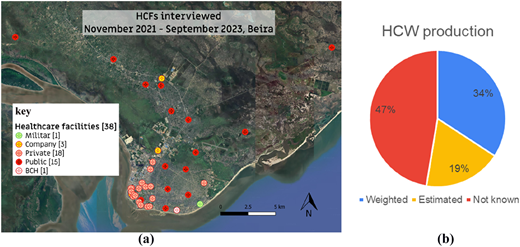
Interviews and visits were conducted in 38 HCFs, 16 public and 22 private (1 military, 18 private clinics, 3 company clinics reserved for staff) (Figure 2a). The sample presented a wide range of services and sizes, but it was not possible to obtain reliable estimates of the average number of patients attended in all HCFs. Despite this, the average number of patients (based on interviewees' estimations, not on proper data collection) in public HCFs (excluding BCH, the largest in the city, that couldn't provide an estimation) varies from 150 to 1,100 per day, while in private HCFs, it ranges from one patient every two days to 100 per day. Regarding the generation of HCW, almost half (47%) of the HCFs stated that they did not know their average daily or monthly production (77% were public ones). Most private HCFs know their exact monthly quantities of waste or have provided an estimate, as they are paying a fixed price per kg of BSW treated to the BCH (Figure 2b). The quantities of waste produced vary widely, ranging from 2 kg per week in a small private clinic (without specifying the segregation of common and BSW) to about 2,000 kg of common and 1,100 kg of BSW per day at BCH. Out of a total of 20 HCFs with anatomical waste production, only 5 have dedicated pits where this type of waste is deposited, thus avoiding the transport and incineration steps.
Responsibilities, management and tasks related to internal HCWM differ in the HCFs. A mere 13 out of 38 HCFs have declared the presence of a dedicated team, and only 34% have declared having an HCWM plan. Regarding waste sorting in hospitals, only one HCF reported not implementing it, as they burn all mixed waste in a hole in the ground. However, 14 HCFs reported not having enough plastic bags and bins for proper sorting. Sharps are generally stored in sufficient quantities in cardboard boxes. After segregating the waste, it is transported using wheelbarrows, 240-litre wheeled containers, individual bins or by directly handling the plastic bag containing the waste. The destinations for the BSW are proper storage rooms (declared by 50% of HCFs) or open-air collection points (32%) if the next steps are transport and treatment in centralised plants at BCH, or the open burning sites (18%) when waste is treated inside the HCF (7 out of 16 public HCFs). The collection points (32%) includes not designated spaces, such as inside a clinic room (“remain in bins until the collection and transport”), or they are in the open air without a roof, which exposes the waste to sun and rain with pollutant release: bad smells, contamination of the soil etc. Furthermore, open-air collection points are not enclosed by a fence, so that animals or unauthorised people (especially children) may come into contact with the waste, spreading infections. The 29 HCFs not practising open burning transport the BSW to BCH. 44% of the HCFs (respectively 9 public and 4 private) reported to have an agreement with the municipal collection service to transport the BSW to BCH, while 43% reported that they organise the transport independently with their own means, which is illegal. The 13% declared to have an agreement with a private company for the collection and transport of the BSW. Figure 3 presents a schematic representation of the aforementioned management chains implemented in the HCFs.
To assess workplace safety, questions were asked about training activities, PPE, accidents and general safety perception. Of the HCFs interviewed, 58% provided training for workers handling waste, 29% only provided empirical training for new recruits and 13% said they had never planned any training. Additionally, 26% of the facilities reported insufficient PPE, and 34% reported accidents resulting from improper handling of BSW. 28 HCFs (74%) stated that the waste is generally handled in safe conditions, even if there is a lack of PPE, accidents, improper storage or open burning. In general, 20 HCFs reported in final open questions one or more critical issues related to the lack of a good service, either municipal or private, for collection and transport of HCW (9), low risk perception of workers (5), difficulties with proper segregation (4), lack of or problems with the anatomical pit (3), inadequate temporary storage (1) and open burning (1) (Figure 4).
A total of 57 individuals participated, including representatives of health authorities, HCFs, scholars, private companies, associations, NGOs in health and/or environmental sectors, and other interested individuals. After institutional interventions and presentation of the cross-sectional study results by the researchers, the open roundtable began. Sixteen participants engaged in spontaneous discussion, sharing perspectives and proposing additional themes, such as:
Concerns regarding radioactive waste storage in HCFs;
The potential opening of new anatomic pits considering groundwater levels;
The presence of BSW on the beach;
The CMB's BSW transport service, informally provided as an emergency solution, which has supported HCFs but involves risks due to the truck's open structure;
Risks related to open burning sites and the need for authoritative solutions;
The need for improved training activities for personnel;
Private HCFs transporting BSW through inadequate private means, in violation of the law, partly due to economic constraints and lack of collection services. Therefore, SABE presentation was very interesting;
The need for funding in environmental management.
3.2 Incineration and sterilisation
The incinerator is overloaded because it was designed more than 20 years ago to treat only waste from the BCH, while now it is treating all the BSW from all public and private ones. This, combined with an outdated design, has led to numerous problems. The closing door at the inlet is broken, and the waste is manually loaded by the operator directly into the combustion chamber, where the protective coating is badly deteriorating. There are two engines, but both are broken. The first should be driving a fan that sprays fuel into the combustion chamber to raise the temperature. The second engine should allow the operations of a filter for the off-gas emissions. The stack height (less than 10 metres) was low, and a cyclone in 2024 destroyed it, so that now less than half stack is still there. In addition, the metal roof of the structure housing the incinerator is often blown off by the wind during the rainy season. Water falls on the plant and, over time, the outer metal layer has corroded and even has holes in the top.
The electric steriliser installed at BCH is a compact machine that uses the thermal process of the FHT system to sterilise the BSW. It employs the heat generated by a high-speed shredder in the sterilisation chamber to convert moisture in the waste into steam (WHO, 2017; UNEP, 2012b). The selected model is capable of treating approximately 30–40 kg of BSW per hour. It consists of 3 parts: steriliser, filter group and electronic unit with control panel. Rotating blades are installed at the bottom of the stainless-steel sterilisation chamber. During the cycle, the internal rotor rotates rapidly, shredding the waste and raising the temperature to 100°C. Water turns to steam that goes through condensers and filters. Due to the rotor, the temperature inside the chamber rises to 150°C. In the last phase of the cycle, a water spray cools the waste down to around 95°C. At the end of the cycle, the output sterilised waste is dry, sterile and finely ground and could be classified as municipal mixed waste. The average volume reduction of the waste is 70%, while the weight reduction is approximately 25%. The next sections report the main criticalities of the incineration and the equivalent performances of the FHT sterilisation.
3.2.1 Emissions to air
Despite the evidence of the incinerator's polluting nature (see Plate 1), an Environmental Impact Assessment for the BCH incinerator has never been carried out. In relation to air pollution, the most critical aspects were related to:
The lack of care in avoiding transients when burning waste below 850°C. The fundamental prevention strategy against the formation of PCDD/PCDF is therefore not guaranteed;
Lack of CO probe to check combustion quality;
Lack of flue gas draught control: dispersion through the filter and stack is affected by the break in the motor that activates the filter; in addition, cyclones often damage the stack;
Lack of a filtration system, at least a mechanical filter for particulate matter.
The FHT sterilisation is characterised by the absence of POPs emissions into the atmosphere, in accordance with the guidelines set out in the Best Available Techniques provided by the Stockholm Convention. When treating the waste with the steriliser, the emissions are caused by steam and gas flows from the heat exchanger, resulting from the capture at the head of the sterilisation cell during the treatment cycle phases. They are occasional, being generated only during certain specific phases of the sterilisation cycle and have a very low flow rate (150–200 m3/h when treating 110 kg/h). The steriliser is equipped with an activated carbon filter and an HEPA filter for emissions reduction.
3.2.2 Bottom ash and output sterilised material final disposal
With regard to the incineration process, no fly ash is collected in the case of Beira because of the absence of filtration. The bottom ash is classified as municipal waste and transported to the municipal dumpsite, where the disposal of chemical and hazardous waste is prohibited by law, as reported by the public health authorities during the interviews. BCH reported that the quantity or volume of bottom ash is unknown. As evidenced in literature and reported by the incinerator operators, the complete combustion of all types of BSW does not occur and sharps waste in particular may persist in the bottom ash. Furthermore, the incineration of HCW has been demonstrated to result in the concentration of heavy metals within the bottom ash. Consequently, their disposal at Beira's municipal dumpsite poses significant concerns on different levels. The first risk is related to the habitual presence of waste pickers operating on the dumpsite and daily exposed to waste. Secondly, the ashes are disposed of in the absence of any soil protection measures to prevent the percolation of leachate, and the absence of a covering system to prevent waste dispersion, contributing to environmental pollution.
In contrast, the sterilised waste is classified as a non-hazardous municipal waste, as it does not exhibit any of the hazardous properties listed in Commission Regulation (EU) No 1357/2014 [1]. In light of the circular economy approach and the potential reuse of sterilised waste output, exploratory initiatives have been conducted by Newster Group to identify alternatives to waste disposal. Solid recovered fuel for energy production in authorised waste-to-energy or cement plants is still in the experimental phase (Rada, 2016; Aydin and Un, 2018), while the potential reuse of the sterilised waste in the construction sector was tested and implemented. The Environmental Management Agency of Zimbabwe has already permitted and empowered this reuse at the Luisa Guidotti Hospital in Mutoko. The installation of a FHT steriliser at Mutoko Hospital in 2019 has resulted in its regular utilisation [2]. The experimental investigation of the new construction materials was conducted by incorporating varying percentages of residue instead of the inert component (sand) in the concrete. The results showed that adding 5% of the residue to the concrete made the material suitable for use as a wall, and adding 10% made it suitable for use as asphalt. After analysing and testing the materials, three main types of construction materials for Mutoko Hospital were identified: pavements, bricks or a light mixture. The bricks were finally used to pave a new section of the hospital.
3.2.3 Health and safety
Considering air pollution and the bottom ash disposal, many categories of people are exposed in different ways to the incineration process. The incinerator's operators mentioned the existence of a conflict between the BCH and the neighbourhood, often complaining because they can't open their windows while the incinerator is operating. All the BCH's workers and patients are also exposed every day to the incinerator's emissions. Nevertheless, the most exposed group of people are the incinerator operators. A risk analysis of the BCH incinerator was never carried out. The incinerator operators declared that they had insufficient PPE and were worried by waste and fuel (gasoline) being manually loaded into the combustion chamber. Operators complained of working in a very hot environment: in addition to the heat of the fire, it's imperative to consider the already high temperature of the geographical area. The door of the combustion chamber remains open, with sparks escaping and fumes remaining inside the room.
The operations for the steriliser are regulated by a safe protocol provided by the producer company. Due to the complexity of the machine and the hazardous materials treated, the operators receive a complete theoretical formation and practical training. The new structure built to host the steriliser has a ventilation fan system to extract the air that could be contaminated by the BSW. The low emissions of the sterilisers do not stay indoors: they are filtered and carried outside through pipes. Moreover, the structure has been built considering resilience requirements against cyclones, typical of Beira. A washing machine has been installed to wash and sterilise the bins. Table 1 reports the comparison between the steps that the waste operators have to perform, focusing on their safety.
3.2.4 Operating costs recovery
An estimation of the operating costs of the two management systems was conducted, showing that incineration, when constructed with low technology, is cheaper. The operating costs of the incinerator are only related to personnel and fuel consumption. However, incineration cannot be considered economically sustainable if considering the costs caused to public health and the environment. On the contrary, the foundation of SABE start-up was a pivotal element in the economic sustainability assessment for HCWM. A business plan has been developed to assess the capital cost of the machine (funded by the project) and the operational costs. SABE's revenue comes from contracts with private clinics, to collect and transport their BSW. When starting the first activities, SABE established the minimum number of kilograms to be transported and treated and the cost per kg to be paid by private clinics (revenue for SABE) to cover all the operative costs of the transport and sterilisation (water, electricity, human resources, taxes, spare parts, maintenance, fuels for the collection lorry). The article does not focus on costs and, due to the sensitive nature of the contracts with the private HCFs, a complete list of costs will not be inserted.
4. Discussion and conclusions
The cross-sectional study in the HCFs reports many different criticalities in all the HCWM steps. Nevertheless, it represents a baseline assessment for the health authorities that could easily repeat audits of resources and practices through quicker surveys (Bannour et al., 2024) over the years, especially after training sessions. The significant moment of having 57 people participate in the roundtable event during a regular working day was an opportunity to understand local interest in the topic of HCWM. This broadened the study's purpose from academic research to a local initiative to discuss existing issues. Our study aimed to place particular emphasis on the complete identification and demonstration of context-related aspects within the city and the various stakeholders. The establishment of direct contacts with the majority of the stakeholder groups has facilitated a comprehensive analysis of the entire waste chain, encompassing steps and consequences that are not immediately evident. One aspect not mentioned in the results section is a theme that emerged from two interviews with HCFs practising open burning. They reported on children playing in HCF gardens and coming into contact with BSW that was not stored properly in fenced areas. In this sense, improving waste storage conditions or treating waste locally in a safer way becomes important for children's health too. The right of all citizens to live in a healthy environment should be taken into particular account when considering waste treatment. Even if not quantified, the study shows how reducing emissions to the air, improving final disposal, reusing sterilised material, improving health and safety conditions, and recovering operating costs could be achieved by shifting from incineration without a filtration system to sterilising BSW. As it is common for low-budget incinerators to lack even basic equipment, a paradigm shift is needed. Considering the criticalities of HCW incinerators and their impact on the environment that have emerged over decades in LICs all over the world, it is time to change the approach, restricting their use and switching to viable alternatives. Sterilisation is a viable alternative, but it requires greater investment and technological advances. However, given the numerous challenges currently being experienced by the health sector, it is uncertain whether significant investments in waste management can be made.
4.1 Limitations
This study has several limitations, starting from the conduct of the interviews. The presence of a representative of the health authorities during the interviews could have left space for the respondents to declare things different from the truth, especially in the private sector. Data analysis presents some limitations too. First, real-time manual transcription may have led to partial loss of nuance despite audio recording and cross-verification between researchers. Second, the absence of qualitative data analysis software may have limited the systematic traceability of coding decisions. Third, categories were constructed pragmatically to meet operational reporting needs within a short timeframe, which may reduce analytical depth compared to more structured qualitative methodologies such as thematic analysis. Indeed, the roundtable event was scheduled two weeks after the end of the interviews. Finally, the cross-sectional design captures practices at a single point in time and does not account for potential temporal variability.
Quantitative methods to assess the impacts related to the incinerator haven't been implemented mainly due to the lack of data to calculate environmental parameters (like the air emissions of the incinerator) or detailed cost analysis (lack of transparency on the current management costs). It would have been possible to estimate the total volume of off-gas, then calculate the specific volumetric flow (per kg) of the stoichiometric exhaust gas, moving on to that of the actual off-gas in real conditions. The consequent estimation of the magnitude of emissions, based also on the knowledge of pollutant concentrations, could be greatly simplified and schematised in several ways (i.e. tables of the percentage chemical composition of volatile solids, simplifications in product analysis, formula for emissions, etc.). However, the absence of suitable laboratories in Beira would have resulted in analytical inaccuracies.
4.2 Final remarks and conclusions
If the data collection for the present study followed a classic and limited qualitative research method, the novelty of the article is to give a complete vision of the HCWM chain, the stakeholders directly or indirectly involved, and the benefits of introducing advanced and sustainable technology for the treatment of HCW in a LIC, particularly the first electric steriliser introduced in Mozambique. What we want to emphasise is that, even if strongly context-related, the methodologies and the approaches that we used to analyse the context could be replicated in every context characterised by data scarcity, starting from the identification of the relevant stakeholders and using a bottom-up approach to understand their perceptions. According to Freeman, one of the pioneers of stakeholder theory, sustainability is a multi-dimensional construct that involves all of the key stakeholders, as well as the environment and society at large (Freeman et al., 2010).
Visits to the HCFs revealed several recurrent challenges. First, greater financial investment in healthcare waste management (HCWM) is required. Waste segregation practices should be strengthened through comprehensive staff training and the provision of adequate equipment, including bins and plastic bags. Respondents also consistently highlighted the need to improve municipal waste collection services by upgrading transportation systems and extending coverage to all public HCFs, thereby eliminating open burning practices. Finally, both facility operators and local communities emphasised the need to discontinue incinerator operations. These findings are consistent with the literature review, which identifies the same issues as the principal challenges across other analysed LICs.
In conclusion, we would like to emphasise that Mozambique is one of the countries with the lowest income in the world, where sustainable technological progress must be driven by the development of strategies with – and not for – local stakeholders. While the potential of technological innovations is high, their practical implementation is not without challenges, especially in resource-constrained environments. Most of the published research aiming to “modernise” solid waste management systems has focused on high-income countries (Wilson et al., 2015). The disparity between the substantial scientific HCW-related production in academia and the limited adaptation of suitable HCW strategies in practice to establish a robust management system could be a salient issue for further exploration within the context of LICs (Ranjbari et al., 2022).
The present work was possible thanks to the scholarship of the PhD Programme SUSTEEMS (Sustainability: Economics, Environment, Management and Society) of the Department of Economics and Management of the University of Trento. The missions in Mozambique were financially supported by two international development cooperation projects. The LimpaMOS MOÇambique and SIRSU projects were funded mainly by the Italian Agency for Development Cooperation, the Autonomous Province of Trento, the European Union Delegation in Maputo, and the Italian private company Newster GroupÔ. The Department of Civil, Environmental and Mechanical Engineering of the University of Trento, represented by Professor Marco Ragazzi, was one of the partners of LimpaMOS MOÇambique project. The responsibility for the content of this publication lies with the authors and does not necessarily represent the views of the funders.
Notes
The supplementary material for this article can be found online.