


This study examines patterns in how a group of fifth- and sixth-grade teachers evaluated and reported using different types of curriculum resources to support their teaching in relation to the mathematical concepts outlined in the Common Core State Standards for Mathematics. In particular, it explores the use of resources that were available to teachers through the Internet, including the extent to which they used these resources to supplement their district-provided materials and the criteria they used to evaluate specific web-based resources. Data were collected through the use of implementation logs and video recordings of professional development sessions related to curricular resources. The results of the study show that resource use varied widely from teacher to teacher, but also that Internet resources were often used as much as, or more than, other resources like textbooks. When evaluating specific resources, the teachers referred to a variety of criteria, but did not often coordinate multiple criteria when making evaluations. Also, they tended to positively evaluate most resources; negative evaluations were primarily given for resources that teachers believed students would be unable to complete successfully. We use these results to build on the idea of curricular reasoning (Roth McDuffie & Mather, 2009), and suggest that teachers need increased opportunities to develop the ability to filter the many curricular options that are available online.
Introduction
The nature and role of mathematics curriculum materials in the United States is shifting, not only because of the transition to the Common Core State Standards for Mathematics, CCSSM (National Governors Association Center for Best Practices, Council of Chief State School Officers, 2010), but also because of the number of resources that are readily available via the Internet. Textbooks are no longer the lone driving force behind the curriculum being taught; instead the CCSSM are seen as establishing the learning goals, and teachers increasingly find themselves searching online for the primary resources they will use to meet those goals (Davis, Choppin, Roth McDuffie, & Drake, 2013). This means that individual teachers have more responsibility for, and more influence over, what gets taught. It also means that much depends on the teachers’ ability to find, recognize, and use potentially effective materials.
Making curricular decisions is not new for teachers. They have long adapted, modified, and supplemented the curriculum materials provided by their districts (Remillard, 2005), using strategies like omitting, adapting, or replacing activities and lessons (e.g., Drake & Sherin, 2009). Roth McDuffie and Mather (2009) describe three influences on curricular reasoning: students’ learning needs, state standards, and the curriculum materials themselves. Curricular reasoning is critical in situations where teachers are drawing substantially from a range of different resources, like those that can be found with a simple Internet search. To what extent are these influences guiding teachers’ curricular decisions when they look at such search results? How do they decide whether and how to use a particular resource?
In this article, we share data from a professional development project designed to help fifth- and sixth-grade teachers interpret and understand the CCSSM, and to support them in their implementation of the standards. The teachers were teaching in a large urban district that was heavily invested in making the transition to the CCSSM. Because district leaders did not believe that currently available textbooks were aligned with the CCSSM, they internally developed several curriculum modules for the teachers to use as primary materials for teaching the CCSSM. However, the modules did not cover all of the standards, which meant that implementing the entirety of the CCSSM would require additional supplementation with outside resources.
In this article, we report on two aspects of teachers’ curricular practices. First, we share data about what resources teachers reported using in relation to each of the CCSSM standards for their grade level, focusing on the extent to which they supplemented their instruction with Internet resources. Then, we share data on the criteria teachers referenced as they evaluated a variety of web-based curriculum resources during an activity within the professional development. In this analysis, we attend to the relationship between the teachers’ evaluations of resources and the criteria they used to justify their evaluations. The larger aim of this work is to better understand the nature of curricular reasoning and use this understanding to make conjectures about the kinds of support teachers might need to build capacity to find, select, and use appropriate resources to support student learning in relation to the CCSSM.
Literature Review and Framework
What is meant by the term “curriculum” can vary widely. In this article, we use the term curriculum resources to refer to any externally produced resource with which both teachers and students interact in order to teach/learn mathematical content. This definition draws on Remillard, Herbel-Eisenmann, and Lloyd’s (2009) definition of curriculum materials as “specific print materials with which teachers and students have physical contact” (p. xvii) with two additional caveats. Because we are interested in exploring specifically how teachers find and use resources that they find on the Internet, we exclude from our definition materials that are created by the teacher, and we include nonmaterial resources such as virtual manipulatives, videos, and websites.
The Role of Curriculum Resources
Within this definition, the most visible and prevalent curriculum resources continue to be mathematics textbooks. There has been a wealth of research examining textbooks and their role in the classroom, particularly in the wake of the National Science Foundation’s investment in a number of mathematics curriculum development efforts in the 1990s (National Research Council, 2004; Reys, Reys, & Rubenstein, 2010; Schoenfeld, 2002; Senk & Thompson, 2003). Many textbook analyses show significant differences in how different textbooks present the same mathematical topics, projecting different ideas about what it means to understand that topic (e.g., Cai et al., 2005; Li, 2000; Mesa, 2004; Nie, Cai, & Moyer, 2009; Son & Senk, 2010). Research has also shown significant differences in student achievement related to curricular program (Grouws et al., 2013; Krupa, 2011; Krupa & Confrey, 2015; Tarr, Grouws, Chavez, & Soria, 2013). These studies provide evidence that the way mathematics is presented and organized in curriculum materials matters for student learning.
Implementation of curriculum resources is also an important factor. For example, Stein and Lane (1996) showed that when cognitive demand of tasks remained high through set up and implementation, learning gains were higher than when cognitive demand declined during enactment. Various teaching practices led to such decline, such as providing procedures for students, omitting or deemphasizing contextual references in the textbook, or simplifying the mathematical language of the task (Henningsen & Stein, 1997). In general, there is great variation in how different teachers use the same curriculum materials, in terms of how much of the textbook content they cover, how much they supplement with other materials, and how their instruction aligns with the pedagogical orientation of the textbook (Boaler & Staples, 2008; Tarr, Chavez, Reys, & Reys, 2006).
Many factors influence how curriculum materials are used, such as expectations about students (Arbaugh, Lannin, Jones, & Park Rogers, 2006), the presence of curriculumcentered professional development (Schoen, Cebulla, Finn, & Fi, 2003),1 and also features of the curriculum materials themselves. For example, in their study of 48 teachers using two different NSF-funded textbooks series, Stein and Kaufman (2010) found that teachers implemented the Investigations in Number, Data, and Space curriculum with greater alignment to the standards than teachers using Everyday Mathematics despite the fact that the Investigations materials contained a larger proportion of tasks with high implementation difficulty. High levels of implementation were not related to teacher capacity such as teacher knowledge or experience, but were related to whether teachers reviewed the big mathematical ideas in the textbook. In interviews, the teachers of Investigations spoke about how supports within the Investigations materials help to clarify and focus their attention on the big ideas, and in their teaching tended to make connections between mathematical ideas across multiple days of instruction. In contrast, teachers of Everyday Mathematics described the curriculum materials as shifting rapidly from topic to topic, and in their teaching tended not to make connections between topics. This study demonstrates the importance of coherence and attention to big ideas across lessons rather than a curricular approach where topics are presented in isolation from one another.
Curricular Reasoning and Curriculum Strategies
Roth McDuffie and Mather (2009) defined curricular reasoning as “a specific kind of reasoning that teachers employ while working with curriculum materials to plan, implement, and reflect on instruction” (p. 302). They identified three categories of influence on curricular reasoning: the curriculum materials themselves, students’ learning needs, and state standards. They also acknowledged that these influencing factors may not always be aligned; in some cases, teachers might be influenced by one factor without considering the others.
Drake and Sherin (2009) also explored the ways that teachers thought about and used curriculum materials, identifying the curriculum strategies used by teachers before, during, and after instruction. These strategies included how they read, evaluated, and adapted materials. In the “evaluate” stage, teachers might consider many aspects of curriculum resources, including the conceptual importance of the activity, students’ current mathematical understandings, the pedagogical demands of the activity, the teacher’s own understanding of the content, and his or her previous experiences teaching the same or similar lessons.
Curricular reasoning and curricular strategies are becoming increasingly important due to a shift in the role teachers take in selecting and adapting curriculum materials in the United States. Instead of being seen as establishing the content that is to be covered (historically the dominant perspective in the United States), curriculum materials are increasingly being treated as a set of resources that can be used to help achieve a particular mathematical or pedagogical goal (Roth McDuffie & Mather, 2009). In our view, we see two factors contributing to this shift. The first of these is the transition to the CCSSM, a set of learning goals currently adopted by most states in the United States. The second factor is the increasing prevalence and use of resources for teaching that can be found via the Internet.
The CCSSM represents a significant departure from state standards for mathematics (Confrey & Krupa, 2012; Wu, 2011). In terms of content, there are major shifts at the elementary grades, including increased emphasis on numeration and operation, measurement, and fractions as number, while deemphasizing early algebra, statistics, ratio, rate, and proportion (Confrey & Krupa, 2012). In terms of mathematical practice, the CCSSM require teachers to focus on depth and coherence rather than coverage and topic mastery (Wu, 2011), and the included “Standards for Mathematical Practice” emphasize problem solving, modeling, mathematical justification, and communication. Despite claims of alignment, current research shows that most textbooks are not well aligned to the CCSSM in either content or practice (Polikoff, 2014). This means that if teachers are to effectively teach the content outlined in the CCSSM, they will need to supplement their current mathematics textbooks.
To find materials to support their teaching of the CCSSM, teachers are likely to turn to the Internet. One recent survey of 403 middle school teachers reported that over 60% regularly supplemented their curricula with resources they found on the Internet in order to implement the CCSSM (Davis et al., 2013). Other studies show similar trends towards the use of online resources (Hanson & Carlson; 2005; Putnam, Boyer, & Otten, 2015).
Putnam et al. (2015) described the process of accessing online resources as cyclical and self-reinforcing; as teachers find and use resources from particular websites, they may be more likely to return to those websites for more resources. This practice may lead to a narrowing of options, as teachers may fall into routines of curriculum use and fail to consider alternative choices. These findings suggest that although teachers have access to more resources than ever before, this may not necessarily result in a richer curricular experience for students. Much depends on the criteria teachers use to select web-based resources.
Methods
Context
The participants were 29 Grade 5 and 6 teachers from 10 schools in a large urban district with a high percentage of minority students (85%) and students with low socioeconomic status (80%). In an effort to help teachers implement the CCSSM, the district abandoned previously adopted textbooks including Everyday Mathematics, Math in Focus, and Connected Mathematics, and created a set of modules to address selected standards in each grade. The materials in the modules were drawn and assembled from a variety of online and print resources by district personnel and teachers. Midway through the year, the district sent out a list of recommended resources that could be used to support teaching related to the CCSSM.
The authors of this article were asked by the district to provide year-long professional development (PD) to assist the participating teachers in implementing the CCSSM, with a focus on preparing them to teach with the district-created modules. The PD included six full-day meetings over the course of the 20122013 school year with the entire group of fifth- and sixth grade teachers, individual classroom visits conducted by the PD facilitators, and a lesson study project enacted with small groups of teachers in the PD. The full day meetings included explorations of the mathematics in the modules, examinations of student work on the tasks included in the modules, and discussions about the CCSSM Standards for Mathematical Practice.
In the course of working with the teachers, we found that many were supplementing the modules with a variety of resources, often obtained by performing an Internet search for the desired standard. While finding and selecting materials for teaching was not a targeted competency for the PD, the fact that many were engaging in this practice made us wonder how they were making such curriculum decisions. To investigate this, we developed the “resource evaluation activity” described below.
Measures
Implementation logs. To document the type of resources teachers were using to teach each of the CCSSM grade level standards, each participant completed a CCSSM implementation log. To create the implementation log, we drew on the work of the Comparing Options in Secondary Mathematics: Investigating Curriculum (COSMIC) project. The COSMIC team measured textbook implementation through Table of Contents Records, which were self-reported by the teachers and customized for the textbook they were using (Tarr, McNaught, & Grouws, 2008). We adapted the Table of Contents Records to measure the use of curriculum materials in relation to the CCSSM. For each CCSSM standard, teachers indicated if they taught the content from (a) the school-approved textbook, (b) the district modules, or (c) an alternative source. Then they were asked to list the alternative sources they used to teach to each specific standard. Our CCSSM-logs allowed for multiple entries for a single standard, allowing us to document multiple resources teachers used to teach a particular standard. In addition, teachers were instructed to leave the row blank if they did not teach the topics described in the standard.
At each of the six PD meetings, a portion of time was dedicated to updating the implementation logs. Teachers provided information for standards they had covered since the previous meeting. Through this process, by the end of the year, teachers had represented the resources they used for all of the standards they taught during the school year.
Resource evaluation activity. To understand teachers’ curricular reasoning, we designed an activity where the teachers were given a selection of resources that we obtained through an Internet search for particular standards: 5.NF.A.1-2 for 5th grade and 6.RP.A.1 3 for 6th grade. Because the evaluation activity was also designed as a learning opportunity for teachers, we selected standards for which there were district-developed modules and about which there had already been significant discussion in the PD. Due to space considerations, in this paper we only report on the resources used in the fifth-grade activity, which were purportedly aligned with the following standards:
5.NF.A.1. Add and subtract fractions with unlike denominators (including mixed numbers) by replacing given fractions with equivalent fractions in such a way as to produce an equivalent sum or difference of fractions with like denominators. For example, 2/3 + 5/ 4 = 8/12 + 15/12 = 23/12. (In general, a/b + c/d = (ad + bc)/bd).
5.NF.A.2. Solve word problems involving addition and subtraction of fractions referring to the same whole, including cases of unlike denominators, such as, by using visual fraction models or equations to represent the problem. Use benchmark fractions and number sense of fractions to estimate mentally and assess the reasonableness of answers. For example, recognize an incorrect result 2/5 + 1/2 = 3/7, by observing that 3/7 < 1/2.
To select resources related to these standards, we looked through Internet search results for resources with a variety of different characteristics in terms of cognitive demand, use of representations, and alignment to the standard. For example, we selected a video from the Khan Academy website (2010), which consisted of a virtual chalkboard with a voice-over. It provided a demonstration of how to find a common denominator to solve the problem 4/9 + 11/12. The video presented fraction addition as a strictly symbolic operation, where all of the operations are performed on the numerators and denominators; neither 4/9 nor 11/12 are treated as quantities (in Grades 3 and 4 the CCSSM specifically calls for fractions to be treated as quantities; the visual fraction models referenced in standard 5.NF.2 require the representation of fractions as quantities).
To contrast this, we included a video from the LearnZillion website (Blackwell, 2011). In this video, a virtual whiteboard is used along with a voiceover, but this whiteboard included number line diagrams to model a pictorial solution to the problem 1/3 + 3/4. After showing two number lines with 1/3 marked on one and 3/4 marked on the other, the narrator explains, “We must section the number line so that they have the same intervals. In order to add or subtract something, the pieces must be the same size.… You wouldn’t add 6 inches to 10 feet and get 16 for an answer.” Rather than carrying out procedures on the whole number parts of each fraction, this video portrays fraction addition as putting together two quantities and finding a unit fraction that can be used to comeasure both quantities in order to name the answer (Olive, 2001). Unlike the Khan Academy video, in this video the fractions 1/3 and 3/4 are treated as quantities as described in the CCSSM. We selected the Khan Academy and LearnZillion videos to see whether teachers would refer to the better alignment between the LearnZillion video and the CCSSM as a criteria in evaluating the resources. The other resources used in the activity are described in the Appendix.
In the resource evaluation activity, we asked the teachers to examine the resources and to discuss whether and how they would consider using each resource. They discussed the resources in small groups, and then the PD facilitator conducted a whole group discussion in which members of each group shared their thoughts about the resources. We recorded audio for all of the small group conversations and recorded video for the large group discussion.
Analysis
Teachers’ use of resources. To analyze the CCSSM implementation log data, each participant’s log data were entered into a unique row in an Excel spreadsheet. We compiled a list of all the resources that teachers reported using to teach all of the standards. Then, we coded each resource based on its source (e.g., Internet, textbook, etc.), using the following codes: school-approved textbook,2 non-school approved textbook, Internet resource, district designed module, and other. We tabulated resource use in terms of how many different resources were used, how many of each type were used, and also organized by teacher and standard: for which and how many standards did individual teachers use which types of resources?
Influences on teachers’ evaluations. We transcribed both the small group and large group conversations during the resource evaluation activity. We used NVivo software to code the transcripts in three ways. First, we coded for which of the six resources teachers were discussing, breaking up the transcript into sections during which a specific resource (e.g., the Khan Academy video) was the topic of conversation. Once we isolated segments by resource, we coded each of these segments for evaluations, asking the question, “is a participant making a judgment about this resource?” In order to be considered an evaluation, a statement needed to be clearly identifiable as positive or negative; if it could not be identified as either expressing support for or against the resource, the statement was not included as an evaluation.
After all of the evaluations were identified, a third round of coding was conducted. We examined each evaluation and the text around it to see whether there was evidence of a criterion being invoked to support the evaluation. We started with the categories: CCSSM (Standards), student’s learning needs, and the curriculum resources themselves (Roth McDuffie & Mather, 2009). In our analysis, we found that a fourth criterion presented itself in the data: teachers’ own needs. Table 1 shows generic examples for each criterion.
Results
Resources Used to Teach the CCSSM
Each teacher had the opportunity to claim using the school-approved textbook, the district module, and/or an external resource for each of the 35 distinct standards for fifth grade or 41 standards for sixth grade. Forty percent of the resources reported fell into the Internet resources category, while 36% of the resources reported were textbooks (see Table 2). The district-designed modules comprised 22% of the reported resources.
We also examined resource usage by teacher, in terms of the percentage of the CCSSM standards that were taught using each kind of resource. Figure 1 shows the distribution of these percentages for Internet resources and textbooks. Interestingly, there is little discernible pattern across the group. It is not the case that individual teachers tended to use Internet resources less when they relied more on the textbook, or vice versa. In fact, the correlation between the use of these two types of resources was positive, although not significantly so (rs = .30, p = .14). One teacher claimed to use both types of resources for all of the CCSSM standards. Four teachers did not claim to use their school-approved textbook at all, while three teachers claimed to use their textbook for more than 90% of the standards. All of the teachers claimed to use Internet resources for at least some standards. Additionally, for 20% of the standards, the teachers did not report using any 3 resource.
Examples of Criteria for Positive and Negative Evaluations in Each Category
| CCSSM | Students’ Needs | Curricular Resource | Own Needs | |
|---|---|---|---|---|
| Positive |
|
|
|
|
| Negative |
|
|
|
Frequency of Resource by Type
| Resource Type | Frequency(n = 1,232) | Percent of All Resources Reported |
|---|---|---|
| Internet resource | 489 | 40% |
| School-provided textbook | 308 | 25% |
| District-designed modules | 267 | 22% |
| Other textbook | 134 | 11% |
| Other | 34 | 3% |
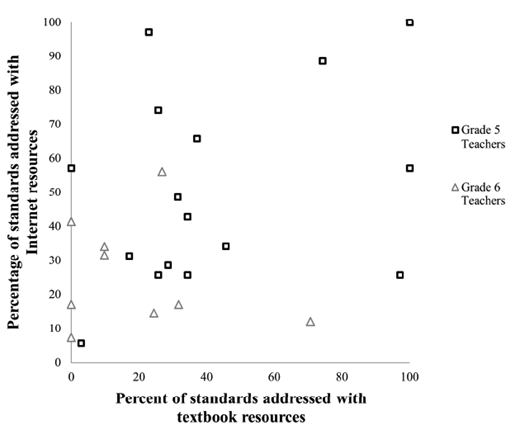
Percent of standards addressed using Internet and textbook resources by teacher.
Percent of standards addressed using Internet and textbook resources by teacher.
Table 3 addresses whether patterns of resource use changed when teachers were covering standards for which there was a district designed module. For each teacher, we computed the percentage of standards claimed to be addressed by each type of resource. Then, within each resource type, we found the median percentage of standards addressed across all of the teachers, shown in the second column of the table. In the third column we restrict the number of standards to only those covered in one of the district developed modules (5.NBT.1-2, 5.NF.1-4, 6.NS.1-3 & 5, 6.RP.1-3, and 6.EE.1-4).
Median Percentage of Standards Addressed by Each of the Resource Types
| Resource Type | Median Percentage of All Standards | Median Percentage of Standards for Which There Was a District-Developed Module |
|---|---|---|
| School-approved textbook | 26.8% | 40% |
| District-developed module | 19.6% | 57.1% |
| Internet | 34.1% | 42.9% |
| Other (including other textbooks) | 60% | 60% |
| No resource reported | 14.6% | 0% |
This table shows that the presence of a district-developed module did seem to play a role in what type of curriculum resources were used. Specifically, teachers used the module more (although still for less than 60% of those standards), and were less likely to leave the standard blank (a median of 0% compared to 14.6% for all of the standards). One surprising result is that the teachers did not appear to use any of the other resources less. In fact, use of the school textbook and Internet resources appeared to increase when teachers were teaching standards covered by the district modules.
Overall, these data suggest that the teachers were drawing on a variety of different resources in their teaching of the CCSSM, and that they were drawing on these different resource types in different proportions, depending on the teacher and the standard. When there was a district module, they tended to use it, but also drew just as heavily (or more so) on outside resources. We also see that teachers report using Internet resources for a substantial proportion of their teaching materials, some teachers doing so for nearly every standard.
Criteria Articulated by Teachers in the Resource Evaluation Activity
Criteria 1: Students’ needs. When evaluating the resources we shared with teachers during the resource evaluation activity, teachers referenced influences in each category. In terms of students’ needs, many of the criteria invoked by teachers had to do with whether the teachers thought that the resource would provide an experience that students would enjoy or be engaged by. Regarding the Khan Academy video, one teacher claimed, “Instead of me standing up there and saying the same things I said last week, if you play a video, they’ll pay attention to the video.” Another teacher saw the LearnZillion and Khan Academy videos similarly in terms of their likelihood for engaging students: “It might be LearnZillion, Khan, whatever … they’ll be like, oh yeah, the computer … and then all of a sudden, they are magically able to do their work again.” When discussing the Fruit Shoot game, one teacher noted the similarity between the game and a popular game involving fruit. “This is [like] some other game they have on the iPhone. Fruit Ninja. Yeah. So this kind of puts it in their mind of that.”
One thing that is apparent in these evaluations is that they attend to the surface characteristics of the tasks—the format (video) or the appearance (involves fruit)—rather than the mathematical requirements, cognitive demand, or opportunity for learning provided by the resources. These criteria suggest that the teachers saw providing engaging and enjoyable activities as a goal that could be met through their selection of curriculum resources, and perhaps believed that these surface characteristics were valued by students.
Another way that the teachers’ criteria related to the needs of their students was their preference for resources that they thought their students could successfully complete. This resulted in positive evaluations for some resources. For example, all of the evaluations of the “Mr. Maffesoli” practice worksheet were positive, accompanied by explanations such as “[Students] could do this.” This concern also surfaced in negative evaluations for other resources. For example, one teacher was unsure about using the LearnZillion video and voiced concern that students would not be able to understand the visual representations used: “I haven’t really worked with number lines with them, so I don’t know if they can use them.” The “Stuffed with Pizza” task received almost all negative evaluations, accompanied by justifications such as, “I think just having to read everything and break it down … this can be very overwhelming,” and, “one can’t do this unless they know the skill.”
One participant, a mathematics coach also involved in the professional development, argued for using the “Stuffed with Pizza” task:
It’s the wording and that’s what kills our children. So, if we don’t start exposing them more to different ways, things and phrases, they’re not going to get to the ultimate goal. We may say they can’t read it, but if we don’t start like, exposing them to it … and showing them how to read it and how to break it down, how to analyze it, then when they get to [the state test] basically they are not going to have any success at all.
This excerpt shows a rare connection between multiple criteria—it invokes criteria related both to student needs and to the CCSSM (articulated in terms of helping students be successful on the CCSSM-aligned state assessment). For the most part, teachers did not make such connections. The criteria related to students’ needs were primarily about selecting resources that would engage or excite students, or selecting resources that students could complete successfully.
Criteria 2: The CCSSM. When the CCSSM were invoked as criteria for evaluating the resources, they were nearly always related to representations. For example, several teachers positively evaluated the LearnZil lion video, voicing criteria such as, “because they show the multiple representations.” However, we have noted elsewhere that some of the teachers in this PD program seemed to treat visual representations not as illustrations of mathematical concepts, but as algorithms that can be used to get the answers (Webel, Krupa, & McManus, in press). This suggests the possibility that even though they knew that visual diagrams were part of the CCSSM, they may not have understood the role that diagrams should play in making operations visible (Arcavi, 2003). Some of the comments about representations in the CCSSM hinted at this phenomenon. One teacher, for example, voiced appreciation for the Khan Academy video, but then followed this evaluation by saying, “Now I feel like I’m cheating when they want pictorial representations.” One interpretation of these comments is that the teacher, while recognizing that the CCSSM emphasized fraction models, saw the algorithm described in the Khan Academy video as a simpler way to learn and teach fraction addition. Thus, providing students with the Khan Academy video was “cheating” because it circumvented the more complicated visual depiction. Perhaps, as suggested by other data from the project (Webel et al., in press), the teacher saw the visual fraction model as an overly complex procedure for solving the problem rather than an illustration of the meaning of the addition operation.
Criteria 3: The curriculum resources themselves. In most cases, the teachers referenced a feature of the resource and tied it to one of the other criteria, so very few evaluations were coded in this category. One exception was the fact that teachers seemed to appreciate resources that contained worked examples. Although they sometimes explicitly noted that these would be helpful for students, at other times they simply indicated that worked examples were a positive aspect of resources. For example, for the LearnZillion video, one teacher noted, “They show step by step … and that’s good.” In reference to the Mr. Maffesoli worksheet, another teacher commented, “I like the fact that it has the example on the top.” These evaluations did not specify a reason why worked examples were positive characteristics. In contrast, some evaluations did tie the use of examples to students’ needs. For example, in reference to the Khan Academy video, one teacher voiced appreciation for the fact that students could watch the video multiple times, explaining: “Because it’s about the reinforcement. And for special ed it can take four hundred times to get something into their head.” In this evaluation, the teacher articulates the view that the repeated demonstration of a procedure is something that will benefit students, particularly those with special needs.
Criteria 4: Teachers’ own needs. Rather than referencing students’ needs or the CCSSM, sometimes teachers tied their evaluations to their own needs. For example, in explaining a positive evaluation of the Khan Academy video, one teacher said, “that’s the way I’m used to it, so that’s the way I teach it.” But another teacher claimed that “[LearnZil lion] is better than Khan.” She continued, saying “Khan I can do. Khan is us.” So, while the first teacher seemed to appreciate resources that were aligned to his current practice, the second teacher expressed value for a resource that provided instruction that was different from her typical practice.
These comments emphasize the role of comfort and familiarity in the selection of electronically available resources. When making such selections, are teachers looking for resources that are familiar and comfortable, or do they look for resources that stretch their practice beyond what they might typically do? To what extent are these resources tools for improving instruction, and to what extent are they reinforcing patterns that already exist? These data provide evidence that different teachers might think of the relationship between resources and their instruction in different ways.
Summary
In terms of positive evaluations, the teachers tended to value activities they perceived students would enjoy (e.g., games, online activities, videos), resources with worked examples and opportunities for practicing procedures, activities that they believed students could complete successfully, and, to some extent, resources with multiple representations (there was more diversity of opinions about such resources). When teachers gave negative evaluations of resources, it was nearly always accompanied by rationale indicating that the resource was too challenging for their students. In general, the teachers liked all of the resources and indicated that they would use them with students, with the exception of the “Stuffed with Pizza” task.
Teachers also tended to focus on one criterion at a time. When they talked about the value of worked examples, they did not discuss whether these examples would promote student engagement. When they did talk about student engagement, they did not tend to consider whether the resources that they thought would engage students were aligned to the CCSSM. When they talked about the CCSSM, they usually only considered one aspect of the standards (e.g., whether the task had visual representations), and in some cases still gave negative evaluations due to a different criteria (such as whether students could use number lines). In addition, references to the CCSSM were often related to concerns about the state assessment and what students need to know and be able to do on the assessment.
Discussion
Included within the curriculum principle of the National Council of Teachers of Mathematics Principles and Standards for School Mathematics (2000) is the idea that “a coherent curriculum effectively organizes and integrates important mathematical ideas so that students can see how the ideas build on, or connect with, other ideas” (p. 15). Schoenfeld (2002) described these standards and the ensuing National Science Foundation funded curriculum development effort as a movement away from the portrayal of mathematics as a disconnected set of skills. One of the aims of the CCSSM was to continue in this direction, by limiting the number of standards, focusing on key ideas across grades, and “continually referring to organizing principles such as place value or the properties of operations to structure those [key] ideas” (National Governors Association, 2010, p. 3). And the recently released Principles to Actions document notes that, “An excellent mathematics program includes a curriculum that develops important mathematics along coherent learning progressions and develops connections among areas of mathematical study” (National Council of Teachers of Mathematics, 2014, p. 5)
The data described in this article raise significant questions about what it will take for this vision of curricular coherence to be achieved in the classrooms of today’s digitally connected teachers. Even when provided with textbooks and district-developed modules specifically designed for particular standards, the teachers in our project were just as likely to seek out resources on their own. When confronted with a variety of resources available on the Internet, they seemed to lack an effective filter for screening resources other than whether they believed their students could successfully complete the tasks. For example, they failed to recognize important differences between resources like the Khan Academy and LearnZillion videos, which projected significantly different messages about the meaning of fraction addition. They supplemented the district-designed modules and textbooks with a variety of worksheets, games, and videos that they believed would engage students, without considering the alignment between these resources and the standards for which they were purportedly designed.
We also do not believe that this is a problem that will be solved by the eventual publication of a set of well-aligned CCSSM curriculum materials. We know from research on NSF funded curricula that even a coherent and focused set of curriculum materials can be implemented poorly (Arbaugh et al. 2006; Stein & Kaufman 2010; Tarr et al. 2006). Access to instructional materials for teaching will no doubt continue to grow; our data make us wonder whether the lack of ability to filter these resources means that the enacted curriculum might actually become more fragmented as a result of this access.
These findings suggest that selecting resources is a skill that teachers will need to learn. In particular, they need to consider how resources fit with multiple criteria: How does this resource support and challenge my students? To what extent does it represent the mathematics as described in the standard? What do I need to do to prepare to use this resource? Making such decisions is not a completely new skill; curricular reasoning is employed even when teachers have a core textbook as they consider decisions like replacing, adapting, supplementing, or eliminating portions of their textbook. But we suggest that explicit training on the selection of web-based resources might support teachers in carefully considering when and how to use the Internet to plan their instruction, how they can maintain the high cognitive demand of tasks they select, and how they can maintain a coherent curriculum based around key mathematical ideas.
Limitations and Conclusion
In this paper we documented how fifth- and sixth-grade mathematics teachers selected resources to use in their teaching of the CCSSM. This research was limited in that the implementation log data was self-reported by the teachers, and they may not have remembered every resource they used in the 6-week intervals between log recording periods. Also, in the evaluation activity, we did not explore whether they actually used the resources they evaluated. We only have data about whether they said they would use it and why. Future research should explore not only how teachers evaluate web-based resources, but also how they adapt and use the resources in their teaching.
Our data showed that while teachers did heed district recommendations in terms of using textbooks, modules, and web-based resources, they also selected and used many resources that they found themselves on the Internet. In exploring their criteria for selecting such resources, we found that they considered students’ needs, the CCSSM, and features of the resources themselves, as predicted in the curricular reasoning framework. Additionally, we found that they considered their own needs, such as their comfort with a particular representation, in making decisions about using a resource. This is not entirely surprising, as Drake and Sherin (2009) found that teachers’ own understanding of the content and previous experiences teaching the same or similar lessons were factors in their decisions about using or adapting resources. Our study supports the inclusion of such factors in research on curricular reasoning, and suggests that teachers might view a strong alignment with current practice as either negative or positive when evaluating resources. Finally, we found that teachers tended to focus on one criterion at a time—for example, student engagement or the CCSSM, but not both together.
Taking the results from both parts of the study, we surmise that the teachers’ curricular choices likely resulted in a curriculum that was not carefully structured around key ideas, but rather an assortment of disconnected activities. This suggests that successful implementation of the vision of the CCSSM will require explicit attention to the skill of finding and selecting resources. Teachers should be encouraged to consider multiple criteria when evaluating web-based resources, including their students’ needs, the alignment between the resource and the CCSSM, and other supports they might need to develop in order to use the resource effectively.
Notes
>Other studies have shown no effect of professional development on student achievement (Harwell et al. 2007; Tarr et al., 2013), suggesting that impact depends on other factors, such as the nature of the professional development, the nature of the student achievement test, and other factors mentioned in this review.
Although the district had constructed the CCSSM-aligned modules, teachers still had access to the textbooks that had been approved for use the previous year. This category refers to those textbooks.
We generally interpreted a blank row in the implementation log to mean that teachers did not teach the standard at all, although it is possible that teachers could not remember what they used and left the row blank.
Reference
Additional Resources Used in the Fifth-Grade Resource Evaluation Activity.
| Resource | Description |
|---|---|
| Mr. Maffesoli (Houghton Mifflin Company, 2007) | A printable worksheet that gave a strictly symbolic example of fraction addition at the top, followed by 16 practice problems. |
| Stuffed with Pizza (Hashim, Santino, & De La Cruz, 2011) | A task developed by the New York City Department of Education to be CCSSM aligned. This was multi-step word problem in which several children eat different portions of three different pizzas. Students are to determine which child ate the most pizza. They are directed to “show all of your mathematical thinking.” |
| Fruit Shoot (Sheppard Software, 2010) | A game where a symbolic fraction addition problem is given under a movable cursor. Animated fruit float across the screen with different answers. The user must “shoot” the fruit with the correct answer. The game tracks the number of correct and incorrect answers. |
| Card Match (Macmillan/McGraw-Hill, 2003) | A game where the user turns over a virtual card which either shows a fraction or a sum of fractions. Then another card can be turned over. The object is to match all of the sums with the answers. |

