


The research analyzes the interaction of 24 students (12 pairs) of secondary students when using peer tutoring techniques to learn Catalan. Students worked together in a program to produce an authentic writing experience. Significant increases were observed in pre- and posttest Catalan attainment scores of students. An analysis of the interactivity, or joint activity highlighted the emergence of 2 patterns: the tutor’s active pattern and the tutee’s reactive pattern. Different styles of cooperative interactions were also identified, tutors tended to utilize cooperative messages, and tutees tended to initiate collaborative messages. A sequential analysis of the exchanges in the peer tutoring session identified 3 types of sequences: collaborative, tutorial and the initiationresponse-feedback.
Introduction
Peer Learning
Peer learning, defined as “the acquisition of knowledge and skill through active help and support among status equals or matched companions” (Topping, 2005, p. 631). It has aroused a great deal of interest in the field of education for a variety of reasons. First, it is a powerful instructional strategy for inclusive education (Ainscow, 1991), second, it fosters the skills and attitudes that are fundamental to building a democratic society to be constructed (Slavin, 1995) and finally it constitutes one of the pillars of networked learning (Heller, Hockemeyer, & Albert, 2004). It is also an excellent resource for promoting the mastering of the interpersonal competencies that are so crucial in the society of knowledge. In addition, peer interaction is a true learning engine. Piaget’s theories depicted interaction as a means for generating the cognitive conflict that fosters development. Sociocultural theories emphasize the key role of interaction to mediate learning. Sociocultural research has helped to modify the belief that all interactions lead to learning and has made us aware of the complex network of factors that promote or hinder development (Hogan & Tudge, 1999). Apart from the contributions of these two theories, there have been attempts to articulate integrative models for peer learning (Grannot, 1993; Murray, 2001; Slavin, 1996). However, there is still not a unitary conceptual framework for peer learning. Researchers have identified the groups of processes that can explain the effectiveness of peer learning (Topping, 2005). These elements include contributions from the negotiation of meaning through dialogued interaction as the optimal mechanism for self-regulating shared knowledge generated through social learning. Dialogued interaction allows learners to jointly construct knowledge—through a process of scaffolding assistance provided by peers. Nonetheless this coconstruction of knowledge does not take place spontaneously, and requires careful structures to be in place to facilitate and maximise the potential of the processes (Monereo, 1995). The teacher must predetermine what must be learned and how this can be facilitated. This requires the teacher to make effective curricular and organizational decisions. Central to the success of the process will be a defined structure to guide interaction. Peer learning, based on the interaction generated within the framework places speaking between classmates as one of the most decisive factors in the success of peer learning. It relies on the process of mutual help between classmates allowing the transfer of control to the students in the classroom (Teasley, 1995).
Peer-mediated learning receives different names according to the aspect that the authors may wish to stress. Thus, apart from the term “cooperative learning,” the most traditional term in the scientific community, we find other names such as peer-mediated instruction and intervention (King-Sears, 2001) or peerassisted learning (Topping & Ehly, 1998). Some authors prefer to use the term collaboration as a general concept (O’Donnell & King, 1999) and who distinguish between cooperation and collaboration (Kneser & Ploatzner, 2001). In our case, as reference, we start from the distinction which Damon and Phelps (1989) made of the dimensions of peer educational interactions, namely, characterizing tutoring, cooperation and collaboration by their ascending degree of symmetry and mutuality. The complementary contributions of McCarthey and McMahon (1992), comparing the three dimensions with the concept of learning, zone of proximal development and discourse, help us to conceive of cooperation as the central space within a continuum. Because of this, the use of cooperation or cooperative learning is used as an umbrella term when referring to peer-learning situations, including tutoring and collaboration in this manuscript. Indeed, the conditions which convert group activity into cooperation (Johnson, Johnson & Holubec, 1994), and which guide the cooperative learning process are applicable to peer learning as a whole.
Peer Tutoring
We shall define peer tutoring as a method of cooperative learning based on the creation of pairs of students with an asymmetrical relationship and sharing a single common goal, which is known and shared and must be achieved through a relationship framework planned by the teacher (Monereo & Duran, 2002). Although peer tutoring encompasses a varied range of classroom organizational typographies, we shall focus on the two aspects that have aroused the greatest interest: the ages within the pair and the consistency of the roles.
The age difference within the pair enables us to distinguish between same-age tutoring and cross-age tutoring. Without a doubt, the latter is more common in school practice due to the fact that it more closely fits within the traditional conception associated with the tutor taking the place of a teacher. However, some studies indicate it is not age differential that is important to successful peer tutoring, but difference in skill level between the tutor and the tutee (Verba & Winnykamen, 1992). Dautie and Dalton (1993) doubt whether one can speak about expert students, and they stress the most important aspect of peer tutoring is having a classmate with whom you can talk with and exchange points of view is the mechanism that promotes development.
King, Staffieri, and Adalgais (1998) maintain that scaffolded learning can take place among students of similar ages and skills. However, for this to occur they have to be proficient in the use of patterns of structured interaction. If clear patterns for structured interaction are present when verbalizing cognitive processes and decisions and redefining them with the help of the peer, students are better able to define and subsequently enhance their cognitive representations. These will become more conscious of their cognition by the process of explaining it to their peer and in turn this will allow the cognitive structure to be more easily modifiable (Karmiloff-Smith, 1992).
Obviously, cross-age practices are working only on a fixed role basis. Each member of the pair always plays the same role, either being a tutor or a tutee. However, the increasing use of same-age or similar skills tutoring allows students to exchange their roles. These practices are known as reciprocal peer tutoring (Fantuzzo, King, & Heller, 1992). Perhaps because of its recent origin, the explanatory mechanisms of its effectiveness have not been greatly investigated (Fantuzzo & Ginsburg-Block, 1998) and its potential superiority with respect to fixed tutoring has still to be demonstrated (Griffin & Griffin, 1997; Sutherland & Topping, 1999). In spite of this, due to its hypothetical superiority, the interest in reciprocal tutoring is increasing (Greenwood, ArreagaMayer, Utley, Gavin & Terry, 2001; King, 1998). On the one hand, it may be that reciprocal tutoring extends the advantages of fixed tutoring to both members of the pair and reduces disadvantages (authoritarianism, dependence on the tutor, transmissive model of knowledge). At the same time, reciprocal tutoring may incorporate the advantages of peer collaboration (greater symmetry, mutuality and negotiation of knowledge), reducing its disadvantages, such as the avoidance of the role of the mediator or the risk of regression in the case of the competent student.
Tutoring, Paired Writing, and Regulation Through Language
The complexity of the writing process, with all its cognitive demands, may produce an overload in the novice writer and make it impossible to simultaneously process all the necessary information. In fact, group or pair work allows a distribution of tasks, so that monitoring of the composition strategies lies with the peer tutor. Group writing demands the need to be explicit and to make conscious and well-argued decisions about the procedures to be used; it stimulates reflection, strengthened by the existence of an audience; and it creates the need to respond to the questions and challenges of one’s companions (Camps, 1994).
In order to structure the interaction between students who compose texts in a peer-tutoring situation, Topping (2005) created “paired writing,” a method of cooperative writing that combines metacognitive reflection with social interaction. Despite the fact that the model suggests steps, these should not be understood as components of a lineal or sequential process. It is, rather, a question of phases, which are repeatedly taken up and which help the students to be aware of composition strategies. The division of the writing process into temporarily independent phases is a method indicated by many authors for reducing cognitive overload and for making it possible to teach the writing process. Previous research into paired writing has tended to focus on the use pre- and posttest statistical analysis, as well as questionnaires and product analysis (Nixon & Topping, 2001). It has generally failed to examine the processes underpinning the peer tutoring interactions. Therefore, one of other aims of this research was to examine these processes in a small group of study subjects in order to gain a better understanding of how they underpinned the learning mechanisms.
The interactive process and regulation through language is an element that is essential for understanding the joint construction of knowledge between peers. While the teacherstudent interaction has been studied, exchanges between students who cooperate are not as well researched (Mercer, 1996). Sinclair and Coulthard (1975) described the initiationresponse-feedback (IRF) exchange structure as the basic interaction structure in the classroom. In its prototypical form, the IRF three-part discourse has three phases: an initiation (I), generally a question formulated by the teacher; a response (R) from a student in reaction to the previous question; and a feedback (F) from the teacher to the student’s response. Wells (1999) maintains that the IRF exchange pattern can be used with very different objectives. When the third component of the structure (F) approaches monitoring or feedback, the IRF sequence can be considered as the prototypical action structure for achieving the global objectives of education.
However, within the sphere of peer interactions, different authors (Graesser, Bowers, Hacker, & Person, 1997; Person & Graesser, 1999) have concluded that the dialogue between tutor and tutee passes from a structure of three phases (IRF) to one of five (IRFCE), with the addition of the collaboration between tutor and tutee improving the tutor’s response (C) and the evaluation of response comprehension (E). The fourth step, which the authors call collaboration, is indicated as being the central core of tutoring and that which explains its advantages. The pedagogical strategies implemented during this phase of the interaction are responsible for the advantages of this method compared to other forms of learning. The one-to-one relationship between tutor and tutee means that the tutor is able to practice forms of conversation that are simply not available to the teacher involved in looking after the classroom.
Therefore, it is important to gain a fuller insight into the different forms of conversation that take place when students cooperate. To do this, we will take as reference the interactivity or joint activity analysis model (Coll, Colomina, Onrubia, & Rochera, 1995), which adopted the didactic sequence (process of teaching and learning in miniature) as the basic unit of observation and analysis. We will also differentiate between two levels of analysis: that of the segments of interactivity (units of joint activity that include a group of consecutive messages) and that of the messages (semiotic processes involved in the negotiation and construction of shared messages).
Research Questions
The study was based around the following three research questions.
Are there observable relationships between the quantity and type of messages that are indicative of coconstruction that are generated in each phase of tutoring activity?
Is there a predominance of a certain type of dialogue observed during tutor and tutee exchanges?
Does the analysis of the interactivity of these pairs lead to the emergence of a sequence of exchanges closer to peer tutoring than to the IRF pattern, commonly accepted for teacher-student exchanges?
Method
This study is concerned with identifying the responsible causes and mechanisms in peer tutoring and, therefore, attention is given to the interaction models between the students. To do this, the microgenetic study combined an analysis of interactivity and sequential analysis. Statistical techniques were used to explore relationships, associations or sequential dependencies between units of conduct (Bakeman & Quera, 1995).
Observations
The methodological approach selected was ecological and contextualized in a school in Catalonia (Spain). Observations took place during peer tutoring in Catalan languages lessons. During observations students interacted with clearly defined roles as tutor and tutee. Data was obtained during two recorded sessions for each pair of students (24 recordings in total). Observations focused on the section of the sessions during which students were jointly required to produce a written text. These session formed part of a Catalan peer tutoring initiative for the students, which has been held regularly in the school. In total the peer tutoring initiative was 35 hours in duration, taking place in three classes per week.
Participants
The participants were 24 students (12 pairs), from secondary education, with an average age of 14 (14 females and 10 males). Subject choice and student selection was made in accordance with the school’s usual procedures, and consequently, the student enrolment reflected typical course variation, namely, a group of students with variable previous attainment in Catalan.
Procedure
During the first three sessions, students receive initial training in the principles of peer tutoring, an overview of the tasks required of each role, and an explanation of the instruments they would use. Their knowledge of Catalan was also assessed by means of tests developed by the Catalan government (Departament d’Ensenyament, 1998). On the basis of the test results, students were matched in 12 pairs on the basis of attainment. Matching was undertaken by rank ordering the students in terms of their Catalan attainment. Then the list of 24 students was divided into two groups at the half-way point. The top ranked students from the top half of the class became tutors to those ranked in the bottom half of the class. The top student from the top half was matched as tutor to the top student from the second half of the class, the second top student from the top half matched with the second top student from the bottom half of the class, and so on until all students were matched as tutor or tutee. Matching was undertaken in this manner in order to try to maintain the relative distance in each pairs in terms of their previous ability in Catalan.
Once the lesson was underway, an audio recording was made of four session distributed over the term. The information from the second and fourth of these sessions has been analyzed further in this study (the other sessions were for student familiarization). The section in which students jointly produce a text has been taken as the didactic sequence from each session. The data set for the analysis of the interaction consists of the audio recording of the pair’s conversation, the transcription, the text produced by the pair (draft and best copy), teacher’s observations and an individual postrecorded report for each student.
At the end of the term, the students’ ability in Catalan is once again evaluated with the same test as used initially, in order to determine whether the students have improved their level of curricular knowledge.
Material
In the two sessions analyzed, the usual work procedure in the subject was followed. In the previous class, the peer tutor had been given the “activity sheet,” which contained a piece of text in Catalan, comprehension questions about the text and a written exercise that had to be completed after reading the text with the tutee. In the first session recorded for analysis, the students had to write a brief story imagining what the most dejected pauper would do if he were a king for a day. In the second session analyzed, the students were asked to write a review about a book, film, or music CD that they had read, seen or heard. To help in the composition process, students were given an adaptation of the paired writing flowchart (Topping, 1995). The flowchart provides a writing frame for students with the following sequence: generation of ideas, drafting, reading, editing, best copy and assessment. However, students were aware that the flowchart simply provided guidelines and that their writing did not have to follow this linear process.
Data Analysis
Following the interactivity analysis model developed by Coll et al. (1995), the joint activity of textual production for each section was adopted as the didactic sequence for analysis. This phase of the interaction had an objective (the text-elaboration problem), an activity (the paired writing model) and an evaluation (selfassessment in pairs). This part of the recorded session had a beginning and an end. This didactic sequence formed the basic unit of observation, recording, analysis and interpretation.
With respect to interactivity, there were two levels of analysis. The first, a macro analysis, sought to identify segments of interactivity or changes in the way in which the joint activity was organized within the didactic sequence. The second level of analysis referred to the semiotic processes involved in the negotiation and construction of shared meaning. This was a finer analysis that took sentences from dialogue as the basic unit within the pair’s joint activity. The system of categorization of behaviors and dialogue for each of these two levels of analysis followed the criteria of mutual exhaustiveness and exclusivity and emerged from the theory, but was defined post-hoc, in accordance with constructivist approaches (Coll, 1998) and the consolidated proposals of peer interaction analysis (Kumpulaien & Wray, 2002).
In order to guarantee a greater degree of objectivity in the system of categories, especially those referring to the second level of analysis, two external observers analyzed a sample of 20% of the total sessions. From the results obtained, the Kappa coefficient for nominal scales, was calculated, with the aim of assessing the reliability of the proposed categorization (Cohen, 1960).
Finally, a sequential analysis was used in order to see how message configurations were developed over time. This allowed basic statistical information to be obtained that described the forms taken by the interactions within the pairs. The sequential analysis allowed exploration of the chain of events during observations. From this it was hoped to determine whether specific message configurations activated or inhibited subsequent interaction, and whether, as a result, there was an optimal sequential pattern for student-student interaction in the observed tutorial situations.
Results
Data obtained from the Catalan Language Test indicated that the mean score of the study group increased significantly from 53.13 (SD = 19.61) to 74.58 (SD = 17.52) between pre- and posttest, producing a bilateral significance p > 0.0001, for a confidence level of 95%.
The reliability of the category system identified for each level of analysis was checked by calculating Cohen’s Kappa coefficient, for two external observers. Alpha values of 0.946 were obtained for the first observation; 0.896 for the second observation. Therefore, there was evidence that the observation system used by the researcher was replicable and valid (being well over the value of 0.7 considered necessary).
First Level of Analysis: Segments of Interactivity
Data from observations, detailing resulting categories of observed behavior is presented in Table 1. Data indicated that pairs followed the phases of the paired writing-model provided for them. This was in spite of the fact that use of the flowchart was not compulsory, the steps were not lineal and the process was not always fully completed by the pairs. The number of observed behaviors (segments of interactivity—SI) and the relative frequencies of each behavior is also presented in Table 1.
Synthesis of the System of Categories for the First Level of Analysis and the Relative Frequencies of the Distribution of Messages According to the Segments of Interactivity
| Segment of interactivity | Absolute Frequencies | Relative Frequencies | |
|---|---|---|---|
| 1. Ideas | Generation of ideas for the writing of the text. | 591 | 0.1918 |
| 2. Drafting | Provisional writing of the text. | 1,288 | 0.4181 |
| 3. Reading | Reading of the draft to get a grasp of the text as a whole and the result. | 1,177 | 0.0574 |
| 4. Editing | Predisposition to improve the text with the appropriate corrections. | 1,226 | 0.0733 |
| 5. Best copy | Final writing of the text. | 1,368 | 0.1194 |
| 6. Evaluate | Self-assessment in pairs of the product (text) and the process. | 152 | 0.0493 |
| 7. Inquiries | Requesting assistance from the teacher to achieve the academic objective. | 260 | 0.0844 |
| 8. Outside task | Leaving the joint activity of textual production. | 18 | 0.0058 |
| Totals | 3,080 | 1 |
The generation of ideas segment accounts for 19.18% of the total messages. This figure included behaviors that underpinned negotiation of the meaning (both of the objective and procedure) that guided joint performance. Tutoring obliged the students to make explicit that which, during more individual work, they may have undertaken without such explicit thought. Data also indicated a large quantity of the dialogue was undertaken within the category of draft writing (41.81%). This result is explained by the fact that the pairs often launched into provisional writing without having sufficiently defined their ideas, which were generated, or redefined, as they wrote the draft. We see an example of this in the following excerpt (pair 1, session 1):
Tutor: Be poor than die. No, rather be poor, you have to rub that out.
Tutee: Rather be poor …
Tutor: Than die, OK? Than die. Mmm …
What else can we put …
Tutee: Mmm …
Tutor: Mmm … How can we, how can we, how can we explain that this, that he thought it and that …
Tutee: The paup … The pauper thought about it and …
Tutor: No, but we have to write, we have to write what he’s thinking. Or we can make the magician say to him: but look at your life now, it isn’t … it isn’t miserable and unhappy
Tutee: Yes, but, as, no as he believed in God before, he would think that he’d go to Heaven. In the Middle Ages … that’s why it says remember, also remember that we’re in the Middle Ages.
Tutor: Yes, yes.
Tutee: I suppose so, don’t you?
Tutor: Yes, yes.
Tutee: And so he’d think that he’d go with whoever to Heaven and then …
Tutor: Then …
Tutee: He said yes.
Tutor: Mmm, then the magician can say to him: but look at your life now, it isn’t, it isn’t miserable and unhappy, it isn’t in Heaven where, where there is true happiness. Put that/. But the astute, the astute magician, magician said to him, colon.
Nevertheless, the drafting segment of the lesson not only included messages typical of the generation of ideas, it also included behaviors that were characteristic of reading and editing. This was because the students decided to read the provisional text section by section, as they were writing it, and they corrected it as they went along. In none of the observed sessions did students specify a change of segment; rather, they carried out the activities that are typical of drafting and redrafting with a seamless transition between the segments. This inclusion of activities characteristic of reading and editing within the drafting segment not only explained the low proportion of messages within the two segments but also the low frequency of messages in the best copy segment (11.94%), when the students were finishing off the draft.
The evaluation segment also obtains a low frequency of messages (4.93%), partly because it was placed at the end of the session and was not reached by some of the pairs. The fact that most of them passed through it with few communicative exchanges, and often mechanically followed the suggestions contained in the model (referring strictly to the quality of the text and seldom to the work process itself) suggested that self-assessment in pairs was not practiced between students during peer tutoring.
Taking into account that, for the interests of this study, the tutoring situations analyzed are based on the peers work and that during the recordings the teacher only intervened at the students’ request, the high frequency of inquiry messages directed at the teacher (8.44%) may be surprising. This provided evidence of the importance of the teacher’s assistance to pupils. Finally, the small number of messages in the outside of task category (0.58%) suggested that the effective work time in tutoring interactions is high. There were also very few discipline problems during the observed lessons, these appeared to be regulated by the students themselves.
Second Level of Analysis: Message Configurations
The system of categories used in this second level of analysis is based on the structure of interaction that Person and Graesser (1999) suggested for tutorial exchanges. This system broadened the classic IRF structure, adding collaboration and evaluation. Within collaboration (which in accordance with the theoretical framework is referred to as cooperation), certain categories were identified. These were grouped into two blocks: Question Cooperation (Qc) and Splicing Cooperation (Sc). Each of these blocks corresponded to forms of collaborative cooperation: they are characterized by symmetry or mutuality between the participants and by the shared and negotiated construction of knowledge. Hinting Cooperation (Hc) and Guided Cooperation (Gc) are forms of tutorial cooperation: characterized by the asymmetry of exchange and by assistance in the form of scaffolding. These forms of interaction are summarized in Table 2.
The majority of observed interactions analyzed from the tutoring sessions was of a cooperative category. Data presented in Table 3, indicated that 81.58% of the interactions analyzed were categorized as cooperative. Of these 50.42% were of a collaborative cooperation type and 31.16% were tutorial cooperation. Taken as a whole, the interactions prevailing in the observations of peer tutoring were therefore cooperative and collaborative.
Data indicated that Response messages (3.53%) was lower that the rate of Initiation (4.99%). This fact, which we will analyze later, suggests that the tutorial-interaction structure predisposes the tutee to skip the response dialogue and pass directly on to cooperative dialogue that, with the tutor’s help, enables the construction of a joint response. An example of this can be seen in the following excerpt (pair 3, session 1):
Tutor: Come on, let’s get started.
Tutee: OK. How shall we start?
Tutor: I don’t know, as if you were the poor man, now, what would you put down, Mmmm … the day //That’s it, what you can do is something like a personal diary, but for that day, OK? But you, how would you write it down? // Today is the happiest day of my life, right? /Today, o, y, no rub that out, o // today is the happiest day of my life, OK? // is the, OK? // happiest, no, with two “p’s, happiest …
Tutee: i?
Synthesis of the System of Categories for the Second Level of Analysis
| Initiation (I): joint activity that initiates a SI (explanation, exemplification, or formulation of a problem or challenge). | ||
| Response (R): answer, complete or not, to the demand formulated in the initiation. | ||
| Feedback (F): evaluative information about the response or about a cooperation message. | ||
| Cooperation | Collaborative |
|
| Tutorial |
| |
| Evaluation (E): assessment of the performance of the pair, or of a member of it, according to the results of the finished SI or of the didactic sequence in general. | ||
| Parenthesis (P): activities situated outside the joint activity for achieving the objectives of each SI. | ||
Frequencies of the Message Configurations
| Categories | Absolute Frequencies | Relative Frequencies |
|---|---|---|
| Initiatation | 154 | 0.0499 |
| Response | 109 | 0.0353 |
| Feedback | 186 | 0.0604 |
| Question cooperation | 393 | 0.1273 |
| Splicing cooperation | 1,164 | 0.3769 |
| Hinting cooperation | 289 | 0.0936 |
| Guided cooperation | 673 | 0.2180 |
| Evaluation | 63 | 0.0204 |
| Parenthesis | 49 | 0.0159 |
If we analyze the frequency of the dialogue categories, according to the student role (tutor and tutee), as shown in Table 4, then the level of dialogue categories used by tutor and tutee are different. It appeared that each took a different role in the interaction sequences. The predominance of certain message configurations seemed to be distributed according to the role adopted by the students. In this way, the Initiation, Feedback and tutorial type cooperation (Hc and Gc) would correspond to behaviors adopted by tutors, while the tutees would tend to exhibit more Response, collaborative cooperation (Qc and Sc) and Evaluation behaviors. Two types of behavior patterns therefore seem to emerge: that of the tutor, more active in character, leading the initiative so as to develop the didactic sequence; and that of the tutee, more reactive in nature, responding to the tutor’s actions.
Inductive Sequential Analysis
With the aim of finding an interaction sequence for peer tutoring closer than the classic IRF, data was subjected to a sequential analysis. Results of the analysis are summarized in Table 5. The columns and rows detail previous behavior that which was immediately prior and subsequent to dialogues. Positive values greater than or equal to 1.96 suggest 1. that the previous behavior activates the subse¬quent behavior, constituting a pattern of activation.
Frequencies of Message Configurations According to the Student Role
| Categories | Tutors | Tutees | ||
|---|---|---|---|---|
| Initiatation (I) | 129 | 0.0507 | 41 | 0.0164 |
| Response (R) | 9 | 0.0035 | 10,56 | 0.0224 |
| Feedback (F) | 144 | 0.0566 | 10,69 | 0.0276 |
| Question cooperation (Qc) | 112 | 0.0440 | 1,299 | 0.1194 |
| Splicing cooperation (Sc) | 1198 | 0.4705 | 1,722 | 0.6877 |
| Hinting cooperation (Hc) | 242 | 0.0951 | 10,24 | 0.0096 |
| Guided cooperation (Gc) | 604 | 0.2372 | 1,155 | 0.0619 |
| Evaluation | 47 | 0.0185 | 10,55 | 0.0220 |
| Parenthesis | 61 | 0.0240 | 83 | 0.0331 |
Adjusted Residues for Delay 1
| I | R | F | Qc | Sc | Hc | Gc | E | |
|---|---|---|---|---|---|---|---|---|
| I | 13.47 | 42.25 | -2.38 | 2.13 | -12.81 | -2.14 | -2.10 | -0.20 |
| R | 9.40 | -1.53 | 7.62 | -0.93 | -5.53 | -0.77 | 2.99 | -0.78 |
| F | -1.30 | 0.71 | 7.99 | 1.95 | -2.98 | -1.76 | -0.82 | -0.14 |
| Qc | 0.46 | -2.50 | -1.30 | -0.56 | 0.06 | 1.96 | 1.47 | -1.67 |
| Sc | -5.11 | -10.44 | 0.58 | -3.50 | 3.42 | 7.81 | 2.64 | -11.04 |
| Hc | -1.53 | -2.60 | -3.71 | -0.18 | 10.52 | -4.25 | -6.80 | -2.52 |
| Gc | -1.71 | -2.28 | -3.05 | 4.30 | 1.77 | -6.09 | -1.97 | 8.22 |
| E | -0.88 | -1.49 | -1.62 | -1.90 | -8.00 | -2.44 | 5.01 | 26.67 |
The activation patterns obtained can be represented on a delay graph. The data from Table 5 is presented graphically in Figure 1. In Figure 1 previous and subsequent activated behaviors are joined together by arrows. Indicated above the arrow is the probability of transition and activation of subsequent behaviours. For greater expression, an attempt has been made to represent such increased probability by increased arrow thickness.
As can be seen on the graph, the probability of transition frequencies between each component of the interaction in the peer tutorials analyzed highlights three differentiated itineraries.
IRF sequence or prototypical structure. The three-part dialogue is also present in peer tutoring. In numerous episodes, the pairs of students follow a form of dialogue similar to that of the teacher in the classroom. The tutor makes the Initiation (I) through multiple forms (explaining, exemplifying, formulating a problem, questioning or challenging). The tutee responds (R) to the demand and the tutor formulated a new Initiation (I) or offered feedback (F), assessing the validity of the response.
IRCE sequence or tutorial structure. The tutor’s Initiation (I) is followed by a Response from the tutee (R) that, by means of a Guided cooperation from the tutor (Gc), was improved through a loop of cooperative exchanges that ended,once again, with the tutor’s Guided cooperation (Gc) and Evaluation (E). In this sequence is the tutor who opens and closes the cooperative exchanges. This sequence could be represented I-R-Gc- (Qc)-Hc-Sc (Hc-Sc)-Gc-E.
ICE sequence or collaborative structure. After the tutor’s Initiation message (I), and starting from a Question cooperation (Qc) from the tutee (who suggests tutor to work together), both students enter into a series of cooperative exchanges to jointly construct the response, which ended with the tutor’s Guided cooperation (Gc), giving way to the Evaluation (E). This sequence could be represented as I-Qc- Hc-Sc (Hc-Sc)-Gc-E.
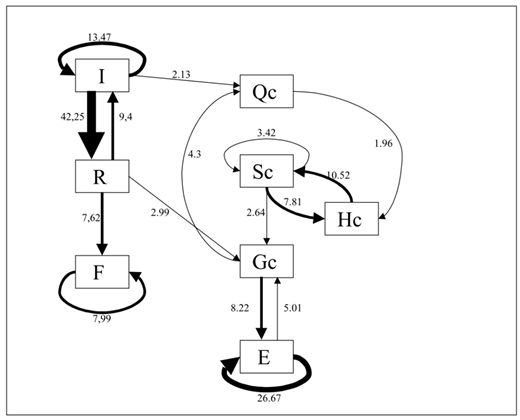
Both sequences, tutorial (IRCE) and collaborative (ICE), may share the IRF sequence, when the simplicity of the proposed activity (I) generates a response (R) from the tutee that is sufficiently complete to be assessed in the form of feedback (F) by the tutor.
Discussion and Conclusions
The statistically significant difference in the test and retest application of the language skill test is of great interest since it stresses the instructional potential of peer tutoring in Catalan. However, this was not the main focus of this study. The sample was relatively small and control groups were not used to control the experimental study. The main purpose of the study was to explore the patterns of interaction during peer tutoring and the discussion will place greater emphasis on this aspect of the dataset.
With respect to what we have called the first level of analysis, that referring to the segments of the interactivity of the pairs during the task of text production, the overdominance of draft editing can be explained by its accumulating effect during each stage of the tutoring process. If the model used for paired writing had not suggested ending with the production of a best copy, the segments of interactivity would probably have been basically organized into three blocks: generation of ideas, editing of the draft and evaluation. This structure is very similar to that of the planning, text production and checking phases of the model proposed by Flower and Hayes (1981). Students’ increased familiarization with word processors probably also favoured the centrality of draft editing, by facilitating editing as part of the final production process and by making it unnecessary to “write it out neatly” or produce a best copy at the end of the interaction.
It was previously reported that manufacture of a product favors the emergence of cognitive operations and, therefore, the specific experience of using language as an object of reflection. The high number of dialogue sequences within the ideas generation segment corroborates this notion. According to studies deriving from the models of Scardamalia and Bereiter (1992), the emergence of planning, as an activity separated from production or editing, constituted the most important moment in the development of writing skills. It is this process that made it possible to pass from the model of “stating knowledge” (following the models of oral discourse) to the model of “transforming knowledge.” Use of peer tutoring in the classroom enabled either the tutor, or if required, the teacher to give immediate assistance to the student or pair requesting it. The difficult task of giving attention to all students individually requiring it, is one of the greatest challenges facing teachers in classroom management. During peer tutoring the reduction in management time (with each student aware of the work process and the responsibilities that accompany their role), the high level of effective work time (dedicated to achieving the specific academic objective in question) and the high percentage of success and feedback (because of permanent monitoring by the tutor student) leads to a high rate of academic learning time (Greenwood, Carta, & Kamps, 1990). The fear that may accompany teachers who give control to the class during peer tutoring may be somewhat abated by the fact that very few interactions were observed indicating that pupils were working outside the task when using cooperative learning methods.
With respect to the second level of analysis, that of the messages, the results show that the peer tutoring analyzed is based on a cooperative-type of interactivity (80.1% of the messages emitted). Peer tutoring is therefore a method of cooperative learning. In addition, taken as a whole, there is a predominance of interactions defined as collaborative cooperation. If we observe the students according to the role that they adopt within the pair, we see that tutors and tutees show an uneven predominance in the observed configurations. This suggested two different patterns according to the role: the tutor’s active pattern (with a predominance of initiation, feedback and tutorial cooperation messages) and the tutee’s reactive pattern (with a predominance of response and collaborative cooperation). The three types of sequences identified in the tutorial situations analyzed (collaborative sequence or ICE, tutorial sequence or IRCE and the prototypical sequence IRF), lead us to emphasize the central core of peer tutoring articulated within cooperation, with its different forms, ranging from the most collaborative (asking for assistance and the joint construction of knowledge) to the most tutorial (offering assistance, using hints or guiding the teaching and learning processes). The different types of behaviors taking place within the core of cooperation, in the first two sequences, substitute for tutor feedback (in the tutorial sequence) or tutee response and tutor feedback (in the case of collaborative sequence).
Certainly, the thought-provoking nature of behavior sequences observed in this study may offer us a better explanation for how peer tutoring can promote the learning processes in schools. The study could have implications for schools in respect of how they structure and manage peer tutoring when undertaking writing. There is now a need to test the theoretical model of interaction developed in this study with a larger sample. Future work may gather a grater quantity of quantitative data and explore the interaction processes to see which of the behaviors identified are responsible for transforming and regulating cognitive growth.

