This study examines how an integrated film-and-facilitation program shapes observational learning and self-efficacy among women in a subsistence marketplace, where conventional entrepreneurship education is poorly suited and in-person role models are scarce.
The study centers on Shakti Rising, a film designed for women in subsistence settings, featuring a culturally proximate female protagonist who serves as a symbolic role model through her entrepreneurial journey. Drawing on social cognitive theory of mass communication as a sensitizing lens, this study analyzes interviews with twenty-nine women in Tamil Nadu, India, who completed a three-day film-and-facilitation program.
Three themes emerged. Participants reported alignment with the symbolic role model through homophily, aspirational fit, and affective engagement. They reported observational learning, drawing lessons from the protagonist and adapting them to their own circumstances. They also reported shifts in entrepreneurial and general self-efficacy beliefs.
The study contributes to film-based entrepreneurship education research by showing how contextualized symbolic modeling operates in low-literacy, resource-constrained settings. It contributes to subsistence marketplace research by showing how the program cultivates women's marketplace literacy, agency, and self-efficacy beliefs while engaging the consumer-entrepreneur duality. It also contributes to social cognitive theory of mass communication by suggesting that the socially mediated pathway of symbolic modeling operates as an essential route in resource-constrained settings where in-person role models are scarce.
Introduction
A woman in Tamil Nadu, India, is in tears as she watches a film in which the female protagonist navigates poverty, an unsupportive household, and psychosocial impediments, and ultimately exerts agency through entrepreneurial action. When asked to describe what prompted her emotional response, the woman exclaims, “I felt like crying seeing her in so much trouble. In fact, I am able to see myself in that movie” [1]. Her response captures the lived experience of women in subsistence marketplaces, where the ability to meet basic needs is chronically constrained (Viswanathan and Rosa, 2007). Women in these settings face compounded challenges, including low literacy, restricted mobility, low self-efficacy, and gender norms that discourage employment beyond the household (Chatterjee et al., 2022; Kaur, 2017; McKelway, 2025). These same constraints also limit their access to and benefit from conventional, classroom-based entrepreneurship education programs, which often presume formal literacy and unrestricted mobility (Kaur, 2017; Viswanathan et al., 2008). Such programs also tend to emphasize technical skills while overlooking the psychosocial aspects, such as self-efficacy and growth mindset, that are central to whether individuals in subsistence settings can translate training into action (Morris et al., 2023).
Recent scholarship has expanded attention to entrepreneurs long underrepresented in mainstream research (Ahlstrom and Lee, 2024; Javadian et al., 2023). In subsistence marketplaces and similarly underserved contexts, scholars have called for “novel approaches to training” (potential) entrepreneurs (Sutter et al., 2019, p. 208) and context-specific entrepreneurship education that departs from approaches designed for affluent contexts (Zollet et al., 2024). Within entrepreneurship education research, prior work has framed film as an experiential pedagogical approach (Liguori et al., 2020) and observed the value of relatable protagonists for the audiences they depict (Dalton and Logan, 2020). What remains underexplored is how such pedagogies translate to impoverished settings where infrastructure is limited, conventional classroom delivery is poorly suited, literacy and formal education are low, and in-person role models (proximal exemplars) are scarce. Accordingly, we examine a context-specific film-and-facilitation program, specifically designed for women in a subsistence marketplace, where mediated protagonists may serve as one of the very few available sources of vicarious learning and self-efficacy. To examine whether and how these processes unfold, we draw on social cognitive theory (SCT) (Bandura, 1986), and particularly the social cognitive theory of mass communication (Bandura, 2001). We use SCT as a sensitizing analytical lens (Bowen, 2006), guiding interpretation of qualitative findings rather than testing the theory empirically.
The research context for our study is a film-and-facilitation program delivered to twenty-nine women in Tamil Nadu, India. The program ran over three days and centered on the film Shakti Rising, supplemented by fourteen video-based educational modules. The film served as the inaugural component, and its scenes were revisited for facilitated discussion across the subsequent modules. The film follows Sundari, a wife and mother in rural India who navigates poverty, an unsupportive household, and limited formal education. Determined to change her circumstances, she engages in entrepreneurial pursuits, learns through both successes and failures, and eventually starts a small business. Her character arc inspires other women in her community. Sundari's story is grounded in the lives of real women in this setting, and her cultural proximity to the audience was a deliberate design feature of the program. The program's primary educational objective was to support women's marketplace literacy and self-efficacy through vicarious engagement with this culturally proximate protagonist alongside guided facilitation. Drawing on SCT, we use the term “symbolic role model” to denote a mediated exemplar who embodies a socially valued role, here entrepreneurship, encountered through narrative and imagery rather than through direct interaction (Bandura, 2001). We analyze in-depth interviews with all twenty-nine participants who completed the program and volunteered to be part of our research.
Using SCT as a sensitizing analytical lens (Bowen, 2006), we identified three themes in our analysis. First, participants reported alignment with Sundari through homophily, aspirational fit, and affective engagement, accepting her as a symbolic role model whose experiences resonated with their own. Second, participants reported observational learning by drawing lessons from Sundari and adapting them to their own circumstances. Third, participants reported shifts in entrepreneurial and general self-efficacy beliefs, often through an “if she can do it, I can do it too” mindset, alongside broader gains in confidence to navigate household and community challenges. Some participants also noted limits to how directly they could apply Sundari's experience to their own lives.
Our study makes three primary contributions. First, we contribute to film-based entrepreneurship education research (Dalton and Logan, 2020; Liguori et al., 2020) by extending it to subsistence settings, showing how contextualized symbolic modeling operates in low-literacy, resource-constrained environments and may serve other underserved populations facing similar constraints. Second, we contribute to research on subsistence marketplaces (Chang and Xu, 2023; Venugopal and Viswanathan, 2021; Viswanathan et al., 2008) by showing how a film-and-facilitation program can cultivate women's marketplace literacy, agency, and self-efficacy beliefs while recognizing the consumer-entrepreneur duality (Viswanathan and Rosa, 2007) present in these settings. Third, we contribute to SCT, particularly the social cognitive theory of mass communication (Bandura, 2001), by suggesting that the socially mediated pathway of symbolic modeling operates as an essential route in resource-constrained settings where in-person role models are scarce. Our findings suggest that this pathway is particularly salient when the symbolic role model is culturally proximate to participants and when facilitation reinforces what the protagonist demonstrates.
The remainder of the paper is organized as follows. The next section reviews relevant literature on social cognitive theory, self-efficacy, and entrepreneurship in subsistence marketplaces. We then describe the research context, the film, the sample, and the data analysis. We present our findings and discuss the research's contributions. We close with boundary conditions, limitations, and directions for future research.
Literature review
Social cognitive theory (SCT)
SCT provides a framework for understanding humans' psychosocial functioning (Bandura, 1986, 2023). Bandura proposes a triadic reciprocal causation model in which intrapersonal factors (e.g. cognitive, motivational, affective, and biological aspects), environmental factors (e.g. the context in which an individual operates), and behavioral factors (e.g. the individual's actions) all influence one another (Bandura, 1986). Within entrepreneurship scholarship, SCT constructs, particularly observational learning and self-efficacy, have been applied to study how entrepreneurial intentions and learning outcomes develop across contexts (Biraglia and Kadile, 2017; Gedeon and Valliere, 2018; Lin et al., 2022), including among women entrepreneurs in resource-constrained settings (Chatterjee et al., 2022; McKelway, 2025). Central to SCT is the distinction between enactive learning, acquired through one's own experiences and actions and their consequences, and vicarious or observational learning, acquired by observing others (Bandura, 1986). Observational learning is especially consequential when opportunities for learning from direct experience are limited, and hence, learning by observing role models or exemplars is a key tenet of SCT (Bandura, 1986). Moreover, observational learning extends beyond direct interpersonal observation to “symbolic modeling”, i.e. learning from models through mediated narrative and imagery (Bandura, 2001). Symbolic models can be presented through various media formats, including film (the focus of this study), radio (Rogers et al., 1999), theater or drama (Colby and Haldeman, 2007), storytelling (Nagarkar et al., 2026), and contemporary mobile-first digital formats (Whittaker et al., 2011).
SCT of mass communication posits that symbolic models may influence people through two pathways: a direct pathway, in which mediated content (directly) shapes the individual viewer (by informing, guiding, motivating, etc.), and a socially mediated pathway, in which media content shapes a social system or group that, in turn, shapes the individual (Bandura, 2001). The socially mediated pathway is especially relevant to community-based pedagogical interventions such as our integrated film-and-facilitation program, in which communal viewing forms part of a broader facilitation process. Observational learning operates through four subprocesses, namely, “attention” to the model's behavior, “retention” of what is observed, “reproduction” of the behavior in one's own actions, and “motivation” to enact what has been learned (Bandura, 1986). Two features of symbolic models are known to strengthen their intended impact. First, perceived or objective similarity between observer and model heightens identification and amplifies self-efficacy beliefs (Bandura, 2004). Second, transitional models, i.e. models that overcome substantial adversity through sustained effort, tend to sustain audience attention and emotional engagement (Bandura, 2004).
Building on the concept of symbolic modeling (Bandura, 2001, 2004), we use the term “symbolic role model” to specify the role-based nature of the mediated exemplar central to our study. By “symbolic role model,” we refer to a mediated exemplar who embodies a socially valued role, here entrepreneurship, encountered through narrative and imagery rather than through direct interaction. Succinctly put, the symbolic role model is a special instance of the broader symbolic model concept.
Consistent with our qualitative design (described later), we employ SCT as a sensitizing analytical framework (Bowen, 2006) for interpreting themes that emerged from inductive coding of participant interviews, rather than as a theory to be subjected to empirical testing. It is important to note that other prominent theoretical frameworks offer adjacent accounts of how individuals engage with mediated characters. As an example, narrative transportation theory (Green and Brock, 2000) describes the cognitive and emotional absorption into a fictionalized narrative that can shift attitudes and beliefs. Similarly, theory on identification with media characters (Cohen, 2001) describes the process by which audience members identify with and adopt the cognitive and emotional perspectives of fictionalized characters. These frameworks share theoretical ground with SCT's account of symbolic modeling, but they address different outcomes. Narrative transportation theory focuses on audience absorption into a story, while identification theory focuses on audience adoption of a character's perspective. Because our research question centers on learning and self-efficacy outcomes in entrepreneurship education, SCT provides the closest conceptual fit as a sensitizing analytical framework.
Self-efficacy
Self-efficacy is defined as “people's judgments of their capabilities to organize and execute courses of action required to attain designated types of performances” (Bandura, 1986, p. 391). Self-efficacy beliefs shape the environments people select, the goals they pursue, and the effort, persistence, and affective states they bring to tasks (Bandura, 1997). They are malleable (or non-static) and develop from four principal sources, namely, mastery experiences (successfully performing challenging tasks), vicarious experiences (observing similar others succeed or fail), verbal persuasion (credible encouragement or feedback), and physiological and affective states (bodily and emotional cues interpreted as capability signals) (Bandura, 1997). Among these, vicarious experience is the primary mechanism by which symbolic role models shape self-efficacy beliefs, particularly when the observer perceives similarity to the model (Bandura, 1997, 2004).
Self-efficacy beliefs vary in their specificity. The broader conception, termed general self-efficacy (GSE), refers to confidence in one's general capacity to cope with a wide range of demands and life circumstances (Schwarzer and Jerusalem, 1995). Self-efficacy can also be domain-specific. As an example, entrepreneurial self-efficacy (ESE) refers to the belief in one's capability to successfully perform tasks associated with entrepreneurial action, like discovering or creating new opportunities (Chen et al., 1998). ESE is associated with entrepreneurial intention and action across diverse settings (Zhao et al., 2005; Newman et al., 2019). Importantly, both GSE and ESE are pertinent to subsistence marketplaces, where women consistently report lower self-efficacy than men and where proximate role models are scarce (Kaur, 2017; Chatterjee et al., 2022).
Entrepreneurship in subsistence marketplaces
Subsistence marketplaces are contexts in which people's ability to meet basic needs is chronically under threat, and in which people routinely function as both consumers and small-scale entrepreneurs (Viswanathan and Rosa, 2007). This dual role, known as the “consumer-entrepreneur duality,” is a distinguishing feature of entrepreneurship in these settings. Exchange in these marketplaces is predominantly one-on-one (face-to-face) and network-embedded, with buyer-seller interactions occurring through repeated, personal transactions rather than impersonal market exchanges (Viswanathan et al., 2010b). The entrepreneur is deeply embedded in the community, sharing consumers' struggles and uncertainties and being a consumer themselves. This unique position allows them to better understand customer needs and generate value more effectively than external organizations or entrepreneurs (Viswanathan et al., 2014). Given the low psychological and social distance between the entrepreneur and the patron, there is a conscious investment in long-term relationships and an inclination to view the world from others′ standpoint (Viswanathan et al., 2012). These marketplaces are further characterized by low literacy, which shapes how information is acquired and used. Individuals in these settings often rely on concrete and pictorial thinking rather than on abstract or text-based forms (Viswanathan et al., 2005).
Women entrepreneurs in subsistence settings operate within strongly patriarchal social institutions that constrain their engagement with the marketplace. The prevailing expectation is that women's place is within the home as homemakers rather than in the market as entrepreneurs, and these norms are often both internalized and externally enforced by family and community (Venugopal and Viswanathan, 2021). Low literacy, limited formal education, and restricted mobility compound these constraints, reducing women's ability to participate in educational and training programs, especially when these opportunities are available far away from home (Kaur, 2017). Formalized institutional practices, including those of microfinance institutions, add layers of cognitive, emotional, and behavioral barriers, which further deter engagement in entrepreneurial activities (Mair and Marti, 2009). Although home-based ventures offer a partial workaround, these opportunities are curtailed in the event of possible spillover to domestic responsibilities or deviation from traditional roles (Al-Dajani and Marlow, 2010).
Additionally, women in subsistence marketplaces confront psychological constraints. They report low self-efficacy beliefs and a relative scarcity of proximate role models, which further impede the prospect of engaging in observational learning and strengthening self-efficacy through vicarious experiences (Chatterjee et al., 2022). These psychological and structural constraints reinforce one another, creating a compounded barrier that makes entrepreneurship appear inaccessible or unrealistic. Experimental evidence from rural India shows that targeted interventions can raise women's general self-efficacy and subsequently shift employment outcomes (McKelway, 2025). Capability-building approaches that are context-tuned and complement rather than substitute for local institutions such as self-help groups (Viswanathan et al., 2008, 2012; Venugopal and Viswanathan, 2017) can help women navigate this compounded barrier. Such approaches cultivate psychological capabilities, notably self-efficacy and a sense of agency, alongside informational capabilities such as marketplace literacy. Critical perspectives caution that entrepreneurship is not an automatic pathway out of poverty, particularly in contexts with weak institutional support, where entrepreneurial engagement can generate financial risk without commensurate benefit (Bruton et al., 2013; Sutter et al., 2019). Viewing capability development solely as a route to entrepreneurial activities is therefore too narrow, since these capabilities also carry empowerment benefits that extend beyond entrepreneurship.
Methodology
Research context
Our research was conducted in Tamil Nadu, a southern Indian state with a vibrant tradition of subsistence entrepreneurship (Viswanathan et al., 2010a, 2012; Venugopal and Viswanathan, 2021). Although Tamil Nadu is among India's more economically advanced states, it also harbors substantial pockets of impoverishment, where access to basic services such as drinking water within the home and reliable electricity remains limited (Venugopal and Viswanathan, 2021). Women's literacy in Tamil Nadu, while above the national average, drops sharply in rural areas (Census of India, 2011), and gendered norms often discourage women from pursuing employment opportunities (Venugopal and Viswanathan, 2021).
Historically, cinema has significantly influenced culture in Tamil Nadu (Velayutham, 2008). This cultural standing informed the choice of film as the narrative anchor of the educational program we examine. The film-and-facilitation program emerged from a partnership between two organizations committed to supporting women in subsistence settings, namely, a non-governmental organization (NGO) focused on knowledge, skills, and literacy, and a microfinance institution that provides loans to women in these regions. The role of NGOs in delivering entrepreneurship education and training to women in subsistence settings is well documented (Karlan and Valdivia, 2011; Chatterjee et al., 2022). One of the authors was closely involved in the program's development. To preserve scientific distance, this author did not participate in the interviews or in the data analysis.
The film
The film Shakti Rising presents Sundari, a wife and mother of two living in rural India. Like many women in her community, Sundari faces unemployment, limited formal education, and a lack of support from her family. To overcome her socioeconomic constraints, she decides to start small business selling bags and purses. She quickly encounters obstacles, including competition from urban market sellers, the need to maintain product quality, and the absence of public transportation, which forces her to sell at reduced margins to an exploitative local shopkeeper. Despite nearing a breaking point, Sundari persists. By the end of the film, she had built her business, brought public transportation to the community, created employment for other women, earned recognition from her family and community, and emerged as a leader. Although Sundari is a fictional character in the film, her narrative is grounded in reality.
The film's director, Aditi, described Sundari as “an amalgamation of the characters and stories I have actually seen in the village … representing their angst and their issues, the problems that they have been facing emotionally, psychologically, socially, and economically.” Table 1 list parallels between Sundari's challenges and those documented among women in subsistence settings in Tamil Nadu, including the women in our study. These parallels span emotional, cognitive, social, and economic dimensions. The cultural proximity of the protagonist was a deliberate design feature of the program. Building on social cognitive theory, we treat Sundari as a symbolic role model whose mediated portrayal anchors the program. The program's primary educational objective is to support women's marketplace literacy and self-efficacy through vicarious engagement with this model alongside guided facilitation.
Sample
In 2014, we interviewed 29 women in Chennai, Tamil Nadu, after they participated in the NGO's film-and-facilitation program. The program ran over three days and included the film and fourteen video-based modules, with approximately 25 women per cohort learning from a teacher on the screen and an in-person facilitator. The program began with a viewing of Shakti Rising, and scenes from the film were subsequently revisited to stimulate discussion across the modules. Participants were recruited through an open invitation announced after each day's sessions, with no handpicking by the NGO or the authors. Inclusion required only that participants were enrolled in the program during the fieldwork window. We did not exclude participants based on current employment, business experience, education, or prior exposure to video-based learning. Participants ranged in age from 24 to 54 years and in education from no formal schooling to a college degree. Several were unemployed, while others operated micro-businesses selling items such as snacks, fruit, milk, clothes, and jewelry. Interviews focused on how participants perceived Sundari's challenges and how her experience related to their own lives. They were conducted in Tamil with the assistance of translators and ranged from 30 to 75 min. The on-site author, who does not speak Tamil, did not conduct interviews.
At the start of each interview, participants were asked for a brief background profile covering age, marital status, number of children, highest level of education, and business status. Responses were voluntary, with non-responses recorded as missing (and left blank). Participant background information is summarized in Table 2. We also interviewed the film's director to understand the character development process. All interviews were tape-recorded, transcribed, and translated literally from Tamil into English (e.g. Temple and Young, 2004). We supplemented these interviews with field observations and independent film analysis.
Two methodological considerations warrant brief acknowledgment. First, because participation was voluntary and contingent on post-session availability, self-selection toward more engaged participants is possible. Second, data were collected in 2014, and aspects of media access have evolved since. We discuss both considerations and the boundaries of our claims in the Limitations section.
Data analysis
Data analysis was carried out in four steps. First, we coded interview transcripts to identify salient themes and compared these themes to established constructs in the literature (Miles and Huberman, 1994). We focused on two themes, namely Sundari's role as a symbolic role model and her influence on participants' motivation, learning, and self-efficacy. Drawing on social cognitive theory (Bandura, 2001) as a sensitizing analytical framework (Bowen, 2006), we identified observational learning when a participant's response was explicitly linked to the film or to Sundari and reflected at least one of the four subprocesses of attention (noticing specific scenes or behaviors), retention (articulating what was learned), reproduction (capability to enact what was learned), or motivation (intention or willingness to enact what was learned). For self-efficacy, we distinguished entrepreneurial self-efficacy (ESE), when confidence was tied to specific entrepreneurial tasks such as comparing prices or negotiating with suppliers, from general self-efficacy (GSE), when confidence was tied to broader life circumstances such as persuading family members. Second, we analyzed the film itself following Mikos (2014), examining how the protagonist's behavior, the structural barriers she confronted, and the surrounding sociocultural context were portrayed. Third, we compared the protagonist's experience with the participants' experiences and triangulated themes from the film with themes from the interviews (Denzin, 2012). Fourth, one of the authors conducted member checks with the NGO staff and the film's director to validate interpretations.
One of the authors, who is not the first author, coded all the translated transcripts using a shared codebook. A trained undergraduate student independently coded six of the twenty-nine transcripts (approximately twenty percent) to establish intercoder reliability. Cohen's kappa exceeded 0.70 on this subset, consistent with standard practice in qualitative research (MacPhail et al., 2016), and disagreements were resolved through discussion. To preserve scientific distance, the co-author closely involved in the program's development did not conduct interviews, code, or analyze data. The first author had no involvement with the NGO, the film, or the field site. The on-site author observed sessions, coordinated logistics, and consulted the filmmaker on key scenes to clarify their intended meaning. This consultation informed our understanding of the film itself, but did not inform the coding of participant interviews.
Findings
Drawing on social cognitive theory as a sensitizing analytical framework, we present findings from our analysis of participant interviews. The film was one component of an integrated film-and-facilitation program, and our qualitative design does not isolate the film's effects from those of the broader program. References to the film in what follows should therefore be read as shorthand for the integrated program. We organize our findings around three themes as follows.
Alignment with symbolic role model
Three forms of alignment with Sundari emerged from participant interviews, namely homophily, aspirational fit, and affective engagement. Many participants described Sundari and her circumstances as similar to their own. Ameena, who now owns a food business, remarked, “[my] husband is not drinking but all the pains are the same in my life. I was facing money problems and it's [the] same as that character. Like Sundari only I was facing difficulty.” Devi, who sells sarees, said, “She [Sundari] struggled and she comes up in her life. Slowly she grows in her life; even we too have struggled like that. I too think the same. I am doing something right now, and slowly, step by step, I should improve.” This sense of similarity is captured in one participant's exclamation, “it is as if our [lives] have been picturized!” As evidenced in Table 3, there is a high level of homophily with Sundari across the sample.
Participants also described aspirational alignment with Sundari, who in addition to generating income, seeks to educate her children, support her community, and overcome the constraints of her circumstances. Indira, who is unemployed, articulated her own aspirations as follows:
I don’t want to expect everything from my husband. I want to start something on my own and earn income for the family … I want to help even more people in my street. I don’t want women to be like this. I want all of them to be independent; you have children, open a self-business and you do it very well. Even if you are unable to give assets to the children, give them good education.
The aspirations of participants expressed at the end of the program closely mirrored those portrayed by Sundari, namely independence from spousal dependence, an economically viable livelihood, children's education, and uplifting other women.
Affective engagement with Sundari was also evident. One of the authors observed women crying during scenes in which Sundari's husband and moneylenders discouraged her, and when Sundari struggled to provide for her children's education. Janaki, for instance, conveyed, “they [the NGO staff] tell us things that are useful for our life. There was a scene [in the movie] where I was crying for some time.” Janaki was referring to a scene in which Sundari considered withdrawing her daughter from school, which prompted Janaki to reflect on her own struggles. Beyond emotional resonance, participants admired Sundari's perseverance. Farah, who runs a milk business, said:
Yes, she [Sundari] faced lots of problems with her husband. In spite of all that, she got the materials for her business. Also, she got her husband back realizing his mistake. So, she fought continuously. She had perseverance. I admired that.
This admiration extended to Sundari's broader role as an exemplar for both current and aspiring entrepreneurs. Vanita, who helped start a self-help group in her community, said, “first she [Sundari] is a role model for those doing business and then for those who are going to do business. She is struggling a lot and like her we should also do something.” Across these forms of alignment, participants accepted Sundari as a symbolic role model and reported a willingness to learn from her.
Reported observational learning
Building on participants' alignment with Sundari, several have reported observational learning. Some identified gaps in their own practices after observing her. Deepa, for instance, exclaimed, “That character was selling things outside her circle. I felt I should have done that. I kept selling inside my apartment itself, so I felt even I should have gone out to sell my clothes.” Selling beyond one's immediate community emerged as a behavioral rule Deepa retained, with motivation to act on it. Farah, who runs a milk business, drew on Sundari's market research practices:
She did not buy her products from only one place. Rather, she went and studied the market … Even I thought I will do the same now as I never did this in my business.
Participants who did not yet operate a business often learned by mimicking Sundari's reasoning. Binita, for example, said:
But now like Sundari, I am also thinking about what business to do. So only I selected [a] fancy store, which I know well … As there is no bag in Sundari’s town, she decided to sell bags. As there is not much fancy store in our town, I [can] open a fancy store.
Binita transposed Sundari's logic of identifying unmet local needs into her own setting. Subsequent video modules revisited film scenes, reinforcing what participants drew from Sundari. Mona reflected:
The first day when we saw Sundari we did not understand anything but the next day we thought that why cannot we be like Sundari. Like her we can do business and why cannot we help others like her … And the second day after seeing the training, we felt that Sundari was a lady and we thought like her why cannot we do things.
Radhika offered a parallel account of what women learned from the training program:
When we saw it [the movie] we just saw it like a story. And the next day when they asked questions about the [value] chain and we understood what they were trying to tell us. I did not know about the value chain and we can do business only when we have transport. And those things were taught. And we can give notice and then only our business would grow.
These accounts illustrate two complementary pathways through which symbolic modeling shaped learning, namely direct engagement with the film and socially mediated reinforcement during group discussion (Bandura, 2001). Some participants also identified boundaries to what could be transferred from Sundari's experience. Sara, for instance, observed:
She [Sundari] went to the shop and showed her bag and asked for the [store’s] bag and they showed her the bag. But now when we go and ask them in the cloth shop they would not show the bags to us. They would not even give sample bags. She took the saree and made bags and sold it. Here they would find out that its old saree.
Hyper-local norms not fully captured by the film's optimistic narrative led some participants to adapt modeled practices rather than replicate them. Across the sample, learning claims took different forms for the two groups, with women already operating micro-businesses identifying refinements such as multi-sourcing and price comparison, while those without businesses described emerging plans grounded in Sundari's reasoning about local needs.
Reported self-efficacy
Participants reported greater confidence after observing Sundari, both for specific entrepreneurial tasks and for broader life circumstances. Several women articulated an “if she can do it, I can do it too” mindset, suggesting that vicarious engagement with a culturally similar entrepreneur shifted what they believed they could undertake (entrepreneurial self-efficacy). This shift was particularly pronounced for participants who, like Sundari, possessed minimal initial resources and limited business experience.
Beyond entrepreneurial tasks, participants also reported broader confidence in navigating household and community challenges (general self-efficacy). Speaking about the social benefit of entrepreneurship for women, Savita, who does tailoring and embroidery, remarked, “she [Sundari] is stitching small bags and comes up in life and like that, rather than sitting idle at home, we can do some business and should come up.” Another participant put the connection between business and broader life more pointedly, “business includes life also. And when we do business, that's for life.” Watching Sundari navigate both business and everyday circumstances was described as evoking a generalized sense of capability.
Some participants reported general self-efficacy gains even when entrepreneurship itself was not feasible for them. Krishna, who lives with a physical disability, conveyed, “I want to do business like Sundari, but my body condition is not allowing me to do so.” Krishna nonetheless reported drawing strength from Sundari's persistence, stating that women “should have the confidence that we can win, then we can achieve things in life.” This response reflects what Chaturvedi et al. (2009) describe as negotiable fate beliefs, an acknowledgment of constraint coupled with optimism about collective empowerment. Participants also described improvements in consumer literacy, including the capacity to weigh quality against cost when purchasing goods, which can serve them in everyday transactions and in dealings with local vendors and lenders.
Note on social desirability bias
Social desirability bias is a possible alternative explanation for participants' positive accounts. The methodological safeguards described earlier, including interviews in Tamil, assured anonymity, literal translation, triangulation, member checks, and the on-site author's non-involvement in interviewing, were intended to reduce this risk. Several disconfirming accounts also make a pure social-desirability explanation less plausible. For instance, Mona reported initial confusion before the modules clarified the film's content, Sara identified hyper-local constraints that the film's narrative did not capture, Krishna stated she could not start a business given her health, and Farah described specific tactical learnings such as multi-sourcing and price comparison. Future studies may consider an end-of-interview check that explicitly queries potential social desirability pressures.
Discussion
Women residing in subsistence settings face compounded challenges, including low literacy, restricted mobility, low self-efficacy, and gender norms that discourage employment beyond the household (Chatterjee et al., 2022; Kaur, 2017; McKelway, 2025). Scholars have called for “novel approaches to training” (potential) entrepreneurs (Sutter et al., 2019, p. 208) in subsistence settings. In this paper, we respond to this call by documenting how an integrated film-and-facilitation program operated for women in a subsistence marketplace in Tamil Nadu, India. Drawing on social cognitive theory as a sensitizing analytical framework, we find that participants reported alignment with a culturally proximate symbolic role model, observational learning of marketplace practices, and shifts in entrepreneurial and general self-efficacy. The program's primary educational objective, namely supporting women's marketplace literacy and self-efficacy through vicarious engagement with the symbolic role model alongside guided facilitation, finds qualitative support in our analysis.
Two cautions bound how we read these findings. First, as noted at the outset of our findings, our claims reflect the integrated film-and-facilitation program rather than the film alone. Second, consistent with critical perspectives on entrepreneurship in subsistence settings (Bruton et al., 2013; Sutter et al., 2019), the program is not a universal remedy for the economic and social challenges women face. Krishna's case illustrates this clearly. Although she stated that her health prevented her from starting a business, she described gains in confidence and resolve. We position the program as capability building within an existing local support system rather than as a stand-alone intervention. The partner organizations embedded in the community made the sessions possible, and their facilitation shaped how participants engaged with the film.
We make three primary contributions to this research. First, we contribute to film-based entrepreneurship education research by extending it to subsistence settings and showing how contextualized symbolic modeling can operate in low-literacy, resource-constrained settings. Building on prior work that frames films as an experiential pedagogical approach (Liguori et al., 2020) and observes the value of relatable protagonists for the audiences they depict (Dalton and Logan, 2020), we show that the protagonist's cultural proximity to the audience (Table 1) heightens these effects. In our setting, the film likely catalyzed attention and identification with Sundari, while retention, reproduction, and motivation appear co-produced by the film, the facilitated modules, and peer discussion. Facilitation also appeared to calibrate participants' entrepreneurial and general self-efficacy toward realistic, context-appropriate intentions and actions. Moreover, curated scenes depicting real frictions encountered by women in subsistence marketplaces made abstract ideas legible. Our findings suggest that culturally proximate symbolic role models, delivered through facilitated programs, may serve as an accessible pedagogical resource for other underserved populations facing similar constraints, including those in impoverished pockets of developed economies (Hümbelin et al., 2022), first-generation college students (Gibbons and Borders, 2010), migrants and refugees (Yakushko et al., 2008), and historically underrepresented groups (Gladstone and Cimpian, 2021).
Second, we contribute to research on subsistence marketplaces (Viswanathan et al., 2008; Venugopal and Viswanathan, 2021; Chang and Xu, 2023). Women in these contexts face compounded barriers, including low literacy, restricted mobility, scarce role models, and gender norms that discourage market participation, which conventional entrepreneurship education programs are poorly suited to address (Chatterjee et al., 2022; Kaur, 2017). Programs that pair culturally proximate symbolic role models with facilitated discussion in trusted local settings can cultivate women's marketplace literacy, agency, and self-efficacy beliefs. Such programs also recognize the consumer-entrepreneur duality (Viswanathan and Rosa, 2007) present in these settings, and help build knowledge and confidence from both consumer and entrepreneur perspectives.
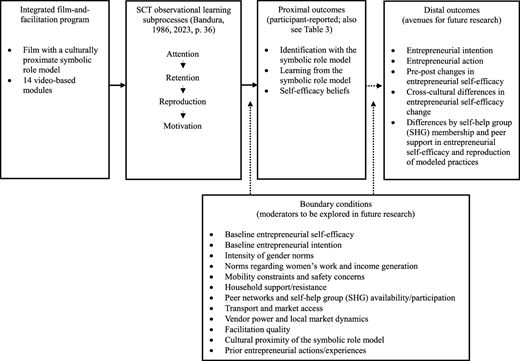
Third, we contribute to the SCT literature, specifically SCT of mass communication (Bandura, 2001), by extending it to subsistence marketplaces. Our findings suggest that in resource-constrained settings where in-person role models are scarce, the socially mediated pathway of symbolic modeling operates as an essential route alongside the direct pathway, rather than as a supplementary one. Cultural proximity of the symbolic model amplifies this effect, while facilitation provides the social mediation through which observational learning is consolidated into reported intentions and actions. Similar patterns appear in other SCT-based media interventions. An entertainment-education film intervention in India increased health knowledge but did not produce observed behavior change (Carpena, 2024), and a mobile entertainment-education intervention in rural India found that interpersonal communication among listeners was the mechanism that drove gains in bystander self-efficacy (Pant et al., 2023). Our findings extend SCT's applicability to subsistence marketplaces, joining a broader body of evidence that the framework operates across diverse social, cultural, and economic contexts. Future longitudinal work could examine whether the gains in observational learning and self-efficacy reported here translate into sustained entrepreneurial intention and action over time. Figure 1 summarizes how the integrated film-and-facilitation program aligns with SCT and participant-reported outcomes. It also conveys avenues for future research by depicting distal outcomes and boundary conditions.
We now turn to the boundary conditions, which clarify the contexts under which our findings might hold and those under which they may not. First, contextual conditions at the household, community, and marketplace levels shape what the program can achieve. Local gender norms and mobility constraints influence both participation in the program and the strength of attention, identification, and motivation. Household support shapes motivation and the reproduction of modeled practices, while peer networks and self-help groups provide social reinforcement that supports retention and the reproduction of these practices. The power held by local vendors and local market dynamics can impede entrepreneurial intention and action even when identification (with the symbolic role model), learning, and self-efficacy beliefs are supported. Second, program design conditions shape the strength of observational learning. The quality of facilitation and the cultural proximity of the symbolic model support attention and retention, and weaker facilitation or less proximate models would likely attenuate these effects. Third, participant baseline conditions may moderate the program's effects. Prior mastery experiences can amplify or temper changes in entrepreneurial and general self-efficacy beliefs. Baseline entrepreneurial intention and self-efficacy may further moderate outcomes, consistent with evidence that personal characteristics moderate the entrepreneurship-education-to-intent relationship (Burch et al., 2022). Participants with lower baselines may primarily experience the program as an engaging narrative, while those with higher baselines may be more likely to translate identification with the symbolic model into entrepreneurial action. Each of these conditions also represents a potential moderator (see Figure 1). Future research with quantitative or mixed-method designs could examine how these moderators shape the proximal and distal outcomes of film-and-facilitation programs such as the one studied here.
We now underscore the study's limitations. First, our findings are based on 29 in-depth interviews and are therefore interpretive rather than statistically generalizable. The participants come from a single subsistence setting in Tamil Nadu, India, and may not capture the full demographic heterogeneity of women in subsistence marketplaces more broadly. The transferability of our claims depends on the boundary conditions discussed earlier. Second, our qualitative approach did not include baseline measurements of self-efficacy or entrepreneurial intention, which limits attribution and precludes assessment of pre- and post-program change. Third, interviews were conducted in Tamil and translated into English. Although translation was literal and triangulated with field observations and film analysis, some culturally embedded nuance may be lost (Temple and Young, 2004). We therefore treat translated quotations as approximations of participants' intended meanings. Fourth, our data collection took place in 2014, and access to media has evolved substantially since then, with notable growth in smartphone penetration and social media use across India. This raises the question of contemporary applicability. However, women's independent access to mobile phones in rural and socioeconomically marginalized settings remains constrained (Mohan et al., 2020; Scott et al., 2021), and recent work documents persistent socio-cultural and structural constraints for women in subsistence contexts (Chatterjee et al., 2022; Venugopal and Viswanathan, 2021). The mechanisms we describe are time-stable features of social cognitive theory and remain salient even as media access evolves. Moreover, greater individual media access does not substitute for facilitation, which our findings suggest is central to the program's effects. Fifth, participants were recruited through an open invitation after each day's sessions, and we cannot rule out self-selection toward more engaged participants. This may shape the pattern of reported reactions, though the disconfirming accounts noted earlier reduce this concern.
We now present directions for future research (see Figure 1). Two research questions warrant particular attention. First, how do cross-cultural variations in gender norms shape gains in entrepreneurial self-efficacy from integrated film-and-facilitation programs? Second, does participation in self-help groups amplify gains in entrepreneurial self-efficacy and the reproduction of modeled practices? Future work could also examine the effects of long-form, multi-episode content, which provides repeated exposure to symbolic role models and may produce longer-lasting psychological and behavioral changes (Bandura, 2001, 2004). We further contend that while film-and-facilitation programs may function as catalysts that increase perceived feasibility and motivation for pursuing opportunities (McMullen and Shepherd, 2006), sustained entrepreneurial action depends on repeated exposure to mastery experiences and support provided by peers, family, and local institutions. Longitudinal assessment of distal outcomes such as entrepreneurial intention and action (see Figure 1) is therefore a particularly important direction. Finally, given evolving access to technology, future research should examine how different digital formats, including unfacilitated individual viewing, facilitated group viewing, and hybrid approaches that combine the two, shape alignment with symbolic role models, self-efficacy beliefs, and entrepreneurial behavior in subsistence marketplaces. Whether digital delivery preserves the facilitative and communal elements of the program may also be explored.
Note
Quote taken from interviews with women in Tamil Nadu, India.